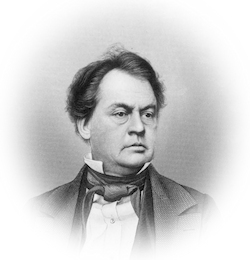
Alexander H Stephens to J. Henly Smith

Miscellaneous document sources

Crawfordville [Ga.], June 17th, 1860.

Dear Smith, . . . What will be done at Baltimore tomorrow I can not even conjecture. I fear the rupture begun at Charleston will be complete. I cannot believe that the party will abandon the doctrine of non-intervention. The seceders seem to demand that as a condition of their future cooperation, so I fear we shall have a Richmond nomination anyhow and that a split in the national Democracy will be permanent. I shall go with the national flag as long as it bears upon its folds the principles it bore when I first acted with them. I am in hopes however that they will in any event give that exposition to the doctrine of non-intervention which was set forth in Gov. Johnson’s resolutions in our state convention. Not that I look upon it as essential—I am perfectly satisfied with the Cincinnati platform—but it would remove a mountain load of prejudice off the mind of thousands of the South who have been kept most studiously and wickedly ignorant of Douglas’s real and true position. He holds that all property, negroes and all, should stand upon the same footing of equality in the territories. How far a territorial legislature can encourage or discourage any species of property is the question really at issue, and that question the Supreme Court never has as yet decided. They have decided only that negro property stands like all other kinds, and this Douglas affirms too. I must however close.

P. S.—Write often, and when the nominations are made write to me fully how they take and what is the prospect at the capital.


From Annual Report of the American Historical Association for the Year 1911.

Alexander Hamilton Stephens was an American politician who served as the vice president of the Confederate States from 1861 to 1865. After serving in both houses of the Georgia General Assembly, he won election to Congress, taking his seat in 1843. After the Civil War, he returned to Congress in 1873, serving to 1882 when he was elected as the 50th Governor of Georgia, serving there from late 1882 until his death in 1883.

J. Henley Smith was a Georgia journalist.

0 comments

From Oregon

News of the Day

[Fayetteville, Ark.] The Arkansian, June 16, 1860

Oregon, April 3d, 1860.

Messrs. Eds. Arkansian:–I have seen a number of your papers. It was a great treat. From it I learned how Fayetteville was improving and prospering, more than I had heard the past eight years. The advertisements were especially interesting to me. Politics had not changed much, except that the negro questions was getting supreme.

In Oregon we have three parties, the Democrats, anti-Administration Democrats and the Republicans. The Republicans are considerably in the minority, even with the divided ranks of the Democracy; but it is hoped that these two wings will soon be reconciled. We should be very glad to hear that Gen. Joe Lane had received the nomination for President, as he is decidedly a Union man and an old war-horse.

I wish here to say something to the young men and women of my native State, Arkansas. Come West, come to the Pacific Coast where land can be had for the settling, and that of the first quality. Leave the old hive, take one another’s sisters for help-mates and come hither and hew out your fortunes. Do not lie around the old hive like drones, but be men and try and do something for yourselves. Come, I say, and leave lands upon which you barely eke out a living, and settle here from lands that will remunerate your labor. There never was a better opening for poor beginners and chances for capitalists to invest money, than now on this Pacific Coast.— There are extensive forests to be made into lumber, with unsurpassed water power for mills, and a constant market. There are some fine prairie lands East of the Cascade Mountains yet to be settled, which are admirably adapted to grazing, wool-growing, farming etc., and offer homes for the taking. I say, then, come.

Yours, with respect,

J. C. Gilbreath.
Direct to Rainer,
Columbia Co., Oregon.

0 comments

Census Notice

News of the Day

Sugar Planter [West Baton Rouge, LA], June 16, 1860

The Assistant Marshal in and for the parishes of Pointe Coupee and West Baton Rouge will pass through in a few days. It is to be desired that every planter or manager of estates, be ready to furnish him a complete and exact list of all slaves on the plantation, beginning with the oldest one and stating the age, sex and color. June 16, 1860.

0 comments

Census

News of the Day

Sugar Planter [West Baton Rouge, LA], June 16, 1860

The Assistant United States Marshal appointed to take the census of this parish announces his coming, therefore be ye all prepared to receive him and afford him all the information the law requires. We do not know the gentleman, nor even his name, but we think it would have been far more preferable to have appointed some one for that purpose from this parish, because the chances of obtaining accurate returns would be greater with one of our own citizens than with a stranger. We trust however, that all information will cheerfully be given the Marshal so that our parish may be correctly represented.

0 comments

Political Gag

New York Times

Harpers Weekly, June 16, 1860

The Democratic nomination will be made at Baltimore on the 18th instant, and the Presidential campaign of 1860 will then be fairly opened. Two of the parties have already engaged in the contest, and the third will not be far behind. It is our province to survey the field with an impartial eye, and we venture to offer a bit of advice to the combatants which, in the heat of the battle, they will probably entirely forget, but which is nevertheless well worthy attention.

When the young lawyer began his argument with the creation of the world, the Judge interrupted him to say, ” Sir, the Court may be presumed to know something.” Bear in mind, therefore, gentlemen, that the people—the tribunal to which you all appeal—may be supposed to know something of their own affairs. The great questions are grave and momentous, doubtless, but they are so mainly because the people understand them as well as the orators. They will not believe, for instance, that any slight shock will shiver the Union because they know that it is always better to bear the ills we have than to fly to those we nothing about. It is only when ills are perceived to be beyond redress that there is any hope of the success of an appeal to violence. And so long as the dominant race in any country are generally prosperous—so long as their own interests and rights are not felt by them to be invaded— so long they will maintain the statu quo. The secret of the enthusiastic success of Garibaldi in Sicily is the conviction of the great mass of the people that he comes to deliver them from an intolerable condition. On the other hand, the cause of the ludicrous failure of the Chartist effort in England is the equally strong conviction of the mass of Englishmen that their troubles are remediable by some process less doubtful in its operation than open revolution.

There never was a people who better understood what may be called “political gag” than the American. They go to great mass meetings during the pleasant summer months of a campaign, as they go to theatres and other places of amusement during the winter, to be entertained. The man who can tell the funniest stories in the funniest way is the favorite orator. Banners, torches, music, rallying cries, symbols of every kind increase the good-humored excitement. But the thinking, which really determines the voting, is not done in a mass meeting. The speaking which persuades is not a volley of rich jokes or fine rhetoric. The President is really elected not during the technical “campaign,” but during the administration of his predecessor. If that administration seem to the people favorable to their interests, his policy is confirmed by the selection of a successor who will pursue the same course. If the majority disapprove of that policy, it is changed by their will, despite the best jokes and the most extravagant rhetoric. Let the orators but remember this; let them bear in mind that the people understand their own interests, and they may spare their threats, denunciations, prophecies, and “gag,” and confine themselves to a reasonable statement of their case on whatever side it may be. Then they may justly congratulate themselves that they have really helped the cause in which they believe, by appealing not to the passions or prejudices but to the common sense of the people.

0 comments

Post Office Despotism Becoming Unpopular At the South

New York Times

Pro-Slavery censorship of the news via the Post-office.

The New York Times, June 16, 1860

The citizens of the Border States are at last beginning to raise their voices against the wholesale robbery, of which the United States Post-office is now being made the instrument by the Pro-Slavery zealots of the South, with the active connivance of Mr. Postmaster-General HOLT. Twenty-one citizens of Kent County, Maryland, have determined not to leave the task of defending their rights any longer to the Northern Press alone, but to stand up for them themselves, and have accordingly protested solemnly and publicly against the action of the Grand Jury of the county in presenting newspapers and books as “incendiary” by wholesale, and thus preventing their delivery to the owners by the Post-office, under Mr. HOLT’s rule.

In Austria and Russia, and all other despotic countries, no matter how rigid the censorship of the Press, newspapers and periodicals are never entirely prohibited by name. The meanest tyrants of those regions have the honesty to examine each number separately, and stop it or let it pass, according to the nature of the contents. The issue of Jan. 1 is never confiscated, because that of July 1 denied the divine right of Kings. They have enough respect for the rights of property, if they have none for free speech, to appoint a censor to read before condemning. The Southern oligarchy, however, in this as in many other respects, show themselves infinitely clumsier and more brazenfaced in the practice of the arts of tyranny, than their Neapolitan and Muscovite prototypes. They have neither manliness enough to establish a regular censorship, nor courage enough to leave the Press alone. A mob either marches in arms upon a solitary printer, and wrecks his office or ruins his property, or a Grand Jury presents half of the readable literature of the country as dangerous, and leaves its suppression to the Postmasters. A man subscribes and pays for a publication, which the common law of the Constitution entitles him to read, which is of necessity perfectly harmless till a jury pronounce it to be otherwise; a crowd of lynchers, dignified with the name of a Grand Jury, prohibit him from receiving it, and the Postmaster from circulating it, not only amongst the slaves or vassals of the community, but amongst the slave owners, the white aristocracy, the “order of nobility,” of which Mr. MASON is so proud.

With the restrictions which Southern whites are pleased to place on their own reading, we, of course, have nothing to do. If any body of men in America are fools enough to eschew books and newspapers, because the contents are now and then disagreeable, it is their affair, not ours. If the majority of the Southern people are bent upon sacrificing their minds as well as their bodies on the altar of Slavery, we may think them silly, but they are welcome to the enjoyment of their whim. But when they set about making the Federal Post-office instrumental in imposing their barbaric regulations upon an unwilling minority, we at the North have a good deal to say in the matter. They may bludgeon and tar and feather everybody who takes any “incendiary” paper as much as they please; but we protest against the Postmasters, whom we pay, being employed, in the dirty work of their censorship, prying into men’s letters and newspapers, and stopping everything that a batch of Carolina farmers may think dangerous reading. The Post-office is mainly supported by the North. All its profits are derived from Northern letters. Through the greater portion of the South it is a luxury which the neighborhood cannot afford, and which is supplied to the inhabitants by the National Treasury at great cost. To have it converted in these very places into a branch of the local police for the maintenance of a regime utterly opposed to the spirit of our institutions, and which the majority of the citizens of the United States abhor and repudiate, is more than average patience can long submit to, Mr. HOLT’s position on this question is about as tenable as Mr. TOUCEY’s on parliamentary law, or Mr. FITCH’s on the right of petition. All three of them seem bent on ascertaining the exact point at which the endurance of the public ceases.

We hope that in the approaching canvass this device of converting the Post-office into an engine of Pro-Slavery despotism will be thoroughly shown up. If the success of the Republican Party were not desirable on any other ground, it would be highly desirable for the purpose of putting an end to this disgraceful effort to make a large and highly civilized community like ours a participant in a barbarian crusade against free speech. When the new Administration comes into power, it must inform its Post-office employes distinctly and clearly that their only duty, under the Constitution and laws of the United States, is to deliver to the owners all letters, papers and packages, properly paid for. Neither the Constitution nor the laws have declared any book or periodical non-deliverable by reason of the nature of its contents. Whatever a Postmaster is bound to deliver in New-York he is bound to deliver in Maryland. His business is to say to the State authorities, that whatever comes into his hands he must give up on demand to the person to whom it is addressed. If the State authorities wish to prevent its circulation, they must prevent the owner from applying for it, or punish him for having it in his possession. With all this the United States has nothing to do. The mobs and grand juries must arrange it with their victims.

If any State declares it will not have Postmasters within its boundaries who take this view of their duties, and who will not act as censors, the remedy is simple—let it go without them. If any district in Maryland, or elsewhere, does not like a Post-office which confines itself to the delivery of all mail matter which it receives, the Postmaster-General has the remedy in his own hands. This is the only kind of Post-office he can supply, and if any town or village does not like it, let it provide a better one for itself. If the Federal authorities were suddenly to break off all postal communication with Kent County, in Maryland, we feel assured that the rest of the country would not be seriously inconvenienced thereby,—that the United States would flourish the same as ever and that the Grand Jury would very soon ask for its restoration upon the usual terms.
0 comments

The Drouth in Kansas

New York Times

Danger of an Utter Failure of Crops—Prospect of Famine—Dismal Forbodings.

The New York Times, June 16, 1860

Lawrence, Kansas, Wednesday, June 6, 1860.

The one topic, more absorbing to us than all others, is the distressing drouth that prevails in Kansas, and probably in some of the States. When I wrote you some two weeks ago, I little thought we should be thus long sweltering in this arid region without a drop of heaven’s gentle rain. Here we still linger, with hopes more forlorn than ever before. Every day is now adding torture to despair. I have never witnessed so sad a people. Almost every man we meet exhibits the same depression of spirits, and it is only the few emigrants who arrive that can carry anything like the usual cheer of a placid, quiet countenance. The salutations most usual have now become changed to—”Any rain in your country yet?” “Can it ever rain in Kansas?” “Does your country burn yet?” “How much longer can we endure this?”—or others pertaining in some way to this unparalleled want of rain.

When strangers arrived it was once our habit to gather around them and fill their ears immediately with the story of the new Italy. Now we take the other extreme, and studiously shun the presence of all such seekers of new homes, and no one likes to be questioned upon a subject, the very thought of which is pain. Day after day and week after week, the same sultry heat continues; some days the thermometer ranges from 90° to 95°, and not even a genial dew at night is granted us. No dew whatever has fallen thus far this season, and the native prairie grass is dying out in many places for miles. Whites who have lived among the Indians of the Territory for fifteen years, say that no serious drouth was ever known before in the Spring, but that they have always occurred in July and August. When I last wrote you there was hope of a partial crop of Spring wheat, but now all is gone; not a kernel will probably be harvested in this county, where thousands of bushels were sawn. For several days our only hope has been in having a partial crop of corn and potatoes, provided it should rain immediately. But now every sun rolls us nearer the brink of certain famine. It may do to plant corn for ten days yet, and potatoes for twenty days; but beyond that, all is hopeless. Our chances seem as one in a thousand, for never has rain appeared more distant than to-day. [continue reading…]

0 comments

The Baltimore Convention

New York Times

The New York Times, June 16, 1860

BALTIMORE, Friday, June 15.

Trains

Three trains, crowded, from the west arrived to-day. Three more on the Baltimore and Ohio Road are expected on the way, with a thousand delegates, &c., to the Convention, from Illinois. Indiana, Ohio, Cincinnati—the delegations with a band of music. Intelligence from western roads report all eastward trains crowded. Washington is said to be so full that many coming are unable to get accommodations. There will be ample accommodations here for all who come.

Police Notice

The Police Department have given notice in anticipation of the political gathering here next week, that the ordinance prohibiting the firing of cannon, guns, &c., in the city, will be strictly enforced.

0 comments

Another Dead Body Found

News of the Day

Daily Times [Leavenworth, KS], June 15, 1860

While Dr. Davis’s sons were fishing on the river bank, a mile below the city, a dead body rose to the surface and lodged. They were about to secure it, when the current bore it away. It was afterwards secured, and an inquest held by the Coroner. The verdict of the jury was, “death by drowning.” The body was that of a young man, with heavy beard; had on two coarse shirts; pair of drawers; blue striped cotton pants; blue cotton overalls; white woolen socks; blue blanket overcoat, bound with black braid, and with black buttons. A woolen comfort was tied round the neck, and there was neither boots nor hat found. The corpse had been in the water from four to six months.

0 comments

The Massachusetts Legislature Indorses Senator Sumner’s Recent Anti Slavery Speech

New York Times

The New York Times, June 15, 1860

The Massachusetts Legislature has resorted to the rather unusual proceeding of indorsing Senator SUMNER’S recent Anti-Slavery speech. Whether that body is in the habit of sitting in judgment upon each speech of its Federal Senators, or whether circumstances existed which rendered its indorsement in this specific case particularly desirable, we are unable to say. We do not remember any other instance, however, in which this course has been pursued. We infer, therefore, that the action of the Legislature in this case was prompted by motives which have no application to the ordinary speeches of the Representatives of the State in Federal Congress. The speech itself was exceptional, and that fact may have led the Legislature to think that exceptional action on their part was demanded. It was not an effort calculated to promote any of the practical national objects for which Mr. SUMNER was sent to Washington. It had no direct bearing upon any question awaiting the Senate’s action, nor did it enlighten that body upon any subject over which it had control. It was an elaborate essay upon the character of Slavery; and if it had been delivered as a lecture, or an oration, before a popular audience, it would only been open to such criticism as its intrinsic character might invite. It would not have been out of place, at all events, as it clearly was when delivered in the Senate.

We have very little doubt that public sentiment in Massachusetts concurs fully in Mr. SUMNER’s opinion of the barbarism of Slavery. Indeed, throughout the Northern States, and we suspect with reflecting men at the South, the belief is very general that the institution of Slavery exerts an influence upon the society where it exists in the highest degree unfavorable to the general progress of the community in the arts and accomplishments which mark a high state of Christian civilization. Some of the ablest writers of the South have expressed this opinion in the strongest language; and experience shows it to he founded in truth.

But this is not all that is necessary to justify such a speech as Mr. SUMNER’s in the Senate of the United States. Place, time and circumstances have quite as much to do in determining the duty of men in high places, as the right or wrong of the views they hold. If no good practical result can fairly be expected to follow it, the delivery of such a speech as Mr. SUMNER’s is not worth while; and when, moreover, it is certain to exasperate the public mind, to arouse the hatreds and resentments of individuals and communities, and still further to inflame a sectional agitation already rife and feverish enough to be dangerous to the public peace, its delivery becomes a positive offence against the public good. If Mr. SUMNER’s speech had produced the effect which he evidently expected, it would have been one of the most mischievous publications ever made. Fortunately it has commanded less attention than was anticipated, and has encountered silence in some quarters, and positive disapproval in others, usually disposed to judge speeches of this class with the utmost forbearance. Even the Tribune, while it has published the speech in its editions intended mainly for the country, has not deemed it judicious or wise to give it circulation among its City readers; and some of the most decided Republican papers in the country have protested against the injustice of holding the party responsible for its sentiments.

These indications of dissent have probably led the Massachusetts Legislature to give the speech their indorsement, as a timely and perhaps necessary indication of their continued confidence in their own Senator. We presume, however, that this action on their part will not be held to bind the Republican Party to its opinions.

0 comments

The Baltimore Contention—Threats of the Seceders Possibility of No Nomination

New York Times

The New York Times, June 15, 1860

Special Dispatch to the New-York Times.

Washington, Thursday, June 14, 1860

The city is again filled with Delegates, discussing the chances of candidates in Baltimore. The friends of DOUGLAS are still sanguine, while the ultras swear terribly, and threaten to break up the Convention, if DOUGLAS does not yield. The Georgia Delegates have declared their intention not to enter the Convention, but to remain here and await the result. The Delegates are steaming freely, and a collision among them, in advance, would cause no surprise here. It seems to be quite certain that DOUGLAS or no one, will be nominated at Baltimore. The Republicans can draw great encouragement from the prospects of a Democratic explosion. The most bitter partisan feeling is displaying itself on the floor of the House, and the Opposition vote down everything indiscriminately that they do not themselves propose.

Mr. YANCRY receives a serenade to night from the Southern fire-eaters.

0 comments

Orinting Office Rules

News of the Day
1860s newsprint

 Albany [GA] Patriot , June 14, 1860, p. 3, c. 3

The following have been almost unanimously adopted by the “craft,” and are expected tobe observed:

1. Enter softly.
2. Sit down quietly.
3. Subscribe for the paper.
4. Don’t touch the poker.
5. Say nothing interesting.
6. Engage in no controversy.
7. Don’t smoke.
8. Don’t whistle.
9. Don’t talk to the printers.
10. Hands off the papers.
11. Eyes off the manuscript.
12. Eyes off the matter.
13. Drunken men are requested to keep as far from the office as possible.

Gentlemen observing these rules when entering a printing office, will greatly oblige  the printers, and need not fear the *Devil*.

The ladies, who sometimes bless us with their presence for a few minutes, are not  expected to keep the rules very strictly, and indeed it would be agreeable to us to have them  break the fifth and ninth rules as often as possible.

Boys unaccompanied by their fathers, are particularly requested to keep their hands in  their pockets.

0 comments

Everything Looks Bad Not Only For the Party But For the Country

Miscellaneous document sources

Excerpt from a letter from President Buchanan to Robert Tyler, son of former President John Tyler

Washington, June 13, 1860.

…I have hardly time now to say my prayers. Should they succeed at Baltimore in rejecting the regular delegates from the seceding States, and admitting those who are bogus, then Douglas will or may be nominated. In that event the unity and strength of the Democratic party is annihilated and Lincoln elected. This is not the worst. The Democratic party will be divided—sectionalized—and that, too, on the slavery issue.

Everything looks bad, not only for the party, but for the country.

JAMES BUCHANAN.

0 comments

The Richmond Convention

New York Times

The New York Times, June 13, 1860

The Democratic Convention at Richmond has adjourned, to await the action of their Northern brethren at Baltimore. They have done exactly nothing else. They took no action concerning a platform, said nothing about candidates, rigorously suppressed all freedom of debate, and severely snubbed the irrepressible Col. BALDWIN, of Syracuse, for pertinaciously protesting his devotion to the Union.

The fact is, the Richmond gathering was designed simply as a sort of screw for coercing Baltimore. It was intended to intimidate the Northern Democrats by the imposing spectacle of a united South, solemnly and sullenly resolved to have no further concert with the North, except upon their own terms and conditions. They are imperative on the subject of protection for slave property in the Territories. They are immovable in their hostility to Squatter Sovereignty. They demand the sacrifice of DOUGLAS, and the repudiation of his platform, as the only peace-offering which they can be induced, under any circumstances, to accept. They assembled at Richmond merely to assure each other that they had not changed their minds. They are going next to Baltimore to assure the Northern Democrats of the same thing. And afterwards they will meet again at Richmond to compare notes, and see what they have made by the whole operation.

We must do the Southern Democrats the justice to say that, in this matter, they appear to be quite in earnest. So far [continue reading…]

0 comments

Village Life in America

Village Life in America, 1852 – 1872, by Caroline Cowles Richards

June.–James writes that he has seen the Prince of Wales in New York. He was up on the roof of the Continental Fire Insurance building, out on the cornice, and looked down on the procession. Afterwards there was a reception for the Prince at the University Law School and James saw him close by. He says he has a very pleasant youthful face. There was a ball given for him one evening in the Academy of Music and there were 3,000 present. The ladies who danced with him will never forget it. They say that he enters into every diversion which is offered to him with the greatest tact and good nature, and when he visited Mount Vernon he showed great reverence for the memory of George Washington. He attended a literary entertainment in Boston, where Longfellow, Holmes, Emerson, Thoreau, and other Americans of distinction were presented to him. He will always be a favourite in America.

June.–Mrs Annie Granger asked Anna and me to come over to her house and see her baby. We were very eager to go and wanted to hold it and carry it around the room. She was willing but asked us if we had any pins on us anywhere. She said she had the nurse sew the baby’s clothes on every morning so that if she cried she would know whether it was pains or pins. We said we had no pins on us, so we stayed quite a while and held little Miss Hattie to our heart’s content. She is named for her aunt, Hattie Granger. Anna says she thinks Miss Martha Morse will give medals to her and Mary Daggett for being the most meddlesome girls in school, judging from the number of times she has spoken to them to-day. Anna is getting to be a regular punster, although I told her that Blair’s Rhetoric says that punning is not the highest kind of wit. Mr Morse met us coming from school in the rain and said it would not hurt us as we were neither sugar nor salt. Anna said, “No, but we are ‘lasses.” Grandmother has been giving us sulphur and molasses for the purification of the blood and we have to take it three mornings and then skip three mornings. This morning Anna commenced going through some sort of gymnastics and Grandmother asked her what she was doing, and she said it was her first morning to skip. [continue reading…]

0 comments

Beggars

News of the Day
1860s newsprint

Daily Gazette & Comet [Baton Rouge, LA], June 12, 1860

Beggars.—So common is this class of people getting to be in this place, that it is time to think of a work-house for their benefit. There is another class that might be benefitted by such an institution—fellows who have no means, and no visible way of obtaining a living. In the olden time, it was fashionable to flog such, or place them on the streets to work; and it may be, that for self protection the old custom will have to be revived. It will be very humiliating to prevailing notions of freedom and do violence to the doctrine, that all men are free and equal; yet this liberty about which there is so much prating, is only secured by the union of sober and industrious people, to protect themselves, against the idle, vagabondish and intemperate. The doctrine is safe, that the man who is too lazy to work, and has no inheritance to live on, must obtain a living in a questionable way, or steal. Hence to a degree there is no such thing as liberty, in civilized society. Every one owes a duty to society, which must either be rendered willingly or forced by the law. This is the argument to use for the colonization of the African on the cotton farm, or sugar plantation. They have no right to exist in Africa or any where else in degradation as they do, and it is the special duty of those who have the advance in civilization and are concerned in working out the great problem of human existence, to see that they are made to work. Begging is as much a profession here as in the old world, and the idle vagabonds who follow it, are better posted about the location of work houses than others. They purposely avoid such places on the river, as require them to work, when found begging, and the only way to get rid of the nuisance here, is to establish a work-house. The roads leading out of the city are beset by these people and where they cannot get what they want by begging, and an opportunity offers—they steal.

0 comments

Republicanism in Missouri.

New York Times

The New York Times, June 12, 1860

Lincoln and Hamlin Enthusiasm

St. Louis, Wednesday, June 6, 1860.

Republicanism is no sham in Missouri. Whatever may be its guise in other Slave States, here it stands out boldly and defiantly, in its true colors. The party which dominates our city, and which in the last four years has passed under the various names of the Benton Democracy, the Free Democracy, and the Emancipationists, sent its delegate to Chicago, and now unfurls the standard of LINCOLN and HAMLIN. The canvass has commenced with considerable energy, despite the disadvantage of there being no Democratic candidate in the field. Like good soldiers and true sons of the venerated sires of Bunker Hill, the Republicans like to see the faces of their enemies before they commence firing. A Lincoln and Hamlin Club has been formed by the young men of the party, and will do efficient service in the campaign. EDWARD BATES would have so concentrated the Opposition vote in this State, if he had been the chosen candidate at Chicago, that Missouri’s electoral vote would have been cast for a Republican President. LINCOLN will not be able to obtain any larger vote here than Mr. SEWARD would have received; he will get probably this city and a few hundred votes from Saint Joseph and the German settlements in the interior, but not enough perceptibly to affect the Democratic majority.

It will require great energy and both tact and talent in FRANK BLAIR to carry his district in August, and should an American ticket play the same part in 1860 as in 1858, the result will be either a democratic Representative from St. Louis, or another contested election case. If BLAIR could command the same vote as the present Mayor did in 1859, he [continue reading…]

0 comments

The Richmond Convention

New York Times

Second Day’s Proceedings—All Seceding States Represented but Delaware—New York Represented by Twelve Delegates.

The New York Times, June 12, 1860

RICHMOND, Monday, June 11

The Convention assembled at noon.

Gov. LURBUCK, of Texas, was called to the Chair, and returned thanks. He deemed his selection a compliment to his State. He trusted they had assembled for a triumph of principles and not for plunder, and that if their principles are repudiated, they will go before the country as the true Democratic Party, will their principles emblazoned on their banners.

Prayer was offered by Rev. Mr. BURROUGHS.

The States were called.

New-York responded amidst immense applause.

A list of delegates, appointed by the Trustees of the National Democratic Hall of the State of New-York, was handed in, as follows: Col. Baldwin of Syracuse, Isaac Lawrence, James B. Bensel, James Villiers, W. Drake Parsons, James S. Selby, M. Dudley Bean, Alfred W. Gilbert, John Lorimer Graham and John B. Borst.

The delegate who presented the credentials is THADDEUS P. MOTT, who is here as the alternate of Hon. GIDEON J. TUCKER, who is detained by serious illness. He said that time did not permit the calling of a State Convention together, but he was assured by the President that fifteen of the sixteen members of the Committee approved of the delegation, and desired that they should represent the State in the Richmond Convention.

The credentials are certified to by SAMUEL B. WILLIAMS, Chairman of the Trustees of National Hall; WM. BASIL LAWRENCE, for the Chairman of the Executive Committee; THADDEUS P. MOTT, Chairman of the Association; WM. DUDLEY BEAN, Secretary of the Trustees; JAS. B. BENSEL, Chairman of the Executive Committee, and J. LAWRENCE, Secretary of the Association.

The presentation created quite a stir and much surprise. It is supposed to be a move in favor of DICKINSON.

New-York members of the Press do not understand the movement.

One Delegate is MEYERS FISHER from Virginia.

All the seceding States are represented but Delaware.

Mr. BARRY, of Mississippi, moved the appointment of a Committee of one from each State on Permanent Organization, and at 1 o’clock the Convention adjourned till 10 to-morrow.

Mayor WOOD has sent word here that the delegation from New-York represents nobody, and the impression is that they will be repudiated by the Convention.

There will be little or no discussion in public. Everything will be settled in Committee, and all differences of opinion accommodated.

There is no doubt that the Convention will close to-morrow to await the action at Baltimore.

0 comments

0

New York Times

The New York Times, June 11, 1860

The Democratic cauldron is beginning to boil again. The time for another attempt at nominating a Presidential candidate is close at hand. The Southern veins of the party meets this week at Richmond,—the Northern wing next week at Baltimore. The Richmond convocation will be merely preliminary. It will do nothing of any consequence, but will await the action of the Baltimoreans Possibly it may pass some resolutions,—declare the unalterable determination of the Southern Democrats never to surrender the ground they took at Charleston, and make a tender of renewed harmony on these conditions. But they will make no nominations, and take no decisive action in advance of the other Convention.

The Douglas men are mustering all their forces for Baltimore. They are determined to make him the candidate, by a two-thirds vote if they can get it, and by a majority vote if they can do no better. They have been busy since the adjournment at Charleston in electing Douglas delegates from southern States, to take the places of the seceders, whom they are determined to exclude. In this way they hope to secure a two-thirds vote, and they stand a fair chance of succeeding. The fact is, the nomination of DOUGLAS has become a matter of necessity to his friends in the Northern and Western States. They have pushed the war upon his opponents to such an extent that his defeat involves their complete destruction. Besides this, it is undoubtedly true that, with any other candidate, the party would have the greatest possible difficulty in maintaining its organization in most of the Northern States. If he were the regular candidate of the whole party, supported by the Southern as well as by Northern Democrats, he would stand a very good chance of carrying several of the most important of the Free States. He is the only Democrat who has any positive personal strength at the North;—and he owes that strength to the fact that he is openly and defiantly at war with the Administration upon its Lecompton policy, and with the Southern Democrats on their peremptory demand for Congressional protection for slave property in the Territories. Virtually, there is no difference of opinion at the North upon these points. Men of all parties agree in hostility to both positions. They may, or may not agree, upon the abstract right of Congress to legislate concerning Slavery, or upon the doctrine of Squatter Sovereignty: but they do agree in resisting the demand of the Pro-Slavery ultraists of the South. DOUGLAS is regarded as the man who has made the boldest protest against it, who has risked the most in resisting it: and this it is which gives him strength in the Northern States even beyond the lines of his own party.

But precisely the same thing weakens and destroys him at the South. His friends insist that when once in the field he will receive the votes of every Southern State. We doubt it. If he were the regular nominee of the party, perhaps he would; but he cannot, as the nominee of its Northern wing, put up in open defiance of the South, and on the express ground of flat hostility to the Southern claim upon the question of Slavery. It is quite common to represent the opposition to DOUGLAS and his doctrines as confined to the politicians of the South. The people, it is said, do not share it. We see no evidence of this,—nothing even to make it plausible. With the exception of special efforts made in a few localities, there is complete unanimity of sentiment on this point among the politicians, public men and newspapers of the South. We think, from the best information we can gather, that Senator BENJAMIN, in his speech, represented the general sentiment of the Southern States towards Mr. DOUGLAS when he said, that he was “a fallen star,”—that he had “lost the confidence and support of the Democratic party,” and that it was utterly impossible that this confidence should ever be restored. If Mr. DOUGLAS should be nominated at Baltimore,—especially if he should be nominated by a majority vote, we believe be would lose several of the Southern States,— enough to prevent his election.

It is natural, we are aware, to presume that the South would rather see him President than a Republican. But they are not driven to this alternative Indeed, many Democrats, South as well as North, believe that their only chance in defeating LINCOLN lies in running two candidates,—one of whom may be able to break the phalanx of Northern States that are likely to vote the Republican ticket. DOUGLAS, they think, might possibly carry enough free States to defeat LINCOLN, even if he should lose so many Slave States as to prevent his own election;—whereas, any other candidate would inevitably be beaten throughout the North and West. And, in this way, the election might be carried into the House of Representatives, where the Democrats would, at least, stand an equal chance.

[continue reading…]

0 comments

0

New York Times

The New York Times, June 11, 1860

Washington, Saturday, June 9.

Mr. Sumner Threatened with an Assault.

Many rumors, some of an extraordinary character, prevail as to Mr. SUMNER. It appears that early last night, an individual representing himself from Virginia called at his room, and imperiously demanded an explanation of certain parts of his recent speech. Mr. SUMNER gave him no satisfaction, and ordered him to depart, which he did, with threats. At a subsequent hour, three others called, halting in the passage-way, and sent up word that they wished to see him alone. They refused the invitation to enter his room, where Mr. SUMNER was surrounded by friends, and left, sending a threatening message by the servant that they would come with a force to assault him at 10 o’clock this morning, when Mr. SUMNER’s friends were again present. In view of these occurrences, some of them accompanied him from his residence to the Senate to-day, apprehensive of personal violence. They are determined to exercise watchfulness and precaution. The attention of the Chief of Police has been called, to the subject.

To-day information was lodged with Mayor BEERETT, without the knowledge of Mr. SUMNER, that the latter’s room was improperly invaded, and that threats had been made against his life. The Mayor promptly investigated the matter, and procured an affidavit as to who the principal party was, and the substance of the language he employed towards Mr. SUMNER.

Upon ascertaining the fact that the offender committed the act while in a state of intoxication, and did not intend any injury to Mr. SUMNER, and regretted having done so, and was gentleman enough to apologize to Mr. SUMNER for his conduct, the Mayor called upon Mr. SUMNER and informed him of the fact, and assured him that if an apology was not satisfactory, he would promptly arrest the party charged and hold him to bail for trial. Mr. SUMNER, being assured by some of his friends that the offender occupied a responsible position under the Government, and in their opinion did not intend to insult him, said he was quite willing to receive the apology of the person, and did not care to have him put under bonds considering his word as good as his bond.

Accordingly Mayor BEEBETT accompanied the gentleman, who gave his name as Capt. HENRY, to Mr. SUMNER’s room, about 9 o’clock to-night, and he duly apologized to Mr. SUMNER, which was accepted as satisfactory by the latter.

0 comments

0

New York Times

The New York Times, June 11, 1860

New Orleans, Saturday, June 9.

The Douglas Convention at Donaldsonville has adjourned. It was represented by one hundred delegates from twenty-one parishes. Resolutions were adopted condemning the Charleston seceders, and expressing a determination to abide by the Baltimore nominations. The delegates appointed to attend the Baltimore Convention go uninstructed. Ex-Senator SOULE, Governor WICKLIFFE and ISAAC MORSE were the ruling spirits of the Convention.

0 comments

0

Diary and Letters of Rutherford Birchard Hayes
Rutherford B. Hayes (young)

June ——, 1860. —A spring of storms; wind prodigious, rains unprecedented. May 21, a wind swept over Ohio and Kentucky, about one hundred miles wide by three hundred long, at the rate of eighty to one hundred miles an hour, unroofing houses in Louisville, Lexington, Cincinnati, Xenia, Chillicothe, Portsmouth, Marietta. Probably twenty lives lost in the towns named. Since, storms in several places equally severe but not so extensive. A much severer one at the West June 4. Many lives lost. Rain on Sycamore street one inch an hour proved too much for the sewers and filled houses and cellars.

0 comments

0

News of the Day

The Ranchero [Corpus Christi, TX], June 9, 1860

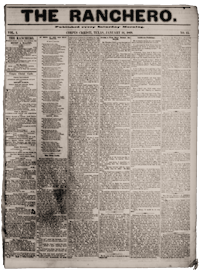
From the Daily Herald of the 29th ult., we learn that a most destructive fire—the largest ever known in that city—occurred the 26th ult. It originated in the buildings around the “old Alamo,” used by the U. S. Quartermaster, and belonged to the Hon. S. A. Maverick. The firemen, citizens, soldiers and Mexicans worked hard to prevent the destruction of the main building, where the government property to the amount of $300,000; and after much exertion against a high wind, succeeded. The buildings destroyed were old and not of much value; the Government property destroyed is valued at $10,000. An altercation took place during the fire, between marshal Byrn and his deputy Gibson, and a soldier of Co. I, 1st Infantry, in which the latter was shot. The two officials were arrested and held to bail, for trial at the next term of the District Court.

0 comments

Washington Light Infantry

Harper’s Weekly

Washington Light Infantry, of Charleston, South Carolina, Harper's Weekly, June 9, 1860: The Encampment at Orangeburg, South CarolinaThe Encampment at Orangeburg, South Carolina

We present our readers with a view of the encampment of the Washington Light Infantry, of Charleston, South Carolina.   The point chosen was in the village of Orangeburg, about eighty miles from the city.   This village is known as one of the most beautiful in the state.   The residences are spacious, and the lots varying size from four to twelve acres.   The shade trees form a striking feature, and add much to the attractions of the place.   In one of the most beautiful of these grounds the Infantry made their camp.   As will be seen by a glance at the picture, the immense shade trees and luxuriant shrubbery cause the tents to appear quite small; the opening through the centre of the encampment is the main avenue–thirty feet wide–which leads to the family mansion.   At the entrance of it stands the “guard tent” and near the house the “marquee” for the officers.   On either side are the tents, arranged in the order of a battalion encampment, in all twenty-four–twelve on the right and twelve on the left of the main street.   The tents are arranged in rows of six each, which face each other on streets of convenient width.

The company carried with them the “Eutaw flag,” the only standard of the Revolution which is known to exist in the state, and which was given to the corps by the widow of Col. William Washington.

The Washington Light Infantry was organized in 1807 during the excitement growing out of the “Leopard and Chesapeake affair” and is known as “the banner corps of South Carolina.   It is at present commanded by Captain Charles H. Simonton, a prominent lawyer of the city.


Note: The dates of the encampment are not identified with this image and article from the June 9, 1860 issue of Harper’s Weekly.

0 comments

0

Miscellaneous document sources

Washington, D. C, June 9th, 1860.

Dear Stephens, … I observe the proceedings of the Milledgeville convention. I do not see but that both wings passed substantially the same resolutions, and why they split I can not tell except under it lies mere personal preferences for the Presidency. I am well satisfied that an explanation of the Cincinnati platform is wise and necessary and made so by the conduct of Mr. Douglas alone. He is not passive in his opposition to the opinions of a very great majority of the party North and South, but he is active, and his official conduct if we were to elect him on the old Cincinnati platform would subvert the principles of the party. There is much greater reason for an explanatory article than in 1856, for the Kansas-Nebraska act was a party interpretation (in terms) of the legislation of 1850. Douglas’s speech in the Senate after the Charleston convention compelled every man to an unconditional submission to his construction or to fight him. I think the latter was the course of duty. I am fully aware that personal hostilities and personal advantages are at the bottom of the strife; but there is a right and a wrong to the controversy for all that. I think the condition of the party is such that nobody can be elected by it, and I do not see that much could be gained by its success. I have ceased to interest myself further than to give my decided opinions to all who ask for them. I think we will adjourn by the 25th Inst. Julia is well tho’ still lame, and sends her kindest regards to you.


From Annual Report of the American Historical Association for the Year 1911.

Robert Augustus Toombs was an American lawyer, planter, and politician from Georgia who became one of the organizers of the Confederacy and served as its first Secretary of State. He served in the Georgia House of Representatives, the US house of Representatives, and the US Senate.  In the Confederacy, he served in Jefferson Davis’ cabinet as well as in the Confederate States Army, but later became one of Davis’ critics.

Alexander Hamilton Stephens was an American politician who served as the vice president of the Confederate States from 1861 to 1865. After serving in both houses of the Georgia General Assembly, he won election to Congress, taking his seat in 1843. After the Civil War, he returned to Congress in 1873, serving to 1882 when he was elected as the 50th Governor of Georgia, serving there from late 1882 until his death in 1883.


0 comments