Old Kickapoo

News of the Day

Daily Times [Leavenworth , KS], July 13, 1860

We learn that a process has been issued by the Mayor of Weston, in order to get possession of this relic of the Kansas troubles. The officer is in town, but has done nothing as yet. We decidedly object to this proceeding. The old gun is one of the legitimate trophies of war. If the Missourians desired to retain their artillery, they should have remained at home with it, instead of interfering with our affairs. “To the victors belong the spoils.”

P.S.—Since the above was written, we are informed that an attempt was made to get possession of the cannon, which was resisted on the ground that it was not the original gun which was taken from the Kickapoo Rangers. We believe it is now in charge of Capt. Dickson, who holds it for the German Turners.

0 comments

Prepare for War

News of the Day
1860s newsprint

Tallapoosa Times [Dadeville, AL], July 12, 1860

Tremendous Excitement.

W.F. Higgins & Co. have established a regular Gun and Pistol Factory, on the corner opposite the Baptist Church in Dadeville, Alabama. They will manufacture Rifles, Shot Guns with both single and double barrels, and Pistols of every variety. All their work will be Warranted to be the very best kind, or no charge will be made. Their experience justifies them in saying that their work cannot be surpassed in the South.  Particular attention paid to all kinds of Repairing, which they warrant to be done with neatness, durability and dispatch. They solicit the patronage of the public, and ask a trial from all.

0 comments

Something Rotten

News of the Day
1860s newsprint

Tallapoosa Times [Dadeville, AL], July 12, 1860

Hamlet said there was something rotten in Denmark, but our government is now a sort of Denmark in which there is nothing that isn’t rotten.

0 comments

Mr. Breckenridge’s Position—The Slavery Issue.

New York Times

The New York Times, July 11, 1860

Mr. BRECKINRIDGE accepts the nomination of the Administration-Secessionists “from a sense of public duty,” and, as he thinks, “uninfluenced in any degree by the allurements of ambition.” We presume the country will give him full credit for disinterestedness. Indeed it would be difficult to conceive how any ambitious politician could hope to achieve place and power, by the course which the Vice-President has resolved to pursue. The Presidential office does not lie in that direction. The day has gone by when a public man could command the support and enlist the favor of the American people, by lending himself to the factious schemes of the extreme sectionalists of the Southern States. That game has been played out. Partly through the overbearing exactions of the Pro-Slavery propagandists themselves, and partly from the rapid growth of the North and West in population and relative political power, the South can no longer dictate terms to the Union, or put a veto upon the will of either of the great political parties into which the country is divided.

Mr. BRECKINRIDGE is unquestionably disinterested in his acceptance of the sectional nomination which has been given him. He may count on escaping all charges of selfishness, — on being acquitted from all suspicion of personal and political ambition. Indeed, his conduct challenges a certain degree of admiration from the spirit of self-sacrifice which it indicates. He is deliberately incurring the settled hatred of the great body of the Democratic Party, in order to second the revenge and hatred of President BUCHANAN, and the little knot of Southern ultraists who have made him their tool. He will probably succeed in accomplishing the wish nearest their hearts, — the defeat of DOUGLAS: — but he will thereby treasure up for himself the abiding wrath of that great section of the Democratic Party with whom Mr. DOUGLAS is the favorite candidate.

We published in yesterday’s TIMES Mr. BRECKINRIDGE’s letter of acceptance. It is able, distinct and clear in the positions which it assumes. He declares it to be the plain duty of the Federal Government to secure, when necessary, to slave-owners the possession of their slave-property in the Territories of the United States. Mr. BRECKINRIDGE is quite as explicit in his adherence to this position as Mr. HERSCHEL V. JOHNSON himself; and he thus states the only answer that can be made to the argument in its support:

“The only logical answer to this would seem to be to claim sovereign power for the Territories, or to deny that the Constitution recognizes property in the services of negro slaves, or to deny that such property can exist. Inexorable logic, which works its steady way through clouds and passion, compels the country to meet the issue. There is no evasive middle ground. Already the signs multiply of a fanatical and growing party, which denies that under the Constitution, or by any other law, slave property can exist; and ultimately the struggle must come between this party and the National Democracy, sustained by all the other conservative elements in the Union.”

Mr. BRECKINRIDGE very skillfully confounds the views of two separate and distinct parties in this paragraph. The only party which “denies that under the Constitution or by any other law slave property can exist,” is the Abolition Party, which may be “fanatical,” but which certainly is not “growing.” But there is a party, and a very large one too, which denies that negro slaves are recognized as property by the Constitution of the United States, and which consequently denies the obligation of the Federal Government to protect their owners in the possession of them, in any of the Territories of the United States. This is the real issue between political parties in this country. On the one hand Mr. BRECKINRIDGE, the Administration, the Southern secessionists and their sympathisers throughout the country, assert that slaves are property, — just like horses or oxen, — made so by local State laws, the force and validity of which, ad hoc, are recognized, and virtually guaranteed, by the Constitution of the United States; and that from this results the duty of Congress, under the Constitution, to protect that property wherever its owner may see fit to take it. This is the position which is denied, — not only by the fanatics to whom Mr. B. refers, but by the great mass of the people in the Northern and Western States without distinction of party, and by very many reflecting men in the South also. And this is an issue which must be met. There is, as Mr. BRECKINRIDGE declares, “no evasive middle ground.” If slaves are property in the contemplation of the Federal Constitution, then the Federal Government is bound to protect them.

[continue reading…]

0 comments

Lincoln’s Early Life.

Civil War Day-by-Day
The following material contains wording that is offensive to many in the world of today. However, the work is provided unedited for its historical content and context.

Letter from an Old Acquaintance and Laboring Associate.

The New York Times, July 11, 1860

DEAR SIR : The following item appeared in the Columbus Statesman a few days ago, which I take from the Coles County Ledger:

“HANKS AGAINST LINCOLN. — We were informed a day or two ago by a delegate to the Baltimore Convention, who called at our office, that JOHN HANKS, the man who assisted ABE LINCOLN to make those rails about which the Republicans are making such a hubbub, has announced himself opposed to the election of LINCOLN. HANKS, who has never been a Democrat, is against the Republican nominee because he knows LINCOLN to be a humbug, and nothing else. Hurrah for HANKS!”
.

To this article I desire briefly to reply. If my choice for President, or how I shall vote as between the candidates for that office, is worth considering at all, I claim it as a simple right to be correctly represented. I am but a farmer, and regret to say not an educated one. I have never been a candidate for any office, nor do I expect ever to be; whilst I can with all truthfulness say this, yet I have never been a negative man in politics. From my boyhood I have been a constant voter with the Democratic Party in all essential elections; I have thought that party to be upright and straightforward in all the principles it has really adopted. So late as 1858 I voted for Mr. DOUGLAS, and against my old friend LINCOLN. For forty years I have looked upon the party with pride, and hailed its success with pleasure; but as Mr. DOUGLAS made a speech in Decatur in 1858, and in my hearing spoke so pleasantly and so honorably of the old Whig Party, and of Mr. CLAY, its leader, after having, for fifteen years, in discussing general politics, when I used to love to listen to him so well, spoke so complainingly and so abusively of that party and of Mr. CLAY, charging upon it and him many bad and mean things, until listening to him I learned to look upon both as dangerous and full of evil, the thought struck me that for the future I would never judge of a party or its leaders by what an opponent might say, and this conclusion I mean to follow the balance of my life. How foolish it is to abuse a party because my friend may do so, and then praise the same party because that friend may change and do so; he may be designing — I would in all probability be a dupe. Ever since Mr. DOUGLAS made that speech, in 1855 he has been, abusing the Republicans just like he used to abuse the old Whigs, I am tired of this kind of warfare; I think it is not right to do so, and as Mr. DOUGLAS further said in that speech that he was in the habit of sometimes changing his politics, I did not know but that it was about time for him to begin to excuse and cease to abuse the Republicans, and made up my mind to let him go in time. Now, as to entirely changing my politics I cannot say I have done this, but for the life of me I can see nothing in the Republican Party that any honest Democrat can seriously oppose. It is true, were they such a party as Mr. DOUGLAS used to say they were, I could see objectionable features about it; but then is it wise to believe everything Mr. DOUGLAS has said, when he tells us he sometimes changes, and when we have near us honest men known to be purely honest for more than thirty years, who deny all this and propose to tell us the true state of the case, and to give us the true principles of that party? I think not. Besides this, when we have for years been opposed, in politics, to a man who has again and again seen his party defeated, and has himself sometimes failed, and still seen that man true to his colors, rearming and reentering the field to try to uphold and successfully plant his colors upon the side of victory, when all the time we knew he had but to change once to win, and yet has never changed, I think I may say never faltered, how are we to respect him? Such a man I have known Mr. LINCOLN for thirty years to be. In boyhood days we toiled together; many are the days we have lugged the heavy oar on the Ohio, the Illinois and the Mississippi rivers together; many are the long cold days we have journeyed over the wild prairies and through the forest with gun and axe, and though it is not pleasant to refer back to it, well do I remember when we set out together in the cold winter to cut and maul rails on the Sangamon river, in Macon County, thirty years ago, to inclose his father’s little home, and from day to day kept at work until the whole was finished and the homestead fenced in; we often swapped work in this way, and yet during the many years we were connected together as laborers, sometimes flat boating, sometimes hog-driving, sometimes rail-making, and too, when it was nearly impossible to get books, he was a constant reader; I was a listener; he settled all the disputes of all the young men in the neighborhood, and his decisions were always abided by. I never knew a man so honest under all circumstances, for his whole life. Thus associated with Mr. LINCOLN, I learned to love him, and when in 1858 he was a candidate for the first time within my reach, against my feelings, and I may say against my convictions, my old party ties induced me to vote for Mr. DOUGLAS — my Democratic friends all declared LINCOLN was an Abolitionist; I heard him make a speech in Decatur just before the election, and I could see nothing bad in it; but I was told by the party he was wrong; I could not see how he could be, but they said so, and I was a Democrat and went it. My wife used to say to me that some day ABE would come out and be something; I thought so too, but I could not exactly see how a man in the lower walks of life, a day laborer, and hopelessly poor, would ever stand much chance to get up very high in the world; at last, one day at home, we heard that the Republican State Convention was to be held at Decatur, and that they were going for ABE for President. As soon as I found this out, I went into town and told a friend of ABE’s that as great and honest merit was as last to be rewarded in the person of my friend, Mr. LINCOLN, by the Republican Party, I thought of the hard and trying struggles of his early days, and recollecting the rails we had made together thirty years ago, made up my mind to present some of them to that Convention as a testimonial of the beginning of one of the greatest living men of the age, believing they would speak more in his praise than any orator could, and honor true labor more than the praise of men or the resolutions of Conventions. On our way to get the rails, I told this friend of old ABE that if ABE should be nominated for President I would vote for him; everybody knows what he has been, and I rejoice that I live to give this testimony to his goodness and honesty, and hope I shall live to vote for him for President of the United States next November. Is there anything wrong in this? Who ought to refuse to vote for as good and as great a man as he is. I know that in voting for him I vote with the Republican Party, and will be considered as adopting its principles; as I now understand them I see no good reason why I may not do so; our own party is divided, and we have no Solomon to tell who shall take the child. Slavery has divided the Democratic Party; nobody can blame Republicanism for the destruction that came upon us at Charleston; Slavery has disunited us — it has united the Republican Party; if there is any good about the question, they have it all, and we have the trouble. If I understand Mr. DOUGLAS now, he occupies a position on this question just as distasteful to the South as Mr. LINCOLN does — with this clear difference: the South seem to understand Mr. LINCOLN’s position better than his, and to respect it a good deal more, and I am convinced if Mr. DOUGLAS does not reflect the nigger he does the mulatto, and one brings just as much in Mobile as the other, and stands as high in the market.

Many of my Democratic neighbors will say I have done wrong, but I know there are many who would do as I have done, were it not that they do not feel willing to break away from party ties and to encounter “the talk” of old friends. As long as I have “Old ABE” to lead me I know I shall never go very far from right. Should he be elected President, and find any trouble in steering his new boat, he has only to remember how we used to get out of hard places by rowing straight ahead, and never by making short turns. The tallest oaks in the forest have fallen by his giant arm; he still wields a tremendous maul; out of the largest timber he can make the smallest rails: I have seen him try a tough cut and fail once; the second trial he never failed to use it up. Though not a very beautiful symbol of honesty I think the rail a fitting one, and mean to present ABE with one of his own make, should he be elected, in the City of Washington, on the day of his inauguration, to be kept in the White House during his Administration.

JOHN HANKS

0 comments

Alexander H Stephens to J. Henly Smith

Miscellaneous document sources

Crawfordville [Ga.], July 10th, 1860.

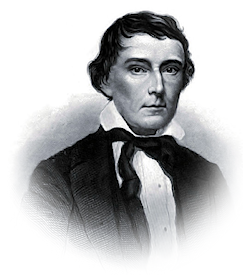
Dear Smith, Your letter of the 6th inst. was received last night. The paper came by the same mail. The point in your historical narrative I referred to was in part corrected by yourself. The word have instead of protect covered the idea. Besides this, one other. My opposition to the Clayton Compromise was not entirely or solely because it did not protect but because it perpetuated the existing status of the country at the time of acquisition, which was anti-slavery. I wished that status changed either by Congress or that authority might be given to the territorial legislatures to change it. That bill tied the hands of both Congress. and the territorial legislatures forever. This however does not amount to much so far as your letter is concerned. I now mention it that you may know the whole facts of the case. You would do well to read that speech, the one I made on the Clayton Compromise, if you write on that subject. What is to become of the country in case of Lincoln’s election I do not know. For one I can only give you my own opinion. As at present advised I should not be for disunion on the grounds of his election. It may be that his election will be attended with events that will change my present opinion, but his bare election would not be sufficient cause in my judgment to warrant a disruption—particularly as his election will be the result if it occurs at all of the folly and madness of our own people. If they do these things in the green tree what will they not do in the dry? If without cause they destroy the present Govt., the best in the world, what hopes would I have that they would not bring untold hardships upon the people in their efforts to give us one of their modelling. All I can therefore say in response to your question is that I would not advocate disunion on that ground. Let events shape their own course. “Sufficient unto the day is the evil thereof.” In point of merit as a man I have no doubt Lincoln is just as good, safe and sound a man as Mr. Buchanan, and would administer the Government so far as he is individually concerned just as safely for the South and as honestly and faithfully in every particular. I know the man well. He is not a bad man. He will make as good a President as Fillmore did and better too in my opinion. He has a great deal more practical common sense. Still his party may do mischief. If so it will be a great misfortune, but a misfortune that our own people brought upon us. This is my judgment—this is the way I look upon it at present. I have not time now to go more into detail, but I will say this, that I consider slavery much more secure in the Union than out of it if our people were but wise. And if they are not this fact adds no additional grounds to hope for more security out of the Union under the head of those who now control our destinies, than in it. We have nothing to fear from anything so much as unnecessary changes and revolutions in government. . The institution is based on conservatism. Everything that weakens this has a tendency to weaken the institution. But I will stop.

P. S.—I see some of our papers are disputing about my position. I shall vote for Douglas ; but I do not intend to take any active part in the canvass. I am out of politicks and intend to stay out. This it seems hard to make the people understand.


From Annual Report of the American Historical Association for the Year 1911.

Alexander Hamilton Stephens was an American politician who served as the vice president of the Confederate States from 1861 to 1865. After serving in both houses of the Georgia General Assembly, he won election to Congress, taking his seat in 1843. After the Civil War, he returned to Congress in 1873, serving to 1882 when he was elected as the 50th Governor of Georgia, serving there from late 1882 until his death in 1883.

J. Henley Smith was a Georgia journalist.

0 comments

The Last Known Slave Ship to Arrive in the U.S.

Civil War Day-by-Day
New Orleans. Monday, July 9, 1860
The schooner Clotilde, with 124 Africans on board arrived in Mobile Bay to-day. A steamboat immediately took the negroes up the river.

_____________

Typical 2 masted schooner

The short notice above, buried on page 5 of the July 11, 1860, issue of The New York Times, fails to convey the historical significance of Clotilda’s delivery of African captives into American slavery.

The importation of slaves had been illegal in the United States since January 1, 1808. The arrival of Clotilda marked the last known slave cargo delivered to the antebellum South.

Clotilda was a two-masted schooner, built and licensed in Mobile, eighty-six feet long by twenty-three feet wide. With white oak framing and planking of northern yellow pine, she had a copper-sheathed hull and measured 120 tons. Destroyed to get rid of the evidence of her illicit cargo, no known image of the Clotilda exists—a generic image of a similar ship is provided above.

Local Alabama lore holds that wealthy Mobile shipyard owner and shipper Timothy Meaher had bet some “northern gentlemen” that he could get around the prohibition on importing slaves without being caught.  Whether the bet was true or not, Meaher dispatched the sleek and swift schooner, Clotilda, to the notorious slave port of Ouidah in the Kingdom of Dahomey—now the Republic of Benin.

The Kingdom of Dahomey was a powerful military and commercial empire that dominated the slave trade on the African Slave Coast until the late 19th century.  It was largely based on conquest and slave labor, international slave trading with Europeans, a centralized administration, a system of taxes, and an organized military, including units of women soldiers—called Dahomey Amazons by European observers—who fought in its wars and in slave raids.  Captives taken during war and raids were enslaved for labor in the kingdom and sale to traders. The fate of many was human sacrifice.

With  $9,000 in gold plus a cargo of merchandise, Captain William Foster purchased over 100 men, women and children from the Dahomey officials.  They were primarily Tarkbar people taken from near Tamale, present-day Ghana. Captain Foster wrote, “from thence I went to see the King of Dahomey. Having agreeably transacted affairs with the Prince we went to the warehouse where they had in confinement four thousand captives in a state of nudity from which they gave me liberty to select one hundred and twenty-five as mine offering to brand them for me, from which I preemptorily [sic] forbid; commenced taking on cargo of negroes [sic], successfully securing on board one hundred and ten.”

According to Foster, Clotilda set sail out of Mobile on March 4, 1860, and arrived on the slave coast of Dahomey in the Bight of Benin on May 15.  Anchored offshore, the naked human cargo bought by Foster was ferried through the surf in small boats.

From an 1890 account by Captain Foster:

“Early in the morning, I went on board, and left the first mate on shore to tally them aboard; after securing 75 aboard, we had an alarming surprise when man aloft with glass sang out “Sail ho,” steamer leeward ten miles. I looked and, behold black and white flags, signals of distress, interspersed the coast for fifteen miles, and two steamers hove in sight for purpose of capture.”

“The crew thinking our capture inevitable, refused duty and wanted to take any boats from the vessel and go on shore but could not have landed with our boats owing to the surf. While getting underway two more boats came along side with thirty five more negroes, making in all one hundred and ten; left fifteen on the beach having to leave in haste. All under headway, both steamers changed their course to intercept us, the wind being favourable; in a short time we knew we were outsailing them; then my crew showed their appreciation for not letting them take my boats to go on shore; in four hours were out of sight of land and steamers.”
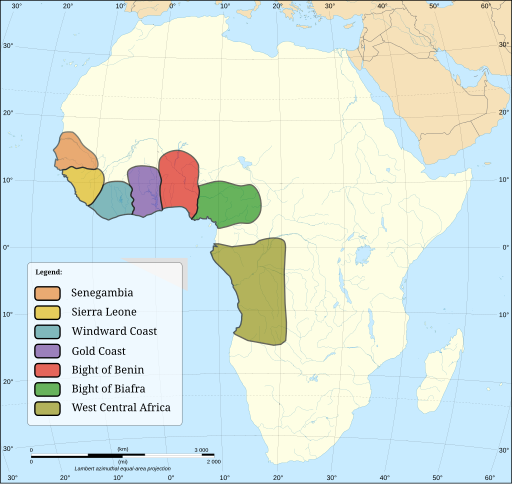
Africa slave Regions

Clotilda departed Africa on about May 24, 1860 and arrived in Mobile Bay in early July.  One girl reportedly died during the six-week brutal crossing.

Purchased for $9,000 in gold as well as merchandise cargo, the imported slaves were worth more than $180,000 in 1860 Alabama.

Articles and books relating the story of Clotilda and her cargo differ widely in some of their information.  The date of arrival in Mobile Bay is given as several different days in July 1860 as well as autumn of 1859; The number of slaves varies from 103 up to 160; and the owner of the ship is given as Timothy Meaher, the ship’s captain, William Foster, or is not named.

The snippet from The New York Times of July 11, 1860, citing the arrival as July 9, solidly establishes Clotilda’s arrival in the second week of July.  Records from the Mobile U.S. District Court identify the date of arrival in Mobile Bay as July 7, 1860.  Captain Foster’s 1890 accounting has the ship anchored off Point of Pines, Grand Bay, Mississippi before July 9.  He then writes:

July 9th. went ashore, gave a resident twenty-five dollars for horse and buggy to take me to Mobile. There I got a steam tug to tow schr (schooner) up Spanish river into the Ala. River at “Twelve Mile Island.” I transferred my Slaves to a river steamboat, and sent them up into the canebrake to hide them until further disposal. I then burned my schr. to the water’s edge and sunk her.

July 9th. When anchored off “P. of P.” Miss. The mates and crew did not want me to leave the vessel until they were paid for voyage and said they would kill me if I attempted to take the negroes ashore without their money. Capt. Tim Meaher and party were to have met me there for the purpose of landing negroes, and pay the crew off, and I had made arrangements with the mates and crew, to take the vessel to Tampico and change her name and get clearance for New Orleans – the parties failing to meet me in time, compelled me to come up to Mobile. I hired a tug and went to the vessel to tow her up to Mobile into Spanish River and crew refused to let me have her because I didn’t have time to get the money to pay them. I came back to Mobile and took on board the tug five men and $8,000 dollars, landed [I think] at vessel 9 p.m. Went aboard and settled with them according to my first arrangement in Mobile.

We put the mates and crew on steamer and sent them to Montgomery on their way to the northern states.

Licensed in December 1855, Clotilda’s first record of carrying cargo lists William Foster as Shipper/Owner and Captain Russell as Master of the ship. Foster was to later lament the burning and scuttling of his ship, saying that it was worth far more than the 10 slaves he received as payment.  However, without a crew and with the government searching for Clotilda, his choices were limited.

The U.S. government first searched for Clotilda shortly after learning of her illicit voyage, but the endeavor proved fruitless. However, enough information was known for authorities to take legal actions. The Mobile District Court records show that Clotilda entered Mobile Bay with 103 slaves “more or less.”

The cargo was distributed to a number of individuals, including Timothy Meaher, Burns Meaher, James Meaher, John Dabney, Thomas Buford, and Captain William Foster.

On August 7, A. J. Requier, the U.S. attorney for the Southern District of Alabama, informed Judge William G. Jones that “William Foster, master or commander of the Schooner Clotilda … wholly failed to report the arrival of the said schooner Clotilda to the Collector of the said port within the time prescribed by law.”  The court wasn’t after Foster for the crime of importing slaves.  He hadn’t paid the required fees on his cargo and had not provided information that was required to be inserted in a manifest under oath. He was fined $1000.  Without the evidence of the Clotilda to tell the tale, the only charge that could stick was a minor one.

In Mobile, Federal Judge William G. Jones issued orders for Burns Meaher and John Dabner to appear in his court on the second Monday in December.  However, the U.S. Marshall didn’t inform them until December 17 and then only verbally.  Three days later the Marshall informed the court that the “named negroes” could not be found in his district. Without the Africans, no crime could be found and, on January 10, federal charges against Meaher and Dabney were dismissed.

Also on January 10, 1861, probably because there was money to be collected and his case was easy to prove, an order was issued that the case, The United States vs. William Foster, be continued.

The next day, Alabama seceded from the Union.

Hector Posset, the ambassador of the Republic of Benin and a descendant of the Dahomey royal family visited the site of the recently found Clotilda in 2018. “I am just begging them to forgive us, because we sold them. Our forefathers sold their brothers and sisters. I am not the person to talk to them. No! May their souls rest in peace, perfect peace. They should forgive us. They should,” Posset said, wiping tears from his cheeks. “Qualified people will come and talk to them in due time. I feel so sad.” The qualified people Posset spoke of would be priests of Benin’s traditional religion, Vodun.


Sources used:

  1. Last American Slave Ship is Discovered in Alabama—National Geographic
  2. The ‘Clotilda,’ the Last Known Slave Ship to Arrive in the U.S., Is Found—Smithsonian Magazine
  3. Clotilda (slave ship)—Wikipedia
  4. Historic Sketches of the South—Roche, Emma Langdon. New York: Knickerbocker Press, 1914.
  5. Alabama Historians: The Last Known Slave Ship Has Been Found—The New York Times
  6. The Case for Clotilda—Archaeology
  7. Last Slaver from U.S. to Africa. A.D. 1860; Transcription of Capt. Foster’s account of the Clotilda voyage and notes accompanying it (with suggestions in [italics]), by Valerie Ellis, Local History and Genealogy, Mobile Public Library—Mobile Public Library Digital Archives
  8. The Clotilda: A Finding Aid (pdf)—National Archives at Atlanta
  9. Diouf, Sylviane A. Dreams of Africa in Alabama: the Slave Ship “Clotilda” and the Story of the Last Africans Brought to America. Oxford: Oxford University Press, 2009.
  10. Dahomey Amazons—Wikipedia
  11. Cudjoe Kazoola Lewis, the third to last known survivor of the Atlantic slave trade between Africa and the United States, brought illegally to the United States on board the ship Clotilda in 1860—Wikipedia
  12. Redoshi, second to last known survivor of the Clotilda slave cargo and the U.S. transatlantic slave trade—Wikipedia
  13. Matilda McCrear, last known living survivor of the U.S. transatlantic slave trade, brought to the United States on the Clotilda—Wikipedia
  14. Glele, tenth King of the Aja kingdom of Dahomey—Wikipedia
  15. Ouidah, coastal city of Benin, formerly Kingdom of Dahomey—Wikipedia
  16. ‘Forgive us, because we sold them,’ says African ambassador on possible slave ship find—Mobile Real-Time News
0 comments

106°

News of the Day
1860s newsprint

Standard [Clarksville, TX], July 7, 1860

The thermometer today, at 1 p.m. in the shade of our sanctum, brick wall, second story, one of the coolest places in town, indicates 106°. At the same time the breeze renders the heat quite endurable; indeed we do not feel it near as much as some days last week, when the mercury was at 94 and 6°.

0 comments

Food Wanted

News of the Day
1860s newsprint

Standard [Clarksville, TX], July 7, 1860

We imagine that our country neighbors are unaware that there is a scarcity of fresh food in Clarksville. Butter, Eggs, Poultry, Mutton, even Beef, are all scarce. Until a few days past we have had pretensions to an occasional beef market; but even that has vanished; and with sheep and cattle abundant on the Prairies all around us, the town is unsupplied. If some person in the County would butcher every evening some sheep or a beef, and have the meat in Town before sunrise every morning, we presume that ready sale for cash, could be found for it. We suppose there are a plenty who would like to exchange their beef and mutton for money; and there are certainly a number of persons in town who are tired of living on salt meats.

Some one or two persons who would steadily supply the demand could do well.

Our town butchers have been irregular in their supplies, all the spring, and have now ceased entirely.

0 comments

Telegraph

News of the Day

[Fayetteville, Ark.] The Arkansian, July 7, 1860

The wires were uncoiled and stretched from insulator to insulator, through and beyond this city, last Wednesday, on which day the electric pulse first thrilled through our midst. Fayetteville is now in instant connection with the world. May the Telegraph be the forerunner of more magnificent enterprises, until our city shall become a great inland city, the Seat of Learning, Science and Art, and beloved of Peace and Prosperity.

To the indefatigable exertions of Mr. Parsons, Telegraph Agent and skilful Operator, the friends of the Telegraph are greatly indebted for the office here.

0 comments

Richard W. Thompson to Abraham Lincoln

Civil War Day-by-Day
Terre Haute July 6, 1860
My Dear Sir
A few days before I left Washington I recd. your last letter & had, as you suggested, a brief interview with H. W. D: — it was, however, necessarily too brief to be very Satisfactory because neither he nor I had time to make it otherwise. It satisfied me that there was a general concurrence between his views & mine.
I reached home a week ago and found a meeting of our State Executive Committee called for 4th instant, & a strong inclination to form an Electoral Ticket & to run a State Ticket. I attended the meeting & opposed both movements, & succeeded in getting it adjourned to meet again on the 15th next month. In the mean time I think I can so manage those who advocate an organization as to prevent it. The State ticket they have already agreed to abandon, & a good many of those who were earnest for an electoral ticket have changed their views. I have to manage the matter with exceeding delicacy & could do nothing if I were to avow openly my ulterior object. This does not arise out of a want of confidence felt in you, but from the strong feelings existing in particular localities between some of our men & the Republicans. You will, therefore, infer that one of my chief arguments is that you, if elected, will not suffer yourself to be led into ultraism by Radical men; but that your administration will be national. If I could succeed in fixing their impressions upon their minds, I should have but little difficulty — & I hope to do it. It cannot be done, however, at once. I made a strong impression upon the minds of the Committee when I told them that you & I & Geo. Dunn voted together in Congress on the Slavery question. By the by, have you forgotten that was seperated from all the other northern Whigs upon Gott’s resolution? Do you think it would do you any hurt amongst the Republicans if I were to mention this as proof of your Conservatism? I have not done it & will not if you think it will hurt you — though I suppose somebody will look it up. I should like very much to see you & have a personal interview with you. I want to talk about some things that you ought not to write about. How can we arrange an interview? If I come openly to Springfield it will get in the papers — for I cannot travel without being known. Is any other plan practicable? Write me on this subject, & I will follow your suggestions.
Very truly yr. friend
R. W. Thompson
      Hon. A. Lincoln
Send your answer in an envelope addressed to Wm R McKeen — by Express — for it is better for you that the P. M’s should not know that you & I are corresponding at present at all events.

Richard Wigginton Thompson (June 9, 1809 – February 9, 1900) was an American politician.
In the election of 1860 Thompson was his state’s leader of those who organized the Constitutional Union Party. At the May convention, Indiana first supported John McLean, but fell in behind John Bell on the second ballot. Thompson was placed on the National Committee, but gave up the on third party strategy in August and supported Abraham Lincoln so as not to risk a Democratic victory in Indiana. (Wikipedia)

0 comments

Kidnapping in Illinois—Three Negroes

New York Times

The New York Times, July 6, 1860

Carried Off—A letter from Clifton, Ill., dated July 2, says: “JAMES, WILLIAM and Mr. KINGMAN’s JOHN were taken last evening by the slave hunters. They were all at SELLER’s, (a store in Clifton,) enticed there by an Ashkum man, who was bribed by the kidnappers from the South. Mr. KINGMAN’s NED and FRANK’s WILLIAM succeeded in getting away. My WILLIAM and Mr. KINGMAN’s JOHN were taken on the spot and handcuffed. JAMES made a desperate struggle and got as far as the railroad, when one of the men threatened, to shoot if he did not stop, and he was foolish enough to do so, for, had he kept on, he might have got away; but I presume he had been stunned by the repeated blows he had received on his head by a pistol. After getting them into a wagon, the man-hunters drove to Ashkum and took the cars there. A gang of men from Clifton were at the cars when I arrived, and we all went to Ashkum; but these scamps, twenty-five in number, were all armed with pistols, and we had no arms of any kind, so it was useless to resist them. The conductor of the train showed no disposition to aid us in any way, and I hope he did not favor the slave-drivers; but it looked very much like it. The Clifton men were scattered about town, and, as it was all done so quick, they had no chance to do anything. It is hard to submit to such things, I assure you. We suspect two Irishmen of Clifton were concerned in it, and are now quite sure of it: and also, two men from Ashkum. Clifton is wide awake to-day, and these fellows will be looked to.”

0 comments

Indian Troubles in Nebraska

New York Times

The New York Times, July 6, 1860

Washington, Thursday, July 5

The Commissioner of Indian Affairs received important intelligence this morning from Nebraska Territory. Agent GILLIS, under date of June 22, writes that 200 or more Cheyenne. Arrappahoe and Sioux Indians had just attacked a Pawnee village in sight of the agency and killed several persons. Mr. GILLIS rode in among the attacking party, and with assistance of a half-breed Pawnee interpreter, succeeded in inducing them to draw off. They declared their purpose to return and “wipe out the Pawnee tribe.” An express was immediately sent to Col. CHAS. MAY, commanding at Fort Kearney, for assistance, as, under the treaty of September, 1857, Government is bound to protect the Pawnees on their new reservation.

The hostile expedition was fitted out west of Fort Kearney, for the express purpose of making war on the Pawnees, and Mr. GILLIS says they are well mounted, and a splendid-looking set of warriors. Two days later he writes:

“I have just learned from a reliable source that a large body of hostile Indians are collecting on Wood River, twenty-five miles this side of Fort Kearney, for the purpose of renewing the attack on the Pawnees, and that they avow their purpose to attack the whites if they attempt to interfere. Their forces are composed of Sioux, Cheyennes, Arrappahoes and Brulés.

Unless troops are ordered forthwith to suppress these depredations, the Pawnees will, in the opinion of Agent GILLIS, be soon “wiped out.” He says that if Government will furnish him with thirty Sharpe’s rifles, with ammunition, he will render a good account from these hostile attacks. The matter has been referred to the War Department, and steps will be taken under the nineteenth section of the Intercourse act of 1824, which directs the President to use the army to suppress and prevent depredations by one tribe of Indians on another, and to arrest all offenders retreating into the Indian country. An unfortunate war spirit seems to be rapidly spreading among all the tribes, and Government fears a general outbreak.

0 comments

From J. R. Mahan to Abraham Lincoln

Library of Congress
Greencastle July 5 60
A. Lincoln
Dr Sir
I take a moment to write you. acording to promise we held a meeting of the Americans at Indianapolis yesterday. the matter we talked of at your House is all Right we will not have a ticket for Bell in this State.[1] Indiana is Reliable for Lincoln I have been around and think I know, and if time would permit could give you the Reasons why, and will soon if you Recolect when I told you of that Brackenridge[2] nomination I Remarked that Douglas would not get a State, that conviction is deepening, and think all will be convinced of the fact before the Canvass is over pleas write
Yours Resp
L R Mahan

[1] By 1860, the American or “Know Nothing” Party was largely defunct and the Republicans hoped to persuade the Know Nothings to join their camp instead of supporting the newly formed Constitutional Union Party. The Constitutional Unionists were primarily comprised of Old Whigs and Know Nothings and had nominated Senator John Bell of Tennessee for the presidency
[2] In June 1860 the Democratic Party split into two factions and each faction nominated its own presidential candidate. Vice President John C. Breckinridge received the nomination from one faction and Stephen A. Douglas received the nomination from the other.

Lincoln, A. (1860) Abraham Lincoln papers: Series 1. General Correspondence. 1833 to 1916: J. R. Mahan to Abraham Lincoln, Thursday,Politics in Indiana. July 5. [Manuscript/Mixed Material] Retrieved from the Library of Congress, https://www.loc.gov/item/mal0326600/.

0 comments

The Last Days of John Brown

Miscellaneous document sources

by Henry David Thoreau

Read at Brown commemoration in North Elba, New York, July 4, 1860.

John Brown’s career for the last six weeks of his life was meteor-like, flashing through the darkness in which we live. I know of nothing so miraculous in our history.

If any person, in a lecture or conversation at that time, cited any ancient example of heroism, such as Cato or Tell or Winkelried, passing over the recent deeds and words of Brown, it was felt by any intelligent audience of Northern men to be tame and inexcusably far-fetched.

For my own part, I commonly attend more to nature than to man, but any affecting human event may blind our eyes to natural objects. I was so absorbed in him as to be surprised whenever I detected the routine of the natural world surviving still, or met persons going about their affairs indifferent. It appeared strange to me that the “little dipper” should be still diving quietly into the river, as of yore; and it suggested that this bird might continue to dive here when Concord should be no more.

I felt that he, a prisoner in the midst of his enemies and under sentence of death, if consulted as to his next step or resource, could answer more wisely than all his countrymen beside. He best understood his position; he contemplated it most calmly. Comparatively, all other men, North and South, were beside themselves. Our thoughts could not revert to any greater or wiser or better man with whom to contrast him, for he, then and there, was above them all. The man this country was about to hang appeared the greatest and best in it.

Years were not required for a revolution of public opinion; days, nay hours, produced marked changes in this case. Fifty who were ready to say, on going into our meeting in honor of him in Concord, that he ought to be hung, would not say it when they came out. They heard his words read; they saw the earnest faces of the congregation; and perhaps they joined at last in singing the hymn in his praise.

The order of instructions was reversed. I heard that one preacher, who at first was shocked and stood aloof, felt obliged at last, after he was hung, to make him the subject of a sermon, in which, to some extent, he eulogized the man, but said that his act was a failure. An influential class-teacher thought it necessary, after the services, to tell his grown-up pupils that at first he thought as the preacher did then, but now he thought that John Brown was right. But it was understood that his pupils were as much ahead of the teacher as he was ahead of the priest; and I know for a certainty that very little boys at home had already asked their parents, in a tone of surprise, why God did not interfere to save him. In each case, the constituted teachers were only half conscious that they were not leading, but being dragged, with some loss of time and power. [continue reading…]

0 comments

Letter to A. G. Henry

Civil War Day-by-Day

SPRINGFIELD, ILLINOIS, July 4, 1860.

My dear Doctor: Your very agreeable letter of May 25th was received three days ago. We are just now receiving the first sprinkling of your Oregon election returns—not enough, I think, to indicate the result. We should be too happy if both Logan and Baker should triumph.

Long before this you have learned who was nominated at Chicago. We know not what a day may bring forth, but to-day it looks as if the Chicago ticket will be elected. I think the chances were more than equal that we could have beaten the Democracy united. Divided as it is, its chance appears indeed very slim. But great is Democracy in resources; and it may yet give its fortunes a turn. It is under great temptation to do something; but what can it do which was not thought of, and found impracticable, at Charleston and Baltimore? The signs now are that Douglas and Breckinridge will each have a ticket in every State. They are driven to this to keep up their bombastic claims of nationality, and to avoid the charge of sectionalism which they have so much lavished upon us.

It is an amusing fact, after all Douglas has said about nationality and sectionalism, that I had more votes from the southern section at Chicago than he had at Baltimore. In fact, there was more of the southern section represented at Chicago than in the Douglas rump concern at Baltimore!

Our boy, in his tenth year (the baby when you left), has just had a hard and tedious spell of scarlet fever, and he is not yet beyond all danger. I have a headache and a sore throat upon me now, inducing me to suspect that I have an inferior type of the same thing.

Our eldest boy, Bob, has been away from us nearly a year at school, and will enter Harvard University this month. He promises very well, considering we never controlled him much.

Write again when you receive this. Mary joins in sending our kindest regards to Mrs. H., yourself, and all the family. Your friend as ever,

A. LINCOLN.

0 comments

Through Some Eventful Years

Through Some Eventful Years by Susan Bradford Eppes
Susa Bradford Eppes

July 4th, 1860.—We went to Tallahassee to attend a celebration of our country’s birthday. Brother Amos belongs to the Governor’s Guards, most of the younger men and boys about grown belong to it too. They have handsome blue uniforms and a brass band to play for them to march. It is a cavalry company and all have fine horses; it is needless to say they make a splendid appearance. The color-bearer carried a large silk flag and I was so proud of The Star-spangled Banner. Francis Scott Key, who wrote that beautiful song, was a friend of Grandpa’s and sent him one of the very first copies ever printed; it is bound in Mother’s music book, and she is so proud of it. Today when the company paraded the band played Hail Columbia first but the crowd clamored for The Star-spangled Banner, showing which they loved best. After the parade there was a picnic dinner and a dance on a platform built for the occasion.

All are tired but me, I am so excited over the day’s proceedings that I cannot sleep, so I am writing it up. Some fine speeches were made and politics were left in the background for once. We came home in the cool of the evening and as we rode along the quiet country road we woke the echoes with one patriotic song after another. When I studied English History it seemed to me that our history was not near so interesting as it was and Scotch History was more entertaining than either English or French. Will there ever come a time when the history of the United States of America will fill one or more big volumes?


Susan Bradford is 14 years old when this entry was made.

0 comments

Letter to A. G. Henry

Miscellaneous document sources

Crawfordville [Ga.], July 4th, 1860.

. . . No news politically—two tickets I suppose will be run in Ga. I shall take no active part—can do no good. The Legislature will have to choose electors if the Democratic party is split to any considerable extent, as it probably may be. The Breck. and Lane ticket will carry much the larger portion I think. I could not favour a movement which in my judgment originated not from principle but hostility to a man. And I feel no disposition to engage in an internecine fight when nothing in the end can be hoped for but a profitless victory even at the very best. I shall therefore take my rest quietly, looking on, hoping for the best, though I greatly fear troubles are ahead. If they come I can bear my share. Those only will be responsible whose folly and madness brought them on. The people must bear them as they do all other misfortunes. What I write to you is always strictly and exclusively for yourself.


From Annual Report of the American Historical Association for the Year 1911.

Alexander Hamilton Stephens was an American politician who served as the vice president of the Confederate States from 1861 to 1865. After serving in both houses of the Georgia General Assembly, he won election to Congress, taking his seat in 1843. After the Civil War, he returned to Congress in 1873, serving to 1882 when he was elected as the 50th Governor of Georgia, serving there from late 1882 until his death in 1883.

J. Henley Smith was a Georgia journalist.

0 comments

Organized Band of Abolitionists

News of the Day
1860s newsprint

Semi-Weekly Mississippian [Jackson, MS], July 3, 1860

The Meridian mentions a rumor that there is an organized band of Abolitionists in the corner of Clark and Wayne of this State, and Choctaw and Washington of Ala., who are defying the people and the authorities. Considerable excitement had been created in Quitman, and other contiguous localities, and the citizens thereof were preparing to adopt the means required to abate the nuisance.

0 comments

Horace Greely to G.T. Hammond—No Political Influence

Civil War Day-by-Day
New York
July 2, 1860
My Dear Sir:
I have never yet had influence with any Federal Administration, and may have no better with the next than with the last. I never wrote a letter to a President elect nor to a nominee of my party for that post. This is a government of lawyers, and I was not educated to their profession. I will not beg office nor tender unsought advice. I do not think it at all probable that I shall be in a position next year to help any one, and I will not humble myself to ask favors. So I do not think it at all probable that I can help you in any contingency.
Horace Greely
G.T. Hammond, Esq.
0 comments

Alexander H Stephens to J. Henly Smith

Miscellaneous document sources

Crawfordville [Ga.], July 2d, 1860.

Dear Smith, Your letter was received two days ago and I delayed answering it until I should get the paper containing the communication referred to in it. This came to hand last night. I read it with interest and was highly pleased with the general tone and style. You present the strong points of the case. In some minor matters you were not quite so effective as you might have been. These I intended to call your attention especially to, but some person took the paper away last night (there were several at the house) and I have not got it to refer to. But one I recollect very distinctly and will name. After stating Mr. Douglas’s position very clearly in which he puts slave property in the territories upon the same footing as all other property, etc., you go on to say, “and yet because the party South disagreed with him upon one vital point they warred against him.” I have not got your words but the idea. Now you should not have styled this a vital point. It should have been immaterial, for it is an immaterial and not a vital point of difference—and if it were a vital, as his opponents allege it to be, would it not

justify their opposition? Can vital points ever be waived? Your whole letter shows that it is not a vital point; and if you had used the word immaterial instead of vital in this connection it would have added great force to your general argument. There were two or three other matters I intended to call your attention to. These related to your historical narrative, but I have forgotten them. But I assure you this letter and your previous one on the whole present Douglas’s claims in a stronger light than I have seen them presented in any Southern paper. I have not seen a speech or an article by a Southern man that has been of real benefit to him except yours not one that met the issue on the right points. No man ever had more cause to exclaim save me from my friends than Douglas has, particularly from his friends at the South. I was surprised at their course at Baltimore. What could they mean by pushing his nomination in the face and teeth of the secession of Tenn., Ky., and Va., to say nothing of the other states, I cannot understand. I may be mistaken. I have heard no explanation of it. I do not know what they rely upon or what their calculations are. I have no lights except what I get from general views and my knowledge of the workings of causes to their effects. But from these lights it does seem to me that this course was neither wise nor patriotic. Madness and folly must have ruled the hour. They put up their man to be beaten. I do sincerely trust it may be otherwise, but I do not see any probable chance for him. Had he been nominated over the votes of the Tenn., Ky., and Va., delegations—had he got two thirds according to the usages which may be regarded as the constitution of the National Democratic organization, had those states adhered to the nomination, then my opinion is that he would have carried them with Ala., La., and Mo., and with enough Northern votes to secure his election. But with the break of the great border States, who that has got sense enough to get out of a shower of rain does not know that even though a ticket may be run for him in those states, yet that it is impossible for him to carry them or either of them? And who does not know that when it is apparent that he will lose the entire south, thousands of men at the North, some for spite and some to get on the winning side, will quit his standard then, and thus leave him perhaps without the vote of a single state? As for his carrying Ala., under existing circumstances, I have no idea. And why the delegation of that State and La. should have persisted in having him nominated with all these considerations before them, I cannot imagine. I can attribute it to nothing short of dementation. I may be mistaken. I hope I am. I would say nor do nothing to weaken their efforts; but as a quiet observer feeling however a deep interest in the general result upon the welfare of the country, I give you freely my candid impressions and convictions at this present writing. I repeat, I maintain these opinions upon general principles only. I have heard no explanations and have no communication with the outside world except through the medium of the public press. I am pained and grieved at the folly which thus demanded the sacrifice of such a noble and gallant spirit as I believe Douglas to be. I can see but one possible good that his nomination may effect, and that is he may get enough electoral votes at the North to defeat Lincoln in the colleges and thus throw [it] in the House where he may be the stepping stone for his party rival (Breckinridge) to rise into office. His back and shoulders may enable his rival to elevate himself to place and honor and in this way attain the object of his ambition, and in this way the country may possibly be benefitted in the ultimate defeat of Lincoln. But what honor this will be to Douglas his friends must determine. They certainly have much less regard for that than I have. If such a position had been necessary for anyone to occupy I would have assigned it to some other one, someone who while rendering public service would have gained instead of losing reputation. I would not have called upon Douglas to do it. Indeed I think it was very unwise to put him or anybody in nomination without the 2/3 vote. It will be regarded as a violation of the constitution of the party and would of itself be sufficient to justify any man who felt disposed from any cause to consider himself as absolved from all obligation to conform to party action. The whole affair therefore I regard exceedingly unfortunate. I see nothing but disaster attending it. I assure you the wish is far from being the father to the thought in this case. I give but the honest convictions that are forced upon my mind, and shall be rejoiced if when the smoke of the battle field clears away I shall see a more encouraging prospect. I take no Northern paper and do not know how the public sentiment there is running. But I do know that the doctrine of non-intervention was never popular there. It was an up hill business to support and sustain it. It broke down the Democratic party. Those who sustained themselves on it did it only in the defensive. It contained no element that addressed itself to the heart of the people. It had no rallying heart for the masses. No converts would ever be made by appealing in its behalf. It was always a question simply of how many would be lost by its advocacy. I have seen nothing to cause me to believe that any change has taken place in the great popular sentiment on this subject in that section. Hence I do not see where Douglas is to gain. The administration will throw all its power against him. This is his only hope for gains in the North. But the old feeling of hate on the part of the Democrats who quit the party on account of this doctrine will seize the opportunity of pouring out all the vials of their wrath against him when they see a prospect of his humiliation. Had the party not split, had he been run at the South with a reasonable show of success there, he would have made great gains from the conservative Union-loving portion of the people North. But there is now nothing to rally that portion unless they see prospects of electing him solely by Northern votes. This I do not think within the range of possibility. What then is to be the result? God only knows. I can say no more. This letter is strictly and exclusively for yourself. I am still confined to the house; do not go out and have no idea that I shall be able to do anything but rest during the heat of summer. I hope I shall not have to take my bed. If I can keep up I shall be content. I wish if you see anything of interest in any Northern paper, the Times, the Herald, or Tribune, or any other, you would buy a copy of the number and send to me. Keep an account and I will pay the amounts. I take none of these papers but would like to see anything of interest in them. What did you mean by referring to certain dispatches in some of the Northern papers about me during the Baltimore Convention in one of your letters to the Confederacy? I did not understand your allusion and do not now. Write often.


From Annual Report of the American Historical Association for the Year 1911.

Alexander Hamilton Stephens was an American politician who served as the vice president of the Confederate States from 1861 to 1865. After serving in both houses of the Georgia General Assembly, he won election to Congress, taking his seat in 1843. After the Civil War, he returned to Congress in 1873, serving to 1882 when he was elected as the 50th Governor of Georgia, serving there from late 1882 until his death in 1883.

J. Henley Smith was a Georgia journalist.

0 comments

It’s All Over

Civil War Day-by-Day

Douglas --"It's all over, The darned boot has bursted and I won't be able to reach the White House.Douglas –“It’s all over, The darned boot has bursted and I won’t be able to reach the White House.”

This July 1, 1860 Chicago Rail Splitter cartoon identifies the split in the Democratic Party as preventing Senator Stephen Douglas of Illinois, nominee of the Northern Democratic faction, from reaching the White House. “Squatter Sovereignty” was a derisive term for “popular sovereignty,” an idea advocated by Douglas that called for the voters in the territories to determine whether to legalize slavery or not.

Harp Week 1860 elections.

0 comments

Ten Dollars

Civil War Day-by-Day

$10 Note, Ocoee Bank, Cleaveland, Tennessee, July 1, 1860

Antebellum bank note includes a stylized Native American and a slave picking cotton.


0 comments

Sad Affair

News of the Day
1860s newsprint

Standard [Clarksville, TX], June 30, 1860

During District Court at Bonham, a little son of Alfred E. Pace, about six years of age, was missing one day, and for several hours some enquiry was made for him, without much anxiety, as he was in the habit of roving about freely. As night came on, however, alarm came with it, and search was continued unsuccessfully. At daylight next morning, his father took his horse and pushed out to search, and a large body of men took Bois d’Arc bottom in line, to let no foot of ground pass unnoticed. Others were out singly. About eight o’clock in the morning, the body of the missing boy was found in the Creek not far from his father’s residence, without much indication of violence. It was in water only a few inches deep. Suspicion was fastened upon a negro woman belonging to Mr. Pace, with whom the child went to the cowpen in the morning before. She was confined and questioned, but not threatened. After awhile questions based upon her movements led her to conclude that her guilt had been discovered, and she acknowledged that she strangled the boy, and threw him into the water, a few yards above where he was found; and that the motive for her conduct was that some statement made by the boy to his mother, a few days before, had caused the negro’s own boy to be whipped.

After consultation among the citizens, a Jury of Inquest was held, evidence received, conclusively making out a case of murder, and the woman was hanged. The grief of the Parents may be imagined. The little boy was their only son—a pet; and the mother in delicate health.

0 comments

Improvements

News of the Day

[Fayetteville, Ark.] The Arkansian, June 30, 1860

Our city is still steadily improving, every business house and dwelling occupied, and new buildings going up every day.

The Telegraph will be completed to, and an office opened in this city during the coming week.

We have also another newspaper, which unheralded, as the sudden flash of a meteor, made its appearance among us and immediately became one of the permanent fixtures of the city.

Again, our enterprising your men have purchased the necessary instruments and organized a “brass band.” As soon as they get a little instruction there will not be a “savage breast” hereabouts but will be moved by a concord of sweet sounds.

With a telegraph office, two newspapers and a brass band, we will be able to hear all the news, print it, and blow it all over the country. One gentlemen, more enterprising than all the others, has made the necessary arrangements for the purchase of an owl which he will press into the service and with the invention genius of a live Yankee make it an useful bird.

Candidates are coming out every day, not because they want office, but because of numerous solicitations and a willingness to serve the people in any capacity to which they may called. None of them can be elected unless they announce in the papers.

0 comments