Letters from Virginia

News of the Day
1860s newsprint

Daily Advocate  [Baton Rouge, LA], September 11, 1860

Bristol, Va., Sept. 2, 1860.

Editors Advocate—We broke down this morning, and failed to make the connection, consequently here we are in this mountain border town for twelve mortal hours. The passengers, from all parts of the Union, are amusing themselves with discussing politics and taking the vote for President. The vote just taken stands 90 for Breckinridge, 50 for Bell, 3 for Douglas, and 1 (a Frenchman,) for Napoleon. It was difficult to make the Frenchman understand, for he was just from France. After explaining to him that we were not going to elect a President for France, but for the United States, he was asked again which of the American candidates he preferred. He replied “Napoleon, Napoleon, toujours Napoleon!” . . .

I stopped in Lynchburg and spent one night. It is a very remarkable place, remarkable for its rugged streets, its fine tobacco and pretty girls. The day I arrived there they were hanging a man for some youthful indiscretion—murder, I believe. The whole town, little and big, old and young, judge and jury, male and female, white, black and mulatto, were all there, that is at the hanging, “enjoying of themselves.” A hanging in Virginia is a perfect God send. It draws better than anything else. It beats Douglas or any other traveling show. Imagine beautiful young ladies seated in windows and on the tops of houses to see a poor wretch strangled to death. Human nature is the same in all ages. The ancient Roman ladies delighted in visiting the Coliseum and witnessing the bloody gladiatorial combats. Fierce as were their pleasures, and bloody as were their pastimes, a germ of that same feeling seems to be implanted in the human breast. Religion may in a great manner subdue it. Long lessons of morality may frown it down, but it will creep out in spite of all the teachings of the Christian world. . . .

September is upon us—the leaves begin to show a purple tinge—the mountain air is “keen and nipping” and reminds one of shawls and blankets. The immense tide of Southern travel is setting in homewards. In one short week, the watering places will be deserted. The festive halls that during the live-long summer have resounded to the music and the dance—will   be as silent as the house of death. The crowded cabins and stuffed cottages will be disgorged of their human tenants, and bats and owls—rats and mice and “such small deer” will take their places for a season. . . .

September 3.—I close this letter at the Grand Junction. This road is wretchedly managed. On yesterday a terrible accident happened—cars ran off, and a young man named Turnbull from Jackson, Miss., was killed and many others badly wounded, cause, an iron rail, called “snake’s head,” ran up through the cars.

In taking the vote on the cars to-day, one man voted for Lincoln. So great was the excitement that many wanted to duck him in the first bayou, others proposed to hang him. The poor fellow agreed at last to give three cheers for Breckinridge, Bell and Douglas, and three groans for Lincoln!! This quieted the excited mob and relieved the Lincoln man very much.

Yours, Watkins.
0 comments

Letters from Virginia

News of the Day
1860s newsprint

Daily Advocate  [Baton Rouge, LA], September 11, 1860,

 Sweet Springs, Va., August 29, 1860.

Editors Advocate—I arrived here on yesterday, and as quick as possible shucked myself and pitched into the bath. What a glorious thing it is to bathe in a hot summer day! When the mercury is at 96 to strip off and jump into such a bath as the Sweet Springs—to feel the gases bubbling up from the medicinal waters, giving health and strength to the afflicted. There is no bath in the wide world equal to this. I think it far superior to Baden Baden, for there the waters are used so far from the spring that the gases escape. The bathing establishments are also on a much smaller scale, and resemble very much the vats of a tan yard. I find the Sweet Springs very much crowded. The company is principally composed of South Carolinians, Alabamians and Louisianians. The Hon. John Slidell and family are here spending the summer. His two beautiful daughters, just budding into womanhood, are very much admired, for they are highly accomplished and very interesting, while Mrs. Slidell is the centre of attraction in the parlor and drawing-room, and beloved by all.

“King John” looks in excellent health, and bids fair to live full many a year yet. He passes his time very agreeably among the visitors in his quiet, unobtrusive way. On all questions of State or national policy, when consulted, he speaks his mind freely, openly, unreservedly. If John Slidell has faults, deceit is not one of them, for I know of no man who is more candid in all that he says and does. It has been often asked how it is that he has such a hold on the affections of the people of Louisiana; how is it that he wields so much influence with the Democracy of his State? That for many years he has been a political Warwick, who has “made kings” and then pulled them down again? The great secret of his success is this: Slidell is true to his friends. He never did and never will desert a friend. Misfortunes may come—fair weather friends, like summer flies, may leave, but here you find a man who is as true as the needle to the pole and as firm as the eternal rock of ages. Well may Louisiana be proud of such a Senator. She cannot spare the services of such a man from her counsels, and will return him to the Senate in January next by a larger majority than he was ever elected by before.

Among the numerous distinguished personages here is General Sparrow, of Carroll. He is in fine health and takes a deep interest in the good old Democratic cause. He informs me that he will return in a short time to Louisiana and take the stump for Breckinridge and Lane. As a popular orator he has no superior in our State and will do good service in the present canvass.

Virginia is all right. Her citizens are aroused to a full sense of their danger, and every Democrat will be forthcoming in November next. Douglas is dragging his short legs through the State, and in Norfolk a few days ago, said in a public speech that in case Lincoln should be elected, and any State should withdraw that he is in favor of whipping them in. His henchman, Gov. Letcher of Virginia, says, that no Northern troops shall ever march through Virginia. Little   Dug. would cut a pretty figure at the head of an Abolition army marching down to conquer the South. I think he would not go far, before he got a bayonet stuck into his a—bdomen. I wonder if the little traitor thinks that Lincoln & Co., could whip in fifteen Southern States!! Only think of Abolition Lincoln as General and Squatter Sovereignty Douglas as Lieutenant heading the fanatical John Browns of the North, and marching against Louisiana. We would welcome them to deep and bloody graves, and hang up their hides at every cross road through the length and breadth of the land. Even our negroes would meet “old Abe” and drive back his horrid motley crew. As for Douglas, we would simply take him prisoner, and show him round on a painted pole. He talks of whipping in “the Southern States!” If old Jackson was alive what would he do in case of a Northern invasion, headed by Lincoln, Douglas, etc. he would rally his legions of gallant Tennesseans, Mississippians, Louisianians, all, all would flock to his standard and woe to the blood hounds of Abolitionism, who should come in deadly conflict with the immortal old hero.

I am for the Union. All good citizens are for the Union, but is there any in our midst who would join Judge Douglas in whipping in fifteen southern States. Who among us will shoot down his neighbor and brother, fighting in defense of his rights guaranteed by the Constitution.

In God’s name, I hope there are none. Adieu.

Yours truly,

Watkins.

0 comments

Discharged

News of the Day
1860s newsprint

Daily Advocate  [Baton Rouge, LA], September 11, 1860

The three men arrested on Sunday night for tampering with slaves were arraigned this morning before Justice Walker. There was not sufficient evidence to convict them, and they were discharged with a recommendation from the Judge that they leave town. They gave their names as James Burk, Patrick Maloy and Wm. Phelps. The remark was general among the spectators that, although the names were Hibernian, the countenances were not.

0 comments

Significant

News of the Day

Alamo Express [San Antonio, TX], September 10, 1860

A correspondent of the Gazette, writing from Fairfield, makes the following significant remarks:

“We are, however vigilant and are guarding our village every night, and expect to do so until the November election.”

That is just what we have been telling people that this infernal agitation about the “Abolition plot” was only gotten up for effect, and that it would die out after the election.—Intelligencer.

0 comments

Snippets

News of the Day

Alamo Express [San Antonio, TX], September 10, 1860

Hung. —Two persons were recently hung in Robertson county for tampering with negroes.

Poison.—A vial of supposed poison was found in a well-bucket, at Mr. Thompson’s place, in Forkstown, one day this week. A meeting of the Vigilance Committee of that beat was called to investigate the matter. Nothing definite was discovered at latest dates. Let everybody be on their guard. Lincolnites must have been about recently.—Bellville Countryman.

Muggins found an old jack-knife the other day. His suspicions are aroused to the highest pitch, and he says, “let every body be on their guard. Lincolnites must have been around recently.”

0 comments

Democracy of de Soto

News of the Day
1860s newsprint

Daily Advocate  [Baton Rouge, LA], September 10, 1860, p. 2, c. 3

 Desoto.—The following note accompanies the proceedings of the enthusiastic meeting recently held in this parish.

Mansfield, La., Aug. 28th, 1860.

Messrs. Editors—By request, herewith I enclose to you the proceedings of a mass meeting held in this place, on Saturday the 25th inst., for publication, which I hope will find place in your columns.

It was truly one of the largest political gatherings I ever witnessed in Northwest Louisiana. The Democracy of De Soto are “up and adoing” their level best for Breckinridge and Lane. Many Old Line Whigs, too, and some of them men of talent and influence, have come out boldly for Breckinridge and Lane.

The Douglasites are scarce indeed in this parish. Within the range of my acquaintance I know not one.

The Belleveretts are making some ado about a meeting they are to have in this place on Saturday next, the 1st September, but from the small force they have on parade, I think the largest show they can exhibit, will be the show bills they have posted around town notifying the Order that the Cow-bells are coming, etc.

It seems to all appearances in this parish, we have but little to do, but like faithful stewards, we wish to do that little well, and when the 1st of November comes, we will send up a majority for Breckinridge and Lane by hundreds larger than ever was given by this parish before.

B. F. J.

0 comments

Alexander H Stephens to J. Henly Smith

Miscellaneous document sources

Crawfordville [Ga.], Sept. 10th, 1860.

Dear Smith, I am now at home—returned or got here from Appling Court Friday last, but have been too unwell to do any business … or answer letters since. … I went through my business at our court, made a political speech and then went to Augusta where I again spoke Saturday night. I was completely exhausted there—I did not get through with what I intended and wished to say. You have seen a very good report of what I did say in the Constitutionalist. I had not prepared anything further than in thought. I had committed nothing to paper. I however revised the report of it. I do not intend to attempt to speak again unless I recover more strength. I am exceedingly weak and debilitated. . . .

We have no news here. The Douglas cause is gaining daily in Georgia. But then it is fighting without hope. If the indications from the elections in Maine today should be favourable to him it will give a new impetus to his cause in the whole country. But my apprehension is that the Black Republican majority will be increased there. The division in the Democratic ranks will it seems to me tend to that result. I look upon it as the most natural result. Indeed I look for nothing but disasters ahead of us. May Heaven avert them. This is all I can say.


From Annual Report of the American Historical Association for the Year 1911.

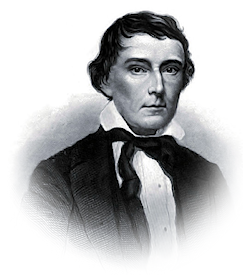
Alexander Hamilton Stephens was an American politician who served as the vice president of the Confederate States from 1861 to 1865. After serving in both houses of the Georgia General Assembly, he won election to Congress, taking his seat in 1843. After the Civil War, he returned to Congress in 1873, serving to 1882 when he was elected as the 50th Governor of Georgia, serving there from late 1882 until his death in 1883.

J. Henley Smith was a Georgia journalist.

0 comments

The New Market House

News of the Day
1860s newsprint

Alamo Express [San Antonio, TX], September 10, 1860

A Market House is one of the most important establishments of a city, and a good one favorably situated, is certainly desirable if not absolutely requisite. The building should be large and substantial, situated on an area of ground sufficiently open to accommodate a large number of vehicles and to allow a free circulation of air in order to secure both health and comfort. As to a central point we do not consider that so requisite; and especially when it is attainable only at the sacrifice of every essential requisite, a little to one side would make no difference in a growing city like our own. These thoughts are suggested by taking a view of new market house now in progress of creation in our city. It is going up around the old market shanty, and fills up the entire space to the edge of the street, leaving perhaps room enough for a horseman or footman to press round it. We have not seen the plan or specifications, but from present appearances the building looks like it will be adequate; but the situation is decidedly objectionable, and displays a want of wisdom and a lack of duty on the part of the authorities. It is jammed in among a lot of business houses with no other access than the narrow street upon which it fronts;–it is the hole in the city. The big future and the present wants, comfort and convenience of our city were certainly not consulted in this selection of a market place. Some may accuse us of a desire to grumble and say that we ought to be eminently thankful for anything in lieu of the present old shanty, but we contend that the people’s money should not be squandered; that those who had the matter in charge should by all means have consulted the public interest in procuring a suitable location, and not have displayed such haste and carelessness in disposing of the public funds as is evident in this particular instance.

Some may think it silly in us to bring up this matter this late in the day when the building is nearly half way completed, but we had not the opportunity of doing so before the commencement of the work, and if we had had that opportunity we have no idea our opposition would have availed any thing, but it is our duty to remind the people of those things, and if possible arrest this mania for spending the people’s money regardless of economy and common sense, as is glaringly evident in all the public works about our city for several years past. Rickety wooden bridges have been built at the expenditure of thousands of dollars of the public money, combining neither beauty or durability; at first cheaper than good iron or stone bridges, but costing in the run of a few years more in the way of continual repair. This is very nice for city jobbers but ruinous to the best interest of the community at large. A reform is needed. Every cent of public money should be expended with care and good judgment, [illegible] have much improvement to [illegible]; and it should be done with especial eye to the wants of the big and growing future.

0 comments

Letter from Northern Texas

News of the Day

Daily Times [Leavenworth , KS], September 8, 1860

[From the Houston Petrel, Aug. 24.]

Below we are permitted to publish a letter from J. L. Craig, of Marshal, Texas, to his father, A. K. Craig, Esq.:

Marshall, Texas, Aug. 9, 1860.

“Dear Father: Once more I embrace the opportunity of addressing a few lines to you. Things have come to pretty pass in Texas. I reckon you have heard of the terrible insurrection; the burning of towns; the hanging of thieves, abolitionists, &c.—Yesterday the election for State and County officers came off, the day fixed for the negroes and abolition dogs to poison all the water on the election grounds, so as to kill off the men at once, but they were watched so closely that they did not make the attempt. Day before yesterday several negroes were taken up and whipped at Henderson, and they confessed that Henderson was to be burned that night, and Marshall the next, which created great excitement among the people. Sure enough, before 9 o’clock that night, the town was on fire, and was all burned to the ground, except two stores. I learn that one of the abolitionists and several negroes were arrested, but the rest made their escape.

“Last night the guards were on the watch all night; in fact, every man in the place was on watch, and by that means the cowardly cut-throats were defeated. I would like to tell you all about this insurrection, but I am too nervous to write any more. If I had time to give all the particulars, I would write them to the Petrel, but I am just starting to Red River county, and must defer till another time.

“Every man that travels through this country is taken up and examined, and if he does not give a good account of himself, he is strung up to the nearest tree. I have to get a passport from here to Red River, and even then, I expect to have a hard time getting through, for a man’s word is nothing in these critical times. I will write more of this when I have time. Your son,

James L. Craig.

0 comments

From Texas, Prices of Provisions—Negro Troubles

News of the Day

[Little Rock] Arkansas True Democrat, September 8, 1860
From the Arkansas Baptist.

Dear Brother Watson: For fear you or some of your friends might conclude this to be the year to come to Texas, I will give you a short statement about the crops.
I have traveled through several counties recently, namely; Falls, Bell, Travis, Milam, Roberson, Limestone and Freestone. There are several counties north of me and from me to the Louisiana line, in which corn cannot be purchased for less than two dollars per bushel, and in a great many places, corn cannot be had at any price. Pork will be very high, but we are blessed here with as good beef as the world can afford and this is a very good substitute for pork. Wheat is worth two dollars a bushel.
It is of no use to mention the cause of the hard times here, as it is understood that this country is seldom blessed with rain enough to make good crops.
Our country has been thrown into excitement in consequence of the burning of several towns and residences. After examination it was found that Abolitionists had placed in the hands of the negroes a great quantity of poisonous medicines and had the plan laid for an insurrection which was to have come off on the fourth of August.
The plan was to poison all the melons to be taken to the Election, on the night before, and on the Election day, to burn all the houses and graneries ; kill all the women and children; then make wives of the young women; then kill all the men as fast as they returned from the Election! But greatly to their disappointment several white men have been convicted and hung! also, several negroes, and there is no telling how many more will be convicted. As the work goes on, the more there is found out. Two or three of those hung, were Methodist ministers; two more were mechanics from the north.
The towns burnt are Dallas, Henderson and Natchodoches . Those fired by extinguished are Tylor , Marlin and Palestine. There is a Vigilance Committee in every county that looks into every hidden mystery, and keeps the county well patrolled.
Your interesting paper comes to hand regularly.

Yours Truly,
J. L. Bowdon.
Springfield, Texas, }
August 12th, 1860. }

0 comments

Hemp Doings

News of the Day

The Ranchero [Corpus Christi, TX], September 8, 1860

On the 16th of August, a notorious horse thief, named Robert Tucker, was hung at Poluxy Springs, Johnson county.

The Vigilance Committee of Henderson sentenced a negro woman, concerned in burning that town, to be hung on the 26th ult.

A man named Morrison was hung in the suburbs of Gilmer, for inciting negroes in Wood, Titus and Hopkins counties, to insurrection.

Three abolitionists, named Templeton, Hensley and Kirk, were hung in Gainesville, Cook county. These men implicated fifteen other men belonging to the abolition conspiracy.

0 comments

The Recent Fires

News of the Day

[Marshall] Texas Republican, September 8, 1860

Whatever exaggerations there may have been in the recent incendiary movements (and we admit there have been many exaggerations) in Texas, one thing is evident, they have been too numerous to have resulted from accident. Over a million of dollars worth of property has been destroyed in the course of a few weeks. And if we are to place any reliance in the testimony elicited by an examination of the negroes, all these outrages were the work of abolition emissaries.

That the followers of Lincoln in the Northern States should endeavor to shield themselves from the necessary result of their doctrines, by charging that the abolition raid in Texas was a mere electioneering trick, is not surprising. But that a public man or a newspaper published in the State, where the facts are known should endeavor to aid the abolitionists in such an escape surpasses our comprehension. Yet there is such a newspaper, and such men, as will be seen from the subjoined extract from an article in the Houston Telegraph:

The Austin Intelligencer and some other papers of that class, are quite busy in attempting to establish the idea that the reports of the burning of towns and other outrages in Northern and Eastern Texas, were started “just previous to the election” in order to influence the election. The attempt is a significant one, and one worthy the attention of the public. Judge Paschal, the former editor of the Intelligencer, and who is responsible for its leading ideas, in a speech at Austin, a short time since, attempted to disprove the burnings, and to show there was no cause whatever for alarm. The Intelligencer even yet omits no opportunity to throw discredit on the reports. Other papers are doing the same thing. We now ask: ARE THESE MEN SOUND ON THE SLAVERY QUESTION?

We do not ask whether they own slaves, or whether they are identified enough with us to constitute a security for their good conduct. What we ask, is, whether they have not for three years past, and are not yet pursing a course calculated to weaken the institution in the South, calculated, in fact, to invite just such an inroad into the State as we have had for the past two months, and calculated to keep the wicked men engaged in that inroad, upon their work? It will be recollected that we have ever since 1858 when they were first promulgated in Texas, denounced Paschal’s free labor notions as the very essence of abolition. We have stated, again and again, that they were doctrines against which we had contended from our very youth, both in the North and in the South, that in the North they had always been called abolitionism, and were the very foundation of that party, that we were astonished that they should have found an advocate in the South, and that the fact of their advocacy alone was enough to satisfy us of the badness of heart, or the want of wisdom of their advocate—badness of heart in the leader, want of wisdom in the dupes.

The Galveston News contains an indignant article upon the same subject, and other papers are following suit. Such men, and such newspapers are as denounced, are, in our opinion, far more dangerous than the Palmers, the Lemmons, and others who have been run out of the country.

0 comments

The Effects of Undue Excitement and Lynch Law

News of the Day

[Marshall] Texas Republican, September 8, 1860

A correspondent of the Paris Press, referring to the excitement prevalent throughout our State and the effects of mob law upon our interests, after stating that everything abroad is exaggerated, says:

“I learned, whilst in Arkansas, that hundreds of persons on their way to look at the country were deterred from coming any farther, and had turned back. This is the first injury to our State, and from the effects of which it will take years to recover.”

0 comments

Confessed he set fire

News of the Day

[Marshall] Texas Republican, September 8, 1860

Mr. R. B. Wright’s dwelling house, about 8 miles from Augusta, in Houston county, was destroyed by fire on the 13th ult. A negro man belonging to Mr. Mike Davis, has confessed that he set it on fire. He was lodged in jail at Crockett.

0 comments

Fools and Rules

News of the Day

[Little Rock] Arkansas True Democrat, September 8, 1860

Seven Born Fools.

1. The angry man—who sets his own house on fire that he may burn his neighbor’s.
2. The envious man—who cannot enjoy life because others do.
3. The robber—who, for the consideration of a few dollars, gives the world permission to hang him.
4. The hypochondriac—whose highest happiness consists in that of rendering himself miserable.
5. The jealous man—who poisons his own banquet and then eats of it.
6. The miser—who starves himself to death in order that his heirs may feast.
7. The slanderer—who tells tales for the sake of giving his enemies an opportunity of proving him a liar.

Eight Useful Rules.

1. Let not the wisdom of the world be your guide.
2. Let not the way of the world be your rule.
3. Let not the wealth of the world be your chief good.
4. Let not the cares of the world encumber you.
5. Let not the comforts of the world entangle you.
6. Let not the crosses of the world disquiet you.
7. Be not too fond of life.
8. Be not too fearful of death.

0 comments

Indians in the Country

News of the Day

Navarro Express [Corsicana, TX], September 7, 1860, p. 2, c. 5

We have learned from several persons that the Indians are down upon the settlements. They have stolen all the horses from Hubbard’s creek, and killed a negro in three-fourths of a mile of the town on last Sunday. Capt. Baylor andhis company will have to go up there again.—Weatherford News.

0 comments

The Struggle in Texas

News of the Day
1860s newsprint

Semi-Weekly Mississippian [Jackson, MS], September 7, 1860

The struggle in Texas is between slavery and freedom—slavery that killeth, and freedom that maketh alive.—New York Tribune.

The struggle in Texas is that of the most demoniac passions against law, civilization and humanity. Houses are burned, men murdered, children massacred, women outraged and then consigned to death—and all in the mere wantonness of cruelty and crime.—As well say that the outrages of the Druses are the struggles of pure religion, as ascribe the horrors of the Texas border to the love of liberty!

0 comments

Sad Picture

News of the Day
1860s newsprint

Tallapoosa Times [Dadeville, AL], September 6, 1860

Deplorable Condition of the people in Texas.

The following addendum to a very lengthy account of the depradations  committed in Texas, was received by Tuesday night’s mail, from our old fellow townsman, now residing in Texas, who will be readily recognised  by our citizens by the signature. The accounts accompanying this letter are so old, dating back as far as the 15th July, that we suppose our readers have become familiar with them.  Our friend is mistaken about old Tallapoosa staggering under the burden of corn, though we have every reason to believe that her citizens will make enough for all necessary purposes.

“Since the above the city of Austin has been twice fired, and the celebrated flouring Mills at Glascock totally destroyed. The city of Jefferson has been set on fire twice, and on the 6th day of this month the beautiful and flourishing town of Henderson in Rusk County was burned to the ground with a loss of a half million dollars of property. The country is in a deplorable state of excitement. Vigilant Committees have been appointed in every village and community, and the country, the whole country, sleep upon its arms. Coupled with these disastrous circumstances, is the mournful fact of an entire and absolute failure in the crop, both corn and cotton. There will not be corn enough made for bread, and thousands will suffer for the necessaries of life. Land has rapidly declined in price, horses and mules turned out to starve or driven in droves to the seaboard to winter, while hundreds of families are moving to favored localities or leaving the State. I hear that you have plenty to eat and that old Tallapoosa staggers under the load of the ripening corn; we rejoice in your prosperity, while we stand literally knee deep in the tears of the most cruel, and bitterest calamity ever visited upon any community.”

Your friend,

DAVE.

N.B. Your old friend, Dr. Jordan’s house and office I learn was burned up. Vigilance Committee of this place hung a man yesterday.

D.

0 comments

Abolitionist Hung at Talladega

News of the Day
1860s newsprint

Daily Advocate  [Baton Rouge, LA], September 6, 1860

 An Abolitionist Hung at Talladega, Ala.—The Talladega Reporter gives the particulars of the arrest and confinement in jail of two white men and some eight or ten negroes, charged with having been engaged in the insurrectionary plot lately discovered in that county, and says that the jail was entered on the night of the 28th ult., and one of the white men, known as Lem Payne, but whose real name is Mahon, was taken out and hung to a shade tree standing near the tan yard, in full view of the jail. The Coroner held an inquest, and the verdict of the jury was that the deceased came to his death by hanging at the hands of some party or parties unknown. It appears that about 3 o’clock in the morning a company waked the jailer up, representing that they had a negro to commit. The jailer struck a light, and got the keys, the parties having a negro (or some one representing a negro) tied. As soon as the keys were produced, the light was blown out, the jailer compelled to submit, and the prisoner demanded. He was taken out by the parties. The jailer immediately gave the alarm, but it was too late to effect anything; they had hurried off, and no one could tell in what direction they had gone.

0 comments

Abolition Incendiary Fires Explained

News of the Day
1860s newsprint

[Little Rock] Old-Line Democrat, September 6, 1860

The Chicago Journal, a rank abolition sheet in endeavoring to explain the abolition incendiary fires in Texas, gravely offers two “theories,” one of which is that the Texans, for the sake of pecuniary profit are “very solicitous of inducing the government to send a force of U. S. troops into the State,” the other “theory” is “that they have resulted from the extreme drouth  which has prevailed in that State!” How base must be the heart that conceived such an explanation!

0 comments

Alexander H. Stephens to J Henly Smith

Miscellaneous document sources

Crawfordville [Ga.], Sept. 6th, 1860.

Dear Smith, I wrote you from this place last Sunday. I am again at home. Got back from Warren Court yesterday and am to start tomorrow to Hancock. I am improving daily in health and strength. I hope by tomorrow to get a letter from you. I have received but one lately and that was at Kingston. Next Tuesday the election takes place in Pa., and Ohio. I feel great interest in hearing the result but greater still in knowing how the discordant elements in Pa. will cooperate after the State elections. I expect Foster to be elected Gov. from what I have heard. But will he after his election come out for Breckinridge as Jackson has done in Mo., or will he go for Douglas? Will a united Democratic vote be cast in that state for either Douglas or Breckinridge, and if so for which? This is an important question and one that will affect us here seriously. Foster is claimed here as a Breckinridge man and his election will be hailed from what I hear as a Breckinridge triumph. From an extract of his speech at Philadelphia I saw I should infer that he was a Douglas man. It was on his line of non-intervention, etc. Write to me just as soon as you get this. The election will be over in those states. Let me know the on dits at Washington. I shall be here tomorrow week—time enough to get your reply to this. The cause is still gaining in this state. If Foster should be elected and he should be shown to be for Douglas and there was good prospect for Douglas to carry Pa., it would give us thousands of votes in Ga.


From Annual Report of the American Historical Association for the Year 1911.

Alexander Hamilton Stephens was an American politician who served as the vice president of the Confederate States from 1861 to 1865. After serving in both houses of the Georgia General Assembly, he won election to Congress, taking his seat in 1843. After the Civil War, he returned to Congress in 1873, serving to 1882 when he was elected as the 50th Governor of Georgia, serving there from late 1882 until his death in 1883.

J. Henley Smith was a Georgia journalist.

0 comments

Threatened Insurrection

News of the Day
1860s newsprint

Tallapoosa Times [Dadeville, AL], September 6, 1860

The citizens of our Town, and vicinity have been in quite a state of excitement for some days past. Vague rumors of a contemplated insurrection, which had been floating around for some time, began to assume a more tangible form.

Evidence that something of the kind had been talked of by various negroes, having been brought before some of our most prominent citizens. A committee was organized, and the work of investigation begun. A number of facts have been developed tending to show that the rumors were by no means groundless.—Two white men and some eight or ten negroes have been arrested and are now confined in our jail. The white men are to have a preliminary examination commencing on this (Wednesday) morning. The trial of one of the slaves is set for Friday. The others, we believe for Thursday next. We do not deem it proper at this time to allude to the evidence. Most of it we learn has been elicited from different negroes but is so corroborated as to give it weight.—Enough has been brought out to warrant the citizens of this and the adjoining counties to resort to the most rigid patrol system, and the utmost vigilance in the control and management of slaves. And a still more careful watch over strolling white men, who are prowling about without any known residence or occupation.

The present movement will doubtless nip the villainous scheme in the bud in this immediate neighborhood. As our citizens are fully on their guard and are exercising the utmost watchfulness and caution. We would say to southern men everywhere adopt a more vigilant system of police and patrol regulations. Keep yourselves at home, and worthless white men off your premises.—Don’t talk politics in their presence and hearing. We learn that the idea prevails to a very considerable extent among them, that a black republican is a negro; and that if a Black Republican is elected President, he will set them free. It is fortunate for our community that the germs of this fiendish plot were discovered in time to crush them before they had reached maturity. The committee who are investigating these matters will doubtless make a thorough work of it and will leave no stone unturned.

Wednesday Morning, 29.

P.S.—The jail was entered last night and one of the white men known as Lem Payne, but whose real name is Mahan, was taken out and hung to a shade tree standing near the tanyard in full view of the jail. The coroner held an inquest this morning and the verdict of the jury was that the deceased came to his death by hanging at the hands of some party or parties unknown.

We learn that about 3 o’clock in the morning a company waked the jailor up representing that they had a negro to commit. The jailor struck a light and got the keys, the parties having a negro (or someone representing a negro) tied. As soon as the keys were produced the light was blown out, the jailor compelled to submit and the prisoner demanded. He was taken out by the parties. The jailor immediately gave the alarm, but it was too late to effect any thing they had hurried off, and no one could tell in what direction they had gone. The Jailor  and Sheriff did their duty as fully as in their power.

It is rumored on the streets that the evidence adduced against the deceased though not legal, was thought to be sufficient to satisfy those who heard it that he was guilty.

We have not space to say more.—We hope that prudent councils will prevail and that those who are officiating will keep the excitement in proper bounds.

0 comments

Threatened Insurection in Talladega

News of the Day
1860s newsprint

Tallapoosa Times [Dadeville, AL], September 6, 1860

In another column will be found an account of the threatened Insurrection in Talladega county, to which we would call the especial attention of our citizens; and while we wholly discountenance mob law in a civilized country we would suggest that our citizens keep a steady lookout for themselves. We would suggest that every slave owner should see that his slaves remain at home during nighttime, and that no other slaves be permitted to visit unless it be under the strict watch of the overseer or owner. Do not repose confidence in a slave because he is yours and you may perchance think him honest. The Reporter offers some good suggestions: — “Keep your slaves at home, and worthless white men off of your premises.—Don’t talk politics in their presence and hearing.” And we would add, don’t let them visit political discussions.

0 comments

Letter from Virginia

News of the Day
1860s newsprint

Daily Advocate  [Baton Rouge, LA], September 5, 1860,

 White Sulphur Springs, Va., Aug. 24, 1860.

 Editors Advocate—I find this great Southern watering place crowded to suffocation. But few are here from the North. All the Southern States, without any exception, are fully represented here. Among the distingués are Mr. Pettigru of South Carolina, Geo. Reynolds of Texas, James Lyons and Professor Bledsoe of Virginia, together with a score or two of Congressmen, foreign ministers and distinguished strangers. The ladies assembled here are not as pretty as I have seen. It really seems as if all the ugly women of the South had by previous agreement, concluded to hold “high carnival” this summer at the White Sulphur. There are, however, many very nice and pretty girls here, who compensate in some measure for the vast amount of ugly that is daily exhibited “ad nauseum.”

The ball-room is well attended—the drawing rooms are crowded, while in every shady walk and winding path are seen the sighing maid and simpering swain. This seems to be the great commercial mart for the sale of “hands and hearts.” Here you see daily, aged and decrepid wealth captivating (in a horn) luscious, blooming, youthful poverty. Here also are dashing widows, fat and forty, with low necked and short sleeved dresses, flirting about with young moustached gentlemen, just as if they didn’t have five or six children at home. Here are the bread and butter country misses just out of boarding school, talking love for the first time, and feeling very happy.

Politicians of every stripe are also here, among whom are a good number of Bell and Everett men, who publicly say that in case Lincoln is elected he will make a very good President—that after all the Republicans are not so bad!! I heard a large slaveholder say to-day, that before he would dissolve the Union he would give up all his negroes. I told him that, as much as Louisiana loved the Union, she would break it into a thousand pieces before she would give up the smallest nigger baby.

In discussing politics with the visitors here, I find that the things are very much mixed. Old Virginia will, however, prove true to the Constitution and the Union, and give her voice in November next for Breckinridge and Lane.

It is generally conceded on all hands, by every body, that Douglas will not carry a single State. His strongest friends admit it. They are, therefore, trying to cajole Bell into the belief that he can be elected. Before the election is over, you will hear of Douglas making Bell and Everett speeches, but as the Little Giant prefers “the clams of Rhode Island to the niggers of the South,” I don’t think his speeches will take very well in our latitude. Yes, says Mr. Douglas in a public speech, “I prefer the clams of Rhode Island to the niggers of the South.” Now, if this means anything, it is a miserable piece of demagogism, pandering to the depraved appetites of Abolitionists. He prefers clams to niggers—that is, he likes clams and doesn’t like niggers. I think the Southern people will, by general consent, permit this fastidious gentleman to eat his New England clams in quiet, cheek by jole with Forney, Dean Richmond & Co., but never will he eat his clams or drink his grog in the White House. It is generally conceded here by all unprejudiced men, that Breckinridge will carry nine Southern States, giving him 64 electoral   votes, certain. This will carry the election into the House, for New York will certainly go for the fusion ticket. Let us, however, do our duty in Louisiana. We are fighting on the only true constitutional platform. We are fighting the great battle of political equality, and even if we are defeated this time, “truth crushed to the earth will rise again. The eternal laws of God are hers.” Leaders may sell out, designing politicians may deceive, but the people, the honest, hard-working masses who read for themselves, and think for themselves, will rise in their might and hurl from power and from place the political judases who betray them.

It is late at night—I must close this letter. I have just escorted a dashing belle from Alabama to her room. She is decidedly the belle of the ball room, but strange to say, when the music has ceased, and the numerous train of admirers retired, she gives many a long-drawn sigh, and seems quite unhappy. Although the fairest of the fair, the loveliest of the lovely, courted, admired, besieged by scores of gallant men, still there is one sentiment, an aching heart. I read her the following verses and they touched a chord I little dreamed. With suffused cheeks and tearful eye, she said it was too true. I give you the verses, for they are really very pretty and will be read by your numerous fair readers with much interest:

The Ball Room Belle.

“The moon and all her fairy train
Were fading from the morning sky,
When home the ballroom belle again
Returned, with throbbing pulse and brain,
Flushed cheek and tearful eye.
The plume that danced above her brow,
The gem that sparkled in her zone,
The scarf of spangled leaf and bough,
Were laid aside—the mocked her now,
When desolate and alone.
That night how many hearts she won;
The reigning belle, she could not stir,
But like the planets round the sun,
Her suitors followed—all but one—
One, all the world to her!
And she had lost him! Marvel not,
That lady’s eyes with tears were wet!
Though love by man is soon forgot,
It never yet was woman’s lot
To love and to forget.”

Good bye. Yours truly,
Watkins.

0 comments

Grand Union Barbecue

News of the Day
1860s newsprint

Daily Advocate  [Baton Rouge, LA], September 3, 1860

By reference to the proceedings published elsewhere, it will be seen that the citizens of Manchac and neighborhood contemplate giving a grand barbecue, at which all political parties will be represented. The barbecue is to be given by the friends of each candidate, exclusively for none, and we call upon our town citizens, without party distinction, to aid our friends in the country by liberal subscriptions.

0 comments