John has been appointed Lieutenant in the State Service, and is now at Fort Moultry, where he is rather uncomfortable.

Journal of Meta Morris Grimball
Meta Morris Grimball

[January] 7th

       Elizabeth arrived from the North with her Aunt, who went on to Butlers Island, where she is to stay for some time, a month at least. E. looks very well in health and in spirits, and gives a pleasant account of her visit. John has been appointed Lieutenant in the State Service, and is now at Fort Moultry, where he is rather uncomfortable.—

       William was at the Arsenal with his Company, Lewis is in some trouble about his commission and has gone to Town to day to see the Governor about it, he, the Gov. does not seem to be a very military chief and consequently is in rather a tight place. Berkley has joined the Sumpter Guards, which is an elderly and sedate bodey of men with an elderly and sedate Captain, John Russel of King Street, a book seller.—Charles sent me word by Elizabeth that Harry thought it proper for the security of the Northern property to have it made over to himself but felt a delicacy in proposing it. I spoke to Papa, & he wrote to Harry this morning,—& sent the letter by Lewis. E. has gone to town to see her friends & brothers.

0 comments

Susan Bradford on the Florida Convention, “Never before have I seen such excitement. It even throws the horse races in the shade. What will tomorrow bring?”

Through Some Eventful Years by Susan Bradford Eppes
Susa Bradford Eppes

January 7th, 1861.—I am so glad it is not raining today. I am really going and, little diary, I will tell you all about the day when we get home.

8:30 p. m. We have just finished supper. Mother would not let me write until we had eaten, now she says I can only have one hour because I am going again tomorrow and must have a good sleep.

The convention was assembling in the hall of representatives when we entered the Capitol, and soon everybody was in place and Dr. DuBose made a very fine prayer. I like Dr. DuBose and perhaps I ought not to write this about him, but nobody will see my diary and really I do not mean any harm, but he has such a convincing way of praying; like he was determined the Lord should grant all he asks. It is very comforting.

After the preliminaries were disposed of a communication from the Governor was read and the first thing I knew Aunt Mary, who was sitting next caught me by the hand and said, “Look, there is the ambassador from South Carolina.” A small man very erect and slender was being introduced by Mr. Villepigue as Mr. Leonidas Spratt of South Carolina. Mr. Spratt bowed gravely and looking around upon the audience with a pair of brilliant, beautiful eyes, he began [continue reading…]

0 comments

An early organization of a Confederate Government – Confederate Correspondence

War of the Rebellion: from the Official Records of the Union and Confederate Armies and Navies

WASHINGTON, January 7, 1861.

JOSEPH FINEGAN, Esq. [Tallahassee, Fla.]:

MY DEAR SIR: On the other side [following] is a copy of resolutions adopted at a consultation of the Senators from the seceding States, in which Georgia, Alabama, Louisiana, Arkansas, Texas, Mississippi, and Florida were present.

The idea of the meeting was that the States should go out at once, and provide for an early organization of a Confederate Government, not later than 15th February. This time is allowed to enable Louisiana and Texas to participate. It seemed to be the opinion that if we left here, force, loan, and volunteer bills might be passed, which would put Mr. Lincoln in immediate condition for hostilities; whereas by remaining in our places until the 4th March, it is thought we can keep the hands of Mr. Buchanan tied and disable the Republicans from effecting any legislation which will strengthen the hands of the incoming administration.

The resolutions will be sent by the delegation to the president of the Convention. I have not been able to find Mr. Mallory this morning. Hawkins is in Connecticut. I have, therefore, thought it best to send you this copy of the resolution.

In haste, yours, truly,

D. L. YULEE.

—–

(Resolutions accompanying Senator Yulee’s letter. ¹)

Resolved, 1. That in our opinion each of the Southern States should, as soon as may be, secede from the Union.

Resolved, 2. That provision should be made for a convention to organize a Confederacy of the seceding States, the convention to meet not later than the 15th of February, at the city of Montgomery, in the State of Alabama.

Resolved, That in view of the hostile legislation that is threatened against the seceding States, and which may be consummated before the 4th of March, we ask instructions whether the delegations are to remain in Congress until that date for the purpose of defeating such legislation.

Resolved, That a committee be and are hereby appointed, consisting of Messrs. Davis, Slidell, and Mallory, to carry out the objects of this meeting.

_____

¹ The copy of these resolutions forwarded by Senator Mallory January 6, 1861, to the president of the Florida Convention, shows that they were adopted on the 5th of the month, and that they were signed by Messrs. Davis and Brown, of Mississippi; Hemphill and Wigfall, of Texas; Slidell and Benjamin, of Louisiana; Iverson and Toombs, of Georgia; Johnson of Arkansas; Clay, of Alabama; and Yullee and Mallory, of Florida.

0 comments

“Talk today that Senator Toombs of Georgia will be arrested for high Treason.”—Horatio Nelson Taft

Diary of US patent clerk Horatio Nelson Taft.

MONDAY, JANUARY 7, 1861.

The weather is soft and rather foggy and some rain. I went to the Bank of the Metropolis today and bot a Draft on N.Y. for $40 and sent to Prest of Elmira College on Julias account. Called upon Doct Fife Dentist with the Note from D Chapman & Co got no money, but a good promise. Was in at Willards, people much excited and everybody talking about public matters. Talk today that Senator Toombs of Georgia will be arrested for high Treason. He Telegraphed to Savannah it is said, to “Seize the Forts.” The fire bells ring every night. —We hardly know what to look for next.


The three diary manuscript volumes, Washington during the Civil War: The Diary of Horatio Nelson Taft, 1861-1865, are available online at The Library of   Congress.

0 comments

A Diary of American Events – January 7, 1861

The Rebellion Record – A Diary of American Events; by Frank Moore

–A variety of plans for capturing Fort Sumter have been devised, but as yet none have been put in practice. One man thought it might be taken by floating down to the fort rafts piled with burning tar-barrels, thus attempting to smoke the American troops out as you would smoke a rabbit out of a hollow. Another was for filling bombs with prussic acid and giving each of the United States soldiers a smell. Still another supposed that the fort might be taken without bloodshed by offering to each soldier ten dollars and a speaking to. And still another thought that by erecting a barricade of cotton bales, and arming it with cannon, a floating battery might be made, which, with the aid of Forts Moultrie and Johnson, and Castle Pinckney, together with redoubts thrown up on Morris’ and Jones’ Islands, and with further assistance of an armed fleet, an attack might be made on the fort, and at some convenient point a party of sharpshooters might be stationed, who would pick off the garrison, man by man, thus giving an opportunity to a party of infantry to scale the walls of the fort. Such a storming, however, could only be accomplished by an immense sacrifice of life; and the only practicable mode of taking the fort would seem to be by a protracted siege, and by the unchristian mode of starving them.–South Carolinian.

–Major Anderson’s course was sustained in the House of Representatives to-day, by the following resolution, offered by Mr. Adrian, of New Jersey:

Resolved, That we fully approve the bold and patriotic act of Major Anderson in withdrawing from Fort Moultrie to Fort Sumter, and the determination of the President to maintain that fearless officer in his present condition; and we will support the President in all constitutional measures to enforce the laws and preserve the Union.

–To-day the arrest of Senators Toombs and Wigfall, on the charges of treason, for sending dispatches to the South recommending the seizure of the forts, was spoken of in the Cabinet “jocularly.”

–The Alabama Convention organized at Montgomery, William M. Brooks in the chair. –Times, Jan. 8.

–The Mississippi Convention organized at Jacksonville, A. J. Barry, of Lowndes, in the chair. It was resolved that a committee of fifteen be appointed by the president, with instructions to prepare and report, as speedily as possible, an ordinance of secession, providing for the immediate withdrawal of Mississippi from the Federal Union, with a view of establishing a new Confederacy, to be composed of the seceding States.–Mobile Advertiser.

–The Governor of Virginia, in a message to the Legislature, in special session, condemns the hasty action of South Carolina, but opposes and says that “he will regard the attempt of the Federal troops to pass across Virginia for the purpose of coercing a Southern State, as an act of invasion which must be repelled.”–Times, Jan. 8.

0 comments

Star of the West sailing to Charleston — Confederate Records

War of the Rebellion: from the Official Records of the Union and Confederate Armies and Navies

WASHINGTON, Tuesday morning, January 8, 1861.

His Excellency F. W. PICKENS,
Governor of South Carolina, Charleston, S.C.:

The Star of the West sailed from New York on Sunday with Government troops and provisions. It is said her destination is Charleston. If so, she may be hourly expected off the harbor of Charleston.

LOUIS T. WIGFALL.


0 comments

Senators from Florida remind Secretary of War of request concerning US forces in Florida—Operations in Florida

War of the Rebellion: from the Official Records of the Union and Confederate Armies and Navies

SENATE CHAMBER, January 7, 1861.

Hon. SECRETARY OF WAR:

SIR: We addressed a letter to your Department a week past, asking certain information interesting to be known to us in connection with our public duty, and not having received a reply we beg leave to call your attention to it, and to ask as early an answer as may be convenient to you.

Respectfully yours,

D. L. YULEE.
S. R. MALLORY.

0 comments

Operations in Florida—”Upon reflection I decided that the only alternative for me was to deliver the keys, under protest…,”

War of the Rebellion: from the Official Records of the Union and Confederate Armies and Navies

SAINT AUGUSTINE, EAST FLORIDA,
January 7, 1861.

SIR: I am obliged to perform what is to me a painful duty, viz, to report to the Chief of Ordnance that all the military stores at this place were seized this morning by the order of the governor of the State of Florida. A Company of volunteer soldiers marched to the barracks and took possession of me, and demanded peaceable possession of the keys of the fort and magazine. I demanded them to show me their authority. An aide-de-camp of the governor showed me his letter of instructions authorizing him to seize the property, and directing him to use what force might be necessary.

Upon reflection I decided that the only alternative for me was to deliver the keys, under protest, and demand a receipt for the property. One thing certain, with the exception of the guns composing the armament of the water battery, the property seized is of no great value. The gentleman acting under the governor’s instructions has promised to receipt to me for the stores.

……….I am, sir, very respectfully, your obedient servant,

HENRY DOUGLAS.
Ordnance Sergeant, U.S. Army.

Col. H. K. CRAIG,
Chief of Ordnance Department, U.S. Army.

0 comments

Captain Wm. H. C. Whiting: “I cannot be responsible for property of the charge of which I have been forcibly deprived.” (The Secession of Georgia)

War of the Rebellion: from the Official Records of the Union and Confederate Armies and Navies

U. S. ENGINEER OFFICE,
Savannah, January 7, 1861.

GENERAL : I have to report that on the 3d instant, being at Fort Clinch, I received a telegram from my clerk informing me that troops of the State of Georgia were moving to occupy Fort Pulaski, by order of the governor. I replied by telegraph, directing Mr. Hirsch to inform the commandant of Engineers of the fact. I took the first opportunity to reach Savannah on the 6th, and arrived last night. This morning I proceeded to Fort Pulaski, which I found occupied by Georgia troops, commanded by Colonel Lawton. I was received with great civility, and informed by him that he held possession of all the Government property for the present, by order of the governor of the State, and intended to preserve it from loss or damage. He requested a return of the public property, both Ordnance and Engineer, which I have given as existing January 1. Those returns for the fourth quarter, 1860, will be forwarded with my quarterly papers, signed as usual up to the commencement of the present quarter. I can sign no more, however, for I cannot be responsible for property of the charge of which I have been forcibly deprived. I have directed Ordnance Sergeant Walker to report at Oglethorpe Barracks until further orders. The fort keeper I have discharged.

On Saturday, 3d instant, the regular mail-boat from Fernandina to this place, by which I intended to travel, was taken off the line by the governor of Florida and ordered, as I was informed, to Saint Augustine, with a force to seize the ordnance mounted in the water battery of Fort Marion for the purpose of arming Fort Clinch.

It is, perhaps, unnecessary for me to say to the Department that in the present condition of Fort Clinch the idea of arming it either for offense or defense is simply absurd. My presence, however, is necessary there, for I know that I have sufficient influence in the community to prevent anything like spoliation or plunder of the public property by lawless individuals. I shall, therefore, return there on Wednesday, the 9th instant.

Previous to leaving that post, I received assurances from the principal citizens to the effect. that they would promptly put down anything like an attempt on the part of unauthorized mobs, to take a dime’s worth of the large amount of valuable material and property at the fort. They manifest a desire that the work shall continue without molestation, and this I believe to be the desire also of the members of the State Convention. I have a force of sixty men at work pushing the masonry as rapidly as possible. On the authority of Department letter of 9th ultimo, I have continued the work with the funds in my bands. The payments for December, which will be immediately made, will exhaust all funds in my hands belonging to Fort Clinch, and perhaps exceed a little. have, as will be seen by the monthly statement, enough of other funds to continue for the present; but unless a portion at least of my last estimates is sent to me, I shall be compelled to close my operations. I respectfully request instructions. It is necessary to inform you that the telegraph is in the hands of the State authorities, and no message of a military or political character is allowed to be sent or delivered except by permission of the governor. The telegram of Mr. Hirsch to Colonel De hussy was refused until countersigned by Governor Brown.

As to the Savannah River improvement, no interference with the property belonging to the appropriation has been attempted, nor is any at present anticipated. I have, however, directed the discharge of all employes except a watchman. Fort Jackson remains as heretofore.

The mail between Charleston and Fernandina having been discontinued, I request that communications be addressed to me via Savannah.

……….Very respectfully,

WM. H. C. WHITING,
Captain of Engineers.

General J. G. TOTTEN, Chief Engineer, Washington.

0 comments

Important from Washington.

Civil War Day-by-Day

January 7, 1861, The New York Herald

WASHINGTON, Jan. 6., 1861

The President, in submitting the correspondence with the South Carolina Commissioners to Congress tomorrow, will accompany it with a special message, setting forth the condition of affairs in South Carolina and other Southern States that have and are still engaged in taking possession of property belonging to the United States and setting at defiance the federal laws. In submitting these facts to Congress he will leave to them to take such action in the matter as they may think proper, whether it be the enactment of a force bill or nay other measure which will meet the exigencies of the times.

It is generally believed that he will recommend something in the shape of a force bill. He will inform Congress as he did the Commissioners, that he intends to collect the revenue, execute the laws and defend the government property with all the power at his command.

The President’s Message will be accompanied by documents showing the position of Major Anderson, which, it is said, will reflect the greater credit upon that gallant officer than he has yet received. Nothing will do so much at this time toward allaying the tendency to treason, now so rampant, and uniting the people, without reference to party, of the Northern and border slave States in their adherence to the Union as the reported firm position that Mr. Buchanan will take in his Message tomorrow.

The Southern Senators and members have got an inkling of the contents of the Message, and are preparing for an onslaught upon the President. They intend to attack him after the manner of the South Carolina Commissioners in their communication, charging him with deception and falsehood, and will attempt to prove that he had given pledges to the people of South Carolina that the status which existed up to the time [continue reading…]

0 comments

A Responsible Commander

Civil War Day-by-Day

January 7, 1861, The New York Herald

WASHINGTON, Jan. 5, 1861.

Those who are well acquainted with Major Anderson are much amused at the descriptions which are given of him by Northern papers. He seems to be thought a phlegmatic statesman rather than a soldier, and to have acted, in removing the troops under his command from Fort Moultrie to Fort Sumter, from motives of pure national policy. The very reverse is the case. He is a highly honorable army officer, and has done no more than, without contrary instructions would have been instinctive and natural to any well informed, judicious military tactician. That is, knowing that Fort Sumter was the key to the entire federal strength in Charleston harbor, that the militia of Charleston, once in possession of it, could not be dislodged, and would possess the command of Fort Moultrie, and having been informed that its seizure by a mob was imminent, he retired to a vantage ground, which it would have been next to reasonable to have permitted insurrectionists to hold and menace him from. Any diplomatic afterthought no more entered his head probably, than it does that of, any responsible commander of a post in fulfilling present duty, leaving the consequence in the hands of Providence.

0 comments

Richardson Guard

Civil War Day-by-Day

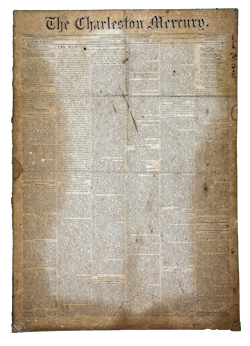
January 7, 1861, The Charleston Mercury

THE RICHARDSON GUARD, preceded by a fine band of music, passed through our principal streets last night, and in the evolutions of their drill evinced remarkable proficiency. They proceeded to the residence of their First Lieutenant, CHAS. H. AXSON, Esq; where, in response to repeated cheers and calls, he came out and acknowledged the compliment in appropriate terms. He then introduced F.D. RICHARDSON, Esq; in whose honor the company was named, who delivered a stirring address. Speeches were also made by Hon. L.M. KEITT and Ex-Governor MANNING, who has taken a great interest in this fine corps, and who has aided them in the purchase of uniforms by a munificent donation. The company then, by invitation, entered and partook of a handsome collation, during which the best feeling prevailed. Shortly before midnight the company was dismissed, with three cheers for Hon. R. BARNWELL RHETT, and separated with six more cheers for Lieut. AXSON

0 comments

Mercury Bulletins

Civil War Day-by-Day

January 7, 1861, The Charleston Mercury

THE MERCURY BULLETINS, we are proud to learn, are always looked for at all the forts and fortifications as containing the very latest and most reliable news in this great crisis. Yesterday afternoon, when copies or our special despatches from Georgia, Florida, Louisiana, Alabama and Washington, reached Fort Moultrie, the glad tidings they contained were greeted by the garrison with huzzas that made the welkin ring. We fancy that the benighted folks in Fort Sumter were rather puzzled to know what their Palmetto neighbors were cheering at.

0 comments

Civil War Day-by-Day

Civil War Day-by-Day
The Steam Ship 'Star of the West'

January 7, 1861

  • John Crittenden tries to resurrect his proposal on the floor of the Senate. It had earlier been killed by committee.
  • Virginia calls a special session of its Assembly to consider convening a convention on the question of secession.

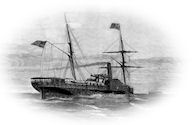
The image is of the steamship “Star of the West” (Harper’s Pictorial History of the Civil War)


0 comments

“He said he was going to show me what a convention was like.”—Susan Bradford

Through Some Eventful Years by Susan Bradford Eppes
Susa Bradford Eppes

January 6th, 1861.—This morning we went to Mount Zion to hear Mr. Blake preach. It is a treat to listen to his sermons, he uses such beautiful language and he explains the passages of Scripture he reads, so clearly that it really stays in our minds and we remember. All ministers do not do this. Today he spoke so earnestly of the representatives of the people of Florida, now in convention assembled in Tallahassee. He spoke of the heavy responsibility resting on them; of the high compliment paid them by the people of Florida, in trusting them with an issue of such paramount importance. He said we, none of us knew which way was best; we must trust in God and do good. We must remember that our strength cometh from on high and the way to gain that strength is to pray to the Lord, for He has said “knock and it shall be opened unto you. Ask and ye shall receive.” Of course I cannot tell it as he spoke it, but it made every one feel solemn and as if some share of the responsibility rested on each one of us.

Mr. Blake took dinner with us and Eddie came with him. He is just the shyest little boy. When the company were all gone Father told me to ask Lulu to get me ready to go with him to town next morning. He said he was going to show me what a convention was like. I was so happy at the thought of going and my heart fell when Mother said: “Surely, Dr. Bradford, you are not going to take the child away from school?” (Mother does not like us to miss any time) but Father said, “Yes, I am going to take her with me in the morning, this is history in the making, she will learn more than she can get out of books and what she hears in this way she will never forget.” I am so glad. I am so excited I cannot hold my pencil steady but I must write this down.


Susan Bradford is nearly 15 when this entry was made.

0 comments

“The news from the South is bad as it can well be.”—Horatio Nelson Taft

Diary of US patent clerk Horatio Nelson Taft.

SUNDAY 6

It has been said that “there are no Sundays in revolutionary times” and this has been a dark and anxious day. The Members of Congress have been together in small companies trying to agree upon some plan that will satisfy all sides. The news from the South is bad as it can well be. It looks as tho the North must prepare for a fight. If nothing but a fight will satisfy the South they can have one probably if it comes to Govt or no Govt.


The three diary manuscript volumes, Washington during the Civil War: The Diary of Horatio Nelson Taft, 1861-1865, are available online at The Library of   Congress.

0 comments

A Diary of American Events – January 6, 1861

The Rebellion Record – A Diary of American Events; by Frank Moore

–A meeting of citizens, irrespective of party, was held at Chicago, Ill., this evening. The resolutions adopted express love for the Union; regard every attempt to rend it as the basest treason and most insane folly; regard the Constitution of the United States as forming a union between the people of the several States, and intended to be perpetual; and every attempt by a State to secede or annul the laws of the United States, is not only usurping the powers of the general Government, but aggression upon the equal rights of the other States; that peaceable secession, if possible, must necessarily be a matter of agreement between the States, and until such agreement is made, the existing Government has no choice but to enforce the law and protect the property of the nation; that in view of what is now transpiring in the Southern States, of threats to prevent the inauguration of a President, constitutionally elected, it is incumbent upon the loyal people of the several States to be prepared to render all their aid, military and otherwise, to the enforcement of the Federal laws; that Major Anderson deserves the thanks of the country for the course pursued by him.–Evening Post, Jan. 8.

–A company of marines was put into Fort Washington, on the Potomac, 14 miles south of Washington city.

–Forty tons of shot, shell, and powder, were forwarded from New York city by Adams’ express for New Orleans; reported to be destined for Mexico, but believed to be for Louisiana.

–Several volunteer companies of Washington were on parade, and upon dismissal were directed to carry their guns to their homes with forty rounds of ball-cartridges each.

–The Alabama and Mississippi delegations in Washington held a conference, and telegraphed to the Conventions of their respective States, to advise immediate secession, as they consider that there is no prospect of a satisfactory adjustment. A caucus of Southern senators at Washington advocated separate and immediate secession.–Times, Jan. 7.

0 comments

Order from the Governor of Florida to seize the Chattahoochee Arsenal

War of the Rebellion: from the Official Records of the Union and Confederate Armies and Navies

U.S. ARSENAL, CHATTAHOOCHEE, FLA.,
January 6, 1861.

SIR: I have the honor herewith to inclose a copy of the order given to Colonel Dunn, the commander of the troops which took possession of this arsenal. I telegraphed this morning to you.

……….I am, sir, very respectfully, your obedient servant,

E. POWELL,
Ordnance Sergeant, U. S. Army.

Capt. W. MAYNADIER, Chief of Ordnance, Washington, D.C.

.

[Inclosure.]

.

STATE OF FLORIDA, EXECUTIVE CHAMBER,
Tallahassee, January 5, 1861.

SIR: Reposing special confidence in your patriotism, discretion, and integrity, I hereby authorize and empower you to raise a company of picked men and proceed to the Apalachicola River and seize and possess the arsenal, arms, ammunition, stores, buildings, and other property now in the possession of the General Government, and retain the same subject to my orders. You are requested to act with secrecy and discretion. You are further authorized to call out the Seventh Regiment Florida Militia for all aid in its power to render that you may deem necessary to retain occupation of said arsenal.

M. S. PERRY.

By the governor State Florida:
T. S. VILLEPIGUE, Secretary of State.

0 comments

Operations in Florida

War of the Rebellion: from the Official Records of the Union and Confederate Armies and Navies

CHATTAHOOCHEE, January 6, 1861.

The arsenal has been taken possession of by the State this morning, 7 o’clock. My forces too weak to defend it. I have refused keys of magazine and armory. Answer, with instructions.

E. POWELL,
U. S. Arsenal.

Captain MAYNADIER,
Chief Ordnance Department.

0 comments

Our Washington Correspondence

Civil War Day-by-Day

January 6, 1861, The New York Herald

WASHINGTON, Jan. 4, 1861.

There are no facts here. An event today is nothing tomorrow, and the scene shifts every hour. The storm is tremendous; but I think it will end without desolating the country. There are many unreasonable men at both extremes – men of precipitation and madness. But in the midst of all their talk I can see that they are not yet ready for savage action. The South Carolina Commissioners were calm, determined, resolute and did not yield any point. It is as well now, that they should not. In all my talk with them I was surprised at the strength of their position. The South generally is equally determined, not so hasty, but just as resolute, and firmly determined to accept no terms but those which will secures all their rights in some form or other.

You have seen the speeches of Nicholson and Benjamin. These tell the story. Rice’s resolutions, with Crittenden’s and Adams’s light advance, indicate one phase of the future.

Cushing is here, and his strong mind carries the principle high above the smoke of conflict for the guidance of the combatants.

There is much talk by Northern men who come here of a united feeling for protecting the federal flag and preserving the federal property. This will be done. The President will protect all the property in his power, and will undoubtedly arm the District against mobs. Yet after he shall have accomplished all in his power, the naked truth will be made more manifest, that, in consequence of the inactivity and imbecility of Congress the great array of strength will be on the side of the South. Georgia has occupied Fort Pulaski. This is the strongest position on our coast, and a small State force can prevent its being retaken, even if the united strength of our whole navy were brought against it. Pensacola [continue reading…]

0 comments

“I would be pleased to receive advice as to what disposition I shall make of myself and men.”—Operations in Florida

War of the Rebellion: from the Official Records of the Union and Confederate Armies and Navies

QUINCY, FLA., January 6, 1861.

SIR: I beg leave to state that I telegraphed this morning from Chattahoochee, and finding that I could get no answer, I came to this place and thought probably I might get an answer from you by writing from here. I informed you that the Florida troops had taken possession of the arsenal, and my force being so weak I was unable to offer any resistance.   I mailed a copy of the governor’s order, &c., this morning at Chattahoochee, but finding that it would not be forwarded on account excitement–they have taken all the public property in spite of all I could do–I refused giving up the keys, but the governor telegraphed to the commanding officer to insist on the delivery of the same, and I was compelled to give them up. I would be pleased to receive advice as to what disposition I shall make of myself and men.

……….I am, sir, very respectfully, your obedient servant,

E. POWELL,
Ordnance Sergeant, U.S. Army.

Capt. W. MAYNADIER, Washington, D.C.

0 comments

Abe Lincoln the Rail Splitter as a Cabinet Maker

Civil War Day-by-Day

January 6, 1861, The New York Herald

Honest Old Abe Lincoln, whose achievements as a splitter of rails now form part of the history of the country, has latterly been engaged in a new line of business, a rather higher branch of woodwork, to wit: – the manufacturing of Cabinets. There is all the difference in the world between splitting timber and putting it together; and we are not at all surprised to see that the opponents of Lincoln declare persistently that he is still at his old business of disintegration; that he has split the country in twain, and that all his Cabinet making will amount to nothing. On the contrary, it is quite natural that the friends of Lincoln should insist that he is a first rate Cabinet maker, and that he will manage to glue the North and South together and dovetail the Union so that all the seams and crack will be as smooth as if they had never been exposed to the fire of secession.

Of course the result of Old Abe’s first attempts at Cabinet making will be looked for with the utmost impatience by the country. Hon. Massa Greeley, who ought to be posted about the affair, gives the following list of Lincoln’s journeymen:

State – Wm. H. Seward, of New York

Treasury – Salmon P. Chase, of Ohio

Attorney General– Edward Bates of, Missouri

War – Simon Cameron, of Pennsylvania

Navy – Robert E. Scott, of Virginia

Interior – Wm. A. Graham, of N. Carolina.

Postmaster General –Gideon Welles, of Connecticut

The first stick of timber brought to Springfield for Lincoln’s inspection was old Mr. Bates, of Missouri – a beautiful fossil, round, smooth, and in very excellent preservation. Old Mr. [continue reading…]

0 comments

“My position will… enable me to hold this fort against any force which can be brought against me…,” Operations in Charleston Harbor

War of the Rebellion: from the Official Records of the Union and Confederate Armies and Navies

FORT SUMTER, S.C., January 6, 1861.

Col. S. COOPER, Adjutant-General:

COLONEL: Through the courtesy of Governor Pickens I am enabled to make this communication, which will be taken to Washington by my brother, Larz Anderson, esq. I have the honor to report my command in excellent health and in fine spirits. We are daily adding to the strength of our position by closing up embrasures which we shall not use, mounting guns, &c. The South Carolinians are also very active in erecting batteries and preparing for a conflict, which I pray God may not occur. Batteries have been constructed bearing upon and, I presume, commanding the entrance to the harbor. They are also to-day busily at work on a battery at Fort Johnson, intended to fire against me. My position will, should there be no treachery among the workmen, whom we are compelled to retain for the present, enable me to hold this fort against any force which can be brought against me, and it would enable me, in the event of a war, to annoy the South Carolinians by preventing them from throwing supplies into their new posts except by the out-of-the-way passage through Stono River. At present, it would be dangerous and difficult for a vessel from without to enter the harbor, in consequence of the batteries which are already erected and being erected. I shall not ask for any increase of my command, because I do not know what the ulterior views of the Government are. We are now, or soon will be, cut off from all communication, unless by means of a powerful fleet, which shall have the ability to carry the batteries at the mouth of this harbor.

Trusting in God that nothing will occur to army a greater number of States than have already taken ground against the General Government,

I am, colonel, respectfully, your obedient servant,

ROBERT ANDERSON,

Major, First Artillery, Commanding.

0 comments

Civil War Day-by-Day

Civil War Day-by-Day
The Steam Ship 'Star of the West'

January 6, 1861

  • Florida militia takes over a federal arsenal near Appalachiacola.
  • Maryland’s pro-Union governor denounces secession in a speech to the residents of the state.
  • Fernando Wood, mayor of New York, proposes that New York City should secede as well, allowing trade with both the North and South

The image is of the steamship “Star of the West” (Harper’s Pictorial History of the Civil War)

0 comments

“This City is threatened and the Citizens do fear that a Mob will have possession of it…”—Horatio Nelson Taft

Diary of US patent clerk Horatio Nelson Taft.

SATURDAY 5

People were startled today to hear that the U.S. Forts and Arsenals at Savannah & Mobile had been taken possession of by the Revolutionists. Where this is all to end God only knows. It looks dark for our Country at present. But there is still a strong feeling that the Government will be upheld. This City is threatened and the Citizens do fear that a Mob will have possession of it unless measures are taken to defend it; incendiary fires occur every night and we feel very unsafe.


The three diary manuscript volumes, Washington during the Civil War: The Diary of Horatio Nelson Taft, 1861-1865, are available online at The Library of   Congress.

0 comments