1861. January 5.–….Mr. Motley, the historian, called and spent an hour in chat. I expressed my great delight with his recently issued work, the “Dutch Republic.” Told him I had noted two new spellings, Escorial and Burghley; the first he said was unquestionably correct, the second he took from the Lord Treasurer’s uniform mode of signing his name, though it was spelled very variously. In the course of conversation he avowed the opinion that Walsingham, not Burghley, was the great Minister of Queen Elizabeth, and he thought that Elizabeth had taken to herself merit and glory which really belonged to the British people generally. We turned over the distressing condition of American politics. He is for saving the Union at almost any sacrifice; but I thought I could perceive that he entertained the theory that, maintaining the name, the flag, and the Constitution, we should be happier and equally great without the cotton States. He is inveterately hostile to slavery. Now that his two volumes are making him famous, he proposes to be presented with his wife and daughter at Court. Of course I shall be proud to gratify his wish in that respect. I think he remembers that the literary fame of Washington Irving made him chargé at this Court and subsequently Minister at Madrid. Lincoln can give me no more acceptable successor. The foundations for such an appointment are more broad, more durable, and in every way more satisfactory than those of mere political partisanship.
American Civil War Chronicles
At the Court of St. James.—George Mifflin Dallas, United States Minister to England.
January 5, 2026
A Diary of American Events – January 5, 1861
January 5, 2026
–A large meeting was held at Norfolk, Va., this evening. Strong speeches were made, urging the citizens to arm themselves and place themselves in a state of defence for any emergency, which were loudly cheered.
Resolutions recommending the Legislature to organize thoroughly the military power of the State, and prepare for civil war should it occur; scorning coercion; and preparing to resist invasion, were unanimously adopted.–National Intelligencer, Jan. 7.
–Apprehensions of an attack on Washington are subsiding, in consequence of the measures already taken. General Carrington, of that city, has issued a call for a military organization for its defence.–(Doc. 15.)
–In the State Convention of Florida, assembled at Tallahassee, resolutions were offered declaring the right of Florida to secede, and the duty of the State to prepare for secession, made special order for the 7th.
Resolution was unanimously adopted in the Missouri Senate, instructing the Committee on Federal Relations to report a bill calling a State Convention.– Times.
–Steamship Star of the West, Captain McGowan, cleared at New York for Havana and New Orleans. Two hundred and fifty artillerists and marines, with stores and ammunition, were put on board in the lower bay by steam-tug, and in the night the ship went to sea, supposed to be destined for Charleston.
–The South Carolina Convention adjourned this morning, subject to the call of the president–Evening Post, Jan. 5.
Great Excitement in Charleston
January 5, 2026Frank Leslie’s Illustrated Newspaper, January 5, 1861
Fort Moultrie Evacuated—The Guns Spiked—The Gun-Carriages Burnt—Captain Foster left in Charge with a few Men—Colonel Anderson in Possession of Fort Sumpter.

Spiking the Guns in Fort Moultrie, Charleston, S. C., Previous to the Evacuation of the Fort by Col. Anderson and the U. S. Troops
On Thursday, at noon, New York was thrown into a state of terrible excitement by rumors which grew and grew, that Fort Moultrie had been attacked by the citizens of Charleston, taken and burnt. Expressions of regret predominated greatly, as it was feared that compromise would now be entirely out of the question. By degrees, as the telegraphic dispatches arrived slowly and meagrely, the excitement subsided in a measure, but expectation was feverish as to what the morrow would bring forth.
Up to the time of our going to press the only facts positively known were, that on Christmas night Colonel Anderson evacuated Fort Moultrie and took possession of the almost impregnable Fort Sumpter, which, though not fully armed, is still armed sufficiently for all purposes of defence. Before abandoning Fort Moultrie, the commander had all the guns spiked, rendering them of no practical use to any who may. come after him. The gun
carriages, of which there were a vast number, were ordered to be burnt, the fire and smoke from which doubtless gave rise to the report that the fort had been.destroyed. It is positively asserted that in abandoning Fort Moultrie and taking possession of Fort Sumpter, Colonel Anderson acted upon his own responsibility. Whatever his reasons were, he doubtlessly deemed them sufficiently grave to warrant his acting without orders, but he will assuredly have to render a strict account for this bold and important strategical movement.

Evacuation of Fort Moultrie, and Burning of the Gun Carriages, On Sullivan’s Island, Charleston Harbor, S. C.
It is said that the authorities of Charleston have taken possession of the telegraph and assumed its entire control, therefore we remain in anxious uncertainty as to what action was taken after the abandonment of the fort, the burning of the gun carriages and the defiant seizure of Fort Sumpter, at the moment, too, when the South Carolina Commissioners were on the way to Washington, authorized to settle all matters of dispute.
We give in this number accurate pictures of the interior and exterior of Fort Moultrie, together with the exciting scenes which have transpired there. The following description of the two Forts, Moultrie and Sumpter, with the map which we engrave, will show their relative strength and position:

Exterior View of Fort Moultrie, On Sullivan’s Island, in the Harbor of Charleston, S.C.
as it Appeared Previous to the Evacuation. – from a Photograph by _ Luce, Esq.
Fort Moultrie.
This fortification is an enclosed water battery, having a front on the south or water side of about three hundred feet, and a depth of about two hundred and forty feet. It is built with salient and re-entering angles on all sides, but until the works now going on there were undertaken the south wall could have been easily scaled, owing to the accumulation of sand from the beach. Some improvement, however, has been recently effected in this respect. The outer and inner wall are of brick; capped with stone, and filled in with earth, making a solid wall fifteen or sixteen feet in thickness. The work now in progress consists in cleaning the sand from the walls of the fort, ditching it around the entire circumference, and erecting a glacis, closing up the postern gates in the east and west walls, and instead, cutting sally ports, which lead into strong outworks on the south-east and south-west angles, in which twelve pounder howitzer guns will be placed, enabling the garrison to sweep the ditch on three sides with grape and canister. The north-west angle of the fort has also been strengthened by a bastionette, to sustain the weight of a heavy gun which will command the main street of the island. The main entrance has also been better secured, and a trap door two feet square cut in the door for ingress and egress. At this time the height of the wall, from the bottom of the ditch to the top of the parapet, is twenty feet. The ditch is from twelve to fifteen feet wide at the base, and fifteen feet deep. The nature of the soil would not soon to admit of this depth being increased, quicksand having been reached in many places. The work on the south side is nearly finished. The counterscarp is substantially built of plank, and spread with turf. The glacis is also finished. It is composed of sand, and covered with layers of loam and turf, all of which is kept firmly in place by the addition of sections of plank nailed to uprights sunk in the sand, and crossing each other at right angles—making squares of about ten feet each. The purpose of the glacis, which is an inclined plane, is to expose an attacking party to the fire of the guns, which are so placed as to sweep it from the crest of the counterscarp to the edge of the beach.

View of the Ramparts of Fort Moultrie, Charleston Harbor, S. C. – from a Photograph by _ Luce, Esq.
Fort Sumpter
Fort Sumpter is one of the most powerful military works in the United States. It is built on an artificial island, immediately within the mouth of Charleston bay, between Fort Moultrie- and the site of old Fort Johnson, of Revolutionary memory, and equidistant from those points about three-fourths of one mile. The ship channel leading from the sea to the City of Charleston is between Forts Sumpter and Moultrie, and is entirely commanded within half range by them. Between Forts Sumpter and Johnson the water is very shallow, only available for vessels of very light draft, and then only at high water. The artificial island on which Fort Sumpter is built is constructed of the refuse from the granite quarries of New England. Ten years were consumed in its completion, at a cost of half a million of dollars. The fortification is of a pentagonal form, built of solid brick masonry. The walls are fifty feet in height, and from eight to ten feet in thickness, and are pierced for three tiers of guns, besides having necessary loopholes for musketry, and designed for an armament of one hundred and forty pieces of ordnance of all calibres. Two tiers of the guns are under bomb-proof casements, and the third or upper tier open, Or, in military parlance, en barbette—the lower tier for forty-two pounder Paixhan guns; the second tier for eight and ten-inch Columbiads, for .throwing solid or hollow shot, and the upper tier for mortars and twenty-four pound guns.
A brief account of the man who is now exciting so wide a discussion will interest our readers:
Major Robert Anderson, U.S.A., the commander of Fort Moultrie, was born in September, 1810, and graduated with high honor at West Point, July 1, 1825, the date of his commission as second lieutenant in the Third Regiment. He served in the Black Hawk War, and in 1838 was assistant instructor and inspector at West Point. In 1838 he became aide-de-camp to Major-General Scott; and in the following year published “Instruction for Field Artillery, Horse and Foot, arranged for the service of the United States.” “For gallantry and successful conduct in the war against the Florida Indians,” he received the brevet of captain, bearing date April 2, 1838. July 7, 1838, he became assistant adjutant-general with the rank of captain, which he relinquished subsequently to being promoted to a captaincy in his regiment, October 1841. In March 1848, he was with the Third Regiment of Artillery in the army of General Scott, and took part in the siege of Vera Cruz—being one of the officers to whom was entrusted, by General Bankhead, the command of the batteries. This duty he performed with signal skill and gallantry, and he continued with the army until its triumphal entry into the city of Mexico, in September following. During the operations in the valley of Mexico he was attached to the brigade of General Garland, which formed a part of General Worth’s division. In the attack on El Molino del Rey, on the 8th of September, where he was wounded very severely, his conduct was the theme of especial praise, and for gallant and meritorious conduct in this battle he was promoted to the brevet rank of major, dating September 8, 1847. October 5, 1857, he was promoted to the position of Major of the First Artillery, which he now holds. He is a man of “clear grit pluck” and high-toned honor, and a devoted lover of the Union.

Plan of the Harbor of Charleston, S. C., Showing the Relative Position of the Several Fortresses
Postscript.
The last news from Charleston states that Forts Moultrie and Pinckney were taken possession of by the South Carolina military, and that the Palmetto flag was flying over those forts. as well as the Custom House and Post Office. It was also said that the South Carolina Commissioners at Washington had demanded from the President the immediate surrender of Fort Sumpter, or this shall be their last interview, and they will return to South Carolina and prepare for the worst.
D. L. Yulee: “The occupation of the navy-yard will give us a good supply of ordnance and make the capture of the forts easier.”—Operations in Florida—Confederate Correspondence
January 5, 2026
WASHINGTON,
January 5, 1861.
JOSEPH FINEGAN, Esq., or
Col. GEO. W. CALL [Tallahassee, Fla.]:
MY DEAR SIR: The immediately important thing to be done is the occupation of the forts and arsenal in Florida. The naval station and forts at Pensacola are first in consequence. For this a force is necessary. I have conversed with Mr. Toombs upon the subject. He will start this week for Georgia, and says if the convention of sov’y [sovereignty] will ask Governor Brown, of Georgia, for a force he will immediately send on sufficient force and take the navy-yard and forts. The occupation of the navy-yard will give us a good supply of ordnance and make the capture of the forts easier. Major Chase built the forts and will know all about them. Lose no time, for, my opinion is, troops will be very soon dispatched to re-enforce and strengthen the forts in Florida. The arsenal at Chattahoochee should be looked to, and that at once, to prevent removal of arms.
I think that by 4th March all the Southern States will be out, except perhaps Kentucky and Missouri, and they will soon have to follow.
What is advisable is the earliest possible organization of a Southern Confederacy and of a Southern Army. The North is rapidly consolidating against us upon the plan of force. A strong Government, as eight States will make, promptly organized, and a strong Army, with Jeff. Davis for General-in-Chief, will bring them to a reasonable sense of the gravity of the crisis.
Have a Southern Government as soon as possible, adopting the present Federal Constitution for the time, and a Southern Army. I repeat this because it is the important policy.
Virginia, Maryland, and Tennessee are rapidly coming up to the work.
God speed you.
I shall give the enemy a shot next week before retiring. I say enemy! Yes, I am theirs, and they are mine. I am willing to be their masters, but not their brothers.
Yours, in haste,
D. L. YULEE.
Lose no time about the navy-yard and forts at Pensacola.
The Secession of Alabama and Mississippi
January 5, 2026
Mobile, January 5, 1861.
DEAR SIR: I have been superseded by Colonel Todd, of the Militia of Alabama, and he took and receipted for all the property belonging to the Ordnance Department and fort.
I wait for orders from the Adjutant-General.
……….I am, very respectfully,
S. PATTERSON,
Ordnance Sergeant, U. S. Army.
The ADJUTANT-GENERAL.
Susan Bradford.—”Cousin Rob does not care about the convention..,”
January 5, 2026
January 5th, 1861.—This is Saturday and Mother lets Lulu make candy on Saturday and if she, my black mammy, will let us, we help with it. She says we “do not help but hinder;” maybe she is right. Cousin Rob is spending the day here and Lulu has promised to teach us how to make the candy baskets, which we love to have her make for us. Cousin Rob does not care about the convention, he is going to school in town but comes home Friday after school and goes back Monday morning. He is calling me now to play Graces, so will say goodbye for this time, little diary.
Susan Bradford is nearly 15 when this entry was made.
The Crisis and the Remedy in the North and in the South.
January 5, 2026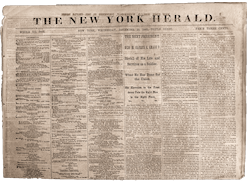
January 5, 1861, The New York Herald
The conservative masses of the people, North as well as South, have become fairly aroused to the conviction that, in this most critical period of our nation’s history, no remedy whatever is to be looked for from their representatives in Congress. A background of incapacity, stupidity, imbecility, gross ignorance and habitual venality only presents in stronger relief such weakness and cowardice, on the part of the majority of the members of the United States Senate and House of Representatives, as has but one or two parallels in the history of constitutional governments. At a moment when the discretion, judgment, patriotism and prestige are needed of statesmen, similar to those produced by the country in the days of Washington and Jefferson, there is only to be found a desolate blank in knowledge and sagacity at the source from whence sound and healthy legislation should proceed. Each incumbent of office, North and South, for the term of two or six years, lives in deadly fear of incurring unpopularity among the populace of his own district or State and even the few who possess the ability are wanting in the moral courage, independence and freedom from local domination which are indispensable for the comprehension of these broad views of inter-State policy which must be developed to heal the present and avert the impending evils that menace the prosperity of the confederation.
Such is the humiliating prospect which greets citizens of the United States in the halls of the Capitol. If they turn their eyes to the present and incoming administrations, an equally sickening state of affairs is presented to view, without the slightest hope of remedy. The wise recommendations of Mr. Buchanan in his annual Message, and the decided stand he has taken with regard to the South Carolina Commissioners, commend themselves to the favor of the nation; but Congress burrows forward in its molehill, and refuses to adopt his suggestions, and to strengthen his hands to stay the downward descent towards disintegration and anarchy. Mr. Lincoln occupies himself with figuring out a Cabinet; and in awarding spoils he may not be permitted to distribute, while not a [continue reading…]
Another Resignation.
January 5, 2026
January 5, 1861, The Charleston Mercury
It is our pleasing duty to record, this morning, the patriotic course of another son of South Carolina, in the resignation, some days since, of Mr. WILLIAM WILKINSON, from the Naval School at Annapolis. The opportunity of a naval education and position have thus voluntarily been abandoned from a high sense of duty, and of proper State pride.
The Georgetown Rifle Guard— Commendable Liberality.
January 5, 2026
January 5, 1861, The Charleston Mercury
We learn that P.D.J. WESTON, Esq; has presented to the Georgetown Rifle Guard, Captain E.J. WHITE, one hundred and twenty of the fine English weapon known as the ‘Enfield Rifle’ with accoutrements and ammunition ample for a long campaign, besides placing funds at the disposal of the company. The Georgetown Guard, composed of many of the first citizens of that place now numbers eighty four, rank and file. The members are making every exertion to place themselves upon a war footing, and they expect to be ordered by detachments to take charge of the fortifications now being erected at the entrance of the harbor by the planters under the superintendence of L.F. LEBLEUX and E.J. WHITE.
Military
January 5, 2026
January 5, 1861, The Charleston Mercury
A detachment of the Richardson Guard, Lieut. C.H. AXSON, were out on duty Sunday afternoon. Another platoon passed the MERCURY office yesterday afternoon, under the command of Lieut. BOAG.
The detachment of Citadel Cadets who have been on the seashore since the first of January, passed our office yesterday on their way to the Citadel, to resume their studies. By their skill and energy the first battery was erected for the defence of Charleston: by their admirable gunnery Federal insolence was checked, and the Star of the West, with her warlike crew, was sent back without having accomplished her stealthy mission. It is well that their duties on the field should now be changed to that of the Academy. They will be thus enabled to make preparation for the future. The Executive knows full well, that at the tap of the drum lads in gray will answer to roll call and gladly receive the order, ‘Forward!’ particularly if a visit is to be paid to Capts. DOUBLEDAY or FOSTER, in Fort Sumter. The Cadets were escorted to the steamer, on their departure, by the Washington Light Infantry, who turned out in large numbers, as a compliment to their old friends. As soon as the steamer started, the Washington Light Infantry gave three cheers, which the Cadets returned with a tiger. They will be missed by the entire garrison, for their places cannot be well supplied.
The Palmetto Riflemen, Capt. MELCHERS, in a gray fatigue suit, passed through Broad street on parade yesterday; the ranks were full, and we doubt not the Captain and his command are ready for any emergency that may arise.
Washington Light Infantry. – Rev. A. TOOMER PORTER, Chaplain – in spite of the rain storm – paid his accustomed visit to the Washington Light Infantry’s quarters, on Sunday afternoon, where divine service was performed. Owing to the inclemency of the weather, the Chaplain was persuaded to remain over night, and, we learn, was [continue reading…]
Civil War Day-by-Day
January 5, 2026
January 5, 1861
- At the last minute General Winfield Scott substitutes the Star of the West, a New York based merchant marine vessel for the Brooklyn, a heavily armed and reinforced sloop ordered to sail to Fort Sumter to resupply the federal outpost. The Brooklyn, however, is to travel to Fort Sumter with the Star of the West.
The image is of the steamship “Star of the West” (Harper’s Pictorial History of the Civil War)
Susan Bradford.—Asking questions about the convention…
January 4, 2026
January 4th, 1861.—I can hardly keep my mind on my books I am thinking so much of the probable action of the convention. I know Father must have been glad when the school bell rang this morning, it seems impossible for me to refrain from asking him questions, which, of course, must be troublesome.
Susan Bradford is nearly 15 when this entry was made.
The “Rattle Snake” and the “Pitiful Palmetto” —Horatio Nelson Taft
January 4, 2026
FRIDAY, JANUARY 4, 1861.
A Mild and pleasant day but I think people feel much like wearing sackcloth and observing the day as recommended. There has been services at most of the churches which were crowded. Myself and wife went to the Capitol to hear Doct Stockton the Chaplin at the “House.” The Hall of Congress was crowded to excess and the services were very solemn. The “Rattle Snake” and the “pitiful Palmetto” even alluded to in connection with the “Eagle” and the glorious “Stars and Stripes.” Stores &c all closed.
The three diary manuscript volumes, Washington during the Civil War: The Diary of Horatio Nelson Taft, 1861-1865, are available online at The Library of Congress.
We must meet Lincoln with a President of our Own
January 4, 2026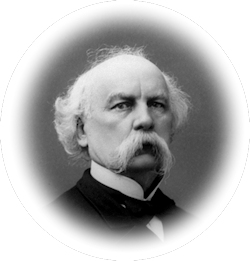
William Henry Trescot[i] to Howell Cobb. E.
(Private and confidential.)
Barnwell Island, Near Beaufort, So. Ca., Jany. 14, 1861.
My Dear Mr. Cobb, I reached home on Friday last with the intention of returning to Charleston today; but having been too late for the railroad I find time enough to do what I have been wanting to do for some weeks—write you a long letter. It would indeed have to be a very long one to give you the history of the events in Washington since you left it. A strange, sad, history it is, and if ever truly written will exhibit a marvellous example of folly in high places. . . .
The papers will have given you by this time Floyd’s[ii] letter of resignation, the correspondence with the Carolina Commissioners, Thompson’s resignation and the President’s special message; and I think they tell their tale. But very few persons will ever know how earnestly and faithfully Mr. Buchanan’s best friends strove to save him, and I believe would have saved him but for Holt and Black. But you were gone, Floyd had resigned Thompson and Thomas sure to go, and Black, Holt, Stanton and Toucey inflexible. That the Union was gone was clear, and their home position had to be secured. As Black said to me the morning I left, “You beat us all the way through, and came very near carrying your last point but fortunately our last card was a trump”—which I suppose means that they threatened resignation. Mr. Buchanan’s position was undoubtedly a difficult one. . . . If, when Anderson moved to Fort Sumter, he had said to the commissioners—”this is against my orders. I would have corrected it but you have taken the forts and I cannot restore the status. I am willing to act in good faith, meet me half way,” he would have had any facility furnished him. On Sunday the ______ I went to him at one o’clock and plead with him for an hour. Unfortunately Toucey[iii] was there. And when I left, I went to Hunter of Virginia and asked him to go to the President and say, “If your only difficulty is the occupation of the forts, say to the commissioners that you will withdraw Anderson from Sumter if they will evacuate the others and restore them to you, to be held as property until this question is settled; say so now, altho four days have passed, and it will be accepted.” Hunter did go and when he came back, he said, “It is useless to repeat what passed. The case is hopeless. The President has changed his ground and will maintain it to the last extremity. Telegraph your people to sink vessels in the entrance of the harbour immediately. They have no time to lose.”
It was not until after this and a great deal more that the letter of the commissioners was written, and then it was meant to be not a diplomatic note to the President but a protest against bad faith and a vindication before the country.
The events which have transpired since, you know—the attempt to send reinforcements; the fire upon them; and civil war depending upon the guns at Fort Sumter. Anderson did not fire but took to writing, and as a matter of course put himself in the wrong, and another chance has thus been afforded Mr. Buchanan. God knows if he is wise enough or strong enough to use it. I hope so. Late on the night before I left, the Governor sent for me to go to Washington, but I declined. I did not see what good was to be done there, and I could not tell what might be done at home while I was away. All things are, I believe, working for good; but neither the government at Washington nor Charleston is helping it forward much. It really does seem that a revolution works its way through the blunders of those who attempt to direct it.
I was not one of the commissioners[iv] officially, but the convention upon my return passed a vote of thanks for services, etc., and put me on the footing of a commissioner. I have not seen their resolution, don’t understand it exactly, but as it was meant kindly have no criticism to make upon it.
I believe you were right from the beginning, altho circumstances so far have helped us all on wonderfully. You will be glad to know that you made a very pleasant and wholesome impression upon our people, and the convention paid you a compliment which I think is a very great one from that body. When the election of a commissioner to Georgia came up, a member rose and stated that you had expressed a wish that Orr should be sent, and he was unanimously elected. But whatever policy it may have been wise to urge a month ago, I am sure you will agree with me that now it is all important to take Georgia out at once and organize a Southern government immediately. We must meet Lincoln with a President of our own. We want the military resources of the South concentrated at once; and above all, our foreign relations ought to be assured as quickly as possible. No attempt at foreign negociations ought to be made by single states. I trust that these are your views. I deem them all important. The condition of weakness and confusion which will result from four or five states floating about is indescribable. Weld them together while they are hot.
As to the Presidency, I will say nothing as yet. If you have anything to say, let me know. You will understand me. I have only one favour to ask—let me have a hand in organising the State Department. There are a great many things I don’t understand, but that I do.
I will be very glad to hear from you.
P. S.—I go to Charleston tomorrow—direct to me there care of Messrs. Barnwell & Son, Factors.
[i] U. S. Assistant Secretary of State, 1860, author of ” The Position and Course of the South ” (1850), ” Diplomatic History of the Administrations of Washington and Adams ” (1857), etc.
[ii] John B. Floyd of Virginia, Secretary of War in Buchanan’s cabinet.
[iii] Isaac Toucey, of Connecticut, Secretary of the Navy in Buchanan’s cabinet.
[iv] From South Carolina.
From Annual Report of the American Historical Association for the Year 1911.
William Henry Trescot was an American diplomatist born in Charleston, South Carolina, on November 10, 1822. From 1852 to 1854 he was secretary of the U.S. legation in London. In June 1860 he was appointed assistant secretary of state, and he was acting secretary of state in June–October, during General Lewis Cass’s absence from Washington, and for a few days in December after Cass’s resignation. His position was important, as the only South Carolinian holding anything like official rank, because of his intimacy with President James Buchanan, and his close relations with the secession leaders in South Carolina. He opposed the reinforcement of Fort Sumter, used his influence to prevent any attack on the fort by South Carolina before the meeting of the state’s convention called to consider the question of secession, and became the special agent of South Carolina in Washington after his resignation from his position as United States Assistant Secretary of State in December. He returned to Charleston in February 1861.
Howell Cobb was an American political figure. A southern Democrat, Cobb was a five-term member of the United States House of Representatives and Speaker of the House from 1849 to 1851. He also served as the 40th Governor of Georgia and as a Secretary of the Treasury under President James Buchanan. Cobb is, however, probably best known as one of the founders of the Confederacy, having served as the President of the Provisional Congress of the Confederate States.
A Diary of American Events – January 4, 1861
January 4, 2026
–Great excitement prevailed at Norfolk, Va., in consequence of the report that four companies of soldiers at Fortress Monroe had been ordered to Charleston.–Balt. Sun.
–It is stated in Washington, on the authority of a member of the Georgia delegation, that the United States revenue cutter Dolphin was fired upon and seized to-day, by the secessionists at Savannah. Upon the same statement in Georgia, the Governor issued an order for her release.–Times, Jan. 5.
–The South Carolina Convention appointed Hons. T. J. Withers, L. M. Keitt, W. W. Boyce, James Chesnut, Jr., R. B. Rhett, Jr., R. W. Barnwell, and C. G. Memminger, delegates to the General Congress of the seceding States.
–The United States arsenal at Mobile was taken by the secessionists at daylight this morning. It contained six stand of arms, 1,500 barrels of powder, 300,000 rounds of musket-cartridges, and other munitions of war. There was no defence.–Evening Post, Jan. 7.
–An appeal to the people of Florida, by the Charleston Mercury, to seize the forts and other defences at Pensacola and Key West, threatens the capture of the California treasure ships by letters of marque and privateers.–(Doc. 13.)
–Fast-day throughout the United States, by proclamation of the President. It is generally observed.–(Doc. 14.)
–Fort Morgan, at the entrance of Mobile Bay, was taken this morning by Alabama troops, and is now garrisoned by two hundred men.–The Press, Jan. 5.
–This evening a workingmen’s meeting was held at Cincinnati, Ohio. Speeches were made, and resolutions adopted, declaring that the Union must be preserved in its integrity by the enforcement of the laws in every part of the Union, by whatever means may be necessary; that the remedy for all grievances can be had under the constitution, and that the only way to safety and peace is the maintenance of it.–Troy Times.
–At Schenectady a salute was fired in honor of Major Anderson and his brave men. National airs were performed amid cheers for Major Anderson and Secretaries Holt and Stanton.–Albany Journal.
–A meeting was held at Westchester, Pa., to enrol volunteers in the regiment of Chester county, to offer their services to the Government to maintain the constitution and enforce the laws.–Evening Post. Jan. 5.
–The following notice is served on residents of Charleston, indiscriminately:
Beat No 1, 16th Regiment, Regimental Parade.
Sir: You are hereby summoned to be and appear at the Citadel Square, properly armed and accoutred, according to law, on Wednesday next, at 1 o’clock P. M., precisely. An inspection of arms will take place at each parade. If you appear in pantaloons, blue or black coat and black hat, arms and accoutrements in complete order will be furnished you at each parade on the ground; if not, the law compels you to furnish yourself with a musket, bayonet, cartridge-box, bayonet-scabbard, with cross-belts, all in good order and fit for service, on one dollar fine for each defect.
Every person subject to military duty in this regiment, who removed from one beat to another, is required to report himself to the captains of the beats from which and to which he has removed, or be fined five dollars, besides all fines for the non-performance of military duty in both beats.
Court-martial held on defaulters at the Military Hall, Wentworth street, on the third Monday of December, at 12 o’clock IL By order of captain.
S. Vale Mallins, Corporal.
Operations in Florida
January 4, 2026
HEADQUARTERS OF THE ARMY,
Washington, January 4, 1861
Maj. ZEALOUS B. TOWER, U.S. Engineer Corps:
SIR: With this you will receive an order assigning you to duty according to your brevet rank, and placing you under my command. You will proceed without delay to the Barrancas and assume the command of the troops and forts in and about Pensacola Harbor. You will wait on the commander of the Pensacola navy-yard, ask his hearty co-operation in the great object of your mission, viz, to prevent the seizure of those works or either of them by any body of men whatsoever. Should either of them be preoccupied by any hostile body of men you will first summon them to surrender, and, in case of refusal, consult with the naval commander as to the sufficiency of your joint means to compel a surrender, and if it should appear to both on grave consideration that the means are sufficient you will exert them to a reasonable extent to effect that object.
Should the intruders surrender without the application of force you may permit them to depart in peace, with the promise of an exemption from legal pursuit, and if the surrender be the result of the application of force permit the captives to depart, but without any promise whatever.
With every confidence in you, I remain yours, truly,
WINFIELD SCOTT.

If the telegraphic wires be in operation, report often; but both the wires and the mail may be under hostile control. In important cases, therefore, send messengers.
The Secession of Alabama and Mississippi
January 4, 2026
MOUNT VERNON ARSENAL, January 4, 1861.
SIR: I have the honor to inform you that this arsenal was taken possession of by four companies of volunteers from Mobile at daylight this morning. I did not make, nor could I have made, any resistance, as they had scaled the walls and taken possession before I knew anything about the movement.
The governor has demanded all the public property, and his men now have entire possession of the arsenal.
I telegraphed to you today for orders as to what disposition is to be made of the enlisted men and of myself. If, unfortunately, my telegram should not be answered, I will wait here a few days in hopes of hearing from you; but in the event the mails should be stopped, I will discharge all those that desire it, and bring the others with me to Washington.
The men have not been paid, and I fear that now there is no prospect of it at present.
I shall probably leave here by the 11th instant, unless I should receive other orders. As it was impossible for me to hold this place with my seventeen men, I trust that the Department will not hold me responsible for this unexpected catastrophe.
……….Very respectfully, your obedient servant,
J. L. RENO,
Captain, Ordnance.
Capt. WM MAYNADIER, Ordnance Office.
Star of the West — Operations in Charleston Harbor
January 4, 2026
.
NEW YORK, January 4, 1861.
Lieut. Gen. WINFIELD SCOTT,
Washington, D. C.:
DEAR GENERAL: I had an interview with Mr. Schultz at 8 o’clock last evening, and found him to be, as you supposed, the commission, and together we visited Mr. M O. Roberts. The latter looks exclusively to the dollars, whilst Mr. S. is acting for the good of his country. Mr. R. required $1,500 per day for ten days, besides the cost of 300 tons of coal, which I declined; but, after a long conversation, I became satisfied that the movement could be made with his vessel, the Star of the West, without exciting suspicion. I finally chartered her at $1,250 per day. She is running on the New Orleans route, and will clear for that port; but no notice will be put in the papers, and persons seeing the ship moving from the dock will suppose she is on her regular trip. Major Eaton, commissary of subsistence, fully enters into my views. He will see Mr. Roberts, hand him a list of the supplies with the places where they may be procured, and the purchases will be made on the ship’s account. In this way no public machinery will be used.
To-night I pass over to Governor’s Island to do what is necessary, i.e., have 300 stand of arms and ammunition on the wharf, and 200 men ready to march on board Mr. Schultz’s steam-tugs about nightfall to-morrow, to go to the steamer, passing very slowly down the bay. I shall cut off all communication between the island and the cities until Tuesday morning, when I expect the steamer will be safely moored at Fort Sumter.
I have seen and conversed with Colonel Scott, and also saw your daughter at your house. After leaving you, I obtained the key of the outer door of the office, but could nowhere find the key of your door or of mine, so failed to get the chart. This is of little moment, as the captain of the steamer is perfectly familiar with the entrance of Charleston.
I telegraphed you this morning, as follows:
Arrangements made as proposed; to leave to-morrow evening; send map.
I will now leave the office, where I am writing, to proceed to the island.
Very sincerely, General, your obedient servant,
L. THOMAS,
Assistant Adjutant-General.

_____
HEADQUARTERS OF THE ARMY,
New York, January 5, 1861.
Maj. T. H. HOLMES,
Eighth Infantry,
Superintendent Recruiting Service, Fort Columbus:
SIR: By direction of the General-in-Chief, you will detach this evening two hundred of the best-instructed men at Fort Columbus, by the steamship Star of the West, to re-enforce the garrison at Fort Sumter, South Carolina.
They will be furnished with arms, and, if possible, one hundred rounds of ammunition per man. Orders will be given to the proper officers of the staff department to furnish one hundred stand of spare arms and subsistence for three months.
The officers assigned to duty with the detachment are Lieuts. C. R. Woods, Ninth Infantry; W. A. Webb, Fifth Infantry; C. W. Thomas, First Infantry, and Asst. Surg. P. G. S. Ten Broeck, Medical Department, all of whom will report for duty to Major Anderson, commanding Fort Sumter.
Yours,
L. THOMAS.

_____
HEADQUARTERS, January 5, 1861.
First Lieut. CHARLES R. WOODS,
Ninth Infantry, Fort Columbus:
SIR: The steamship Star of the West has been chartered to take two hundred recruits from Fort Columbus to Fort Sumter, South Carolina, to re-enforce the garrison at that post. You are placed in command of the detachment, assisted by Lieuts. W. A. Webb, Fifth Infantry; C. W. Thomas, First Infantry, and Asst. Surg. P. G. S. Ten Broeck, Medical Department. Arms and ammunition for your men will be placed on the steamer and three months’ supply of subsistence.
The duty upon which you are now placed by direction of the General-in-Chief will require great care and energy on your part to execute it successfully, for it is important that all your movements be kept as secret as possible. Accordingly, on approaching the Charleston bar, you will place below decks your entire force, in order that only the ordinary crew may be seen by persons from the shore or on boarding the vessel. Every precaution must be resorted to to prevent being fired upon by batteries erected on either Sullivan’s or James Island.
Yours,
L. THOMAS.
_____
HEADQUARTERS OF THE ARMY, New York,
January 5, 1861.
Maj. ROBERT ANDERSON,
First Artillery, Commanding Fort Sumter :
SIR: In accordance with the Instructions of the General-in-Chief, I yesterday chartered the steamship Star of the West to re-enforce your small garrison with two hundred well-instructed recruits from Fort Columbus, under First Lieut. C. R. Woods, Ninth Infantry, assisted by Lieuts. W. A. Webb, Fifth Infantry; C. W. Thomas, First Infantry, and Asst. Surg. P. G. S. Ten Broeck, Medical Department, all of whom you will retain until further orders. Besides arms for the men, one hundred spare arms and all the cartridges in the arsenal on Governor’s Island will be sent; likewise, three months’ subsistence for the detachment and six months’ desiccated and fresh vegetables, with three or four days’ fresh beef for your entire force. Further re-enforcements will be sent if necessary.
Should a fire, likely to prove injurious, be opened upon any vessel bringing re-enforcements or supplies, or upon tow-boats within the reach of your guns, they may be employed to silence such fire; and you may act in like manner in case a fire is opened upon Fort Sumter itself.
The General-in-Chief desires me to communicate the fact that your conduct meets with the emphatic approbation of the highest in authority.
You are warned to be upon your guard against all telegrams, as false ones may be attempted to be passed upon you. Measures will soon be taken to enable you to correspond with the Government by sea and Wilmington, N. C.
You will send to Fort Columbus by the return of the steamer all your sick, otherwise inefficient officers and enlisted men. Fill up the two companies with the recruits now sent, and muster the residue as a detachment.
I am, sir, very respectfully, your obedient servant,
L. THOMAS,
Assistant Adjutant-General.
The Secession of Alabama and Mississippi
January 4, 2026
EXECUTIVE DEPARTMENT,
Montgomery, Ala., January 4 [?], 1861.
To his Excellency JAMES BUCHANAN, President of the United States:
SIR: In a spirit of frankness I hasten to inform you by letter that by my order Fort Morgan and Fort Gaines, and the United States Arsenal at Mount Vernon were on yesterday (*) peacefully occupied, and are now held by the troops of the State of Alabama. That this act on my part may not be misunderstood by the Government of the United States, I proceed to state the motives which have induced it, and the reasons which justify it, and also the course of conduct with which I design to follow that act.
A convention of the people of this State will, in pursuance of a previously-enacted law, assemble on the 7th instant. I was fully convinced by the evidences which I had that that convention would at an early day, in the exercise of an authority which in my judgment of right belongs to it, withdraw the State of Alabama from the Government of the United States and place it in the attitude of a separate and independent power. Being thus convinced I deemed it my duty to take every precautionary step to make the secession of the State peaceful, and prevent detriment to her people.
While entertaining such a conviction as to my duty, I received such information as left but little, if any, room to doubt that the Government of the United States, anticipating the secession of Alabama, and preparing to maintain its authority within this State by force, even to the shedding of the blood and the sacrifice of the lives of the people, was about to re-enforce those forts and put a guard over the arsenal. Having that information, it was but an act of self-defense, and the plainest dictate of prudence, to anticipate and guard against the contemplated movement of the authorities of the General Government. Appreciating, as I am sure you do, the courage and spirit of our people, you must be sensible that no attempt at the coercion of the State, or at the enforcement by military power of the authority of the United States within its jurisdiction in contravention of the ordinance of secession can be effectual, unless our utmost capacity for resistance can be exhausted. It would have been an unwise policy, suicidal in its character, to have permitted the Government of the United States to have made undisturbed preparations within this State to enforce by war and bloodshed an authority which it is the fixed purpose of the people of the State to resist to the uttermost of their power. A policy so manifestly unwise would probably have been overruled by an excited and discontented people, and popular violence might have accomplished that which has been done by the State much more appropriately and much more consistently with the prospect of peace and the interests of the parties concerned.
The purpose with which my order was given and has been executed was to avoid and not to provoke hostilities between the State and Federal Government. There is no object, save the honor and independence of my State, which is by me so ardently desired as the preservation of amicable relations between this State and the Government of the United States. That the secession of the State, made necessary by the conduct of others, may be peaceful is my prayer as well as the prayer of every patriotic man in the State.
An inventory of the property in the forts and arsenal has been ordered, and the strictest care will be taken to prevent the injury or destruction of it while peaceable relations continue to subsist, as I trust they will. The forts and arsenal will be held by my order only for the precautionary purpose for which they were taken, and subject to the control of the convention of the people to assemble on the 7th instant.
……….With distinguished consideration, I am your obedient servant,
A. B. MOORE.
Operations in Florida
January 4, 2026
HEADQUARTERS OF THE ARMY
Washington, January 4, 1861.
Captain MEIGS, U. S. Engineers:
SIR: With this letter you will receive one hundred muskets and accouterments complete, with one hundred rounds of cartridges for each musket, to be used in defense of Fort Jefferson if you can find hands to use them. Major Arnold with his company will probably sail from Boston on the 7th instant to garrison your work. In the mean time it is quite possible that some attempt may be made to seize the fort by an expedition sailing from Charleston, say in the Isabel, and secessionists from Florida. All that it is possible for you to do without troops we know will be performed.
WINFIELD SCOTT.
Dissolution is Inevitable—Is a Reconstruction Possible?
January 4, 2026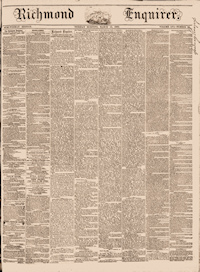
January 4, 1861, Richmond Enquirer
The rush of events is fast hurrying the final dissolution of the Confederacy; the excitement increases as despatch after despatch is made public, and subsides into deeper resentment and more determined resistance. Men ─ who a few months ago were Union men ─ soon become cooperationists, and are now the earnest advocates of separate State resistance. The whole mind of the State is fast accepting the only alternative left ─ that of separate State action. All hope of preserving the present Union has been abandoned by the people of Virginia; and while they earnestly desire that its dissolution may be peaceable, and that reconstruction may speedily follow, they will not be unprepared for war, if that dread alternative is tendered by the North.
Separate State action is necessary before that effectual co-operation can be had, which alone can produce reconstruction ─ and if the Northern people are not hopelessly blinded by the fanaticism that pervades their communities, they will recognize in the peaceable secession of South Carolina and other States the only hope of subsequent reconstruction. The Federal Government, while powerless to prevent dissolution, is not, under Mr. Buchanan at least, without great capacity to effect a reconstruction of the States into a durable and permanent confederacy. It is, indeed, to be hoped, that Mr. Buchanan has realized the fact that dissolution is inevitable, and that his whole duty centres in the preservation of the peace. Had he early recognized the causes of the county’s troubles as existing between the States, and that for their settlement the General Government was powerless, he might have opened the way, first for peaceable dissolution and next for reconstruction.
He has not thought proper to withdraw the forms of law from over those States in which he acknowledges it is impossible to execute them, and yet has declared it unconstitutional to coerce a State. The telegraph announces that, to all the wrongs already perpetrated upon South Carolina, he has superadded insults to her Peace Commissioners. If this be true, Mr. Buchanan has fully gone over to the coercionists, and it matters very little whether they be Black Republicans or democrats. He has driven from his Cabinet the representatives of the South, and taken to his councils Ge. Scott, brim full of malice and hatred towards the people of the South ─ a man who has the vanity to suppose, that in the anarchy which sectional war will introduce, he may become a Dictator, a la Napoleon. Mr. Buchanan has thus assumed the responsibility of inaugurating civil war. If he finds any consolation in this exploit, there will be none to [continue reading…]
Diary and Letters of Rutherford Birchard Hayes
January 4, 2026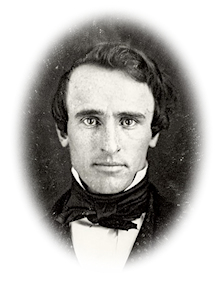
January 4, 1861.–South Carolina has passed a secession ordinance, and Federal laws are set at naught in the State. Overt acts enough have been committed. Forts and arsenal taken, a revenue cutter seized, and Major Anderson besieged in Fort Sumter. Other cotton States are about to follow. Disunion and civil war are at hand; and yet I fear disunion and war less than compromise. We can recover from them. The free States alone, if we must go on alone, will make a glorious nation. Twenty millions in the temperate zone, stretching from the Atlantic to the Pacific, full of vigor, industry, inventive genius, educated, and moral; increasing by immigration rapidly, and, above all, free–all free–will form a confederacy of twenty States scarcely inferior in real power to the unfortunate Union of thirty-three States which we had on the first of November. I do not even feel gloomy when I look forward. The reality is less frightful than the apprehension which we have all had these many years. Let us be temperate, calm, and just, but firm and resolute. Crittenden’s compromise! ¹
Windham speaking of the rumor that Bonaparte was about to invade England said: “The danger of invasion is by no means equal to that of peace. A man may escape a pistol however near his head, but not a dose of poison.”
¹Hayes’s disapproval of the Crittenden Compromise is indicated by the exclamation point. The venerable John J. Crittenden, Senator from Kentucky, sought by eloquent appeals to induce Congress to submit to the States for approval an amendment to the Constitution forbidding Congress to abolish slavery in the District of Columbia so long as it existed in Virginia or Maryland, or to abolish it in national territory south of latitude 360 30’–the southern line of Kansas. This was to be irrepealable by any subsequent amendment, as were also certain existing paragraphs in the Constitution relating to slavery. Further, Mr. Crittenden wished Congress to strengthen the Fugitive Slave Law and to appeal to the States and to the people for its thorough enforcement.
The News
January 4, 2026
January 4, 1861, The New York Herald
The reports from the South are again of a startling character. It is announced from Georgia that the Governor of that State has seized and garrisoned with militia the forts in the harbor of Savannah, and there is reason to believe that a plan has been matured by the secessionists for taking possession of all the fortifications on the Southern coast. The intelligence from Charleston is to the effect that Fort Sumter is besieged, that Major Anderson’s communications have been cut off, that Fort Moultrie has been repaired, that new batteries have been erected, and that everything is in readiness to open fire on the federal forces. The Florida Convention met yesterday. Without doubt this body will pass a secession ordinance as soon as the formalities can be gone through with. The federal Judge of Florida has resigned his commission.
A large and brilliant audience assisted at M. Du Chailler lecture before the Geographical and Statistical Society, Clinton Hall, last evening. M. Du Chailler gave an interesting account of his adventurers in Africa and of his encounters with the gorilla. From the formation of the brain and of the back bone, the organism of which was entirely different in the man and the ape, it was M. Du Chailler’s opinion that men never were and never could become apes, and vice versa. Of the slave trade he said the negroe of the interior thought that all white men were alike, and that they bought slaves to eat them. Masters there had perfect control over the lives of their slaves, but granted them every privilege. The negroes were sold for crime or for debt. The slaves brought to the coast said that there was a cloven footed tribe in the interior, but Du Chailler did not believe it. The thanks of the Society were voted the lecturer for his very interesting paper.
Excitement
January 4, 2026
January 4, 1861, Richmond Enquirer
This city was never before within our recollection, in such a state of excitement. The all-absorbing topic of conversation is the action of South Carolina, and on every man’s lips there is an eager cry of ‘What’s the news?’- and bulletin boards are watched for each new message, with intense eagerness. Let all our readers North understand this plainly, that the excitement here is not that of fear or submission. On the contrary, there is the utmost determination on all hands that this State shall never be pressed by the foot of an invader without resistance being offered to the very death. ─ Let it be understood, too, that South Carolina has the sympathy of the immense bulk of our citizens, and that she will be assisted and fought for to the bitter end. Some time ago there was an idea abroad, that there was a large body of submissionists among us, but that idea is now, indeed, a fallacy. ‘Fight’ is in every man’s mouth, and whoever assaults this old State will be encountered by such an uprising of our people, as will prove her to be a faithful and most loyal devotee of the motto on her banner ─ ‘Sic Semper Tyrannis’ ─ fighting for our homes and firesides, for State Rights and the rights of the South. We have a just cause, and for that cause we will do battle, every man of us, with all the power and strength in us.
Civil War Day-by-Day
January 4, 2026
January 4, 1861
- Alabama troops seize an arsenal near Mobile.
The image is of Fort Sumter, seen from the rear, at low water (Harper’s Pictorial History of the Civil War)