If you will let your whiskers grow I will try and get the rest of them to vote for you

Miscellaneous document sources

Westfield, Chatauqua Co. NY
Oct 15, 1860

Hon. A. B. Lincoln

Dear Sir,.

My father has just home from the fair and brought home your picture and Mr. Hamlin’s.   I am a little girl only eleven years old, but want you should be President of the United States very much so I hope you won’t think me very bold to write to such a great man as you are.   Have you any little girls about as large as I am if so give them my love and tell her to write me if you cannot answer this letter.   I have got 4 brothers and part of them will vote for you anyway and if you will let your whiskers grow I will try and get the rest of them to vote for you you would look a great deal better for your face is so thin.   All the ladies like whiskers and they would tease their husbands to vote for you and then you would be President.   My father is a going to vote for you and if I was a man I would vote for you to but I will try and get everyone to vote for you that I can.   I think that rail fence around your picture looks very pretty.   I have got a little baby sister she is nine weeks old and just as cunning as can be.   When you direct your letter direct to Grace Bedell Westfield, Chatauqua County, New York.   I must not write any more answer this letter right off.

Good bye.

Grace Bedell

.

Abraham Lincoln Letters and Documents at the Detroit Public Library

Note:

Shortly after this exchange, Lincoln allowed his beard to grow. By the time he began his inaugural journey from Illinois to Washington, D.C. by train, he had a full beard. The trip took him through New York state, and included a stop in Bedell’s hometown of Westfield, New York, where thousands gathered to meet the president-elect. Once there, Lincoln asked to meet Grace Bedell by name.

Bedell recalled the event years later:

“He climbed down and sat down with me on the edge of the station platform,” she recalled. “‘Gracie,’ he said, ‘look at my whiskers. I have been growing them for you.’ Then he kissed me. I never saw him again.”

0 comments

Hung

News of the Day
1860s newsprint

The Constitutional [Alexandria, LA], October 13, 1860

The Vigilance Committee of Henderson, Texas, have hung Green Herndon and his negro woman found guilty of firing the town.

0 comments

All I Now Hope for is to Defeat the Seceders

Miscellaneous document sources

Alexander H. Stephens to J. Henly Smith.

Crawfordville [Ga.], Oct. 13th, 1860.

Dear Smith, I got back from Hancock court this evening and found your letter of the 8th Inst. The news of the elections in Pa., Ohio and Indiana reached me at Sparta. I was not much disappointed though greatly saddened by the result. I have as you know ever since the final rupture at Baltimore been prepared for a general rout of the Democracy everywhere and the triumph of the Republicans in November. This conviction of the mind I have not been able to get rid of all the time. It is true I still hope for New York to prevent the catastrophe, but I see but little grounds upon which to rest a hope. We shall I fear very soon see the “beginning of the end” we have often heard so much of. I foresaw or thought I foresaw these coming events when the Administration began their war on Douglas on the grounds of his Freeport speech. That wickedly foolish policy has brought upon us all these troubles and those far greater troubles just ahead of us. Present appearances however will not cause me to relax in the least my endeavours to arrest the evils if possible. Should Mr. Breckinridge get the entire South and Lincoln the entire North no earthly power could prevent civil war. I do not know that it can be anyhow should Lincoln be elected. Still if those whose folly and wickedness brought it about should not be sustained at the South by public sentiment in their secession movement they may pause before pushing their projects to extremes. I do trust the popular vote of this State at least will not sustain them. How it will be I cannot venture a conjecture at this time. Had Indiana, Ohio or Pa. gone Democratic it would have aided us greatly. As it is I fear the sectional tendency in the popular mind will be increased by the result in all those States. I have not yet seen or witnessed the effect of these elections upon our people. The time has been too short. I shall fight on to the end. I made a speech on Wednesday in Sparta. It produced I was told a powerful effect. Many said it was the greatest speech I ever made. This I say to you though but to few would I so express myself. My health has greatly improved. I spoke two hours and a half. Next Wednesday I am to speak at Lexington—Saturday at Elberton, then at Savannah, and other places. Douglas is to be in Georgia on the 29th. We will keep the flag afloat even though he does not get a single electoral vote. Should the Government survive, the principles will live, they will form the basis for future action and organization. These are my views. I see the States and Union published the Confederacy’s report of my Atlanta speech. I was sorry for that. The report was a miserable one. The speech was one hour and a half long and the best parts were not alluded to, and in some instances I was very inaccurately reported. Indeed it was no report at all, it was simply an account of the speech put in the form of a verbatim report. I send you an account of our Dalton meeting, cut from the Rome Southerner. Judge Wright is the author of this. He was wonderfuly pleased with that demonstration. Mr. Cobb I see has come home and gone to stumping. Mr. Toombs is active. He spoke at Warrenton and Sparta during court. His speeches had no effect at either place. Linton is going up to a mass meeting at Turnpike Gate near Cuhutta Mountain in Murray County next Saturday. It is on the line of Gilmer and Murray counties. The popular mind is fast beginning to be awakened to the importance of the issues. If we had but six months to go upon I do verily believe the state could be carried for Douglas. All I now hope for is to defeat the seceders before the people. Continue to write to me. The letter of the 8th is the only one I have got from you since the one at Kingston. I fancy that I see a letter from you occasionally over the signature of Cleaveland in the Cincinnati Enquirer. Am I right or not? And if so, am I not good at guessing? I shall go to Oglethorpe Court Monday, and I shall not be home until Monday week. Then I wish to get a letter from you. Jones, our member of Congress, is out canvassing the district for the seceders’ ticket. I understand he spoke in this place Thursday of this week. He had a small crowd. Breckinridge will not get exceeding fifty votes in this county I think. Bell will probably get a plurality. Douglas and Bell together will get a large majority in the district. If Bell could sustain Akin’s vote in the State, there would be no difficulty in defeating Breckinridge before the people. But I fear he will not. He will I think lose several thousand of Akin’s vote. Some will vote for Douglas but most of them who fall off will [illegible] vote for Douglas. I have not time to say more—so good night.


From Annual Report of the American Historical Association for the Year 1911.

Alexander Hamilton Stephens was an American politician who served as the vice president of the Confederate States from 1861 to 1865. After serving in both houses of the Georgia General Assembly, he won election to Congress, taking his seat in 1843. After the Civil War, he returned to Congress in 1873, serving to 1882 when he was elected as the 50th Governor of Georgia, serving there from late 1882 until his death in 1883.

J. Henley Smith was a Georgia journalist.

0 comments

KGC

News of the Day

The Ranchero [Corpus Christi, TX], October 13, 1860

The last party of gallant knights arrived here, that took a trip up the country, for they knew “there must be at the least calculation one thousand warriors up there somewhere,” and that all Mexico would be a toy for their future amusement. But, lo! they have returned, having been disappointed in the number of braves they expected to find at the lowest calculation one thousand men.

0 comments

Abolitionist Hung

News of the Day

[Marshall] Texas Republican, October 13, 1860

Rev. Wm. Buley was arrested at Fayetteville, Arks., and brought back to Fort Worth, Texas, and on the 13th, was hung by the Vigilance Committee, on a pecan tree about a mile west of the town. Buley had two sons hung in Texas for their abolitionism. He was the man to whom the Bailey letter was addressed. The White Man states that he had been prowling about the country all last summer, but left Veal’s Station very suddenly. When arrested, he was on his way to Missouri. He told the people of Fayetteville, that if “they came after him from Texas, he was sure to be hung.”

0 comments

Favorite Drinks of the Candidates

News of the Day

[Marshall] Texas Republican, October 13, 1860

The following ascertained with considerable trouble, are the favorite drinks of the candidates now in the field for President and Vice-President; Abe Lincoln, Red Eye Whiskey; Hannibal Hamlin, Wolfe’s Scheidam Schnapps; Stephen A. Douglas, Jersey Lightening [40 rods brand]; H. V. Johnson, Georgia Baldface; Edward Everett, Currant Wine; John Bell, Eau Sucrae; John C. Breckinridge, generally a cold water, but occasionally a little fine Old Otard; Joe Lane, Pure old Rye.—Boston Post.

0 comments

The Late General Walker

Harper’s Weekly
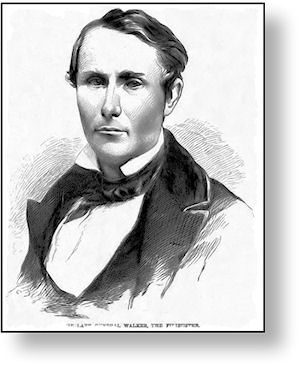
The Late General Walker, The Filibuster

We publish herewith, as matter of history, the portrait of the famous filibuster Walker, who was executed in Honduras on 12th ult. His life had been eventful and romantic.

He was only thirty-six years old when he died. Born at Nashville, Tennessee, in 1824, he was bred a lawyer: his father, a Scotch banker, occupied a prominent position in society, and enjoyed the respect of the community in which he lived. The son was a scape-grace. He failed as a lawyer; tried medicine, and achieved no particular success in that profession; finally fell back on the press, and so, in 1851, at the dawn of civilization on the Pacific slopes, he looms up as the editor of a paper at San Francisco.

It seems likely that the unsettled and turbulent temper of the people with whom he lived shaped the uncertain aspirations of William Walker. He had not been very long in California, and was doing a good business, when he suddenly crossed the frontier, and, squatting on some unoccupied land in Northern Mexico, proclaimed “an independent Republic of Lower California.” This farce did not last long. There was a stir among the Mexican authorities, and an appearance of vigilance among the United States troops; but the point of the struggle was that the “independent Republic” and her newly-constituted rulers had nothing to eat. Walker surrendered himself and his party to a revenue officer of the United States, went through the form of a trial, and was promptly acquitted. At that day filibusterism was all the rage.

Not cured by experience, but rather encouraged by the sympathy his not very glorious exploits had won, Walker two years afterward undertook his second filibustering affray. The Democrats of Nicaragua offered him twenty thousand acres of land to fight on their side against the aristocratic party. A similar offer led Sir De Lacy Evans to fight against the Carliats in Spain, General Guyon to take a command in the Hungarian army of independence, Lord Cochrane to take a leading command in South America; Lafayette and Steuben fought for less in the United States, General Church was- satisfied with less in Greece, Colonel Upton in Russia. General Walker made some further stipulations on behalf of his men, then chartered his vessel.

Five years ago last May that vessel, the Vesta, lay in the harbor of San Francisco, with General Walker and fifty-six men on board. She was under seizure. A deputy-sheriff”s officer had possession. At midnight on Monday, the 4th May, Walker requested the sheriff’s officer to step below to examine some documents in the cabin. The unsuspecting official complied. The door shut, he was informed that he was a prisoner.

“There, Sir,” said Walker, in a slow, drawling voice, “are cigars and Champagne; and there are handcuffs and irons. Pray take your choice.”

The deputy, a sensible man, took the former, and was in a very happy frame of mind when he was put on board the steam-tug to be taken back to the scene of his official duties. In the month of June General Walker arrived in Nicaragua. The Serviles were prepared in force to resist him; he fought a battle every three weeks. The capture of Granada was quickly followed by the massacre at Virgin Bay, and the necessary inauguration of General Walker’s power in Nicaragua.

In the course of a short while a treaty of peace was signed between the contending forces; a native named Patricio Rivas was appointed President, and Walker General-in-chief of the army. This was the culminating moment of Walker’s career. He held the real power in the Government of Nicaragua, Rivas being simply his tool. He had a fine transit route in full operation, which brought him hundreds of immigrants every month. Great Britain and the United States, sick of the unsuccessful endeavors of the Spanish Americans to establish stable governments, were both ready to recognize and support him. In this country especially everyone was in his favor; he could have obtained money and men to any extent on a mere requisition. Finally, there is reason to believe that the best people in Nicaragua were fascinated by his brilliant success, and really believed that he was destined to be the regenerator of their country.

All this fair edifice of present power and future prospects Walker now proceeded deliberately to destroy. He shot Corral, his old foe, the head of the Serviles–a Central American gentleman of high standing–charging him with having plotted against the government they had combined together to establish. He revoked, without cause, the transit grant to the Nicaragua Company, and seized steamers belonging to American citizens, thus shutting himself and his new country out from the world, and closing the door to immigration. He made war upon Costa Rica, and managed matters so badly that his troops were beaten at the first encounter. Ho lost patience with Rivas, dismissed him, and usurped the Presidency. From that moment to the close of the Nicaraguan campaign his history was one of defeat, disaster, disappointment, and distress. The Nicaraguans and Costa Ricans combined against him; drove him from place to place, and at last so beleaguered him that, had it not been for the presence of an American sloop of war, which received him and his followers on board, he must have perished then and there. So ended the second filibustering expedition of Walker.

The third and fourth expeditions, both directed against Nicaragua, may be briefly disposed of. They were both ill-advised, and ill-planned; they both failed miserably; both would have terminated fatally for Walker and his followers but for the kindly interference of American and British vessels of war.

Walker’s fifth and last filibustering raid was originally intended to be prosecuted against the famous Bay Islands which Great Britain is just ceding to Honduras. Several Anglo-Saxon residents of the islands had expressed unwillingness to be handed back to Honduras; Walker saw the opportunity of erecting a new independent empire. Unfortunately for him; Honduras foresaw his game, and requested Great Britain to delay the cession of the islands. Thus disappointed, Walker cruised about in the Bay of Honduras for some weeks, literally seeking what he might devour, and finally, to his ruin, fell upon Truxillo. Forced to evacuate this place by the British war vessel Icarus, he was chased to bay by the Hondurenos; and refusing to claim either British or American protection, lie died the death of a soldier at the hands of the Honduras authorities. The details of his execution will be found in the news columns.

Walker was undoubtedly a mischievous man, better out of the world than in it. He never displayed any constructive ability; his energies were wholly destructive. He was brave, persevering, and energetic; but he had little or no foresight, no compunctions of honor or conscience, and not a spark of human pity in his breast. His works, from first to last, have been injurious rather than beneficial to the world.

0 comments

The Southern masses are not yet ready to imitate Mexico

News of the Day
1860s newsprint

Cleveland Herald (Ohio), October 13, 1860

The New Orleans Picayune for the 8th says:

If Lincoln is successful in the electoral college—which can scarcely be possible*—will he not be elected President by the voice of the people constitutionally expressed—elected too according to the ordinary modes of party action and popular voting—peacefully and regularly honored with the office which Washington, Jefferson and their long line of successors have honored. Is it for this reason that any man at the South proposes to resist? Are we prepared to disown allegiance to a Government whose administrations hitherto have been followed by a series of uninterrupted blessings, because at some future time an act may be committed hostile to the spirit of the constitution? Will such an issue be one that can secure for any movement that we may commence not the favorable moral influence of the world, but what is far more important, the union of the South itself?

There is a public sentiment at the South that will forbid success to any movement of this character for this cause, no matter by whom it be originated and favored. The more violent such a movement may be, the less favor would it receive. It would have no foundation in law, it would appeal to no public sense of necessity. It would have no stimulus in the public feeling of positive wrong done, or in the sense by individuals, of actual distress inflicted.

It is time that the men of the South began to speak plainly on this subject. The Southern masses are not yet ready to imitate Mexico, nor will they, like that distracted people,  be put in hostility to the legal government by the pronouncements of any popular leader.

(*Pennsylvania; Indiana and Ohio have said that it is not only possible, not only probable, but absolutely certain.–Eds. HERALD.]

0 comments

The Rising Generation

News of the Day
1860s newsprint

Daily Gazette & Comet [Baton Rouge, LA], October 12, 1860

We have often deprecated the system of training which multitudes of children receive. We turn in vain for a spot where childhood is properly trained; where it is respected as childhood and allowed to be childhood. In solitary instances, perhaps, we might find families who understand what is due to infancy and the wants of nature demand for the growing child. But they are few and far between. Children, now a days are looked upon as so many puppets n which to display lace, jewels, gimcrackery, and the last new modes in flounce and whalebone. Corsetted , be starched, be furbelowed, and bidizened  off, they look like so many men and women grown down, until even in face and conversation they lose the freshness and simplicity of childhood in the monkeyisms of grown up folly. What of childhood may be left in them—these miniature cards of fashion—is crushed out of them by the idea of being little belles and beaux, by minature  flirtations, among which their time is spent in vieing , to the utmost particular, with the affectations, rivalries, jealousies, and appointments making of their elder, though not models.

Turn where we will, childhood is abused. They are allowed their own way; they become men and women before they have passed the threshold of youth; they have no respect for seniors, and are as mannerless as bears. They have indoctrinated into them false views and false notions of society; they are puffed up with pride and conceit; they are trained into fops and dolts by fashionable mammas and indulgent pappas, as animals are trained by show masters—for exhibition. What then are we to look for from the coming age? Naught else but the follies, extravagances, debaucheries and depravities of the present age will be increased to a four fold degree. The next generation will truly illustrate the ‘visiting the sins of fathers upon their children.’

0 comments

An Expedition come to Nothing

News of the Day
1860s newsprint

Daily Gazette & Comet [Baton Rouge, LA], October 12, 1860

The Galveston Civilian is responsible for the following piece of information. The Knights of the Golden Circle, who have been so far benightened  as to march to Western Texas, have concluded that they have had about as near a view of the elephant as would pay. The Corpus Christi Ranchero says:

“The last detachment of Knights of the Golden Circle that arrived here instead of going farther towards the “seat of war,” left, we understand, for their respective homes. Those who went to the Banquette, came back here and did likewise; and as they performed the trip into the country and back on foot, will satisfy the Civilian they did not carry bridles with them.

“This morning another party of K. G. C., from the States, arrived here. There must be mismanagement on the part of the leaders, or else a concentration of force would be better understood.”

Young men at a distance should be cautious how they enter upon quixotic and desperate expeditions of this kind. The whole scheme, in the present state of affairs, is chimercal  and dangerous in the extreme.

0 comments

Not really hung

News of the Day

Navarro Express [Corsicana, TX], October 12, 1860

(Note: the original article was a bad attempt at humor and really refered to a hung decision between officials, not an execution. — MpG)

We have been questioned by many persons with regard to a statement made in a recent issue of our paper that four members of our County Court were hung on the public square, and that the presence of the Chief Justice would have saved them from that horrible fate. We would state that death did not ensue from the hanging, and that all parties concerned are yet sound of “wind and limb.” The difficulty grew out of the question as to whether a friend of one of the candidates had the right to contest the Sheriff’s election. Two voting that he had the right and two nay created the hanging, and the Chief Justice not being present court adjourned to the 24th inst. when no doubt matters will be arranged without any more hanging.

0 comments

What are the Southern States Going to do?

News of the Day

New York Herald, October 12, 1860

Recent events at the elections in some of the Central States, and all the eventualities and chances which they foreshadow with regard to the Presidential contest, pointing in the direction of Mr. Lincoln’s election by the Northern States, people are beginning naturally to look towards the South and ask what the people there are going to do. The South has for a few years past been threatening disunion and secession, and all kinds of movements, in the event of the triumph of a Northern faction, and in the present aspect of affairs we think it is about time now that the Southern people should be making arrangements for their future course. If the politicians and orators of the South rightly represent the feelings of the people, there is a strong inclination towards secession in South Carolina, in parts of Virginia, in Alabama and other States. Mr. Yancey has just delivered a very eloquent speech in this city, in which he touched upon many points concerning the interests of his section of the country, but he did not solve the problem, “What they are going to do down there”

The South has a great many important relations, social as well as commercial, with the North, and consequently its future proceedings in the event of Lincoln’s election are matters of considerable interest. We presume that the Legislatures of the different Southern States will come together at once and consult about the plan of action to be adopted. They have time enough to decide upon what they intend to do between this and the inauguration day, March the 4th, 1861.

0 comments

USRC Harriet Lane (1857)

Frank Leslie’s Illustrated Newspaper
Arrival of the Revenue Cutter Harriet Lane at the Battery - Land of the Prince of Wales, Accompanied by the Duke of Newcastle, Lord Lyons, Earl St. Germains, and the rest of the Suite, Thursday, October 11, 1860
Arrival of the Revenue Cutter Harriet Lane at the Battery – Land of the Prince of Wales, Accompanied by the Duke of Newcastle, Lord Lyons, Earl St. Germains, and the rest of the Suite, Thursday, October 11, 1860

as represented in Frank Leslie’s Illustrated Newspaper, October, 27, 1860

Arrival at the Battery.

After a pleasant passage, the Harriet Lane arrived at Castle Garden about two o’clock, amid the booming of cannon, which poured horn their throats royal salutes with an energy that awoke the echoes of old Hudson.

The view now was animating in the extreme: the gaily decked-out shipping on both the North and East Rivers, the saluting from the merchant shipping and from the forts, the crowds which thronged the pier-heads and darkened the roofs of every house-top, and the dazzling uniforms and bristling bayonets of the military, which occupied every foot of space upon the Battery, formed a scene the most impressive and beautiful. The galleries around Castle Garden were densely packed. The Prince remained upon the pilot-house, and was not distinguished by the spectators until he left the position, and with his suite prepared to leave the steamer. The Harriet Lane was handsomely laid alongside the Castle Garden landing, and in a few minutes the Prince and his friends prepared to land. He shook hands very cordially with Captain Faunce on stepping ashore, and thanked him for his polite attentions. Lord Lyons and the Duke did the same. Mr. Schell introduced the Prince to Mr. Kennedy, the Superintendent of Police, who stood on the landing prepared to receive him. Cheers now broke forth from all sides, and the Prince, followed by his friends, entered Castle Garden, bowing and raising his bat to the greetings of the crowd.

0 comments

Douglas is losing friends

News of the Day
1860s newsprint

Charleston Free Press (Virginia), October 11, 1860

W. W. Lamb, a Breckinridge elector at Norfolk, who put the question to Senator Douglas as to the course to be pursued in case of resistance by the South to Lincoln’s election, and who received the prompt and emphatic reply that the laws must be enforced, even to the hanging of rebels, promised that the same question should to put to Mr. Breckinridge. This has not been done, and the Secessionists boast that Douglas has lost friends by his reply. They make a great clamor about the use of force, although Polk and Dallas both voted for Gen. Jackson’s “force bill,” and were afterward supported by the whole Democracy.

The Norfolk Argos (edited by the Breckinridge elector) boasts that Douglas is losing friends in Virginia since he “fell into the trap” set for him. It seems to be forgotten that it is a two-edged sword. A few men may fly off, and allege this as an excuse, but Breckinridge is losing friends by not answering. He loses character for frankness, and thereby leaves it to be inferred that he is afraid to speak out on that point.

Tho writer of this has recently had an opportunity to know the sentiments of the people of the ‘Tenth Legion’ on this subject, and the Douglas men are not only firm in his support, as a friend of the Union, but are more than ever determined to beat the Disunionists. Yancey’s speeches inflame the leaders of the Douglas party, and disgust the rank and file. They find that this “champion of Southern rights,” as he is called, has one speech for the South and another for the North. In the Valley of Virginia he talks much about a “Constitutional Union,” but is as gentle as a dove in regard to secession. He does not say a word about his project to “precipitate the Cotton Stares into a revolution.” He knows such talk does not suit this meridian, and therefore he does nothing more than appeal to the pride of Virginia, as ‘the Mother of States and of Statesmen,’ a very original idea –found in every school-boy’s vocabulary. He tells us most pathetically how much we are oppressed by our government.

0 comments

All want to know whether Mr. Yancy is for or against them…

News of the Day

Chicago Press and Tribune, October 10, 1860

It is announced that Mr. Wm. L. YANCEY is to address the public on the political issues of the day, this evening, at the Cooper Institute. We do not know that the announcement is authentic, but we have been assured that it is.

What Mr. YANCY’S special object may be in so doing, we have no means of knowing. Whether he intends to fortify the faith or speculators for a fall in stocks, and to encourage the hopes of political alarmists,—or to clear himself from the suspicion of being a Disunionist, we ave not aware. We cannot, however, forget the part he has played hitherto in political affairs. We cannot forget his organization of the Southern League, nor his advice to a colleague, that he should remain in the Democratic ranks for the purpose of so shaking its action that, “when the proper opportunity should arise, they might precipitate the Cotton States into revolution.” Nor can we forget the part he has recently taken in the disruption of the Democratic Party, and the advocacy of the Breckinridge ticket in the Southern States. And all these recollections lead us to watch his proceedings with a good deal of interest.

We are a little curious to know whether he will advocate fusion here. or urge his friends to vote the regular Breckinridge ticket. If he does the latter, we shall be warranted in inferring that he regards the election of LINCOLN by the people as affording a favorable opportunity for his “revolution.” If he urges fusion, for the purpose of defeating Lincoln, we shall infer that he considers a Presidential canvass in the House of Representatives as affording much the best chance.

There is one point on which his friends here will insist on having from him an explicit answer. Does he believe that the election of Lincoln, in advance of any act of injustice or aggression, would constitute a sufficient cause for secession? As a frank man he cannot well refuse to declare himself on this point,—nor can he fail to recognize its importance. He will speak here to a large commercial community, which has everything at stake on the preservation of the Union. Many of them are seeking to save it by defeating Lincoln;—others aim at the same result by preventing the election from going to the House of Representatives. But all are for the Union. And all will insist, after the election is over, and whatever may be the result, upon upholding the Constitution and maintaining the Confederacy inviolate. And they will all want to know whether Mr. Yancy is for or against them on this point of transcendent importance. We hope he will find it convenient to be perfectly explicit in regard to it.

0 comments

Execution of William Walker

News of the Day

Chicago Press and Tribune, October 9, 1860

Havana, Wednesday, Sept. 26, 1860.

I yesterday sent to Charleston, via Cedar Key, the “news” of the execution of William Walker at Truxillo on the 12th inst., and suppose you are, or will be before this reaches your hand, in possession of the intelligence by the aid of the telegraph. The “news” reached this city on the evening of the 24th inst., from Batubano, at which port the propeller Osceola had arrived that day.

Walker, it appears, was not permitted to have any communication with any of his followers previous to his execution. He marched from his cell to the place of execution with a steady step and unshaken mien. A chair had been placed for him with its back towards the Castle. Having taken his seat, he was blindfolded. Three soldiers stepped forward to within twenty feet of him and discharged their muskets, the balls entered his body, and he leaned a little forward; but, it being observed he was not dead, a fourth soldier mercifully advanced so close to the suffering man that the muzzle of the musket almost touched his forehead, and being there discharged scattered hie brains and skull to the winds. Thus ends the life of the “gray eyed man of destiny,” and though we may differ in our several estimates of the character of the man, and of the correctness of the cause he has of late years pursued, yet I believe none will be found who will assert that he was not a man of true courage.


.See Wikipedia article on William Walker

“Before the end of the American Civil War, Walker’s memory enjoyed great popularity in the southern and western United States, where he was known as ‘General Walker’ and as the ‘grey-eyed man of destiny.'”

0 comments

And let the consequences be what they may.

News of the Day

New York Herald, October 8, 1860

The Atlanta (Ga.) Southern Confederacy says:—

The South will never permit Abraham Lincoln to be President of the United States.   This is the determination of all parties at the South! And let the consequences be what they may—whether the Potomac be crimsoned in human gore, and Pennsylvania avenue is paved ten fathoms in depth with mangled bodies, or whether the last vestige of liberty is swept from the face of the American continent—the South, the loyal South, the constitutional South, will never submit to such humiliation and degradation as the inauguration of Abraham Lincoln.
.

This fellow is scared before he is hurt.   Lincoln is not yet elected; and if he should be elected, these very fire-eaters of the Georgia school, who are always blowing and threatening, and never doing anything but mischief to their own friends, will be responsible for the result.   Had they stood their ground, instead of running from the Charleston convention, there would have been no occasion for any alarm concerning Lincoln’s election.   Being assured, however, from the late Southern elections, that the Southern people will take care of their pro-slavery disunionists in November, the conservative people of the North have only to look after our no-slavery disunionists and all will be well.


0 comments

Duke of Newcastle to Col. Colt

Miscellaneous document sources
Henry Pelham-Clinton, 5th Duke of Newcastle

RICHMOND, VA., October 7, 1860.

DEAR COLONEL COLT:—I am sorry to say it will not be possible for the Prince of Wales to accept your kind invitation. After leaving New York we propose to proceed to Albany before going to Boston, so that we shall not be able to visit Hartford.

Had arrangements permitted it, the Prince would have been much pleased to inspect your celebrated establishment.

I am yours very truly,
Newcastle

From “Armsmear: The Home, The Arm, and The Armory of Samuel Colt,” A Memorial, 1866

Newcastle was Henry Pelham-Clinton, 5th Duke of Newcastle

0 comments

Forced to Leave

News of the Day

Daily Times [Leavenworth, KS], October 6, 1860

A German named Fred. Amthor, who formerly resided in Texas, writes a letter to the Chicago “Press,” giving an account of his expulsion from that State. While there, he never expressed any sentiments hostile to the institution of slavery. But a man named Evans, with whom he had a slight acquaintance, was not so cautious. Evans uttered some sentiments which gave offense to the pro-slavery men, for which he was taken by a mob, and without any trial of any kind was whipped to death, and his body left out on the prairie. At this Amthor felt so indignant, that he boldly denounced mob law, but at the same time said that Evans had been a fool for not keeping his mouth closed on the subject of slavery. These utterances directed the rage of the mob to Amthor, and he was arrested by an armed posse. A committee of five was appointed to try him, and they reported that there was no evidence showing that his presence was dangerous to a slave-holding State. Notwithstanding this report, the feeling was so strong against Amthor, and there were so many attempts to assassinate him that he was forced to leave the State.

0 comments

Memento of Texas Prisoners in Mexico

News of the Day

The Ranchero [Corpus Christi, TX], October 6, 1860

A letter written by a late American traveler in Mexico says:

“I’m traveling through Mexico; I stopped a short time at the Castle of Perote. I was much surprised to find a number of charcoal sketches made on the walls of several of the prison cells. One of these represented Santa Anna hanging to a tree; another a ranger chasing twenty mexicans; another a fat Mexican officer, with the name of “Gutts,” written underneath the figure; several miserable half starved creatures represented in a kneeling position with a Mexican guard in the act of firing at them; together with some considerable writing, such as ‘Old Simpy,” “a fair field and no more white flags;” “old peg and his yellow nation we owe you much.” Several names were written on the walls of the different cells. Among those that could be made out through smoke and dirt, I made out to copy the following names:

Trimble, W. H. Moore, Capt. Cameron, W. M. Shepard, Virginia; John Tanney, Maryland; William H. Lush, New York; Zaccheus Wilson, Thomas Nelson, Tennessee; Isaac Allen, John Young, Thos. Hancock, Kentucky; Harry Oats, A. D. Heddenburg, New York.”

The writer is puzzled by those odd records. He says:

“These appear to be American names. Who they were, or what crimes they had committed, does not appear. It is quite probable, however, that they were occupants of these cells at some time or other. The date appears to be the years 1841 and ’42. Please publish this. It may possibly convey information to the friends of the poor fellows whose names appear on these prison walls.”

There is no mystery about the affair. The authors of this “brief memorial” were Texas prisoners captured by overwhelming numbers of Mexicans, and confined in the Castle of Perote. Some of them are still alive in Texas, and have had ample revenge on the Greasers. Many others have gone to their long homes; but not unavenged.—Civilian.

0 comments

Texas Penetentiary

News of the Day

The Ranchero [Corpus Christi, TX], October 6, 1860

Prof. Alexander, who has been to Huntsville lately, gives us the following items relative to the Penitentiary, which he visited while there. After being admitted through a massive iron gate, guarded by two sentinels; he was placed in the charge of a warden who conducted him over the building. All the cells are clean, some ornamented with pictures, etc. There are 201 prisoners in all, 150 of whom are in the weaving room. They weave cotton and woolen goods of divers qualities. There are 70 Mexicans, in for horse stealing; one woman, an accomplice in a murder case. In another room they make furniture, shoes, and do the tailoring for the tailoring for  the establishment; in another place blacksmith is done. The Mexicans do the cooking and washing for the prisoners. The mode of punishment is the stocks; the neck and wrists of the refractory criminal is placed within a circle of wood, too small to allow the head or hands to pass through; this frame is elevated so that the culprit barely touches with his toes and there fastened he stands until he promises better behavior. Another punishment is the dark cell or black hole—it is painted black and the culprit remains in solitary confinement in the darkness and stillness that is oppressive in the extreme—starvation is also resorted to. One cell the Professor noticed, had this inscription over it: “William Brown, aged 24 years, convicted of murder in Grimes county, in 1858, for which he is now suffering solitary confinement for life.” He weeps constantly, it is said.—Crockett Printer.

0 comments

Can Such Things Be?

News of the Day
1860s newsprint

Daily Gazette & Comet [Baton Rouge, LA], October 6, 1860

It was a fit night, was that of Tuesday last, for a merciless deed. It was black and dark enough for any action—it rained and the wind howled pitiously, without a single flash from heaven, to give a ray of hope to the traveler. The earth seemed given to the furies, and terror filled the weak house of man; his frail tenements were blown down and his trees torn up. A fit time this, for that terrible offence, against the laws of God, and man, which some human being with the heart of a foul fiend, perpetrated on the road. In the vicinity of the plantation of J. A. and W. D. Stokes, about nine miles east of this, was found, on the morning after that terrible night a new born babe, as God in his mercy had spoken it into existence. It had been stifled by the monster’s hand that took it there, to prevent its cries (a needless cruelty, since the storm fiend howled above its feeble voice) and there in its innocence and purity, was it murdered—apparently by being dashed against a tree—and thrown in the underbrush. A jury of inquest was held, but no clue had to the author of this—the most hellish crime in the calendar. The people came from far and near and raised their hands in horror; still the mystery is veiled by the darkness of that night. The impression is, that the child was taken to the place where the murder was perpetrated, from a distance. It may be, yet we care not how far it came, or how long, or how far on the road of life, the parties concerned may travel; they will hear the cries of the innocent and be haunted by the terrors of that night to the end. It is just and proper that they should be. Do they suppose that murder will conceal the truth? If so, it will be the first time, in the history of the depraved and guilty human heart. The shame of the action may be borne; because merely a violation of the ordinances of society, but the crime which has followed it, bears the blood stains of a most heartless and cruel murder—there is no water in the ocean to wash it out.

0 comments

Harper’s Weekly, October 6, 1860

Harper’s Weekly

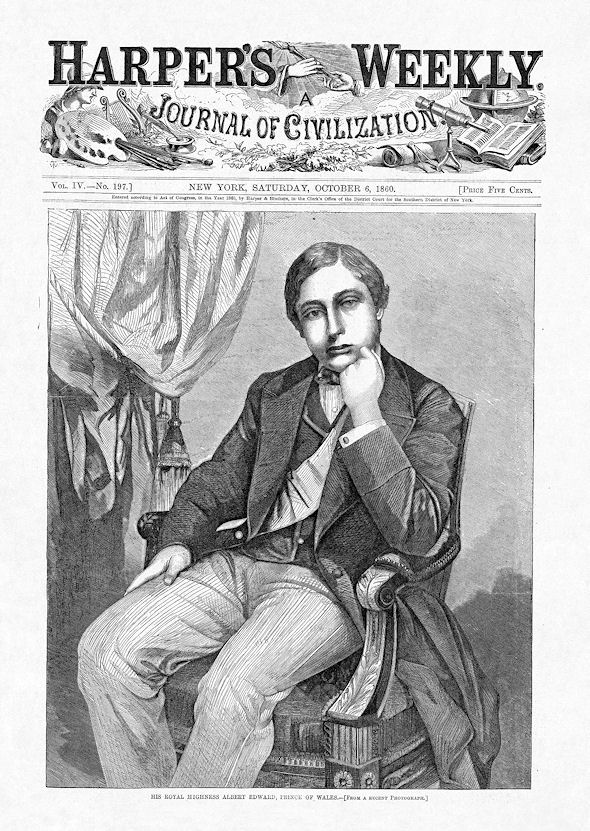
His Royal Highness, Albert Edward, Prince of WalesHis Royal Highness, Albert Edward, Prince of Wales, The eldest son of Queen Victoria and Prince Albert of Saxe-Coburg and Gotha,

The future king visits America.

Edward VII was King of the United Kingdom of Great Britain and Ireland and Emperor of India from 22 January 1901 until his death in 1910.

0 comments

A Registry Law

News of the Day

The Ranchero [Corpus Christi, TX], October 6, 1860

We always have been and are still in favor of a registry law. The Mexican vote has always been cause of serious complaint for years past, and no American has been in this vicinity long enough to tell whether the majority of Mexicans are voters. We have been here for nine years, and have known persons who based their election upon the Mexican vote to be mistaken, and then, perhaps owing to the state of affairs, become very uproarious about the purity of the ballot box. They were chagrined at their defeat, and must have something, some great fraud to assign as the cause. There are many Mexicans who are entitled to vote, and understand the principles and workings of our government, as well as any Americans, but the ignorant do not, and from the nature of circumstances there must be many who have not the legal right to vote. As a general thing, a short time previous to an election, many of the friends and supporters of the different candidates and even the candidates themselves make every exertion for the Mexican vote. Those who secure it are satisfied, and the disappointed affect to imagine and perhaps have good cause to cry fraud, corruption, etc., etc. Those who didn’t get the Mexican vote are then of course immaculate.

Who is to blame for this? Certainly not the Mexicans! They are controlled, and who is there, where the opportunity has been before him, that has not taken part in the controlling, if no more than to simply vote his hired Mexican. It is a notorious fact, and no matter how he voted, if illegal, a wrong has been perpetrated. Under our present election law this “simply voting my hired Mexicans,” will be practiced. In the emergency what is to be done to rid ourselves of this depredation on the rights of the people, if depredation it is? Shall we assume all power into our hands—raise above the law—and by brutal force crush out the existence of every suspicious obstacle to our own idea of right, and become dictators because the law happens to be defective? Or shall we, like rational beings, advanced in the scale of civilization, appeal to our law-makers for wholesome laws to protect our rights, repair all defects and to construct a safeguard to the purity of the ballot box? No one who loves our country and her institutions can even hesitate in choosing the latter of the two alternatives.

A Registry Law, with requirements sufficiently stringent so there will be no mistake about the persons who may obtain a certificate under it having a complete right to vote, is what is wanted. It would do more toward uniting our people in feeling and opinion than any one measure now extant. We shall urge the enactment of such a law.

0 comments

Lynch Law

News of the Day

Navarro Express [Corsicana, TX], October 5, 1860

(Note: this really refers to a hung decision between officials, not an execution. — MpG)

We regret to state that Judge Lynch has been in our midst. On Tuesday morning, the second last, four respectable citizens of this county, all members of our County Court, were found hung in the public square of this town. Various are the conjectures, as to the causes of this unfortunate affair. We presume, however, that it was owing to the fact, that they were members of the County Court. In saying this, we must here enter our declaration that we know of no conduct of theirs which deserved such a severe penalty. It is thought that the presence of the Chief Justice could have saved them from this fate. As we will hereafter speak more of this matter, we withhold comment, until further developments shall put us in possession of all the facts connected with this melancholy affair.

0 comments