Abolition Sentiments

News of the Day
1860s newsprint

Indianola [TX] Courier, November 10, 1860

A man by the name of Richard Putney (not our talented friend Richard J. Putney,  Attorney, Columbus,) was brought before the Grand Jury here and indicted for uttering Abolition sentiments on the streets of Columbus. He is now in jail, and we suppose will stand his trial at  the present District Court. He was, we learn, a stage driver about twenty years ago at  Tuscaloosa, Ala. He has been living in this country for some time, engaged, we believe, in  overseeing and raising stock. The words he used were to the effect that the country would never  see any peace until all the negroes were set free and sent out of it, that then the country would be  settled up with farmers and be at peace.

Judge Smith, we learn, for we did not hear his charge, charged the jury particularly with  regard to the statute concerning such cases. He expressed himself opposed to Lunch Law, and  said if the Grand Jurors would take proper cognizance of these matters, there would be no  necessity for vigilance committees and a visit to Judge Lynch.—Colorado Citizen.

0 comments

How Lincoln Voted

Miscellaneous document sources

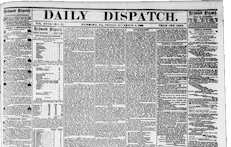
Richmond Daily Dispatch, November 9, 1860

A dispatch from Springfield, Ill, speaking of Lincoln’s visit to the polls to vote on Tuesday, says:

“Mr. Lincoln advanced as rapidly as possible to the voting table, and handed in his ticket, upon which, it is hardly necessary to say, all the names were Republicans. The only alteration he made was the cutting off of his own name at the top, where it had been printed.—As he emerged, after voting, from the temporary enclosure, the manifestations of enthusiasm were frequent, and Mr. Lincoln, removing his hat, bowed in acknowledgment.”

0 comments

A Diary From Dixie

Civil War Day-by-Day

CHARLESTON, S. C, November 8, I860.—Yesterday on the train, just before we reached Fernandina, a woman called out: “That settles the hash.” Tanny touched me on the shoulder and said: “Lincoln’s elected.” “How do you know?” “The man over there has a telegram.”

The excitement was very great. Everybody was talking at the same time. One, a little more moved than the others, stood up and said despondently: “The die is cast; no more vain regrets; sad forebodings are useless; the stake is life or death.” “Did you ever!” was the prevailing exclamation, and some one cried out: “Now that the black radical Republicans have the power I suppose they will Brown¹ us all.” No doubt of it.

I have always kept a journal after a fashion of my own, with dates and a line of poetry or prose, mere quotations, which I understood and no one else, and I have kept letters and extracts from the papers. From to-day forward I will tell the story in my own way. I now wish I had a chronicle of the two delightful and eventful years that have just passed. Those delights have fled and one’s breath is taken away to think what events have since crowded in. Like the woman’s record in her journal, we have had “earthquakes, as usual”—daily shocks.

At Fernandina I saw young men running up a Palmetto flag, and shouting a little prematurely, “South Carolina has seceded!” I was overjoyed to find Florida so sympathetic, but Tanny told me the young men were Gadsdens, Porchers, and Gourdins,² names as inevitably South Carolinian as Moses and Lazarus are Jewish.

From my window I can hear a grand and mighty flow of eloquence. Bartow and a delegation from Savannah are having a supper given to them in the dining-room below. The noise of the speaking and cheering is pretty hard on a tired traveler. Suddenly I found myself listening with pleasure. Voice, tone, temper, sentiment, language, all were perfect. I sent Tanny to see who it was that spoke. He came back saying, “Mr. Alfred Huger, the old postmaster.” He may not have been the wisest or wittiest man there, but he certainly made the best after supper speech.


¹ A reference to John Brown of Harper’s Ferry.
² This and other French names to be met with in this Diary are of Huguenot origin.

0 comments

Alexander H. Stephens to J. Henly Smith

Miscellaneous document sources

Crawfordville [Ga.], Nov. 8th, 1860.

Dear Smith, I got home Sunday night last—was here at the election. Taliaferro County did well; but the State I fear has gone for Breckinridge by the popular vote. The old Eighth is all right, I feel confident. I have just heard that Judge Andrews[i] has been elected to fill Irwin’s place in the House of Rep. in our State Legislature. This shows that Wilkes county does not endorse the course of the seceders at Charleston and Baltimore. I see by the papers received this morning that Lincoln is elected President. It does not surprise me in the least. I have been expecting it ever since the burst up at Baltimore, as you know very well. What is to be the result I cannot tell. We shall I apprehend have trouble. The people here are taken greatly by surprise at the result. They did not anticipate it and thought I was only indulging in unnecessary apprehensions when I told them months ago how it would most probably be. I have never been disappointed in a Presidential election since 1840. I do not feel so much oppressed in spirits at the result now actually upon us as I did months ago in looking forward to it. But enough of this. I got your letter enclosing the States and Union with extract of my letter to you. I should have preferred that you had only given the first part and omitted that which spoke of my reasons for the course I was taking. The first part would have answered the misrepresentation of my position. But the whole makes no difference. The truth seldom does any harm; and in this case I have been actuated from the beginning by disinterested patriotism looking to the safety, peace, security and best interest of the whole country. I can say no more. Let me hear from you often.


[i] Judge Garnett Andrews, of Washington, Ga., was one of the most thoroughgoing unionists in the State.


From Annual Report of the American Historical Association for the Year 1911.

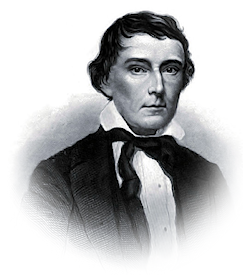
Alexander Hamilton Stephens was an American politician who served as the vice president of the Confederate States from 1861 to 1865. After serving in both houses of the Georgia General Assembly, he won election to Congress, taking his seat in 1843. After the Civil War, he returned to Congress in 1873, serving to 1882 when he was elected as the 50th Governor of Georgia, serving there from late 1882 until his death in 1883.

J. Henley Smith was a Georgia journalist.

0 comments

A Quiet Election

News of the Day
1860s newsprint

Daily Advocate  [Baton Rouge, LA], November 7, 1860

One of the quietest, most orderly and pleasant elections ever held in this country occurred at our polls on Tuesday. Not a harsh word passed between the sovereigns in our hearing throughout the day. No drunken rowdies blocked up the passageway to the ballot- box; no illegal votes were polled, nor none attempted to be polled when it was ascertained that they were illegal. Good humor and friendly intercourse characterized the proceedings of the day, and while the “working men” of the respective parties were unusually active to advance the interests of their favorites, not an incident occurred to mar the universal harmony and kindly feeling that prevailed.

0 comments

An Alabama Town Destroyed

News of the Day
1860s newsprint

Memphis Daily Appeal [Memphis, TN], November 7, 1860

Ten houses, constituting the entire business potion of the  town of Opelika, in Alabama, were destroyed by fire last Thursday night. It is stated that the fire  was undoubtedly the work of some incendiary, and suspicions are entertained that abolitionists  are at the bottom of it. One man, who was unable to give an account of himself, has been  arrested. It is said that his neck is in some danger.

0 comments

The Die is Cast

Turning on the Light: A Dispassionate Survey of President Buchanan’s Administration, From 1860 to its Close, by Horatio King

Washington, November 7, 1860.

My Dear Sir,—The die is cast, and Lincoln is elected.

Shall we now fan the flame of disunion, or shall we exert our influence toward calming the already excited sentiment of the South?

What course should we, here in the District of Columbia, pursue? Should we join hands with the disunionists and help on the storm, or should we not rather pour oil on the troubled waters ? . . .

My own will illustrate the condition of thousands in this district. With us everything depends on the Union being preserved.

What, then, was my indignation on learning that men holding office here under your administration were parading the streets here this morning with disunion cockades on their hats! and the leading article of the ‘Constitution’ to-day can have no other effect than to encourage and fan the flame of disunion, both here and at the South.

You will bear me witness that I have never intruded myself upon your counsels. But may I not, in the most respectful yet in the most earnest manner, now appeal to you—for if you are silent your enemies will, I am sure, attempt to hold you responsible for these things—to use your power in at once checking this dread spirit of disunion here in our midst?

With great respect,

Very sincerely your friend,

Horatio King.

His Excellency, James Buchanan.

The editorial article of the Constitution referred to in the preceding letter concludes as follows :

“We can understand the effect that will be produced in every Southern mind when he reads the news that he is now called on to decide for himself, his children, and his children’s children, whether he will submit tamely to the rule of one elected on account of his hostility to him and his, or whether he will make a struggle to defend his rights, his inheritance, and his honor.”

0 comments

The Election Today

New York Times

The New York Times, November 6, 1860

It is universally conceded that the vote of New-York to-day decides the Presidential question. Every other Northern State is surrendered to LINCOLN. The great West will pronounce for him by enormous majorities. No one has a moment’s doubt about any New England State, and the vote of last month rendered it absolutely certain that Pennsylvania will vote for him by at least 30,000 majority. The decision of the question, therefore, rests with New-York;—and so certain is the vote of the whole interior, that nothing less than forty or fifty thousand against him in the City can cast a shadow of doubt on the result in the State at large.

The most remarkable feature of the canvass has been the fact that the Republicans are the only organized party in the field. Theirs is the only platform of principles and the only candidate for which any citizen has a chance to vote. The Opposition to LINCOLN are united upon no candidate, nor do they agree upon any political principle. No man can tell what would follow their success,—what principles would come into the ascendant,—what man would take the guidance of public affairs. Indeed the only result of electing the Fusion ticket would be to throw everything into greater confusion than ever. Instead of ending the Presidential contest it would only be just commenced. The agitation throughout the country would be greater, more violent and more ruinous to business than ever before, and we might look forward to a Winter of political turmoil, business stagnation and commercial disaster. Business men in this City begin to see this tendency and dread the result. If the defeat of LINCOLN would end the contest, or put the matter in the way of a peaceful solution;—if it would elect anybody else or settle the principles and policy of the Administration, there would be some show of excuse for pressing it with so much zeal. But no such result is anticipated, or even claimed by his opponents.

The simple truth is, the political parties—and especially the Douglas Democrats,—have been made to play a purely subordinate part in this whole Fusion movement. The active leaders of the [continue reading…]

0 comments

Lincoln Column

Miscellaneous document sources

The ‘Lincoln column,’ first monolith raised, Nov. 1860, Presidential election, being S. column of connecting corridor says the caption of this image in Benjamin Brown French’s album of photographs related to the construction of the capitol and other public buildings. French was the Public Commissioner of Buildings in Washington, D.C. under Franklin Pierce but was fired in the next administration for his anti-slavery views and was reinstated to the position by Abraham Lincoln.

French’s designation of this column as the “Lincoln Column” may simply derive from the date marked on the stone on the right side of the photo, Nov. 6. 1860, election day 1860, when America selected Abraham Lincoln as its next president.  Searching online for the phrase “Lincoln column,”  I find no references to anything other than the various copies of the photo from French’s album.  There are no stories available of any sort of dedication or other kinds of ceremony that might honor this supposedly special column.

A cached version of a November 6, 2010 New York Times article does show a subsequent image obtained from the library of Congress of the column being lifted into place.

Click on image for larger version

Ironically, even if the column was somehow designated as the “Lincoln Column,” all of the 1860s columns were taken down and placed in storage during a 1950s enlargement and renovation of the capitol building.  No effort was made to track the columns and ensure they were returned to their original location.

So, if there was a Lincoln Column, which specific hunk of stone it is is now unknown.

Original Library of Congress image file of the “Lincoln Column.”

The “Lincoln column,” first monolith raised, Nov. 1860, Presidential election, being S. column of connecting corridorThe “Lincoln column,” first monolith raised, Nov. 1860, Presidential election, being S. column of connecting corridor

0 comments

Diary and Letters

Diary and Letters of Rutherford Birchard Hayes
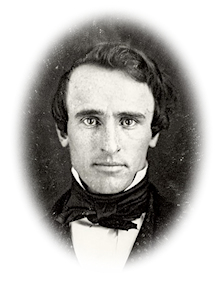
Rutherford B. Hayes (young)

November 6, 1860.—Election day. Had a birthday feast in honor of Birch’s 7th birthday (Sunday 4th) today. Aunty and Uncle Warren both present. Boys delighted with their presents.

The Southern States are uneasy at the prospect of Lincoln’s election today. The ultra South threatens disunion, and it now looks as if South Carolina and possibly two or three others would go out of the Union. Will they? And if so, what is to be the result? Will other slave States gradually be drawn after them, or will the influence of the conservative States draw back into the Union or hold in the Union the ultra States? I think the latter. But at all events, I feel as if the time had come to test this question. If the threats are meant, then it is time the Union was dissolved or the traitors crushed out. I hope Lincoln goes in. All now depends on New York. The October elections settled Pennsylvania and the other doubtful States.

0 comments

The K.G.C.

News of the Day
1860s newsprint

Alamo Express  [San Antonio, TX], November 5, 1860

Below we give from the Austin “Southern Intelligencer” an account of the speech of Gen.  Bickley which meets the necessity of the case so well that we transfer it to our columns instead  of going into a review of the speech as reported in the Herald.

[“] The following placard was displayed in our city on last Wednesday:

K. G. C.

Gen. Geo. Bickley, President of the American Legion of K. G. C. will address the  citizens of Austin on the character and aim of the Knights of the Golden Circle, at the Hall over  Darden and Maynard’s, this (Wednesday) evening at 7½ o’clock. The public is respectfully  invited to attend.

As our people are not much given to running after sights [except the circus,] and would  not be humbugged even by the Biological, Odological Dr. Hale, the notice of itself would have  excited but little attention in these speaking days, but for the circulation of a pamphlet by the  orator, who is understood to be the President of the “K. G. C.”

This pamphlet produced some excitement among a number of our citizens, who  otherwise would not have attended the meeting. Among the passages which look to the political  aspect of the thing, we copy the following:

“The Knights of the Golden Circle constitute a powerful military organizations , as a  nuceleus  around which to hang such political considerations as will, if well managed, lead  to the disenthrallment of the cotton States from the oppressive majority of the manufacturing and  commercial interests of the North.”

“The great West was being rapidly settled by Europeans who arrived in our country with  deep rooted pejudices against slavery, until the anti-slavery party was no longer confined to  the manufacturing districts of New England, but like some fatal epidemic, it has spread over the  whole North and West.”

“The Republican or Northern party is abolitionized—the Southern party is gong rapidly  to secession. All parties in the North are free-soil; all parties in the South are constitutionalists,  and when the provisions of that instrument are violated, then our people are secessionists. It is  quite true that there are many pro-slavery men in the North—men who have stood by us  [illegible] there are men in the south who are in favor of the Union [illegible]—men who to  preserve the Union, would give up the slave institutions of the Southern States, and re-enact the  farce and folly of Jamaican Emancipation.”

“It is then clear that the acquisition of Southern territory by the Federal Government is a  dangerous experiment, and not to be countenanced for one moment.”

“Northern men have been called to edit our papers and Northern women to educate and  train our daughters. The one propagates abolitionism by insidious clippings of abolition  arguments, and weak comments thereof; the other, while their conduct is, so far as we have  observed in the main, irreproachable, by constantly reminding the child of our duty to be kind  and affable, and that we are all the work of the Creator, and of one race, so impress the child’s  mind that by the time it arrives at maturity it is already abolitionized.”

“The third division or degree is also divided into two classes, the “Foreign and Home  Councils.” This is the political or governing division. The “Home Council” is one of pure  advisement, and takes no active steps. It is unknown to the public or the first division of the K. G. C., and intended to guard us against infractions of the law. Like other “Home” classes it  enjoys advantages known only to the order. The Foreign Council is divided into ten  departments, representing respectively the interests of agriculture, education, manufacture,  finance, police, war, navigation, law and foreign relations. Also from the “Foreign Council”  there is selected three classes as a high court of appeals and entrusted with the making laws for  the government of the K. G. C. These classes represent respectively the interests of capital,  manufacturing and mining interests, and the interests of commerce and agriculture.

“Our people must present an unbroken front—no division should now be tolerated. The  old party issues should be forgotten, and we should have but one Electoral Ticket in the South,  and that should be for a representative man. We now need men who will step boldly out and  declare themselves either for or against us. The disposition to “shirk” the question and issue is  ill-adapted to the dangers which now threaten us. Let us know our friends and our enemies.”

“There is a mercantile objection, [illegible] that the K. G. C. will not “pay.” To this  objection we refer to the history of the Hudson’s Bay and East India Companies.—The K. G. C.  is precisely such an association as those, and as they won empires for Great Britain, so may the  K. G. C. for a Southern Confederacy.”

“It would make the South strong in or powerful out of the Union.”

“Let the people go to work in earnest and the South will soon be mistress of her own  interests and destiny. Put off this crisis another term and we are lost. The border States are  slipping from our grasp, and unless the people are aroused to a full sense of their danger, the  Southern Confederacy will embrace only the cotton States.” [“]

We have made our quotations this extensive because it saves the necessity of a full report  of the speech, which was in sentiment to all extents and purposes the same.

It is true the speaker began by denying all political objects and purposes; and he  patriotically advised the election of Breckinridge, Douglas or Bell, if either could defeat  Lincoln.—He disavowed disunion objects—and yet he insisted that there are but two parties—a  Northern and Southern party; and he sought to teach that there should be but these sectional    parties and to doubt the patriotism of all who thought differently. He regarded it as a foregone  conclusion, that if Lincoln was elected, resistance would surely follow, and the “K. G. C.” would  become the rallying army for the Southern disunionist.

He read the first and second degrees of the order, but not the third. As the first degree  swears “allegiance to the order, &c., and the speaker invited any one not satisfied to ask  questions, Judge Paschal, [Union elector] rose and said: “I am not satisfied with the oath, and I  wish to inquire, whether the “Allegiance” which you swear rises above or in subordination to the  Constitution and the laws of the United States and of the respective States, where the members of  the order may be?” The speaker said “yes” and to prove it he read from the first degree which  says:

“You do each swear to obey the laws of the United States provided the same are  consistent with the spirit and letter of the Constitution of the United States and the States in  which you live; that you will do no act of which an American citizen should be ashamed?”

Judge Paschal said:

“Do the members of the order assume to themselves to determine the constitutionality of  the laws of Congress and to resist them, or do they refer that question to the lawful tribunals of  the land?” Gen. Bickley said: “As citizens we do judge of the constitutionality of laws, and act  accordingly.” At this answer, most theatrically expressed, the leading Breckinridge State officers  present, applauded vociferously, as indeed they did at every sentiment of a revolutionary  character.

The speaker then proceeded to give the Mexican view of the subject which he denied was  filibusterism; but only a decent way of getting hold of the country, by some kind of conquest,  and the bringing it into the United States, or else adding it to the Southern Confederacy. The  plan was certainly more ornamental than practical. And the denial of Filibusterism was as little  convincing as the denial that the thing is being used as a political engine.

But upon this part of the speech we have no criticism at present.

In the course of the remarks, frequent reference was made to the order being a “police  regulation.” When through, Judge Paschal took the stand and read the last paragraph in the  pamphlet, in these words:

“The people must begin to examine the state of the nation, and determine on a line of  policy united to the exigencies of the times. If the K. G. C. shall succeed we shall hear no more  of the disunion, and, if so, it will be a secession of the North—not the South. We shall stand by  the Constitution and the Government that will see that every provision thereof is religiously  obeyed. Outside of all other considerations, the South ought to support and extend the K. G. C.  organization and Domestic Police system—and [illegible] nucleus for her military system. That  we [much of rest of column illegible]  ican People.”

Judge Paschal then said: “I have understood that it has been said that the order acts as  spies upon travelers, and even marks baggage, and that baggage has come marked to this city as  suspicious. Is this so?”

Gen. Bickley—”It is.”

Judge Paschal—”I wish to know if the Mexico which you may find in the District of  Columbia, points to the contingency of the Presidential election, and if the order stands ready to  obey Southern Governors and to raise the standard of rebellion, if they are not satisfied with the  “Presidential election?” Gen. Bickley made quite a flourish of trumpets, and was understood to  answer in the affirmative.

Gen. Bickley then said he wished to ask Judge P. a question. But instead thereof, he went  into some declamation about the duty of citizens to obey their Governors; stated that Gov. Pettus  of Mississippi and other Southern Governors were members of the order, and would act if  Lincoln should be elected. He said that should he (B.) be in Texas, and Gov. Houston call for his  services, his “tried sword” would be drawn, to march to the District of Columbia, or wherever  else the Gov. Might command. Or should he be in Virginia, as little as he liked Gov. Letcher, he  would march at his command. And he knew that Virginia would not submit, &c.

As to the “baggage searching,” the spotting of men,” &c., he said there ought to have  been such an order thirty years ago; that people were welcome to search Bickley’s baggage, and  no sound man should object to it. It was intended for the nutmeg men, the Yankee pedlers,  and such suspicious characters. His question was: “Did any one object to these sentiments,  objects and practices.”

Judge Paschall said: “This is not the place to express my full sentiments in regard to all I  have heard to-night. It is the meeting of a man, who says he has expended six years and  thousands of dollars in the cause. Great as I think his errors, I would speak of him with respect  and courtesy.

But to the avowal that the order is a secret police; accustomed to denounce individuals;  working by secret means, (as dangerous to the innocent as the guilty) that it marks baggage, and  sends forward its suspicions with the unsuspecting traveler, that it is a secret order which  undertakes to pass upon the soundness of Southern citizens, having a common interest in the  subject of slavery—I say that it is the institution of the order or Robespiere, which will plunge us  into a sea of revolution worse than the bloodiest days of France. It cannot, it will not be  tolerated.” He then briefly pointed out some of the consequences.

And he continued: “You all know that I never belonged to any secret order, and therefore  I may overrate the dangers of secret higher law and political orders. I denounced the know-nothing order, because I saw in it a government and degrees, which taught an habitual disregard  of the constitution in favor of the freedom of religion and the eligibility of all free white citizens  of the United States to office. But here is an order which goes many steps further. It is “military,  financial and political;” and its purposes by secret means, to attain its ends. It arrays itself with  the misguided partizans who threaten to overthrow the government, should they not elect  their candidate! And it proposes, by secret means, to proscribe all who will not fall into their  revolutionary purposes. It is then a secret political agency, and one which establishes a police  above the laws, which are sufficient for every emergency.

As to the sentiment that it is the duty to obey the governor, even should he raise the  standard of rebellion. I have no language strong enough for it. Revolutions must be the work of  the people. We elect governors to see that the laws are executed; not to inaugurate revolution.  When the public voice is to be tested on such a subject, the question must be submitted to ever  voter; because each of them has an interest as high as the governor himself. Much as I love the  Governor of Texas; highly as I honor his judgment and patriotism, yet I declare, that should he  usurp the power of calling for soldiers to resist the constitution, laws and lawful authority of the  United States, I would denounce him as a traitor to his oath. But I fear no such consequences.— Houston will never lead a rebellion; nor do I believe that any governor will take any such  responsibility. Evils exist, dangers threaten, but to the people belong the questions of life,  liberty, property and honor. All appeals to their judgments and passions, should be open and  public. All plottings and cabals will be met by counter plots, until if continued you will have  civil war at home and in our very streets. Improvident men are now [most of rest of column illegible]

lowered by the temper of the crowd.—There were however, some repetitions of the necessity of  purely “northern and southern parties,” and of fight and fury, whereat a few of the intense  Yanceyites applauded with diminished enthusiasm.

We give this brief report to the public. We trust that Gen. Bickley will publish the entire  speeches. We would hold no political party responsible for this secret order; but trust that all  parties will disavow it as a secret political engine. In its secrecy, in its police espionage and its  avowed southern confederacy disunionism, we see nothing but mischief. We trust its strength  and the character of those who compose it are not fairly represented by its advocates. Secrecy in  political movements, is not to be tolerated among a people who rely upon an enlightened public  opinion.

Gen. Bickley said, that he could not speak for Austin, he could for Texas. We call upon  every Texas editor and Texas speaker and candidate to speak for themselves. Judge Paschal has  spoken the sentiments of this community, with a few uninfluential exceptions. He stands by the  constitution and the laws against all mobs, higher lawism and secret espionage. And our citizens  should be proud, that they had a man bold enough to speak in the right time, the right tone and  temper towards men, who, however pure their motives might be, are certainly upon a most  dangerous road. Let us have no political secret conclaves—no reign of terror—but let all  political subjects be openly and boldly discussed.

We are glad to learn that the expose of the mysterious K. G. C., was not pleasing to some of the  more moderate followers of the bolters, (the extremists had hoped to make a good thing of it.)  Yesterday morning a large showbill was posted, giving notice that M. R. Reagan, Esq., would  address the unterrified at the same place last night. It was whispered around, that Morris would  “show up” the new secret political order, and prove it to be “a Bell and Everett trick.” The editor  attended, and found Gen. Bickley there, with his aids Col. Groiner and Maj. Bickley. Our friend  Morris spoke to the great satisfaction of the organizers, and really got off some patriotic  sentiments, such as a willingness to die for the country, and the declaration that “to spot a man in  this country is to hang him to the first black oak.” But there was so much of the warp and woof  of “the fire the southern heart, and precipitate the Cotton States into a revolution—campaign  orators, that Gen. Bickley mistook him for “one of ’em,” and gave the sign, and after the speech,  claimed him, and commenced reading the degrees. It was a rich meeting, and we heard a wag  say, that if the Breckinridge orator came there to “show up” the K. G. C.’s he did it after the  fashion of Archie [illegible] a story of the Belle who went to the Kentucky quarter-race, to see  Bob Easly’s new importation of the animal of the tribe which the queer cursing old Balaam road.

The secrecy is too good a thing for the Yanceyites to shake off with such delicate jerks. They  must put on the power which old Doddy Biggs employed upon the opossum, which would not let  go when every foothold was broken. The K. G. C. will stick to them by the tail unless there is a  hard shake.
0 comments

The Republicans and Slavery

New York Times

The whole disturbance which prevails through the country has been caused by the efforts of the South to increase Slavery.

The New York Times, November 5, 1860

Senator SEWARD, in his speech on Friday night, declared the whole aim and duty of the Republican Party to be to leave Slavery just where it is. They do not seek to abolish or disturb it; but they do propose to prevent its extension or increase. It is not easy to see what objection any rational man can make to such a policy. The whole disturbance which prevails through the country has been caused by the efforts of the South to increase Slavery. They have pursued this policy steadily for some years past, covering its purpose by charging its opponents with designing to interfere with it where it now exists.

Senator SEWARD’s declaration on this point ought to have weight with candid and fair-minded men. He has always been regarded as among the most advanced of the Anti-Slavery Republicans. If any one had designs upon Slavery in the South, he was supposed to be the man. But his disclaimer on this point is direct and complete. All he aims at is to have Slavery left where it is, and this is all the Republican Party proposes to do about it.

The Charleston Mercury not long ago declared that the success of the Republican Party would put an end to the slavery agitation as a sectional question. “It will cease to be a contest between the North and South,” said the Mercury, and will be transferred to the Southern States.” Is not that precisely where it belongs? Has it not been a standing reproach for years that we were meddling with a subject which did not concern us,—that we were stirring up a sectional agitation,—that the question of Slavery belonged exclusively to the South, and should be left for the South to manage? Yet this is precisely the result which the Charleston Mercury dreads and deprecates as the result of a Republican victory.

We venture the prediction that, in less than one year after the incoming of a Republican Administration, that party will be generally recognized as the most truly national and conservative party in the Union. It proposes the settlement of the Slavery question on the only possible basis,—that of checking the increase of the evil, and leaving it to the operation of natural causes and the laws of social economy.

0 comments

Illegal Registration of Voters.

New York Times

The New York Times, November 5, 1860

Unqualified for voting at all.

A warrant was issued yesterday by Justice QUACKENBUSH for the arrest of GEORGE K. COOKE, the Democratic member of the Board of Registry for the Eighth District of the Fifteenth Ward, on a charge of having violated the Registry law. An affidavit has been made to the effect that COOKE, while acting as Registrar on the 17th ult., caused his name to be placed on the list of voters for that District, giving No. 308 Bowery as his place of residence. It was subsequently ascertained, however, that he resided at No 373 Fourth-street, which is not in the Eighth District, and that he had also been to the registering-place of the Ninth District, of the same Ward, and had his name registered there. NAPOLEON B. HOBBS, a clerk for LORD & TAYLOR, is also charged with an offence similar to the one of which COOK is accused. On the 30th inst. he caused his name to be registered as a legal voter in the Eighth District of the Fifteenth Ward, and went off boasting that he should vote for “The Union, the Constitution, and the enforcement of the laws.” As, however, he had not lived in this State one year, having come here from Baltimore, Md., in March last, he was unqualified for voting at all, and his arrest was effected on the ground that he had willfully violated the law. Justice QUACKENBUSH required him to funish bail in $500 to answer. The penalty, upon conviction of the offences charged, is not less than one year’s imprisonment in the State Prison.

0 comments

Operations in Charleston Harbor

War of the Rebellion: from the Official Records of the Union and Confederate Armies and Navies

Fort MOULTRIE, S. C., November 5, 1860.

Col. H. K. CRAIG,
Chief of Ordnance, U. S. Army, Washington, D.C.:

COLONEL: Your communication of 1st instant, with its inclosure, in reference to placing forty muskets in the hands of the Engineer officer in charge of Fort Sumter as a precautionary measure proper to this time of excitement, is received. My views are asked on two, or rather three points:

1st. On that which forms the condition of the Secretary’s approval of the issue, namely, that I concur in its expediency;

2d. On the “propriety” of placing the arms in the hands of hired men for the purpose indicated; and,

3d. On the “expediency” of doing so.

To the first I reply that I have already said in effect, on my post return for last month, that while I do not apprehend that any attempt upon the United States works here will receive the countenance of the State or city authority, it is by some thought that a tumultuary force may be incited by the feeling of the time, and invited by the present disordered condition of the works to make such an attempt without it, and that this possibility makes it incumbent on me to provide as far I may against it, and forty additional musketeers would then be desirable.

As to the “propriety” of the issue I see no objection. The arms need not be delivered to the men selected by the Engineer officer till the occasion should actually obtain. The workmen in charge of the property are bound on principles of common law to defend it against purloiners, to say nothing of the 96th Article of War, applicable to all “persons whatsoever receiving pay from the United States.” [continue reading…]

0 comments

A Speech at Cooper Institute, New York

Civil War Day-by-Day

November 4, 1860

Fellow Citizens,—In thanking you for the honor which you have conferred upon me, I cannot refrain from addressing you a few brief remarks at this critical juncture of our political affairs.

In less than four days you will be called upon to record your votes at an election, upon the result of which depends not only the preservation of your property, and the prosperity of your native city, but also the very existence of this great and vast Republic.

Whatever the Republican leaders may say to the contrary, I fear that the election of Mr. Lincoln to the presidential chair must prove the forerunner of a dissolution of this confederacy amid all the horrors of civil strife and bloodshed.

I know that Mr. Lincoln’s friends claim for him sentiments of patriotic and conservative attachment to the Union. But of what avail can these sentiments be, even if they do exist, from the moment that he consents to become the standard-bearer of a sectional party holding principles incompatible with the sacred obligations of the Constitution, and arrayed in open and unrelenting hostility against the property and the institutions of the fairest portion of our common country.

But, my friends and fellow-laborers in the cause of the Union, with God’s blessing we must not give our opponents a chance to carry out their fair promises, or their boasting taunts.

I do not believe the great State of New York, which under the beneficent influences of our institutions has grown up to a mighty empire in herself, will ever give her casting vote in favor of fanatical sectionalism.

I will not believe that the City of New York, [continue reading…]

0 comments

Army Movements

News of the Day

Daily Times [Leavenworth, KS], November 3, 1860

[Correspondence of the Times.]

 Fort Washita, C. N.,}
Oct. 22, 1860. }

. . . When near the Southern boundary of Kansas, we met a large party of the Osage tribe on their return from the buffalo hunt, having laid in a large quantity of their favorite meat. Leaving the Osage country, we came into the Cherokee Nation, where settlements are quite numerous. The crops (especially corn) look remarkably well, and are the best we have seen this summer. The drouth don’t appear to have been so severe here as in Kansas.—We did not see a running stream of water after leaving Fort Riley, until we arrived at the Grand, or Neosho river, and this was very low, not having over twelve inches of water in its channel. Even the Virdigris was dry as a bone. From Grand river to Fort Smith, we marched through one continual stretch of timber. When evening approached we turned off the road and encamped by the side of some little mountain stream, tying our horses to trees, and giving them their four quarts of corn per day, on which they had to travel from twenty-five to thirty miles a day. We passed through Tallequah, the Capitol of the Cherokee Nation, a beautiful little village of about three hundred inhabitants, and completely surrounded by woods. I have noticed that all villages built by Indians, whether civilized or not, are invariably located in some secluded, but generally romantic spot.

We arrived at Fort Smith on the 19th of September, where we were disposed of as follows: Companies E and D, 3d Squadron, under command of Capt. Sturgis, to remain at Fort Smith, to assist the Cherokee Indian Agent in removing unlawful settlers upon the lands of the Cherokees, out of the Nation, should it require force to expel them therefrom. The remainder, companies B and A, 1st Squadron, under command of Capt. W. N. R. Beale, to proceed to Fort Arbuckle, where they were stationed last winter; and Companies C and I, 2nd Squadron, under command of Capt. C. A. Caw, to proceed to Fort Washita, where they were stationed last winter.

The Arkansas river is very low at present—only fourteen inches of water in the channel. Navigation to Fort Smith has been suspended since last May. Steamboats can now run up only as far as Little Rock, where all the government stores to supply Forts Smith, Washita, Arbuckle and Cobb, are unloaded, and from there transported, by government trains, to Fort Smith, to be again transported from there to the different forts above mentioned, as necessity requires them.

The 1st Squadron remained at Fort Smith eight days, and then proceeded homewards, where I learn they arrived after a journey of twelve days.

The 2nd Squadron remained fifteen days, to give the horses time to recruit up, they having been nearly used up in marching through the timbered country north of the Arkansas river. On the 3d of October, the 2nd Squadron took up the line of march for this place, where it arrived on the 11th inst., having been on the plains six months and two days, during which time we traveled 126 days, and laid over 47 days; traveling 2419 miles, making an average of 19¾ miles for each marching day, or 13 1/5 miles for each day on the plains. This is the longest trip the First Regiment of Cavalry has made since its organization in 1855.

The weather here is very pleasant, and the troops in good health.

 Rover.

0 comments

Returned from Whence They Came

News of the Day

The Ranchero [Corpus Christi, TX], November 3, 1860

The body of armed men, forty-five in number, who invaded this county last week, have, we understand, returned from whence they came. It seems the many stories that caused so much alarm in the other counties turned out to be moonshine, and that really every reason does exist why there should be the best of feeling among all.

0 comments

A Word of Caution

News of the Day

Sugar Planter [West Baton Rouge, LA], November 3, 1860

Let every Bell and Everett voter look well to his ticket before depositing it in the ballot box. Spurious tickets are already out, calculated to deceive the unwary. Be on your guard, therefore, against the fraud. Our opponents are determined to win at all hazards. The miserable Slidell dynasty must be perpetuated in the State, that the faithful of his clique may still enjoy the loaves and fishes. Refuse all proposals to “pair off,” unless in case of absolute necessity, and then be sure that you contract with honorable parties, and ABOVE ALL—be at the polls early, and see that your neighbor is there also.

0 comments

Gen. Geo. Bickley’s K. G. C. speech at Austin

News of the Day

The Ranchero [Corpus Christi, TX], November 3, 1860

The San Antonio Herald publishes a two column and a half report of Gen. Geo. Bickley’s K. G. C. speech at Austin on the 17th. He disclaimed the title of a filibuster for himself or order—intimated that they were a humanitarian society—would “perfect” negro slavery in the South and extend it abroad—were not leagued with any political party in the country—did not propose to march into Mexico as an armed force, but as a defensive colony, (per invitation of certain intelligent State Governors,) pledging allegiance and assistance to the liberal people of that country, who are kept “under the surf” by their revolutionary brethren, etc., etc.

The K. G. C. platform reads well on paper, but we have serious doubts whether there is enough powder in their guns to cure the “sick man” on the other side of the Rio Grande. The Mexicans are not very apt to affiliate with the “barbarians of the North,” and well informed letter writers say that such a movement as that spoken of by Gen. Bickley, would meet with determined resistance from all parties. We advise young men in the States to stay with their parents a while longer, and seek some surer path to emolument and fame than becoming Bickley Mexico colonists.

0 comments

Escape of O.M. Jackson

News of the Day

The Ranchero [Corpus Christi, TX], November 3, 1860

O. M. Jackson, who has been had-cuffed and shackled by our Sheriff, to secure him in durance, that he might answer to the charge of the murder of Hegenbottom at Santa Rosa, last June, made good his escape early yesterday morning. Through the assistance of his wife he obtained a file, cut off his irons, and then majestically crawled out of the shed where he was confined. He is yet at large, but many persons are after him.

Here is another instance of the escape of an undoubted criminal, because of there being no county jail. On next Tuesday, each voter will have the right to give his preference, through the ballot box, for tax, or against tax, to build a jail. How are you prepared to vote? If you wish to see the laws enforced, vote for the tax; but if on the contrary, you wish to see the law defeated, you have no right to vote at all.

0 comments

American Forces in Panama

Frank Leslie’s Illustrated Newspaper

Frank Leslie’s Illustrated Newspaper, November 3, 1860

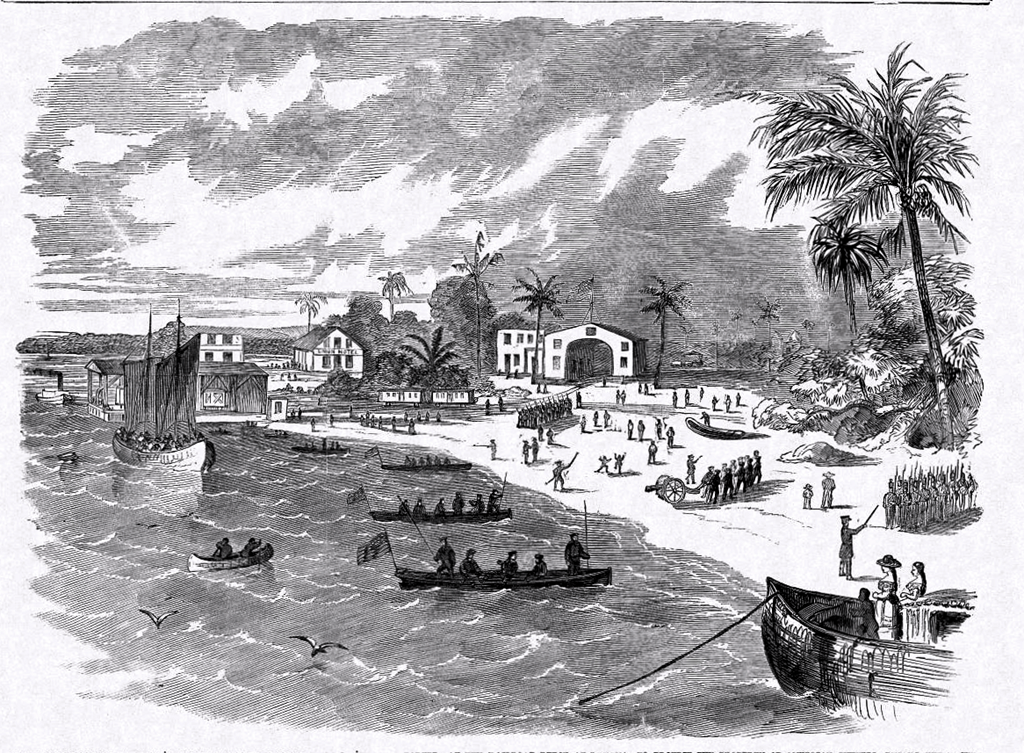
The landing of the St. Mary’s Forces, under the command of W. D. Porter, at the railroad depot at Panama, to protect the property of American citizens, during the recent extensive negro insurrection, Sept. 27, 1860 — From a sketch by W.G. Overend, U.S.N.


image
0 comments

La Grange Burnt

News of the Day

Navarro Express [Corsicana, TX], November 2, 1860

We learn from a gentleman from Waco, that the way bill brought by the stage driver just previous to his departure, stated that one side of the square of La Grange had been burnt.

We learn that two barns in Rusk county, one in Tarrant county and a store at Troy, on the Trinity, in Freestone county, have all been burnt, and all set of fire. We presume it is the same with la Grange. What has become of our night patrol? We think it is the duty of our County Court to take the matter in hand, appoint a patrol for town and country, and compel each man to fulfill his duty. Corsicana may be burnt next.

0 comments

Pass Them Round

News of the Day

Navarro Express [Corsicana, TX], November 2, 1860

Robinson’s Mill, Tarrant Co., Tex.}
Sept. 25, 1860.}

To the Editors of the White Man,

Dear Sirs: —The vigilant committee at this place having had under consideration the conduct of Salathiel Goff, about 60 years of age; voice rough; nearly all his front teeth out; weighs about 175 pounds; and his son, Payton Goff, about 30 years of age; low, heavy set; and weighs about 150 pounds. They have been notified to leave this county on account of their abolition tendencies. This is done in order that the people may be on the look out for them wherever they may go. It is thought that the old man has gone to Southern Texas, and Payton to Missouri.

All papers friendly to the South will copy.

 Truly your friends,
Vigilance Committee
At Robinson’s mills.

—White Man.

0 comments

The Alleged Abolition Plot in Texas

New York Times

The New York Times, November 2, 1860

Correspondence of the Louisville Democrat.

LAMAR Co., Texas, Sept., 1860.

Seeing that the many Rumors and reports which were circulated through our State a few months since, as to Abolition emissaries, insurrections, etc., are being published and accredited by many of the papers in the older States, I desire, through the columns of your paper, to say to my friends in Kentucky, and to the public generally, that all such rumors are altogether unfounded. It is true, that during the exceedingly hot and dry weather of the past Summer, there were many destructive fires in the State of Texas. The town of Henderson was nearly destroyed — that of Dallas greatly damaged, and some houses burned in other towns in different parts of the State. But the origin of these fires, as far as yet ascertained, was either from the ignition of matches or some other accidental cause. I have not been able to learn of a single instance in which there was the slightest evidence that it was the work of an Abolition emissary — in fact, I don’t believe there is one in the State, though there are some characters nearly as bad.

As to the reports that poison had been found in the possession of negroes in various and sundry parts of the country, and in wells, &c., they are all false, as far as I have been able to learn. I have not met with a single man who knows of an authenticated instance. Yet these reports were published by all the papers in the State, and accredited by many, and the people in many parts were excited almost to desperation. Who originated these reports, and for what purpose, are the questions that have perplexed the good citizens of our State for some time past. Such reports are certainly calculated to injure the State, and keep away such emigrants as desire to come. Why, then, should the people of Texas circulate and give credit to them?

It is the opinion of many of our best citizens, after mature deliberation and thorough investigation of the subject, that these reports had their origin in the minds of scheming politicians, and are a part of that great plan concocted and being put in execution to “nerve the Southern arm and excite the Southern mind, preparatory to precipitating the cotton States into a revolution.” R.B.D.

0 comments

Operations in Charlston Harbor, S.C.

War of the Rebellion: from the Official Records of the Union and Confederate Armies and Navies

ORDNANCE OFFICE, WAR DEPARTMENT,
Washington, November 1, 1860.

Col. J. L. GARDNER,
Commanding Fort Moultrie, Charleston, S.C.:

SIR: I transmit herewith a copy of a letter addressed by me to the Secretary of War, which has been approved by him, and which I submit to you for your views as to the expediency or propriety of placing arms in the hands of hired men for the purpose indicated.

Should you approve the measure I will thank you to request Military Storekeeper Humphreys to make the issue indicated in said letter, and to report the fact to this office that it may be covered by an order for supplies.

Respectfully, &c.,

H. K. CRAIG,
Colonel of Ordnance.

[Inclosure.]

ORDNANCE OFFICE, WASHINGTON, D. C.,
October 31, 1860.

Hon. J. B. FLOYD,
Secretary of War:

SIR: There is at Fort Sumter, Charleston Harbor, now in course of construction, besides a part of its armament, a considerable quantity of   ammunition, &c., and it has been suggested by the Engineer officer in charge of the work that a few small-arms placed in the hands of his workmen for the protection of the Government property there might be a useful precaution. If the measure should, on being communicated, meet with the concurrence of the commanding officer of the troops in the harbor, I recommend that I may be authorized to issue forty muskets to the Engineer officer.

With much respect,

H. K. CRAIG,

Colonel of Ordnance.

[Indorsement.]

WAR DEPARTMENT,
October 31, 1860.

Approved:

J. B. FLOYD,
Secretary of War.

0 comments