Flag of the New Confederacy

News of the Day

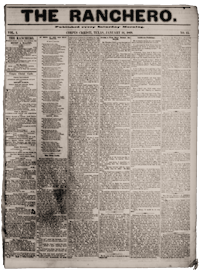
The Ranchero [Corpus Christi, TX], December 1, 1860

The Charleston Mercury publishes the following suggestion for the flag of the “Southern Confederacy:”

The ground entirely blue, with a golden palmetto in the center; a golden rattlesnake twining around the stem of the palmetto, with its rattle sprung, head erect, and tongue protruded. In the back-ground, to the rear of the tree and snake, a golden spread eagle, and a single golden star in the upper right corner, with the words, “Room for More,” on the opposite.

0 comments

Military Companies

News of the Day

The Ranchero [Corpus Christi, TX], December 1, 1860

The News says a Lone Star rifle company, numbering nearly one hundred young men, has been organized in Galveston, and that the old artillery company is also being reorganized, to be composed of some of the older citizens. Many citizens are wearing the blue cockade, surmounted by metalic  five-pointed stars.

The Telegraph notices the appearance of the blue cockade on the streets of Houston, worn by numbers of citizens, and gives the following description of it:  It consist  of a neat blue rosette, pinned to the hat, having a silver five-pointed star in the centre . It means that the wearers pledge their lives, their fortunes and their sacred honor to resistance to abolition encroachments, and that they can see no way of successful resistance but in the withdrawal of their State from the Union.

A movement is on foot for the organization of an artillery company.

0 comments

Views in Charleston, South Carolina

Frank Leslie’s Illustrated Newspaper

Frank Leslie’s Illustrated Newspaper, Dec 1, 2020

At this time, when the attention of the whole country is centered upon the gallant State of South Carolina, in speculation as to the course she will pursue, it will be both seasonable and interesting to present some views in the city of Charleston, where the secession seems to be vigorous and demonstrative.   We have selected a few sketches of the prominent buildings, in advance of other illustrations of these stirring times of more vivid interest.

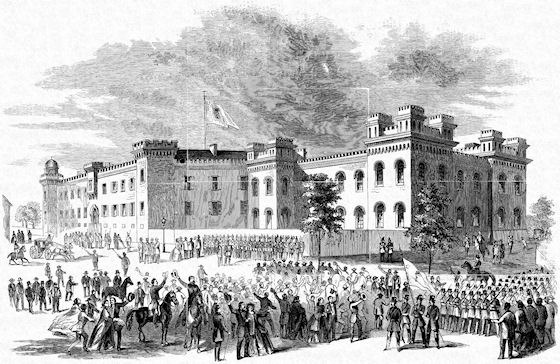
The Government Arsenal in Charleston, S.C. — This extensive, handsome and important building, which we illustrate this week, is at the present time an object of peculiar interest.   In the present state of popular excitement in Charleston, this great depot of arms and ammunition is watched with great care and peculiar jealousy.   It was reported on the 10th, that an attempt had been to remove the arms, &c., to Fort Moultrie, but had been resisted by the people.   A later report states that it had been seized by the people, but the report was entirely unfounded.

The Government Arsenal in in Charleston, S.C.

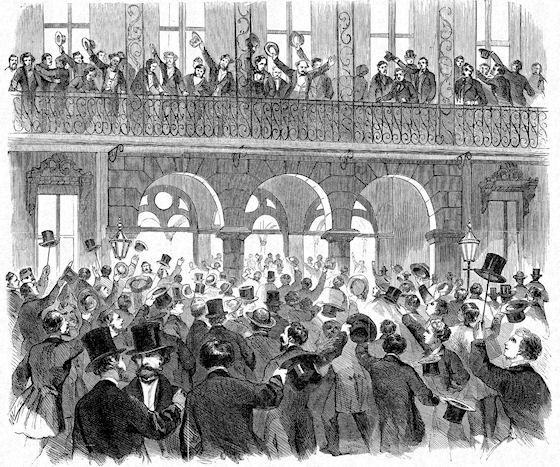
Secession Meeting at the Mills House. — We present in connection with the present secession movement in the South, a sketch of an enthusiastic meeting in favor of secession, held in front of the popular hotel, the Mills House.   The speeches were decidedly in favor of immediate secession, and every Southern sentiment was cheered most vociferously.

Secession Meeting at the Mills House.
0 comments

My Dear Eliza, December 1860

Woolsey family letters during the War for the Union
Mother to Eliza:

Saturday Morning, Dec., 1860.

My dear Eliza: Your very modest little, “may I Mother?” leads me to an immediate reply. Yes, my dear child, come and welcome, just as often as you possibly can and never feel it necessary to ask if you may come home, for this you know is only another home. I am happy to enclose you a foreign letter bringing still further pleasant news. How much we have all to be thankful for that the travellers have so much enjoyment and so little interruption to it. Dear Mary finds, I dare say, comfort enough in the little new baby to compensate in a great measure for all the suffering consequent upon its arrival.

What do you think of Felice added to Una? Our opinions will be useless now, however, as before the last letters reach, the baptism will have been done. Did you see the paragraph stating that the continual assassinations in the streets of Rome render it unsafe to strangers and to residents after dark! This is very comforting to anxious families who have friends there! Hatty and Carry are certainly having a gay time at Naples. Just think of Vesuvius, a hurried dinner, rush to the Crocelli to meet a party of naval officers, a fourteen-oared boat excursion, dancing, and other festivities on board the Admiral’s ship-of-war, supper, etc., etc., all on one day! And after that the return civility of an egg nogg party! I am very glad they are under the care of a clergyman and his wife!

0 comments

The character and purposes of Montgomery and his men.

News of the Day

Daily Times [Leavenworth, KS], December 1, 1860

There is a wide difference of opinion among the Eastern journals concerning the character of Montgomery and his followers.—On the one hand, they are regarded as men actuated purely by principle, and governed only by philanthropic motives; while, on the other, they are stigmatized as pirates, bandits and robbers. We believe that neither of these estimates of them is a correct one.

Capt. Montgomery is said, by those who know him, to be a man of strict integrity, and possessed of many good qualities. He suffered injuries from the pro-slavery party, during the early conflicts in Kansas, which so intensified his hostility to the “institution,” that he now seems disposed to retaliate upon everyone who apologises for, or defends it.—He deals largely in scriptural quotations, and the influence which he has over some of his men is attributed to a sort of superstition which they entertain for him, as a religious enthusiast. Of course, many of those he has gathered round him partake of his own nature.—They appear to be ever ready to rush to arms for the redress of their grievances,—real or supposed,—and shout, “The sword of the Lord and of Gideon.” They are infatuated zealots,—earnest and honest, but willing to adopt almost any means for the accomplishment of their purposes.

While this is true of a portion of Montgomery’s band, it is certain that there are numbers of them, whose sole object is plunder, and who are controlled by the lowest instincts and purposes.

But, no matter what may be the character of these men, we cannot excuse their recent transactions. They may be all that is claimed for them, and yet the course which they have pursued is unjustifiable.

Even though their intentions be entirely pure and unselfish, the mad schemes which we have reason to believe they have concocted, can only injure and retard the anti-slavery cause. Lord George Gordon, though a fanatic, was sincere; yet the wild outbreak which he incited, brought disgrace upon Protestantism, the interests of which he meant to subserve. Peter the Hermit thought he was doing God’s service when he became a leader in the Crusades; yet their history is an evidence of the folly and madness of him and his associates. John Brown believed that he was doing his duty when he projected his raid into Virginia; yet of that affair and its author Senator Seward truly said,–“While generous and charitable natures will probably concede that John Brown and his associates acted on earnest, though fatally erroneous convictions, yet all good citizens will nevertheless agree that this attempt to execute an unlawful purpose in Virginia, by invasion, involving servile war, was an act of sedition and treason, and criminal to just the extent that it affected the public peace, and was destructive of human happiness and human life.”

Let us not be understood to intimate that anything has yet transpired in Southern Kansas bearing a comparison with the historical events to which we have referred. We allude to them merely to show how the best motives may inspire the most disastrous enterprises.

However excellent may be the intentions of Montgomery and his men, their actions are fraught with dangerous consequences, and can neither be excused nor tolerated.

0 comments

The Forts of Charleston Harbor

Frank Leslie’s Illustrated Newspaper

Frank Leslie’s Illustrated Newspaper, December 1, 1860

The harbor of Charleston, S. C., is a noble expanse of water, affording ample depth and scope for all the purposes of commerce on the grandest scale. It has, however, one great drawback, namely, the sandbar, which forbids the entrance of ships of large burthen. Measures are about being taken by the authorities of Charleston to dredge the channel, and thus open the way for the admission of every class of vessels. Scientific men consider that the proposed dredging is perfectly feasible, and will prove completely effective.

Fort Sumter, which commands the channel, is a very strong fortress, mounting a double tier of guns of heavy calibre. It is situated on a mole at the end of the sand-bar, and would prove a formidable objection to a hostile force approaching too near.

Fort Moultrie, on Sullivan’s Island, is a low but strong fortification, and is of great historic interest to all Americans, it being if the scene of one of the first and best fought battles of the Revolution, when a few hundred native riflemen, who had never fired a cannon before, beat off and nearly destroyed a formidable. British fleet, making such slaughter among them as, in proportion to the numbers engaged, was not even reached by that of Trafalgar and the Nile.”

Castle Pinckney, also a very strong fortress, stands at the very portals of the city, covering an ancient mud reef. There were other forts in the olden time; one at Haddrill’s, Mount Pleasant Village, in 1776, and another on James’s Island, which was wrested from the British by a small body of citizen soldiers previous to the battle of Fort Moultrie.

Fort Moultrie on Sullivan's IslandThe Harbor of Charleston, S.C. – From Sketches by our Special Artist – Fort Moultrie, on Sullivan’s Island
Castle Pinkney - Charleston , S.C.Fort Pinckney – Charleston, S.C.
Fort Sumter, Charleston, S.C.Fort Sumter, Charleston, S.C.

0 comments

Operations in Charleston Harbor

War of the Rebellion: from the Official Records of the Union and Confederate Armies and Navies
“Two Charlestonians who were down here to-day remarked to me that as soon as the State seceded she would demand the surrender of the forts, and that if not given up, they would be taken.”

..
FORT MOULTRIE, S.C., December 1, 1860.

Col. S. COOPER,
Adjutant-General U. S. A.:

COLONEL: I have the honor to acknowledge the receipt of your letter of the 28th ultimo, and regret that I have to report that things look more gloomy than the day at the date of my last communication. Captain Seymour, just returned from the city, reports that the excitement there is very great. Col. E. B. White and other gentlemen, with whom he conversed, stated that the people of Charleston would not allow another man or any kind of stores to be landed at or for these forts. They say that anything which indicates a determination on the part of the General Government to act with an unusual degree of vigor in putting these works in a better state of defense will be regarded as an act of aggression, and will, as well as either of the other acts mentioned above, cause an attack to be made on this fort.

Two Charlestonians who were down here to-day remarked to me that as soon as the State seceded she would demand the surrender of the forts, and that if not given up, they would be taken; but that this would not be done sooner unless some action on the part of the Government proved that it was preparing to hold possession of them.

The agent of the boat which brought the 24-pounder howitzer and ammunition is severely censured for having brought them, and the agent of the steamer James Adger was told that any vessel bringing troops here would not be safe in this harbor. Since writing the above I have seen Assistant Surgeon Crawford, who has also been in the city. He says that never until to-day did he believe that our position was critical. One of his friends told him that we would have trouble in less than fifteen days. He thinks that they will first attempt to take Fort Sumter, which they (justly) say will control this work. Castle Pinckney they regard as theirs already. [continue reading…]

0 comments

A Few Letters and Speeches of the Late Civil War

Civil War Day-by-Day

To William Martin,

Charleston, S.C.

New York, November 30, 1860.

My Dear Sir,—I have received your letter, and you will have heard from my house, that we are entirely satisfied with the execution of our small exchange orders.

The unfortunate state of our politics, which in your State particularly have assumed a most threatening aspect, prevents us, to my great regret, from renewing our orders for the moment. It is also impossible for us to hold out any hopes for the present, as to our being able to do any thing in your market after the secession of your State, which you predict as certain to take place very shortly.

My heart misgives me when I think of the terrible consequences which the present action of your leading men must inevitably bring upon every section of our common country.

I have written my views on the subject a few days ago to a friend in Alabama, and beg to hand you a copy of my letter.

The idea of separate confederacies living in peace and prosperity on this continent, after a dissolution of the Union, is too preposterous to be entertained by any man of sound sense, and the slightest knowledge of history.

Secession means civil war, to be followed by a total disintegration of the whole fabric, after endless sacrifices of blood and treasure. If patriotism and love of the Union will not make people pause in their mad career, I hope they may not lose the instinct of self-preservation.

Can you tell me where Governor Aiken is at present ? I addressed him a letter a week ago, to Charleston. Do you think it will reach him ?

0 comments

Governor Gist Letter

Miscellaneous document sources

Executive Office, Columbia, S. C,
November 29, 1860.

Mr. Wm. Henry Trescot.

Dear Sir: Although South Carolina is determined to secede from the Federal Union very soon after her Convention meets, yet the desire of her constituted authorities is, not to do anything that will bring on a collision before the ordinance of secession has been passed and notice has been given to the President of the fact; and not then, unless compelled to do so by the refusal of the President to recognize our right to secede, by attempting to interfere with our exports or imports, or by refusal to surrender the forts and arsenals in our limits. I have found great difficulty in restraining the people of Charleston from seizing the forts, and have only been able to restrain them by the assurance that no additional troops would be sent to the forts, or any munitions of war. Everything is now quiet, and will remain so until the ordinance is passed, if no more soldiers or munitions of war are sent on. That is to say, I will use my utmost efforts to effect that object, and believe I will succeed; but the Legislature and myself would be powerless to prevent a collision if a single soldier or another gun or ammunition is sent on to be placed in the forts. If President Buchanan takes a course different from the one indicated and sends on a reinforcement, the responsibility will rest on him of lighting the torch of discord, which will only be quenched in blood. I am under a pledge to sanction resistance, and to use all the military power of the State to prevent any increase of troops in these garrisons, and had to make the pledge to restrain the people, who are restive, and hope no necessity will arise to compel me to redeem the pledge. I write to you knowing that, while you will be faithful to the Government of the United States as long as you hold office under it, yet you are also a South Carolinian, and would desire, by all means, to avoid the needless shedding of blood. If you think there is no impropriety in showing this letter to the President you are at liberty to do so, for I do not wish him to be mistaken and act in such a way as to bring upon the country a bloody war, without the most imperious necessity.

Very truly yours,

Wm. H. Gist.


The Genesis of the Civil War: The Story of Sumter, 1860-1861; Samuel Wylie Crawford; C. L. Webster & Company, 1887; p. 31.

0 comments

On their way to the “seat of war.”

News of the Day

Daily Times [Leavenworth, KS], November 28, 1860.

Yesterday, about 1 o’clock, two companies of mounted artillery, consisting of 180 men, besides the officers, with two cannons, fifteen train wagons and the necessary teamsters, wagon masters, &c., passed through there, on their way to the “seat of war.”—They are to meet the detachments from Riley and Kearney, at Lawrence, whence they will proceed immediately in the direction of Fort Scott. Gov. Medary has also left here, on his way to the scene of the troubles. It is the intention to arrest all the men who were engaged in the lynching of Hines, Moore and others, and bring them to trial. A messenger has been sent for Judge Williams, and the term of Court for the Fort Scott District will be commenced at once.

Yesterday, Capt. Dan. McCook, of the Shields’ Guards, received notice to put his command in marching order. He forthwith called a meeting of the company, and it was unanimously resolved to go, in full force.—Gen. Harney thinks that the services of the Guards will be required, and they will receive instructions to move, as soon as the necessary arrangements can be made with the War Department, for equipments, rations, &c. Capt. McCook expects to bring into the field from 60 to 100 men.

Gen. Harney will leave here to-day, for Southern Kansas.

It has been deemed necessary to bring this large force into requisition, in order to restore peace in Southern Kansas. We hope that all measures to this end, will be dictated by calm and prudent counsels. The people of that section feel justly indignant at their treatment by the Federal Government, and nothing should be done which will unnecessarily increase that feeling. By pursuing a proper course, all offenders can be brought to trial and justice, without further violence and bloodshed.

0 comments

Extensive Purchases of War Munitions for the South

News of the Day
1860s newsprint

Daily Advocate  [Baton Rouge, LA], November 28, 1860

Those Republican editors, preachers and lecturers who think that the indignation of the south is best put down by ridicule, and who, therefore, lavish the resources of their buffoonery upon every reported attempt of a Southern State to arm her citizens for an impending conflict, will find in the following facts more evidence that the South is in earnest, and that the calamities of disunion, which they would laugh   away with their ill-timed jests, are actually imminent.

Yesterday there arrived by the steamer City of Hartford, from Hartford, 180 cases of Sharp’s patent carbines, containing 10 pieces each, making in all arms for 1,800 men, and 40 cases of conical balls, each containing 1,000 bullets, or 40,000 cartridges in the aggregate. These arms and ammunition were ordered by telegraph from the Governor of Georgia, and will be sent to Savannah by the next steamer. The same factory has also received orders from Alabama for 1,000 stands of the same death-dealing weapons.

Cooper & Pond, of this city, receive from twenty to fifty orders daily from South Carolina, Alabama, and Georgia—and people who suppose that the South is not a paying customer may be astonished to know that their business transactions in this line are strictly on a cash basis. Cash within thirty days is their invariable rule. Most of the orders are for rifles and navy revolvers, though Cooper & Pond supply an immense number of flint-lock muskets. They lately sent twenty gun carriages to Georgia, and have done a brisk business in all kinds of small arms and ammunition with all the principal Southern States.

Another large house in this city has filled orders for about 5,000 stand of muskets of the United States pattern, and has sold large quantities of artillery swords and army pistols. Its orders come from all the Southern States, but mainly from those in which secession is regarded as the only remedy for Southern grievances. A third extensive establishment has supplied an immense number of Colt’s revolvers and rifles to Georgia, principally to Columbus. All the wholesale houses and agencies in the city have been hard pressed to supply the orders for every imaginable species of weapon. To the above list may be added Aime’s Manufacturing Company, which has furnished Georgia with cannon and with 300 artillery swords, and has done a large miscellaneous business with all the aggrieved States.

The Southern States, living until recently in peace and happiness under the roof-tree of a common Union, have neglected the establishment of firearm factories within their own borders. During the past year, Virginia first recognized the necessity of starting a State armory, and appropriated $100,000 for the work. Some commencement has already been made on it, but it is certain that the armory will not be completed within one year, and in the meantime she must depend on the North. Various statements have been circulated about the present armament of Virginia. It is believed that she can, as asserted, bring 25,000 men into the field, but the tremendous batteries of rifled cannon which have been said to belong to her, do not exist. We understand, from good authority, that she has but one rifled cannon. Indeed, in the matter of heavy ordnance, all the Southern States appear to be far behind the North.

South Carolina is the only Southern State which has an armory of her own. It has been in operation some years, and turns out good work, though at a cost not less probably than that of the same class of arms in the North.—Journal of Commerce.

0 comments

San Jacinto Flag

News of the Day
1860s newsprint

Bellville [TX] Countryman, November 28, 1860

The flag that waved in the thick of the fight at San Jacinto, was yesterday flung to the breeze from the tallest flag staff in the city, in token of the love which many of our citizens feel for the “Lone Star,” and their wish to see it again take its place independently among the nations of the earth.—Houston Telegraph.

0 comments

The Blackness is Gathering so Fast…

Turning on the Light: A Dispassionate Survey of President Buchanan’s Administration, From 1860 to its Close, by Horatio King

Letter to Horatio King from an ex-President

Andover, Mass., November 28,1860.

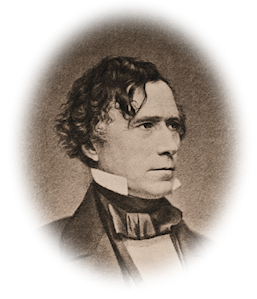
My Dear Sir,—I have received your kind, earnest letter, and participate strongly in your apprehensions. To my vision the political horizon shuts down close and darkly. It may be that light is to break ‘through somewhere, but I do not discern the quarter whence it is to come. I had occasion to write a friendly letter to Secretary Thompson (Interior) a day or two since, and expressed to him briefly my convictions and fears and hopes in relation to the present state of public affairs. I did not expect that letter to be published, but the blackness is gathering so fast that if anything can be done to save our glorious Union it must be done speedily, and, in my judgment, at the North chiefly. If you call on the Secretary he will show you that letter, and if he thinks the publication of it would be useful, he can use it as he pleases. The truth must appear that it was written in the course of friendly correspondence, and not with a view to publication. Among intelligent, reflecting men, alarm is evidently increasing here daily. One decisive step in the way of coercion will drive out all the slave-labor States. Of that I entertain no doubt. My suggestion about the tone and temper of Congress, and the importance of temperate words and actions might possibly have some degree of good influence, and there is, perhaps, more hope that the letter might be serviceable just at this juncture at the North; but it was hastily written, and my friend, the Secretary, must judge. If you call on him, show him this note.

In haste, your friend,

Franklin Pierce.

0 comments

A Few Letters and Speeches of the Late Civil War by August Belmont (DNC Chairman)

Civil War Day-by-Day

To John C. Bradley,

Huntsville, Ala.

New York, November 28, 1860.

My Dear Sir,—I have received your letter of the 23d inst., and am rejoiced to see that the conservative men of your part of the country have moved in the right direction.

The patriotic men of the country look to the Douglas and Bell party of the South as their only hope in the present crisis. Yancey and his compeers, by seceding at Charleston, broke up the Democratic party, and were the chief means of Lincoln’s election.

It is clear now that this was the programme, in order to throw the cotton States into their hands, and force a dissolution of the Union by terrorism and packed conventions.

If there is conservative spirit and love of the Union enough left in the South to prevent them from carrying out their treasonable schemes, all may be saved yet.

A convention of all the Southern States would certainly save us. It would be followed by a convention of all the States North and South, where the guaranties which the South has a right to demand, would be sure to be granted to her under the Constitution.

I inclose you a copy of a letter which I addressed a few days ago to John Forsyth, embodying my views on the present crisis. If you think proper you may show it to such friends as are with us in sentiment.

0 comments

Operations in Charleston Harbor

War of the Rebellion: from the Official Records of the Union and Confederate Armies and Navies
“I am inclined to think that if I had been here before the commencement of expenditures on this work, and supposed that this garrison would not be increased, I should have advised its withdrawal, with the exception of a small guard, and its removal to Fort Sumter, which so perfectly commands the harbor and this fort.

.
.
FORT MOULTRIE, S.C., November 28, 1860.

Col. S. COOPER,

Adjutant-General U. S. A.:

COLONEL: I have the honor to acknowledge the receipt of your communication of the 24th instant. I presume that my letter of the 23d has been received, and that the Department is now in possession of my views in reference to the measures I deem advisable and necessary for keeping this work and this harbor. Your letter confines my answer to what refers to the work under my charge. I cannot but remark that I think its security from attack would be more greatly increased by throwing garrisons into Castle Pinckney and Fort Sumter than by anything that can be done in strengthening the defenses of this work. There are several intelligent and efficient men in this community, who, by intimate intercourse with our Army officers, have become perfectly well acquainted with this fort, its weak points, and the best means of attack. There appears to be a romantic desire urging the South Carolinians to have possession of this work, which was so nobly defended by their ancestors in 1776; and the State, if she determines to act on the aggressive, will exert herself to take this work. The accompanying report exhibits the present state of my command. I think I can rely upon their doing their duty, but you will see how sadly deficient we are in numbers, whether to repel a coup de main or to maintain a siege. We finished mounting our guns this morning, and I shall soon commence drilling and exercising my men in firing with muskets and cannon. I find that in consequence of sickness, &c., very little military duty has been attended to here for a long time; we shall try, and I hope [continue reading…]

0 comments

An Hour with the President

Turning on the Light: A Dispassionate Survey of President Buchanan’s Administration, From 1860 to its Close, by Horatio King

P. O. Dept., Appt. Office, November 27, 1860.

My Dear Sir,—Our chief clerk, Mr. Clements, and myself had an hour with the President last evening, and our interview was most satisfactory. Mr. C. has just returned from Tennessee, and brings good news from that State to the effect that nearly everybody there is opposed to the hasty action of South Carolina, and is in favor of one more effort to preserve their rights in the Union. The President appeared to be much gratified to be reassured of this. He is, as I supposed, a firm Union man. I told him about your writing to and not receiving any answer from Mr. Cobb, and he remarked that it would not do the slightest good to write to him. I expressed myself freely to him about the course of the Constitution newspaper, and told him how much it had injured him, etc., etc. I have no doubt he will take strong ground in his message against secession, as well as the right of secession; but were I allowed to guess, I would say that he will not be in favor of using force unless the property of the United States is interfered with, such as the taking of the forts, etc., when he would be obliged to act.

Very truly,

Horatio King.

HON. John A. Dix, P. M., New York.

0 comments

Repugnance to Visiting Washington

Turning on the Light: A Dispassionate Survey of President Buchanan’s Administration, From 1860 to its Close, by Horatio King

(Unofficial.)

P. O., New York, November 27, 1860.

My Dear Sir,—It is impossible for me to leave here at this moment, and I have an insuperable repugnance to a visit to Washington. On receipt of your letter I sat down to write to the President, but constant interruptions prevented me from finishing it. Besides I have some doubt whether it would do good. I have made some inquiry in regard to the editor of the ‘Constitution,’ and incline to the belief that he cannot be influenced from this quarter. At all events, those who might influence him think as he does. I am, in a quiet way, doing all I can to promote a better feeling at the South. I am sorry to say that nothing I have yet done has met with a response from any of our Southern friends. I believe we shall have to rely entirely on the efforts of our conservative friends there. They seem at present to be overborne by the general excitement. I cannot think this will last. There must, at least, be an effort to prevent a dissolution. I trust events here may aid the conservative movement there. Vermont is moving to repeal her personal liberty bills, with what success remains to be seen. Massachusetts will follow her lead, and, I think, will repeal.

I shall send my letter to the President this evening or to-morrow.

With sincere regards, yours,

John A. Dix.

Hon. Horatio King.

0 comments

A Few Letters and Speeches of the Late Civil War by August Belmont (DNC Chairman)

Civil War Day-by-Day

To Julius Izard Pringle,

Charleston, S.C.

New York, November 26, 1860

Dear Pringle,—I note the contents of your note of the 22d inst. The present political and financial crisis will, I trust, soon pass over and every thing turn back to its regular channels.

It will then appear clearly a qui la faute of the calamities which have overtaken us, and to which you allude in your letter. My convictions on that point have never changed.

We are cursed with two sets of Abolitionists in this country, and until they are crushed out of political existence, our onward march as a great and prosperous nation must be retarded, and the foundations of the Union and Constitution undermined. They are the fanatical Abolitionists of slavery, led by Sumner and other demagogues, and the selfish and short-sighted Abolitionists of the Union, under the leadership of Yancey, Rhett, and Toombs. If the conservative spirit of our people North and South cannot silence forever the howlings of these false prophets, we are all doomed to leave an inheritance of ruin and blood to our children, who otherwise might have grown up as citizens and brethren of the freest and mightiest empire upon which God’s sun ever shed its radiant lustre.

I have embodied my views on the present crisis in a letter, which I addressed a few days ago to Mr. Forsyth, in Alabama, and of which I hand you inclosed a copy.

The hour is dark, but I do not yet despair entirely of the patriotism and good sense of the American people.

0 comments

A Letter from Franklin Pierce

Turning on the Light: A Dispassionate Survey of President Buchanan’s Administration, From 1860 to its Close, by Horatio King

Lowell, Mass., Nov. 26, 1860.

My Dear Sir,—Your letter was received at Concord on Saturday, and I should have answered it while there if I could have found a little interval of leisure. I am here to-day on business, and can therefore do scarcely more than to thank you; but let so much, at least, be said. The apprehensions which you so forcibly express did not increase mine. You know how sincerely and earnestly I have for years deprecated the causes which, if not removed, I foresaw must produce the fearful crisis which is now upon us; and I know how ineffectual, in this section, have been all warnings of patriotism and ordinary forecast. Now, for the first time, men are compelled to open their eyes, as if aroused from some strange delusion, upon a full view of the nearness and magnitude of impending calamities. It is worse than idle–it is foolhardy–to discuss the question of probable relative suffering and loss in different sections of the Union. In case of disruption we shall all be involved in common financial embarrassment and ruin, and, I fear, in common destruction so much more appalling than any attendant upon mere sacrifice of property, that one involuntarily turns from its contemplation. To my mind one thing is clear: no wise man can, under existing circumstances, dream of coercion. The first blow struck in that direction will be a blow fatal even to hope.

You have observed, of course, how seriously commercial confidence, and consequently the price of stocks, etc., have already been shaken at the North, and yet there is in the public mind a very imperfect apprehension of the danger. Still, there are indications of a disposition to repeal laws directed against the constitutional rights of the Southern States,—such as personal liberty bills, etc.–and if we could gain a little time, there would seem to be ground of hope that these just causes of distrust and dissatisfaction may be removed. I trust the South will make a large draft on their devotion to the Union, and be guided by the wise moderation which the exigency so urgently calls for. Can it be that this flag, with all the stars in their places, is no longer to float, at home, abroad, and always, as an emblem of our united power, common freedom, and unchallenged security? Can it be that it is to go down in darkness, if not in blood, before we have completed a single century of our independent national existence? I agree with you that madness has ruled the hour in pushing forward a line of aggressions upon the South, but I will not despair of returning reason and of a re-awakened sense of constitutional right and duty. I will still look with earnest hope for the full and speedy vindication of the co-equal rights and co-equal obligations of these States, and for restored fraternity under the present Constitution—fraternity secured by following the example of the fathers of the republic—fraternity based upon admission and cheerful maintenance of all the provisions and requirements of the sacred instrument under which they and their children have been so signally blessed. When that hope shall perish, if perish it must, life itself, my friend, will lose its value for you and me. It is apparent that much will depend upon the views expressed and the tone and temper manifested during the early days of the session of Congress now near at hand. May the God of our fathers guide the counsels of those who in the different departments of government are invested in this critical epoch with responsibilities unknown since the sitting of the convention which framed the Constitution.

Your friend,

Franklin Pierce.

Hon Horatio King, 1st Asst. P, M. General, Washington D.C.

0 comments

Beset by Secessionists

Turning on the Light: A Dispassionate Survey of President Buchanan’s Administration, From 1860 to its Close, by Horatio King

(Confidential.)

P. O. Dept., November 25,1860.

My Dear Sir,—I have good reason to believe that the President is beset by secessionists, who are almost exclusively occupying his attention; and it is important that the true friends of the Union should do all in their power to strengthen his hands. Why will you not either write or come and see him, and get all the strong men of your city to do the same? I cannot call names, but rest assured what I tell you is true. The course of the ‘Constitution’ is infamous, but the President, I presume, has no means of controlling it. Pray let him hear from you all in a most decided manner on this subject. Let him know how much the paper and suspicions of disunion influences near him are injuring him.

Stephens’s speech is admirable; but observe that you do not see it, or anything like it, in the ‘Constitution.’ Get the papers to come out and denounce the ‘Constitution.’ You may rely upon it, all its secession articles are directly against the feelings of the President.

As the existence of the Department depends on the stability of the Union, I shall treat this as ‘on official business.’

Yours truly,

Horatio King.

HON. John A. Dix, New York.

0 comments

The Whole Weight of His Influence

Turning on the Light: A Dispassionate Survey of President Buchanan’s Administration, From 1860 to its Close, by Horatio King

Washington, November 25,1860.

My Dear Sir,—I would call and report to you what I know of the feelings of your friends whom I met recently in a flying visit to my native State, but that I know you are much occupied. May I not, therefore, be allowed to say to you briefly, in writing, that their most anxious desire is that the President will cast the whole weight of his influence against the secession movements at the South and in support of the Union? Among those whom I met was General Dix, who, of course, is greatly concerned with reference to the present excitement. He had written both to Mr. Cobb and Mr. Breckinridge, pressing them to come out boldly against secession. The inclosed note from him may be interesting to you. You need not trouble yourself to return it.

I hope I shall not be deemed obtrusive. My great desire is that the Union may be preserved, and that in your noble efforts to that end you may know that all your true friends will stand by you to the last.

I have the honor to be,

Very sincerely your friend,

Horatio King.

His Excellency, James Buchanan.

0 comments

When this Union is Dissevered

News of the Day

Alexander H. Stephens to ______[i]

Crawfordville [Ga.], Nov. 25, 1860.

Dear Sir: Your kind and esteemed favor of the 19th instant is before me, for which you will please accept my thanks. I thoroughly agree with you as to the nature and extent of the dangers by which we are surrounded, and the importance of united action on the part of our people in the line of policy to be pursued.

I know also that there breathes not a man in Georgia who is more sensitively alive to her rights, interest, safety, honor and glory than myself; and whatever fate befalls us I earnestly hope that we shall be saved from the worst of all calamities, internal divisions, contentions and strifes. The great and leading object aimed at by me in Milledgeville was to produce harmony on a right line of policy. If the worst comes to the worst, as it may, and our State has to quit the Union, it is of the utmost importance that all our people should be united cordially in this course. This, I feel confident, can only be effected on the line of policy I indicated.

But candor compels me to say that I am not without hopes that our rights may be maintained and our wrongs be redressed in the Union. If this can be done it is my earnest wish. I think also that it is the wish of a majority of our people. If, after making an effort, we shall fail, then all our people will be united in making or adopting the last resort, the “ultima ratio regum“. Even in that case I should look with great apprehension as to the ultimate result. When this Union is dissevered, if of necessity it must be, I see at present but little prospect of good government afterwards. At the North I feel confident anarchy will soon ensue. And whether we shall be better off at the South will depend upon many things that I am not now satisfied that we have any assurance of.

Revolutions are much easier started than controlled, and the men who begin them, even for the best purposes and objects, seldom end them. The American Revolution of 1776 was one of the few exceptions to this remark that the history of the world furnishes. Human passions are like the winds; when aroused they sweep everything before them in their fury. The wise and the good who attempt to control them will themselves most likely become the victims. This has been the history of the downfall of all Republics. The selfish, the ambitious, and the bad will generally take the lead. When the moderate men who are patriotic have gone as far as they think right and proper, and propose to reconstruct, then will be found a class below them, governed by no principle but personal objects, who will be for pushing matters further and further, until those who sowed the wind will find that they have reaped the whirlwind.

These are my serious apprehensions. They are founded upon the experience of the world and the philosophy of human nature, and no wise man should condemn them. To tear down and build up again are very different things; and before tearing down even a bad Government we should first see a good prospect for building up a better. These are my views candidly given. If there is one sentiment in my breast stronger than all others, it is an earnest desire for the peace, prosperity, and happiness which a wise and good government alone can secure. I have no object, wish, desire, or ambition beyond this; and if I should in any respect err in endeavoring to attain this object it will be an error of the head and not of the heart.


[i] From the National Intelligencer, Washington, D. C, Dec. 6, 1860, reprinting the letter from the New York Journal of Commerce, with a notice that it was addressed by Stephens to a friend in New York. Copy obtained through the courtesy of Mr. J. K. Smith, of Grand Rapids, Mich.


From Annual Report of the American Historical Association for the Year 1911.

Alexander Hamilton Stephens was an American politician who served as the vice president of the Confederate States from 1861 to 1865. After serving in both houses of the Georgia General Assembly, he won election to Congress, taking his seat in 1843. After the Civil War, he returned to Congress in 1873, serving to 1882 when he was elected as the 50th Governor of Georgia, serving there from late 1882 until his death in 1883.

0 comments

Enemies Within or Foes Without

News of the Day
1860s newsprint

The Constitutional [Alexandria, LA], November 24, 1860

 We consider it our duty to call the attention of the citizens of the parish, to the position in which the whole Southern country is placed by the result of the recent Presidential election.

We consider it to be the duty of the people of each Ward to organize themselves in such a way, as to protect themselves from “enemies without or foes within.” It is unnecessary for us to explain our reasons for this notice, as they are known to all. A strict surveillance should be kept up.

0 comments

The Secession Movement in the South

Frank Leslie’s Illustrated Newspaper

Frank Leslie’s Illustrated Newspaper, November 24, 1860

Ever since the vote of the 6th of November, which indicated beyond peradventure that the candidate for the Republican party would be the next President of the United States, there has been a wild excitement and a terrible agitation in our sister States of the South. Even before the vote which settled the doubt, many Southern politicians looked upon the result as a foregone conclusion, and had prepared the minds of their constituents for an organized and determined resistance. So the feeling had been growing and growing, fanned almost to a premature fire by the sneering and insulting tone of too many of the Northern papers, until the public mind at the South was fully prepared for some prompt, definite and determined action.

South Carolina led the van in opposition to the assumption of power of that party so obnoxious to the sentiment of the entire South. Her State Legislature has authorised a Convention, to meet on the 17th, to deliberate upon the present state of affairs and decide what course of action the State shall pursue. Popular indications seem to point to immediate secession as the only means of allaying the feverish excitement of the people. In Charleston and Columbia meetings take place daily and nightly. Distinguished public men address excited crowds from the steps of the public buildings, from the windows of the hotels., and at the corners of the streets. The language of the speakers is unmistakable, and those who speak the loudest for immediate dissolution are the most enthusiastically cheered. A large proportion of the Federal officers have resigned, and are to be remunerated by the State for their sacrifice for. the cause of right, and it is said that their course will be followed by every official; Postmasters, &c., now holding positions under the Federal Government. Senators Toombs, Chestnut and Hammond have resigned.

South Carolina does not stand alone in this secession movement. Georgia and Alabama are active, enthusiastic and demonstrative in the cause. Alabama will call a State Convention on the seventh of December, and the Governor of Georgia, in a lengthy message, recommends a system of retaliation against hostile States (those which nullify the Fugitive Slave Law), and the immediate.calling of a State Convention. From State to State the disunion feeling is spreading with a terrible rapidity, and the more it spreads the wilder and the more intense it seems to grow. In our next issue we shall probably chronicle the first steps taken by the Southern States towards withdrawing from the Union.

Charleston is boiling over with the spirit of secession. It is the theme of every tongue, and, apparently, the hope of every heart.. The palmetto flag was raised amidst the thunder of cannon and the shouts of the people, and now waves from a hundred houses. Several State Legislatures have made large appropriations for the arming of the militia, and “minute” men are being enrolled by hundreds. It has been stated that the minute men organization numbers between one and two hundred thousand men, prepared to defend the action of the South at all hazards. Hardee’s drill is adopted and zealously practised.

The Legislature passed a bill authorizing the banks to suspend specie payments, and the military committees of both houses were to sit during the recess.

Governor Pettus, of Mississippi, is about to summon the Legislature to consider the state of affairs.

There is a disposition at the North to speak lightly of this great and general movement, but a free people so strongly moved, and writhing under what they believe to be a deliberate and settled plan to rob them of that which they consider to be their vested and inalienable rights, are not likely to be quieted without some definite object is obtained, be it what it may.

Great Mass Meeting to Endorse the Call of the Legislature of South Carolina for a State Convention to Discuss the Question of Secession from the Union, held at Intitute Hall, Charleston, S.C on Monday, Nov. 12, 1860 - from a Sketch by our Special Atist

On Monday, the 12th inst., a mass meeting of the people of Charleston was called to be holden at the Institute Hall, to ratify the call of a convention by the Legislature. The invitation extended to ladies and was responded to with enthusiasm, the galleries of the vast hall being thronged by the gentle sex, who displayed a deep and earnest interest in the transactions. The bantling was densely thronged, and the thousands outside who could not force their way in were addressed at various points by strong and excited speakers. The meeting was presided over by the late Federal Judge Magrath, and addresses were made by ex-Senator Rhett, Mr. Spratt, ex-Government Attorney Conner, ax-Collector Colcock. and other eloquent men. It is stated that when the speaker declared “The Union is dissolved,” the enthusiasm beggared description. The vast audience rose as with one Impulse, and amid waving of hats and handkerchiefs shout after shout pealed forth, which seemed to shake the building to its foundation. Fireworks and illuminations marked the occasion, which appeared to be one of general joy.
0 comments

The Americans in Garibaldi’s Army

News of the Day

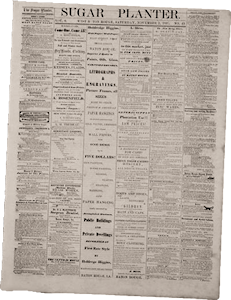
Sugar Planter [West Baton Rouge, LA], November 24, 1860

We recently announced that among the volunteers who went out from England to join Garibaldi, was our countryman Gen. Wheat. In a letter from Gen. Avezzana to a friend in this city, dated Maildaloni, October 16, we find mention of four other Americans as being attached to his (General Avezzana’s) staff—namely, Charles Carroll Hicks, of Columbus, Ohio; Frank Maney, of Nashville, Tennessee; Henry N. Spencer, Jr., of Pennsylvania; and Alfred Benthuysen, of New Orleans, Louisiana. They all had the good fortune to be present at the battle of Caserta, and the General speaks of their conduct in the highest terms.—New York Herald, 12th.

0 comments