Letters to W. H. Seward

Civil War Day-by-Day

SPRINGFIELD, ILLINOIS, December 8, 1860.

My dear Sir: With your permission I shall at the proper time nominate you to the Senate for confirmation as Secretary of State for the United States. Please let me hear from you at your own earliest convenience.

Your friend and obedient servant,

A. LINCOLN.

(Private and confidential.)

SPRINGFIELD, ILLINOIS, December 8, 1860.

My dear Sir: In addition to the accompanying and more formal note inviting you to take charge of the State Department, I deem it proper to address you this. Rumors have got into the newspapers to the effect that the department named above would be tendered you as a compliment, and with the expectation that you would decline it. I beg you to be assured that I have said nothing to justify these rumors. On the contrary, it has been my purpose, from the day of the nomination at Chicago, to assign you, by your leave, this place in the administration. I have delayed so long to communicate that purpose in deference to what appeared to me a proper caution in the case. Nothing has been developed to change my view in the premises; and I now offer you the place in the hope that you will accept it, and with the belief that your position in the public eye, your integrity, ability, learning, and great experience, all combine to render it an appointment preëminently fit to be made.

One word more. In regard to the patronage sought with so much eagerness and jealousy, I have prescribed for myself the maxim, “Justice to all”; and I earnestly beseech your cooperation in keeping the maxim good.

Your friend and obedient servant,

A. LINCOLN.

0 comments

Through Some Eventful Years

Through Some Eventful Years by Susan Bradford Eppes
Susa Bradford Eppes

December 8th, 1860.—Miss Sadie Talbot, our new governess, arrived today. She and her sister are Southern girls from Easton, Maryland.

They are tall blondes and very pretty, I think. They have the little touch in their speech which most Marylanders whom I have known have had, and it sounds real sweet from them though it sounds affected in a great big man like Mr. Burton. These young ladies were educated at Poughkeepsie, New York, but they are real Southerners, though they are not in favor of secession; but they are quite young and full of fun.

The legislature met in Tallahassee in November and Governor Perry advised that they call a convention to meet January 3rd, to consider whether Florida shall follow South Carolina’s example or not; so I suppose we will soon know our fate. Florida is a big state in area but her people are comparatively few and the settlements are far apart. Florida is a young state, too; she is only one year older than I am, so she must be almost a child still. The question is, can she stand alone? I hear all the pros and cons of this movement from both the Secession and the Union side, so I am afraid I am sometimes a little mixed as to politics. Anyway Christmas is much more interesting so I will think about that. I like Miss Sadie, (she says we must call her Miss Sadie and it is best for her sister is Miss Talbot).


Susan Bradford is 14 years old when this entry was made.

0 comments

The City of Charleston, S. C.

Frank Leslie’s Illustrated Newspaper

General View of the Harbor and the City of Charleston, S.C. - From a Sketch by Our Special Artist.General View of the Harbor and the City of Charleston, S.C. – From a Sketch by Our Special Artist.

Frank Leslie’s Illustrated Newspaper, December 8, 1860

The beautiful city of Charleston, which we illustrate this week, is the largest city of South Carolina, and is situated on a tongue of land, bounded on either side by the rivers Ashley and Cooper, which, joining at the extreme outward point, form a large and beautiful bay, which communicates with the ocean at Sullivan’s Island, seven miles below. It was founded in 1672. In 1687 a large company of French Huguenots, flying from religious persecution, landed at Charleston, and made it their permanent residence, and from this noble stock are descended many of the first families in the city. It was incorporated as a city in 1783, and played a glorious part in the following Revolutionary struggle. History mentions no more gallant action than the victory gained by Colonel Moultrie and his four hundred gallant volunteers who
repelled and badly beat a British squadron of nine ships, making it retreat with much damage and severe loss of life, before the well-served guns of Fort Moultrie. Charleston has suffered immense losses by fire, the loss at one, in 1838, being over five millions of dollars; but she has great recuperative powers, and the beautiful city comes out still more beautiful after each desolating disaster.

The ground on which the city of Charleston is built is some eight or nine feet above high water-mark. The tide rises about six feet, and passing, like the tide of our Hudson and East Riven, on either side of the city, preserves it pure and healthy. The streets are laid out in lines running parallel with each other from the Cooper to the Ashley Rivers, and are intersected almost at right angles by others. Many of the streets are very broad, varying from sixty to seventy feet in width. One of the most delightful features of the city is the abundance of beautiful shade trees which line the streets of the Palmetto City, serving the double purpose of screening the pedestrian from the rays of the summer sun and of an ornament of rare and unequalled beauty.

The public buildings of the city were planned on a liberal scale. They are remarkable for architectural beauty, and for the solidity of their structure. Not only are the Government buildings particularly worthy of notice, but the banking-houses, churches, public institutions, hotels and private mansions are rich in their architecture and spacious in their accommodation.
Charleston is a great resort for strangers, not only for the salubrity of its climate, but for the charming case, the hospitality and the refined and elegant tone which prevails in every class of its society. The commerce of Charleston is very considerable, not only by the marine, but inland, by means of the several railroads which centre in the city.

0 comments

The author of “War Diary of a Union Woman in the South”

Miscellaneous document sources

I am providing background information for authors of the civil war era material that I will be posting as I blog my way through the civil war 160 years later.  They will all be listed on the Authors page, accessible on the menu at the top of every page.  Each listed author will also include a short summary with links to longer biographical sketches and other material.

The most recent addition is:

Dora Richards Miller—Born in St. Thomas in the Danish Virgin Islands and raised in the Frederiksted, St. Crois home of a grandmother who had freed all her late husband’s slaves, Dora Richards started her diary as a single, pro-Union, 25-year-old woman in New Orleans, Louisiana.  Within months, she was married to Anderson Miller, an Arkansas lawyer and living in a small Arkansas delta county seat.  With the Mississippi flooding, “swamp fever” raging, and food supplies disrupted by the needs of a rebel army, their Arkansas home wasn’t a refuge for long. Trying to find a safer place where Anderson can ply his trade, they ended up in Vicksburg just before the beginning of the Vicksburg campaign and got stuck there until after the city fell. Years later, a widow with two sons, to protect her job as a teacher in New Orleans, her diary was published anonymously in two magazine articles and two books as “A Woman’s Diary of the Siege of Vicksburg” and “War Diary of a Union Woman in the South,” all edited by George W. Cable. (Besides teaching Dora Miller was also an author and inventor. Her story about her life in St. Croix and her observations and experiences during the July 1848 slave revolt was published in 1892 as “A West Indian Slave Insurrection” in Scribner’s.)

0 comments

Governor Pickens to President Buchanan by Colonel Hamilton Demanding Peaceable Possession of Fort Sumter

Miscellaneous document sources

[COPY.]

Columbia, December 7, 1860.

[STRICTLY   CONFIDENTIAL.]

My Dear Sir: With a sincere desire to prevent a collision of force, I have thought proper to address you directly and truthfully on points of deep and immediate interest.

I am authentically informed that the forts in Charleston harbor are now being thoroughly prepared to turn, with effect, their guns upon the interior and the city. Jurisdiction was ceded by this State expressly for the purpose of external defence from foreign invasion, and not with any view that they should be turned upon the State.

In an ordinary case of mob rebellion, perhaps it might be proper to prepare them for sudden outbreak. But when the people of the State, in sovereign convention assembled, determine to resume their original powers of separate and independent sovereignty, the whole question is changed, and it is no longer an act of rebellion. I, therefore, most respectfully urge that all work on the forts be put a stop to for the present, and that no more force may be ordered there.

The regular Convention of the people of the State of South Carolina, legally and properly called, under our Constitution, is now in session, deliberating upon the gravest and most momentous questions, and the excitement of the great masses of the people is great, under a sense of deep wrongs, and a profound necessity of doing something to preserve the peace and safety of the State.

To spare the effusion of blood, [continue reading…]

0 comments

Another Liberty Pole and Banner

Miscellaneous document sources

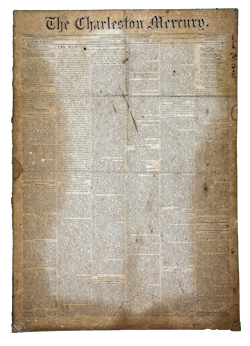
The Charleston Mercury, December 7, 1860

At one o’clock yesterday, Messrs. E. LAFITTE & CO. erected a handsome flagstaff, twenty-five feet high on the roof of their office, Savannah Packet wharf, and unfurled a banner at its summit which has been universally admired. The flag has a plain white ground—something like the Hayne and Meeting streets banner—with a green palmetto in the centre and the lone star in the upper inner corner. It was saluted by prolonged cheers from the many friends whom the Messrs. LAFITTE had invited to be present on the occasion, and also by a volley of cannon, fired by the redoubtable SMITH, of shark-killing notoriety, and who proved himself as equally efficient a gunner as a knight of the hook and line. Five guns were fired off—one for South Carolina, for Georgia, for Florida, for Alabama and for Mississippi, and between the intervals of the firing the enthusiastic spectators renewed the cheering.

Messrs. LAFITTE & CO. Then invited their friends…. where they were received most cordially by Capt. PECK, and where a bounteous collation, with the auxiliaries of wine, &c., awaited them. As the guests got on board the Cecile, Capt. PECK hoisted a blood-red banner with a yellow palmetto, which was received with additional marks of enthusiasm.

Indeed, poles, of late, are multiplying almost as fast as banners. We notice that Messrs. CHAFEE & KNAUFF, at No. 135 East Bay, have erected from the second story of their store, a staff, thirty feet in height, and displaying a handsome flag from the summit. The flag is a red ground, with a yellow palmetto; in the centre the lone star and a crescent.

0 comments

A New Military Company in Home Made Jeans

News of the Day

1860s newsprintNavarro Express [Corsicana, TX], December 7, 1860

Week before last we urged the propriety of the military companies now being formed throughout the State uniforming themselves in home made jeans. Last Monday our enterprising friend, Wm. T. Patton, of Flowerdale, Freestone county, orderly sergeant in a new company organized in that neighborhood called the Prairie Wake Ups, called on us dressed in the uniform of said company. It consists of a frock coat and pants made of homemade jeans, with red and white worsted stripes on the breast and [legs?]. It looked neat and comfortable, and instead of the money being sent North to feed our enemies, it was distributed at home. The spirit of this company is worthy of imitation, and we would urge the propriety on all companies being formed throughout the State, of having their uniforms made of goods of home manufacture.

0 comments

Howell Cobb to his Wife

Miscellaneous document sources

Washington City, 7 Dec, 1860.

My Dear Wife, … I put a printed copy of my address to the people of Georgia in Judge Black’s[i] hand to be handed to the President. Whether I remain here after its publication to the world will soon be decided. I suppose I cannot; but I hope to part from the old gentleman pleasantly. Duty to Georgia compels me to speak and self respect compels me to speak in plain language. This I have done, as you know from having heard the address read. . . .


[i] Jeremiah S. Black, Attorney-General.


From Annual Report of the American Historical Association for the Year 1911.

Howell Cobb was an American political figure. A southern Democrat, Cobb was a five-term member of the United States House of Representatives and Speaker of the House from 1849 to 1851. He also served as the 40th Governor of Georgia and as a Secretary of the Treasury under President James Buchanan. Cobb is, however, probably best known as one of the founders of the Confederacy, having served as the President of the Provisional Congress of the Confederate States.

0 comments

Operations in Charleston Harbor

War of the Rebellion: from the Official Records of the Union and Confederate Armies and Navies
“Our time is short enough for what we have to do. Should the ordnance stores I have called for or re-enforcements not arrive, in the event of our being attacked I fear that we shall not distinguish ourselves by holding out many days.”
.

FORT MOULTRIE, S. C., December 6, 1860.
(Received A. G. O., December 10.)

Col. S. COOPER,
Adjutant-General U. S. Army:

COLONEL: I have the honor to acknowledge the receipt, on the 4th, of your communication of the 1st instant. In compliance therewith I went yesterday to the city of Charleston to confer with Colonel Huger, and I called with him upon the mayor of the city, and upon several other prominent citizens. All seemed determined, as far as their influence or power extends, to prevent an attack by a mob on our fort; but all are equally decided in the opinion that the forts must be theirs after secession. I shall nevertheless, knowing how excitable this community is, continue to keep on the qui vive, and, as far as in my power, steadily prepare my command to the uttermost to resist any attack that may be made. As the State will probably declare itself out of the Union in less than two weeks, it seems to me that it would be well to discontinue all engineering work on this fort except such as is necessary to increase its strength. I have not pretended to exercise any control over that department, and have found Captain Foster generally disposed to accede to the suggestions I have ventured to make; and the suggestions I now make are not made in any unkind spirit towards him, as he is compelled to carry out the instructions of his department, but such as I feel it my duty to make, as being held responsible for the defense of this work. One of the bastionettes is nearly completed, now awaiting the arrival of the pintle blocks, without which the embrasure cannot be made. The foundation has only been laid for the other. I certainly think that it is now too late to begin the construction of the second one, and that it would be better to substitute some other flanking arrangement, which can be finished in a few days.

Captain Foster is now [continue reading…]

0 comments

A Few Letters and Speeches of the Late Civil War

Civil War Day-by-Day

To Governor WM. SPRAGUE,

Providence, R.I.

New York, December 6, 1860

My Dear Sir,—The deep solicitude which the events in the South must call forth in the breast of every American citizen induces me to address you these lines.

The secession of South Carolina, which must be looked upon now as an accomplished fact, will inevitably very soon be followed by the secession of all the cotton States, and a consequent dissolution of the whole Confederacy, unless prompt and energetic measures are taken by the leading men of the North, in order to prevent this fearful calamity.

Even the most fervent adherents of the Union in the border States despair of the possibility of maintaining their States within the Union, unless the just grievances of the South are remedied by early and prompt action.

At this moment the patriotic men in the gulf States are using every effort, in order to bring about a joint convention. In this they are violently opposed by the disunionists, who are for immediate and separate action. The latter are undoubtedly in the ascendency, and unless some action is at once taken at the North which will strengthen the hands of our friends, no earthly power can save the Union.

If the programme of the co-operation men, composed of [continue reading…]

0 comments

A Letter from Franklin Pierce

Turning on the Light: A Dispassionate Survey of President Buchanan’s Administration, From 1860 to its Close, by Horatio King

Concord, N. H., Dec. 6,1860.

My Dear Sir,–Your letter of November 30 I found here on my return from Hillsboro yesterday, and also several northern papers containing my letter to Secretary Thompson.

Since the action of the Vermont Legislature upon the report of the Judiciary Committee of the House of Representatives, declaring the ‘personal liberty bill’ of that State to be clearly unconstitutional, I am in despair with regard to any amendment of errors at the North, so far as the question of slavery is concerned. Reason has surrendered its throne, all sense of patriotism, justice, and right seems to have departed forever from the black Republican portion of the country. If the legislature of this State were convened to-day, I do not believe that they would repeal their unconstitutional laws. When I say this you will understand that I think the Union has already reached its termination.

It seems to me that few men in this crisis suffer so keenly as I do. With regard to pecuniary loss, it is nothing. I do not take it into the account. It is not worth considering. We can all have bread, if we will work for it, but we shall never have again the glorious ensign of our country, which has been the object of our just admiration, the type of our power, and the shield of our protection the world over.

Your friend,

Franklin Pierce.

Horatio King

0 comments

Capt. Montgomery

News of the Day

Daily Times [Leavenworth, KS], December 6, 1860

Description of His Personal Appearance—A Short Biography of Him.

[Correspondence of the New York Tribune.]

Boston, Nov. 27, 1860.

James Montgomery, whose recent operations in Kansas are now attracting considerable attention, was here last Summer, and I saw something of him. In person he is tall and straight, of spare but highly nervous organization, and with a step as elastic as an Indian’s. Judging by the pictures of Col. Fremont, I should say that he and Montgomery resemble each other strikingly in their physical characteristics. Montgomery is a very different man from John Brown. Brown, in company, sat apart, evidently possessed by an idea, and determined to fulfill his mission in the world at all hazards. Montgomery sat at table and ate his dinner like other people, giving you the impression that he was a brave, frank, open-hearted, sincere and honest man, who would do his duty, but would cautiously consult his friends, and try to adopt the best means of reaching the result desired. Brown depended upon his despotic will; Montgomery evidently relies upon the influences of common sense, of which he possesses a great deal, to exert its proper sway over his associates. I have obtained some particulars of his history. He was born in Ashtabula County, Ohio, but emigrated to Kentucky when he was 15 years old. He at first undertook the profession of a school teacher, and also learned the carpenter’s trade. By joint brainwork and hand work he soon acquired a competency. At an early age he married a Kentucky girl, of highly respectable family, with whom he lived four years. She died, leaving no children. Soon after this he lost all his property by a heavy freshet, which carried off his mill-dam which he had begun to build. He now was obliged to begin life anew—wife and property were gone, but the cool head and strong hands remained. After awhile he married again. His second wife was a young girl of the neighborhood, uneducated, and of simple manners. She has become the mother of seven children, the eldest of whom is a stout girl of sixteen. During her husband’s absence upon his numerous expeditions to defend his own home and those of his neighbors, she provides for the family. At one time, when they were destitute of provisions, she waded through the snow to the woods, and with her gun procured game enough for the support of her household until relief came.

After several years of hard work in Kentucky, Montgomery, being obliged to compete with slave labor at $1 a day, found himself unable to improve his condition; so he resolved to remove to Missouri. Selling all his property except his chest of tools, he, with his own and wife’s family, went to Cincinnati, and there took passage for St. Louis. He had only $1.50 in his pocket when he arrived there. Failing to obtain employment, he pledged his chest of tools to the captain of a Missouri boat for a passage up the river, and on arrival requested the captain to take such tools as he preferred for payment. But the offer was declined, the captain generously telling that he would wait for the money until he could conveniently pay it. Montgomery stayed in Missouri a year, supporting himself by his trade in Summer and by teaching school in Winter. In the Summer of 1855 he proceeded to Lawrence, intending to pre-empt a homestead for himself in Kansas. He was disappointed to find most of the best claims occupied, and so he continued his search Southward to Linn, where he bought the claims of two Pro-Slavery men who had become tired and desirous of getting back to Missouri, and so were willing to sell at almost any price. He finished their cabin, and, returning to Missouri for his family, conducted them to their new home. He then went back to Missouri for a time, in order to complete a contract for work, and returned in the Spring with $200, the fruit of his Winter’s work. A gentleman who visited him not long ago says that his farm is the best he saw in Kansas. It consists of 240 acres, a large part of which has been placed under cultivation by himself and his boys. He is a good judge of cattle, and takes much pleasure in pointing out their fine points, and he delights to anticipate and describe the improvements which he intends to make when quieter times and a greater degree of prosperity shall give him the means.

Montgomery’s experience in Kentucky and Missouri had convinced him of the bad policy of Slavery, and upon leaving Missouri he became thoroughly Anti-Slavery in his opinions. Therefore, although he remained quietly on his farm, he soon became a prominent mark for Border Ruffian malice. Several attempts were made to assassinate him, and on one occasion, being set upon by three men, he narrowly escaped their bullets by hiding all day in the timber on the creek. Finding his home the most dangerous place he could remain in, he took up arms, and, collecting a few of his neighbors, commenced reprisals on his assailants. His exploits from 1856 to 1859 are matters of history, and I will not undertake to recapitulate them. The most readable and trustworthy account of them may be found in a volume written by William P. Tomlinson, entitled, “Kansas in 1858.” The events of 1858 were followed by a pacification, under the auspices of Gov. Denver and Montgomery, and an era of good feeling existed for a considerable time. Judge Williams and Montgomery took part together in a celebration in honor of the restoration of peace, and Montgomery’s operations were generally regarded, even by his enemies, as justified by the state of the country and the necessities of the Free State settlers.

0 comments

From Fort Washita

News of the Day

Daily Times [Leavenworth, KS], December 6, 1860

[Correspondence of the Leavenworth Times.]

 Fort Washita, C. N.}
Nov. 23, 1860. }

 Editor Times:–Within the past two weeks there have been brought before Gen. Douglass H. Cooper, Choctaw and Chickasaw Indian Agent, five persons, charged with murder, theft and perjury, and were all committed to the jail at Van Buren, Ark., to await further action of the courts of justice. Two were charged with perjury, one with murder, arson, burglary and kidnapping; and the other two have to answer the charge of stealing a wagon and two yoke of oxen. This latter crime was committed in the Chickasaw Nation, opposite Preston, Texas. Immediately upon missing his property, the owner, accompanied by a constable, started in pursuit, and succeeded in overtaking the rascals forty miles north of Perryville, C. N.

A general Court Martial was convened at Fort Arbuckle, C. N., last week, for the trial of all offenders that might be brought before it.

At a recent sale of five condemned horses, the highest bid for a horse was $96; the lowest, $40; total proceeds, $321—an average of $64½ per head—a good price for unserviceable horses, but it is in fair proportion with everything else. Corn sells at $2.21 per bushel; oats, $1.80; sweet potatoes, $2; and apples at twenty-five cents per dozen; butter brings from 25 to 50 cents per pound, according to quality; eggs, 40 cents per dozen.

About ten days since, orders were received from Department Head Quarters, to cut off the allowance for the horses one half; ever since then our horses have been on the decline, and are rapidly going, going, like South Carolina, to destruction. To-day orders were received to suspend all grain contracts. This looks rather bilious. The Buchanan Administration has commenced curtailing its expenses at rather too late a period.

A light snow covered the ground hereabouts early this morning, but had to give way to the influence of a hot Southern sun, towards twelve o’clock.

The post office, at Tishomino City, capital of the Chickasaw Nation, has suspended, or, in other words, fizzled out, for want of sufficient patronage.

The election of Lincoln is hailed here with much joy. The most ignorant suppose that it will lead to a disbanding of the army, and thus they be set at liberty. More anon.

 Rover.

0 comments

Disunion Demonstration in Texas

News of the Day
1860s newsprint

Daily Advocate  [Baton Rouge, LA], December 5, 1860

The secession enthusiasm in Texas seems to be at fever heat. If the raising of Lone Star Flags be a reliable indication of the feelings of a majority of Texans, we should say that the feeling of determined resistance to Black Republican rule is spreading throughout the State like a fire in the woods. The following are a few of the localities in which the Lone Star flag has been unfurled to the breeze amid popular acclamations. It will be seen that they are the most populous and wealthy towns in the State: Wharton, Matagorda, Houston, Galveston, Gonzales, Goliad, Port Lavaca, Richmond, Columbus, Brazoria, Lagrange, and Castorville. Preparations were being made for hoisting the same ensign in San Antonio towards the close of last week.

0 comments

Jane Stuart Woolsey to a Friend in Paris

Woolsey family letters during the War for the Union

New York, Dec. 5, 1860.

We came down to Centre Harbor on the 6th of November (the great day) and there the Republican majorities came rolling in for Abraham Lincoln. Our host in that place was of a practical turn, and, having no artillery and having some rocks to blast in the garden, laid his trains and waited for the news; and when the stage coach came in from Meredith village he “stood by to fire,” and all the rocks went off at once and made a pretty good noise. Georgy and I stopped in New Haven for a visit and had some delicious breezy, rushing, sparkling little sails in the bay and in the sound. We took to the salt water with a keen relish after nearly five months of mountains. Miss Rose Terry was in New Haven. She has just published a little volume of poems, and is writing New England stories for the magazines. Think of our national bird being in danger of splitting at last, like that odious fowl, the Austrian Eagle—a step toward realizing the vision of a “Bell-Everett” orator in the late campaign, whose speech I read, and who saw the illustrious biped with “one foot upon the Atlantic shore, one on the golden strand, and one upon the islands of the main!” Not that I care for secession; let them go! We are told we “mustn’t buy too many new dresses this winter,” but still I say no matter—no compromises. Millions for defence, not one cent for tribute. I can live on a straw a day. “ So can I,” Georgy puts in here, “if one end of it is in a sherry cobbler.” But what a sight we must be to other peoples. Just as morning breaks over Italy with sunshine and singing, this evil cloud comes up in our heaven. [continue reading…]

0 comments

Remember the Poor

News of the Day

Daily Times [Leavenworth, KS], December 5, 1860

The writers of the following article tells of two cases of extreme poverty which have come under his own observation. They are not isolated instances but such as may be found every day in our city. We cannot be too often reminded of the necessity of making provision for the poor, and we hope that the facts related below will stimulate every one to active efforts to alleviate their sufferings and supply their wants.

___________________________________

 Lo, the Poor!—Winter is coming, and with the wintry blasts, the cold, snow, wind and sleet, more than the usual amount of suffering and privation. It behooves us all to interest ourselves somewhat in the affairs of those who by accident, circumstances beyond their control, dissipation, the duplicity and meanness of others, have been reduced from plenty, comparatively, to poverty and want. It is no time to stop, to hesitate and discuss the question as to the causes which have produced this state of things; we only know that absolute, craving want, exists among us. How shall the poor be relieved, and by whom, is the question now. The city is insolvent.—Hard times, and a much harder administration of Kansas affairs, have depressed all things, and created a stringency in the financial affairs of every man of us to that extent as to induce us to ask ourselves the question, How shall we get through the winter? But then there are so many, so very many, who actually suffer for something to eat. Who will stop a moment, reflect, and volunteer their services to assist in relieving the destitute? It is not yet too late. The writer of this, on Saturday, in company with a friend, visited two families, the first that of a German woman. She said:

“I don’t know where my husband is. He went off to look for work; he left the city, and I have not seen him since. I have six children, you see them here. The oldest, Fred, is a good boy, but he is yet too young to assist any to earn food. He is only twelve years old. The baby is eight months, and of course you know, Sir, requires attention and nursing. I was never compelled to ask any body to help me before this, but you see, Sir, the children are young and growing, and will eat as much as large people. I pay four dollars a month rent for this house, but I work one dollar of it out for the landlord.”

The second family was that of an American woman. She said:

“Before my husband died we were in tolerably good circumstances. We had some good property but it has all gone into the hands of strangers, and I fear not altogether rightfully. For the last year or two, I have been doing sewing for the support of myself and children. I have five children. I have a good deal of trouble to get my pay now, after I have done the work. Times are so hard! My landlord comes punctually once a month for his rent. This distresses me, for I do not always have it. He will take it out in sewing, but then if all my time is given to making up the rent, where are the victuals to come from? The wind and cold comes in those broken panes in the window. The landlord told me to get them put in and take it out of the rent; but how could I do that, when the children were hungry, and asked me—mother, will dinner soon be ready? The quality of the food we have been subsisting upon, Mr. _____, is not always the best. At times it is good, bad, and indifferent, and really, sometimes we have nothing at all in the house. We have some potatoes and flour, which will keep starvation out of doors for three days or so, but as far as meat, we have had none in the house for three weeks past. The children are all young and need something, besides flour and potatoes. Sometimes I feel quite discouraged, but then, for the children’s sake, I must live and strive.”

These are not solitary cases, Mr. Editor, and if any one, especially the ladies, should feel benevolently inclined, there is a wide field for their exertion and enterprise right here in our midst.

Col.

0 comments

Operations in Charleston Harbor

War of the Rebellion: from the Official Records of the Union and Confederate Armies and Navies
“The plan of the leaders in this State appears to be, from all that I can see and hear, first, to demand the forts of the General Government, after secession, and then, if refused, to take them by force of arms. A quite large party is in favor of not waiting to ask the General Government, but to summon the immediate commanders, and, if refused, to attack at once.”
.

CHARLESTON, S.C., December 4, 1860.

Col. R. E. DE RUSSY,
Commanding Corps of Engineers:
COLONEL: I have been obliged to vary the plan which I indicated in my last letters as the one I intended to follow in order to carry out the wishes of the Department concerning the security of the works under my charge. In consequence of recent developments of the state of feeling among my men, I do not now judge it proper to give them any military instruction, or to place arms in their hands; at least this is the case with reference to the men at Fort Sumter. I do not think that any of them will go so far in the defense of public property as to fight an armed body of the citizens of this State. I ascertained this for the first time, to-day, of the men in Fort Sumter, where I had been confident that I could rely in any emergency, at least upon the Baltimore mechanics, about fifty in number.

But the overseer ascertained last night that they were disinclined to use force to resist an attempt to seize the fort on the part of the citizen soldiers of the State, although willing to resist a mob. The men in Castle Pinckney, placed there as I intended, on the 3d instant, being picked men, may prove more reliable. But the feeling here in regard to secession is become so strong that almost all are entirely influenced by it. I therefore judge it best to suspend all idea of arming them at present. I may mention that [continue reading…]

0 comments

At the Court of St. James

Diary of George Mifflin Dallas, United States Minister to England 1856 to 1861

1860. December 3.–The news brought by the steamer from America is exciting. The political storm rages fiercely in the South, taking a reckless direction for secession, and produces a financial panic which cannot pass away without effecting a widespread ruin. The successful Republican party at the Presidential election are striving to appease and propitiate, but having, during the canvass, taken the “irrepressible conflict” ground, and having had the aid of the Garrisonian Radicals, who denounce the Constitution as a “League with hell,” it seems natural that the South should regard their defeat as involving a destruction of their property and rights. If I could perceive among the leading men in the agitation of the South any staid, judicious statesmen, I should think the Union lost. I see only such uniformly violent, effervescing, and unsuccessful ranters as Yancey, Rhett, Keitt, Toombs, and I conclude that the local movements will yet be settled by the ballast near the keelson of the ship.

0 comments

Operations in Charleston Harbor

War of the Rebellion: from the Official Records of the Union and Confederate Armies and Navies
“Hoping that everything may go on smoothly here for some time longer at least, and assuring you that I shall do everything in my power to add to the strength of my defenses…,”
.

FORT MOULTRIE, S.C., December 3, 1860.

Col. S. COOPER,
Adjutant-General U. S. A.:

COLONEL: Captains Doubleday and Seymour said to-day that when they gave me their opinions a few days ago on the feasibility of securing reliable men here to perform police and fatigue duty they did not think of some discharged soldiers, who they now say could be hired for that purpose. My opinion, as expressed, that I doubted whether any reliable men could be hired here, was based upon their opinions and upon my knowledge of the deep interest and excitement of the populace here.

I shall be pleased, then, to receive authority and instructions to employ eight or ten men for the purposes suggested. This will give one relief for my guard, garrison, and battery, or interior.

Captain Foster has just reported that he left Lieutenant Davis and twenty of the detachment of laborers, designed to make repairs in Castle Pinckney, in that work, with one month’s supply of provision.

Fourteen men will be added to that party to-morrow. The captain spoke of his having placed Lieutenant Davis and the party in the Castle whilst in the city, and he said that there was not the least appearance of excitement about it.

Lieutenant Davis has been cautioned to act with the greatest discretion and caution.

Hoping that everything may go on smoothly here for some time longer at least, and assuring you that I shall do everything in my power to add to the strength of my defenses,

I am, colonel, respectfully, your obedient servant,

ROBERT ANDERSON,

Major of U. S. Army.

0 comments

Secession Movement in South Carolina

Frank Leslie’s Illustrated Newspaper

Frank Leslie’s Illustrated Newspaper, December 1, 1860

We publish in our present number the portraits of three of the leading spirits in the Secession movement in the South.

James Chesnut, Jun., of South Carolina.

Jas. Chesnut, Jr. Senator from Camden, S.C., was, we believe, the first who resigned his seat in obedience to what he deemed the call of honor and duty. His term of office does not expire until the year 1865.

Hon. James Chesnut, Jun., Seceding Senator from South Carolina - Photographed by BradyHon. James Chesnut, Jun., Seceding Senator from South Carolina —Photographed by Brady

Robert Toombs, of Georgia.

Robert Toombs, of Washington, Wilkes county, Georgia, has been for many years before the people in a public capacity.   First in the Creek war, where he distinguished himself; afterwards in the Legislature of his State, and then from 1845 to 1853 in the House of Representatives. He was then elected to fill a vacancy in the United States Senate, and was re-elected at the expiration of the term.   He only awaits the action of his State before resigning his seat; he is actuated by the same principles as Senator Chesnut, but less precipitate.   His present term does not expire until 1865.

Hon. Robert Toombs, Senator from Georgia—Photographed by BradyHon. Robert Toombs, Senator from Georgia—Photographed by Brady

Alexander H. Stephens, of Georgia.

While the whole country is echoing with rumors and cries of secession, there is one man bold enough to stand forward and, in the height of a popular political excitement almost unprecedented, speak soothing words of peace, and endeavor, by all the power of his eloquence and all the weight of of his position, to throw oil upon the troubled waters, that discontent may vanish and harmony prevail.   It is no common man who thus endeavors to stem the tide of public opinion, and takes the unpopular side at a moment when the ultra man is almost deified by the enthusiastic many.   Alexander H. Stephens is the statesman who assumed this position, a position which cannot fail to have its weight with the thinking and wealthy men of the South.   Mr. Stephens was invited to speak in the House of Representatives of Georgia, on Wednesday evening, the 14th inst.   After reviewing the position of the country, he said — “The first question that presents itself is, shall the people of the South secede from the Union in consequence of the election of Mr. Lincoln to the Presidency of the United States?   My countrymen, I tell you frankly, candidly and earnestly of no man, constitutionally chosen to that high office, is sufficient cause for any State to separate from the Union.   It ought to stand by and aid still in maintaining the constitution of the country.   To make a point of resistance to the government — to withdraw from it because a man has been constitutionally elected — puts us in the wrong.   We are pledged to maintain the constitution.”

Hon. Alexander H. Stephens, Ex-Senator of Georgia, photographed by Brady

He was decidedly in favor of remaining in the Union for strong and cogent reasons; he showed the strong opposing power to the coming President in the Senate, and also that the majority in the House of Representatives was against him, deducing from these facts that it was manifestly the interest of the South not to secede, but to fight the constitutional fight for the maintenance of their right in the National Legislative Halls.   His speech throughout was eminently patriotic and practical, and frequently during the delivery and at the close Mr. Stephens was greeted with loud and enthusiastic cheering.   We do not doubt Mr. Stephens’ speech in the Legislative Halls of Georgia will have a most soothing and tranquilizing effect upon the whole country.

0 comments

Secession

War Diary of a Union Woman in the South

New Orleans, Dec. 1, 1860.—I understand it now. Keeping journals is for those who can not, or dare not, speak out. So I shall set up a journal, being only a rather lonely young girl in a very small and hated minority. On my return here in November, after a foreign voyage and absence of many months, I found myself behind in knowledge of the political conflict, but heard the dread sounds of disunion and war muttered in threatening tones. Surely no native-born woman loves her country better than I love America. The blood of one of its revolutionary patriots flows in my veins, and it is the Union for which he pledged his “life, fortune, and sacred honor” that I love, not any divided or special section of it. So I have been reading attentively and seeking light from foreigners and natives on all questions at issue. Living from birth in slave countries, both foreign and American, and passing through one slave insurrection in early childhood, the saddest and also the pleasantest features of slavery have been familiar. If the South goes to war for slavery, slavery is doomed in this country. To say so is like opposing one drop to a roaring torrent. This is a good time to follow St. Paul’s advice that women should refrain from speaking, but they are speaking more than usual and forcing others to speak against their will.


Note: To protect Mrs. Miller’s job as a teacher in post-civil war New Orleans, her diary was published anonymously, edited by G. W. Cable, names were changed and initials were generally used instead of full names—and even the initials differed from the real person’s initials. (Read Dora Richards Miller’s biographical sketch.)

0 comments

Views in Charleston, S. C.

Frank Leslie’s Illustrated Newspaper

Interior View of the Office of Adams' Express Company, in Charleston, S. C.Interior View of the Office of Adams’ Express Company, in Charleston, S. C.

The Mills House on Market street, is a commodious and beautiful hotel, and is kept in very popular style by Major Nickerson, who is known and respected by every one. It was built a few years since by Otis Mills, Esq., one of the merchant princes of the “Queen City of the South.” The building is constructed of brick, covered with cement or plaster, and painted
a dark cream color. It is palatial in style, ornamented with well sized windows, enriched with massive and elaborately carved cornice, which gives a cast of elegance to the entire fabric; but the entrance is rather small and cramped, while a verandah of delicate structure is stretched across the second story, and mars, to some extent, the beauty of the building. It is four stories in height, and interiorly it is decidedly the most handsome hotel
in the city, and is generally esteemed the favorite stopping-place of Northern sojourners.

Hibernian Hall is situated a few doors below the Mills House. Its architectural style being of the Ionic order, it is a neat, plain and impressive structure, and in size is next to the largest hall in the city. It is the property of the Hibernian Society, and the favorite resort of our Celtic friends for holding anniversary suppers, balls and festivals.

Street Views in Charleston, S. C. -- From Sketches by our Special Artist

Street Views in Charleston, S. C. – From Sketches by our Special Artist

(Note: Hibernian hall is on the left and Mills House is on the right of the image. – MpG)

0 comments

Secession Meeting

Frank Leslie’s Illustrated Newspaper

Secession Meeting in Front of the Mills House, Meeting Street, Charleston, S.C. - From a Sketch by Our Special ArtistSecession Meeting in Front of the Mills House, Meeting Street, Charleston, S.C. – From a Sketch by Our Special Artist

Frank Leslie’s Illustrated Newspaper, December 1, 1860

We present, in connection with the present secession movement in the South, a sketch of an enthusiastic meeting in favor of secession, held in front of the popular hotel, the Mills House. The speeches were decidedly in favor of immediate secession, and every Southern sentiment was cheered most vociferously.

0 comments

Charleston Arsenal

Frank Leslie’s Illustrated Newspaper

The Government Arsenal in Charleston, S. C., Guarded by Detachments of the Washington Light Infantry – From a Sketch by our Special ArtistThe Government Arsenal in Charleston, S. C., Guarded by Detachments of the Washington
Light Infantry – From a Sketch by our Special Artist

Frank Leslie’s Illustrated Newspaper, December 1, 1860

The Government Arsenal In Charleston, S. C.

This extensive, handsome and important building, which we illustrate this week, is at the present moment an object of peculiar interest. In the present state of popular excitement in Charleston, this great depot of arms and ammunition is watched with great care and peculiar jealousy. It was reported on the 10th, that an attempt had been made to remove the arms, &c., to Fort Moultrie, but had been resisted by the people. A later report states that it had been seized by the people, but the report was entirely unfounded. At the present moment it is guarded by detachments of the Washington Light Infantry. It is believed that an immense amount of ammunition is stored there. Military discipline is strictly observed; the Light Infantry patrols are not admitted into the arsenal, but are encamped in the enclosure.

0 comments

Meeting

News of the Day

Sugar Planter [West Baton Rouge, LA], December 1, 1860

A meeting of the members of the Infantry Company, raised above the Court House, will meet to-day at the Court House, for the purpose of electing officers, deciding upon a uniform, equipments, &c. Let every member be present. We anticipate a large and enthusiastic meeting.

0 comments