Operations in Charleston Harbor

War of the Rebellion: from the Official Records of the Union and Confederate Armies and Navies

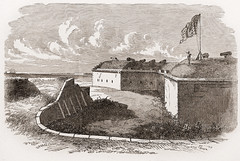
FORT MOULTRIE, S.C.,
Friday, December 14, 1860.

Col. S. COOPER, Adjutant-General U. S. Army:

DEAR COLONEL: I inclose herewith a slip from the Charleston Mercury of 13th instant, mentioning from Washington correspondent Major Bell’s [Buell’s] mission to this place.

I told the major that it was likely they would get an inkling of it. I merely send this to show you the almost impossibility of keeping anything secret. Nothing here worthy of an “official”—a calm before the storm. Many think no attack will be made on me until after they are in position in Fort Sumter, and that they will drive me out with her guns. It is all conjecture. I shall, of course, prepare here for the worst.

All well and in fine spirits.

Yours, truly,

ROBERT ANDERSON.

[Inclosure.]

FROM WASHINGTON.

WASHINGTON, December 10.

Mr. EDITOR: A Caucus was held here a few nights since of Senators and Representatives from the cotton States. It numbered about twenty-six, and represented the States of Texas, Louisiana, Mississippi, Alabama, South Carolina, Georgia, Florida,   and North Carolina, and upon the question of the necessity of the immediate secession of South Carolina there was not a dissenting voice.

Major Bell [Buell] and several other officers of the Army have been sent to Fort Moultrie to look after the forts and keep a sharp lookout upon them. They were sent for no good to us. See that they make no change in the distribution of soldiers, so as to put them all in Fort Sumter. That would be dangerous to us.

Yours,

CHARLES.

0 comments

Abolition Raid

News of the Day

Navarro Express [Corsicana, TX], December 14, 1860

The Dallas Herald urges the County Court to arm and equip a company of men, to be held n readiness to repel the threatened invasion of Montgomery and his gang of marauders. We learn also that the inhabitants along the borders of Missouri, in great numbers, have fled at the approach of this notorious character, with a company said to number four or five hundred men. Montgomery has just returned from Massachusetts with arms and money to assist him in prosecuting his abolition and thievish designs.

The Herald speaks of a letter having been received by certain citizens, from the Rev. Mr. Blount, threatening that if $20,000 was not forthcoming soon, that they would hear from him again, and might expect worse troubles than those experienced in July last.

0 comments

Recommendation for Immediate Absolute, Irrevocable Secession of SC

Miscellaneous document sources

William Henry Trescot to Howell Cobb.

Washington [D. C], Decem, 14, 1860.

Dear Sir: I have no time to tell all that has happened here. I write to say that if you hope to do any good in Columbia, recommend the following plan which I cannot argue but which will explain itself. It has the recommendation of Hunter, Davis and Yulee. Let the State pass its ordinance providing

1. The immediate, absolute, irrevocable secession of S. C.

2. That commissioner or commissioners be appointed to notify the fact and negotiate.

3. That in order to the proper execution of this ordinance and to avoid all unnecessary business disturbance, all collectors, treasurers post masters and other officers holding commissions under the U. S. be allowed ______days to wind up the affairs, settle the a/c, etc., of their respective offices, after which date the said offices shall expire within the State.

I have no time, as you can well imagine, in the present confusion to say more; but the whole scope and advantage of the plan both to the State and the country will suggest themselves to you at once.


From Annual Report of the American Historical Association for the Year 1911.

William Henry Trescot was an American diplomatist born in Charleston, South Carolina, on November 10, 1822. From 1852 to 1854 he was secretary of the U.S. legation in London. In June 1860 he was appointed assistant secretary of state, and he was acting secretary of state in June–October, during General Lewis Cass’s absence from Washington, and for a few days in December after Cass’s resignation. His position was important, as the only South Carolinian holding anything like official rank, because of his intimacy with President James Buchanan, and his close relations with the secession leaders in South Carolina. He opposed the reinforcement of Fort Sumter, used his influence to prevent any attack on the fort by South Carolina before the meeting of the state’s convention called to consider the question of secession, and became the special agent of South Carolina in Washington after his resignation from his position as United States Assistant Secretary of State in December. He returned to Charleston in February 1861.

Howell Cobb was an American political figure. A southern Democrat, Cobb was a five-term member of the United States House of Representatives and Speaker of the House from 1849 to 1851. He also served as the 40th Governor of Georgia and as a Secretary of the Treasury under President James Buchanan. Cobb is, however, probably best known as one of the founders of the Confederacy, having served as the President of the Provisional Congress of the Confederate States.

0 comments

Civil War Day-by-Day

Civil War Day-by-Day

December 14, 1860

  • Georgia calls for a convention of Southern states to form an independent nation.
0 comments

Southern Manifesto

Miscellaneous document sources

Washington, December 13th. At the request of Hon. Reuben Davis of Mississippi, member of the Committee of States, the Southern members of Congress assembled at his rooms to-night and adjourned at eleven o’clock, at which the following declaration was made and signed by those present. It had already been presented to the Committee of Thirty-three:

Washington, December 13th, 1860.

To our Constituents: The argument is exhausted. All hope of relief in the Union, through the agency of committees, Congressional legislation, or constitutional amendments, is extinguished, and we trust the South will not be deceived by appearances or the pretence of new guarantees. The Republicans are resolute in the purpose to grant nothing that will or ought to satisfy the South. We are satisfied the honor, safety, and independence of the Southern people are to be found only in a Southern Confederacy –a result to be obtained only by separate State secession–and that the sole and primary aim of each slaveholding State ought to be its speedy and absolute separation from an unnatural and hostile Union.

Signed by J. L. Pugh, David Clopton, Sydenham Moore, J. L. M. Curry, and J. A. Stallworth of Alabama; Alfred Iverson, J. W. H. Underwood, L. J. Gartrell, and Jas. Jackson, (Senator Toombs is not here, but would sign). John J. Jones, and Martin J. Crawford of Georgia; Geo. S. Hawkins of Florida. It is understood Mr. Yulee will sign it. T. C. Hindman of Arkansas. Both Senators will also sign it. A. G. Brown, Wm. Barksdale. O. R. Singleton, and Reuben Davis of Mississippi; Burton Craige and Thos. Ruffin of North Carolina; J. P. Benjamin and John M. Landrum of Louisiana. Mr. Slidell will also sign it. Senators Wigfall and Hemphill of Texas, will sign it.

Mr. Davis made the following statement to the caucus:

Being a member of the Committee of Thirty-three, I state that the above witnessed despatch was communicated to the committee this evening, and a resolution passed proposing no specific relief, eight Northern States dissenting, avowedly intended to counteract the effect of the above despatch, and, as I believe, to mislead the people of the South. From information derived from Republican members of the committee and other Northern Representatives, I fully concur in the above despatch.

Reuben Davis. The manifesto will be immediately communicated to the several constituencies of the gentlemen named by telegraph.


McPherson, Edward. The Political History of the United States of America, during the Great Rebellion: Including a Classified Summary of the Legislation of the Second Session of the Thirty-Sixth Congress… Philp & Solomons, 1865. page 37

0 comments

A Few Letters and Speeches of the Late Civil War

Civil War Day-by-Day

To Governor WM. SPRAGUE,

Providence, R.I.

New York, December 13, 1860

My Dear Sir,—I am much obliged for your favor of 10th inst., but regret that you take the view that the repeal of the personal-liberty bill, by your State, at this moment could be looked upon as a concession made under the pressure and influence of fear and threats.

The secession movement of the South has lost all the character of bluster and threat, which our Northern friends supposed too long was its principal element. The most conservative men have joined in it, right or wrong; they feel that their institutions and property are not any longer safe within the Union, and that self-preservation commands action before the Federal power passes into hands which they take for granted are hostile to their section. They do not threaten, but they want to be allowed to go out peaceably. The great majority are for immediate action, but the Union men are striving to postpone secession if possible until the 4th of March.

In this they can only succeed if aided by the North. The action which I suggested to you would go very far toward paving the way to [continue reading…]

0 comments

Civil War Day-by-Day

Civil War Day-by-Day

December 13, 1860

  • Twenty-three House members and seven Senators from the South make a public announcement calling for the creation of a Southern Confederacy.
0 comments

So far this month—In 1860

Civil War Day-by-Day

This is the second of a series of posts, generally daily, on the events and milestones related to the Civil War from 160 years before the date posted. This post is a “catch up” post to bring the blog up to date.

  • 12/01/1860—Robert Anderson makes his third request for reinforcements at Fort Moultrie
  • 12/04/1860—Outgoing President James Buchanan sends a distressed State of the Union message to Congress. In it he states that secession is unconstitutional, says the federal government lacks the authority to prevent it and calls for a constitutional amendment allowing Southern states to retain slaves as property. The message attempts to appease both northerners and southerners. Buchanan views secession as a consequence of the “intemperate interference of the Northern people with the question of slavery” and urges the North to respect the sovereignty and rights of the southern states. At the same time, Buchanan condemns secession and signals his intent to defend any federal forts in the South that come under attack. Both sides are displeased with the speech. The House of Representatives creates a Committee of Thirty-three (one member per state) to study the country’s crisis and issue recommendations.
  • 12/08/1860—The first rupture in Buchanan’s cabinet occurs when Secretary of the Treasury Howell Cobb (GA) resigns his post. A former unionist, Cobb has come to believe that the “evil” of Black Republicanism is “beyond control” and must be met with resistance. The same day, a group of South Carolina congressmen visits the White House and encourages Buchanan to relinquish federal property to their state.
  • 12/08/1860—Governor Isham Harris calls for a special session of the Tennessee legislature to consider secession.
  • 12/10/1860—South Carolina congressmen meet with Buchanan and promise that their forces will not attack U.S. forts before the issue of secession is debated, or the two governments reach an agreement, as long as the military status quo is maintained.
  • 12/11/1860—Under orders from Secretary of War John Floyd, General Don Carlos Buell visits Robert Anderson at Fort Sumter. Buell tells Anderson he may occupy any fort that he wants to if he is attacked or feels he is about to be attacked.
  • 12/12/1860—Lewis Cass tenders his resignation as Secretary of State over President Buchanan’s refusal to reinforce federal troops in Charleston.

America’s Civil War, Events by Date. Retrieved December 13, 2020, from http://blueandgraytrail.com/; Presented by Georgia’s Historic High Country Travel Association

0 comments

Last Month—In 1860

Civil War Day-by-Day

This is the first of a series of posts, generally daily, on the events and milestones related to the Civil War from 160 years before the date posted. This post is a “catch up” post to bring the blog up to date, starting with the election of Lincoln.

  • 11/06/1860—United States presidential election: Abraham Lincoln elected President and Hannibal Hamlin vice president with only 39.7% of the vote in a four man race, defeating Stephen Douglas, John Breckinridge and John Bell.
  • 11/09/1860—South Carolina calls for a convention on December 17 to decide if the state should secede from the Union
  • 11/09/1860—Lame-duck president James Buchanan convenes a cabinet meeting to discuss the national crisis that has been unleashed in the wake of Lincoln’s election. Like the country as a whole, his advisors are split over the issue of secession. Buchanan proposes a convention of the states with the object of hammering out a compromise.
  • 11/10/1860—South Carolina Senator James Chesnut becomes the first Southerner to resign from the Senate. He is quickly followed by South Carolina Senator James H. Hammond.
  • 11/10/1860—The legislature of South Carolina orders a convention to meet in Columbia on December 17 to decide whether or not the state should remain in the Union.
  • 11/12/1860—In Preston County, Western Virginia holds its first organizational meeting, expressing a desire to “adhere to the Union”.
  • 11/13/1860—At the end of a fiery, pro-secession speech, Robert Toombs announces his resignation from the U. S. Senate at the end of his term.
  • 11/13/1860—The South Carolina legislature authorizes the raising of ten thousand men for the state’s defense.
  • 11/14/1860—In Milledgeville, Alexander Stephens gives a response to Toombs’ speech the day before, calling for a meeting of southern states to discuss secession; speaks out against secession. He argues that the South should pursue a more moderate course and, “Let the fanatics of the North break the Constitution, if such is their fell purpose.”
  • 11/18/1860—The Georgia legislature authorizes one million dollars for weapon purchases.
  • 11/23/1860—Major Robert Anderson reports Fort Sumter is being threatened in Charleston as federal forces begin to improve Fort Moultrie and Fort Sumter in the harbor. The report identifies Fort Sumter as the key to the defense of the city’s harbor. In addition, he argues that secession is a fait accompli in South Carolina.

America’s Civil War, Events by Date. Retrieved December 13, 2020, from http://blueandgraytrail.com/; Presented by Georgia’s Historic High Country Travel Association

0 comments

It Seems All Look to Secession

Miscellaneous document sources

Robert Toombs to E. B. Pullin and Others.[i]

Washington, Ga. Dec. 13, 1860.

Gentlemen: Your letter of the 10th. inst., inviting me on behalf of the citizens of Danburg and its vicinity to address you at an early day, was received yesterday. I regret very much that my public duties deprive me of the pleasure of accepting your kind invitation. But I shall be compelled to leave for Washington city day after tomorrow, and unless the state of the public business will allow me to return during the Christmas holidays I shall have no day at my command before your election; if I should return, I will take great pleasure in meeting you in council on the state of the country. The legislature of Georgia have unanimously declared that the present crisis demands resistance, and have unanimously voted to call a convention of the people to determine the mode and measures of redress. This is plain language—it is easily understood. It proposes to resist wrongs at the time and in the manner best calculated to obtain redress. The Legislature also unanimously voted a million of dollars to arm the people of Georgia, in order that they may repel by force whatever force may be brought to resist the measures of redress the people may adopt.

Then, upon the question that we have wrongs and that we intend to redress them by and through the sovereignty of Georgia, the state is unanimous. What then is likely to divide us? It cannot be the mode of redress, for it seems all look to secession, separation from the wrong doers, as the ultimate remedy. The time when this remedy ought to be applied seems to be the most important, if not the only point of difference between us; we ought not to divide upon this point. Many persons think the remedy ought to be applied immediately, others at a day not to extend beyond the 4th of March next, others again supposing that too short a time for the convenient action of the abolition states would extend it only to what might be fairly deemed a reasonable and convenient time within which our wrongs might be redressed by the wrong doers. I would strongly advise that there be no division among those who hold either of those opinions. While I personally favor the position of those who are opposed [to] delaying longer than the 4th of March next, I certainly would yield that point to earnest and honest men who were with me in principle but who are more hopeful of redress from the aggressors than I am, especially if any such active measures should be taken by the wrong doers as promised to give us redress in the Union. But to go beyond the 4th of March we should require such preliminary measures to be taken before as would with reasonable certainty lead to adequate redress, and in the mean time we should take care that the delay gives no advantages to the adversary and takes none from ourselves.

But let us not deceive ourselves as to what is redress and how we can secure it in the Union. The open and avowed object of Mr. Lincoln and the great majority of the active men of his party is ultimately to abolish slavery in the States. This he himself expressly avows, and there is not a single public man of his party in the United States within my knowledge who does not avow his hostility to the relation of master and servant as it exists among us. The means by which they seek to accomplish this result are many, but all consistent and all efficient to produce that result. The first is that we shall be driven out of the Territories by law. Upon this Mr. Lincoln and his party are unanimously agreed; and it is the corner stone of the entire Abolition party in the United States, and is planted in the Chicago platform. This they propose to do in violation of the Constitution of the United States as generally construed from the beginning of the Government and in express violation of that instrument as expounded by the Supreme Court of the United States.

2. They propose to exterminate slavery by abrogating by State laws, that portion of the Constitution which provides for the return of fugitive slaves to their owners.

3. To weaken and destroy it by protecting those who steal slaves and murder the inhabitants of the slave-holding States in pursuit of revolutionary schemes for its abolition, in direct violation of that clause of the Constitution which requires such criminals to be given up.

4. To destroy it by exciting revolt and insurrection among the slaves; this the pulpit, the press, the political orators, and indeed we may say the great body of the abolition party in Congress, in the State Legislatures, and everywhere else, are daily endeavoring to accomplish.

How is it possible to remedy these enormous evils in the Union? There is but one mode, one only; all others are delusions and snares, intended to lull the people into false security, to steal away their rights, and with them the power of redress. This mode is by amendments to the Constitution of the United States. In the Union the States cannot make contracts with each other; all departments of the government would disregard them. To repeal laws hitherto passed by the Abolition States would not redress; they would reenact them next year. The amendment of the Constitution should be such as could neither be evaded or resisted by the Abolition States, and should not rest for their efficiency upon the oaths of Abolitionists—no oaths can bind them.

The Constitution provides two modes for its own amendment. Article 5th is as follows on the point before us: “The Congress, whenever two-thirds of both Houses shall deem it necessary, shall propose amendments to this Constitution, which shall be valid, to all intents and purposes as part of this Constitution when ratified by the legislatures of three-fourths of the States or by conventions in three-fourths thereof, as the one or the other mode of ratification may be proposed by the Congress,” etc.

Thus, you perceive, the road is plain, it is easily tested; you can here find a test which ought to satisfy every honest resistance man in Georgia. Do this: offer in Congress such amendments of the Constitution as will give you full and ample security for your rights; then if the Black Republican party will vote for the amendments, or even a majority of them in good faith, they can be easily carried through Congress; then I think it would be reasonable and fair to postpone final action until the legislatures of the northern States could be conveniently called together for definite action on the amendments. If they intend to stop this war on your rights and your property, they will adopt such amendments at once in Congress; if they will not do this, you ought not to delay an hour after the fourth of March to secede from the Union. This is a constitutional and effectual ultimatum, means something, can be tested—can be tested at once. This will be putting planks where they are good for something if they are the right kind of planks; but putting planks in your Georgia platform is putting them where our experience teaches us they are powerless for good, and only subject us to the jibes and jeers of our enemies. A cart load of new planks in the Georgia platform, will not redress one wrong, nor protect one right of the people of Georgia. Demand additional constitutional securities from your confederates, and if they are refused, confederate with such of them as are willing to grant them, or defend them yourselves.


[i] From the Southern Recorder, Milledgeville, Ga., Dec. 25, 1860. Pullin was the chairman of a committee of citizens of Danburg, a village near Washington, Ga.


From Annual Report of the American Historical Association for the Year 1911.

Robert Augustus Toombs was an American lawyer, planter, and politician from Georgia who became one of the organizers of the Confederacy and served as its first Secretary of State. He served in the Georgia House of Representatives, the US House of Representatives, and the US Senate.  In the Confederacy, he served in Jefferson Davis’ cabinet as well as in the Confederate States Army, but later became one of Davis’ critics.
0 comments

What Imbecility!

Turning on the Light: A Dispassionate Survey of President Buchanan’s Administration, From 1860 to its Close, by Horatio King

(Private.)

P. O. Dept., Appt. Office, Dec. 12, 1860.

My Dear Sir,—Your note of yesterday is received.

It is becoming every day more and more apparent that there is quite a large party at the South who, traitors at heart, are resolved on effecting a dissolution of the Union, even though the North were to yield to the utmost of their former demands, and these men are now in the lead. One of them kept his place in the government till forced to resign from very shame, and there are others of smaller calibre who are still retained,—traitors in the camp.

And we are to allow the best government in the world to be destroyed in the first hour of danger, without an effort to demonstrate that if statesmen will but do their duty it is capable of withstanding far more serious shocks than that with which it is now threatened. What mockery of statesmanship! What imbecility! What culpable wickedness! Will not the God of nations send down his thunderbolts and arrest the base wretches who are thus plotting our ruin?

It seems now to be pretty generally conceded that the cotton States will secede, and the next thing is to avoid a conflict on that account, or the whole country will be ablaze with civil war!

Very respectfully and truly yours,

Horatio King.

Hon. John A. Dix, New York.

0 comments

Letter to William Kellogg

Civil War Day-by-Day

Entertain no proposition for a compromise in regard to the extension of slavery. The instant you do they have us under again: all our labor is lost, and sooner or later must be done over. Douglas is sure to be again trying to bring in his “popular sovereignty.” Have none of it. The tug has to come, and better now than later. You know I think the fugitive-slave clause of the Constitution ought to be enforced—to put it in its mildest form, ought not to be resisted.

0 comments

Operations in Charleston Harbor

War of the Rebellion: from the Official Records of the Union and Confederate Armies and Navies

FORT MOULTRIE, S.C., December 11, 1860.

Memorandum of verbal instructions to Major Anderson, First Artillery, commanding at Fort Moultrie, S.C.

You are aware of the great anxiety of the Secretary of War that a collision of the troops with the people of this State shall be avoided, and of his studied determination to pursue a course with reference to the military force and forts in this harbor which shall guard against such a collision. He has therefore carefully abstained from increasing the force at this point, or taking any measures which might add to the present excited state of the public mind, or which would throw any doubt on the confidence he feels that South Carolina will not attempt, by violence, to obtain possession of the public works or interfere with their occupancy. But as the counsel and acts of rash and impulsive persons may possibly disappoint those expectations of the Government, he deems it proper that you should be prepared with instructions to meet so unhappy a contingency. He has therefore directed me verbally to give you such instructions.

You are carefully to avoid every act which would [continue reading…]

0 comments

To Lyman Trumball

Uncollected Letters of Abraham Lincoln—1917

Private & Confidential

SPRINGFIELD, ILLS. Dec. 10. 1860

Hon. L. Trumbull.

My Dear Sir: Let there be no compromise on the question of extending slavery. If there be, all our labor is lost, and, ere long, must be done again. The dangerous ground—that into which some of our friends have a hankering to run—is Pop. Sov. Have none of it. Stand firm. The tug has to come, & better now than any time hereafter.

Yours as ever

A. LINCOLN.

0 comments

A Diary from Dixie

Civil War Day-by-Day

December 10th.—We have been up to the Mulberry Plantation with Colonel Colcock and Judge Magrath, who were sent to Columbia by their fellow-citizens in the low country, to hasten the slow movement of the wisdom assembled in the State Capital. Their message was, they said: “Go ahead, dissolve the Union, and be done with it, or it will be worse for you. The fire in the rear is hottest.” And yet people talk of the politicians leading! Everywhere that I have been people have been complaining bitterly of slow and lukewarm public leaders.

Judge Magrath is a local celebrity, who has been stretched across the street in effigy, showing him tearing off his robes of office. The painting is in vivid colors, the canvas huge, and the rope hardly discernible. He is depicted with a countenance flaming with contending emotions—rage, disgust, and disdain. We agreed that the time had now come. We had talked so much heretofore. Let the fire-eaters have it out. Massachusetts and South Carolina are always coming up before the footlights.

As a woman, of course, it is easy for me to be brave under the skins of other people; so I said: “Fight it out. Bluffton ¹ has brought on a fever that only bloodletting will cure.” My companions breathed fire and fury, but I dare say they were amusing themselves with my dismay, for, talk as I would, that I could not hide. [continue reading…]

0 comments

Journal of Meta Morris Grimball

Journal of Meta Morris Grimball
Meta Morris Grimball

December 10 1860

We came up very nicely on the 3d Mr Grimball Ella Lotty Harry & Racky, the sky terrier, a most intelligent and affectionate little dog. When Lewis was in Liverpool, Bob Miller gave him this puppy, & he brought it home, we are all attached to her, and she enjoys the change as much as any of us.—I am to keep her until Lewis marries, then his wife, if fond of Dogs, is to take her.

John is as happy as a child and so much like a child that I agree with Lewis in thinking the only change in him is that he has grown, he enjoys a joke & makes fun but—he is terribly obstinate, which is an ascertained fact—consequently when John says he wont do anything I dont like to interfere. Lewis has come to the conclusion that his prospects up here are not worth anything, his practise is pretty much a family affair, and not at all progressive, on the contrary, the life of several old people would close it, except at home, his Grandfather and Mrs Wayne, so he intends going to Charleston and attending Medical Lectures, and practising there. So there is every prospect of our having the 6 boys at home next summer. I think I shall take a travel off somewhere, & relieve myself of the Housekeeping. I have been trying to persuade Berkly to got married, he has been set up with 5 thousand dollars, he had saved 1 thousand himself, and is so saving I suppose he will soon have 10 thousand: and I am afraid be a miser too; which is hateful. I wish some of them could get married and settled off.— Elizabeth has of course to wait until a good offer comes, but the boys can ask.—

Mr W. Heyward has promised us a visit, and now that the house has got fixed, I shall be very glad for him to come. Lewis tells me Mrs Bulo laughed a great deal about her visit up here, and the manner in which Mrs Manigault & Mrs Grimball were taken in by her. She is not a nice person, I am afraid much of the scandal retailed about her, is true. She had very little to do with me, but was much thrown with Charlotte, riding with her on horseback, &c. Papa paid the 4 thousand to the Factors that Charles owed them.

We came up in the cars with Major Wharley and his new young wife, an English lady, & her baby, she is much taller than her old husband; and looks like his daughter; she was poor, or I am sure she could never have married that blear-eyed old creature.

0 comments

Howell Cobb to his Wife

Miscellaneous document sources

Washington City, 10 Dec, 1860.

My Dear Wife, As you have already learned through the telegraph, I have resigned my office and am again a private citizen. The President and myself part in the most friendly spirit. We both see and feel the necessity and both regret that it should be so. I shall leave here the end of this week, with a view to stopping a day or two in Columbia, S. C. to attend their convention, and shall reach Macon next week, not later than Wednesday. I shall send appointments at once to speak in my old district where I think I can do more good than anywhere else. I shall commence in Lawrenceville on Monday the 24th and shall speak every day until the election, going from Lawrenceville to Gainesville and thence to the mountains. It will be pretty hard work, but I have set out and must do all I can. To carry out this plan I must have a buggy with two horses, to be at Lawrenceville on Sunday night the 23rd and some one to drive, as I must make the travelling as easy as possible. The boys told me they had a good buggy at Athens that would answer the purpose, and if they can do no better they must get horses from the livery stable at Athens. Don’t think of sending your horses, as you will not only need them in Macon but they will not be in a condition to stand the rough treatment of the mountains. If they should want me to speak in Macon let it be on Thursday after I get there, so that I may if necessary speak Friday and Saturday up the country or wherever I may be wanted, so that I get to Lawrenceville on Monday 24. Tell your Brother to consult and if deemed necessary he can arrange for Friday and Saturday. If it could be so, my own opinion is I had better go upon the State road somewhere.

I sent your carriage and horses today to Baltimore and Mr. Guthrie will go with them to Savannah. He will be in Macon and you will see him. I sent to day by Adams Express a bundle of my addresses to the Col.[i] for circulation. He need not send any to Milledgeville as I have already sent there. I have written you a political business letter and shall be too much engaged for several days to write again. If Tom is in Macon say to him he ought to meet me in Columbia. It would be a good idea if the Legislature would appoint me at once a Commissioner to S. C. That idea might be sent over to Milledgeville.


[i] Col. John B. Lamar.


From Annual Report of the American Historical Association for the Year 1911.

Howell Cobb was an American political figure. A southern Democrat, Cobb was a five-term member of the United States House of Representatives and Speaker of the House from 1849 to 1851. He also served as the 40th Governor of Georgia and as a Secretary of the Treasury under President James Buchanan. Cobb is, however, probably best known as one of the founders of the Confederacy, having served as the President of the Provisional Congress of the Confederate States.

0 comments

James Buchanan to Howell Cobb

Miscellaneous document sources

Washington, 10 December, 1860.

My Dear Sir: I have received your communication of Saturday evening resigning the position of Secretary of the Treasury which you have held since the commencement of my administration. Whilst I deeply regret that you have determined to separate yourself from us at the present critical moment, yet I admit that the question was one for your own decision. I could have wished you had arrived at a different conclusion, because our relations both official and personal have ever been of the most friendly and confidential character. I may add that I have been entirely satisfied with the ability and zeal which you have displayed in performing the duties of your important office.

Cordially reciprocating your sentiments of personal regard, I remain, very respectfully, your friend.


From Annual Report of the American Historical Association for the Year 1911.

James Buchanan Jr. served as the 15th president of the United States from 1857 to 1861, serving directly prior to the American Civil War.

Howell Cobb was an American political figure. A southern Democrat, Cobb was a five-term member of the United States House of Representatives and Speaker of the House from 1849 to 1851. He also served as the 40th Governor of Georgia and as a Secretary of the Treasury under President James Buchanan. Cobb is, however, probably best known as one of the founders of the Confederacy, having served as the President of the Provisional Congress of the Confederate States.

0 comments

Secession

War Diary of a Union Woman in the South

Sunday, Dec.—, 1860.—In this season for peace I had hoped for a lull in the excitement, yet this day has been full of bitterness. “Come, G.,” said Mrs. F. at breakfast, “leave your church for to-day and come with us to hear Dr. ______ on the situation. He will convince you.” “It is good to be convinced,” I said; “I will go.” The church was crowded to suffocation with the élite of New Orleans. The preacher’s text was, “Shall we have fellowship with the stool of iniquity which frameth mischief as a law?” … The sermon was over at last and then followed a prayer …Forever blessed be the fathers of the Episcopal Church for giving us a fixed liturgy! When we met at dinner Mrs. F. exclaimed, “Now, G., you heard him prove from the Bible that slavery is right and that therefore secession is. Were you not convinced?” I said, “I was so busy thinking how completely it proved too that Brigham Young is right about polygamy that it quite weakened the force of the argument for me.” This raised a laugh, and covered my retreat.


Note: To protect Mrs. Miller’s job as a teacher in post-civil war New Orleans, her diary was published anonymously, edited by G. W. Cable, names were changed and initials were generally used instead of full names—and even the initials differed from the real person’s initials. (Read Dora Richards Miller’s biographical sketch.)

0 comments

Out for Secession

News of the Day
1860s newsprint

Memphis Daily Appeal [Memphis, TN], December 9, 1860

A gentleman of this city, now travelling in Mississippi, says the Nashville Gazette, writes  back to a friend as follows:

The further down I get, the more secession I see. Not content with wearing the blue  cockade themselves, the people put them up on wagons, carriages, riding horses, etc. At one  place where I stopped, all the negroes had them on. You may safely put Mississippi down as  dead out for secession.

0 comments

Operations in Charleston Harbor

War of the Rebellion: from the Official Records of the Union and Confederate Armies and Navies

FORT MOULTRIE, S. C., December 9, 1860
(Received A. G. O., December 12.)

Col. S. COOPER Adjutant-General:

[SIR:] I have the honor to acknowledge the receipt of your letter of the 6th instant, and to state that I have directed the A. A. Q. M. to hire men to perform police and fatigue duty at this post, and to send on a special estimate for funds to pay them.

I hear that the attention of the South Carolinians appears to be turned more toward Fort Sumter than it was, and it is deemed probable that their first act will be to take possession of that work.

The idea of attempting to take this place by a coup de main appears not to be so favorably regarded as it was, and they will perhaps determine to besiege us. To enable them to do this they must procure heavy guns, which they can get (if not from Fort Sumter and Castle Pinckney) from Pulaski or some other southern fort. Anything that can be done which will cause delay in their attack will give time for deliberation and negotiation, and may, by God’s blessing, save the shedding of blood. I would therefore respectfully suggest whether it might not be advisable and prudent to cause the ammunition, except what may be needed for the defense of this fort and the armament of Fort Sumter and Castle Pinckney, to be destroyed or rendered unserviceable before they are permitted to fall into their hands. The same may be advisable at those forts from whence supplies might be brought to Charleston. Fort Sumter is a tempting prize, the value of which is well known to the Charlestonians, and once in their possession, with its ammunition and armament and walls uninjured and garrisoned properly, it would set our Navy at defiance, compel me to abandon this work, and give them the perfect command of this harbor. [continue reading…]

0 comments

Buchanan’s Treasury Secretary Resigns

Miscellaneous document sources


Howell Cobb to James Buchanan.[i]

Washington City, Dec. 8, 1860.

My Dear Sir: A sense of duty to the State of Georgia requires me to take a step which makes it proper that I should no longer continue to be a member of your Cabinet.

In the troubles of the country consequent upon the late Presidential election, the honor and safety of my State are involved. Her people so regard it, and in their opinion I fully concur. They are engaged in a struggle where the issue is life or death. My friends ask for my views and counsel. Not to respond would be degrading to myself and unjust to them. I have accordingly prepared, and must now issue to them, an address which contains the calm and solemn convictions of my heart and judgment.

The views which I sincerely entertain, and which therefore I am bound to express differ in some respects from your own. The existence of this difference would expose me, if I should remain in my present place, to unjust suspicions, and put you in a false position. The first of these consequences I could bear well enough, but I will not subject you to the last.

My withdrawal has not been occasioned by anything you have said or done. Whilst differing from your Message upon some of its theoretical doctrines, as well as from the hope so earnestly expressed that the Union can yet be preserved, there was no practical result likely to follow which required me to retire from your Administration. That necessity is created by what I feel it my duty to do and the responsibility of the act, therefore, rests alone upon myself.

To say that I regret—deeply regret—this necessity, but feebly expresses the feeling with which I pen this communication. For nearly four years I have been associated with you as one of your Cabinet officers, and during that period nothing has occurred to mar, even for a moment, our personal and official relations. In the policy and measures of your Administration I have cordially concurred, and shall ever feel proud of the humble place which my name may occupy in its history. If your wise counsels and patriotic warnings had been heeded by your countrymen, the fourth of March next would have found our country happy, prosperous, and united. That it will not be so, is no fault of yours.

The evil has now passed beyond control, and must be met by each and all of us under our responsibility to God and our country. If, as I believe, history will have to record yours as the last administration of our present Union, it will also place it side by side with the purest and ablest of those that preceded it.

With the kindest regards for yourself and the members of your Cabinet, with whom I have been so pleasantly associated.


[i] From the Constitution, Washington, D. C, Dec. 12, 1860.


From Annual Report of the American Historical Association for the Year 1911.

Howell Cobb was an American political figure. A southern Democrat, Cobb was a five-term member of the United States House of Representatives and Speaker of the House from 1849 to 1851. He also served as the 40th Governor of Georgia and as a Secretary of the Treasury under President James Buchanan. Cobb is, however, probably best known as one of the founders of the Confederacy, having served as the President of the Provisional Congress of the Confederate States.

0 comments

Sharpes Rifles for Georgia

News of the Day

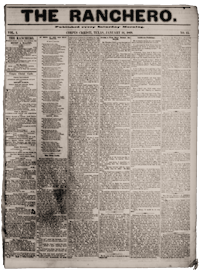
The Ranchero [Corpus Christi, TX], December 8, 1860

The Hartford Times, of the 19th ult., says the steamer City of Hartford takes, this afternoon, as freight, one hundred and eighty cases of Sharpe’s patent carbines, containing ten pieces each, amounting to arms for one thousand eight hundred men, and forty cases of conical balls, containing each one thousand bullets. These are ordered by the State of Georgia, to be delivered at Savannah, and are only the first shipment of an extensive order.

0 comments

Minute Men

News of the Day

The Ranchero [Corpus Christi, TX], December 8, 1860

The minute men of Gonzales county met at Gonzales on the 1st instant, for the purpose of organizing a regiment. So says the Inquirer. Companies of minute men are being formed in nearly every county in the State. Are there none of Corpus Christi’s chivalrous spirits ready to take the matter in hand and raise a company of minute men? We shall see.

0 comments

To Lyman Trumball

Uncollected Letters of Abraham Lincoln—1917

Private

SPRINGFIELD, ILL.,
Dec 8, 1860.

Hon. Lyman Trumbull,

My Dear Sir: Yours of the 2nd is received. I regret exceedingly the anxiety of our friends in New York, of whom you write; but it seems to me the sentiment in that state which sent a united delegation to Chicago in favor of Gov. Seward ought not and must not be snubbed, as it would be, by the omission to offer Gov. S. a place in the Cabinet. I will myself take care of the question of “corrupt jobs” and see that justice is done to all our friends of whom you wrote as well as others.

I have written Mr. Hamlin on this very subject of Gov. S. and requested him to consult fully with you.

He will show you my note and enclosures to him; and then please act as therein requested.

Yours as ever,

A. LINCOLN.

0 comments