Orders to Re-enforce Fort Sumter.—Operations in Charleston Harbor

War of the Rebellion: from the Official Records of the Union and Confederate Armies and Navies

HEADQUARTERS OF THE ARMY,
Washington, December 31, 1860.

Colonel DIMICK, or commanding officer, Fort Monroe:

SIR: Prepare and put on board of the sloop-of-war Brooklyn, as soon as the latter can receive them, four companies, making at least two hundred men, destined to re-enforce Fort Sumter. Embark with said companies twenty-five spare stands of arms, complete, and subsistence for the entire detachment for ninety days, or as near that amount as your supplies may furnish. Communicate at once with the commander of the war steamer, learn the earliest moment at which he can receive the troops on board, and do not fail to have them there by that time.

W. SCOTT.

Manage everything as secretly and confidentially as possible. Look to this.

______

HEADQUARTERS OF THE ARMY,
Washington, December 31, 1860.

To the PRESIDENT:

Lieutenant-General Scott again begs leave to trespass for a moment on the indulgence of the President of the United States, particularly as he learns by rumor that there is no head to the War Department. Such are the necessities of the service that it is hoped the vacancy in question may be speedily filled, and, incidentally, that the new Secretary, if ad interim, may not be a junior officer of the Army, as it would wound the pride of any senior to serve under such Secretary.

Lieutenant-General Scott deems it to be his duty to lay the accompanying letter [not found] before the President. The writer is a distinguished graduate of the Military Academy, and an eminent lawyer of the New York bar. Major-General Sandford, mentioned by him, is an officer and citizen of great merit and discretion, commanding the City Division of Volunteers.

General Scott does not recommend the acceptance of Mr. Hamilton’s proposition, as we have disposable regulars enough for that single purpose; but that we already require many and large detachments for the protection of our coast defenses farther south is becoming daily more and more evident.

In reference to General Scott’s note of yesterday to the President, he respectfully adds: Of course, the War Department and General Scott cannot communicate anything to Major Anderson, or receive by mail or telegraphic wires, anything from him (who must be regarded as in a state of siege), except by permission of the authorities in Charleston; and it is just possible in his state of isolation a system of forged telegrams from this place may be played off so successfully as to betray him into some false movement.

Most respectfully submitted to the President of the United States.

WINFIELD SCOTT.

P. S.—As a sequence to the foregoing, it is respectfully suggested that there seems to be no other way of freely communicating with Major Anderson than by water, say by a revenue cutter running regularly between Wilmington, N. C., and Fort Sumter.

______

FORT SUMTER, S.C., December 31, 1860.
(Received A. G. O., January 5, 1861.)

Col. S. COOPER, Adjutant General:

COLONEL: I have the honor to report that the South Carolinians show great activity in the harbor to-day. Several steamers have been running to and fro, and this afternoon about 80 soldiers, with wheelbarrows, barrels, &c., and some draught horses, were landed on Morris Island. They are evidently constructing a battery or batteries there. The lights in the harbor were put out last night, and ours is the only light-house of this harbor which exhibits light to-night. I am at a loss what this means, unless it be that some armed vessel is expected here. The more I reflect upon the matter the stronger are my convictions that I was right in coming here. Whilst we were at Fort Moultrie our safety depended on their forbearance. A false telegram might, any night, have been seized upon as an excuse for taking this place, and then we would have been in their power, And even if there had been an understanding between the two Governments that I was not to be interfered with until the termination of the mission to Washington, the fact of the governor’s having ordered armed steamers to keep watch over me would have absolved our Government from the obligation to remain quiescent. It is certain, too, that the moment a telegram was received announcing the failure of the mission, attack would have been made and my command sacrificed, for there can be no surrender with these men, if attacked, without a serious fight. Thank God, we are now where the Government may send us additional troops at its leisure. To be sure, the uncivil and uncourteous action of the governor in preventing us from purchasing anything in the city will annoy and inconvenience us somewhat; still, we are safe. I find that in consequence of a failure (accidental) to comply with my instructions, there is only a small supply of soap and candles, and also of coal. Still, we can cheerfully put up with the inconvenience of doing without them, for the satisfaction we feel in the knowledge that we can command this harbor as long as our Government wishes to keep it.

I am, colonel, respectfully, your obedient servant,

ROBERT ANDERSON,

Major, First Artillery, Commanding.
0 comments

Correspondence on the Surrender of the Charleston Arsenal.—Operations in Charleston Harbor

War of the Rebellion: from the Official Records of the Union and Confederate Armies and Navies

CHARLESTON ARSENAL, S.C.
December 31, 1860

SIR: I have the honor to submit the correspondence relative to the surrender of this post yesterday to the authorities of this State. Trusting that my course may meet the approval of the Department,

I am, sir, very respectfully,

F. C. HUMPHREYS,

Military Storekeeper Ordnance, U. S. A.

Capt. WM. MAYNADIER,

In charge of Ordnance Bureau, Washington, D.C.

[Inclosures.] [continue reading…]

0 comments

President Buchanan on Operations in Charleston Harbor

War of the Rebellion: from the Official Records of the Union and Confederate Armies and Navies

.

WASHINGTON CITY, December 31, 1860.

Hons. ROBERT W. BARNWELL, JAMES H. ADAMS, JAMES L. ORR:

GENTLEMEN: I have had the honor to receive your communication of the 28th instant, together with a copy of your “full powers from the Convention of the People of South Carolina” authorizing you to treat with the Government of the United States on various important subjects therein mentioned, and also copy of the ordinance, bearing date on the 20th instant, declaring that “the union now subsisting between South Carolina and other States under the name of   “the United States of America is thereby dissolved.”

In answer to this communication I have to say that my position as President of the United States was clearly defined in the message to Congress on the 3d instant. In that I stated that “apart from the execution of the laws, so far as this may be practicable, the Executive has no authority to decide what shall be the relations between the Federal Government and South Carolina. He has been invested with no such discretion. He possesses no power to change the relations heretofore existing between them, much less to acknowledge the independence of that State. This would be to invest a mere executive officer with the power of recognizing the dissolution of the confederacy among our thirty-three sovereign States. It bears no resemblance to the recognition of a foreign de facto government, involving no such responsibility. Any attempt to do this would, on his part, be a naked act of usurpation. It is therefore my duty to submit to Congress the whole question in all its bearings.”

Such is still my opinion, and I could therefore meet you only as private gentlemen of the highest character, and I was quite willing to communicate to Congress any proposition you might have to make to that body upon the subject. Of this you were well aware. [continue reading…]

0 comments

DNC Chairman August Belmont to Stephen A. Douglas: “The South cannot ask for more, and the dominant party of the North ought certainly to acquiesce…”

Civil War Day-by-Day

To The Hon. S. A. DOUGLAS,

Washington, D. C.

New York, December 31, 1860

My Dear Sir,—Your kind favor crossed with the letter which I had the pleasure of addressing you last week.

I have read carefully your resolutions for a conference, and they meet my entire approval. The South cannot ask for more, and the dominant party of the North ought certainly to acquiesce in a plan of settlement, which, in my opinion, would not add a foot of slave territory to the Union, except where climate and soil render it more profitable than free labor.

Several of the ultra men of the South whom I have seen lately, are loud in their praises of the stand which you have taken, and approve the mode of settlement proposed by your resolutions. I see, however, with great regret, by the papers, that the committee of thirteen have rejected them.

Now, if you will allow me one suggestion, dictated only by my warm attachment to you, I would advise you to support a compromise which has for its basis the restoration of the Missouri compromise, carried to the eastern frontier of California. I have good reason to know that the conservative portion of the Republican leaders are in favor of it, and it can only add to your high position as a patriotic and a Union man, if you support actively and energetically the restoration of the Missouri line.

It will forever silence the clamors of your enemies at the North, who have tried to lay the repeal of that act at your door, forgetting the refusal of the North to carry that line to the Pacific rendered that repeal necessary.

The self-denial and sacrifice of your favored doctrine of popular sovereignty, when the salvation of the Union requires it, would place you higher in the affections of the American people than you have ever been before. I am told by Republican leaders that they will not vote for Crittenden’s amendment because they will not accept the Missouri line for future acquisitions of territory. They say this would be holding out a premium for filibustering against Mexico and Cuba, in order to make new slave States. If you could hit upon some plan of compromise by which to get over this difficulty, there might be some hope of saving the country.

I have written, yesterday, to Governor Johnson, of Georgia, urging upon him the policy of getting the convention of his State to submit their final action to the ratification of the people, and showing how incompatible with the best interests of Georgia it would be to follow in the wake of South Carolina.

I beg to hand you inclosed copy of my letter, and if you approve of my suggestions, I hope you will find leisure to recommend them to the earnest consideration of Stephens and Johnson.

My own impressions are very gloomy indeed, and I fear nothing will be done to save the sinking ship of state. We must, however, do our duty as men, and stand by the Union to the last.

0 comments

All is now dark and Gloomy. I see no ray of hope.

Miscellaneous document sources

The people are misled, and will see their course I fear when it is too late.

Alexander H. Stephens to J. Henly Smith.

Crawfordville [Ga.], Dec. 31st, 1860.

Dear Smith, Yours of the 26th inst. was received last night. I do not think anything can be made of any of the propositions I have seen submitted for the settlement of our existing national troubles. Mr. Douglas sent me his. I got it a few days ago and wrote to him forthwith by return mail that I did not think his terms would ever be agreed to by the South. His first and second would never be agreed to—the one looking to the colonization of the blacks would never—nothing can be made of any such scheme of adjustment. I do not think that we stand in need of any new constitutional guarantees—we may hereafter if the Union should last—but at present we do not. All we now want or ought to want is a faithful administration of the gov[ernme]nt, under the present constitution with all its present obligations and guarantees. All that the South has at present just cause to complain of, and the chief ground of just complaints, is the personal liberty bill[s] of some of the non-slaveholding states. These ought to be repealed, and I doubt not if the whole South had united in asking their repeal with firmness and decision and with an honest intent to be satisfied with it when they got it that success would have crowned their efforts. Of this I am satisfied. But the truth is our ultra men do not desire any redress of these grievances. They would really obstruct indirectly any effort to that end. They are for breaking up. They are tired of the gov[ernme]nt. They have played out, dried up, and want something new. Here was all the danger or the great difficulty in the way of making any settlement or adjustment. It seems to me at present insurmountable! I do not see how it can be removed or gotten over. Our difficulties spring not from the gov[ernme]nt, its frame work or its administration so much as they do from the people, the leaders mainly. [continue reading…]

0 comments

Civil War Day-by-Day

Civil War Day-by-Day
The United States Sloop of War 'Brooklynn'

December 31, 1860

  • Charleston is notified by telegraph that a man of war with troops is on the way

Image: The United States Sloop of War “Brooklynn”

0 comments

The Arsenal—Operations in Charleston Harbor

War of the Rebellion: from the Official Records of the Union and Confederate Armies and Navies

.
CHARLESTON, S.C.,
December 30, 1860.

SIR: This arsenal has to-day been taken by force of arms. What disposition am I to make of my command?

F. C. HUMPHREYS.

Capt. MAYNADIER,

In charge of Ordnance Bureau.

0 comments

Winfield Scott asks the President for permission to “send two hundred and fifty recruits from New York Harbor to re-enforce Fort Sumter…,”—Operations in Charleston Harbor

War of the Rebellion: from the Official Records of the Union and Confederate Armies and Navies

WASHINGTON, December 30, 1860.

The PRESIDENT OF THE UNITED STATES:

Lieutenant-General Scott begs the President of the United States to pardon the irregularity of this communication.

It is Sunday; the weather is bad, and General Scott is not well enough to go to church. But matters of the highest national importance seem to forbid a moment’s delay, and if misled by zeal, he hopes for the President’s forgiveness.

Will the President permit General Scott, without reference to the War Department and otherwise, as secretly as possible, to send two hundred and fifty recruits from New York Harbor to re-enforce Fort Sumter, together with some extra muskets or rifles, ammunition, and subsistence stores?

It is hoped that a sloop of war and cutter may be ordered for the same purpose as early as to-morrow.

General Scott will wait upon the President at any moment he may be called for.

The President’s most obedient servant,

WINFIELD SCOTT.

0 comments

“The question now is union or disunion.”—Horatio King (soon to be Postmaster General for the last part of the Buchanan Administration)

Turning on the Light: A Dispassionate Survey of President Buchanan’s Administration, From 1860 to its Close, by Horatio King

Washington, Dec. 30,1860.

My Dear Sir,—I rejoice to learn that the disunionists failed yesterday in their impudent and insulting demand that the administration should remove Major Anderson or otherwise degrade him.

It is every day becoming more and more apparent that they are determined, as far as lies in their power, to make use of the administration to strengthen themselves in their rebellious position, and, if necessary for their purpose, to break up the Government. Does it require any close discernment to see that it would be fatal to follow their counsels?

They commenced, long before the election, by getting possession of the Constitution newspaper, which, from the announcement of Lincoln’s election, has been openly for a dissolution of the Union, and some of them have continued, and still continue, to hold office here in the Government, although known to be hostile to that very Government which feeds them!

In a letter to the President on the 7th of November,—the day after election,—I called attention to these startling facts; and, from that day to the present, my amazement has increased until I am, at times, almost paralyzed to see such things go unrebuked. It is all folly for the [continue reading…]

0 comments

“Never was a good and righteous cause so much damaged…”—DNC Chairman August Belmont

Civil War Day-by-Day

To The Hon. HERSHEL V. JOHNSON,

Speir’s Turnout, Jefferson County, Ga.,

New York, December 30, 1860

My Dear Sir,—Since I wrote you last, I have seen, with much pleasure, that you have been elected a member of your State convention. Your eloquence and popularity will give you great influence in that body; I still have hopes that your wise counsel will be listened to, and that the empire State of the South will not allow herself to be dragged into a precipitate and hasty action by the example of South Carolina. It is impossible to contemplate the events which are now enacting in Charleston without feeling, as a true friend of the South, the deepest regret and the most fearful apprehensions.

Never was a good and righteous cause so much damaged as the just claims of the whole South for its Constitutional rights are at this moment by the revolutionary movement of South Carolina.

Mr. Gorter showed me, a few days ago, a letter of yours, recently written to his father-in-law. You give, indeed, a gloomy picture of the state of feeling in Georgia. If your anxious forebodings should really prove true, and the advocates of immediate and separate secession should carry the day in your convention, then this great and prosperous Republic is doomed to pass under all the horrors of anarchy and civil war. [continue reading…]

0 comments

Alexander H Stepehens to President Lincoln

Miscellaneous document sources

Crawfordville, Georgia,
30th December, 1860.

Dear Sir,—Yours of the 22d instant was received two days ago. I hold it and appreciate it as you intended. Personally, I am not your enemy,—far from it; and however widely we may differ politically, yet I trust we both have an earnest desire to preserve and maintain the Union of the States if it can be done upon the principles and furtherance of the objects for which it was formed. It was with such feelings on my part that I suggested to you in my former note the heavy responsibility now resting upon you, and with the same feelings I will now take the liberty of saying, in all frankness and earnestness, that this great object can never be obtained by force. This is my settled conviction. Consider the opinion, weigh it, and pass upon it for yourself. An error on this point may lead to the most disastrous consequences. I will also add, that in my judgment the people of the South do not entertain any fears that a Republican Administration, or at least the one about to be inaugurated, would attempt to interfere directly and immediately with slavery in the States. Their apprehension and disquietude do not spring from that source. They do not arise from the fact of the known anti-slavery opinions of the President-elect. Washington, Jefferson, and other Presidents are generally admitted to have been anti-slavery in sentiment. But in those days anti-slavery did not enter as an element into party organizations. [continue reading…]

0 comments

Civil War Day-by-Day

Civil War Day-by-Day
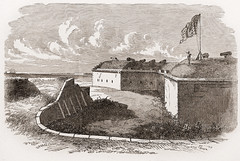
Fort Sumter, Seen from the Rear, at Low Water

December 30, 1860

  • South Carolina’s convention officially approves the Ordinance of Secession. South Carolina secedes from the Union
  • South Carolinians seize the Federal Arsenal at Charleston, making Fort Sumter the last piece of federal property in the state controlled by the United States government.

The image is of Fort Sumter, seen from the rear, at low water (Harper’s Pictorial History of the Civil War)

0 comments

Fort Moultry has been abandoned, and the U.S. troops commanded by Major Anderson have been clandestinely removed to Fort Sumpter

Journal of Meta Morris Grimball
Meta Morris Grimball

29 December

        The Xmas passed very pleasantly with us, the boys were all here and we had a tree fixed off in a very lively and interesting manner with little Canibusses[?], ships, tables, chairs & dolls dressed, and lighted by little tapers. Papa dined with us, and we had a nice dinner and were pleasant. John has resigned and gone to town to offer his services to the Governor, he is very much enchanted at getting rid of a profession his heart was not very much interested in, and William and Berkley are very sorry he has given up his support. It is a great addition to Mr Grimballs expenses 3 hundred dollars a year.—

        Mrs Wayne has been talking in her flighty style about giving her Palmetto nephews a New Years party. I said what I could to prevent her going to this unnecessary expense for she has not threshed her crop or sold it and has not been able give her negroes clothes, this winter, but now the matter is at rest, for the boys have been obliged to go to Town. Fort Moultry has been abandoned, and the U.S. troops commanded by Major Anderson have been clandestinely removed to Fort Sumpter, so the troops have been ordered off, and are marching round & round, to show their spirit and excitement.—

        Daisy Barnwell dined with Lotty on Thursday & I think is a very fast little girl: she seemed wild with delight at John & Arthur flirting with her: & looked very pretty, Lotty is to dine with her to day if she can get there.

Mr Grimball is suffering from an attack of his difficult breathing, last night I had to get up & make the fire, he took his remedy but it does not relieve very soon.

A Plantation life is a very active one. This morning I got up late having been disturbed in the night, hurried down to have something arranged for breakfast, Ham, & eggs, wrote a letter to Charles in answer to one he wrote about Johns resigning, disapproving of it. Had prayers, got off the boys to town. Had work cut out, gave orders about dinner, had the horse feed fixed in hot water, had the box filled with cork:—went to see about the carpenters working at the negro houses, where there are men mending chimneys, white washing, & these carpenters Mr Grimball told me he wished me to see about every day, & now I have to cut out flannel jackets, and alter some work.—

Amy’s leg continues very bad, I don’t know when she will get better, a most provoking thing, for it is owing to her own stupidity.

0 comments

Major Anderson’s Movement

News of the Day
1860s newsprint

Boston Courier, December 29, 1860

We must own that the news of the transaction in Charleston harbor was learned by us yesterday with a prouder beating of the heart. We could not but feel once more that we had a country—a fact which has been to a certain degree in suspense for some weeks past. What is given up for the moment is of no consequence, provided the one point, stands out clear, that the United States means to maintain its position, where its rights exist, and that its officers, civil and military, intend to discharge their duty. The concentration of the disposable force in Charleston harbor in a defensible post, is thus a bond of union. It is a decisive act, calculated to rally the national heart. * * We are not disposed to allow the Union to be broken up for grievances of South Carolina, which might be settled within the Union; and if there is to be any fighting, we prefer it within, rather than without. The abandonment of Fort Moultrie was obviously a necessary act, in order to carry into effect the purpose contemplated with such an inferior force as that under the command of Major Anderson.

0 comments

From a Texas Lady

News of the Day
1860s newsprint

Austin State Gazette , December 29, 1860

EDITOR GAZETTE:–I love Texas–it is my home; I love her breezes, I love her flowers, I love her people. When I look back to the time when Texas was young, and remember the “days that tried men’s souls,” I can fully realize the agony she felt, when, straggling with a sparse and scattered population, to throw off the yoke that bound her. At one time I felt hard that the old Texans should discriminate between those that adopted her soil as their own, in favor of her own honored land. I thought she should have welcomed us with open hands and open hearts, since we had come to her, to make their homes our homes, their land our land, their people our people; and if good or evil came upon us, we would share their woes in common. But when I learned their history, and found the dark and stormy times that did surround them in their troubles, when I learned, as one man they stood together, and battled against a powerful foe, and learned that side by side, they laid together, upon the tented field, looking calmly and firmly, when the nightshades came upon them—at the stars, that shone in the Heavens, and felt that He smiled upon them through those little windows, my heart was with them.

 I can now fully excuse all that I once though unkind, when I read of their trials and sufferings, and now know, how each heart answered to another, and how each strong arm was nerved to defend one another, the [illegible] comforts that surrounded them, were shared mutually. Knowing all this, how can I think that there is a single Texian now living who feels   the patriotism, that then throbbed in his bosom, but will come now to the rescue. You were once in trouble, stout hearts, and strong arms came to your support, and will you turn over into the hands of northern fanatics—a blind and bigoted people—this fair land. Never! never! The scenes you once witnessed, the troubles you once felt, lead you to cry for freedom without control. The Lone Star banner that once floated above you, flung out its beams, which reached the hearts of your kindred in other lands, must again flutter in the breeze, and receive the adulation, that I know rests, but does not sleep, in your warm, patriotic hearts. I am but a woman, yet shall I not love my country, and love my home. A woman loves her household gods as warmly as men. She loves those that are ready to stand by her, ready and willing to protect her. I do not wish to create in your minds any foolish fear. I only wish to say, be prepared for any emergency. Look for a moment at the spectacle now presented us from our bleeding frontier. Do you think that the depredations there committed are only the offspring of the fiendish Indians that swarm upon our borders? Do you think there is no incentive beyond their hope of livelihood which prompts them to these deeds of darkness? Do you think that the incendiary’s torch, kindled in our towns, villages and country homes, are purely accidental? Singular it is that all should have occurred within a few months. I would ask the most conservative, the most Union-loving man: “Stop and ponder upon these events; go and tell your wife and little ones that look to you for protection, help, and sustenance, and say it is all an idle speculation,” and answer in your conscience to y our God. I know that there are yet men enough, and true enough, to look upon these things as they really exist.

 VOLUMNIA.
Austin, Dec. 16.

0 comments

Uncle Sam — a Rich Obituary

News of the Day
1860s newsprint

The Constitutional [Alexandria, LA], December 29, 1860

We clip the following touching tribute to a worthy old gentleman deceased, from the Memphis Avalanch [sic]. Requiescat in pace:

Died.—On the 6th of November last, at the ripe old age of 84 years, 4 months and two days, UNCLE SAM, leaving a numerous and respectable set of friends and relatives to mourn his loss. The funeral will take place immediately, or at least as soon as decency permits. As the deceased was renowned on tented fields and the briny wave, there will be several volleys of musketry and a few rounds of ordnance fired over his remains. The disease of which my uncle died was African Itch, somewhat resembling Red River mange, but much more virulent and fatal. He has been ailing for a long time, and his complaint had become chronic, and caused frequent spasms, which he bore with surprising fortitude. A good many doctors worked on him from time to time, until finally Dr. Buchanan took charge of the case.—He had several poultices prepared to put on my uncle’s stomach and spleen, but the nurses either never put them on, or else pulled them off too quickly to do any good. After my uncle was dead, Dr. Buchanan tried to bring him to by blowing in his nose and saying some charm word over him. Then he recommended a coroner’s jury of 33 men to sit on the body, but cousin Hawkins and some other declined because they thought it smelt too bad, and so a great many of my cousins, seeing that the old man was dead, started home to tell their mothers about it, and try to comfort them. My uncle had no money about him when he died, but he has a right pretty property in real estate, which is to be administered on and divided among the heirs by one Lincoln, who has just taken a lease of the place for four years. L. is considered a very honest man. His brother-in-law who goes in with him, is named Hamlin, and is also a very worthy man.

 Orphan Boy.

0 comments

United States Minister to England, George Mifflin Dallas.—”My country, my country…,”

Diary of George Mifflin Dallas, United States Minister to England 1856 to 1861

1860. December 29.–Dates and news from New York to the 15th inst. General Cass had resigned. Governor Dickinson is mentioned as his successor. So we go, from one unfit to another more so. My country, my country, whither in the intoxication of your liberty are you plunging!

Skating for several days on the Serpentine; ice three or four inches thick. The wind has veered to the southeast, and a thaw may be expected.

0 comments

Operations in Charleston Harbor

War of the Rebellion: from the Official Records of the Union and Confederate Armies and Navies

WASHINGTON, December 29, 1860.

LARZ ANDERSON, Esq., Cincinnati:

SIR: General Scott has been hoping for two or three days to find himself well enough to answer your letter, but is too much prostrated by diarrhea. He has done everything in his power to support your brother in his command, repeating, with what effect remains to be seen, within the last twenty-four hours, an urgent recommendation, long since made, to the President to re-enforce the major.

The War Department has kept secret from the General the instructions sent to the major, but the General, in common with the whole Army, has admired and vindicated as a defensive measure the masterly transfer of the garrison from Fort Moultrie to the position of Fort Sumter.

G. W. LAY.

0 comments

The Arsenal in Charleston: “…this post is to all intents and purposes in the possession of the South Carolina troops.”—Operations in Charleston Harbor

War of the Rebellion: from the Official Records of the Union and Confederate Armies and Navies

.
CHARLESTON ARSENAL, S. C.,
December 29, 1860.

Capt. WM. MAYNADIER,

In charge of Ordnance Bureau, Washington, D.C.:

SIR: I reported by telegraph on the 28th instant that this arsenal was surrounded by a body of South Carolina militia, and that myself and the command are not allowed to pass in or out without a countersign. Those in authority disclaim any intention of occupying the post, nor do they molest the flag. I asked for instructions, but have received none.

I protest (the disclaimer notwithstanding) that this post is to all intents and purposes in the possession of the South Carolina troops, and also against the indignity offered me as an officer of the United States Army, to say nothing of the annoyance the entire command is subjected to by this measure.

I shall, therefore, unless otherwise instructed from the War Department, make a formal protest against the posting of sentinels around this arsenal, and request that they be removed, which, if denied, I shall consider an occupancy of it by the State, and shall haul down my flag and surrender.

I respectfully submit that such a course is proper, and due to myself and the position I occupy as commanding officer.

Very respectfully, I am, sir, your most obedient servant,

F. C. HUMPHREYS,

Military Storekeeper Ordnance, Commanding.

[Indorsement.]

ORDNANCE OFFICE,
January 17, 1861.

Respectfully submitted to the Secretary of War.

WM. MAYNADIER,

Captain of Ordnance.

[Inclosure.]

Abstract from muster-roll of F. C. Humphreys, military storekeeper of ordnance, dated to include the 30th day of December, 1860.

Present: Brevet Col. Benjamin Huger, who assumed command November 20, by order of the Secretary of War, and who was absent under orders from the Adjutant-General’s Office, dated December 1, 1860, and assumed his former duty at Pikesville, Arsenal, by instructions of the Secretary of War, dated December 15, 1860.

F. C. Humphreys, military storekeeper, who resumed command of post December 7, 1860. Fourteen enlisted men.

F. C. HUMPHREYS,

Military Storekeeper, U. S. Army.

0 comments

Civil War Day-by-Day

Civil War Day-by-Day

December 29, 1860

  • As requested, John Floyd tenders his resignation as Secretary of War. Charges come out later in the day that he had misdirected funds to contractors and guns to the South. Neither charge will be fully investigated and his guilt (or innocence) is still a hotly debated subject
0 comments

Operations in Florida

War of the Rebellion: from the Official Records of the Union and Confederate Armies and Navies

WAR DEPARTMENT,
Washington, December 28, 1860.

Hon. D. L. YULEE,   Senate:

SIR: In answer to your letter of the 21st instant I have the honor to inclose to you a statement showing the names, rank, and pay, and emoluments  of the officers of the United States Army appointed from Florida.* The contingent allowances for fuel and quarters and similar items are not included.

Very respectfully, your obedient servant,

JOHN B. FLOYD.

*List not deemed of sufficient importance for publication (in Official Records).

0 comments

Governor Pickens:— Castle Pinkney and Fort Moultrie Taken

War of the Rebellion: from the Official Records of the Union and Confederate Armies and Navies

EXECUTIVE DEPARTMENT,
Charleston, December 28, 1860.

Hon. D. F. JAMISON, President of the Convention :

SIR: As the Convention sent for me yesterday, to be informed upon important business, I take the occasion to say that, under my order, Castle Pinckney was taken last evening, and the United States flag hauled down and the Palmetto banner run up in its place. And I also ordered a detachment from an artillery regiment to occupy Sullivan’s Island; and if it could be done without any immediate danger from mines, or too great loss of life, to take Fort Moultrie and to run up the Palmetto flag, and put the guns in immediate preparation for defense. I have now full possession of those two forts. I considered the evacuation of Fort Moultrie, under all the circumstances, a direct violation of the distinct understanding between the authorities of the Government at Washington and those who were authorized to act on the part of the State, and bringing on a state of war.

I therefore thought it due to the safety of the State that I should take the steps I have. I hope there is no immediate danger of further aggression for the present.

Respectfully,

F. W. PICKENS.

0 comments

Charleston arsenal surrounded.—Operations in Charleston Harbor.

War of the Rebellion: from the Official Records of the Union and Confederate Armies and Navies

CHARLESTON, December 28, 1860.

Capt. WM. MAYNADIER,
Ordnance Bureau:

A body of South Carolina military now surround the arsenal outside, however of the inclosure, but denying ingress or egress without countersign. The officer in command disclaims any intention of occupancy, and the United States flag is undisturbed. I await instructions.

F. C. HUMPHREYS.

0 comments

“… for the present we are treated as enemies.”—Operations in Charleston Harbor

War of the Rebellion: from the Official Records of the Union and Confederate Armies and Navies

.

FORT SUMTER,
S.C., December 28, 1860.
(Received A. G. O., January 1, 1861.)

Col. S. COOPER, Adjutant-General:

COLONEL: I have the honor to send herewith a copy of a memorandum received to-day from the governor of South Carolina, in reply to a message from me, which shows that for the present we are treated as enemies. I sent my post-adjutant this morning with a message to the commanding officer of Fort Moultrie asking by what authority he held possession of that work, and desiring to know whether he would make any opposition to my sending for some property, public and private, left there. He replied to my first question that he held that post by authority of the sovereign State of South Carolina, and in obedience to the orders of the governor. To the second, that his orders were not to permit public property of any kind to be removed on any pretext whatever; that he was directed to take an inventory of the same, and to send it to the governor; that he would with pleasure assist in recovering and restoring all private property that was left. This decision about the public property shows that South Carolina is acting in this matter also toward us as if we were her enemy. The amount of public property thus left is not great, as I merely retained enough to prevent my movement from being suspected. He requested Lieutenant Hall to say that at a general meeting of the officers, the military move I made was unanimously pronounced to have been one of consummate wisdom; that it was the best one that could have been made, and that if I had not effected it things would have been very different. Speaking of his own position, he remarked that the guns of Fort Sumter looked into his guns, and said that he ought not to have been ordered to fire upon me, because if I returned his fire he would be compelled to retire to the sand hills. There were yesterday two regiments to guard the island. The remark about his orders looks like an intention to attack me here. I must confess that I feel highly complimented by the expression of such an opinion (from those most deeply affected by it) of the change of position I felt bound to take to save my command and to prevent the shedding of blood. In a few days I hope, God willing, that I shall be so strong here that they will hardly be foolish enough to attack me. I must confess that we have yet something to do before, with my small force, I shall feel quite independent, as this work is not impregnable, as I have heard it spoken of.

Trusting that something may occur which will lead to a peaceful solution of the questions between the General Government and South Carolina,

I am, colonel, very respectfully, your obedient servant,

ROBERT ANDERSON,

Major, First Artillery, Commanding.

P. S.–I do not feel authorized to reply to the memorandum of the governor, but shall regret very deeply his persistence in the course he has taken. He knows not how entirely the city of Charleston is in my power. I can cut his communication off from the sea, and thereby prevent the reception of supplies, and close the harbor, even at night, by destroying the light-houses. These things, of course, I would never do, unless compelled to do so in self-defense.

[Inclosure.–Copy of memorandum from Governor Pickens.]

HEADQUARTERS, December 28, 1860.

In reply to Major Anderson’s request, made this morning verbally through First Lieutenant Snyder, from Fort Sumter, I hereby order and direct that free permission shall be given to him to send the ladies and camp women from Fort Sumter, with their private effects, to any portion of Sullivan’s Island, and that entire protection shall be extended to them. It is also agreed that the mails may be sent over to the officers at Fort Sumter by their boats, and that all the ladies of Captain Foster’s finally shall be allowed to pass, with their effects and the effects of any kind belonging to Captain Foster, from the Mills House to Fort Sumter, and the kindest regard shall be paid to them. Of course, Lieutenant Meade’s private effects can be taken possession of; but for the present there shall be no communications of any other kind allowed from the city to the fort, or any transportation of arms or ammunition, or any supplies, to the fort; and this is done with a view to prevent irregular collisions, and to spare the unnecessary effusion of blood.

F. W. PICKENS.

0 comments

Abby…unwilling to give him up, argued and entreated in vain.—Extracts from a letter to a Southern cousin.

Woolsey family letters during the War for the Union

Abby Howland Woolsey to Benjamin Mintorn Woolsey

When we were all children and spending, as usual, our summer with Grandfather Woolsey at Casina there arrived one day a new and charming cousin, Benjamin Minthorn Woolsey, from Alabama. He belonged to the Melancthan Taylor branch of the family, and none of us had ever seen him before. A warm friendship began and was continued until the mutterings of secession were heard. Abby, unwilling to give him up, argued and entreated in vain. The letter from which the following extracts are taken was probably her last to him and will give an idea of her clear and forcible thinking and writing. Many families decided at this point to meet again only as enemies.
.

My dear Cousin: I hasten to answer your letter, for, as events march, mail facilities may soon be interrupted between North and South. When the great separation is a recognized fact postal treaties, along with others, may be arranged. Meantime, it is one of the curious features of your anomalous position that you are making use of a “foreign government” to carry your mails for you, on the score of economy. Congress may cut off the Southern service and occasion some inconvenience and delay, but I am told it will save the government about $26,000 weekly, that being the weekly excess of postal expenditure over revenue in the six seceding states.

I thank you very sincerely for your letter. It was very kind in you to write so promptly and fully and in so sedate a tone. But what a sober, disheartening letter it was! We have been slow to believe that the conservative men of the cotton states have been swept into this revolution. I could not believe it now but for your assurance as regards yourself and your state. “Not a hundred Union men” as we understand it, in Alabama! We had supposed there were many hundreds who would stand by the Union, unconditionally if need be, and uphold the Constitution, not according to any party construction, but as our fathers framed it, as the Supreme Court expounds it, and as it will be Mr. Lincoln’s wisest policy to administer it. Not a hundred Union men in your state! Truly not, if Mr. Yancey speaks for you and Alabama when he [continue reading…]

0 comments