Transportation of Families–Operations in Charleston Harbor

War of the Rebellion: from the Official Records of the Union and Confederate Armies and Navies

FORT SUMTER, S.C., February 3, 1861.

Col. S. COOPER, Adjutant-General:

COLONEL: Yesterday and last night, in consequence of the continuance of a storm of wind and rain, very little work was done, as far as we could observe, around us. The rain is still (11 a.m.) continuing. The steamer has not yet left the harbor with the women and children.

I am, colonel, very respectfully, your obedient servant,

ROBERT ANDERSON,

Major, First Artillery, Commanding.

0 comments

The News

Civil War Day-by-Day

February 3, 1861; The New York Herald

Col. Hayne, the South Carolina Envoy, sent a communication to the President yesterday, in which he proposes to open negotiations for the transfer of the federal property to the State, and in case of non-compliance threatens the capture of Fort Sumter. The President summoned his Cabinet on the receipt of the letter to deliberate upon the subject. The result is not known, but it is stated that the President will act as heretofore with regard to the demands of South Carolina, and await the result.

The Louisiana secessionists have seized the Mint and Custom House at New Orleans. The Mint contains a considerable sum of public money, which the government agent at New Orleans has refused to deliver up to the United States.

Both the Washington Peace Convention and the Convention of the secession States at Montgomery meet tomorrow. Several of the delegates to the former had reached Washington last evening, and it is likely that they will all be at the capital by Monday morning.

0 comments

The Reaction Against the Abolitionists—American Civilization Versus Puritan Fanaticism

Civil War Day-by-Day

February 3, 1861; The New York Herald

The reports of the proceedings of the Abolition Convention at Syracuse, which we published a day or two ago, show that a strong reaction has set in against the abolition sentiment in a city of this State, the scene of the Jerry rescue, and long the stronghold of anti slavery fanaticism. Similar developements have taken place in other parts of the State, including this city, and at various points in the North. Among these healthy symptoms, are the repeal of the Personal Liberty bill in Rhode Island, and the return of the fugitive slave Lucy from Cleveland, Ohio. The fanatical anti-slavery proceedings in Boston at the close of last week were not allowed to pass off so smoothly as usual; though in that city, a year ago, John Brown was canonized by the assembled citizens, including Governor Andrew.

The fearful consequences of the abolition propagandism in breaking up the Union and inaugurating civil war are coming home to every man’s business, if not to his bosom. Hence the effort to suppress it. But the sentiment still lies deep in the Northern mind, and though bills nullifying the Fugitive Slave law may be repealed in New England, the anti-slavery feeling is not eradicated, and will break out again in full blast if the question is not now finally settled beyond the reach of agitation. The Northern mind needs to be re-educated. The fertile source of the ever recurring mischief is the Puritan idea of the superiority of their sect over other men, and a mysterious divine right which they claim to possess of dictating to all mankind – a right which they hold to be higher than the authority of the Bible and the constitution, and which ought to be maintained at all hazards, even with Sharpe’s rifles, bayonets and cannon balls. This is a principle which has deluged Europe with blood for centuries, but happily is exploded there in the present age. The question for the American people to decide is, whether they will allow it to produce the same fruits here, or whether they will not now lay the axe to the root, that the poison tree may fall, never to bloom again in this soil.

According to Mr. Beecher, in a late sermon, ‘Puritan blood means the blood of Christ.’ Hence the superiority of Puritan blood, and the inferiority of all other blood; and hence Mr. Beecher says, ‘North is the brain and the moral centre of this confederacy;’ and Wendell Phillips last week, and indeed in all his lectures, affirms that the Puritanism of Massachusetts is the germ of which everything that is good in the country has sprung.

As for the North being the brain of the confederacy, the assertion is contrary to the notorious truth of history. A Southern man – Jefferson, a slaveholder – drew up the Declaration of Independence; a Southern man – Madison, a [continue reading…]

0 comments

The Revolution

Civil War Day-by-Day

February 3, 1861; The New York Herald

WASHINGTON, Feb. 2, 1861.

The President has received Colonel Hayne’s communication in regard to the public property in South Carolina, and demanding, in case he will not enter into negotiations for it, the surrender of Fort Sumter.

This letter has been prepared with great care, having been submitted to Messrs. Hunter and Mason, and also to Messrs. Benjamin and Slidell.

The President will reply to it as early as possible. His views are already well known to the people of South Carolina in regard to this matter. He has seen nothing in the events of the last few weeks to change them.

Lieut. Hall’s departure for South Carolina, with official despatches, has been postponed for the present. He expected to have gone tonight.

0 comments

“More talk now of an attack upon Forts Sumpter & Pickens…”—Horatio Nelson Taft.

Diary of US patent clerk Horatio Nelson Taft.

SATURDAY 2

Foggy and misty day with water driping from roofs all the time. A Salute of 34 guns was fired today at noon at the Armory on account of the Admission of Kansas into the Union. Many of the Citizens who did not know the cause of the firing were much alarmed thinking that the “fighting” had commenced. No particular news today. More talk now of an attack upon Forts Sumpter & Pickens now held by U.S. troops. In Congress the Republicans are giving ground for the sake of peace. The Peace Convention invited by Virginia meets Monday the 4th. Did not go down to the Ave tonight.


The three diary manuscript volumes, Washington during the Civil War: The Diary of Horatio Nelson Taft, 1861-1865, are available online at The Library of   Congress.

0 comments

At the Court of St. James

Diary of George Mifflin Dallas, United States Minister to England 1856 to 1861

1861. February 2.–A slight solace to one’s anxieties about home is found in the circumstances brought by successive steamers during the week. 1. The proposition of Mr. Crittenden, or “The Border States,” seems growing into favour. 2. There was a large minority on the question of secession before next 4th of March in the Georgia Convention. 3. The Alabama members of Congress have been instructed not to quit, but to wait further advices. 4. The South Carolina Commissioner, Colonel Hayne, has suspended his demand for the evacuation of Fort Sumter. 5. Charleston is suffering greatly from want of supplies. 6. Major Anderson is universally applauded. 7. Virginia has adopted as satisfactory the compromise of Crittenden. 8. Financial affairs are improving; the United States stock rose one per cent.

There would seem to be a most extraordinary departure from the chivalric honour in public life which has heretofore characterized Southern gentlemen in the disloyal treachery with which Cobb, Floyd, Thomson, Thomas, and Trescott have pursued secession in the very penetralia of Mr. Buchanan’s Cabinet. Nothing can relieve them from the charge of deceit and treachery but their having apprised the President, on entering his counsels, that, instead of recognizing as paramount their allegiance to the Union, they were governed by “a higher law” of duty to Georgia, Virginia, Mississippi, Maryland, and South Carolina respectively.

Persigny, recently appointed to the Ministry of the Interior in Paris, made a popularity-seeking plunge at his outset in relaxing restrictions on the Press. Suddenly he has turned a corner; giving, three days ago, an “avertissement” to the Cormier de Dimanche, and arbitrarily ordering the offensive writer, Ganeseo, out of the Kingdom. He says that Ganeseo is a foreigner, and cannot be allowed to criticise the principle of the Imperial Government.

0 comments

Lieutenant Hall

Civil War Day-by-Day

Civil War Portraits—Leaders, Influencers, and the Incidentally Important #001

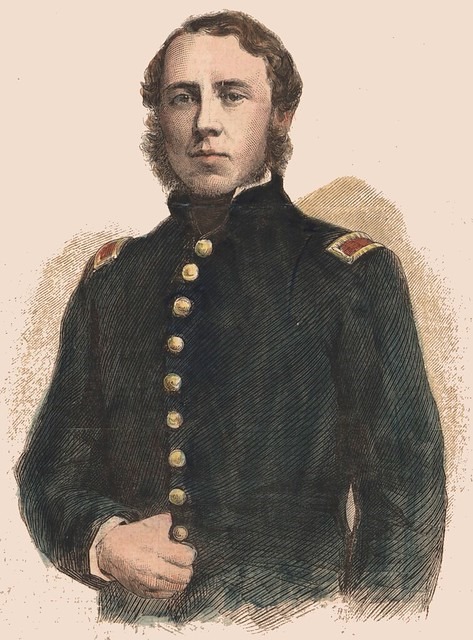
Lieutenant Hall, USA, Bearer of Despatches from Major Anderson to Governor Pickens—Photographed by Brady

Lieutenant Hall, USA, Bearer of Despatches from Major Anderson to Governor Pickens

(Norman Jonathan Hall was initially sent with messages to Governor Pickens after the Star of the Wst was fired on.)

The Star of the West was fired upon on January 9, 1861.

From a handed-tinted off-print of Frank Leslie’s Illustrated Newspaper, February 2, 1861.

Locations: Charleston, Charleston County, South Carolina, United States(32.77657,-79.93092)
Item Location: Fort Sumter NM/Charles Pinckney NHS Curatorial Storage Facility, located at Charles Pinckney National Historic Site
Box: Box 2 of 3 Fosu 19th-c Illustrations Frank Leslie Harpers Weekly London Times, Etc.
Permanent Link: purl.clemson.edu/E2A32D39E8A2F084F3864BCC3FC414A1
___________
Mike’s notes:

Special handed-tinted off-prints were also sold separately from newspapers. Numerous originals held today by public institutions and in private collections.

Note – This image has been digitally adjusted for one or more of the following:
– fade correction,
– color, contrast, and/or saturation enhancement
– selected spot and/or scratch removal
– cropped for composition and/or to accentuate subject

0 comments

Civil War Day-by-Day

Civil War Day-by-Day

February 2, 1861

  • Texas adopts a Declaration of Causes.
0 comments

Groceries and Transportation of Families–Operations in Charleston Harbor

War of the Rebellion: from the Official Records of the Union and Confederate Armies and Navies

FORT SUMTER, S.C., February 2, 1861.
(Received A. G. O., February 6.)

Col. S. COOPER, Adjutant-General:

COLONEL: I received a letter yesterday from Mr. Gourdin, in which he says: “I saw his excellency this evening, and he makes no objection to your groceries being sent you.” The South Carolinians were, we thought, occupied nearly all last night on the works at Cummings Point. One of them is now probably twelve or fifteen feet high, and appears to be bomb-proof, and may be intended to defilade a battery pointing on the channel from our fire. From the energy with which their operations are carried on it is evident that they regard them as very necessary, and that they consider that they are also important, and that they shall be pushed as rapidly as possible. The women and children are on board the steamer, but the wind is blowing so heavily that it is doubtful whether they will attempt to cross the bar with this tide.

I am, colonel, your obedient servant,

ROBERT ANDERSON,

Major, First Artillery, Commanding.

0 comments

Our Washington Correspondence

Civil War Day-by-Day

February 2, 1861; The Charleston Mercury

WASHINGTON, January 30, 1861.

It was a matter of suprise this morning to every one to learn that Col. HAYNE had received no instructions in regard to demanding the surrender of Fort Sumter. The unanimous declination of Virginia’s mediation could only have looked to immediate action on the part of South Carolina. It is to be believed that she will rest content with the simple assertion of her final withdrawal from the Union? Such a declaration of independence, unsustained by some prompt and practical step, would amount to nothing more than a studied affront of Virginia for the benefit of the Federal power, coupled with real imbecility or a species of prudence inconsistent with the true spirit of liberty.

Public men here, who, a month ago, shrunk from the horrors of a conflict at arms, have been forced to reconcile themselves to such an event, as one which the insane course of the Administration renders inevitable. This much is plain. BUCHANAN ought either to reinforce ANDERSON or to recall him. He has not yet reinforced him, and he won’t recall him. Does any one suppose he means to charge himself with the crime of sacrificing seventy men – to say nothing of the lives of those who will fall in the assault – merely on a point of honor. You Carolinians are deceiving yourselves. Mr. BUCHANAN is a Northern man – a Union man at all hazards. He intends to hand over Fort Sumter and Fort Pickens to his successor, cost what it may. He wants time – desires no collision. But those who expect him to give up these fortifications, do not know the man or his feelings. By postponing the capture of these posts, you are only accumulating the chances of failure and compounding interest of your best blood. By delay you afford time for the amplest preparations within the fort, and you stand continually exposed to the dangers of a successful reinforcement from a hostile and treacherous Government. Many military and naval men think that it can be readily affected in boats, despite all your precautions. And depend upon it, SCOTT is no trifler, and will not fail when the next effort is made. South Carolina is drifting into a position where a bloody battle will be inevitable or a disgraceful backing down and reconstruction of the Union. Were the South in possession of these fortifications, there would long since have been an end of all the war talk at the North. By delay you keep up the irritation and excitement, and may end by getting up a civil war; for, this exhibition of apparent weakness, irresolution or unpreparedness to take a fort held by but seventy men, [continue reading…]

0 comments

The Negro in the Metropolis

Civil War Day-by-Day

February 2, 1861; The New York Herald

The statistics of the colored population in New York, which we published the other day, must suggest to every thinking mind the inferiority of condition which characterizes the negro race in the free States, as compared with the African living under the Southern system of servitude. Since 1850 the total population of the city has increased some three hundred thousand, while in the same time the negro population, black and mulatto, has decreased from 13,815 in 1850 to 10,831 in the present year – a falling off of nearly three thousand in a single decade. At this rate of decrease the whole free negro population of the country will have vanished in half a century from now, unless preserved by some unusual migration from the Southern States. Out of the ten thousand negroes now in the metropolis, only eighty five own any real estate, and not quite eight hundred own personal estate. They have completely abandoned all employments requiring active manual labor, and are to be found for the most part in the position of waiters and domestic servants, and the females in the capacity of washerwomen and laundresses. A negro mechanic is a rarity – the whole number in the city not reaching eighty; and in any higher pursuit there are none to be found, excepting fourteen clergymen of different persuasions, eight physicians, eight musical professors and seventeen teachers.

In the wards where they are the most numerous they form the very lowest stratum of society; in the Fifth ward especially prostitution and indiscriminate intercourse between the sexes is the common rule of life. The number of mulattoes among the colored population shows the immorality of the female portion in a very marked manner, considering that only thirty two cases of intermarriages with white women are returned by the census marshals, and not one case of intermarriage between a white man and a black woman. Of the thirteen thousand colored people in the metropolis, nevertheless, no less than three thousand are the offspring of black and white parents, and the census shows that more than five sixths of them were born in free States, and most of them in this city.

These facts prove that the negroes in the much lauded condition of freemen are descending in the scale of civilization and diminishing in numbers. No such results can be deduced from the statistics of the negro in Southern servitude. The very converse of the picture is presented there. The negro of the South is physically strong and sound, healthy and fruitful, happy, contented, and, in many cases, moral and religious; increasing in numbers year by year, and never exposed to the vicissitudes of poverty. There is something in this to induce philosophical reflection. It is the best answer that can be made to the fanatical outcry about the equal right of the black man and the white to perfect liberty and a joint civilization.

0 comments

The News

Civil War Day-by-Day

February 2, 1861; The New York Herald

There are reports from Charleston in circulation that the military authorities there have completed their preparations for an attack upon Fort Sumter, and only await the order to open the batteries. It is also reported that Gov. Pickens has directed Col. Hayne to demand of the President the unconditional surrender of the fort, and in case of noncompliance that the attack will be ordered. Col. Hayne had not presented any communication to the President up to eight o’clock last evening. He has, however, it is stated, received his instructions, and will no doubt attempt to open negotiations with the President without delay.

Lieutenant Jewett, of the navy, has arrived in Washington from Pensacola. He states that he was arrested by the authorities of Florida, who held him in custody until he gave his parole of honor that he would never take up arms against the State of Florida. The facts in the case have been communicated to the Navy Department.

The slavers Kate and Weathergage were condemned yesterday by Judge Betts in the United States District Court.

0 comments

Fort Palmetto—Cole’s Island

Civil War Day-by-Day

February 2, 1861; The Charleston Mercury

 FORT PALMETTO. – COLE’S ISLAND. – One of our brave volunteers, writing to us, from this point says:

‘This has been quite an exciting day. At 12 o’clock, we were formed into line, and marched to the fort, when we fired six guns in honor of the Seceding States. As the first gun was fired, a large Palmetto flag was hoisted to the top of the flagstaff, which measures seventy five feet, and was made by us here on the spot, having carved on its base, ‘La Lafayette Artillery, January 31st, 1861.’ After which, three hearty cheers were given for the ‘Southern Confederacy’- three more for our ‘Noble and gallant Captain POPE’- and three more for glorious old State of South Carolina.’This day we finished the fort, and now, thank God, we are fully prepared to treat our Yankee friends to a dose of Carolina balls in French style.

‘After we had retired, some fifty negros, who had assisted in building ditches, &c., assembled on the ramparts around the flagstaff and gave utterance to the following sentiment: ‘We are de first dat cum to dis fort – we work on til finish – tree chairs for Palmetto Fort – tree chairs for Capen POPE, and tree more for Sous Carolina.’ The enthusiasm with which these cheers were given would have amazed the old Railsplitter himself. After which they all dispersed to their homes about the several Islands singing ‘Dixie.’

‘Now, then, are our little band of ‘La Fayettes’ in sole possession of Coles’ Island, including Bird Key and Stono Inlet. We fear naught; we are ready for whatever may occur.’

0 comments

The Next Congress—An Appeal to the People Unavoidable

Civil War Day-by-Day

February 2, 1861; The New York Herald

The leaders of the republican party find themselves in a peculiarly perplexing position. They are opposing with all their might the meeting of Commissioners to consider the Virginia resolutions, and they are determined to resist the Bigler proposition to submit the whole question to the people. In both of Mr. Seward’s speeches he has clearly indicated that the policy of the new administration is the strict party policy, and that the republican leaders believe that the secessionists will exhaust themselves in time. Mr. Seward adheres to his former position, that after one, two or three years shall have elapsed the Southern storm will blow over. Then will be the proper time for a Constitutional Convention of all the States; but if all else fails, and Union by force of arms is to stand or fall, he will advise his people to stand or perish with it – that is, to fight for it to the death.

The republican leaders, Mr. Seward included, have no confidence in the masses of their party. The fear that if the question of compromise should be put directly to the people of the North they would vote in the affirmative, when the republican party would be broken into half a dozen cliques, and finally perish of strangulation at the hands of its own friends. They will therefore take the risk of losing the border States rather than run the chance of destroying their party organization. If the matter could be left to the people, it would be very soon settled; but the politicians are bound to keep it in their own hands, on the principle of rule or ruin. So there is nothing to be hoped for from the republicans. They go in for the inauguration of Lincoln and the spoils first, and adjustment afterwards, if adjustment is practicable. It is probable that nothing practical will result from the efforts now being made to bring about a settlement, and that all or nearly all the border States will withdraw from the Union on or about the 4th of March. When Mr. Lincoln takes office he will be compelled to call an extra session of Congress, to assemble at the earliest possible moment. As will be seen by the tables we have given elsewhere, fourteen States – namely: Alabama, California, Connecticut, Georgia, Kentucky, Kansas, Louisiana, Maryland, New Hampshire, North Carolina, Mississippi, Rhode Island, Tennessee, Texas and Virginia – have still to elect representatives to the next Congress. Of course the seceding States will disregard the President’s proclamation altogether; but we shall obtain from New England, California, and, we trust, from the border States, an expression of the public sentiment, which may go far towards bringing about a peaceable settlement of existing difficulties.

The New England States choose in March, and elsewhere special Congressional elections will be ordered. It is claimed [continue reading…]

0 comments

Our Key West Marine Correspondence

Civil War Day-by-Day

February 2, 1861; The Charleston Mercury

KEY WEST, FLA., Jan. 26.

The steamship Joseph Whitney, Captain LOVELAND, arrived at Fort Jefferson, Garden Key, Tortugas, the morning of the 18th, and landed Major ARNOLD and his command the same day. There being no heavy ordnance at Fort Jefferson Capt. MEIGS, the Engineer Officer in charge, made a requisition upon Captain E. B. HUNT, U. S. Engineer in charge of Fort Taylor, for a portion of his heavy ordnance, together with the ordnance property appertaining thereto, and sent the steamer Whitney to this place to transport the same.

The Barkantine Horace Beal was here chartered by Capt. MEIGS to receive on board the Columbiads and Howitzers, &c. She was taken in tow by the steamer and carried down under convoy of the U. S. steamship Crusader, Lieut. MAFFITT. The vessels arrived at Tortugas in safety, and the guns were at once mounted. This fortification may now be considered safe in the hands of the Federal Officers.

The U. S. Steamer Crusader, Lt. MAFFITT is at Havana. She will return to this rendezvous the 28th, and remain here to assist Capt. BRANNAN in the defence of Fort Taylor.

The Steamship Mohawk, Lt. CRAVEN, is at present at Fort Jefferson assisting in its defence. No other men of war are known to be in these waters.

Fort Taylor has a large part of her armament mounted, and is considered capable of sustaining a protracted siege. The company of Artillery, in command of Capt. J. M. BRANNAN, have been transferred from the barracks, and now occupy quarters within its walls. They have six months supply of provisions, and water sufficient for twice that period.

In marine matters we have little of interest. No wrecks have occurred on our coast since the Ocean Belle went ashore, [continue reading…]

0 comments

The Banner State of the South—The Troubles of South Carolina to Get an Ensign

Civil War Day-by-Day

February 2, 1861; The New York Herald

Among the many measures that have exercised the wisdom of the South Carolina Legislature recently, is one on the subject for the adoption of a national or State flag.

About one week after the passage of the secession ordinance the South Carolina Legislature adopted a flag of the following description: –

The flag has fifteen white stars on a marine blue ground, the centre star the larger one; a white palmetto tree and crescent on the upper right hand corner, and the corner spaces, including the ground on which the palmetto and crescent are placed, of red.

On the 26th of January the Legislature repealed the first resolution adopting a State flag, and substituted another one. The following cut will give an idea of the appearance of the new ensign: –

The field is dark blue. Upon the upper inner corner of the flag is the crescent, in white, the horns pointing upward. In the middle of the flag is an oval, in white, emblazoned with a golden palmetto, upright.

The subsequent day the Legislature rescinded the second resolution, and substituted the following: –

It now consists of a blue field, with a white palmetto tree in the middle, upright. The white crescent in the upper flag staff corner remains as before, the horns pointing upward.

Whether these shiftings and changes in the Legislature of the miniature republic are ominous or indicative of the character of its statesmen or policy we cannot at present divine. It strikes us, however, that the vision of the stars and stripes of the Union, which have proudly waved over our country for seventy years, is still impressed in the imaginations of the legislators of South Carolina, and that, notwithstanding their new flags, made up with combinations of snakes, palmettos, half moons and fifteen stars, they will not be content until they re-unfold the flag with thirty four stars and thirteen stripes.

0 comments

“There are many ‘Secessionists’ or Disunionists among the Citizens here.”—Horatio Nelson Taft.

Diary of US patent clerk Horatio Nelson Taft.

FRIDAY, FEBRUARY 1

Fine cool morning, M: 24 — warmer and misty the latter part of day. Got measured for new black coat. Paid some Bills & small note at Bank. Willie has been quite ill. I came home from the office at 1’o’ck. He is much better tonight. The day has passed off much as yesterday. Two more companys of U.S. Soldiers came today. One is quartered on E St. near pat & post offices. The other in west part of the City. There are many “Secessionists” or Disunionists among the Citizens here. It is my opinion that the District Militia would prove, in case of need, a poor support for the Govt to rely upon. Have spent the evening at home with the boys in various amusements.


The three diary manuscript volumes, Washington during the Civil War: The Diary of Horatio Nelson Taft, 1861-1865, are available online at The Library of   Congress.

0 comments

Civil War Day-by-Day

Civil War Day-by-Day

February 1, 1861

  • Texas secessionist convention votes 166 to 7 to secede, calling for a ratification election by the people
0 comments

An indirect argument… “in speaking of the courage of the blacks.”—Letters of a Family During the War for the Union

Woolsey family letters during the War for the Union

Abby Howland Woolsey to Eliza Woolsey Howland

8 Brevoort Place, Feb. 1, 1861.

My dear Eliza: As Charley was away at Astoria Georgy sent round for young Herdman, and she and I went with him to hear Wendell Phillips’ lecture. I never saw him before, and found it a perfect treat. A more finished and eloquent sketch I never heard, enlivened by telling anecdotes, and that quiet, shrewd wit which distinguishes the speaker. He made the lecture an indirect argument of course for the negro race; twice in the course of it mentioned John Brown’s name, which was received with a storm of applause, and once, in speaking of the courage of the blacks, he said: “Ask the fifty-two thousand of LeClerc’s soldiers who died in battle. Go stoop with your ear on their graves! Go question the dust of Rochambeau and of the eight thousand who escaped with him under the English Jack! and if the answer is not loud enough, come home!” and (dropping his voice) “come by the way of quaking Virginia!” There was a great crowd, but we went early and had excellent seats, and were perfectly charmed.

On Friday Rose Terry (who is at the Danas) and Dr. Bacon are to dine here. Rose wrote the “Samson Agonistes” it seems, –the fragment about John Brown in the Tribune which we all liked.

0 comments

Request for Letters of Introduction.

Miscellaneous document sources

Augustus K. Wright[i] to Howell Cobb.

Augusta, Ga., Feby. 1st, 1861.

Dear Sir: Suffer me to presume upon a casual acquaintance many years ago and the intimacy that for many years existed between our fathers to ask for letters to such gentlemen of your acquaintance in the State of Maryland and at Washington as may be useful or important to me in the mission upon which our State convention has sent me. I would be highly gratified also to have your views as to the best line of argument or policy to be pursued by me to bring about the cordial cooperation of Maryland in our new Government. Should I go at once and lay before Gov. Hicks our ordinance etc., or do you think it best for me to wait a few days to ascertain whether the legislature will be convened or a convention called?


[i] Commissioner from Georgia to Maryland, 1861 ; Member of the Confederate Congress from Georgia.


From Annual Report of the American Historical Association for the Year 1911.

0 comments

Our Nashville Correspondence

Civil War Day-by-Day

February 1, 1861; The Charleston Mercury

NASHVILLE, January 28, 1861.

The Legislature has called a Convention. The election takes place on the 9th of February, and they meet on the 25th of that month. There is strong sympathy here with all parties, for the seceding States, and everybody declares that any effort to force any State into submission, will be met with armed resistance. Whether this State will go out before the 4th of March, is doubtful. JOHN BELL is doing all in his power to prevent it. He made a speech in the Capitol last week, in which he announced that the appointment of SEWARD was a favorable indication for the South. He was for submission, and I regret that this cold blooded and unnatural desertion of the cause of an outraged people, meets with support from his followers. The battle here will be fierce. GOV. FOOTE is out as a candidate for the Convention upon Southern grounds, and he will make the fur fly. He gave BELL a most unmerciful skinning the other night. Our friends are very hopeful of carrying a decided majority of the Convention. This State could not live in peace or safety except with her Southern neighbors. Every consideration of prudence shows the line of policy she should adopt….

COCKADE.

0 comments

The Israelites of South Caroliana

Civil War Day-by-Day

February 1, 1861; The Charleston Mercury

The Israelites of South Carolina are amongst the most faithful and patriotic of the people of South Carolina. On every occasion of difficulty and danger they have exhibited a devotion to the State worthy their well known characteristics of a hatred of oppression, and a dauntless spirit to resist it. With an equal right to enter into all the offices of our Government, they have shown themselves competent to fill the highest. In the late Senate of the United States, they furnished two Senators – being one sixteenth of the numerical power of the Senate, – and both of these Senators were from the South, and both of them have been foremost in vindicating the rights, interests and liberties of the South. Mr. BENJAMIN and Mr. YULEE are worthy to sit in any assembly of statesmen in the world. Indeed, the former, in intellectual ability, was not surpassed by any public man in the late Senate of the United States; whilst his fidelity to the State he represented was as illustrious as the great ability with which he defended her. Recently in New York Dr. RAPHALL has defended us in one of the most powerful arguments put forth North or South. Here, in South Carolina (as, we believe, everywhere in the South), our Israelite fellow citizens have promptly thrown their whole weight to sustain the State in the great contest in which she is engaged, to save her liberties and institutions from the ruthless despotism of the Northern people. They too well understand the Old Testament, and that grandest of all revelations for the conduct of men, the Commandments which God gave them from Mount Sinai, to be carried away by the false philanthropy of a spurious fanaticism, which, born in infidelity and nursed by sectional hatred, has broken up the fairest fabric of free government the world has ever seen. True to their God and true to their native land, they faithfully exemplify the motto of our State, ‘opibusque parati.’ In expressing these opinions, we know that we but echo the feelings of the great body of our people.

0 comments

Our Key West Correspondence

Civil War Day-by-Day

February 1, 1861; The Charleston Mercury

KEY WEST, January 22.

Fort Taylor, a large first class fortification at the entrance of the harbor of Key West, is now nearly finished, the barracks and a few platforms for barbette guns being alone uncompleted. Capt. E. B. HUNT, Engineer Corps, in command, on account of the seizure of Southern works by State authorities, has given the military command of the fort to Capt. JOHN M. BRANNAN, First Artillery, United States army, and he, with his officers and men, are now quartered within the walls. The fort is an irregular quadrangle, with three channel curtains of equal length, and a gorge or shore curtain of much greater length. It is situated near the S. W. point of the island, in from six to twelve feet of water, and distant from the shore three hundred yards. The foundation is granite and the superstructure brick. The scarp walls are eight feet thick, and rise to the height of forty one feet from the wateredge. It has two tiers of casemates and one barbette tier, and mounts one hundred and twenty 8 and 10 inch Columbiads on the channel fronts, and forty five heavy guns on the shore fronts. Most of the armament is in place, enough to sustain a protracted siege. The troops are well supplied with ordnance stores, provisions, water, fuel, &c., and are probably better fitted to resist attacks than Major ANDERSON at Fort Sumter.

The steamship Joseph Whitney, LOVELAND, sails today for Baltimore via Fort Jefferson, and we send the marine items collected since our regular despatch of the 12th per steamship Atlantic.

The ship Ocean Belle, BROWN, was brought into this port on the 12th by the steamer Salvor. As she received little apparent injury, the survey which was called to examine her pronounced the ship in a fit state to take on board her cargo and complete her voyage without undergoing repairs. The Admiralty Court has heard the testimony of the wreckers, but has not yet rendered a decision. It is thought that the compensation will be $20,000.

The ship Clifton is being repaired. She has been hove out and is now receiving a sheathing of copper. She will take in her cargo next week and at once proceed to Boston.

The bark Sophia is having her starboard side renewed. The rigging, sails, &c., will be replaced with new. Her detention will not be long. [continue reading…]
0 comments

The Revolution

Civil War Day-by-Day

February 1, 1861; The New York Herald

WASHINGTON, Jan. 31, 1861.

Colonel Hayne has been engaged today in preparing a letter to the President in regard to affairs at Charleston. This document will contain the ultimatum of South Carolina, which is understood to be the unconditional surrender of that fort to the authorities of South Carolina.

Colonel H. had been instructed to make this demand when he first arrived here, but was dissuaded by leading Southern men to withdraw it. The demand is now reiterated in the most positive terms, and will be laid before the President tomorrow in Colonel Hayne’s communication.

A rumor was very current this evening, that Fort Sumter had been assaulted and captured by the South Carolina troops. It could be traced to no reliable source. News of such an event, however, would not any moment create unusual surprise here. The plan of attack, as divulged, is to dismantle schooners and convert them into floats, load them with cotton bales, and, the vessels being towed under the walls of the fort, the cotton bags are to be piled one upon another until a sufficient height is reached to enable the scaling parties in multitudes to ascend the walls. It is believed that the fort can be taken by this process at less sacrifice of life than by any other means.

The friends of the Union are much discouraged by the news from Pensacola and Charleston. A collision is imminent, and the fear is it has already occurred. Once began, it is idle to talk of compromise. Whatever may have been the criminal folly that prompted the attack, the appalling consequences are to precipitate at once all the central slave States into the vortex of revolution. Whatsoever may have been the outrage perpetrated, they can never permit federal troops to avenge the fate of their comrades without themselves becoming partners in the melee.

The policy now talked of among leading Union men is to call on the President to evacuate Fort Sumter and Fort Pickens, and thus remove all the opportunity for the seceding States inaugurating civil war, and carrying off the central States with them. This course will save the Union, as it is now certain that none of these States can be voted out except by the application of some such unnatural stimulus as a fight at the South between State and federal troops.

The President is known to be opposed to the withdrawal of the troops, but the representations that will be made to him by many true men at the South, and to avoid civil war, it is thought by many he may be induced to do it.

0 comments

…while numbers are homeless, am enjoying a most comfortable establishment…

Journal of Meta Morris Grimball
Meta Morris Grimball

31 December

       —the last day of the year, a gloomy, wet day, which were it not for the busy occupations of each hour would be very trying to the spirits.—Went to Church yesterday, and heard an excellent sermon from Mr Dickson, a retrospect of the past year, a very instructive train of thought. I have so many mercies to be thankful for, and here, while numbers are homeless, am enjoying a most comfortable establishment and what a poor creature I am, little deserving of any mercy.—

       I was thinking over the children this morning and I find a loving and hopeful feeling for all of them. As people get old they become more indifferent and are spared much annoyance by not feeling or seeing things which when they were young almost crazed them.

0 comments