Operations in Charleston Harbor

War of the Rebellion: from the Official Records of the Union and Confederate Armies and Navies

FORT SUMTER, S.C., February 5, 1861.
(Received A. G. O., February 8.)

Col. S. COOPER, Adjutant-General:

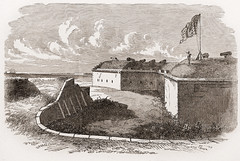
COLONEL: The character of the work on the end of Cummings Point nearest to us is, I think, now pretty well established. It seems to be a bomb-proof, with embrasures for the guns, the embrasures cut in a sloped wall, formed of heavy timbers, which is now being covered with railroad bars. This battery, though too far off for doing much damage to our walls, unless they have or get heavy rifled guns, will be pretty safe from the effect of our horizontal fires. They appear to be at work to-day connecting this battery with one between it and the battery which fired on the Star of the West, by means of a covered way. Their engineering appears to be well devised and well executed, and their works, even in their present condition, will make it impossible for any hostile force, other than a large and well-appointed one, to enter this harbor, and the chances are that it will then be at a great sacrifice of life. Our 10-inch columbiads are now in position. One points towards the city, one towards Fort Moultrie, and the third can be directed either towards Fort Moultrie or Morris Island. They are at an angle of from 30 ° to 35 °. I tried a shell, a few evenings ago, and we calculated that from a charge of two pounds we got a range of about two thousand yards. I have also four 8-inch seacoast howitzers planted in the area at an angle of 39 °. These bear upon Morris Island. I am now removing the pieces of flagging from the area of our work, as I want it clear, hoping that should any shells fall in it they will probably sink so deep that they will not do much, if any, damage. Captain Foster is engaged in experimenting with one of the iron shutters, trying to see whether we can use them in the lower embrasures. It is very desirable that these embrasures shall be made as secure as possible.

I am, colonel, respectfully, your obedient servant,

ROBERT ANDERSON,

Major, First Artillery, Commanding.

P. S.–Of course, in speaking of forcing an entrance, I do not refer to the little stratagem of a small party slipping in.

FORT SUMTER, S.C.,
February 5, 1861.

General Jos. G. TOTTEN,
Chief Engineer U.S. A., Washington, D.C.:

GENERAL: The sketch upon the margin below gives a pretty correct idea of the position of the works on Cummings Point, thrown up by the South Carolinians. Of course it is subject to errors, arising from the distance at which I am obliged to obtain the information by means of the spy-glass alone.
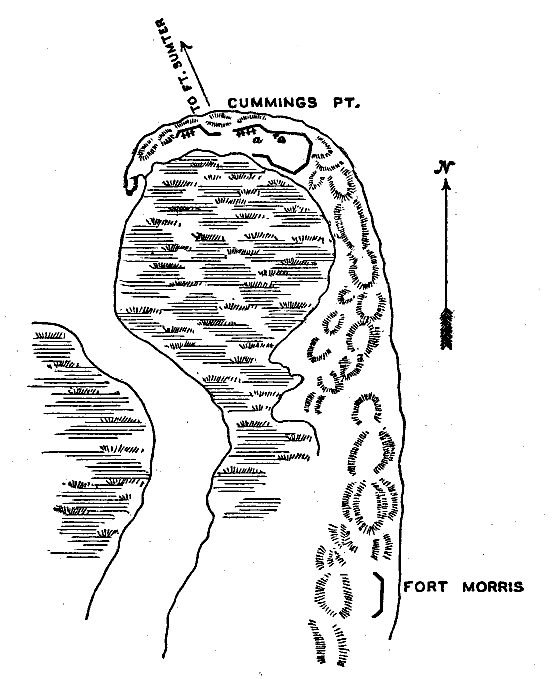
Position of the works on Cummings Point, Charleston Harbor, February 1861, South Carolina

The lines of the work are not yet complete, the main efforts having been directed to getting ready those guns that are intended to fire upon this work. All the guns that I have indicated by a + are (or appear to be) in position and covered by bomb-proof roofs.

Those at a a are covered by heavy timbers, laid horizontally upon firm timber supports, similar to the marginal sketch. The revetment of the cheeks of the embrasures appear to be formed of palmetto logs, as also the revetment of the interior slope near the guns. The horizontal timbers are large 14-inch raft, sticks, covered apparently by a lighter timber, or planking, running at right angles to the timbers. The guns at a a were being put upon their carriages (which I suspect, from their using a gin in the operation, are some of the barbette carriages <ar1_165> from Castle Pinckney or Fort Moultrie) at the time I wrote to you this morning. Subsequently the rough opening of the embrasures was made and the revetment of the cheeks commenced.
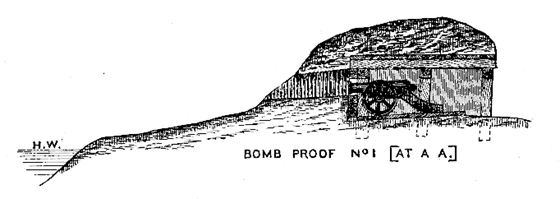
Bom Proof on Cummings Point, Charleston Harbor, February 1861, South Carolina

The second bombproof battery is built differently. The timbers on top are sloped at an angle of 45 °, about as in the sketch. They rest upon two horizontal supports parallel to the direction of the battery, one higher than the other, and these are supported by stout posts, about 5 feet from each other. Upon the timbers are placed at right angles a stout planking, and upon this again another covering running up and down. This last consists of railroad iron, apparently the T rail. The work has only progressed thus far, although there is no doubt that the whole is to be covered with sand. The guns are mounted and the openings for embrasures formed.
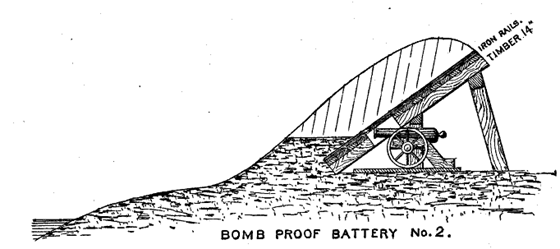
Bom Proof on Cummings Point, Charleston Harbor, February 1861, South Carolina

The work is carried on quite rapidly, considering the heavy nature of the work. The idea of covering the bomb proof with iron and giving it an inclination is no doubt derived from the Sardinian method for forming the sides of a man-of-war, so as to deflect the shot.

A large force of negroes is employed in extending the embankment of the parapet so as to connect this battery with the field work.

The guard-boats are very active at night, and some are always on the watch by day.

Inside this fort the work of preparation goes steadily on. My force is now employed in clearing the parade of the stone flagging. I am also having all the material on hand made into sand bags.

Very respectfully, your obedient servant,

J. G. FOSTER,

Captain, Engineers.
0 comments

Military

Civil War Day-by-Day

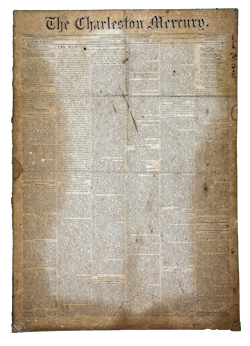
February 5, 1861; The Charleston Mercury

A detachment of the Richardson Guard, Lieut. C.H. AXSON, were out on duty Sunday afternoon. Another platoon passed the MERCURY office yesterday afternoon, under the command of Lieut. BOAG.

The detachment of Citadel Cadets who have been on the seashore since the first of January, passed our office yesterday on their way to the Citadel, to resume their studies. By their skill and energy the first battery was erected for the defence of Charleston; by their admirable gunnery Federal insolence was checked, and the Star of the West, with her warlike crew, was sent back without having accomplished her stealthy mission. It is well that their duties on the field should now be changed to that of the Academy. They will be thus enabled to make preparation for the future. The Executive knows full well, that at the tap of the drum lads in gray will answer to roll call and gladly receive the order, ‘Forward!’ particularly if a visit is to be paid to Capts. DOUBLEDAY or FOSTER, in Fort Sumter. The Cadets were escorted to the steamer, on their departure, by the Washington Light Infantry, who turned out in large numbers, as a compliment to their old friends. As soon as the steamer started, the Washington Light Infantry gave three cheers, which the Cadets returned with a tiger. They will be missed by the entire garrison, for their places cannot be well supplied.

0 comments

The Carolina Light Infantry—Pleasing episode in camp life

Civil War Day-by-Day

February 5, 1861; The Charleston Mercury

The Carolina Light Infantry have now been on duty, without intermission, since the 27th of December last. On Saturday, 2d inst., a little incident broke in upon the routine of their military discipline at Fort Morris which will not soon be forgotten by those present on the occasion. The Light Infantry, cherishing the high esteem and regard for the Colonel of the First regiment of Rifle which his gentlemanly bearing and military proficiency had given birth to while he held the office of First Lieutenant of the corps, determined to present him with a testimonial of their confidence and appreciation. Through Messrs. HAYDEN & WHILDEN, a handsome sword was manufactured to order, bearing upon the blade the Palmetto,’and upon the scabbard the devices of South Carolina; near the top a Lone Star, in the centre a well executed Palmetto, and near the end a silver Crescent. Upon the guard was a silver tablet, inscribed:

COL’N J. JOHNSTON PETTIGREW,

From his brother soldiers of the Carolina Light Infantry,

December 27th, 1860.

This date recording the investing of Castle Pinckney by the troops under his command. The sword was presented in the presence of the Staff and Field Officers of the Regiment and the Carolinas, by Capt. PINCKNEY, in a happy and most appropriate address, and received by the Colonel in a speech which drew closer, if possible, the ties which bind the company to its old Lieutenant. After the presentation, speeches were made, and sentiments offered by many of the guests, who heartily joined the corps around the festive board. After partaking of the collation, the company formed into line, and marched to where a new battery is being erected, and spent the balance of the day in forwarding a work which, God grant, may soon belch forth iron arguments against the enemies of Carolina, and be instrumental in advancing the honor of the worthy recipient of the sword of the Carolinas, and the troops under his command at Fort Morris.

0 comments

The Revolution

Civil War Day-by-Day

February 5, 1861; The New York Herald

WASHINGTON, Feb. 4, 1861.

There is not a shadow of foundation in the report that the Brooklyn threw men into Fort Sumter. I have it on authority.

The President has not yet finished his reply to the ultimatum of South Carolina, hence Col. Hayne and Lieut. Hall, the joint messengers from Gov. Pickens and Major Anderson, will delay their departure until tomorrow, when, it is authoritatively asserted, the Presidents’s reply to Gov. Pickens will be ready.

When Lieutenant Hall returns to Fort Sumter there will be seventy one men there, and no more. The fact that the secessionists have guard boats in the harbor all night, makes it impossible for a fleet of boats large enough to convey three hundred men to approach Fort Sumter without being known. Besides, Major Anderson doesn’t desire so large a reinforcement, because it would incur greater responsibilities in the way of providing provisions and the liability of sickness among the men.

0 comments

The Southern Congress and Free Trade

Civil War Day-by-Day

February 5, 1861; The Charleston Mercury

One of the most important, if not the greatest, of all questions to be brought before the Southern Congress, will be the question of taxation. Shall the treasury of the new confederacy be filled by direct or indirect taxation? As a measure of taxation alone, the latter method, whose practical application is by a tariff of duties on imports, recommends itself by the consideration that the tax is included in the price of the imported commodity when it is sold, and eluding observation, is more willingly borne by the people. If the object of governments was to raise money, the scheme that would enable them to extort the most out of the people ought perhaps to obtain the preference over all others. But since it is or ought to be the object of every people to have the public business of the country transacted as cheaply as may be consistent with the respectability and dignity of their government, the method of taxation that reveals to them most faithfully and promptly the true cost of the government, and the real source from whence the taxes are drawn, should certainly command this preference….

0 comments

The Southern Forts

Civil War Day-by-Day

February 5, 1861; The Charleston Mercury

We commend to perusal Executive Document No. 2, relating to Fort Sumter, published in our issue of yesterday morning.

This correspondence distinctly indicates what never was a secret – that the fortification is not held alone as property of the United States, but because of its importance as a military station. Not for the brick and lime of which it is composed, and the cannon and ammunition within its walls, is it valued, but for the strength of those walls to resist attack, and the ranges of its guns to command our ports and inflict harm upon our people. If these reasons are deemed all and sufficient, so far as they relate to Fort Sumter, how much more forcible will they be when applied by the Government at Washington to the consideration of Fort Pickens at Pensacola, Fort Taylor at Key West, and Fort Jefferson at Tortugus? The former covers the approach to the only Navy Yard on the Gulf of Mexico, and the two last completely command the commerce of that Gulf, passing along the north side of Cuba, from Cape Florida to the Rio Grande. Key West and Tortugus have been fortified to shelter and supply the fleets of the United States, and for that purpose they will be held. Even when Virginia comes to our side, she will bring with her the landward pointing guns of Fortress Monroe, and the entrenched city of Washington. Upon our northern frontier, in our centre, and upon our Gulf shores, the enemy will have – through the advice of Southern politicians – planted his strongholds, and may use them as the starting points from which he may attempt to overawe or subject us. The question, we believe, is becoming – on account of the weak position we occupy – a military one. Thus, by military preparation alone, can we meet it. Let the Southern Congress so regard it; there is no time to be lost, for hours are precious to us now in working out the future of the South. We ask first, then, of the Southern Congress, a Government, and then an army and navy sufficient to meet and ward off the dangers which are accumulating upon us. Preparation is the talisman of success; then let us be ready.

We therefore hope that early attention will be given by the Southern Congress, now in session, to the thorough organization of a Southern Army and a Southern Navy, each State being required to furnish its due quota of men and money on a matured system. And in this connection we would venture to suggest JEFFERSON DAVIS, of Mississippi, as the Commander in Chief of the Southern Army, and General TWIGGS, of Georgia, as the second officer in rank. With such leaders to regulate and fight our armies, we should have the prestige of victory and success. For the organization and command of the Southern Navy, we know of no more competent or illustrious names than DUNCAN N. INGRAHAM and HENRY HARSTEIN – men who have added to their fame as gallant and accomplished officers, the civic wreath of self sacrificing patriotism by throwing up distinguished and lucrative commissions, and siding promptly with their State and people in the hour of difficulty and doubt.

0 comments

Our Pensacola Correspondence

Civil War Day-by-Day

February 5, 1861; The New York Herald

NAVY YARD, PENSACOLA, Fla., Jan. 14, 1861.

I propose giving to your readers a statement of facts in reference to recent events connected with the Navy Yard here and the forts that protect and command the entrance to this harbor. At such times as these facts that exhibit prominent political moves are interesting, even if they are not from the hand of a ready writer.

Upon the right hand of the entrance of the bay of Pensacola stands Fort Pickens; upon the left hand is Fort McRea, and upon the same shore with the latter, one mile and a quarter farther up the bay, is Fort Barrancas. These forts are nearly equidistant from each other, and so situated as completely to command the entrance to the harbor. Fort Pickens is an admirably constructed fortification, at the extremity of a long, narrow sand spit that separates the bay from the Gulf for some distance. This fort is so situated as really to command the entrance to the bay completely. It is approachable by land only along the narrow neck mentioned above, and its defences so arranged that even a small force may defend it against vastly superior numbers. Fort McRea is rather a dilapidated concern, but is, nevertheless, a strong water battery. Fort Barrancas is well built and a powerful defence of the entrance of the harbor, but neither its construction nor position is adapted to resist a strong land attack. These three large fortifications, with all their guns, ammunition, &c. were in charge of a single company of artillery, under the command at present, of Lieut. A. J. Slemmer. This company occupied the barracks near Fort Barrancas.

The Navy Yard is situated upon the same shore of the bay with Forts McRea and Barrancas, about one and a half mile above the latter. It was under the command of Commodore Jas. Armstrong; the next officer in rank at the yard was Commander Ebenezer Farrand. The disposable force at the Yard consisted of about seventy sailors, or ‘men,’as they are termed, and forty eight marines, under the command of Capt. Joseph Watson. There were also at the yard, subject to the commands of Commodore Armstrong, the United States storeship Supply, with two thirty pounders and thirty eight men, and the steamer Wynandot, with six thirty two and eight men. For a number of days rumors had been in [continue reading…]

0 comments

The News

Civil War Day-by-Day

February 5, 1861; The New York Herald

The Peace Conference met at Washington yesterday, and organized temporarily by appointing Mr. Wright, of Ohio, Chairman, and A.E. Ward, of Maryland, Secretary. A committee to select permanent officers was appointed, and it is supposed ex-President Tyler will be chosen to preside. Without transacting any other business, at half past one othe Convention adjourned. All the States that have appointed Commissioners were represented, excepting New York, Tennessee, Missouri and Illinois. Eleven States were fully represented. No reporters were admitted to the Convention.

There was considerable excitement throughout the city yesterday, caused by a report that Fort Sumter had been reinforced. There was, however, not the least foundation for the rumor.

Gov. Brown, of Georgia, has demanded of Gov. Morgan the immediate surrender of the arms recently, seized in the city by the Metropolitan police, by order of superintendent Kennedy, and in his communication expresses the hope that a like outrage will not again be committed. Gov. Morgan has not yet replied to the demand. The illegal action of the police in this matter, if not speedily repudiated, will doubtless lead to reprisals on the part of Georgia.

A public meeting was held last evening in the large hall of the Cooper Institute for the purpose of aiding Mr. Orville Gardner and the committee to carry on the charitable institution located in the new Bowery, and known as the Fourth Ward Reading Room – an institution intended to reclaim drunkards and to prevent others from becoming such. Addresses were made by Mr. Wm. C. Noyes, Rev. Dr. Chapin and Mr. Gardner, and the sum of $230 was collected from the audience.

According the City Inspector’s report, there were 367 deaths in this city during the past week – a decrease of 36 as compared with the mortality of the week previous, and 103 less than occurred during the corresponding week last year. The recapitulation table gives 3 deaths of diseases of the bones, joints, &c.; 65 of the brain and nerves, 9 of the generative organs, 13 of the heart and blood vessels, 149 of the lungs, throat, &c. 9 or old age, 42 of diseases of the skin and eruptive fevers, 5 premature births, 46 of diseases of the stomach, bowels and other digestive organs; 25 of general fevers, and 3 unknown – of which 8 were from violent causes. The nativity table gives 243 natives of the Unites States, 76 of Ireland, 5 of England, 30 of Germany, 4 of Scotland, and the balance of various foreign countries.

0 comments

Arrangements for the Inauguration of Mr. Lincoln at Washington

Civil War Day-by-Day

February 5, 1861; The New York Herald

We publish in another column a strong and significant address from Senators Slidell and Benjamin, and other Congressional representatives of Louisiana to the Convention of that State which decreed its secession from the United States, strongly urging an immediate co-operation with South Carolina, and approving of the seizure of the forts and arsenals at New Orleans, which they had urged. The Louisiana representatives were previously in favor of submitting to the authority of the federal government until the 3d of March; but we learn from their address to the convention that they were led to counsel immediate secession in consequence of the military movements at Washington, which have been set on foot by the rumors of an intended attack on the national capital to prevent the inauguration of Mr. Lincoln. They say that Gen. Scott is well known to have submitted to the President a plan of a campaign on a gigantic scale for the subjugation of the seceding States, the initiation of movements for garrisoning all the Southern forts and arsenals, with a view of employing them, not for the beneficent purposes for which they were intended – our defence against a foreign foe – But for intimidation and coercion.

It is true that serious fears have been entertained of an attempt to prevent the inauguration of Mr. Lincoln, and perhaps to seized up the federal capital by armed bands from the border slave States of Virginia and Maryland, aided by volunteers from the neighboring slave States, and that in consequence of these reports Gen. Scott has been concentrating troops, artillery and munitions of war at Washington.

We learn also that the United States troops in the Northern States are being rapidly put upon a war footing. At the laboratories destructive pyrotechnics, with balls and cartridges, are being prepared. Large contracts for ambulances and field litters have been given out by the War Department. Within the past week five hundred additional troops have arrived in Washington, forming an aggregate of about one thousand men, with five batteries of light artillery – a quota sufficient for an army of five thousand men. General Scott has also ordered large supples of ammunition to be sent to Fort McHenry.

In the Northern navy yards no less activity prevails. The equipment of vessels of light draught is being pushed with [continue reading…]

0 comments

Civil War Day-by-Day

Civil War Day-by-Day

February 5, 1861

  • “Fort Sumter will not be surrendered” messages came from various people in the Buchanan Administration in response to a demand for surrender from South Carolina
0 comments

“The Election for Delegates to State Convention takes place in Virginia today.”—Horatio Nelson Taft.

Diary of US patent clerk Horatio Nelson Taft.

MONDAY 4

The Peace Convention met today but all the Delegates had not arrived and but little was done. The ground was covered with snow again this morning, but nearly melted off during the day. Schuyler Colfax M.C. was at my table in the office attending to a “case.” At Willards tonight I met J F Starbuck of Watertown NY and his new wife. Spent an hour in their room in the Hotel. He was Clerk in the Constitutional Conv’n NY,1846. Willards Hotel is now about full and the Av’e is much crowded during the day. The Election for Delegates to State Convention takes place in Virginia today.


The three diary manuscript volumes, Washington during the Civil War: The Diary of Horatio Nelson Taft, 1861-1865, are available online at The Library of   Congress.

0 comments

Transportation of Families–Operations in Charleston Harbor

War of the Rebellion: from the Official Records of the Union and Confederate Armies and Navies

FORT SUMTER, S.C., February 4, 1861.
(Received A. G. O., February 6.)

Col. S. COOPER, Adjutant-General:

COLONEL: The South Carolinians continued to do as much work yesterday (Sunday) at Cummings Point as the storm permitted. The   work nearest to us now presents the appearance of a battery, having an inclined guard in front to glance our balls off. They are using large quantities of railroad bars in their constructions on that point. The New York steamer sailed yesterday with our women and children.

I am, colonel, respectfully, your obedient servant,

ROBERT ANDERSON,
Major, First Artillery, Commanding.

0 comments

The Southern Congress

Civil War Day-by-Day

February 4, 1861; The Charleston Mercury

Today meets a body charged with the duty of constructing a Confederate Government for those States which have seceded from the Union of the late United States. It is a grave mission. Since the framing of the United States Constitution and Government, no work of such magnitude and importance has been imposed upon any statesmen in this country. The counsels now inaugurated are fraught with the destinies of the Southern people. Nor is it unlikely that the fate and practicability of Republican Government will be here settled. At the North this has proved a failure. The people there are ignorant of the theory of constitutional free government, and the public men, steeped in schemes of corruption and ambition and plunder, are the rankest of demagogues. Republicanism of Northern interpretation, is the vulgar and irresponsible tyranny of the majority of voters, overriding all law and all legal rights, and trampling the minority under their feet as opportunity and inclination urge. Higher law radicalism and lawless agrarianism have usurped the place of order and conservative justice. Society is given up to the selfish whims and festering isms of the licentious, the irreverent and the unscrupulous – a prey to political harpies – bloated and rotten throughout. It now remains to be seen whether, with slave institutions, the master race can establish and perpetuate free government. Shall the white man here enjoy liberty protected by law, and be free from impertinent interference with private rights – secure under his vine and fig tree. This is the problem to be solved – this the task of the Montgomery Convention. It is a question in the determination of which the human race is not indifferent – the civilized world is deeply interested – the North agitated. To us it is an issue of prosperity and success, or disaster and ultimate ruin – a question of life and death.

All eyes will be fixed upon the deliberations of that body. We trust they will be characterized by wisdom, promptness and efficiency; that a Southern Confederacy will be the aim of all; and the speedy establishment of a permanent Central Government for the South – the grand desideratum of our position and its necessities.

0 comments

Federals will Respond if Sumter Attacked — Confederate Records

War of the Rebellion: from the Official Records of the Union and Confederate Armies and Navies

WASHINGTON, March 4, 1861.

Gov. F. W. PICKENS, Charleston, S.C.:

Do not permit any attack on Sumter without authority of Government of Confederated States. This is all important. Inaugural means war. There is strong ground for belief that re-enforcements will be speedily sent. Be vigilant.

LOUIS T. WIGFALL.

I concur, and believe this Government will act promptly.

L. Q. WASHINGTON.

0 comments

The News

Civil War Day-by-Day

February 4, 1861; The New York Herald

Our despatches from Washington this morning are interesting. A despatch received from Governor Pickens assured his friends at the federal capital that no attempt would be made to take Fort Sumter until all peaceable means to get possession had been exhausted. The seizure of the revenue cutter Robert McClelland at New Orleans has been confirmed. Her commander sometime ago notified the government that he would not obey the orders of the Secretary of the Treasury. The instructions of Secretary Dix to the officer appointed to succeed Captain Brushwood, which, it appears, were intercepted by the Governor of Alabama, were, as will be seen by the despatch, of the most spirited and decisive character. It is now stated that the leading spirits of the republican party are about to make a serious change in their policy, and that hereafter the question to be decided will be one of boundaries and not of slavery and Territories; that they will submit to the loss of all the slave States, with the exception of Maryland and Delaware, the possession of which will place the National capital, with all its associations in their hands, and by a peaceable union with the Canadas, and a peaceable or forcible acquisition of Mexico and Central America, build up an empire greater than has ever existed on the Continent.

The Peace Congress will assemble in Washington today. Our despatches furnish all the gossip and rumors in regard to their proceedings that were current in the federal capital yesterday.

The Convention of the seceding States assembles at Montgomery, Alabama, today. A despatch received in Washington yesterday states that the Convention would probably adjourn over to await the action of the Peace Conference.

Colonel Hayne, the commissioner from South Carolina, on Saturday sent to the President a communication containing the ultimatum of that State. He proposes to enter into negotiations for the purchase of Fort Sumter, and in case of refusal threatens the capture of that fortification. The President will reply to the letter as soon as possible, and as his views have undergone no change, it is thought his answer will be substantially the same as that given a few weeks since.

By telegraph we learn that the Mint and Custom House at New Orleans had been seized by the secessionists of that place. The Mint contained a considerable amount of money, which, it was reported, the Assistant Treasurer had refused to deliver up to the agent of the United States. A communication in our paper explains the matter, and the writer thinks, the Legislature will return to the government at Washington whatever moneys may stand to its credit.

0 comments

The Washington Artillery

Civil War Day-by-Day

February 4, 1861; The Charleston Mercury

Harper’s Weekly has the following well deserved compliment to the Washington Artillery, Capt. WALTER, accompanied by a cut representing the uniform of the company.

‘This is the largest and most efficient corps in this branch of the service among the citizen soldiers of Charleston, having a roll of one hundred and fifty active members. A detachment of this corps is at present stationed at Fort Moultrie, where, in the late attack upon the steamship Star of the West, they gave strong evidence of what may be expected at their hands should Charleston be invaded. When the Ordinance of Secession was passed, this corps was the first to offer its services to the State. Their arms are six brass field pieces, and Minnie muskets with Maynard primers.’

As the MERCURY has already stated, the Washington Artillery have been relieved from Fort Moultrie, and a detachment of thirty members have charge of Fort Walter, on Sullivan Island, guarding the Maffit’s Channel. The entire company, however, is under orders to be ready for service at three hour’ notice – one hour of which will suffice to turn the W. A. out to a man.

0 comments

Military

Civil War Day-by-Day

February 4, 1861; The Charleston Mercury

A detachment of the Sumter Guard, Lieut. H.C. KING commanding, were out for special duty on Friday afternoon; they were well equipped, and presented a substantial appearance.

A detachment of the Charleston Riflemen, Lieut. MILLS commanding, passed our office on Saturday afternoon on special service. Conspicuous in the ranks was the venerable REEVES, whose bent form and silvery locks gave evidence of at least three score and ten years, most of which has been spent in this favorite corps. What an earnest measure of the feeling of our people when the gray haired old men, without even a summons, shoulder their rifles, knapsacks and blankets to join with the young in the cause of their native State.

The Irish Volunteers. – This fine company, we are advised on reliable authority, notwithstanding the order for their relief, which, for State reasons was countermanded, still maintain their force full and effective, and their esprit du corps is as vital as when they promptly responded to the call of the State, now nearly thirty days ago. This is the more to be commended, as this corps is entirely composed of those who, by their absence, are sacrificing every thing subject to their country’s call. It is to be hoped they may soon be permitted to resume their ordinary avocations.

The Phoenix Riflemen, Capt. P. C. GAILLIARD, were out for drill and instruction on Saturday afternoon. They comprise the members of the Phoenix Fire Engine Company, and have become bearing men’since the Presidential election. Their ranks were full, and their appearance soldierly. The Charleston Light Dragoons, Capt. B. H. RUTREDGE in command, in very large numbers (eighty two men), well mounted, and equipped in the most serviceable manner, were on parade on Saturday afternoon. This spirited corps has apparently kept pace with the stirring times through which we are now passing, and we warrant that should they ever have an opportunity to, their bright sabres will cleave a path for each trooper to victory.

0 comments

The Revolution

Civil War Day-by-Day

February 4, 1861; The New York Herald

WASHINGTON, Feb. 3, 1861.

Governor Pickens has assured his friends here that there will be no hostile movements on the part of South Carolina, or any attempt made to take Fort Sumter until all efforts have been exhausted to get peaceable possession of that fort.

It will be at least a week yet before the President letter in reply to Colonel Hayne is laid before the authorities of South Carolina. Therefore we may look for a week yet of peace.

The New Orleans Delta, of the 30th of January, arrived here tonight, containing the following announcements, which not only show where the traitors are, but that we have a Secretary of the Treasury who, although he did not know on the 29th of January that the telegraphic lines of the extreme south were not in reliable hands, is a bold man, and is determined to execute the laws of his country:

The Mayor of New Orleans, Mr. Monroe, last night received a highly important despatch from Governor Moore, of Alabama, addressed to the Governor of Louisiana or the Mayor of New Orleans. Mr. Monroe finding himself unable to communicate with Captain Brushwood last night, has thought it best to give publicity to this despatch, in order that its object may thus be attained. We think his course in the matter the best that can be adopted under the circumstances.

No reply has been received by Secretary Dix to the despatch sent yesterday to the collector and Unites States Treasurer, inquiring into the circumstances of seizure of the mint by the State authorities of Louisiana. The refusal of those officers to reply shows conclusively that there has been a deliberate plan in which these officers were parties to seized the money in the mint. [continue reading…]

0 comments

Civil War Day-by-Day

Civil War Day-by-Day

February 4, 1861

  • Washington Peace Conference (also called Convention or Congress) convenes
  • In Montgomery, Alabama, delegates from six break-away U.S. states meet in Convention of Seceded States. Georgian Howell Cobb is elected President of the Convention.
  • John Slidell and Judah Benjamin of Louisiana withdraw from the U. S. Senate
  • Elections in Virginia create a pro-Union secessionist convention
0 comments

The Presidency of the Confederacy is an Office I Cannot Seek

Miscellaneous document sources

Howell Cobb to His Wife.

Montgomery [Ala.], 3 Feby., 1861.

My Dear Wife, I have been here for more than a day. . . .

Most of the delegates have arrived, but there has been not much consultation. From all I hear there is a general disposition to make me president of the convention. It is thought that my taking that position will exclude me from the Presidency of the Confederacy and some of my friends doubted on that account the policy of my taking it. In this I differed from them and have determined to follow my own judgement. The truth is that the Presidency of the Confederacy is an office I cannot seek and shall feel no disappointment in not getting.

There is at present much diversity of opinion as to the course to be pursued in the formation of a provisional government, but there is a general good feeling and disposition to unite and harmonize on whatever may be found the best policy. I feel confident all will work out well in the end. . . .


From Annual Report of the American Historical Association for the Year 1911.

Howell Cobb was an American political figure. A southern Democrat, Cobb was a five-term member of the United States House of Representatives and Speaker of the House from 1849 to 1851. He also served as the 40th Governor of Georgia and as a Secretary of the Treasury under President James Buchanan. Cobb is, however, probably best known as one of the founders of the Confederacy, having served as the President of the Provisional Congress of the Confederate States.

0 comments

“It is said that Virginia will demand as a preliminary that the U.S. troops now in this City be immediately withdrawn…”—Horatio Nelson Taft.

Diary of US patent clerk Horatio Nelson Taft.

SUNDAY, FEBRUARY 3, 1861.

A little frozen this morning, but warm the rest of the day with plenty of mud. Wife and boys went to church. I did not go out till evening. Was in at “Willards” Hotel. Quite full of eastern and northern men. Was introduced to ex Gov Gardner of Mass. Very young man for an ex Governor. The “Peace Congress” meets tomorrow. Most of the Delegates are here. It is said that Virginia will demand as a preliminary that the U.S. troops now in this City be immediately withdrawn and that no State that “Secedes” shall be coerced. If such be the case it will make trouble & Virginia herself will be ignored altho she first called for the convention. It cannot mean Peace.


The three diary manuscript volumes, Washington during the Civil War: The Diary of Horatio Nelson Taft, 1861-1865, are available online at The Library of   Congress.

0 comments

Goodbye to Sumter, February 3, 1861

Harper’s Weekly
Goodbye to Sumter, Wives and Children on Steamship Marion Departing Charleston Harbor, South Carolina

Goodbye to Sumter, Wives and Children on Steamship Marion Departing Charleston Harbor, South Carolina

Date Created: 1861-02-23,  black and white engraving in Harper’s Weekly

Good-by to Sumter, hand-colored offprint

Medium: illustrations (layout features)
Item Location: Fort Sumter NM/Charles Pinckney NHS Curatorial Storage Facility, located at Charles Pinckney National Historic Site
Box: Box 3 of 3 FOSU 19th c Illustrations Frank Leslie Harper’s Weekly London Times etc Drawer 1.
Held By: Fort Sumter and Fort Moultrie National Historical Park
Identifiers
Permanent Link: purl.clemson.edu/AFBB896B13A75A4DEE2F682A131215BD


Mike’s notes:

Special handed-tinted off-prints were also sold separately from newspapers. Numerous originals held today by public institutions and in private collections.

Note – This image has been digitally adjusted for one or more of the following:
– fade correction,
– color, contrast, and/or saturation enhancement
– selected spot and/or scratch removal
– cropped for composition and/or to accentuate subject

0 comments

The Steamship Marion, on her way to New York with the Wives and Children of the Soldiers of Fort Sumter — Manning the Ramparts and Cheering of the Men as the Steamer passes the Fort — The Parting Salute from Fort Sumter

Frank Leslie’s Illustrated Newspaper
The Steamship Marion, on her way to New York with the Wives and Children of the Soldiers of Fort Sumter — Manning the Ramparts and Cheering of the Men as the Steamer passes the Fort — The Parting Salute from Fort Sumter

Title: The Steamship Marion on the way to New York, with a parting salute from Fort Sumter, South Carolina, 1861
From Frank Leslie’s Illustrated Newspaper.
Medium illustrations (layout features)
Item Location Fort Sumter NM/Charles Pinckney NHS Curatorial Storage Facility, located at Charles Pinckney National Historic Site
Box: Box 2 of 3 Fosu 19th-c Illustrations Frank Leslie Harpers Weekly London Times, Etc.
Held By Fort Sumter and Fort Moultrie National Historical Park
Permanent Link: http://purl.clemson.edu/BC8EEF2879AB7F144428AF321DE6C31E


Mike’s notes:

Special handed-tinted off-prints were often sold separately from newspapers and other publications. Numerous originals held today by public institutions and in private collections.

Note – This image has been digitally adjusted for one or more of the following:
– fade correction,
– color, contrast, and/or saturation enhancement
– selected spot and/or scratch removal
– cropped for composition and/or to accentuate subject

0 comments

Revolution has been moving on regularly and tomorrow will determine the fate of Virginia and probably the fate of other border States.

The Letters of Samuel Ryan Curtis

Washington Feby 3. 1861

My dear wife

This is Sunday and my birthday1 and it would be wrong to pass it over without writing to you. The past week has been passed in the usual way, except that I have attended two or three evening parties. One at Speaker Penningtons a very nice one. Sadie had the headache and could not go. One at Mr Forneys a Gentleman’s party where we sang hail Columbia and the Star Spangled banner with great glee. One at Willards to meet a New York delegation who came to bring the petition of 40,000 favorable to compromise.

Sadie was out with Henry at hops on several occasions also where they all enjoyed themselves very much. We were sorry to part with Henry on Friday I tried to prevail on him to stay longer but he thought it would not do for him to delay any longer.

Revolution has been moving on regularly and tomorrow will determine the fate of Virginia and probably the fate of other border States. If they all determine on Secession it is hard to see what will be the extent of the future disaters to our whole country. It will unsettle the National Government by establishing facilities for disunion which will render all new unions entirely unsettled and uncertain.2

Yet that is not the immediate consequence and therefore it will not be so generally appreciated The immediate effect will be a strife in regard to the ownership of this the Capitol of the United States. More force will be needed to hold Washington and immediate efforts will be taken to secure it. Hitherto the President has resisted every effort to prepare or procure force for the occasion3 but I think in the event of secession in Va the necessity will be so apparent no one will object to it.

The Union men in Virginia are hopeful and may carry the election. If they do there will be a great check on revolution as Virginia has deservedly a great influence in the South.4

Mr Sturges is here writing at my table. He is very well and entirely himself. Yet he is always in my room and he and Ed together occupy too much of my time and that of Sadie’s too. Kate and one of her brothers are expected this week and that will not reduce the interruptions. Of course I go on with my writing but I have no time to think or study while my room is so occupied.

Our last letter from you was written to Sadie after you had dined at Laiffes I believe You were all very well then and busying sewing. I would not bother much about pillow cases till we know how long we are going to remain at home Certainly do not add to our furnature which we will have to rent or stow away.

I wish you and Caddie were here. It is rather pleasant although I have not been out to enjoy it. Am talking of going out with Mr. Sturges who is enammoured with all the ladies especially one friend in Georgetown–But I think he sees too many wrinkles on some of their faces to satisfy his fancy. He has offered 15 thousand dollars for Mr Nicholls’ property but that is not enough for it and therefore he is not likely to get it.

Mr. and Miss Delano5 are here at this house and Miss Delano is a fine companion for Sadie. She also occupies too much of Sadies time. But she is a very smart and agreeable girl. Delano is anxious to be one of the Cabinet. What his chances are I cannot say. It seems agreed that Chase6 cannot be admitted as one and somebody ought to be taken from Ohio Perhaps he may be.

The proceedings of the Union meeting in Keokuk were not such as to unite the North. I am sorry to see such divisions when we ought to be United.7

Divisions must be disposed of in some way or instead of having the South to fight neighbors will be fighting each other. The revolutionists are uniting the South most effectually

What about money. Are you in need of funds? I have my deposit so it draws interest in New York and only want to draw when you need it. Have you killed the old cow? Has the farms brought you in any provisions? How are the things in the garden are they all safe. I will send you some seeds soon. I suppose the river is closed and therefore you have no boats running. Kiss Caddie

Affectionately yours
Saml. R. Curtis


1. Born February 3, 1805, near Champlain, N. Y., while family was en route to Ohio.

2. In January Virginia authorized the election on February 4, of members to attend a state convention to determine that state’s position in the developing threat of federal schism. The election was a decided triumph for the conservative-compromise forces. Cf. Rhodes, 3. 309.

3. Buchanan wavered between a desire to avoid Civil War while president, and a sincere desire to refrain from agression on the part of the North. His policy changed markedly after January, 1861, with changes in his cabinet. Scott, Commander in Chief of the Army, was not in good graces with Buchanan. and only moved his headquarters from New York to Washington in December, 1860.

4. See fn. 31. The result in Virginia had a great influence on Tennessee and Maryland particularly.

5. Columbus Delano, of Ohio, an ardent Republican leader of that state, was among those who seconded the nomination of Lincoln in Chicago in 1860. He served in Congress, 1845-1847, 1865-1869, and as Secretary of Interior under Grant, 1871-1875.

6. Salmon P. Chase, ardent Whig, Free Soiler, and “Black” Republican served Ohio in the U. S. Senate 1849-1855, 1861. His selection for a cabinet position was strongly opposed by Seward followers were were more favorable to compromise than was Chase. Chase was a strong favorite son contender for the nomination in 1860 at Chicago.

7. Keokuk, south-rest tip of Iowa, was a strongly Democratic stronghold. The impending Civil War sorely tried the faiths and loyalties of that party. A Union meeting called by the principle Democrats was held January 19, and adjourned to January 23, at which time vigorous arguments ensued in a disharmonious fashion over the rights of secession, and the virtues of the Crittenden compromises. Democrats were willing to let the seceding states go rather than wage war, the Republicans present were not.

A second meeting of the Democratic adherents in Keokuk was held January 26, at which time the Crittenden compromises were generally approved. Such a report showed little unity or harmony, these divided counsels boded ill for a vigorous policy. See Keokuk Gate City, January 19, 23, 25, 27, 28, 1861.

0 comments

Operations in Florida – Confederate Correspondence

War of the Rebellion: from the Official Records of the Union and Confederate Armies and Navies

HUNTSVILLE, ALA.,

February 3, 1861.

Hon. L. P. WALKER, Montgomery:

MY DEAR SIR: There is at Pensacola an immense quantity of powder, shot, and shells, which ought to be removed to the interior at the earliest possible moment. Where they now are they are constantly exposed to the danger of recapture, and if they are permitted to remain, one of Lincoln’s first movements will be to concentrate a sufficient force at that point to retake them.

In my judgment there is no hope of a peaceful settlement of our difficulties with the Government of the United States, and all our calculations should be made with reference to the breaking out of a war of vast magnitude and almost unparalleled ferocity. We had the subject of these munitions before the military committee of our Convention, but as they were on the soil of Florida, and beyond our jurisdiction, we could do nothing. Your convention will have more extensive powers.

There is still much discontent here at the passage of the ordinance of secession, but it is growing weaker daily, and unless something is done to stir it up anew will soon die away.

Last week Yancey was burned in effigy in Limestone, but I suppose it was rather a frolic of the “b’hoys” than a manifestation of serious feeling on the part of the older citizens.

I shall be glad to hear from you from time to time during the session of the Convention.

Very truly and respectfully, your friend and obedient servant,

JERE. CLEMENS.

0 comments