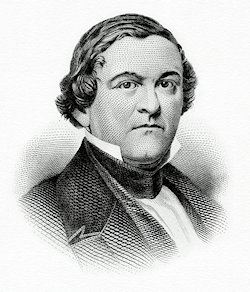
“The “Peace Convention” promises good results.”—Horatio Nelson Taft

Diary of US patent clerk Horatio Nelson Taft.

THURSDAY 7

The morning was bright with a fine and cool atmosphere, just freezing, but tonight the wind blows almost a hurricane. I like almost any kind of weather better than a cold wind, consequently I have not gone out tonight. Nothing of importance has occured today. More U S troops have arrived and the idea of taking Washington will I think be abandoned by all who have been so disposed heretofore. Had letters today from Julia and from [S A Dewey or Ducey?]. Sent off ten copies of Agricultural Report of Pt office to friends in different States north. Rejected a case which Hon Schuyler Colfax M.C. has in charge. The “Peace Convention” promises good results.


The three diary manuscript volumes, Washington during the Civil War: The Diary of Horatio Nelson Taft, 1861-1865, are available online at The Library of   Congress.

0 comments

Revolution has been moving on regularly and tomorrow will determine the fate of Virginia and probably the fate of other border States.

Woolsey family letters during the War for the Union
Jane Stuart Woolsey to Cousin Margaret Hodge.

Feb. 7, 1861.

Night before last a Virginia gentleman said to us: “Don’t be too sanguine. Union does not mean in Virginia what it means in New York. There it means only delay–it means Crittenden’s compromise; it means secession, not today but tomorrow.” The same gentleman said: “Floyd was no gentleman. No Virginia gentleman would ask him to dinner” (the climax of earthly honors I suppose) and that “he was intoxicated at the Richmond dinner and not responsible for his speech.” This Virginian said he would “stake his existence,” or something of the sort, on the honor of the South in paying, to the last cent, everything it owes the North. As an offset to this, Mr. Lockwood last night repeated to us the contents of three letters he had read yesterday, sent to acquaintances of his in answer to requests for payment. One said: “I shall pay, of course, every farthing I owe you, in cash, but not till I pay it in the currency of the Southern Confederacy.” Another sent a note to the effect: “I promise to pay, etc., five minutes after demand, to any Northern Abolitionist the same coin in which we paid John Brown, endorsed by thousands of true Southern hearts.” The third said: “I cannot return the goods, as you demand, for they are already sold, and the money invested in muskets to shoot you– Yankees!” Georgy was at a party last night at Amy Talbot’s, where nothing but politics was talked. Uncle Edward has just popped in, for a minute, and says: “All I am afraid of now is that Virginia and the other Border states will stay in; and we shall have the curse of their slavery on our shoulders without the blessings of a complete union.”

Dr. Roosevelt dined with us on Saturday, and I said: “What do you go for, Doctor?” “I go for gun-powder!” he answered. Mrs. Eliza Reed hears from her brother-in-law, a clergyman in Beaufort, S. C., that she “ought to be very thankful that her property is safely invested at the South” (partly in his own hands) and that he is “sorry he is not able to forward her the interest now due,” the fact being that she has not had a cent of her income this winter.

One more anecdote and then my gossip is over. Mrs. Dulany overheard two negresses talking on a corner in Baltimore. “Wait till the fourth of March,” said one of them, “ and then won’t I slap my missus’ face!”

ABRAHAM LINCOLN was inaugurated President of the United States on the fourth of March, 1861. In closing his inaugural address he said to the Southern seceders:
“In your hands my dissatisfied fellow countrymen, and not in mine, is the momentous issue of Civil War. You can have no conflict without being yourselves the aggressors. You have no oath registered in Heaven to destroy the government, while I shall have the most solemn one to preserve, protect, and defend it.”
0 comments

“Yesterday I landed at Fort Pickens, assumed command of the forces on the station, inspected the defenses, and had a consultation with Lieutenant Slemmer.”—Israel Vogdes.—Operations in Florida

War of the Rebellion: from the Official Records of the Union and Confederate Armies and Navies

PENSACOLA HARBOR, FLA., February 7, 1861.

Col. L. THOMAS, Assistant Adjutant-General, U. S. Army:

SIR: I have the honor to report that I arrived on this station yesterday in the U. S. steamer Brooklyn, with Company A, First Artillery. I met orders here which prevent the landing of my company or the re-enforcement of the garrison of Fort Pickens at present. Yesterday I landed at Fort Pickens, assumed command of the forces on the station, inspected the defenses, and had a consultation with Lieutenant Slemmer. I am compelled to remain on board the Brooklyn for the present, and can, of course, only give general instructions to Lieutenant Slemmer. I am sorry to inform the Department that I found Fort Pickens in a very inefficient state of defense. At the time Lieutenant Slemmer removed his command to Fort Pickens there were only forty guns mounted in the fort. At present there are fifty-four in position. The accompanying sketch indicates the position and class of guns now in position; total, fifty-four of all kinds.

Lieutenant Slemmer has with him only forty-six enlisted men for duty, and thirty ordinary seamen from the yard at this station, and the latter are entirely untrained, insubordinate, and of but little use in case of attack. There are fifty-seven embrasures that are unprovided with cannon, and are only about seven feet from the bottom of the ditch, and at present but few of them have only the common wooden shutter, presenting only a slight obstacle to an enemy. There are only very imperfect means of barricading them. Such as they are, however, I have given orders to be immediately employed.

Lieutenant Slemmer has been obliged to employ his command in getting guns into position and in barricading the embrasures. He is obliged to keep one-half of his men under arms every night, and they are nearly all exhausted with fatigue. The guns and carriages and implements are all old, and nearly unserviceable. I have made a requisition direct on the Department for the necessary supply of guns, carriages, and ammunition. The supply of this last is very inadequate. There is no ammunition for the columbiads, no cartridge bags for them, nor flannel to make any. In fact, had it been the intention of the Government to place the fort in the state to render its defense impossible, it could not have been done more efficiently than it has been done. The post is without any medical officer, and if it is intended to defend it there should be an Engineer officer sent at once to the station. I trust that the Department will immediately order that the supplies requested be sent. There are no bunks either for the hospital or for the troops, and but little bedding for the sick. I request a supply may be sent. There are plenty of provisions for the present, although I should like some desiccated vegetables and supplies for the officers. I   would mention that all of the troops will be compelled to live in open casemates, and many of them will soon be on the sick-list.

The seceders have a considerable force in and about Pensacola; what number I am unable to say positively, but they are estimated at about 1,700 men. They are disorderly, and very unwilling to be controlled. Their leaders, from what I can learn, I believe are sincere in their intention to observe the armistice, but their ability to control the men under their command is very doubtful. They are engaged in erecting batteries, are making sand bags, &c. They have plenty of means of transporting their troops to Santa Rosa Island, and can attack the fort on all sides at once. At present there is not one trained man to a gun within the fort. Should the enemy decide to attack, it is exceedingly probable that he might succeed in penetrating into the fort before my company could be landed or any succor could arrive from the fleet. I should therefore urge upon the Department the necessity of the fleet taking up a position such as to prevent the landing of any forces within one and a half miles of the fort; this would give time to provide for the defense of the work and the landing of the troops from the fleet; otherwise we may have the mortification and disgrace of seeing the fort taken by a body of untrained troops under our very noses.

Should the armistice be broken, my company, all the marines, and as many sailors as may raise the garrison to four hundred men should be immediately landed. All of the advantages of the present armistice are entirely on the side of the seceders. I would therefore urge upon the Department the necessity of immediately re-enforcing the garrison. The two additional companies ordered to Forts Taylor and Jefferson are not immediately required for the defense of those works. In fact, in their present state, and with the forces now in them, they would be stronger than Fort Pickens will be when garrisoned with four hundred men. Captain Meigs kindly offered his services, if necessary, to assist in the defense of this place, and I request the Department that he may be ordered to repair to this place.

Lieutenant Slemmer has-done all that it has been possible to do with the small force under his command. His resolution to defend his post at all hazards evinces the highest moral courage on his part, but at the same time I must state that with any amount of vigor on the part of the assaulters his defense would have been hopeless. His resolution has probably been the means of preserving Fort Pickens from the seceders.

Yours, &c.,

I. VOGDES,
Captain, First Artillery.

P. S.–I must not be understood as recommending any violation of the existing armistice, but the collection of an amount of troops on the station as may be necessary for the defense should anything occur to rupture the present armistice.

0 comments

Military

Civil War Day-by-Day

February 7, 1861; The Charleston Mercury

The Aetna Guard, Capt. E. F. SWEEGAN, were out in full force yesterday on a target excursion. The corps comprises the members of the Aetna Fire Engine Company, and have been mustered into the military service of South Carolina within the last month. The uniform is a grey pea jacket, trimmed with red, grey pants, and the kept with the initials A.E.G. in gilt letters on the front. They passed our office in the afternoon under escort of the Charleston Riflemen, Capt. JOS. JOHNSON in command of the battalion, both companies appearing to great advantage. Our Firemen have taken wonderfully well to the military profession, and have added much to the military strength of the city by this patriotic course.

The Zouaves, Lieutenant CHICHESTER commanding, were out fully equipped for special service yesterday afternoon. Their picturesque uniform, with the scarlet blanket on the knapsack, adds greatly….

0 comments

Medical College of the State of South Carolina

Civil War Day-by-Day

February 7, 1861; The Charleston Mercury

We have had placed upon our table the Annual Catalogue of the above institution, by which it appears that the class in attendance amounted to two hundred and twenty two students, from the States of South Carolina, North Carolina, Alabama, Florida, Georgia, Virginia, Louisiana, Mississippi, Pennsylvania, Kansas and New Providence, Nassau.

In addition to the Clinical advantages, so essential to students, presented by the Marine and Roper Hospitals, we take pleasure in calling public attention to another hospital, recently erected in Trapmann street, exclusively for the accommodation of sick negros. The building is large, spacious and remarkably well ventilated, two stories high, with piazzas fronting south, containing four capacious wards, with all the modern improvements and conveniences of hospitals of the present day, and capable of accommodating sixty patients. It is superintended by an experienced matron, residing in the building, assisted by attentive and efficient nurses, and is directly under the supervision of Professor CHISOLM, by whose energy and enterprise it was erected.

To planters in the country who may send patients to the city – to our citizens having negros hired out, or living in different places, it offers the greatest advantages, with the best assurance that their servants will receive every care, attention and comfort. We know of no private enterprise which commands itself more highly to public patronage and support, the more especially as masters may retain their own physicians, all of whom have access to the hospital.

We are glad to observe that the wards are already filling up, and that there are a goodly number of both male and female patients.

0 comments

The News

Civil War Day-by-Day

February 7, 1861; The New York Herald

The reply of the government to the communication of Colonel Hayne, the South Carolina envoy, was sent to that gentleman last evening, and a reply was requested, which will close the correspondence. The administration refuse decidedly to comply with the demand for the surrender of Fort Sumter. It now remains to be seen what course the authorities of South Carolina will pursue. Will they order an immediate attack upon the fort, and thus inaugurate at once a war? Or will they await the organization of a provisional government by the Southern Congress, now in session at Montgomery, before commencing hostilities? A very few days will solve the question.

Accounts from the Indian Territory state that the Texans have threatened to seize upon Forts Washita, Cobb and Arbuckle. The garrisons at those forts are believed to be strong enough for their protection.

The arsenal at Little Rock was seized by the Arkansas State troops on Saturday night last.

The report of the secession of Texas from the Union is confirmed. The ordinance was adopted by the State Convention on the 1st inst. by a vote of 166 to 7. The ordinance is to be voted on by the people on the 23d inst. and if ratified will go into effect on the 2d of March.

The Peace Convention at Washington yesterday unanimously adopted a resolution providing for the appointment of a committee of one from each State represented to draw up a plan of adjustment.

The military authorities continue the concentration of troops at Washington. The company of artillery which arrived at this port on Tuesday from Augusta Ga., has been ordered to the capital.

0 comments

Progress of the Slave Population

Civil War Day-by-Day

February 7, 1861; The New York Herald

The returns of the national census, upon which we commented yesterday, show a very material growth of the slave population during the last decade – a growth, indeed, which may surprise many who supposed that slavery was declining under the pressure of abolition propagandism, virulent denunciation and fanatical raids. In every Southern State, except Delaware, Maryland and Missouri, the increase of the slave population has been nearly in the same ratio as that of the free population, white and colored; and in the aggregate the growth of the slave population in the fifteen Southern States has kept pace with that of the whole population of the United States – that is to say it shows an increase of about thirty per cent in ten years. And very curiously even same ratio as that of the free population white and colored, and in the aggregate the growth of the slave population in the fifteen Southern States has kept pace with that of the whole population of the United States.

0 comments

Our Washington Correspondence

Civil War Day-by-Day

February 7, 1861; The Charleston Mercury

WASHINGTON, February 4, 1861.

An eventful day this. Virginia chooses her destiny–if, indeed, destiny can be chosen–and a clap trap Congress meets here to help her in choosing the wrong side of the question. Some of her Commissioners, with whom I have conversed, think a majority of secessionists will be elected to the Convention. I have no idea this will be the case. If Virginia is saved from the disgrace of being the rump of the Abolition Confederacy, it will not be the fault of her leading politicians. The glory will be due to the obstinacy of the Republicans.

As Virginia goes, so will go all the border States, Maryland included; for the spirit of the ‘Maryland Line’ is fairly roused. The issue rests in good part with the Peace Congress, which, I am happy to say, promises to do nothing and that speedily. ‘But all signs fail in dry weather–sometimes even in wet weather. The Congress may squeeze out a little strip of plank, just large enough for Virginia to cling to until after the 4th of March. Still, a few favorable indications are not wanting in the Old Dominion. Prominent Old Line Whigs have come out for secession, or rather quasi secession; and the Submission Legislature, bad as it is, has had too much independence to encourage LETCHER in the course he is pursing. I am told that not a member has visited him socially since the session began. If Virginia goes out, one of the North Carolina delegation swears that his State may be kept in till twelve o’clock p. m. on the 4th of March – but not a second longer, lest it be said the Old North State was even for an instant the subject of LINCOLN.

0 comments

Charleston-made fatigue caps

Civil War Day-by-Day

February 7, 1861; The Charleston Mercury

WE ARE PREPARED TO MAKE FATIGUE MILITARY CAPS to order, any color or material, to correspond with the undress of the uniform. Being HOME MANUFACTURERS, we solicit a call for supply of Regiments or Rifle Companies for the same, in or out of the city.

WILLIAMS & BROWN.

No. 277 KING STREET.

0 comments

The Revolution

Civil War Day-by-Day

February 7, 1861; The New York Herald

WASHINGTON, Feb. 6, 1861.

The Secretary of War communicated late this evening the reply to Col. Hayne’s letter. It calls for an answer from Col. B., which will be made tomorrow, and which will close the correspondence.

The government respectfully refuse to comply with the propositions of South Carolina for the surrender of Fort Sumter. All hopes of a solution of this questions has been abandoned for some time but there has been an apparent disposition on both sides to delay matters, in the hopes that an amicable adjustment might be made, and which would lead to a peaceable termination of affairs in Charleston harbor. The matter cannot be further postponed. South Carolina has presented her ultimatum. The government have positively refused to comply. Thus the affair stands.

It now only remains for South Carolina to carry out her purpose of taking the fort.

The President’s course in relation to the proposition of Colonel Hayne is similar to that towards the former Commissioners from South Carolina, namely: –That he has no authority to treat for the sale or make any other disposition whatever of the forts or other public property in that State; that it is his duty to defend the forts to the best of his ability, and that the consequences of doing so must fall on those who attack them. Colonel Hayne will now return to South Carolina.

0 comments

“The Peace convention now in Session here sit with closed doors..,”—Horatio Nelson Taft

Diary of US patent clerk Horatio Nelson Taft.

WEDNESDAY, FEBRUARY 6, 1861.

A pleasant day overhead but muddy under foot. Wm H [Burridge or Burniage?] of Cleveland Ohio dined with us today, Chas also. Public affairs look brighter than they did before the Virginia Election. The Peace convention now in Session here sit with closed doors, but as far as known everything with regard to it looks favorable to an adjustment. Had letter today from Brother C R. He will start for Washington 1st day of March. Did not go down to the Ave’e tonight. Willie was learning from me how to write his name and to add up figures. The other boys, Halsey & H N, are drawing.


The three diary manuscript volumes, Washington during the Civil War: The Diary of Horatio Nelson Taft, 1861-1865, are available online at The Library of   Congress.

0 comments

At the Court of St. James

Diary of George Mifflin Dallas, United States Minister to England 1856 to 1861

1861. February 6.–Parliament was opened yesterday by the Queen in person. The military parade, turnout of royal equipages, and assemblage of Peers, Peeresses, Bishops, and Judges, were unusually imposing. The speech was fuller and clearer than common. The paragraph devoted to the United States was uttered as if really felt, though I certainly did not do what some of the newspapers allege,–nod my head with an expression of misgiving as to a “satisfactory adjustment.”

“Serious differences have arisen among the States of the North American Union. It is impossible for me not to look with great concern upon any events which can affect the happiness and welfare of a people nearly allied to my subjects by descent, and closely connected with them by the most intimate and friendly relations. My heartfelt wish is that these differences may be susceptible of a satisfactory adjustment.

“The interest which I take in the well-being of the people of the United States cannot but be increased by the kind and cordial reception given by them to the Prince of Wales during his recent visit to the continent of America.”

Went to the Commons at eight o’clock, and witnessed the first scene of what I cannot but regard, for the existing government, as an inauspicious breach, on reform, between Lord John Russell and Mr. Bright. The motion was to amend the reply to the speech by a clause as to the omission of that topic. Forty-six, in a thin house, voted for it.

0 comments

Secret Session

Miscellaneous document sources

Howell Cobb to His Wife.

Montgomery [Ala.], 6 Feby., 1861.

My Dear Wife, Since my election as President of the Congress I have been engaged all the time and had no chance to write.

We have gone into secret session, and on pain of expulsion not permitted to divulge anything that is going on. The details would not however be interesting. I can say to you that whilst there are differences of opinion, there will in the end be great unanimity and our final action will prove satisfactory. I feel the greatest confidence in the entire success of our great movement. The newspaper men are annoyed at their exclusion from our sessions and hence you may expect to see all sorts of rumours in the papers. Our friends may rest satisfied that everything is going on well and will end well.

Little or nothing is said about President of the Confederacy, and yet we shall elect one in a day or two, perhaps before you get this letter. So far from making an effort to obtain that position, I have frankly said to my friends that I greatly prefer not to be put there. All that I have seen and learned since I got here has satisfied me that it is a most undesirable position. I rather think that Jeff. Davis will be the man, though I have not heard any one say that he is for him. The truth is—and it is creditable to our public men here— there is no effort made to put forward any man, but all seem to desire in everything to do what is best to be done to advance and prosper the cause of our independence. I cannot better give you an idea of the sentiment of the Congress than to say that my speech on taking the chair is approved by everybody—Stephens, Hill, Wright and Kenan are as strong against reconstruction[i] as any of us. The two first made strong speeches yesterday on that line. The delegation from Georgia are acting with perfect unanimity on all questions.


[i] I. e., delegates who had previously opposed secession now advocated permanent independence for the South.


From Annual Report of the American Historical Association for the Year 1911.

Howell Cobb was an American political figure. A southern Democrat, Cobb was a five-term member of the United States House of Representatives and Speaker of the House from 1849 to 1851. He also served as the 40th Governor of Georgia and as a Secretary of the Treasury under President James Buchanan. Cobb is, however, probably best known as one of the founders of the Confederacy, having served as the President of the Provisional Congress of the Confederate States.

0 comments

Response to South Carolina’s proposal to “buy” Fort Sumter — “The title of the United States to Fort Sumter is complete and incontestible.”—Operations in Charleston Harbor

War of the Rebellion: from the Official Records of the Union and Confederate Armies and Navies

WAR DEPARTMENT,
Washington, February 6, 1861.

Hon. I. W. HAYNE,
Attorney-General of the State of South Carolina:

SIR: The President of the United States has received your letter of the 31st ultimo, ¹ and has charged me with the duty of replying thereto. In the communication addressed to the President by Governor Pickens, under date of the 12th of January, ¹ and which accompanies yours, now before me, his excellency says:


I have determined to send to you Hon. I. W. Hayne, the attorney-general of the State of South Carolina, and have instructed him to demand the surrender of Fort Sumter, in the harbor of Charleston, to the constituted authorities of the State of South Carolina. The demand I have made of Major Anderson, and which I now make of you, is suggested because of my earnest desire to avoid bloodshed, which a persistence in your attempt to retain the possession of that fort will cause, and which will be unavailing to secure to you that possession, but induce a calamity most deeply to be deplored.

The character of the demand thus authorized to be made appears–under the influence, I presume, of the correspondence with the Senators to which you refer–to have been modified by subsequent instructions of his excellency, dated the 26th, and received by yourself on the 30th of January, in which he says:


If it be so that Fort Sumter is held as property, then as property, the rights, whatever they may be, of the United States can be ascertained; and for the satisfaction of these rights the pledge of the State of South Carolina you are authorized to give.

The full scope and precise purport of your instructions, as thus modified, you have expressed in the following words:


I do not come as a military man to demand the surrender of a fortress, but as the legal officer of the State–its attorney-general–to claim for the State the exercise of its undoubted right of eminent domain, and to pledge the State to make good all injury to the rights of property which arise from the exercise of the claim.

And lest this explicit language should not sufficiently define your position, you add:

The proposition now is that her (South Carolina’s) law officer should, under authority of the governor and his council, distinctly pledge the faith of South Carolina to make such compensation in regard to Fort Sumter and its appurtenances and contents, to the full extent of the money value of the property of the United States delivered over to the authorities of South Carolina by your command.

You then adopt his excellency’s train of thought upon the subject so far as to suggest that the possession of Fort Sumter by the United States, “if continued long enough, must lead to collision,” and that “an attack upon it would scarcely improve it as property, whatever the result, and if captured it would no longer be the subject of account.”

The proposal, then, now presented to the President is simply an offer on the part of South Carolina to buy Fort Sumter and contents as property of the United States, sustained by a declaration in effect that if she is not permitted to make the purchase she will seize the fort by force of arms. As the initiation of a negotiation for the transfer of property between friendly governments this proposal impresses the President as having assumed a most unusual form. He has, however, investigated the claim on which it professes to be based, apart from the declaration that accompanies it; and it may be here remarked that much stress has been laid upon the employment of the words “property” and “public property” by the President in his several messages. These are the most comprehensive terms which can be used in such a connection, and surely, when referring to a fort or any other public establishment, they embraced the entire and undivided interest of the Government therein.

The title of the United States to Fort Sumter is complete and incontestible. Were its interest in this property purely proprietary, in the ordinary acceptation of the term, it might, probably, be subjected to the exercise of the right of eminent domain; but it has also political relations to it, of a much higher and more imposing character than those of mere proprietorship. It has absolute jurisdiction over the fort and the soil on which it stands. This jurisdiction consists in the authority to “exercise exclusive legislation” over the property referred to, and is therefore clearly incompatible with the claim of eminent domain now insisted upon by South Carolina. This authority was not derived from any questionable revolutionary source, but from the peaceful cession of South Carolina herself, acting through her legislature, under a provision of the Constitution of the United States. South Carolina can no more assert the right of eminent domain over Fort Sumter than Maryland can assert it over the District of Columbia. The political and proprietary rights of the United States in either case rest upon precisely the same grounds.

The President is, however, relieved from the necessity of further pursuing this inquiry by the fact that, whatever may be the claim of South Carolina to this fort, he has no constitutional power to cede or surrender it. The property of the United States has been acquired by force of public law, and can only be disposed of under the same solemn sanctions. The President, as the head of the executive branch of the Government only, can no more sell and transfer Fort Sumter to South Carolina than he can sell and convey the Capitol of the United States to Maryland, or to any other State or individual seeking to possess it. His excellency the governor is too familiar with the Constitution of the United States, and with the limitations upon the powers of the Chief Magistrate of the Government it has established, not to appreciate at once the soundness of this legal proposition.

The question of re-enforcing Fort Sumter is so fully disposed of in my letter to Senator Slidell and others, under date of the 22d of January–a copy of which accompanies this–that its discussion will not now be renewed. I then said: “At the present moment it is not deemed necessary to re-enforce Major Anderson, because he makes no such request. Should his safety, however, require re-enforcements, every effort will be made to supply them.” I can add nothing to the explicitness of this language, which still applies to the existing status. The right to send forward re-enforcements when, in the judgment of the President, the safety of the garrison requires them rests on the same unquestionable foundation as the right to occupy the fortress itself.

In the letter of Senator Davis and others to yourself, under date of the 15th ultimo, they say: “We, therefore, think it especially due from South Carolina to our States, to say nothing of other slaveholding States, that she should, as far as she can consistently with her honor, avoid initiating hostilities between her and the United States or any other power”; and you now yourself give to the President the gratifying assurance that” South Carolina has every disposition to preserve the public peace “; and, since he is himself sincerely animated by the same desire, it would seem that this common and patriotic object must be of certain attainment.

It is difficult, however, to reconcile with this assurance the declaration on your part that “it is a consideration of her (South Carolina’s) own dignity as a sovereign, and the safety of her people, which prompts her to demand that this property should not longer be used as a military post by a Government she no longer acknowledges,” and the thought you so constantly present, that this occupation must lead to a collision of arms, and the prevalence of civil war.

Fort Sumter is in itself a military post, and nothing else; and it would seem that not so much the fact as the purpose of its use should give to it a hostile or friendly character. This fortress is now held by the Government of the United States for the same objects for which it has been held from the completion of its construction. These are national and defensive, and were a public enemy now to attempt the capture of Charleston, or the destruction of the commerce of its harbor, the whole force of the batteries of this fortress would be at once exerted for their protection. How the presence of a small garrison, actuated by such a spirit as this, can compromise the dignity or honor of South Carolina, or become a source of irritation to her people, the President is at a loss to understand. The attitude of that garrison, as has been often declared, is neither menacing, nor defiant, nor unfriendly. It is acting under orders to stand strictly on the defensive, and the government and people of South Carolina must well know that they can never receive aught but shelter from its guns, unless, in the absence of all provocation, they should assault it, and seek its destruction. The intent with which this fortress is held by the President is truthfully stated by Senator Davis and others in their letter to yourself of the 15th of January, in which they say, “It is not held with any hostile or unfriendly purpose towards your State, but merely as property of the United States, which the President deems it his duty to protect and preserve.”

If the announcement, so repeatedly made, of the President’s pacific purposes in continuing the occupation of Fort Sumter until the question shall have been settled by competent authority has failed to impress the government of South Carolina, the forbearing conduct of his administration for the last few months should be received as conclusive evidence of his sincerity; and if this forbearance, in view of the circumstances which have so severely tried it, be not accepted as a satisfactory pledge of the peaceful policy of this administration towards South Carolina, then it may be safely affirmed that neither language nor conduct can possibly furnish one. If, with all the multiplied proofs which exist of the President’s anxiety for peace and of the earnestness with which he has pursued it, the authorities of that State shall assault Fort Sumter and peril the lives of the handful of brave and loyal men shut up within its walls, and thus plunge our common country into the horrors of civil war, then upon them, and those they represent, must rest the responsibility.

Very respectfully, your obedient servant,

J. HOLT,

Secretary of War.

______

¹ Not of record in War Department

0 comments

Operations in Florida

War of the Rebellion: from the Official Records of the Union and Confederate Armies and Navies

FORT TAYLOR, KEY WEST, FLA.,……….
February 6, 1861.

SIR: Nothing has occurred at Key West since my last communication to disturb my relations with its citizens. It is very doubtful now if any attempt will be made upon this fort. I have transferred seven more 8-inch columbiads to Major Arnold, which will give him additional strength if ammunition is furnished him by the Ordnance Department. My powder is very bad; also friction tubes. A supply should be sent here immediately.

Very respectfully, your obedient servant,

J. M. BRANNAN, Captain, ……….
First Artillery, Commanding.

Lieut. Col. L. THOMAS,
……....Asst. Adjt. Gen., Headquarters Army, Washington City, D.C.

0 comments

Georgia

Civil War Day-by-Day

February 6, 1861; The Charleston Mercury

MONTGOMERY, February 3, 1861.

I stated to you this morning by the last mail, the Mississippi project for the organization of a Provisional Government. I propose now to state to you the Georgia project. It is this: That the Convention here shall elect a President of the Southern Confederacy. But a President without a Legislature which can create a cabinet, foreign ministers, an army and navy, and raise the money to support them, is an useless absurdity. The Georgians, therefore, propose that the Convention here assembled shall assume all legislative power, and shall be a Senate and House of Representatives together, and shall levy the taxes, create the offices, and confirm the appointments expedient for a Provisional Government, with a Provisional Constitution to last for one year. And having done this, that the Convention shall then proceed to frame the permanent Constitution for the permanent Confederacy, to be submitted to the Conventions of the several States for their ratification or adoption. This project is practical and consistent. If the Convention is to elect the President of the confederacy, there can be no good reason why they should not also create the Legislature; and by assuming to be the Legislature themselves, they have a body nearer the people than by their appointing a Legislature. The objection to the scheme is: First, That it is an usurpation of power. The Conventions that created this Convention never supposed that it was not only to frame the fundamental law of a Provisional Government, but to be a part of it themselves. If there was any pressing necessity which rendered six days more or less vital to the public welfare, it might be defended. But it is clear that without any usurpation, a Provisional Government, with a Provisional Constitution, can be put into full operation in twenty days, quite in time enough before the 4th of March. The alteration in three or four clauses of the Constitution of the United States, is quite enough for a Provisional Government. This can be done certainly in two days – say by the 7th of February. Immediately the telegraph can convey the intelligence to every President of every Convention of the seceding States in the South in two days – say the 9th. On that day the call can be made by them on the Conventions to assemble five days thereafter – say the 13th of February. On that day, or the day after, the Conventions can cast their votes for a President and Vice President of the Southern Confederacy, and appoint the Senators and Representatives to constitute the Congress. The Congress can meet eight days thereafter, count the votes for President and Vice President, and if no one has the majority, the House of Representatives can then elect him. Thus, by the 20th or 25th day of February a Provisional Government can be installed, with a Legislature competent to wield all powers necessary to carry it on. It is unnecessary, therefore, to usurp the powers proposed by the Georgia Plan. The rule ‘populi suprema Lex,’ does not apply. If it did apply, doubtless the people of all the Southern States would acquiesce in everything the Convention should do. You will see that whilst aiming at the same end, there are various expedients to attain it.

0 comments

The Peace Convention at Washington

Civil War Day-by-Day

February 6, 1861; The New York Herald

WASHINGTON, Feb. 5, 1861.

The Peace Congress assembled this morning at twelve o’clock, and ex-President John Tyler was elected President. Mr. Tyler being the highest official dignitary in the United States, and the State of Virginia, which he in part represents, having initiated the movement creating the convention, it was deemed but an act of courtesy that he should be selected to preside over the body.

Upon taking the chair, Mr. Tyler spoke briefly of the early struggles of the colonies, rehearsing history. He commented upon the present crisis, and finally came to an analysis of the Convention. He pointed to the Vermont delegation, members of which would not have participated in the Convention had Massachusetts declined to send delegates, and commented upon her early history in Revolutionary times; then Connecticut, then North Carolina, and other States of the original thirteen. But he remarked that there was a State whose peerless history in the struggle of the Revolution was eclipsed by no other, and asked, ‘Where is Massachusetts?’

A profound sensation was observed, when Hon. Thomas Ewing, of Ohio, announce, ‘She is coming,’ which produced the most tremendous applause.

The Committee on Credentials reported, that as the delegations of some four or five States had not yet arrived, that they would delay their report.

The Convention agreed to open their daily sittings with prayer, and without transacting any other business adjourned until tomorrow. [continue reading…]

0 comments

Southern Convention

Civil War Day-by-Day

February 6, 1861; The Charleston Mercury

Our Montgomery Correspondence.

The members of the convention have commenced coming in. Mr. RHETT and Mr. BARNWELL from South Carolina, Governor SWAIN from North Carolina, and several from Mississippi, arrived today by the 12 o’ train. Many others will most probably arrive tonight, but the greater part will doubtless swing up somewhere on the road tomorrow (Sunday) and will come in on Monday.

Alabama’s very equivocal invitation will bring a Deputation from North Carolina, Tennessee, and perhaps other non-seceding States. What they will do here, it is difficult to say. Being in the Union, they cannot join in the deliberations to construct a Southern Confederacy. Their counsel and object doubtless will be delay – postponement; and in this policy they might support or make a party in the Convention, which may oppose immediate action and the organization of a Southern Confederacy. They will fail in their efforts, however, although they may foster discontent.

The continual rains have converted the prairie soil of this city into a most troublous prospect of slush, to those who enter upon the enterprise of navigating the streets; and strongly point out the necessity of macadamizing and paving. Columbia is bad enough, but this is a little worse just now. Mules and horses, from their throats to their tails, are capital representatives of our yellow bellied terrapins. I saw a dog attempt to run across the street and to bark at the same time; but that dog will never perpetrate that folly again. He nearly choked with mud he splashed up; and as to his countenance – its gentility was utterly spoiled. He tried to clear it of some off the mud, by rubbing the side of his head on his foreleg, when, Jupiter! he was yellow tanned from his nose to his ears; and was obliged to shake his head vehemently to get the mud out of his eyes. Is not this a pretty good examplification of the Southern States, who are trying to run along the muddy road of the Union, made soft, and foul, and black, by the continual fall of Abolition rains and tempest? What are Maryland and Virginia doing, but filling their mouths and eyes with Abolition slush and dirt.

The Senate Chamber of the Capital is being prepared for the use of the Convention. But how will the members of the Convention get to the Capital, near a half mile off? This is the question doubtless which now agitates the anxious breasts of the members I see looking out of the windows of the parlor; whilst the rain drops! – drops! – drops!

0 comments

The Cotton Fright in England

Civil War Day-by-Day

February 6, 1861; The New York Herald

It will be seen, from the extracts from the London journals published elsewhere, that the alarm occasioned in England by the prospect of the suspension of the cotton supply from this country is assuming all the features of a panic. The commercial and industrial interests there feel that their very existence depends on there being no interruption of, or considerable falling off in, the quantity of that staple which we send them. Several suggestions are thrown out by the writers of these articles as to the means by which England can be rendered independent of us for her cotton. Most of these are familiar to our readers, having been ventilated in one shape or other for many years back. For the last quarter of a century, in fact, this questions of multiplying the sources of cotton supply has been agitated both in and out of Parliament. The abolition societies and companies of private speculators have each in their turn pressed it upon the attention of the government. The publications of Dr. Livingstone’s African explorations revived public interest on the subject, which had died out from the impractical character of the schemes recommended in connection with it. It was demonstrated by his researches that abundant supplies of cotton could be obtained from the region under certain conditions. These were that Great Britain should take possession of the cotton growing districts, and employ slave labor, for without that no dependence could be placed on the supply. Even then the cotton thus produced could not compete with the American staple, as the latter had the advantage of all the organization and machinery suggested by long experience.

Now that secession has brought home to the English people the dangers to which they may be exposed by the interruption of our cotton exports, all theses exploded schemes are being again revived and agitated. That their government has but little faith in the practicability of any of them is evident from the letter of Lord John Russell, published in another column. All the aid that he can offer them is the services of her Majesty Consuls in the countries which are said to be adapted to the growth of cotton. The truth is that his lordship and his colleagues, like all person who have investigated the subject, are convinced that Africa is the only region, besides the United States, where this staple can be produced. As there it can only be rendered reliable by slave labor under British rule, it is useless for the manufacturers to count upon it. The English cannot stultify themselves by returning back to the system of forced labor, and they must therefore continue to depend upon American for their supply. The prospect which alarms them, is, after all, more imaginary than real; for whether there be a peaceable or violent disruption of the confederacy, the Southern States will still go on producing cotton so long as they find a market for it.

0 comments

The Revolution

Civil War Day-by-Day

February 6, 1861; The New York Herald

WASHINGTON, Feb. 5, 1861.

Colonel Hayne, the messenger of South Carolina, has again postponed his departure until tomorrow.

The President has not yet communicated his reply to Col. Hayne. He will probably do so tomorrow. It was under consideration by the Cabinet today. The whole correspondence will be communicated to Congress as soon as Col. Hayne leaves for Charleston. At least such is the present intention of the President.

There is no doubt that the policy of the President and Cabinet has been to delay the answer to South Carolina until after the Virginia election, hoping it would result as it has. It is said that many leading men in the South who sympathize with South Carolina but regret her hasty steps, have counciled with Colonel Hayne, and urged him to delay action until after Virginia was heard from.

Lieutenant Hall, who accompanies Colonel Hayne, and will leave with him tomorrow, bearing desptaches from the Secretary of War to Major Anderson, is quite a lion in Washington.

WASHINGTON, Feb. 5, 1861 The speech of Mr. Bouligny, of Louisiana, in refusing to accede to the request of his Legislature, to withdraw from the House, not only produced a tremendous sensation at the time among the members and spectators, but has won for him the praises of conservative Union loving men everywhere. After the House adjourned, Mr. Crittenden met Mr. Bouligny and grasping him with both hands, invoked God’s blessing upon him, assuring him that however much he might be cursed now by those who are disloyal to their country he, (Bouligny) would outlive them all in the affectionate memory of a glorious, Union loving, law abiding people. The gallant old Kentuckian was very impressive in his manner and speech, and wept as he spoke. [continue reading…]

0 comments

The News

Civil War Day-by-Day

February 6, 1861; The New York Herald

A despatch from New Orleans states that a report prevailed there that the Texas State Convention has passed a secession ordinance by a vote of 154 to 6. Should the report be true, and there is little reason to doubt its correctness, Texas will make the seventh State which has cut loose from the Union.

There are various reports in circulation relative to the condition of affairs at Pensacola, but the latest accounts announce the gratifying intelligence that an armistice has been concluded between Lieutenant Slemmer, the commander of Fort Pickens, and the State forces. The Mississippi troops were to leave Pensacola for their homes on the 4th inst. but the Alabama troops would remain until relieved.

The trial of Gordon Hires, mate of the American bark Anna, charged with the murder of a colored seaman, named John Tuttle, was commenced yesterday in the Unites States Circuit court, before Judge Smalley. It will be recollected that six colored men out of eight of the same hue, died on the voyage from Laguna to England, and the matter was thereafter fully investigated at Southampton. The second mate is now being tried for the murder of one of those colored men.

0 comments

Our Shells

Civil War Day-by-Day

February 6, 1861; The Charleston Mercury

The Petersburg Express described the shells lately sent through that city, en route for this State. The cavity in these bombs is six inches and three quarters in diameter, leaving a shell of 1 5/8 thickness. The explosive force must be tremendous. The shell is perforated by an inch and a half hole, which, when the shell is prepared for action, is closed with an iron plug, through which is a small fuse hole, and the plug is strapped down by a band of iron, which is secured to the ball by being clasped to two small apertures, one on each side of the ball, near the plug. The shell is then placed into the mortar, plug downwards, and when the mortar is fired the fuse is ignited, and the shell speeds on its way. The length of the fuse being regulated by the distance to which the shell is to be thrown, thus tends to prevent the premature explosion of the ball, leaving it to do its work when its journey is ended.

0 comments

A list of posts for February 5, 1861

Civil War Day-by-Day

Each day, a portion of the posts published here are shared on the American Civil War Chronicles Facebook page and/or The American Civil War Facebook page.

Over the next 4 years, over 20,000 items will be posted here from diaries, journals, letters, news articles, and other sources from or relating to the corresponding date 160 years earlier.
Only a portion of those posts will be shared on Facebook.  Here is the complete list from February 5, 1861.

0 comments

“I think the Secession Movement has reached its climax and a re-action will now take place..,”—Horatio Nelson Taft

Diary of US patent clerk Horatio Nelson Taft.

TUESDAY 5

The Unionists carried the State Virginia yesterday by a large majority and everyone has felt better today. I think the Secession Movement has reached its climax and a re-action will now take place, but perhaps the wish is Father to the thought. The Chief Engineer of U.S. Navy was with me an hour or two today in the office, had long conversation upon Steam and Steam Engines. He is a knowing man. Bot H N Jr suit of clothes tonight. Was in at Willards and saw numerous friends and almost innumerable strangers. Weather pleasant.


The three diary manuscript volumes, Washington during the Civil War: The Diary of Horatio Nelson Taft, 1861-1865, are available online at The Library of   Congress.

0 comments

“…having been advised of the seizure of the forts in Mobile Bay, I deemed it proper, having received no instructions from Washington, to endeavor to prevent, by all the means in my power, a like seizure here.”—Lt. A. J. Slemmer

War of the Rebellion: from the Official Records of the Union and Confederate Armies and Navies

FORT PICKENS, FLA., February 5, 1861.

SIR: Having heard rumors that the forts and other public property in Pensacola Harbor were to be seized by troops under the orders of the governor of Florida, and having been advised of the seizure of the forts in Mobile Bay, I deemed it proper, having received no instructions from Washington, to endeavor to prevent, by all the means in my power, a like seizure here.

On the morning of the 7th ultimo, accompanied by Lieutenant Gilman, I called upon the commander of the navy-yard, Commodore Armstrong, to consult with him in reference to some plan to be adopted to insure the safety of the public property. We had a similar consultation on the evening of the same day and on the morning of the 8th. The commodore, in the absence of any orders, deemed it inexpedient to cooperate with us.

On the morning of the 8th I removed all the powder from the magazine in the Spanish battery of Fort Barrancas to the inner magazines, because, from its exposed position, it was liable to seizure at any moment. I also caused all the batteries to be put in working order, and at night placed a sergeant’s guard in the fort with the drawbridge raised. That night a body of men (about twenty in number) came to the fort with the evident intention of taking possession. The corporal of the guard caused the alarm to be given, upon which the assailants retreated precipitately. The guard was immediately strengthened by half the company, but nothing further occurred that night.

On the morning of the 9th I received through the mail a letter, of which the following is a copy:

HEADQUARTERS OF THE ARMY,
Washington, January 3, 1861.

First Lieut. A. J. SLEMMER,
……..First Artillery, or Commanding Officer Barrancas Barracks, Fla.:
SIR: The General-in-Chief directs that you take measures to do the utmost in your power to prevent the seizure of either of the forts in Pensacola Harbor by surprise or assault, consulting first with the commander of the navy-yard, who will probably have received instructions to co-operate with you.

……..I am, sir, very respectfully, your obedient servant,

…..GEO. W. LAY,……..
Lieutenant-Colonel, A. D. C.

Immediately on its reception, accompanied by Lieutenant Gilman, I called on Commodore Armstrong to consult with him. He had received orders to co-operate with me. We decided that with our limited means of defense we could hold but one fort, and that should be Fort Pickens, as it commanded completely the harbor and the forts, and also the navy-yard, and, in case of necessity, could be more readily re-enforced than either of the others, and presented the best means of defense. In order to act on this decision, the commodore promised to send the U.S. steamer Wyandotte at 1 o’clock p.m. to take us over, to give us all the men he could possibly spare, and to allow the steamer Wyandotte and the storeship Supply to anchor under the guns of the fort, in order to protect the land approach.

At 10 o’clock a.m. I came with the greater part of my command, Company G, First Artillery, to Fort Pickens to mount guns and make necessary preparations for defense, leaving Lieutenant Gilman at Barrancas Barracks with the remainder to make the necessary arrangements for removal. At 1 p.m. Lieutenant Gilman, seeing no signs of the promised assistance, called to see the commodore, and was informed by him that the only assistance he could afford would be to furnish some provisions and take the command over, which fact Lieutenant Gilman reported to me at Fort Pickens. I immediately stopped all work, sent the men back, and with Lieutenant Gilman went to see the commodore. I stated that I had been deceived by him; that he had promised me men and the co-operation of the two vessels of war, besides the mere fact of giving us provisions and taking us over; that with my command, only 46 strong, I should never dream of defending so large a work, calculated for upwards of 1,200 men; that I had been at work on that promise, and had thus lost a day’s time in the preparation of Fort Barrancas for defense; that he had distinctly promised me what I asseverated. The commodore then sent for Commander Farrand, Lieutenant Renshaw, and Lieutenant-Commander Berryman, and gave instructions for carrying out the original design.

Captain Berryman, of the steamer Wyandotte, promised to be ready to leave his wharf at 5 p.m., at which time all should be in readiness at the Barrancas wharf for removal. I immediately returned to Barrancas Barracks to make preparations. As time was very limited all means were used to place the public property on the wharf for removal. Night came, and yet no signs of assistance. The company labored until 12 m., when a heavy fog coming in rendered it highly improbable that the steamer would come that night. At 8 a.m. on the 10th a flat-boat was sent to the wharf, which was loaded, as well as all the small boats which could be had. We were landed at Fort Pickens at about 10 a.m. On the way over, Captain Berryman turned over to me thirty ordinary seamen from the yard, without arms or equipments of any kind. We labored all day until night carrying up the stores to the fort, and arranging for its defense. I directed that all the powder in Fort Barrancas should be taken out and rolled to the beach, for transportation if possible; if not, for destruction. Nearly all the powder and all the fixed ammunition for the field battery was brought over that day. All the guns bearing on the bay were spiked by my orders, in position, as I had neither means nor time to dismount them. The provisions required were, by agreement with the commodore, to be drawn from the Supply as they were wanted, instead of sending them from the yard; yet, almost the instant we landed the master of the yard came with some small stores in a barge, bringing with him an order from Commodore Armstrong to land the stores immediately and proceed to anchor off the   center wharf of the yard. As I was not ready to receive the stores, the Supply remained at her anchor that night.

On the morning of the 11th I was informed by Captain Walke that he had received another order from Commodore Armstrong to deliver the stores and return to the navy-yard. Captain Berryman also told me that he expected to sail that evening or the next morning for the south side of Cuba. I immediately caused the following note to be addressed to the commodore by my acting adjutant, Lieutenant Gilman: [continue reading…]

0 comments