The News

Civil War Day-by-Day

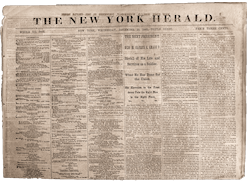
February 14, 1861; The New York Herald

The counting of the electoral votes for President and Vice President took place yesterday at Washington, when Abraham Lincoln was declared President and Hannibal Hamlin Vice President of the United States for four years from the 4th of March next. The following is the vote: –

Lincoln and Hamlin………………… 180

Breckinridge and Lane……………… 72

Bell and Everett…………………….. 39

Douglas and Johnson……………….. 12

Mr. Lincoln left Cincinnati yesterday morning for Columbus, where he arrived in the afternoon. On his arrival at Columbus he proceeded to the State House. He was welcomed in the House of Representatives by the Lieutenant Governor in a short address, to which Mr. Lincoln responded in a speech which is given elsewhere. While at Columbus Mr. Lincoln and family are the guests of Governor Dennison.

Affairs at the South still present the same aspect. Letters received from Fort Sumter state that the South Carolinians have erected an impregnable barrier of railroad iron on Cummings’ Point, at a point so near the fort as to enable them to do much mischief. Fort Moultrie has also been much strengthened. Lieut. Gillman, one of the officers in command of Fort Pickens, at Pensacola, arrived at Washington last evening. He states that the Brooklyn had not landed her supplies, Captain Slemmer having notified her commander that he had sufficient for three months. There were twelve hundred troops at Pensacola, eager to attack the fort, and it was apprehended that it would be taken before the Brooklyn could throw her troops into it.

The Virginia State Convention convened to decide on the course the Old Dominion shall pursue in the present crisis met at Richmond yesterday. The President of the Convention, on assuming the duties of his position, said that Virginia was in favor of the Union, but would insist on her rights as a condition of remaining in it.

0 comments

Mr. Lincoln’s Journey to Washington—Cincinnati

Civil War Day-by-Day

February 14, 1861; The New York Herald

Last evening a large torchlight procession marched to the Burnet House and called out Mr. Lincoln, who briefly returned his thanks for the honor done him. A number of citizens afterwards had the pleasure of shaking Mr. Lincoln’s hand.
It was not until after midnight that the corridors of the Burnet House were vacated by the last of the thousands that had come to take a look at the President elect, and quietness settled over the immense edifice. A strong police force had charge of the hotel all night, and secured the Presidential party the rest they so greatly needed.
At half past six o’clock this morning the call to rise was made on the floor assigned to the President, his family and suite. Shortly after seven o’clock the entire company partook of breakfast. The Governor and other prominent representatives of Indiana and the city committees then took formal leave of Mr. Lincoln and party, and soon after eight o’clock the carriages conveyed them to the Little Miami depot.
Several thousand people were assembled around the depot to bid farewell to the distinguished visiter. An efficient police escort prevented, however, any close approach, and the cars were entered without any uncomfortable crouding. At nine A.M. precisely the whistle was sounded, and the train rolled out amidst the cheers of the innumerable spectators.
Mr. Lincoln stood on the platform of the rear car as the train went out of the depot, bowing his farewell to the crowd, who cheered enthusiastically. Mr. A. Stager, General Superintendent of the Western Telegraph Company, goes with the Presidential party as far as Buffalo, with apparatus for making a connection with wires between the stations, in case of accident to the train.
COLUMBUS, Feb. 13, 1861.
The magnificent weather today again favored the President travels. This, together with the happy appointments of those in charge of the special train, rendered the trip to Columbus the most pleasant portion of the journey thus far accomplished. The train consisted of three passenger cars in which only about a hundred persons were comfortably distributed. The Presidential family and suite occupied the rear, the local company the middle, and the representatives of the press the front car. Of prominent individuals there were aboard Adjutant General Carrington, deputed by the [continue reading…]

0 comments

Mr. Lincoln’s Journey to Washington—The Approach of President Lincoln—Preparations for his Reception in New York—Meeting of the Joint Common Council Committee

Civil War Day-by-Day

February 14, 1861; The New York Herald

The Joint Committee of the Common Council, specially appointed to make arrangements for extending the hospitalities of the city to Abraham Lincoln, the President of the United States elect, on his arrival here, held their first meeting yesterday afternoon. Alderman Cornell presided, and Aldermen Barry and Smith, and Councilmen Gross and Stevenson were present. The meeting, like the majority of the committee meetings of the Common Council, when any subject of importance or interest to the public is before them, was a private one – the newspaper reporters being excluded from it. The Clerk, however, supplied the following information in reference to the proceedings of the committee after its adjournment.

Alderman SMITH moved to invite the Mayor to participate in the proceedings of the committee and give them his cooperation. The motion being carried, Alderman Barry was appointed to inform the Mayor of this action on the part of the committee, and the Mayor signified his acceptance of the invitation, and soon afterwards appeared in the meeting. Alderman Barry and Councilman Stevenson were appointed a Committee on Conveyances.

On motion of Councilman STEVENSON it was agreed that the Committee of the Common Council should proceed to Albany on Monday morning next to meet the President elect there, and tender to him the hospitalities of the city of New York in the name of the city government.

Alderman SMITH moved that the resolution which passed the Common Council tendering the hospitalities of the city to President Lincoln on his arrival here be engrossed. The motion was carried.

The Committee then adjourned till today at three o’clock P.M.

0 comments

Mr. Lincoln’s Journey to Washington—The Reception of Mr. Lincoln at Albany

Civil War Day-by-Day

February 14, 1861; The New York Herald

ALBANY, Feb. 13, 1861.

The committee to entertain the President elect is yet in hot water. Gov. Morgan insists that he shall have his own way, and that Lincoln shall dine at his house with a select party. He informed one of the committee that the dinner had been arranged, Lincoln had been invited and had accepted, and the committee might do as they pleased – that had been fixed.

The Committee convened again at twelve o’clock in the Executive Chamber. The Governor appeared before them, and insisted that he should meet Lincoln at the depot and ride up in the carriage with him; but on a direct vote of the committee it was decided that he should not, but on the contrary, should be in the rotunda of the Capitol, and welcome him in behalf of the Sate; and that the Mayor and Common Council should meet him at the depot. This decision was like a wet sheet to the Governor. They also decided that the Senate Committee shall take him to the Senate and the House Committee to the Assembly Chamber. They also agreed that he should be at the Delavan on the morning of Tuesday, for one hour, to receive calls from the ladies of Albany. The question then arose as to what should be done with him in the evening, and where he should dine. On this the Governor commenced to dictate, holding that it should be at his residence. Says one of the committee, ‘What will you do with Lincoln’s staff or those in his company?’ Says the Governor, ‘The State will pay their expenses – take them to any hotel that you please.’ A portion of the committee insisted that there shall be a legislative dinner…. Being unable to come to any conclusion, after a lengthy wrangle, it was agreed that a committee, consisting of the Governor, Mayor, Chairman of the Senate and Assembly Committee, should draw up a programme and submit it to the committee tomorrow morning for their action. The Governor is pleading with the members tonight for his plan, placing it on a point of honor. His position is looked upon as sublimely ridiculous. He seems to think that he owns the State. There are bitter denunciations uttered against Senator Ferry for his sneaking course. A movement is on foot tonight to get the Assembly to instruct the committee in favor of a legislative dinner.

There is intense excitement on the subject, and everybody is asking, ‘Will the Governor monopolize Lincoln?’ Really, what shall be done with the rail splitter? Shall the office seekers or the Legislature entertain him? What a trouble it is to have a President the first time.

0 comments

“The Prest Elect is now on his way to the Capital.”—Horatio Nelson Taft

Diary of US patent clerk Horatio Nelson Taft.

WEDNESDAY 13

The Presidential votes were counted in Congress today without any disturbance which had been heretofore anticipated, but Genl Scott had all things ready. The Dragoons & Flying Artillery men were standing by their horses all accoutered, ready to mount at a moments warning. The Prest Elect is now on his way to the Capital. I was at the Hotels this evening. Nothing of importance stirring. Saw Mr Lighthall and Mr Lowe of NY at National. Miss Douglass called at my office today and invited myself and wife to a Musical entertainment at her School Rooms tomorrow night. Have read the NY Times an hour, to bed at 12.


The three diary manuscript volumes, Washington during the Civil War: The Diary of Horatio Nelson Taft, 1861-1865, are available online at The Library of   Congress.

0 comments

Governor Pickens responds to Confederacy resolution on forts.—“The denial, therefore, of the right of the State to have possession of the fort was, in fact, a denial of its independence.”—Confederate Records

War of the Rebellion: from the Official Records of the Union and Confederate Armies and Navies

HEADQUARTERS, CHARLESTON, S.C.,
February 13, 1861.

Hon. HOWELL COBB,
President of the Provisional Congress:

SIR: I had the honor last night to acknowledge the receipt of your telegram, in which you informed me that the Provisional Congress had taken charge of the “questions and difficulties” now existing between the several States of the Confederacy and the Government of the United States.In the reply made to   you by telegraph I stated that I would communicate with you by letter, and added to it the expression of the urgent conviction of the authorities of the State as to the period in which the reduction of Fort Sumter should be complete. And, in the first place, let me offer you my warm congratulations upon the success which has attended you in the organization of the Provisional Government. May it be equal to the emergency of every occasion which can arise, and be to each State in this new confederation the efficient guardian of those rights, which, ignored or usurped under the former confederation, has united these States in the bonds of a new political compact.

In taking charge of the “questions and difficulties” which relate to Fort Sumter, it will be necessary for the Congress to apprehend rightly their present position. The force of circumstances devolved upon this State an obligation to provide the measures necessary for its defense. It has been obliged to act under the guidance of its own counsels, but has never forgotten the interest of its sister States in every measure which it was about to provide for its own safety. And I beg to assure you that, in all which it may at any time do, a regard for the welfare and wishes of its sister States in the new confederation will exercise a marked influence upon the conduct of this State.

The “questions and difficulties” of Fort Sumter can scarcely be fully appreciated, unless by those who have been familiar with its progress from the commencement of its history to the present moment. If it shall appear otherwise, it has, nevertheless, been the constant, anxious desire of this State to obtain the possession of a fort which, held by the United States, affected its dignity and safety without a collision, which would involve the loss of life. To secure this end every form of negotiation which could be adopted, in consistency with the dignity of the State, or had the promise or seeming of success, has been honestly attempted. To all of these attempts there has been but one result: A refusal in all cases, positive and unqualified, varied only as to the reasons which were set forth for its justification? has followed each demand. And now the conviction is presented to the State, derived from the most calm and deliberate consideration of the whole matter, that in this persistent refusal of the President of the United States is involved a denial of the rightful independence of the State of South Carolina.

The questions and difficulties, therefore, of Fort Sumter, comprehend now, as you will perceive, considerations which are political as well as military; and it would scarcely be considered that an undue estimate was made of the former if they were said to be as important as the latter. The establishment of them, moreover, is of the utmost consequence to every State which has united with this State in the bonds of a new confederation. The State has held its right to the possession of Fort Sumter to be the direct and necessary consequence of its right, as a sovereign State, to have the control of a military post within its limits, which post, during the period of the political connection of the State with the other States, was held by the United States for the protection of South Carolina because South Carolina was a part of the United States, and being so, upon the United States was devolved the obligation to provide that defense for this State. With the termination of the political connection between South Carolina and the United States the obligation of the United States to defend that State ceased, unless that State itself was the property of the United States. If the State was an independent power the rightful control within its limits of a military post, which involved its dignity and affected its safety, was and is recognized by the plainest rules of public law. The denial, therefore, of the right of the State to have possession of the fort was, in fact, a denial of its independence. Nor has there been even a colorable pretext for a consistency of that possession by the United States with the independence of the State, since the President authorized the distinct avowal that it was held as a military post. The sole use of it as a military post is in the control (called by the President the protection) it gives to the United States of the harbor of Charleston. The assertion, then, as you will perceive, of the rightful independence of the State carries necessarily with it the right to reduce Fort Sumter into its own possession, which is held, as it is, by a hostile power, for an unfriendly purpose. It is a hostile power when it asserts a right to exercise a dominion over the State, which that State refuses to recognize as consistent with its own dignity and safety; and its purpose cannot be otherwise than unfriendly when it can only be to enable the United States to commit to its military subordinates a power to refuse “to permit any vessels to pass within range of the guns” which are within its walls. It has, therefore, been considered at once proper and necessary for this State to take possession of that fort as soon as the measures necessary for the accomplishment of that result can be completed, and it is now expected that within a short time all the arrangements will be perfected necessary for its certain and speedy reduction. With the completion of these preparations and the assurance they afford of success, it has ever been the purpose of the authorities of this State to take this fort into the possession of the State. The right to do so has been considered the right of the State, and the resources of the State have been considered equal to the exercise of that right.

Whatever may be the mode in which the Congress will take charge of these “questions and difficulties,” I trust that it is considered that in the solution of them you will regard the position which the State of South Carolina now occupies in relation to them. That position is marked by these propositions: That the right to have possession of the fort is a right incident to the independence (she) the State has asserted; that, to obtain possession of the fort, she has exhausted all modes which, consistently with her dignity, can be devised for a peaceful settlement; that the failure of such attempts has remitted her to the necessity of employing force to obtain that which should have been yielded from considerations of justice and right, and that as soon as her preparations are completed the reduction of that fort should be accomplished.

In the absence of any explanation or direction connected with the telegram received from you, I have assumed that the policy and measures which have been adopted by this State, and which are in prosecution, will be recognized as proper. In the consideration of the question of Fort Sumter, I have not been insensible of those matters which are in their nature consequential, and have, I trust, weighed, with all the care which befits the grave responsibilities of the case, the various circumstances which determine the time when this attack should be made. With the best lights which I could procure in guiding or assisting me, I am perfectly satisfied that the welfare of the new confederation and the necessities of the State require that Fort Sumter should be reduced before the close of the present administration at Washington. If an attack is delayed until after the inauguration of the incoming President of the United States, the troops now gathered in the capital may then be employed in attempting that which, previous to that time, they could not be spared to do. They dare not leave Washington now and do that which then will be a measure too inviting to be resisted.

Mr. Lincoln cannot do more for this State than Mr. Buchanan has done. Mr. Lincoln will not concede what Mr. Buchanan has refused. Mr. Buchanan has placed his refusal upon grounds which determine his reply to six States, as completely as to the same demand if made by a single State.

If peace can be secured, it will be by the prompt use of the occasion, when the forces of the United States are withheld from our harbor. If war can be averted, it will be by making the capture of Fort Sumter a fact accomplished during the continuance of the present administration, and leaving to the incoming administration the question of an open declaration of war. Such a declaration, separated, as it will be, from any present act of hostilities during Mr. Lincoln’s administration, may become to him a matter requiring consideration. That consideration will not be expected of him, if the attack on the fort is made during his administration, and becomes, therefore, as to him, an act of present hostility. Mr. Buchanan cannot resist, because he has not the power. Mr. Lincoln may not attack, because the cause of the quarrel will have been, or may be, considered by him as past.

Upon this line of policy I have acted, and upon the adherence to it may be found, I think, the most rational expectation of seeing that fort, which is even now a source of danger to the State, restored to the possession of the State without those consequences which I should most deeply deplore. Should such consequences, nevertheless, follow from an adherence to this policy, however much I would regret the occurrence, I should feel a perfect assurance that, in happening under such circumstances, they demonstrated conclusively that, under the evil passions which blind and mislead those who govern the United States, no human power could have averted the attempted overthrow of these States; and that, in the exhibition of an ability by the States of the new confederation to maintain their rights, there could be found satisfaction in the reflection that their sufferings at this time might purchase for them quiet and happiness in time to come.

I have the honor to be, with great respect, your obedient servant,

F. W. PICKENS,

Governor of South Carolina.
0 comments

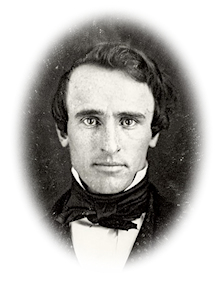
The President Elect and a Future President Meet.—Rutherford B. Hayes

Diary and Letters of Rutherford Birchard Hayes
Rutherford B. Hayes (young)

CINCINNATI, February 13, 1861.

DEAR UNCLE:–We are all well. Mother is in better health; went to church Sunday, and was able to enjoy the Lincoln reception yesterday. The great procession and crowd could be seen well from our windows and steps, and all had a good view of the President. He is in good health; not a hair gray or gone; in his prime and fit for service, mentally and physically. Great hopes may well be felt.

Lucy and I went with a jolly party of friends to Indianapolis on Monday, and returned on the Presidential train to Cincinnati, seeing all the doings here and on the road. We heard Lincoln make several of his good speeches, talked with [him], etc., etc. Regards to all.

Sincerely,

R. B. HAYES.

S. BIRCHARD.

0 comments

From a message to Governor Pickens: “… the guard-boats, and occasionally small row-boats from Morris Island, have recently violated your orders by coming too near our walls.”—Operations in Charleston Harbor

War of the Rebellion: from the Official Records of the Union and Confederate Armies and Navies

HEADQUARTERS, FORT SUMTER, S.C.,
February 13, 1861.

His Excellency F. W. PICKENS.
Governor of South Carolina:

SIR: Knowing that your desire to prevent, and your determination, as far as in your power, to guard against the recurrence of anything calculated to add to the excitement which already unfortunately exists, I deem it my duty to report that the guard-boats, and occasionally small row-boats from Morris Island, have recently violated your orders by coming too near our walls. Yesterday morning one of the steamers–the General Clinch, I think–passed very near and last night the guard-boats came nearer than was proper, twice–once about midnight, and again at 3.30 a.m.–when a steamer, although warned off by the sentinel, continued to approach, head on, until he fired his musket over her, when she altered her course. The gun-battery guard, I am happy to say, did not deem it necessary to fire.

Assuring you that every exertion will be made by me to guard against   any wrong act on the part of my command, and hoping that these boats will henceforth be more particular in obeying your instructions,

I am, sir, with sentiments of the highest regard, &c.

ROBERT ANDERSON,

Major, U.S. Army, Commanding.

0 comments

The News

Civil War Day-by-Day

February 13, 1861; The New York Herald

The Southern Congress at Montgomery, Alabama, yesterday in secret session adopted a resolution declaring that the new government takes under its charge the questions and difficulties existing between the States of the confederacy and the United States, relative to the forts, arsenals and other public establishments. We shall, therefore, have no collision by the secessionists at any of the points threatened, until a formal declaration of war is made by the Southern Congress, unless the federal government take the initiative steps. A resolution directing inquiry as to the propriety of sending Commissioners to Washington was referred to the Committee on Foreign Relations.

The President elect and party, en route for the White House, left Indianapolis yesterday morning, and arrived at Cincinnati in the evening, where he made a speech to the people, a report of which may be found in our account of the journey of the party, in another column.

A large number of memorials relative to the crisis were presented in Congress yesterday. In the Senate Mr. Sumner and Mr. Crittenden discussed the perilous condition of the country. The Naval Appropriation bill was taken up, the question being on the adoption of an amendment providing for the construction of six steam sloops of war. Mr. Green opposed the amendment, but it was finally adopted by a vote of 27 to 17. After an executive session, in which a number of appointments were confirmed, the Senate adjourned.

0 comments

The Journey of the President-Elect

Civil War Day-by-Day

February 13, 1861; The New York Herald

INDIANAPOLIS, Feb. 12, 1861.

Last night, previous to Mr. Lincoln’s departure from the Bates House, he was again introduced by the Hon. Sol Meredith. Mr. Lincoln said he had no speech to make. If he made speeches whenever his friends desired, he would not be able to reach the national capital at the appointed time. He once more thanked the assemblage for the reception, and trusted we all might meet again under one flag of one Union. He bade them an affectionate farewell.

Like the first, the second day of the journey of the President elect is favored by the most beautiful weather.

Mr. Lincoln rose shortly after seven o’clock, and was soon after called upon by Governor Morton, who escorted him, according to previous arrangement, to the gubernatorial mansion, to partake of a dejeuner. The following members of the Presidential cortege were also invited:–K. Dubois, O. H. Browning, N. B. Judd, Col. Sumner and Major Hunter.

The entire party returned to the Bates House at nine A. M., from the balcony of which a brass band had been playing national airs since sunrise.

With daybreak curious groups commenced gathering in front of the hotel, and at the time Mr. Lincoln made his appearance every available space in and about the building was as crowded as last night, and it is likely to remain so until the departure of the centre of attraction.

Mrs. Lincoln and two sons, and Captain George Hazzard, U.S.A., will join the Presidential party this morning. Mrs. Lincoln will arrive at a quarter to eleven o’clock from the West.

Several Illinois gentlemen who accompanied Mr. Lincoln to this place will return home today. The party that will go through to Washington will be composed as follows:–Hon. Abraham Lincoln, Mrs. Lincoln and two children, R. T. Lincoln, D. W. S. Wallace, John Nicolay, John M. Hoy, Hon. N. B. Judd, Hon. David Davis, D. H. Browning, Col. E. V. [continue reading…]

0 comments

Lincoln on Medical Science

Civil War Day-by-Day

February 13, 1861; The New York Herald

In the course of his very remarkable speech at Springfield, the President elect made an allusion to the pills of the homeopathists’ as being too large for the opponents of coercion to swallow. The comparison is more after the manner of Hon. Massa Greeley than that of the ancient rail splitter, but still may be of use with another application. If the incoming administration pursues the homeopathic plan in its dealings with the cotton States, giving allopathic doses of kindness, concession and conciliation, and administering infinitesimal doses of coercion, the national troubles may be settled, and the Union, which is really very sick, be restored to better health than ever. Otherwise, with allopathic coercion and homeopathic compromise, Doctor Lincoln may as well get ready for a funeral. He will have the poor consolation of not being the only political quack who has killed his patient through combined stupidity and ignorance.

0 comments

The Authoritative Coercion Programme of Mr. Lincoln and his Administration—Civil War Upon Us

Civil War Day-by-Day

February 13, 1861; The New York Herald

The bells of St. Germain d’Auxerrois have at length tolled forth the signal for massacre and bloodshed by the incoming administration. The speech of Mr. Lincoln, at Indianapolis, is the first authoritative proclamation of his intentions in the present crisis. His words are pregnant with meaning, and deserve the mature and deliberate consideration of every conservative citizen of the country. ‘If the United States,’ he exclaimed, ‘merely hold and retake its own forts and the properties, and collect the duties on foreign importations, or even withhold the mails from places where they are habitually violated, would any of these things be invasion or coercion? Would the marching of an army into South Carolina be invasion?’ The Premier of Mr. Lincoln had already declared to the United States Senate that ,’which should sweep away opponents to republicanism moths before the whirlwind,’ was his idea of the final development of conflict. And, by a well calculated coincidence, on the same day, perhaps at the same moment that Mr. Lincoln was indoctrinating the citizens of Indiana into invasive and coercive principles, Senators King and Fessenden were announcing, at Washington, their reasons for reinforcing the navy of the United States with vessels which should be able to penetrate Southern harbors, and attack Southern fortresses.

‘Treason,’ says Mr. King, ‘is abroad in this land, and I believe there is an occasion and a necessity of the increase of the armament and the power of the country. But for the condition of things in the country now, I would vote against it, but I vote for it as a measure to put the country in a condition to defend itself against its enemies, whether they are domestic or foreign enemies. This government and this country cannot be peaceable destroyed, or overthrown or divided. Men cannot talk treason–they must act it; and he who acts it, in my judgment, should take the fate of a traitor, and should not seek to escape by pretending that he can commit it peacefully against the country. I tell these gentlemen that, in my judgment, this reason must come to an end, peacefully I hope, but never, in my judgment, peacefully, if by an ignominious submission of the honor of the people of this country to traitors. Never. I desire peace, but I would provide, amply provide, for the means of defence of the country, by war, if necessary.’

Senator Fessenden was equally positive in deciding if the time was coming to use force, he was perfectly ready to do it. ‘Where, then does the country stand? Governor Morgan offers the militia of New York to Mr. Lincoln, and a large sum of [continue reading…]

0 comments

Terrible Commercial Convulsion Threatened in the North

Civil War Day-by-Day

February 13, 1861; The New York Herald

That the Northern States at the present moment are on the eve of a calamitous commercial crisis, which threatens to plunge us into disorder, and perhaps ruin, no one with any foresight can fail to see. Apart from the evils resulting from the political difficulties now shaking the country from its centre to its borders, which have already culminated in the dismemberment of the Union, and a radical change in the positions of the North and the South, we are threatened here at the North with a terrible financial and social convulsion, completely breaking up all our commercial interests, destroying our profitable inter-trade with the Southern States, and the consequent interruption of the manufacturing industry of this section of the country, with all the trials and distresses which such a state of things is certain to entail upon us.

In a few weeks from now the new President will take possession of the purse and the sword at Washington; and we have no intimation from him with regard to his future policy, excepting it be in the dimly shadowed idea of a National Convention, which, at best, will take years to settle the question at issue, and will leave us nothing in the future. It seems to be his intention to take hold of the rump of Congress and the rump of the republic which is left to govern, and convert them into a military despotism; to make war upon the seceding Southern States with the naval and military arm at the disposal of the new administration: in other words, to inaugurate a sanguinary and unnatural civil war, on the mistaken idea that the Southern people are rebels and traitors. They are no more rebels and traitors than were the patriots of the thirteen colonies, who were dissatisfied with the British government because they believed that its laws infringed upon their personal rights and privileges, and they determined to form a government for themselves. If the Southern States believe that their rights and privileges have been invaded by the government of the united confederacy, and that there is no longer safety for them within its limits, the right of revolution remains to them just as much as it was vested in the thirteen British colonies in the middle of the last century. The seceding States have so decided, and have availed [continue reading…]

0 comments

Our Washington Correspondence

Civil War Day-by-Day

February 13, 1861; The Charleston Mercury

South Carolina is but not forgotten. Abolitionists of the North and traitors from the South do not permit her name and fame to pass away from the memory of men. She is the chosen theme of their bitterest revilings. But, albeit she is without a representative in either House, she is not without brave and strong defenders. Foremost of these is Senator WIGFALL – the tenor of whose speech, in reply to ANDREW JOHNSON, has, no doubt, been laid before your readers by telegraph. This speech will bear careful perusal, for it is not only a scalding excoriation of the Tennessee SUMNER, but an able argument on the right of secession.

As I predicted, the Springfield tyrant is going to back down. KELLOGG’s speech in the House yesterday decides this matter conclusively. It is conceded by the strongest Southern men in the Peace Congress, that a compromise of some sort will be made–enough to keep the Border States in, but not enough to bring the Gulf States back. I was amused, though, to hear a Southern Senator’s opinion of this Congress. He said: ‘It will do nothing. If one of the old setting hens who compose it, should get a dozen egg plants, and put on a pair of feather breeches, and set on them, there would be as much probability of his hatching a brood of vegetable chickens, as of this Congress doing anything practical.’

The secession party in Virginia are worse than defeated. They are bound neck and heels to the Abolition Confederacy. They contend that the State has been made to occupy a false position, and that the people at heart prefer the South to the North. Even the worst submissionists agree with them on this point. SANDY STUART boasts that himself and the other submission leaders outgeneralled the secession chiefs. It must be confessed that a coalition, headed by such men as BOTTS, LETCHER, STUART, ALEXANDER, RIVES, JAMES, BARBOUR, and THOMAS, is more than a match for all the rest of the State combined; but the overwhelming vote against reference, which shows the real succession strength in Virginia, also shows the tremendous power of the Union sentiment all over the State, in the East as well as in the West. The only question now to be solved by true Southern men, is emancipation or expatriation.

Much significance is attached to the fact, that the Tennessee delegation to the Peace Congress have moved, in a body, up to WILLIARD’s Hotel, the hot bed of the Abolitionists. Some go so far as to say that a man’s Southernism may be judged by the locality he selects. As long as he does not go higher up than KIRKWOOD, you may consider him sound; but beyond that point you cannot trust him. This rule, like all others, has its exceptions. For example, that incarnation of genuine fire eating, LAWRENCE M. KEITT, never roomed below WILLARD, while HALE and CRITTENDEN board at the National and HATTON of Tennessee, with HARRIS, of Virginia, are at BROWN.

0 comments

The Journey of the President-Elect—Arrangements for Mr Lincoln’s Reception at Albany

Civil War Day-by-Day

February 13, 1861; The New York Herald

ALBANY, Feb 12, 1861.

The joint committee to entertain the President elect held a meeting this afternoon in the Executive chamber. Governor Morgan appeared before them, and insisted that he should be his guest whilst here, the State to pay the bills, and that the members and all others should be introduced to him in the Executive chamber, after which he should retire to the Governor’s private residence, and he there entertained, with only such company as the Governor should select.

This absurd proposition came very near kicking up a row in the committee. The Governor was also anxious that the committee should meet Mr. Lincoln at Utica, and he would ride in the carriage with him to the Capitol.

After wrangling some time over the plan they adjourned until tomorrow morning.

There is a large amount of buttonholing tonight with the members on the subject. It is understood that Senator Ferry is doing all that he can to have that plan adopted; but others, including Mr. Bergen, declare that they will not play second fiddle to the Governor in any such arrangement, stating that they will resign first.

Mr. Bergen, in connection with several other members of the committee, have proposed the following plan to submit to the committee tomorrow, which it is now thought will be adopted–The joint committee of the Senate and Assembly to meet the President elect either at Utica or Buffalo, and conduct him to Albany, to be meet at the station by the President of the Senate and Speaker of the Assembly, and the Chairman of the joint committee to occupy the carriage with the President elect, the balance of the committees to follow in the next carriage. Upon the arrival at the Capitol he will be [continue reading…]

0 comments

Our Montgomery Correspondence

Civil War Day-by-Day

February 13, 1861; The Charleston Mercury

MONTGOMERY, February 10, 1861.

The Provisional Constitution being disposed of, I understand that yesterday a committee was raised, of two from each State, to frame and report a Permanent Constitution for the Confederacy. The members of this committee from your State, I learn, are Mr. RHETT and Mr. CHESNUT. Not much was done in the Provisional Constitution by way of improvement on the abandoned United States Constitution. The taxing power seems as vague as in the United States Constitution; whilst there is an implied stigma on the institution of slavery, by going beyond the Constitution of the United States, which only authorized Congress, after a certain time, to prohibit the African slave trade; whereas, it is prohibited in the Provisional Constitution itself. All debates on the Constitution being secret, the course of your delegation is unknown; but the Conventions of Alabama and Georgia both instructed their delegates to prohibit it in the Constitution. I suppose it to be a beg to the frontier States, which is about as respectable as the present course of those States, who are begging the Abolitionists. So far, the Abolitionists have shown most decidedly the highest and most consistent spirit in vindicating their positions and principles. As the Congress has adopted all the nine volumes of the United States laws, tariff and all, I do not see what is to keep the Congress long here. If there is to be no war, they can certainly rise by the 4th of March, and by that time this fact will be known, if it is to exist. I believe it will not exist. If the frontier States do not join us, and join their Northern confederates, they will control them, and then there will be no war; and if they join us there will be no war. In either event, therefore, there will be no war. War from Fort Sumter, since Col. HAYNE return is followed by no action, is here considered as past hoping for. Fighting in South Carolina is confined to the Poet’s Corner in the MERCURY – that is what an Alabamian said to me today.

0 comments

Civil War Day-by-Day

Civil War Day-by-Day

February 13, 1861

  • A Joint Session of Congress meets to count and certify the Electoral College votes. The U. S. Electoral College makes Lincoln’s win official.
  • In Richmond, former President John Tyler and former Virginia governor Henry Wise lead the notables who meet for the first time as Virginia’s secessionist convention.
0 comments

Confederacy resolves to take charge of issue of forts — Confederate Records.

War of the Rebellion: from the Official Records of the Union and Confederate Armies and Navies

FEBRUARY 12, 1861. No. 5.—A RESOLUTION in relation to the occupation of the forts and arsenals, &c.

Resolved by the Congress of the Confederate States of America, That this Government takes under its charge the questions and difficulties now existing between the several States of this Confederacy and the Government of the United States of America, relating to the occupation of forts, arsenals, navy-yards, and other public establishments; and that the President of the Congress be directed to communicate this resolution to the several States of this Confederacy, through the respective governors thereof.

Adopted February 12, 1861.

0 comments

Meanwhile, at Ft. Pickens.—Lt. A. J. Slemmer.—Operations in Florida

War of the Rebellion: from the Official Records of the Union and Confederate Armies and Navies

slemmer_a_jFORT PICKENS, FLA., February 12, 1861.

Hon. J. HOLT,   Secretary of War:

SIR: Since the departure of Lieutenant Gilman as special messenger for Washington nothing of special interest has transpired. I am continuing the defenses, mounting guns on the ramparts, and blocking up the casemate embrasures. Having observed a battery in course of erection upon which they were mounting heavy guns, 8-inch columbiads, and as this battery would rake two bastions and the connecting curtains of this fort, I addressed the following note to Colonel Chase:

FORT PICKENS, FLA., February 11, 1861.

Col. WM. H. CHASE, Commanding the Forces of Florida:

SIR: I observe you are erecting and arming battery west of the light-house. I deem it my duty to protest against its further continuance, and also of all batteries which may bear on Fort Pickens.

I am, sir, very respectfully, your most obedient servant,

A. J. SLEMMER,
First Lieutenant, First Artillery, Commanding.

To which I received the following satisfactory reply:

HEADQUARTERS PENSACOLA DISTRICT,
February 12, 1861.

Lieut. A. J. SLEMMER, Commanding Fort Pickens:

SIR: I have this moment received your letter of the 11th instant. I am determined to make good the assurances that I have given, that no attack shall be made on Fort Pickens, and to discontinue all preparations for one, as stated in my letter to Capt. S. Barren, dated January 29. I do not consider the erection of batteries on this side as aiming at an attack on Fort Pickens; but, desiring to avoid all actual or implied preparations for an attack, I will give orders for the discontinuance of the erection of the battery.

I am, very respectfully, your obedient servant,

WM. H. CHASE,
Colonel, Commanding Forces of Florida, &c.

I have the honor to be, sir, very respectfully, your most obedient servant,

A. J. SLEMMER,
First Lieutenant, First Artillery.

0 comments

Joseph E. Brown to Alexander H. Stephens.

Miscellaneous document sources

Milledgeville [Ga.], Feby. 12th, 1861.

Dear Sir: I have appointed Lewis F. Kenan Captain and young Mr. Barrow 2d Lieut, as you and others of the Georgia delegation requested. Col. Kenan’s course, while a political opponent, has been towards me high toned and honorable, and it affords me much pleasure to appoint his son who is a worthy and promising young man.

Col. Barrow is here now with his so. The positions are now all filled in the two regiments and we shall go immediately to enlisting men. There will be great difficulty in getting them for [5?] years, hence I shall fix the term at 3 years. We hope to transfer them immediately after they are raised to the Govmt. of the Confederate States.

I have just received Gov. Cobb’s telegram informing me that the Congress has taken under its charge the question of the forts, etc. I suppose it desires me to hold Pulaski till it has men to garrison it. I am happy to hear of so much harmony in the Congress.

Permit me in conclusion to tender you my sincere congratulations on your election with unanimity to the high position you now occupy.[i] I have not the pleasure of a personal acquaintance with the President, but regard the selection a good one, as his wisdom and statesmanship are known to all to be of the most profound and highest order. May the God of our fathers, whose aid I try always to invoke, aid and guide the President, yourself and the Congress in this hour of trial.


[i] The vice-presidency in the provisional government of the Confederate States.


From Annual Report of the American Historical Association for the Year 1911.

Joseph Emerson Brown (April 15, 1821 – November 30, 1894), often referred to as Joe Brown, was an attorney and politician, serving as the 42nd Governor of Georgia from 1857 to 1865, the only governor to serve four terms. He also served as a United States Senator from that state from 1880 to 1891.

A former Whig, and a firm believer in slavery and Southern states’ rights, Brown was a leading secessionist in 1861 and led his state into the Confederacy. Yet he also defied the Confederate government’s wartime policies: he resisted the military draft, believing that local troops should be used only for the defense of Georgia; and denounced Confederate President Jefferson Davis as an incipient tyrant, challenging Confederate impressment of animals and goods to supply the troops, and slaves to work in military encampments and on the lines. Several other governors followed his lead.

Alexander Hamilton Stephens was an American politician who served as the vice president of the Confederate States from 1861 to 1865. After serving in both houses of the Georgia General Assembly, he won election to Congress, taking his seat in 1843. After the Civil War, he returned to Congress in 1873, serving to 1882 when he was elected as the 50th Governor of Georgia, serving there from late 1882 until his death in 1883.

0 comments

The Reception at Cincinnati—Speech of Mr. Lincoln

New York Times
burnet house

CINCINNATI, Tuesday, Feb. 12.

The train arrived at the appointed time at the foot of Fifth-street, which was literally blocked with people. The locomotive was once compelled to stop. The crowd was so great it was impossible to get out of the way at the depot, and it was found necessary to bring the military and police forces into requisition to clear the way.

The reception was an era in the history of Cincinnati. The weather was mild and beautiful. The streets were crowded with citizens and people from this and the neighboring States. The streets through which the procession passed were crowded at an early hour, and the windows filled with ladies. The Burnett House, where the Presidential party stop, was handsomely decorated, and every arrangement made for the comfort of the distinguished guests. The stars and stripes were flying from all the public, and a number of private buildings.

At 2 1/2 o’clock, the military, which made a fine display, and the Committee of Arrangements, were at the Indianapolis and Cincinnati Railroad depot. On the arrival of the train, Mayor BISHOP introduced and welcomed the President elect to Cincinnati. Mr. LINCOLN took a seat in a barouche drawn by six white horses, amid the deafening cheers of a vast concourse of people. The procession, in charge of MILES GREENWOOD, took up its march passing through the principal streets, amid the cheers of men, and waving of flags and handkerchiefs by the ladies, to the Burnet House, where it arrived at 5 1/2 o’clock, which Mr. LINCOLN entered, amid deafening cheers, — Mentor’s Band playing “Hail Columbia” and “Star-spangled Banner.”

After a few moment’s rest, Mr. LINCOLN made his appearance on the balcony, accompanied by Mayor BISHOP, who made a short introductory address. Mr. LINCOLN then spoke.

He said: I have spoken but once before this in Cincinnati. That was a year previous to the late Presidential election. On that occasion, in a playful manner, but with small words, I addressed much of what I said to the Kentuckians. I gave my opinion that we, as Republicans, would ultimately beat them, as Democrats, but that they could postpone that result longer by nominating Senator DOUGLAS for the Presidency, that they could in any other way. They did not, in any true sense of the word, nominate Mr. DOUGLAS, and the result has come certainly as soon as ever I expected. I also told them how I expected they would be treated after they should have been beaten; and I now wish to call their attention to what I then said upon that subject. I then said, “When we do as we say, beat you, you perhaps want to know what we will do with you. I will tell you, as far as I am authorized to speak for the Opposition, what we mean to do with you. We mean to treat you, as near as we possibly can, as WASHINGTON, JEFFERSON and MADISON treated you. We mean to leave you alone, and in no way to interfere with your institutions; to abide by all and every compromise of the Constitution; and, in a word, coming back to the original proposition, to treat you so far as degenerate men, if we have degenerated, may, according to the example of those noble fathers, WASHINGTON, JEFFERSON, and MADISON. We mean to remember that you are as good as we; that there is no difference between us, other than the difference of circumstances. We mean to recognize and bear in mind always that you have as good hearts in your bosoms as other people, or as we claim to have, and treat you accordingly.

Fellow-citizens of Kentucky! friends! brethren, may I call you in my new position. I see no occasion, and feel no inclination to retract a word of this. If it shall not be made good, be assured the fault shall not be mine.”

The remarks were received with great enthusiasm. In passing to his room those that could rushed at him, throwing their arms around him, patting him on the back, and almost wrenching his arms off. Politicians were thick; among them GEORGE N. SANDERS and others.

This evening, in the grand hall of the Burnet House, which has been decorated for the occasion, Mr. LINCOLN will receive the people generally. He looks well, and is in good spirits.

The whole arrangements thus far, which have been under the charge of W.S. WOOD, have been admirable; nothing has occurred to mar the pleasure of the journey.


(Published in the New York Times, February 13, 1861, without Lithograph)

Lithograph

Title: Burnet House ; Hôtel Burnet, Cincinnati, Ohio / A. Forbriger, Lith. ; Onken’s Lithography, Cincinnati.

Created by Aldolphus A. Forbriger, Published [Cincinnati] : Onken’s Lithography, [between 1850 and 1860]

Library of Congress image

0 comments

At the Court of St. James

Diary of George Mifflin Dallas, United States Minister to England 1856 to 1861

1861. February 12.–Yesterday’s news from home a shade more promising. The President’s message to Congress on the mediatorial propositions from Virginia is calmly and judiciously written. It looks to that State for the preservation of the Union. The Convention of the Border States, free as well as slave, assembled on the 30th of January, and we ought now to have its first movements. There will be a collection of distinguished men at it,–Rives, Tyler, Reverdy Johnson, etc. I fear, however, they are rather effete celebrities than fit for the moment.

A curious sort of intermediate public counsel, not employed by either plaintiff or defendant, but seeming to act and argue as a Judge-Advocate at a Court-Martial, has addressed an admirable argument to the Bench in “Betsey Bonaparte’s” case at Paris. He seems a representative “pro bono publico.” His name is Duvignaux. Another singular feature of this trial was in allowing a presumptuous American called Gould to intrude his written notions as to what was general opinion about the marriage of Jerome and Betsey with our eminent lawyers in 1803! How completely this could have been exploded by the production of my father’s written and elaborate view of the whole matter given to old Mr. Paterson at the time. I have the rough draft among his relics.

0 comments

“Went this evening to the Levee (the last of Pres Buchanans).”—Horatio Nelson Taft

Diary of US patent clerk Horatio Nelson Taft.

TUESDAY, FEBRUARY 12, 1861.

Have had rather a busy day of it and it has been quite warm. Packed Julia’s trunk and then went to the Pat office. Went up to the Navy Dept by request of Chief Engineer Saml Archibold to inspect some Drawings and Models of Engines, Valves, &c. Went to Express off and pd charge on trunk $2.00 and then back to Pat office. Have not done much office work today, a good many in the room talking over the affairs of the Nation. Went this evening to the Levee (the last of Pres Buchanans). A great crowd there, many Army & Navy officers in uniform. H N Jr went with me and was introduced to the Prest & shook hands with him.


The three diary manuscript volumes, Washington during the Civil War: The Diary of Horatio Nelson Taft, 1861-1865, are available online at The Library of   Congress.

0 comments

Our Washington Correspondence

Civil War Day-by-Day

February 12, 1861; The Charleston Mercury

Great efforts are making by the Republican press and by men in and out of Congress, to detach, by every sort of trick, the Border Southern States from union or sympathy with the other Southern States. They promise them, if they will only renounce the seceding States, any amount of plunder they may ask–such as subsidizing a line of steamers to run from Norfolk to Liverpool to carry the mails, and to give them a larger share in all the Federal appointments. How far their efforts may prove successful, remains to be seen.

There is another scheme behind this application of soap–that is, secret preparations for the coercion of Maryland and Virginia under the force of a coercion army, organizing at Washington under General SCOTT. The Black Republicans have picked up and kept alive fabulous reports of a ‘raid’ upon Washington. To help this the recent hubbub about the attack on the navy yard at Brooklyn was originated by them. Under the cover of these reports, they have induced General SCOTT to form the nucleus of a large coercion army in Washington, for the purpose of compulsory operations against Maryland and Virginia first should they conclude to secede, and against the other Southern States next.

I have gleaned the following important particulars regarding the movements of General SCOTT, from the most reliable military authority:

The corps of engineers have been removed from West Point to Washington–a measure never resorted to unless the country is engaged in hostilities.

The entire garrison of soldiers have also been ordered from West Point, leaving the place without a regular soldier. This has never been done before since the establishment of West Point.

SCOTT has, at the present time, no less than five light artillery batteries in Washington, a quantity of artillery for a body of 5000 men. [continue reading…]

0 comments

The President-Elect on his Travels, His Inauguration and Inaugural

Civil War Day-by-Day

February 12, 1861; The New York Herald

The President elect left Springfield, Illinois, yesterday morning, en route for the White House at Washington, via Buffalo, Albany and New York. He will reach this city, according to the published programme… on Tuesday, the 19th instant. His journey is divided into easy stages, and all the arrangements thereof have been adapted to the contingencies of a triumphal march. Holding over several days in this metropolis, and a day or two, perhaps, at Philadelphia and Baltimore, Mr. Lincoln may not reach Washington till the end of the month. It is understood, however, that he desires to be there in season to appropriate several days and evenings to consultations with the republican members of Congress upon the important subject of his Cabinet, which does not as yet appear to be half made up.

But, dismissing all these incidentals, the question still recurs, what will be the line of policy marked out in Mr. Lincoln’s inaugural touching the revolutionary troubles and sectional difficulties which his election has precipitated upon the country? For many weeks past his reputed home organ at Springfield, and our special correspondent there, and the Hon. Massa Greeley, and everybody else supposed to speak by authority, have had only one report to make–to wit: that the President elect stands firm upon the Chicago platform, that he has no compromise to make with rebels and traitors, but that his fixed and unalterable purpose is enforcement of the laws.

We are at length, however possessed of information from which we feel authorized to declare that the President elect, in his inaugural address, will submit a proposition of pacification to the country, in the form of a National Convention for the reconstruction of the Union. Mr. Seward, in his first speech in the Senate after his appointment as Mr. Lincoln’s Premier, pretty broadly suggested that he would be ready to go for something of that sort: ‘after these eccentric secession and disunion movements shall have subsided, and when calmness shall have resumed its wonted sway over the public mind.’ In this suggestion, we now perceive, our cautious Senator foreshadowed the intended peace offering from the incoming administration–a National Convention for the revision of the federal constitution, whereby the States contemplating [continue reading…]

0 comments