The News

Civil War Day-by-Day

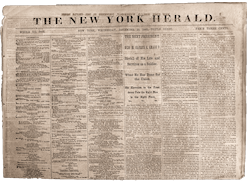
February 12, 1861; The New York Herald

The President elect and suite left Springfield, Illinois, at half past seven o’ yesterday morning, en route for the White House. Mr. Lincoln made a farewell address to his neighbors just before the train started, which so affected both himself and his hearers that tears were copiously shed. Our despatches in another column furnish a record of the progress of the party.

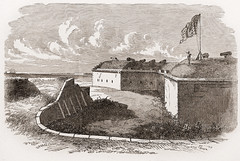
Lieutenant Putnam, of the army, arrived at Washington yesterday, direct from Pensacola, which place he left on the 7th inst. He reports everything tranquil there, but that the Alabama troops were exceedingly restive and desirous of a collision with the government forces at Fort Pickens. Five vessels of war, including the Brooklyn, were at anchor off the port. The secessionist forces were quartered in the Navy Yard, and were subsisting upon the provisions of the federal government.

The proceedings of Congress yesterday are of unusual interest. In the Senate no less than seventy memorials, containing the names of thousands of citizens, urging a settlement of the troubles of the nation, were presented. A resolution, calling for the correspondence between Great Britain and the United States respecting the case of the fugitive slave Anderson, was offered and laid over. Another conference committee on the Deficiency bill was ordered. The naval appropriation bill was then taken up, and the appropriations for the Pensacola navy Yard stricken out. So much of the act of last year as applies to the purchase of patented firearms was repealed. An amendment authorizing the construction of seven steam sloops of war was adopted by a vote of thirty to eighteen. The bill was then reported, and on the question of concurring in the amendment an important debate ensued. Mr. Mason said by no vote of his should there by any addition to the military force of the government which was to be used to coerce seceded States. Mr. Fessenden said if the time ever comes when it is necessary to use force to execute the laws of the Untied States, then he was quite ready to do it. Mr. King said he had opposed the measure theretofore, but now treason was abroad in the land, and he believed there was a [continue reading…]

0 comments

Our Baltimore Correspondence

Civil War Day-by-Day

February 12, 1861; The Charleston Mercury

BALTIMORE, February 6. 1861.

The crisis in Maryland is rapidly approaching. Last evening delegates were elected in all the wards to attend a City Convention, for the purpose of selecting delegates to represent the city in a State Convention to consider the present state of affairs, to meet on the 18th inst. Several of the counties have already selected delegates to the Convention, and by the day fixed for meeting the entire State will be represented. So you will see that the people have at length taken the matter in their own hands. The huckstering politicians at the head of affairs may howl as much as they please, but it will be of no avail, for the handwriting is already upon the wall, their days are numbered, and their ill used power is rapidly passing from them.

0 comments

The Provisional Constitution of the Confederate States of America

Civil War Day-by-Day

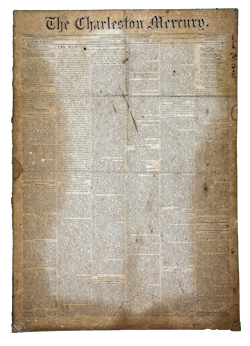
February 12, 1861; The Charleston Mercury

Our readers will perceive that the United States Constitution, with a few emendations, has been adopted, and also, by a sweeping enactment, the United States laws, for the temporary government of the seceding States confederated at Montgomery.

We regret that any Provisional Government was formed at all, and in one or two important particulars confess to disappointment and surprise at the Government and laws enacted. It seems that the United States Protective Tariff of ‘has been adopted, and that a positive condemnation of the institution of slavery, through the slave trade, has been inserted into the Constitution itself. Neither of these did we expect. We did not suppose that any Southern Government, whether for a month or a year, would sanction the policy of Protective Tariffs. The tariff is odious and oppressive in its discriminations. It was made to favor Northern enterprise at the expense of the people of the South–a huge free list for them – the burden of taxation for us to bear, and we maintain is adverse to revenue, unjust in principle and oppressive in practice. Whether this is brought about by a partial remission of duties or a partial imposition, it is still the same in effect. We enter our protest against the scheme and policy both as regards ourselves and in the results so far as foreign nations are concerned and their friendship, at this time, valuable to us. In each respect Free Trade is the true policy of the Confederate States.

We deem it also unfortunate and mal apropos that the stigma of illegitimacy and illegality should be placed upon the institution of slavery by a fundamental law against the slave trade. In our opinion it is a matter of policy, and not of principle, to be decided now and hereafter, from sound views of the necessities and safety of our peoples. We think it a proper subject of legislation. We are willing to prohibit it by legal enactment, like any other topic of legislation. But while England imports her thousands of Coolie slaves, and France hers, under the farcical appellation of–while they are striving by these means to compete with us and supersede us, in producing the tropical productions of slave labor–while [continue reading…]

0 comments

Our Montgomery Correspondence

Civil War Day-by-Day

February 12, 1861; The Charleston Mercury

MONTGOMERY, February 9, 1861.

Last night the Congress agreed on the Constitution of a Provisional Government, and today they are to sign it at twelve o’clock. There must have been some tough debating, from their procrastinated sittings, but I understand the Constitution is announced as unanimously adopted. Its temporary character will, I suppose, shield it from severe criticism. We will not know what it is until it is signed today by the Delegates. Today the election of the President and Vice President of the confederacy takes place. Mr. DAVIS of Mississippi, and Mr. COBB, of Georgia, will probably be the only persons voted for. Mr. DAVIS will most probably, I learn, be elected. Who will be Vice President, I have not learned.

As Col. HAYNE is now returned to Charleston, without an order for the surrender of Fort Sumter, public attention here is on the tip toe to hear what your Executive will do. Will he, like Governor BROWN, of Georgia, vindicate the rights of the State and attack Fort Sumter? The people here are listening to hear the guns.

I think from what I can learn here, that this Congress considers itself, with the South, to have passed the Rubicon. No reconstruction seems to be the decided policy. But there is a strong leaning to the Frontier States. The sessions being secret, we outsiders can know nothing of the differences which agitate the Convention, but I think I see no little dissatisfaction on some faces. Yet they all seem resolute and determined.

0 comments

Mr. Lincoln off for Washington

Civil War Day-by-Day

February 12, 1861; The New York Herald

The Start from Home–Speech to His Neighbors–The Presidential Cortege–Speed of the Train–Cheers for Lincoln and the Constitution, &c., &c., &c.

THE LAST DAY AT HOME.
SPRINGFIELD, ILL., Feb. 10, 1861.
The President is spending this last day of his stay in Springfield quietly in a select circle of friends. Edward Bates was invited to accompany Mr. Lincoln to Washington, but telegraphed last night that he would not be enabled to go.
Carl Schurz arrived last evening. Mr. Lincoln showed him marked courtesy, and introduced him personally to a number of prominent men as the great German orator. Major Hunter and Colonel Sumner have not yet arrived.
Invitations to accompany Mr. Lincoln to Washington have been extended to the following parties. The list comprises prominent republicans and Douglas and Breckinridge democrats:–Governor Yates, Ex-Governor Moore, Honorables O. M. Hatch, William Butler, N. Baleman and E. Peck, J. Grimshaw, William R. Morrison. L. M. Ross, M.H. Cassel, William S. Underwood, William H. Carlin, J.A. Hough, D. H. Gilman and Colonel Burgess. Carl Schurz was invited, but is obliged to decline.

TAKING LEAVE OF HIS NEIGHBORS. SPRINGFIELD, ILL., Feb. 11, 1861.
The President elect, accompanied by his lady and a number of friends, left his hotel at half past seven A. M, and rode up to the Great Western depot. Over a thousand persons of all classes were assembled in the depot building and on each side of the festivity decorated special train to bid farewell to their honored townsman.
The President elect took his station in the waiting room, and allowed his friends to pass by him and take his hand for the last time. His face was pale, and quivered with emotion so deep as to render him almost unable to utter a single word. At eight o’clock precisely he was conducted to the cars by Mr. Wood and Mr. Baker, of the Journal. After exchanging a parting [continue reading…]

0 comments

I Nominate (Replacement officers for some who have resigned from the Navy and Army)

Civil War Day-by-Day

The following messages were received from the President of the United States, by Mr. Glossbrenner, his secretary: To the Senate of the United States:

I nominate —

  • Hamilton H. Dalton to be a lieutenant in the Navy, from the 16th December, 1860, vice Lieutenant John R. Hamilton, resigned.
  • George A. Bigelow to be a lieutenant in the Navy, from the 19th of December, 1860, vice Lieutenant George E. Law, resigned.
  • Robert F. Bradford to be a lieutenant in the Navy, from the 22d of December, 1860, vice Lieutenant William G. Dozier, resigned.
  • Robert L. Phythian to be a lieutenant in the Navy, from the 25th December, 1860, vice Lieutenant Alexander F. Warley, resigned.
  • Augustus P. Cooke to be a lieutenant in the Navy, from the 28th of December, 1860, vice Lieutenant Robert Selden, resigned.
  • George S. Shryock to be a lieutenant in the Navy, from the 9th of January, 1861, vice Lieutenant John M. Stribbling, resigned.
  • Le Roy Fitch to be a lieutenant in the Navy, from the 12th of January, 1861, vice Lieutenant Thomas B. Huger, resigned.
  • Joseph W. Harris to be a lieutenant in the Navy, from the 12th of January, 1861, vice Lieutenant Thomas P. Pelot, resigned. [continue reading…]
0 comments

The National Crisis

Civil War Day-by-Day

February 12, 1861; The New York Herald

WASHINGTON, Feb. 11, 1861.

The most positive assurances are received here by Secretary Dix and others that Northern capitalists decline taking any portion of the twenty five million loan in the present distracted condition of the country. They complain that the administration daily permits extravagant violations of the most sacred laws of the country, and manifests no disposition whatever to bring the offenders to justice. If a financial crisis to follow such gross negligence on the part of our rulers, the money holders would rather have it precipitated now during the existence of the administration that produced it, than to throw it upon the new government, which will be sufficiently embarrassed with its own arfairs, without having to incur the responsibility of a state of things which it had no part in creating. The capitalists of New York, Boston and Philadelphia express the belief that Mr. Lincoln administration will restore the confidence of the whole people, especially the financial portion, and they quote the highest authority in the incoming adminstration for arriving at this conclusion. It is believed that if the capitalists decline much longer to take the loan, that the loyal States will offer to exchange their own bonds for them and borrow on their own credit.

0 comments

Important from Pensacola

Civil War Day-by-Day

February 12, 1861; The New York Herald

WASHINGTON, Feb. 11, 1861.

Lieutenant Putnam, of the army, who was despatched some days ago by the Secretary of War to Pensacola with despatches to Captain Slemmer and Captain Walker, commander of the Brooklyn, has just returned with despatches to the government from these officers. He left Pensacola on the 7th Instant. He says affairs were tranquil when he left, but does not know how long they will remain so, as there were a good many who were belligerently inclined. The Mississippi troops had returned home. The Alabama troops, however, were still there, and seemed determined to precipitate a collision.

Major Chase was doing everything in his power to prevent an attack. His conduct was severely condemned by the Alabama, Mississippi and Florida troops. They were and still are anxious to make an attack upon Fort Pickens.

There were five United States vessels anchored off Pensacola. The Brooklyn was among the number, having just arrived, and presented a warlike appearance. The Alabama troops regarded this fleet as a menace, and were disposed to fire into them.

The insurgent troops were quartered at the Navy Yard, having taken possession of all the stores belonging to the United States. In fact, it was the only means of subsistence which they had. They had also sent large quantities of these supplies to other points on the coast.

A private letter, dated Fort Barrancas, February 1, says:–

We are getting on quietly here–doing nothing, comparatively speaking. Mount guard at nine o’ in the morning; company drill at ten; battalion drill at four, and dress parade at five in the evening. There is no prospect to taking Pickens soon. Out of the two thousand State troops assembled here a few days ago, about [continue reading…]

0 comments

Diary of Horatio Nelson Taft

Diary of US patent clerk Horatio Nelson Taft.

MONDAY 11

It has been warm and pleasant today but is a little rainy tonight. Business in the Pat office goes on as usual and is now increasing. Went down to Willards and met my old friend J C Smith who is a member of the Peace Convention from NY. The Hotel is or appears to be quite full. It is said that the proffits are at least $1200 pr day. Went from Willards to the Adams Express office (sending trunk of clothing &c to Julia). Called in at the “National.” Came home and read papers and go to bed at 12 1/1.


The three diary manuscript volumes, Washington during the Civil War: The Diary of Horatio Nelson Taft, 1861-1865, are available online at The Library of   Congress.

0 comments

Heart and Soul With the South

Miscellaneous document sources

R. K. Hudgins to Howell Cobb.

New Orleans, February 11th, 1861.

Sir: The revenue cutter Washington, authorised by you while Secretary of the Treasury to be repaired at this place under my superintendence, doubtless you are aware, has been taken possession of by the authorities of Louisiana with the view of ultimately constituting her a part of the Southern navy. Not being a citizen of Louisiana, of course I could not retain the command and the supervision of the repairs on that vessel any longer, which I exceedingly regret.

I yesterday received a dispatch from the Hon. J. A. Dix, Secretary of the Treasury, ordering me to report myself at the Department, which order I feel it incumbent to obey as I still hold a Federal Commission, which commission I purpose throwing up the moment my native state, Virginia, secedes from the Union, which I trust she will speedily do. In any event I am heart and soul with the South, as I ever have been and hereby declare my fixed purpose of sharing her fortunes, be they weal or woe, and will hold myself ready to obey her call, when and wherever the government of the Southern Confederacy may require my services.

You Sir know my reputation as an officer and a gentleman, and if consistent would be much obliged if you would endorse this paper and file it in the proper department of the government of the Southern Union.


From Annual Report of the American Historical Association for the Year 1911.

0 comments

“Secession sentiments have become very offensive to the present powers.”

Miscellaneous document sources

T. Allan[i] to Howell Cobb.

Washington D. C., February 11, 1861.

Dear Governor, The glorious news of a Southern Confederacy was received here on yesterday and has created a profound sensation. Whilst the tinkers from  the border States are here in secret conclave saving the Union (as if it were not dissolved as far back as 20th December), the Southern Congress is moving on majestically and firmly toward the organization of a powerful independent Govt, which will be in full operation before the inauguration of Lincoln. The news has elevated my feelings wonderfully, for I assure you I have been depressed and felt as if I were (as humble as I am) an incubus to the fag end of what was once a glorious Administration. But alas all its glory has departed with those patriotic counsellors who one by one have left the Cabinet. Secession sentiments have become very offensive to the present powers and particularly with the Census Bureau. No sooner had Mr. Thompson retired than the creature of his misplaced confidence, Kennedy, by whose appointment he drew upon himself unmeasured abuse from divers quarters, commenced to exhibit his ingratitude by turning out every man in the Census Bureau who entertains the right of secession and has the boldness to express his sentiments. And so it goes. We all who entertain those sentiments feel like orphans. Yet no one has interfered with me. On the contrary I have been treated with as much respect as ever. I have not hesitated (without being offensive) to express my fealty to Georgia and entire approbation of the step she has taken in seceding from the old Union, as well as my well settled determination to resign my office the moment this Administration comes to an end or that a collision takes place between Georgia and the General Government. Yet our Southern friends keep dropping off until few are left. Many who remain in office are mere truckling time servers and ready to do anything to propitiate the favor of the incoming Abolition dynasty. Others are poor and helpless and succumb from necessity, as the best escape from starvation. The people in the District, influenced by their interests as merchants, butchers and builders, et cet, the flesh pots upon which they have grown fat, are also anxious to curry favor with the party soon to be in power. Hence sociability and good fellowship with me and all such is broken and I feel as if I were not in the right place. . . . Before the 4th of March I shall be rolling on to my native state to share her dangers as well as glories. My destination is my brother’s in Banks. Many noble spirits from the cotton states will soon be set adrift on the wide world without means or employment. Apart from a desire to be provided for my unworthy self I hope these gentlemen will be remembered in the formation and organization of the new Government and provided with suitable places. I will take occasion now to mention the name of a true and trusty friend,— a man of truth, integrity and talents, with whom I have long been intimately associated officially as well as socially. I mean Wm. Hall Esqr., a native of Missi., appointed from Louisiana. He is a $1600 clerk in the Genl. Land Office and belongs to my division. He will go out when I do, determined as I am not to have the smell of abolitionism about his garments. It is to you, my noble friend, we look to represent us before the new authorities.

I shall be gratified to hear from you soon if you can spare a moment from the cares of state in the midst of which you are now engaged. The city is full of insolent soldiers and the Dist. militia in complete organization, ready no doubt to butcher Southern men because they will not submit to be ruled by an abolitionist. But all will be peace I think. My eyes shall not behold the disgrace of this once happy republic by the inauguration of an abolitionist as President.

[i] A resident of Banks County, Ga., then holding a government clerkship at Washington.


From Annual Report of the American Historical Association for the Year 1911.

0 comments

Alexander H. Stephens Acceptance of Election as Vice President of the Confederacy

Journal of the Congress of the Confederate States of America

Mr. President: I have been notified by a committee of this body of my election to the office of Vice-President under the Provisional Government established for the Confederate States of America; the notification is in a letter, which I beg leave to read:

Montgomery, Ala., February 9, 1861.

Sir: The Congress of the Provisional Government for the Confederate States of America have this day unanimously elected you to the office of Vice-President of the Confederate States, and we have been appointed to communicate the fact, and to respectfully invite your acceptance.

In performing this pleasing duty, allow us to express the hope that you will accept; and we beg to suggest that it would be most agreeable to the body we represent, as you are a member of the Congress, that you should signify to it, in person, your consent to serve the country in the high position to which you have been called.

We have the honor to be, very respectfully, yours,

JOHN PERKINS, Jr.,

W. P. HARRIS,

JNO. GILL SHORTER.

To Hon. Alexander H. Stephens.

From this it appears to be the general desire that I should in person make known to the body in a verbal response my acceptance of the high position to which I have been called.

This I now do. In this august presence, before you, Mr. President, before this Congress and before this large concourse of people under the bright sun and brilliant skies which now smile so auspiciously upon us, I will take this occasion also to return my most profound acknowledgments for this expression of confidence on the part of Congress.

There are special reasons why I place an unusually high estimate on it. The considerations that induced me to accept it I need not state. Suffice it to say that it may be deemed questionable whether any good citizen can refuse to discharge any duty that may be assigned him by his country in an hour of need.

It might be expected that I should at this time indulge in some remarks upon the state of our public affairs, the dangers that threaten us, and the most advisable measures to he adopted to meet pressing exigencies. Allow me to say, that in the absence of the distinguished gentleman who has been called to the chief executive chair I think it best to forbear to say anything on such matters. We expect him here in a few days–by Wednesday of this week at farthest–unless providentially detained longer. When he comes we will hear from him on all these difficult questions, and I doubt not we shall cordially and harmoniously concur in the line of policy his superior wisdom and statesmanship shall indicate. In the meantime there are matters we may very profitably be directing our attention to. Such as providing necessary postal arrangements, making provision for the transfer of the custom-houses from the jurisdiction of the separate States to the Confederacy, and the imposition of such duties as will be necessary to meet present and expected exigencies. In the exercise of the power to assess duties we are limited to the objects of revenue. A small duty, not exceeding 10 per cent upon importations, it is believed will be sufficient.

And above all, in the interim between this and the arrival and inauguration of the President, we can be directing our attention to the constitution of a permanent government, stable and durable, which is one of the leading objects of our assembling.

I am now ready to take the oath of office.

______

Source: Journal of the Congress of the Confederate States of America, 1861 – 1865. Vol. 1; page 42

0 comments

I look forward to the future with a fear of starvation.

News of the Day

Junius Hillyer to Howell Cobb.

Washington [D. C],
Monday, Feb. 11th [1861].

Dear Sir: Before I close my official term I will use one more frank to you, and that will end a very convenient privilege which I was never fully satisfied ought to have been allowed me.

There is I think a growing tendency here to a peaceble acquiescence in our revolution. My opinion is that the Republicans are as much afraid of us as we are of them, and they are daily becoming more and more impressed with the idea of our resources and strength. And my opinion now is that if you can avoid a collision, assume towards old Lincoln an attitude of respectful determination, that we can so manage him as to get along till Congress meets, when they will repeal all federal laws so far as they affect the seceding States. This will answer our purpose for the present. And the day is not distant when we may reasonably hope for the establishment of friendly relations with the present Government of the U. S. This will of course depend upon the temper of Lincoln and his cabinet. We must hope for the best.

I had a long talk today with J. B. Guthrie and I am of opinion that he would be glad to take a place in our treasury department. I am sure of it. We will want some experience etc. in organizing our revenue system. You and Tom and Stephens and Toombs and the rest must not fail to provide a place in the law or judicial department of the Government for me. I look forward to the future with a fear of starvation. I tell you that under the present pressure my income is destroyed and is just nothing. Talk to our delegation and get them to unite in providing some employment for me. There must be a solicitor of the treasury or some place corresponding to it. And for that I am better qualified than any other living man. [continue reading…]

0 comments

Washington

Civil War Day-by-Day

February 11, 1861; The Charleston Mercury

Washington, February 8, 1861

If proof were needed of South Carolina’s wisdom and foresight in seceding promptly, it is to be found in the present attitude of the Border States. Virginia has acted irresolutely, and the other States have done worse. In the face of actual dissolution, we find the Northern Slave States clinging to the Union, and two of them refusing to call a Convention. How plain it now is, that if the deliverance of the Gulf States from Abolition oppression had been dependent on a Convention of all the States, or even of all the Southern States, no such deliverance would or could have occurred.

Virginia secessionists console themselves with the hope that the recent election is the best thing that could possibly have happened – as it encourages the uncompromising Republicans, and thus, in the end, will result in the union of all parties in Virginia in favor of secession before the 4th of March. It is a wretched self deception….

SEVEN.

0 comments

Old Abe on his Travels

Civil War Day-by-Day

February 11, 1861; The New York Herald

The President elect leaves Springfield this morning en route for the White House. He travels in special trains, accompanied by a numerous suite. The arrangements are all completed; no outsiders are to be admitted to the Presidential presence, and office beggars are particularly requested to clear the track. Sundry offers of a military escort have been very sensibly declined, but receptions by the local militia will not be objected to. Among the military gentlemen accompanying the Presidential party is Colonel Ellsworth, of the famous Chicago Zouaves. So the soldiers who turn out to do honor to Old Abe must put their best foot forward. Without doubt the journey of the new President will be after the manner of a triumphal march, and altogether the most agreeable of his official experiences.

0 comments

Latest by Telegraph—Great News from Montgomery—A Southern Confederacy Formed—Davis of Mississippi President

Civil War Day-by-Day

February 11, 1861; The Charleston Mercury

Stephens, of Georgia, Vice President.

THE PROVISIONAL CONGRESS, ETC., ETC., ETC.

MONTGOMERY, February 8 – The Congress last night unanimously agreed to a Constitution for the Provisional Government. A strong and vigorous Government will go into immediate operation, with full power and ample funds. No proposition for compromise or reconstruction will be entertained. Congress will remain in session to pass all necessary laws.

SECOND DESPATCH.

MONTGOMERY, February 9.—Unusual interest is manifested among outsiders today, and the Convention Hall and gallery is crowded.

Mr. MEMMINGER presented a beautiful flag, consisting of a blue cross, studded with seven white stars, upon a red field. It is the handiwork of South Carolina ladies, and is much admired. He also presented another model, suggested by a gentleman of Charleston, consisting of a cross of fifteen stars upon a field of fifteen stripes. A Committee has been appointed to report on a flag, a seal, and a coat of arms for the Confederacy.

The President has been directed to appoint Committees of Foreign Affairs, Finance, Military and Naval Affairs, a Committee on the Judiciary, on Postal Affairs, on Commerce, on Patents, and on Printing.

The election for President and Vice President of the Provisional Government next came up, and [continue reading…]

0 comments

Our Washington Correspondence

Civil War Day-by-Day

February 11, 1861; The Charleston Mercury

WASHINGTON, February 7, 1861.

A distinguished gentleman, just returned from a long sojourn abroad, says that the duty of the Southern Confederacy is to pay no earthly attention to the opinion of the foreign public. The South is universally despised at all the European Courts. Our people are regarded as among the lowest grades of humanity, grossly ignorant and brutal, and addicted to lawlessness and vice. This opinion, based upon the slanders of the Northern press, will never be changed until we have relieved ourselves from dependency upon the Northern papers, and proved the contrary by the establishment of a vigorous and polished literature; and, above all, by a brilliant feat of arms. We must first have our cause properly championed in a way to reach Europe, and inspire respect for our courage. There will be plenty of time to excite admiration for our culture.

The Postal Discontinuance Bill, which passed the House yesterday by a sweeping vote, and which will, no doubt, pass the Senate also, does not leave the Southern Confederacy entirely bereft of the delights of perusing Northern duos and Abolition journals. The mails will be carried to the border of the new Republic, and then handed over to ADAMS’ Express Company, or some other agency. If the ADAMS’ Company discover the same energy and promptness in carrying mail bags that they have heretofore displayed in transporting parcels, the change will be decidedly to the advantage of our people. Uncle Sam has never been noted for his speed as a mail agent, especially on the Southern and Southwestern routes. On three or four different occasions this winter, we have been for ten days at a time without a mail from Memphis and New Orleans. From the latter locality, I have been told that letters have never been known to come regularly for more than a few days in succession.

Touching the secret sessions of the Peace Congress, reports are discouraging for the Submissionists. The Republicans, it is stated, showed their anti compromise hand so plainly that even WM. C. RIVES had to take high Southern ground. [continue reading…]

0 comments

The News

Civil War Day-by-Day

February 11, 1861; The New York Herald

Much excitement was created in this city on Saturday by the receipt of a despatch from Savannah, Georgia, stating that five New York vessels had been seized in that port by order of the Governor, in retaliation for the recent seizure in this city by our Metropolitan police of arms about to be shipped to Georgia. The news of the seizure of these vessels also caused quite a sensation in Washington, and in the House of Representatives. Hon. John Cochrane, of this city, offered a resolution calling on the Secretary of the Treasury for any information he may have received on the subject, which resolution being objected to, Mr. Cochrane gave notice he would present it again today. The Georgia arms seized by our police were on Saturday given up by the authorities here to Mr. G. B. Lamar, the agent in this city of the Savannah consignees, and intelligence of the fact immediately telegraphed to the Collectors or the port of Savannah. By a despatch which we give in another column, it will be seen that, immediately on the fact of the restoration of the arms to their rightful owners being made known to Governor Brown he ordered the release of the reprised vessels, and they were accordingly given up on Saturday.

The War Department at Washington has advices from Major Anderson, at Fort Sumter up to the 7th inst. He is in good spirits, and prepared for whatever may come. He seems to anticipate an early attack from the Carolinians but thinks, however formidable it may be, he can maintain his position for an indefinite period. He has been informed by the government that should an attack on him be commenced he will be immediately reinforced. It is said that leading secessionists in Washington advise the South Carolinians still to postpone the attack on the fort. It is also reported that the South Carolina authorities themselves are disposed to pass over the whole business connected with the possession of Sumter to the Congress of the new Southern confederacy. Indeed, it is even stated that the whole subject of the possession of the Southern forts will be passed over to his body for its action.

Colonel Judge, of Alabama, has called on President Buchanan, with a view of entering into negotiations for the transfer of the United States forts and other government property in Alabama to the government of that State. The President, however, declines to recognise him in an official capacity.

Our readers will remember that the telegraph several days ago reported the seizure of the Untied States Arsenal at Little Rock, Arkansas, by the State authorities. That despatch, however seems to have anticipated the event, as the Arsenal was not taken possession of until Friday last. On that day, as we learned by telegraph from Memphis yesterday, it was surrendered to the State. It contained nine thousand stand of arms, a large amount of ammunition and forty cannon.

0 comments

Major Anderson Taken

Civil War Day-by-Day

February 11, 1861; The Charleston Mercury

Mr. GEORGE S. COOK, the well known Photographist, by special permission of the Governor, visited Fort Sumter on Friday, and succeeded in taking several lifelike likenesses of Major ANDERSON and a group of the officers under his command. Mr. COOK has made several copies of the originals, which may be seen and procured at his fashionable gallery, King street, opposite Hasell. We learn the Mr. COOK is also prepared to take Fort Sumter at the shortest notice.

0 comments

They that are not With us are Against us.

Civil War Day-by-Day

February 11, 1861; The Charleston Mercury

‘The United States of North America,’ as the great Central Government of all the Republican States of this continent, no longer exists. It is now a dwarfed and factional authority. It was a confederation or union of thirty six States for common purposes of defence, and the benefits of reciprocal free trade and free intercourse. The United States’ Constitution was the fundamental law on the terms of which it was organized and established. Strictly construed and observed in its limitations, the Government would have continued to last as it was intended. But that instrument has, by degrees, under the constructive ingenuity and higher law unscrupulousness of Northern rapacity, ambition, and fanaticism, become a dead letter. A party, springing up upon principles and a policy avowedly hostile to the interests, the equality and the institutions of the Southern half of the confederated States, has been elected, by a strictly sectional vote of the Northern half, to the power of the Government. To avoid the consequences, seven Southern States have withdrawn from the Union, formally resuming all those powers, which, by the adoption of the Constitution, they had ceded to it for specified purposes. They have organized at Montgomery another Central Government for the obtainment of the objects, which, so far as they are concerned, the Washington Government has failed to secure. Seven or eight other Southern States stand ready to follow the first into the new Confederacy, so soon as their demands, for new guaranties and a satisfactory reconstruction of the old Government, shall have been rejected by the States of the North. The Government at Washington is, therefore, disintegrated, and fast lapsing and subsiding into a Government of only those States whose principles and policy are represented by the dominant party in power – that is, into a Government of the Northern States.

In this condition of affairs, it is a matter of interest and of duty on the part of every man to know his precise status as a citizen; where he belongs, and what part he is to play in the events in progress. And to no class are these questions so important to have satisfactorily answered, as to those who, by profession, are expected to occupy the chief place in the picture in case of collision of arms, or war, between the two sections. To military and naval officers they may constitute issues of duty or guilt – patriotism or treason – – fame or infamy. For, whether active or passive, the obligations of citizenship are upon them. To shrink from those obligations in a time of difficulty and danger – obligations upon the official performance of which, at such periods, the profession of arms exists – is a dereliction of duty so gross as to [continue reading…]

0 comments

Resignations of Army and Navy Officers.

Civil War Day-by-Day

February 11, 1861; The New York Herald

Since the secession movement commenced resignations in the army and navy have been plentiful. In the army two lieutenant colonels, two majors, eight captains, ten lieutenants and four cadets have resigned. In the navy three captains, three commanders, three pursers, two surgeons and two assistants, sixteen lieutenants, three masters, four midshipmen and twenty acting midshipmen, have retired from the service, believing that their first allegiance is due to the soil upon which they were born, and that they cannot under any circumstances draw the sword against the South. the resignation of these gentlemen, many of whom are dependent upon their pay for support, is another proof, if any more were needed, that the South is willing to give up everything for the sake of the principle at stake in this conflict.

0 comments

Civil War Day-by-Day

Civil War Day-by-Day

February 11, 1861

  • The Electoral College begins to meet amid fears of a show of force against the election of Abraham Lincoln. General Winfield Scott reinforces the city and the meeting occurs as planned. Vice-president John C. Breckinridge declares Lincoln the winner of the Election of 1860. (Joint session of Congress will meet to count the Electoral College votes from the individual states.)
  • The United States House of Representatives unanimously passes a resolution guaranteeing noninterference with slavery in any state.
  • President-elect Abraham Lincoln begins his journey to Washington D. C. from Springfield, Illinois
  • President-designee Jefferson Davis begins his journey from Vicksburg, Mississippi to Montgomery, Alabama to accept the Presidency of the Confederate States.
0 comments

Charles has resigned, and is in the service of the State of Georgia

Journal of Meta Morris Grimball
Meta Morris Grimball

10 Feb.

       Lewis went to the City & bought for me an old fashioned wed. ring for $3, a very satisfactory arrangement.—Lewis saw all the boys in Town, John alternates with Peter in harbor duty, and has a boy Bacot with him which gives him 4 hours sleep, he always has some man from the City Companies with him. Berkly, who is in the Sumpter Guards, said when he went out there were only 4 men in the detatchment fit for duty, Berkly, Wilkins, himself & 2 others. The rest were horribly sea sick, or very drunk. Oh! my country men!

       Lewis is now proposing to himself to apply for a commission in the Army of the State. Poor Notty’s boy, I wish some thing might suit him.—

       He had a very nice photograph of himself taken, and gave it to me. He is quite a good looking follow.—Charles has resigned, and is in the service of the State of Georgia, Lewis met him going to Town on Public business when he came up.—Mrs Butler still at Butler’s Island. Went to see Juliet Elliott yesterday, she is up for the Spring, she says, unless there is a war.—She looks wonderfully, and is as usual, a gossiping, frivolous woman—but I do not think her gifts are many, and perhaps she does as well as she can. She told me Mrs Lucia Lowndes was in a miserable fix with her two eldest daughters, Lucia & Emily, they had not spoken to her for several years, and lived while they remained at Litchfield entirely apart, and when she came back which she did last fall, refused to accompany her. Lucia says she intends to be a Governess, & Emily says she intends to be a Childs nurse. What a terrible situation, these unprotected girls will be in there. I told Juliet in a case like this there must be faults on both sides. She seemed to take the part of the Mother.—

       Charlotte prefers our meetings to take place in the afternoons as the morning is altogether taken up with her childrens lessons. Went last Saturday although it was an afternoon cloudy and the day had been rainy. We talked a little, and had tea, and came home refreshed. Mr John Elliott has been engaged to take charge of the Church up here and as Mrs LaRoche is not able to come this winter, Elizabeth has taken upon herself to play on the organ and lead the singing.—Ella is to go with her, & Miss Butler, Charlotte’s Governess. Mrs. Wayne had a Lunch yesterday, to which we went. She expected Mrs. Barnwell, & her daughter, but they did not come, Mr. B[?] had unexpectedly returned. She expected Charlotte but she did not come on account of the girls & their lessons.—

       Mrs. Brown and her step daughter came, she is the wife of the Methodist Missionary, quite a good looking & educated woman. E. stopped at the Church to practise on the organ, & came to the lunch. Mrs. Wayne had adorned her person in her peculiar style, a bunch of black lace in front of her head, a pink rose on each side like two horns, and pink strings hanging down. Her own perfect satisfaction with herself was pleasant to see; we had sausages, lamb chops, rice, & sweet meats, and she is very hospitable.—

       Mr. Lewis has taken rooms at the Miles house, and Mrs. John Vanderhorst is introducing his daughter, Julia, they have receptions.—He seems very fond of his children, & to be trying to make Julia have a nice time.—

       Charlotte, her girls & Governess came to tea, an unsettled looking afternoon. The music on Sunday was not as good as it will be for Elizabeth did not understand about the stops.—

0 comments

“Very little trouble is now apprehended at the Inauguration, or before that time.”—Horatio Nelson Taft

Diary of US patent clerk Horatio Nelson Taft.

SUNDAY 10

Warm spring day and very pleasant in the street. Went to Ch. with wife this morning. Doct Smith is something of a “fossil” in Theology, but is eloquent and earnest and a very industrious man, has preached in the same church (4 Presn) twenty one years. Took a walk with the boys round Lafayette Square this evening. The boys were much interested in the U.S. Soldiers which we frequently met, over one thousand now in the City. Very little trouble is now apprehended at the Inauguration, or before that time. There are four Batteries of flying Artillery here. Washington presents at the present time quite a military appearance.


The three diary manuscript volumes, Washington during the Civil War: The Diary of Horatio Nelson Taft, 1861-1865, are available online at The Library of   Congress.

0 comments

The Southern Convention—however—have elected a strong President and Vice President—Davis and Stevens.

The Letters of Samuel Ryan Curtis

Washington Feby 10th 1861

My dear wife

I received a dispatch and then a letter from Henry H Curtis1 S. Louis urging me to make out a mortgage immediately to secure his debt. He says the court is in cession and judgements will be increased against me so as to endanger his claims.

I do not understand that court is siting I wrote brother Hosmer on this subject some time ago. I supposed there would be no more courts till some time after the adjournment giving me a little time for reflection and arrangement. I wish you would ask brother Hosmer and write me immediately. I wrote Henry I did not wish to give any more mortgages unless I could postpone difficulties and expressed a preference for an assignment. If others are trying to get ahead I must prevent injustice among friends.

Mr Sturges is here quiet and rather disconsolate. Sadie Kate George and Edward have been enjoying the last two days sight seeing. They are gone over to see the Coxes this evening. It has moderated as Suddenly as it became cold last week. I never saw such sudden changes. I see by the papers there was a great snow storm north. I suppose you had your share of it at Keokuk and I fancied you and Caddie would have a renewal of bad colds. I could hardly keep warm by a good coal fire here in Washington and you must have felt it much worse there at home.

The first instalment of news from Tennessee comes in today favorable to the Union. If Tennessee comes up right I shall consider the border States quite2

The Southern Convention-however-have elected a strong President and Vice President-Davis and Stevens.3 They however may be better able to secure a compromise as they are both very reasonable men; but if they will not have adjustment and union ; then these men are formidable as leaders of a Southern Confederacy

It looks in their hands like a defacto Government likely to be respected by foreign nations and therefore likely to be permanent fixture. It looks as though my apprehensions are to be consumated. The republic will be divided before Mr Lincoln takes his seat and Mr Buchanan will pass over only a broken septer and divided sovereignty The democracy will glory in the shame of having transmitted to their successor despoiled treasury a divided country and a civil war. Let us hope that enough may remain to restore the tottering edefice and secure a renewal of the happy days of our great republic.

My mail last night was so overwhelming, I have laid it aside and attended church today. I should have taken a walk it was so pleasant but somehow I neglected it until it was too late.

The city is filling up with strangers. The Peace Conference has increased till it makes a large assembly. My business in the House prevents me from doing much at the Convention. Mr. Harlan has the post of Committee man there and I leave him to try his hand as Grimes, Vandever,4 and I have done on former occasions. He thinks they will agree to leave the matters to a convention of the people. I suppose this may do: but it will continue and perhaps embitter the slavery discussion throughout the country. It may defer disastrous civil war and possibly give time for sensible reflections.

My correspondence is mostly about office. Every candidate gets his friends to write as much and as often as possible.

The apprehensions in regard to the taking this capitol grow less as military companies arrive daily and the determination of the border States look more towards perpetuating the union. We have now near a thousand regulars here, and the danger of attack is therefore insignificant. If reaction takes place in favor of secession we will make further guards against accident.

Continue to write often and fully. I am glad to see the time now begins to shorten. Only 3 weeks. A long time in revolution: and much may traspire during this period. Still the dangers that threatened Lincolns advent seem to have received a quietus by the Virginia election. And I regard his inaugeration as an accomplished fact.

Much love to all and many kisses to Caddie

Affectionately yours
Saml. R. Curtis


1. relative whose address was also given later as Quincy, Illinois

2. A call was issued for a state convention in Tennessee on January 7, 1861, to consider position of the state in the impending crisis. The elections, held February 9, gave the Union friends a clear 67.000 majority, the people voting down the holding of a convention. After Sumter, however, the tide of secession rose rapidly, and the state cast its lot with the Confederacy May 1, 1861. Cf. American Annual Cyclopedia, Appleton & Co., 1861, pp. 677-679.

3 Jefferson Davis, graduate of West Point in 1828, veteran of two wars, representative in Congress from Mississippi, Senator, and Secretary of War under Franklin Pierce, was an ardent States Rights Southerner who probably yearned for the command of the Confederate armies more than for the presidency. He resigned from the U. S. Senate Jan. 21. 1861. inaugurated President of the Confederate States of America February 18 and 22, 1861. He was a contemporary in the Senate with Curtis.
Alexander H. Stephens, a short, crippled representative from Georgia, was, prior to 1861, a compromising Democrat, serving in Congress from 1843 to 1859. Elected Vice President of the Confederacy in February, 1861, after the war he served in Congress from 1873 to 1882. He likewise was a contemporary in the House of Curtis from 1857 to 1859.

4. James W. Grimes, junior senator from Iowa, one of the three principle leaders of the Republican party in the state, served as U. S. Senator from 1859 to 1870. He was one of the Committee of 13 appointed in the Senate December 18, 1860. Vandever (see January 19, 1861 footnote 7).
0 comments