“Prof Rogers was in with a working model of his Steam and air Engine operating upon the principle of the “Jefford Injector” for Steam Boilers.”—Horatio Nelson Taft

Diary of US patent clerk Horatio Nelson Taft.

SATURDAY 16

A delightful and bright warm day, but muddy in the streets. Worked pretty busily in the office today. Prof Rogers was in with a working model of his Steam and air Engine operating upon the principle of the “Jefford Injector” for Steam Boilers. In Rogers Engine the Steam took in a current of air into the Steam chest. He claims a gain of nearly 100 pr cent over the Comn [common?] S Engine. A boy brought a Box of excellent Cigars, present from W A Lighthall. Was in at Willards this evening. Saw W VanMaster from Lyons there, bot “Times.”


The three diary manuscript volumes, Washington during the Civil War: The Diary of Horatio Nelson Taft, 1861-1865, are available online at The Library of   Congress.

0 comments

Columbiad

Harper’s Weekly

A Ten-Inch Columbiad Mounted as a Mortar at Fort Sumter—Drawn by an Officer of Major Anderson's Command
A Ten-Inch Columbiad Mounted as a Mortar at Fort Sumter
Drawn by an Officer of Major Anderson’s Command

Harper’s Weekly, February 16, 1861, handed-tinted off-print

Special handed-tinted off-prints were often sold separately from newspapers. Numerous originals held today by public institutions and in private collections.

0 comments

We should be Prepared for the Worst

News of the Day

Richard H. Clark[i] to Howell Cobb.

Albany, Ga, Feb. 16th, 1861.

My Dear Sir: I observe that the Montgomery Congress has taken charge of our difficulties with the administration at Washington and perhaps will pursue the policy of making demands of the Lincoln administration. It has for sometime been my suspicion—it is now my conviction, that Genl. Scott, under a pretence of alarm for the Federal Capital, has concentrated troops and munitions of war, to be ready for Lincoln’s use, on the very day of his inauguration. I think Mr. Buchanan has allowed Holt and Scott to exercise the powers they have, from a knowledge that their acts will conform with Lincoln’s policy. I think there is now and has been for some time a perfect understanding between Lincoln and the War department. Lincoln is reported as saying on his way to Washington, that he would coerce only to the extent of executing the laws and recovering the public property seized. If I am right the 4th, 5th, or 6th March may find a strong Army and Navy force at Charleston and Pensacola. In apprehension of this, there should be proper and extra preparations to meet the attacks, or rather we should take the initiative and anticipate by an attack of our own in due time, if satisfied coercion will be the policy executed with promptness. The only result of a new commission to Washington will be “to go through the motions,” and I think “the motions” should be gone through with, provided we lose no vantage ground thereby. If Mr. Buchanan cannot treat with us; more strongly, Mr. Lincoln will not. The prompt secession of Virginia, together with a peace policy adopted by Congress, are the only things which will prevent Lincoln, Scott and Co. from using force. We should be prepared for the worst. These thoughts have no doubt occurred to yourself and others, but they weigh so heavily on my own mind I have thought you would excuse me for bringing them to your special attention, as one of your constituents.


[i] One of the codiflers of the laws of Georgia, 1861, afterward judge of the city court of Atlanta.

0 comments

Return of Soldiers’ Families from the South

Civil War Day-by-Day

February 16, 1861, Harper’s Weekly

The United States storeship Supply, Commander Walker, arrived last week from Pensacola, having on board the wives and families of the Commander, officers, and others at Fort Pickens, Pensacola. She has had twenty days’ passage, a portion of which was rough. The passengers and command arrived in good health.

The wives and children of the soldiers at Fort Sumter arrived on Wednesday in the Marion.

0 comments

The Demand for the Surrender of Fort Sumter

Civil War Day-by-Day

February 16, 1861, Harper’s Weekly

The correspondence between South Carolina and the United States, relative to the demand of Fort Sumter, has been published. The following is the first letter:

“STATE OF SOUTH CAROLINA, EXECUTIVE OFFICE,

HEAD-QUARTERS, CHARLESTON, Jan. 11, 1861. “SIR,–At the time of the separation of the State of South Carolina from the United States, Fort Sumter was, and still is, in the possession of troops of the United States, under the command of Major Anderson. I regard that possession as not consistent with the dignity or safety of the State of South Carolina ; and I have this day addressed to Major Anderson a communication to obtain from him the possession of that Fort by the authorities of this State. The reply of Major Anderson informs me that he has no authority to do what I required, but he desires a reference of the demand to the President of the United States. ” Under the circumstances now existing, and which need no comment by me, I have determined to send to you Hon. I. W. Hayne, the Attorney-General of the State of South Carolina, and have instructed him to demand the delivery of Fort Sumter, in the harbor of Charleston, to the constituted authorities of the State of South Carolina.

“The demand I have made of Major Anderson, and which I now make of you, is suggested because of my earnest desire to avoid the bloodshed which a persistence in your attempt to retain the possession of that fort will cause; and which will be unavailing to secure you that possession, but induce a calamity most deeply to be deplored.

” If consequences so unhappy shall ensue, I will secure for this State, in the demand which I now make, the satisfaction of having exhausted every attempt to avoid it. “In relation to the public property of the United States within Fort Sumter, Hon. I. W. Hayne, who will hand you this communication, is authorized to give you the pledge of the State, upon the adjustment of its relations with the United States, of which it was a part. [continue reading…]

0 comments

Letter from Lord John Russell

Civil War Day-by-Day

February 16, 1861, Harper’s Weekly

Lord John Russell, in a letter to the Manchester Chamber of Commerce, refers to the possible effects on the cot-ton supplies under the political crisis in the United States, and tenders to the cotton manufacturers the services of British Consuls in all cotton-producing districts, for the dissemination of the wants of the cotton trade, and the acquisition of information relative to possible supplies. Lord John says that Government is not prepared to incur any expenditure or any liability in the matter, but he thinks the Consuls may be useful in ascertaining what amount of cotton may be forthcoming from their respective districts to meet any sudden demand, or what amount might be brought into the local market, if the native dealers had a reasonable assurance of finding customers for it at a given time.

0 comments

The News

Civil War Day-by-Day

February 16, 1861; The New York Herald

The Committee of the Peace Congress at Washington, yesterday agreed upon a plan of adjustment, substantially the same as that presented by Mr. Crittenden in the Senate. The vote stood 12 to 9.

We continue our accounts of the progress of the President elect and party towards the White House. Mr. Lincoln made a speech at Pittsburg yesterday morning, which, as it was a carefully considered effort, demands more consideration than is usually bestowed upon ordinary oratorical displays. He spoke upon the crisis and the Tariff bill now before Congress. With regard to the crisis he advises everybody to keep cool, and predicts a peaceful settlement of all our troubles. Respecting the tariff, he confesses his unacquaintance with the subject, but is of the opinion that the subject should remain over for the next Congress to act upon. The Presidential party will arrive in this city on Tuesday next.

Accounts from Montgomery, Alabama, received at Washington, state that the Southern Confederacy have made arrangements by which they will have, on the 1st of March, fourteen millions of dollars, and fifty regiments of troops ready to take the field.

We publish today an official copy of the ‘Constitution for the Provisional Government of the Confederate States of America.’ As we have heretofore remarked, the instrument follows in the main the original constitution of the country. The first article relates to the powers of Congress, with reference to its own body and the confederacy at large; the second to the duties of the Executive; the third to the judicial authority; the fourth to the duties of the citizens of the several States; the fifth to future amendments of the constitution, and the sixth to the constitution and general government itself as the supreme law of the land.

0 comments

Our Washington Correspondence

Civil War Day-by-Day

February 16, 1861; The Charleston Mercury

WASHINGTON, February 14, 1861.

Abolition newspapers are making merry over the fact that South Carolina gets neither a President nor a Vice President in the Southern Confederacy. They say the RHETT party is much aggrieved. South Carolina will secede again, they contend. The truth seems to be that these people are incapable of comprehending unselfish actions. Whatsoever things that are noble, patriotic, magnanimous, in men or in unions, are far beyond the capacity of the Abolition understanding. The swinish depravity which fanaticism induces in the human mind is horrible to contemplate. How far Mr. RHETT is capable of being influenced by motives of personal elevation, his long career of self-sacrificing, heroic devotion to the South can show. The world well knows that Mr. RHETT never had, and has not now, a party – that is, a personal party. A reserved man, it is said, with few intimates and without those powers of conciliation and flattery which constitutes popularity among public men, he has never been wise in the arts of pushing himself forward to office. Nor has he had personal friends sufficiently interested to do it for him and on his account. Whatever positions he has occupied, they were obtained from the value put upon his services by the public. Certainly, if there be any one who has devoted himself and his political preferment to the cause of the South, regardless of personal consequences, that individual is the Hon. R. B. RHETT. And yet those Northern harpies rejoice at the defeat of what they conceive to be his schemes of personal ambition. But their abuse is praise.

You will have read LINCOLN’S vulgar, insidious, and unmistakable coercion speech, at Indianapolis, ere this reaches you. The wilful ignorance of the federative nature of our government displayed by this man, his filthy allusion to free love, and his method of advocating coercion, would be pitifully ludicrous did they not come from a creature who is a sober and determined fanatic, shortly to be armed with terrible power. If, after this speech, the Government of the Southern Confederacy chooses to wait on Providence, with the idle expectation that Forts Sumter and Pickens will surrender themselves spontaneously, and trust to see their walls fall down, like those of Jericho, at the mere blowing of a parcel of rams’ horns, than an excellent start will have been made towards ultimate submission and the universal contempt of the civilized world. Nations care nothing for sentiment. They adore courage. To obtain their respect you must inspire terror.

SEVEN.

0 comments

“The Peace convention will not I fear amount to much in the end.”—Horatio Nelson Taft

Diary of US patent clerk Horatio Nelson Taft.

FRIDAY, FEBRUARY 15, 1861.

This has been a peculiar day as regards the weather. Sunshine and rain alternating all day with high wind and threatening Cloud occasionaly. No particular news. The Peace convention will not I fear amount to much in the end. As it regards the question of Slavery, I think, it & Congress may agree upon terms of settlement. But as regards what the south Claims viz the right of Secession the north will never agree with the south. Hon M Butterfield M.C. from NY, wife & daughter, Doct Everitt, wife & Brother, spent the evening with us. All very pleasant. Bed 11 1/2 o’clock.


The three diary manuscript volumes, Washington during the Civil War: The Diary of Horatio Nelson Taft, 1861-1865, are available online at The Library of   Congress.

0 comments

No wish to be entertained with a display, but, rather, see the man in whose hands is the destiny of our country.—Rutherford B. Hayes

Diary and Letters of Rutherford Birchard Hayes
Rutherford B. Hayes (young)

CINCINNATI, February 15, 1861.

DEAR UNCLE:–. . . The reception given to the President-elect here was most impressive. He rode in an open carriage, standing erect with head uncovered, and bowing his acknowledgments to greetings showered upon him. There was a lack of comfort in the arrangements, but the simplicity, the homely character of all was in keeping with the nobility of this typical American. A six-in-hand with gorgeous trappings, accompanied by outriders and a courtly train, could have added nothing to him; would have detracted from him, would have been wholly out of place. The times are unsuited to show. The people did not wish to be entertained with a display; they did wish to see the man in whose hands is the destiny of our country. You will read the speeches in the papers, and search in vain for anything to find fault with. Mr. Lincoln was wary at all times, wisely so I think, and yet I hear no complaint. Our German Turners, who are radical on the slavery question and who are ready to make that an issue of war, planned to draw from him some expression in sympathy with their own views. They serenaded him and talked at him, but they were baffled. ¹ In private conversation he was discreet but frank. He believes in a policy of kindness, of delay to give time for passions to cool, but not in a compromise to extend the power and the deadly influence of the slave system. This gave me great satisfaction. The impression he made was good. He undoubtedly is shrewd, able, and possesses strength in reserve. This will be tested soon. . . .

Sincerely,

R. B. HAYES.

S. BIRCHARD.

_______

¹ Mr. William Henry Smith happened to be present when the Germans serenaded Mr. Lincoln. He made a shorthand report of Mr. Lincoln’s reply. The speech is preserved in print in Francis F. Browne’s “Everyday Life of Lincoln,” p. 385.

0 comments

The complete report of the surrender of the arsenal at Augusta.—Captain Arnold Elzey.—The Secession of Georgia

War of the Rebellion: from the Official Records of the Union and Confederate Armies and Navies

WASHINGTON, D. C., February 15,1861.

SIR: In compliance with your letter of this date, I have the honor to submit the following complete report of the surrender of the United States Arsenal at Augusta, Ga.:

On the morning of the 23d of January, ultimo, I received from the governor of Georgia, then in Augusta, backed by a superior force of State troops, numbering some six or seven hundred, a verbal demand of the arsenal, which I refused. Shortly after came through his aide de-camp a written demand in the following terms, the substance of which was telegraphed by me to the War Department, to wit:

AUGUSTA, January 23, 1861.

SIR: I am instructed by his excellency Governor Brown to say to you that, Georgia having seceded from the United States of America and resumed exclusive sovereignty over her soil, it has become his duty to require you to withdraw the troops under your command, at the earliest practicable moment, from the limits of the State.

He proposes to take possession of the arsenal, and to receipt for all public property under your charge, which will be accounted for on adjustment between the State of Georgia and the United States of America.

He begs to refer you to the fact that the retention of your troops upon the soil of Georgia after remonstrance is, under the laws of nations, an act of hostility, and he claims that the State is not only at peace but anxious to cultivate the most amicable relations with the United States Government.

I am further instructed to say that an answer will be expected by to-morrow morning at 9 o’clock.

……..I am, sir, very respectfully, your obedient servant,

HENRY R. JACKSON,
Aide-de-Camp, &c.

About 1 o’clock on the night of the 23d of January, ultimo, I received from the War Department the following reply to my telegram, to wit:

Washinton, January [23, 1861.]

Capt. ARNOLD ELZEY,
……….Second Artillery, Commanding Augusta Arsenal, Ga.:

The governor of Georgia has assumed against your post and the United States an attitude of war. His summons is harsh and peremptory: It is not expected that your defense shall be deeper. If forced to surrender by violence or starvation, you will stipulate for honorable terms and a free passage by water with your company to New York.

J. HOLT,
Secretary of War.

To have resisted such a force, then ready to attack me, with my kbowledge of large re-enforcements at Savannah and Atlanta, ready to come up by rail at a moment’s warning, would have been desperation in my weak position. I therefore directed my adjutant to address and convey the following note in reply to the governor’s demand:

HEADQUARTERS AUGUSTA ARSENAL,
January 24, 1861.

Col. H. R. JACKSON, A. D. C.

SIR: I have the honor to inform you that I am directed by Captain Elzey, commanding this post, to say, in reply to the demands of the governor of Georgia, made through you yesterday, requiring in to withdraw his command beyond the limits of the State, he begs to request an interview with his excellency the governor for the purpose of negotiating honorable terms of surrender at as early an hour this morning as practicable.

……….I have the honor to be, very respectfully, your obedient servant.

J. P. JONES,
Lieutenant, Second Artillery, Post Adjutant.

About 10 o’clock of the same morning (24th) the governor, accompanied by his staff and Brigadier-General Harris, commanding the troops, rode up to my quarters and were received by me, when the following honorable terms were agreed upon and executed, to wit:   (see inclosure to report of January 24, 1861)

……….I have the honor to be, very respectfully, your obedient servant,

ARNOLD ELZEY,
Captain, Second Artillery.

Col. S. COOPER, Adjutant-General U. S. Army.

0 comments

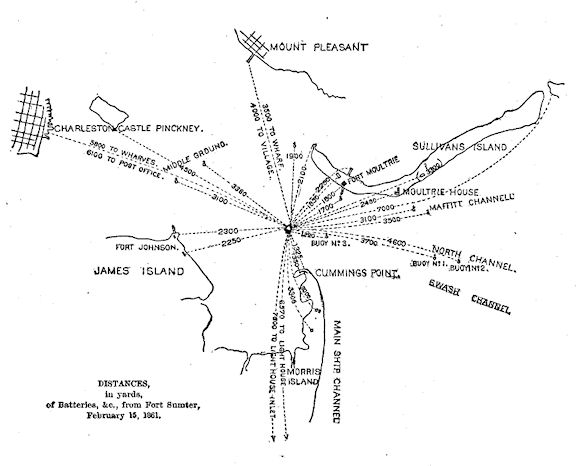
Distances of South Carolina batteries from Fort Sumter

War of the Rebellion: from the Official Records of the Union and Confederate Armies and Navies
Distances of South Carolina batteries from Fort Sumter
0 comments

Fort Sumter

Civil War Day-by-Day

February 15, 1861; The Charleston Mercury

THE TIME IS APPROACHING WHEN FORT SUMTER will probably be attacked. Let the assailants remember that the garrison are, in the main, poor hirelings, bound to obey the orders of their superiors, and, doubtless, not disposed to fight if they could avoid it. That they are not responsible for the acts of the President, or of the United States, and that not one of them should be put to death, but as a necessary measure to secure the fort to South Carolina. Let not one be killed after the fort is surrendered; let as little blood be shed as possible.

A.B. LONGSTREET.

0 comments

Lincoln Speaks

Civil War Day-by-Day

February 15, 1861; The Charleston Mercury

That our readers may not fail to understand the views and policy of LINCOLN, as regards the Confederate States, we call attention to his remarks at Indianapolis. In his opinion, the United States, holding those forts which have not yet been captured, and retaking those which have been captured by the Confederate States, and the collection of duties in their harbors, is neither coercion or invasion, but a gentle exercise of legitimate power towards so many rebellious counties, to bring them to their senses. LINCOLN is a cool man; an able man; a determined man; a man not of words, but of action, who says what he means, and means what he says; an earnest man withal, and no politician. Our readers may come to their own conclusions.

0 comments

Our Washington Correspondence

Civil War Day-by-Day

February 15, 1861; The Charleston Mercury

WASHINGTON, February 12, 1861.

At a single bound, we have leaped from thrilling regions of thick ribbed ice into the heart of the tropics. The heat is almost intolerable. Great masses of thick clouds are floating overhead; the streets and avenues are alive with dashing vehicles and well dressed promenaders. Hired soldiers, arrayed in the uniform of the United States, are visible everywhere. This is the day for counting the votes, and of course the mercenaries are on the alert.

The Virginia Convention meets in Richmond tomorrow. Instead of sucking its thumbs in peace till the conclusions of the Peace Congress are reached, it will begin at once a fierce war in regard to State politics; and it will not be the fault of BOTTS, LETCHER, and STUART, if in the end the Old Dominion is not divided in twain. These men will stickle at nothing to accomplish their purpose of personal aggrandizement. Encouraged by the late election in their State, and greatly elated by the result in Tennessee, they will join hands with ANDREW JOHNSON to keep the people where they now are, completely under their feet. Indeed it is but too apparent that they have sold their Motherland into bondage to SEWARD and DOUGLAS.

In the course of the Senate debate on yesterday, in regard to the bill authorizing the government to build seven steam vessels of light draught and heavy armament, KING and FESSENDEN came out openly and above board in favor of coercion. KING was peculiarly fierce. His age and enormous bulk preclude the possibility of fighting; he can well afford, therefore, to talk terrifically. GREEN, of Missouri, obtained the floor, and will reply to the ferocious New Yorker today. GREEN is a man of considerable natural ability; unpolished, though; and careful rather of his points than his rhetoric. He is true to the South.

The anti abolition party in the Border States are by no means content with a single defeat. They are ready and willing to [continue reading…]

0 comments

The Inauguration of Mr Lincoln—The Armed Occupation of the Federal Capital by Federal Troops to Secure the Peaceful Inauguration of the President-Elect

Civil War Day-by-Day

February 15, 1861; The New York Herald

Our Washington Correspondence.

WASHINGTON, Feb. 14, 1861.

The first intimation the public received that Lieutenant General Winfield Scott meditated the occupation of the federal capital by federal troops was through a telegraphic despatch sent by the General from the city of Washington to Fort Leavenworth some two months ago. In this despatch General Scott ordered the presence here, with the utmost despatch, of the United States troops stationed at Leavenworth, excepting a few who were retained to garrison the fort. The nature of this order leaked out somewhere on the line between Washington and St. Louis and the fact was published in the newspapers, much to the chagrin of General Scott, and much to the alarm of some people and to the indignation of others in the federal capital. This initiative movement of General Scott once becoming known, there was but little, at any rate no extraordinary pains taken to conceal subsequent proceedings of a similar character.

WHY GENERAL SCOTT ORDERED THE TROOPS HERE.

Early as November last the acting Commander-in-Chief received intimations that the capital would be in danger on or before the 4th of March. He was informed, from time to time, that bodies of armed men, with hostile intent against the incoming administration, were holding secret meetings, and forming the most diabolical plans against the federal capital. These secret meetings, according to his information, were held in the adjoining States of Virginia and Maryland (especially in the city of Baltimore) and in the city of Washington itself. At one time it was reported that a force of ten thousand men was organized in Virginia to invade the District of Columbia. A close surveillance was instituted in this city upon all military meetings of a secret and suspicious character. General Scott was kept regularly informed of the proceedings of at least one of these meetings, through the faithlessness of one of the conspirators. These organizations, there is reason to believe, at one time numbered some seven hundred men, and were daily or nightly increasing in [continue reading…]

0 comments

More Unconstitutional Violence of the New York Police

Civil War Day-by-Day

February 15, 1861; The New York Herald

On Wednesday last the New York police, notwithstanding their being compelled to surrender the greater portion of the muskets which they seized belonging to the State of Georgia, committed another act of depredation against the rights of Southern citizens. They seized a quantity of cartridges about being shipped for South Carolina, by way of Savannah. These highhanded proceedings can only irritate and annoy the Southern States, and take away trade from New York, without doing any good to the North or harm to the South; for both the Georgians and South Carolinians can obtain all the ammunition and arms they want from the border slave States and even from New England, whose Yankees will sell anything for cash down, to say nothing of Old England, France and other nations of Europe. It is the duty of Governor Morgan to put an end to this illegal violence by ordering the ammunition to be given up.

It appears that the Georgia case is not fully settled yet. The arms are not all surrendered, as they ought to have been. In consequence of the retaliation of the Governor of Georgia, the greater portion of the muskets have been delivered up; but for some inexplicable reason or other Superintendent Kennedy has retained ten cases, which belong to a different owner in Georgia. The police allege that they belong to that State, and, therefore, refuse to give them up. Now this is a distinction without a difference. The State of Georgia has as good a right to the free possession and use of arms as the State of New York. Yesterday a writ of replevin was issued, and what the result will be remains to be seen.

When we first heard of the seizure of these arms we knew it would lead to serious trouble, and we said so at the time. We denounced the act as unconstitutional, and we advised its repudiation by the Governor and the immediate surrender of the arms, with a suitable apology for the hostile proceeding. If it was not an act of war it was a violation of the rights of private property, and in either case indefensible. Ample time had been given to repair the mischief, but instead of that, the arms were refused when demanded by the Governor of Georgia, and the authorities have been since compelled by retaliation to give way, and to do from necessity what they might have done voluntarily with a good grace, to the honor of the State, and not, as afterwards to its humiliation. The best thing that can be done now is to surrender at once the ten [continue reading…]

0 comments

The News

Civil War Day-by-Day

February 15, 1861; The New York Herald

The committee of the Peace Convention to whom was entrusted the task of devising an adjustment of the troubles of the nation were busy at their work yesterday. Everything has, it is reported, been arranged, on the basis of Mr. Guthrie’s proposition, excepting the territorial question. On this point, while the border State members desire a permanent settlement, by including all territory now held or that may be hereafter acquired, the Northern republicans desire a temporary settlement by applying the compromise to existing territory only. The committee will probably report a plan to the Convention today.

The ten cases of muskets intended for Georgia, and seized by the police, have been replevined by H. B. Cromwell & Co. The gunpowder seized by the police on Wednesday, and also intended for Georgia, will not, it is said be replevined, as the legal proceedings would probably cost as much as the articles are worth. Proceedings, however, may be taken, in order to strengthen the admitted illegality of such seizures.

0 comments

Confederate Congress Resolution in Relation to the Occupation of Forts Sumter and Pickens

Civil War Day-by-Day

Resolved by the Confederate States of America in Congress assembled, That it is the sense of this Congress that immediate steps should be taken to obtain possession of Forts Sumter and Pickens, by the authority of this Government, either by negotiations or force, as early as practicable, and that the President is hereby authorized to make all necessary military preparations for carrying this resolution into effect.

Passed February 15, 1861.

0 comments

The Young Guard

Civil War Day-by-Day

February 15, 1861; Richmond Enquirer

Military balls are unquestionably the most attractive of all festivals. No opera, nor drama, nor civic ball, nor anything else that we know in the line of public entertainment, can produce such flutter among hoops or in the dear little hearts that lie hidden behind boquets and cotton, as those assemblages where women and brave men do congregate. There is something in the rattle of the sabre that sets said little hearts agoing pit-pat, and there is something in the glitter of the golden epaulette that makes the eye of girlhood glisten with increased lustre. On no arm does woman dear lean with more pride and confidence that on that of the soldier boy, and, there is no passport so sure to a woman’s heart as the gay uniform of him who belongs to bold brigade.

The Young Guard will have a ball on the 22d, at the Central Hotel, on 9th street and if dashing uniforms and dashing fellows inside them have the effect we have spoken of – and who doubts it? – many a heart will be carried into captivity, and there will be many secessions in behalf of the Southern union.

0 comments

Civil War Day-by-Day

Civil War Day-by-Day

February 15, 1861

  • Provisional Confederate Congress
    • votes to take Ft. Sumter and Ft. Pickens (FL) by force if necessary
    • passes a resolution to appoint commissioners to the USA to negotiate friendly relations
  • Delegates from Texas arrive at the Convention of Seceding States (now the Provisional Congress of the CSA)
0 comments

Diary of Horatio Nelson Taft

Diary of US patent clerk Horatio Nelson Taft.

THURSDAY 14

This day has passed off much as others have of late, nothing very startling having occured. J C Wright, a member of the “Peace Convention” from Ohio, died yesterday. His funeral took place in the Hall of the Convention today. We attended the Musical soire of Miss Douglass this evening. A great crowd there and some of the notables of this City, some Members of the Cabinet, some M.C.s, some Artists &c. Music was fine, refreshments very nice. The crowd very genteel but quite too large. Got home 1/4th past 11 o’clock but left the crowd there.


The three diary manuscript volumes, Washington during the Civil War: The Diary of Horatio Nelson Taft, 1861-1865, are available online at The Library of   Congress.

0 comments

Are secessionists more intellectual than Union men? In what have they displayed it? Are they more patriotic? What proofs have they given of the fact? —Rev. James W. Hunnicutt.

Miscellaneous document sources

From the following brief article the reader can form some idea of the persecution to which Union men had to submit in the town of Fredericksburg as early as the 14th of February, 1861, the date of its publication:–

“Why is it that secessionists talk of compromise with derision? Why is it that they wish to precipitate Virginia out of the Union? Why is it that they call conservative or Union men ‘Submissionists,’ ‘Black Republicans,’ ‘Abolitionists,’ ‘ Traitors and enemies to the South,’ &c. &c.? Are secessionists more intellectual than Union men? In what have they displayed it? Are they more patriotic? What proofs have they given of the fact? Are they more brave? Why then did they vacate their seats in the Senate and Congress halls of the United States, thus virtually surrendering all their rights into the hands of their enemies? Why, in the hour of their country’s peril, did they retreat into the Gulf States, having as a safeguard the Atlantic Ocean on the one side, and the border States between them and danger on the other side? There is no submission in all this, is there? Very brave, is it? In what have Union men compromised their honor or dignity? It is not honorable, not dignified, for a man to stand his ground and fight for his rights on his own soil, and sacredly maintain the trust the people have confided in him! But it is very honorable, quite dignified, for a man to throw down his legal weapons of defence and run away, and belt on the sword, and swear if the enemy comes to him he’ll thrash him out! This is very brave, is it?

“What rights have secessionists to protect that Union men have not? Have Union men no civil, religious, and domestic rights to protect? We think it bad policy for secessionists who would break up the peace and harmony of the Government, and plunge the whole country into civil war, to be accusing their fellow-citizens, who are trying to pour oil upon the troubled waters and are making all possible efforts to bring about peace and harmony, of being ‘Submissionists,’ ‘Black Republicam,’ ‘Abolitionists,’ and ‘ Traitors’ and ‘Enemies to the South'”


“The Conspiracy Unveiled. The South Sacrificed; the Horrors of Secession.” Rev. James W. Hunnicutt (Editor of the Fredericksburg (Va.) Christian Banner); 1863, Philadelphia; J. B. Lippincott & Co.


“The Union, Now and Forever, One and Inseparable.”

0 comments

Our Washington Correspondence

Civil War Day-by-Day

February 14, 1861; The Charleston Mercury

In spite of the constant excitements to which it has been subjected during the past two months, the sensibility of Washington is not yet extinct. Gov. BROWN’S bold reprisals at Savannah, and the seizure of the Arsenal at Little Rock, turned up the depths on Saturday. The commotion soon subsided. As soon as New York gave up the arms, Georgia released the ships, and the game at forfeits ended. It is a consolation to know that Arkansas has put her foot in it. Mr. MEMMINGER may put eight stars in his cross. The flag containing fifteen stars may be laid aside as an interesting relic, until the number is made up by the addition of States lying south of Texas. The Northern slave States have deliberately chosen an Abolition master, and all that true Southern men now living in these States ask is permission to come among you, bringing their slaves with them. The movement at expatriation has already commenced in Virginia.

Southern men here are delighted – no other word will convey the fullness of their satisfaction – at the election of DAVIS and STEPHENS, and the established fact of an organized Southern Confederacy. All predict a happy and proud future for the new Republic, and I have yet to see the man, with a spark of fire in his breast, who does not openly express his desire to share your fortunes, whether for weal or woe. Constitutional liberty, freedom from Abolition outrage, freedom from a negro equality and military despotism – these are priceless blessings. How men of the Border States can choose to forego them, passes my comprehension. Providence seems to have decreed it so. We all trust and believe that firmness and prudence will characterize the actions of your rulers, and so believing, we join, with one accord, and with full hearts, in wishing you God speed. As to the recognition of your Confederacy among the powers of the civilized world, no one entertains a serious doubt. There will be a good deal of higgling and piggling among the Republicans, but they are obliged to knock under a little, or lose the Border Slave States.

Coercive measures are by no means abandoned. Bills authorizing the President to close ports at his discretion, and to call out the entire militia force in addition to the regular army and navy, to aid him in enforcing the laws, will be put on their passage today or tomorrow, and be pushed through as soon as possible.

SEVEN.

0 comments

The National Crisis—Military Movements at the National Capitol

Civil War Day-by-Day

February 14, 1861; The New York Herald

WASHINGTON, Feb. 13, 1861.

Owing to the apprehensions of a conspiracy of purpose in seizing the public buildings they have been privately guarded, though not in large force, some three weeks past; and, in addition to other fears, the blowing up of the Capitol was regarded as an event not impossible, and hence every night a thorough examination of the cellars and vaults of that building has been made by the Capitol police, to be sure that no explosive materials had been there clandestinely deposited for such purpose.

Today the officers of the artillery were on duty for the purpose of immediately communicating with Congress should an attempt be made to attack the Capitol, and the military forces were ready to advance at a minute’s warning. But there was nothing whatever visible to excite the least apprehension, and it can safely be asserted that never during the last twenty years at least has the counting of the Presidential electoral votes been attended by better, if as good, order as on the present occasion.

Governor Hicks, of Maryland, was examined today by the special committee. His belief that a conspiracy existed in connection with the federal capital was, he said, superinduced by private and anonymous letters and newspaper articles, and that such combinations did not exist in Maryland but in other Southern States. That at the time of his publication, in the beginning of January, he was satisfied there were existing organizations, having in view an illegal interference with the federal authorities and the seizure of public property, but for some time past whatever may have been the designs of any secret confederations or associations, he was satisfied that such purposes have been abandoned. The special [continue reading…]

0 comments