The President

Civil War Day-by-Day

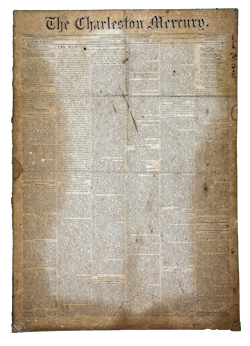
February 28, 1861; The Charleston Mercury

For many days past rumors have been rife to the effect that JEFFERSON DAVIS, president of the Confederate States, was on his way to Charleston. Yesterday morning some color was given to these reports by the publication of a despatch, dated Montgomery, announcing the departure of the President for this city.

It is scarcely necessary for us to say that, had such been the case, the readers of THE MERCURY would have been duly informed of the fact in our special despatches from Montgomery. President DAVIS is still in that city, and from present appearances is likely to remain there.

We may add that General DUNOVANT was yesterday summoned by telegraph to the seat of the Provisional Government, to confer with the Secretary of War.

0 comments

Civil War Day-by-Day

Civil War Day-by-Day

February 28, 1861

  • The House passes a measure supported by President-elect Lincoln which prohibits the federal government from interfering with slavery in states where it exists.
  • North Carolina voters reject the call for a secessionist convention by 651 votes.
0 comments

The Prest announced to those assembled that the peace ‘Con’n’ had come to an agreement, and adjourned & that the Country was saved.”—Horatio Nelson Taft

Diary of US patent clerk Horatio Nelson Taft.

WEDNESDAY, FEBRUARY 27, 1861.

Weather warm, and air soft as May. The Peace Convention did not adjourn yesterday, but did today, Sine die, after voting for compromise resolutions which are deemed very satisfactory to all parties. At 1/2 past ten o’clock today most of the Govt Employees paid their respects to Pres Buchanan at the “White House.” We were rcd by the Pres in the East room. The Prest announced to those assembled that the peace “Con’n” had come to an agreement, and adjourned & that the Country was saved. Took tea with Col Paine at Kirkwood House, and then went with him to see the Exhibition of Rarey, the famous Horse Tamer.


The three diary manuscript volumes, Washington during the Civil War: The Diary of Horatio Nelson Taft, 1861-1865, are available online at The Library of   Congress.

0 comments

Operations in Charleston Harbor — Confederate Records

War of the Rebellion: from the Official Records of the Union and Confederate Armies and Navies

“Major Whiting is here, and thinks our energies have been too much directed to attacking Fort Sumter, and not enough to the defenses of the harbor, so as to prevent re-enforcements, &c.”

STATE OF SOUTH CAROLINA,
Charleston, S.C., February 27, 1861.

The PRESIDENT OF THE CONFEDERATE STATES, &c.,
Montgomery, Ala :

DEAR SIR: I received yours dated the 22d instant by Colonel Lucas, inclosing the resolution of Congress expressly taking charge of the military operations in the harbor of Charleston. I have the fullest confidence that you and Congress will do everything that may be due to the honor and the rights of South Carolina.

Of course we feel that our honor and safety require that Fort Sumter should be in our possession at the very earliest moment possible. We have had great difficulties to contend with. By the extraordinary movement of the United States garrison from Fort Moultrie we were suddenly and unexpectedly precipitated into a situation which created the most hostile feelings, and were at the outset involved in the most scientific and expensive branches of modern warfare, where the most exact military knowledge and experience were required.

I felt this, and therefore telegraphed you to come by Charleston on your way to Mississippi, in order to consult on military matters, &c. I again sent to the governor of Georgia for General Twiggs, and then sent to you for a military engineer, as I desired the highest military approbation. Before taking the last step I earnestly wished the best military counsels.

Major Whiting is here, and thinks our energies have been too much directed to attacking Fort Sumter, and not enough to the defenses of the harbor, so as to prevent re-enforcements, &c. You will see him, and, of course, now we will await your orders and the directions of Congress, as we feel that our cause is common, and that it is due to our common government that we should do nothing to involve all the States united in a permanent war by any separate act of ours, unless it shall be necessary in self-defense or to prevent re-enforcements; but in the mean time I will go on with the same activity as ever in preparing our defenses and our men for any event that may arise.

We would desire to be informed if when thoroughly prepared to take the fort shall we do so, or shall we await your order; and shall we demand the surrender, or will that demand be made by you?

An answer to this by telegram is desired.

I have the honor to be, very respectfully, your obedient servant,

F. W. PICKENS.

0 comments

Civil War Day-by-Day

Civil War Day-by-Day

February 27, 1861

  • The Peace Convention proposes six constitutional amendments to Congress—most relate to the impasse over slavery. None passes. The House of Representatives rejects a call for a constitutional convention and the Crittenden Compromise.
0 comments

The News

Civil War Day-by-Day

February 27, 1861; The New York Herald

The Conference Committee of the two houses of Congress on the Senate’s amendments to the Tariff bill, levying a duty on tea and coffee, have agreed to recommend that the Senate recede from their position. The committee will make their report today, and as the tea and coffee tax is the only point in dispute between the two branches, the report will no doubt be accepted, and thus the bill be passed, and sent to the President for his signature. The bill complete is published in todaypaper, and its great importance will insure its attentive perusal.

Our Washington despatches announce that Mr. Simon Cameron, of Pennsylvania, will go into Mr. Lincoln’s Cabinet as Secretary of the Treasury. The struggle between the conservative and radical sections of the republican party in Washington is increasing in intensity and bitterness, as our reports from the capital this morning abundantly prove.

The Peace Conference at Washington has, after three weeks’ labor, accomplished nothing – a result generally anticipated. The Conference yesterday voted upon the first section of the adjustment, and defeated it by a vote of 12 to 8. The vote was subsequently reconsidered, in the hope that some plan may yet be proposed upon which a majority may unite. It is the general belief, however, that the Conference will not be able to do anything towards a settlement of the existing troubles of the country.

We have received a very interesting letter from the United States steamer Brooklyn, off Pensacola harbor, giving a detailed account of the effects and complete failure of secession in Florida. The garrison holding possession of the government property is represented as nothing more than a wild and undisciplined gang of revolutionists, plundering and robbing where and when the opportunity presents itself. Those on board the Brooklyn were anxiously awaiting orders to retake the property occupied by the secessionists, which they are confident of accomplishing, without any great exertion, in about two hours.

In the Legislature at Albany yesterday the Senate again had up the report of the Committee on Federal Relations, in reference to the present crisis of the country; but after some discussion further action was postponed to a future day.

0 comments

Prospectus of the Charleston and Liverpool Steamship Company

Civil War Day-by-Day

February 27, 1861; The Charleston Mercury

We call attention to the movement now on foot here, to establish a line of steamships with Liverpool for purpose of direct trade. It is a step forward, and one that is needed. A Revenue Tariff and Free Trade will rid the Southern peoples of Northern monopolists in manufacture, and enable them, to buy where they can buy cheapest, and to sell where they can sell to the best advantage in the markets of the world. Direct trade with their great customers of Europe, and with those who furnish the commodities we require in return – free from the levies of pampered manufacturing and factorage, which have so enriched the North, and so damaged the South – will restore us to our natural prosperity and respectability amongst the countries of the world.

Norfolk, Charleston, Savannah and Mobile have been but suburbs of New York, Philadelphia and Boston. These Northern cities have carried on the foreign trade for the Southern cities. Instead of receiving direct from our chief customers in Europe, their manufactured commodities in return for our agricultural productions, shipped direct, the Government of the United States has intervened, and by unjust Tariffs, first has prevented us from receiving the manufactured products of our foreign customers at lower prices, and compelled us to take Northern manufactures from Northern cities at higher prices; and, second, it has not only spent the money collected by the Tariff in Northern cities, but also, by United States Banks, made Northern cities the centres of credit. It has endowed them, by the capital of the Government, with artificial resources of commerce. It has made their citizens the factors and middlemen of all great mercantile operations, a business of immense profits and little risk. By these means, capital has been accumulating for a half century in Northern cities, and with it the increase of population which capital always produces; for capital is nothing but the wages of labor accumulated; and in order to increase, must continue to employ labor. Hence the rapid growth of Northern cities, and the lingering prosperity of Southern cities. In the Union, with the fixed policy of the Federal Government, there has been no hope of increase in our cities, corresponding to their natural advantages. The Northern cities have already the advantage in the accumulation of capital – for it is an axiom of trade, that, with equal advantages, the larger capital must undersell the smaller. Our trade, therefore, in the Union has been hopelessly colonial. Our natural commerce has been annihilated by the artificial channels of trade established by the Government. When the Constitution of the United States was [continue reading…]

0 comments

Loan for the Military Defence of the State $675,000

Civil War Day-by-Day

February 27, 1861; The Charleston Mercury

THE BANK OF THE STATE OF SOUTH CAROLINA is the Agent of the State to effect the Loan. The Bonds to be issued are for sums of $50, and $100, and $500 each – bearing an interest of SEVEN PER CENT, payable annually, at the State Treasury, and the principal is redeemable in 1868, 1870, and 1872.

Subscriptions for the Loan will be received by the Bank in Charleston and its Branches, and by all the Banks in the State. They will also be received by the Clerks of the Court, in the several Districts of the State. When the subscriptions are paid to the Bank of the State, the Bonds will be delivered.

The Bonds are made for small amounts, to give an opportunity for small subscriptions. It is expected that at the next session of the Legislature, the Bonds will be converted into Stock.

The purpose of this Loan presents an appeal to the patriotism of the people, which must secure its being promptly taken up. It is needless to enlarge on the momentous consequences dependent on the prompt completion of the Loan.

Apart from considerations of patriotism, the Bonds present the most advantageous investment of money which can be made. The interest is large, and the Security superior to any other that can be offered.

The citizens of Charleston and of the State are called upon to come forward promptly and take up the Loan.

0 comments

Presents to the President

Civil War Day-by-Day

February 27, 1861; The New York Herald

Everybody likes to make presents to a new President, especially everybody who wants an office or who likes to effect a little notoriety, and Mr. Lincoln has in consequence been a recipient of several favors of this kind, some of them of a very curious nature. Before he left Springfield he received a handsome cane from San Francisco, mounted in pure California gold in its virgin state. While on his route – somewhere, we believe, between Indianapolis and Cleveland – a very nice present, in the shape of a torpedo, with the fuse lighted, was found under his seat in the railroad car – an emblem, we suppose, of the hot time before him. A mysterious box was also presented to him somewhere else, which his suite exercised the great caution in opening, after mature deliberation, lest it should contain a torpedo or some other internal machine; but its contents proved to be a torpedo for the republican party, and not for Lincoln in person, for the box only enclosed the effigy of a negro. On another occasion he got a handsomely bound book; whether it was the Helper book or the constitution of the United States we are not aware.

When he arrived in New York some of the capitalists here presented him with a magnificent carriage; but they made a grave mistake in its construction, for it is not bombproof, and hence he has not been able to use it at all up to this time with any regard to his personal safety.

The latest gift presented to the new President is a handsome gold breastpin intended to be emblematic of Union; but, curiously enough, the device is composed of two flags crossed – one the unmistakeable of our Union, with its thirty-four stars displayed, and the other a rather misty delineation of a banner, which, we presume from its indistinctness, is intended to represent the flag that is to be of the Southern confederacy, but which is not yet decided upon. A bundle of sticks forms the basis of these two flags, which may mean to recall the fasces of the Roman liotors, the emblem of retributive justice which was borne before the magistrates of that republic, and perhaps indicates the policy which Mr. Lincoln is expected to pursue towards the seceded States; or it may be intended to symbolize the well known fable of Aesop: it is not very easy to tell which reading is the correct one. So far it would seem that the presents made to Old Abe are not very apropos.

0 comments

“Strangers are pouring into the City, and the Patent office is thronged from morning till night.”—Horatio Nelson Taft

Diary of US patent clerk Horatio Nelson Taft.

TUESDAY 26

Another fine day, air soft and warm as May. The “Peace Convention” adjourned today having passed resolutions which are said to be satisfactory to all except the extremists of both parties. Strangers are pouring into the City, and the Patent office is thronged from morning till night. Wrote to Julia today to come home if she can get good company. Wrote to Mr Redfield to provide it — for [her] if he can. Fixed up some bedsteads after dinner, got pretty tired, did not go out this evening as usual. People are indignant at the conduct of Genl Twiggs in Texas.


The three diary manuscript volumes, Washington during the Civil War: The Diary of Horatio Nelson Taft, 1861-1865, are available online at The Library of   Congress.

0 comments

Major Anderson and Captain Elsey

Civil War Day-by-Day

February 26, 1861; The Charleston Mercury

These two officers were placed in similar situations; their conduct has been the reverse, one of the other. Major ANDERSON has become the pet of a party; of Capt. ELSEY we hear nothing. Yet ELSEY has behaved, in a difficult situation, with consummate judgment. ANDERSON has complicated and embarrassed a delicate conjuncture of public affairs by hasty and inconsiderate action.

He was in command at Fort Moultrie. He was ordered to defend himself, if attacked by lawless assemblages. He changed his post, not only orders, but against orders. If ever there was an occasion in which it became an officer to confine himself to a strict obedience of orders, and not to go a hairbreadth beyond them, it was this. He did not obey his orders. He made a stampede from his post, destroyed the public property, and abandoned private stores, for which compensation was afterwards sought in Congress, without a shadow of just reason. There was no cause for his proceedings, except a false rumor of a riotous attack. By the act, he threw himself into an attitude of hostility to the State of South Carolina. He became a political partizan. He mixed himself up in questions with which he had nothing to do. He volunteered little effort of strategy and inaugurated civil war. It was a party movement, and made him immensely popular with a party. He received swords, salutes, and innumerable resolutions of approbation from all the politicians of the North of a certain class. He might well ask himself, under this load of praise, whether he has not done something very foolish, as a certain honest orator of old asked a friend whether he had not said something particularly absurd, when in delivering a speech he was applauded by the mob of listeners.

Now look at ELSEY’S proceedings in a similar position. He holds his post quietly. He listens to no idle rumors about mobs and riotous assailants. When the State of Georgia demands the surrender of his arsenal with an overwhelming force, he appreciates perfectly the exigencies of his position. Under the same orders with ANDERSON, he attempts no work of superogation; no act that would throw him into the arms of one or another political party. He is a soldier, and does his work like a soldier. He marches out of the post which he could no longer hold, and which no principle of honor required him to hold any longer, with bag and baggage. His flag is saluted. He received a receipt from the State authorities of all the Federal property which he leaves. He does not spike his guns, or destroy his ammunition, or break his muskets, or cut down his flagstaff. He simply does his duty, with no flourish. He has received no swords, nor salutes of cannon, nor applauses of pot house politicians or political partizans, nor eulogies from inflammatory party papers; but he has the approbation of every judicious man of all parties, and not an enemy has dared to assail the admirable propriety of his course.

Which of these two men has justly appreciated himself, his duty and the occasion on which he has been obliged to act? It was an unusual occasion. A blunder, therefore, like that of Major ANDERSON’S is pardonable. We can excuse, but we cannot approve.

0 comments

A Prospective Stampede.

Civil War Day-by-Day

February 26, 1861; Richmond Enquirer

Private advices from different parts of the State inform us that a large number of our largest slaveholders are already making preparations for an exodus, which they consider may be rendered necessary as well by the dilatory action of the Convention now assembled, as by final submission on the part of the Convention. When this prospective stampede shall once become present and actual, none can predict the extent to which it will be carried. – Some opine that some of our largest and most flourishing agricultural districts will be left as desolate as the wilderness of Jamaica. Even if it shall fall far short of this, it will still involve incalculable damage to all our interests. These large slaveholders comprehend a large quota of the very flower of our population – representing much of the wealth, talent, virtue and commanding influence of the State. they will carry away from us millions of property. They will carry away from us what is far more valuable to the State than property – thousands and tens of thousands of busy hands, which now constitute the PRODUCTIVE LABOR of the State.

Nor will the stampede be confined at all to slaves and slaveholders. If there shall be a stampede of large agriculturists, there will be a corresponding stampede of large merchants and manufacturers. If there shall be a stampede of slave labor, there will be a corresponding stampede of free white labor, now appreciated, dignified, and maintained by a demand created by slave labor. The large slaveholders are the principal customers of our large merchants and manufacturers. Moreover, the merchants and manufacturers will justly regard the exodus of the large slaveholders as an unmistakable indication of the final separation of Virginia from the Southern States, and her irrevocable dependence on a Northern Confederacy. Now, our large merchants and manufacturers have little or no Northern custom. Outside of Virginia, their custom is found almost exclusively in States South of Virginia.

What can they do, then, when their custom in Virginia shall be broken down by a prostration of the agricultural interest [continue reading…]

0 comments

The News

Civil War Day-by-Day

February 26, 1861; The New York Herald

Mr. Lincoln yesterday visited both houses of Congress and the Justices of the Supreme Court. His appearance at the Capitol created quite a sensation. In the evening he had an informal reception at his hotel. Mr. Lincoln was occupied during a portion of the day in perfecting his inaugural address. The rumors respecting Mr. Lincoln’s Cabinet are as plentiful as usual on the eve of a new administration. The following list is supposed to be not very wide of the mark: Secretary of State Mr. Seward, of N. Y.; Secretary of the Treasury Mr. Cameron, of Pa.; Secretary of War C. M. Clay, of Ky. or Montgomery Blair, of Md.; Secretary of the Navy Mr. Welles, of Conn.; Secretary of the Interior Mr. Smith, of Ind.’ Postmaster General Mr. Etheridge, of Tenn.; Attorney General Mr. Bates, of Missouri.

The Peace Conference at Washington were busy up to eleven o’clock last night discussing the points of the plans of adjustment before them, with a determination to settle the question, if possible, before adjourning. The main subject in dispute was the territorial question.

In the Southern Congress yesterday the Committee on a Permanent Constitution announced that they would report on Wednesday. Hon. Henry T. Ulett, of Mississippi, and Hon. Judah P. Benjamin, of Louisiana, were confirmed as Postmaster General and Attorney General respectively. Messrs. Abroman, of Louisiana; Mr. J. Crawford, of Georgia, and John Forsyth, of Alabama, have been appointed Commissioners to Washington.

Despatches from Texas announce that General Twiggs, the commander of the federal troops in that department, has turned over to the State authorities the property of the United States valued at $1,300,000. The federal troops were allowed to depart quietly. There are, we believe, about two thousand United States troops in Texas. General Twiggs, it will be recollected, has been offered the command of the Georgia State troops.

We publish in another column the new Tariff act recently adopted by the Congress of the Southern Confederate States. It will be seen that all kinds of provisions, agricultural productions in their natural state, and munitions of war are exempt from duty. All merchandise purchased in any of the States not members of the Southern confederacy, during the ten [continue reading…]

0 comments

Our Washington Correspondence

Civil War Day-by-Day

February 26, 1861; The Charleston Mercury

WASHINGTON, February 23, 1861.

Surprises are not always pleasant. Jaded by the excitement of yesterday’s military performance, to say nothing of the numerous balls at night, we were not prepared this morning to receive the news of LINCOLN’S arrival with that joyful enthusiasm which the suddenness of the occasion, and the meanness, if not the magnitude, of the event demanded. That the man of the people’s choice should select, of all other methods of reaching the capital of the United States, that method which a negro pilferer chooses when he would despoil a hen roost, is surely, to use old ABE’S language, ‘a most gratifying circumstance.’

After threatening to set his foot down firm, and announcing his entire willingness to be for the sake of anti slavery principles, the dirty old wretch creeps tremblingly across the soil of Maryland under the cover of darkness, and in defiance of the lying programme he had caused to be published. Here, with a thousand men at arms to guard him, he considers himself safe. It is hoped that the proud old State of Virginia will be inflamed with admiration of this daring performance, which was not on the bills.

The Commencement of the National Medical College came off at the Smithsonian Institute night before last, and from what the city papers say, I infer that the graduates from South Carolina and Mississippi were hissed, when their names were called to come forward and receive their diplomas. But this disgraceful occurrence was not needed to prove what has all along been known – that this city is as thoroughly abolitionized as Boston itself.

JOSEPH HOLT, who is more cordially and justly hated and despised than any man in the Cabinet, has refused to receive a box sent to him from South Carolina. The box, when opened at the ADAMS’ Express Company’s office, was found to contain beautiful flowers. No one dared to disturb these flowers, for fear of an explosion or of some subtle poison. HOLT does not deserve the honor of an assassination. But he is a marked man. If ever he ventures within the confines of the Confederate States, he will never return to practice coercion again. The breed of such traitors cannot be perpetrated among us.

0 comments

“Mr & Mrs Lincoln were holding a Levee in their parlors and we went up and were introduced.”—Horatio Nelson Taft

Diary of US patent clerk Horatio Nelson Taft.

MONDAY 25

It has been a delightful day and the streets are nearly dry. Nothing in particular has occured in the City. Everything moves along as usual only there is getting to be a great crowd here. Called tonight with my wife on Mrs & Miss Butterfield at Willards Hotel. Mr & Mrs Lincoln were holding a Levee in their parlors and we went up and were introduced. Mrs L in one room and Mr L in an adjoining room. They are both quite ordinary looking people. I hope He is equal to the crises. To my Mind, appearances do not favor the conclusion that he is. A brilliant assembly at the Hotel, staid there two hours.


The three diary manuscript volumes, Washington during the Civil War: The Diary of Horatio Nelson Taft, 1861-1865, are available online at The Library of   Congress.

0 comments

Politics, power and influence in Montgomery.—A Diary From Dixie

Civil War Day-by-Day

February 25th.–Find every one working very hard here. As I dozed on the sofa last night, could hear the scratch, scratch of my husband’s pen as he wrote at the table until midnight.

After church to-day, Captain Ingraham called. He left me so uncomfortable. He dared to express regrets that he had to leave the United States Navy. He had been stationed in the Mediterranean, where he liked to be, and expected to be these two years, and to take those lovely daughters of his to Florence. Then came Abraham Lincoln, and rampant black Republicanism, and he must lay down his life for South Carolina. He, however, does not make any moan. He says we lack everything necessary in naval gear to retake Fort Sumter. Of course, he only expects the navy to take it. He is a fish out of water here. He is one of the finest sea-captains; so I suppose they will soon give him a ship and send him back to his own element.

At dinner Judge _____ was loudly abusive of Congress. He said: “They have trampled the Constitution underfoot. They have provided President Davis with a house.” He was disgusted with the folly of parading the President at the inauguration in a coach drawn by four white horses. Then some one said Mrs. Fitzpatrick was the only lady who sat with the Congress. After the inaugural she poked Jeff Davis in the back with her parasol that he might turn and speak to her. “I am sure that was democratic enough,” said some one.

Governor Moore came in with the latest news–a telegram from Governor Pickens to the President, “that a war steamer is lying off the Charleston bar laden with reenforcements for Fort Sumter, and what must we do?” Answer: “Use your own discretion!” There is faith for you, after all is said and done. It is believed there is still some discretion left in South Carolina fit for use.

Everybody who comes here wants an office, and the many who, of course, are disappointed raise a cry of corruption against the few who are successful. I thought we had left all that in Washington. Nobody is willing to be out of sight, and all will take office.

“Constitution” Browne says he is going to Washington for twenty-four hours. I mean to send by him to Mary Garnett for a bonnet ribbon. If they take him up as a traitor, he may cause a civil war. War is now our dread. Mr. Chesnut told him not to make himself a bone of contention.

Everybody means to go into the army. If Sumter is attacked, then Jeff Davis’s troubles will begin. The Judge says a military despotism would be best for us–anything to prevent a triumph of the Yankees. Al l right, but every man objects to any despot but himself.

Mr. Chesnut, in high spirits, dines to-day with the Louisiana delegation. Breakfasted with “Constitution” Browne, who is appointed Assistant Secretary of State, and so does not go to Washington. There was at table the man who advertised for a wife, with the wife so obtained. She was not pretty. We dine at Mr. Pollard’s and go to a ball afterward at Judge Bibb’s. The New York Herald says Lincoln stood before Washington’s picture at his inauguration, which was taken by the country as a good sign. We are always frantic for a good sign. Let us pray that a Cffisar or a Napoleon may be sent us. That would be our best sign of success. But they still say, “No war.” Peace let it be, kind Heaven!

Dr. De Leon called, fresh from Washington, and says General Scott is using all his power and influence to prevent officers from the South resigning their commissions, among other things promising that they shall never be sent against us in case of war. Captain Ingraham, in his short, curt way, said: “That will never do. If they take their government’s pay they must do its fighting.”

A brilliant dinner at the Pollards’s. Mr. Barnwell ¹ took me down. Came home and found the Judge and Governor Moore waiting to go with me to the Bibbs’s. And they say it is dull in Montgomery! Clayton, fresh from Washington, was at the party and told us “there was to be peace.”

____

¹ Robert Woodward Barnwell, of South Carolina, a graduate of Harvard, twice a member of Congress and afterward United States Senator. In 1860, after the passage of the Ordinance of Secession, he was one of the Commissioners who went to Washington to treat with the National Government for its property within the State. He was a member of the Convention at Montgomery and gave the casting vote which made Jefferson Davis President of the Confederacy.

0 comments

L. K. Bowen to Howell Cobb

Miscellaneous document sources

This ruse by Lincoln

Washington [D. C], Feby. 25th, ’61.

My Dear Sir: I enclose you a slip from the Sun of this morning communicating facts you may not otherwise get as to the extraordinary movements of Mountebank Lincoln. Some incidents in Balto. the papers discreetly omit.

At the Calvert station there were not less than 10,000 people, and the moment the train arrived, supposing Lincoln was aboard, the most terriffic cheers ever heard were sent up, three for the Southern Confederacy, three for “gallant Jeff Davis” and three groans for “the Rail Splitter.” Had Lincoln been [there], contrary to my preconceived opinions, I now believe he would have met with trouble. The cause of the feeling was the impudent app[oin]tm[en]t the day before of 100 Black Republicans to escort him through the city. It was this fact which induced his friends wisely to anticipate trouble, and it would have occurred. The moment the crowd ascertained his family without him were on board they retired quietly in disgust.

This ruse by Lincoln has produced an active feeling amongst our people and hurried their action, and we thank him for it.

Ere long now we hope to see Va. and Md. move and join your noble confederacy.


From Annual Report of the American Historical Association for the Year 1911.

0 comments

The News

Civil War Day-by-Day

February 25, 1861; The New York Herald

Much excitement was caused in this city and throughout the country on Saturday by the announcement that the President elect had quietly left Harrisburg on Friday night by a special train and made his appearance in Washington early the next morning. All sorts of rumors and opinions were current in regard to this change of programme, some asserting that it was from fear of assassination on the route or in Baltimore, and other declaring that, shortly after leaving Springfield, Mr. Lincoln had made up his mind to act in the manner he did. Our despatches this morning from Washington state that persons who are in the secret positively assert that for some time past a plot has been in existence against the President elect. A detective officer, who discovered the plot, carefully watched the conspirators and informed Mr. Lincoln and his friends of the facts while on their way to Philadelphia. On the other hand, the people of Baltimore deny that there was ground for apprehending any difficulty in regard to the President elect, and state that arrangements had been perfected for giving him a reception suitable to his position. On Saturday Mr. Lincoln called on President Buchanan, and was introduced to the members of the Cabinet. In the evening the members of the Cabinet, the members of the Peace Conference and a large number of ladies and gentlemen were received by Mr. Lincoln at Willard’s Hotel. Early Saturday evening Mrs. Lincoln and the party comprising the Presidential suite arrived in Washington. Yesterday Mr. Lincoln, in company with Senator Seward, attended divine service at an Episcopal church, and was the observed of all observers.

From the South we learn that some decisive movement was expected to be made this week in regard to Forts Pickens and Sumter. The speech of the President elect at Indianapolis was looked upon as a declaration of war, and the only question at Montgomery was how to commence it advantageously. President Davis, it was reported, would take command of the army in person, and General Twiggs take command at Charleston. Despatches from Major Anderson report everything quiet. He was allowed to receive marketing and other necessaries from Charleston, and had all the intercourse with the city he desired. Captain Hazzard, who had arrived at Washington from Pensacola, reports matters quiet, but says he cannot tell how long they will remain so. Three thousand troops are believed at present to be enroute for Pensacola.

A strange steamer, supposed to be the Daniel Webster, which cleared from this port, with United States troops on board for Brazos, Texas, was, on Thursday last, fallen in with outside of Charleston bar. Governor Pickens was immediately notified of the fact, and proceeded to take measures to prevent her entering the harbor.

0 comments

Our Washington Correspondence

Civil War Day-by-Day

February 25, 1861; The Charleston Mercury

WASHINGTON, February 21, 1861.

Those in the middle classes, who have access to the soldiers now quartered here, and are on intimate terms with them, assure me that they are just as anxious as the citizens themselves that matters should be amicably adjusted. Many of them, some say a majority, affirm that when the worst comes to the worst they will not fight against the South. Those who can resign, will do so; those who cannot, will desert.

A great deal of breath has been wasted in the Peace Congress about the acquisition of future territory. The old fogies argue just as if the Confederate States had no existence. All is based on the idea of the treachery of politicians. This is very silly. Not one inch of soil will ever be added to this Union south of the Rio Grande. All expansion in that direction will be made by and for the Southern Confederacy. But the drift of the action of many really true Southern men in the Peace Congress shows that they are still laboring under the delusion of reconstruction. I heard one of them declare positively that the Gulf States would come back on the CRITTENDEN amendment. It really seems that the most intelligent men in the Border States are totally ignorant of the Southern people.

The returns from Arkansas and Missouri are very encouraging to the Republicans, who now, more than ever, are convinced that the Border States be kicked out.’ They are not far wrong. Certainly nothing short of steady kicking can do it. If the Border States are to be saved, LINCOLN will be their saviour. The natural desire of an ignorant man to atone for mental deficiency by assuming an immense amount of moral firmness, may lead him into acts of great folly and oppression. And his so called conservative Cabinet will join him, heart and hand, as soon as the reins of power are fairly within their grasp.

Northern men are slowing waking up to the fact that, when war begins, it will be waged on Northern soil; and even they who have urged the border States to remain in the Union as a barrier between the combatants, begin to think that this barrier will not only give way to the advance of the Southern army, but actually join it. When men get to fighting with revolvers, it is not usual for persons, even of the largest size, to stand in the way of the bullets. They step aside very quickly, and, if they happen to be so situated that they can do that, they join one party or the other, as a matter of security and self defence.

0 comments

Civil War Day-by-Day

Civil War Day-by-Day

February 25, 1861

  • President-Elect Lincoln meets with both houses of Congress
  • The Saratoga, a ship in the U. S. African Squadron, captures the sloop Express, a slave ship
0 comments

“There is a week (at least) of excitement in prospect in view of the Inauguration on the 4th.”—Horatio Nelson Taft

Diary of US patent clerk Horatio Nelson Taft.

SUNDAY, FEBRUARY 24, 1861.

A very windy day and rather cool but not freezing. The mud is drying up in the streets. The Lincolns are all here and it is understood that satisfactory terms have been agreed upon for a settlement of the difficulties as far as the North and the border Slave states are concerned. There is a week (at least) of excitement in prospect in view of the Inauguration on the 4th. No Trouble is now apprehended then. Mr Lincoln did not stand upon his dignity yesterday but called upon the Prest, Genl Cass, and the Cabinet who returned his in evening at Willards. There is a full moon and it is very pleasant out tonight.


The three diary manuscript volumes, Washington during the Civil War: The Diary of Horatio Nelson Taft, 1861-1865, are available online at The Library of   Congress.

0 comments

(Lincoln’s arrival) will be reflected on him and will be charged to timidity.

The Letters of Samuel Ryan Curtis

Washington Feby 24 1861

My dear wife

Although I have about finished a large table full of letters, I must not close writing till I give you a few broken sentences. Before this reaches you, you will hear of Mr. Lincolns arrival at this place, and that he came through by a night train without complying with his programme so unfortunately prolonged and so foolishly performed.1 I regret the whole matter. First that he made the array of a programme Second that he made light of grave questions, and finally that he did not carry out the programme at all hasards. But I make no open fuss about matters comparatively trifling and hope his inaugeration and policy may justify all our hopes. But there should not have been the least display of alarm. Courage and prudence are the utmost importance at this crisis of our affairs, and although his coming was no doubt a prudential arrangement made by others, yet it will be reflected on him and will be charged to timidity.

I have not called as yet to see him. I hear he looks care worn and weary, and I do not wish to annoy him. Certainly his position is not to be envied. The democracy may rejoice in leaving him a barren scepter. The great republic that has been the pride and glory of the world is I fear a broken vase which will defy the potters skill to restore.

But I will not despair. Some time may be given to things which will restore peace and harmony.

The breach has grown too wide and too deep to be remedied by threats or denunciations. Settlement or civil war is now the dilemma. I see you and other friends so remote still mistake the matter as a new Slavery question, and overlook the greater evil which is here more appararent because it seems to sap the foundation of Civil Society and threaten the peace of every fireside in the country. Liberty must subscribe to law or anarchy follows and despotism after. Many are now beginning to long for a stronger government. If the republicans break up and democracy resume the ascendance, the danger is they will supply anarchy with a powerful military government. Even if republicans hold power they must materially increase their military strength. A firm but very prudent policy may conquer revolution: but every step we take is so persistently misconstrued and used to aid the Southern excitement; it is still hard to tell what a day or an hour may bring forth. Virginia hangs on a pivot. Her Convention might turn the scale either way. She has checked the progress of revolution but holds the shafts in her hand ready to let them loose if the peace Convention does not relieve the terror of her people. Maryland stands ready to follow Virginia in whatever may be her determination. In the mean time the masses are thrown out of employment. They are restive and revengeful: and unfortunately in all this region their misfortunes are charged on republican rule; although republicans are not yet in power. The inaugeration is likely to be a gloomy pageant. There will be apprehensions although I think there will be no danger. But the anxiety will be apparent, and the display will therefore appear gloomy.

During the past week I have been going to and fro between Congress and the Peace Convention, at the same time laboring to keep up my everlasting correspondence. The city is becoming crowded with strangers among them many from Iowa including Mr Graham Hawkins Taylor and Mr. Kasson all of whom you know.2 Sadie is very well and is expecting Mr Bridgeman3 with Clara and his sister tomorrow to spend a few days. We have got rooms adjoining for them and therefore they will be very near us.

I received letters from Sam and Henry both today. Sam is at Denver or was when he wrote on the 2nd and Henry is at home from whence no doubt he will write you very fully. Sam wants the Post Office at Denver and I am going to try hard to get it for him. The delegate4 goes for him and says he has a right to it being quite as prominent and efficient as any other public man connected with the public service out there.

Goodril is excited about the Post office or some other office and you must try to cool him down. It would not do to get him the Post Office in the face of so many prominent political aspirants and I am surprised that he should have dreamed of it. James too wants office. He is better known among political circles but I am so overshadowed and overloaded with applications I can form no idea of what I may be able to do. I will do the best I can for both of them of course consistant with justice and reason.

You better not show them this letter, but quietly cool their arder as much as you can: for they must be disappointed in the scramble that surrounds the avenues of power.

It is about 8 oclock P M and I have not been out doors today. Kiss little Caddie for me. This is the last week of this Congress during which I have a vast amount to do. After the adjournment I hope to have a little more time to consider matters about which my constituents are anxiously looking and I shall therefore stay long enough to fix up my papers and see the lay of the field for office

Affectionately yours
Saml. R. Curtis


1. Abraham Lincoln’s progress towards Washington, an 11 day trip, took him through the major cities of the north. On Feb. 22, at Philadelphia, he was persuaded to forgo the stop at Baltimore upon representations of a plot to assassinate him there. In consequence he boarded a special train and slipped into Washington by night, arriving at 6 A. M. February 23. The reaction of Curtis was a feeling possessed by many, although definitely difficulties would have been encountered in Baltimore. Cf. Sandburg, Abraham Lincoln, the War Years, I.

2. Hawkins Taylor, resident in Iowa since 1836, prominent in county politics, was an early Republican supporter of Abraham Lincoln. He succeeded Curtis as Mayor of Keokuk in 1857. His appointment as Special Mail Agent was made shortly after March, 1861.
John A. Kasson, able lawyer, suave diplomat, efficient administrator, with Taylor was a member of the Iowa delegation at Chicago in 1860. His reward was the appointment as First Assistant Post Master General in 1861. Aside from three periods as representative in Congress, Kasson gave distinguished service to the nation as ambassador abroad and in the administrative negotiation of numerous special treaties and at numerous international conferences in the post Civil War years.

3. Arthur Bridgeman, an Iowa settler since 1838, merchant, Register of the U. S. Land Office at Fairfield, and railroad promoter, by common courtesy called “General.” A native of Massachusetts, he was since 1849 a resident of Keokuk.

4. Hiram P. Bennett. The territory was not granted a delegate officially until February 28, 1861.
0 comments

War Diary of a Union Woman in the South

War Diary of a Union Woman in the South

Feb. 24, 1861.–The toil of the week has ended. Nearly a month has passed since I wrote here. Events have crowded upon one another. A lowering sky closes in upon the gloomy evening, and a moaning wind is sobbing in every key. They seem in keeping with the national sorrow, and in lieu of other sympathy I am glad to have that of Nature to-night. On the 4th the cannon boomed in honor of Jefferson Davis’s election, and day before yesterday Washington’s Birthday was made the occasion of another grand display and illumination, in honor of the birth of a new nation and the breaking of that Union which he labored to cement. We drove to the race-course to see the review of troops. A flag was presented to the Washington Artillery by ladies. Senator Judah Benjamin made an impassioned speech. The banner was orange satin on one side, crimson silk on the other, the pelican and brood embroidered in pale green and gold. Silver crossed cannon surmounted it, orange-colored fringe surrounded it, and crimson tassels drooped from it. It was a brilliant, unreal scene; with military bands clashing triumphant music, elegant vehicles, high-stepping horses, and lovely women richly appareled.

Wedding cards have been pouring in till the contagion has reached us; Edith will be married next Thursday. The wedding dress is being fashioned, and the bridesmaids and groomsmen have arrived. Edith has requested me to be special mistress of ceremonies on Thursday evening, and I have told this terrible little rebel, who talks nothing but blood and thunder, yet faints at the sight of a worm, that if I fill that office no one shall mention war or politics during the whole evening, on pain of expulsion. The clock points to ten. I must lay the pen aside.


Note: To protect Mrs. Miller’s job as a teacher in post-civil war New Orleans, her diary was published anonymously, edited by G. W. Cable, names were changed and initials were generally used instead of full names—and even the initials differed from the real person’s initials. (Read Dora Richards Miller’s biographical sketch.)

0 comments

A Carriage for Mrs. Lincoln

Civil War Day-by-Day

February 24, 1861; The New York Herald

A few gentlemen of this city have presented to Mrs. Lincoln an elegant coach, made to order by Messrs. Brewster & Co., of Broome street. It was forwarded to Washington on Saturday.

0 comments

Startling Intelligence—Sudden Departure of Mr. Lincoln for Washington—Alleged Plot to Assassinate Him

Civil War Day-by-Day

February 24, 1861; The New York Herald

THE ASSOCIATED PRESS DESPTACH.

HARRISBURG, Feb. 23, 1861.

The people of this city were astounded this morning by an announcement that Mr. Lincoln had started in a special train for Washington, despatches having been received requiring his presence in that city. Reports are busily circulated that there was a plot to assassinate him while passing through Baltimore, but such stories are not believed. The Baltimore Committee is here, but did not have an interview with Mr. Lincoln.

OUR SPECIAL DESPATCH.

HARRISBURG, Feb. 23, 1861.

The city was startled just now by a rumor that Mr. Lincoln had left by a special train. The information was said to have leaked out from Col. Summer, who was indignant at this flight, but was not made public until after the telegraph office closed for the night. Two hours before the HERALD reporter obtained the facts, but was kept locked in a room, unable to use them, until half an hour before the despatch was written.

The details of the whole affair were obtained by him, and even rumor has not hinted them all. In brief, Mr. Lincoln, the President elect, left Harrisburg secretly at six o’clock last evening, took a special train over the Pennsylvania Central Railroad to Philadelphia, thence took a special train to Washington, and before this news reaches New York will be, if no accident occurs, safe at the federal capital, and in charge of General Scott. The reason for this movement, so extraordinary and unprecedented, is that Mr. Lincoln’s friends believe, from information acquired – I am not permitted to tell how – that if he carried out his programme, and left by special train at nine this morning, the train would wither be [continue reading…]

0 comments