Accounts from other Journals

Civil War Day-by-Day

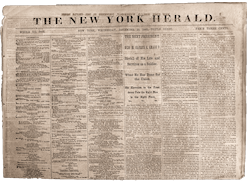
February 24, 1861; The New York Herald

(Special Despatch to the New York Times.)

HARRISBURG, Feb. 23. – 8 A.M.

Abraham Lincoln, the President elect of the United States, is safe in the capital of the nation. By the admirable arrangement of General Scott the country has been spared the lasting disgrace, which would have been fastened indelibly upon it had Mr. Lincoln been murdered upon his journey thither, as he would have been had he followed the programme as announced in the papers and gone by the Northern Central Railroad in Baltimore.

On Thursday night after he had retired, Mr. Lincoln was aroused and informed that a stranger desired to see him on a matter of life or death. He declined to admit him unless he gave his name, which he at once did. Of such prestige did the name carry that while Mr. Lincoln was yet disrobed he granted an interview to the called.

A prolonged conversation elicited the fact that an organized body of men had determined that Mr. Lincoln should not be inaugurated, and that he should never leave the city of Baltimore alive, if indeed, he ever entered it.

The list of the names of the conspirators presented a most astonishing array of persons high in Southern confidence, and some whose fame is not to this country alone.

Statesmen laid the plan, bankers endorsed it, and adventurers were to carry it into effect. As they understood, Mr. Lincoln was to leave Harrisburg at nine o’clock this morning by special train, and the idea was if possible to throw the cars from the road at some point where they would rush down a steep embankment and destroy in a moment the lives of all on board. In case of the failure of this project, their plan was to surround the carriage on the way from depot to depot in Baltimore, and assassinate him with dagger or pistol shot. [continue reading…]

0 comments

The Journey of a Night—The President Elect Incog

Civil War Day-by-Day

February 24, 1861; The New York Herald

A hundred years hence the night journey of the President elect of the United States, in the year of grace 1861, from Harrisburg, the capital of Pennsylvania, to Washington, the capital of the United States, will be read by wondering schoolboys, with all the circumstances and dreadful rumors and apprehensions resulting in this expedition, in the same frame of mind in which the rising generation of our time ponder over the flight of Mahomet or the adventures of Sinbad the Sailor. The particulars of this remarkable journey between two days, as far as received, are before our readers in the various despatches on the subject which he publish this morning.

It will be observed that, with all the facts thus placed before us, we are left a wide margin of conjecture as to the precise cause of this mysterious journey, and as to the time when it was arranged. Our Harrisburg correspondent tells us that, although not divulged to Mr. Lincoln till yesterday as some say, the whole plan was arranged days ago; but the special sensation despatch from the same quarter to a republican contemporary says that Thursday night (at Philadelphia), after he had retired, Mr. Lincoln was aroused and informed that a stranger desired to see him on a matter of life and death; that Mr. Lincoln (refused) to admit him unless he gave his name, which being given accordingly, prestige did the name carry, that while Mr. Lincoln was yet disrobed he granted an interview to the caller; that prolonged conversation elicited the fact that an organized body of men had determined that Mr. Lincoln should not be inaugurated, and that he should never leave the city of Baltimore alive, if indeed, he ever entered it. And hence this mysterious night journey to Washington.

There may be something in this report of the stranger call of Thursday night; for on the next day, in Independence Hall, Mr. Lincoln declared that he would rather be on this spot than abandon the cardinal principle of the Declaration of 1776 – a remark which indicated, perhaps, that his mind had been preoccupied with assassins and treasonable conspiracies. But this extraordinary manifestation of firmness on the 22d contributed not a little to intensify the public excitement, curiosity and astonishment, at the news that the President elect, under cover of the night, had doubled upon his track, and had slipped through incog to Washington. It appears, too, that he was ingeniously disguised in a long military cloak: and a ‘Scotch cap,’ the better to accomplish the secretive purposes of this adventure. The ‘Scotch cap,’ we dare say, was [continue reading…]

0 comments

The Trip of the Presidential Suite—Our Special Despatches on Special Presidential Train

Civil War Day-by-Day

February 24, 1861; The New York Herald

Between Harrisburg and Baltimore, Feb. 23, 1861.

The special train, with Mrs. Lincoln and party on board, left Harrisburg at nine o’clock, as arranged. The party were conveyed to the cars from the hotel in carriages. Very few people were out. There were no cheers, but denunciations of Mr. Lincoln’s secret departure were deep and unanimous. The republicans seemed to feel the most chagrined at the sudden movement.

All the party are on the train, though but few think we shall reach Washington without accidents. Colonel Ellsworth expects the train will be mobbed at Baltimore. The party is arranged as before, the Lincoln family, except Old Abe, in the rear car, and the balance of the party, including the reporters, in the front car. Only Mr. Judd and Major Lamon of Illinois are absent. Major Lamon was the only person who went with Mr. Lincoln.

I telegraphed Mr. Judd’s name by mistake this morning. He went on to Philadelphia in the regular train, at half past two o’clock. Major Lamon is only a militia officer.

The party don’t talk much. Judge Davis said that the telegraph was taken care of last night. The army officers are very angry. The republican on board, some of them editors of leading republican journals, are outrageous. They call it cowardly and draw a parallel between the conduct of Mr. Lincoln and the actions of the South Carolinians, very much to the disadvantage of the former. They say nothing can excuse or justify such conduct. These men who talk so are not in want of office. Ill-advised, injudicious, indeed every epithet is showered upon the movement. Still Mr. Lincoln is not blamed, but only his advisers. Others make a defence by saying that Mr. Lincoln can do as he pleases, that it is better to be prudent than rash, and that the matter was one of life and death.

Mr. Lincoln’s disinclination to go is also dwelt upon, as also the refusal of the Baltimore Council to invite him. It is now known, however, that this thing was discussed at Springfield and came very near being done at Pittsburg on Sunday. [continue reading…]

0 comments

The Arrival of Mr. Lincoln in Washington

Civil War Day-by-Day

February 24, 1861; The New York Herald

OUR SPECIAL DESPATCHES.

WASHINGTON, Jan. 23, 1861.

Mr. Lincoln arrived here at six o’clock this morning direct from Harrisburg, and was received at the depot by Senator Seward and Mr. Washburne, of Illinois, and proceeded very quietly to Willard’s Hotel. A private letter received here from Mr. Lincoln last night announced this change in his programme. He was advised by high authorities here to come through Baltimore in the night in order to avoid a difficulty growing up in that city about who should receive him and how it should be done. He was accompanied on the trip by Mr. Lamon, of Illinois, and Mr. Allen, of New York. Mr. Lincoln, after getting some rest, breakfasted privately.

Senator Seward received official intelligence on Thursday evening, from reliable sources, that most diabolical plot had been unsuccessfully arranged, on the part of a secret organization in Baltimore to assassinate the President elect on this arrival in that city. Mr. Seward communicated this intelligence to a few private friends, and it was determined to despatch a messenger at once to Philadelphia, informing him of the fact, and urging him to take an earlier train, which would bring him through in the night. Mr. Lincoln said he had received intelligence from Baltimore of a similar nature. A special train was accordingly arranged, and he departed at once for Washington.

It is positively denied by Baltimoreans that any such organization exists, or that any interference would have been made with the Presidential party. There is little doubt that the feeling and sentiment of the people of Baltimore is very bitter against Mr. Lincoln, so much so, indeed, that violence might have been attempted. It is regarded as a very wise move in giving them the slip.

Mr. Lincoln’s family, accompanied by his suite, will reach here this afternoon. A suit of five elegantly furnished rooms in the southwest corner of Willard, fronting on Pennsylvania avenue and overlooking the White House, have been set apart for President Lincoln and his family. [continue reading…]

0 comments

The News

Civil War Day-by-Day

February 24, 1861; The New York Herald

The city was thrown into great commotion yesterday by the receipt of intelligence that Mr. Lincoln, the President elect, had unexpectedly appeared in Washington city. Our despatches from Harrisburg on Friday night reported Mr. Lincoln quietly housed at that place, resting himself after the fatigue of his day’s journey from Philadelphia and his reception at the Pennsylvania State capital. It will be seen, however, from the accounts given in another part of today’s paper, that Mr. Lincoln friends apprehended that an attempt would be made to do him personal injury, either on the route to or upon his arrival at Baltimore, and they therefore persuaded him to change the programme of his journey. Accordingly Mr. Lincoln, accompanied by one of his suite only, left Harrisburg early on Friday evening, reached Washington at six o’clock yesterday morning, and quietly proceeded to Willard’s Hotel. All our reports from Baltimore strenuously deny that there was the slightest ground for apprehending any indignity to Mr. Lincoln in that city. Arrangements had been made to give him a proper reception, and precautions had been taken to prevent any popular disturbance. The real cause for Mr. Lincoln’s sudden departure from Harrisburg yet remains to be revealed. Mr. Lincoln yesterday visited Mr. Buchanan and General Scott, and dined with Senator Seward. In the evening he held a reception, when the members of the cabinet, the Peace Commissioners, and a large number of ladies and gentlemen waited upon him to pay their respects. Mrs. Lincoln, and the party comprising the Presidential suite, reached Washington early last evening.

The Peace Convention at Washington yesterday did not succeed in agreeing upon a plan for settling the troubles of the nation. It is believed, however, that in spite of the opposition of the radical republicans, the Convention will eventually adopt the Guthrie plan of adjustment.

0 comments

“Mr Lincoln arrived today by the morning train direct from Harrisburg without stopping in Baltimore.”—Horatio Nelson Taft

Diary of US patent clerk Horatio Nelson Taft.

SATURDAY 23

Another pleasant morning but rainy towards night. I had numerous calls today in the office from NY friends and two or three letters requesting me to attend to business for the writers. Mr Lincoln arrived today by the morning train direct from Harrisburg without stopping in Baltimore. It is said that a dispatch was sent him from here to come immediately. He is here at Willards and seeing his friends at his room. The Hotel seemed jamed full tonight. I went to market with the black “chattel” behind me, a feat on her part which seems to satisfy her ambition entirely.


The three diary manuscript volumes, Washington during the Civil War: The Diary of Horatio Nelson Taft, 1861-1865, are available online at The Library of   Congress.

0 comments

Officers’ Quarters at Fort Sumter

Harper’s Weekly

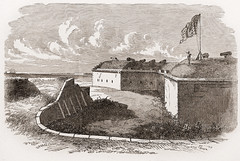
Officers’ Quarters at Fort Sumter—from a sketch by an officer of Major Anderson’s command

Date Created: 1861-02-23, black and white engraving in Harper’s Weekly

  • Officers ‘ quarters at Fort Sumter.

Medium: illustrations (layout features)
Item Location: Fort Sumter NM/Charles Pinckney NHS Curatorial Storage Facility, located at Charles Pinckney National Historic Site
Box: Box 3 of 3 FOSU 19th c Illustrations Frank Leslie Harper’s Weekly London Times etc Drawer 1.
Held By: Fort Sumter and Fort Moultrie National Historical Park
Identifiers
Permanent Link: http://purl.clemson.edu/AFBB896B13A75A4DEE2F682A131215BD

___________
Mike’s notes:

Special handed-tinted off-prints were also sold separately from newspapers. Numerous originals held today by public institutions and in private collections.

Note – This image has been digitally adjusted for one or more of the following:
– fade correction,
– color, contrast, and/or saturation enhancement
– selected spot and/or scratch removal
– cropped for composition and/or to accentuate subject

0 comments

Major Whiting to inspect works in Charleston Harbor for President Davis.— Confederate Records

War of the Rebellion: from the Official Records of the Union and Confederate Armies and Navies

MONTGOMERY, ALA.,
February
23, 1861.

Maj. W. H. C. WHITING:

MY DEAR SIR: You will proceed to Charleston and deliver the note addressed to Governor Pickens, which you will find herewith inclosed. After conferring with him as to the time and mode of visiting the different posts in Charleston Bay, you will enter upon a reconnoissance of the harbor of Charleston and its approaches. You will inspect the various works in our possession and gain such knowledge as circumstances will permit of Fort Sumter. In inspecting the works of the Confederate States you will bear in mind the double relation they may have as works of offense and of defense. You will make an inventory of the armament and of the munitions at the forts and in store, noting particularly the different qualities of cannon powder, as indicated by grain. Generally, I desire you to perform all the duties which devolve upon an engineer charged with the examination of works, and the preparation for active operations under circumstances such as those of Charleston, in this emergency.

Very respectfully, truly, yours,

JEFF’N DAVIS.

0 comments

Operations in Charleston Harbor

War of the Rebellion: from the Official Records of the Union and Confederate Armies and Navies

WAR DEPARTMENT, February 23, 1861.

Maj. ROBERT ANDERSON,
First Artillery, Commanding Fort Sumter, Charleston Harbor, S.C.:

SIR: It is proper I should state distinctly that you hold Fort Sumter as you held Fort Moultrie, under the verbal orders communicated by Major Buell, subsequently modified by instructions addressed to you from this Department, under date of the 21st of December, 1860.

In your letter to Adjutant-General Cooper, of the 16th instant, you say:

I should like to be instructed on a question which may present itself in reference to the floating battery, viz: What course would it be proper for me to take if, without a declaration of war or a notification of hostilities, I should see them approaching   my fort with that battery? They may attempt placing it within good distance before a declaration of hostile intention.

It is not easy to answer satisfactorily this important question at this distance from the scene of action. In my letter to you of the 10th of January I said:

You will continue, as heretofore, to act strictly on the defensive, and to avoid, by all means compatible with the safety of your command, a collision with the hostile forces by which you are surrounded.

The policy thus indicated must still govern your conduct.

The President is not disposed at the present moment to change the instructions under which you have been heretofore acting, or to occupy any other than a defensive position. If, however, you are convinced by sufficient evidence that the raft of which you speak is advancing for the purpose of making an assault upon the fort, then you would be justified on the principle of self-defense in not awaiting its actual arrival there, but in repelling force by force on its approach. If, on the other hand, you have reason to believe that it is approaching merely to take up a position at a good distance should the pending question be not amicably settled, then, unless your safety is so clearly endangered as to render resistance an act of necessary self-defense and protection, you will act with that forbearance which has distinguished you heretofore in permitting the South Carolinians to strengthen Fort Moultrie and erect new batteries for the defense of the harbor. This will be but a redemption of the implied pledge contained in my letter on behalf of the President to Colonel Hayne, in which, when speaking of Fort Sumter, it is said:

The attitude of that garrison, as has been often declared, is neither menacing, nor defiant, nor unfriendly. It is acting under orders to stand strictly on the defensive, and the government and people of South Carolina must know that they can never   receive aught but shelter from its guns, unless, in the absence of all provocation, they should assault it and seek its destruction.

A dispatch received in this city a few days since from Governor Pickens, connected with the declaration on the part of those convened at Montgomery, claiming to act on behalf of South Carolina as well as the other seceded States, that the question of the possession of the forts and other public property therein had been taken from the decision of the individual States and would probably be preceded in its settlement by negotiation with the Government of the United States, has impressed the President with a belief that there will be no immediate attack on Fort Sumter, and the hope is indulged that wise and patriotic counsels may prevail and prevent it altogether.

The labors of the Peace Congress have not yet closed, and the presence of that body here adds another to the powerful motives already existing for the adoption of every measure, except in necessary self-defense, for avoiding a collision with the forces that surround you.

Very respectfully, your obedient servant,

J. HOLT.

0 comments

South Carolina—White Lead, Zinc and Color Works

Civil War Day-by-Day

February 23, 1861; The Charleston Mercury

The White Lead, Zinc and Color Works manufactory of Messrs. CARMALT & BRIGGS, we are pleased to say, have never since their commencement been in a more flourishing condition than at the present time. The enterprising proprietors have demonstrated the fact that colors of all kinds can be manufactured in Charleston and sold at Northern prices, thereby giving the Charleston and more Southern purchaser a saving of freight and insurance – equal to three percent. Having heretofore been able to successfully compete with the Northern manufactories, the new tariff which goes into effect on the fourth of March, and which places a tax of fifteen percent on this class of Northern imports, will give our Charleston manufactory a decided and very apparent advantage, and will enable its managers to sell their lead and colors at much more reasonable rates than foreign imported goods, besides the gratification and satisfaction to purchasers of supporting a Southern institution. The mills of Messrs. CARMALT & BRIGGSs have been recently improved and extended, and the superior quality of the various colors manufactured has been fully and frequently acknowledged by many purchasers.

We mention these facts to apprise our friends of the Confederate States who are engaged in the business, of the fact that they need no longer be dependent on a stock on which they will have to pay a high tariff, while an acknowledged superior article, without a tariff, can be purchased in Charleston.

0 comments

The Confederate States of America—Our Montgomery Correspondence

Civil War Day-by-Day

February 23, 1861; The New York Herald

MONTGOMERY, Ala., Feb. 14, 1861.

The little capital of Alabama, hitherto merely the radiating point from which State politics warmed into ardor over questions of local importance, has now become a focal point of interest to the whole nation. When the present times shall have become historic, Montgomery will be read of as the scene of one of the most wonderful revolutions – wonderful alike whether it be peaceful or bloody – that the world has ever witnessed; and whilst the continuation of secret sessions of the Congress prevents much of interest from being chronicled in the contemporaneous history of the times, still the press, the great political barometer of the world, should record faithfully the stages of the storm. The intense excitement which has heretofore pervaded the people has subsided, and the prevailing feeling seems to be much of that satisfaction which is expressed in Scriptural phrase as that a man child is born into the world.’

The election of Davis and Stephens, and the adoption of the old constitution with such wondrous unanimity, have proved an earnest of serious patriotism which has calmed all apprehension. The people who for several days crowded around the closed doors of the Congress have now gone home satisfied. Nothing can be more gratifying to the patriot’s heart than the simple confidence which all classes have in the present disposers of their destinies. They feel that the great trail is passed, the mental conflict over with, and the mere carnal war which is at their door they welcome as nothing in comparison with what they have suffered. The man who has struggled through a family quarrel, or suffered under the necessities of resenting an insult from a friend, can believe the truth of this statement. Even the poor negroes, so alive to every sympathy with their masters, seem to have caught this contagion of the general satisfaction, and while they know that some great change has taken place, they find they are in the same boat with their natural protectors, and are glad that they are no longer the scapegoats for the sins of others. I do not make this assertion gratuitously; for now, God knows, we have but little interest in influencing Northern opinion. [continue reading…]

0 comments

Reconnoissance of the harbor of Charleston and its approaches—Orders from Jefferson Davis

Civil War Day-by-Day

MONTGOMERY, ALA., February 23, 1861.

Maj. W. H. C. WHITING:

MY DEAR SIR: You will proceed to Charleston and deliver the note addressed to Governor Pickens, which you will find herewith inclosed. After conferring with him as to the time and mode of visiting the different posts in Charleston Bay, you will enter upon a reconnoissance of the harbor of Charleston and its approaches. You will inspect the various works in our possession and gain such knowledge as circumstances will permit of Fort Sumter. In inspecting the works of the Confederate States you will bear in mind the double relation they may have as works of offense and of defense. You will make an inventory of the armament and of the munitions at the forts and in store, noting particularly the different qualities of cannon powder, as indicated by grain. Generally, I desire you to perform all the duties which devolve upon an engineer charged with the examination of works, and the preparation for active operations under circumstances such as those of Charleston, in this emergency.

Very respectfully, truly, yours,

JEFF’N DAVIS.

0 comments

Seizure of Arms for the South—Georgia Reprisals

Civil War Day-by-Day

February 23, 1861; The New York Herald

We are informed, by telegraph from Savannah, that, in consequence of the refusal of the police authorities of New York to give up the eight cases of muskets illegally taken from a vessel lying in this port and bound for Georgia, Governor Brown of that State, has seized several New York ships and detained them in the harbor of Savannah, to the great damage of their owners.

As a matter of course, the republican presses will make a great tirade against Governor Brown, but it is not easy to see how he could have pursued any course other than that which he has adopted. The action of the police of New York was altogether unjustifiable, and the refusal of the General Superintendent to give up the arms is a flagrant abuse of power. We take it for granted that whatever may be the case at the South, the North is still at peace with all mankind. No foreign Power menaces us, and it is not presumed that the Southern people are coming here to fight with us any more than that we are going there to whip them. Under such circumstances, we all have certain rights which cannot be infringed. One of these is the right to keep and bear arms; another, to be secure in our person, houses and effects against unreasonable searches and seizures – all searches and seizures to be made by virtue of a warrant issued upon probable cause, supported by oath or affirmation, and particularly describing the place to be searched and the person or things to be searched. We have been careful to quote here the exact words of the organic law of the land, as the republicans claim that they will support the constitution as it is. Under that constitution the Police commissioners have been guilty of an offence which can only be properly named by the use of a very disagreeable term – to wit, piracy. We are told that the Governor of the State disavows all connection with the matter, and throws the blame upon the Police Commissioners. Kennedy, the Superintendent, has been very officious in this affair, but his motive probably is to curry favor with the Commissioners, whose pliant tool he is. They (the Commissioners), in the absence of any declaration of war, had no more right to seized upon the arms and declare them contraband than they would have to enter the house of a private citizen and take away his fowling piece or revolver. Latterly, the Metropolitan Police seem to have assumed despotic functions, [continue reading…]

0 comments

The News

Civil War Day-by-Day

February 23, 1861; The New York Herald

The difficulty between the States of Georgia and New York still remains unsettled. A despatch from Savannah states that Governor Brown, of Georgia, on Thursday seized the ship Martha J. Ward, the bark Adjuster, and the brig Harold, all belonging to New York. These vessels will be detained until the arms seized by the New York police are given up.

We continue to chronicle the progress of Mr. Lincoln and suite. The President elect yesterday morning hoisted the American flag over Independence Hall, at Philadelphia, amid the cheering of a vast concourse of spectators. Subsequently he proceeded to Harrisburg. Along the route the people turned out generally to welcome the party. At Harrisburg Mr. Lincoln was received by the Pennsylvania Legislature, and addresses were delivered by the presiding officers of the two houses, and by Mr. Lincoln. The President elect will reach Baltimore today. There are some symptoms of a demonstration at Baltimore against Mr. Lincoln, but the police arrangements will prevent any indignity being offered to him. Mr. Hamlin, the Vice President, reached Washington yesterday.

0 comments

The Cabinet of the Confederate States—Secretary of State

Civil War Day-by-Day

February 23, 1861; The Charleston Mercury

Hon. ROBERT TOOMBS was born in Wilkes County, Ga., July 2, 1810. Commencing his collegiate life at the University of Georgia, he subsequently went North, and graduated at Union College, Schenectady, N.Y. In 1836, he served as a captain of volunteers in the Creek war. In the next year he was elected to the Legislature, and since that time has been constantly in public life as Representative and Senator. In both branches of the Federal Congress he has always served upon important committees.

Mr. TOOMBS has been so conspicuously before the country, and his ability and experience are so well known, that it is superfluous for us to say anything of him. In the late movement of Georgia, he has been active and potential in the cause of secession. We honor him for the signal service he has rendered. He has been called to a post of greater importance – one which will serve to display all his merits as a statesman. Upon the sagacity of his counsels and the power of his pen, much will depend in regard to the relationship of the Confederate States with the rest of the world. He has or hearty good wishes for complete success in the grave duties which lie before him.

0 comments

Civil War Day-by-Day

Civil War Day-by-Day

February 23, 1861

  • Abraham Lincoln arrives secretly in Washington after the discovery of a potential assassination attempt that was to have taken place as the Lincoln party traversed Baltimore. The President-elect’s clandestine journey is lampooned by a number of newspaper cartoonists, who inflate wild rumors that he was disguised as a Scotsman.
  • Texas citizens ratify the actions of the secessionist convention, voting to secede, 34,794 to 11,235
0 comments

“A salute of 34 guns was fired, and the “Stars & Stripes” were flying from every point today.”—Horatio Nelson Taft

Diary of US patent clerk Horatio Nelson Taft.

FRIDAY 22

This has been a delightful day, rather cool, but pleasant. The celebration of Washingtons birth day called out a grand display of the Military of the District in the morning. The U.S. troops paraded afterwards by themselves. The order for their appearance in the morning with the Militia was for some reason not now understood countermanded. Wife and family went to the Ave at 10. o’clock and witnessed the display from C Woodwards Balcony. I dined by invitation at the National with some Gentlemen from NY City. A salute of 34 guns was fired, and the “Stars & Stripes” were flying from every point today. Spent the evening at home.


The three diary manuscript volumes, Washington during the Civil War: The Diary of Horatio Nelson Taft, 1861-1865, are available online at The Library of   Congress.

0 comments

A Frank Answer

Turning on the Light: A Dispassionate Survey of President Buchanan’s Administration, From 1860 to its Close, by Horatio King

Hon. A. G. Jenkins, Member of Congress from Virginia, informed why a Route Agent in his District was removed.

Post-office Department, February 22, 1861.

Dear Sir,–Your letter of the 20th inst. is received, requesting ” distinct and specific answers” to the following interrogatories,–viz.:

1. What are the grounds of the removal of Thomas J. West, late route agent on the line from Grafton to Parkersburg, Va., and of the substitution of another person in his place?

2. Why is it that these proceedings have been carried out on my part without affording you any information of my contemplated action?

3. Upon whose suggestion was I led to remove Mr. West, and by whose recommendations was I induced to appoint his successor?

4. And, finally, whether the same policy of secretly decapitating your friends is to be acted upon hereafter as the settled rule of the Department?

These are plain questions, stated nearly in your own language, and, in view of the custom which for a number of years has prevailed in the Department, of consulting members of Congress in regard to appointments and removals in their respective districts, it is not unnatural and perhaps not unreasonable that you should ask them. But you will excuse me for remarking, in all kindness, that, in the first place, it is contrary to the rule of the Department to communicate written answers to such inquiries; and, secondly, that the right which you seem to claim, of controlling the appointments in your district, has no existence in fact. Excepting the comparatively few cases in which the law imposes this duty on the President and Senate, the power of appointing the officers of this Department rests exclusively with the Postmaster-General, who alone is responsible for its proper exercise. By courtesy, the member, when agreeing politically with the administration, is very generally consulted with respect to appointments in his district; but his advice is by no means considered as binding on the Department, nor is the Postmaster-General precluded, even by courtesy, from making removals or appointments on satisfactory information, as in the present instance, exclusively from other reliable sources. When the member is politically opposed to the administration, it is not usual to consult him.

Here I might close; but, since you have asked these questions, evidently under the honest impression that it is my duty to answer them, I will disregard the rule so far as to reply to the first, second, and fourth, simply stating, with reference to the third, that I respectfully decline giving the names of the parties by whose suggestions and recommendations I have been guided in making the change.

To the first, then, I have to inform you that Mr. West was removed for leaving his route without permission from the Department, and actively engaging in a movement the avowed object of which is to induce the withdrawal of Virginia from the Union. In other words, he was discharged for undertaking to destroy the Government from whose treasury he was drawing the means of daily subsistence and whose Constitution he had solemnly sworn to support.

Your second and fourth interrogatories may be answered together. I did not advise with you because I had good reason to believe that you were yourself, honestly, I doubt not, fully committed to the secession interest in your State. As to the policy to be pursued in the future towards your friends in office, I can speak only of what may be done in the few remaining days of this administration; and I hesitate not to assure you that if, during this short time, any other cases like the present come before me, I shall esteem it my imperative duty to pursue the course adopted in this instance.

This being not strictly an official letter, I may be pardoned for adding that I am for the Union without reservation, equally against disunionists at the South and abolitionists at the North, and for the just rights of all sections in the Union.

I have the honor to be,

Very respectfully, your obedient servant,

Horatio King.

Hon. A. G. Jenkins,

House of Representatives.
0 comments

C.W. Cotton to Howell Cobb

Miscellaneous document sources

Democrat Office,
Winona, Min., Feb. 22d, 1861.

Hon. Howell Cobb: The action of the Southern States in seceding from a Union which refused to recognize and protect their constitutional rights, meeting my most cordial approbation, and the absolute proscription of every Journal in the North which defends this action, has induced me to sell my office at this place with a view to a location in the South.

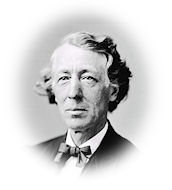
Having always been (permit me to say without intent to flatter) an admirer of yourself as a public man, I have taken the liberty to address you as to the eligibility of a location, believing that you would freely communicate such information as I may desire: 1st, as to a good location for a poor man who fully understands his business, and can edit and print a paper which would not discredit any gentlemen who might take an interest in his enterprise. I have had seventeen years experience as an editor and publisher—was in ’55 and ’56 one of the editors of the State Sentinel at Indianapolis, Ind., and since that time conductor of a paper in this State. Am industrious, sober and energetic, supported Breckinridge and lost a large portion of my patronage for so doing—have since defended the South, and lost the most of what remained. Am soul, body and strength opposed to Abolitionism and all other Black Republican heresies. Can give you such gentlemen as Senators Rice of this State and Bright and Fitch of Indiana as references; and will do my whole duty as an editor and publisher. Would prefer Georgia or Northern Alabama—a healthy location.

If an old (though young in years) political admirer may presume upon your time and patience I will be greatly obliged for an answer to this brief letter.

P. S.—I leave here in a few days for New Albany, Ind., at which place please address me.


From Annual Report of the American Historical Association for the Year 1911.

C. W. Cottom from Rochester, Minnesota, founded and edited a Winona,  Indiana newspaper.

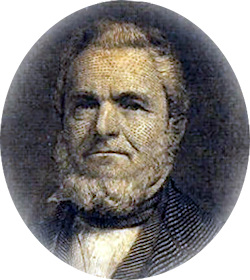
Howell Cobb was an American political figure. A southern Democrat, Cobb was a five-term member of the United States House of Representatives and Speaker of the House from 1849 to 1851. He also served as the 40th Governor of Georgia and as a Secretary of the Treasury under President James Buchanan. Cobb is, however, probably best known as one of the founders of the Confederacy, having served as the President of the Provisional Congress of the Confederate States.

0 comments

Operations in Charleston Harbor

War of the Rebellion: from the Official Records of the Union and Confederate Armies and Navies

HEADQUARTERS OF THE ARMY,
New York, February 22, 1861.

[COL. L. THOMAS, A. A. G. :]

SIR: I have the honor to acknowledge the receipt of your confidential letter of the 21st instant, conveying instructions of the General-in-Chief. I have already taken steps towards executing those instructions, by conferring with Captain Ward, of the Navy, and the quartermaster and commissary of subsistence on duty in this city. I shall see Major Thornton to-morrow. Captain Ward will not be able to take any bales of hay for bedding purposes, and at his suggestion I propose to send mattresses to Fort Sumter instead, unless objected to by the General-in Chief. Captain Ward will provide the coal and wood which Lieutenant Hall’s memorandum calls for. In relation to clothing, I am unable to make out what the memorandum requires. Instead, therefore, of writing myself to Philadelphia, I beg that the necessary orders may be given from Washington to the clothing officers in Philadelphia to send to Colonel Tompkins here the clothing required by the memorandum, and the garrison flag and cord for lanyards on this same memorandum. I shall see that everything else on the memorandum is provided here, including such groceries as might be for sale to officers, &c. The clothing should be put up in small bales, so that it may be distributed among the vessels. Colonel Tompkins will attend to its proper marking after its arrival here. Please let me know as soon as you give the order to the clothing-department. I saw Commodore Bruce, who will do all that he can, but hopes to receive instructions.

Very respectfully, your obedient servant,

H. L. SCOTT.

—–

P. S.–I have arranged with Captain Ward to send all the stores, &c., on board the North Carolina, addressed to him. He will attend to their distribution among his vessels.

H. L. S.,

Lieutenant-Colonel.

0 comments

Confederate Congress resolution in relation to the occupation of Forts Sumter and Pickens. — Confederate Records

War of the Rebellion: from the Official Records of the Union and Confederate Armies and Navies

CONGRESS, February 22, 1861.

Mr. Bartow, from the Committee on Military Affairs, reported the following resolution, which was adopted, viz:

Resolved, That the President of the Confederate States be requested to communicate, in such manner as he may deem expedient, to the governors of South Carolina and Florida the resolution of Congress concerning Forts Sumter and Pickens.


[Copy of the resolution above referred to.]


RESOLUTION in relation to the occupation of Forts Sumter and Pickens.


Resolved by the Confederate States of America in Congress assembled, That it is the sense of this Congress that immediate steps should be taken to obtain possession of Forts Sumter and Pickens, by the authority of this Government, either by negotiations or force, as early as practicable, and that the President is hereby authorized to make all necessary military preparations for carrying this resolution into effect.


Passed February 15, 1861.

0 comments

Operations in Charleston Harbor

War of the Rebellion: from the Official Records of the Union and Confederate Armies and Navies

.

.FORT SUMTER, S.C.,

February 22, 1861.

Col. S. COOPER, Adjutant General:

COLONEL: I have the honor to report that they are forming three embrasures in the work near the bomb-proof battery. We are, as I write (12 m.), firing a national salute from our battery in honor of the day.

I am, colonel, very respectfully, your obedient servant,

ROBERT ANDERSON,

Major, First Artillery, Commanding

—–

FORT SUMTER, S.C., February 22, 1861.

General Jos. G. TOTTEN,
Chief Engineer U. S. Army, Washington D.C.:

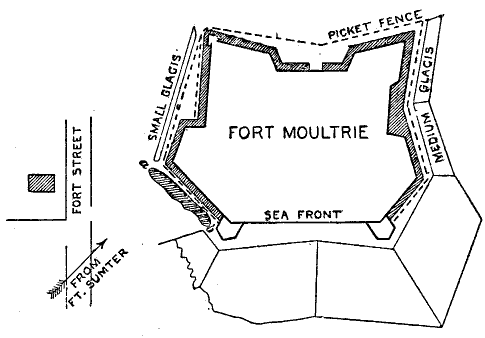
GENERAL: The work on the third breaching battery on Cummings Point has progressed so that the embrasures, three in number, are being commenced. Some work was also done on Fort Moultrie yesterday and the day before; at least it was commenced the day before. This consists of a parapet of earth in front of the scarp wall of the front that faces us, apparently intended to serve as a glacis, as it rises to the height of the cordon. It is revetted on the side next the scarp wall with barrels, and has a pretty steep slope upon the side towards us.

Fort Moultrie, Charleston, South Carolina, Harbor, February 22, 1861

The parallelogram a b shows its position very nearly. This sketch in black shows in a rough way the condition of the fort when we left it,   being bordered on all sides but one with a shallow wet ditch and picket fence, which fence was again protected by a small glacis in front of it. The large glacis on the sea front was very nearly completed, and the second caponiere would have been completed and the guns mounted in four days.

This morning at sunrise a salute of thirteen guns was fired from Castle Pinckney. I understand that Major Anderson has ordered a salute to be fired at noon to-day.

I have the honor to be, very respectfully, your obedient servant,

J. G. FOSTER,

Captain of Engineers.

0 comments

Operations in Florida – Jefferson Davis Correspondence

War of the Rebellion: from the Official Records of the Union and Confederate Armies and Navies

EXECUTIVE OFFICE,
Montgomery, Ala.,

February 22, 1861.

His Excellency Governor PERRY:

SIR: The subjoined resolution was passed by Congress, in secret session, and the injunction of secrecy, you will perceive, has been removed only so far as to authorize me to communicate in the manner deemed expedient, and I must, therefore, ask that you consider it as confidentially done. The resolution suggests two methods by which possession of the forts may be had. It was not intended, however, that the progress of the one should retard or affect the preparations for the other; while, therefore, steps are being taken for negotiation, earnest efforts have been made to procure men of military science and experience, and to seek for munitions and machinery suitable to remedy the supposed or known deficiencies in the existing supplies. Congress, probably, did not design to interfere with the progress of Constructions which had been commenced by State authority, the instruction of troops or other preparation, which will be useful in further operations, and I hope you will continue thus to prepare for whatever exigency may arise. As soon as a skillful engineer is available he will be sent to make an examination of the fort within your State and to aid in the works needful to the execution of the resolution of Congress, should force be the means to which we must resort.

Very respectfully and truly, yours,

JEFF’N DAVIS.

0 comments

Gazaway Lamar to Howell Cobb

Miscellaneous document sources

Bank of the Republic,
New York, Feby. 22d, 1861.

My Dear Sir: If the S. Confederacy are going to make a tariff, how will they adjust the navigation of the Mississippi? It is greatly better to put a ten pr. ct. duty on exports; but best of all to go free trade in full. That will settle the Mississippi question at once and without exception from any one. But above all, free trade will commend you to the European powers and cause them to go with you and not with the North.

The police would not surrender the 10 cases muskets, and Gov. Brown has seized more vessels. I regret it because it increases irritation and agitation.

My opinion is that the Republicans will show their teeth after 4 March and blockade and collect the revenues after their fashion to which you will submit of course, after your fashion.

The interruption of vessels by Gov. Brown causes more damage to Georgia than to N. York. He ought to seize debts or some other property if he retaliate at all—which I think inexpedient at this time. [continue reading…]

0 comments

Our Montgomery Correspondence

Civil War Day-by-Day

February 22, 1861; The Charleston Mercury

MONTGOMERY, ALA., February 18, 1861.

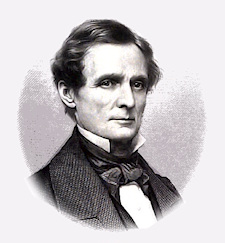
The great event of the nineteenth century, initiated on the 20th day of December, 1860, has this day been consummated, and the last act necessary in its fulfillment is concluded. The Hon. JEFFERSON DAVIS, of the State of Mississippi, was this day, the 18th of February, 1861, inaugurated, at 1 o’clock, President of THE CONFEDERATE STATES OF AMERICA.

The end has come at last. And, whether in war or peace, the people of the Cotton States under one Government have achieved their independence, now and forever, of the people of the Northern States of America. The seal is set. The decree has gone forth from four millions of burning hearts. Today the grand fact was realized, and sunk deep into the hearts of all present. To see it was to feel it.

At 10 o’clock in the morning the military began their proceedings. At 12 o’clock Congress met, as usual. At 12 1/2 o’clock the procession began to move, headed by the military, with the President in their midst, drawn in a coach, with six white horses. Next came the line of vehicles; then those on foot. A little before 1 o’clock they arrived at the Capitol. The President then alighted, and with the Committee appointed by Congress, leaning upon the arm of Mr. RHETT, of South Carolina, on the left, and Mr. CHILTON, of Alabama, proceeded, amidst the enthusiastic greetings of the assembled multitude, through the grounds to the Capitol, and thence to the Hall of Congress. Mr. DAVIS was then introduced by Mr. RHETT to the Congress, in a short and graceful speech. The members then formed in line, and leaving the hall, advanced to the portico, where their seats were arranged – those of the President, Vice-President and the President of the Congress being elevated, so as to be conspicuous to all assembled. Prayer being offered up by the Rev. Dr. MANLY, the President of the Congress, Mr. COBB, announced the election of Messrs. DAVIS and STEPHENS as President and Vice-President of the Confederate States of America, by the Congress assembled.

The President was greeted with the deepest enthusiasm. His speech will be before your readers ere this will reach you. [continue reading…]

0 comments