The News

Civil War Day-by-Day

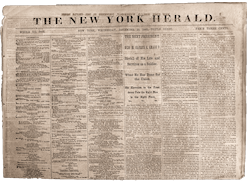
March 3, 1861; The New York Herald

President Buchanan has signed the new tariff bill, and it is now the law of the land. The act complete has already been published in the columns of the HERALD. The last section of the new tariff provides that all goods, wares and merchandise actually on shipboard and bound to the United States, within fifteen days after the passage of this act, and all goods, wares and merchandise in deposit in warehouses or public store on the first day of April, eighteen hundred and sixty one, shall be subject to pay such duties as provided by law before and at the time of the passage of this act; and all goods in warehouse at the time this act takes effect, on which the duties are lessened by its provisions, may be withdrawn on payment of the duties herein provided. An explanatory and revisory act, correcting the errors of the Tariff act, has also been passed.

At last the Cabinet of Mr. Lincoln has been definitely arranged. It is as follows:

Secretary of State………. Wm. H. Seward, of N.Y.

Secretary of Treasury……. Salmon P. Chase, of Ohio.

Secretary of War………… Simon Cameron, of Pa.

Secretary of Navy……….. Montgomery Blair, of Md.

Secretary of Interior……. Caleb B. Smith, of Ind.

Postmaster General………. Edward Bates, of Mo.

Mr. Lincoln’s inaugural address will, it is said, be completed today. Its sentiments, so far as regards the all important question of our relations with the seceded States, have already been predicted by our Washington correspondents. It will favor that course of policy, in this respect, which is comprehended in the favorite phrase of the republicans, namely, enforcement of the laws. The Lincoln administration will, it is again announced, at an early day attempt to recover [continue reading…]
0 comments

The Incoming Administration — The Cabinet of Mr. Lincoln Completed.

Civil War Day-by-Day

March 3, 1861; The New York Herald

Washington, March 2, 186l.

The Cabinet vexation has at last come to an end, to the great relief of all concerned. This morning Mr. Cameron got over his squeamishness, and signified his readiness to serve, when it at once became settled that Seward, Bates, Smith, Chase, Cameron, Blair and Welles would constitute the personnel of the Cabinet. A definite assignment of departments to the last two was postponed, owing to the absence of Mr. Welles. His arrival this evening, by special train from Baltimore, E. S. Cleveland, of Connecticut and G. M. R. Pauleson, of New Jersey, and the irrepressible W. S. Wood, enabled the President elect to close up matters.

The Cabinet now stands, definitely and positively, as follows:

Secretary of State……… Wm. H. Seward, of New York.

Secretary of the Treasury.. Salmon P. Chase, of Ohio.

Secretary of the Interior.. Caleb B. Smith, of Indiana.

Secretary of War……….. Simon Cameron, of Pa.

Secretary of the Navy…… Montgomery Blair, of Md. [continue reading…]

0 comments

Civil War Day-by-Day

Civil War Day-by-Day

March 3, 1861

  • General P. G. T. Beauregard arrives at Charleston and assumes command of Confederate troops
0 comments

Operations in Charleston Harbor — Confederate Records

War of the Rebellion: from the Official Records of the Union and Confederate Armies and Navies

WAR DEPARTMENT,
Montgomery, March 2, 1861.

Brigadier-General BEAUREGARD,
Commanding at Charleston:

GENERAL: The Secretary of the Treasury has directed Governor Pickens to transfer to your credit, as commanding officer at Charleston, the sum of $20,000, to meet your present necessities. Other arrangements are in progress, with every prospect of speedy success, to place to your credit such sums as you may need from time to time. If you have failed to secure the services of a competent assistant adjutant and quartermaster, let me know it without delay, as I can now supply you with these officers. As there may be some temporary dissatisfaction with the State troops at Charleston, owing to the fact that you have superseded their commanding officers, it might be proper for you, soon as possible, to muster one or more companies at least into the Provisional Army. This would give you an organized and independent action.

I suggest, unless in your opinion it is absolutely necessary, that you decline to receive any cavalry into the Provisional Army, as you are aware the cost of this arm of the service is very heavy, and it is more than probable that the necessities of your position at Charleston will not require this outlay.

I have the honor to be, very respectfully, your obedient servant,

L. P. WALKER,

Secretary of War.

0 comments

Horatio Nelson Taft

Diary of US patent clerk Horatio Nelson Taft.

SATURDAY, MARCH 2, 1861.

A warm summer day, quite uncomfortable in the sun. Brother C R Taft came this morning direct from Wmstown. I went to the Presidents with him and to the Capitol, was not much in the office today. Julia also came this evening about 8 o’clock with Judge Davis from Batavia NY. She was put in his charge by my friend Redfield of Elmira and arrived through the crowd rushing to witness the Inauguration. The Judge will stop with us till it is over. Our Lyons Friends have disappointed us. Went to the Hotels with C R in the Evening.


The three diary manuscript volumes, Washington during the Civil War: The Diary of Horatio Nelson Taft, 1861-1865, are available online at The Library of   Congress.

0 comments

Our Washington Correspondence

Civil War Day-by-Day

March 2, 1861; The Charleston Mercury

WASHINGTON, February 27, 1861.

LINCOLN’s designs are still shrouded in thick darkness. The ass is between the bundle of hay – anxious to go to CHASE and afraid to leave SEWARD. It is some consolation to know that only five days remain ere the fountain of the great deep will be broken up, and the voice of the Rail Splitter be heard. The problem of Fort Sumter must be solved very shortly.

The time for South Carolina to take Fort Sumter has passed. In my opinion, and according to the views of a great many, the capture of that post some time since would have been pregnant with the best results for the cause of a Southern confederacy. It would not only have made such a breach between the North and the South as to have lit up, in an uncontrollable degree, the dormant Southern feeling throughout the Border States, and swept the Union savers and submissionists into their political graves – bringing all those States into the Confederate States – but it would have given a prestige and power to the South Carolina Delegation at Montgomery that would have enabled them to engraft their State frights, free trade and pro slavery emendations upon the new Constitution. These objects could have been effected by pursing the bold, straight forward policy of “Know you are right, then go ahead.” But the policy pursued has been different, and its objects are lost. The Mare has passed. Having waited so long, honor will not suffer by waiting longer. The State can now gain nothing by an attack. If President DAVIS is to make the fight, and to reap the glory of that which may turn out to be a necessity, would it not be wise, at this stage, to let the enlisted soldiers and regular army of the Confederate States do the fighting? There was a time when Carolina and Carolinians might well have established her independence themselves, under their own authorities. By too great caution as to the means, the end is forfeited. As you have had pursued the policy of saving risk to the lives of valuable citizens, that policy should now be carried through. At this time of day it would be worse than useless to sacrifice them for what cannot be redeemed. Wisdom now requires that the whole matter should be turned over to the Confederate States Government, and to its forces of regular soldiers, recruited at so much a head. Your people can then congratulate themselves that, at lest, prudence has done something, if it has left undone other things. It would be exceedingly unwise to lose now what has been gained. [continue reading…]

0 comments

Mr. Lincoln’s Cabinet—The Beginning of the End

Civil War Day-by-Day

March 2, 1861; The New York Herald

—The latest shuffle of the cards of Mr. Lincoln’s initiative Cabinet, it appears, has resulted in the following distribution of his Executive departments, to wit:-

Secretary of State ……….. Wm. H. Seward, of N.Y.

Secretary of Treasury……… Simon P. Chase, of Ohio.

Secretary of War………….. Simon Cameron, of Penn.

Secretary of Navy…………. Montgomery Blair, of Md.

Secretary of Interior……….Caleb B. Smith, of Ind.

Postmaster General………….Gideon Welles, of Conn.

Attorney General……………Edward Bates, of Mo.

And this Cabinet, we are told, has been virtually adopted as a compromise between the contesting sections, factions and cliques of the republican party. This may be so, but we fear that this compromise foreshadows the predominance of the radical anti-slavery interest, and its dictatorship over the new administration. Two such radicals as Chase and Blair, men of great energy, activity, tenacity and decision of character, will lead by the nose or ride over a host of such excavated fossils as Smith, Welles and Bates. Thus Seward and Cameron, with the Cabinet turned against them, will have nothing to do but to follow as Chase and Blair may lead. There can hardly be a doubt upon this point when the history, the antecedents and the latest expositions of Mr. Lincoln himself put him quite up to chase and Blair in his hostility to any concessions to slavery.

Poor Pierce, it was supposed, set out with a conservative Cabinet, Marcy, his Premier, being a host in himself. But Marcy’s influence and counsels in the general policy of poor Pierce, although backed in the beginning by a Cabinet majority, were soon borne down by that resolute and persevering Southern revolutionary radical, Jefferson Davis. Hence the repeal of the Missouri compromise, which was the opening of Pandora’s box upon the country. Next, the first Cabinet [continue reading…]

0 comments

The News

Civil War Day-by-Day

March 2, 1861; The New York Herald

Our despatches from Washington state that the list of Cabinet officers of the incoming administration which was published in yesterday’s HERALD, and which is again published today, is the true one. The selection of Governor Chase to a place in the Cabinet is regarded as a triumph of the radical republicans over the Seward conservatives.

It is reported from Washington that among the first acts of the Lincoln administration will be the reinforcement of Fort Sumter, and an attempt to collect the revenue at the Gulf ports. Should this report be verified we shall soon witness the inauguration of civil war.

In Congress yesterday the Senate took up the report of the committee on the proposition of the Peace Congress, and a general debate ensued upon the merits of the questions involved. No definite action was taken, however. Indeed, the proposition meet with as little favor from the border State Senators as from the republicans. In the House the report of the committee of thirty three on the crisis was taken up. The clause providing for the admission of New Mexico into the Union, with or without slavery, as her people may elect, was laid on the table by a vote of 114 to 71. The amendment to the act for the rendition of fugitive slaves was passed – 92 to 85. The amendment to the act for the rendition of fugitives from justice – John Brown negro stealers and the like – was rejected by a vote of 47 to 162. A motion was made to suspend the rules in order to take up the proposition of the Peace congress. On taking a vote the motion was rejected by a vote of 92 to 66 – two thirds not voting for the motion. The Nevada and Dacotha Territorial bills were passed.

Major Anderson, who is in daily communication with the War Department, writes that the batteries and other works of the South Carolinians are nearly completed, and that unless the Southern Congress interpose, he expects Fort Sumter will be attacked immediately after the 4th inst. It appears that there is a large party in South Carolina who ignore the Southern Congress particularly as regards military operations in Charleston harbor, while the Governor and the conservatives generally are disposed to abide by the directions of the authorities of the confederate States.

Late accounts from Texas furnish an explanation of Gen. Twiggs’ connection with the recent seizure of the federal [continue reading…]

0 comments

Civil War Day-by-Day

Civil War Day-by-Day

March 2, 1861

  • The U. S. Congress passes a proposed 13th Amendment that would shield “domestic institutions” of the states from the federal constitutional amendment process and from abolition or interference by Congress. Although the Corwin Amendment does not explicitly mention slavery, it is designed specifically to protect slavery from federal power. The amendment is never ratified.
  • Texas Secessionist Convention reconvenes
  • Congress passes the Morrill Tariff Bill.
0 comments

“It seems doubtful now whether anything will be done in Congress with the “Peace” Recommendations.”—Horatio Nelson Taft

Diary of US patent clerk Horatio Nelson Taft.

FRIDAY, MARCH 1

The weather has, today, been warmer still. No fire in the house except to cook with, and no fire in the office. The Patent office has been crowded with visitors and in fact the same may be said of the City generaly. I was down at the Hotels this evening, all crowded as more than ever, “and still they come.” Spent an hour with Col Paine at the Kirkwood House and another with Jas C Smith at Willards. He thinks that Mr Lincoln is a man Equal to his position and the crisis. It seems doubtful now whether anything will be done in Congress with the “Peace” Recommendations.


The three diary manuscript volumes, Washington during the Civil War: The Diary of Horatio Nelson Taft, 1861-1865, are available online at The Library of   Congress.

0 comments

Operations in Charleston Harbor — Confederate Records

War of the Rebellion: from the Official Records of the Union and Confederate Armies and Navies

WAR DEPARTMENT, C. S. A.,
Montgomery, March 1, 1861.

Brig. Gen. P. G. T. BEAUREGARD:

SIR: You will proceed without delay to Charleston and report to Governor Pickens for military duty in that State.

You are authorized by your appointment as brigadier-general, under the provisions of the third section of an act of the Congress to raise Provisional Forces for the Confederate States, to receive into the service of this Government such forces as may be tendered or may volunteer, not to exceed five thousand men, as you may require, or for whom you can make suitable provision. A copy of the act referred to has been this day transmitted to Governor Pickens.

You will report to this Department your arrival at Charleston, and give such information with respect to the defenses of that harbor as you may consider important. You will also secure, if possible, the services of a competent adjutant, and report your action in that behalf to this Department.

Very respectfully, your obedient servant,

L. P. WALKER,

Secretary of War.

2 comments

“Went to pay my respects to Mrs. Jefferson Davis. She met me with open arms.”—A Diary From Dixie

Civil War Day-by-Day

March 1st.–Dined to-day with Mr. Hill¹ from Georgia, and his wife. After he left us she told me he was the celebrated individual who, for Christian scruples, refused to fight a duel with Stephens.² She seemed very proud of him for his conduct in the affair. Ignoramus that I am, I had not heard of it. I am having all kinds of experiences. Drove to-day with a lady who fervently wished her husband would go down to Pensacola and be shot. I was dumb with amazement, of course. Telling my story to one who knew the parties, was informed, “Don’t you know he beats her?” So I have seen a man “who lifts his hand against a woman in aught save kindness.”

Brewster says Lincoln passed through Baltimore disguised, and at night, and that he did well, for just now Baltimore is dangerous ground. He says that he hears from all quarters that the vulgarity of Lincoln, his wife, and his son is beyond credence, a thing you must see before you can believe it. Senator Stephen A. Douglas told Mr. Chesnut that “Lincoln is awfully clever, and that he had found him a heavy handful.”

Went to pay my respects to Mrs. Jefferson Davis. She met me with open arms. We did not allude to anything by which we are surrounded. We eschewed politics and our changed relations.


¹ Benjamin H. Hill, who had already been active in State and National affairs when the Secession movement was carried through. He had been an earnest advocate of the Union until in Georgia the resolution was passed declaring that the State ought to secede. He then became a prominent supporter of secession. He was a member of the Confederate Congress, which met in Montgomery in 1861, and served in the Confederate Senate until the end of the war. After the war, he was elected to Congress and opposed the Reconstruction policy of that body. In 1877 he was elected United States Senator from Georgia.
² Governor Herschel V. Johnson also declined, and doubtless for similar reasons, to accept a challenge from Alexander H. Stephens, who, though endowed with the courage of a gladiator, was very small and frail.

0 comments

Operations in Charleston Harbor — Confederate Records

War of the Rebellion: from the Official Records of the Union and Confederate Armies and Navies

“… the President has appointed Peter G. T. Beauregard brigadier-general to command the Provisional Forces of this Government in the harbor of Charleston.”

WAR DEPARTMENT, C. S. A.,
Montgomery, March 1, 1861.

His Excellency F. W. PICKENS, Governor, &c.:

SIR: Your letter of the 27th ultimo addressed to the President has been referred by him to this Department for reply.

In controlling the military operations in the harbor of Charleston the President directs me to say that everything will be done that may be due to the honor and rights of South Carolina.

The President shares the feeling expressed by you that Fort Sumter should be in our possession at the earliest moment possible. But this feeling, natural and just as it is admitted to be, must yield to the necessity of the case. Thorough preparation must be made before an attack is attempted, for the first blow must be successful, both for its moral and physical consequences, or otherwise the result might be disastrous to your State in the loss of many of those whom we can least afford to spare. A failure would demoralize our people and injuriously affect us in the opinion of the world as reckless and precipitate.

Entertaining these opinions, the President directs me to say that he is engaged assiduously in pressing forward measures to effect results in which all are interested. Under the fourth section of an act of Congress to raise Provisional Forces for the Confederate States of America, and for other purposes, a copy of which I have the honor to inclose in another communication of this date, the President has appointed Peter G. T. Beauregard brigadier-general to command the Provisional Forces of this Government in the harbor of Charleston. General Beauregard will be accompanied by an adjutant, whose duty it will be to receive into the Provisional Army, with their officers, under the provisions of the act aforesaid, the forces of your State now in Charleston.

General Beauregard has the entire confidence of the President and of this Department, and I beg to commend him as possessing every soldierly quality.

I have the honor to be, with high regard, your obedient servant,

L. P. WALKER,

Secretary of War.

0 comments

The Parade Yesterday

Civil War Day-by-Day

March 1, 1861; The Charleston Mercury

In pursuance of regimental orders, the Seventeenth Regiment paraded yesterday afternoon for review. At three othe regiment formed in Broad street, the right resting upon Meeting street and the left upon Church street. We noticed the following mounted staff officers in command: Colonel JOHN CUNNINGHAM, Adjutant F. A. MITCHELL, Paymaster J. HOWARD, Quartermaster R. Q. PINCKNEY, and Surgeons PRIOLEAU and FITCH.

At half past three the regimental colors were taken from the Court House, and the regiment wheeled into line and marched through Meeting street to the Citadel Green, in the following order:

Staff.

Palmetto Brass Band.

Charleston Riflemen, Capt. JOHNSON, 58 men.

Irish Volunteers, Capt. MAGRATH, 65 men.

Sumter Guards, Capt. RUSSELL, 48 men.

Montgomery Guards Capt. CONNER, 70 men.

Palmetto Guards. Lieut. BREWSTER, 110 men.

Charleston Brass Band.

Color Guard with Regimental Colors.

German Fusiliers, Capt. LORD, 60 men.

Richardson Guard, Lieut. AXSON, 45 men. [continue reading…]

0 comments

The Revolution in Washington – Dreadful Conditions of Things.

Civil War Day-by-Day

March 1, 1861; The New York Herald

In this transition interval between the outgoing and the incoming administrations, when old things are to be done away with, old parties, old principles, old platforms, old politicians, old office holders, old lobby and kitchen favorites, old tricksters and hucksters, old fashions and old clothes, old kettles, pots and pans, and when all things are to be new, and when ‘Old Abe’ is expected to play the regenerative role of Louis Napoleon, he would indeed be a dull scholar if he had not already learned that he has a tough job upon his hands. According to our information he is at last wide awake to the exigencies and the necessities of his position. He is the rising sun and the living lion of Washington, for within a day or two Mr. Buchanan will be on the same private calendar with our meditative ex-Presidents, Van Buren and Tyler, and Fillmore and poor Pierce; and all the power and all the spoils in reversion that have not been lost, stolen, or carried off, or given away, will fall into the hands of ‘Old Abe.’

But what is the condition of things before him in Washington, in this busy interregnum to the ins who are preparing to go out, and to the outs who are pushing to get in? Dreadful to contemplate. Office seekers, retainers, drummers, pipelayers, kitchen scullions and scamps of both factions swarm around the royal pavilion. A hard fight, a long siege, a long fast and hard times, have multiplied these camp followers by thousands, and they are now gathered and are gathering in Washington like jackals, wolves and buzzards in the wake of a wasted army.

All these expectants of spoils and plunder are barking, howling and scratching at the door of the new fountain of power. Mr. Lincoln stands at bay like a man in a dream. Which way shall he fly? To the Capital? The regular troops which daily parade the streets–infantry, draggoons and artillery–under the regulations of General Scott, admonish the President elect that treason is still afoot, and that he had better keep within doors. No Guy Fawkes has yet been detected, fixing his thirty six barrels of gunpowder under the portico of the Capitol, where the inauguration is to take place; but where there is so much smoke there must be some fire. It cannot be that five or six thousand men under arms in Washington for the last month, and all the police arrangements from that city to this, and the mysterious midnight visiter to Mr. Lincoln at [continue reading…]

0 comments

Gen. Twiggs, the Georgian

Civil War Day-by-Day

March 1, 1861; The Charleston Mercury

The impotent spite and reasonless abuse now heaped upon Gen. TWIGGS by Abolition prints at the North, for his recent sensible and manly course as a Southern officer of the late United States Army, is so ludicrous in its desponding virulence, that we really cannot get up a feeling of anything akin to indignation. Notwithstanding the accumulation of epithets the most vehement, and comparisons the most odious, the grand effect is only tragi-comedy, burlesque and grimace, – a species of performance that can awake no sentiment deeper than contempt.

General TWIGGS owes no allegiance and no gratitude to the North. He received his military education, as a citizen of Georgia, at a school established and supported in party, and more than proportionally, by Georgia. It was Georgia that gave him the appointment and educated him for his profession. It was thought her influence he entered, as a citizen of Georgia, upon that profession in the common Army of the United States. He has never transferred his domicile, citizenship or allegiance to any other State. Georgia has retired from the Union, in consequence of grievances dangerous to her institutions, her security and her liberties. The allegiance of her citizens is due to her. Texas does the same thing for the same cause. As a Southern man, Gen. TWIGGS comprehends the action of these States, and knows that, being sovereign parties to the Federal compact, they are each, upon separation, entitled, by right of local authority, and the right of eminent domain, to possession of all the military posts within their territory. After vainly asking for instructions as to its wishes from the late General Government, to whom, while it was his Government, his obedience was due, he acts on his own responsibility as a southern officer and a citizen of the State of Georgia. The Union being dissolved, these States being independent of the authority of the Washington Government and Texas having a right to the fortifications, built by her common Government for her defence, he recognises the facts, and withdraws from Texas, delivering up to her what is hers, subject to a settlement with her late co-States in the Union. A plain, unvarnished tale that will bear criticism. The conduct of Gen. TWIGGS is unimpeachable, patriotism or good common sense. It is correct. The insane twaddle and vague denunciations of Northern fanatics are as nonsensical and baseless as they indicate doleful desperation. The North will understand that it must do its own fighting – at least, so far as the great majority of Southern officers are concerned. Any other calculation will prove eminently delusive. Turn loose your tigers.

0 comments

Civil War Day-by-Day

Civil War Day-by-Day

March 1, 1861

  • P. G. T. Beauregard appointed Brigadier General and is ordered to Charleston by Jefferson Davis.
  • Congress organizes two new territories, Nevada and Dakota, and passes the Morrill Tariff Act, which raises taxes on imports.
  • The U. S. Congress rejects the Washington Peace Conference proposals.
0 comments

Raphael Semmes to Howell Cobb

Miscellaneous document sources

Richmond, Va., Feb. 28th, 1861.

Dear Governor, I was dispatched from Montgomery under orders from the President so suddenly that I had not the opportunity of calling on my friends, yourself among the number, as I intended to do; so you must excuse me for my seeming remissness. As I shall not return for some two or three weeks the Departments will probably all be organized in my absence. I had an interview before I left with Mr. Memminger on the subject of the organisation of the Light House Establishment. I proposed to get rid of the cumbrous machinery of a Light House Board, which I found to be useless under the old Government, and to substitute therefor a Light House Bureau to be placed under a naval Captain. Mr. Memminger seemed to be favorably impressed with my idea and I suppose this form of organization will be adopted. If it be agreeable to Mr. Memminger and to the new Secretary of the Navy I should like to have the first charge of this Bureau—although I must confess I am not very fond of the confinement—merely for the purpose of giving form and shape to my bantling before it falls into inexperienced hands. A word from you would probably secure this object.

Remember me very kindly to Mr. Toombs and Mr. Stephens.

Letters addressed to me at Washington to the care of “Richard H. Clarke, Esq.,”[i] will be forwarded to me promptly.


[i] A lawyer in Washington, afterwards prominent in New York City.


From Annual Report of the American Historical Association for the Year 1911.

Raphael Semmes (September 27, 1809 – August 30, 1877) was an officer in the Confederate navy during the American Civil War. Until then, he had been a serving officer in the United States Navy from 1826 to 1860. During the American Civil War, Semmes was captain of the cruiser CSS Alabama, the most successful commerce raider in maritime history, taking 65 prizes. Late in the war, he was promoted to rear admiral and also acted briefly as a brigadier general in the Confederate States Army. His appointment or arrangement to act as a temporary brigadier general from April 5 to April 26, 1865, was never submitted to or officially confirmed by the Confederate Senate.

Howell Cobb was an American political figure. A southern Democrat, Cobb was a five-term member of the United States House of Representatives and Speaker of the House from 1849 to 1851. He also served as the 40th Governor of Georgia and as a Secretary of the Treasury under President James Buchanan. Cobb is, however, probably best known as one of the founders of the Confederacy, having served as the President of the Provisional Congress of the Confederate States.

0 comments

“What a pity to bring the spites of the old Union into this new one!”—A Diary From Dixie

Civil War Day-by-Day

February 28th.–In the drawing-room a literary lady began a violent attack upon this mischief-making South Carolina. She told me she was a successful writer in the magazines of the day, but when I found she used ”incredible” for “incredulous,” I said not a word in defense of my native land. I left her “incredible.” Another person came in, while she was pouring upon me her home troubles, and asked if she did not know I was a Carolinian. Then she gracefully reversed her engine, and took the other tack, sounding our praise, but I left her incredible and I remained incredulous, too.

Brewster says the war specks are growing in size. Nobody at the North, or in Virginia, believes we are in earnest. They think we are sulking and that Jeff Davis and Stephens ¹ are getting up a very pretty little comedy. The Virginia delegates were insulted at the peace conference; Brewster said, “kicked out.”

The Judge thought Jefferson Davis rude to him when the latter was Secretary of War. Mr. Chesnut persuaded the Judge to forego his private wrong for the public good, and so he voted for him, but now his old grudge has come back with an increased venomousness. What a pity to bring the spites of the old Union into this new one! It seems to me already men are willing to risk an injury to our cause, if they may in so doing hurt Jeff Davis.

____

¹ Alexander H. Stephens, the eminent statesman of Georgia, who before the war had been conspicuous in all the political movements of his time and in 1861 became Vice-President of the Confederacy. After the war he again became conspicuous in Congress and wrote a history entitled “The War between the States.”

0 comments

“I think I could get them Patented if I was out of the office, cannot while I am in.”—Horatio Nelson Taft

Diary of US patent clerk Horatio Nelson Taft.

THURSDAY 28

Another Spring day rather too warm in the sun. I took the shady side in coming from the office. One Hundred Guns were fired at noon on account of the result of the Peace Contn by order of Genl Scott. Interupted a good deal today in the office, could not do much business. Went on to 7th St after dinner and made some purchases, 2 looking glasses and Holly a Jacket. Have been at home this evening Drafting—a Condenser and also a Decalorator or water cooler for Steam Ships, plans of my own. I think I could get them Patented if I was out of the office, cannot while I am in. I have other improvements relating to the Steam Engine.


The three diary manuscript volumes, Washington during the Civil War: The Diary of Horatio Nelson Taft, 1861-1865, are available online at The Library of   Congress.

0 comments

I called to see Mr Lincoln this morning with General Wool but there is always such a crowd about him

The Letters of Samuel Ryan Curtis

Washington Feby 28. 1861.

My dear wife

I did suppose I would not have another moment to write to you; but while there is a discussion going on about the Indian bill, I will drop a line merely for the purpose of sending you the photograph of Edward Sturges and say we are all very well. The day is delightful. Sadie was invited to go with friends to Mt Vernon but she has been so much disturbed in her course of studies I declined my leave. Yet when I came to the capitol grounds and saw the yellow crocus peeping brightly and enjoying the bright beams of a summer sun and the soft air of a summer day I wished I could go and Sadie too and enjoy the day on the bright waters of the Potomac and in the groves of Mt. Vernon

But here I must stay. I called to see Mr Lincoln this morning with General Wool1 but there is always such a crowd about him that I feel no satisfaction in the call. He is overwhelmed with visitors and oppressed with care. We have those around us republicans who seem to care nothing for consequences as though consequences are outaide of moral obligations.

Our Union friends of the South are cheered and will fight more earnestly for our country because they Consider it a good omen. The South must fight the South if any body has to fight and I think yet there is much danger of such consequences.

This is Thursday
Affectionately yours
Saml. R. Curtis


1. John Ellis Wool began his military career in 1812, rose in ranks until a Brigadier General in 1841. He served with Taylor in the Mexican War. Curtis was a member of Gen. Wool’s staff during that war. Following 1856 Wool was Commander of the Department of the East. Probably connection with some of the military bills before the House and the defense of Washington brought the two acquaintances together before Lincoln.

0 comments

At the Court of St. James

Diary of George Mifflin Dallas, United States Minister to England 1856 to 1861

1861. February 28.–….By the arrival of the Anglo-Saxon at Londonderry, a telegram announces the fact that the Committee of the Peace Convention had reported a plan for adjustment, made up of Crittenden’s, Guthrie’s, and the Border States’ proposal. If this be approved, the great body of the Union may be saved; with a reasonable prospect of reattracting the eight States which have seceded, and are now embodied as “The Confederated States of America.” General Jefferson Davis and A. H. Stephens were inaugurated as President and Vice-President on the 18th instant. Query: Were they chosen by popular election, or by the Convention only at Montgomery? Perhaps they are provisional only, and for a limited time.

0 comments

The Secession of Georgia

War of the Rebellion: from the Official Records of the Union and Confederate Armies and Navies

U. S. ENGINEER OFFICE,
Savannah, January 28, 1861

GENERAL: I arrived here this evening from Fort Clinch. I left that post in charge of Mr. James A. Walker as fort keeper. A copy of my instructions to him is forwarded herewith.

Previous to leaving Fernandina I received verbal assurance from a member of the governor’s council that the property at Fort Clinch would not be disturbed by the State, and that the work would be allowed to remain in the charge of the United States fort-keepers in statu quo. On my arrival here I found that the authorities of the State of Georgia had taken possession of all the works under my charge iu the State, and had formally assumed the control of Oglethorpe Barracks. I forward herewith a copy of a letter addressed to me by Colonel A. R. Lawton, of the Georgia troops. Ordnance Sergeant Burt having refused to surrender, his storeroom was taken possession of, and on his reporting to me I gave him orders to make no further resistance. Both Ordnance Sergeant Walker, late at Fort Pulaski, and Ordnance Sergeant Burt are now at the barracks, where they are permitted to remain. My command having been forcibly interrupted, I can give them no further orders, and must leave the disposition of them to headquarters.

……….Very respectfully,

WM. H. C. WHITING, ……..
Captain of Engineers.

General J. G. TOTTEN, Chief of Engineers.

.

[Inclosure]

.

SAVANNAH, January 28, 1861.

Captain WHITING, U. S. Engineers:

SIR: I am instructed by the governor and commander-in-chief of the State of Georgia to take possession of Oglethorpe Barracks, in the name of the State of Georgia, and in your absence from this city possession has been taken. The occupants will not be disturbed at present, and you will please consider yourself at liberty to occupy, with your employés, such apartments as are necessary for your convenience while you are closing up your business here. The steamer Ida and appurtenances have also been taken possession of under the same authority. This, I believe, includes all the property held by you in the State of Georgia, as military engineer of the United States, but does not include any light-house property.

You have been already notified, informally, that Forts Pulaski and Jackson had been occupied by the troops of the State of Georgia under my command.

……….Very respectfully,

A. R. LAWTON,
Colonel, Commanding.

0 comments

Our Baltimore Correspondence

Civil War Day-by-Day

February 28, 1861; The Charleston Mercury

BALTIMORE, February 24, 1861.

As if the cup of our country’s deep, and, I fear lasting degradation were not already filled to overflowing by the ill timed harangues of ABRAHAM LINCOLN, made during his recent trip from Springfield to Washington, his stealthy midnight transit through Maryland on Friday night last would seem to be sufficient for the purpose. Loud and deep are the anathemas hurled at him now by hundreds of our citizens, who, only a few days since, were willing, for the sake of the Union, to give his administration a trial, and this last most disgraceful act of his has made many converts to the ranks of Secessionists. Having been in the upper portion of Pennsylvania on business, your correspondent was induced to visit Harrisburg on Friday, for the double purpose of witnessing the celebration of the natal day of the Father of his Country, and to get a glimpse of the man who, while journeying to the Federal Metropolis for the purpose of taking the helm of the dismasted Ship of State, has had the audacity to proclaim, again and again, that the present was only an crisis, and that so far nobody has been hurt, and I now purpose furnishing, for the amusement of your readers, some of the scenes and incidents of the day, together with an account of LINCOLN’S inglorious flight from the Capital of Pennsylvania.

The morning of the 22d was a lively one in the town of Harrisburg. The Legislature had adjourned for the day, and from every prominent point was displayed flags, streamers and banners. Many of the latter, to the shame of Pennsylvanians be it said, coupled the name of WASHINGTON with that of LINCOLN. During the morning long trains of cars came in from every direction, filled with soldiers; and by the time that LINCOLN arrived at two in the afternoon, there must have been not less than thirty thousand troops drawn up in line to receive him. A procession was formed, over three miles long, and the man of Pennsylvania’s choice placed in a barouche and conducted all over the town, stopping at the Jones House, where the formal reception took place. Gov. CURTIN made a short address, very carefully prepared, and at which the most extreme Southerner could take no exception. Not so with the lion of the day. His reply was uttered in disjointed sentences, the greater portion of them having no meaning whatever, and the whole affair would have done no [continue reading…]

0 comments

The Way The Conspiracy Against Lincoln Was Discovered.

Civil War Day-by-Day

February 28, 1861; The New York Herald

We have at last got a clue to the way the terrible conspiracy to assassinate Mr. Lincoln was discovered, and it certainly reflects great credit upon our police system, which we shall not be slow to accord to it. It appears that there were two sets of most effective detectives sent to work upon the matter. Mr. Fouche Kennedy, of New York, at the instance of Thurlow Weed, despatched one band of detective police to Baltimore and the interlying points between that place and Harrisburg, to ferret out the plot, and the Vidoc of Baltimore had another band employed in the same localities, neither chief being aware of the action of the other. If there was anything to be discovered this efficient combination of detective talent would be sure to find it out; and so it did; for it happened that the detectives from New York came into frequent communion with the detectives from Baltimore, and, not knowing one another, each supposed that he had found a conspirator in the other party, and forthwith commenced to sympathize with the plot and draw his communicative companion out, for the purpose of getting information, as these wise officials are wont to do; and so between them they unravelled, if they did not concoct, the whole terrible conspiracy against the life of Mr. Lincoln, which compelled him to resort to the Scotch cap of the Camerons and the long military cloak, in which undignified disguise he reached the federal capital with a whole skin. No sooner did Mr. Fouche Kennedy succeed in discovering this awful conspiracy than he turned up at Washington, in search of an office, we suppose, to which he is undoubtedly entitled at the hands of Mr. Lincoln, whose life he so miraculously preserved.

But there are more plots against the new President which it may require detective sagacity to discover. Mr. Fouche Weed and Mr. Vidoc Greeley have each their detectives at work to discover a conspiracy against the political existence of Mr. Lincoln, and whichever of the two finds out the plot – whether it be got up by the ultras or the moderates of the party – will, of course, be entitled to the spoils.

0 comments