The Declaration of War

Civil War Day-by-Day

March 5, 1861, The Richmond Enquirer

Mr. Lincoln’s Inaugural Address is before our readers—couched in the cool, unimpassioned, deliberate language of the fanatic, with the purpose of pursuing the promptings of fanaticism even to the dismemberment of the Government with the horrors of civil war. Virginia has long looked for and promised peace offering before her—and she has more, she has the denial of all hope of peace. Civil war must now come. Sectional war, declared by Mr. Lincoln, awaits only this signal gun from the insulted Southern Confederacy, to light its horrid fires all along the borders of Virginia. No action of our Convention can now maintain the peace. She must fight! The liberty of choice is yet hers. She may march to the contest with her sister States of the South, or she must march to the conflict against them. There is left no middle course; There is left no peace; was must settle the conflict, and the God of battle give victory to the right!

We must be invaded by Davis or by Lincoln. The former can rally fifty thousand of the best and bravest sons of Virginia, who will rush with wiling hearts and ready hands to the standard that protects the rights and defends the honor of the South—for every traitor heart that offers aid to Lincoln there will be many, many who will glory in the opportunity to avenge the treason by a sharp and certain death. Let not Virginians be arrayed against each other, and since we cannot avoid war, let us determine that together, as people of the same State, we will defend each other, and preserve the soil of the State from the polluting foot of the Black Republican invader.

The question, “where shall Virginia go?” is answered by Mr. Lincoln, She must go to war—and she must decide with whom she wars—whether with those who have suffered her wrongs, or with those who have inflicted her injuries.

Our ultimate destruction pales before the present emergency. To war! to arms! is now the cry, and when peace is declared, if ever, in our day, Virginia may decide where she will finally rest. But for the present she has no choice left; war with Lincoln or with Davis is the choice left us. Read the inaugural carefully, and then let every reader demand of his delegate in the Convention the prompt measures of defense which it is now apparent we must make.
0 comments

The Inauguration

Civil War Day-by-Day

March 5, 1861; The Charleston Mercury

LATEST by TELEGRAPH.

Lincoln Marches to the Capitol under the Protection of Federal Bayonets.

COERCION PROCLAIMED.

Our Exclusive Despatches.

FROM OUR REPORTERS IN WASHINGTON.

WASHINGTON, March 4 – 10 a.m. – The city is all astir and excited concerning the Inauguration of ABRAHAM LINCOLN, to come off this morning. The scene is a very different one from that presented at all former inaugurations. A deep and general gloom hangs over the city. The volunteers seem to feel that they are ordered out to join in the funeral procession of the Union. There are over twelve hundred of SCOTT’S hireling troops under arms, with shotted cannon, closely watching every movement. The citizens are completely overawed.

QUARTER PAST ELEVEN O’CLOCK. – The procession has begun to move from the City Hall. The military escort is a powerful one.

SCOTT has hit upon a new coup de guerre. At all the principal points along Pennsylvania Avenue the housetops are covered with Federal soldiers, with their muskets pointing at the crowd. This is a Mexican idea.

ONE O’CLOCK. – The procession has reached the Capital, and the inaugural ceremonies have begun. The following is

THE INAUGURAL ADDRESS.

Fellow Citizens of the United States: In compliance with a custom as old as the government itself, I appear before you to address you briefly, and to take in your presence the oath prescribed by the Constitution of the United States to be taken by the President before he enters on the execution of his office. [continue reading…]

0 comments

The News Yesterday

Civil War Day-by-Day

March 5, 1861; The Charleston Mercury

All Charleston was yesterday upon the qui vive to learn the tone of the Inaugural Address of the Abolition President, who now rules in Washington. As fast as the reports of the Address came flashing over the lines they were put in type and placed upon THE MERCURY Bulletin Board, to gratify the curiosity of our friends.

It was after six o’clock before the conclusion of the Address reached us. Almost immediately our Extras, containing the Inaugural, were issued, affording the first copies of the document that were distributed in Charleston. In spite of the shocking weather, hundreds remained till a late hour at our office conning our Extra and discussing the news.

0 comments

The News

Civil War Day-by-Day

March 5, 1861; The New York Herald

Yesterday was a great day in Washington, the occasion being the inauguration of Abraham Lincoln, the sixteenth President of the United States, and the retirement of his predecessor, James Buchanan. On another page we give a full account of all the proceedings of the day from early dawn–the military and civic display, the precautions against attack, the scenes at the capital, inaugural address and cermemonies, installation of Vice President Hamlin and closing scenes of the Thirty sixth Congress, and a variety of other interesting matter pertaining to the event.

The Thirty sixth Congress of the United States came to a termination at noon yesterday. The Senate continued its Sunday night’s session through to nine o’clock yesterday morning when it took a recess for one hour, reassembling again at then. The debate of Sunday night on the motion to adopt the Corwin resolution, as it passed the House, was continued, and after different proposed amendments had been voted on and defeated, the original resolution was finally adopted by 24 yeas to 12 nays. A vote was then taken on the Crittenden resolutions, and they failed by 19 yeas to 20 nays. Several reports were then made to the Senate, and the joint resolution correcting clerical errors in the Tariff bill passed. At twelve o’clock Vice President Breckinridge made his farewell address, after which Mr. Hamlin took the oath as the new Vice President, and the Senate was declared adjourned sine die. Vice President Hamlin then took the chair, and the proclamation of the extra session was read.

The House met at ten o’clock yesterday. Great excitement and confusion prevailed, and, as usual in the hurry incident to the closing of a session, many bills were rushed through, and much business hastily transacted, but nothing of a very important nature. At twelve o’clock Speaker Pennington delivered his closing address to the members, and pronounced the final adjournment of the House of Representatives of the Thirty sixth Congress.

It appears, according to our advices from the national capital, that Lord Lyons, the British Minister, has notified the government at Washington that his government will not recognize merely a proclamation of the blockade of the Southern ports on the part of Mr. Lincoln’s administration, but that a blockade, to be considered such, must be effectual. It is stated, too, that the French government, also , will soon give similar official notification, and that this course will probably be followed by all the leading European Powers having commercial interests at stake.

In the Louisiana State convention yesterday a resolution was passed to unite today in a public reception to General Twiggs, late commander of the Department of Texas under the government of the United States, and inviting him to a seat on the floor of the Convention. A resolution was introduced in the Convention instructing the Louisiana delegates in the Southern Congress not to cede any of the public domain to the confederation.

0 comments

Civil War Day-by-Day

Civil War Day-by-Day

March 5, 1861

  • Lincoln learns from Major Anderson that Fort Sumter must either be re-supplied or abandoned within a matter of weeks. The president understands that surrendering the fort would mean a loss of federal sovereignty, but that sending supplies would likely start a war. He loses sleep over the situation.
  • Texas secessionist convention accepts Confederate statehood.
0 comments

“I have seen a negro woman sold on the block at auction… I was walking and felt faint, seasick.”—A Diary From Dixie

Civil War Day-by-Day

March 4th.–The Washington Congress has passed peace measures. Glory be to God (as my Irish Margaret used to preface every remark, both great and small).

At last, according to his wish, I was able to introduce Mr. Hill, of Georgia, to Mr. Mallory,¹ and also Governor Moore and Brewster, the latter the only man without a title of some sort that I know in this democratic subdivided republic.

I have seen a negro woman sold on the block at auction. She overtopped the crowd. I was walking and felt faint, seasick. The creature looked so like my good little Nancy, a bright mulatto with a pleasant face. She was magnificently gotten up in silks and satins. She seemed delighted with it all, sometimes ogling the bidders, sometimes looking quiet, coy, and modest, but her mouth never relaxed from its expanded grin of excitement. I dare say the poor thing knew who would buy her. I sat down on a stool in a shop and disciplined my wild thoughts. I tried it Sterne fashion. You know how women sell themselves and are sold in marriage from queens downward, eh? You know what the Bible says about slavery and marriage; poor women! poor slaves! Sterne, with his starling–what did he know? He only thought, he did not feel.

In Evan Harrington I read: “Like a true English female, she believed in her own inflexible virtue, but never trusted her husband out of sight.”

The New York Herald says: “Lincoln’s carriage is not bomb-proof; so he does not drive out.” Two flags and a bundle of sticks have been sent him as gentle reminders. The sticks are to break our heads with. The English are gushingly unhappy as to our family quarrel. Magnanimous of them, for it is their opportunity.


¹ Stephen R. Mallory was the son of a shipmaster of Connecticut, who had settled in Key West in 1820. From 1851 to 1861 Mr. Mallory was United States Senator from Florida, and after the formation of the Confederacy, became its Secretary of the Navy.

0 comments

“The crowd was very great at the Capitol, probably Thirty Thousand people stood before Mr L, and all were very orderly…,”—Horatio Nelson Taft

Diary of US patent clerk Horatio Nelson Taft.

MONDAY 4

This has been an eventful day in Washington. A Lincoln has been Inaugurated Pres of the U.S. His address seems to give general satisfaction. I stood near him and heard it distinctly. The crowd was very great at the Capitol, probably Thirty Thousand people stood before Mr L, and all were very orderly, and nothing has occured during the day to interupt the proceedings. Was at Willards this evening with Brother C R, great crowd there still. Wife & boys saw the procession pass and went to the “White House.”


The three diary manuscript volumes, Washington during the Civil War: The Diary of Horatio Nelson Taft, 1861-1865, are available online at The Library of   Congress.

0 comments

The Letters of Samuel Ryan Curtis

The Letters of Samuel Ryan Curtis

Washington Mar 4 1861

My dear wife

The inaugeration has gone off very quietly. The attendance was very great and the day very delightful. Congress finally passed through both houses the measures proposing amendment of the Constitution so as to prevent one state medling with other folkses business and some other matters suggested by the Committee of 33.1 The Senate set all night. Grimes & Harlan both voted for the compromise measure. Mr Lincolns speech was concilliatory but firm. It approves of the concilliatory measures but ably argues the duty and necessity of executing the laws.

Unfortunately we could not carry any measure to enforce obedience when the difficulties amount to great magnitude So the President cannot do much without exceeding or being charged with exceeding his functions. The Union men of the South and the people of the city seem pleased with the spirit and tone of the message as well as the final action of Congress.

These may give a further check to revolution and disappointment the malevlent hopes which some fanatics entertain that a general insurrection and bloody civil war would be immediately inaugerated. Yet this will not satisfy the revolutionists. They will try hard to keep up the storm. Wigfall2 told me he liked the message it was ” ‘war to the knife and the knife to the hilt’ and if we do not remove our troops they will attack them next week.” Of course he is determined to make everything a menace however kindly the tone and conclusive the logic. They will now have no earthly excuse. If they are determined to invoke war they will find it difficult to prove to the world we are the aggressors, and they must proceed with a consciousness of wrong surmounted with a painful conviction that we are right.

If revolution can prosper under such auspices surely the days of the downfall of civilisation like that which devasted Rome has returned to dessolate the world.

Sadie has too much headach to go to the great ball to-night so I am working in my room surrounded by Uncle Johny, Mr. Scholte3 and others. It is late. I will enclose Sams last and bid you good night.

Affectionately and ever yours
Saml. R. Curtis


1. Passed February 27;   proposed: “No amendment shall he made to the Constitution which will authorize or give to Congress the power to abolish or interfere within any State with the domestic institutions thereof including that of persons held to labor or service by the laws of said State.”

2. Louis Tresvant Wigfall. U. S. Senator from Texas 1859-1861. A native of South Carolina he was an ardent Southern rights man, was present at the firing on Fort Sumter, later served in the Confederate army.

3. Hendrick Peter Scholte, “Domino Scholte,” leader of the Hollanders who settled at Pella. Iowa, in 1847. A man of brilliant attainments, early a Democrat, joined the Republican party in 1856.

0 comments

Two Colts from Col. Colt

Miscellaneous document sources

John A. Cobb to Howell Cobb. E.

Macon [Ga.], March 4th, 1861.

Dear Father, … A package came by express today from Washington containing two presents from Col. Colt (the revolver man) one [for] Mother and one for you. Yours is a large horseman’s pistol (revolver) in a fine case.

Mother’s is a book. On the back it has “Colt on the Constitution, Higher Law and Irrepressible Conflict” “Dedicated by the Author to Mrs Howell Cobb.” On the inside it is a pistol case containing a fine ivory handle revolver and in the handle is engraved “To Mrs. Howell Cobb from Col. Colt.”


From Annual Report of the American Historical Association for the Year 1911.

0 comments

The Incoming Administration

Civil War Day-by-Day

March 4, 1861; The New York Herald

WASHINGTON, March 3, 1861.

The arrangements for the ceremonies of inauguration are progressing felicitously. As so far determined, at ten o’clock the procession will be formed in front of the White House, where President Buchanan will take a seat in an open barouche, which, preceded by a military escort, will proceed to Willard Hotel, where Mr. Lincoln will take a seat beside the President. Senators Foot and Baker, members of the Committee of Arrangements, will here also take places in the Presidential barouche. The procession will then proceed substantially in the following order:

Escort of District military.

Carriage containing thirty-four young ladies attired in white, each carrying an American flag, with the coat of arms of the several State.

A full corps of United States sappers and miners.

Presidential cortege, flanked by the Marshal of the District and aids on the right; on the left, by the Marshal of the procession and aids, ten in number.

Then follow the Presidential suite, such as the President elect may invite, in carriages, and so on, according to the published programme.

Extensive preparations have been made to prevent the interruption of the procession at any point, and a temporary fence has been placed around the space immediately in front of the platform from which the President will deliver his Inaugural, in order to prevent a crush.

To guard against surprise, an enclosed avenue of stout boards has been constructed from the point where the President elect will leave his carriage until he passes into the Capitol –a distance of about one hundred feet. A cotton umbrella would have served a similar purpose twelve years ago, when General Taylor was inaugurated, if the rain had been too hard.

The weather promises to be glorious, and the display will probably be the most imposing ever seen in the national capital.

There are at least five thousand persons who assert most positively that they have seen President Lincoln’s Inaugural, and that it is in all respects sound.

No one except his Cabinet has seen it or knows what it contains. One thing is pretty certain, it will not be finished entire before tomorrow. It has been submitted in part to members of his Cabinet known to be on the slate. He is trying to make [continue reading…]

0 comments

Ominous

Civil War Day-by-Day

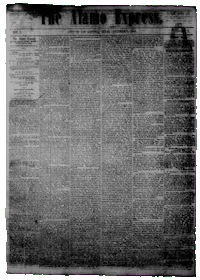
March 4, 1861; Tri-Weekly Alamo Express; San Antonio

On Saturday, the 2nd of March, the day of Texas Independence, just at 12 A.M., the time the secession ordinance was to take effect, the Lone Star Flag over Carolan’s Auction room, the Head Quarters of Travis, fell to the ground, the K. G. C. Flag floating over Braden’s Grocery appeared minus the Star, and the flag raised over the Alamo in attempting to get it down, caught half mast and there staid some time in spite of the efforts to haul it down.

0 comments

The Inaugural of Mr. Lincoln

Civil War Day-by-Day

March 4, 1861; The New York Herald

This day is the 4th of March—a day which has been looked forward to with intense anxiety by the country. It is the day of inauguration de facto. The ceremony will take place at twelve o’clock, and Mr. Lincoln, like Mr. Buchanan, will deliver his inaugural before taking the oath of office. Never since the formation of the government was an inauguration day invested with so much gloom. There is no longer any apprehension of disturbance at the capital; but the little cloud size of a man’s hand which appeared in the Southern horizon on the morning after the 6th of November has grown and spread and become darker and darker, till now the whole Southern heavens are overcast, and tempest seems almost inevitable. The clouds at the North, too, have been ever since gathering and growing blacker, and moving forward in dense masses charged with electricity. It only needs a word and a blow from one man to produce a collision and make the theory of irrepressible conflict a fearful practical reality. A word alone may be sufficient to precipitate the antagonistic elements upon each other, but, followed up by a blow, the result is certain.

No President of the United States has ever been inaugurated under such circumstances before. It is a new era in the history of the country–and unprecedented result of a Presidential election. It is the first time that a party organized on an issue involving a controverted question of morals and religion–a party organized moreover on a purely sectional issue, in opposition to the institutions of fifteen States, divided by a geographical line from the other States–was enabled to elect its candidate to rule over the whole Union, including those fifteen Southern States, not one of which gave him a vote. Upon this dangerous issue, therefore, Mr. Lincoln has been borne into power by a party whose principles are antagonistic of the people–whose combined opposition stands recorded in the ratio of three and a half to one. The popular vote for Mr. Lincoln was 1,865,840. The whole vote was 4,739,982. The official vote against him was thus 2,874,142. If from those who voted for him we deduct the whigs and conservatives, who merely desired a change, and did not intend to endorse the Chicago platform, and who if they had to vote now would throw their suffrages in a very different direction, the strictly republican vote was about one million, against upwards of 3,700,000 opposed to the Chicago platform. Yet it has been claimed, ever since the election, that the small republican minority have a right to enforce their policy over the large majority, to the overthrow of the constitution, to the disruption of the confederacy, and even to civil war.

The result was that State after State seceded at the South, till at length a new confederation was formed and a new government is established at Montgomery. But it was earnestly hoped by every patriotic heart that the leaders of the [continue reading…]

0 comments

Our Washington Correspondence

Civil War Day-by-Day

March 4, 1861; The Charleston Mercury

WASHINGTON, February 28, 1861.

One hundred guns have just been fired in honor of the salvation of the Union, minus the best part of it, according to the apocryphal gospel of the GUTHRIE FRANKLIN, half WILMOT Proviso and half Squatter Sovereignty proposition. I cannot forget that much powder was burnt at the time the Lecompton Constitution was passed. Old BUCK is fond of crowing before he is out of the woods. Old SCOTT is not unwilling to count chickens before they are hatched. As the Lecompton matter proved an abortion and ended in Free Kansas, so will it be with the GUTHRIE FRANKLIN deception. It will serve to keep the Border Slave States quiet until they can be secured.

The patch work Compromise has not passed yet, nor is it likely to do so. Indeed, the chances are quite the other way. SEWARD himself seems to be opposed to it. So likewise the straightest Southern men in both Houses. SEWARD’s idea, as I hear from a reliable source is to have no settlement while BUCHANAN is in power. The moment he is dethroned, peace will be proclaimed, and the honor of saving the country will rebound not to the Republicans, but to the new Union party which SEAWARD is forming with the help of BELL and DOUGLAS, LETCHER and BOTTS. Peace restored, and the confederate States recognized, the next step will be to call a National Convention. This Convention will remodel the whole structure of the Government in such a way as to bring back the seceded States, and place the Union on a permanent and enduring foundation. Such is the grand project which SEWARD contemplates. What is to become of the conflict’s between free and slave society, he has not vouchsafed to inform us.

The House is becoming more and more like a Pandemonium. So disgraceful is the conduct of members, that some gentleman yesterday moved that the galleries be cleared, in order that the people might not be witnesses of the revolting behavior of their public servants. All sense of dignity, of decency even, seems to have departed. No respect is paid to Speaker PENNINGTON–a good old man, with hardy intellect enough to keep him out of the fire. The ultimate effects of a pure democracy may be foreseen in the disgusting spectacles which we now behold in the popular branch of the Federal Legislature. Under the corrupting influence of universal suffrage, it s easy to predict a time, not far off, when the House of Representatives will have to be kept in order by bayonets. [continue reading…]

0 comments

The Fourth of March

Civil War Day-by-Day

March 4, 1861; The Charleston Mercury

ABRAHAM LINCOLN, as President of the States that have not withdrawn from the Union, speaks for the first time today. He can scarcely avoid foreshadowing, in some degree, the policy of his administration. He must proclaim peace or declare war. He must virtually recognize the independence of the Confederate States, or encounter them in a conflict of arms. In his Western railroad speeches, which sedulously flattering the vanity and the ignorance of the rabble, by his frequent and pleasant allusions to the (?) of the laws, he has been shrewd enough to allow himself a wide margin for a change of mind. How far will he avail himself of this comfortable reservation, he will probably tell us today. His wily advisers are evidently in sore distress. They begin to understand the madness of coercion, yet looking upon the tide of Northern prejudice and ambition which has thus far borne them upward, they dare not falter. Like Frankenstein, they have raised a monster which they cannot quell. Let them solve their riddle as best they may. The strength of the South is her safety.

0 comments

The Two American Confederacies

Civil War Day-by-Day

March 4, 1861; The New York Herald

The Administration of the Northern and Southern Confederacies – sketches of the Members, &c., &c., &c.

The inauguration of Abraham Lincoln, the President elect, takes place at Washington toady; and as the new administration comes into office under circumstances unparalleled in the history of the republic, with a separate and distinct Southern government in full operation, we give below brief sketches of the personnel of the two governments, which our readers will find very serviceable.

THE NORTHERN CONFEDERACY.

ABRAHAM LINCOLN, PRESIDENT.

Abraham Lincoln, President of the Northern Confederacy, was born in Kentucky, Feb. 12, 1809. His ancestors, belonging to the society of Friends, originally settled in Bucks county, Pennsylvania, whence they removed to Virginia, and subsequently settled in Kentucky, where the subject of this memoir was first introduced on the stage of life. Mr. Lincoln, imbued with the wandering proclivities of his ancestry, soon removed to Spencer county, Indiana, where he remained for fourteen years. He here received a limited education. In 1830 our subject removed to Illinois. shortly afterwards he served as captain in a regiment of volunteers in the war against Black Hawk. After sustaining a defeat, in 1832, for the Legislature, he was elected to that body for the three succeeding terms by the Whig party. During his term he studied law, and subsequently engaged in practice at Springfield, although still devoting great attention to politics, serving as Whig elector in several Presidential elections. He was elected to Congress in 1846, and served three years, distinguishing himself by his pertinacity in sustaining the Wilmot Proviso, in connection with Seward, Chase & Co. and his opposition to the Mexican war. In 1848 he supported the nomination of Gen. Taylor, and in 1852 was very active for the success of Gen. Scott. In 1849 he was defeated by Gen. Shields for the United States Senatorship, and again in 1855 by Judge Trumbull. In 1856 Mr. Lincoln’s name headed the Fremont electoral ticket. He was first, however, brought in public notice by his memorable campaign against Douglas for the Senatorship. [continue reading…]

0 comments

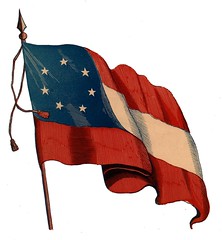
Flag of the Confederacy

Civil War Day-by-Day

Adopted March 4, 1861

0 comments

The News

Civil War Day-by-Day

March 4, 1861; The New York Herald

At noon today, at the national Capitol in Washington city, Abraham Lincoln, of Illinois, and Hannibal Hamlin, of Maine, will be inaugurated President and Vice President of the United States. The inaugural address of Mr. Lincoln, which is looked for with great anxiety throughout the entire country, will, in its general tone, it is said, be conciliatory toward the South, but in firm and positive terms will assert the right and duty of the government to enforce the federal laws, and to possess and hold all the forts, navy yards, arsenals, &c., belonging to the United States. We expect to be able to spread this important document before the public in our afternoon edition of today’s paper.

Numerous reports were current in Washington yesterday that changes had been made in the Cabinet of Mr. Lincoln, but there is no good reason to believe that any alteration will be made in the list published in the HERALD on Saturday and yesterday. Our despatches this morning furnish a report of the rumors, reports and surmises that were afloat until a late hour last night.

The United States Senate were in session last evening, and the chamber was overcrowded with persons anxious to witness their deliberations. At the commencement of the proceedings the noise and confusion in the galleries were so great that quiet was not restored until they had been ordered to be cleared. Mr. Crittenden made a most forcible and eloquent appeal in favor of his peace measure and for the preservation of the Union. He was followed by Mr. Trumbull, of Illinois, in a most ultra and uncompromising speech against all compromise. In answer to a question as to what would be the policy of the new administration respecting the captured forts and arsenals, he indicated very clearly that it would be to recapture them, a declaration which produced considerable excitement among the Southern Senators. The Senate had not adjourned when we were compelled to go to press.

On Saturday last the new tariff bill, recently passed by Congress, received the signature of Mr. Buchanan. The new tariff [continue reading…]

0 comments

The Chronology of Four Eventful Months

Civil War Day-by-Day

March 4, 1861; The New York Herald

Since the sixth day of last November a series of unparalleled and eventful circumstances has become a part of the history of this country–circumstances which, in their present aspect, and in the gloomy hue they assume as concerns the future, vitally affect the prosperity and being of the most wondrous nation that ever grew from a few dependent provinces to the strength and majesty of a powerful empire.

On that day a sectional party, born of fanaticism, and nurtured for thirty years by a violent agitation which pervaded the lecture room, the schoolhouse, the pulpit and the family hearthstone, was elevated to power. Its success was the signal for revolt against its principles on the part of that portion of the country whose institutions its orators and politicians denounced as an iniquity and a curse. Six Southern States abandoned their allegiance to a government which was soon to be administered by the chiefs of this party, who were chosen according to the provisions of the constitution, but against the majority of the popular vote. Hostile attitudes were assumed by the seceding States, who seized the property of the general government, and the federal authorities, whose duty it was to protect it; but immediate collision was suspended by the forbearance of the Executive, in the hope that some compromise would be effected which might spare the shedding of fraternal blood. Remonstrances poured in from all sections of the country against the inauguration of coercive measures. State Legislatures proposed compromise and conciliation; a Peace Conference met at Washington; Congress talked by the hour over the affairs of the nation; financial disaster pressed hard upon every mercantile interest; threats of an attack upon the federal capital caused the concentration of a strong military force there; and while in many quarters voices were raised for peace, preparations were making for war. But the politicians of the dominant faction, in the face of all this, were obdurate and unrelenting in their denial of any compromise which might save the country from impending ruin, and the 4th of March has come, leaving the difficulty unsettled, and the country in as perilous a condition as ever.

Today at noon the administration will be established in power, while a separate confederacy is organizing in the cotton States; and in view of the alarming agitation which stirred the whole country to its utmost depths for the past four months, we have prepared and publish today a chronological table of all the important political events which have transpired in the period from the 6th of November to the 4th of March. That period will form a momentous episode in the history of the United States of America.

0 comments

Mr. Buchanan’s Departure for Home

Civil War Day-by-Day

March 4, 1861; The New York Herald

WASHINGTON, March 3, 1861.

Mr. Buchanan will leave Washington on Tuesday afternoon, remaining one night in Baltimore, as the guest of Zenas Barnum. He will be conveyed by special train to Wheatland by the Northern Central Railroad Company. He will be escorted home from Baltimore by the Baltimore City Guards.

The force bills of Bingham, for the collection of revenue, and of Mr. Stanton for the calling forth of the militia are inevitably lost. Bingham’s bill was lost, not commanding two-thirds of the House, while John Cochran’s successful motion last evening to adjourn the house killed Stanton’s bill, then pending. It cannot be reached. Thus, if the incoming administration mean to coerce the Southern States they must call the new Congress immediately.

The President has signed the following appropriation bills: Invalid Pensions, Military Academy, Deficiencies, Consular, Legislative, &c., Naval Service and Post Office. Appropriation bills not signed as yet: Indian, Civil, Expenses and Army. The President having decided not to sign any private bill passed on the day of adjournment, will throw out a few bills on private calendar.

There is a powerful effort being made by friends of the Oregon and Washington Territory War Debt bill to induce the President to sign it. It is very doubtful whether he will sign it. His Cabinet are nearly all averse to it. Mr. Holt made a strong argument against it.

The office seekers from New York have all arrived, and already it is apparent that there is to be a fearful struggle for the Collectorship, Surveyor, Naval Officer and Postmastership. It is thought that Mr. Seward will control a majority of these important appointments.

0 comments

Civil War Day-by-Day

Civil War Day-by-Day

March 4, 1861

  • Abraham Lincoln is inaugurated as the president of the United States. He tells the crowd gathered around the Capitol that he has no intention of interfering with slavery, but that secession is illegal and the Union perpetual.
  • The first national flag of the Confederate States of America (the “Stars and Bars”) is adopted.
0 comments

Father has volunteered.

Through Some Eventful Years by Susan Bradford Eppes
Susa Bradford Eppes

March 3rd, 1861.—Father has volunteered. Mother was bitterly opposed but though Father yielded to her in many things he would not in this. I wish I was a boy; even if I am young, I could go with him if only I were not a girl. It will beak my heart if he goes.


Susan Bradford is a few days from her 15th  birthday when this entry was made.

0 comments

Horatio Nelson Taft

Diary of US patent clerk Horatio Nelson Taft.

SUNDAY 3

Warmer than ever today, quite oppressive walking. Went up to the Depot at 6 o’clock for the Baggage, walked there and back. Went to the Capitol with Brother and Judge D., but there was no Services there today as we Expected to hear Mr Stockton the Chaplin. Fell in with Chas and brot him home to dine with us. Went to hear Doct Smith in the afternoon but heard Mr Collins. Went with Julia in the Evening to call on Miss Butterfield at Mis Mannings and we then went to Doct Gurleys church and heard Mr Haskel of Boston. Got home 1/2 past nine o’clock.


The three diary manuscript volumes, Washington during the Civil War: The Diary of Horatio Nelson Taft, 1861-1865, are available online at The Library of   Congress.

0 comments

“…the farther away they send us from this Congress the better I will like it.”—A Diary From Dixie

Civil War Day-by-Day

March 3d.–Everybody in fine spirits in my world. They have one and all spoken in the Congress¹ to their own perfect satisfaction. To my amazement the Judge took me aside, and, after delivering a panegyric upon himself (but here, later, comes in the amazement), he praised my husband to the skies, and said he was the fittest man of all for a foreign mission. Aye; and the farther away they send us from this Congress the better I will like it.

Saw Jere Clemens and Nick Davis, social curiosities. They are Anti-Secession leaders; then George Sanders and George Deas. The Georges are of opinion that it is folly to try to take back Fort Sumter from Anderson and the United States; that is, before we are ready. They saw in Charleston the devoted band prepared for the sacrifice; I mean, ready to run their heads against a stone wall. Dare devils they are. They have dash and courage enough, but science only could take that fort. They shook their heads.


¹ It was at this Congress that Jefferson Davis, on February 9,1861, was elected President, and Alexander H. Stephens Vice-President of the Confederacy. The Congress continued to meet in Montgomery until its removal to Richmond, in July, 1861.

0 comments

Programme of the Inauguration

Civil War Day-by-Day

March 3, 1861; The New York Herald

THE INAUGURATION OF ABRAHAM LINCOLN AS SIXTEENTH PRESIDENT OF THE UNITED STATES.

Washington, Feb. 28, 1861.

The following is the programme of proceedings on Monday, the 4th March next, for the inauguration of President Lincoln, as arranged under the supervision of the Chief Marshal, Colonel B. B. French:

THE ORDER OF PROCESSION.

AIDS. MARSHALL-IN-CHIEF. AIDS.

The Military escort, the Commander of which will issue his orders of detail, informing the officers of the district and visiting corps at what place and hour he will form his line, and to whom they must report.

A national flag, with appropriate emblems.

The President of the United States, with the President elect and suite, with marshals on their left and the Marshal of the United States for the District of Columbia (Colonel William Selden) and his deputies on their right.

The Committee of Arrangements of the Senate.

Ex-Presidents of the United States.

The Republican Association.

The Judiciary [continue reading…]

0 comments

Directive to obey Beauregard’s orders — Confederate Records

War of the Rebellion: from the Official Records of the Union and Confederate Armies and Navies

EXECUTIVE OFFICE, DEPARTMENT OF WAR,
Charleston, S.C., March 3, 1861.

Peter G. T. Beauregard having been appointed brigadier-general of the Confederate States of America, and having been ordered to assume command of the troops in and near Charleston Harbor, will be obeyed and respected accordingly, and all State officers of the volunteers, enlisted men, and militia, on duty, are commanded to obey all orders emanating from him.

D. F. JAMISON.

0 comments