The News

Civil War Day-by-Day

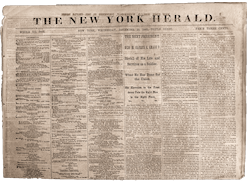
March 7, 1861; The New York Herald

It is stated that President Lincoln will today send to the Senate for confirmation the nomination of Senator Crittenden to the bench of the Supreme Court of the United States, to fill the vacancy caused by the death of Judge Daniels. Major Anderson now in command of Fort Sumter, it is also said, will be nominated to the generalship in the army lately made vacant by the removal of Gen. Twiggs.

A Washington correspondent infers, from the recent conduct of Senator Douglas, his intimacy with the President and those in Presidential confidence, and the tone of his speech in the Senate yesterday on the subject of the Inaugural, that there may, at no distant day, be a place made in the Cabinet for the Little Giant.

All the three Commissioners from the Southern confederacy are now in Washington–Messrs. Forsyth and Roman having arrived yesterday, and Mr. Crawford on the day previous. They have not yet officially announced their presence or object to the government, but are expected to do so soon. It is supposed President Lincoln will refuse to hold any intercourse with them.

The Senate of the United States was again in extra session yesterday. The business transacted was merely of a routine character. On a motion to print extra copies of President Lincoln’s Inaugural a debate sprang up between Senators Clingman and Douglas, in which Mr. Clingman gave expression to his condemnation of the tone of the message, and interpreted it as meaning war. Mr. Douglas, in replying, regarded it as calculated to continue peaceful relations, and as promising reconciliation between the sections.

Our Washington despatches this morning furnish much information, of interest as well to the general public as the active politicians. The new Cabinet has commenced operations, most of the Secretaries having assumed control of their departments, and a number of appointments for various positions have been made.

The State of Texas is out of the Union. From New Orleans it is stated that the people have ratified the ordinance of secession by a majority of from 40,000 to 45,000. General Houston has resigned the Governership.

Mr. Buchanan left Baltimore yesterday morning for his residence at Wheatland, near Lancaster, Pa., whither he was escorted by the Baltimore City Guard. The turnout on the occasion of his departure from the Monumental City was very fine. He arrived at home last evening.

0 comments

Republican National Platform

Civil War Day-by-Day

March 7, 1861; The Charleston Mercury

The New York Tribune thinks the following is worthy of special attention at this time. We agree with the Tribune in this particular.

REPUBLICAN NATIONAL PLATFORM,

ADOPTED AT CHICAGO, 1860.

Resolved, That we, the delegated representatives of the Republican electors of the United States, in convention assembled, in discharge of the duty we owe to our constituents and our country, unite in the following declarations:

1. That the history of the nation, during the last four years, has fully established the propriety and necessity of the organization and perpetuation of the Republican party, and that the causes which called in into existence are permanent in their nature and now, more than ever before, demand its peaceful and constitutional triumph.

2. That the maintenance of the principles promulgated in the Declaration of Independence and embodied in the Federal Constitution, all men are created equal; that they are endowed by their Creator with certain inalienable rights; that among these are life, liberty, and the pursuit of happiness; that to secure these rights, Governments are instituted among men, deriving their just powers from the consent of the governed, is essential to the preservation of our Republican institutions; and that the Federal Constitution, the rights of the States, and the Union of the States, must and shall be preserved.

3. That to the Union of the States this nation owes its unprecedented increase in population, its surprising development of material resources, its rapid augmentation of wealth, its happiness at home, and its honor abroad; and we hold in abhorrence all schemes for disunion, come from whatever source they may: and we congratulate the country that no Republican member of Congress has uttered or countenanced the threats of disunion so often made by Democratic members, without rebuke, and with applause from their political associates; and we denounce these threats of disunion in [continue reading…]

0 comments

The New Postmaster General

Civil War Day-by-Day

March 7, 1861; The Charleston Mercury

The telegraph brings the announcement of the appointment and confirmation of Judge REAGAN, of Texas, as Postmaster General of the Confederate States.

JOHN H. REAGAN was born in Sevier county, Tennessee, October 8, 1818. Having chosen the profession of law, and emigrated to the Republic of Texas, he advanced, by his own merits, through many honorable grades of civil and military distinction, until 1852 when he was appointed a Judge of the District court of Texas. In 1857 he was elected a member of the Thirty fifth Congress, which position he retained, serving with tact and success as a member of various important Committees.

We have no doubt that in the discharge of the arduous duties of his new position, Judge REAGAN will show that his administrative talent is not less than his ability as a legislator.

0 comments

The Lincoln Inauguration

Civil War Day-by-Day

March 7, 1861; The Charleston Mercury

A Washington correspondent of the Baltimore Sun writes:

I have seen today such a sight as I could never have believed possible at the capital of my country. An inauguration of a President surrounded by an armed soldiery, with loaded pieces and fixed bayonets. The President himself hid from public view, in a hollow square of cavalry three or four deep. The tops of houses occupied by soldiery, watching for signs of tumult or assassination.

The carriage in which Mr. Lincoln rode was flanked on either side by cavalry, six or eight deep. It was almost impossible for the crowd on the pavement to get a sight of the President, as the cavalry hid the vehicle from view. Mr. Lincoln did not look either to the right or the left, and it was only occasionally that he raised his hat. There was no enthusiasm exhibited–no cheering–and with but very few exceptions the ladies remained motionless at the windows, and looked upon the pageant without manifesting the slightest feeling. For the most part, Mr. Lincoln appeared to be looking vacantly at the bottom of the carriage. There was but little conversation between him and Mr. Buchanan, and the latter looked as though he would much rather not have participated in the ceremonies.

0 comments

The Inaugural

Civil War Day-by-Day

March 7, 1861; Richmond Enquirer

Our readers have seen and, we feel confident, most anxiously perused the inaugural address of Mr. Lincoln. Never was an inaugural looked for with such deep interest, for never did a President hold the fate and destiny of the Union so completely in his hands. A dismembered and severed Union, a people discordant, dissatisfied and almost belligerent, looked to Mr. Lincoln for some word of hope, some hint of peace. With a deliberation which the Convention of Virginia certainly will appreciate, Mr. Lincoln has spoken, and with a frankness at least commendable, he has told ‘the people of the United States’ that there cannot and shall not be any separation. – He says:

‘It follows from these views that no State, upon its own mere motion, can lawfully get out of the Union; that Resolves and Ordinances to that effect are legally void; and that acts of violence within any State or States, against the authority of the United States, are insurrectionary or revolutionary, according to circumstances. I therefore consider that in the view of the Constitution and the laws, the Union is unbroken; and, to the extent of my ability, I shall take care, as the Constitution itself enjoins upon me, that the laws of the Union be faithfully executed in ALL the States.’

Here, then, is an end to peaceable separation.

Mr. Lincoln has no ambiguity as to his purposes, and he coolly tells the States that have seceded, that if in the future anybody should be hurt, that they must not charge upon him; for he says:

‘In doing this there needs to be no bloodshed or violence, and there shall none, unless it be forced upon the National Government.’

He does not stop with generalities, but enters into details of purpose about which there can be no misunderstanding.

‘The power confided to me will be used to hold, occupy and possess the property and places belonging to the Government, and to collect the duties and imposts, but beyond what may be necessary for these objects, there will be no invasion, no using of force against or among the people anywhere. Where hostility to the United States in any interior [continue reading…]

0 comments

Civil War Day-by-Day

Civil War Day-by-Day

March 7, 1861

  • Salmon P. Chase appointed Secretary of the Treasury
0 comments

“Strength of the volunteer division of South Carolina” — Confederate Records

War of the Rebellion: from the Official Records of the Union and Confederate Armies and Navies

CHARLESTON,
March
6, 1861.

President DAVIS, Montgomery:

MY DEAR SIR: I inclose you, according to promise, a statement showing the strength of the volunteer division of South Carolina. Some of the regiments are commanded by highly accomplished graduates of our military academies, and some by officers of the Palmetto Regiment. It is altogether a superb body of troops, and I think will give a good account of themselves by their acts.

Under the skillful conduct of General Beauregard the works here are likely to be put promptly in the best possible condition to prevent re-enforcements. The danger to be feared is that light-draught vessels, barges, or boats in the night may be sent in through the two middle channels, known as the Overall and North Channels; but you doubtless get fuller information than I can give you on these points.

Mr. Miles has doubtless apprised you of my readiness to enter the service of the confederation in the capacity you indicated. I say to you, however, frankly, that I should like to see my brigadiers in the field with their commands, or so many as may be needed, and be there myself with my present rank. If raising General Beauregard’s rank a grade does not embarrass you, I would cheerfully report to him. The exhibition of skill, promptness, and energy by General Beauregard is highly gratifying to the authorities here.

I am, very sincerely and truly, yours,

M. L. BONHAM.

[Inclosure.]

HEADQUARTERS, STATE   OF SOUTH CAROLINA,
March 6, 1861.

M. L. BONHAM,
Major-General, Commanding Volunteer Forces of S. C.:

GENERAL: The number of companies organized and received under the act of general assembly of 17th December, 1860, is one hundred and four–in the aggregate amounting to 8,835, rank and file, constituting ten regiments of ten companies each. The force is divided into four brigades, constituting one division.

Respectfully,

S. R. GIST,

Adjutant and Inspector General of South Carolina.

0 comments

Operations in Charleston Harbor

War of the Rebellion: from the Official Records of the Union and Confederate Armies and Navies

FORT SUMTER, March 6, 1861.
(Received A. G. O., March 9.)

Col. S. COOPER, Adjutant-General U. S. Army :

COLONEL: I have the honor to report that a very large re-enforcement was landed last night at Cummings Point and bivouacs near No. 10. This morning it was marched out of sight, around the point of the island. Yesterday the three other guns were mounted in No. 10, thus completing its armament of four heavy pieces. They continued working yesterday at the places mentioned in my report, and are still so occupied to-day. A party has also been at work this morning on the Fort Moultrie glacis. Everything indicates activity and determination.

I had the honor to present in No. 58 my opinion of the strength of the army which will be necessary to force an entrance into the harbor. The presence here, as commander, of General Beauregard, recently of the U.S. Engineers, insures, I think, in a great measure the exercise of skill and sound judgment in all operations of the South Carolinians in this harbor. God grant that our country may be saved from the horrors of a fratricidal war!

I am, colonel, very respectfully, your obedient servant,

ROBERT ANDERSON,

Major, First Artillery, Commanding.

—–

FORT SUMTER, S.C., March 6, 1861.

General Jos. G. TOTTEN,
Chief Engineer U.S.. Army, Washington, D.C.:

GENERAL: I have the honor to report that during the day, and especially towards night, unusual activity was observed among the South Carolinians around us. Several steamer loads of men were landed on Cummings Point. The number was greater than the arrangements for shelter, apparently, for I observe quite a large number grouped about their bivouac fires this morning. Their suffering must have been considerable during the night, for the weather suddenly changed from the warm temperature of the preceding days to a high degree of cold for this climate, the wind blowing fresh from the north.

I learn that portable hot-shot furnaces have been furnished to several, and probably all, of the batteries. The mortar battery on James Island, south of Fort Johnson, is armed, but the number of mortars is not ascertained. The magazine in the flank of this battery is also finished. The mortar battery on Sullivan’s Island, west of Fort Moultrie, is also armed.

All the batteries on Morris Island are armed. The guns range from 32-pounders down, with the exception of the iron bomb-proof, which is (I think, from all reports and observations) armed with 8-inch columbiads–three of them.

The raft does not meet expectations. It is being covered with railroad strap-iron instead of the T rail. This has a cross-section of about three-fourths or one inch by two inches or two and a half inches. They are now ironing the top portion, the front not being yet commenced. Two 8-inch columbiads are lying on the wharf ready to be put on board. I do not think this floating battery will prove very formidable.

We have not yet received the inaugural address of President Lincoln, although it is reported from town that it is coercive in its character, and that much excitement prevails.

Very respectfully, your obedient servant,

J. G. FOSTER,

Captain, Engineers.

0 comments

Beauregard Assumes Command in Charleston Harbor — Confederate Records

War of the Rebellion: from the Official Records of the Union and Confederate Armies and Navies

HDQRS. OF THE
CONFEDERATE STATES
OF AMERICA,
Charleston, S. C., March 6, 1861.

GENERAL ORDERS,
No. 1.

.


I. By virtue of authority from the War Department, Confederate States of America, bearing date Montgomery, March 1, 1861, and of authority of the Department of War, State of South Carolina, bearing date March 3, 1861, the undersigned assumes command of all the troops—Regulars, Volunteers, and Militia—on duty in and near Charleston Harbor.

II. The following appointments are announced on the staff of the brigadier-general commanding: Capt. D. R. Jones, as assistant adjutant general; Capt. Stephen D. Lee, of the regular artillery service of the State of South Carolina, as acting assistant quartermaster-general and acting assistant commissary-general; Capt. S. Wragg Ferguson, of the regular infantry service of the State of South Carolina, as aide-de-camp; First Lieut. Joseph J. Legaré, of the regular engineer service of the State of South Carolina, as private secretary.

G. T. BEAUREGARD,

Brigadier-General, Commanding.

0 comments

Horatio Nelson Taft

Diary of US patent clerk Horatio Nelson Taft.

WEDNESDAY 6

Worked busily in the office all day but had numerous “Calls.” Called, myself, upon Mr Kelly the acting Sec’y of Interior. The Sec’y [has] not taken his position yet but expected today. Wife & Julia called at the office for me just before 3 o’clock. I went home with them, C R T along. In the evening went to Willards with them all, staid two or three hours with our friends in the parlors. We went from there to “Gautiers” and took Ice Cream, Tea, &c. Got home about 11 o’clock and soon went to bed.


The three diary manuscript volumes, Washington during the Civil War: The Diary of Horatio Nelson Taft, 1861-1865, are available online at The Library of   Congress.

0 comments

Report of Brig. Gen. G. T. Beauregard, C.S. Army—”A general view of the condition of the offensive works of this harbor..,”

War of the Rebellion: from the Official Records of the Union and Confederate Armies and Navies

HEADQUARTERS C. S. ARMY,
Charleston, S. C., March 6, 1861.

SIR: In obedience to War Department orders of the 1st instant I arrived at this place on the 3d instant, and immediately reported to Governor Pickens for military duty. That day we inspected the floating battery now being constructed here. On the 4th instant we inspected the works on the southern portion of the harbor (Morris Island and Fort Johnson) and yesterday those on the north (Fort Moultrie, &c., including Castle Pinckney).

I have now the honor to state that I coincide fully in the opinion and views contained in Maj. W. H. C. Whiting’s letter preceding his full report, and that, as I have not time to write more fully on the subject, I desire that portion of his letter referring to the above works should be annexed to this report, and a copy thereof sent to me for my files.

On Morris Island the flanking defects are being remedied, and will probably soon be completed, as well as the position, &c., of said works will permit. I have ordered that only six mortars, instead of twelve, intended for that point, should be put in position there. I have ordered the construction of a series of small batteries of heavy guns, two in each, and twenty in all, well protected by traverses along the channel shore of that island, said batteries to be about fifty or one hundred yards apart (according to the nature of the ground), to prevent the broadsides of a vessel, from silencing them in a few minutes. When those batteries shall be ready, I will remove into them all the heavy guns I can dispose of. I have ordered to that island the whole of Colonel Gregg’s regiment, with two short 12-pounders and one light battery, for the protection of said works, selecting a strong natural position to protect their right flank from a land attack.

I have ordered an additional battery (for two mortars) to be constructed near Fort Johnson, to receive half of those intended for a defectively-placed mortar battery, to the south of said work, the latter not being in itself of much importance, containing only an open battery of four 24-pounders bearing on the inner harbor. At Fort Moultrie, towards the north of Fort Sumter, I have ordered additional traverses to be thrown up, of a better construction than those already there, for the protection of the channel guns against enfilade from Fort Sumter. Between Moultrie and the western extremity of Sullivan’s Island I have ordered the construction of a four-gun concealed battery, to enfilade the channel face of Sumter, having nine or ten guns (en barbette) bearing on the Morris Island works. I have ordered two more 32-pounders to be added to the extreme five-gun battery, commanding the Maffitt or northern shore channel into the harbor, and I have selected the site of two more mortar batteries, of two each, to take in reverse the casemate and barbette guns of Fort Sumter bearing on Morris Island.

I have fortunately found that we would soon have mortars enough for all our present wants; but, generally, the carriages and chassis of nearly all the guns, especially those on the Morris Island works, are either defective or not of the proper kind. I am going to remedy this defect as soon as practicable.

I find that the gorge of Fort Sumter is too much inclined to the guns on Morris Island to be breached by them at this distance (thirteen hundred yards); and, moreover, they have double the number of guns bearing on them, reversing thereby the advantages of the attack over the defense. If we succeed in constructing my enfilading battery on Sullivan’s Island we will then have a preponderating fire against said gorge wall (four feet six inches thick); but, as already stated, at about thirteen hundred yards, and at an angle of about fifty degrees.

I find that the battery of heavy guns (10-inch columbiads), which I proposed putting up in the vicinity of Fort Johnson, would be impracticable (if we had said guns), the grounds being too low and marshy.

I have now given you a general view of the condition of the offensive works of this harbor, and I am of the opinion that, if Sumter was properly garrisoned and armed, it would be a perfect Gibraltar to anything but constant shelling, night and day, from the four points of the compass. As it is, the weakness of the garrison constitutes our greatest advantage, and we must, for the present, turn our attention to preventing it from being re-enforced. This idea I am gradually and   cautiously infusing into the minds of all here; but, should we have to open our batteries upon it, I hope to be able to do so with all the advantages the condition of things here will permit. All that I ask is time for completing my batteries and preparing and organizing properly my command, which is still in a more or less confused state, not having yet my general staff officers around me. So soon as I shall have here a competent engineer officer (Major Whiting arrived here on the 4th, and will probably leave again for Savannah to day, where his presence is required), I will send to the department a plan of this harbor, with the position, &c., of all the works marked thereon. Those Drummond lights, ordered from New York, will be here in about ten days.

I remain, sir, very respectfully,

G. T. BEAUREGARD,

Brigadier-General, Commanding.

General L. P. WALKER,

Secretary of War, Montgomery, Ala.
0 comments

William Babham, Jr. to Howell Cobb

Miscellaneous document sources

Edenton [N. C], Mar. 6/61.

Dear Sir: Acquainted with no one in the Capital of the South ern] R[epublic], and my State unfortunately having no representative there, I beg you to furnish me with [a] little information if the numerous demands upon your time will permit. I am satisfied your ardent nature induces you to contribute in every and the least respect to the advancement of the Government in which you have recently embarked. From present indications Old Rip[i] has even pronounced against the propriety and expediency of assembling a convention. If this be so, the necessity of secession must soon be presented again to the people. If however the convention is called and the members, composed as it will be mostly of Unionists, are compelled by the withdrawal of Va. to consign No. Ca. to a similar fate, the people will be called upon to ratify it. In this section they are not even prepared for that, and my object in addressing you is to request that you will furnish me with the name of a proper person in the city through whom I may obtain what documents I desire for the purpose of promoting the Southern feeling and reconciling the majority here to the Southern Republic.

In the recent election we had but one candidate in this section whose ground was immediate secession and opposition to reconstruction. He of course was defeated. I take and have ever taken the So. Ca. and Georgia, ground. You will oblige me by also suggesting to me the name of the government organ in Montgomery, and if it has none, the best Southern-rights paper in the city. The provisional Constitution has pronounced against the Afr. slave trade. I hope the permanent one will do likewise.


[i] North Carolina.


From Annual Report of the American Historical Association for the Year 1911.

0 comments

General Beauregard

Civil War Day-by-Day

March 6, 1861; The Charleston Mercury

There is no name better known for science and worth among army men, than Gen. BEAUREGARD.

The histories of the Mexican War, favorably as they have mentioned him, have failed to notice two of the most conspicuous incidents of his life, and which have gone far to establish his fame. We will relate them promising that we were not in the war, and that we repeat them from memory on authentic information. The principal facts will be stated accurately, though there may be errors in unimportant details.

The first occurred before Vera Cruz.

Gen. B., then a Lieutenant of Engineers, was sent out by his Colonel (TOTTEN, if we remember aright) with a party of sappers to dig and prepare a trench, according to a profile and plan prepared by the Colonel. No sooner had BEAUREGARD examined the ground than he discovered great objections to the plan. To assure himself, he climbed into a tree, and with the aid of the marine glass, the engineer’s vade mecum, he made a reconnoisance, and saw plainly that the trench, as planned would be enfiladed by the enemy’s cannon. Here was a difficult position for a subaltern ministerial officer. He decided promptly, and returned to headquarters without sticking a spade. The Colonel met him and expressed surprise that he had so soon performed his task. BEAUREGARD replied that he had not touched it. The Colonel, with the astonishment military men feel in hearing their orders have not been obeyed inquired the reason. He was soon informed of it. He was incredulous–ground had been examined–“reconnaissance was perfect,” &c. The young Lieutenant was satisfied, however, that the reconnaissance of his old chief had not been made like his, “up in a tree.” The Colonel, like a sensible man, concluded to make another examination–the plan was changed in accordance with the young Lieutenant’s [continue reading…]

0 comments

The Veto

Civil War Day-by-Day

March 6, 1861; The Charleston Mercury

It is said that the President has vetoed the Act currently passed by the Congress to suppress the African slave trade. The grounds of the veto are not as yet known; but it is certainly unfortunate that there should be a difference between Congress and the Executive on such a subject. Slavery is the immediate cause of the existence of the Confederacy. That difference should already arise concerning it, in its councils, is very much to be deplored. That Congress expected no such thing is plain from the fact that it removed the injunction of secresy, and published the act to the world. This act is a modification of the laws of the United States upon the subject, which were adopted, with all the other laws of the United States, by the Congress of the Confederate States. The laws of the United States make the importation of African slaves piracy. This act punishes it as a high misdemeanor. To veto the latter, is to keep in force the former. Can this be the object of the veto?

0 comments

The News

Civil War Day-by-Day

March 6, 1861; The New York Herald

The numerous despatches from various portions of the country on the subject of President Lincoln’s inaugural which we furnish this morning will indicate the manner in which it has been generally received by the country, and the different lights in which it is viewed by persons of different party predilections. One of our despatches from New Orleans, published in another column, states that in that city it was considered as contradictory, incongruous and ridiculous.

Despatches from Montgomery, Alabama, the capital of the new Southern confederacy, say that it is considered there that war between the North and South is now inevitable. It is said that the Congress of the confederate States are busily engaged in organizing a standing army for the anticipated conflict.

The Cabinet of the new President is given to our readers in another portion of this morning’s issue. It will be found to be the same as that published in the HERALD some days ago.

Mr. Crawford, one of the three Commissioners from the Southern confederacy appointed to negotiate with the governor of the United States for the transfer of the public property, arrived in Washington yesterday. He will not announce his mission to the government until the arrival of his colleagues, who are expected in a few days. It is supposed that Mr. Lincoln will decline all conference with these gentlemen.

In the Missouri State Convention yesterday resolutions were adopted appointing a committee to wait on the Commissioner from Georgia and inform him that Missouri dissented from the position taken by his State, and very respectfully but emphatically declined to accept the invitation of Georgia to share with her the honors and responsibilities of secession.

A despatch from Raleigh gives us some further returns of the North Carolina election for State Convention. So far as the results have been obtained the Unionists are in a large majority. The vote on the question of holding a convention is said to be so close that the official returns will be necessary to decide it.

0 comments

Lone Star Flag

Civil War Day-by-Day

March 6, 1861, Dallas Herald

Last Saturday amidst the booming of cannon and the shouts of the people, the Lone Star Flag, made for the occasion by the Ladies of Dallas, was raised above the Court House, and floated triumphantly to the breeze. It is a beautiful piece of work and reflects the highest credit upon the fair ladies who gathered together and wrought his fine emblem of Texas Independence. At night, there was a brilliant illumination and a thousand lights were shedding their rays upon the enthusiastic crowds that promenaded its streets. The establishments of Messrs. Simon, Wells & Bro., Caldwell, Jeff Peak Jr., the Dallas Hotel, Crutchfield House, Nevill’s, Baird’s, and the Court House were perfect blazes of light. Appropriate transparencies were gotten for the occasion and had a fine effect.

0 comments

Our Washington Correspondence

Civil War Day-by-Day

March 6, 1861; The Charleston Mercury

It is now night. But the last day of this eventful session is not over yet; for both Houses are still in squabbling turmoil at the Capitol, with every probability of keeping at it till morning. As to their proceedings during the last forty eight hours, a long dash, a large zero, would be the best report. A man of spirit loses all patience even in running over the newspaper abstracts. What must be his feeling, then, if constrained to witness the tiresome farce, hour after hour? Truly, the fundamental principle of this government is hopelessly lost. It is rotten at its very core. All parties, alike, lapsing from bad to worse in the natural progress of Republican institutions, have spewed up into public life a set of men as incompetent to meet the grand exigencies of the present crisis, as unfit for anything save petty intrigues and plunder, as so many semi idiotic dwarfs from Terra del Fuego.

It sounds monstrous, but is only the plain truth, that hardly a man in either House seems to realize, even at this last moment, the imminent and terrible calamities with which the country is threatened. It is but the bald, unadorned fact that every one here, from the highest to the lowest, is far less exited, far less apprehensive of danger, than they were at the beginning of the session. This apathy may be traced to a number of circumstances. First: the constant presence of danger has made men accustomed to its form and lineaments. They are no longer frightful. Second: the long delay at Sumter and Pickens has led people to believe that there never will be any fighting. I say this with pain, and with no earthly desire to hasten hostilities; but it is the simple truth. Your own reason will tell you that is must and can be no otherwise. Third: the delusion of Reconstruction tends to allay excitement. Thousands will swear, if need be, that the majority of the people of the Confederate States are already heartily sick of secession, and anxious to get back into the Union. All that is needed is aid and comfort from the Federal Government to enable the Reconstructionists to carry things before them like a whirlwind. Men of all sides honestly believe this, for they have been assured of the fact by papers like the True Delta, by travellers just returned from Georgia and Alabama, and by forged or real letters from wealthy planters to ABRAHAM LINCOLN. Fourth: the coalition formed between the Whigs and Douglasites in the [continue reading…]

0 comments

“…it does not seem as though there could be war!”—Village Life in America.

Village Life in America, 1852 – 1872, by Caroline Cowles Richards

March 4, 1861.– President Lincoln was inaugurated to-day.

March 5. – I read the inaugural address aloud to Grandfather this evening. He dwelt with such pathos upon the duty that all, both North and South, owe to the Union, it does not seem as though there could be war!

0 comments

Things remain as they were.

Journal of Meta Morris Grimball
Meta Morris Grimball

March 5

       Mr Grimball went to Town to see about the boys. We understood they were to be ordered down to Morris’s Island & he wished to give them, William & Arthur, a little money towards fixing themselves comfortably. He found they were not at that time ordered: so he left an order for $50 with W. to be used if they seem to require it.

       Papa went down on Monday and we went over to pay a visit to the Aikens, found Mrs A. at home, better I think, and Miss A. talked away pleasantly, as usual.

       On Tuesday visited Mr Elliott and his wife and invited them to dine with us the next day. Mrs Wayne[,] Mrs Vanderhorst were also of the party and the dinner was quite a pleasant one. I am very glad the thing is over, for it was to be done. Mr Elliott is an intelligent and pleasant mannered young man.—

       Things remain as they were.

0 comments

“It is uncomfortable that the idea has gone abroad that we have no joy, no pride, in this thing.”—A Diary From Dixie

Civil War Day-by-Day

March 5th.–We stood on the balcony to see our Confederate flag go up. Roars of cannon, etc., etc. Miss Sanders complained (so said Captain Ingraham) of the deadness of the mob. “It was utterly spiritless,” she said; “no cheering, or so little, and no enthusiasm.” Captain Ingraham suggested that gentlemen “are apt to be quiet,” and this was “a thoughtful crowd, the true mob element with us just now is hoeing corn.” And yet! It is uncomfortable that the idea has gone abroad that we have no joy, no pride, in this thing. The band was playing “Massa in the cold, cold ground.” Miss Tyler, daughter of the former President of the United States, ran up the flag.

Captain Ingraham pulled out of his pocket some verses sent to him by a Boston girl. They were well rhymed and amounted to this: she held a rope ready to hang him, though she shed tears when she remembered his heroic rescue of Koszta. Koszta, the rebel! She calls us rebels, too. So it depends upon whom one rebels against–whether to save or not shall be heroic.

I must read Lincoln’s inaugural. Oh, “comes he in peace, or comes he in war, or to tread but one measure as Young Lochinvar?” Lincoln’s aim is to seduce the border States.

The people, the natives, I mean, are astounded that I calmly affirm, in all truth and candor, that if there were awful things in society in Washington, I did not see or hear of them. One must have been hard to please who did not like the people I knew in Washington.

Mr. Chesnut has gone with a list of names to the President–de Treville, Kershaw, Baker, and Robert Rutledge. They are taking a walk, I see. I hope there will be good places in the army for our list.

0 comments

For the new president from Secretary of War, Joseph Holt

Turning on the Light: A Dispassionate Survey of President Buchanan’s Administration, From 1860 to its Close, by Horatio King
A letter to the new president on Major Anderson and Fort Sumter.

War Department, March 5, 1861.

Sir,–I have the honor to submit for your consideration several letters with inclosures received on yesterday from Major Anderson and Captain Forster of the Corps of Engineers, which are of a most important and unexpected character. Why they were unexpected will appear from the following brief statement:

After transferring his forces to Fort Sumter he (Major Anderson) addressed a letter to this Department, under date of the 31st December, 1860, in which he says, ‘ Thank God! we are now where the Government may send us additional troops at its leisure. To be sure, the uncivil and uncourteous action of the Governor (of South Carolina) in preventing us from purchasing anything in the city will annoy and inconvenience us somewhat; still we are safe.’ And after referring to some deficiency in his stores, in the articles of soap and candles, he adds: ‘Still we can cheerfully put up with the inconvenience of doing without them for the satisfaction we feel in the knowledge that we can command this harbor as long as our Government wishes to keep it.’ And again, on the 6th of January, he wrote: ‘My position will, should there be no treachery among the workmen whom we are compelled to retain for the present, enable me to hold this fort against any force which can be brought against me; and it would enable me, in the event of war, to annoy the South Carolinians by preventing them from throwing supplies into their new posts except by the aid of the Wash Channel through Stono River.’

Before the receipt of this communication, the Government, being without information as to his condition, had despatched the Star of the West with troops and supplies for Fort Sumter, but the vessel, having been fired on from a battery at the entrance to the harbor, returned without having reached her destination.

On the 16th of January, 1861, in replying to Major Anderson’s letters of the 31st of December and of the 6th of January, I said, ‘Your late despatches, as well as the very intelligent statements of Lieutenant Talbot, have relieved the Government of the apprehensions previously entertained for your safety. In consequence it is not its purpose at present to reinforce you. The attempt to do so would no doubt be attended by a collision of arms and effusion of blood–a national calamity which the President is most anxious to avoid. You will, therefore, report frequently your condition, and the character and activity of the preparations, if any, which may be being made for an attack upon the fort or for obstructing the Government in any endeavors it may make to strengthen your command. Should your despatches be of a nature too important to be intrusted to the mails, you will convey them by special messenger. Whenever, in your judgment, additional supplies or reinforcements are necessary for your safety or for a successful defence of the fort, you will at once communicate the fact to this Department, and a prompt and vigorous effort will be made to forward them.’

Since the date of this letter Major Anderson has regularly and frequently reported the progress of the batteries being constructed around him, and which looked either to the defence of the harbor or to an attack on his own position. But he has not suggested that these works compromised his safety, nor has he made any request that additional supplies or reinforcements should be sent to him. On the contrary, on the 30th of January, 1861, in a letter to this Department, he uses this emphatic language: ‘I do hope that no attempt will be made by our friends to throw supplies in; their doing so would do more harm than good.’

On the 5th of February, when referring to the batteries, etc., constructed in his vicinity, he said, ‘Even in their present condition they will make it impossible for any hostile force, other than a large and well appointed one, to enter this harbor, and the chances are that it will then be at a great sacrifice of life;’ and in a postscript he adds : ‘Of course, in speaking of forcing an entrance, I do not refer to the little stratagem of a small party slipping in.’ This suggestion of a stratagem was well considered in connection with all the information that could be obtained bearing upon it, and in consequence of the vigilance and number of the guard-boats in and outside of the harbor it was rejected as impracticable.

In view of these very distinct declarations, and of the earnest desire to avoid a collision as long as possible, it was deemed entirely safe to adhere to the line of policy indicated in my letter of the 16th January, which has been already quoted. In that Major Anderson had been requested to report ‘at once,’ ‘whenever, in his judgment, additional supplies or reinforcements were necessary for his safety or for a successful defence of the fort.’ So long, therefore, as he remained silent upon this point the Government felt that there was no ground for apprehension. Still, as the necessity for action might arise at any moment, an expedition has been quietly prepared, and is ready to sail from New York on a few hours’ notice, for transporting troops and supplies to Fort Sumter. This step was taken under the supervision of General Scott, who arranged its details, and who regarded the reinforcements thus provided for aa sufficient for the occasion. The expedition, however, is not upon a scale approaching the seemingly extravagant estimates of Major Anderson and Captain Forster, now offered for the first time, and for the disclosures of which the Government was wholly unprepared.

The declaration now made by the major that he would not be willing to risk his reputation on an attempt to throw reinforcements into Charleston harbor, and with a view of holding possession of the same, with a force of less than twenty thousand good and well-disciplined men, takes the Department by surprise, as his previous correspondence contained no such intimation.

I have the honor to be,

Very respectfully,

Your obedient servant,

J. Holt.

To The President.

0 comments

“Lincoln is fairly in the harness, he can now ‘go to work.’”—Horatio Nelson Taft

Diary of US patent clerk Horatio Nelson Taft.

TUESDAY, MARCH 5, 1861.

This has been one of the disagreable days of Washn cold, very windy and the atmosphere loaded with dust. It has not frozen, but warm clothing necessary. Brother C R tried to go to Mt Vernon but there was such a crowd on the Boat that he backed out for the day. The Pat office has been crowded all day with visitors. Judge W H Davis returns tomorrow morning home. Called at the Hotels with Bror this evening, great crowds there yet. Cabinet appointments just out. Lincoln is fairly in the harness, he can now “go to work.” Got the NY Papers, read at home till 1/2 past 11 o’clock.


The three diary manuscript volumes, Washington during the Civil War: The Diary of Horatio Nelson Taft, 1861-1865, are available online at The Library of   Congress.

0 comments

Operations in Charleston Harbor

War of the Rebellion: from the Official Records of the Union and Confederate Armies and Navies

FORT SUMTER, S.C., March 5, 1861.

Col. S. COOPER, Adjutant-General:

COLONEL: I have the honor to report that parties are working to-day on the mortar battery at Fort Johnson, which they are making higher and stronger, and on the Morris Island batteries, numbered on Captain Seymour’s sketch Nos. 1, 9, and 10. They are filling the embrasures in this last battery, in which we see that one gun has been placed. They are also at work on the covered way connecting Nos. 9 and 7.

I presume, from the movements around us yesterday, that Brig. Gen. P. G. T. Beauregard assumed command and made an inspection of the forts, &c., in this harbor, which are garrisoned by the South Carolina troops.

I am, colonel, very respectfully, your obedient servant,

ROBERT ANDERSON,

Major, First Artillery, Commanding.

0 comments

Operations in Charleston Harbor — Confederate Records

War of the Rebellion: from the Official Records of the Union and Confederate Armies and Navies

“We agreed that it was Lincoln’s purpose at once to attempt the collection of the revenue, to re-enforce and hold Fort Sumter and Pickens, and to retake the other places. He is a man of will and firmness.”

WASHINGTON CITY, March 5, 1861.

General L. POPE WALKER,
Secretary of War, Montgomery, Ala.:
DEAR SIR: Judge Clay asked me before he left here to telegraph and write to Governor Moore any matters of importance. This was before the formation of the Provisional Government at Montgomery. Nothing has occurred since that request to justify a special dispatch, and now it appears to me that if there should be movements of troops or ships which come to my knowledge it would be better to send them to you. I shall do so on learning anything of importance in a reliable way. I may send the dispatch in a letter to Richmond to be telegraphed from there, or I may send it from here, as circumstances dictate.

The inaugural undoubtedly means war, and that right off. I have never doubted as to Lincoln’s views, and nothing would have changed them but the secession of the border States, who have not acted.

Mr. Crawford is here, and will proceed to execute the duties of his mission as soon as the new Secretary of State is installed. This will bet I suppose, to-morrow morning at furthest.

I was present last evening at a consultation of Southern gentlemen, at which Messrs. Crawford, Garnett, Pryor, De Jarnette, of Virginia, and Wigfall, of Texas, were present. We all put the same construction on the inaugural, which we carefully went over together. We agreed that it was Lincoln’s purpose at once to attempt the collection of the revenue, to re-enforce and hold Fort Sumter and Pickens, and to retake the other places. He is a man of will and firmness. His Cabinet will yield to him with alacrity, I think. Seward has, of course, agreed to the inaugural, and the pretenses of his conservatism are idle.

We believe that these plans will be put into execution immediately. I learn five or six United States ships are in New York Harbor, all ready to start. The United States steamer Pawnee came here the other day suddenly from Philadelphia, fully provisioned and ready to go to sea.

I understand that it is spoken of in Army circles to re-enforce Sumter by sending in men in whale-boats by night. This will probably be attempted in the first instance. After the garrison is re-enforced sufficiently to stand an assault, then the attempt may be made to fight the way up by five or six war vessels. Simultaneously or prior to this will be the change of programme at Pensacola by the United States, Pensacola being a point of infinitely more importance. Considering this and the evident purpose announced in the inaugural, would it not be expedient to prevent anything in the shape of dispatches, letters, or messengers from going to Slemmer or the other United States officers or men at Pensacola? By this you will have the advantage of knowing the movements from this point before the Government officers at Pensacola.

We shall endeavor to get hold of movements as soon as possible, and to advise you. Of course we labor under great difficulties in procuring early intelligence.

There is a general concurrence in the opinion that if any attack is made on Sumter it should be by order of the Government of the Confederate States and not by South Carolina alone.

Very truly yours,

L. Q. WASHINGTON.

Will you please show this letter to the Hon. Mr. Perkins, Secretary of the Navy?

I fear the present Virginia Convention will not pass an ordinance of secession unless a collision or war ensues; then public feeling will force them to it. There is a majority of old Federal submissionists, who got in by pretending to be resistance men.

0 comments

Our Washington Correspondence

Civil War Day-by-Day

March 5, 1861; The Charleston Mercury

WASHINGTON, March 1.

People being tolerably well satisfied that SCOTT with his cannon has overawed WISE with his minute men, it is likely, from present appearances, that we shall have just as large a crowd here on next Monday as on any previous inauguration day. But thousands on thousands would have come under any circumstances. The natural thirst of the Yankee and the Hoosier for office, masters all other passions, and carries them, if need be into the jaws of instant death.

We are no means at the bottom of LINCOLN’S policy yet. The obsequious Washingtonians serenaded him last night, and he told them he would give the people of the South all their rights under the Constitution. According to whose interpretation? The question was not put as it ought to have been. But the boot-licks and toad eaters of this city care nothing on earth for rights. They want quiet, repose–leisure to feed on the Federal pap until they are satisfied, if that be possible. Nothing can been more disgusting than the alacrity with which not only the poor devils of clerks, but the solid business men also, are trimming, the sails of their principles to suit the incoming political breeze. Towering above all others in this shameful movement are the old line Whigs who were born in Virginia. The truth is–and they admit it, – a Virginia Whig is naturally a perfect Republican, barring a little free soil.

You, people of Charleston, have been made famous by virtue of secession. All the papers in this country have had their spiteful curlike snap at you, and now the English papers are following suit. The last number of the London Illustrated News has a picture entitled, “The Secession movement–entrance hall to an hotel at Charleston, South Carolina.” If THE MERCURY had the appliances for cheap piracy which the HARPER’S possesses, it ought to reproduce this charming cut. The display of badly clad individuals and ponderous spit boxes is very rich. The gentlemen who frequent hotel at Charleston, would be delighted to see themselves so outrageously caricatured.

The Tribune pitches into Mr. SPRATT with great vigor; calls him “The Apostle to the Africans,” and says “reminds us of that conscientious actor who, when he was to play Othello, blacked himself all over, that his consistency might be perfect and entire,”and is otherwise most facetious over him. It is to be hoped Mr. SPRATT may survive. [continue reading…]

0 comments