Important from Texas

Civil War Day-by-Day

March 18, 1861; The Charleston Mercury

LATEST by TELEGRAPH.

NEW ORLEANS, March 17. – Galveston dates to the 15th inst. have been received. Fort Brown was evacuated by the Federal Troops on the 12th, and no difficulty occurred – Major PORTER superintending the evacuation. The troops, it is said, will proceed to Key West and Tortugas by the Daniel Webster. Several hundred State troops have been enlisted for six months, to serve under Col. FORD, on the Rio Grande frontier. They have occupied various ports. The Convention is discussing measures for military defence. Major MARTIN, of the United States Army, had resigned, and tendered his services to the State. Camp Colorado, on the Northern frontier, had been taken by the State troops. Capt. SAYRE, of the Confederate army, had arrived, to muster in a regiment of Rangers for the frontiers, by order of the President.

The steamer Rusk had arrived from Brazos with 300 State troops.

0 comments

News from Pensacola

Civil War Day-by-Day

March 18, 1861; The Charleston Mercury

(Extract from a private letter.)

Yesterday Col. Forney was placed in full command of all the forces at this place–Colonel Chase having resigned–and he has commenced his operations with energy. A sand battery is a cellar dug in the sand, three feet deep and eighteen by twenty four wide. The sand which comes to of this place is piled up so as to make a sort of wedge shaped defence eighteen feet long and four feet high at the edge of the pit, which, being itself three feet deep, makes the whole, from the bottom of the pit to the top of the parapet, seven feet–high enough to protect a man’s head. Col. Forney is constructing three of these sand batteries, distant, the extreme one from the other, about a mile and three quarters. The right extreme one is to have four 8 inch columbiads; two of these are already mounted and ready for action. The left extreme one four 8 inch columbiads; and the central one three 10 inch columbiads. Although this is Sunday, there have been 300 men engaged all day in building these batteries. With good luck, I think that in a few days we can have all the guns mounted. The 10 inch guns weigh, each, 15,000 pounds, and it is a vast labor to get them here through this sand. You see the gun is much bigger at the butt than the muzzle, and, therefore, will not roll forward, but Forney has had an arrangement made to go round the muzzle, so as the equalized the diameters, and then talking about 50 men, to each gun, they will be rolled along on skids, and in time will reach their destination. One hundred and twenty pounds of iron flung by twenty pounds of powder will batter down any brick work, I don’t care how thick, which is only one and a quarter miles distant; and, if the enemy will stand still, and let us pound away upon them, we will inevitably knock down Fort Pickens. Its walls are not of granite, as we have heard, but of brick, just like all the other forts here, and they have only two 10 inch guns while we have three. Then every brick we knock out of them is a brick gone, but they may fling 1000 ten inch balls into our sand and it will do no harm an hurt nobody, and make not an inch of progress, unless they hit our gun itself, a very unlikely possibility. They may fire a week and do little mischief. I cannot understand why the services of troops are not accepted and they sent here. If we had 3000 men properly armed we could reduce Pickens and take it, I think, without the [continue reading…]

0 comments

News from Washington—Important from Texas

Civil War Day-by-Day

March 18, 1861; The New York Herald

WASHINGTON, March 17, 1861.

Lieutenant Putnam, of the army, arrived here last evening from Texas, with despatches to the government from Colonel Waite. Lieutenant P. left Indianola on the 7th inst. Colonel Waite had received instructions to withdraw the troops from Texas, and was arranging to concentrate them at Indianola, where they were to embark on board vessels and proceed to such destinations as the government might determine.

All the property of the United States, including stores, supplies and munitions of war, were in the hands of the Commissioners appointed by the Texas Convention to take charge of them. The Commissioners, however, had allowed the necessary supplies to send the troops out of the country. Colonel Wait would remain until the entire force had left the State, when he intended to return to Washington and report unless otherwise ordered.

A gentleman connected with a leading mercantile house in New York arrived here today direct from Brazos, having left there on the 7th inst. I have obtained from him some important facts in regard to affairs on the Rio Grande. He left New Orleans on board the Arizona, which plies between New Orleans and the Brazos Santiago, which vessel is owned by Commodore Morgan. The captain had sealed instructions, which were not to be opened until at sea. These directed him to wait at Indianola until the General Rusk, with seven hundred Texas Rangers under command of Gen. Nicholds, from Galveston, should pass him, in order that the Rusk might reach the Brazos ahead of him, so that the latter should not take the news of their intentions. He waited two days at Indianola and saw nothing of the General Rusk, when the captain, who was indignant at the detention, proceeded to Brazos. The Rusk arrived soon after and proceeded at once to [continue reading…]

0 comments

Our Key West Marine Correspondence

Civil War Day-by-Day

March 18, 1861; The Charleston Mercury

KEY WEST, March 12, 1861.

The ship Pocahantas, DELANO, from New Orleans, bound to Liverpool, with 3100 bales cotton and 1000 barrels lard, ran ashore on the shoal off Molasses Key, 40 miles east of this city on Thursday night last. She pounded heavily after grounding, and soon wore off her false keel. She afterwards keeled over, and her bilge, at last accounts, was in great danger of being chafed through, and it is feared that she will fill with water before the wreckers can get the cargo out. From fifteen to eighteen vessels are engaged in lightering her, and five have already arrived with loads from her. The weather today has been tempestuous, and we expect to hear that she has broke up. The large number of vessels employed in saving the cargo is fortunate for the property, as it will not doubt thus be saved without great loss. We hear that the master has consigned his cargo to A. F. TIFT.

The schr. W. H. Fry, Captain MARSHALL, has completed her repairs, and sails tomorrow for Baltimore. Expenses $4,012.89.

The schr. Maria Pike is nearly loaded, and will sail this week.

The brig Andover will also be ready for sea by the 15th.

The United States mail steamer Magnolia, CROWELL, arrived form New Orleans the 6th, and returns today. It is reported that this is the last trip to be made by this line. Such we trust is not the case. Should they be withdrawn our [continue reading…]

0 comments

Civil War Day-by-Day

Civil War Day-by-Day

March 18, 1861

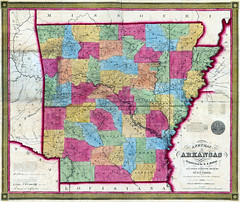
  • By a vote of 39-35 the Arkansas convention defeats a secession motion. Instead, they vote to hold a general election in August to determine the question of secession.
0 comments

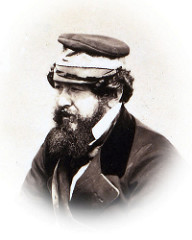
“…the majority of the people of New York, and all the respectable people, were disgusted at the election of such a fellow as Lincoln to be President…—William Howard Russell

My Diary North and South – William Howard Russell

Sunday, 17th March.–The first thing I saw this morning, after a vision of a waiter pretending to brush my clothes with a feeble twitch composed of fine fibre had vanished, was a procession of men, forty or fifty perhaps, preceded by a small band (by no excess of compliment can I say, of music), trudging through the cold and slush two and two: they wore shamrocks, or the best resemblance thereto which the American soil can produce, in their hats, and green silk sashes emblazoned with crownless harp upon their coats, but it needed not these insignia to tell they were Irishmen, and their solemn mien indicated that they were going to mass. It was agreeable to see them so well clad and respectable looking, though occasional hats seemed as if they had just recovered from severe contusions, and others had the picturesque irregularity of outline now and then observable in the old country. The aspect of the street was irregular, and its abnormal look was increased by the air of the passers-by, who at that hour were domestics – very finely dressed negroes, Irish, or German. The coloured ladies made most elaborate toilettes, and as they held up their broad crinolines over the mud looked not unlike double-stemmed mushrooms. “They’re concayted poor craythures them niggirs, male and faymale,” was the remark of the waiter as he saw me watching them. “There seem to be no sparrows in the streets,” said I. “Sparras” he exclaimed; “and then how did you think a little baste of a sparra could fly across the ochean?” I felt rather ashamed of myself.

And so down-stairs where there was a table d’hdte room, with great long tables covered with cloths, plates, and breakfast apparatus, and a smaller room inside, to which I was directed by one of the white-jacketted waiters. Breakfast over, visitors began to drop in. At the “office” of the hotel, as it is styled, there is a tray of blank cards and a big pencil, whereby the cardless man who is visiting is enabled to send you his name and title. There is a comfortable “reception room,” in which he can remain and read the papers, if you are engaged, so that there is little chance of your ultimately escaping him. And, indeed, not one of those who came had any but most hospitable intents.

Out of doors the weather was not tempting. The snow lay in irregular layers and discoloured mounds along the streets, and the gutters gorged with “snow-bree” flooded the broken pavement. But after a time the crowds began to issue from the churches, and it was announced as the necessity of the day, that we were to walk up and down the Fifth Avenue and look at each other. This is the west-end of London–its Belgravia and Grosvenoria represented in one long street, with offshoots of inferior dignity at right angles to it. Some of the houses are handsome, but the greater number have a compressed, squeezed-up aspect, which arises from the compulsory narrowness of frontage in proportion to the height of the building, and all of them are bright and new, as if they were just finished to order,–a most astonishing proof of the rapid development of the city. As the hall door is made an important feature in the residence, the front parlour is generally a narrow, lanky apartment, struggling for existence between the hall and the partition of the next house. The outer door, which is always provided with fine carved panels and mouldings, is of some rich varnished wood, and looks much better than our painted doors. It is generously thrown open so as to show an inner door with curtains and plate glass. The windows, which are double on account of the climate, are frequently of plate glass also. Some of the doors are on the same level as the street, with a basement story beneath; others are approached by flights of steps, the basement for servants having the entrance below the steps, and this, I believe, is the old Dutch fashion, and the name of “stoop” is still retained for it. No liveried servants are to be seen about the streets, the doorways, or the area-steps. Black faces in gaudy caps, or an unmistakable “Biddy” in crinoline are their substitutes. The chief charm of the street was the living ornature which moved up and down the trottoirs. The costumes of Paris, adapted to the severity of this wintry weather, were draped round pretty, graceful figures which, if wanting somewhat in that rounded fulness of the Medicean Venus, or in height, were svelte and well poised. The French boot has been driven off the field by the Balmoral, better suited to the snow; and one must at once admit– all prejudices notwithstanding–that the American woman is not only well shod and well gloved, but that she has no reason to fear comparisons in foot or hand with any daughter of Eve, except, perhaps, the Hindoo.

The great and most frequent fault of the stranger in any land is that of generalizing from a few facts. Every one must feel there are “pretty days” and “ugly days” in the world, and that his experience on the one would lead him to conclusions very different from that to which he would arrive on the other. Today I am quite satisfied that if the American women are deficient in stature and in that which makes us say, “There is a fine woman,” they are easy, well formed, and full of grace and prettiness. Admitting a certain pallor–which the Russians, by the bye, were wont to admire so much that they took vinegar to produce it– the face is not only pretty, but sometimes of extraordinary beauty, the features fine, delicate, well defined. Ruby lips, indeed, are seldom to be seen, but now and then the flashing of snowy-white evenly-set ivory teeth dispels the delusion that the Americans are–though the excellence of their dentists be granted–naturally ill provided with what they take so much pains, by eating bon-bons and confectionery, to deprive of their purity and colour.

My friend R––, with whom I was walking, knew every one in the Fifth Avenue, and we worked our way through a succession of small talk nearly as far as the end of the street which runs out among divers places in the State of New York, through a débris of unfinished conceptions in masonry. The abrupt transition of the city into the country is not unfavourable to an idea that the Fifth Avenue might have been transported from some great workshop, where it had been built to order by a despot, and dropped among the Red men: indeed, the immense growth of New York in this direction, although far inferior to that of many parts of London, is remarkable as the work of eighteen or twenty years, and is rendered more conspicuous by being developed in this elongated street, and its contingents. I was introduced to many persons to-day, and was only once or twice asked how I liked New York; perhaps I anticipated the question by expressing my high opinion of the Fifth Avenue. Those to whom I spoke had generally something to say in reference to the troubled condition of the country, but it was principally of a self-complacent nature. “I suppose, sir, you are rather surprised, coming from Europe, to find us so quiet here in New York: we are a peculiar people, and you don’t understand us in Europe.”

In the afternoon I called on Mr. Bancroft, formerly minister to England, whose work on America must be rather rudely interrupted by this crisis. Anything with an “ex” to it in America is of little weight–ex-presidents are nobodies, though they have had the advantage, during their four years’ tenure of office, of being prayed for as long as they live. So it is of ex-ministers, whom nobody prays for at all. Mr. Bancroft conversed for some time on the aspect of affairs, but he appeared to be unable to arrive at any settled conclusion, except that the republic, though in danger, was the most stable and beneficial form of government in the world, and that as a Government it had no power to coerce the people of the South or to save itself from the danger. I was indeed astonished to hear from him and others so much philosophical abstract reasoning as to the right of seceding, or, what is next to it, the want of any power in the Government to prevent it.

Returning home in order to dress for dinner, I got into a street-railway-car, a long low omnibus drawn by horses over a strada ferrata in the middle of the street. It was filled with people of all classes, and at every crossing some one or other rang the bell, and the driver stopped to let out or to take in passengers, whereby the unoffending traveller became possessed of much snow-droppings and mud on boots and clothing. I found that by far a greater inconvenience caused by these street-railways was the destruction of all comfort or rapidity in ordinary carriages.

I dined with a New York banker, who gave such a dinner as bankers generally give all over the world. He is a man still young, very kindly, hospitable, well informed, with a most charming household–an American by theory, an Englishman in instincts and tastes –educated in Europe, and sprung from British stock. Considering the enormous interests he has at stake, I was astonished to perceive how calmly he spoke of the impending troubles. His friends, all men of position in New York society, had the same dilettante tone, and were as little anxious for the future, or excited by the present, as a party of savans chronicling the movements of a ” magnetic storm.”

On going back to the hotel, I heard that Judge Daly and some gentlemen had called to request that I would dine with the Friendly Society of St. Patrick to-morrow at Astor House. In what is called “the bar,” I met several gentlemen, one of whom said, “the majority of the people of New York, and all the respectable people, were disgusted at the election of such a fellow as Lincoln to be President, and would back the Southern States, if it came to a split.”
0 comments

Horatio Nelson Taft

Diary of US patent clerk Horatio Nelson Taft.

SUNDAY, MARCH 17, 1861.

It threatened rain all day but none fell. Holly has been rather sick today, sore throat, cold, &c. Julia D[itt]o. Neither went to church. Uncle C R and the rest of us all went to Doct. Smiths in the morning. Bro & myself went over to the Island to hear Mason Noble in the afternoon. Bro thinks of starting home tomorrow, must try and keep him a little longer. He seems very near to me as a Brother. We have concluded not to send Juliet back to Elmira this term. Holly has considerable fever tonight and we feel somewhat anxious about him. I sleep with him tonight.


The three diary manuscript volumes, Washington during the Civil War: The Diary of Horatio Nelson Taft, 1861-1865, are available online at The Library of   Congress.

0 comments

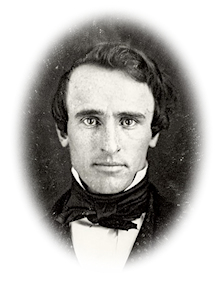
“Yes, giving up Fort Sumter is vexing.”—Rutherford B. Hayes

Diary and Letters of Rutherford Birchard Hayes
Rutherford B. Hayes (young)

CINCINNATI, March 17, 1861.

DEAR UNCLE:–I received yours of the 13th yesterday. I shall not come out for three or four weeks, perhaps not so soon. It is not yet possible to guess how the [city] election will go, but the chances are decidedly against our side. The Democrats and Know-nothings have united and will nominate their ticket this week. If they nominate men tolerably acceptable to both wings of the fusion, they will succeed beyond all question. Their majority at the last election over the Republicans was nearly three thousand. We can’t beat this. Our chance is that there will be some slip or mistake which will upset the union. I shall go under with the rest, but expect to run ahead of the ticket. Of course, I prefer not to be beaten, but I have got out of the office the best there is in it for me. I shall get me an office alone, and start anew–a much pleasanter condition of things than the one I left with Corwine.

Yes, giving up Fort Sumter is vexing. It hurts our little election, too; but I would give up the prospect of office, if it would save the fort, with the greatest pleasure.

Elinor Mead ¹ leaves us on Tuesday to return home the last of the week. She has enjoyed her visit, I think. Mother is very well again; is able to go out, to shop and to church. Little Ruddy (our brag boy now) has been sick, but is getting nearly well. The other boys count largely on going to Fremont this summer.

Sincerely,

R. B. HAYES.

S. BIRCHARD.

_______

¹A cousin from Vermont; later to become the wife of William Dean Howells, who that winter was a newspaper correspondent at Columbus.

0 comments

The Letters of Samuel Ryan Curtis

The Letters of Samuel Ryan Curtis

Washington March 17, 1861

My dear wife

I have not had an hour of peace and quiet since the adjournment. I have new friends coming daily, and new matters to be attended to-directed by every mail.

I did hope to be at home to-day: but could not leave till I had secured some places beyond a peradventure.

I have now secured a place for Mr. Stanton, who has done a great deal of document work for me this winter, at 1200 a year He is also editor of the Washington paper. For Uncle Johnny I have secured after much labor the office of chief clerk in the Registers office 2000 a year which pleases him entirely.

I have also got Grinnell1 appointed Secret Mail agent, and the promise and order for a hoste of P. offices including Keokuk for Howell.

Of course I will disappoint thousands of active old influential poltical friends and to have given Goodril or James appointments would have exasperated such men as Stevens, Fulton, Genl Bridgemen and others who want the same offices. I will at a proper time try to get places for both but I must not and you must not encourage it; for I am determined to first try to secure places for our own boys who have really deserved places because of their public efforts in two territories. But they will be charged to me as family affairs, and I must not do too much of this. Sams appointment is safe. Henrys is not yet certain. Mr Stevens was a candidate for Marshall but we gave that to Hoxie2 who was a great worker as Chairman of the State Committee.

Conn, Bums, Shart, and fifty more, will complain because they could not be something. I have got along with appointments so as to hope to get home this week At any rate. I hope no new difficulties will arise. Uncle Johnny wants to stay till he is fully inaugerated. Of course I must see that all is done which is deemed necessary to aid such a working friend.

He has aided in arranging papers, writing letters &c &c, every since he came.

This is Sunday. I ought to go over and bid the Georgetown people goodby before I leave Jinny was over and left a note for her friend Hollingsworth to get a clerkship Everybody wants aid. Wallace Curtis is here, and I would like to aid him. He has been a working editor in Fulton and ought to be aided by Illinois Politicians. Ned is here yet. He has come down to demand a $2000 Consulate and I think stands some chance. But he can make no great political showing as he has not been much of a politician.

You see how my minds runs with my troubles. Hawkins Taylor and Mr Turner are also earnest and active workers in the general scramble. Hawkins will be Special Mail agent on Keokuk and St. Louis mail line. Sadie is very well and I am as ever

Affectionately yours
Saml. R. Curtis


1. Josiah Bushnell Grinnell, founder of Grinnell College, Grinnell, Iowa, was a member of the Iowa delegation at Chicago in 1860. Following two years as Special Mail Agent he served in Congress from 1863 to 1867.

2. H. M. “Hub” Hoxie.

0 comments

Visit by V.P. Stephens?

War of the Rebellion: from the Official Records of the Union and Confederate Armies and Navies

FORT SUMTER, S. C., March 17, 1861.

General Jos. G. TOTTEN,
Chief Engineer U. S. Army, Washington, D. C.:

GENERAL: The unusual activity observed and reported yesterday morning in the surrounding batteries was due to preparations for receiving some distinguished person who visited them in the afternoon.

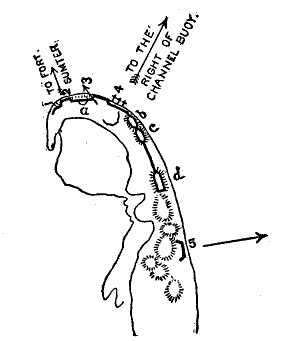
It is supposed that this was Vice-President Stephens, of the so-called Southern Confederacy. Three rounds were fired from all the batteries on Morris Island, except No. 1, apparently as much for practice as for saluting, for most of the guns not pointed in this direction were shotted. This firing enabled me to detect the positions and approximate calibers of the guns in these batteries.

imageThe marginal sketch represents this roughly:

No. 1. Battery of sand and palmetto logs, four 24-pounders.

No. 2. Iron-clad battery, three guns, 42-pounders or 8-inch columbiads.

No. 3. Battery of sand and palmetto logs, three guns, 24-pounders or 32-pounders.

No. 4. Battery of sand and palmetto logs, with one 8-inch columbiad or 8-inch sea-coast howitzer.

No. 5. Star of the West battery, five guns, 24-pounders or 32-pounders.

a is a large magazine; b, c, d are defenses of the character of redoubts on top of three sand hills.

There were two guns at each round fired from the light-house battery. Three or four more guns were landed yesterday with barbette carriages, and most of them (in fact, all that are removed from the landing which is in front of battery No. 1, where there is deep water close in shore) were carried around upon the channel side. One, at least, was placed in battery No. 4, making four guns in that battery at present.

These guns with barbette carriages came from Castle Pinckney, nearly the whole of the upper tier of which is being removed for this purpose. None of the guns from Fort Moultrie bearing upon this fort or the channel have been removed. No work is being done on the batteries looking towards us. All preparations are directed to strengthening the channel batteries very much, and to covering the present batteries in the rear, which was before open.

No work of any magnitude is being done on Cummings Point to-day (Sunday). On James Island the work on the covered way connecting the flank of the line of intrenchments and the mortar battery is being continued.

The weather is pleasant, although there are indications of a storm brewing.

I have the honor to be, very respectfully, your obedient servant,

J. G. FOSTER,

Captain of Engineers.

0 comments

At the Court of St. James

Diary of George Mifflin Dallas, United States Minister to England 1856 to 1861

1861. March 17. –A long and interesting telegram by the America. The Inauguration on the 4th had gone off without disturbance of any kind, in the presence of some thirty thousand persons. Mr. Lincoln’s address was both firm and mild,–firm against the constitutionality of secession, mild in assurances and language. Nothing in the telegram about convening the new Congress, nor about the new Tariff bill, though he noticed the passage of Corwin’s resolution to amend the Constitution by expressly prohibiting Congress from meddling with slavery in the States, and approved it.

0 comments

Through Some Eventful Years

Through Some Eventful Years by Susan Bradford Eppes
Susa Bradford Eppes

March 17th, 1861.—Brother Amos has been a member of the Governor’s Guards for a long time; that is, ever since the company was organized last October and he did not tell us until tonight that the Guards volunteered two weeks ago. Sister Mag was wild with grief at first but Mother tried to comfort her by insisting that there would be no fighting—just talk of war and reconciliation would follow. Brother Junius came in to supper and he told us he and Dr. Gardner and several others were raising a company in this county, to be called the Dixie Yoemen. Richmond Gardner, Captain; Joel Blake, 1st Lieutenant; Junius Taylor, 2nd Lieutenant; Jimmie Conner, 3rd Lieutenant. These men must think there will be war or they would not be preparing for it. This is extremely exciting.


Susan Bradford is 15 years old when this entry was made.

0 comments

Wigfall on recruiting in Baltimore — Confederate Records

War of the Rebellion: from the Official Records of the Union and Confederate Armies and Navies

U. S. STEAMER BROOKLYN,
Pensacola Harbor, Fla., March 17, 1861.

Col. L. THOMAS,   Assistant Adjutant-General:

SIR: On the 24th of last January I left Fort Monroe, Va., with sealed orders from the headquarters of the Army, which assigned me to the command of the forts in this harbor. On my arrival at this station I met a telegraphic dispatch from the Secretary of War which instructed the commander of the Brooklyn not to land my company for the present. A few days since I requested a copy of the post return from Lieutenant Slemmer in order to make a monthly return of the whole command. He declines furnishing me with it, as he holds that the telegraphic dispatch superseded my orders, and of course deprived me of the right to command. I do not so construe the dispatch, nor can I consider it as binding upon me, as I have never received a copy of it, nor is it in any way directed to me. I can hardly imagine that the Department could intend that I should be superseded by an officer junior to myself both in grade and rank, and that it would have at least informed me directly of the fact if such had been its intention.

I need not point out to you how important in the present critical state of affairs it is to have a perfect unity of command. Should anything occur that may render it necessary that my company should be landed, it is necessary that some previous arrangements should be made for its   reception and distribution of the whole command. It is unnecessary for me to state that such arrangements cannot be made by Lieutenant Slemmer, nor can I for one moment consent to his dispensing of either myself or my command. Besides which, until Lieutenant Slemmer declined sending me the return, I had no idea that he disputed my right to command, and I had made arrangements with Captain Adams, commanding the naval forces on this station, to land a force of marines and sailors, which, with my company and the troops now in the fort, will raise the command to five hundred men. This force, in my opinion, will be sufficient to hold Fort Pickens against any force that may attempt to carry it by escalade. There is, however, a great deficiency both of ammunition and supplies for so large a command. The medical supplies are very limited. There are no bunks either for the hospital nor for the men. The casemates are open, and have only brick floors. At present the men are in the officers’ quarters, but these will be required for the officers, and would besides be entirely inadequate to accommodate so large a command. To expose the men to sleep on the damp brick exposed as they would be to the inclemency of the weather, would soon place most of them on the sick-report.

It is important that requisitions should be made for medicines and quartermaster’s supplies of lumber, bunks, and clothing for the command. I directed the attending surgeon and the acting assistant quartermaster to make the necessary requisitions, but whether they have done so or not I cannot say, as they have not been submitted to me.

I think that the above statement will satisfy you as to the importance of placing things upon such a footing as may settle at once the right to command. I have not deemed it judicious to take the course with Lieutenant Slemmer which I should have taken at any other time, but I think I have said sufficient to satisfy you that it is important that all ambiguity as to my right to command should be at once removed. I therefore ask that instructions may at once be given for me to at once take up my residence within the fort, which the authorities now seem to think is contrary to the agreement entered into.

I deem it important that the commissary and quartermaster’s department at this post should be supplied with money, as it is impossible to obtain supplies without it.

Some batteries have been erected by the seceders between the navy-yard and Fort Barrancas, on the shore. These may offer a very serious obstacle to the ships-of-war entering the harbor. The troops, however, I think can be safely landed on Santa Rosa Island, and enter the fort without encountering any serious impediment. May I request that you will give your early attention to the above case, and let me know your decision?

Yours, &c.,

I. VOGDES,
Captain, First Artillery.

0 comments

The South in the Manufacturing Business

Civil War Day-by-Day

March 17, 1861; The New York Herald

We perceive that the States of the Southern confederacy are bestirring themselves in the manufacturing line, with a view to provide for their own wants in those articles for which they were heretofore dependent upon New England. Cotton mills, shoe factories, yarn and twine manufactories are being put extensively into operation in Georgia and other states. An association of Southern merchants is busily engaged in locating sites for all kinds of factories, with the assistance of competent engineers, where the indispensable water power can be made available. In the neighborhood of Columbus Georgia, there are already established cotton and woollen mills, a tan yard and a shoe factory, grist mills and saw mills, of the capacity and operations of which a description will be found in another column. In New Orleans there is a very large factory at work in the manufacture of brogans, and article of immense consumption on the plantations, and hitherto supplied by the factories of Lynn and other New England towns. It is evident that the Southern confederacy is straining every point to make itself independent of the North commercially as well as politically.

0 comments

The News

Civil War Day-by-Day

March 17, 1861; The New York Herald

Since the administration has decided to evacuate Fort Sumter, Fort Pickens has become the centre of public attention. Reports, received from Washington, were in circulation yesterday, that a collision had occurred between the federal and State forces at Pensacola. These reports were premature. Up to the latest accounts no actual demonstration had been made on either side. It is a fact, however, that the commander of the federal vessels off Pensacola have been notified not to land any troops at Fort Pickens, or communicate with the shore. Should they disregard this notification, a collision will inevitably ensue, and as the Fort is invested by numerous batteries of heavy artillery, the result of the conflict may be easily predicted. Nearly all the families have left Pensacola in anticipation of a battle.

The answer of the administration to the communication of the Commissioners from the Southern republic will be transmitted to them tomorrow. It is understood that the administration will decline holding any official intercourse with the Commissioners.

Nothing of importance occurred in the United States Senate yesterday. Mr. Douglas’ resolution calling for information in relation to the forts in the South, &c. was taken up, and Mr. Wilson moved as a test question to lay it on the table. At the suggestion of Mr. Powell, however, the motion was withdrawn, and the further consideration of the resolution was postponed till Monday. In answer to an inquiry, Mr. Fessenden said a member of the Cabinet had stated that the Senate would finally adjourn in a very few days. Mr. Mason moved that his resolution with reference to the quartering or troops at the capital, but the Senate decided to go into executive session on the appointments.

0 comments

“I should almost think him half insane.”—Horatio Nelson Taft

Diary of US patent clerk Horatio Nelson Taft.

SATURDAY 16

A cool pleasant day. Brother C R went to Mt Vernon this morning with Maj [Bulkley?] & others. Retd about 4 o’ck. I wrote to the Sec’y of Interior in reference to Promotion. It is now understood that Mr Holloway of Indiana is appointed Comr of Patents. E G Allen of Boston in the office today. He is a singular man. I should almost think him half insane. Did not go down town after dinner. Charley and Miss Woodward spent the evening, took tea with us. She appears very much accomplished and is a very beautiful girl. Bro went to market with me, bed at 12 o’clock.


The three diary manuscript volumes, Washington during the Civil War: The Diary of Horatio Nelson Taft, 1861-1865, are available online at The Library of   Congress.

0 comments

Operations in Charleston Harbor — Relief of Fort Sumter

War of the Rebellion: from the Official Records of the Union and Confederate Armies and Navies

BALTIMORE, MD., March 16, 1861.

General BEAUREGARD, C. S. A., Charleston, S.C.:

MY DEAR SIR: By the authority of the Secretary of War, I have established a recruiting station here, and I am induced to believe that it will meet with decided success. By the time an officer can reach here there will probably be one hundred recruits to examine. The moneyed arrangements are all made. I have concluded that it would be better not to send the men to Charleston until they were examined. We will then avoid the danger of having to pay the passage money for men not fit for service. I was merely requested and authorized to recruit here for the Army of the Confederate States. I have made arrangements for sending them to you, supposing that you would have use for them, or, if not, that you could have them enlisted and drilled till they were ordered elsewhere. Be pleased to confer with the Secretary of War on the subject if you have no orders. The recruiting will go on rapidly, and as I determined this morning not to send men before they were examined, I telegraphed you for an experienced officer. The men will be kept together until he comes. If this shall reach you before you have sent an officer, be pleased to refer him to William T. Walters, of the house of Walters & Co., 68 Exchange Place, with whom I have made the financial arrangements.

Very respectfully,

LOUIS T. WIGFALL.

0 comments

Latest from the Rio Grande

Civil War Day-by-Day

March 16, 1861, The Ranchero (Corpus Christi, Texas)

Correspondence of The Ranchero.

Brownsville, Texas, March 11, 1861.

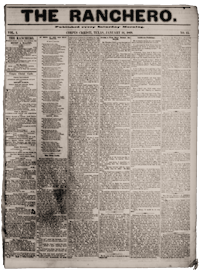
Mr. Ranchero:—Almost everything on this frontier bears a powerful “seedy” appearance. Though warlike, turbulent, and stormy betimes, yet always “seedy.” This or anything else that I lay down as a rule to go by, the ladies are always exceptions. The Aztec ladies are more than ever fair, fresh and winning, and seem but little browned, and, if anything, improved from the withering and drying-up effects of a March sun. Those fair creatures, as of old, have already made powerful impressions upon the gallant command of Col. Ford, knowing, as they well do, that the airs and epaulets, as proverbially worn by the West Pointers, is about to vamos forever from the field of Rio Grande action–from the stage of their watch by day and toil by night, have tacked ship, and are now steering under heavy pressure and full rig of crinoline, for the young and inexperienced privates and officers of the Stately army. . .

U.S. officers and soldiers will take away with them many lasting remembrances of the kind treatment they have received on this frontier; and for the services they have rendered at all times, in protecting, from violation and worthless assault, their extensive range, they will carry with them the warmest thanks of the undivided whole. Wherever they go, they will often turn with feelings of rapturous delight to the Rio Grande–the late field of their manly labors, where no breastwork could intimidate them, no trench too broad for them to leap, and no obstacle they have not surmounted. But they are [continue reading…]

0 comments

The Flag is on the High Seas

Civil War Day-by-Day

March 16, 1861, Texas Republican (Marshall)

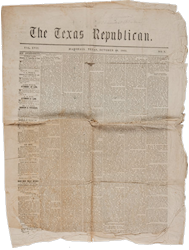
We learn that as the British shop Peter Maxwell, which was cleared for Liverpool on the 16th inst., by Messrs. D. Wheeler & Co. with 3680 bales of cotton, passed Fort Morgan on Wednesday last, she hoisted the Palmetto flag and dipped it three times. The compliment was returned by those in command of the fort, by dipping the Alabama flag six times and hoisting the ship’s numbers. The Maxwell sailed off with the Palmetto flying at her main. She is the first foreign vessel, we believe, that has crossed the bar with that flag hoisted, since the establishment of the Southern Confederacy.–Mobile Tribune.

0 comments

The Centres of Trade to be Removed to the South

Civil War Day-by-Day

March 16, 1861; The New York Herald

The forcible revolution of commerce, brought about by the fanatics and unprincipled political demagogues of the North, will result in diverting the whole trade of the country to the South. As if the disturbance naturally resulting from the secession of the cotton States and the low tariff they have established were not enough to damage the Northern States by cutting off their own trade with the South, and by drawing away from them the commerce of Europe, the late stolid, blundering Congress capped the climax of their suicidal folly by adopting a high protective tariff, which in may instances amounts to a prohibition of imports, and in all cases tends to drive to Southern ports the commerce of the world. Already the merchants of New York who are not yet utterly ruined are preparing to establish importing houses in the southern cities, for the triple purpose of supplying the local trade, of sending goods to the West by the Mississippi river and other channels of communication, and of sending the merchandise over the frontier of the Southern confederacy to New York, thus escaping the duties of the Morrill tariff. Dry goods palaces here are being offered for sale, without purchasers, at half what they cost, and leases of warehouses can be had at a little over half their former rent.

The merchants say it is impossible for them to do any business under the new tariff, from the delay in passing goods through the Custom House, owing to the complicated calculations of the duty. For instance, in the case of linen, the number of threads in the square inch must be counted, and narrow velvet must be calculated by the square yard. To render the matter worse, the Custom House will be filled with new hands who know nothing about the business. The embarrassments will be overwhelming and litigation endless. The importation of carpets, blankets and other heavy woollen articles, on which an enormous duty is levied by the pound, is in effect prohibited. The same observation applies to steel. Another of the absurdities of this tariff is that the duty on unmanufactured tobacco is far greater than on [continue reading…]

0 comments

President Vetoes African Slave Trade Act

Civil War Day-by-Day

March 16, 1861; The Charleston Mercury

Latest by Telegraph from Montgomery.

MONTGOMERY, March 15. – The injunction of secrecy was today removed from the veto of President DAVIS, of the Act lately passed by Congress, prohibiting the African slave trade. It is as follows:

THE VETO.

EXECUTIVE DEPARTMENT, February 28, 1861.

Gentlemen of the Congress: With sincere deference to the judgment of the Congress I have carefully considered the Bill in relation to the slave trade, and to punish persons offending therein, but I have not been able to approve, and therefore return it, with a statement of my objections.

The Constitution, section 9 article 1, provides that the importation of African negros from any foreign country other than the slaveholding States, is hereby forbidden; and Congress is required to pass such laws as shall effectually prevent the same. The rule herein given is emphatic, and distinctly directs legislation which shall effectually prevent the importation of African negros. The bill before me denounces as high misdemeanor the importation of negros or other person of color, either to be sold as slaves, or held to service or labor, affixing heavy and degrading penalties on the act, if done with such intent. To that extent it accords with the requirement of the Constitution, but in the 6th section of the bill provision is made for the transfer of negros who may have been illegally imported into the Confederate States to the custody of foreign States or societies, upon condition of deportation and future freedom; and if the proposition thus to surrender them shall not be accepted, it is then made the duty of the President to cause said negros to be sold at public outcry to [continue reading…]

0 comments

The Hon. Jefferson Davis

Civil War Day-by-Day

March 16, 1861, The Illustrated London News

0 comments

Heavy Artillery

Civil War Day-by-Day

March 16, 1861; The Charleston Mercury

The title of a manual for the use of siege and garrison guns, printed for, and used by, the late United States army. In these days of and rumors of wars, such a book has become a necessity to all military men. As the work is not for sale North or South, our neighbors, EVANS & COGSWELL, No. 3 Broad street, are now reprinting it, under the supervision of officers of the artillery of this State, with an amendment to the Manual of the Columbiads as made by Lieutenant Colonel R. S. RIPLEY, of the 1st Artillery, S. C. A. We would suggest that in order to secure copies of this useful book, and early call had better be made on Messrs. E. & C., No. 3 Broad street, a limited edition being in the press.

0 comments

The News

Civil War Day-by-Day

March 16, 1861; The New York Herald

The government of the seceded States has appointed Hon. William L. Yancey, of Alabama; Judge P.A. Rost, of Louisiana; Col. A. Dudley Mann and T. Butler King, of Georgia, special Commissioners to proceed to England and France to obtain the recognition of the independence of the Confederate States, and make such commercial arrangements as their joint interest may inspire.

The Cabinet and Gen. Scott held a protracted conference yesterday, partly on the subject of evacuating Fort Sumter, but mainly upon the distribution of the spoils.

There was a report in circulation in Washington yesterday, to the effect that the Baltimore sympathizers with the secession movement will be the first to offer resistance to the federal authority. They are, it is said, determined to oppose to the last the appointment of black republicans of office in Baltimore.

The proceedings of the Senate yesterday are of unusual interest. Mr. Mason offered a resolution calling upon the President for information as to the number of troops quartered in the district, when they are to be withdrawn, for what purpose they are maintained there, and whether the force is to be increased, and to what extent. The resolution was laid over. Mr. Douglas’ resolution, calling upon the Secretary of War for information in relation to the forts, arsenals, navy yards, and other public property in the seceded States, whether the administration intend to recapture those in possession of the secessionists, and if so what military force will be necessary, &c. was taken up. The resolution calls for a detailed exposition of the policy of the administration with reference to the seceded States. Mr. Douglas, in advocating his resolution, said that, the policy of the administration being peace he desired to relieve the apprehensions of the country by obtaining a reply to his resolution, which he believed would give quiet and restore good feeling among the different [continue reading…]

0 comments

Ruin of Blockade and Blockade Ridiculous

Civil War Day-by-Day

March 16, 1861; The Charleston Mercury

After flirting along in the fogs of a deluded self sufficiency and bouncing about without ballast and rudderless in the shoals and quicksands of senseless vituperation, bellying out and incontinently swelling of the vast strength, independence and general superiority of the great North, belittling the South as infinitely weak, insignificant and contemptible, it seems that at last the Northern craft and its navigators, as they approximate to the end of their cruise, begin to entertain a shrewd suspicion of the practical result of their brave exertions against this section, and of the watery fate that awaits their piratical enterprise. A downward sinking–an evident feeling of goneness, as if a seasick qualm–is coming o’ the spirit of their epigastric region. Still they have stomach for a fight. But, from appearances, there is danger of such a collapse soon, that those who cannot reach our shores in long boats, will begin to fire minute guns of distress, and appeal, without stint, to our humanity to save repentant sinners, lest they be the deep bosom of the ocean buried–sunk in a sea of deliberately selected disaster.

The New York Evening Post is certainly one of the most thorough going and radical of Black Republican journals. CHASE and SUMNER are its heroes. We, therefore, in the way of preparation for the events that cast their shadows before, commend to our readers the sentiment and logic of an article from that paper, to be found in our columns.

0 comments