More Secession —The Border Slave States

Civil War Day-by-Day

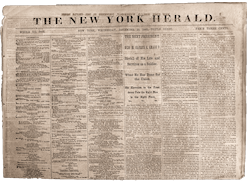
March 22, 1861; The New York Herald

By a telegraphic despatch in another column, it will be seen that the State Convention of Arkansas has passed a secession ordinance, to be submitted to the vote of the people. Arkansas is likely to go the way of Texas and of all the cotton States. By the news published yesterday it appeared that the secession ordinance was defeated by a vote of 39 to 35; but on reconsideration the ordinance was passed, subject to the popular vote, which will probably be for separation. The revolution of late is rapidly gaining ground in the south.

It is a great mistake to suppose that there is in any of the slaveholding States any considerable number of men who are in favor of the Union at all hazards and under all circumstances. With a very few exceptions, the only Union men to be found are conditional Unionists–men who have been prevented from seceding by mere hopes that Congress, or the new administration or the Northern States, would take some action which would lead to a reconstruction of the Union. But as soon as they found that neither the Northern States, nor Congress, nor the new administration, did anything calculated to heal the breach, but on the contrary much to widen it, many of them became secessionists; and it is very evident that ever since the promulgation of the inaugural, which proposes no remedy, but threatens coercion, the secession movement has gained ground in Virginia and all the other slave States. In North Carolina, out of a vote of upwards of 93,000 the majority against holding a secession Convention was less than six hundred. The moment Mr. Lincoln commences his coercive measures he may be prepared to hear of every remaining slave State seceding, one after another.

The telegraphic news from the Missouri State Convention, which we publish elsewhere, indicates not only what that State will do, but all the other slaveholding States, in the contingency of a collision between the federal government and the Confederate States. Through the secession ordinance was voted down for the present on Wednesday, but in yesterday session the following resolution was adopted by a vote of 89 to 6; –’That it is the opinion of this convention [continue reading…]

0 comments

Shall we make a fuss over the Evacuation?

Civil War Day-by-Day

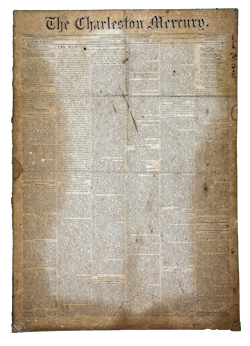
March 22, 1861; The Charleston Mercury

A correspondent suggests that the day Fort Sumter is to be evacuated be made a day of public rejoicing in Charleston – a general holiday, with thanksgiving and an illumination. For our part, we doubt the propriety and good taste of any such grand demonstration. The retirement of seventy men from the possession of a fortress in our harbor, which they have held three months, and leave only because of the difficulty of getting reinforcements and supplies, through the erection of batteries which we, their enemies, have been permitted to construct under their guns, is not, we think, an occasion that will justify, before the world, the flourish of a general jubilation. We may all be glad and thankful that none of our blood has been spilt in our bay, while the coercive intentions of our foes have been foiled here by our preparations. Providence has helped us much. But it seems to us more in accordance with true dignity, the merits of the affair and the habits of Carolinians, not to exhibit the appearance of being overjoyed. A delicate illumination, with a positive prohibition of fire crackers, we should not object to. But the revolution is not yet ended, and we should not begin to halloo too much or too soon.

0 comments

The Evacuation of Fort Sumter

Civil War Day-by-Day

March 22, 1861; The New York Herald

News from Washington.

WASHINGTON, March 21, 1861.

The failure to evacuate Fort Sumter yesterday, as anticipated, is attributed in administration circles to technical reasons merely. It is now said the evacuation will take place immediately.

A crisis will soon arrive. Mr. Seward has been in favor of the evacuation of Fort Sumter. After a great amount of labor, he induced Gen. Scott to issue to the Cabinet an opinion that the fort could not be reinforced. This opinion influenced the other members of the Cabinet, with one exception, who viewed the evacuation as a military necessity. Under this influence the Cabinet were induced to submit their opinions to Mr. Lincoln, who has not yet decided whether to order Major Anderson to evacuate Fort Sumter or not. It is most likely that he will issue the order, inasmuch as the matter has gone so far. But it is useless to disguise the fact that nothing but the exertions of Mr. Seward has brought about this state of things.

Mr. Lincoln is puzzled to understand the strange inconsistency in the despatches of Major Anderson before the inauguration and after. Before it he had plenty of provisions and men; after, he was without provisions, could make no fight without more men, and it would be impossible to get either without employing twenty thousand men for land service and a fleet of war vessels. These two statements have been much discussed, and are yet the difficult point to surmount. It would be useless to disguise the fact that it is whispered in executive circles that Major Anderson is suspected of complicity with the secessionists of South Carolina.

A statement that no reinforcements have been sent South, and that no orders have been issued to reinforce Fort Pickens, is considered reliable.

0 comments

Fort Sumter

Civil War Day-by-Day

March 22, 1861; The Charleston Mercury

The arrival of a special messenger to Major ANDERSON, last evening, produced some comment and curiosity in the city. The gentleman who was the envoy of the Administration in Washington, is Mr. G.V. FOX, of Massachusetts, formerly of the United States Navy. He was accompanied to Fort Sumter by Capt. HENRY J. HARTSTENE at 8 o’clock p.m. Mr. Fox only remained at Fort Sumter for half an hour, and left for Washington in the 11 p.m. train.

He announced that the object of this mission was simply to hear from Major ANDERSON the exact condition of the garrison. From the shortness of the stay of his Envoy Extraordinary, we presume that it did not take the gallant Major long to give him an inventory of his provisions, &c.

Now as the communication between Fort Sumter and Washington is open to the garrison of the former, are we to believe the object of Mr. FOX’s excursion was simply to ascertain whether Major ANDERSON was in a temper to have his military prestige sacrificed upon the altar of Black Republicanism? By this we would enquire whether it is the intention of LINCOLN and his pack to leave him to eat his last ounce of bread, and then to let loose the Northern howl, which has already commenced, against him for retiring? So far as South Carolina is concerned, we believe that Major ANDERSON will be permitted to salute his flag on hauling it down, and to march out of the fort with his side arms, leaving the property intact. When we remember the disgraceful manner in which the late Administration sneaked out of the San Juan del Norte affair, and turned Commodore PAULDING over to the denunciation of the country for obedience to orders, which he could only construe as he did, and then coolly, a year afterwards, in a State paper, appropriated the whole honor of the affair, we have a right to ask what we have. They can do as they please.

0 comments

Vieles Hand Book for Active Service

Civil War Day-by-Day

March 22, 1861; The Charleston Mercury

This book should be in the hands not only of every volunteer officer, but of every soldier, who hopes ever to become an officer. It is of great importance to volunteers to have their attention merely called to the subjects selected by the author. To have them treated in the clear, full manner, as they have been, is to give to the volunteers of our day an opportunity for improvement not possessed by those of former days. The perusal of this book will be sure to increase the desire for military knowledge in all who have any occasion for such. To officers of military education this book offers much information, in convenient shape, for reference, and should be at hand for that purpose.

0 comments

The News

Civil War Day-by-Day

March 22, 1861; The New York Herald

The reports from Washington respecting the evacuation of Fort Sumter are to the effect that the troops will be removed immediately.

There were rumors in circulation in Washington yesterday of an apprehended collision at Fort Pickens, but they were universally discredited.

The State Convention of Louisiana yesterday ratified the constitution of the Confederate States.

The State Convention of Arkansas on Wednesday adjourned, after passing an ordinance of secession and co-operation resolutions. They are to be submitted to the people for ratification or rejection.

A despatch from Mobile announces the seizure, on Wednesday night, off Pensacola, of the sloop Isabella, Captain Jones, laden with supplies for the United States squadron.

In the United States Senate yesterday the consideration of Mr. Douglas’ resolution in relation to the Southern forts, &c., was resumed, and Mr. Bayard concluded his remarks in favor of recognizing the independence of the Confederate States.

In our State Senate yesterday the resolutions reported to that body some time ago by the Committee on Federal Relations, in reference to the national troubles, coming up as the special order, their consideration was indefinitely postponed. Considerable business was transacted by the Senate. In response to an inquiry from a Senator as to whether any reply had been received from the Metropolitan Police Commissioners in answer to the resolutions of the Senate with regard to their sending members of the force out of the State, the presiding officer stated that no reply had been made by the Commissioners, and that there was no way of compelling them to reply unless they should be declared in contempt. The Assembly passed a number of bills of more or less interest. Governor Morgan transmitted with his recommendation of their adoption by the Legislature, the joint resolutions of the Thirty-sixth Congress, known as the Corwin proposition, for an amendment of the constitution to prohibit Congress from interfering with slavery in the States.

Mr. John Sherman, member of the United States House of Representatives from Ohio, was, on Wednesday night, on the seventy-ninth ballot, elected United States Senator, in place of Salmon P. Chase, appointed Secretary of the Treasury by President Lincoln.

0 comments

Our means of communication with the Government are very uncertain

War of the Rebellion: from the Official Records of the Union and Confederate Armies and Navies

U. S. STEAMER BROOKLYN, March 21, 1861.

[General SCOTT:]

GENERAL: I wrote to you a few days since asking you to decide the subject of command on this station. Since then Lieutenant Gilman has arrived. I hope, however, that you will give my communication a careful consideration, and will see the necessity of establishing a unity of command on the station. As I mentioned in my communication, it is indispensable that there should be a perfect understanding between the troops and the naval forces, and the positions to be occupied beforehand be fully determined upon. How this can be done when the troops will have to land only when the fort is attacked I am unable to see. It cannot be done unless Lieutenant Slemmer is to be allowed to give me orders and to assign me a position, and to that I never will submit. I will endeavor to perform my duty, I trust, on all occasions, but I never will submit to be commanded, directly or indirectly, by my junior. Moreover, when I enter the fort I become its commander, and will be held responsible for its defense. This will be, probably, when the enemy is already before its walls, and when I must, of course, be ignorant of the disposition which Lieutenant Slemmer has made for its defense. How am I to be held accountable for its defense when I have not the command until the last moment? I trust, general, that you will see at once the false position in which I am placed, and at once relieve me from it. If not, I enter my protest against being in any way held accountable for what may take place.

Until within a few days the naval and military forces have been supplied with fresh provisions from Warrington and Pensacola, but General Bragg has issued an order prohibiting any supplies being furnished to us, and prohibits the citizens communicating with us, except by special permission.

The conditions of the agreement entered into by the late Government and Major Chase and Senator Mallory give every advantage to the seceders, yet some of them deny the right of those two gentlemen to make it. They are not required to give any notice of its abrogation, and may attack the fort without a moment’s notice, and under the most favorable circumstances it will be impossible to send any assistance to the fort from the ships in less time than three hours. Should there be the least panic among the troops within the fort it would probably be taken. There are about forty guns mounted, and the garrison is about one man to a gun. They could only make a single discharge, and would not probably be able to reload the guns. Should those on any of the fronts be discharged too soon, that front would be left without any defense. Moreover, the garrison is kept constantly harassed, and is almost every night obliged to be under arms, from fear of attack. With the present garrison, my company, and one hundred marines, which we could obtain from the fleet, I think it would be perfectly secure from assault.

Our means of communication with the Government are very uncertain. We do not feel certain that our communications have reached the Department, nor do we know whether the Department’s messenger to us may not have been intercepted. Of course, we do not know how we are expected to act. I would suggest that a small steamer should ply between here and Havana, so as to communicate with the mail steamer from New York at that port. The supplies at the fort are getting low, and those of the naval forces are still lower. These last have not ten days’ supply.

The Brooklyn leaves to-morrow for Key West or Havana in order to obtain a supply. Should she not succeed, the naval forces will have to be withdrawn. The Brooklyn has by far the most efficient battery of any of the ships on the station, and is besides probably the only vessel that could take up a position to effectively cover our landing. It is much to be regretted that she should be withdrawn at this juncture. My company is to be transferred to the frigate Sabine.

Major Tower, of the Engineers, arrived on the 19th, but under the existing arrangement cannot reside within the fort. Even was he there not having any force to labor, he could not do much. I have endeavored to lay before you a true statement of the disadvantageous position in which we are placed, and I trust that so far as it can be done it will be remedied. Whatever may be done, I trust that we will be soldiers enough to do all that lies in our power to uphold the honor of our country’s flag, and prevent its forts from being seized by those in rebellion against its authority.

Yours, truly,

I. VOGDES,
Captain, First Artillery.
0 comments

Sloop seized – Confederate Correspondence

War of the Rebellion: from the Official Records of the Union and Confederate Armies and Navies

WAR DEPARTMENT! C. S. A.,
Montgomery, March 21, 1861.

Hon. L. T. WIGFALL, Washington, D.C.:

MY DEAR SIR: I have just received your letter of the 17th instant. Orders were given to General Beauregard, at Charleston, to detail an officer for the special service at Baltimore, and I am only just informed that the officer appointed is still in Charleston. A person will be sent from this place to-night to perform that duty, with instructions to report to you if in Baltimore, and in your absence to William T. Walters, 68 Exchange Place, Baltimore. It will be much cheaper to ship the men as steerage passengers than by rail, and he will be so instructed unless you have special reasons for a contrary course.

Although it would be most agreeable to all of us to have you here, it occurs to me that you could render more efficient service by remaining in Baltimore until our recruiting depot is fully and successfully established as an institution. Captain Pender, the officer to be sent from here to inspect and superintend the shipment of the men, is directed to place himself under your orders, and will remain in Baltimore for some weeks. Such money as he may require within the scope of his business you will arrange for him to have.

I regret to say that I have no authority to receive the Washington company in the manner proposed. I have no other idea than war, and we hope soon to be ready for any emergency.

Very truly,

L. P. WALKER.

0 comments

“The indications are now that Fort Sumpter will be evacuated and perhaps the other Forts in the seceded states, and that there will be no War.”—Horatio Nelson Taft

Diary of US patent clerk Horatio Nelson Taft.

THURSDAY 21

It has been a cold windy day. It snowed some last night, and we are now having about as much Winter as we have had. The indications are now that Fort Sumpter will be evacuated and perhaps the other Forts in the seceded states, and that there will be no War. But in my opinion a peaceable separation will ultimately be brought about (probably with all the Slave States) and two confederacys be formed. Went with Julia (after calling on our neighbor Mr Douglass with my wife) to the Raven Club at Prof Whitakers, heard Doct Chesney discuss the Character of Queen Elizabeth.


The three diary manuscript volumes, Washington during the Civil War: The Diary of Horatio Nelson Taft, 1861-1865, are available online at The Library of   Congress.

0 comments

Recruiting in Baltimore — Confederate Records

War of the Rebellion: from the Official Records of the Union and Confederate Armies and Navies

MOBILE, March 21, 1861.

Hon. L. P. WALKER:

The sloop Isabella, laden with stores mostly for officers of the United States Navy at Pensacola, was seized last night by the acting mayor, and at the request of General Bragg.

W. J. HARDEE,

Colonel First Regiment Infantry.

0 comments

Recruiting in Baltimore — Confederate Records

War of the Rebellion: from the Official Records of the Union and Confederate Armies and Navies

MONTGOMERY, March 21, 1861.

Hon. L. T. WIGFALL, Washington:

Officer leaves to-night with letter for you and full instructions. Did not know until half hour ago that Haskell had not gone. If men can’t wait ship them at once, and write Beauregard the vessel they are in, so that he may be ready to enlist on arrival.

L. P. WALKER.

0 comments

Fort Pickens to be re-enforced – Confederate Correspondence

War of the Rebellion: from the Official Records of the Union and Confederate Armies and Navies

WASHINGTON, March 21, 1861.

Hon. L. P. WALKER:

Large number of men in Baltimore. Cannot be kept together there much longer. Nothing heard of or from Haskell. What shall I do? Answer immediately.

LOUIS T. WIGFALL.

0 comments

Our Washington Correspondence

Civil War Day-by-Day

March 21, 1861; The New York Herald

WASHINGTON, March 19, 1861.

It is now over a week since the country was electrified by the announcement in the HERALD of the intention of the new administration to abandon Fort Sumter. When that humbling piece of intelligence first flashed over the land, a shock of indignant surprise was experienced throughout the republican North. Angry excitement and wrathful disappointment became manifest on all sides, and a sweeping storm of opposition appeared imminent. But a second sober thought prevailed in the end. Facts and figures benumbed the stinging sense of wounded pride and deep humiliation. Gradually, though reluctantly, the rank and file of the republicans grew reconciled to the idea of giving away for the nonce, from inexorable necessity to treason and rebellion. To be sure, to withdraw Major Anderson was to them like renouncing an article of their political faith, and abandoning the ardent hopes and recalling the fervent prayers of many months. Yet the dose of mortification, compounded for them by Mr. Lincoln’s predecessor, had to be swallowed, however large and bitter, and hence they set about preparing their minds for the emergency.

But, although the majority of Northern republicans are evidently ready for the consummation of what they have learned to consider inevitable–although they are ready to vouchsafe, if not their active approbation, at least the passive tolerance, of the most unpopular and yet necessitous step the government of their election could possibly take–they loathe to be kept on the rack of suspense. They intend to abide by the action of the new administration in the premises, but they desire it to act with promptness. They want to be rid of this demoralizing incubus at the earliest possible moment. They yearn to b relieved of the taunts, jeers and ridicule the sorry evaporation of their promises and pledges, boasts and threats, in regard to Fort Sumter have heaped upon them. They know that the only plausible argument in justification of its abandonment by order of the republican Executive was its and immediate necessity, and that it was losing force by every hour of delay. They feel that boldness of resolution and energy of execution are essentially [continue reading…]

0 comments

Adams Express Company

Civil War Day-by-Day

March 21, 1861; The Charleston Mercury

There are few, indeed, who will not bear testimony to the convenience and efficiency of ADAMS’ Express Company as a medium of transportation. Business men would be at a loss without it, and private individuals would be subjected to enormous expense and great trouble should its admirable arrangements be interrupted for even a fortnight. By means of its various ramifications, goods may be safely dispatched to any point on this continent–in fact, we risk nothing in adding, to any known point in the world. Next to building of railroads and the planting of telegraph poles, we believe the establishment of ADAMS’ Express Company has exerted the most beneficial influences upon the growth of trade and commerce. So highly appreciated and liberally patronized has it been, that in every city of any size and importance the finest business houses are appropriated to its use. Its growth, at first slow and sure, of late years has been surprisingly rapid. Its money transactions alone, in the course of a year, amount to fabulous sums. But its business is not solely that of transporting goods and moneys. Many persons, whose loss and inconveniences, in consequence of the faithlessness of postoffice agents and the irregularity of the mails, engendered complete distrust of the Postoffice Department at Washington, long ago adopted it as the canal of their correspondence. So much more satisfactorily was the service performed that the carrying of letters has constantly increased, and since the formation of the Southern Confederacy many persons do not make use of the postoffices at all. In short, if the decayed and decaying government at Washington has carried out its threat of stopping the mails, it would simply have increased the importance and usefulness of this indefatigable and praise deserving company. And while we are alluding to some of its many advantages, we may as well remark that there are none who are more indebted to it, or more sensible of its service, than the editors and proprietors of newspapers. Always attentive and obliging to their patrons, we are sure they are peculiarly so to the press. Not a day but they communicate valuable information, and never do they refuse to deliver a letter. It was by availing ourselves of their attention at Montgomery, that we were enabled promptly to furnish our readers with important and interesting intelligence in relation to the formation of our new, and, as we firmly believe, permanent Government. We hope their future success will be commensurate with their merits.

0 comments

The Troubles of the Nation—The Peace of the Country to be Preserved

Civil War Day-by-Day

March 21, 1861; The New York Herald

—WASHINGTON, March 20, 1861.

There is a perpetual fever of excitement and a world of inquiry as to the policy of the administration towards the South. A new rumor captures the city every twenty four hours. It would be well, however, that the public understand that these rumors are started for specific purposes, sometimes to constrain the administration, but more frequently to inspire with madness the population of the border States.

The concentration of all the available naval force along the Southern coast is regarded as very significant. The Southern Commissioners, however, have the positive assurance from the administration that no movement of troops, or reinforcements of forts in the Confederate States, will be permitted for the present. The present status is to remain.

The Commissioners do not believe that the government of the United States will violate that pledge. However they keep their government at Montgomery fully advised, and the commanders of the several forts in the Confederate States are on the alert day and night, watching for the vessels that recently departed from the Northern ports.

The administration is aware of the significance of the action of the border slave states, and of the control which Virginia exerts over them. They have been assured that this veteran State is in the hands of the conservative, Union loving and constitutional right exacting men of her citizens. Nothing, it is said, will be done to embarrass their senatory action. The inflammatory and unauthorized declarations of the Hales and Chandlers do not represent the views of the administration. Mr. Lincoln says if the laws can be executed they shall be; if they cannot, they will not be. They will not be executed to the production of war.

Among the foreign Ministers on the floor of the Senate this morning, were those from the Confederate States. They [continue reading…]

0 comments

The News

Civil War Day-by-Day

March 21, 1861; The New York Herald

Our despatches from Washington this morning reiterate the assurance that both the Lincoln administration and the government at Montgomery are disposed to preserve the peace. It is stated that the Commissioners from the Confederate States have the positive assurance from the administration that no movement of troops, or reinforcement of forts in the seceded States will be permitted for the present. On the other hand, the Montgomery government will do nothing to disturb the existing condition of affairs.

The two indictments against Mr. Floyd, late Secretary of War, for conspiring to defraud the government, and for malfeasance in office, were yesterday dismissed by the Court at Washington as untenable.

In the United States Senate yesterday, Mr. Hale offered a resolution, which lies over, that the Senate adjourn without day at one o’clock on Saturday next. The consideration of Mr. Douglass’ resolution in relation to southern forts, &c., was then resumed, and Mr. Bayard, of Delaware, made a speech on the troubles of the nation. He considered a reconstruction of the Union impossible, and there remained but one of two courses to pursue, namely, war, with a view to subjugation, or the recognition of the independence of the Southern republic. He indicated a proposition which he should offer, investing the President, by and with the advice and consent of the Senate, with power to accept the declaration of the seceded States, that they are an alien people, and authorizing him to conclude with them a treaty acknowledging their independence as a separate nation. At the conclusion of Mr. Bayard’s remarks the Senate held an executive session, and confirmed a number of appointments.

0 comments

What is the North to do for a Navy?

Civil War Day-by-Day

March 21, 1861; The New York Herald

The Confederate States have already annexed several of the United States vessels found in Southern waters. That, however, might be borne with tolerable equanimity, and those vessels might be replaced by others; but the worst of it is that all the regions on which the United States government calculated for the production of live oak timber for the construction of ships-of-war are located within the jurisdiction of the Southern confederacy. We are therefore dependent upon the charity of an alien government for the material for a navy. The South can, and probably will, go to work to get up an effective marine; but what will the North do? This is one of the fruits of that conflict of which the republican party is at once the author and the victim.

0 comments

Civil War Day-by-Day

Civil War Day-by-Day

March 21, 1861

  • Provisional Vice-President of the Confederate States of America, Alexander Stephens,  gives the Cornerstone Speech.
  • Missouri secessionist convention adjourns having voted 98-1 against secession
0 comments

My Diary North and South

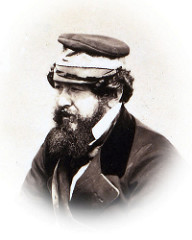
My Diary North and South – William Howard Russell

March 20th.–The papers are still full of Sumter and Pickens. The reports that they are or are not to be relieved are stated and contradicted in each paper without any regard to individual consistency. The “Tribune” has an article on my speech at the St. Patrick’s dinner, to which it is pleased to assign reasons and motives which the speaker, at all events, never had in making it.

Received several begging letters, some of them apparently with only too much of the stamp of reality about their tales of disappointment, distress, and suffering. In the afternoon went down Broadway, which was crowded, notwithstanding the piles of blackened snow by the kerbstones, and the sloughs of mud, and half frozen pools at the crossings. Visited several large stores or shops – some rival the best establishments in Paris or London in richness and in value, and far exceed them in size and splendour of exterior. Some on Broadway, built of marble, or of fine cut stone, cost from £6000 to £8000 a year in mere rent. Here, from the base to the fourth or fifth story, are piled collections of all the world can produce, often in excess of all possible requirements of the country; indeed I was told that the United States have always imported more goods than they could pay for. Jewellers’ shops are not numerous, but there are two in Broadway which have splendid collections of jewels, and of workmanship in gold and silver, displayed to the greatest advantage in fine apartments decorated with black marble, statuary, and plate-glass.

New York has certainly all the air of a “nouveau riche.” There is about it an utter absence of any appearance of a grandfather–one does not see even such evidences of eccentric taste as are afforded in Paris and London, by the existence of shops where the old families of a country cast off their “exuviae” which are sought by the new, that they may persuade the world they are old; there is no curiosity shop, not to speak of a Wardour Street, and such efforts as are made to supply the deficiency reveal an enormous amount of ignorance or of bad taste. The new arts, however, flourish; the plague of photography has spread through all the corners of the city, and the shop-windows glare with flagrant displays of the most tawdry art. In some of the large booksellers’ shops–Appleton’s for example–are striking proofs of the activity of the American press, if not of the vigour and originality of the American intellect. I passed down long rows of shelves laden with the works of European authors, for the most part, oh shame! stolen and translated into American type without the smallest compunction or scruple, and without the least intention of ever yielding the most pitiful deodand to the authors. Mr. Appleton sells no less than one million and a half of Webster’s spelling books a year; his tables are covered with a flood of pamphlets, some for, others against coercion; some for, others opposed to slavery,–but when I asked for a single solid, substantial work on the present difficulty, I was told there was not one published worth a cent. With such men as Audubon and Wilson in natural history, Prescott and Motley in history, Washington Irving and Cooper in fiction, Longfellow and Edgar Poe in poetry, even Bryant and the respectabilities in rhyme, and Emerson as essayist, there is no reason why New York should be a paltry imitation of Leipsig, without the good faith of Tauchnitz.

I dined with a litterateur well known in England to many people a year or two ago–sprightly, loquacious, and well informed, if neither witty nor profound – now a Southern man with Southern proclivities, as Americans say; once a Southern man with such strong anti-slavery convictions, that his expression of them in an English quarterly had secured him the hostility of his own people–one of the emanations of American literary life for which their own country finds no fitting receiver. As the best proof of his sincerity, he has just now abandoned his connection with one of the New York papers on the republican side, because he believed that the course of the journal was dictated by anti-Southern fanaticism. He is, in fact, persuaded that there will be a civil war, and that the South will have much of the right on its side in the contest. At his rooms were Mons. B––, Dr. Gwin, a Californian ex-senator, Mr. Barlow, and several of the leading men of a certain clique in New York. The Americans complain, or assert, that we do not understand them, and I confess the reproach, or statement, was felt to be well founded by myself at all events, when I heard it declared and admitted that “if Mons. Belmont had not gone to the Charleston Convention, the present crisis would never have occurred.”

0 comments

U.S. Minister to England instructed to oppose recognition of any C.S.A. minister by England.—At the Court of St. James

Diary of George Mifflin Dallas, United States Minister to England 1856 to 1861

1861. March 20.–Dr. Hitchcock, of California, the surgeon of General Taylor at the battle of Buena Vista, who saved the life of Jeff. Davis by extracting from the wound he received a piece of steel of a spur and part of its leather strap, brought me direct from Secretary Black a despatch instructing me to oppose any recognition by this Government of a Minister from the Confederate States. . . I immediately asked an interview with Lord John Russell. As this despatch relates to high questions of domestic politics, and is dated as late as the 28th of February, only three days before the Inauguration, it suggests the possibility of its having been sanctioned by Mr. Lincoln, for his inaugural speaks to the same effect.

Macaulay’s fifth volume, edited by Lady Trevelyan, is just out, and is a brilliant specimen of picturesque history. His sketch of Peter the Great and his development of the rival pretensions to the Spanish succession are admirable in every way.

0 comments

Horatio Nelson Taft

Diary of US patent clerk Horatio Nelson Taft.

WEDNESDAY, MARCH 20, 1861.

Cool again today, but not freezing. Busy in the office for two or three days on Steam gauges. Work in the office increasing this Month. Do not take much time now to read in office hours, am interupted much by frequent “calls.” Juliet commenced school with Miss Douglass today. The Boys go (as they have for some months) to Mr [De Harts?]. Went down to the Ave with my wife to make some purchases. I called at Willards, quite a crowd there yet, saw some that I knew. Came home about 8 with the “Times,” been reading all the evening. 1/2 past 10 o’clock.


The three diary manuscript volumes, Washington during the Civil War: The Diary of Horatio Nelson Taft, 1861-1865, are available online at The Library of   Congress.

0 comments

Operations in Charleston Harbor — Confederate Records

War of the Rebellion: from the Official Records of the Union and Confederate Armies and Navies

AUGUSTA, March 20, 1861.

President DAVIS:

My always reliable Washington correspondent says evident Lincoln intends to re-enforce Pickens.

WM. H. PRITCHARD.

0 comments

Operations in Charleston Harbor

War of the Rebellion: from the Official Records of the Union and Confederate Armies and Navies

WAR DEPARTMENT, A. G. O.,
Montgomery, March 20, 1861.

Brig. Gen. PETER G. T. BEAUREGARD,
Commanding Forces Charleston Army, Charleston, S.C.:

SIR: The governor of South Carolina has, in a written communication, strongly urged the propriety and necessity of enlarging your command, and extending it so as to embrace the coast of South Carolina, say from Beaufort to Georgetown. After a careful consideration of the subject the Secretary of War has concluded to conform to the earnest recommendation of his excellency, with the full understanding, however, that in thus extending the limits of your command no risk is to be incurred by your temporary absence from the harbor of Charleston at any critical moment, and that your first duty will be to give your personal attention to the defense of that harbor. The Secretary desires, therefore, that you will confer with his excellency and be governed by these instructions.

I am, very respectfully, your obedient servant,

S. COOPER,

Adjutant-General.

0 comments

 John is now Lieutenant on board the “Lady Davis”, the first war vessel of the State.

Journal of Meta Morris Grimball
Meta Morris Grimball

[March] 20

       Mr Grimball wondered at my enjoyment of the old letters, and says he does not like to hear them read, although he did not know any of the people. I say, for that very reason I enjoy “them”, they are no longer here but I rejoice that such charming, elegant people belonged to me, & their memory & their lives, delight me. My Grandmother I loved, and she more than returned the affection. Aunt Caroline we also knew. Aunt Charlotte, Aunt Harriet, Uncle Wilcocks, Miss Mease, Mr Vaughn, Mr Short, my Great Grandmother, Aunt Deas, Aunt George, Aunt Balfour, the Smiths. Incidents in the letters bring them all to me again.—

       Elizabeth returned from Chicasee with Arnoldus who remained with us until Monday, and then went on to the City. He dined at Papas on Saturday. In the afternoon we had an early tea, Mrs Barnwell, Ann, & Emma Manigault were here, and it was pleasant. Elizabeth had a nice time at Chickasee.—They all dined with Charlotte on Monday.—We have had snow.—

       John is now Lieutenant on board the “Lady Davis”, the first war vessel of the State.

0 comments

Some dissattisfaction that thare is no appointments…

Miscellaneous document sources

A. M. Evans to Howell Cobb.

[Gillsville] , Hall Co[unty], Ga., March 20, 1861.

Dear Sir: Nothing ever has bin more gratifying to me than the movement of the Southern Confederacy so fare as it has Went, thare seems to be still some among us disposed to act with The Black Republican party. It is uncertain which has the power in our county, the Black Republicans or the true American people thare seems to be some dissattisfaction that thare is no appointments in the North Eastern part of Georgia Neither Cival Nor Military. If they is any office that is to fill By Appointment Should you know of any person in our portion of the State capable of filling the office it would grattify me for you to use your influence in that way and I think would be the means of Reconcilling the people to our great and glorious confederacy.

I understand that I. N. Garrison of Gillsville would like to get the appointment of Mail Agt. Now Garrison is one of Our Warmest friends Thorough Going high minded Honorable Man. It would give general satisfaction in our part of the Stat and in A Good portion of South [Carolina] as he was Raised thare and has Large connection and acquaintance in that State.

Excuse My Badly Written Letter. I remain your Humble Friend.

0 comments