Literary Breakfast.—“England might dispute the right of the United States Government to blockade the ports of her own States…”.—Departure for Washington City.—William Howard Russell’s diary

My Diary North and South – William Howard Russell

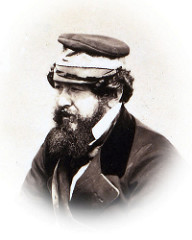
March 25th.–I had an invitation to meet several members of the New York press association at breakfast. Among the company were–Mr. Bayard Taylor, with whose extensive notes of travel his countrymen are familiar – a kind of enlarged Inglis, full of the genial spirit which makes travelling in company so agreeable, but he has come back as travellers generally do, satisfied there is no country like his own–Prince Leeboo loved his own isle the best after all–Mr. Raymond, of the “New York Times” (formerly Lieutenant-Governor of the State); Mr. Olmsted, the indefatigable, able, and earnest writer, whom to describe simply as an Abolitionist would be to confound with ignorant if zealous, unphilosophical, and impracticable men; Mr. Dana, of the “Tribune;” Mr. Hurlbert, of the “Times;” the Editor of the “Courier des Etats Unis;” Mr. Young, of the “Albion,” which is the only English journal published in the States; and others. There was a good deal of pleasant conversation, though every one differed with his neighbor, as a matter of course, as soon as he touched on politics. There was talk de omnibus rebus et quibusdam aliis, such as Heenan and Sayers, Secession and Sumter, the press, politicians, New York life, and so on. The first topic occupied a larger place than it was entitled to, because in all likelihood the sporting editor of one of the papers who was present expressed, perhaps, some justifiable feeling in reference to the refusal of the belt to the American. All admitted the courage and great endurance of his antagonist, but seemed convinced that Heenan, if not the better man, was at least the victor in that particular contest. It would be strange to see the great tendency of Americans to institute comparisons with ancient and recognized standards, if it were not that they are adopting the natural mode of judging of their own capabilities. The nation is like a growing lad who is constantly testing his powers in competition with his elders. He is in his youth and nonage, and he is calling down the lanes and alleys to all comers to look at his muscle, to run against or to fight him. It is a sign of youth, not a proof of weakness, though it does offend the old hands and vex the veterans.

Then one finds that Great Britain is often treated very much as an old Peninsula man may be by a set of young soldiers at a club. He is no doubt a very gallant fellow, and has done very fine things in his day, and he is listened to with respectful endurance, but there is a secret belief that he will never do anything very great again.

One of the gentlemen present said that England might dispute the right of the United States Government to blockade the ports of her own States, to which she was entitled to access under treaty, and might urge that such a blockade was not justifiable; but then, it was argued, that the President could open and shut ports as he pleased; and that he might close the Southern ports by a proclamation in the nature of an Order of Council. It was taken for granted that Great Britain would only act on sordid motives, but that the well known affection of France for the United States is to check the selfishness of her rival, and prevent a speedy recognition.

After our pleasant breakfast came that necessity for activity which makes such meals disguised as mere light morning repasts take their revenge. I had to pack up, and I am bound to say the moral aid afforded me by the waiter, who stood with a sympathizing expression of face, and looked on as I wrestled with boots, books, and great coats, was of a most comprehensive character. At last I conquered, and at six o’clock p.m. I left the Clarendon, and was conveyed over the roughest and most execrable pavements through several miles of unsympathetic, gloomy, dirty streets, and crowded thoroughfares, over jaw-wrenching street-railway tracks, to a large wooden shed covered with inscriptions respecting routes and destinations on the bank of the river, which as far as the eye could see, was bordered by similar establishments, where my baggage was deposited in the mud. There were no porters, none of the recognized and established aides to locomotion to which we are accustomed in Europe, but a number of amateurs divided the spoil, and carried it into the offices, whilst I was directed to struggle for my ticket in another little wooden box, from which I presently received the necessary document, full of the dreadful warnings and conditions, which railway companies inflict on the public in all free countries.

The whole of my luggage, except a large bag, was taken charge of by a man at the New York side of the ferry, who “checked it through” to the capital–giving me a slip of brass with a number corresponding with a brass ticket for each piece. When the boat arrived at the stage at the other side of the Hudson, in my innocence I called for a porter to take my bag. The passengers were moving out of the capacious ferry-boat in a steady stream, and the steam throat and bell of the engine were going whilst I was looking for my porter; but at last a gentleman passing, said, “I guess y’ill remain here a considerable time before y’ill get any one to come for that bag of yours;” and taking the hint, I just got off in time to stumble into a long box on wheels, with a double row of most uncomfortable seats, and a passage down the middle, where I found a place beside Mr. Sanford, the newly-appointed United States Minister to Belgium, who was kind enough to take me under his charge to Washington.

The night was closing in very fast as the train started, but such glimpses as I had of the continuous line of pretty-looking villages of wooden houses, two stories high, painted white, each with its Corinthian portico, gave a most favorable impression of the comfort and prosperity of the people. The rail passed through the main street of most of these hamlets and villages, and the bell of the engine was tolled to warn the inhabitants, who drew up on the side walks, and let us go by. Soon the white houses faded away into faint blurred marks on the black ground of the landscape, or twinkled with starlike lights, and there was nothing more to see. The passengers were crowded as close as they could pack, and as there was an immense iron stove in the centre of the car, the heat and stuffiness became most trying, although I had been undergoing the ordeal of the stove-heated New York houses for nearly a week. Once a minute, at least, the door at either end of the carriage was opened, and then closed with a sharp crashing noise, that jarred the nerves, and effectually prevented sleep. It generally was done by a man whose sole object seemed to be to walk up the centre of the carriage in order to go out of the opposite door –occasionally it was the work of the newspaper boy, with a sheaf of journals and trashy illustrated papers under his arm. Now and then it was the conductor; but the periodical visitor was a young gentleman with a chain and rings, who bore a tray before him, and solicited orders for “gum drops,” and “lemon drops,” which, with tobacco, apples, and cakes, were consumed in great quantities by the passengers.

At 10 o’clock, P.M., we crossed the river by a ferry boat to Philadelphia, and drove through the streets, stopping for supper a few moments at the La Pierre Hotel. To judge from the vast extent of the streets, of small, low, yet snug-looking houses, through which we passed, Philadelphia must contain in comfort the largest number of small householders of any city in the world. At the other terminus of the rail, to which we drove in a carriage, we procured for a small sum, a dollar I think, berths in a sleeping car, an American institution of considerable merit. Unfortunately a party of prizefighters had a mind to make themselves comfortable, and the result was anything but conducive to sleep. They had plenty of whiskey, and were full of song and fight, nor was it possible to escape their urgent solicitations “to take a drink,” by feigning the soundest sleep. One of these, a big man, with a broken nose, a mellow eye, and a very large display of rings, jewels, chains and pins, was in very high spirits, and informed us he was “Going to Washington to get a foreign mission from Bill Seward. He wouldn’t take Paris, as he didn’t care much about French or Frenchmen; but he’d just like to show John Bull how to do it; or he’d take Japan if they were very pressing.” Another told us he was “Going to the bosom of Uncle Abe” (meaning the President)–”that he knew him well in Kentucky years ago, and a high toned gentleman he was.” Any attempts to persuade them to retire to rest made by the conductors were treated with sovereign contempt, but at last whiskey asserted its supremacy, and having established the point that they “would not sleep unless they pleased,” they slept and snored.
0 comments

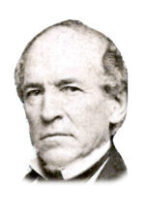
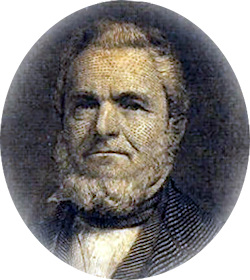
Horatio Nelson Taft

Diary of US patent clerk Horatio Nelson Taft.

MONDAY 25

This has been a delightful day, bright & warm. Have been very busy in the office, doing the work of two Desks or the Clerical duties of the room in addition to my own from the removal of our assist. Went down to the “National.” Saw Carl Shurz the famous Dutch Orator. And also met my old friend P Dorsheimer who is now State Treasurer of NY. He is after the N York Naval office. Got the NY papers & read them. Bed at 11.


The three diary manuscript volumes, Washington during the Civil War: The Diary of Horatio Nelson Taft, 1861-1865, are available online at The Library of   Congress.

0 comments

Gazaway B Lamar to Howell Cobb

Miscellaneous document sources

New York, March 25th, 1861.

My Dear Sir: The differences between the rates of the tariffs North and South are creating great discontent already at the North, and they will in the North have to call an extra Congress to repeal their Morrill tariff. This will be the consequence; and if not, a considerable part of the direct importations usually coming North will go to the South. With free trade at the South all the imports would be diverted to the Southern ports until New York City could redress herself either by dissolving the relations she holds to the Union and adopting free trade or by bringing all the other states to do it. With her thousand millions of real estate, self defence would demand her to do the one or the other.

So, whilst cotton (whilst in the South) is king, free trade is to the rest of the Union explosion. Whilst the South can rule Europe and New England by cotton, she can by free trade explode all the power of the rest of the Union.

The South, with but light taxation now, can increase and pay fifteen times as much as they now do and then not pay as much as New York and many of the other States pay now. But if you destroy Northern revenues by free trade [continue reading…]

0 comments

Baltimore Recruits — Confederate Records

War of the Rebellion: from the Official Records of the Union and Confederate Armies and Navies

FORT SUMTER, S.C., March 25, 1861.
(Received A. G. O., March 28.)

Col. L. THOMAS, Adjutant-General U. S A.:

COLONEL: I have the honor to report that everything is quiet around us, and that we do not see any work being prosecuted except that at the new battery at Fort Johnson. They are practicing this morning with shells from the columbiads at Fort Moultrie and from a mortar battery between Nos. 9 and 10.

I inclose herewith a report of the condition of our fort. It will be seen that a great deal of work has been done since we came in. We are now about finishing the closing of the openings in the gorge–a measure first suggested by Captain Doubleday.

I have not noted the different operations we have been engaged in from time to time, as I did not deem them of sufficient importance to require it.

I am, colonel, very respectfully, your obedient servant,

ROBERT ANDERSON,

Major, First Artillery, Commanding.

[Inclosure.]

FORT SUMTER, S.C., March 24, 1861.

Maj. ROBERT ANDERSON, First Artillery, Commanding:

SIR: In accordance with verbal instructions given by you, we have the honor to submit the following report upon the condition of Fort Sumter when occupied December 26, 1860, the measures taken to put it in a state of defense, and its present condition:

Condition of the work December 26, 1860.

The barbette tier was ready for its armament: Three 24-pounders were mounted at the left and three more were ready to be mounted at the right gorge angle.

Fort Sumter, Charleston Harbor, March 25, 1861

The second tier of arches was not ready for its guns. The embrasures were not yet placed, and forty-one openings, eight feet square, were left in the scarp wall for this purpose. Those on the flanks (20) were closed only with a sheathing of 1-inch boards; the remainder, on the faces (21), were either entirely open or closed with three courses of brick dry-laid, or, as on the left face, With two courses laid in mortar; some few were only half closed. One 32-pounder was mounted, for experimental purposes, on the right flank.

First tier.–Eleven 32-pounders were mounted on the left face. Guns could be mounted throughout. The forty-one embrasures were closed with the ordinary 6-inch wooden shutters, secured with a wooden brace and rope lashing. Two small posterns in the gorge angles were closed, each with two doors, the outer hooked, the inner barred. The soldiers’ quarters were unfinished, and as those portions that were tenable were occupied by workmen, the transferred garrison was placed in the officers’ quarters, which were completed.

The parade was crowded with temporary wooden buildings (6), used as shops and storehouses, with a large amount of flagging, lumber, sand, shell, and brick, and with the ordnance, consisting of sixty-six guns with their carriages and 5,600 shot and shell. The communications through these incumbrances were very difficult.

The main postern was closed by two gates, each of two 4-inch leaves, secured with wooden cross-bars; they were loopholed and were weak and insecure.

On the gorge seven loopholed doors were closed with 5-inch wooden shutters; twelve magazine ventilators with wooden shutters at the throat; fifty-one loopholed windows were not closed. The esplanade and wharf were much incumbered with flagging, sand, and brick, and by two apparatuses, twelve feet high and attached to the scarp wall, for hoisting boats.

The garrison transferred from Fort Moultrie consisted of seven officers, seventy-six enlisted men, and forty-five women and children. There were three officers, one enlisted man, two hundred and five laborers, and one woman at Fort Sumter. One hundred and fifty of the laborers were discharged within a few days, and the women and children were shipped to New York early in February, 1861, leaving at this date a garrison consisting of ten officers, seventy-five enlisted men, and fifty-five laborers. There has been and is an ample supply of water and a sufficiency of fuel, principally in the shape of lumber, flooring, and gun carriages.

Immediately after the transfer of the garrison to this place, and your assuming command, instructions were given to limit the defense to the barbette and first tier, closing all openings in that tier, except three or four at each angle, where guns were to be mounted, and all openings in the second tier, permanently and securely. The first labors were directed to mounting the proposed armament, and to closing these openings, after which such defenses were prepared as the situation of the garrison suggested, until this date, when the condition of the work is as follows:

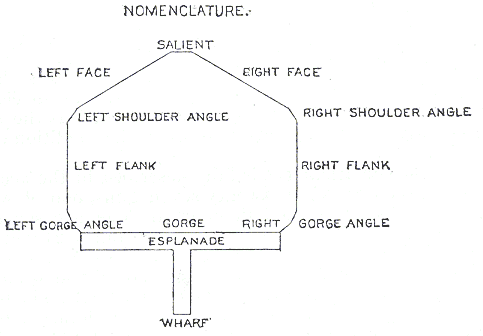
Barbette tier.–The armament is fully described in the accompanying figure. It consists, in all, of twenty-seven guns, one of which, a 42-pounder, is mounted at the left shoulder angle on a casemate carriage placed on the chassis of a 10-inch columbiad, and a 24-pounder at the left gorge angle is so arranged and the parapet so cut away that it can be depressed to 18o and fired upon the end of the wharf. Several machicoulis galleries of 1 1/2-inch plank (five lined with 1/2-inch iron plate) are placed on the parapet, one on the center of each face and flank, and three on the gorge, over and commanding the main postern; 225 shells, mostly 8-inch, are arranged as grenades, to be rolled off the parapet and exploded by means of a lanyard of proper length. Thunder-barrels are placed at each angle and over the main gate; fragments of stone, brick, &c., along the breast-height for missiles; twenty-three flights of steps lead to the parapet; ammunition in limber-boxes is placed convenient for instant use, and grape, canister, shot, and shell in abundance at each gun. Some five hundred cartridge bags have been made. The powder is well stored in the first-story magazine in the left gorge angle.

Second tier.–The 32-pounder on the right flank is dismounted; the forty-one 8-foot square openings are securely closed by a 3-foot brick wall, laid in cement, and backed in twenty-seven by two feet of sand, kept in place by a sheathing of boards or by barrels, in eight by two feet of flagging-stones, laid dry, and in six by dry brick, or re-enforced only by piles of finishing-stuff and flooring-boards.

First tier.–The armament consists of twenty-seven guns, and is fully described in the plan adjoined. There are eighteen guns ready for instant service, sixteen of the embrasures in front of which are closed with the original 6-inch wooden shutter, and also with an inner 6-inch shutter fitting close to the throat, and through the center of which a link from the outer shutter passes; an iron key tightens both firmly together. Two are closed by iron shutters of 1/2-inch iron plate; all are further secured by a 10-foot brace abutting against the gun run “from battery.” Where guns are mounted (9), but not required for immediate use, the embrasures (9) are closed temporarily, in addition to the outer shutter, by stone flagging, notched to fit the throat and laid flat, or by brick laid in mortar. There are fourteen embrasures, behind which guns are not mounted, of which eight, on the flanks, are closed by an 18-inch brick wall laid in mortar against the outer shutter; one by the dry-stone flagging, and the remainder (five) on the right face, by an entire embrasure filling of brick and stone laid in mortar.

The doors of the two posterns on the flanks are strengthened by 3-foot brick walls laid in mortar against the outer doors.

On the parade four 8-inch and one 10-inch columbiads are mounted as mortars (see preceding plan), and point to Morris Island and Charleston. All the temporary buildings and the lumber have been removed for fuel, the flagging turned on edge against the quarters or in the ends of the casemates, the shell spread on the walks, the sand and brick used, with a stone revetment, for splinter-proof traverses about the guns and in front of the hospital. The lantern has been removed from the light-house and placed on a platform in the center. The entire parade is clear.

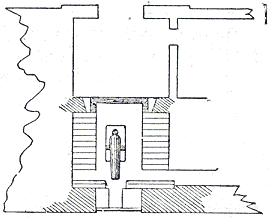
Main postern.–A stone and brick wall laid in cement is built against the outer gate to within four feet of the lintel. It is three feet six inches thick and six feet high. Through it is a manhole one foot eleven inches wide. An 8-inch sea-coast howitzer on a casemate-top carriage only looks through the manhole. In the door above the wall are four loopholes, reached by steps. One leaf of the gate is firmly bolted shut; the other can be opened or securely shut, and through it and corresponding with the manhole in the wall is a manhole closed by a door.

Fort Sumter, Charleston Harbor, March 25, 1861

The outside of the gate and inside of the small door are covered with ½-inch iron. The inner door is fastened with a wooden cross-bar, and has a manhole closed by a door; there are four loopholes in it, and two in the cross wall to which it is hung. Material is at hand with which to close the outer door permanently. The walls of the stairways leading     to the second floor are closed with 1 ½-inch plank, and openings over the postern are arranged for throwing grenades.

Fort Sumter, Charleston Harbor, March 25, 1861

The gorge.–In the second story the thirty-four windows and six magazine ventilators are protected by placing in each two wrought-iron embrasure jams, eight inches thick and three feet six inches long, permitting of musketry fire over them. In the first story the seven doors are closed with a 5-inch wooden shutter, against which, outside, is built a 9-inch brick wall, laid in cement, and outside this a pintle stone, 8 feet by 2 feet 2 inches by 1 foot 3 inches, with pieces of flagging, fastened in with wooden wedges and melted lead; the six magazine ventilators by large stones and lead against the wall and shutter; and fifteen windows are closed by the pintle stone and flagging, fastened with the wedges and lead. In all these openings the filling is placed against the offset at the throat, by which a solid wall, two feet thick and well secured in the rear, has been obtained.

On the esplanade two 8-inch sea-coast howitzers are mounted on casemate carriages only, one each side of the main gate, to sweep the gorge and the approaches to it. The stone &c., has been removed, leaving only a row along the edge to prevent grenades rolling off. Two fougasses, of 12 feet diameter, charged with 50 pounds of powder, are placed against the foot of the scarp wall, one in the center of each half gorge.

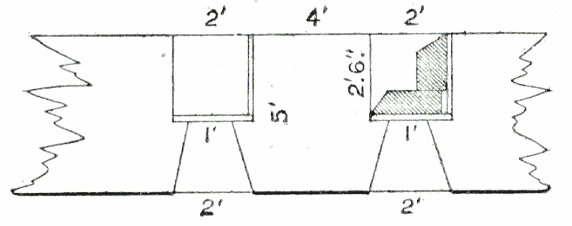
Two mines, charged with 25 pounds of powder, are sunk in the wharf 40 feet apart. A wooden fence, 8 feet high, at each end of the esplanade, extends from the scarp to low water. The stones of the enrockment in front of embrasures to be opened are removed. A deep cut in the enrockment on the left flank obstructs communication.

Respectfully submitted.

G. W. SNYDER,

First Lieutenant of Engineers, U. S. Army.

T. SEYMOUR,

Brevet Captain and First Lieutenant, First Artillery.

[Indorsement.]

FORT SUMTER, S.C., March 25, 1861.

Report exhibiting the work done at Fort Sumter since its occupation by the present garrison, and its condition at this date. Confidentially communicated for the information of the War Department.

ROBERT ANDERSON,

Major, First Artillery, Commanding.

0 comments

Operations in Charleston Harbor — Confederate Records

War of the Rebellion: from the Official Records of the Union and Confederate Armies and Navies

HEADQUARTERS
PROVISIONAL FORCES,

Charleston, S.C.,
March
25, 1861.

Brig. Gen. S. COOPER, Adjutant-General C. S. Army:

SIR: I have the honor to acknowledge the receipt of your two letters dated, respectively, the 20th and 21st instants, the former extending the limits of my command, &c.; the latter in relation to the recruiting service in Baltimore; also, a telegram from the Secretary of War in relation to the recruits. The instructions contained therein will be complied with. I will not leave this city until after the evacuation of Fort Sumter. Sixty-four recruits arrived here from Baltimore, under the charge of Mr. R. E. Haslett, on Saturday, the 23d instant, and were sent to Castle Pinckney. They will be enlisted to-day. Captain Childs and Lieutenants O’Brien and Robertson have been assigned to duty with them. The quartermaster-general of the State of South Carolina has kindly offered to furnish them with the necessary rations, clothing, &c., to be settled for hereafter. It would, perhaps, be economical to prescribe the uniform for the Regular Army as early as practicable. Mr. Haslett informs me that a bounty was promised these men, but does not know the amount–thinks about $25 or $30. I have, therefore, to request that you notify me what amount will be paid, and under what regulations, that I may cause the same to be noted on their muster and pay rolls. I am just informed that Lamon, special messenger from Washington, has arrived, and is now conferring with the governor.

I am sir, very respectfully, your obedient servant,

G. T. BEAUREGARD,

Brigadier-General, Commanding.

0 comments

Governor Pickens to General Beauregard on a Sumter “inventory.”

War of the Rebellion: from the Official Records of the Union and Confederate Armies and Navies

EXECUTIVE DEPARTMENT,
State of South Carolina, March 25, 1861.

[General BEAUREGARD?]:

MY DEAR SIR: I sent Lamon to Major Anderson, and all right. Will see you as soon as I can. I told him we would agree to evacuation upon any honorable and reasonable terms, but would not suffer any war vessel to come up to the fort, and everything must be conducted respectably, and in no arrogant or wanton manner towards us. He says Spencer will come out in a few days, certain.

Truly,

F. W. PICKENS.

0 comments

The News

Civil War Day-by-Day

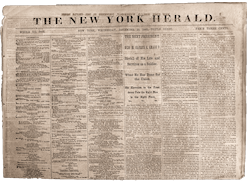
March 25, 1861; The New York Herald

It was believed in Washington yesterday that the programme of the administration, in regard to the evacuation of Fort Sumter, had been altered since the departure of Col. Lamon. It is now reported that the evacuation is to be conditional. Col. L. is to examine the stock of provisions on hand, and if the supply is not sufficient to maintain the troops now there, the he will deliver the President’s order to Major Anderson to evacuate the fortress.

The government is said to be in receipt of advices stating that the independent State of Texas has sent Commissioners to New Mexico, Arizona, Sonora and Chichuahua in induce the people of those States to cast their fortune with the Southern confederacy. Their mission is said to be favorably regarded, which, if true, will tend still further to complicate the embarrassments of Mr. Lincoln’s administration.

Despatches from Fort Pickens state that the garrison there is short of provisions, and can hold out but a short time longer. None but official communication is permitted at Pensacola, and the squadron can neither reinforce the Fort nor furnish supplies. Appearances indicate that before long the government will also be compelled to abandon Fort Pickens to the secessionists.

From Texas we learn that both branches of the Legislature had taken the oath of allegiance to the new government, a few of the members under protest. Governor Houston and the Secretary of State have retired from their offices and delivered up the records. Gen. Houston had issued an appeal to the people, in which he severely denounces the action of the Convention.

By a despatch from New Orleans we learn that the commissioners from the Confederate States to Europe will leave that [continue reading…]

0 comments

Admission of Northern States into the Southern Confederation

Civil War Day-by-Day

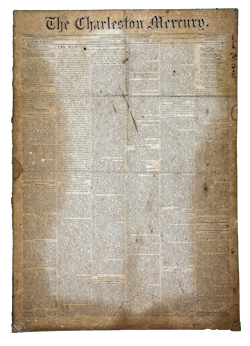
March 25, 1861; The Charleston Mercury

As the new Constitution has been framed, there is nothing to prevent the admission of Northern States into the new Confederation. A vote of two thirds is all that is requisite; and, after the accession of Virginia, Maryland, North Carolina, Tennessee, Kentucky, Missouri and Arkansas, there is likely to be no great difficulty in obtaining this vote. In thus constructing the fundamental law, of course, a struggle has occurred in the secret sessions of the Montgomery Congress, in which those refusing to close the door against the reception of anti-slavery States have achieved a victory. Thus the policy of ultimately admitting the anti-slave States of the Northwest first, and afterwards Pennsylvania, New York, et cetera, is obviously the programme or prevailing idea of the Montgomery Congress. The Union is not to be reconstructed on terms of the old Constitution. It is to be reorganized on the new basis, and we are in danger, if the views of the Constitution makers are carried into practice of being dragged back eventually into political affiliation with the States and peoples from whom we have just cut loose.

Now, some may think us hypercritical and captious in seeing anything disagreeable, or in finding fault at all, when matters appear to be progressing satisfactorily. But, a reference to the future must govern us in the present, if we would control events. It is shortsighted and pusillanimous to cover up and conceal from view stubborn facts which, however unpleasant to know, our future peace and prosperity urge us not to overlook, but to strive and remedy. It has been found that, in the construction of a great ship, the unwise insertion of one stick of worm eaten timber has involved her fate with the loss of hundreds of lives and millions of property. So a defect of grave character, like this of the new Constitution may entail upon the peoples of the Southern States the difficulties and dangers of again going through the same struggle from which we are emerging, and perhaps may ultimately wreck the hopes of republican liberty throughout the world. It is too late, and South Carolina is not the State to resist the embodiment of this imprudent provision in the Constitution. And it is almost hopeless to expect that, after the accession of the Border States, the fundamental law can, without undue [continue reading…]

0 comments

“I am not a great admirer of Doct Smiths Sermons.”—Horatio Nelson Taft

Diary of US patent clerk Horatio Nelson Taft.

SUNDAY 24

We have had a “march Wind” today in good earnest, with plenty of dust. I did not go to church in the morning. The Family went. I am not a great admirer of Doct Smiths Sermons. I wrote letters part of the day, one to S Patrick, one to Wm Van Camp, and one to Frank. In the evening I called with Holly at Mr Cramers and had a pleasant chat with them. Did not get home till near 10 o’clock, read awhile and went to bed about 11 o’clock.


The three diary manuscript volumes, Washington during the Civil War: The Diary of Horatio Nelson Taft, 1861-1865, are available online at The Library of   Congress.

0 comments

Operations in Florida – Confederate Correspondence

War of the Rebellion: from the Official Records of the Union and Confederate Armies and Navies

Headquarters, State Of South Carolina,

March 24, 1861.

General Beauregard:

My Dear General: I have read the papers and your note to Major Anderson. As to the inventory suggested, of all public property, would it not be well to wait his propositions first? Because, if we propose an inventory, it will imply that our Government is to be responsible for the amount in any future settlement, whereas, considering that the United States forces inaugurated a state of hostilities, approaching a state of war (by the removal from Moultrie, by leaving the carriages, spiking the guns, and cutting down the flagstaff, and left the fort in actual flames, which would have reached the magazine if I had not taken possession and stopped the progress), then the attempt to throw re-enforcements in and the whole course of the Government and command here, has forfeited all claim for future accountability for armament and public property in this fort now; besides, the expenses they have forced us to, in order to ward off the conquest and subjugation intended by their occupation of Sumter, all cancel the obligation to account. If Anderson should offer or desire to have an inventory, then I will agree to it with pleasure, or any reasonable request, so as to get them out without difficulty. But I would, when they retire, sign the inventory with a protest against the Government being finally responsible, unless it might be expedient to do so in a full settlement. I have no idea that Anderson has as yet any authority to agree to your propositions in any shape, because I do not think the Government has yet empowered him. I merely throw out these suggestions for the present, and have no objections to your sending a letter somewhat like yours, if you think the time has now arrived.

With great regard, yours, very truly,

F. W. PICKENS.

(Source: The War of the Rebellion: v. 1-53 [serial no. 1-111] Formal reports, both Union and Confederate, of the first seizures of United States property in the southern states, and of all military operations in the field, with the correspondence, orders and returns relating specially thereto. 1880-98.)

0 comments

No news has yet come of the evacuation of Fort Sumter

Louise Wigfall Wright — A Southern Girl in ’61

(excerpt from letter by Louise Wigfall’s mother, Charlotte)

March 24th. My mother says: “Your father has gone over to-day to Alexandria to meet McCulloch. McCulloch arrived here last night and went right to Mr. Gwin’s. It was deemed imprudent by his friends for him to remain in Washington on account of the part he took about the Forts in Texas, and they advised him to go to Alexandria, so your father has gone there to see him. . . . No news has yet come of the evacuation of Fort Sumter.”

0 comments

The News

Civil War Day-by-Day

March 24, 1861; The New York Herald

The news from Washington this morning is highly important. The official order for the evacuation of Fort Sumter was issued on Friday, and a special messenger was immediately despatched with it to Major Anderson. The fort is to be evacuated on the arrival in Charleston harbor of a United States vessel to receive them. Should the South Carolina authorities oppose the departure of the troops in the manner directed by the instructions to Major Anderson, that officer has been ordered, it is stated, to open his batteries. There is no doubt, however, but that the garrison will be permitted to depart in the manner prescribed.

Despatches received by the government from Fort Pickens represent that the garrison is short of provisions, and can hold out but a short time longer. The squadron off Pensacola are unable to reinforce the fort or land supplies. The administration will doubtless before the lapse of many days be obliged also to abandon that stronghold to the secessionists.

Later accounts from Texas state that both houses of the Legislature have taken the oath of allegiance to the new government, and that Gov. Houston and the Secretary of State have retired from their office and surrendered the archives. Gov. Houston has issued an appeal to the people denouncing the State Convention.

In the United States Senate yesterday, the Vice President having signified his intention to be absent during the remainder of the session, on motion of Mr. Hale, Mr. Foot, of Vermont, was chosen President pro tempore. Mr. Foot, returned this thanks for the honor in appropriate terms. Mr. Sherman, the newly elected Senator from Ohio, was qualified and took his seat. The resolution of Mr. Hale, to go into an election for Sergeant at Arms and doorkeepers, was then taken up. The democrats opposed this first attempt to bestow the offices of the Senate upon political partisans with warmth and spirit and, after an expenditure of considerable gasconade on both sides, succeeded in postponing the election. The Senate then went into executive session, and confirmed a number of appointments.

0 comments

Important from Washington

Civil War Day-by-Day

March 24, 1861; The New York Herald

The Order Issued for the Evacuation of Fort Sumter.

WASHINGTON, March 23, 1861.

I am permitted to announce to the HERALD tonight, that on yesterday the President issued the order to Major Anderson to put his command in readiness to evacuate Fort Sumter, upon the arrival at that place of a United States war steamer.

Colonel Lamon, of Illinois, the confidential friend of the President, was sent bearer of despatches to Major Anderson.

The evacuation will take place upon the arrival of the steamer which has been despatched by the Secretary of the Navy.

There is no intimation whatever, on the part of the South Carolina authorities, that any attempt will be made to prevent the evacuation in such a manner as the United States government have seen fit to employ. Major Anderson will salute his flag and embark with his command.

Major Anderson is ordered to report North.

I an any attempt is made by the South Carolina authorities to prevent the evacuation in the order directed by the United States government, Major Anderson is instructed to remain in the fort and open his batteries upon the city. This, however, will not be done, as there will be no opposition to the evacuation on the part of the secessionists.

0 comments

… the Government appears to be helplessly drifting with the current of events, having neither bow nor stern, neither keel nor deck, neither rudder, compass, sails, or steam.—William Howard Russell

My Diary North and South – William Howard Russell

March 23rd.–It is announced positively that the authorities in Pensacola and Charleston have refused to allow any further supplies to be sent to Fort Pickens, the United States fleet in the Gulf, and to Fort Sumter. Everywhere the Southern leaders are forcing on a solution with decision and energy, whilst the Government appears to be helplessly drifting with the current of events, having neither bow nor stern, neither keel nor deck, neither rudder, compass, sails, or steam. Mr. Seward has declined to receive or hold any intercourse with the three gentlemen called Southern Commissioners, who repaired to Washington accredited by the Government and Congress of the Seceding States now sitting at Montgomery, so that there is no channel of mediation or means of adjustment left open. I hear, indeed, that Government is secretly preparing what force it can to strengthen the garrison at Pickens, and to reinforce Sumter at any hazard; but that its want of men, ships, and money compels it to temporize, lest the Southern authorities should forestall their designs by a vigorous attack on the enfeebled forts.

There is, in reality, very little done by New York to support or encourage the Government in any decided policy, and the journals are more engaged now in abusing each other, and in small party aggressive warfare, than in the performance of the duties of a patriotic press, whose mission at such a time is beyond all question the resignation of little differences for the sake of the whole country, and an entire devotion to its safety, honour, and integrity. But the New York people must have their intellectual drams every morning, and it matters little what the course of Government may be, so long as the aristocratic democrat can be amused by ridicule of the Great Rail Splitter, or a vivid portraiture of Mr. Horace Greeley’s old coat, hat, breeches, and umbrella. The coarsest personalities are read with gusto, and attacks of a kind which would not have been admitted into the “Age” or “Satirist” in their worst days, form the staple leading articles of one or two of the most largely circulated journals in the city. “Slang” in its worst Americanised form is freely used in sensation headings and leaders, and a class of advertisements which are not allowed to appear in respectable English papers, have possession of columns of the principal newspapers, few, indeed, excluding them. It is strange, too, to see in journals which profess to represent the civilization and intelligence of the most enlightened and highly educated people on the face of the earth, advertisements of sorcerers, wizards, and fortune-tellers by the score–”wonderful clairvoyants” “the seventh child of a seventh child,” “mesmeristic necromancers,” and the like, who can tell your thoughts as soon as you enter the room, can secure the affections you prize, give lucky numbers in lotteries, and make everybody’s fortunes but their own. Then there are the most impudent quack programmes–very doubtful “personals” addressed to “the young lady with black hair and blue eyes, who got out of the omnibus at the corner of 7th Street”–appeals by “a lady about to be confined” to any respectable person who is desirous of adopting a child:” all rather curious reading for a stranger, or for a family.

It is not to be expected, of course, that New York is a very pure city, for more than London or Paris it is the sewer of nations. It is a city of luxury also–French and Italian cooks and milliners, German and Italian musicians, high prices, extravagant tastes and dressing, money readily made, a life in hotels, barrooms, heavy gambling, sporting, and prize-fighting flourish here, and combine to lower the standard of the bourgeoisie at all events. Where wealth is the sole aristocracy, there is great danger of mistaking excess and profusion for elegance and good taste. To-day as I was going down Broadway, some dozen or more of the most over-dressed men I ever saw were pointed out to me as “sports;” that is, men who lived by gambling-houses and betting on races; and the class is so numerous that it has its own influence, particularly at elections, when the power of a hard-hitting prizefighter with a following makes itself unmistakably felt. Young America essays to look like martial France in mufti, but the hat and the coat suited to the Colonel of Carabiniers en retraite do not at all become the thin, tall, rather long-faced gentlemen one sees lounging about Broadway. It is true, indeed, the type, though not French, is not English. The characteristics of the American are straight hair, keen, bright, penetrating eyes, and want of color in the cheeks.

0 comments

“Despairing applicants for office are telegraphing to their friends to come & help them.”—Horatio Nelson Taft

Diary of US patent clerk Horatio Nelson Taft.

SATURDAY, MARCH 23, 1861.

Warm comfortable day today with indications of rain towards night. Nothing of note occured in the office. No Comr yet. A great many removals in the Pension Office, and a clamorous crowd ready to fill vacancies. The City is yet quite full of strangers. Despairing applicants for office are telegraphing to their friends to come & help them. Was in at Willards & Kirkwoods, bought a cravat at Berglings and the papers at [French & Richsteins?], and came home about 9 o’ck, read till 11.


The three diary manuscript volumes, Washington during the Civil War: The Diary of Horatio Nelson Taft, 1861-1865, are available online at The Library of   Congress.

0 comments

Operations in Charleston Harbor

War of the Rebellion: from the Official Records of the Union and Confederate Armies and Navies

WAR DEPARTMENT, A. G. O.,
Montgomery, Ala., March 23, 1861.

Brig. Gen. BRAXTON-BRAGG,
Commanding Pensacola Harbor:

SIR: The Secretary of War wishes to be informed, at your earliest convenience, whether any reconnaissance or examination of the country in your rear toward Perdido Bay, and along the Gulf coast, has been made. Having in view the transport of supplies from Mobile to Pensacola, it is of eminent importance to know whether the long transit between Blakely and the latter point can in any way be avoided. You are therefore requested to transmit any information which you may have on the subject, and to ascertain, if possible, whether communication by water, portage, and land carriage can be made between Bonsecours Bay, Perdido Bay, and Pensacola Harbor, and, if so, the least depth of water and the length of portage it would be necessary to make.

I am, very respectfully, your obedient servant,

S. COOPER,

Adjutant-General.

0 comments

General Beauregard—Something of His History

Civil War Day-by-Day

March 23, 1861; The Charleston Mercury

In the year 1858, when rowdyism ruled supreme in New Orleans elections, General (then Major) BEAUREGARD was nominated by the order loving citizens of that place for the Mayoralty. We find in a New Orleans paper of that time the following interesting sketch of his previous career:

Major Beauregard, then, the independent candidate of the intelligence, enterprise, industry and wealth of New Orleans for the Chief Magistracy of their city, is a native of this State, born, of Creole parents, in the year 1815, and is, consequently, now in his forty third year. At the early age of sixteen he entered the United States Military Academy, where, having stood next to head in all his classes, he graduated second of his date in 1838. He was then commissioned Second Lieutenant in the Corps of United States Engineers, to which he has ever since remained attached, serving the principal portion of the twenty years in the Gulf of Mexico, constructing or repairing the different forts for the protection of the coast.

When the war with Mexico occurred in 1846, he made three successive applications to be employed in its prosecution, and at last had the great satisfaction of being ordered to Tampico, which had just fallen into the possession of our arms, where, in conjunction with Major J. G. Barnard, of the same corps, an officer of great merit, were planned and constructed the defences which at this moment have served to keep Gen. Garza force so long and successfully at bay. In 1847 he joined Gen. Scott, as a member of his staff, before Vera Cruz, in the reduction of which, like all his brother engineer officers, he took an active and most serviceable part. The honor of selecting three of the sites of the five batteries which reduced the city of the Holy Cross to capitulate on the 19th of March, devolved upon him. In the following April, before the battle of Cerro Gordo, the reconnoisance, under the orders of General Twiggs, of the mule path which turned the left of the Mexican position, was entrusted to, and performed satisfactorily by him, he, two other officers and handful of daring men, going over one mile in rear of the advanced positions of the Mexican army, afterwards [continue reading…]

0 comments

The United States Navy

Civil War Day-by-Day

March 23, 1861; The Illustrated London News

Mr. Dowes, of Massachusetts, from the Committee of the House of Representatives to whom was referred the President’s message of Jan. 8, has reported concerning the United States’ navy. It appears that there are now in commission, in various parts of the world, forty-eight vessels; that twenty-eight are unfit for service, and not to be repaired under several weeks’ or even months’ time; that the entire naval force available for the defence of the Atlantic coast at the time this committee was appointed consisted of the steamer Brooklyn, of 25 guns, and the store-ship Relief, of two guns; the former being unable, by reason of her draught, to enter Charleston harbour with safety, and the latter being under orders for the African coast. Under these circumstances, the committee refer with much severity to the extraordinary disposition of our naval force, by which it was kept out of the way in a manner which would be injudicious at any time, but which now clearly showed hopeless imbecility or a deliberate conspiracy to give the country into the hands of traitors. The report next takes up the matter of resignations by traitorous naval officers, sets forth in plain terms the name and offense of each of these, and places in a clear light the extraordinary conduct of the Secretary of the Navy in accepting the resignations, concluding by recommending the passage of a resolution of censure upon that Cabinet officer.—New York Tribune.

0 comments

The News

Civil War Day-by-Day

March 23, 1861; The New York Herald

In the United States Senate yesterday Mr. Hale offered a resolution that the Senate proceed to an election of Sergeant-at-Arms and Doorkeepers. It was laid over. A resolution directing the payment of extra compensation to clerks of committees was discussed, and rejected. Mr. Douglas’ resolution calling for information as to the designs of the administration with reference to the Southern forts was then taken up, and Mr. Bayard concluded his remarks in favor of recognizing the independence of the Confederate States. He was followed by Mr. Howe, of Wisconsin, in opposition to the resolution. Before Mr. Howe had concluded the Senate went into executive session, and confirmed several appointments.

The Montgomery Ala. Advertiser of the 19th inst. has the following respecting the Tariff bill of the Southern republic:

As there is general misapprehension in regard to the Tariff bill having passed the Congress of the Confederate States, we take this occasion to inform the public that the bill did not pass. The committee drafted the Tariff bill, which was ordered to be published, in order that it might be examined and discussed, and its merits or demerits thoroughly understood before the final passage of a bill on this important subject. But by some means the impression got out that the bill had been adopted by the Congress, and it was at once telegraphed and sent over the country as a law of the confederacy. This, however, as we have stated, proves to be an error.

A rehearing was had yesterday morning in the case of Police Detective Williamson. Superintendent Kennedy, being placed upon the stand, testified in substance to about the same that was heretofore published. The report of the two detectives who were sent to Washington, regarding the intended assassination of the President, was called for by the counsel for Mr. Williamson, but it was withheld by Mr. Brown, on the ground that it had no bearing on the case. Thomas T. Everett was called as a witness, and testified as to the sobriety of Mr. Williamson at the time he was charged with intoxication, and as to his deportment while in Mr. Kennedy’s presence.

0 comments

The Pelican Rifles

Civil War Day-by-Day

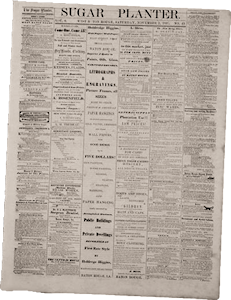
March 23, 1861, Sugar Planter
(West Baton Rouge, LA.)

This excellent body of citizen soldiery made a fine turn out in Baton Rouge on Monday last for target exercise. In their beautiful uniforms of dark green which they have just adopted, the Rifles looked as their indomitable Captain wished them to look–like true and good soldiers, every one. Their target evinced some excellent shooting, which, considering the miserable weapons the State has allowed them to use–the condemned Mississippi rifle–showed that they had practised their best under the most disadvantageous circumstances. The first prize, a beautiful gold cross was won by private Allen W. Cameron; and the second prize, a handsome gold pencil was taken by private Benny Hickman. The leather medal won by Benny last spring stirred him up to unusual energy. The Rifles are well worthy the attention of the State in matter of arms, as they have supported themselves without the slightest outside assistance since their organization, and it would be no more just that the State give them arms to suit the indomitable energy which they have displayed since their first organizing, now nearly two years since.

0 comments

“Be sure you examine the slave-pens. They will be afraid to refuse you, and you can tell the truth.”—William Howard Russell Diary

My Diary North and South – William Howard Russell

March 22d.–A snow-storm worthy of Moscow or Riga flew through New York all day, depositing more food for the mud. I paid a visit to Mr. Horace Greeley, and had a long conversation with him. He expressed great pleasure at the intelligence that I was going to visit the Southern States. “Be sure you examine the slave-pens. They will be afraid to refuse you, and you can tell the truth.” As the capital and the South form the chief attractions at present, I am preparing to escape from “the divine calm ” and snows of New York. I was recommended to visit many places before I left New York, principally hospitals and prisons. Sing-Sing, the state penitentiary, is “claimed,” as the Americans say, to be the first “institution” of its kind in the world. Time presses, however, and Sing-Sing is a long way off. I am told a system of torture prevails there for hardened or obdurate offenders–torture by dropping cold water on them, torture by thumbscrews, and the like–rather opposed to the views of prison philanthropists in modern days.

0 comments

“The Heads begin to drop in our office.”—Horatio Nelson Taft

Diary of US patent clerk Horatio Nelson Taft.

FRIDAY 22

A cold wind till near night, but a fine evening & bright moon. The Heads begin to drop in our office. Three assistant exmrs have been removed today, others will probably follow. Called with Juliet at Doct Everitts after dinner, then went on to the Ave alone and round the Hotels. They are pretty well crowded yet with anxious faces. Levee at the Prests tonight, crowds were moving that way on the Ave. Came home before 9, and read “Williams on heat” till 11, read last night till after 12 o’clock.


The three diary manuscript volumes, Washington during the Civil War: The Diary of Horatio Nelson Taft, 1861-1865, are available online at The Library of   Congress.

0 comments

I enter my protest against being in any way held accountable for what may take place.”—Operations in Florida

War of the Rebellion: from the Official Records of the Union and Confederate Armies and Navies

Fort SUMTER, S.C., March 22, 1861.

General Jos. G. TOTTEN,
Chief Engineer U. S. Army, Washington., D.C.:

GENERAL: Everything appears to be quiet this morning in the batteries around us. Night before last the South Carolinians put down   again the buoy that had been taken up a few nights before from its   position, about half a mile to the east of this fort. It appears, however, that it was not replaced in the former position, but placed upon   the opposite side of the channel.

Last night a special messenger, Mr. Fox, arrived from Washington,   and came down to the fort under the escort of Captain Hartstene, formerly of the United States Navy. After a confidential interview with   Major Anderson, he left immediately for Washington.

With respect to this fort, I have filled all the loophole openings on   the first tier with solid stone. All the openings are now closed, with   the exception of five near the ends of the gorge, which had been partially filled with a 9-inch brick wall. I am now completing the filling   of these with lead concrete.

I am also building traverses in front of the hospital, which is on the   first floor of the quarters, and in front of the ordnance storeroom, to   shield them from shells from Fort Moultrie.

Very respectfully, your obedient servant,

J. G. FOSTER,

Captain, Engineers.

0 comments

A Visit to the East Wing of the Citadel Acadamy

Civil War Day-by-Day

March 22, 1861; The Charleston Mercury

OUR CITIZENS will be much gratified by a visit to the east wing of the Citadel Academy, where ammunition and military fireworks generally are fabricated in all their various forms, under the superintendence of that very active and efficient young officer, Capt. C.P. THOMAS, of the Citadel. It is incredible to behold the silent progress which has been going on in our midst in the preparation of war material in the last two or three months, and certainly without precedent in any country.

0 comments

The South Carolina Cadets Reviewed by Gen. Beauregard—Annual Drill before the Board of Visitors

Civil War Day-by-Day

March 22, 1861; The Charleston Mercury

About five o’clock yesterday afternoon, the Citadel Green presented quite an animated appearance. Owing to the announcement having appeared in THE MERCURY, a crowd of not less than three thousand persons had assembled to witness the annual drill of the South Carolina Cadets, before Brig. Gen. BEAUREGARD. the Citadel Building itself wore an air of unusual life and activity. Not an available window was there that did not exhibit a pair of rosy cheeks and laughing eyes, and the summit was alive with interested spectators. Every South Carolinian is aware that the Cadets are the pride of the State, and the citizens of the Confederate States need only be reminded of the present occasion to be fully satisfied of the fact themselves.

The battalion in drill was composed of six companies, commanded by Capt. J.B. THOMAS. Lieut. MORRIS acted as Lieutenant Colonel, and Lieut. MAZYCK acted as major. Capt. J.M. WHILDEN took charge of the first company; Lieut. R.O. SANDS, of the second; Lieut. R. CRAWFORD, of the third; Lieut. J. BRUNS, of the fourth; Lieut. A. TENNANT, of the fifth; and Lieut. S.P. PICKENS, of the sixth. These, together with Adjutant J. WALKER, and sergeant Major BROWN, composed the officers of the Cadets.

One of the features of the occasion was the presence, by invitation, of Brigadier General BEAUREGARD, of the regular army of the Confederate States, and now in command of the South Carolina forces. General BEAUREGARD attracted universal attention, and hearty were the encomiums passed upon his military bearing and look of high courage and determination. He was accompanied by his staff, the Professors of the institution, Col. GREGG, and the Board of Visitors of the Citadel Academy, composed of General J. JONES, who was instrumental in the establishment of the Citadel Academy; General JAMISON, Secretary of War, General JAMES SIMONS, and General J. H. MEANS, of the South Carolina Army. We noticed the presence of Adjutant General EVANS and Colonel JOHN CUNINGHAM. The arrival of Brigadier General BEAUREGARD was announced by the firing of a salute of eleven guns. He was received by the Cadets on the parade ground, who formed, marched out on the green and passed in review; after which commenced the drill, which won unbounded applause, and led many of the skilled in military discipline and manœuvring to compare them with the West Pointers, and decide in their favor. The first movement was from line of battle into column; then to close in mass on the first company, which was handsomely executed. This was followed by several other movements, such as right about face, &c. when the battalion came by the right into line; then by the right two columns to the rear into column. After marching in this position for some time, the companies formed in to division, and diminished by the right and left. After coming to a halt, the battalion formed into square, and advanced by the first front while in the square. Whilst marching in this position the battalion fired first by the rear rank, and second by the front rank. After firing, the battalion reduced square and deployed into line of battle and by filed. After several other well executed manoeuvres, the command was formed into square again, when the whole battalion fired. Line of battle was then formed on the right by falling into line, when the battalion entered the Citadel, and closed the day be executing their regular evening dress parade.

The entire exercise was warmly commended by military men. All the manœuvres were executed in quick and double quick time. But one opinion prevailed. The Cadets have exhibited the advantages of the Citadel Academy and the ability of the Professors. The institution gained may friends by the exhibition yesterday afternoon, and in the future will reap its reward. The Cadets proved their capacity in the difficulties consequent upon the secession of South Carolina, and deserve, as we have no doubt they will receive, a prominent place in the army of the Confederate States. We see no reason why the graduates of this institution may not rival the graduates of West Point. they have both the ambition and the capacity. We may also add they have the best wishes of the citizens of South Carolina. And, in conclusion, we can assure them that General BEAUREGARD paid a high compliment to the institution, and expressed himself well pleased with the parade.

The Mounted Guard, General W. E. MARTIN in command, were present, and added to the martial appearance of the scene. The drill of the Guard, which took place before the parade of the Cadets, deserved the plaudits which it called forth. The Charleston and Palmetto Bands were also in attendance.

0 comments