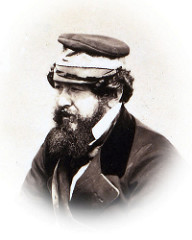
Major Anderson at Fort Sumter: “I must state most distinctly that if I can only be permitted to leave on the pledge you mention I shall never, so help me God, leave this fort alive.”

War of the Rebellion: from the Official Records of the Union and Confederate Armies and Navies

FORT SUMTER, S.C., March 27, 1861.

(Received A. G. O., March 30.)

Col. L. THOMAS; Adjutant-General U. S. Army:
COLONEL: I have the honor to report that three heavy guns were landed yesterday at Cummings Point, and that this morning we can only see that they are working at the place at Fort Johnson mentioned in yesterday’s letter. I send herewith a correspondence which has taken place since my last date between Brigadier-General Beauregard and myself. They may have misunderstood a remark which I have made; viz, that if attacked, and I found that I could not hold possession of the fort, that I would blow it up, sacrificing our lives in preference to permitting ourselves to fall into their hands. I hope that the authorities here now understand distinctly that I shall give no pledges whatever. I shall do nothing which is not fully justified by the highest sense of honorable and straightforward dealing and will not permit from any source any insinuation   that I have acted in any other manner in the performance of my duty, &c., here.

I am, colonel, very respectfully, your obedient servant,

ROBERT ANDERSON,

Major, First Artillery, Commanding.


[Inclosure No. 1.]

CHARLESTON, S. C., March 26, 1861.

Maj. ROBERT ANDERSON,
U. S. Army, Commanding at Fort Sumter, Charleston Harbor, S.C.:

MY DEAR MAJOR: Having been informed that Mr. Lamon, the authorized agent of the President of the United States, advised Governor Pickens, after his interview with you at Fort Sumter, that yourself and command would be transferred to another post in a few days, and understanding that you are under the impression I intended under all circumstances to require of you a formal surrender or capitulation, I hasten to disabuse you, and to inform you that our countries not being at war, and wishing as far as lies in my power to avoid the latter calamity, no such condition will be exacted of you, unless brought about as the natural result of hostilities.

Whenever you will be prepared to leave the fort, if you will inform Governor Pickens or myself of your intentions relative thereto, we will be happy to see that you are provided with proper means of transportation out of this harbor for yourself and command, including baggage, private and company property. All that will be required of you on account of the public rumors that have reached us will be your word of honor as an officer and a gentleman, that the fort, all public property therein, its armament, &c., shall remain in their present condition, without any arrangements or preparation for their destruction or injury after you shall have left the fort.

On our part no objection will be raised to your retiring with your side and company arms, and to your saluting your flag on lowering it. Hoping to have the pleasure of meeting you soon under more favorable circumstances,

I remain, dear major, yours, very truly,

G. T. BEAUREGARD.


[Inclosure No. 2.]

FORT SUMTER, S. C., March 26, 1861.

General G. T. BEAUREGARD, Charleston, S.C.:

MY DEAR GENERAL: I have the honor to acknowledge the receipt of your letter of this date, and hasten to say that I needed no denial from you of the expression attributed to you. The moment I heard that you had said that I should not leave this fort without surrendering I remarked that it was not true, and that I knew you had not said so. I am much obliged to his excellency the governor and yourself for the assurances you give me, but you must pardon me for saying that I feel deeply hurt at the intimation in your letter about the conditions which will be exacted of me, and I must state most distinctly that if I can only be permitted to leave on the pledge you mention I shall never, so help me God, leave this fort alive.

Hoping that you do not mean what your words express, and in that case cordially uniting with you in the wish that we may have the pleasure of meeting under more favorable circumstances,

I remain, dear general, yours truly,

ROBERT ANDERSON,

Major, U. S. Army, Commanding.


[Inclosure No. 3.]

CHARLESTON, S. C., March 26, 1861.

Maj. ROBERT ANDERSON,
U. S. Army, Commanding at Fort Sumter, Charleston Harbor, S.C.:

MY DEAR MAJOR: I have the honor to acknowledge your letter of this date, and hasten to disabuse you as to any intention on my part of wounding, in any manner whatsoever, the feelings of so gallant an officer by anything I may have written in my letter of this morning.

I only alluded to the pledge referred to by you on account of the high source from which the rumors spoken of appeared to come, and which, in the eyes of many officers of high standing, might be considered a sufficient reason for executing orders which otherwise they would not approve of; but I regret now having referred to the subject.

I remain, dear major, yours very truly,

G. T. BEAUREGARD.


[Inclosure No. 4.]

FORT SUMTER, S.C., March 27, 1861.

General G. T. BEAUREGARD, Charleston, S.C.:

MY DEAR GENERAL: I hasten, in reply to your kind and satisfactory note of yesterday afternoon, just received, to express my gratification at its tenor. I only regret that rumors from any source made you, for one moment, have the slightest doubt as to the straight path of honor and duty, in which I trust, by the blessing of God, ever to be found.

I am, dear general, yours sincerely,

ROBERT ANDERSON,

Major, U. S. Army, Commanding.
I must state most distinctly that if I can only be permitted to leave on the pledge you mention I shall never, so help me God, leave this fort alive.
0 comments

“…thinks the Secession Movement will die out if it is let alone.”—Horatio Nelson Taft

Diary of US patent clerk Horatio Nelson Taft.

WEDNESDAY 27

A rainy morning, but pleasant by noon. It rained nearly all last night. We have at last got a Comr of Patents. Mr Holloway of I.A. was confirmed by the Senate today. Went down to the Hotels this evening. Strange and anxious faces yet crowd them. Called at the “National” upon Judge Ira Harris NY Senator. Had a pleasant “call,” conversed upon various subjects. He thinks the Secession Movement will die out if it is let alone. Got the NY “Times” and came home 1/2 past 9 & read it. Got letter today from Prest Cowles of Elmira Female College. Clock has just struck 11.


The three diary manuscript volumes, Washington during the Civil War: The Diary of Horatio Nelson Taft, 1861-1865, are available online at The Library of   Congress.

0 comments

Fort Sumter

Civil War Day-by-Day

March 27, 1861, Albany Evening Journal

                      Capt. Fox, who visited Fort Sumter on the requisition of the War Department, has returned here and reported the result of his mission. It is very well understood that he had a plan for introducing reenforcements, which had been submitted to the members of the Cabinet, and was regarded as measurably practicable but attended with the probability if not certainty of collision, which constituted the chief objection to its adoption. He is perfectly familiar with all the approaches to the harbor of Charleston, having been long connected with the coast survey, and had practical experience as the commander of one of Aspinwall’s steamers. His scheme did not contemplate any serious danger in running the gauntlet of the batteries on the islands which guard the channels, but only in landing the men and provisions at Sumter, after it had been reached. If a fire was opened on his transports from Fort Moultrie or the other batteries, it would be necessary for Sumter to silence them in order to discharge the reenforcements. Any attempt, therefore, looking to that object would almost inevitably lead to bloodshed, and before resorting to it, the Administration would be constrained to expect that alternative. Even if successful without great loss of life, nothing would be gained but the retention of a fortress which has only a local value in protecting Charleston, and is of no national moment whatever.

                      Capt. Fox is fully impressed with the courage, integrity and sincerity of Major Anderson, with whom, however, his communication was necessarily limited, as Gov. Pickens sent Capt. Hartstein, late of our Navy, as an escort with him to the Fort, who kept within earshot during most of the interview, or, at least, near enough to prevent any free communication. He considers that the Fort can be reenforced either by a military operation, which, of course, would require a force not at the disposal of the President, or by the strategy already referred to, with its attendant hazards of a desperate conflict. The supply of provisions now in the garrison will probably enable Major Anderson to sustain his command reasonably well until the 15th of April. From all the facts disclosed by this investigation, it is manifest that Fort Sumter must be abandoned, or civil war inaugurated. Capt. Fox is cautious, intelligent and well-informed, and was brought to the notice of the Government by Mr. Aspinwall and some of the principal ship-owners of New-York and Boston.

0 comments

Update to the Chief Engineer

War of the Rebellion: from the Official Records of the Union and Confederate Armies and Navies

General JOS. G. TOTTEN,

                        Chief Engineer, U. S. Army, Washington, D. C

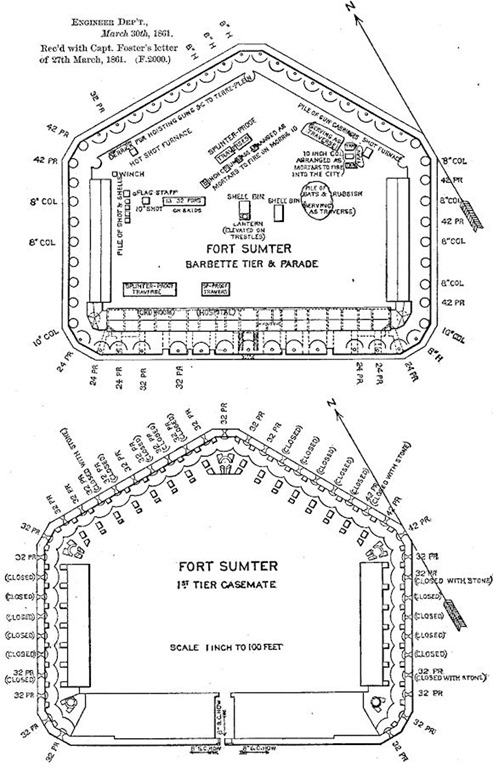
Fort Sumter sketch sketch showing the arrangement of guns, &c., on the first and third tiers GENERAL: The only work being done this morning in the surrounding batteries is on Cummings Point, where small parties, apparently of soldiers, are at work on the parapets of battery No. 3 (looking towards Fort Moultrie) and the redoubt on the sand hill in rear of the Star Of the West battery. They appear to be repairing the damages caused by the wind and rain of yesterday and last night. More guns were landed on Cummings Point, but how many I cannot tell. Three of them, apparently 24-pounders on Siege carriages, are now on the beach at the place of landing.

Two messengers from the city, Lieut. S. W. Ferguson, formerly of the Army, and Colonel Chisolm, came yesterday as bearers of a letter to Major Anderson from General Beauregard.

My operations are confined to the collection and counting of materials, clearing of the parade, construction of splinter-proof traverse in front of ordnance room, and cutting of interior slope of parapet, so as to allow the 10-inch columbiad at the west gorge angle to traverse so as to firre on all the batteries on Cummings Point.

It was with great pleasure that I received the expressions of the approval of the Department contained in your letter of the 23d.

I inclose herewith a sketch showing the arrangement of guns, &c., on the first and third tiers of this work. This arrangement will probably not be altered unless active operations be commenced against the work.

I have the honor to be, very respectfully, your obedient servant,

J. G. FOSTER,

Captain, Engineers.

0 comments

I deem it advisable to state that this fort is fully garrisoned with veteran soldiers…,

War of the Rebellion: from the Official Records of the Union and Confederate Armies and Navies

HEADQUARTERS FORT TAYLOR, FLA.,
March 27, 1861.

T. A. M. CRAVEN,

Lieutenant, Commanding U. S. Steamer Crusader, Harbor of Key West:

SIR: In reference to our conversation this morning and the letter shown by you to myself, and with the desire that we may act together should an occasion occur, I deem it advisable to state that this fort is fully garrisoned with veteran soldiers, and I believe it is entirely within my power to control this island and to prevent a lodgment thereon by any hostile force whatsoever; further, that I intend to treat any attempt to do so as an overt act of war, to be met at its initiation. I have no specific instructions from the War Department, but the course of my duty is clear, and I mean to follow it.

I am, sir, very respectfully, your most obedient servant,

WM. H. FRENCH,
Brevet Major, First Artillery, Commanding.

0 comments

Sketches of Fort Sumter

War of the Rebellion: from the Official Records of the Union and Confederate Armies and Navies

Official drawings from War of the Rebellion: a Compilation of the Official Records of the Union and Confederate Armies

(click on image to view larger version of drawing)

Sketches of Fort Sumter, March, 1861
0 comments

Admission of Northern States into the Southern Confederation

Civil War Day-by-Day

March 27, 1861; The Charleston Mercury

The South is fully aware that the peoples of the Northern States are fundamentally unsound on the question of slavery. They universally regard it as immoral and sinful to hold property in man. They believe it unrighteous and unjustifiable in the Caucasians at the South to hold Africans in bondage. This doctrine has been taught them by their mothers and their school mistresses, their college professors and their preachers, their orators, poets and historians, their lawyers and their jurists. It has been impressed upon them in their primers and their text books, in their religious reading and their light reading, in their histories and their law books. It has come to them through the multifarious channels of the teeming daily press. Generation after generation the work has gone on. Anti-slavery has been taken in with their mothers’ milk, grown with their growth and strengthened with their strength, until so thoroughly assimilated into their constitutions as to become a part of their political principles, their ethics and their religious faith. With singular exceptions the universal sentiment at the North is one of condemnation of Southern civilization and Southern citizens. Whether rudely proclaimed or politely repressed, it pervades their homes, their hustings, their court houses and their sanctuaries, and everywhere its hostile and disparaging influence may be felt by the Southron as the perpetual frown of an alien people against him and against his, touching their domestic institutions and their civil, moral and religious status.

It is true that here and there at the North is found a man who, understanding the true condition and appropriate relations of the Caucasian and African in this country, justifies slavery. But these are few and far between, singular and without influence among their fellows. It is true that many are found who apologize for the South and her semi-barbarous institutions, and find reasons to palliate, and, in great measure excuse, the guilt of her people. Nor is it untrue that many more urge that, however criminal, it is the business of the South, and not the North, who is not our conscience keeper, and has no right to intermeddle. [continue reading…]

0 comments

The Wholesale Trade of Charleston

Civil War Day-by-Day

March 27, 1861; The Charleston Mercury

The business men of Charleston are already beginning to reap the advantages of the independent position which the South has taken, in consequence of the refusal of the North to grant her constitutional rights. The results of the last few weeks have demonstrated conclusively that the commercial prosperity and political equality which THE MERCURY for years predicted, were not vain boasts. Business of all kinds has increased at an amazing pace; customers are thronging the city from all quarters of the South, and the indications are that Charleston is destined to become the commercial metropolis of the Confederate States.

In dry goods and fancy goods the operations have been very large, and the purchasers, we are informed, are principally composed of those who used to patronize New York. One house alone, the business of which heretofore was chiefly confined to Georgia, has sold heavy bills to merchants from Georgia, Mississippi, Arkansas, and Texas. In shoes alone, the sales of the last two seeks have amounted to upwards of $200,000.

In short, the prospects of Charleston never were more bright than at this season. It would be impossible to furnish at this writing details of the great increase of business which has taken place, and which is but a small part of what may be expected in the future. Suffice it to say that it is enough to stimulate the energies of our business men.

So serious has been the effect of this rush of trade to Charleston, that Northern merchants engaged in Southern trade have circulated the report that Charleston traders have increased their prices by adding on the duties under the recent tariff charged on all good from the Northern States–in other words, that the business men of Charleston have determined to take an undue advantage of their customers. This is manifestly so untrue that is hardly deserving of notice, and yet it is by such means that the attempt is made to obtain Southern patronage. Not a merchant that we have visited has made any such addition to his prices. All the goods received before the tariff went into operation, are disposed [continue reading…]

0 comments

Shoe and Leather Manufacturing Company

Civil War Day-by-Day

March 27, 1861; The Charleston Mercury

As another evidence of the direction given to the public mind by the independent action of the South, we would call attention to the advertisement of this Manufacturing Company in another column. It is a movement of great importance to the whole South. This is a corporation which will benefit alike all the Confederate States, for, in all of them, shoes enter largely into trade, and heretofore Northern manufacturers have furnished the supplies. In this manner, we would see Southern Capital and southern energy and enterprise employed. Too long has the North absorbed the wealth of those States which now form the Southern Confederacy. Let the future bear witness to a successful effort to regain our lost advantages. And this we predict, will be one of the most profitable investments of the day.

0 comments

Southern vs. Northern Manufactures

Civil War Day-by-Day

March 27, 1861; The New York Herald

We are informed from a reliable source that numerous companies are now being organized within the precincts of the Confederate States with a view of developing their water power resources and the establishment of manufactories in the republic for the fabrication of those kinds of goods usually furnished by the New England States, especially the States of Connecticut and Massachusetts. It will be inferred, therefore, from this statement that the Southrons are determined to be independent in a manufacturing as well as political point of view of the North.

The newspapers of the South come to hand with their columns filled with displayed advertisements, calling upon their readers to patronize manufactures’ and, as far as we can learn, this little admonition is not being disregarded. In yesterday’s paper we presented for the perusal of our readers specimens of these advertising appeals.

We take this occasion to say that a very grave error prevails among the people of the North in respect to the manufacturing and handicraft resources of the South. It has been alleged time afore time, by the republican press, that Southern manufacturers cannot compete with those of New England, even were they to make the attempt; but the logical or philosophical reasons for such a conclusion have been as frequently obscured from the public. Many of those men who worked and voted for the election of Mr. Lincoln will learn, perhaps too soon, that the South can manufacture goods–such as agricultural implements, farm wagons, carriages, boots, shoes and brogans and like articles–as well as the men of the North, if the capitalists of the new confederacy shall zealously push their manufacturing’s project to a finality. To those who are uniformed as to the real cause why the South has not paid attention to manufacturing industry we will explain. Heretofore the people of the South have found it necessary to devote their whole time to the development and growing of the great staples for which they are world wide celebrated, and in charity to the North gave them the job to make the implements whereby these were husbanded. Consequently the Northern States have had their share, indirectly, of the profits of the Southern crops. There is nothing under heaven to prevent the South from manufacturing every article necessary for domestic use. She has water power facilities second to none in the world, and if the manufacture’s system shall be adopted, the New England mechanics would soon wend their way where they may find remunerative labor; and in a short time the Yankee master manufactures and capitalists would find, to their surprise, their factories idle and rotting over their heads.

0 comments

Union Sentiment in Texas

Civil War Day-by-Day

March 27, 1861 Tri-Weekly Alamo Express , San Antonio, TX

Our dull and gloomy city was enlivened by a pleasant and stiring event on Tuesday last; some four companies of the 3d, Infantry, Maj. Brooks in command, passed through our city with the flag of our country flying gaily on the breeze and the fife and drums playing ‘Yankee Doodle’; they were saluted with many a warm cheer, and many a curse fell upon the heads of those who have “precipitated” our state out of the Union. The troops were accompanied by a long train of waggons.

0 comments

The News

Civil War Day-by-Day

March 27, 1861; The New York Herald

Our despatches from Washington state that the Cabinet have had under consideration of evacuating Fort Pickens, and there is good reason to believe that the fort will be abandoned by the federal troops within thirty days, thus removing the last immediate cause for hostilities between the two confederacies.

The Commissioners of the confederate States dined last evening with Mr. Corcoran, the Washington banker, in company with the foreign Ambassadors. The commissioners are, it is said, on friendly terms with the English and French Ministers–a circumstance regarded as very significant.

The South Carolina State convention reassembled yesterday. The first proposition presented was a resolution to cut off all the supplies and mail facilities hitherto accorded to the garrison of Fort Sumter. It is said the resolution will be voted down. As an evidence of popular feeling, however, it is suggestive.

In the United States Senate yesterday the debate on Mr. Douglas’ resolution calling for information as to the policy of the administration with reference to the seceded States, was resumed, and continued mainly by Messrs. Douglas and Breckinridge, who discussed the issued involved in the Kansas question and the present troubles of the nation. Finally Mr. Douglas’ resolution was laid on the table by a vote of 23 against 11. Mr. Breckinridge and Mr. Clingman then offered resolutions, to the effect that the Senate recommend the withdrawal of the federal troops from the limits of the confederate States. They were laid over for future consideration, and the Senate went into executive session and confirmed a number of appointments.

The commercial article of the Paris Constitutionel of March 3 says: –’If the Morrill tariff should pass congress, as appears likely, exportations from France, England and Germany to the Northern States would receive a severe check, [continue reading…]

0 comments

Arrival in Washington City.–Willard’s Hotel.–Dinner at Mr. Sanford’s.–Meeting Secretary of State Seward.–William Howard Russell’s Diary

My Diary North and South – William Howard Russell
There is no specific entry in the book for March 26th.   However, since there is a clear demarcation of arrival at Washington, the entry for the 25th is split at this point for publication in this blog.—MpG 1/23/2011

March 26th.—At six A.M., we were roused up by the arrival of the train at Washington, having crossed great rivers and traversed cities without knowing it during the night. I looked out and saw a vast mass of white marble towering above us on the left, stretching out in colonnaded porticoes, and long flanks of windowed masonry, and surmounted by an unfinished cupola, from which scaffold and cranes raised their black arms. This was the Capitol. To the right was a cleared space of mud, sand, and fields studded with wooden sheds and huts, beyond which, again, could be seen rudimentary streets of small red brick houses, and some church-spires above them.

Emerging from the station, we found a vociferous crowd of blacks, who were the hackney-coachmen of the place; but Mr. Sanford had his carriage in waiting, and drove me straight to Willard’s Hotel where he consigned me to the landlord at the bar. Our route lay through Pennsylvania avenue–a street of much breadth and length, lined with ælanthus trees, each in a white-washed wooden sentry box, and by most irregularly-built houses in all kinds of material, from deal plank to marble–of all heights, and every sort of trade. Few shop-windows were open, and the principal population consisted of blacks, who were moving about on domestic affairs. At one end of the long vista there is the Capitol; and at the other, the Treasury buildings–a fine block in marble, with the usual American classical colonnades.

Close to these rises the great pile of Willard’s Hotel, now occupied by applicants for office, and by the members of the newly-assembled Congress. It is a quadrangular mass of rooms, six stories high, and some hundred yards square; and it probably contains at this moment more scheming, plotting, planning heads, more aching and joyful hearts, that any building of the same size ever held in the world. I was ushered into a bed-room which had just been vacated by some candidate–whether he succeeded or not I cannot tell, but if his testimonials spoke truth, he ought to have been selected at once for the highest office. The room was littered with printed copies of letters testifying that J. Smith, of Hartford, Conn., was about the ablest, honestest, cleverest, and best man the writers ever knew. Up and down the long passages doors were opening and shutting for men with papers bulging out of their pockets, who hurried as if for their life in and out, and the building almost shook with the tread of the candidature, which did not always in its present aspect justify the correctness of the original appellation.

It was a remarkable sight, and difficult to understand unless seen. From California, Texas, from the Indian Reserves, and the Mormon territory, from Nebraska, as from the remotest borders of Minniesota, from every portion of the vast territories of the Union, except from the Seceded States, the triumphant republicans had winged their way to the prey.

There were crowds in the hall through which one could scarce make his way – the writing-room was crowded, and the rustle of pens rose to a little breeze –the smoking-room, the bar, the barbers, the reception-room, the ladies’ drawing-room–all were crowded. At present not less than 2,500 people dine in the public room every day. On the kitchen floor there is a vast apartment, a hall without carpets or any furniture but plain chairs and tables, which are ranged in close rows, at which flocks of people are feeding, or discoursing, or from which they are flying away. The servants never cease shoving the chairs to and fro with a harsh screeching noise over the floor, so that one can scarce hear his neighbor speak. If he did, he would probably hear as I did, at this very hotel, a man order breakfast, “Black tea and toast, scrambled eggs, fresh spring shad, wild pigeon, pigs’ feet, two robins on toast, oysters,” and a quantity of breads and cakes of various denominations. The waste consequent on such orders is enormous – and the ability required to conduct these enormous establishments successfully is expressed by the common phrase in the States, “Brown is a clever man, but he can’t manage an hotel.” The tumult, the miscellaneous nature of the company – my friends the prize-fighters are already in possession of the doorway–the heated, muggy rooms, not to speak of the great abominableness of the passages and halls, despite a most liberal provision of spittoons, conduce to render these institutions by no means agreeable to a European. Late in the day I succeeded in obtaining a sitting-room with a small bed-room attached, which made me somewhat more independent and comfortable–but you must pay highly for any departure from the routine life of the natives. Ladies enjoy a handsome drawing-room, with piano, sofas, and easy chairs, all to themselves.

I dined at Mr. Sanford’s, where I was introduced to Mr. Seward, Secretary of State; Mr. Truman Smith, an ex-senator, much respected among the Republican party; Mr. Anthony, a senator of the United States, a journalist, a very intelligent looking man, with an Israelitish cast of face; Colonel Foster of the Illinois railway, of reputation in the States as a geologist; and one or two more gentlemen. Mr. Seward is a slight, middle-sized man, of feeble build, with the stoop contracted from sedentary habits and application to the desk, and has a peculiar attitude when seated, which immediately attracts attention. A well-formed and large head is placed on a long, slender neck, and projects over the chest in an argumentative kind of way, as if the keen eyes were seeking for an adversary; the mouth is remarkably flexible, large but well formed, the nose prominent and aquiline, the eyes secret, but penetrating, and lively with humor of some kind twinkling about them; the brow bold and broad, but not remarkably elevated; the white hair silvery and fine–a subtle, quick man, rejoicing in power, given to perorate and to oracular utterances, fond of badinage, bursting with the importance of state mysteries, and with the dignity of directing the foreign policy of the greatest country–as all Americans think–in the world. After dinner he told some stories of the pressure on the President for place, which very much amused the guests who knew the men, and talked freely and pleasantly of many things –stating, however, few facts positively. In reference to an assertion in a New York paper, that orders had been given to evacuate Sumter, “That” he said, “is a plain lie–no such orders have been given. We will give up nothing we have–abandon nothing that has been entrusted to us. If people would only read these statements by the light of the President’s inaugural, they would not be deceived.” He wanted no extra session of Congress. “History tells us that kings who call extra parliaments lose their heads,” and he informed the company he had impressed the President with his historical parallels.

All through this conversation his tone was that of a man very sanguine, and with a supreme contempt for those who thought there was anything serious in secession. “Why,” said he, “I myself, my brothers, and sisters, have been all secessionists – we seceded from home when we were young, but we all went back to it sooner or later. These States will all come back in the same way.” I doubt if he was ever in the South; but he affirmed that the state of living and of society there was something like that in the State of New York sixty or seventy years ago. In the North all was life, enterprise, industry, mechanical skill. In the South there was dependence on black labor, and an idle extravagance which was mistaken for elegant luxury–tumble-down old hackney-coaches, such as had not been seen north of the Potomac for half a century, harness never cleaned, ungroomed horses, worked at the mill one day and sent to town the next, badly furnished houses, bad cookery, imperfect education. No parallel could be drawn between them and the Northern States at all. “You are all very angry,” he said, “about the Morrill tariff. You must, however, let us be best judges of our own affairs. If we judge rightly, you have no right to complain; if we judge wrongly, we shall soon be taught by the results, and shall correct our error. It is evident that if the Morrill tariff fulfils expectations, and raises a revenue, British manufacturers suffer nothing, and we suffer nothing, for the revenue is raised here, and trade is not injured. If the tariff fails to create a revenue, we shall be driven to modify or repeal it.”

The company addressed him as “Governor,” which led to Mr. Seward’s mentioning that when he was in England he was induced to put his name down with that prefix in a hotel book, and caused a discussion among the waiters as to whether he was the “Governor” of a prison or of a public company. I hope the great people of England treated Mr. Seward with the attention due to his position, as he would assuredly feel and resent very much any slight on the part of those in high places. From what he said, however, I infer that he was satisfied with the reception he had met in London. Like most Americans who can afford it, he has been up the Nile. The weird old stream has great fascinations for the people of the Mississippi –as far at least as the first cataract.

0 comments

A Diary from Dixie

Civil War Day-by-Day

CHARLESTON, S. C, March 26, 1861—I have just come from Mulberry, where the snow was a foot deep—winter at last after months of apparently May or June weather. Even the climate, like everything else, is upside down. But after that den of dirt and horror, Montgomery Hall, how white the sheets looked, luxurious bed linen once more, delicious fresh cream with my coffee! I breakfasted in bed.

Dueling was rife in Camden. William M. Shannon challenged Leitner. Kochelle Blair was Shannon’s second and Artemus Goodwyn was Leitner’s. My husband was riding hard all day to stop the foolish people. Mr. Chesnut finally arranged the difficulty. There was a court of honor and no duel. Mr. Leitner had struck Mr. Shannon at a negro trial. That’s the way the row began. Everybody knows of it. We suggested that Judge Withers should arrest the belligerents. Dr. Boykin and Joe Kershaw¹ aided Mr. Chesnut to put an end to the useless risk of life.

John Chesnut is a pretty soft-hearted slave-owner. He had two negroes arrested for selling whisky to his people on his plantation, and buying stolen corn from them. The culprits in jail sent for him. He found them (this snowy weather) lying in the cold on a bare floor, and he thought that punishment enough; they having had weeks of it. But they were not satisfied to be allowed to evade justice and slip away. They begged of him (and got) five dollars to buy shoes to run away in. I said: “Why, this is flat compounding a felony.” And Johnny put his hands in the armholes of his waistcoat and stalked majestically before me, saying, “Woman, what do you know about law?”

Mrs. Reynolds stopped the carriage one day to tell me Kitty Boykin was to be married to Savage Heyward. He has only ten children already. These people take the old Hebrew pride in the number of children they have. This is the true colonizing spirit. There is no danger of crowding here and inhabitants are wanted. Old Colonel Chesnut² said one day: “Wife, you must feel that you have not been useless in your day and generation. You have now twenty-seven great-grandchildren.”


¹ Joseph B. Kershaw, a native of Camden, S. C, who became famous in connection with “The Kershaw Brigade” and its brilliant record at Bull Run, Fredericksburg, Chickamauga, Spottsylvania, and elsewhere throughout the war.
²Colonel Chesnut, the author’s father-in-law, was born about 1760. He was a prominent South Carolina planter and a public-spirited man. The family had originally settled in Virginia, where the farm had been overrun by the French and Indians at the time of Braddock’s campaign, the head of the family being killed at Fort Duquesne. Colonel Chesnut, of Mulberry, had been educated at Princeton, and his wife was a Philadelphia woman. In the final chapter of this Diary, the author gives a charming sketch of Colonel Chesnut.

0 comments

Horatio Nelson Taft

Diary of US patent clerk Horatio Nelson Taft.

TUESDAY, MARCH 26, 1861.

Another warm pleasant day with some wind, rained some last night. At work hard in the office and very much fatigued tonight. Julia called for me from her school after calling upon Mr Alexander of the Seed Room and geting some garden & flower seeds. I did not go down to the Ave this evening. Took a walk with Julia up 14th St after taking short nap on the sofa. Read the days news in the “Star,” heard the boys read some. Their mother thrumed the Piano some. I have noded some, am off to bed at 1/2 past 9.


The three diary manuscript volumes, Washington during the Civil War: The Diary of Horatio Nelson Taft, 1861-1865, are available online at The Library of   Congress.

0 comments

A Dudley Mann to John Beauchamp Jones

Miscellaneous document sources
Washington, March 26, 1861.
          My Dear Sir:
Yours of the 23rd did not reach me until last night.
More than ever I cherish old friends, those whom I knew and esteemed in my early years. Of that number, now unhappily rapidly diminishing, I include yourself. I wish I could see you before I cross the wide water; but in view of my present engagements I am at a loss to know how I can arrange for a meeting.
I honor you for your inflexible devotion to the great cause of the South—a cause which at last has been gloriously won. You eminently deserve remunerative public employment. and as far as my influence extends I am not only willing but anxious to assist you in obtaining it.
The Congress of the Confederate States will re-assemble at Montgomery on the second Monday in May. The permanent government will probably be inaugurated about the beginning of December. I may be back by that time. If so I will argue in person your capacity and your claims, otherwise, for such a place as you may designate. The present provisional salaries are all low. They will perhaps be increased after a while.
What will suit you? Inform me at London. Direct your letter to the care of Messrs. Baring Brothers & Co. I leave here tomorrow.
Your Friend Truly.
A. Dudley Mann
          John B. Jones. Esq.
Burlington.
NJ.
0 comments

Operations in Charleston Harbor — Confederate Records

War of the Rebellion: from the Official Records of the Union and Confederate Armies and Navies

“I inclose herewith a correspondence between the South Carolina officials and myself in reference to some points to which attention was called some time since.”

FORT SUMTER, S.C., March 26, 1861.
(Received A. G. O., March 29.)

Col. L. THOMAS, Adjutant-General U. S. Army:
COLONEL: I have the honor to report that quite a large party is busy this morning on what is probably a bomb-proof in rear of the large work near Fort Johnson. They have extended and heightened several of the works on Morris Island, particularly No. 1 of Captain Seymour’s sketches.

We are constructing splinter-proofs on the parade, and closing the opening in the gorge wall. I have the honor to mention that Mr. Lamon, from Washington City, visited me yesterday.

I am, colonel, very respectfully, your obedient servant,

ROBERT ANDERSON,

Major, First Artillery, Commanding.

P. S.–I inclose herewith a correspondence between the South Carolina officials and myself in reference to some points to which attention was called some time since. Expecting a reply to my last communication, I have delayed sending these letters off, but now do so, as no rejoinder will probably be made.

Respectfully,

R. A.

[Inclosure No. 1.]

FORT SUMTER, S.C., March 13, 1861.

His Excellency Gov. F. W. PICKENS:

SIR: I have the honor herewith respectfully to inclose, for the consideration of your excellency, a note received yesterday by the clerk of Captain Foster from the beef contractor, which appears to show an interference with your excellency’s orders.

I am confident in the event of your excellency having made any change in your instructions in reference to my supplies I would have been promptly notified thereof. A similar interference may have prevented my receiving some boxes of solidified milk, which have been several days in the city to my address and which cannot have been detained on account of freight, as it was prepaid. This certainly would not, in the eyes of the transportation agent, come under the head of contraband of war or prohibited articles. It may be as well for me to mention here a few points which have not received that attention to which I think they are entitled.

About six weeks ago I sent, under cover to Col. L. M. Hatch, quartermaster-general, a note from Sergeant Renehan, of this command, to his brother-in-law, asking him to send from Fort Moultrie his private property, which was already packed up, and I respectfully asked Colonel Hatch if he would be pleased to give it his attention. No reply has been received to my communication, nor have the articles been sent.

About a month since instructions were given by the honorable Secretary of War that Captain Foster’s private property on Sullivan’s Island, as well as some public papers in the office in Charleston, should be sent down. Neither the property nor the papers have yet been received here.

Early in January I sent some officers to Fort Moultrie for certain private property left there. They were received in so different a manner from the civility and courtesy that characterized the manner of Colonel De Saussure that I have not ventured to make another attempt to obtain possession of it, and I am thus cut off from regimental books (not public property) and office papers, valuable to us, and merely interesting to others.

Some of the officers of this command have been put to considerable inconvenience and discomfort by the detention in the city of their hired servant, who left the post with a permit from the honorable Secretary of War. His detention after the discovery that the correspondence, at first characterized as a “very improper one,” proved to be “nothing more than what might have been expected between any silly persons in their situations,” is unwarranted. I attached no importance to this matter from the first, and so remarked to a gentleman who came down to see me in reference to it. No one, not even an owner of a slave, would have a right, under such circumstances, to prevent his return, and it was undoubtedly called for in this case by common civility and courtesy as the officers have no opportunity of replacing him.

In regard to packages arriving from time to time, through the express or otherwise, if it is necessary to trouble your excellency for special permits whenever articles of such mirror importance as condiments, &c., are to be sent down to us, it is questionable with me whether it would not be better for us to do without them altogether, and to send instructions to the various express companies not to receive any packages destined for my command.

With sentiments of high consideration and regard,

I am, very respectfully, your excellency’s obedient servant,

ROBERT ANDERSON,

Major, U. S. Army, Commanding.

[Inclosure No. 2.]

EXECUTIVE OFFICE, DEPARTMENT OF WAR,
Charleston, S. C., March 15, 1861.

Maj. ROBERT ANDERSON:

SIR: I am instructed by his excellency the governor to inform you that he is unwilling to modify his original permission that you should receive from the markets in this city such supplies of fresh meat and vegetables as you might indicate. A proper investigation will be instituted to inquire what obstacle has been interposed to the execution of the orders given on the subject.

I will inquire why Lieutenant-Colonel Hatch has not sent the private property of Sergeant Renehan which was left at Fort Moultrie.

With respect to the furniture left by Captain Foster in the house occupied by him before he left Sullivan’s Island, and the papers, &c., left in his office in this city, I reply that Captain Simonton was requested to separate the furniture claimed by Captain Foster from his own, and send it to Fort Sumter through the quartermaster-general. This has been delayed, I believe, chiefly on account of some reclamations on the part of Captain Simonton for injuries done to his own furniture during the time the house was occupied by Captain Foster, and for rent. I have been informed that the matter has been attended to by Captain Simonton within the past few days, and I will take steps to have Captain Foster’s property sent to him without delay. As to the papers, Mr. Legaré, who was indicated by Captain Foster as a proper person to carry out his wishes, reported to me that he had collected and sent the papers, &c., to Captain Foster.

With respect to the property which you failed to recover from Fort Moultrie, I am informed by Lieutenant-Colonel Ripley that he sent word to you that if you would transmit an inventory of any articles of property left by you he would endeavor to collect and send them to you, but that he received no reply to his offer.

As to the servant referred to in your letter, it is proper that I should say that I am unwilling to discuss any question of right or courtesy growing out of the case beyond the unquestionable privilege of a slave owner to permit or not, at his own pleasure, the return of his slave to a hostile fort; but, as you have put a different interpretation on the language employed by me in my letters on the subject than I designed, I desire to state what I did mean: “The very improper correspondence” between the slaves to which I alluded had reference to the slaves alone, as information was given by the woman to the boy of operations in this city which were not proper to be communicated to any one in your garrison, and the reply of the boy clearly showed that his temper and principles had not been improved by a residence in Fort Sumter. The other words of mine, which you quote–“nothing more than what might have been expected between silly persons in their situation”–were meant as kind expressions on my part, to disabuse the minds of Dr. Crawford and other officers at the fort of any unfavorable impression upon me of a complicity on their part with the improper correspondence of idle negroes.

I am, sir, respectfully, yours,

D. F. JAMISON.

[Inclosure No. 3.]

FORT SUMTER, S. C., March 17, 1861.

Hon. D. F. JAMISON, Executive Office, Department of War:

SIR: I have the honor to acknowledge the receipt of your communication of the 15th instant in reply to mine of the 13th to his excellency the governor.

I hasten to ask you to refer to my letter to his excellency, and you will see that I did not solicit any modification of his original permission about receiving supplies of fresh meat and vegetables. I am satisfied with the existing arrangement, and only called attention to a reported interference of it. I thank you for your promise in reference to the property of Captain Foster.

Lieutenant-Colonel Ripley did kindly offer to attend to collecting any “private property” left on the island by the officers, and I thanked him for having done so.

The property alluded to in my note is not, strictly speaking, private, but belongs to the regiment or post, and therefore was not, in my opinion, embraced in his offer. My object in mentioning this matter was to call attention to it, in order that such directions might be given regarding it as might be deemed proper.

I beg leave to assure you that I had no desire to discuss the question of right or of courtesy in reference to the treatment my officers received in the failure to return the hired boy, and my remarks were intended to apply to the professed owner of the boy, who, neglecting his duty as owner or master for months, had permitted the boy to hire himself out, every one supposing him to be free, and now, at a time when the exercise of his “undoubted right” puts gentlemen here to a serious inconvenience, for the first time asserts his rights of ownership.

His excellency mentions in his letter to me, received yesterday, that the boy is a slave, and, of course, that ends the matter. In justice to myself I must state that I did not intentionally place a forced construction on your words. The day your first letter was received about the boy a gentlemen came down to see me about the “improper correspondence,” which he was told had reference to the negroes joining us in the event of a collision. He remarked to his informants, as he told me, that he thought it a foolish story, advised them to say nothing about it, and said that he was certain, at all events, that I had no idea of anything of the kind, and came down to tell me of the rumor.

I regret exceedingly that your letter contains the remark it does in reference to the effect of a residence at Fort Sumter on the boy’s “temper and principles,” and I am satisfied that, upon further consideration, you will regret it.

I am, sir, respectfully, yours, &c.,

ROBERT ANDERSON,

Major, U. S. Army, Commanding.

0 comments

Operations in Charleston Harbor

War of the Rebellion: from the Official Records of the Union and Confederate Armies and Navies

HDQRS. PROVISIONAL ARMY CONFEDERATE STATES,

Charleston, S.C., March 26, 1861.

Hon. L. P. WALKER,

Secretary of War, Montgomery, Ala.:

SIR: The Department letter of the 21st has been received, and I inclose you herewith the copy of the letter I have thought proper to address to Maj. Robert Anderson, with whom I am personally well acquainted. His answer will be communicated to the Department as soon as received, and I have no doubt it will be satisfactory. Mr. Lamon left here last night, saying that Major Anderson and command would soon be withdrawn from Fort Sumter in a satisfactory manner. I am, however, progressing with my offensive and defensive batteries, which will all be finished and armed to-morrow night or the day after. I find great difficulty, for want of an ordnance officer, in properly organizing the armament, &c., of said batteries. I have this day had assigned to me for that duty Lieutenant Rutledge, South Carolina Navy, who I hope will be of assistance to me in that department.

As already telegraphed, Capt. W. H. Stevens, of the Engineers, is not at present required here. He might be usefully employed at Savannah if not wanted elsewhere, or I may soon have need of him for the defenses of the sea coast of South Carolina, which I may have to order hereafter.

Four of the Drummond lights ordered for this harbor have this day arrived, with the required instructions, a copy of which is herewith inclosed. No operator could be sent with them. I have procured the welcome and generous services of Professor Gibbes, of Charleston College, for the purpose of instructing a proper person here in their use. I have no doubt that Professor Riddle, of New Orleans, postmaster, would be happy to give his assistance in a like manner for the six sent there, two of which might be sent to Pensacola or some other harbor. With four here we shall have enough now.

I remain, sir, very respectfully, your obedient servant,

G. T. BEAUREGARD,

Brigadier-General, Commanding.

0 comments

Howell Cobb to James Buchanon

Miscellaneous document sources

Macon, Ga., 26 March, 1861.

My Dear Mr. Buchanan, I intended to address you this letter on the 5th of March, but at that time I was so much engaged at Montgomery that I could not carry out my purpose. In fact I have been constantly employed since my return to Georgia and have not even yet reached my home at Athens.

My heart often prompted me to write to you; but whilst you remained in Washington I declined to do so because I knew that my opinions differed so widely from yours that any suggestions from me would be obtrusive and unacceptable. Though silent I sympathised with you in every embarrassment which you encountered and rejoiced with all my heart when the fourth of March came and relieved you from troubles and difficulties which your counsels would have avoided but which were forced upon you by the folly and madness of your enemies and the enemies of your country. However much we may have differed and widely apart the roads we have travelled for the last few months, I assure you that the strong feeling of personal regard and attachment which your uniform kindness and confidence had created remains unchanged. I know not what the future has in store for any of us but I pray God you may long live to enjoy the peace and quiet of the home to which your old neighbors and friends have welcomed you with so much kindness and cordiality.

As you know, I never doubted the result of Lincoln’s election. My opinion was and is that it would and ought to dissolve the Union.

Upon this subject no shadow of a doubt has ever passed across my mind. Whilst with the good and true men of the north we could have happily and prosperously lived as brethren, there is between us and the northern abolitionists an intense mutual hatred which was irreconcileable. Separation was a necessity which could not be avoided and reunion an impossibility which will never be realized. The Union is not only dissolved but will never be reformed. Of this you may rest assured. Whatever differences existed among our people before the dissolution there is now but one sentiment on the subject of reconstruction; and that is, unalterable opposition to it. Good neighbourhood between the two sections is the universal desire of all our people, beyond that no one seeks to go. [continue reading…]

0 comments

A Nauseating Dose

Civil War Day-by-Day

March 26, 1861; The New York Herald

Nearly thirty years ago Messrs. Tappan, Hale and Hallock set up an anti-slavery newspaper in the city of New York. Instead of publishing the news, they devoted their columns to details of alleged cruelties practiced by slaveholders upon their chattels. A baser attempt at political demoralization was never attempted, and the worst publications of French sansculottes writers are innocuous compared with these records. The establishment of this pestilent sheet was the commencement of the anti-slavery crusade which has now resulted in the dissolution of the Union, the overthrow of this hitherto great nation, this superb governmental fabric, the work of Washington and the patriots and sages who lighted the torch of liberty at Lexington and saw its full blaze at Yorktown. More than all this, the work of Tappan, Hallock, Hale & co. has arrested the progress of this imperial city, paralyzed its trade, and thrown thousand of honest artisans upon the charity of a cold and heartless world. The publication to which we refer is the Journal of Commerce, the vehicle through which the first grain of abolition poison was administered. What merchant will not kick this sheet out of his counting room?

0 comments

The Flag Raising at Chester

Civil War Day-by-Day

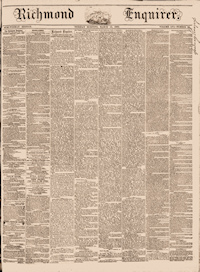
March 26, 1861; Richmond Enquirer

Some three hundred or more persons assembled at Chester (10 miles from Richmond, in Chesterfield county) on Saturday last, to witness the raising of a Southern Confederacy Flag. The trains from Richmond and Petersburg arrived simultaneously, each bringing a goodly number to participate in the interesting proceedings which the programme had shadowed forth. Several ladies from the neighborhood and some residing in more distant parts of the county, were also present. Their presence tended much to enliven the scene and lend to it a charm which the presence of ladies can only give. The Armory Band from Richmond was present, and contributed much to the interest of the festivities, the inevitable Dixie being served up in every conceivable style, and occasionally rendered with attractive variations.

The speaking took place from the front piazza of the larger hotel, and was listened to with unflagging interest throughout. Among the orators was the Hon. Daniel C. Jarnette, of Caroline, who spoke with impressive animation and elicited very spirited applause.

Mr. L.S. Hall, a distinguished member of the State Convention from the county of Wetzel, responded to the urgent calls of the people, in terms fluent, forcible and eloquent. The speaker took occasion to declare that his county was for the South and her institutions most emphatically; that if there should be a conflict of arms between the North and South, the speaker knew two hundred men, and could then name them, who would rush with eagerness to the fray, and battle gallantly for the South. His remarks were heartily endorsed by the approving plaudits of the assemblage.

The beautiful flag, with seven stars, (an eighth half made up to represent Virginia,) and three stripes, was run up at 12 o’clock precisely, amid enthusiastic cheering and an air from the band, which made the inspiring strains of Dixie ring through the forests of Old Chesterfield. The ladies too joined in with a zest that wreathed their fair faces with sweet smiles, and waved their snowy handkerchiefs with exultant pride and approval. [continue reading…]

0 comments

Another Envoy from Washington

Civil War Day-by-Day

March 26, 1861; The Charleston Mercury

The city was all agog yesterday, at the announcement that still another Ambassador from Washington has come to town, and was in close conference with the Governor. It appears that this last Envoy, Mr. W.H. LAMON, of Illinois, arrived in the city on Sunday morning, and registered his name upon the books of the Charleston Hotel as from Virginia. He remained quietly at the hotel until yesterday morning, when he sent his card to the Governor, requesting an interview. The nature of his communication has not been made public. About one o’clock, accompanied by Col. DURYEA, Aid to the Governor, Mr. LAMON left the city in the steamer Planter, Capt. FERGUSON, and proceeded to Fort Sumter. The tide being low, the steamer was unable to reach the Fort wharf, but was met at a short distance by a boat commanded by an officer, who, we understand, was Lieut. HALL. After presenting a written communication to the Lieutenant, Mr. LAMON was invited into the boat, accompanied by Col. DURYEA, and they were then taken to Fort Sumter, where they remained for about one hour. On the approach of the steamer to the Fort, about half the garrison had collected on the wharf, and some half dozen officers were on the ramparts, using their spy glasses. After staying in the Fort for some time, Mr. LAMON, accompanied by Major ANDERSON, took a walk around the ramparts of the fortification, the Major apparently explaining to his visitor the position of the Fort and its surroundings. While on the steamer, the Envoy from Washington alluded several times to the importance of preserving the peace, saying that he expected to leave immediately for Washington City, and hoped to return here in a few days. The last remark would indicate that he bore no order for the evacuation of the fortress, and would give color to the opinion held by many, that the question of leaving is still in debate between Major ANDERSON and the Washington authorities, each being anxious to shift the responsibility of leaving off their own shoulders. This matter as it stands is becoming rather annoying to the public here, and the people are expecting with anxiety a final settlement, either peaceably or by the sword.

Mr. LAMON left by the night train last night for Washington. The latest and apparently most reliable rumor was that his brief visit related to postal affairs, and that his trip to Fort Sumter was merely incidental, as bearer of despatches.

0 comments

Abraham Lincoln’s Importance

Civil War Day-by-Day

March 26, 1861, The Richmond Enquirer

The importance of Abraham Lincoln is vastly overrated by the Black Republicans of the North, and the Submissionists of the South. They endeavor to impress upon the people the idea that he holds in his hand the issue of life or death to the South, and that he has fully made up his mind to speak the life giving word to our section! Many presses and politicians of the South declare for Submission and against Secession, upon the ground that Lincoln will give the country a “conservative administration.” Does any reflecting man, of any section, really believe that the present opinions or intentions of Abraham Lincoln, whether right or wrong, ought to have the slightest influence in deciding the question of the relations of the border-slave States to the two confederacies between which they are now compelled to make choice? No considerate mind can view Lincoln, in the position to which he was called last November, in any other light than that of a mere “feather on the tide” of Abolitionism. The people of the South have no fears of the feather, but they ought to be alive to the importance of protecting themselves against the torrent of Abolition fanaticism which threatens to engulf them.

0 comments

Admission of Northern States into the Southern Confederation

Civil War Day-by-Day

March 26, 1861; The Charleston Mercury

We stated yesterday that it was unmistakeably the idea entertained by the body which formed the Confederate States Constitution, to admit hereafter into the new Government the States of the Northwest, Pennsylvania, New York, &c., the power being given to futures Congresses of doing so by a two thirds vote. We urged the importance of at once educating the public mind throughout the South upon the impolicy and danger of reorganizing on any terms, the political connection with the North just severed. The dissolution of the Union was both rightful and expedient. It was a step essential to our peace, or equality, our prosperity and our development. Were the causes, which have brought us into peril and rendered a separation necessary, temporary and evanescent, it would be well to look to a readjustment of our intimate relations with those who have nearly threatened us with degradation and ultimate ruin. But the sources of our troubles are not of today, nor are they shifting and transitory in their nature. They are the growth and product of many years systematic persistent cultivation. They are as deep rooted and stable as the hard characteristics of the stubborn Yankee race. The Union has been dissolved in consequence of the steady, long, increasing and now predominating hostility evinced by the whole North towards the South. For years the Southern peoples have, with unexampled patience, endured the unceasing assaults of Northern interests, Northern ambition and Northern fanaticism, placed in direct antagonism to their just rights and vital institutions. As a matter of self preservation and self respect they have at last placed themselves beyond the reach of this incessant and harassing warfare waged upon them under the privileges of a common government, and to promote their designs. We now have a government of our own to meet their government. Before it will be desirable, wise or possible to take such enemies again into the fellowship of a common government, the plainest common sense dictates that a vast change must come over their feelings, their political opinions, and their policy. How probable such a change is and how soon it is likely to occur to an extent to justify their admission, depends upon the facts of their past history and present condition in these respects. [continue reading…]

0 comments

The News

Civil War Day-by-Day

March 26, 1861; The New York Herald

Col. Lamon, the President’s envoy to Charleston, and bearer of the order to Major Anderson to evacuate Fort Sumter, reached Charleston on Sunday, and, after an interview yesterday morning with Gov. Pickens and Gen. Beauregard, visited the fort. It is supposed that the fort will be evacuated tomorrow; but the day of the departure of the troops has not transpired.

Reports from Montgomery state that by the 1st of April there will be five thousand troops of the Southern confederacy concentrated around Pensacola.

In the United States Senate yesterday Mr. Hale’s resolution for an election of subordinate officers was again laid over. Mr. Powell offered a resolution calling for copies of Major Anderson’s despatches to the War Department during his command at Fort Sumter. The reminder of the session was occupied in discussing Mr. Douglas’s resolution calling for information relative to the policy of the administration with reference to the seceded States. The discussion was interesting, as will be seen by our report.

The English press discuss American affairs at considerable length, and generally regard the establishment of the Southern confederacy as a fact accomplished. We this morning reproduce several articles upon this subject from the London press.

In the State Senate yesterday the long deferred response to the resolutions of inquiry by that body was received from the Metropolitan Police Commissioners, in regard to their sending members of the force South on the occasion of President Lincoln’s journeying to Washington. The Commissioners say they had reason to believe that a conspiracy existed to disturb the public peace, and that the field of its operations lay outside of the city of New York. Detectives were accordingly sent to Philadelphia, Baltimore and Washington; but from the confidential character of the information on which they acted, and from the nature of the detective system, it would be inexpedient for them to divulge the sources or the nature of this information. The minority report of the State Commission in the late Peace Congress was also received by the Senate signed by Messrs. Granger, Corning, Bronson and Dodge.

0 comments