April 1st.–On Easter Monday, after breakfast with Mr. Olmsted, I drove over to visit Senator Douglas. Originally engaged in some mechanical avocation, by his ability and eloquence he has raised himself to the highest position in the State short of the Presidency, which might have been his but for the extraordinary success of his opponent in a fortuitous suffrage scramble. He is called the Little Giant, being modo bipedali staturd, but his head entitles him to some recognition of intellectual height. His sketch of the causes which have led to the present disruption of parties, and the hazard of civil war, was most vivid and able; and for more than an hour he spoke with a vigor of thought and terseness of phrase which, even on such dreary and uninviting themes as squatter sovereignty and the Kansas-Nebraska question, interested a foreigner in the man and the subject. Although his sympathies seemed to go with the South on the question of slavery and territorial extension, he condemned altogether the attempt to destroy the Union.
American Civil War Chronicles
Orders from Winfield Scott for an Expedition to Reenforce and Hold Fort Pickens
April 1, 2021
HEADQUARTERS OF THE ARMY,
Washington, April 1, 1861.
Bvt.. Col. HARVEY BROWN,
U. S Army, Washington, D. C.:
SIR: You have been designated to take command of an expedition to re-enforce and hold Fort Pickens, in the harbor of Pensacola. You will proceed with the least possible delay to that place, and you will assume command of all the land forces of the United States within the limits of the State of Florida. You will proceed to New York, where steam transportation for four companies will be engaged, and, putting on board such supplies as you can ship, without delay proceed at once to your destination. The engineer company of Suppers and Miners; Brevet Major Hunt’s Company M, Second Artillery; Captain Johns’ Company C, Third Infantry, Captain Clitz’s Company E, Third Infantry, will embark with you in the first steamer. Other troops and full supplies will be sent after you as soon as possible.
Captain Meigs will accompany you as engineer, and will remain with you until you are established in Fort Pickens, when he will return to resume his duties in this city. The other members of your staff will be Asst. Surg. John Campbell, medical staff; Capt. Rufus Ingalls, assistant quartermaster; Capt. Henry F. Clarke, assistant commissary of subsistence; Bvt. Capt. George L. Hartsuff, assistant adjutant-general; and First Lieut. George T. Balch, ordnance officer.
The object and destination of this expedition will be communicated to no one to whom it is not already known. The naval officers in the Gulf will be instructed to co-operate with you, and to afford every facility in their power for the accomplishment of the object of the expedition, which is the security of Fort Pickens against all attacks, foreign and domestic. Should a shot be fired at you, you will defend yourself and your expedition at whatever hazard, and, if needful for such defense, inflict upon the assailants all the damage in your power within the range of your guns.
Lieutenant-Colonel Keyes, military secretary, will be authorized to give all necessary orders, and to call upon the staff department for every requisite material and transportation, and other steamers will follow that on which you embark, to carry re-enforcements, supplies, and provisions for the garrison of Fort Pickens for six months. Captain Barry’s battery will follow as soon as a vessel can be fitted for its transportation. Two or three foot companies will embark at the same time with the battery. All the companies will be filled up to the maximum standard, those to embark first from the recruits in the harbor of New York. The other companies will be filled, if practicable, with instructed soldiers.
You will make Fort Jefferson your main depot and base of operations. You will be careful not reduce too much the means of the fortresses in the Florida Reef, as they are deemed of greater importance than even Fort Pickens. The naval officers in the Gulf will be instructed to cooperate with you in every way, in order to insure the safety of Fort Pickens, Fort Jefferson, and Fort Taylor. You will freely communicate with them for this end, and will exhibit to them the authority of the President herewith.
The President directs that you be assigned to duty from this date according to your brevet rank in the Army.
With great confidence in your judgment, zeal, and intelligence, I remain, respectfully,
WINFIELD SCOTT.
APRIL 2, 1861.
ABRAHAM LINCOLN.
Approved:

[Inclosure.]
EXECUTIVE MANSION, April 1, 1861.
All officers of the Army and Navy, to whom this order may be exhibited, will aid by every means in their power the expedition under the command of Col. Harvey Brown, supplying him with men and material and co-operating with him as he may desire.
ABRAHAM LINCOLN.
“What have I done wrong?” Intrigue and Interference in Lincoln’s Cabinet.
April 1, 2021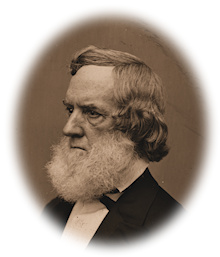
On the 1st of April, while at my dinner at Willard’s, where I then boarded, Mr. Nicolay, the private secretary of the President, brought to me and laid upon the table a large package from the President. It was between five and six o’clock in the afternoon when I received this package, which I immediately examined and found it contained several papers of a singular character, in the nature of instructions, or orders from the Executive in relation to naval matters, and one in reference to the government of the Navy Department more singular and remarkable than either of the others. This extraordinary document was as follows: –
(Confidential)
Executive Mansion, April 1, 1861.
To the Secretary of the Navy.
Dear Sir: You will issue instructions to Captain Pendergrast, commanding the home squadron, to remain in observation at Vera Cruz – important complications in our foreign relations rendering the presence of an officer of rank there of great importance.
Captain Stringham will be directed to proceed to Pensacola with all possible despatch, and assume command of that portion of the home squadron stationed off Pensacola. He will have confidential instructions to cooperate in every way with the commanders of the land forces of the United States in that neighborhood.
The instructions to the army officers, which are strictly confidential, will be communicated to Captain Stringham after he arrives at Pensacola.
Captain Samuel Barron will relieve Captain Stringham in charge of the Bureau of Detail.
Abraham Lincoln.
P. S. As it is very necessary at this time to have a perfect knowledge of the personal of the navy, and to be able to detail such officers for special purposes as the exigencies of the service may require, I request that you will instruct Captain Barron to proceed and organize the Bureau of Detail in the manner best adapted to meet the wants of the navy, taking cognizance of the discipline of the navy generally, detailing all officers for duty, taking charge of the recruiting of seamen, supervising charges made against officers, and all matters relating to duties which must be best understood by a sea officer. You will please afford Captain Barron any facility for accomplishing this duty, transferring to his department the clerical force heretofore used for the purposes specified. It is to be understood that this officer will act by authority of the Secretary of the Navy, who will exercise such supervision as he may deem necessary.
Abraham Lincoln.

Without a moment’s delay I went to the President with the package in my hand. He was alone in his office and, raising his head from the table at which he was writing, inquired, “What have I done wrong?” I informed him I had received with surprise the package containing his instructions respecting the Navy and the Navy Department, and I desired some explanation. I then called his attention particularly to the foregoing document, which I read to him. This letter was in the handwriting of Captain Meigs of the army, then Quartermaster-General; the postscript in that of David D. Porter, since made Vice-Admiral. The President expressed as much surprise as I felt, that he had sent me such a document. He said Mr. Seward, with two or three young men, had been there through the day on a subject which he (Seward) had in hand, and which he had been some time maturing; that it was Seward’s specialty, to which he, the President, had yielded, but as it involved considerable details, he had left Mr. Seward to prepare the necessary papers. These papers he had signed, many of them without reading, – for he had not time, and if he could not trust the Secretary of State, he knew not whom he could trust. I asked who were associated with Mr. Seward. “No one,” said the President, “but these young men were here as clerks to write down his plans and orders.” Most of the work was done, he said, in the other room. I then asked if he knew the young men. He said one was Captain Meigs, another was a naval officer named Porter.
I informed the President that I was not prepared to trust Captain Barron, who was by this singular proceeding, issued in his name, to be forced into personal and official intimacy with me. He said he knew nothing of Barron except he had a general recollection that there was such an officer in the Navy. The detailing officer of the Department, I said to him, ought to have the implicit confidence of the Secretary, and should be selected by him. This the President assented to most fully. I then told him that Barron, though a pliant gentleman, had not my confidence, and I thought him not entitled to that of the President in these times; that his associations, feelings, and views, so far as I had ascertained them, were with the Secessionists; that he belonged to a clique of exclusives, most of whom were tainted with secession notions; that, though I was not prepared to say he would desert us when the crisis came on, I was apprehensive of it, and while I would treat him kindly, considerately, and hoped he would not prove false like most others of his set, I could not give him the trust which the instructions imposed.
The President reiterated they were not his instructions, though signed by him, that the paper was an improper one, that he wished me to give it no more consideration than I thought proper, to treat it as canceled, or as if it had never been written. He said he remembered that both Seward and Porter had something to say about Barron, as if he was a superior officer, and in some respects, perhaps, out any equal in the Navy, but he certainly never would have assigned him or any other man knowingly the position without consulting me.
Barron was a courtier, of mild and affable manners, a prominent and influential officer, especially influential with the clique which recognized him as a leader. He and D. D. Porter were intimate friends, and both were favorites of Jefferson Davis, Slidell, and other Secessionists, who, I had learned, paid them assiduous attention.
When I took charge of the Navy Department, I found great demoralization and defection among the naval officers. It was difficult to ascertain who among those that lingered about Washington could and who were not to be trusted. Some belonging to the Barron clique had already sent in their resignations. Others, it was well understood, were prepared to do so as soon as a blow was struck. Some were hesitating, undecided what step to take. Barron, Buchanan, Maury, Porter, and Magruder were in Washington, and each and all were, during that unhappy winter, courted and caressed by the Secessionists, who desired to win them to their cause. I was by reliable friends put on my guard as respected each of them. Buchanan, Maury, and Magruder were each holding prominent place and on duty. Barron was familiar with civil and naval matters, was prepared for any service, ready to be called to discharge such duties as are constantly arising in the Department, requiring the talents of an intelligent officer.
Porter had some of the qualities of Barron, with more dash and energy, was less plausible, more audacious, and careless in his statements, but like him was given to intrigues. His associations, as well as Barron’s, during the winter of 1861, had been intimate with the Secessionists. He sought and obtained orders for Coast Survey service in the Pacific, which indicated an intention to avoid active participation in the approaching controversy. That class of officers who at such a time sought duties in the Pacific and on foreign stations were considered, prima facie, as in sympathy with the Secessionists, but yet not prepared to give up their commissions and abandon the Government. No men were more fully aware that a conflict was impending, and that, if hostilities commenced and they were within the call of the Department, they would be required to participate. Hence a disposition to evade an unpleasant dilemma by going away was not misunderstood.
Barron and Porter occupied in the month of March an equivocal position. They were intimate, they were popular, and the eye of the Department was necessarily upon them, as it was, indeed, upon all in the service. In two or three interviews with me, Barron deprecated the unfortunate condition of the country, expressed his hopes that extreme measures would not be resorted to, avowed his love for the profession with which from early childhood he had been identified and in which so many of his family had distinguished connection. There were suavity in his manner and kindly sentiments in his remarks, but not that earnest, devoted patriotism which the times demanded, and which broke forth from others of his profession, in denunciation of treason and infidelity to the flag. Porter had presented himself but once to the Department, and that was to make some inquiries in relation to his orders to the Pacific, but there was no allusion to the impending difficulties nor any proffer of service if difficulties ensued. As with many others, some of whom abandoned the Government, while some remained and rendered valuable service, the Department was in doubt what course these two officers would pursue.
This was the state of the case when the instructions of the 1st of April were sent me. On learning from the President who were Mr. Seward’s associates, I was satisfied that Porter had through him proposed and urged the substitution of Barron for Stringham as the detailing and confidential officer of the Secretary of the Navy. I was unwilling to believe that my colleague Mr. Seward could connive at, or be party to, so improper and gross an affair as to interfere with the organization of my Department, and jeopardize its operations at such a juncture. What, then, were the contrivances which he was maturing with two young officers, one of the army and the other of the Navy, without consulting the Secretary of War or the Secretary of the Navy? What had he, the Secretary of State, to do with these officers in any respect? I could get no satisfactory explanation from the President of the origin of this strange interference, which mystified him, and which he censured and condemned more severely than myself. He assured me it would never occur again. Although very much disturbed by the disclosure, he was anxious to avoid difficulty, and, to shield Mr. Seward, took to himself the whole blame and repeatedly said that I must pay no more attention to the papers sent me than I thought advisable. He gave me, however, at that time no information of the scheme which Mr. Seward had promoted, farther than that it was a specialty, which Mr. Seward wished should be kept secret. I therefore pressed for no further disclosures.
The instructions in relation to Barron I treated as nullities. My first conclusions were that Mr. Seward had been made a victim to an intrigue, artfully contrived by those who favored and were promoting the Rebellion, and that the paper had been in some way surreptitiously introduced with others in the hurry and confusion of that busy day without his knowledge. That he would commit the discourtesy of imposing on me such instructions I was unwilling to believe, and that he should be instrumental in placing, or attempting to place, a person more than suspected, and who was occupying so equivocal a position as Barron, in so responsible a position in the Navy Department, and commit to him all the information of that branch of the Government, seemed to me impossible.
Lincoln orders Powhatan to be fitted out for mission.
April 1, 2021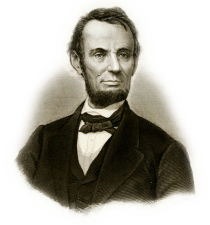
NAVY DEPARTMENT,
Washington, April 1, 1861.
To the COMMANDANT OF THE NAVY-YARD, Brooklyn N. Y.:
Fit out the Powhatan to go to sea at the earliest possible moment under sealed orders. Orders by a confidential messenger go forward to-morrow.
ABRAHAM LINCOLN.
Provisions supplied to workers that took away from rations available to Sumter forces.
April 1, 2021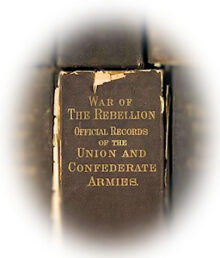
FORT SUMTER, S.C., April 1, 1861.
(Received A. G O., April 4.)
Col. L. THOMAS, Adjutant-General U. S. Army:
COLONEL: I have the honor to report that everything is still and quiet, as far as we can see, around us. The South Carolina Secretary of War has not sent the authority, asked for yesterday, to enable me to send off the discharged laborers. Having been in daily expectation, since the return of Colonel Lamon to Washington, of receiving orders to vacate this post, I have kept these men here as long as I could; but now, having nearly completed the important work of cleaning up the area, &c., I am compelled, in consequence of the small supply of provisions on hand, to discharge them. An examination of the accompanying report of the A. A. C. S. will show that the supply of provisions brought over would, had the issues been limited to my command, have lasted for a longer period than that mentioned in my letter of December 26, 1860. I have not made frequent mention of the question of our rations, because the Department was kept fully informed from time to time, of the state of our supply. Lieutenants Talbot and Hall gave full information in reference to it when they went on, and on the 27th of January a detailed statement was sent on, from which any one in the Commissary Department could have told, knowing the number of souls in the fort, including the Engineer laborers, the exact amount on hand at any given time.
I told Mr. Fox that if I placed the command on short allowance I could make the provisions last until after the 10th of this month; but as I have received no instructions from the Department that it was desirable I should do so, it has not been done. If the governor permits me to send off the laborers we will have rations enough to last us about one week longer.
I am, colonel, very respectfully, your obedient servant,
ROBERT ANDERSON,
Major, First Artillery, Commanding.
[Inclosure.]
FORT SUMTER, S. C., April 1, 1861.
Maj. ROBERT ANDERSON, First Artillery, Commanding:
MAJOR: In compliance with your request, I have the honor to submit the following list of provisions sold to Capt. J. G. Foster, Corps of Engineers, for the subsistence of the employees in his department at this post, and have expressed the quantities in numbers of rations, viz:
Five and one-half barrels of pork–one thousand four hundred and sixty-seven rations.
Twenty barrels of flour–three thousand four hundred and eighty-five rations.
One hundred and eighty pounds hard bread–one hundred and eighty rations.
Two and one-half bushels of beans–one thousand rations.
One hundred and seventy-four pounds coffee–one thousand seven hundred and forty rations.
Seven hundred and seventy-four pounds sugar–five thousand one hundred and sixty rations.
These provisions, which have necessarily been consumed by others, would have added to the time we have already been at this post subsistence for the following number of days, respectively: Pork–Sixteen and twenty-seven-ninetieths days.
Flour and hard bread–Forty and sixty-five-ninetieths days. Beans–Eleven and one-ninth days. Coffee–Nineteen and one-third days. Sugar–Fifty-seven and one-third days.
Or, with what is now on hand, at least thirty-five days of comfortable subsistence for the command, including the laundresses, who were sent away about two months ago.
I have the honor to be, very respectfully,
NORMAN J. HALL,
Second Lieutenant, First Artillery, A. A. C. S.
Admission of Northern States into the Southern Confederation
April 1, 2021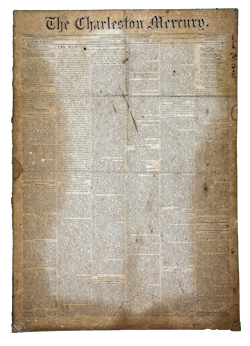
April 1, 1861, The Charleston Mercury
We have briefly indicated a few of the weighty reasons for the Confederate States rejecting all proffers of association with the anti-slavery States of the North, whether Eastern or Western. But many readers may suppose our apprehensions groundless, and our reasoning uncalled for and premature. To such we would respectfully dissent. To us the future, in this respect, judged by the signs of the times, is ominous. ‘Reconstruction,’ on the basis of the old Constitution, is, we judge, the policy of the SEWARD wing of the Black Republican party, and every day will strengthen that element. ‘Reorganization’ under the new Constitution is evidently the programme chalked out some months since by Washington leaders of the South. And to this end the policy so far pursued unquestionably tends. Under the promulgation that war, pestilence and famine impended, in case any other course was adopted, inactivity has reigned, and every cause for alienation has been studiously avoided. Delay is still going on. A Constitution, too, has been carefully made, at Montgomery, which, with a little repression of the fanaticism on the slavery question, will be sufficiently acceptable to the Northwest to constitute no permanent difficulty in the way of their consenting to adopt it. Two years ‘meditation upon the pros and cons will suffice them. Friends of Mr. DOUGLAS, including the near and dear GEORGE N. SAUNDERS, are already declaring that the Northwestern States should apply for admission into the Confederate States. Mr. BRECKINRIDGE, in the United States Senate, speaks of this being the probable result. The Border States all look to it. The New York Herald daily urges the advantages of New York doing the same thing. We might go on and mention many other facts and circumstances that lead us unmistakably to apprehend the evil effects of reorganization, as a not improbable thing. We only wish to open the eyes of our people to the danger, and to warn them at once of the drift of events. They that have ears to hear, let them hear.
The News
April 1, 2021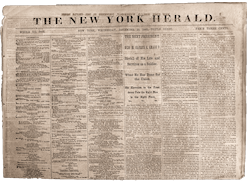
April 1, 1861; The New York Herald
Our despatches received on Saturday night announced that Mississippi and Texas had ratified and adopted the constitution framed in the Convention representing the seceded States, at Montgomery, Alabama. Five of the seven States have now ratified that instrument, and in the following order:
Alabama……………. March 13, 186l 87 Yeas 5 Nays
Georgia……………. March 16, 1861 96 Yeas 5 Nays
Louisiana………….. March 21, 1861 101 Yeas 7 Nays
Mississippi………… March 30, 1861 78 Yeas 7 Nays
Texas……………… March 25, 1861 68 Yeas 2 Nays.
Two States, South Carolina and Florida, are yet to adopt the new constitution. There is little need of conjecture as to the part they will take in ratifying and endorsing the action of their brethren. The Convention of South Carolina is now in session, and that of Florida meets in a few days, and in a week or two, therefore, the final action of the confederacy will be perfected in regard to this important matter.
Civil War Day-to-Day
April 1, 2021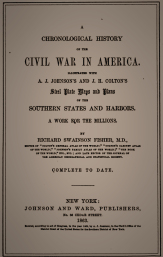
- April 1, 1861 – U. S. Tariff Act went into operation.1
- A Chronological History of the Civil War in America
by Richard Swainson Fisher, New York, Johnson and Ward, 1863
The Southern Forts
April 1, 2021
April 1, 1861; The Charleston Mercury
The New York Tribune learns that orders were sent last week to the naval commanders at Warrington, near Pensacola, to land the 400 troops on board the Brooklyn, and reinforce Fort Pickens. No intelligence, however, of the execution of this order has yet reached the government. The Washington correspondent of the same paper, in giving this news, adds:
It is not disguised that some apprehension is entertained here of a possible attack by the revolutionary army now encamped before Fort Pickens, under command of General Bragg, though wiser counsels are hoped.
The government does not regard this movement as a reinforcement, and if treated as such by the secession leaders, they must take the consequences. No hostile demonstration is designed, and no attempt will be made to re-take the other forts and navy yard.
In transferring these troops from a sloop of war, which has been stationed off Pensacola for two months, the Secretary of War intended to protect Fort Pickens against surprise or surrender, and if their landing is resisted, reinforcements will be immediately thrown there, be the consequences what they may.
It is not true that the government vessels at Pensacola are short of supplies, or they need not be, with Key West so near at hand. The transport containing all the necessary provisions for the home squadron was detained at New York, but must have reached Pensacola by this time.
RETURN OF COL. LAMON.
Col. Lamon, who went to Charleston for the purpose of making personal investigation of the condition of affairs at Fort Sumter and in the city, returned this afternoon. He visited Major Anderson, and found him well, and determined on the [continue reading…]
A Sermon before the City Gate Guards
April 1, 2021
April 1, 1861; Southern Confederacy (Atlanta, GA)
Yesterday morning, at ten o’clock, the spacious room in the City Hall was crowded to its utmost capacity, to hear a sermon from the Rev. Dr. J. S. Wilson—well known and universally beloved throughout this community—before the “Gate-City Guards,” previous to their departure for Pensicola, which took place today at half-past one o’clock. It was a bright and glorious Spring morning, and the glorious orb of day seemed prodigal of his cheering light, as if in mockery of the sadness within many hearts at the parting with those who were near them, and whose patriotism called them to the point of their country’s danger.—At half-past ten, the “Guards,” with solemn tread, entered the room under command of Capt. Ezzard, and quietly took the front seats, which had been reserved for them. After some excellent vocal music, the venerable Minister arose, and, with evident emotion, read the morning lesson, which consisted of 1st, 46th, and 99th Psalms. He then offered up to the Throne of Grace a fervent, heart-moving prayer for the safety and protection of our gallant soldiers, the salvation of all his hearers, and the peace, prosperity and glory of our beloved land.
He selected his text from the 13thverse, 6th chapter of Paul’s Epistle to the Ephesians: “Wherefore take unto you the whole armor of God, that ye may be able to withstand the evil day, and having done all, to stand.”
The first portion of his sermon was addressed to the congregation at large, urging the necessity of all Christians wearing the armor of Godliness, with which successfully to fight the great battles of life and win the never-fading crowns of glory which are reserved for the faithful to the end. The learned Divine then took up the causes which have for forty years been agitating the public mind and exciting apprehensions for our safety on the part of the people of the South, and which have brought about our present difficulties. With a master hand he portrayed those causes, pointed out their remedies, and established the justice of our cause. He implored the blessings of Heaven on our threatened country and her gallant defenders. His features glowed with earnestness, and his eloquence and power as a pulpit orator are peculiarly his own. All who were present, listened spell-bound to his burning words, and were deeply impressed. Many mothers, wives and sisters of those who left to-day, earnestly lifted up their hearts in silent prayer for their safety. May their Christian spirits, like guardian angels, hover over and protect our gallant soldiers from every temptation and evil, and from all harm.
Jamison Riflemen
April 1, 2021
April 1, 1861; The Charleston Mercury
The undersigned, members of the Jamison Riflemen would respectfully appeal to the citizens of Charleston, for aid in equipping our Corps. In all new organized military bodies a great deal of expense attend their first efforts in furnishing a suitable uniform. We desire simply assistance sufficient to obtain what is absolutely necessary for active service, in the discharge of our duty as citizen soldiers of the Confederate States of America. We hope that our appeal will not be in vain, and that the usual liberality will be granted us in behalf of the Jamison Riflemen, as the citizens of Charleston hitherto have granted to other military bodies when appealed to for assistance in behalf of rendering aid to the State of South Carolina.
In establishing the above Corps, our aim is to bear a part of the danger which now threatens us with civil war, and to be ready to guard against any emergency that may occur to our beloved State. We therefore announce in this humble form our hope that the Jamison Riflemen will be sustained by a generous public, and that the Committee appointed to make collections from the citizens of Charleston will be fully appreciated in so laudable a purpose.
The following gentlemen, appointed by the company, constitute the Committee:
JOHN ALLEN MILES, Chairman,
ROBERT JAMES.
HAMILTON CAREW.
WILLIAM WRIGHT.
W. H. DUV
A. ALPHONSO
C. HAMETT, Secretary. March 27
Confederate Encampment
April 1, 2021
Encampment of Palmetto Guard, Sumter Guard, and Marion Artillery, the companies who fought the Comings (i.e. Cummings) Point Batteries1
Title: Encampment of Palmetto Guard, Sumter Guard, and Marion Artillery, the companies who fought the Comings (i.e. Cummings) Point Batteries
Creator(s): Osborn & Durbec, photographer c. 1860-61
Summary: Photograph shows three Confederate soldiers amidst the fortifications at their camp at Cummings Point on Morris Island in preparation for the capture of Fort Sumter.
Title: from back of item Library of Congress Prints and Photographs Division Washington, D.C.
Permalink: www.loc.gov/pictures/item/2015645327/
- Osborn & Durbec, photographer. Encampment of Palmetto Guard, Sumter Guard, and Marion Artillery, the companies who fought the Comings i.e. Cummings Point Batteries. South Carolina Charleston United States Cummings Point Morris Island, None. [Charleston, S.C.: Osborn & Quebec’s Southern Stereoscopic & Photographic Depot. between 1860 and 1861] Photograph. Item retrieved from the Library of Congress 12-26-20
Note – This image has been digitally adjusted for one or more of the following:
- fade correction,
- color, contrast, and/or saturation enhancement
- selected spot and/or scratch removal
- cropped for composition and/or to accentuate subject
The harbor batteries
April 1, 2021
April 1, 1861; The Charleston Mercury
Saturday last was an occasion that will long be remembered by our troops at the various posts in the harbor, as well as by the large number of distinguished gentlemen whose visit to the fortifications formed the chief incident of the day. Shortly after nine o’clock the members of the State Convention, and a few others who had been invited to accompany them, repaired to the Southern Wharf, where the commodious steamers Carolina, Capt. LOCKWOOD, and General Clinch, Capt. RELYEA, were in readiness to receive them. At ten o’clock the lines were cast off and the boats, with the State and Confederate colors streaming fore and aft, moved from the wharf to the inspiriting strains of ‘DixieLand,’ from the Palmetto Band, stationed on the forward deck of the Clinch. The weather, fortunately, was most propitious. The genial sun shone out gloriously over the harbor, and the mild spring atmosphere, with the fresh sea-breeze, could scarcely have been more agreeable.
WHO WERE ABOARD.
The company who, by the invitation of Gen. BEAUREGARD, participated in the excursion, must have numbered several hundred. Among them we noticed Hon. D.F. JAMISON, and nearly all the members of the Convention, including quite a number of Ex-Governors, Judges, Chancellors and military men. It was more especially in honor of these gentlemen that the visit had been arranged. Among the other guests were Hon. EDMUND RUFFIN and Col. RUTHERFORD, both of Virginia; Major General SCHNIERLE, 2d Division, S.C.M.; Major WHITING, of the Engineer Corps, C.S.A.; Rev. Dr. BACHMAN, and several ladies, who had availed themselves of the chance to get a glimpse of the batteries, of which they had heard so much. Gen. BEAUREGARD, in undress uniform, was aboard the Carolina, chatting socially in the groups that filled the cabins, and pointing out to those to whom the scene was a new one, the principal points of interest. [continue reading…]
But in the course of events a fanatical party usurped the reigns of Government
April 1, 2021
April 1, 1861, Southern Confederacy
Gen. J. H. Rice, on the part of the ladies, made the presentation speech as follows:
CAPTAIN EZZARD AND SOLDIERS OF THE GATE-CITY GUARDS:
Why the assemblage here? Why peals forth the note of martial music? Why this Paraphernalia of War which I see before me? But a few short months ago, the citizens of what was then the United States of America, were living in peace and harmony with each other. But in the course of events a fanatical party usurped the reigns of Government, foisting themselves into power by the assertion of a principle that was destructive to our very existence, to-wit: the infamous dogma of an Equality of the White and Black Races. While I, for the sake of not being considered contentious, would admit that, in many respects, this doctrine would apply to many of the people of the Abolition States of the North; yet we of the South rightfully insist that the Black Race are, and should be, our Slaves, and we their Masters; and that such relative status was given by the decrees of GOD; and which law of our society was recognized by the Constitution of the United States, and which they were bound by such solemn compact to observe. Regardless of this compact–led on by their lust for power, and guided by their [continue reading…]
In fact, the Federal system is radically defective against internal convulsion…,–William Howard Russell
March 31, 2021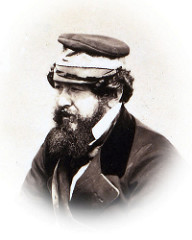
March 31st, Easter Sunday.–I dined with Lord Lyons and the members of the Legation; the only stranger present being Senator Sumner. Politics were of course eschewed, for Mr. Sumner is Chairman of the Committee on Foreign Relations of the Senate, and Lord Lyons is a very discreet Minister; but still there crept in a word of Pickens and Sumter, and that was all. Mr. Fox, formerly of the United States’ Navy, and since that a master of a steamer in the commercial marine, who is related to Mr. Blair, has been sent on some mission to Fort Sumter, and has been allowed to visit Major Anderson by the authorities at Charleston; hut it is not known what was the object of his mission. Everywhere there is Secession resignation, in a military sense of the word. The Southern Commissioners declare they will soon retire to Montgomery, and that any attempt to reinforce or supply the forts will be a casus belli. There is the utmost anxiety to know what Virginia will do. General Scott belongs to the State, and it is feared he may be shaken if the State goes out. Already the authorities of Richmond have intimated they will not allow the foundry to furnish guns to the seaboard forts, such as Munroe and Norfolk in Virginia. This concession of an autonomy is really a recognition of States’ Rights. For if a State can vote itself in or out of the Union, why can it not make war or peace, and accept or refuse the Federal Government? In fact, the Federal system is radically defective against internal convulsion, however excellent it is or may be for purposes of external polity. I walked home with Mr. Sumner to his rooms, and heard some of his views, which were not so sanguine as those of Mr. Seward, and I thought I detected a desire to let the Southern States go out with their slavery if they so desired it. Mr. Chase, by the way, expressed sentiments of the same kind more decidedly the other day.
Horatio Nelson Taft
March 31, 2021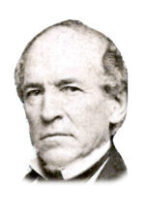
SUNDAY 31
Went out to church this morning. It was cold enough to wear my cloak. Family wer[e] all out but Julia who is unwell. She went with Miss Sallie to “St Mathews” in the afternoon. Chas and Sallie came up about dark from “Vespers” and spent the evening. Miss S. performed on the Piano and the passersby might have heard in some of the pieces anything but Sunday music. I took a walk down 12th St to the Ave & back, quick step. It took me twenty minutes.
The three diary manuscript volumes, Washington during the Civil War: The Diary of Horatio Nelson Taft, 1861-1865, are available online at The Library of Congress.
Operations in Charleston Harbor
March 31, 2021
FORT SUMTER, S. C., March 31, 1861.
(Received A. G. O., April 4.)
Col. L. THOMAS, Adjutant-General U. S. Army:
COLONEL: I have the honor to report that we do not see any work going on this morning. Yesterday, in consequence of the members of the Convention coming down, a great deal of firing of shot and shell took place at Fort Moultrie and from the batteries on Morris Island.
The three batteries outside of the Star of the West have certainly guns of very heavy caliber; this we know from the great extent of the ranges and from the reports.
As our provisions are very nearly exhausted, I have requested Captain Foster to discharge his laborers, retaining only enough for a boat’s crew. I hope to get them off to-morrow. The last barrel of flour was issued day before yesterday.
I am colonel very respectfully, your obedient servant,
ROBERT ANDERSON,
Major, First Artillery, Commanding.
“…the North has no idea of what is going on.”
March 31, 2021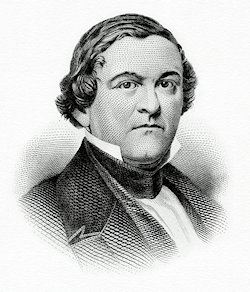
Howell Cobb to His Wife. E.
Mobile [Ala.], 31 March, 1861.
My Dear Wife, We failed to make connection at this point, so I am detained here for a day. I shall leave this evening however for New Orleans and expect to be there early tomorrow morning. I have met many friends and acquaintances and passed the time quite pleasantly. . . .
I attended last night, before going to the theatre, a lecture from Mr. Smith, a Member of our Congress from this place. It was on the same subject with my speech in Macon and was a most able and successful effort. It will be published and I advise everyone to read it. It was really a finished and eloquent defence of our new Constitution.
Mobile looks more like a military barracks than a commercial city. There are some fifteen hundred troops here on their way to Pensacola—most of them from Mississippi and composed of the best young men of the State.
The Financial Position of the Government—The Real Difficulty at Washington
March 31, 2021
March 31, 1861; The New York Herald
The predominant power just now at Washington is Wall street. The question of money is one that this government as well as all others must look squarely in the face. Money has been aptly defined as the sinews of war, and it is very certain that the Lincoln administration is now bound hand and foot by this ugly spectre which has ruined so many splendid schemes and thwarted so many magnificent ideas of brilliant theoretical statesmen. It is all very well for the radical republicans to demand that the principles of Garrison, Phillips & Co. shall be carried into effect without regard to the cost; and it doubtless sounds well to Southern ears when Mr. Memminger offers to borrow fifteen millions for the purpose of putting the Confederate States upon a war footing. But the question for the people of the North and South to settle is, whether or not they will impoverish themselves in going to war upon an abstract question which cannot be settled by the sword. As it appears to us, both governments–that at Washington and that at Montgomery–are equally powerless.
Davis & Co. have, however, the advantage over Lincoln & Co. The government of the Southern confederacy is plucky and clever in its personnel. The Lincoln administration is cowardly, mean and vicious, without the power to carry out its designs. So far from being in a condition to make war–the most expensive luxury wherewith a government can indulge itself–the administration has not sufficient money for the ordinary expenses of the departments. Mr. Dix borrowed eight millions at twelve per cent. Mr. Chase wants eight millions more, and will probably get it from the brokers, who have done well with the Dix loan. In a very short time Mr. Chase will be obliged to call for nine millions and then our national debt will reach the disagreeable figure of one hundred millions of dollars.
In the event of war this debt would be very much increased. One item will indicate how much. The last Congress authorized the building of six steam sloops of war. To construct, equip and keep this fleet in commission during twelve [continue reading…]
The News
March 31, 2021
March 31, 1861; The New York Herald
The steamship Daniel Webster, from the Rio Grande via Key West and the Tortugas forts, with United States troops, arrived at this port yesterday. She left Brazos on the 19th, Fort Jefferson on the 24th and Fort Taylor on the 25th of March. She landed two companies of troops at Fort Jefferson, and also two companies at Fort Taylor. The steamer Gen. Rusk also landed two companies at each of these forts on the 24th. Fort Taylor is now on a complete war footing, amply garrisoned and furnished with supplies of all sorts for one year.
When the Daniel Webster left Brazos there were one company of artillery and two of cavalry at Fort Brown, and two companies of infantry were daily expected to arrive. Since the secession of Texas from the Union the military posts in the upper part of the State have been abandoned by the United States troops. All along the frontier the savages had renewed their depredations, killing the settlers, running of stock and committing great havoc. In addition to the attacks of the Indians the Texas were menaced on the Rio Grande by the Mexican robber chief Cortinas. He is reported to have a large force in readiness for a foray upon the Texans as soon as the United States troops are withdrawn. From all the indications, it is likely that before many weeks the Southern republic will find ample employment for a portion of its army in repelling the Camanches and Mexican bandits from the frontier.
The steamships Star of the West and Coatzacoalcos, from New York for Brazos, passed Key West, the former on the 20th and the latter on the 21st inst.
The President and Cabinet were yesterday again engaged in discussing the question of abandoning Fort Sumter. The administration moves very slowly in this disagreeable business. Meantime the Charlestonians are growing dangerously restive. Our correspondent at Charleston telegraphs that if the evacuation does not speedily take place the fort will be attacked and captured.
Civil War Day-by-Day
March 31, 2021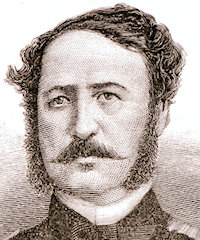
March 31, 1861
- General John Bankhead Magruder reassigned from Arkansas to Texas.
The Washington Navy Yard–William Howard Russell
March 30, 2021
March 30th.–Descended into the barber’s shop off the hall of the hotel; all the operators, men of color, mostly mulattoes, or yellow lads, good-looking, dressed in clean white jackets and aprons, were smart, quick, and attentive. Some seven or eight shaving chairs were occupied by gentlemen intent on early morning calls. Shaving is carried in all its accessories to a high degree of publicity, if not of perfection, in America; and as the poorest, or as I may call them without offence, the lowest orders in England have their easy shaving for a penny, so the highest, if there be any in America, submit themselves in public to the inexpensive operations of the negro barber. It must be admitted that the chairs are easy and well-arranged, the fingers nimble, sure, and light; but the affectation of French names, and the corruption of foreign languages, in which the hairdressers and barbers delight, are exceedingly amusing. On my way down a small street near the Capitol, I observed in a shop window, “Rowland’s make easier paste,” which I attribute to an imperfect view of the etymology of the great “Macassar;” on another occasion, I was asked to try Somebody’s “Curious Elison,” which I am afraid was an attempt to adapt to a shaving paste, an address not at all suited to profane uses. It appears that the trade of barber is almost the birthright of the free negro or colored man in the United States. There is a striking exemplification of natural equality in the use of brushes, and the senator flops down in the seat, and has his noble nose seized by the same fingers which the moment before were occupied by the person and chin of an unmistakable rowdy.
In the midst of the divine calm produced by hard hand rubbing of my head, I was aroused by a stout gentleman who sat in a chair directly opposite. Through the door which opened into the hall of the hotel, one could see the great crowd passing to and fro, thronging the passage as though it had been the entrance to the Forum, or the “Salle de pas perdus.” I had observed my friend’s eye gazing fixedly through the opening on the outer world. Suddenly, with his face half-covered with lather, and a bib tucked under his chin, he got up from his seat exclaiming, “Senator! Senator! hallo!” and made a dive into the passage–whether he received a stern rebuke, or became aware of his impropriety, I know not, but in an instant he came back again, and submitted quietly, till the work of the barber was completed.
The great employment of four-fifths of the people at Willard’s at present seems to be to hunt senators and congress men through the lobbies. Every man is heavy with documents–those which he cannot carry in his pockets and hat, occupy his hands, or are thrust under his arms. In the hall are advertisements announcing that certificates, and letters of testimonial, and such documents, are printed with expedition and neatness. From paper collars, and cards of address to carriages, and new suites of clothes, and long hotel bills, nothing is left untried or uninvigorated. The whole city is placarded with announcements of facilities for assaulting the powers that be, among which must not be forgotten the claims of the “excelsior card-writer,” at Willard’s, who prepares names, addresses, styles, and titles in superior penmanship. The men who have got places, having been elected by the people, must submit to the people, who think they have established a claim on them by their favors. The majority confer power, but they seem to forget that it is only the minority who can enjoy the first fruits of success. It is as if the whole constituency of Marylebone insisted on getting some office under the Crown the moment a member was returned to Parliament. There are men at Willard’s who have come literally thousands of miles to seek for places which can only be theirs for four years, and who with true American facility have abandoned the calling and pursuits of a lifetime for this doubtful canvas; and I was told of one gentleman, who having been informed that he could not get a judgeship, condescended to seek a place in the Post Office, and finally applied to Mr. Chase to be appointed keeper of a “lighthouse,” he was not particular where. In the forenoon I drove to the Washington Navy Yard, in company with Lieutenant Nelson and two friends. It is about two miles outside the city, situated on a fork of land projecting between a creek and the Potomac river, which is here three-quarters of a mile broad. If the French had a Navy Yard at Paris it could scarcely be contended that English, Russians, or Austrians would not have been justified in destroying it in case they got possession of the city by force of arms, after a pitched battle fought outside its gates. I confess I would not give much for Deptford and Woolwich if an American fleet succeeded in forcing its way up the Thames ; but our American cousins,–a little more than kin and less than kind, who speak with pride of Paul Jones and of their exploits on the Lakes,–affect to regard the burning of the Washington Navy Yard by us, in the last war, as an unpardonable outrage on the law of nations, and an atrocious exercise of power. For all the good it did, for my own part, I think it were as well had it never happened, but no jurisconsult will for a moment deny that it was a legitimate, even if extreme, exercise of a belligerent right in the case of an enemy who did not seek terms from the conqueror; and who, after battle lost, fled and abandoned the property of their state, which might be useful to them in war, to the power of the victor. Notwithstanding all the unreasonableness of the American people in reference to their relations with foreign powers, it is deplorable such scenes should ever have been enacted between members of the human family so closely allied by all that shall make them of the same household.
The Navy Yard is surrounded by high brick walls; in the gateway stood two sentries in dark blue tunics, yellow facings, with eagle buttons, brightly polished arms, and white Berlin gloves, wearing a cap something like a French kepi, all very clean and creditable. Inside are some few trophies of guns taken from us at York Town, and from the Mexicans in the land of Cortez. The interior inclosure is surrounded by red brick houses, and stores and magazines, picked out with white stone; and two or three green grass-plots, fenced in by pillars and chains and bordered by trees, give an air of agreeable freshness to the place. Close to the river are the workshops: of course there is smoke and noise of steam and machinery. In a modest office, surrounded by books, papers, drawings, and models, as well as by shell and shot and racks of arms of different descriptions, we found Capt. Dahlgren, the acting superintendent of the yard, and the inventor of the famous gun which bears his name, and is the favorite armament of the American navy. By our own sailors they are irreverently termed “soda-water bottles,” owing to their shape. Capt. Dahlgren contends that guns capable of throwing the heaviest shot may be constructed of cast-iron, carefully prepared and moulded so that the greatest thickness of metal may he placed at the points of resistance, at the base of the gun, the muzzle and forward portions being of very moderate thickness.
All inventors, or even adapters of systems, must be earnest self-reliant persons, full of confidence, and, above all, impressive, or they will make little way in the conservative, status-quo-loving world. Captain Dahlgren has certainly most of these characteristics, but he has to fight with his navy department, with the army, with boards and with commissioners,– in fact, with all sorts of obstructors. When I was going over the yard, he deplored the parsimony of the department, which refused to yield to his urgent entreaties for additional furnaces to cast guns.
No large guns are cast at Washington. The foundries are only capable of turning out brass fieldpieces and boat-guns. Capt. Dahlgren obligingly got one of the latter out to practice for us–a 12-pounder howitzer, which can be carried in a boat, run on land on its carriage, which is provided with wheels, and is so light that the gun can be drawn readily about by the crew. He made some good practice with shrapnel at a target 1200 yards distant, firing so rapidly as to keep three shells in the air at the same time. Compared with our establishments, this dockyard is a mere toy, and but few hands are employed in it. One steam sloop, the “Pawnee,” was under the shears, nearly ready for sea: the frame of another was under the building-shed. There are no facilities for making iron ships, or putting on plate-armour here. Everything was shown to us with the utmost frankness. The fuse of the Dahlgren shell is constructed on the vis inertia principle, and is not unlike that of the Armstrong.
On returning to the hotel, I found a magnificent bouquet of flowers, with a card attached to them, with Mrs. Lincoln’s compliments, and another card announcing that she had a “reception” at 3 o’clock. It was rather late before I could get to the White House, and there were only two or three ladies in the drawing-room when I arrived. I was informed afterwards that the attendance was very scanty. The Washington ladies have not yet made up their minds that Mrs. Lincoln is the fashion. They miss their Southern friends, and constantly draw comparisons between them and the vulgar Yankee women and men who are now in power. I do not know enough to say whether the affectation of superiority be justified; but assuredly if New York be Yankee, there is nothing in which it does not far surpass this preposterous capitol. The impression of homeliness produced by Mrs. Lincoln on first sight, is not diminished by closer acquaintance. Few women not to the manner born there are, whose heads would not be disordered, and circulation disturbed, by a rapid transition, almost instantaneous, from a condition of obscurity in a country town to be mistress of the White House. Her smiles and her frowns become a matter of consequence to the whole American world. As the wife of the country lawyer, or even of the congress man, her movements were of no consequence. The journals of Springfield would not have wasted a line upon them. Now, if she but drive down Pennsylvania Avenue, the electric wire thrills the news to every hamlet in the Union which has a newspaper; and fortunate is the correspondent who, in a special despatch, can give authentic particulars of her destination and of her dress. The lady is surrounded by flatterers and intriguers, seeking for influence or such places as she can give. As Selden says, “Those who wish to set a house on fire begin with the thatch.”
A Diary From Dixie.— “…after that den of dirt and horror, Montgomery Hall, how white the sheets looked, luxurious bed linen once more, delicious fresh cream with my coffee!”
March 30, 2021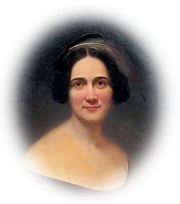
Wednesday.–I have been mobbed by my own house servants. Some of them are at the plantation, some hired out at the Camden hotel, some are at Mulberry. They agreed to come in a body and beg me to stay at home to keep my own house once more, “as I ought not to have them scattered and distributed every which way.” I had not been a month in Camden since 1858. So a house there would be for their benefit solely, not mine. I asked my cook if she lacked anything on the plantation at the Hermitage. “Lack anything?” she said, “I lack everything. What are corn-meal, bacon, milk, and molasses? Would that be all you wanted? Ain’t I been living and eating exactly as you does all these years? When I cook for you, didn’t I have some of all? Dere, now!” Then she doubled herself up laughing. They all shouted, “Missis, we is crazy for you to stay home.”
Armsted, my butler, said he hated the hotel. Besides, he heard a man there abusing Marster, but Mr. Clyburne took it up and made him stop short. Armsted said he wanted Marster to know Mr. Clyburne was his friend and would let nobody say a word behind his back against him, etc., etc. Stay in Camden? Not if I can help it. “Festers in provincial sloth”–that’s Tennyson’s way of putting it.
“We” came down here by rail, as the English say. Such a crowd of Convention men on board. John Manning ¹ flew in to beg me to reserve a seat by me for a young lady under his charge. “Place aux dames,” said my husband politely, and went off to seek a seat somewhere else. As soon as we were fairly under way, Governor Manning came back and threw himself cheerily down into the vacant place. After arranging his umbrella and overcoat to his satisfaction, he coolly remarked: “I am the young lady.” He is always the handsomest man alive (now that poor William Taber has been killed in a duel), and he can be very agreeable; that is, when he pleases to be so. He does not always please. He seemed to have made his little maneuver principally to warn me of impending danger to my husband’s political career. “Every election now will be a surprise. New cliques are not formed yet. The old ones are principally bent upon displacing one another.” “But the Yankees–those dreadful Yankees!” “Oh, never mind, we are going to take care of home folks first! How will you like to rusticate?–go back and mind your own business?” “If I only knew what that was–what was my own business.”
Our round table consists of the Judge, Langdon Cheves, ² Trescott, ³ and ourselves. Here are four of the cleverest men that we have, but such very different people, as opposite in every characteristic as the four points of the compass. Langdon Cheves and my husband have feelings and ideas in common. Mr. Petigru4 said of the brilliant Trescott: “He is a man without indignation.” Trescott and I laugh at everything.
The Judge, from his life as solicitor, and then on the bench, has learned to look for the darkest motives for every action. His judgment on men and things is always so harsh, it shocks and repels even his best friends. To-day he said: “Your conversation reminds me of a flashy second-rate novel.” “How?” “By the quantity of French you sprinkle over it. Do you wish to prevent us from understanding you?” “No,” said Trescott, “we are using French against Africa. We know the black waiters are all ears now, and we want to keep what we have to say dark. We can’t afford-to take them into our confidence, you know.”
This explanation Trescott gave with great rapidity and many gestures toward the men standing behind us. Still speaking the French language, his apology was exasperating, so the Judge glared at him, and, in unabated rage, turned to talk with Mr. Cheves, who found it hard to keep a calm countenance.
On the Battery with the Rutledges, Captain Hartstein was introduced to me. He has done some heroic things–brought home some ships and is a man of mark. Afterward he sent me a beautiful bouquet, not half so beautiful, however, as Mr. Robert Gourdin’s, which already occupied the place of honor on my center table. What a dear, delightful place is Charleston!
A lady (who shall be nameless because of her story) came to see me to-day. Her husband has been on the Island with the troops for months. She has just been down to see him. She meant only to call on him, but he persuaded her to stay two days. She carried him some clothes made from his old measure. Now they are a mile too wide. “So much for a hard life!” I said.
“No, no,” said she, “they are all jolly down there. He has trained down; says it is good for him, and he likes the life.” Then she became confidential, although it was her first visit to me, a perfect stranger. She had taken no clothes down there–pushed, as she was, in that manner under Achilles’s tent. But she managed things; she tied her petticoat around her neck for a nightgown.
- John Lawrence Manning was a son of Richard I. Manning, a former Governor of South Carolina. He was himself elected Governor of that State in 1852, was a delegate to the convention that nominated Buchanan, and during the War of Secession served on the staff of General Beauregard. In 1865 he was chosen United States Senator from South Carolina, but was not allowed to take his seat.
- Son of Langdon Cheves, an eminent lawyer of South Carolina, who served in Congress from 1810 to 1814; he was elected Speaker of the House of Representatives, and from 1819 to 1823 was President of the United States Bank; he favored Secession, but died before it was accomplished–in 1857.
- William Henry Trescott, a native of Charleston, was Assistant Secretary of State of the United States in 1860, but resigned after South Carolina seceded. After the war he had a successful career as a lawyer and diplomatist.
- James Louis Petigru before the war had reached great distinction as a lawyer and stood almost alone in his State as an opponent of the Nullification movement of 1830-1832. In 1860 he strongly opposed disunion, although he was then an old man of 71. His reputation has survived among lawyers because of the fine work he did in codifying the laws of South Carolina.
“Some removals among the subordinates today. Many are trembling expecting decapitation.”—Horatio Nelson Taft
March 30, 2021
SATURDAY 30
This has been rather a busy day in the office for me as I had to make out the monthly account, or Report. Some removals among the subordinates today. Many are trembling expecting decapitation. I think that the removals so far have been generaly judicious and such as ou[gh]t to have been made. The day has been windy and dry, and consequently very dusty. Went down to the Ave and got the NY papers. Came home with Julia from Mr Woodwards, read the papers till it is now high time to bed 1/2 pst 11.
The three diary manuscript volumes, Washington during the Civil War: The Diary of Horatio Nelson Taft, 1861-1865, are available online at The Library of Congress.
Lt. Slemmer: “If it is the intention of the Government to hold this fort, I would most respectfully suggest that the stores and supplies necessary for the effective defense of the work be forwarded immediately…”
March 30, 2021
FORT PICKENS, FLA., March 30, 1861.
The ASSISTANT ADJUTANT-GENERAL, Headquarters of the Army:
SIR: I have the honor to report that matters have not assumed hostile attitude. Everything appears quiet. Troops are being quietly concentrated and preparations made for an immediate movement should the present amicable agreement be interrupted. From all I can learn, there are now nearly one thousand enlisted men occupying the various posts and batteries in the vicinity and five thousand expected. Since my last report the redoubt between Fort Barrancas and the bayou has been occupied and made an ordnance depot. Nearly all the powder has been transferred from the navy-yard to that post. The troops are organized and apparently under good discipline, a marked difference existing between them and the volunteers who first occupied these positions. Guns are being mounted at Fort McRee. The light-house battery has four 8-inch columbiads which bear directly on this work. Another battery of four 8-inch columbiads is situated to the east and front of the naval hospital. Report says that another battery has been constructed at the old light-house. I cannot distinguish any signs of however. If made, it is effectually masked.
Fort Barrancas is fully armed. Guns are mounted in the navy-yard for its protection. These works are being strengthened and completed each day, and soon the position will be one which will be very difficult to reoccupy, and one which will prove a serious annoyance to this post. Shot and shells can be thrown from each of these works into Fort Pickens. I have protested against the prosecution of these works, but with no effect. Colonel Chase did stop the work, but his successors have continued them on the plea of being for defensive purposes. With one or two batteries established on Santa Rosa Island, Fort Pickens would be in almost as bad a position as Fort Sumter. Fort McRee and these batteries would be able to drive off any shipping and prevent the introduction of re-enforcements and provisions. I have thus far succeeded in preventing any lodgment on the island, and will consider any such movement a breach of the agreement.
It is very necessary that we should be informed as to passing events, and would, therefore, most respectfully call the attention of the Commanding General to the fact that from the 23d February until the 29th March no important communication has been received. We receive nothing but from the sufferance of the opposing forces, which at any moment may be stopped should anything occur contrary to their desires. I am now left without an officer, but will request the transfer of Lieutenant Langdon to the fort during the absence of Lieutenant Gilman.
Fresh provisions are now denied us. If it is the intention of the Government to hold this fort, I would most respectfully suggest that the stores and supplies necessary for the effective defense of the work be forwarded immediately, with definite instructions as to their being landed.
I am, sir, very respectfully, your most obedient servant,
A. J. SLEMMER,
First Lieutenant, First Artillery, Commanding.