General Beauregard is only waiting for the arrival of the troops from the country to make the attack on the Fort.

Louise Wigfall Wright — A Southern Girl in ’61

(excerpt from letter by Louise Wigfall’s mother, Charlotte)

“CHARLESTON, April 10, 1861.

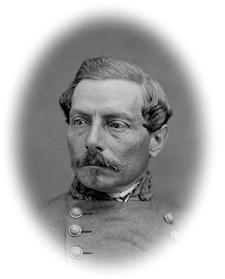
“You see we are still here and it is quite impossible to say for how long a time. Your father has been with General Beauregard almost constantly since we came, until yesterday, when General Beauregard requested him to go on his staff, and since then he has been actively engaged in carrying out his orders. I suppose you know the condition of things from the papers—that the administration after their professions of peace have determined to reinforce the Fort at all risks, and we are in hourly expectation of the arrival of the storeship and the fleet sent to protect it. General Beauregard is only waiting for the arrival of the troops from the country to make the attack on the Fort. He is quite confident of the result, and God grant he may be right. We are all anxious enough as you may suppose.”

0 comments

Let us take Fort Sumter, before we have to fight the fleet and the Fort.

Louise Wigfall Wright — A Southern Girl in ’61

“CHARLESTON, 10 April, 1861.

“No one now doubts that Lincoln intends War. The delay on his part is only to complete his preparations. All here is ready on our side. Our delay therefore is to his advantage, and our disadvantage. Let us take Fort Sumter, before we have to fight the fleet and the Fort. General Beauregard will not act without your order. Let me suggest to you to send the order to him to begin the attack as soon as he is ready. Virginia is excited by the preparations, and a bold stroke on our side will complete her purposes. Policy and Prudence are urgent upon us to begin at once. Let me urge the order to attack most seriously upon you.                                                                       ” L. T. WIGFALL.”

0 comments

Captain J. G. Foster’s Journal of the Bombardment of Fort Sumter

Civil War Day-by-Day

April 10.—Every one, by order of the commanding officer, Major Anderson, changed his quarters into the gun casemates to-day. The work on the traverse progressed well. Lieut. R. K. Meade, Engineers, being placed on ordnance duty, found the supply of cartridges on hand to be too small, and took immediate measures to increase the supply by cutting up all the surplus blankets and extra company clothing to make cartridge bags. The curb for the traverse at the right shoulder angle was completed and put together on the terre-plein at nightfall, and after dark raised up on the parapet and filled with earth, which had been hoisted from the parade. The working party, under Lieutenant Snyder, increased by a large detail from the command, completed this work about midnight.

The supply of bread failed to-day, and its absence was supplied by rice obtained by picking over some damaged rice, which, while spread out to dry in one of the quarters, had been filled with pieces of glass from the window-panes shattered by the concussion of guns fired in practice.

A second battery was unmasked to-day on Sullivan’s Island, nearer the western point of the island than the one last discovered. It is of one gun, and very heavy—evidently a 9-inch Dahlgren gun, or a 10-inch columbiad.

The enemy’s steamers were very active at night, but no alarm occurred.

0 comments

Civil War Day-by-Day

Civil War Day-by-Day

April 10, 1861

  • Floating battery at Charleston finished and mounted
  • Large numbers of troops sent to the various fortifications.

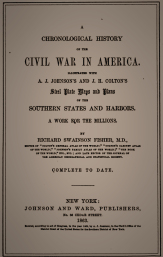
A Chronological History of the Civil War in America by Richard Swainson Fisher, New York, Johnson and Ward, 1863

0 comments

“They were bold denouncers of the rebellion; the others were silent, thoughtful, but in earnest.”—John Beauchamp Jones

Civil War Day-by-Day
A likeness of Jones when he was editor and majority owner of the Daily Madisonian during President John Tyler’s administration.

April 9th.—My adieus over, I set out in the broad light of day. When the cars arrived at Camden, I proceeded, with the rest of the through passengers, in the boat to the navy yard, without going ashore in the city. The passengers were strangers to me. Many could be easily recognized as Southern men; but quite as many were going only as far as Washington, for their reward. They were bold denouncers of the rebellion; the others were silent, thoughtful, but in earnest.

The first thing which attracted my attention, as the cars left the Delaware depot, was a sign-board on my left, inscribed in large letters, “UNION CEMETERY.” My gaze attracted the notice of others. A mocking bon-mot was uttered by a Yankee wit, which was followed by laughter.

For many hours I was plunged in the deepest abstraction, and spoke not a word until we were entering the depot at Washington, just as the veil of night was falling over the scene.

Then I was aroused by the announcement of a conductor that, failing to have my trunk rechecked at Baltimore, it had been left in that city! Determined not to lose it, I took the return train to Baltimore, and put up at Barnum’s Hotel. Here I met with Mr. Abell, publisher of the Baltimore Sun, an old acquaintance. Somewhat contrary to my expectations, knowing him to be a native of the North, I found him an ardent secessionist. So enthusiastic was he in the cause, that he denounced both Maryland and Virginia for their hesitancy in following the example of the Cotton States; and he invited me to furnish his paper with correspondence from Montgomery, or any places in the South where I might be a sojourner.

0 comments

“Many are fearing an attack upon the City now, as it is thought that a War is about commencing.”—Horatio Nelson Taft

Diary of US patent clerk Horatio Nelson Taft.

TUESDAY 9

Rained again all day, and a perfect tempest of wind and rain all last night as well as today. Much anxiety is felt on account of the fleet which for two or three days past has been leaving NY with troops &c for the South. E G Allen of Boston in our Rooms today. Singular man. Many are fearing an attack upon the City now, as it is thought that a War is about commencing. Have been at home all the evening hearing the boys read, and cleaning my “revolver” after they went to bed. It rains yet at 11 o’clock, fair prospect for it tomorrow.


The three diary manuscript volumes, Washington during the Civil War: The Diary of Horatio Nelson Taft, 1861-1865, are available online at The Library of   Congress.

0 comments

Torrents and Willard’s Happy Mob.

My Diary North and South – William Howard Russell

April 9th.—A storm of rain, thunder, and lightning. The streets are converted into water-courses. From the country we hear of bridges washed away by inundations, and roads rendered impassable. Accounts from the South are gloomy, but the turba Remi in Willard’s are as happy as ever, at least as noisy and as greedy of place. By-the-by, I observe that my prize-fighting friend of the battered nose has been rewarded for his exertions at last. He has been standing drinks all round till he is not able to stand himself, and he has expressed his determination never to forget all the people in the passage. I dined at the Legation in the evening, where there was a small party, and returned to the hotel in torrents of rain.

0 comments

War Declared

Civil War Day-by-Day

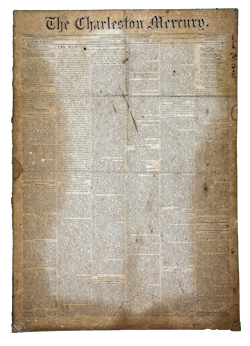
April 9, 1861; The Charleston Mercury

Our authorities yesterday evening received notice from LINCOLN’S Government, through a special messenger from Washington, that an effort would be made to supply Fort Sumter with provisions, and that, if this were permitted, no attempt would be made to reinforce it with men! This message comes simultaneously with a fleet, which we understand is now off our bar waiting for daylight and tide to make the effort threatened.

We have partially submitted to the insolent military domination of a handful of men in our bay for over three months after the declaration of our independence of the United States. The object of that self-humiliation has been to avoid the effusion of blood, while such preparation was made as to render it causeless and useless. It seems we have been unable, by discretion, forbearance and preparation, to effect the desired object; and that now the issue of battle is to be forced upon us. The gage is thrown down, and we accept the challenge. We will meet the invader, and the God of Battles must decide the issue between the hostile hirelings of Abolition hate and Northern tyranny, and the people of South Carolina defending their freedom and their homes. We hope such a blow will be struck in behalf of the South, that Sumter and Charleston harbor will be remembered at the North as long as they exist as a people.

0 comments

Interesting from South Carolina

Civil War Day-by-Day

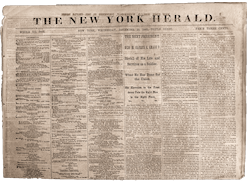
April 9, 1861; The New York Herald

Our Charleston Correspondence.

CHARLESTON, April 3, 1861.

The city was astir this evening in consequence of rumors about another vessel, showing the American flag, being fired into from batteries on Morris Island. The reports were very conflicting, and nothing definite will be known until an official report is made to Gov. Pickens–an officer having been despatched to the island to ascertain the particulars.

The rumors are that the vessel was a regular trading schooner from Philadelphia, and attempted to make her way into the harbor without showing proper signals; that she was fired at with blank cartridges, and not paying attention thereto, Col. Lamar gave her a shot in the hull from his columbiad. She then displayed the American ensign, and that not being a satisfactory signal, another shot was fired at her, but it was not known at eleven othis evening whether the second shot took effect or not. Capt. Dozier went down in the government steamer Lady Davis, but did not succeed in ascertaining the whereabouts of the vessel. It is supposed she put to sea.

When the firing was observed by Major Anderson, it is stated, he despatched two of his officers – Captains Seymour and Snyder – to Morris Island, with instructions to seek Colonel De Saussure, commanding artillery on the island, and ascertain the cause of the hostile demonstration against his flag. The reply was that the vessel was endeavoring to pass the batteries without coming to at the first summons. Major Anderson’s officers than proceeded, with the consent of Colonel De Saussare, to the vessel to examine her condition; but their report has not yet reached the city. The affair is considered of some importance by the highest functionaries here, although it may eventually prove to be of little consequence. The official report will be made to Governor Pickens early tomorrow morning. [continue reading…]

0 comments

The News

Civil War Day-by-Day

April 9, 1861; The New York Herald

Startling news from Washington may be found in our despatches in another part of today’s paper. The curtain has been rung up, and the tragedy is about to begin. A portion of the squadron of war ships and transports fitted out at New York are ordered to Fort Sumter. Supplies are to be thrown into that stronghold at all hazards. Major Anderson has been directed, in the event of the federal vessels being opposed by the secessionists, to open his batteries. Such, in brief, is the government programme for Charleston harbor. Our reports from that point confirm the statement that the supplies of the garrison from the city have been cut off. Intense excitement prevailed there yesterday. Five thousand men have been ordered out, the batteries have been strengthened, and every preparation made to repel the federal forces. Beyond doubt the dreaded fratircidal conflict will commence within forty eight hours. As soon as it is known in Washington that the war has begun, the President will, it is said, issue a proclamation calling Congress together.

The flying artillery, cavalry and sappers and miners which have left this port within the past five days are to proceed to Texas, there to cooperate with Gen. Houston for the restoration of the government authority in that State, while a portion of the fleet will reinforce Fort Pickens, and other posts on the Gulf coast.

The President will soon, it is believed, call for fifty thousand volunteers. Governor Curtin, of Pennsylvania, who has just returned to Harrisburg from Washington, yesterday sent to the Legislature a message recommending an appropriation of half a million dollars to put the militia of the State on a war footing. Governor Dennison, of Ohio, who has also been in Washington for some days past, will make a similar recommendation to the Legislature of his State.

The State Department yesterday sent word to the Confederate State Commissioners that the administration would hold no official intercourse with them. They will respond to the communication of the Secretary of State, and then probably proceed to the South. The Montgomery Cabinet were in session last night, expecting important news from the Commissioners.

The war steamer Harriet Lane and the steam transports Illinois and Baltic sailed from this port yesterday for the Gulf, loaded with stores, munitions of war and troops.

0 comments

The End of Negotiation

Civil War Day-by-Day

April 9, 1861; The Charleston Mercury

Much surprise was created about six o’clock yesterday evening, by the announcement, upon the bulletin board of THE MERCURY, that Lieut. TALBOT–now Captain TALBOT, of the United States Army–had returned to Charleston by the evening train, and was then at the Charleston Hotel. It appears that he was accompanied by Mr. R. S. CHEW, the confidential secretary, we believe, of Secretary CHASE. Capt. TALBOT came as bearer of despatches to Major ANDERSON, and upon making known his mission to General BEAUREGARD, was peremptorily refused permission to communicate with Fort Sumter.

Mr. CHEW, we understand, came as special messenger to the authorities here, with an official notification from the LINCOLN Government that Fort Sumter was to be provisioned–peaceably, if practicable, forcibly, if necessary. It is almost needless to add that Mr. CHEW received no information of a very consoling nature.

Both he and Capt. TALBOT departed on their return to Washington, by the eleven o’clock train.

During the afternoon, despatches had been received of a nature to warrant the belief that a formidable naval force was off our coast. Subsequent despatches confirming the first reports, it was determined to send down additional troops to the harbor fortifications. Shortly before midnight the city was startled by the booming of seven guns from the Citadel Green–the signal for the mustering of the 17th Regiment. In a few minutes the wet, misty streets were all commotion; volunteers could be seen hurrying to and fro to join their respective commands, and the neighborhood of the City Hall was speedily thronged by the citizen soldiery, who, like true men, had left their beds and hastily donned the knapsack and shouldered the musket. As company after company filed silently down to the boats, the occasional flashes of the lightning lit up their right bayonets and glazed kepis, and nothing save the steady measured tramp of the men disturbed the solemn stillness.

Colonel RION’S Regiment from Kershaw was sent for yesterday, and is expected to arrive this morning. Ample provision has been made for accommodation of the troops. Before daylight this morning the force at the threatened points will be fully doubled.

As we go to press (4 o’clock a.m.) all is yet quiet, but a rumor prevails that there are seven vessels off the bar.

0 comments

Fort Randall

Civil War Day-by-Day

April 9, 1861; The Charleston Mercury

One of the fortifications recently erected at the entrance of Little River, has been named as above, in honor of Capt. THOMAS RANDALL, a venerable citizen, residing in its neighborhood. The honor is well deserved, for, of all of our able citizens who have exerted their energies in preparing for the defence of our seacoast, none have exceeded Capt. RANDALL. He has generously and promptly contributed to the defence of his State, with provisions, labor and money. He has in early life experienced the woes of British tyranny in Dartmoor Prison, and he now acquires new strength and activity in furthering resistance to American tyrants. Fort Randall will be garrisoned by a detachment of artillery and the All Saints Rifles, and will present a formidable opposition to an invasion of its immediate vicinity.

0 comments

Our Montgomery Correspondence

Civil War Day-by-Day

April 9, 1861; The Charleston Mercury

MONTGOMERY, April 5, 1861.

The first of the Treasury notes have been issued and are now being signed rapidly. The first was taken by Judge A.B. CLITHERALL, the Register of the Treasury and Navy, instead of coin, for their salaries. There is considerable competition for the first bond of the Confederate States, and twenty per cent premium has already been offered for it. The form of these Treasury notes is as follows:

Twelve months after date the CONFEDERATE STATES will pay to bearer, $50, with interest at half a cent per day. Montgomery, ALEX. B. CLITHERALL, Register. E. C. ELMORE, Treasurer.

Receivable in payment of all dues except duties.

The vignette is a plantation scene–three negros hoeing cotton, one with a basket–fields and mansion in the background. They are of different denominations from fifty to five hundred.

In reply to the Treasury circular issued to the Banks, the President and Directors of the Banks of Charleston, Augusta and Savannah have agreed to the proposition, and will redeem, in coin, all notes of their respective banks which have been paid to the government for stock in the new loan. I am informed upon good authority that the Central Bank of Alabama, as well as the other suspended Banks in this State, will agree to the same. The Central Bank has been retarded in its action on account of the absence of some of the directory. There is no doubt of its course, however.

Nothing in particular has been done in the Navy Department, as all its operations must be slow. A few appointments have been made in the Marine Corps:

Captains. George Holmes, Florida; A. J. Hays, Alabama; [continue reading…]

0 comments

Latest by Telegraph

Civil War Day-by-Day

April 9, 1861; The Charleston Mercury

The Administration Refuses to Recognize the Southern Commissioners.

FORTS SUMTER AND PICKENS TO BE REINFORCED. THE NOTE OF PREPARATION, &c., &c., &c, (FROM OUR OWN CORRESPONDENT)

WASHINGTON, April 8. The Southern Commissioners today received from the Department of State the reply to their official communication.

SEWARD declines to recognize them, and refuses to hold any communication with them other than as citizens of the United States.

It is now placed beyond all possible doubt that the attempt will be made by the United States Government to throw a full supply of provisions into Forts Sumter and Pickens.

The great military and naval preparations now going on mean COERCION. All disguise is now thrown off.

There will be a collision in less than a week.

It is a significant fact, that of all the officers appointed to command in the expeditions now filling out for the South, not one is from a Southern State.

Captain M. C. MEIGS said yesterday that the people will in less than ten days know all about the movements, which create so much excitement here and elsewhere. [continue reading…]

0 comments

The History of the Times

Civil War Day-by-Day
1860s newsprint

April 9, 1861; The Telegraph, (Harrisburg Pennsylvania)

“When the impartial pen of the historian is invoked to trace the transaction of the present to their true source and responsibility, he will be compelled to discharge a duty which will leave a stain of dark and irrefaceable crime on the name of the Democratic party, its measures and its men. However we may endeavor to deal leniently with the errors of individuals, and close our eyes to the common faults and frailties of our nature – there are yet degrees of crime and extents of excuse which must not be permitted to pass unnoticed or uncondemned. They will not be permitted to do so, particularly when they seek to thrust suffering on the generation that governs or entail misery and sorrow on that which is to come after us, to inhabit and posses the land. All that we were as a government, so far as prestige and political influence are concerned, we inherited from the wisdom of those who bathed their virtues and their patriotism in their own blood, and became martyrs to their faith, with the holy resolution and purpose of creating a government which would end the martyrdom of patriotism, and establish forever the civil and religious rights of mankind. Those who formed and framed and labored for the establishment of free institutions on this hemisphere, never dreamed that the blow which would destroy their cherished object and holy purpose, would be dealt by the hands of a portion of the American people themselves. They never imagined that treason would be hatched in the capital of the republic they poured out their blood to organize. If the blow ever did come, and treason plotted to subvert the liberty of the American people, in their opinion it would come from abroad, and be hatched by those who never enjoyed and therefor could not appreciate the blessings of free institutions. But in their confidence in those who were to come after them, the statesmen and heroes of the revolution were mistaken. Instead of the blow that is to destroy us, coming from abroad, it is dealt from at home, by those most benefitted, and the treason with which it is clutching the nation by the throat, was concocted by the very men who were sworn to its preservation and protection. This is no idle assertion. The history of the past proves the origin of the treason, while the transactions of the present are daily developing the designs of those engaged in this treacherous revolution. [continue reading…]

0 comments

Visit to Pensacola Bay

Civil War Day-by-Day

April 9, 1861; The New York Herald

 (From the Mobile Advertiser, April 3.)

Saturday night, having obtained a berth for a trip to the Warrington Navy Yard, at a little after eight o’clock we cast loose from the Hitchcock’s press wharf on board the steamer Kate Dale, Capt. J. M. Brainard, bound for that place, with a load as per manifest of 10,000 solid and hollow shot, 40,000 cartridges, some 140 boxes of grape, and quantities of bacon, pork, flour, and other rations for the troops of the Confederacy. The boat also carried over Company A. of the Louisiana Zouaves, Capt. A. Coppens, who, as we left, were saluted with hearty cheers by the Mississippians quarter at the press, which were acknowledged by a roll of the drum; the Zouaves not being much given to cheering, but being in fact the most quiet corps we have encountered in these war times. The bay was calm, but not knowing what kind of weather there might be outside, Captain Brainard expressed a doubt whether he should proceed directly on the trip, the Kate Dale’s cargo being of a kind which would strain the boat severely in a heavy sea, not to mention the danger of its rolling overboard, and making a considerable smash of things on board while being got rid of.

At twelve o’clock we found ourselves close under Fort Morgan, the relief of the fort showing itself sharp and clear in the moonlight, with no sign of life about it but the figure of a sentinel walking his watch on the ramparts. There was scarcely a perceptible swell on the bar, which we crossed at once, and on rising in the morning Barrancas light was flashing right ahead of us, and off to seaward lay the frigate Sabine and sloop St. Louis, and two vessels under canvas, a British and an American bark bound for Pensacola. As the light strengthened the smoke of two steamers could be discerned still further at sea, which were recognized to be the boats of the New Orleans and Havana line, this being the point where they meet on their trips going and coming. Soon we had passed Fort McRea and the low battery on its right, and heading toward Fort Barrancas, and running close to Fort Pickens, came in sight of the steamer Wyandot lying inside, and of the rising sun at about the same moment. We were hardly made fast at the Navy Yard when the two steamers and the British bark [continue reading…]

0 comments

Our Washington Correspondence

Civil War Day-by-Day

April 9, 1861; The Charleston Mercury

WASHINGTON, April 5, 1861.

The warlike movements of the LINCOLN Government exclude all other topics of remark. For weeks past their proceedings, which before were suspicious, have been threatening. Long before Mr. LINCOLN came to Washington it was clear enough he bore a deadly hatred to the South. His inaugural ought to have dispelled all doubts in the minds of sensible people that he meant to employ force to bring back the Confederate States. It was a fair and open warning. How it should ever have been misunderstood I cannot conceive. That it should be misrepresented by men like DOUGLAS, SEWARD, and the Border State Unionists is conceivable enough, considering their general reluctance to tell the truth on any subject, and especially upon one which it was important for the South to be truly advised about. Accordingly, these politicians have cried peace when there was no peace. It is a satisfaction to consider now, when the veil is lifted from the purposes of the Administration, that the able and sagacious head of the Montgomery Government has not been deceived by them, and that no military preparation has been omitted which was calculated to place the South in a proper condition for defence.

Since the 4th of March the United States Government has pursued precisely the policy which might have been expected from Black Republicans, supposing their policy to be war. To maintain a conflict in Texas with two or three thousand scattered troops, without a base of operations, surrounded by a hostile community, well acquainted with firearms, was evidently contrary to a sound policy. Accordingly the troops were withdrawn as fast as possible, and concentrated at points convenient to the Southern coast.

It was desirable also to avoid precipitating a conflict before they were ready for it. Therefore, rumors were first started, and then explicit statements made by General SCOTT and by members of the Cabinet, that Sumter would be evacuated. [continue reading…]

0 comments

Beauregard informs Anderson that Sumter’s public (official) letters were sent to the Confederate Government

War of the Rebellion: from the Official Records of the Union and Confederate Armies and Navies

HDQRS. PROV. FORCES
CONFEDERATE STATES,
Charleston, S.C., April 9, 1861.

Maj. ROBERT ANDERSON,
Commanding at Fort Sumter, Charleston, S.C.:

SIR: Your favor of this day has just been received, through Captain James. The private letters you refer to in the mail of yesterday were sent to their destination, but the public ones were sent to the Confederate Government at Montgomery, in return for the treachery of Mr. Fox, who has been reported to have violated his word given to Governor Pickens before visiting Fort Sumter.

I remain, sir, very respectfully, your obedient servant,

T. BEAUREGARD,

Brigadier-General, Commanding.

0 comments

On the Brink of War—Confederate Messages and Directives

War of the Rebellion: from the Official Records of the Union and Confederate Armies and Navies

“… by God’s providence we will, I trust, be prepared for them; and if they approach with war vessels also I think you will hear of as bloody a fight as ever occurred.”

MONTGOMERY, April 9, 1861.

General BEAUREGARD, Charleston:

Major Anderson’s mails must be stopped. The fort must be completely isolated.

L. P. WALKER.

—–

CHARLESTON, April 9, 1861.

L. P. WALKER:

The mails have already been stopped.

G.T. BEAUREGARD.

—–

ADJUTANT AND INSPECTOR GENERAL’S OFFICE,
Montgomery, April 9, 1861.

Brig. Gen. G. T. BEAUREGARD,
Commanding Confederate Forces, Charleston, S. C.:

GENERAL: It is much to be desired that the recruits sent from Baltimore to Charleston should remain with your command and be provided for at present by the arrangements made by Captain Lee, or else by appointing him as acting assistant quartermaster for the troops of the Confederate States under your command, in addition to his present duties, which would involve very little increase of labor on his part, and afford the advantage of placing funds in his hands for disbursement on account of the military service of the Confederate States. If possible you will please make this arrangement, or else select some other competent officer of the army of the Confederate States for the same purpose. It is not deemed necessary at present to furnish the supplies for the full equipment of these recruits.

I am, general, very respectfully, your obedient servant,

S. COOPER,

Adjutant and Inspector General.

—–

STATE OF SOUTH CAROLINA,
Headquarters, April 9, 1861.

To the PRESIDENT OF THE CONFEDERATE STATES:

MY DEAR SIR: I send by the bearer important dispatches to the Secretary of War, and beg to call your immediate attention to them. The bearer is Colonel Hayne an aide of mine, and will return immediately to me. If you have anything particular to General Beauregard or myself, you can trust it to him, and he will bring it back immediately. Since I inclosed the dispatch to the Secretary of War Major Anderson has written a polite note to General Beauregard, requesting that the letters taken from the mail might be returned, as he had been notified that his mails would be stopped entirely. The general returned for answer that the private letters had been sent to their destination, but the official letters were sent to the Confederate Government, because rumors, well established, indicated that Mr. Fox had violated his faith to me in visiting the fort, under the guarantee of Captain Hartstene, who went with him. The pledge was that he visited Major Anderson by authority, for pacific purposes entirely. You see that the present scheme for supplying the fort is Mr. Fox’s. It is thought that the attempt will be made to-night, and we have doubled our steamboats on the harbor and bar.

Since I wrote to the War Department we have increased the forces on Morris Island to two thousand one hundred men, and ten companies of fine men arrive to-night, in the next train, of eight hundred men, and two more regiments arrive to-morrow. We hope to have about six thousand men there on the harbor batteries and posts. I trust we are ready, and if they come we will give them a cordial reception, such as will ring through this country, I think. I hope we are not mistaken; but, at any rate, we will try and do our duty.

With great esteem, yours, very truly,

F. W. PICKENS.

—–

STATE OF SOUTH CAROLINA, Headquarters, April 9, 1861.

Hon. Mr. WALKER, Secretary of War:

SIR: At the request of General Beauregard I inclose the within. I took possession of the mails this morning from Sumter, and retained the packages marked “official.” These are all sent you. The private letters are all sent, as directed, to their owners. I did this because I consider a state of war is now inaugurated by the authorities at Washington, and all information of a public nature was necessary to us. The mails and all intercourse of any kind with Sumter are now forbidden, and I immediately refused Captain Talbot any interview with Major Anderson, and also his request to be restored to his command in the fort. I called in General Beauregard, and made Captain Talbot and Mr. Chew repeat in his presence what they had said and what the former desired as to Sumter, and General Beauregard entirely and immediately concurred.

You will see by these letters of Major Anderson how it is intended to supply the fort; but by God’s providence we will, I trust, be prepared for them; and if they approach with war vessels also I think you will hear of as bloody a fight as ever occurred. We now have three thousand seven hundred men at the different posts and batteries, and will have by to-morrow three thousand more, which I have called down. From my calculation. I think they will have about two thousand six hundred, and will attempt to land in launch-boats with 24 and 12 pounders, and it will probably be on the lower end of Morris Island, next the light-house. If so, we will have a fine rifle regiment to give them a cordial welcome from behind sand hills (that are natural fortifications), and two Dahlgren guns will be right on them, besides four 24-pounders in battery. I have four hundred fine Enfield rifles that have been practiced at nine hundred yards, and on that island, altogether, we have now one thousand nine hundred and fifty men, and are increasing it today.

There has just arrived on the bar a fine rifled cannon from Liverpool, of the latest make (Blakely gun), an improvement upon Armstrong, of steel rolls or coils, with an elevation of seven and one-half degrees to a mile. It throws a shell or twelve-pound shot with the accuracy of a dueling-pistol, and only one and one-half pounds of powder. Such, they write me, is this gun, and I hope to have it in position to-night. We expect the attack about 6 o’clock in the morning, on account of the tide.

Very respectfully,

F. W. PICKENS.

(Captured Union Letters)

[Inclosure No. 1.]

FORT SUMTER, S.C., April 8, 1861.

General JOSEPH G. TOTTEN,
Chief Engineer U. S. Army, Washington, D.C.:

GENERAL: The increased activity and vigilance of the investing force, as reported yesterday, still continues. Three large traverses are nearly completed on the front, from battery No. 3 to 5, on Morris Island, and traverses are also being erected in the interior of battery No. 5. Additions of sand bags are being made to the covering of the magazine, between Nos. 2 and 3, and to the left flank of No. 1, where I think they are constructing a service magazine.

I am busily at work constructing splinter-proof shelters on the terre-plein. I obtain timber by taking the gun carriages to pieces, and form the covering of the 2-inch iron pieces for embrasures, as seen below. The plates are spiked on, so as to be securely retained in their places, even if struck by a shell, which I am confident it will turn.

Our supplies are entirely cut off from the city, and those on hand are very limited.

The besieging forces worked all day yesterday, whenever the intervals between the showers of rain would allow.

Very respectfully, your obedient servant,

J. G. FOSTER,

Captain, Engineers.

P. S.–I received yesterday a letter from the Secretary of War to Major Anderson, which, by mistake, had been enveloped to me. I handed it to Major Anderson without reading.

Respectfully, &c.,

J. G. FOSTER,

Captain, Engineers.

[Inclosure No. 2.]

Col. L. THOMAS Adjutant-General:

DEAR COLONEL: In another envelope I shall send a No. 96, ¹ Which you will be pleased to destroy.

That God will preserve our beloved country, is the heart-felt prayer of your friend,

R.A.

—–

No. 96.] FORT SUMTER, S.C., April 8, 1861.

Col. L. THOMAS, Adjutant-General, Washington, D. C.:

COLONEL: I have the honor to report that the South Carolinians have since about noon yesterday been very actively engaged in strengthening their works on Morris Island. I pray that God will avert the storm which seems impending over us, and restore amicable and permanently-pacific relations between the States who still stick to the old Union and those who have formed another Government in the South.

I am, colonel, very respectfully, your obedient servant,

ROBERT ANDERSON,

Major, First Artillery, Commanding.

P.S.–I omitted acknowledging the receipt of the letter from the honorable Secretary of the 4th instant.

[Inclosure No. 3.]

No. 96.] FORT SUMTER, S.C., April 8, 1861.

Col. L. THOMAS, Adjutant-General U. S. Army:

COLONEL: I have the honor to report that the resumption of work yesterday (Sunday) at various points on Morris Island, and the vigorous prosecution of it this morning, apparently strengthening nearly all the batteries which are under the fire of our guns, shows that they either have received some news from Washington which has put them on the qui vive or that they have received orders from Montgomery to commence operations here. I am preparing by the side of my barbette guns protection for our men from the shells, which will be almost continuously bursting over or in our work.

I had the honor to receive by yesterday’s mail the letter of the honorable Secretary of War, dated April 4, and confess that what he there states surprises me very greatly, following as it does and contradicting so positively the assurance Mr. Crawford telegraphed he was authorized to make. I trust that this matter will be at once put in a correct light, as a movement made now, when the South has been erroneously informed that none such will be attempted, would produce most disastrous results throughout our country.

It is, of course, now too late for me to give any advice in reference to the proposed scheme of Captain Fox. I fear that its result cannot fail to be disastrous to all concerned. Even with his boat at our walls the loss of life (as I think I mentioned to Mr. Fox) in unloading her will more than pay for the good to be accomplished by the expedition, which keeps us, if I can maintain possession of this work, out of position, surrounded by strong works, which must be carried to make this fort of the least value to the United States Government.

We have not oil enough to keep a light in the lantern for one night. The boats will have, therefore, to rely at night entirely upon other marks. I ought to have been informed that this expedition was to come. Colonel Lamon’s remark convinced me that the idea, merely hinted at to me by Captain Fox, would not be carried out. We shall strive to do our duty, though I frankly say that my heart is not in the war which I see is to be thus commenced. That God will still avert it, and cause us to resort to pacific measures to maintain our rights, is my ardent prayer.

I am, colonel, very respectfully, your obedient servant,

ROBERT ANDERSON,

Major, First Artillery, Commanding.

—–

HEADQUARTERS PROVISIONAL FORCES,
Charleston, S. C., April 9, 1861.

Hon. D. F. JAMISON,
President of the Convention, State of South Carolina:

SIR: I had the honor this morning of receiving, through a committee of your State Convention, its resolutions, expressing confidence in my professional skill, courage, and sound judgment, and in the efficient cooperation of the several members of my staff and other assistants, military and naval; and tendering to the individuals designated, and to the various forces in the service, the thanks of the State for their successful efforts thus far in protecting the honor and interests of the State.

Allow me, sir, through you, to thank the honorable body over which you preside for this evidence of their kindness to myself and assistants, and to the forces under my orders. I feel highly gratified that in so short a time it has been my good fortune to merit your approbation in the discharge of my official duties, and it is a source of pride for me to state that I feel much indebted for the expression of your resolutions to the active and willing co-operation of every one under my command. Never have I seen a more universal exhibition of determination and self-denial on the part of individuals for the promotion of any cause than that of the forces under my command, for the accomplishment of the great object we have in view. Encouraged by the great trust reposed in them, I can confidently express the hope that all under my command will continue to merit your approbation. It will be my pleasure to communicate to the troops and others under my orders the substance of your flattering resolutions.

I am, sir, very respectfully, your obedient servant,

G. T. BEAUREGARD,

Brigadier-General, Commanding.

—–

HDQRS. PROVISIONAL ARMY CONFEDERATE STATES,
Charleston, S. C. April 9, 1861.

Col. M. GREGG, Commanding, Morris Island, S. C.:

SIR: I have ordered two 12-pounders and a battery of 6-pounders to be sent to you this day, to be used in the defense of Vinegar Hill and Light-house Hills, and in preventing a landing on the low ground between them. Have them put in position forthwith, and look out for to-night or to-morrow morning. Caution Colonel De Saussure about not throwing away the shot of his batteries. Be careful that the sand does not fill up the holes of the nipples of your muskets and Enfield rifles.

Your obedient servant,

G. T. BEAUREGARD,

Brigadier-General, Commanding.

—–

HDQRS. PROV. FORCES CONFEDERATE STATES OF AMERICA,
Charleston, S. C., April 9, 1861.

Capt. G. S. JAMES, Commanding Port Johnson, S. C.

CAPTAIN: The brigadier-general commanding directs that you send to-night to Legare’s Landing, on Schooner Creek, twenty, or, if practicable,     twenty-five men from your command, under the command of a commissioned officer; this detachment to guard that point during the night and return to you in the morning. You will send the same or an equivalent detachment to the same point every night until further orders.

I am, captain, very respectfully, your obedient servant,

S. W. FERGUSON,

Captain, and Aide-de-Camp.

—–

HDQRS. PROV. FORCES CONFEDERATE STATES OF AMERICA,
Charleston, S. C., April 9, 1861.

Capt. F. L. CHILDS, Commanding Castle Pinckney, S. C.:

CAPTAIN: The brigadier-general commanding directs that in consequence of the difficulty of transporting your command to where it was ordered, you will hold it in readiness to embark this evening, about 7 p.m., on board three steamboats, that are to report to Captain Hartstene for duty in the outer harbor, at the rate of twenty-five men to each steamer, each man to be armed with his musket and take with him forty rounds of ammunition, which will be sent to you. These detachments will be returned in the morning and will hold themselves in readiness for similar duty every: night until further orders.

Very respectfully, your obedient servant,

S. W. FERGUSON,

Captain, and Aide-de-Camp.

—–

HDQRS. PROVISIONAL ARMY CONFEDERATE STATES,
Charleston, S.C., April 9, 1861.

Col. MAXCY GREGG,
Commanding Morris Island, Charleston Harbor, S.C.:

SIR: I have ordered Major Whiting, of the Engineers, to represent to you what I consider the best position for locating the troops on Morris Island, resulting from his reconnaissances. You will please consult with him freely on the subject, and afford him all the assistance he may require for the construction of the light-house battery, and such other works as may be required for the defense of the south end of said island, and of the strong position at or near Vinegar Hill. Should you have any disposable field pieces you will so locate them as to sweep the flat ground between the latter position and the Light-house Hills. Re-enforcements will continue to be sent to you as fast as practicable, to the extent of one or two regiments more besides the Seventeenth. Should you be attacked before their arrival, you will make a desperate stand on the Light-house Hills and at Vinegar Hilly which are the keys of Morris Island.

Respectfully, your obedient servant,

G. T. BEAUREGARD,

Brigadier-General, Commanding.

—–

HQDRS. PROV. ARMY CONFEDERATE STATES OF AMERICA,
Charleston, S.C., April 9, 1861.

Col. J. J. PETTIGREW, Commanding Sullivan’s Island, S.C.:

SIR: You were informed last night that you were to hold your regiment in readiness for any change of station that circumstances might dictate. This order should not preclude you from maintaining all your present arrangements for the defense of Sullivan’s Island, for it is impossible to state now when you may be called upon to move from your present position. I may even have to strengthen the present forces on that island.

Respectfully, your obedient servant,

G. T. BEAUREGARD.

P. S.–Have you put that flat-boat in position, as already directed, in the Sullivan Creek

G. T. B.

—–

WASHINGTON, D.C., April 9, 1861.

General BEAUREGARD, Charleston:

The messenger speaks doubtless by authority. He gives the promised notice to Governor Pickens. Diplomacy has failed. The sword must now preserve our independence. Our gallant countrymen will do their duty.

MARTIN J. CRAWFORD.


¹ Major Anderson numbered his reports, which were dispatched virtually every day until near the end, sequentially.   The numbers have not been included here at American Civil War Chronicles and only selected reports have been included.

0 comments

Captain J. G. Foster’s Journal of the Bombardment of Fort Sumter

Civil War Day-by-Day

April 9, 1861.—The four-gun battery on the upper end of Sullivan’s Island that was unmasked yesterday morning by blowing up the wooden house standing in front of it was situated very nearly upon the prolongation of the capital of this fort, and, therefore, could enfilade the terre-pleins of both flanks of the work, as well as sweep, to a certain extent, the outside of the scarp wall of the left flank, where alone a vessel of any considerable draught of water could lie near to the fort and discharge her cargo. It therefore became a matter of importance to provide traverses to intercept the fire along the barbette tier of the right flank, as this contains the heaviest battery, intended to operate both upon Fort Moultrie and Cummings Point, and also to prepare means for quickly unloading any vessel that may run in alongside the left flank with supplies for the garrison.

For the first purpose I commenced to prepare (for want of sand bags) a large double curb of boards and scantling, to be elevated upon the top of the parapet at the right shoulder angle, and being filled with earth hoisted from the parade, to serve for a traverse to protect this flank.

For the second I prepared ladders and runways to take in re-enforcements and provisions at the embrasures rapidly, one embrasure being enlarged so as to admit barrels, and also cleared the passage around to the main gate. A large stone traverse was also commenced to cover the main gates from the fire from Cummings Point. The masons were put at work cutting openings through the walls of the officers’ quarters so as to admit a free communication through them, on the first and second floors, from one flank to the other. The battery in the right shoulder angle, first tier, was also being improved by substituting a 42-pounder for a 32-pounder, cutting into the magazine wall, so as to allow the gun on the gorge to be used against the batteries, and cutting away one side of the embrasure, so as to allow the first gun on the right flank to be used in the same way.

The quantity of bread became very small, and only half-rations of it were allowed to the men. The enemy’s steamers were very active carrying supplies to their batteries.

0 comments

Civil War Day-by-Day

Civil War Day-by-Day

April 9, 1861

  • U. S. steamers “Illinois” and “Baltic” sailed from New York with sealed orders.

  • President Davis makes a requisition for troops.


A Chronological History of the Civil War in America by Richard Swainson Fisher, New York, Johnson and Ward, 1863

0 comments

Rebel War Clerk

Civil War Day-by-Day
A likeness of Jones when he was editor and majority owner of the Daily Madisonian during President John Tyler’s administration.

8 o’clock P.M.–My wife and children have been busy packing my trunk, and making other preparations for my departure. They are cheerful. They deem the rupture of the States a fait accompli, but reck not of the horrors of war. They have contrived to pack up, with other things, my fine old portrait of Calhoun, by Jarvis. But I must leave my papers, the accumulation of twenty five years, comprising thousands of letters from predestined rebels. My wife opposes my suggestion that they be burned. Among them are some of the veto messages of President Tyler, and many letters from him, Governor Wise, etc. With the latter I had a correspondence in 1856, showing that this blow would probably have been struck then, if Fremont had been elected.

0 comments

“Handed Green my revolver to draw the charges, it has been loaded two months.”—Horatio Nelson Taft

Diary of US patent clerk Horatio Nelson Taft.

MONDAY 8

Rained all day or rather drizzled all day. No new excitement today. No removals from the Pat office today. Got letter from Bro C.R. Went over to the Post office and got his “papers” taken up. His appointment as Post Master at Wmstown Mass will be made out in a day or two. Wrote to him tonight at home, most of my private letters I write in the office. Handed Green my revolver to draw the charges, it has been loaded two months. Have spent the entire evening at home with one girl & three boys round the table with me writing.


The three diary manuscript volumes, Washington during the Civil War: The Diary of Horatio Nelson Taft, 1861-1865, are available online at The Library of   Congress.

0 comments

Spanish, British, and French Fleets

Civil War Day-by-Day

April 8, 1861; The Charleston Mercury

The evil effects of a dissolution of the Union of the United States, upon the North, are apparent, not only in the paralyzing of trade in the Northern States and cities, but in the new aspect presented by Foreign Powers. But yesterday, the Union–the Northern States united with the South– against the world. We were the dictators on this Continent. With the powerful commercial and economical necessity of cotton in the hands of the United States, they could threaten and command the policy of European nations. But, now, the Union is divided; and the North is impotent. The grand element of command is with the South. The Northern States have scarcely one element of trade with European nations, excepting grain, which is sometimes available. They are the rivals of France and England in navigation and manufactures. The Confederate States, on the contrary, do not stand in competition with the great European nations in their productions. They are agricultural States, and produce cotton, rice and tobacco– commodities essential to the industry and necessities of European nations. In this state of things, these nations are called upon to choose their allies. Will they support the United States, their natural rivals and enemies, or will they go with the Confederate States, their natural friends? No one but a Black Republican bigot could, for a moment, doubt their determination. They will, beyond question, recognize and support the Confederate States; and this being their determination, they are about to send fleets to this Continent, to see that their policy is carried out. They do not intend to submit to paper blockades. They do not intend that our cotton shall be kept from their looms. They will have it, and to this end they will recognize the independence of the Confederate States, within six weeks from this time; and anticipating that some obstacles to this policy, with its accruing advantages, may be put in their way by the United States, they send a fleet to enforce it. If the United States acquiesce in a peaceful separation of the States lately composing it–the precaution of having a fleet on our coasts will be useless; but if a blockade of our ports is to be attempted–if war is to arise– the fleets of France and England will be necessary to protect their commerce. [continue reading…]

0 comments

The Mysterious and Threatening Aspect of the Revolution

Civil War Day-by-Day

April 8, 1861; The New York Herald

Secresy is only the defence of the weak, and is always calculated to arouse suspicion. It is, therefore, a bad sign when we find the administration of this country hiding its designs, as the ostrich hides his head, in the face of proceedings that are the theme of universal comment and anxious speculation from Florida to Maine. We find the government chartering and despatching transports laden with troops and stores, and equipping the entire naval force at its command with the utmost haste, and without letting the public know the purpose or destination for which they are intended. Meanwhile rumor is busy on the wing, and we are left to conjecture. Some say the vessels are bound for Pensacola, which is probable; others that they are for Texas, in order to carry on the war against the Indians that are making hostile demonstrations on the borders; while many surmise any and everything, probable and improbable, from active interference with Spain at San Domingo to the reinforcement of Fort Sumter.

To the ominous and painful uncertainly occasioned by these warlike movements, we have added an increased distrust of the administration, consequent on the surmise that there is trouble, almost amounting to a split, in the Cabinet. It is evident that the war section of that august body has triumphed over the peace section. What, therefore, are we to expect? The administration, by working only in the dark, has evidently no definite policy to proclaim, and is weak and uncertain in its movements. Now, let us ask in what good can all this secresy result, and what necessity is there for maintaining it? There is no necessity for or utility in it whatever. It is only blinding the people, while the country is drifting to ruin, and while civil war with all its attendant horrors is being wilfully inaugurated. Look at the immense harm the condition of things is producing in financial and commercial circles; for, of course, according to the acts of the administration, direct or mysterious, stocks in Wall street rise or fall, and just now, as a consequence, we find the heart of the money market very irregular indeed in its pulsations.

From present appearances we know what we may expect in the future. We see that all the professions of peace uttered by Mr. Lincoln and others were mere idle talk, or else made to lull the country into a state of false security till the administration concluded its loans and was ready to strike a blow. Fort Pickens, on its lonely sandbar, may, in its ruins in years hereafter, tell of the bloody battle of Pensacola which commenced the civil war that desolated the United States in the year of our Lord 1861. Our fervent prayer is that it may not, and that those enemies of their country who cry for blood may be disappointed. But of this there seems now to be little hope.

0 comments