Military

Civil War Day-by-Day
April 12, 1861; The Charleston Mercury
In compliance with a notice on our bulletin board yesterday, some five hundred citizens congregated at the Citadel last evening, and formed themselves into detachments for the guarding of the city during the night.The Charleston Mounted Guard, Capt. MARTIN, numbering over eighty horses, were also on duty. They drew up in front of THE MERCURY office, and tendered us a salute, for which we return our acknowledgments.Three regiments of volunteers, mustering about 3000 men, arrived by the South Carolina Railroad last night. The regiments are commanded by Col. RION, Col. WILLIAMS, and Col. JOHNSON HAGOOD.
0 comments

The Issue

Civil War Day-by-Day
April 12, 1861; The Charleston Mercury
Never, in the world’s history, has any people entered into combat with a higher spirit or a more satisfied, settled, concentrated purpose of achieving independence and respect, than the people now assembled in military force about the harbor of Charleston. Quiet, orderly, prayerful, the unmistakable, irreversible resolve is present. No vain regrets escape the lips of even the women of Carolina. No words of remonstrance fall from the mouth of disqualified age–while the face of manhood is sternly lit with the guadia certaminis. We fear not that the legitimacy of these men of ‘to those of ‘ will not be fully proven, and that the legacy of MOULTRIE and MARION will not be triumphantly maintained. With a deeper sense of wrong, there is the same devotion to duty, the same indignation against the tools of power sent to cleave down their liberties. If anything mars the sober joy with which the bloody arbitrament is welcomed, it is that we shall have to deal with these men and not with their masters. But the issue as made shall be met–and again, as in the Revolution, it will be seen how superior is patriotic valor to hireling skill, and that brave men, fighting on their own soil, for their dearest rights, are invincible. We rejoice that our people, as one man, with serene spirit, are ready for the solemn reckoning with our enemies at hand, and advance upon their great destiny with hearts that, knowing neither doubt of the right, nor fear of consequences, feel sure of success.
0 comments

Things seem at last to have reached the War point.

Journal of Meta Morris Grimball
Meta Morris Grimball

12th April

       Things seem at last to have reached the War point. The 17th Regiment has been ordered down to Morris’s Island, and The Northern Government have sent to inform the Southern that they intend to reinforce the Forts, and collect the revenue. A fleet is expected off the Harbour, and every thing is in a state of preparation.—4 of the boys are on duty, Berkley in the Sumpter Guards, and Arthur & William in the Cadet Riflemen. Lewis wants to volunteer in the Sumpters, I think he ought not. John is now on constant duty, and seems actively engaged; he wrote to us yesterday that he had been in Town for Anchors, and found the house deserted, only Adam, covered with White Wash. He said he was alive but he could not say kicking, for he could hardly move one leg before the other, he was so tired.—Mr Grimball went down to see about the boys, and found them all gone, he will return on Saturday, and then we shall hear. All yesterday I was in a most terrible state of anxiety and misery, about my boys—but I know my case is not different from others. Mrs Elliott, the Mother of William’s Captain, has her only child down there, Mrs Lowndes her only son, & many others, but mine are very fine boys, and very dear to me, still they must do their duty to their State; and I put my trust in my God, & their God, my Savior & their Savior,—and I Pray for them & for myself.—The Government at Washington seem full of duplicity, and in looking back to the conduct of the seceding States, there seems to have been a truthful and noble faith, actuating them.

       Fortunately, before things came to the War, the interest was paid on the money at the North, and I have mine now in Charleston, six hundred and ninety seven dollars. I am very glad of this for it will help us through the Summer.—

       Mrs Bulow & Mrs Gammage have left Charlotte, they were sent for.—

       Went to Papa’s this morning he had been to Mr Barnwell to hear the news. Mr B. wrote to his wife that yesterday at 1 o’clock Gen. Boregeard demanded the surrender of the Fort from Anderson, he replyed he could not with honor, and this morning at 5 o’clock the war began, we have not heard the guns. The news is that the “Harriet Lane” U S S is out side with troops and supplys .

0 comments

Bombardment of Fort Sumter Map

Civil War Day-by-Day
2 comments

Charlotte Wigfall in Charleston

Louise Wigfall Wright — A Southern Girl in ’61

(excerpts from letter)

“CHARLESTON, April 11th, 1861

. . . Your father was gone all night with Captain Hartstein, seeing to placing light boats, with fires of pine wood, in the harbor, for the purpose of detecting the approach of the enemy’s boats. He has gone again to-day and will not return until evening. . . . A demand for the surrender of the Fort was made to-day, but the answer has not yet come. In case of Anderson’s refusal (of which there is little doubt), the fire of the batteries on him will open at 8 to-night. God grant the Fort may be surrendered before the arrival of the Fleet, for although I believe General Beauregard is prepared on every side, yet I should feel all danger were over if we had the Fort. It will be a night of intense excitement and although I can’t help feeling shivery and nervous, yet I am not as much alarmed as I might be, and something tells me it won’t be so bad after all I am going down after a while to walk with Mrs. Chesnut on the Battery and will add more when I hear the answer Anderson returns.”

“April 12.

“I was awakened about half past four, this morning, by the booming of a cannon, and it has been going on steadily ever since—the firing is constant and rapid—with what results we don’t yet know. Your father has gone to Morris’s Island to obtain a report from the command there, and in order to avoid the guns of Sumter he has taken Major Whiting’s row boat, so as to run in by the Inlets. I don’t know how long he will be gone.”

“11 o’clock. The news we hear so far is good. No one killed on Morris’s Island so far—and a breach reported in Fort .Sumter. The iron battery is working well and the balls from Sumter have no effect on it. All is excitement of the most painful kind. Another story is that the Harriet Lane which was off the bar last night has been fired into and injured.”

0 comments

The News

Civil War Day-by-Day
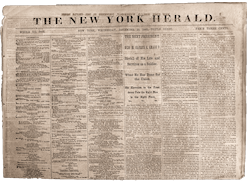
April 12, 1861; The New York Herald
Highly important news from Charleston is published in this morning’s paper. Major Anderson was formally summoned, by General Beauregard, the commander of the secession forces, at noon yesterday, to surrender Fort Sumter. Major Anderson declined compliance, alleging that such a course would be incompatible with his duty to his government. The people of Charleston were intensely excited on the receipt of this refusal to surrender the Fort. The piers and housetops, and all the places from whence a view of the harbor could be obtained, were thronged with men and women, eager to witness the conflict, which was expected momentarily to begin. No hostile shot, however, was fired on either side. But later in the day negotiations were reopened between the commanders, and pending their conclusion hostilities have of course been postponed. The federal fleet had not made its appearance off Charleston at last accounts.
The non-arrival of the squadron off Charleston is doubtless due to [continue reading…]
0 comments

Telegram from Jefferson Davis to Louis Wigfall

Louise Wigfall Wright — A Southern Girl in ’61

“MONTGOMERY, Alabama, “April 12th, 1861.

“My dear friend,

“Your despatch reached me after I had directed one to be sent, which anticipated your wish so fully that you might have imagined it to be an answer if the dates had been reversed. I shall attend to your request about the pistols. The Secretary of War, to whom I handed your letter, has not replied; but there can be no difficulty too great to be overborne by your anxiety in the matter.

“As ever your friend,

“JEFFERSON DAVIS.”

“A want of vigilance let Anderson pass from Moultrie to Sumter. I hope your guard boats, steamers and launches are under competent and faithfully watchful officers.                                                                         ” J. D.”

0 comments

Submission is Ruin

Civil War Day-by-Day
1860s newsprint
The Vindicator, April 12, 1861
Staunton, Virginia
Nothing could be more preposterous, nothing more stupid, than the dogma that slavery is a curse to the country. On the contrary, the heaviest calamity that could befall any slave State on this continent, the greatest curse that an angry Providence could inflict upon the South, would be the destruction of its slave institution. The North ascribe its own rapid increase in population and wealth chiefly to the immigration of foreigners; and does so with reason. The foreigner comes over, in the general, destitute, obliged to work, and willing to labor with his own hands. The Yankee lives upon his wits; but the foreign laborer is a real producer–he works with his own hands, he digs the earth, and he produces food for his own consumption as well as for that of his Yankee taskmaster. Well may the North ascribe its prosperity in a great degree to the immigrant; for that individual becomes a producer from the outset, and not until he accumulates a little capital by his manual industry, does he imitate the Yankee, resort to his wits for a livelihood, and resolve himself into a consumer.
It is from immigration that the North derives its chief want, its most exigent desideratum–labor, manual labor; dirt digging, soil tilling labor; the labor decreed against man by the curse of Eden; the labor that brings to his brow the dust and the sweat. Various are the devices which the Yankee contrives to avoid, himself, this sweat of the brow–machines without number, factories where women and girls are made to work in droves; ligneous nutmegs and hams; protective tariffs, and like inventions. But the influx of penniless immigrants from Europe, was the Yankee’s godsend–poor, necessitous, stout, sinewy immigrants, used to privation and toil, willing to labor with their hands, anxious to barter their service for mere bread. But the evil of immigrant labor is, that it is not permanent. Industry in our flourishing country soon brings its reward of accumulated means and easy competency. The humble, industrious immigrant soon grows too well-to-do to be willing or obliged to sweat and toil longer. His service at the shovel and the hoe is but an apprenticeship of a few years, at the end of which he becomes, in his turn, an imployer [sic] and consumer, rather than a laboring producer. [continue reading…]
0 comments

Captain J. G. Foster’s Journal of the Bombardment of Fort Sumter

Civil War Day-by-Day

April 12.–At 1 a.m. four aides of General Beauregard (Colonel Chesnut, Colonel Chisolm, Captain Lee, and Mr. Pryor, of Virginia) came with a second letter, stating that as Major Anderson had been understood to make the remark to the bearers of the first letter, in taking leave, that he would “await the first shot, and if not battered to pieces, would be starved out in a few days,” it was desired to know what importance might be attached to it. The reply of Major Anderson did not satisfy the aides, who were authorized in that case to give notice that the fire would open. Accordingly, on leaving at 3 ½ a.m. they gave notice that their batteries would open in one hour.

At 4 ½ a.m. a signal shell was thrown from the mortar battery on James Island; after which the fire soon became general from all the hostile batteries. These batteries were, as nearly as could be ascertained, armed as follows, viz.:

On Morris Island: Breaching battery No. 1, two 42-pounders; one 12-pounder Blakely rifled gun. Mortar battery (next to No. 7), four 10-inch mortars. Breaching battery No. 2 (iron-clad battery), three 8-inch columbiads. Mortar battery (next to No. 2), three 10-inch mortars.

On James Island: Battery at Fort Johnson, three 24-pounders (only one of them bearing on Fort Sumter). Mortar battery south of Fort Johnson, four 10-inch mortars.

On Sullivan’s Island: Iron-clad (floating) battery, four 42-pounders. Columbiad battery No. 1, one 9-inch Dahlgren gun. Columbiad battery No. 2, four 8-inch columbiads. Mortar battery west of Fort Moultrie, three 10-inch mortars. Mortar battery on parade, in rear of Fort Moultrie, two 10-inch mortars. Fort Moultrie, three 8-inch columbiads; two 8-inch sea-coast howitzers; five 32-pounders; four 24-pounders. At Mount Pleasant, one 10-inch mortar.

Total, firing on Fort Sumter, 30 guns, 17 mortars.

At 7 a.m. the guns of Fort Sumter replied, the first shot being fired from the battery at the right gorge angle, in charge of Captain Doubleday. All the officers and soldiers of Major Anderson’s command were divided into three reliefs, of two hours each, for the service of the guns, Lieutenants Snyder and Meade, of the Engineers, taking their turns with the other officers in the charge of batteries.

Of the forty-three workmen constituting the Engineer force in the fort nearly all volunteered to serve as cannoneers, or to carry shot and cartridge to the guns.

The armament of the fort was as follows, viz.:

Barbette tier: Right flank, one 10-inch columbiad, four 8-inch columbiads, four 42-pounders. Right face, none. Left face, three 8-inch seacoast howitzers, one 32-pounder. Left flank, one 10-inch columbiad, two 8-inch columbiads, two 42-pounders. Gorge, one 8-inch sea-coast howitzer, two 32 pounders six 24-pounders. Total in barbette, 27 guns.

Casemate tier: Right flank, one 42-pounder, four 32-pounders. Right face, three 42-pounders. Left face, ten 32-pounders. Left flank, five 32-pounders. Gorge, two 32-pounders. Total in casemate, 21 guns. Total available in both tiers, 48 guns.

Besides the above, there were arranged on the parade, to serve mortars, one 10-inch columbiad to throw shells into Charleston and four 8-inch columbiads to throw shells into the batteries on Cummings Point. The casemate guns were the only ones used. Of these, those that bore on Cummings Point were the 42-pounder in the pan-coupé of the right gorge angle, the 32-pounder next to it on the gorge, which, by cutting into the brick wall, had been made to traverse sufficiently, and the 32-pounder next the angle on the right flank, which, by cutting away the side of the embrasure, had been made to bear on a portion of the Point, although not on the breaching batteries.

The guns of the first tier, that bore on Fort Johnson, were four 32-pounders on the left flank. (Of these, one embrasure had been, by order, bricked up.)

The guns that bore on the three batteries on the west end of Sullivan’s Island were ten 32-pounders, situated on the left face, and one at the pan-coupé of the salient angle (four embrasures being bricked up).

The guns bearing on Fort Moultrie were two 42-pounders, situated on the right face, and one at the pan-coupé of the right shoulder angle.

The supply of cartridges, 700 in number, with which the engagement commenced, became so much reduced by the middle of the day, although the six needles in the fort were kept steadily employed, that the firing was forced to slacken, and to be confined to six guns–two firing towards Morris Island, two towards Fort Moultrie, and two towards the batteries on the west end of Sullivan’s Island.

At 1 o’clock two United States men-of-war were seen off the bar, and soon after a third appeared.

The fire of our batteries continued steadily until dark. The effect of the fire was not very good, owing to the insufficient caliber of the guns for the long range, and not much damage appeared to be done to any of the batteries, except those of Fort Moultrie, where our two pounders appeared to have silenced one gun for a time, to have injured the embrasures considerably, riddled the barracks and quarters, and torn three holes through their flag. The so-called floating battery was struck very frequently by our shot, one of them penetrating at the angle between the front and roof, entirely trough the iron covering and woodwork beneath, and wounding one man. The rest of the 32-pounder balls failed to penetrate the front or the roof, but were deflected from their surfaces, which were arranged at a suitable angle for this purpose. We could not strike below the water line on account of the sea wall behind which the battery had been grounded, and which was just high enough to allow their guns to fire over it, and to intercept all of our ricochet shots.

The columbiad battery and Dahlgren battery near the floating battery did not appear to be much injured by the few shot that were fired at them. Only one or two shots were fired at Fort Johnson, and none at Castle Pinckney or the city.

Our fire towards Morris Island was mainly directed at the iron-clad battery, but the small caliber of our shot failed to penetrate the covering, when struck fairly. The aim was therefore, taken at the embrasures, which were struck at least twice, disabling the guns for a time. One or two shots were thrown at the reverse of batteries 3 and 4, scattering some groups of officers and men on the lookout, and cutting down a small flagstaff on one of the batteries. At one time during the day a revenue schooner which had been seized by the insurgents was observed lying at anchor between Sullivan’s Island and Mount Pleasant. Lieutenant Snyder, Corps of Engineers, who had charge at this time of the battery firing in this direction, directed two or three shots at her with such effect as to put one of them through the vessel and cause her to haul down her colors, the flag of the so-called Confederate States, to hoist her anchor and sails, and get out of range as soon as possible.

One or two shots were thrown at the hulks which had been anchored in the channel on a line between Cummings Point and Fort Moultrie, to be fired at night if our fleet should attempt to come in. As no person appeared on board, the fire was not continued in this direction.

The barracks caught fire three times during the day, from shells, apparently, but each time the flames, being in the first or second stories, were extinguished by a pump and application of the means at hand. Peter Hart, who was formerly a sergeant in Major Anderson’s company, and employed by me at the time as a carpenter, was very active and efficient in extinguishing the flames.

The effect of the enemy’s fire upon Fort Sumter during the day was very marked in respect to the vertical fire. This was so well directed and so well sustained, that from the seventeen mortars engaged in firing 10-inch shells, one-half of the shells came within or exploded above the parapet of the fort, and only about ten buried themselves in the soft earth of the parade without exploding. In consequence of this precision of vertical fire, Major Anderson decided not to man the upper tier of guns, as by doing so the loss of men, notwithstanding the traverses and bomb-proof shelters that I had constructed, must have been great. These guns were therefore only fired once or twice by some men who ventured upon the parapet for this purpose. In doing this they managed without much care, producing little or no effect upon the enemy, besides doing injury to the guns. At the third fire of the 10-inch columbiad at the right gorge angle, it was omitted to throw the friction wheels out of bearing and consequently in the recoil the gun ran entirely off its chassis, overturning itself and in its fall dismounting the 8-inch sea-coast howitzer next to it.

The direction of the enemy’s shells being from the northeast, north, southwest, and southeast, sought every part of the work, and the fuses being well graduated, exploded in most instances just within the line of parapet. To this kind of fire no return was made. The four 8-inch columbiads that I had planted in the parade to be used as mortars on Cummings Point were not used, neither was the 10-inch columbiad, arranged to fire shot and shells towards the city. The hot-shot furnaces were not used nor opened. The effect of the direct fire from the enemy’s guns was not so marked as the vertical. For several hours firing from the commencement a large proportion of their shot missed the fort. Subsequently it improved, and did considerable damage to the roof and upper story of the barracks and quarters, and to the tops of the chimneys on the gorge. The aim of the guns during the day, with the exception of batteries Nos. 1 and 2, on Cummings Point, appeared to be directed to dismount the guns of our barbette tier. Those from Fort Moultrie succeeded in dismounting an 8-inch columbiad, and in striking on its side and cracking a second 8-inch columbiad, both situated on the right flank. The roof of the barracks on this flank and the stair towers were much damaged by this fire.

The shots from the guns in the batteries on the west end of Sullivan’s Island did not produce any considerable direct effect, but many of them took the gorge in reverse in their fall, completely riddling the officers’ quarters, even down to the first story, so great was the angle of fall of many of the balls.

Three of the iron cisterns over the hallways were destroyed by shots during the day, and the quarters below deluged by their contents of water, aiding in preventing the extension of the fire. The shots from these batteries and from Fort Moultrie, aimed at the embrasures, failed to produce any effect. None of the shot came through, although one shell exploded in the mouth of one embrasure.

A part of the guns from Cummings Point essayed to dismount the barbette tier on the gorge, and the remainder to breach the gorge, or rather the pan-coupé at the right gorge angle. At this latter point, two columbiads and a Blakely rifled gun fired almost constantly. The effect of this fire on this day was to breach around the embrasure of the first tier at the pan-coupé to a depth of twenty inches, and to put one shot through the filling, consisting of brick and bluestone combined, with which the embrasure opening of the second tier had been filled. One shot was also put through the top of a loophole window on the second tier, another through the top of the main gate, and a third through the magazine ventilator at the right of the gorge, falling between the pier and the inner wooden ceiling.

Three of the embrasure cheek-irons that I had placed in the second tier loopholes, were knocked out of place. Several of the stones that had been placed in the first tier loopholes were struck, but owing to the lead run in around them to hold them in place none were broken.

The penetration of the 8-inch columbiad balls from Cummings Point was eleven inches at the first shot–and that of the twelve-pound bolt from the Blakely gun was the same, as ascertained by measurement. The latter, however, threw its shot with greater accuracy, and with less time of flight, than the former. The distance was about 1,250 yards.

The shot from Cummings Point that passed a little over the gorge took the left face in reverse, damaging the masonry of the parade wall, coping, &c., and splintering the chassis of one gun in barbette. As an instance of strength of masonry, I may mention that one 10-inch shell from Cummings Point fell upon the second tier casemate arch, which was not covered by concrete or flagging, and so good was the masonry of this 15-inch arch that the shell did not go through, although it bedded itself, and broke off from the soffit below a large fragment of brickwork.

The night was very stormy, with high wind and tide. I found out, however by personal inspection, that the exterior of the work was not damaged to any considerable extent, and that all the facilities for taking in supplies in case they arrived, were as complete as circumstances would admit. The enemy threw shells every ten or fifteen minutes during the night. The making of cartridge bags was continued by the men, under Lieutenant Meade’s directions, until 12 o’clock, when they were ordered to stop by Major Anderson. To obtain materials for the bags all the extra clothing of the companies was cut up, and all coarse paper and extra hospital sheets used.

0 comments

The Impending War—The Very Latest

Civil War Day-by-Day

April 12, 1861; The New York Herald

CHARLESTON, April 11—Midnight.
Negotiations have been reopened between General Beauregard and Major Anderson. For this reason the respected hostilities have been deferred.

0 comments

Civil War Day-by-Day

Civil War Day-by-Day

April 12, 1861

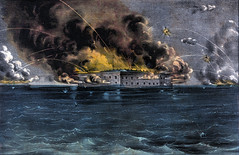
  • Battle of Fort Sumter. The war begins with Confederate forces firing on Fort Sumter, in the harbor of Charleston, South Carolina.
  • Beginning at 4:30 am on the 12th and continuing until the morning of the 13th, Confederate batteries along the shore of Charleston Harbor fire on Fort Sumter under the command of Major Robert Anderson.
  • Bombardment of Fort Sumter–actual commencement of the war–began at 4.30 A.M., and continued all day and at intervals during the night.1
  • Legislature of Pennsylvania voted $500,000 to arm the State.1
  • Fort Pickens reinforced by U. S. troops.1

  1. A Chronological History of the Civil War in America by Richard Swainson Fisher, New York, Johnson and Ward, 1863
0 comments

Key West Defense

War of the Rebellion: from the Official Records of the Union and Confederate Armies and Navies

HEADQUARTERS U. S. TRANSPORT SHIP ATLANTIC,
April 11, 1861.

Capt. E. B. HUNT, U. S. Engineers, Fort Taylor:

SIR: You will make a reconnaissance of the island of Key West with a view to the erection of any field-works which may be required to enable the garrison of Fort Taylor and of the town of Key West to prevent a hostile landing. In making this project you will consult with the commander of the forces in the island, and call upon him for any necessary assistance. The project, when complete, should be submitted to headquarters of the Department of Florida for further orders. You will, for fear of accident, make it in duplicate, retaining one copy and forwarding the other to said headquarters.

I am, sir, very respectfully, your obedient servant,

HARVEY BROWN,
Colonel, Commanding.

0 comments

The Impending War

Civil War Day-by-Day

April 11, 1861; The New York Herald

The News from Charleston.
The Latest.

CHARLESTON, April 10–Evening.
The floating battery finished, mounted and manned, was taken out of the dock last evening, and anchored in the cove near Sullivan’s Island.
Our people are not excited, but there is a fixed determination to meet the issue.
An additional regiment of one thousand men is hourly expected from the interior.
The Convention has just adjourned subject to the call of the President. Before adjourning it passed resolutions approving the conduct of General Twiggs in reseigning his commission and turning over the public property under his control to the authorities.
Governor Pickens was in secret session with the Convention today.
About 1,000 troops were sent to the fortifications today. 1,800 more go down tomorrow.
Messrs. Wigfall, Chesnut, Means, Manning, McGowan and Boyleston have received appointments in General Beauregard staff.
A large number of the members of the Convention, after adjournment, volunteered as privates.
About seven thousand troops are now at the fortifications. The beginning of the end is coming to a final end.
0 comments

Our Montgomery Correspondence

Civil War Day-by-Day

April 11, 1861; The Charleston Mercury

MONTGOMERY, April 8, 1861.
Several important items have been received today from New York, which have caused some excitement in this city. The most absurd rumors are afloat, and men are leaving for Pensacola on the strength of them. No important orders have been sent from the War Department to General BRAGG, neither has anything of a positive nature been received from Washington, unless it be in the despatches which came this evening, and upon which a Cabinet meeting was called. The result of this meeting is not known; but, of course, the surmises as to its import are many. There is little talked of here but Pensacola, and the prospects there.
The Georgia and Florida troops are <!–more–>passing through here at the rate of four hundred a day. They are all fine, noble looking men, and avow their anxiety to be in the field in the service of their country. They expect work at Pensacola and look forward with eagerness for the ball to open.
The offers of volunteers continue to pour in daily, and I am creditably informed that more than forty thousand men have offered themselves to the War Department as ready and willing to enter into the service of the Confederate States, or the Provisional Army. Since the result of the Connecticut election has been known, and the probability that the coercionists would prevail in the Government at Washington, a large number of companies have offered themselves from the Border States. No less than seven thousand men from these States have tendered their services during the last few days. In addition to these, two thousand Indian warriors, living on the border, have signified their intention of fighting against the United States army, and in favor of the Confederate States. The offers from the Confederate States is legion, and the department is overwhelmed with them. This is a voice direct from the people, and in case of the Border States, shows they are still with us in heart and feeling, though their politicians have forced them to occupy a false position.
But two appointments have been made since I wrote you before. A. J. CLARKE, of Mississippi, has been appointed Chief Clerk in the Comptroller’s Office, and Mr. JOHN L. HURRELL, Chief Clerk in the Finance Bureau in the Postoffice Department.
The duel between Messrs. MOSES, of South Carolina, and BANKS, editor of the Confederation, came off this morning at Pensacola. MOSES’ pistol snapped and his opponent’s ball passed through the collar of his coat. The affair was then settled satisfactorily, I believe, to all parties.
In view of the increased number of strangers in this city since it has become the seat of Provisional Government, and of the anticipated necessity for ample accommodations arising from the strong probability that it will be the permanent Capital, it has been projected by some of our most wealthy and enterprising citizens to erect a splendid hotel, which shall be an ornament and an honor to the city. The location selected is on the corner of Bibb and Commerce streets. It is intended that the building shall be the largest and most magnificent structure in the Southern States. I have not seen the plans, but doubt not it will be worthy the enterprise, wealth and liberality of this city, in the elegance of its design and the magnificence of its proportions.
TROUP
0 comments

“As we approached Richmond, it was observed that the people were more and more excited, and seemed to be pretty nearly unanimous for the immediate secession of the State.”—A Rebel War Clerk’s Diary.

Civil War Day-by-Day
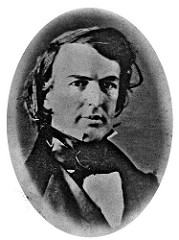
A likeness of Jones when he was editor and majority owner of the Daily Madisonian during President John Tyler’s administration.

April 10th and 11th–These two days were mainly lost by delays, the floods having swept away many bridges, which had not yet been repaired. As we approached Richmond, it was observed that the people were more and more excited, and seemed to be pretty nearly unanimous for the immediate secession of the State. Everywhere the Convention then in session was denounced with bitterness, for its adherence to the Union; and Gov. Letcher was almost universally execrated for the chocks he had thrown under the car of secession and Southern independence. I heard very many who had voted for him, regret that they had ever supported the clique of politicians who managed to secure his nomination. And now I learned that a People’s Spontaneous Convention would assemble in Richmond on the 16th of the month, when, if the other body persisted in its opposition to the popular will, the most startling revolutionary measures would be adopted, involving, perhaps, arrests and executions. Several of the members of this body with whom I conversed bore arms upon their persons.

0 comments

Programme of Operations to Relieve Fort Sumter

Civil War Day-by-Day

April 11, 1861; The New York Herald

The News from Washington.
WASHINGTON, April 10, 1861.
The refusal to admit Captain Talbot to Fort Sumter does not alarm the government in the least.
The commanders of the naval and military forces now supposed to be off Charleston received only general instructions from the respective departments. That is, they are instructed to attempt, first, a peaceable supply of Fort Sumter with provisions, but if resistance be offered to force a relief, with both men and stores, at all hazards. The details of the operations are left to their discretion as their character will depend, of course, altogether on contingencies. But it is known in military circles here that, for a succession of attempts to reach the fort, in case of hostilities, both steamtugs and boats are expected to be employed. As soon as the first shot is fired by the revolutionists, an attempt will be made to effect a landing of the troops on board the transports in the rear of the attacking forces, and, if successful, earth works will at once be thrown up and batteries erected. The heavy ordnance shipped on some of the vessels is intended for that purpose. Hot work will be given by the government regulars to the secession volunteers. [continue reading…]
0 comments

The Impending War

Civil War Day-by-Day

April 11, 1861; The New York Herald

The News from Charleston.
CHARLESTON, April 9, 1861.
Everything is quiet tonight as regards excitement. People are becoming accustomed to suspense, and nothing but sounds of actual battle will disturb the calm determination with which they await events.
The floating battery has been towed into position between Sullivan’s Island and Fort Sumter.
Senator Wigfall, of Texas, and Edmund Ruffin, of Virginia (nearly seventy years of age), shouldered muskets and joined the army as privates. Numbers of old men have done the same. Even cripples are anxious to fight, and may be seen riding with the cavalry.
The fleet is not yet in sight, but is expected off Stono tonight.
Troops continue to arrive in the city from the interior.
The Charleston Courier of Tuesday morning report the arrival of Lieutenant Talbot there on Monday. He had a conference with Governor Pickens and General Beauregard, but was not allowed to communicate with Major Anderson at Fort Sumter. Lieut. Talbot started back for Washington Tuesday night. It is understood that the nature of his conference with Governor Pickens and General Beauregard was to obtain permission for an unarmed storeship to victual the garrison at Fort Sumter. Permission was refused. It is generally believed that the unarmed storeship will be accompanied with a naval force. Every preparation is made to prevent any relief being sent into Fort Sumter.
CHARLESTON, April 10, 1861.
Everything is quiet tonight. The effect is momentarily looked for.
I have reason to state that, if battle results, Washington will be invested in less than sixty days.
Tremendous preparations are making throughout the South
There is also an assurance that the French and English governments will recognize the Southern confederacy as soon as it manifests the solidity and strength of a thoroughly organized government.
0 comments

The Relief of Fort Pickens

Civil War Day-by-Day

April 11, 1861; The New York Herald

The News From Washington.
WASHINGTON, April 10, 1861. Official advices from Lieutenant Slemmer confirm what I telegraphed you some ten days since upon the authority of a Cabinet officer. The Brooklyn was ordered to leave her troops at Fort Pickens, but did not land them, owing to the refusal of the commander to receive them. His reasons for this act were not disclosed to the War Department until a few days ago. They were, simply, that his supply of provisions was inadequate to the maintenance of the proposed increase of his command. The administration was greatly puzzled, in determining upon a line of action in regard to Fort Pickens, by this seemingly inexplicable movement of Lieutenant Slemmer. But, the mystery being solved, no time was lost in providing for his necessities. There can be no doubt that several of the transports which have sailed from New York since Saturday are bound for Pensacola bay, and that orders have been sent, not only to throw provisions, but also men, into the fort.
Lieutenant Slemmer’s despatches also corroborate my previous statement in reference to the relative danger in which Fort Pickens has been placed by its investment with Confederate troops. A communication can be readily effected with it by men of war, and even without reinforcements it would be in a condition to withstand a protracted siege.
0 comments

“The Cotton States are all up in Arms, while Ben McCulloch is threatening Washington. He is fearless and desperate.”—Horatio Nelson Taft

Diary of US patent clerk Horatio Nelson Taft.

THURSDAY 11

A delightful morning and a very pleasant day. City full of Military and full of excitement. Nothing heard from Charleston unusual, but news expected by tomorrow. Fort Sumpter, it is now thought, is without doubt to be relieved in some way. The Cotton States are all up in Arms, while Ben McCulloch is threatening Washington. He is fearless and desperate. Chas took dinner with us and came up in the evening with Miss Woodward and staid till 10. Sent young H N to the Ave for the NY papers early in the evening. Retired at 11 o’clock.


The three diary manuscript volumes, Washington during the Civil War: The Diary of Horatio Nelson Taft, 1861-1865, are available online at The Library of   Congress.

0 comments

The Way Government gets done is Curious

Civil War Day-by-Day
1860s newsprint

April 11, 1861; Daily Advocate (Baton Rouge, LA)

“Blynnks”–Who is an applicant for the Nashville Postoffice, in a letter written from Washington to the Nashville Patriot, thus show up the economy of the Federal Government:
The way the Government gets its work done is curious. As an illustration, you and your family meet in convention of the whole, and adopt a resolution authorizing the construction of a hencoop to your back yard. You at once appoint me superintendent of the work, putting a thousand or two dollars in bank for me to check on. I get you to appoint my brother-in-law chief engineer. I appoint two of my brothers assistant superintendents, and my brother-in-law appoints two of his brothers assistant engineers–all at your expense. We buy of each a fast horse and buggy, and ride around town, drink cocktails and play billiards, until the bank deposit gives out, when we make out a printed report of seventy three pages, furnishing you a complete topographical survey of your back yard, and a vast amount of statistical information with regard to the number of hens you are likely to have for the next forty years.
We wind up the report with the announcement that the site of the hencoop has been selected and a call for another appropriation to prosecute the work, which we assure you will be done with “vigor.” You place another thousand or two in bank, and we employ two hundred hands at three dollars a day to transport seventy-five cents worth of lumber, which costs you under our management about ten times that many dollars, to the place of operations, which requires about three months.
In the meantime we drive around and go on vigorously with the liquor and the billiards. We then come up with another report, and a demand for another appropriation. With this we get the walls of the structure up, and with one or two more appropriations, and a great many more cocktails and billiards, we get the thing covered in; and at the end of twelve months, which we very appropriately style our “fiscal year,” we put you in formal possession of a ten thousand dollar hencoop that any negro carpenter would have been glad to knock up some Saturday afternoon for a suit of your old clothes.
0 comments

The News from Washington

Civil War Day-by-Day

April 11, 1861; The New York Herald

WASHINGTON, April 10, 1861.
Washington bore a highly warlike aspect all day. Troops kept constantly marching through the streets, and drums and fifes were heard in every direction.
Intense commotion was produced this morning by the promulgation of an order calling out the entire militia of this district. A raid upon the federal capital by Virginia and Maryland filibusters was forthwith believed to be impending. It was soon ascertained, however, that the movement arose from precaution, and from the immediate necessity of means of defence.
The government is in possession of positive information, to the effect that there is a secret understanding between the disunion leaders and the revolutionary authorities at Montgomery, aiming at a demonstration against the federal capital in case of the secession of Virginia, and hence deemed it a duty to provide additional guaranties for the personal security of officials and citizens, and the protection of the public property in general, and more particularly of the treasury and the naval and military stores.
Some twenty companies were inspected at noon. At the parade it was announced that volunteers for the formation of seven companies would be called for, to enter the service of the United States for an indefinite period of time. Several hundred men were mustered into service in the course of the afternoon.
The troops will be employed to guard the public buildings. The report that they will be sent to garrison Fort Monroe is unfounded.
It is understood that Governor Curtin will order out Pennsylvania volunteers for the occupation of the capital upon the first sign of danger.
A leading Ohio democrat despatches today to the President as follows: – ‘We are for you to the death if you will hold Fort Sumter, the necessity of holding it is absolute.’
The warlike demonstrations in Washington today, consequent upon the mustering of ten of the volunteer companies of the District into the actual service of the United States, not only increased the general excitement, but gives confidence to the permanent residents and property holders of the federal capital in the government. The majority of the men composing the volunteers who have so gallantly entered the regular service are property holders in this district, and will prove loyal to the Union and the flag. Thirty two members of the national Rifles resigned, rather than remain in the ranks of the corps under the flag of the Union in the present emergency. They mostly, if not all, belong to Southern States.
0 comments

Defense of Fort Jefferson, Tortugas

War of the Rebellion: from the Official Records of the Union and Confederate Armies and Navies

HEADQUARTERS U. S. TRANSPORT SHIP ATLANTIC,
April 11, 1861.

Lieut. J. ST. C. MORTON,   Fort Jefferson, Tortugas:

SIR: You will act in concert with Major Arnold, commanding the harbor of the Tortugas, in preparing with the least possible delay projects for the complete temporary defense and occupation of the whole harbor of the Tortugas. The orders issued to Major Arnold, which he will exhibit to you, will impress you of the general project. Requisitions have been made upon the Ordnance Department for twenty to twenty-four heavy guns with barbette carriages and platforms of timber for these batteries. If these arrive they will be used. If ships arrive before them, the guns from the ships will be landed for this use, to be replaced by the Army pieces when received.

Orders have been issued to the commander of Fort Taylor to clear the brush and timber from a certain portion of the island of Key West. This brushwood will be used to make fascines, and will be transferred to the Tortugas upon requisition.

Relying upon your resources, energy, and intelligence for official professional aid in this matter,

I am, respectfully, your obedient servant,

HARVEY BROWN,
Colonel, Commanding.

0 comments

Take Measure for the Occupation of the Harbor of Tortugas

War of the Rebellion: from the Official Records of the Union and Confederate Armies and Navies

U. S. TRANSPORT SHIP ATLANTIC,
April 11, 1861.

Bvt. Maj. L. G. ARNOLD,   Commanding Fort Jefferson:

SIR: You will take measures for the occupation by sea-coast earthen batteries of all the points in the harbor of Tortugas necessary to secure a complete command of the anchorage and of the channels of entrance thereto. For this purpose you will consider that a certain number of sailing vessels of the Navy will be available. They will be moored in such positions as to command the anchorage and the passes, and will themselves be supported by the shore batteries. These batteries should be constructed to resist projectiles now used in our own and European navies, and should therefore be provided with earthen parapets of not less than twenty-four feet in thickness. It is considered that no battery should contain less than three pieces of heavy caliber, and that the means disposable will not permit more than three to be constructed at any one point. The batteries should be closed works capable of offering some resistance to a sudden assault; should contain bomb-proof magazines for a small supply of ammunition, renewable from the ships or from Fort Jefferson, and will be occupied by detachments from the crew, of the troops or the garrison of the fort, relieved at short intervals.

Sufficient shelter for the garrison must be provided. For this purpose temporary sheds of lumber will suffice. The guns should be mounted in barbette. They will be supplied either by the fleet or by the Ordnance Department. The works will be constructed of the materials to be found on the spot, sand and fascines or gabions. Timber will be supplied from   the public stores for the platforms, magazines, &c.

The points to which your attention is particularly directed as probable to be occupied are Bird Key, Sand Key, Loggerhead Key, East Key, Middle Key, and Bush Key. The construction of their outlines should be commenced at once, in order that they may be ready to receive the guns as soon as they arrive. In their construction your command will be employed. The Engineer officers at Fort Jefferson will be called upon by you for their professional advice and assistance in this matter.

Plans, as soon as prepared, should be forwarded to the headquarters of the department for consideration and approval, but you will not wait for this approval of the complete system to commence the works.

The first point on which to commence work is Bird Key.

Respectfully, your obedient servant,

HARVEY BROWN,
Colonel, Commanding.

0 comments

“Gentlemen, if you do not batter the fort to pieces about us, we shall be starved out in few days.”

War of the Rebellion: from the Official Records of the Union and Confederate Armies and Navies

HEADQUARTERS PROVISIONAL FORCES, C. S. A.,
Charleston, S.C., April 11, 1861.

SIR: In obedience to the orders of Brigadier-General Beauregard, we left headquarters at 2.20 p.m., charged with a communication from him to Major Anderson, at Fort Sumter, in which we were authorized to demand the evacuation of the fort. We arrived there at 3.45 p.m., under a white flag. Lieutenant Davis, the officer of the day, received us very politely, and on being informed that we had a message in writing for Major Anderson which we desired to deliver in person to the officer in command of the fort, conducted us into the presence of Major Anderson. We were welcomed by the major with great courtesy, who, after receiving and reading our communication, left us to consult with his officers. About 4.30 he again joined us, bringing his reply, the contents of which he stated to us, after which, and but a short time before departing, we held a short conversation with him, in the course of which he made the following remarks: “Gentlemen, if you do not batter the fort to pieces about us, we shall be starved out in few days.” These words, under the circumstances, seemed to have much significance, and to be of sufficient importance to induce us to report them particularly. We took leave of Major Anderson and the fort at 4.40 p.m., and reached the city at 5.10 p.m. We verbally reported immediately at headquarters the substance of what is written above.

All of which is respectfully submitted for the information of the brigadier-general commanding.

JAMES CHESNUT,

Aide-de-Camp.

STEPHEN D. LEE,

Captain C. S. Army, Aide-de-Camp.

A. R. CHISOLM,

Lieutenant-Colonel and Aide-de-Camp.

Maj. D. R. JONES,

Adjutant-General of the Provisional Forces, C. S. A., Charleston, S. C.

0 comments

Lincoln’s Policy Defined

Civil War Day-by-Day
April 11, 1861; Richmond Enquirer
All doubt as to the intention of the Lincoln Government with regard to the Southern forts is at length removed. The authoritative declaration has been made that Fort Sumter is to be re-inforced at all hazards, and a fleet of seven war vessels is now in Charleston Harbor engaged in the attempt to make good the declaration. It is also announced, by authority, that all forts now in the occupancy of the Southern Confederacy are to re-captured, and that all Southern posts in the possession of the Black Republican Government are to be defended to the last extremity. Thus it appears that Lincoln has defined his policy towards the Southern States in the most unambiguous manner. He defines, by a blood line, the boundary between the Southern Confederacy and the ‘United States’ that acknowledge his authority as ruler.
We have not, at any time, doubted either the willingness or the desire of Mr. Lincoln and his Cabinet advisers to adopt the dreadful policy to which they have now committed themselves; because, like our friend of the New Orleans Bulletin, we believed them capable of any enormity; but, like the editor of that paper, we find it difficult to bring our mind to the conclusion that President Lincoln, Premier Seward, and Mars Cameron could conceive such a piece of fatuity and madness, as to take the initiative in an actual hostile demonstration against the South. As a measure of policy it must, in any and every contingency, result most disastrously to them and to the Government of which they are the recognized heads. The resort to force necessitates the withdrawal of the border slave States. The ‘Tyranny at Washington’ undertake to wreak their vengeance upon the seceded States, with a reckless and wicked disregard of all consequences. They will soon be taught to feel quite sensitively the truth of the old adage, is the first step that costs.
We say, that the war declared by the Lincoln administration against the Southern Confederacy necessitates the withdrawal of the border slave States from the abolitionized Union. This is a proposition which does not admit of debate. Those States have now to decide between fighting, literally, with their brethren of the Confederate States, in favor of the institutions of the South, or fighting with the Black Republicans in their war to put down the institutions of the South. Is there, can there be a doubt as to the course which any slaveholding State will adopt?
0 comments