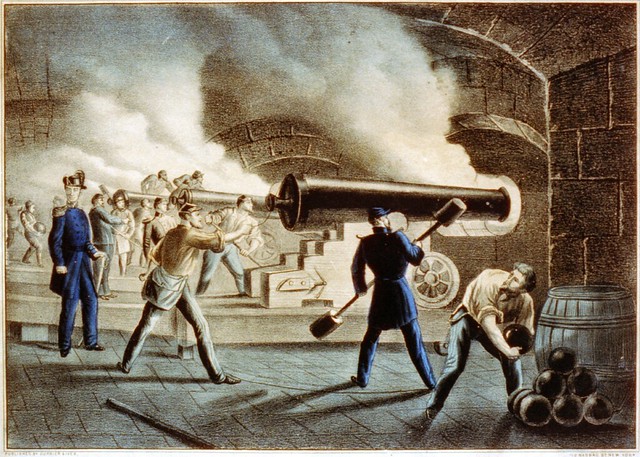
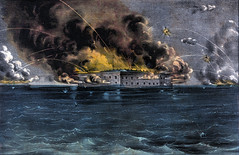
Title: Interior of Fort Sumter: during the bombardment, April 12th, 1861
Creator(s): Currier & Ives.
Title: Interior of Fort Sumter: during the bombardment, April 12th, 1861
Creator(s): Currier & Ives.
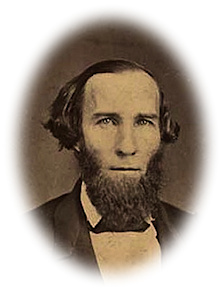
MONTGOMERY, April 12, 1861.
General BRAGG, Pensacola:
Lieutenant Worden1, of U. S. Navy, has gone to Pensacola with dispatches. Intercept them.
L. P. WALKER.
——–
BARRANCAS, April 12, 1861.
Hon. L. P. WALKER:
Mr. Worden had communicated with fleet before your dispatch received. 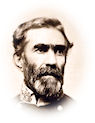 Alarm guns have just fired at Fort Pickens. I fear the news is received and it will be re-enforced before morning. It cannot be prevented. Mr. Worden got off in cars before I knew of his landing. Major Chambers is in the cars. He will watch Mr. Worden’s movements. If you deem it advisable, Mr. Worden can be stopped in Montgomery.
BRAXTON BRAGG,
Brigadier-General.

FRIDAY 12
It has been rainy the latter part of the day and rains hard tonight. Went with Juliet and the boys to see the soldiers over to the Long Bridge. Nothing but the guard there. Visited the City Armory, a company of U.S. Artillery stationed there. The Military companies are now divided and stationed at various points all over the City. Treason is in our midst. One hardly knows whom to trust. But I speak my own sentiments freely as I have all the time and denounce “seceders” as Traitors. Went down to the Ave & got the NY papers. It is said today that Fort Sumpter has been provisioned without bloodshed.
The three diary manuscript volumes, Washington during the Civil War: The Diary of Horatio Nelson Taft, 1861-1865, are available online at The Library of Congress.
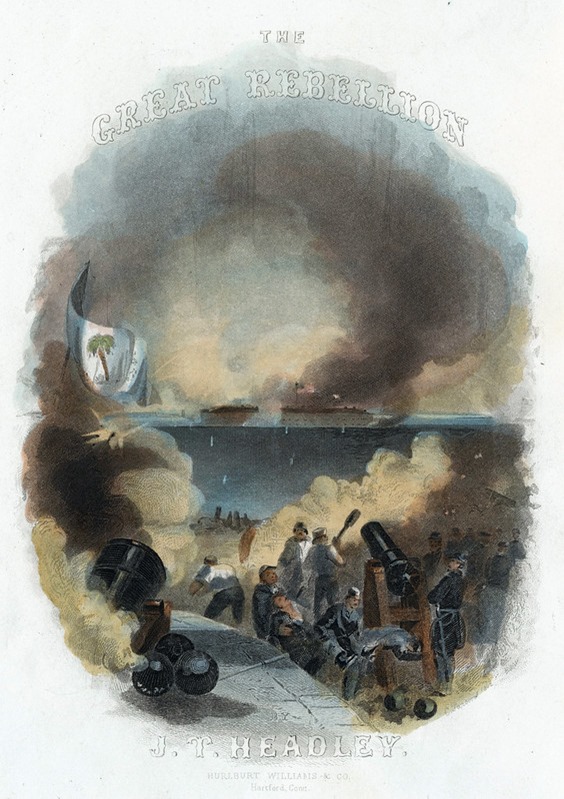
Bombardment of Fort Sumter
Vignette title page image from J. T Headley’s 1898 The Great Rebellion: A History of the Civil War in the United States
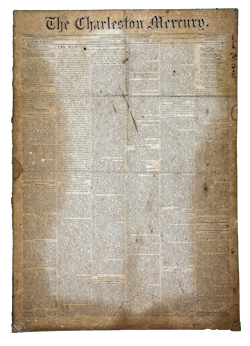
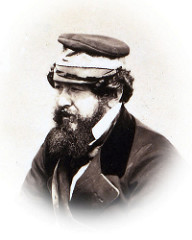
April 12th.—This morning I received an intimation that the Government had resolved on taking decisive steps which would lead to a development of events in the South and test the sincerity of Secession. The Confederate general at Charleston, Beauregard, has sent to the Federal officer in command at Sumter, Major Anderson, to say, that all communication between his garrison and the city must cease; and, at the same time, or probably before it, the Government at Washington informed the Confederate authorities that they intended to forward supplies to Major Anderson, peaceably if permitted, but at all hazards to send them. The Charleston people are manning the batteries they have erected against Sumter, have fired on a vessel under the United States flag, endeavoring to communicate with the fort, and have called out and organized a large force in the islands opposite the place and in the city of Charleston.
I resolved therefore to start for the Southern States to-day, proceeding by Baltimore to Norfolk instead of going by Richmond, which was cut off by the floods. Before leaving, I visited Lord Lyons, Mr. Seward, the French and Russian Ministers; left cards on the President, Mrs. Lincoln, General Scott, Mr. Douglas, Mr. Sumner, and others. [continue reading…]
The News From Washington.
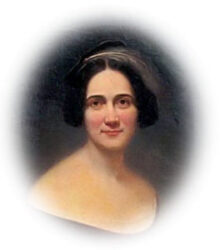
April 12th.–Anderson will not capitulate. Yesterday’s was the merriest, maddest dinner we have had yet. Men were audaciously wise and witty. We had an unspoken foreboding that it was to be our last pleasant meeting. Mr. Miles dined with us to-day. Mrs. Henry King rushed in saying, “The news, I come for the latest news. All the men of the King family are on the Island,” of which fact she seemed proud.
While she was here our peace negotiator, or envoy, came in–that is, Mr. Chesnut returned. His interview with Colonel Anderson had been deeply interesting, but Mr. Chesnut was not inclined to be communicative. He wanted his dinner. He felt for Anderson and had telegraphed to President Davis for instructions–what answer to give Anderson, etc. He has now gone back to Fort Sumter with additional instructions. When they were about to leave the wharf A. H. Boykin sprang into the boat in great excitement. He thought himself ill-used, with a likelihood of fighting and he to be left behind!
I do not pretend to go to sleep. How can I? If Anderson does not accept terms at four, the orders are, he shall be fired upon. I count four, St. Michael’s bells chime out and I begin to hope. At half-past four the heavy booming of a cannon. [continue reading…]
MONTGOMERY, April 12, 1861.
General BEAUREGARD, Charleston, S. C.:
What was Major Anderson’s reply to the proposition contained in my dispatch of last night!
L. P. WALKER.
—–
CHARLESTON, S. C., April 12, 1861.
L. P. WALKER:
He would not consent. I write to-day.
G T. BEAUREGARD
—–
HEADQUARTERS PROVISIONAL FORCES,
Charleston, 8. C., April 12, 1861.
Hon. L. P. WALKER, Secretary of War:
SIR: I have the honor to transmit the [continue reading…]
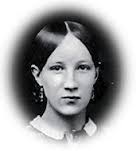
April 12. – We went down town this morning and bought us some shaker bonnets to wear to school. They cost $1 apiece and we got some green silk for capes to put on them. We fixed them ourselves and wore them to school and some of the girls liked them and some did not, but it makes no difference to me what they like, for I shall wear mine till it is worn out. Grandmother says that if we try to please everybody we please nobody. The girls are all having mystic books at school now and they are very interesting to have. They are blank books and we ask the girls and boys to write in them and then they fold the page twice over and seal it with wafers or wax and then write on it what day it is to be opened. Some of them say, “Not to be opened for a year,” and that is a long time to wait. If we cannot wait we can open them and seal them up again. I think Anna did look to see what Eugene Stone wrote in hers, for it does not look as smooth as it did at first. We have autograph albums too and Horace Finley gave us lots of small photographs. We paste them in the books and then ask the people to write their names. We have got Miss Upham’s picture and Dr and Mrs Daggett, General Granger’s and Hon. Francis Granger’s and Mrs Adele Granger Thayer and Friend Burling, Dr Jewett, Dr Cheney, Deacon Andrews and Dr Carr, and Johnnie Thompson’s, Mr Noah T. Clarke, Mr E. M. Morse, Mrs George Willson, Theodore Barnum, Jim Paton’s and Will Schley, Merritt Wilcox, Tom Raines, Ed Williams, Gus Coleman’s, W. P. Fisk and lots of the girls’ pictures besides. Eugene Stone and Tom Eddy had their ambrotypes taken together, in a handsome case and gave it to Anna. We are going to keep them always.
HEADQUARTERS STEAMSHIP ATLANTIC,
Off Key West, April 12, 1861.
Lieut. Col. E. D. KEYES,
Secretary to General-in-Chief, Washington, D.C.:
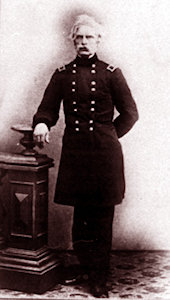
COLONEL: In obedience to the special instructions of the General-in-Chief, I proceeded to New York on the 2d, and arrived there on the morning of the 3d instant, and was engaged until Saturday, the 6th, in preparing for this expedition. On the afternoon of that day Barry’s battery (Company A, Second Artillery), Hunt’s company (M, Second Artillery), Duane’s company of Sappers and Miners, and Companies C and E (Johns’ and Clitz’s), Third Infantry, and twenty Engineer carpenters were embarked on board the steamship Atlantic, Captain Gray. We hauled out in the stream at dark, but continued to take in cargo through the night, and on Sunday morning at 3 ½ weighed anchor and went to sea. On Tuesday and Wednesday we had a heavy gale, dead ahead, the horses of the battery suffering very much from the heavy sea, the wet, and the cold, and were preserved only by the substantial excellence of our ship and the vigilant care of the officers. Only two died during the gale, and the rest are doing well. My command are all healthy and in good spirits.
I have directed Lieutenant Balch, ordnance officer, to make on the proper offices requisitions for various articles which were not to be procured at our departure. I respectfully urge that they be sent immediately.
I ordered the purchase of two 6-pounder rifled guns, which are said to be at Fort Columbus, and that a 42-pounder rifled gun, also at that post, be sent, with all the necessary implements and projectiles, by the first vessel. I have also directed Lieutenant Balch to make a special estimate of guns for Fort Jefferson, which may be of vital importance, and which should be furnished without delay.
I would respectfully and earnestly urge that six 42-pounder rifled guns, with implements complete, and one thousand rounds of ammunition to each gun, as specified in the requisition of Lieutenant Balch, be immediately prepared and sent by steamer to Fort Pickens. Their value will be inestimable. With them we shall be able to act, if need be, with great efficiency against Fort McRee, Barrancas, and the navy-yard, and place our opponents from an offensive to a defensive position. I earnestly solicit the approbation of the General-in-Chief on this subject, and that the guns may be prepared and sent by steam without a moment’s delay. James’ apparatus for rifling guns is at Fort Columbus, and the guns, if diligence be exercised, may be prepared for shipment in a week.
We go into Key West for two or three hours on important duty enjoined by the General-in-Chief, and from thence to Fort Jefferson for some indispensable articles, where we shall be delayed only a short time, and shall then proceed to our destination.
I am, sir, very respectfully, your obedient servant,
HARVEY BROWN,
Colonel, Commanding.
WASHINGTON, D.C., April 12, 1861.
Hon. SIMON CAMERON, Secretary of War:
SIR: I have the honor to report that in obedience to your instructions, dated April 6, 1861, I left Washington on the evening of the same day in company with Mr. R. S: Chew, and arrived at Charleston, S.C., on the evening of the 8th instant. Immediately after my arrival I visited Governor Pickens, and, having informed him of the nature of my written instructions, stated that Mr. Chew had requested me to ask his excellency for an interview at his earliest convenience. The governor replied that he would receive Mr. Chew at once, and shortly after I accompanied Mr. Chew to the governor’s quarters. Mr. Chew read to the governor, in my presence, a message from the President of the United States, handing him a copy of the same, which was compared by the governor. The governor stated to Mr. Chew that, South Carolina having ratified the constitution of the Confederate States, General Beauregard now had charge of military affairs in the vicinity of Charleston, and that, as General Beauregard was near at hand, he would desire to have him present at the interview. To this Mr. Chew assented, and General Beauregard having been called into the room, the governor read and handed to him the copy of the message which he had just received.
In compliance with your verbal instructions, I asked Governor Pickens if I would be permitted to proceed to Fort Sumter for the purpose of remaining on duty at that post. The governor referred me to General Beauregard for an answer, by whom the request was peremptorily refused. I then asked if I would be permitted to hold communication with Major Anderson at Fort Sumter, with the distinct understanding that after such interview I should immediately return to Charleston. This was also refused, General Beauregard remarking that no communication whatever would be permitted with Major Anderson, except to convey an order for the evacuation of the fort, such being the instructions received from Montgomery
I then informed Governor Pickens and General Beauregard that I had no further official business to transact with them, and that it was the desire of Mr. Chew and myself to start North that night. Both replied that there would be no obstruction to our departure, and each of them detailed an officer of the staff to escort us to the railroad depot. We left Charleston at 11 o’clock p.m. on the 8th instant, arriving here this morning. We were detained several hours at Florence, S.C., and at Richmond, Va., in consequence of the railway trains failing to connect at those places. I brought back with me the sealed dispatch for Major Anderson, intrusted to my care by the President.
I am, sir, very respectfully, your obedient servant,
THEO. TALBOT,
Brevet Captain, Assistant Adjutant-General, U.S. Army.
HEADQUARTERS PROVISIONAL FORCES,
Charleston, S.C., April 12, 1861.
SIR: We have the honor to submit the following report of our movements and action:
After leaving the brigadier-general commanding last night, at 11 o’clock p.m. in obedience to orders we repaired with the second communication to Major Anderson, at Fort Sumter. This communication was based on the telegram from Hon. L. P. Walker, expressing a desire not to injure the fort unnecessarily, and wishing to make another effort to avoid any useless effusion of blood. We reached Fort Sumter at 12.45 a.m., delivered the communication, and received Major Anderson’s reply at 3.15 a.m. He expressed his willingness to evacuate the fort on the 15th instant at noon, if provided with the necessary means of transportation, if he should not receive prior to that time contradictory instructions from his Government or additional supplies, and that he would not in the mean time open his fire upon our forces unless compelled to do so by some hostile act against his fort or the flag of his Government by the forces under General Beauregard’s command, or by any portion of them, or by the perpetration of some act showing a hostile intention on our part against his fort or the flag it bears. His reply, which was shown to us, plainly indicated that if instructions should be received contrary to his purpose to evacuate, or if he should receive supplies, or if the Confederate troops should fire on hostile troops of the United States, or upon transports covered by his flag, although containing men, munitions, and supplies intended for him, and designing hostile operations against us, he would still feel himself bound to fire upon us, and at liberty not to evacuate Fort Sumter.
These terms being manifestly futile so far as we were concerned., placing us rather at a great disadvantage, and not within the scope of the instructions verbally given us, we promptly refused them and declined to enter into any such arrangements. Under these circumstances, pursuing our instructions, we notified him at once in writing that our batteries would open fire upon him within an hour from that time, which would be at 4.20. We then proceeded at once to Fort Johnson which we reached at 4 a.m., and to Capt. George S. James, commanding at that post, gave the order to open fire at the time indicated. His first shell was fired at 4.30 a.m., the other batteries generally opening at 4.45 a.m. We were delayed at Fort Sumter longer than we expected, and we think longer than was necessary to decide upon the communication we received, and so indicated to Major Anderson; but this delay we could not avoid. Immediately upon leaving Fort Johnson we reported to General Beauregard, at his office, about daylight.
All of which is respectfully submitted for the information of the brigadier-general commanding.
JAS. CHESNUT, JR.,
Aide-de-Camp.
STEPHEN D. LEE,
Captain, C. S. Army, Aide-de-Camp.
A. R. CHISOLM,
Lieutenant-Colonel and Aide-de-Camp.
Maj. D. R. JONES,
Adjutant-General of Provisional Forces, Charleston, S.C.