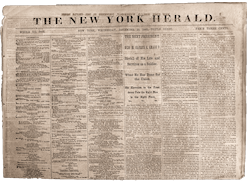
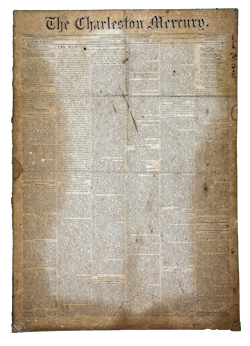
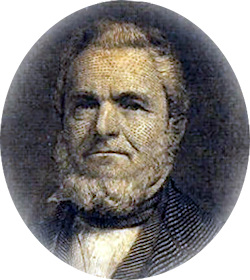
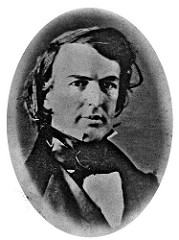
“Everybody much excited, and all will soon be compelled to “show their hands,” for or against the Union.”—Horatio Nelson Taft

Diary of US patent clerk Horatio Nelson Taft.

SATURDAY, APRIL 13, 1861.

This has been the most exciting day yet. The last report about the provisioning Ft Sumpter was untrue and today or early this morning news came that the Rebels were bombarding it and tonight the report is that Maj Anderson has surrendered, it being on fire. The last report is not generaly credited. Even if true, it is not astonishing. The Rebels have ten thousand men & nineteen Batteries. Anderson had 70 men only. I went on to the Ave after 3 o’clock, a great crowd round all the Printing or News paper offices. Everybody much excited, and all will soon be compelled to “show their hands,” for or against the Union.


The three diary manuscript volumes, Washington during the Civil War: The Diary of Horatio Nelson Taft, 1861-1865, are available online at The Library of   Congress.

0 comments

The News from Washington

Civil War Day-by-Day
April 13, 1861; The New York Herald
WASHINGTON, April 12, 1861.
Up to three o’clock P.M. the government has no reliable news from Charleston. The telegraph is working for business purposes. The writer received a despatch from Charleston this morning, from a reliable source, saying, “No signs of the supply ships yet.”
The President has received a despatch from Charleston this morning, stating that orders were received there from President Davis not to fire on any supply vessel. The President places no reliance upon the statement.
The opinion generally entertained here is, that the recent storm must have reached the coast, and probably drove the fleet out to sea, but the belief is that it will arrive some time today.
Joel Dwight has been appointed Superintendent of the Springfield (Mass.) Armory, vice Col. Isaac H. Wright. There are now seventy thousand first class arms in the above named armory, and the work shops are very active, the number of arms manufactured each week being greatly increased.
Colonel Ripley, who had leave of absence for two years, to inspect the Ordnance Departments of the European governments, hearing of our national difficulties, at Alexandria, in Egypt, threw up his privilege to travel in Europe, and has returned home to share the fortunes of his countrymen in the Union and under the Union flag.
0 comments

Glorious News!

Louise Wigfall Wright — A Southern Girl in ’61

“Saturday, April 13.

        “The news is glorious for us. No one hurt on our side, and no damage of any consequence to our batteries. Your father has been at Morris’s Island all yesterday, and all night. He however wrote me not to expect him and I did not feel uneasy, as Captain Hartstein told me it was utterly impossible for boats to land with such a high sea. This morning Fort Sumter is on fire (produced from the shells it is thought). They say the flag is at half mast and has been so all the morning—a sure sign of distress. The fleet will try to relieve him, of course, but it will be in vain, and thus, I trust in God, this business will end. Heaven has favored our side, and we are all grateful to a Kind Providence. I doubt if your father returns before night.”

0 comments

The Bombardment of Fort Sumter, Sketched from Morris Island, Charleston Harbor, S.C.

Miscellaneous document sources
The Bombardment of Fort Sumter, Sketched from Morris Island, Charleston Harbor, S.C.

Frank Leslie’s The Soldier in Our Civil War, Vol. I.; The Stanley Bradley Publishing Company, Incorporated.

0 comments

Beauregard’s Staff

Civil War Day-by-Day
April 13, 1861; The Charleston Mercury

GEN. BEAUREGARD, we learn, has attached to his staff Hon. ROGER A. PRYOR, of Virginia, and Hon. WM. PORCHER MILES, volunteering their services; and these gentlemen, in addition to Hon. LOUIS T. WIGFALL, Hon. JAMES CHESNUT and Hon. JOHN L. MANNING, with the regular army staff appointments, were all busy yesterday in bearing despatches to the various military posts, sometimes incurring the risk of a stray ball sent from Sumter.

0 comments

Gazaway B. Lamar to Howell Cobb.

Miscellaneous document sources

Gazaway B. Lamar to Howell Cobb.

Bank of the Republic,
New York, Apl. 13, 1861.

Dr. Sir: We have just learned by telegram of the bombardment and surrender of Fort Sumter.

Strange as it may seem to you, it is true that the people of this city who have professed to sympathise with the South have recently changed their expressions to hostility, some for one cause and some for another, and more so since the fleet left a week ago for Charleston. Even many influential Democrats have changed and there are very few reliable. The masses may feel differently, but they are led by a few corrupt, spoils-seeking rascals, and will go with them for or against the South as they may be led.

You may calculate that you may have to fight out and fight long too. And Prest. Davis should enlist and accept all the Volunteers he can from Kentucky and the other border States—which will incline all of each State that way. . . .

The Constitution ought on many considerations to be submitted to the vote of the people

1st. In order to clinch the people to its support through evil as well as good report. [continue reading…]

0 comments

Incidents

Civil War Day-by-Day
April 13, 1861; The Charleston Mercury
Two companies of volunteers passed THE MERCURY office at three o’clock yesterday, with their banners flying, and tendered us a salute, for which we return our compliments.
Two members of the Palmetto Guard paid fifty dollars cash for a boat to carry them to Morris Island, to join their company.
The Battery, the wharves and shipping in the harbor, and every steeple and cupalo in the city, were crowded with anxious spectators of the great drama. Never before had such crowds of ladies without attendants visited our thoroughfares.
Business was entirely suspended. The stores on King street, Meeting street and East Bay were all closed.
Dr. SALTERS, the ‘Jasper’s correspondent of the New York Times, was arrested, and locked up in the Guard House, where he yet remains.
One of our special reporters to Fort Moultrie brought a trophy of war, in the shape of a 32 pound ball, which ANDERSON had fired at Moultrie, and which lodged in the sandbags. It may be seen at our office.
Another of our reporters has circulated the number of pounds of balls fired by both sides up to seven o’, the hour at which Fort Sumter ceased firing. He gives as a total 75,000 pounds or over thirty-six tons of iron.
It was currently rumored that the Harriet Lane was crippled by the Star of the West Battery, while trying to run in yesterday morning, but that the Harriet Lane pursued the course of her predecessor, and put back to sea minus one wheel.
0 comments

Beauregard requests a “clear and concise statement of the main facts of yesterday’s proceedings” from Wigfall

Louise Wigfall Wright — A Southern Girl in ’61

“My dear Colonel:
“Will you do me the favor to prepare for the files of my office a clear and concise statement of the main facts of yesterday’s proceedings, so far as they related to yourself, and to Sumter, for use hereafter if required.

“Yours truly,
G. T. BEAUREGARD.”

__________________

“Head Quarters, Confederate States Army,
“CHARLESTON, South Carolina,
“April 13, 1861.

“Major:
“I have the honor to report that between one and two o’clock this afternoon, the flag having fallen at Fort Sumter, and its fire having ceased, I left Morris’s Island, with the consent and approval of General Simons to demand the surrender of the work, and offer assistance to the garrison.

“Before reaching the Fort the flag was again raised. On entering the work I informed Major Anderson of my name and position on the staff of the Commanding General, and demanded the surrender of the Fort to the Confederate States. [continue reading…]

0 comments

Battle of Fort Sumter: Police-Sergeant Hart nailing the flag to a temporary flagstaff

Miscellaneous document sources


HONORING THE LIFE OF SERGEANT PETER HART

______

HON. STEVE ISRAEL
of New York
in the House of Representatives
Wednesday, April 13, 2011

Mr. ISRAEL. Mr. Speaker, I rise today to pay special tribute to the life and legacy of Sergeant Peter Hart, a soldier and New York City Police Officer, who served in the American Civil War.

Sergeant Hard will be remembered for valiantly leaving New York to join in the defense of Fort Sumter in January 1861. Major Robert Anderson, Commander of Fort Sumter, had served with him in the Mexican American War. As tensions between the North and South increased, Major Anderson’s wife requested Sergeant Hart join the defense of Fort Sumter. Early in the morning of April 12, 1861 the first shots of the American Civil War rang out. By afternoon the shelling had knocked the American flag from the flagstaff flying over the fort. Sergeant Hart proudly retrieved the fallen flag, climbed up the flagstaff and successfully reattached it. His refusal to allow the flag to lie torn and tattered serves as a symbol of the unwavering spirit of all Americans who defend our Nation in the Civil War.

I offer my recognition of Sergeant Peter Hart on the 150th anniversary of the start of the American Civil War. Sergeant Hart’s courage not only inspired the brave men at Fort Sumter. His patriotic spirit and devotion to our Nation continues to inspire Americans today.

1 comment

Bombardment of Fort Sumter

Civil War Day-by-Day
April 13, 1861; The New York Herald
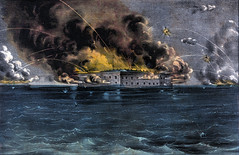
Civil war has begun! General Beauregard, in accordance with instructions received on Wednesday, from the Secretary of War of the Southern confederacy, opened fire upon Fort Sumter yesterday morning, at twenty seven minutes after four o’clock. Forts Johnson and Moultrie, the iron battery at Cummings’ Point, and the Stevens Floating Battery, kept up an active cannonade during the entire day, and probably during the past night. The damage done to Fort Sumter had been, up to the last accounts considerable. Guns had been dismounted, and a part of the parapet swept away.
Major Anderson had replied vigorously to the fire which had been opened upon him, but our despatches represent the injury inflicted by him to have been but small. The utmost bravery had been exhibited on both sides, and a large portion of the Charleston population, including five thousand ladies, were assembled upon the Battery to witness the conflict.
Down to our latest advices the battle had been carried on solely by the batteries of the revolutionists and Fort Sumter. [continue reading…]
0 comments

Rebel War Clerk

Civil War Day-by-Day
A likeness of Jones when he was editor and majority owner of the Daily Madisonian during President John Tyler’s administration.

April 13th – After breakfast I accompanied Gov. Wise to his room. He advised me to remain a few days before proceeding elsewhere. He still doubted, however, whether Virginia would move before autumn. He said there was a majority of 500 Union men then in the city. But the other Convention, to meet on the 16th, might do something. He recommended me to a friend of his who distributed the tickets, who gave me a card of admission.

0 comments

The Bombardment of Fort Sumter

Civil War Day-by-Day
April 13, 1861; The Charleston Mercury
Splendid Pyrotechnic Exhibition. Fort Moultrie Impregnable. The Floating Battery And Stevens’ Battery a Success. ‘Nobody Hurt’ on Our Side, ETC., ETC., ETC.
As may have been anticipated from our notice of the military movements in our city yesterday, the bombardment of Fort Sumter, so long and anxiously expected, has at length become a fact accomplished. The restless activity of the night before was gradually worn down, the citizens who had thronged the battery through the night, anxious and weary, had sought their homes, the Mounted Guard which had kept watch and ward over the city, with the first grey streak of morning were preparing retire, when two guns in quick succession from Fort Johnson announced the opening of the drama.
Upon that signal, the circle of batteries with which the grim fortress of Fort Sumter is beleaguered opened fire. The outline of this great volcanic crater was illuminated with a line of twinkling lights; the clustering shells illuminated the sky above it; the balls clattered thick as hail upon its sides; our citizens, aroused to a forgetfulness of their fatigue through many weary hours, rushed again to the points of observation; and so, at the break of day, amidst the bursting of bombs, and the roaring of ordinance, and before thousands of spectators, whose homes, and liberties, and lives were at stake, was enacted this first great scene in the opening drama of what, it is presumed, will be a most momentous military act. It may be a drama of but a single act. The madness which inspires it may depart with this single paroxysm. It is certain that the people of the North have rankling at their hearts no sense of wrong to be avenged; and exhibiting to those who expect power to reconstruct the shattered Union, its utter inadequacy to accomplish a single step in that direction, the Administration of the old Government may abandon at once and forever its vain and visionary hope of forcible control over the Confederate States. But it may not be so; they may persist still longer in assertions of their power, and if so, they will arouse an independent spirit in the South, which will exact a merciless and fearful retribution.
But to return to our report. The act which we have undertaken to record was so unique as might be supposed there were few incidents to mark it. Below we have presented the reports as they successively arrived from the different batteries, and which when placed on our bulletin board, were received with the most eager interest by the mass of anxious friends who at every instant of the day came crowding to our office.
There were several circumstances, however, developed by the day’s experience which it is important to notice.
It affords us infinite pleasure to record that Fort Moultrie has fully sustained the prestige of its glorious name. It fired very nearly gun for gun with Fort Sumter. We counted guns from eleven to twelve o’clock, and found them to be 42 to 46, while the advantage was unquestionably upon the side of Fort Moultrie. In that fort not a gun was dismounted, not a wound received, not the slightest permanent injury sustained by any of its defences, while every ball from Fort Moultrie left its mark upon Fort Sumter. Many of its shells were dropped into that fort, and Lieut. JOHN MITCHELL, the worthy son of that patriot sire, who has so nobly vindicated the cause of the South, has the honor of dismounting two of its parapet guns by a single shot from one of the Columbiads, which at the time he had the office of directing.
The famous iron batteries–the one at Cummings’ Point – named for Mr. C.H. STEVENS, the inventor, and the celebrated Floating Battery, constructed under the direction of Capt. HAMILTON, have fully vindicated the correctness of their conception. Shot after shot fell upon them and glanced harmless away, while their favorable position their shots fell with effect upon Fort Sumter, and the southeast pancopee, under the fire of the STEVENS’ battery, at nightfall, if not actually breached, was badly damaged. At this battery the honor of firing the first gun was accorded to the venerable EDMUND RUFFIN, of Virginia, who marched to the rendezvous at the sound of the alarm on Monday night, and who, when asked by some person who did not know him, to what company he belonged, replied, that in which there is a vacancy.
It were vain to attempt an exhibition of the enthusiasm and fearless intrepidity of our citizens in every department of this eventful day. Boats passed from post to post without the slightest hesitation under the guns of Fort Sumter, and with high and low, old and young, rich and poor, in uniform or without, the common wish and constant effort was to reach the posts of action; and amid a bombardment resisted with the most consummate skill and perseverance, and with the most efficient appliances of military art and science, it is a most remarkable circumstance, and one which exhibits the infinite goodness of an overruling Providence, that, so far as we have been able to learn from the most careful inquiry, not the slightest injury has been sustained by the defenders of their country.
It may be added, as an incident that contributed no little interest to the action of the day, that from early in the forenoon three vessels-of-war, two of them supposed to be the Harriet Lane and Pawnee, lay just beyond the bar, inactive spectators of the contest. Whether they will attempt to enter during the night and encounter the batteries on either side that line the shore, is yet to be determined; if so we will present the record of a bloody issue in our next.
Fort Sumter did not return the fire of our batteries for over two hours, and ceased firing at seven o’clock, p.m., though our men continued to the hour of our going to press.
Annexed are the reports above referred to, which appeared on our Bulletin.

0 comments

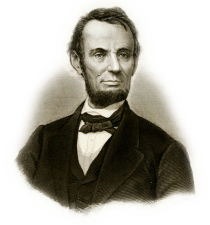
President Lincoln’s Response to the Virginia Commissioners.

Life and Public Services of Abraham Lincoln: Sixteenth President of the United States; and Commander-in-chief of the Army and Navy of the United States

On the 13th of April, 1861, Messrs. Preston Stuart and Randolph, a committee appointed by the Virginia Convention, were formally received by the President, and presented the resolutions under which they were appointed. In response, Mr. Lincoln made the following address:

Gentlemen: As a committee of the Virginia Convention, now in session, you present me a preamble and resolution in these words:
‘Whereas, in the opinion of this Convention, the uncertainty which prevails in the public mind as to the policy which the Federal Executive intends to pursue towards the seceded States is extremely injurious to the industrial and commercial interests of the country, tends to keep up an excitement which is unfavorable to the adjustment of the pending difficulties, and threatens a disturbance of the public peace; therefore,
‘Resolved, That a committee of three delegates be appointed to wait on the President of the United States, present to him this preamble, and respectfully ask him to communicate to this Convention the policy which the Federal Executive intends to pursue in regard to the Confederate States.’
In answer I have to say, that having, at the beginning of my official term, expressed my intended policy as plainly as I was able, it is with deep regret and mortification I now learn there is great and injurious uncertainty in the public mind as to what that policy is, and what course I intend to pursue. Not having as yet seen occasion to change, it is now my purpose to pursue the course marked out in the inaugural address. I commend a careful consideration of the whole document as the best expression I can give to my purposes. As I then and therein said, Í now repeat, ‘The power confided in me will be used to hold, occupy, and possess property and places belonging to the Government, and to collect the duties and imports; but beyond what is necessary for these objects there will be no invasion, no using of force against or among the people anywhere.’ By the words property and places belonging to the Government,’ I chiefly allude to the military posts and property which were in possession of the government when it came into my hands. But if, as now appears to be true, in pursuit of a purpose to drive the United States authority from these places, an unprovoked assault has been made upon Fort Sumter, I shall hold myself at liberty to repossess it, if I can, like places which had been seized before the Government was devolved upon me, and in any event I shall, to the best of my ability, repel force by force. In case it proves true that Fort Sumter has been assaulted, as is reported, I shall, perhaps, cause the United States mails to be withdrawn from all the States which claim to have seceded, believing that the commencement of actual war against the Government justifies and possibly demands it. I scarcely need to say that I consider the military posts and property situated within the States which claim to have seceded, as yet belonging to the Government of the United States as much as they did before the supposed secession. Whatever else I may do for the purpose, I shall not attempt to collect the duties and imposts by any armed invasion of any part of the country; not meaning by this, however, that I may not land a force deemed necessary to relieve a fort upon the border of the country. From the fact that I have quoted a part of the inaugural address, it must not be inferred that I repudiate any other part, the whole of which I reaffirm, except so far as what I now say of the mails may be regarded as a modification.”


Williamson, David. Life and Public Services of Abraham Lincoln: Sixteenth President of the United States, and Commander-in-Chief of the Army and Navy of the United States .. Philadelphia: T.B. Peterson, 1864.

0 comments

The News

Civil War Day-by-Day
April 13, 1861; The New York Herald
An extraordinary session of the Confederate States Congress has been called for the 29th inst.
Pennsylvania is preparing for war. A bill was reported to the Legislature of that State yesterday appropriating half a million dollars for arming and equipping the militia, and subsequently passed in both houses, all the democrats voting against it. On the announcement of the beginning of hostilities, one democrat changed his vote.
The work at the Brooklyn Navy Yard is being carried on with unabated vigor. The Perry is nearly ready for sea. It is expected that the masts of the Wabash will be taken in today, while every factory and workshop resounds with the din of preparation. Similar activity prevails in the Philadelphia, Charlestown and other navy yards.
Yesterday was the eighty fourth anniversary of the birthday of the illustrious Henry Clay, the conciliator in chief of the feuds which, in the troublous times of 1850, threatened to disrupt the Union. Strange and melancholy it is, that on this anniversary, that peace which the sage of Ashland secured to the country for a brief period has fled, and that the telegraph brought us the intelligence that fratricidal blood had been shed in the harbor of Charleston in a conflict between the army of the Confederate States and the troops of the United States. The morning had brought no news of the fray, and hope yet lingered in many a breast that hostilities would be averted, and on that feeling the minds of our citizens were anxious to do honor to the memory of the departed patriot. Flags were displayed in more than usual number from the City Hall, Custom House, the Battery, the Exchange, and from all the hotels and from numerous stores the flag of the old United States threw its broad folds to the breeze, and many a hopeful glance was directed to its flaunting, and many an aspiration, no doubt, went forth that it would again be the emblem of a reunited people. In the evening the usual Clay banquet was held at the St. Denis Hotel, to which upwards of a hundred gentlemen sat down. Patriotic toasts and speeches were the order of the night, while full justice was done to the bounteous spread prepared for the occasion.

[continue reading…]

0 comments

Captain J. G. Foster’s Journal of the Bombardment of Fort Sumter

Civil War Day-by-Day

April 13.—At daybreak no material alteration was observed in the enemy’s batteries. The three U. S. men-of-war were still off the bar. The last of the rice was cooked this morning, and served with the pork–the only other article of food left in the engineer mess-room, where the whole command has messed since the opening of the fire. After this the fire was reopened, and continued very briskly as long as the increased supply of cartridges lasted. The enemy reopened fire at daylight, and continued it with rapidity. The aim of the enemy’s gunners was better than yesterday. One shot from the rifled gun in the battery on Cummings Point struck the cheek of an embrasure in the right gorge angle, and sent a large number of fragments inside, wounding a sergeant and three men. The spent ball also came in with the fragments. An engineer employee Mr. John Swearer, from Baltimore, Md. was severely wounded by pieces of a shell which burst inside the fort close to the casemates. One or two balls also penetrated the filling of the embrasure openings of the second tier, but fell entirely spent in-side–one of them setting a man’s bed on fire.

It soon became evident that they were firing hot shot from a large number of their guns, especially from those in Fort Moultrie, and at nine o’clock I saw volumes of smoke issuing from the roof of the officers’ quarters, where a shot had just penetrated. [continue reading…]

0 comments

April Twelfth, 1861

Civil War Day-by-Day
April 13, 1861; The Charleston Mercury
We stated yesterday that on Thursday, at three o’clock, p.m. General BEAUREGARD had made a demand upon Major ANDERSON for the evacuation of Fort Sumter through his Aids, Colonel CHESNUT, Captain LEE, and Colonel CHISHOLM, and that Major ANDERSON had regretfully declined, under the circumstances of his position. It was, however, understood that unless reinforced he would necessarily yield the post in a few days–say by the fifteenth. An effort was, therefore, made to avoid an engagement, without incurring greater risk of reinforcement. At one and a half, a.m., Colonel CHESNUT and Captain LEE reached Fort Sumter from General BEAUREGARD, and, we gather, were prepared to enter into any arrangement for non action as to Fort Sumter, if no assistance were given to the efforts of reinforcement; but postponement merely to mature hostile plans was impossible. No satisfactory agreement being proposed, and time being important, at three and a half o’ a.m., Major ANDERSON was notified that, at the expiration of an hour, the batteries would open their fire upon him. The Aids then passed thence in a boat to Fort Johnson, and Col. CHESNUT ordered the fire to begin. [continue reading…]
0 comments

The Volunteers. — Fort Sumter

War Diary of a Union Woman in the South

April 13, 1861.—More than a month has passed since the last date here. This afternoon I was seated on the floor covered with loveliest flowers, arranging a floral offering for the fair, when the gentlemen arrived (and with papers bearing the news of the fall of Fort Sumter, which, at her request, I read to Mrs. F.).


Note: To protect Mrs. Miller’s job as a teacher in post-civil war New Orleans, her diary was published anonymously, edited by G. W. Cable, names were changed and initials were generally used instead of full names—and even the initials differed from the real person’s initials. (Read Dora Richards Miller’s biographical sketch.)

0 comments

Civil War Day-by-Day

Civil War Day-by-Day

April 13, 1861

  • At 7 A.M. Sumter reopened fire; at 8 the officers’ quarters were fired by a rebel shell; at 10 a chance shot struck down the flag, and at noon most of the wood-work of the fort was burning, and the men rolled out 90 barrels of powder to prevent explosion, and soon after arrangements were made for the evacuation of the fort.1
  • Fort Sumter surrenders to Confederate forces.
    • Texas Senator Louis Wigfall “arranges” a surrender with Anderson on the morning of the 13th.

  1. A Chronological History of the Civil War in America by Richard Swainson Fisher, New York, Johnson and Ward, 1863
0 comments

“The news-boys are rushing in all directions with extras announcing the bombardment of Fort Sumter! This is the irrevocable blow!”— A Rebel War Clerk’s Diary.

Civil War Day-by-Day
A likeness of Jones when he was editor and majority owner of the Daily Madisonian during President John Tyler’s administration.

April 12th.–

To-day I beheld the first secession flag that had met my vision. It was at Polecat Station, Caroline County, and it was greeted with enthusiasm by all but the two or three Yankees in the train. One of these, named Tupps, had been questioned so closely, and his presence and nativity had become so well known, that he became alarmed for his safety, although no one menaced him. He could not sit still a moment, nor keep silence. He had been speculating in North Carolina the year before, and left some property there, which, of course, he must save, if needs be, at the risk of his life. But he cared nothing for slavery, and would never bear arms against the South, if she saw fit to “set up Government business for herself.” He rather guessed war was a speculation that wouldn’t pay. His volubility increased with his perturbation, and then he drank excessively and sang Dixie. When we reached Richmond, he was beastly drunk.

Arrived at the Exchange Hotel, Richmond. A storm rages above, and below in the minds of men; but the commotion of the elements above attracts less attention than the tempest of excitement agitating the human breast. The news-boys are rushing in all directions with extras announcing the bombardment of Fort Sumter! This is the irrevocable blow! Every reflecting mind here should know that the only alternatives now are successful revolution or abject subjugation. But they do not lack for the want of information of the state of public sentiment in the North. It is in vain that the laggards are assured by persons just from the North, that the Republican leaders now composing the cabinet at Washington were prepared to hail the event at Charleston as the most auspicious that could have happened for the accomplishment of their designs; and that their purpose is the extinction of slavery, at least in the border States; the confiscation of the estates of rebels to reimburse the Federal Government for the expenses of the war which had been deliberately resolved on; and to gratify the cupidity of the “Wide-Awakes,” and to give employment to foreign mercenaries.

But it is not doubtful which course the current of feeling is rapidly taking. Even in this hitherto Union city, secession demonstrations are prevalent; and the very men who two days ago upheld Gov. Letcher in his conservatism, are now stricken dumb amid the popular clamor for immediate action. I am now resolved to remain in Richmond for a season.

After tea I called upon Gov. Wise, who occupied lodgings at the same hotel. He was worn out, and prostrated by a distressing cough which threatened pneumonia. But ever and anon his eagle eye assumed its wonted brilliancy. He was surrounded by a number of his devoted friends, who listened with rapt attention to his surpassing eloquence. A test question, indicative of the purpose of the Convention to adjourn without action, had that day been carried by a decided majority. The governor once rose from his recumbent position on the sofa and said, whatever the majority of Union men in the Convention might do, or leave undone, Virginia must array herself on one side or the other. She must fight either Lincoln or Davis. If the latter, he would renounce her, and tender his sword and his life to the Southern Confederacy. And although it was apparent that his physique was reduced, as he said, to a mere “bag of bones,” yet it was evident that his spirit yet struggled with all its native fire and animation.

Soon after President Tyler came in. I had not seen him for several years, and was surprised to find him, under the weight of so many years, unchanged in activity and energy of body and mind. He was quite as ardent in his advocacy of prompt State action as Wise. Having recently abandoned the presidency of the Peace Congress at Washington, in despair of obtaining concessions or guarantees of safety from the rampant powers then in the ascendency, he nevertheless believed, as did a majority of the statesmen of the South, that, even then, in the event of the secession of all the Southern States, presenting thus a united front, no war of great magnitude would ensue. I know better, from my residence in the North, and from the confessions of the Republicans with whom I have been thrown in contact; but I will not dissent voluntarily from the opinions of such statesmen. I can only, when my opinion is desired, intimate my conviction that a great war of the sections might have been averted, if the South had made an adequate coup d’etat before the inauguration of Lincoln, and while the Democratic party everywhere was yet writhing under the sting and mortification of defeat. Then the arm of the Republican party would have been paralyzed, for the attitude of the Democratic party would at least have been a menacing one; but now, the Government has been suffered to fall into the possession of the enemy, the sword and the purse have been seized, and it is too late to dream of peace – in or out of the Union. Submission will be dishonor. Secession can only be death, which is preferable.

Gov. Wise, smiling, rose again and walked to a corner of the room where I had noticed a bright mus?et with a sword-bayonet attached. He took it up and criticised the sword as inferior to the knife. Our men would require long drilling to become expert with the former, like the French Zouaves; but they instinctively knew how to wield the bowie-knife. The conversation turning upon the probable deficiency of a supply of improved arms in the South, if a great war should ensue, the governor said, with one of his inevitable expressions of feeling, that it was not the improved arm, but the improved man, which would win the day. Let brave men advance with flint locks and old-fashioned bayonets, on the popinjays of the Northern cities – advance on, and on, under the fire, reckless of the slain, and he would answer for it with his life, that the Yankees would break and run. But, in the event of the Convention adjourning without decisive action, he apprehended the first conflict would be with Virginians – the Union men of Virginia. He evidently despaired, under repeated defeats, of seeing an ordinance of secession passed immediately, and would have preferred ”resistance” to “secession.”

0 comments

The News from Washington

Civil War Day-by-Day
April 12, 1861; The New York Herald
WASHINGTON, April 11, 1861.
The capital was again full of all the pomp and circumstances of war today. The tramp of infantry and the clatter of cavalry and artillery was heard in every direction. Nearly a thousand men are now enrolled into the United States service from the ranks of the District militia. Both infantry and cavalry corps are being organized. In less than a week the government expects to have two thousand men under arms here.
The administration of the oath of allegiance has effectively [continue reading…]
0 comments

Louis Wigfall: “The wind is very high and I cannot hear the firing, but they still keep it up.”

Louise Wigfall Wright — A Southern Girl in ’61

“HEAD QUARTERS,
“Morris Island,
“April 12th.”

        ” . . . I take a moment to write you a line to say that I am well and that all is well. I cannot return till General Beauregard comes. I am very busy examining the position of the different batteries and arranging Infantry to support them in case a landing should be attempted. They are, you know, entirely out of the reach of the guns of Sumter. I have not been to Cummin’s Point, but hear a good report. The Iron Battery stands fire admirably, and has dismounted two of Sumter’s barbette guns. Not a single accident up to this time on our side. Thought that Sumter suffered this morning from the effect of shells—as Anderson is keeping his men at the casemates. He has thrown no shell, and probably has none; or perhaps, no guns from which to throw them. He has been throwing 32 solid shot at the iron battery, and they break to pieces, and fly off without making the slightest impression. Dr. St. Julien Ravenel has just come in and says that up to this time no one has been hurt. The wind is very high and I cannot hear the firing, but they still keep it up. I have been on the upper part of the Island, and am about to mount my horse again. We have just held a council to distribute the forces for the night, and before mounting I write to make you easy and assure you that all is well.

0 comments

Fort Sumter; Sketch Showing Position of Besieging Batteries

Civil War Day-by-Day
0 comments

Bombardment of Sumter

Miscellaneous document sources
Bombardment of Sumter; probably from Moultrie Drawn by Frederic B. Schell; Engraved by Samuel Sartain from The history of the Civil War in the United States : its cause, origin, progress and conclusion by Smucker, Samuel M. (Samuel Mosheim), 1823-1863; Brockett, L. P. (Linus Pierpont), 1820-1893 Publisher Philadelphia [etc.] Jones Brothers & Co.; Chicago [etc.] Zeigler, McCurdy & Co 1865

probably from Moultrie

Drawn by Frederic B. Schell; Engraved by Samuel Sartain

from The history of the Civil War in the United States : its cause, origin, progress and conclusion

by Smucker, Samuel M. (Samuel Mosheim), 1823-1863; Brockett, L. P. (Linus Pierpont), 1820-1893

Publisher Philadelphia [etc.] Jones Brothers & Co.; Chicago [etc.] Zeigler, McCurdy & Co

1865

0 comments

Fort Sumter during the Bombardment

Miscellaneous document sources
Fort Sumter during the Bombardment

Title: Bombardment of Fort Sumter, Charleston Harbor: 12th & 13th of April, 1861

Creator(s): Currier & Ives.

0 comments

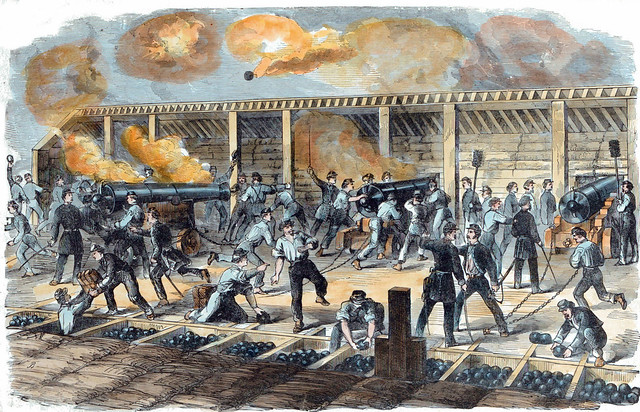
Scene on the floating battery in Charleston Harbor during bombardment of Fort Sumter

Miscellaneous document sources

Scene on the floating battery in Charleston Harbor during bombardment of Fort SumterHanded-tinted off-print of originally black and white engraving

Title: Scene on the floating battery in Charleston Harbor during bombardment of Fort Sumter [verso]
From the book: The Soldier In Our Civil War.
Locations: Charleston Harbor, Charleston County, South Carolina, United
Medium: illustrations (layout features)
Item Location: Fort Sumter NM/Charles Pinckney NHS Curatorial Storage Facility, located at Charles Pinckney National Historic Site
Box: Box 2 of 3 Fosu 19th-c Illustrations Frank Leslie Harpers Weekly London Times, Etc.
Held By: Fort Sumter and Fort Moultrie National Historical Park
Identifiers
Permanent Link: http://purl.clemson.edu/8599D0F7E59ED7E89B93031A3CB52873

___________
Mike’s notes:

Special handed-tinted off-prints were often sold separately from newspapers and other publications. Numerous originals held today by public institutions and in private collections.

Note – This image has been digitally adjusted for one or more of the following:
– fade correction,
– color, contrast, and/or saturation enhancement
– selected spot and/or scratch removal
– cropped for composition and/or to accentuate subject

0 comments