
April 17, 1861 broadsheet.
Note: This particular diary entry–a document written in 1861–includes terms that are offensive to many today. No attempt will be made to censor or edit 19th century material to today’s standards.
April 17th.—The streets of Charleston present some such aspect as those of Paris in the last revolution. Crowds of armed men singing and promenading the streets. The battle-blood running through their veins– that hot oxygen which is called “the flush of victory” on the cheek; restaurants full, revelling in bar rooms, club-rooms crowded, orgies and carousings in tavern or private house, in tap-room, from cabaret–down narrow alleys, in the broad highway. Sumter has set them distraught; never was such a victory; never such brave lads; never such a fight. There are pamphlets already full of the incident. It is a bloodless Waterloo or Solferino.
After breakfast I went down to the quay, with a party of the General’s staff, to visit Fort Sumter. The senators and governors turned soldiers wore blue military caps, with “palmetto” trees embroidered thereon; blue frockcoats, with upright collars, and shoulder-straps edged with lace, and marked with two silver bars, to designate their rank of captain; gilt buttons, with the palmetto in relief; blue trousers, with a gold-lace cord, and brass spurs–no straps. The day was sweltering, but a strong breeze blew in the harbor, and puffed the dust of Charleston, coating our clothes, and filling our eyes with powder. The streets were crowded with lanky lads, clanking spurs, and sabres, with awkward squads marching to and fro, with drummers beating calls, and ruffles, and points of war; around them groups of grinning negroes delighted with the glare and glitter, a holiday, and a new idea for them–secession flags waving out of all the windows–little Irish boys shouting out, “Battle of Fort Sumter! New edishun!”–As we walked down towards the quay, where the steamer was lying, numerous traces of the unsettled state of men’s minds broke out in the hurried conversations of the various friends who stopped to speak for a few moments. “Well, governor, the old Union is gone at last!” “Have you heard what Abe is going to do?” “I don’t think Beauregard will have much more fighting for it. What do you think?” And so on. [continue reading…]

April 17, 1861
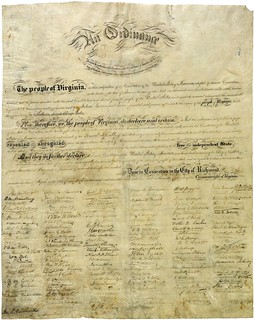
An Ordinance to Repeal the Ratification of the Constitution of the United States of America by the State of Virginia and to resume all the rights and powers granted under said Constitution.
April 17th, 1861.—Yesterday we had a picnic on Lake McBride, the occasion being the presentation of a flag to the Dixie Yeomen. The ladies of the Bradford neighborhood embroidered the banner and though cousins Martha and Rebecca Bradford designed and selected the silks, we, every one, did our part in the work. Even if the stitches were few, when the fingers were unskilled, those few stitches represented the deepest love for our country and her brave defenders.
The flag was presented by Miss Bradford and received by Captain Gardner. Both made fine speeches and, when that was over, we served an elegant dinner under the magnificent Live Oaks, which have stood guard over the lovely lake for many centuries. After dinner there was target practice and boat-riding; this does not seem like war.
The 1st Florida Regiment went to Pensacola today. Oh! this is like war. In the Leon Artillery, Captain Hilton commanding, Edward Bradford and Mr. Routh and many others of our Tallahassee friends. In the Leon Rifles were many more, but it was the Madison Company, Captain Richard H. Bradford commanding, which hurt me most. The entire Bradford family adore Cousin Rich, he is so young, so talented, so handsome and Sir Galahad himself was not more spotless than he. When the call for volunteers was made in the court house in Madison, Judge Vann made a stirring and patriotic speech. He pictured the grimness of war as well as its glory and when he had finished he stood beside the table, where a blank sheet awaited the signatures of those who should respond. For a moment the silence of death rested on the crowd assembled there, then Richard Bradford stepped forward and affixed his name to the paper which meant so much. Others came quickly and in a few minutes the hundred men needed for the company had [continue reading…]
April 17th.–This was a memorable day. When we assembled at Metropolitan Hall, it could be easily perceived that we were on the threshold of momentous events. All other subjects, except that of a new political organization of the State, seemed to be momentarily delayed, as if awaiting action elsewhere. And this plan of political organization filled me with alarm, for I apprehended it would result in a new conflict between the old parties —Whig and Democrat. The ingenious discussion of this subject was probably a device of the Unionists, two or three of them having obtained seats in the Revolutionary Convention. I knew the ineradicable instincts of Virginia politicians, and their inveterate habit of public speaking, and knew there were well-grounded fears that we should be launched and lost in an illimitable sea of argument, when the business was Revolution, and death to the coming invader. Besides, I saw no hope of unanimity if the old party distinctions and designations were not submerged forever.
These fears, however, were groundless. The Union had received its blessure mortelle, and no power this side of the Potomac could save it. During a pause in the proceedings, one of the leading members arose and announced that he had information that the vote was about being taken in the other Convention on the ordinance of secession. “Very well!” cried another member, “we will give them another chance to save themselves. But it is the last!” This was concurred in by a vast majority. Not long after, Lieut.Gov. Montague came in and announced the passage of the ordinance by the other Convention! This was succeeded by a moment too thrilling for utterance, but was followed by tears of gladness and rapturous applause. Soon after, President Tyler and Gov. Wise were conducted arm-in-arm, and bare-headed, down the center aisle amid a din of cheers, while every member rose to his feet. They were led to the platform, and called upon to address the Convention. The venerable ex-President of the United States first rose responsive to the call, but remarked that the exhaustion incident to his recent incessant labors, and the nature of his emotions at such a momentous crisis, superadded to the feebleness of age, rendered him physically unable to utter what he felt and thought on such an occasion. Nevertheless, he seemed to acquire supernatural strength as he proceeded, and he spoke most effectively for the space of fifteen minutes. He gave a brief history of all the struggles of our race for freedom, from Magna Charta to the present day; and he concluded with a solemn declaration that at no period of our history were we engaged in a more just and holy effort for the maintenance of liberty and independence than at the present moment. The career of the dominant party at the North was but a series of aggressions, which fully warranted the steps we were taking for resistance and eternal separation; and if we performed our whole duty as Christians and patriots, the same benign Providence which favored the cause of our forefathers in the Revolution of 1776, would again crown our efforts with similar success. He said he might not survive to witness the consummation of the work begun that day; but generations yet unborn would bless those who had the high privilege of being participators in it.
He was succeeded by Gov. Wise, who, for a quarter of an hour, electrified the assembly by a burst of eloquence, perhaps never surpassed by mortal orator. During his pauses a silence reigned, pending which the slightest breathing could be distinctly heard, while every eye was bathed in tears. At times the vast assembly rose involuntarily to their feet, and every emotion and expression of feature seemed responsive to his own. During his speech he alluded to the reports of the press that the oppressors of the North had probably seized one of his children sojourning in their midst. “But,” said he, “if they suppose hostages of my own heart’s blood will stay my hand in a contest for the maintenance of sacred rights, they are mistaken. Affection for kindred, property, and life itself sink into insignificance in comparison with the overwhelming importance of public duty in such a crisis as this.” He lamented the blindness which had prevented Virginia from seizing Washington before the Republican hordes got possession of it – but, said he, we must do our best under the circumstances. It was now Independence or Death – although he had preferred fighting in the Union – and when the mind was made up to die rather than fail, success was certain. For himself, he was eager to meet the ordeal, and he doubted not every Southern heart pulsated in unison with his own.
Hon. J. M. Mason, and many other of Virginia’s distinguished sons were called upon, and delivered patriotic speeches. And finally, Gov. Letcher appeared upon the stage. He was loudly cheered by the very men who, two days before, would gladly have witnessed his execution. The governor spoke very briefly, merely declaring his concurrence in the important step that had been taken, and his honest purpose, under the circumstances, to discharge his whole duty as Executive of the State, in conformity to the will of the people and the provisions of the Constitution.
Before the sine die adjournment, it was suggested that inasmuch as the ordinance had been passed in secret session, and it was desirable that the enemy should not know it before certain preparations could be made to avert sudden injury on the border, etc., that the fact should not be divulged at present.

WEDNESDAY 17
Cold and windy day, fire in the office and as much in the house as on a winters day. Soldiers are now met with at every turn and the drum and bugle are heard almost all the time from some quarter of the City. Went down to the Hotels after dinner (Chas dined with us), the crowd not so great tonight and less excitement. All the papers from the North indicate but one feeling in reference to the coming contest. Men and money to any extent are offered to sustain the government. Came home before 9, City very quiet. Bed at 11.
The three diary manuscript volumes, Washington during the Civil War: The Diary of Horatio Nelson Taft, 1861-1865, are available online at The Library of Congress.
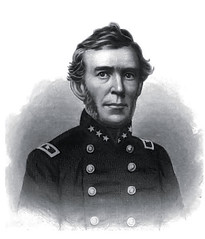
PENSACOLA, April 17, 1861.
Hon. L. P. WALKER:
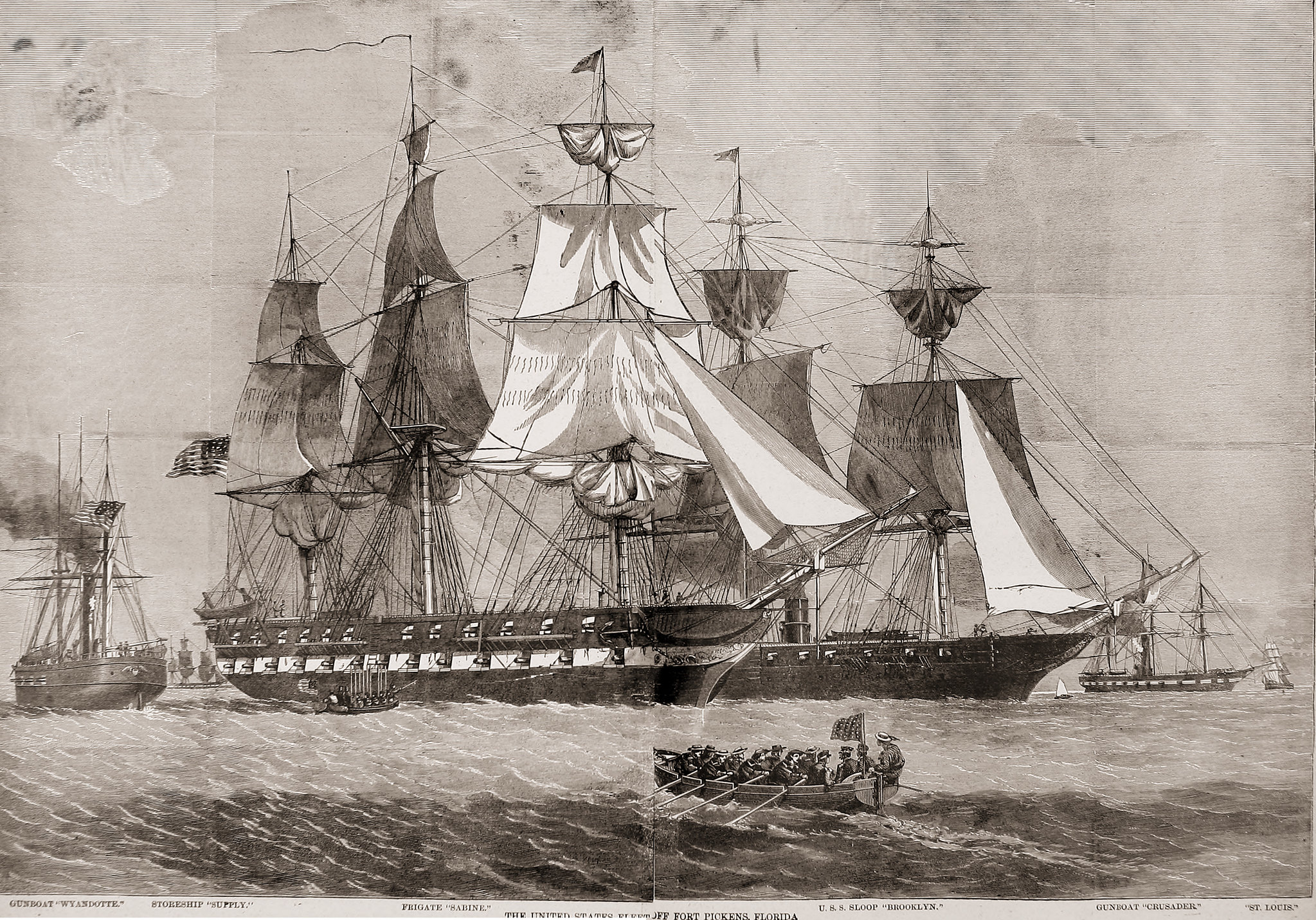
Large steamer with troops joined the fleet last night. Send me instructed officers of Artillery for my batteries.
BRAXTON BRAGG.
—–
PENSACOLA, April 17, 1861.
Hon. L. P. WALKER:
Another naval steamer arrived to-day. Col. Harvey Brown and several hundred men landed. Colonel B. informs me he will hold himself on the defensive.
BRAXTON BRAGG.
HEADQUARTERS PROVISIONAL ARMY, C. S. A.,
Charleston, S.C., April 17, 1861.
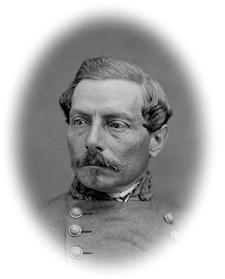
SIR: I have the honor to transmit by Col. R. A. Pryor, one of my aides (who like the others was quite indefatigable and fearless in conveying my orders, in an open boat, from these headquarters to the batteries during the bombardment), a general report of the attack of the 12th instant on Fort Sumter. This report would have been sent sooner if my other pressing duties had permitted me to devote my time to it, while the presence of the enemy’s fleet still led us to expect an attack along the coast at any moment. A more detailed account will be sent forward as soon as the returns of the commanders of batteries shall have reached this office. The great difficulty I will labor under will be to do full justice to all when so much zeal, energy, and gallantry were displayed by officers and soldiers in the execution of my orders. I wish, however, to record two incidents, which will illustrate the feelings that animated all here.
Whilst the barracks in Fort Sumter were in a blaze, and the interior of the work appeared untenable from the heat and from the fire of our batteries (at about which period I sent three of my aides to offer assistance in the name of the Confederate States), whenever the guns of Fort Sumter would fire upon Fort Moultrie the men occupying Cummings Point batteries (Palmetto Guard, Captain Cuthbert) at each shot would cheer Anderson for his gallantry, although themselves still firing upon him, and when on the 15th instant he left the harbor on the steamer Isabel the soldiers of the batteries on Cummings Point lined the beach, silent, and with heads uncovered, while Anderson and his command passed before them, and expressions of scorn at the apparent cowardice of the fleet in not even attempting to rescue so gallant an officer and his command were upon the lips of all. With such material for an army, if properly disciplined, I would consider myself almost invincible against any forces not too greatly superior.
The fire of those barracks was only put out on the 15th instant, p.m., after great exertions by the gallant fire companies of this city, who were at their pumps night and day, although aware that close by them was a magazine filled with thirty thousand pounds of powder, with a shot-hole through the wall of its anteroom.
I am now removing the tottering walls of the buildings within, and clearing away all the rubbish, &c., from the interior of the work, so as to render it still more formidable than it was before it was attacked.
In one or two days I will send forward to you photographs taken at different points of sight, from which you can clearly understand the condition of the fort within when first occupied by us.
I have the honor to be, very respectfully, your obedient servant,
G. T. BEAUREGARD,
Brigadier-General, Commanding.
Hon. L. P. WALKER,
Secretary of War, Montgomery, Ala.
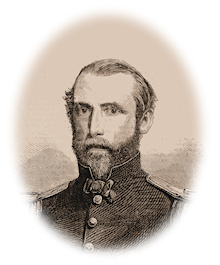
April 17.–Arrived in New York.
The following observations may be made upon the bombardment: The enemy’s fire on the second day, the 13th, was more rapid and more accurate than on the previous day. It seemed to be directed at the embrasures, and to set the quarters on fire. The latter object was fully attained, but not the former, for only two embrasures were struck–one at the right gorge angle by the rifled shot mentioned above, and the other at the left shoulder angle by a shot from the so-called floating battery, which struck the shutter, but without destroying it or entering the throat of the embrasure. The attempt to form a breach at the right gorge angle only succeeded in breaching around one embrasure to the depth of twenty-two inches, and in knocking off a large piece of one cheek, but without disabling the gun or rendering the embrasure inefficient. The barbette tier was not much injured by the second day’s firing, none of the guns being dismounted by it; and few of them struck. The fire, however, destroyed all the gun carriages and splinter-proof shelters on the gorge.
After the cessation of fire, about six hundred shot-marks on the face of the scarp wall were counted, but they were so scattered that no breached effect could have been expected from such fire, and probably none was attempted except at the right gorge angle. The only effect of the direct fire during the two days was to disable three barbette guns, knock off large portions of the chimneys and brick walls projecting above the parapet, and to set the quarters on fire with hot shot. The vertical fire produced more effect, as it prevented the working of the upper tier of guns, which were the only really effective guns in the fort, being columbiads, 8-inch sea-coast howitzers, and 42-pounders principally, and also prevented the use of the columbiads arranged in the parade to be used as mortars against Cummings Point. The shells that struck the stair towers nearly destroyed them, and filled the stairways with so much rubbish as to render them almost impassable. This, with the destruction of the stairs at the gorge by the explosion of the magazine of shells by the fire, made it almost impossible to get to the terre-plein.
The burning of the quarters and barracks produced a great effect on the defense while the fire lasted, inasmuch as the heat and smoke were almost stifling, and as the fire burned all around the magazines, obliging them to be closed, and thus preventing our getting powder to continue the firing. It also destroyed the main gates and the gun carriages on the parapet of the gorge. But we could have resumed the firing as soon as the walls cooled sufficiently to open the magazines, and then, having blown down the wall left projecting above the parapet, so as to get rid of flying bricks, and built up the main gates with stones and rubbish, the fort would actually have been in a more defensible condition than when the action commenced. In fact, it would have been better if the chimneys, roofs, and upper walls of the quarters and barracks had been removed before the firing begun, but the short notice and the small force did not permit anything of this kind to be done after the notice of the attack was received.
The weakness of the defense principally lay in the lack of cartridge bags, and of the materials to make them, by which the fire of our batteries was, all the time, rendered slow, and towards the last was nearly suspended. The lack of a sufficient number of men to man the barbette tier of guns at the risk of losing several by the heavy vertical fire of the enemy also prevented us making use of the only guns that had the power to smash his iron-clad batteries, or of throwing shells into his open batteries, so as to destroy his cannoneers.
The want of provisions would soon have caused the surrender of the fort, but with plenty of cartridges the men would have cheerfully fought five or six days, and if necessary much longer, on pork alone, of which we had a sufficient supply.
I do not think that a breach could have been effected in the gorge at the distance of the battery on Cummings Point, within a week or ten days; and even then, with the small garrison to defend it, and means for obstructing it, at our disposal, the operation of assaulting it, with even vastly superior numbers, would have been very doubtful in its results.
Respectfully submitted.
J. G. FOSTER,
Captain, Engineers.
April 17, 1861
A Chronological History of the Civil War in America1
April 16th.–This day the Spontaneous People’s Convention met and organized in Metropolitan Hall. The door-keeper stood with a drawn sword in his hand. But the scene was orderly. The assembly was full, nearly every county being represented, and the members were the representatives of the most ancient and respectable families in the State.
David Chalmers, of Halifax County, I believe, was the President, and Willoughby Newton, a life-long Whig, among the Vice-Presidents. P. H. Aylett, a grandson of Patrick Henry, was the first speaker. And his eloquence indicated that the spirit of his ancestor survived in him. But he was for moderation and delay, still hoping that the other Convention would yield to the pressure of public sentiment, and place the State in the attitude now manifestly desired by an overwhelming majority of the people. He was answered by the gallant Capt. Wise, who thrilled every breast with his intrepid bearing and electric bursts of oratory. He advocated action, without reference to the other Convention, as the best means of bringing the Unionists to their senses. And the so-called Demosthenean Seddon, and G. W. Randolph (grandson of Thomas Jefferson), Lieut.-Gov. Montague, James Lyons, Judge Robertson, etc., were there. Never, never did I hear more exalted and effective bursts of oratory. And it was apparent that messages were constantly received from the other Convention. What they were, I did not learn at the moment; but it was evident that the Unionists were shaking in their shoes, and they certainly begged one – just one – day’s delay, which was accorded them. The People’s Convention agreed to adjourn till 10 o’clock A.M. the next day. But before we separated a commotion was observed on the stage, and the next moment a Mr. P., from Gov. Wise’s old district, rushed forward and announced that he had just arrived from Norfolk, where, under instructions, and with the acquiescence of Gov. Letcher, he had succeeded in blocking the channel of the river; and this would either secure to us, or render useless to the United States, certain ships of the navy, stores, armament, etc., of the value of millions of dollars. This announcement was received with the wildest shouts of joy. Young men threw up their hats, and old men buttoned their coats and clapped their hands most vigorously. It was next hinted by some one who seemed to know something of the matter, that before another day elapsed, Harper’s Ferry would fall into the hands of the secessionists.
At night the enthusiasm increases in intensity, and no further opposition is to be apprehended from the influence of Tim Rives, Baldwin, Clemens, etc. etc. It was quite apparent, indeed, that if an ordinance of secession were passed by the new Convention, its validity would be recognized and acted upon by the majority of the people. But this would be a complication of the civil war, now the decree of fate.
Perhaps the occurrence which has attracted most attention is the raising of the Southern flag on the capitol. It was hailed with the most deafening shouts of applause. But at a quiet hour of the night, the governor had it taken down, for the Convention had not yet passed the ordinance of secession. Yet the stars and stripes did not float in its stead; it was replaced by the flag of Virginia.
 Left side of a stereograph
www.loc.gov/pictures/item/2015645343/
Title: Moultrie shot furnace
Creator(s): Osborn & Durbec, photographer
Date Created/Published: Charleston, S.C. : Osborn & Durbec’s Southern Stereoscopic & Photographic Depot, 223 King Street, [between 1860 and 1861]
Medium: 1 photograph : print on card mount ; sheet 8 x 17 cm (stereograph format)
Summary: Photograph shows a view of the shot furnace at Fort Moultrie, with officer’s quarters behind it.
Reproduction Number: LC-DIG-stereo-1s03909 (digital file from original item, front) LC-DIG-stereo-2s03909 (digital file from original item, back)
Rights Advisory: No known restrictions on publication.
Call Number: LOT 14110-1, no. 30 (H) [P&P] LOT 15015-1, no. 30 (former call number)
Repository: Library of Congress Prints and Photographs Division Washington, D.C. 20540 USA hdl.loc.gov/loc.pnp/pp.print
Notes:
….Purchase; Robin Stanford; 2015; (DLC/PP-2015:022).
….Title from item.
….Osborn & Durbec’s label on verso, item no. “4”.
….Forms part of: The Robin G. Stanford Collection.
….Digitized 2015 Funding from Center for Civil War Photography.
 Right side of a stereograph
www.loc.gov/pictures/item/2015645343/
Title: Fort Moultrie
Creator(s): Osborn & Durbec, photographer
Date Created/Published: [Charleston, S.C.] : [Osborn & Durbec’s Southern Stereoscopic & Photographic Depot], [1861]
Medium: 1 photograph : print on card mount ; sheet 8 x 17 cm (stereograph format)
Summary: Photograph shows the harbor face view of Fort Moultrie taken after the bombardment in April 1861. Photographers returned to the same spot in the fort that they had photographed in LOT 14110-1, no. 20. Fort Sumter is in the distance.
Reproduction Number: LC-DIG-stereo-1s03907 (digital file from original item, front) LC-DIG-stereo-2s03907 (digital file from original item, back)
Rights Advisory: No known restrictions on publication.
Call Number: LOT 14110-1, no. 28 (H) [P&P] LOT 15015-1, no. 28 (former call number)
Repository: Library of Congress Prints and Photographs Division Washington, D.C. 20540 USA hdl.loc.gov/loc.pnp/pp.print
Notes:
Purchase; Robin Stanford; 2015; (DLC/PP-2015:022).
Inscribed on verso: Moultrie #5.
Title from item.
Forms part of: The Robin G. Stanford Collection.
Digitized 2015 Funding from Center for Civil War Photography.
 The South-West or Gorge Front of Fort Sumter, Showing the Gate, Wharf, and Esplanade, Machicoulis Gallerries on the Parapet and the Effect of the Fire from Cumming’s Point and Fort Johnson. From a Photograph
Chester, James. “Inside Sumter in ’61.” Essay. In Battles and Leaders of the Civil War , edited by Clarence Clough Buel and Robert Underwood Johnson, Vol. 1. New York, NY: The Century Co., 1887. page 50
 Harper’s Pictorial History of the Civil War by Alfred H. Guernsey and Henry W. Alden; copyrighted 1866 by Harper and Brothers; 1894 by Alfred H. Guernsey and Henry W. Alden; 1894 by McDonnell Bros; pub. The Puritan Press Co.; Chicago, Illinois
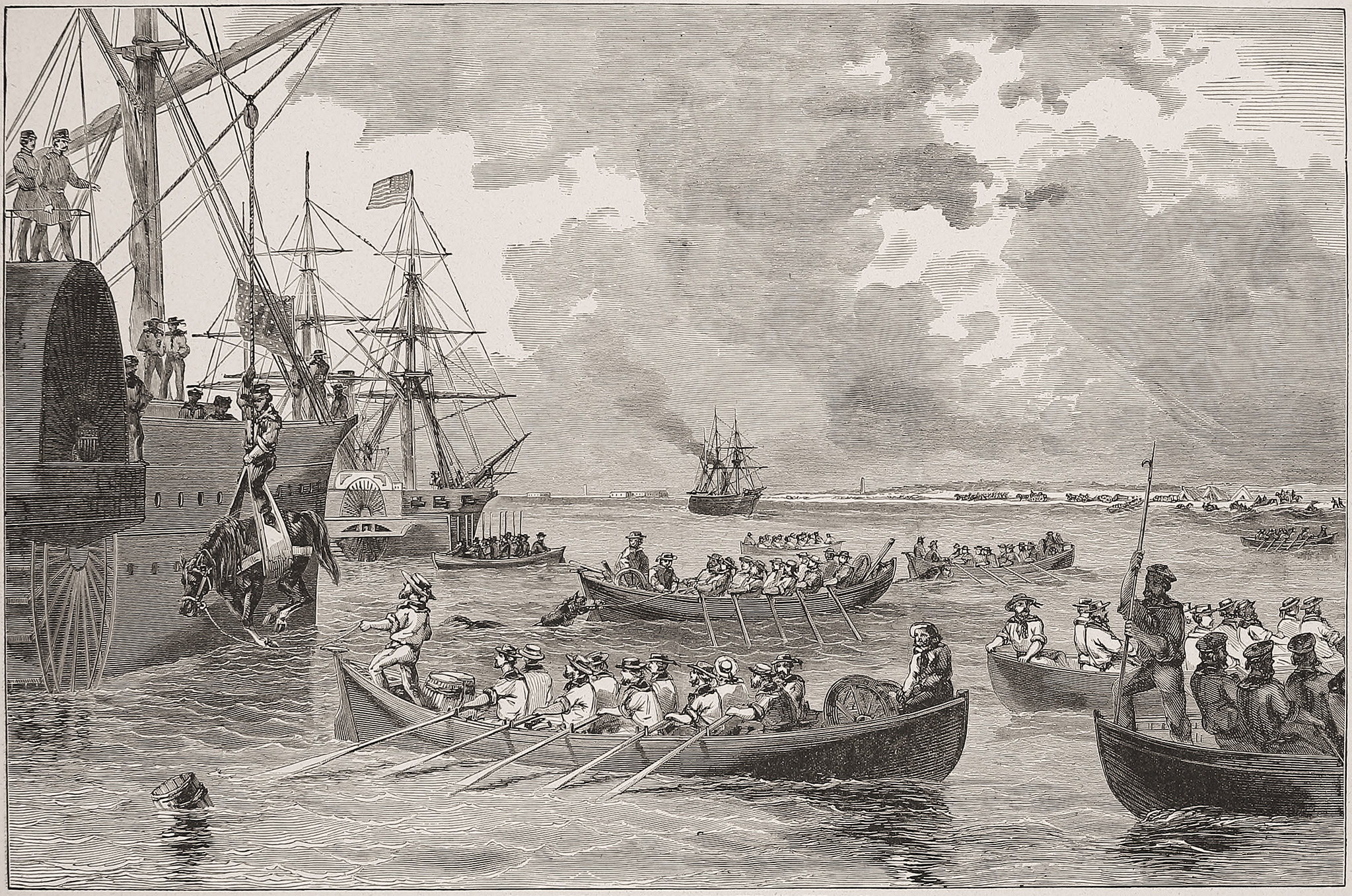
Harper’s Pictorial History of the Civil War by Alfred H. Guernsey and Henry W. Alden; copyrighted 1866 by Harper and Brothers; 1894 by Alfred H. Guernsey and Henry W. Alden; 1894 by McDonnell Bros; pub. The Puritan Press Co.; Chicago, Illinois
TUESDAY, APRIL 16, 1861.
Another rainy day, a continuation of the Easterly Storm. The public buildings are all strongly guarded, from 150 to 300 men being quartered in each. There are now about three thousand men under arms in the City, all in the service of the U.S. Some thousands more from the North will be here this week The excitement at the Hotels is not quite so great tonight. I was at the “National” and “Willards.” NY papers scarce, could get only the Tribune. Came home about 9, read till 11. Cold wet evening. Everything looks gloomy.
The three diary manuscript volumes, Washington during the Civil War: The Diary of Horatio Nelson Taft, 1861-1865, are available online at The Library of Congress.
(April 16) Early next morning, soon after dawn, I crossed the Cape Fear River, on which Wilmington is situated, by a steam ferry-boat. On the quay lay quantities of shot and shell. “How came these here?” I inquired. “They’re anti-abolition pills,” said my neighbor; “they’ve been waiting here for two months back, but now that Sumter’s taken, I guess they won’t be wanted.” To my mind, the conclusion was by no means legitimate. From the small glance I had of Wilmington, with its fleet of schooners and brigs crowding the broad and rapid river, I should think it was a thriving place. Confederate flags waved over the public buildings, and I was informed that the Forts had been seized without opposition or difficulty. I can see no sign here of the “affection to the Union,” which, according to Mr. Seward, underlies all “secession proclivities.”
As we traversed the flat and uninteresting country, through which the rail passes, Confederate flags and sentiments greeted us everywhere; men and women repeated the national cry; at every station militia men and volunteers were waiting for the train, and the everlasting word “Sumter” ran through all the conversation in the cars.
The Carolinians are capable of turning out a fair force of cavalry. At each stopping-place I observed saddle-horses tethered under the trees, and light driving vehicles, drawn by wiry muscular animals, not remarkable for size, but strong-looking and active. Some farmers in blue jackets, and yellow braid and facings, handed round their swords to be admired by the company. A few blades had flashed in obscure Mexican skirmishes–one, however, had been borne against “the Britishers.” I inquired of a fine, tall, fair-haired young fellow whom they expected to fight. “That’s more than I can tell,” quoth he. “The Yankees ain’t such cussed fools as to think they can come here and whip us, let alone the British.” “Why, what have the British got to do with it?” “They are bound to take our part: if they don’t, we’ll just give them a hint about cotton, and that will set matters right.” This was said very much with the air of a man who knows what he is talking about, and who was quite satisfied “he had you there.” I found it was still displeasing to most people, particularly one or two of the fair sex, that more Yankees were not killed at Sumter. All the people who addressed me prefixed my name, which they soon found out, by “Major” or “Colonel”–”Captain” is very low, almost indicative of contempt. The conductor who took our tickets was called “Captain.” [continue reading…]
HEADQUARTERS SURGEON-GENERAL’S DEPARTMENT,
Charleston, April 16, 1861.
SIR: From the returns received from the various posts I have the unexampled and happy privilege of stating that no serious casualty has occurred during the vigorous action of thirty-three hours in reducing Fort Sumter. Four trifling contusions are reported at Fort Moultrie, but none at other posts, and it is a subject of equal gratification that even in the management of heavy ordnance by new recruits and unpracticed volunteers no accident to life or limb has occurred.
Immediately upon the flag of Fort Sumter being struck I proceeded to that fortress to tender my assistance and hospital at Mount Pleasant to Major Anderson, and received from him the pleasing intelligence that only four cases of slight injuries had resulted to his men. On Sunday a sad casualty occurred in saluting his flag, when the explosion of some loose cartridges beneath a gun struck down seven men. One was instantly killed, and another so seriously wounded that he died soon after reaching my hospital in Charleston; one remaining in the hospital, doing well under the care of Prof. G. G. Chisolm, of the medical college of the State, and four were removed with the garrison. The precipitation suddenly of several regiments upon me during the past few days, totally without any preparation of their surgeons, has required a large supply of medicines, instruments, hospital stores, &c., but I am happy to say they have received promptly all their requisitions.
Respectfully,
R. W. GIBBES, M.D.
Surgeon-General South Carolina Army.
Adjutant-General JONES.
FLA., April 16, 1861.
To the ASSISTANT ADJUTANT-GENERAL,
Department of the East:
SIR: I have the honor to report that on the 14th instant it was reported to me that a small boat had landed at the wharf with a flag of truce, and that the bearer solicited an interview with the commanding officer of the post. I requested Lieutenant Slemmer, of the First Artillery, to accompany me, and repaired to the wharf. On my arrival the gentleman bearing the flag informed me that he was the bearer of a message from General Bragg, and that he was his adjutant-general. He then inquired whether I was the commanding officer of the fort. I replied that I was. He then stated that he was directed by General Bragg to inquire why the armistice in respect to re-enforcing Fort Pickens had been violated by throwing re-enforcements into it. I replied that I had never been a party to any armistice; that I had been sent by the General Government to take command of the post, and had entered under the orders of the General Government. He then addressed himself to Lieutenant Slemmer, and stated that he was directed to inquire of the former commanding officer why the armistice had been violated, to which Lieutenant Slemmer replied that he always obeyed the orders of his superiors. This ended our official interview. After exchanging the usual civilities customary among gentlemen previously acquainted, we parted, and Colonel Wood left the post. I would mention that Lieutenant Ingraham, formerly of the Marine Corps, was present during the interview as a witness on the part of Colonel Wood, and that Lieutenant Slemmer, at my request, performed the same duty on my part.
I am, sir, very respectfully, your obedient servant,
I. VOGDES,
Captain, First Artillery, Commanding Fort Pickens.
HEADQUARTERS PROVISIONAL ARMY, C. S. A.,
Charleston, S.C., April 16, 1861.
SIR: I have the honor to submit the following summary statement of the circumstances of the surrender of Fort Sumter: —
On the refusal of Major Anderson to engage, in compliance with my demand, to designate the time when he would evacuate Fort Sumter, and to agree meanwhile not to use his guns against us, at 3.20 o’clock in the morning of the 12th instant I gave him formal notice that within one hour my batteries would open on him. In consequence of some circumstance of delay the bombardment was not begun precisely at the appointed moment, but at 4.30 o’clock the signal gun was fired, and within twenty minutes all our batteries were in full play. There was no response from Fort Sumter until about 7 o’clock, when the first shot from the enemy was discharged against our batteries on Cummings Point.
By 8 o’clock the action became general, and throughout the day was maintained with spirit on both sides our guns were served with skill and energy. The effect was visible in the impressions made on the walls of Fort Sumter. From our mortar batteries shells were thrown with such precision and rapidity that it soon became impossible for the enemy to employ his guns en barbette, of which several were dismounted. The engagement was continued without any circumstance of special note until nightfall, before which time the fire from Sumter had evidently slackened. Operations on our side were sustained throughout the night, provoking, however, only a feeble response.
On the morning of the 13th the action was prosecuted with renewed vigor, and about 7 ½ o’clock it was discovered our shells had set fire to the barracks in the fort. Speedily volumes of smoke indicated an extensive conflagration, and apprehending some terrible calamity to the garrison I immediately dispatched an offer of assistance to Major Anderson, which, however, with grateful acknowledgments, he declined. Meanwhile, being informed about 2 o’clock that a white flag was displayed from Sumter I dispatched two of my aides to Major Anderson with terms of evacuation. In recognition of the gallantry exhibited by the garrison I cheerfully agreed that on surrendering the fort the commanding officer might salute his flag.
By 8 o’clock the terms of evacuation were definitely accepted. Major Anderson having expressed a desire to communicate with the United States vessels lying off the harbor, with a view to arrange for the transportation of his command to some port in the United States, one of his officers, accompanied by Captain Hartstene and three of my aides, was permitted to visit the officer in command of the squadron to make provision for that object. Because of an unavoidable delay the formal transfer of the fort to our possession did not take place until 4 o’clock in the afternoon of the 14th instant. At that hour, the place having been evacuated by the United States garrison, our troops occupied it, and the Confederate flag was hoisted on the ramparts of Sumter with a salute from the various batteries.
The steamer Isabel having been placed at the service of Major Anderson, he and his command were transferred to the United States vessels off the harbor.
The urgency of immediate engagements prevents me from giving at present a more circumstantial narrative of the incidents connected with the capture of Fort Sumter. When the reports from the various commanders of batteries are received I will hasten to forward you a more detailed account.
In conclusion, I am happy to state that the troops, both officers and soldiers, of the Regulars, Volunteers, Militia, and Navy, by their energy, zeal, perseverance, labor, and endurance before the attack, and by their courage and gallantry during its continuance, exhibited all the characteristics of the best troops; and to my staff, Regular and Volunteer, I am much indebted for the prompt and complete execution of my orders, which had to be communicated in open boats during the bombardment to the different batteries then engaged.
I remain, sir, very respectfully, your obedient servant,
G. T. BEAUREGARD,
Brigadier-General, Commanding.
Hon. L. P. WALKER,
Secretary of War, Montgomery, Ala.
MONTGOMERY,
April 16, 1861.
Hon. L. P. WALKER,
Secretary of War, Montgomery:
SIR: I have the honor to submit the following statement in relation to my recent visit to Pensacola to your attention:
I left Washington City on the morning of April 7, with a communication from the Secretary of the Navy to Captain Adams, of the United States ship Sabine, and was informed by the Secretary that I would have no difficulty in making the communication to Captain Adams under the existing agreement. I arrived at Pensacola on the morning of the 11th instant, announced myself to Mr. LeBaron as an officer of the U. S. Navy, who sent an officer with me to General Bragg. I informed General Bragg that I had come from Washington, and desired to communicate with Captain Adams, of the Sabine. He wrote me a pass authorizing me to go to the Sabine, and upon handing it to me he asked if I had dispatches for Captain Adams. I replied that I had not written ones, but that I had a verbal communication to make to him from the Navy Department. I then asked him if I would be permitted to land on my return towards Washington. He replied that I would, provided Captain Adams or myself did nothing in violation of the agreement existing between them. I remarked that I knew nothing of the agreement he mentioned. I then left General Bragg and went to the navy-yard, from whence I embarked for the Wyandotte about 4 o’clock p.m. On reaching her I was informed by her commander that he could not carry me out to the Sabine that night, in consequence of the strong wind and rough sea on the bar.
During that evening Lieutenant Slemmer, of Fort Pickens, came on board, and I had a few moments’ social conversation with him. I had no dispatches for him whatever, and I gave him no information as to the nature of the communication which I had to make to Captain Adams. Of course he knew, as did every officer on board, that I came from the Navy Department to communicate with Captain Adams. On the next morning, the 12th instant, while waiting for the sea to subside on the bar, so that the Wyandotte could go out, one of the officers suggested that we should go on shore and take a look at Fort Pickens, to which I assented. We accordingly, about 9 o’clock a.m., landed there, and walked about the ramparts for half an hour, and then returned on board. During my visit to the fort I did not see Lieutenant Slemmer, as he was asleep and I did not desire to disturb him, as I had no object in seeing him, except to pay him the proper visit of courtesy on going within the limits of his command.
At about 10.30 or 11 o’clock a.m. the Wyandotte went out of the harbor and put me on board the Sabine, somewhere near 12 o’clock. I made my communication to Captain Adams, and stated to him what General Bragg had said in relation to the agreement between them. He, nevertheless, gave me a written order to return to Washington as “special messenger,” which order you have. Of course I proceeded to obey the order, and was landed by the Wyandotte at Pensacola about 5 o’clock p.m. I was told by Captain Adams that it was not necessary for me to see General Bragg on my return, and therefore I did not stop at his quarters.
I make this statement, ready with the solemnity of an oath to be confirmed. It is made, not with regard to personal safety, or of any consequences that might result to me personally, but purely in defense of my honor as an officer and a gentleman. Several officers in the Confederate service—among them I will mention Capt. D. N. Ingraham and Surg. W. F. Carrington—I think I can appeal to with confidence.
I respectfully submit this statement to the consideration of the honorable Secretary of War.
Respectfully, your obedient servant,
JOHN L. WORDEN,
Lieutenant, U. S. Navy.
April 16, 1861
Note: This particular diary entry–a document written in 1861–includes terms that are offensive to many today. No attempt will be made to censor or edit 19th century material to today’s standards.
Monday, April 15.–Up at dawn. Crossed by ferry to Portsmouth, and arrived at railway station, which was at no place in particular, in a street down which the rails were laid. Mr. Robinson, the superintendent, gave me permission to take a seat in the engine car, to which I mounted accordingly, was duly introduced to, and shook hands with the engineer and the stoker, and took my seat next the boiler. Can any solid reason be given why we should not have those engine sheds or cars in England? They consist of a light frame placed on the connection of the engine with the tender, and projecting so as to include the end of the boiler and the stoke-hole. They protect the engineer from rain, storm, sun, or dust. Windows at each side afford a clear view in all directions, and the engineer can step out on the engine itself by the doors on the front part of the shed. There is just room for four persons to sit uncomfortably, the persons next the boiler being continually in dread of roasting their legs at the furnace, and those next the tender being in danger of getting logs of wood from it shaken down on their feet. Nevertheless I rarely enjoyed anything more than that trip. It is true one’s enjoyment was marred by want of breakfast, for I could not manage the cake of dough and the cup of bitter, sour, greasy nastiness, called coffee, which were presented to me in lieu of that meal this morning.
But the novelty of the scene through which I passed atoned for the small privation. I do not speak of the ragged streets and lines of sheds through which the train passed, with the great bell of the engine tolling as if it were threatening death to the early pigs, cocks, hens, and negroes and dogs which walked between the rails – the latter, by-the-bye, were always the first to leave–the negroes generally divided with the pigs the honour of making the nearest stand to the train–nor do I speak of the miserable suburbs of wooden shanties, nor of the expanse of inundated lands outside the town. Passing all these, we settled down at last to our work: the stoker fired up, the engine rattled along over the rugged lane between the trees which now began to sweep around us from the horizon, where they rose like the bank of a river or the shores of a sea, and presently we plunged into the gloom of the primaeval forest, struggling as it were, with the last wave of the deluge.
The railroad, leaving the land, boldly leaped into the air, and was carried on frailest cobweb-seeming tracery of wood far above black waters, from which rose a thick growth and upshooting of black stems of dead trees, mingled with the trunks and branches of others still living, throwing out a most luxuriant vegetation. The trestle-work over which the train was borne, judged by the eye, was of the slightest possible construction. Sometimes one series of trestles was placed above another, so that the cars ran on a level with the tops of the trees ; and, looking down, we could see before the train passed the inky surface of the waters, broken into rings and agitated, round the beams of wood. The trees were draped with long creepers and shrouds of Spanish moss, which fell from branch to branch, smothering the leaves in their clammy embrace, or waving in pendulous folds in the air. Cypress, live oak, the dogwood, and pine struggled for life with the water, and about their stems floated balks of timber, waifs and strays carried from the rafts by flood or the forgotten spoils of the lumberer. On these lay tortoises, turtles, and enormous frogs, which lifted their heads with a lazy curiosity when the train rushed by, or flopped into the water as if the sight and noise were too much for their nerves. Once a dark body of greater size plashed into the current which marked the course of a river. “There’s many allygaitors come up here at times” said the engineer, in reply to my question; “but I don’t take much account of them.” [continue reading…]
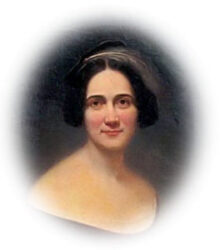
April 15th.—I did not know that one could live such days of excitement. Some one called: “Come out! There is a crowd coming.” A mob it was, indeed, but it was headed by Colonels Chesnut and Manning. The crowd was shouting and showing these two as messengers of good news. They were escorted to Beauregard’s headquarters. Fort Sumter had surrendered! Those upon the housetops shouted to us “The fort is on fire.” That had been the story once or twice before.
When we had calmed down, Colonel Chesnut, who had taken it all quietly enough, if anything more unruffled than usual in his serenity, told us how the surrender came about. Wigfall was with them on Morris Island when they saw the fire in the fort; he jumped in a little boat, and with his handkerchief as a white flag, rowed over. Wigfall went in through a porthole. When Colonel Chesnut arrived shortly after, and was received at the regular entrance, Colonel Anderson told him he had need to pick his way warily, for the place was all mined. As far as I can make out the fort surrendered to Wigfall. But it is all confusion. [continue reading…]