Rev. Dr. Bachman, of South Carolina

Harper’s Weekly

Harper’s Weekly, January 19, 1861

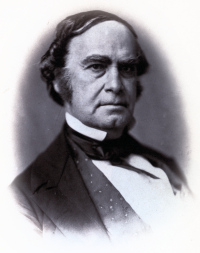
Rev. Dr. Bachman, who asked a blessing on the secession ordinanceWe publish on page 33 the portrait of the Rev. Dr. Bachman, of South Carolina, the minister who was selected by the Secession Convention to ask a prayer on the ratification of the Ordinance of Secession. Dr. Bachman is distinguished as a naturalist, but has made himself more conspicuous, latterly, by his strong political leanings to the side of disunion. The Charleston Mercury thus describes the scene which attended the signing of the Ordinance of Secession :

“The scene was one profoundly grand and impressive. There were a people assembled through their highest representatives—men most of them upon whose heads the snow of sixty winters had been shed—patriarchs in age—the dignitaries of the land—the High Priests of the Church of Christ—reverend statesmen—and the wise judges of the law. In the midst of deep silence an old man, with bowed form and hair as white as snow, the Rev. Dr. Bachman, advanced forward, with upraised hands, in prayer to Al-mighty God, for His blessing and favor in this great act of his people about to be consummated. The whole assembly at once rose to its feet, and, with hats off, listened to the touching and eloquent appeal to the All-Wise Dispenser of events.

At the close of the prayer the President advanced with the consecrated parchment upon which was inscribed the decision of the State, with the great seal attached. Slowly and solemnly it was read unto the Last word—’dissolved;’ when men could contain themselves no longer, and a shout that shook the very building, reverberating long continued, rose to heaven, and ceased only with the lots of breath. In proud, grave silence the Convention itself waited the end with beating hearts.”

0 comments

“It is not the work of a day to organize arm and equip forces as you know.”

The Letters of Samuel Ryan Curtis

Washington Jany 19. 1861.

My dear wife

I have not anything very late from you, but before going to bed I feel desirous of writing you a few lines. I know the rumours of threatened attack on this city, and the continual advance of revolution, must create much anxiety; and my letters will therefore be especially interesting.

The great speech of Mr. Seward1 and the report of Mr Corwin Chairman of our Committee, and the general effort to show a desire to prevent a destruction of the Union; it is evident must create some consideration in Sections where people have not entirely got besides themselves. Mr Etheridge2 of Tennessee told me yesterday he had little more hope of reaction. Still the movements in several states are looked upon with much anxiety, and we every day feel that some trifling event will create new complications. So long as Virginia and Maryland are within the Union, according to their own resolves: this city is quite safe in my judgement. General Scott3 is collecting regular Marines and organising the Volunteers which he thinks “may secure the peace of the City.” So he writes me in a private note responding to a letter sent through me from Col Whittlesey4 of Cleveland tendering forces &c. If things appear to me the least dangerous, I will send Sadie home with some of our friends who are visiting at this place. I received a letter from Henry5 dated at Cincinnati. He expects to be here about the 22d or 24th and wants to stay some week or ten days. By that time I can judge better of danger, but I do not think the taking of this city on the 4th of March or before that time, is now at all probable.

Every day makes it less likely. It is not the work of a day to organize arm and equip forces as you know; and we do not believe there are many volunteers in Virginia that could be easily collected for this point.

Mr Sturges and his son Shelton, are here occupying rooms in this house. Mr Sturges is quite nervous, but not near so much so as he was last year. Edward is also here yet. He and Sadie have gone to Resides to spend the evening.

I had a letter from Mr Stevens6 of Keokuk to day, dated at Springfield. He says I am still talked of there in Connection with a Cabinet appointment. Messers Harland7 and Vandever8 have both written letters very favorable to me. They much prefer my appointment to that of Warrens.9

It is very flattering to me, that I should be named in such honorable connection ; especially that my Colleagues should so endorse me.

Mrs Andrews and Sadie are always together; and I am exceedingly glad of it, for the more I see of Mrs. Andrews the more I admire her.

She is very kind and confiding with Sadie, and I see she has her entire confidence.

The weather has been quite warm and spring like to day, and Sadie has been out of school visiting the Smithsonian institutue with Mr. Sturges and Miss Delano who is at Willards with her father spending a few days.

The fluttering of the burner, shows that other gas lights are generally extinguished, and it must therefore be growing late. How does your money matters hold out? I must send you a draft if you need funds.

The 4th of March is approching, but none too fast to satisfy me and save the country. I look forward to it with anxiety, not merely because Lincoln is coming into power, but because I want to see you and my dear little daughter and all our dear friends in Keokuk.

Kiss the little darling for papa. Tell her I do not think I can find any little sister pretty enough for a match for her. Besides I wonder whether she would love her big sister just as well. You know how much better she loves to play with little children than she does with us. I want her to play with me when the grass gets green and the flowers are bright and pretty like her.

Affectionately & Ever yours
Saml. R. Curtis


1 William H. Seward, Governor of New York, and leading member of the Republican party, later Secretary of State under Lincoln and Johnson, was a spokesman for the Compromise Republicans. His speech in the Senate referred to here, delivered January 12, 1861, was widely quoted in the press of the north. It caused some concern among Republicans because it was thought Seward had gone too far in hinting at willingness to compromise. A calm dispassionate speech. Seward re-hearsed the history of comprise in the history of the nation. See Congressional Globe. 35th Congress, 1860-1861, pp. 341-344; Keokuk Gate City, Jan. 19, 1861.

2. Emerson Etheridge, representative from Tennessee, 1853-1857, 1859-1861, followed that state into the Confederacy.

3. Winfield Scott, southern born, entered the military forces in the War of 1812, rose to rank of Brigadier General in 1814, and became a national hero by his fight at Lundy’s Lane, 1814. In 1841 was appointed Commander in Chief, a position he held until age and physical debilities caused his resignation Nov. 1, 1861. A splendid tactician, an excellent diplomat. he was the Whig nominee for President in 1852, being soundly whipped by Pierce.

4. Col. Charles Whittlesey, graduate of the United States Military Academy in 1831, was a classmate of Curtis. A geologist of note and distinction, he served as a Col. in the Ohio Infantry until 1862. See Iowa Historical Records 3, 428-429.

5. Henry Z. Curtis, son of S. R. Curtis.

6. James Harlan, senior Senator from Iowa, 1853-1865, 1867-1873, served as Secretary of Interior under Johnson, 1865-1866

7. William Vandever, Representative from Iowa 1859-1861, and from California 1887-1891, was Col. of the 9th Iowa Vol. Infantry, 1861, raised to Brigadier General in 1862, was appointed Major. General in 1865. He was a member of the Peace Convention of 1861.

8. Fitz Henry Warren, a stormy figure in Iowa Whig and Republican politics, resident of Burlington, was Assistant Post. Master General under Presidents Taylor and Fillmore, 1849-1852. Warren was spoken of for Post Master General in 1861, which appears to have been the post for which Curtis was likewise recommended. Warren followed a stormy period on the Greely New York Tribune with an equally strife-filled period in the army, first as Col. 1st Iowa Vol. Cav., and as a Brigadier General in the state of Louisiana.

9. Probably Manning W. Stevens, a farmer of Jackson Township, Lee County, who “acted with the Republican party since its organization.”

0 comments

Charleston Zouaves

Harper’s Weekly

Harper’s Weekly, January 19, 1861

The Charleston Zouaves (from a photograph)WE have given pictures of the Chicago Zouaves, whose admirable discipline has rendered them an object of general envy among our military folks, We now publish on the preceding; page a picture of the Charleston Zouaves, a corps less generally known, but one which may become pretty conspicuous in the course of the next few weeks. The uniform, it can not be denied, is very handsome; and the men who wear it are gallant and brave.

0 comments

A Diary of American Events – January 19, 1861

The Rebellion Record – A Diary of American Events; by Frank Moore

–The State Convention of Georgia has adopted the secession ordinance by a vote of two hundred and eight against eighty-nine. –(Doc. 22.)

A motion to postpone the operation of the ordinance until the 3d of March was lost by about thirty majority.

Alexander H. Stephens and Herschel V. Johnson are among those who voted against the ordinance.

The ordinance of secession is ordered to be éngrossed on parchment, and to be signed on Monday at noon.

Judge Linton Stephens says that, while he approves of the ordinance, he sees no reason for its adoption now. He therefore will not vote for or sign it.

Unusual demonstrations of approbation are being made at Milledgeville to-night in honor of the adoption of the ordinance, including the firing of cannon, the letting off of sky-rockets, the burning of torches, and music and speeches. –Richmond Enquirer.

0 comments

Judge Magrath, Secretary of State of South Carolina

Harper’s Weekly

Harper’s Weekly, January 19, 1861

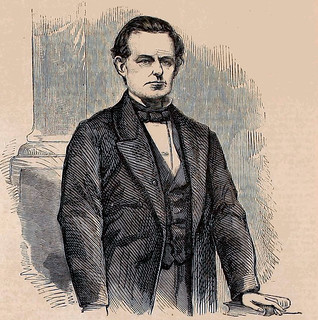
WHon. Judge Magrath, Secretary of State of South CarolinaE publish on page 33, from a photograph sent us from Charleston, South Carolina, a portrait of Judge Magrath, late Judge of the United States District Court at Charleston. Judge Magrath is a lawyer of high standing at the South Carolina bar, and enjoys the respect of the public. He has hitherto taken no leading part in politics outside of his State; but in the Convention he was reckoned one of the strongest men, and is now one of the Executive Council of the new nation of South Carolina. The first act which directed public attention to him was his resignation of his office on 7th November last. On that day, when the Grand Jury reported that there was no more business before them, Judge Magrath said :

“The business of the term has been disposed of. And under ordinary circumstances, it would be my duty to dismiss you to your several avocations, with my thanks for your presence and aid. But now I have something more to do; the omission of which would not be consistent with propriety. In the political history of the United States an event has happened of ominous import to fifteen slave-holding State:. The State of which we are citizens has been always understood to have deliberately fixed its purpose, whenever that event should happen. Feeling an assurance of what will be the action of the State, I consider it my duty, without delay, to prepare to obey its wishes. That preparation is made by the resignation of the office I have held. For the last time I have, as a Judge of the United States, administered the laws of the United States within the limits of the State of South Carolina. While thus acting in obedience to a sense of duty, I can not be indifferent to the emotions it must produce. That department of government which, I believe, has best maintained its integrity and preserved its purity, has been suspended. So far as I am concerned, the Temple of Justice, raised under the Constitution of the United States, is now closed. If it shall be never again opened, I thank God that its doors have been closed before its altar has been desecrated with sacrifices to tyranny. May I not say to you that in the future which we are about to penetrate, next to the reliance we should place in the goodness of that God, who will guide us in the right way, should be our confidence in our State, and our obedience to its laws. We are about to sever our relations with others, because they have broken their covenant with us. Let us not break the covenant we have made with each other. Let us not forget that what the laws of our State require becomes our duties. And that he who acts against the wish or without the command of his State usurps that sovereign authority which we must maintain inviolate. To you, gentlemen of the jury, I may speak as the representative of the juries with whom I have been connected: and to you I now give expression to that conviction I have always had, of the fidelity with which the responsible duties of jurors have been here discharged. To my brethren of the bar, whose uniform courtesy and aid have made my official intercourse and duties the sources of pleasure and instruction, I tender the assurances of my kind and grateful recollection. To the officers of this court, with whom I have been so long and pleasantly connected; to the Attorney of the United States for this State, whose ability and fidelity in the discharge of his duties merit the highest commendation; to the Marshal whose zeal has ever kept pace with the obligations of his office; to the Clerk, whose experience has ever been generously exercised in the business of the Court; to all other officers, who have invariably been exact in all they were required to do; with all of whom my official relations have been productive of the highest gratification: I now tender, as the last official act which I shall here discharge, my kindest wishes for their happiness and prosperity.”

At the conclusion of these remarks his Honor laid aside his gown and retired.

0 comments

“This Capitol is the Key to our Nationality and it can only be with with Maryland.”

The Letters of Samuel Ryan Curtis

H. R Washington Jany 19. 1861

My dear wife

Your letter of the 12th and 13th and 14th was duly received and has caused us great anxiety on account of the illness of our dear little daughter. We shall be trembling with fear for every hour that hangs over the uncertainty of her illness. I hope we will receive a letter today. If we do not we will hope she is not worse. You are so far away I will hereafter insist on your coming nearer to us during future sessions.

Things still look precarious. We have not power to do what ought to be done; and while revolution proceeds it is hard to say what would be best. This Capitol is the Key to our Nationality and it can only be with with Maryland. That it seems to me is a clear and incontroversable proposition. To hold Maryland we must try to do so pecibly for if forces be necessary to hold such a state against the will of her people will require a very strong force and the United efforts of every branch of our government. Unity everywhere and prudent Councils are necessary to hold this point and our impatient friends who wonder why we do not make more bluster should rather reproach the indiscretion of some who throw firebrands which are used by those who guard the citidel of a great good and glorious confederacy.

I send you a globe of today giving a 5 minute speech of mine on the power to hold border states. It is short and to the point, and the Gate ought to publish it.1

I have just made a speech of about 5 minutes on the subject Indian wars. It ought to be published also I will send it forward tomorrow. However this last should be published at Council Bluffs as it is more on frontier matters and excuses our frontier people for their unfortunate struggles in Indian difficulties.2

I had a long letter yesterday from Texas giving me assurances that the conspiracy for taking this capitol extends to Texas and is part of the plan of the Knights of the Golden Circle3 who No. one hundred and fifty thousand men Sworn to do any and everything to carry out their revolutionary purposes. The letters comes from an old friend and free Mason now in Texas. He says he does not want to see Sam Curtis Tom Corwin & John Sherman assassinated.4

I think we are very safe so long as Maryland hold firm, but her secession cannot be accomplished in a day and cannot be accomplished without “the note of preparation” I am therefore very easy in my place in the performance of my duty.

You are very right in saying I ought to write to Mr Graham.5 Tell him he is not the less the first object of my influence.

Tell him (and tell no body else) I have set my eye on the office of 5th Auditor and I have the promise of the aid of Mr. Harlan6 for that particular thing. It is to audit the Post office accounts which I am told requires but little personal labor but the charge of clerks who do the duty.

We are all very well. Mr. Sturges Sadie and I have arranged to go over to George Town today after dinner to visit the Nichols. We are all very well and Affectionately yours

Saml. R. Curtis


1. A short speech delivered January 19, it was in reply to a resolution proposed by Jenkins of Virginia that none of the army approriations be used to recover forts or arsenals taken by states now seceded, or from those which may secede. Curtis declared: “When the forts of the Government are taken by lawless mobs, I deem it my duty to vote for their recovery. . . . I would adopt every means of conciliation, exhaust all other means before I would resort to force ; but, as a Representative of the United States, I could never consent to a proposition like that now offered. . .” Congressional Globe, op. cit., p. 461. The remarks never appeared in the Gate City, largely because of the controversial Union meetings then in progress.

2. Also a short speech, delivered the same day, January 19. Cong. Globe, 478. The speech was not printed in the Gate City.

3. The Knights of the Golden Circle was organized about 1855, had definite pro-Southern directions. During the Civil War it was an active Copperhead organization. cf. American Historical Review, XLVII, 23-50.

4. Thomas Corwin and John Sherman, both of Curtis’ former state of Ohio, were colleagues in the House of R.

5. Probably John A. Graham, former mayor of Keokuk, 1849-1852, a Virginian by birth.

6. Senator James Harlan of Iowa.

0 comments

Governor Pickens of South Carolina

Harper’s Weekly

Harper’s Weekly, January 19, 1861

EW publish herewith a portrait of Governor Pickens, the newly-elected Governor of the State of South Carolina.

Hon. Francis W. Pickens, Governor of South CarolinaGovernor Pickens comes of good revolutionary stock. His grandfather, General Pickens, commanded the American forces at the Battle of the Cowpens. His father, Colonel Pickens, held a military command in the war of 1812, though it is not known that he was ever engaged in active service. The present Governor, Francis W. Pickens, was born in South Carolina about fifty years ago, and has been some twenty years in public life.

He took an active part in the nullification movement in 1832, and was one of the most ardent champions of actual resistance by arms. In 1835 he was sent to Congress, where he represented one of the South Carolina districts for ten years. He was offered the mission to England by President Polk, and the mission to France by President Tyler: he declined these, but accepted from President Buchanan the mission to Russia, which he filled until recently. On his return home he was elected, as the world knows, first Governor of the independent State of South Carolina.

The Herald publishes the following anecdotes about the Governor:

“During the nullification times, the remark was made that the occasion was one that might excite fears and apprehension, when Colonel Pickens is alleged to have replied as follows:

“‘Fear! fear! Mr. President, I was born insensible to fear!'” His servant man, Tom, an old negro about sixty-five years of age, stands in the relation to him of a confidant and a friend more than that of a slave. When Colonel Pickens received his appointment to Russia he said to his faithful old servant:  “Now, Tom, I have been appointed as Minister to Russia. It is a very cold, a very bad climate for you”

“On my way there I’ll have to pass through the State of New York, and also through England, where you’ll be a free man, and if you have a desire to leave me you will have an opportunity to do so. If you would rather go to Russia, Tom, you can go; but it appears to me you would enjoy yourself better if you stay at home. But you can do as you please. ‘Master Colonel Pickens,’ said the faithful old fellow—Master Colonel Pickens, your father and my old master died in my arms on the banks of the Mississippi; I took from his pocket thirteen hundred dollars in money and his gold watch, and I let nobody know it, and I came on foot through the woods and brought it safely to you in Carolina—you know, master; and if you die in Russia, you shall die in my arms, like your father.’ ” So Tom went to St. Petersburg, and he was the head man at the door on all state occasions, and acquitted himself with all the dignity due to his position. When Colonel Pickens was about leaving St. Petersburg he said to his old servant, ‘Tom, I am going through Germany, and I want to send a courier with very important dispatches to our Minister, Mr. Dallas, in London. Now, Tom, I shall make you courier; you shall go with my dispatches to Mr. Dallas.’

“Tom accepted the mission, and we do him but justice when we say that he discharged his duty with promptness, correctness, and fidelity to his master.”

0 comments

The Secession of Alabama and Mississippi

War of the Rebellion: from the Official Records of the Union and Confederate Armies and Navies

MOTTLE, ALA., January 19, 1861.

SIR: I have to state that Fort Gaines was formally taken possession of in name of the State of Alabama yesterday. I was about to send all the hands off on a steamer chartered for the purpose; some provisions, &c., were also to [be] taken to Mobile and sold. Colonel Todd, of the State militia, arrived there in a small boat with four or five officers, at about   the same time that the steamer came to take the hands, provisions, &c., and prevented the shipment of anything but personal property, and demanded the surrender of fort and all property pertaining thereto. I gave the sub-overseer directions to turn over keys, &c. Colonel Todd informed me that about 30 men would be left there that day. Fort Morgan has now, I think, at least 400 and perhaps 500 men.

……….Respectfully, your obedient servant,

C. B. REESE,
Lieutenant of Engineers.

General J. G. TOTTEN,
Chief of Engineers.

0 comments

Operations in Florida – Confederate Correspondence

War of the Rebellion: from the Official Records of the Union and Confederate Armies and Navies

WASHINGTON, January 19, 1861.

Gov. A. B. MOORE, Montgomery, Ala.:

Telegraph not to attack Fort Pickens. Florida Senators and friends think it unwise.

C. C. CLAY, JR.

BEN. FITZPATRICK.

0 comments

Civil War Day-by-Day

Civil War Day-by-Day
One of the Ten Flank Casemate Batteries at Fort Pickens, Florida

January 19, 1861

  • Following two days of debate and a day of hammering out the wording of the secession document, Georgia votes to leave the Union.
  • Virginia calls for a peace conference
  • Tennessee votes to hold a secessionist election
  • Georgia secedes from the Union.

Image: One of the Ten Flank Casemate Batteries at Fort Pickens, Florida

0 comments

An 1850s Slave Sale in Charleston

The Illustrated London Times

Slave Sale, Charleston, South Carolina, From a Sketch by Eyre CroweSlave Sale, Charleston, South Carolina, From a Sketch by Eyre Crowe

The Illustrated London News, November 29, 1856

Hand-tinted off-print, click on image for a larger version

A black and white version is at The British Museum:

“A slave auction taking place in a street, the purchasers gathered before the platform including a black gentleman on horseback at left, some examining the slaves; the masts of a ship beyond at left; after Eyre Crowe, page taken from ‘the Illustrated London News'”

Historic Charleston Foundation has a color engraving:

“The engraving was based on a painting by Crowe depicting an actual scene witnessed by him 1853. It was published in the Illustrated London News on November 29, 1856, accompanied by an essay in which Crowe concluded with a call for greater public condemnation of slavery by the British.”

Special handed-tinted off-prints were often sold separately from newspapers. Numerous originals held today by public institutions and in private collections.

0 comments

1861 Texas Map

Miscellaneous document sources

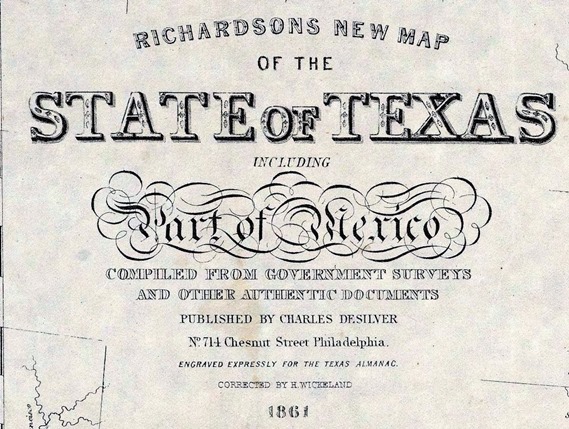
Richards New Map of the State of Texas 1861
Richardson’ss New Map of the State of Texas 1861

Richardson’s New Map Of The State Of Texas Including Part of Mexico Compiled From Government Surveys And Other Authentic Documents. Published By Charles Desilver No. 714 Chestnut Street Philadelphia. Engraved Expressly For The Texas Almanac. Corrected By H. Wickland. 1861. Entered … 1861 by Charles Desilver … Pennsylvania. (inset) Map Showing The Proposed Route Of The Aransas (sic) Railroad (And Its) Connections With The Eastern Roads.

Texas 1861 Map Legend
0 comments

Operations in Florida – Confederate Correspondence

War of the Rebellion: from the Official Records of the Union and Confederate Armies and Navies

WASHINGTON, January 18, 1861.

His Excellency Governor PERRY, Tallahassee, Fla:

We think no assault should be made. The possession of the fort is not worth one drop of blood to us. Measures pending unite us in this opinion. Bloodshed now may be fatal to our cause.

JNO. SLIDELL.

J. P. BENJAMIN.

A. IVERSON.

JNO. HEMPHILL.

LOUIS T. WIGFALL.

C. C. CLAY, JR.

BEN. FITZPATRICK.

JEFF. DAVIS.

S. R. MALLORY.

We sent this to Chase to-day.

0 comments

“An attack upon Fort Sumpter is expected…”—Horatio Nelson Taft.

Diary of US patent clerk Horatio Nelson Taft.

FRIDAY 18

The discussions in Congress are now very pointed and interesting. An attack upon Fort Sumpter is expected since the Prest flatly refuses to Treat with Col Hayne the last Comr from S.C. for its peacable surrender. If the attack is made it will be no holiday job for the “fireeaters.” The weather today has been wet & foggy, nearly cold enough to freeze. Got letter from Julia. She is expecting to come if she has a good opportunity but seems to adapt herself to circumstances with much facility and will not complain if she stays there during the vacation. She seems contented & happy.


The three diary manuscript volumes, Washington during the Civil War: The Diary of Horatio Nelson Taft, 1861-1865, are available online at The Library of  Congress.

0 comments

Norther Force and Southern Fear

Civil War Day-by-Day

January 18, 1861, Richmond Enquirer

The hope held out of a subsequent reconstruction of the Union, has not had the desired effect upon the conservatives of the North; it has lulled them into a fatal indifference and apathy as to the present Union, in expecting a speedy re-adjustment after a short interval of separation. We doubt very much if the apathy which prevails in the North, has not, more than Gen. Scott’s infamous conduct, tended to strengthen the Republicans in their persistence and stubbornness, until reconstruction has become impossible. – The New York Legislature has received this apathy as tacit consent of the people of that State to attempt coercion, and has shamefully tendered men and money for the purpose, not of preserving the Union, but of devastating the country with civil war; of conquering the Southern States and reducing them to the condition of tobacco, rice and cotton plantations for Northern masters. Mr. Clarke, of the United States Senate, has also accepted Northern apathy as an indication of Northern society in favor of coercion. A gentleman in Richmond received, yesterday, from a United States Senator, the following note and resolutions:

‘I have no time to say anything further than that the Republicans, by unanimous vote, have just rejected all of Crittenden’s propositions and adopted the enclosed force resolutions. – What has Virginia to say now?

‘Resolved, That the provisions of the Constitution are ample for the preservation of the Union, and the protection of all material interests of the country; that it needs to be obeyed rather than amended; and that an extrication from our present dangers is to be looked for in strenuous efforts to preserve the peace, protect the public property and enforce the laws, rather than in new guarantees for particular interests, compromises for particular difficulties, or concessions to unreasonable demands.

‘Resolved, That all attempts to dissolve the present Union, or overthrow or abandon the [continue reading…]

0 comments

Compromise and Ultimatum

Civil War Day-by-Day

January 18, 1861, Richmond Enquirer

The Legislatures of New York, Pennsylvania, and Ohio, have tendered men and money to the General Government, to coerce and subjugate Virginia, should the Convention of her sovereign people determine that secession is the only safety of the State. The action of these States, intended to be offensive and degrading, was deliberately and determinedly made at the very moment of intensest excitement, to show the authorities of Virginia that they condemn and despise the slave States, and are determined to degrade them into conquered provinces.

The unnecessary and wicked action of these States should open the eyes of the people of Virginia, to the purpose and disposition of the three largest Northern States. This tender of men and money to coerce and subjugate sovereign States, has increased the difficulties of adjustment, and should cause the manhood of Virginia to shrink from the debasement of offering any compromise, or even intimating the willingness to compromise with States that gratuitously offer Southern States another result. The Legislature of Virginia having called the people of the State together in Convention, are, as to all matters of compromise and ultimatum, functus officio – the people in Convention assembled, are the only power authorized to submit any ultimatum. The Legislature has no power, and will be treated with contempt by the Republicans – which will only aggravate and intensify the feeling in Virginia. We have no idea that the Convention of Virginia will ever agree to any compromise that has not been previously adopted by the Northern States in an authoritative and binding manner. Virginia will never tie herself to a Northern Confederacy, which may be rejected by her Southern sisters. The North must first adopt such amendments as they are willing to abide by, and these being submitted to all the Southern States must be agreed to by all of them. Virginia will patch up no compromise and agree to no amendments as long as the [continue reading…]

0 comments

Our Washington Correspondent

Civil War Day-by-Day

January 18, 1861, The New York Herald

WASHINGTON, Jan. 17, 1861.

What another day may bring forth no one can tell, but it is not believed here that South Carolina will really proceed to hostilities. Colonel Hayne has been earnestly assured by leading Southern Senators and others that an attack upon Fort Sumter will be unpopular elsewhere in slaveholding communities, and will not be sustained. On the other hand, it is believed that South Carolina is anxious to precipitate matters, in order to force Mississippi, Georgia, Louisiana, Florida and Alabama to ultra measures. Governor Pickens counts apparently upon civil war to concentrate Southern feeling and render the breach between the North and South as wide and incurable as possible. Up to the present time it is clear that, notwithstanding the seizure of federal fortresses and other aggressive acts on the part of the more excited portions of the population, led on by interested demagogues, the bone and sinew of the south are still in favor of the preservation of the Union. Had Mr. Buchanan not been powerless, had Congress taken one single step in advance to save the country, or had Mr. Lincoln declared himself in favor of concessions, South Carolina would have remained alone. but there has literally been nothing to rally around.

Mr. Toombs, of Georgia, understood this when he introduced his bill proposing amendments to the constitution. They were quite reasonable – more so than his own individual tastes would have sanctioned; but he was convinced that Georgia would not back him in a secession movement unless he could put the North more explicitly in the wrong and committed against congress than it yet had been. He succeeded in procuring the rejection of his measure, which was as satisfactory to himself, probably, as success; and the consequence has been a change of feeling for the worse in the cotton States, which has aided immensely the cause of fire eating. Until within one week a direct Union movement would have found favor in the South, under proper auspices. I fear it is now [continue reading…]

0 comments

The Revolution

Civil War Day-by-Day

January 18, 1861, The New York Herald

WASHINGTON, Jan. 17, 1861.

Colonel Hayne sent his communication to the President today. It is understood that since the arrival of Colonel Hayne, after a free conference with his Southern friends here, he has somewhat changed his original intention and purpose, and instead of making an unconditional demand for the surrender and evacuation of Fort Sumter, he now presents it in the shape of a suggestion. He therefore suggests to the President the propriety of the surrender, in order to avoid bloodshed.

It does not change in the slightest degree the aspect of the question, or the state of affairs. They want Fort Sumter, and are willing to enter into negotiation with the President for it. The President will inform South Carolina, through Colonel Hayne, that he has no authority to open such negotiations. They must appeal to Congress, it being the only power that can act or entertain such a proposition; and as regards the surrender of that fort to South Carolina, that is impossible.

The correspondence, as soon as it is closed, will be immediately communicated to Congress by the President.

Colonel Hayne has already become satisfied that the government will not yield one iota, and has undoubtedly informed Governor Pickens to that effect.

The firmness of the administration in dealing with the secession messenger now here caused the prominent secessionists in the city to join in advising the authorities of Charleston to suspend the execution of their threat to take fort Sumter until after the 4th of March, and Major Anderson is to be provided with provisions from Charleston, proving the South Carolina authorities accept the proposition and Major Anderson [continue reading…]

0 comments

The News

Civil War Day-by-Day

January 18, 1861, The New York Herald

Our despatches from Washington state that Col. Hayne, the South Carolina Commissioner, after conference with the secessionists at the capital, has considerably modified his proposals to the government. He no longer demands the unconditional surrender of Fort Sumter to the authorities of South Carolina, but suggests that it be given up to them in order to prevent a collision and a useless effusion of blood.

We have no news of startling import from Charleston today. Governor Pickens has recommended the legislature of South Carolina to increase the army of that State, so as to be prepared for enemies from any quarter, and also provide for fortifications and a seacoast police.

In Congress yesterday the Senate took up the Deficiency Appropriation bill and passed it. Among other appropriations is one of $350,000 for the New York and California mail service, from July 1, 1860, to July 1, 1861; $300,000 for a coaling station on the Isthmus of Panama, and a sum sufficient to carry out the provisions of law relative to the Printing Bureau. The Pacific Railroad bill was then discussed till the adjournment. In executive session the nomination of Mr. Holt as Secretary of War was received from the President, and a lively contest arose between the secessionists and their opponents on the question of referring it to a committee. In this is the opponents of Mr. Holt were defeated, and the nomination will probably be confirmed today. In the House the debate on the crisis of the nation was continued by Messrs. Thomas, of Tennessee; Sickles, of New York; Ashley, of Ohio; and Perry, of Maine. The discussion will be closed today by Mr. Sherman, of Ohio.

It would seem that the Alabama secessionists are not altogether harmonious. It is reported that they have telegraphed to their delegation in Congress not to resign their [continue reading…]

0 comments

The Crisis Before the People—The Approaching New England State Elections

Civil War Day-by-Day

January 18, 1861, The New York Herald

The ultimatum of Mr. Buchanan to the warlike requisition of South Carolina, through Colonel Hayne, for the surrender of Fort Sumter, has concentrated the public attention upon the issue thus made up of peace or war. Anticipating a bloody collision, which may summon the whole country to arms, we apprehend that our readers of all parties are thus brought to the opinion that prompt sacrificing the honor or the prestige of the general government, are much more important now than any sectional movements, propositions or concessions for the salvation of the Union.

Admitting the force of this opinion, but still entertaining the hope that war in the interim will be avoided, so as to leave the incoming administration free to make its election between conciliation and coercion, we have the whole field of the argument – peace or war, conciliation or coercion, Union or disunion – still open before us. Our republican contemporaries admonish us that first question to be decided is whether we have a government or not. They demand, too, that the rights and the integrity of the government of the Union shall first be vindicated in the enforcement of the laws, before any propositions involving further concessions to slavery can be entertained. Nor can it be denied that the moral strength of this government materially depends upon its capacity to enforce, if necessary, its constitutional rights against domestic usurpations, as well as in resistance to foreign aggressions.

The powers of the federal government are well defined. They are the powers surrendered by the States for the general welfare; and so far they make the United States a single sovereignty. Furthermore, as there is nothing in the constitution recognizing the right of a State to secede from the Union, and as there are no exceptional constitutional provisions, making any discrimination between acts of rebellion against the federal government under State authority and similar acts without any such authority, we must concede the power of the federal government to enforce the laws of the Union not less [continue reading…]

0 comments

Union with the Northern States Necessarily Destructive of Southern Liberty

Civil War Day-by-Day

January 18, 1861, The Charleston Mercury

The most destructive feature of Northern society, political and social, is radicalism – license. The basis of all Southern organism is conservatism – order. The two systems are in direct antagonism – theoretically and practically. It is but human that men should enforce their own views, if practicable. The system of the North is essentially radical, intolerant, aggressive. Without ballast or restraint, liberty has necessarily degenerated into license. License is subject to no laws, and hence is without the control or direction of an limiting power. The shifting will of the mobocracy, guided by interest or passion alone, becomes their law. A student of history, or a thinker upon government, would at once find himself drawn to this conclusion in anticipation of the result. The practical workings of their social and political organization more than sustains the conclusions of reason and the experience of mankind in all ages. More precipitately than any politician society upon record, commencing in liberty, it has rushed into lawlessness and anarchy. Eighty short years have converted the people of the North into one vast mob – a ranting reckless, lawless mob – shrieking for liberty amidst blood and freedom in plunder. It would be of little consequence to the rest of the world if the blood they shout for were their own, and the rapine their lawlessness would reap were amongst themselves. But, as we have said, their system of politics is aggressive. Might is their only test of right. To rob where they can, is their political creed. Of course this robbery and aggression will first commence abroad. They must plunder and exhaust others before they being amongst themselves. Thus far they have now advanced in the programme which time and human passion have marked out for them. So long as they have Southern fields upon which to make their descent and to pillage, they may keep their hands from each other throats and pockets. But cut short this means of supply, remove this rich field from their robber devastations, shut them up in their own barns and workshops to earn amongst themselves their own subsistence and maintain their own rights, laws, and institutions – and how long will they stand? The second act of the drama will then be [continue reading…]

0 comments

A Diary of American Events – January 18, 1861

The Rebellion Record – A Diary of American Events; by Frank Moore

–In the Massachusetts State Legislature to-day, a series of resolutions was passed by a unanimous vote, tendering to the President of the United States such aid in men and money as he may request, to maintain the authority of the general Government. The preamble to the resolution declares that the State of South Carolina, in seizing the fortifications of the Federal Government, the Post Office, Custom Home, money; arms, munitions of war, and by firing upon a vessel in the service of the United States, has committed an act of war. The Senate passed a bill authorizing the increase of the volunteer military of the State.–Boston Journal, Jan. 19.

0 comments

“I would respectfully inquire if Fort Jefferson is a double-ration post?”—Operations in Florida

War of the Rebellion: from the Official Records of the Union and Confederate Armies and Navies

HEADQUARTERS FORT JEFFERSON, TORTUGAS,
January 18, 1861.

SIR: I have the honor to report that I arrived at Fort Jefferson today with my command; garrisoned and assumed command of the post, in accordance with the instructions of the General-in-Chief, dated Washington, January 5, 1861. Strength: four commissioned officers and sixty-two enlisted men, Bvt. Maj. L. G. Arnold, commanding; Surg. A. N. McLaren, First Lieut. Henry Benson, A. A. Q. M and A. C. S.; First Lieut. M. M. Blunt. I would respectfully inquire if Fort Jefferson is a double-ration post? If not, I request that it be announced as such in orders from the War Department, from the 18th instant.

I am, very respectfully, your obedient servant,

L. G. ARNOLD,
Brevet Major, U.S. Army, Commanding.

Col. S. COOPER,
Adjt. Gen. U. S. Army, Washington City, D.C.

0 comments

“People generaly are less excited than they were a week ago…,”—Horatio Nelson Taft

Diary of US patent clerk Horatio Nelson Taft.

THURSDAY 17

There has been no startling News today, but the right of Secession is contested by all northern men who with the president consider it Revolution. I have not hesitated to call it Treason. I was at Willards this evening. People generaly are less excited than they were a week ago, and since the Cabinet has been purged of Secessionists and the President has taken a stand for the Union and the Constitution we all feel much better. It is now thought that “secession” will be at a discount soon even in the South. Became acquainted with Mr Fitman (Sigma), Mr Cluskey &c.


The three diary manuscript volumes, Washington during the Civil War: The Diary of Horatio Nelson Taft, 1861-1865, are available online at The Library of   Congress.

0 comments

Who are the True Owners of Our Federal Fortifications?

Civil War Day-by-Day

January 17, 1861, The New York Herald

The argument is continually brought forward by that portion of the people of the Southern States who would justify the seizure of federal property by State governments, that our coast defences were erected exclusively for local defence. They say that Fort Pulaski belongs to Georgia, from the very necessity of the case, as much as Dover does to England, or Cherbourg and Toulon to France. They maintain that the authorities of South Carolina have an absolute, inherent right to hold forts Pinckney, Moultrie and Sumter; that the approaches to New Orleans belong to Louisiana; and that forts McHenry and Monroe are appendages of Virginia and Maryland, just so soon as those states have cut themselves off from the Union. This is an entire fallacy. It was not alone for the protection of any particular point, or line of coast, that our fortifications were built with so much care and at such vast expense; but for the security of the common country, and to prevent the possibility of invasion, which would give a lodgment anywhere on the continent to a common enemy.

The inhabitants of Philadelphia, New York and Baltimore are no less interested that troops should not be landed in Georgia and South Carolina, than are those of Savannah, Columbus and Charleston. An attack upon any one point of our coast is an invasion of the whole United States, and would be resisted as much in the present dislocated state of our national and administrative machinery as it would have been under the Presidency of Monroe, Madison or Jackson. Were Louisiana menaced by a foreign foe, would the people of that State cry out hands off; let us fight out this battle singly and alone? They would justly demand the assistance of the whole sea and land force of the Union to aid them, and they would receive succor alike from Missouri, Ohio, New York and even Connecticut and Massachusetts. The blood still flows from one common heart, and the pulsations of every artery are dictated from one common national centre. An injury [continue reading…]

0 comments