Honor to Georgia

Civil War Day-by-Day

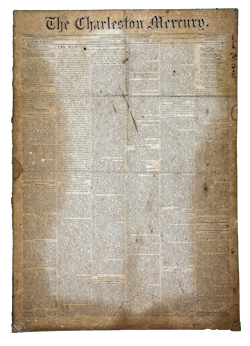
January 21, 1861, The Charleston Mercury

On Saturday last a salute was fired on the reception of the news of the secession of Georgia from the Federal Union, by Mr. C.H. SCHWECKE, a member of the German Artillery, and Mr. WILLIAM ROGERS. Both gentlemen assisted in the firing of this gun under the flag of the MERCURY office, on the secession of South Carolina. As it was first used on that occasion the gun was dubbed ‘Secession.’

0 comments

The News

Civil War Day-by-Day

January 21, 1861, The New York Herald

There was a rumor in Washington last night to the effect that fighting had commenced in Florida between the federal and State troops; but whether the rumor is well founded or not we are unable to learn. If any fighting has taken place it must have been at Fort Pickens. Advices from there by way of New Orleans represent that on Friday State troops were concentrating in the neighborhood of Pensacola from all parts of the State. The steamer Wyandot was lying at the entrance of the harbor, communicating with Fort Pickens, but was not allowed to enter the harbor. The families of the officers were on board the Wyandot.

The general tone of the advices from Washington which we publish this morning indicates a somewhat less belligerent aspect of affairs. It is stated that Governor Pickens, of South Carolina, has, yielding to the solicitations of his friends in Washington, addressed Col. Hayne, the South Carolina Commissioner, instructing him to change his policy. Col. Hayne will remain in Washington for some time. The letter which he transmitted to the President on Saturday is said to have been very temperate in tone. The attack on Fort Sumter is considered to be abandoned for the present. In the meantime, it is hoped some plan of conciliation may be adopted. The Virginia legislature propositions of adjustment, a synopsis of which will be found in our despatches, were much discussed in Washington political circles yesterday.

0 comments

Civil War Day-by-Day

Civil War Day-by-Day

January 21, 1861

  • Five senators from Florida, Alabama, and Mississippi bid farewell to their colleagues in the upper house. Among them is Senator Jefferson Davis, future president of the Confederacy.
  • All but 6 of the delegates to Georgia’s Secessionist Convention sign the Ordinances of Secession
Fort Sumter, Charleston, South Carolina, 1861

Fort Sumter, Charleston, South Carolina, 1861 (from Frank Leslie’s Illustrated History of the Civil War…, edited by Louis Shepheard Moat, Published by Mrs. Frank Leslie, New York, 1895)


0 comments

Operations in Florida – Confederate Correspondence

War of the Rebellion: from the Official Records of the Union and Confederate Armies and Navies

WASHINGTON, January 20, 1861.

Gov. M. S. PERRY, Tallahassee, Fla.:

The Southern Senators all agree that no assault on Fort Pickens should be made; that the fort is not worth one drop of blood at this time, and desire us to invoke you to prevent bloodshed. First get the Southern Government in operation. The same advice has been given as to Charleston, and will no doubt be adopted there.

S. R. MALLORY.

D. L. YULEE.

0 comments

“Servile insurrection, too, seems contemplated in Virginia.”—Diary of George Mifflin Dallas, United States Minister to England.

Diary of George Mifflin Dallas, United States Minister to England 1856 to 1861

1861. January 20.–….The news from home during this week has been deplorable. On the l0th inst. the President sent a message to Congress which depicts the state of things in the gloomiest colours. South Carolina, at Charleston, has fired repeated volleys at a United States transport carrying troops for Major Anderson at Fort Sumter, and has compelled her to retire. The Brooklyn, a second-class screw steamer of fourteen guns, and the revenue cutter Harriet Lane are about to convoy the troops back again to Charleston on board the Star of the West, and we may expect our next news to announce a bloody fight, possibly a bombardment of the city. Seward has made a speech in the Senate which the Times calls “grand and conciliatory,” but which obviously asserts a determination to enforce the laws. Servile insurrection, too, seems contemplated in Virginia, some twenty-five barrels of gunpowder having been disinterred from secret hiding-places.

0 comments

“There are so many villinous looking fellows roaming about the City, that it seems necessary for some one to be on the watch all the time.”—Horatio Nelson Taft.

Diary of US patent clerk Horatio Nelson Taft.

SUNDAY 20

Cooler today, and quite windy, but did not freeze till night. Did not go to church today. Took care of the house while the rest of the family went. Read the “Times” “Herald” and Partons last Vol of Jackson. There are so many villinous looking fellows roaming about the City, that that [sic] it seems necessary for some one to be on the watch all the time. Burglaries and incendiary fires occur every night. I sleep with a loaded “revolver” within reach every night. Took a walk with the boys round Lafayette Square this evening and did not go out again. The air was cool and bracing. It freezes tonight.


The three diary manuscript volumes, Washington during the Civil War: The Diary of Horatio Nelson Taft, 1861-1865, are available online at The Library of   Congress.

0 comments

Condition of the Border Slave States

Civil War Day-by-Day

January 20, 1861, The New York Herald

It is not to be disguised that the warlike preparations are now being made in the North have produced a very bad feeling in the border Slave States. In Maryland there is a sharp contest going on between the Union party and the secessionists – the latter desiring that a State Convention shall be called as a preliminary to the seizure of Washington by a coup d etat. The same feeling is manifested in Virginia, where the party in favor of Governor Wise’s plan to prevent the inauguration of Lincoln is daily increasing in strength. The Governors of Kentucky and Virginia, both Union men, have declared solemnly that the passage of troops, intended to coerce the seceding States, across the border will not be permitted. And yet, in spite of all this, the republican leaders are arming their followers. This is worse than folly. It is absolute suicide.

0 comments

A Diary of American Events

The Rebellion Record – A Diary of American Events; by Frank Moore

January 19.–This evening a party scouting for Colonel Williams, in command of the military post at Rossville, Ark., returned to camp, having captured in the Magazine Mountains, some fifteen miles east of the post, the county records of Vernon and Cedar Counties, Mo. The books and papers so captured and retained were worth one million dollars to those counties.– Colonel Clayton attacked and routed Shelby’s rebel force, twenty miles below Pine Bluff, Ark., on the Monticello Railroad. The fight lasted half an hour, when the enemy fled, pursued by Colonel Clayton, with his command, for two hours and a half. The rebels were driven seven miles. Shelby was badly beaten, and the rout was complete.

Shelby’s force was estimated at eight hundred. Colonel Clayton marched sixty miles in twenty-four hours, and made fight and gained a victory. –An unsuccessful attempt was made to burn the residence of Jefferson Davis, at Richmond, Va.– A sale of confiscated estates took place at Beaufort, S. C.

0 comments

Steamship Sloop of War “Brooklynn”

Harper’s Weekly

The United States Sloop of War 'Broklynn'Harper’s Weekly, January 19, 1861
The Brooklyn is at present hourly expected at Charleston, and may take an active part in any future contest at that point. She was launched at New York on the 27th of July, 1858, and took her place in the navy on the 1st of January, 1859. She is by far the largest sloop of war in our navy, or in the world, and carries the heaviest battery ever placed on the deck of any vessel of her class; yet she only draws 16 feet water. Her length on deck is 247 feet, breadth of beam 43 feet, depth of hold 21 1/2 feet, being 2000 tons, government measurement; and is rated at 14 guns on the navy register, although pierced for 24 9-inch shell guns and two 10-inch pivot guns, the weight of each being nearly six tons. All the hatch and mast combings on this deck are of mahogany—a wood never before used for such a purpose in our navy. All the spare spars required, together with three boats, are carried upon a bridge amidships, elevated above the deck sufficiently high to walk under, which is an entirely new arrangement. By this improvement the space upon deck is kept clear and unobstructed for working the guns. Her entire complement is about 300 men. The captain’s cabin occupies the space of 25 feet in length at the after end of this deck. The boilers are Martin’s patent, now generally adopted in the naval service. Her propeller is of composition, 14 feet 6 inches in diameter, and weighing 13,500 pounds. It is arranged for hoisting on deck when not needed, and can be taken out of water by means of a capstan, arranged for the purpose, in less than two minutes. She is sparred precisely like sailing vessels of similar tonnage in the merchant service, her screw being merely an auxiliary affair. Her speed is estimated at ten knots under steam.

0 comments

The Secession of Georgia

War of the Rebellion: from the Official Records of the Union and Confederate Armies and Navies

ORDNANCE OFFICE,
Washington D. C., January 19, 1861.

SIR : The inclosed letter from Captain Rimy to the Adjutant-General of the Army is submitted for the perusal of the Lientenant-General commanding, and for such action as he may deem proper in the case, with the remarks that the captain had no means of knowing whether the Colonel of Ordnance had or had not consulted higher authority on the matter, even if such consultation, under the peculiar circumstances of the case, had been requisite.

The Ordnance detachment had been ejected from the Charleston Arsenal by the treasonable violence of the State authorities, and it became absolutely necessary to shelter it elsewhere. The Augusta Arsenal, Ga., under the control of this Department, where ample quarters are prepared for its enlisted men, is the nearest acceptable military post to which the detachment could be sent. The order to that effect was given after a full consideration of its propriety, and it is believed that if Captain Elzey had taken the pains to offer such explanations as his information warranted, the excitement alluded to by him need not have occurred, or might have been readily abated.

………With much respect,

H. K. CRAIG,
Colonel of Ordnance.

Lieut. Col. L. Thomas,
Assistant Adjutant-General, Headquarters.

[Inclosure.]

AUGUSTA ARSENAL, GA., January 11, 1861.

SIR: I have the honor to foward a field return of a detachment of Ordnance which arrived at this post last night from Charleston, S. C., under command of Military Storekeeper Humphreys. He reported here by telegraphic order from Colonel Craig. This movement on the part of Colonel Craig I believe to be wholly unauthorized by the War Department. It was injudicious and impolitic, added much to the excitement in Augusta, and was very nigh praducing serious difficulties in this quarter, the people believing it to be a re-enforcement to my command. I had no previous knowledge of it whatever.

………I am, sir, very respectfully, your obedient servant,

………ARNOLD ELZEY, ………
Captain, Second Artillery, Commanding Post.

Col. S. COOPER,
………Adjutant-General U. S. Army, Washington, D. C.

0 comments

“…all classes are looking towards Charleston with much anxiety, as an attack is expected on Ft Sumpter.”—Horatio Nelson Taft.

Diary of US patent clerk Horatio Nelson Taft.

SATURDAY, JANUARY 19, 1861.

This has been a warm and pleasant day, but the streets and crossings very muddy. No particular news is afloat but all classes are looking towards Charleston with much anxiety, as an attack is expected on Ft Sumpter. I went with the boys after office hours to the Navy Yard to see the new war Steamer Pensacola. We got permission to go on board and the boys were much interested. She is here for her Engines, &c, which were built at this yard. She is expected to exceed any vessel in the Navy in speed. Her Engines could not be excelled. Was at the Hotels in evening. Saw old Comodore Stewart at “National.”


The three diary manuscript volumes, Washington during the Civil War: The Diary of Horatio Nelson Taft, 1861-1865, are available online at The Library of   Congress.

0 comments

The First of the War

Harper’s Weekly

Harper’s Weekly, January 19, 1861

The Steamship 'Star of the West'
The Steamship ‘Star of the West’

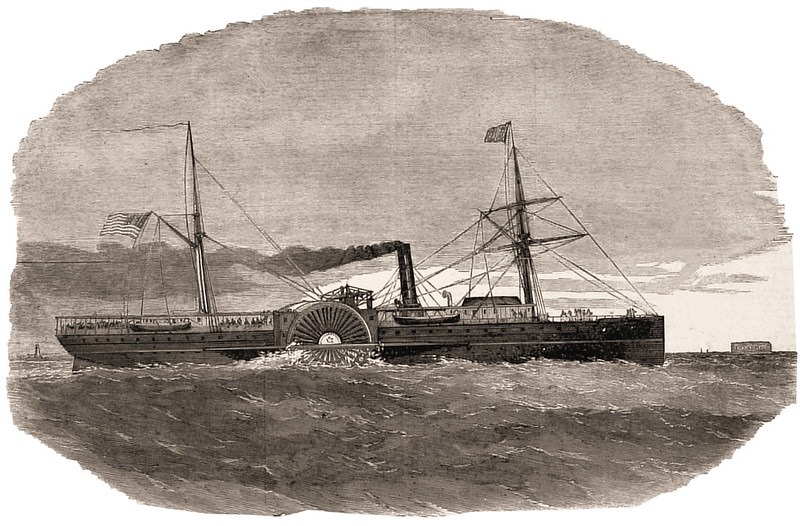
WE publish herewith pictures of the United States steam-sloop Brooklyn, and of the steamship Star of the West, and of the steamship Marion, which three vessels figured so prominently in the movements of last week; and on page 37 we give a large plan of Charleston harbor, showing the forts, etc., together with a view of Fort Johnson. These pictures will enable our readers to realize what is going on in this most memorable contest of the present age.

On Wednesday morning, January 9, 1861, the first shots were fired.  At daybreak on that morning the steamship Star of the West, with 250 United States troops on board, attempted to enter the harbor of Charleston for the purpose of communicating with Fort Sumter. The people of Charleston had been warned of her coming and of her errand by telegraph. They determined to prevent her reaching Fort Sumter. Accordingly, as soon as she came within range, batteries on Morris Island and at Fort Moultrie opened on her. The first shot was fired across her bows; whereupon she increased her speed, and hoisted the stars and stripes. Other shots were then fired in rapid succession from Morris Island, two or more of which hulled the steamer, and compelled her to put about and go to sea. The accompanying picture shows the Star of the West as she entered Charleston harbor; the plan will explain the situation of the forts, and the position of the steamer when she was fired upon. The channel through which she passed runs close by Morris Island for some distance.

Fort Sumter made no demonstration, except at the port-holes, where guns were run out bearing on Morris Island.

About eleven o’clock A.M. on 9th a boat from Fort Sumter, bearing Lieutenant Hall with a white flag, approached the city. Lieutenant Hall had an interview with Governor Pickens, and was afterward escorted to his boat and re-embarked for Fort Sumter. The communication from Major Anderson was as follows :

Major Anderson to Governor Pickens

“To His Excellency the Governor of South Carolina:

“SIR,—Two of your batteries fired this morning on an unarmed vessel bearing the flag of my government. As I have not been notified that war has been declared by South Carolina against the United States, I can not but think this a hostile act, committed without your sanction or authority. Under that hope I refrain from opening fire on your batteries. I have the honor, therefore, respectfully to ask whether the above-mentioned act—one which I believe without parallel in the history of our country or any other civilized government—was committed in obedience to your instructions, and notify you, if it is not disclaimed, that I regard it as an act of war, and I shall not, after reasonable time for the return of my messenger, permit any vessel to pass within the range of the guns of my fort.

“In order to save, as far as it is in my power, the shedding of blood, I beg you will take due notification of my decision for the good of all concerned. Hoping, however, your answer may justify a further continuance of forbearance on my part, I remain, respectfully,

“Robert Anderson”

Governor Pickens Response to Major Anderson

“Governor Pickens, after stating the position of South Carolina to the United States, says that any attempt to send United States troops into Charleston harbor to reinforce the fort would be regarded as an act of hostility, and in conclusion adds that any attempt to reinforce the troops at Fort Sumter, or to retake and resume possession of the forts within the waters of South Carolina, which Major Anderson abandoned after spiking the cannon and doing other damages, can not be regarded by the authorities of the State as indicative of any other purpose than the coercion of the State by the armed force of the Government.

“Special agents, therefore, have been off the bar to warn approaching vessels, armed and unarmed, having troops to reinforce Fort Sumter aboard, not to enter the harbor. Special orders have been given the commanders at the forts not to fire on such vessels until a shot across their bows should warn them of the prohibition of the State. Under these circumstances the Star of the West, it is understood, this morning attempted to enter the harbor with troops, after having been notified she could not enter, and consequently she was fired into. The act is perfectly justified by me.

“In regard to your threat about vessels in the harbor, it is only necessary for me to say you must be the judge of your responsibility. Your position in the harbor has been tolerated by the authorities of the State, and while the act of which you complain is in perfect consistency with the rights and duties of the State, it is not perceived how far the conduct you propose to adopt can find a parallel in the history of any country, or be reconciled with any other purpose than that of your government imposing on the State the condition of a conquered province.

“F. W. Pickens”

To His Excellency Governor Pickens:

” SIR,—I have the honor to acknowledge the receipt of your communication, and say that, under the circumstances, I have deemed it proper to refer the whole matter to my Government, and intend deferring the course I indicated in my note this morning until the arrival from Washington of such instructions as I may receive.

“I have the honor also to express the hope that no obstructions will be placed in the way, and that you will do me the favor of giving every facility for the departure and return of the bearer, Lieutenant T. Talbot, who is directed to make the journey.

“Robert Anderson”

Lieut. Talbot left Charleston accordingly for Washington, without hindrance by the authorities.
0 comments

The News

Civil War Day-by-Day

January 19, 1861, The New York Herald

The steamship Asia, from Liverpool 5th and Queenstown 6th inst., arrived at Quarantine last evening, but owing to the quantity of ice in the bay she did not come up.

Our accounts from South Carolina are rather more pacific than usual, owing, as it is said, to the pressure excited at Washington by the secessionists there. Colonel Hayne has not yet presented his propositions to the President. He awaits further instructions from his government. Governor Pickens has concluded to allow Major Anderson to obtain such supplies as he may require from Charleston, and his mail communications are again open.

The steamship Marion, Captain Adkins arrived yesterday morning from Charleston, had on board, as passengers, three laborers from fort Sumter and twenty three free colored persons. As to the condition of the parties in fort Sumter, we learn that they are in good spirits, number seventy five men rank and file, and twenty five laborers, have plenty of provisions and water, and a scarcity only of fresh provisions, which, however, they are now at liberty to procure from Charleston as formerly.

0 comments

Interesting from Arizona

Civil War Day-by-Day

January 19, 1861, The New York Herald

Our Tucson Correspondence.

TUCSON, Dec. 30, 1861.

On the 20th instant the Apaches murdered an American named Hoyt, who was cutting wood about a mile and a half from Fort Breckinridge. Hoyt’s partner escaped, but very narrowly. The Indians took a rifle, pistol and ammunition from the murdered man. Hoyt was from Virginia, where he has relatives. The Indians were not pursued, nor has there yet been any attempt to chastise them for numerous robberies and murders, notwithstanding they are constantly in the vicinity of the fort and their country is only three or four days’ march from the commanding officer’s quarters. The garrison of Fort Breckinridge consists of two full (or nearly full) companies of dragoons, and one company of infantry. The inactivity of the troops in this region fairly beats the celebrated inactivity of General Taylor’s forces on the Rio Grande. Indians stealing and killing all around us, and nearly five hundred United States soldiers doing nothing but attacking bacon and beans with a vigor such as is always displayed by our gallant army in such warfare.

Of course the fault is not in the rank and file nor the sub-officers; they can only do as they are ordered; the blame lies with the department commanders and the commanders of the posts. Col. Fauntleroy, in the tribulations of his Navajo campaign, seems to have forgotten that Western Arizona, although overrun by Apaches, has five hundred brave sons of Mars shut up in adobe houses, wasting their valor upon salt provisions and venerable sour krout. Yet such is the case. I imagine the Quartermaster and Commissary bills at Washington will satisfy people that troops are here if nothing else will, and if Col. Fauntleroy has forgotten the fact, it might be well for the Secretary of War to mildly remind him, and after the Colonel ascertains that we have soldiers among us he may [continue reading…]

0 comments

Curious Features of the Secession Movement

Civil War Day-by-Day

January 19, 1861, The New York Herald

Among some of the curious features of the secession movement is the agreement on the part of South Carolina to continue to use the postal service of the federal government for its own special accommodation, while that State is seizing the Post Office, forts, arsenals and Custom House, the property of that government. Mississippi, too, it appears from her secession ordinance, is going to avail herself of the Post office privileges of the country from which she declares herself cut off. For several days past we have been receiving our remittances from South Carolina, and the other seceded States, in postage stamps. The ordinary mode of remitting by draft having become so difficult of late, our neighboring States are using the stamps of the national government as a medium. The mail of one day recently brought us nearly a hundred dollars worth of postage stamps. The secessionists have in fact converted our office into an extensive picture gallery of the patriots of the early days of the republic, containing multitudinous duplicates of the heads of Franklin and Washington.

0 comments

Touching Scene at Fort Sumter

Civil War Day-by-Day

January 19, 1861, Harper’s Weekly

The Baltimore American has the following story: One of the Baltimoreans who recently returned from Fort Sumter details an impressive incident that took place there on Major Anderson taking possession. It is known that the American flag brought away from Fort Moultrie was raised at Sumter precisely at noon on the 27th ultimo, but the incidents of that ‘flag raising’ have not been related. It was a scene that will be a memorable reminiscence in the lives of those who witnessed it. A short time before noon, Major Anderson assembled the whole of his little force, with the workmen employed on the fort, around the foot of the flag-staff. The national ensign was attached to the cord, and Major Anderson, holding the end of the lines in his hands, knelt reverently down. The officers, soldiers, and men clustered around, many of them on their knees, all deeply impressed with the solemnity of the scene. The chaplain made an earnest prayer such an appeal for support, encouragement, and mercy, as one would make who felt that ‘Man’s extremity is God’s opportunity.’ As the earnest, solemn words of the speaker ceased, and the men responded Amen with a fervency that perhaps they had never before experienced, Major Anderson drew the ‘ Star Spangled Banner’ up to the top of the staff, the band broke out with the national air of ‘ Hail Columbia,’ and loud and exultant cheers, repeated again and again, were given by the officers, soldiers, and workmen. ‘ If,’ said the narrator, ‘South Carolina had at that moment attacked the fort, there would have been no hesitation upon the part of any man within it about defending that flag.’”

0 comments

Suffering in Charleston

Civil War Day-by-Day

January 19, 1861, Harper’s Weekly

According to a dispatch in the Herald, terrible suffering already exists at Charleston. The  “troops who have volunteered and presented themselves for service are camped in unhealthy locations, and, in consequence of rain, swamps, and miasma, are suffering from disease. No vessels loading, no business doing, women weeping, and men overcome by sickness, and the city in the hands of a mob, is the bulletin travelers present of the condition of things at the present time.”

0 comments

Seizure of Forts at the South

Civil War Day-by-Day

January 19, 1861, Harper’s Weekly

The Baton Rouge arsenal (Louisiana) was taken possession of by the State troops on 11th. All the fortifications are now in possession of the Louisiana troops. The United States arsenal at Baton Rouge, in command of Major Haskins and two companies, refused to surrender. The arsenal was surrounded by six hundred State troops, and a parley was held between Governor Moore and Major Haskins, which finally resulted in the surrender of the garrison. There was no opposition in taking the other forts.

The State of Georgia has seized Fort Pulaski, in the Savannah River.

A private dispatch to the Courier says that the Federal troops have abandoned all the forts in Pensacola harbor, except Fort Pickens, where they are concentrated, and that three hundred men have left Mobile to surprise Fort Pickens.

A telegram, dated Wilmington, North Carolina, January 10, says : Forts Johnson and Caswell were taken possession of on the night of the 8th by the Smithville Guard.

0 comments

Privateering Prospects

Civil War Day-by-Day

January 19, 1861, Harper’s Weekly

The Charleston Mercury, at the close of an appeal to the Floridians to seize the defenses at Pensacola and Key West, threatens the seizure of the California treasure-ships by Southern privateers. We copy :

“To our friends in Florida we would respectfully pass a word. There are two powerful strong-holds and most important points of military offense and defense in Florida–Pensacola and Key West. The States both of Georgia and Alabama have wisely taken time by the forelock, and put themselves in possession of such fortresses as lie within their borders, simply because they do not choose that their territories should be occupied, their commerce cut off, and the lives of their people put in jeopardy by General Scott’s or Mr. Buchanan’s despotic theory of the powers and duties of the executive officer of a consolidated, vulgar mobocracy. They have chosen to ward off violence and out-rage by a timely precaution. If any thing could tend to demonstrate to the executive at Washington the folly of attempting the blockading of Southern ports, it would be the late action of Georgia and Alabama in regard to their forts. Yet it is impossible to tell to what extremities folly and desperation may drive men. In this view, it is important for the people of Florida to reflect that there are, perhaps, no fortresses along our whole Southern coast more important than those of Florida. These forts can command the whole Gulf trade. And should Mr. Buchanan carry out what appears to be his present plan, he certainly must desire to hold possession of these forts. He may thus, with the assistance of war-steamers, block up the whole Gulf. But let Florida hold these forts, and the entire aspect of affairs is changed. Such vessels, in time of war, will have no port of entry, and must be supplied in every way from a very long distance, and that at sea ; while the commerce of the North in the Gulf will fall an easy prey to our bold privateers; and California gold will pay all such little expenses on our part.”

“We leave the matter for the reflection and decision of the people of Florida.”

0 comments

United States Troops Despatched to Rhode Island.

Civil War Day-by-Day
1860s newsprint

January 19, 1861, Elwood Free Press

Elwood, Kansas

In 1843, the people of the State of Rhode Island assembled by delegates in State Convention, framed a State Constitution, and by a majority of votes, but without the sanction of their existing state government, adopted it and attempted to put it in operation. The old state government resisted, and called on the United States government for assistance under the constitution, and it was granted. Acting President Tyler, with John C. Calhoun approving, sent United States troops to Rhode Island to coerce the people of a sovereign state, a people nearly as numerous in white population, and at least equally intelligent and brave, with the people of South Carolina.

0 comments

Purchase of Slaves

Civil War Day-by-Day

January 19, 1861, The Charleston Mercury

Suggestions have been made at Washington looking to the introduction of a proposition into Congress to buy out all the slaves in Maryland, Delaware, Missouri, Arkansas, Texas, and Louisiana, in order to settle the slavery and secession question in the country north of the Potomac and west of the Mississippi River, in a peaceful manner. It is thought $100,000,000 would complete the work and carry this compromise in favor of freedom through Congress and be a wiser expenditure than the same sum appropriated to put down secession in those quarters by military means. This proposition is more favorably regarded than the suggested compromises looking to the future impossible abrogation of slavery anywhere.

0 comments

News from Fort Sumter—Letter from Captain A. Doubleday

Civil War Day-by-Day

January 19, 1861, The Charleston Mercury

(From the Auburn Union.)

General Segoine has kindly permitted us to publish the following letter received by him on Saturday last, from Captain Abner Doubleday, who is with Major Anderson at Fort Sumter. It speaks for itself:

FORT SUMTER, S.C., Jan. 6, 1861.

MY DEAR SIR: It is a matter of great satisfaction to me to see that our movements here have been approved by my former townsmen, and that the heart of New York still beats warm and true for the Union. We have been so long surrounded with trimmers and traitors, that I began to fear the love of the national flag was dying out in our country. You cannot imagine the annoyance of the South Carolinians on finding themselves forestalled in the possession of this important work. At Fort Moultrie everything had been repaired for a desperate stand; but we could have done little against the powerful batteries of this fort, which would have been turned against us in addition to an army of at least 10,000 men, who would have assailed us on the land side. Our own lives were of little consequence, but our defeat would have involved the loss of this harbor to the United States, a loss that would have been irreparable. The State still continues her aggressive actions. The Charlestonians are surrounding us with batteries on every point of land in the vicinity, and are arming them with guns from forts they have seized. This is done with the hope of preventing any vessel from coming to our assistance and also with a view to force us ultimately to surrender from a lack of supplies. In this I think they will be disappointed, for there is no such word as surrender in Major Anderson’s composition. The war garrison of this fort is six hundred men. We have about seventy; but should they attack us, I hope the country at large will have no reason to find fault with our defence. [continue reading…]

0 comments

Arrival of Lieut. Talbot

Civil War Day-by-Day

January 19, 1861, The Charleston Mercury

This gentleman arrived in the city last night, by the six o’clock train on the Northeastern Railroad, and is stopping at the Charleston Hotel. He will leave for Fort Sumter at an early hour this morning. The tenor of his instructions for Major ANDERSON has not transpired, but we have good reason to suppose that they are of the general character foreshadowed in the MERCURY’s special despatches – that is to say, to hold Fort Sumter at all hazards, if he can.

0 comments

Georgia Appoints Commissioner to Europe

Civil War Day-by-Day

January 19, 1861, The Charleston Mercury

The Commissioner who has been appointed by the State of Georgia to proceed to Europe, for the purpose of making commercial arrangements with European Governments for direct commerce with the Southern States, and with Savannah, especially, is now in correspondence with diplomatic individuals here, and gathering all necessary information to facillitate his objects. One of his main objects is to procure the establishment of a line of freight, passenger and mail steamers, between the ports of Antwerp and Savannah. Though Georgia has not yet formally seceded, she is evidently acting in view of its speedy accomplishment. Charleston Courier, 15th.

0 comments

Steamship “Marion”

Harper’s Weekly

The Steamship 'Marion,' seized by the State of South Carolina to be Converted into a Man-Of-WarThe Steamship ‘Marion,’ seized by the State of South Carolina to be Converted into a Man-Of-War

The steamship Marion, 800 tons burden, of the New York and Charleston line, was seized by the State authorities of South Carolina on 10th, to be converted into a vessel of war. She was built here (New York) by Jacob Bell, and was launched on February 3, 1851. At the time of her capture she was commanded by Captain Sam Whiting.

0 comments