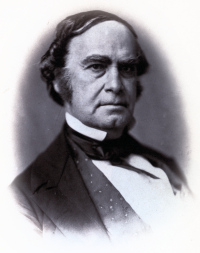
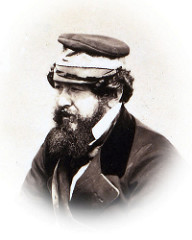
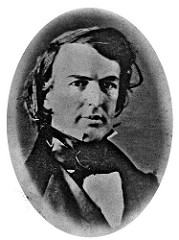
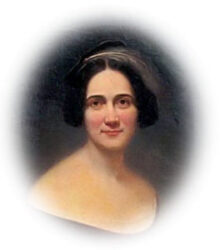
“One gentleman confidently predicted that the Southerners would capture Washington and give the Northerners the severest thrashing they have ever had.”—George Mifflin Dallas, U. S. Minister to U. K.

Diary of George Mifflin Dallas, United States Minister to England 1856 to 1861

1861. April 28.—I have repeatedly observed on the utter impossibility of keeping a diary without long chasms. More than a month has gone by, and an eventful one, too, without my dotting a single item! I must brush up and try to preserve the features of my few days for remaining in this great country, which, while commanding my highest admiration, I find, after five years of trial, I do not and cannot like.

I went last night to Cambridge House. Lord Palmerston has emerged from the tortures of the gout, and is in admirable looks and spirits. He looks upon the extraordinary report of the bombardment for forty hours of and from Fort Sumter, without any one being hurt, as an absurdity which further news will clear up. Nothing else engaged the conversation of the whole company. Italy, Poland, Hungary, and Holstein all yield in interest to the drama thought to be now formally inaugurated in America. One gentleman confidently predicted that the Southerners would capture Washington and give the Northerners the severest thrashing they have ever had. Motley has worked himself into such a fever at the prospect that he says he can neither read nor write, and must go home.

0 comments

“Some of the men who were turned out of our company threatened to shoot our captain..,”—Charles Wright Wills

Civil War Day-by-Day

Cairo, April 28, ’61.

This is the twilight of our first day here. We started from Peoria last Wednesday at 11 a.m. amid such a scene as I never saw before. Shouting, crying, praying, and shaking hands were the exercises. Along the whole line from Peoria to Springfield, from every house we had cheers and waving of handkerchiefs. Got to Springfield at dark and marched out to Camp Brick (it is a brickkiln) by moonlight. Our beds were of hay, scattered on the earthen floor of the dry shed. We had to sleep very close together, being cramped for room. Our eatables are bread, bacon, beef, coffee, beans, rice, potatoes and sugar and molasses and pickles.

I had to quit last night because the light wouldn’t wait for me. Well, we stayed at Camp Brick until Thursday 25th in the p.m., when we were marched over to Camp Yates to form a regiment. Ten companies of us, numbering from 93 to 125 men in each, were trimmed down to 77 rank and file, each. This created considerable dissatisfaction and made a deal of very wicked swearing. Some of the men who were turned out of our company threatened to shoot our captain, but he is still living. After we were trimmed to the required number we were sworn in by company and then quartered in Camp Yates, though we elected our officers first. You will see by the papers who they are. To be certain I will put them down: Colonel, Oglesby; Lieutenant Colonel, Rhoads; Major, Post; Captain, Denison; First Lieutenant, Wetzel; Second Lieutenant, Probstein. Our quarters are the old cattle stalls. Eight men are allowed the same room that one cow or jackass had. [continue reading…]

0 comments

Victuals and Furlough

Civil War Day-by-Day

FORT MACON, N. C., April 28, ’61.

Dear Mother:
As there is a man going by Clayton tomorrow I thought I would write you a few lines, to let you know how we are getting along. We are enjoying ourselves as well as can be expected. We had prayers and singing this morning by Mr. Cobb. He spoke of the injuries of the South in an eloquent manner.

For the last day or two we have been living on the victuals that the people sent down here. The first few days we had bread, butter, etc., but as they have given out we live on bread, fat meat and coffee. If Blake does not tell you, I wish you would please send Walter and me a cooked ham and some biscuits, with a few of those small round cakes, for the cakes that are sent down here for the company are usually taken care of by the officers and are hardly seen by the privates. Walter is upon his bunk enjoying himself finely and sends his love to you. I am going to try to get a furlough to go home before long, for I long to be home with you all. * * * I forgot to tell you that we did not have to drill or work either this Sunday like we did the last. You spoke of sending a mattress down to us, but you need not for we are getting along very well. We are ordered to stay down here three months without lief to go home in the meantime, so Col. Tew says. Believe me as ever

Your loving son,
GEORGE.


Letters from two brothers who served in the 4th North Carolina Infantry during the Civil War are available in a number of sources online.  Unfortunately, the brothers are misidentified in some places as Walter Lee and George Lee when their names were actually Walter Battle and George Battle. See The Battle Brothers for more information on the misidentification.

0 comments

The Confederate Army.

Civil War Day-by-Day

Richmond Enquirer
April 27, 1861

The hope of the enemy is that some time will be necessary to organize and render efficient the forces that have been raised in Virginia and the other Southern States, for the present emergency. They have rushed forward to their country’s standard at a moment’s warning, the most of them without any experience in the battle field, and many of them without even the advantage of the militia drill with which the soldier is familiar. So say our Northern enemies. They should not deceive themselves. No people in the world are so accustomed to the use of the implements of war as the men of the South and the South-West. No people on the face of the earth are so much to be feared in hand to hand conflicts, both bayonet, small sword or bowie knife, as the defenders of the flag of the Southern Confederacy. The Yankees know all this, and at heart fully realize (no matter what they may say) the magnitude of the danger which they incur going into a war of invasion of the South.

The want of organization and discipline will doubtless be felt for a time in the Confederate army; but for a short time only. The forces of South Carolina, Georgia, Alabama, Mississippi, Louisiana, Texas and Florida have been for some time in the field, and are now fully arrayed for battle. The forces from Virginia, N. Carolina and the other border slave States, which have been raised by the first blast of the bugle, are composed of the best material, and will be ready for effective service in a very few days. They will have the advantage of the best military instruction that can be had upon this continent; a number of the most distinguished and efficient officers of the late United States army being now actively engaged in our service. Gen. Scott  is reported to have said that he would rather have received the resignation of every general officer than Col. Lee—now Gen. Lee, Commander of the Volunteers of Virginia. Besides Gen. Lee, we have now here in Virginia, Gen. Johnston, Gen. J. B. Magruder, Col. Ruggles, Capt. Carr, Capt. Maury and others, all eminently distinguished for former service under the Government of the United States.

The Confederate Troops have confidence in their Commander-in-Chief—Jefferson Davis. They look upon mind as a council and his arm as a host. He is, indeed, one of the few men of the age who combine the Caesarian faculty of writing with the pen, speaking with the tongue, and fighting with the sword.

The army of the North has no advantage over the Confederate troops on the score of service or discipline. The former is composed chiefly of raw recruits, the most of whom are but little skilled in the use of the weapons which the Southerners handle with such fearful dexterity and effect.

0 comments

Civil War Inaugurated.

Civil War Day-by-Day

The Scientific American
April 27

Reluctantly we recall the deplorable fact that civil war has actually broken out in our own country, where peace, happiness and financial prosperity have so long existed.

For some time past a feeling of animosity has prevailed in some of the remote Southern States against the people of the Northern States, who have been charged with imbibing hostile feelings toward the South, for the sentiments there existing on the subject of African slavery.

Soon after the election of Abraham Lincoln to the Presidential Chair, the citizens of South Carolina, Georgia, Florida, Alabama, Mississippi, Louisiana, and Texas formed themselves into a Southern Confederacy, and after meeting in convention, they adopted a constitution, and elected Hon. Jefferson Davis, formerly member of Congress from Mississippi, President of the Confederated States.

The first step of these Secessionists was the seizure of various forts, arsenals, custom houses, and other public buildings belonging to the Federal Government, and their occupation in opposition to the will of the Federal authorities. Fort Sumter, in the harbor of Charleston, South Carolina, and Fort Pickens, in the Gulf of Mexico, nearly opposite the city of Pensacola, Fla., the Secessionists were unable to obtain. Fort Sumter has been garrisoned with only about seventy men, under command of Major Anderson, for several months; the authorities of the Confederated Government objected to the garrison being reinforced. [continue reading…]

0 comments

War Spirit

Civil War Day-by-Day
1860s newsprint

 Waukegan Gazette
(Illinois)
April 27, 1861

The war spirit seems to have become general all over Lake County. From Millburn we have two letters giving glowing accounts of an enthusiastic meeting which was held there on Monday evening last, but our space forbids our publishing them both entire, as we should like to do, we must therefore content ourselves with giving such extracts as we can find room for. Edward Hearns, Esq. writes us that the meeting surpassed his power of description. He further says: “The whole is presented to my mind, confused but yet consistent, like a dream that flits in form yet constantly changing and still bearing some relation to the mind in matter and substance. I don’t know where to begin, nor how to disconnect what was so well connected. The resolves of the meeting and the enthusiasm manifested, with every thing so well in place and done with so much connected order, in the midst of what to one not understanding the call would have seemed a confused and tremendous disorder of unbounded joy.”

In speaking further of the meeting Mr. Hearne says: “The oldest and all who have lived here from the beginning, recollect no scene like it, the insides of the Meeting House crammed to its utmost capacity, the windows besieged, the doors thrown open, could not make room for seeing and hearing.”

In alluding to the parting with the Millburn boys, he further says: “And as we shook hands on Tuesday morning with this band of youthful patriots, we heard one noble girl say, “I wish I could go with them to nurse them if they are sick,” but I cannot finish without one further notice, the son of Mr. Gideon Thayer leaves behind him a bride of scarce 2 weeks to fight the mad and besotted traitor who would destroy the liberty of his country and honor, and who would render her declaration of independence a mockery before the civilization of the world.” [continue reading…]

0 comments

The News.

Civil War Day-by-Day

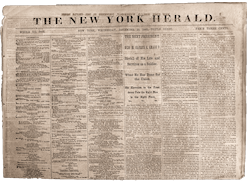
New York Herald
April 27

A meeting of the Home Guard was held at the Astor House yesterday evening, at which it was decided to tender the command to Mr. George Law. The Guard is to be composed of twenty thousand men, all to be able bodied and active. They will be armed with rifles, and will soon be ready for service. Mr. Law will meet a committee at the Astor House this morning to inform them whether he will accept the responsible position offered him or not.

The American Telegraph Company will commence receiving messages from Washington this morning. Those deposited at the office here (21 Wall street) before half past one o’clock of each day, will reach Washington the same evening. Arrangements are being made by which an almost hourly communication will be made with Washington. The press will thus be enabled to furnish to the public a much fuller and more reliable idea of the state of affairs at Washington than they have done for some days past.

The departure of Col. Ellsworth’s Fire Zouaves has been postponed until Sunday, when they will leave in the Baltic for Washington. Two stands of colors are to be presented to them—one by Mrs. John Jacob Astor, Jr. and one by the ladies of the Astor House. [continue reading…]

0 comments

The Situation of Affairs.

Civil War Day-by-Day

New York Herald
April 28, 1861

Washington is now garrisoned by 18,000 troops. All the regiments despatched from the North have arrived there safely. New York sent the Seventh, Seventy first, Twelfth, Sixth, Sixty ninth and Eighth; Brooklyn, the Thirteenth; Albany, the Twenty fifth—each a thousand strong; while Massachusetts sent her two regiments, the Seventh and Eighth, numbering two thousand. The Twenty eighth, Brooklyn regiment, leaves today by the Kedar, and the Fifth (German) regiment, now in camp at the Battery, together with the Zouaves (firemen’s caps), each a thousand strong, also start for the seat of war today. The concentration of this large force renders the federal capital secure.

The latest reliable reports represent a complete reaction of feeling in Maryland, thus confirming the news of yesterday that the Union sentiment was taking courage and acquiring strength. In Baltimore, as well as in other parts of the State, the Stars and Stripes were hoisted in various buildings. The message of Governor Hicks to the legislature, which has just assembled at Frederick, impresses upon that body the necessity of Maryland remaining neutral as the only hope of safety; but while this sentiment is indicative of a friendly disposition towards the Union, it is manifestly absurd that a mere condition of neutrality on the part of any State can be accepted in the present crisis. The Senate has also issued an address to the people of Maryland, declaring that the Legislature will not pass an act of secession; but if they believe that the people desire it, they will give them an opportunity of declaring for themselves their future destiny. Such, then, is the present position of Maryland.

Delaware has taken a still more decisive position for the Union. Governor Burton has issued a proclamation stating that as Delaware has no regular militia, or no Militia laws, it cannot be compelled to place troops under the authority of the general government, but at the same time he advises the raising of volunteers, who may, if they choose, tender their services to the government. [continue reading…]

0 comments

The Theatre in War Time.

Civil War Day-by-Day

New York Herald
April 28, 1861

We have noticed that during the prevailing war excitement the theatres and other places of public amusement are quite deserted. The Opera singers have become mute, concerts have been indefinitely postponed, and two of the principal Broadway theatres—Niblo’s and Wallack—will close their seasons this week. One of the managers, Mr. Fox, of the Bowery, has already gone off to the wars, and several privates in the Thespian ranks have followed his example. During the war of 1812, and the brush with Mexico, the player fold were always patriotic, some enlisting in the regular line, and others, forming themselves into small companies, hovered in the rear of the army, acting or fighting, as occasion seemed to demand. Undoubtedly the dramatic profession is one which inspires noble sentiments and stimulates public virtue, and this must naturally be the case with the performers as well as the public. We have no doubt, then, that our Thespians, finding their immediate occupation gone for the present will be glad to take parts in the drama of real life now being enacted hereabouts, and will, therefore, be off to the wars without unnecessary delay.

0 comments

The Call for Volunteers.

Harper’s Weekly

Harper’s Weekly
April 27

THE Secretary of War has addressed the following circular to the Governors of States:

“WAR DEPARTMENT, WASHINGTON, April —, 1861. “SIR,—Under the Act of Congress ‘ for calling forth the militia to execute the laws of the Union, suppress insurrections; repel invasions,’ etc., approved February 28, 1795, I have the honor to request your Excellency to cause to be immediately detached from the militia of your State the quota designated in the table below, to serve as infantry or riflemen for the period of three months, unless sooner discharged.

” Your Excellency will please communicate to me the time at or about which your quota will be expected at its rendezvous, as it will be met as soon as practicable by an officer or officers to muster it into the service and pay of the United States. At the same time the oath of fidelity to the United States will be administered to every officer and man.

” The mustering officer will be instructed to receive no man under the rank of commissioned officer who is in years apparently over forty-five or under eighteen, or who is not in physical strength and vigor.”

New York Replies.

On 16th the Legislature passed a bill authorizing the Governor to call out thirty thousand State troops, to be placed at the disposal of the President, and appropriating three million dollars therefore. The bill, slightly amended from the form in which it passed the Assembly, was passed by the Senate, and returned to the former body, which concurred in the amendments almost unanimously, there being but one negative vote. Great feeling and enthusiasm were manifested in both Houses on the subject. Part of the troops have already gone forward to Washington.

So Do Massachusetts,

Without waiting the official requisition for troops, but acting upon the report sent to the press of the country, Governor Andrews telegraphed to the President as follows :

” The quota of troops required of Massachusetts is ready. How will you have them proceed ?”

The Secretary of War responded:

” Send them by rail.” [continue reading…]

0 comments

Real Patriotism.

Civil War Day-by-Day
1860s newsprint

 Daily Advocate
(Baton Rouge, LA)
April 27, 1861

The noble example set by a couple of gentlemen of Natchez, is the first step in a most excellent movement that should become general throughout the Southern States. Assure the man who goes forth to fight the battles of his country that those nearest and dearest to him will be properly cared for during his absence, and you at once transfer him into a hero, and very materially lessen the burthens and cares of the campaign. The families of the volunteers should be well provided for. It is the duty of every citizen of the South who is unable to take part in the conflict, but who is none the less anxious to see it brought to a successful issue, to contribute his mite in accomplishing that much desired result.

We commend the following paragraph, from the Natchez Free Trader, to the attention of our readers:

Spirit of the Times.—Two gentlemen of this city, whose names they desire shall not be published, each agree to contribute the sum of one thousand dollars for the support of the families of those who have given, or may give, their services to the Confederacy in the field, whose families need such assistance. Others, we learn, will do likewise, and in amount sufficient to support the families of a platoon or more. This is the right spirit and the spirit of the times in the South.

0 comments

The Constitutional

Civil War Day-by-Day
1860s newsprint

April 27
(Alexandria, LA)

We are United.

The tocsin of war has been sounded through the length and breadth of the land. Lincoln has at last unmasked himself, and his mad policy stands revealed in all its damnable and unmistakable purposes. In his madness he has done for the Southern States what was considered by many to be absolutely necessary to maintain a distinct and powerful government. He has united all the slave States as one man, and they are now banded together, an unwavering and impenetrable phalanx, ready and determined to defend and vindicate their rights to the last extremity.

As one of those who strongly dissented from the dormant party in the mode of secession, and the object for which I contended—a union of the slave States—is now attained, there can be no longer but one voice in the land. There is now but one purpose—one heart—one destiny. One Who Loves His Country Better Than Party.

Telegraph— A Perfect “Lying Machine”

We publish in another column the latest telegraphic intelligence received here. Our readers should not place too much confidence in them as the telegraph has become a perfect “lying machine” and dispatches are sent over the lines, for the purpose of misleading the people. The reported non-resignation of Gen. Scott  we believe to be false in every particular.

Secession of “Old Virginia”

On Saturday last the news of the secession of “Old Virginia” was received here with the wildest delight. A salute of eight guns was fired on the occasion, under the superintendence of our chief gunner Lieut.-Col. Russel. The secession of Virginia has produced the desired effect, and all of the border States will soon follow. Co-operation has at last been accomplished.

Great Excitement in St. Martinsville

The annexed paragraph is from a correspondent of the New Orleans Crescent, dated St. Martinsville, April 20:

Mr. Editor—There is great excitement in St. Martinsville. Everything, from the cradle to the crutch, is in motion. Lincoln was hanged and burnt in effigy here, last night, amidst great rejoicings of the people. On the 15th inst., all the young men in the town and vicinity of St. Martinsville came forth and registered their names as volunteers, and are to be seen every day since actively operating on the parade ground from 10 o’clock A.M. till night. Their gallant Captain, Alcibiad Deblanc, left for New Orleans, on the 16th inst., to procure the necessary equipments, and enroll for immediate equipments, and enroll for immediate service. The ranks are filling up every day from New Iberia, Breaux Bridge, and Fausse Pointe. The colored men here are getting up a very good company.

0 comments

Were There Any Men Killed at Fort Moultrie?

Civil War Day-by-Day

Harper’s Weekly
April 27

A private letter received by a gentleman in this city from a friend in Charleston, gives some new and interesting particulars respecting the bombardment of Fort Sumter. The writer states that such was the effectiveness of Major Anderson’s fire that thirty of the secessionists in Fort Moultrie were killed, besides many wounded, and that the Stevens Battery was silenced, and the Floating Battery half shot away. He extols the courage and skill of the garrison, and intimates that the casualties of the enemy were more numerous than they wish to acknowledge.

0 comments

Sugar Planter

Civil War Day-by-Day

April 27, 1861
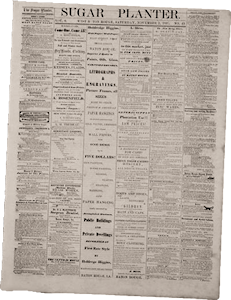
(West Baton Rouge, LA)

Our Parish Liberality.

Amongst the Delta Rifles and Tirailleurs, companies of this parish, now awaiting orders to march to the scene of conflict, are many poor, hard-working men whose families would suffer by their absence. This fact being made known, a subscription was immediately set on foot to raise means for their support, while a special session of the Police Jury has been convoked to levy a special tax for the same purpose, so that full provision may be made for supplying them with all comforts and necessaries, while their main supports are away at the war. This is indeed liberal, and speaks volumes for the high-minded generous people of our parish.

Good!

Fifteen hundred colored men have enrolled themselves into volunteer companies in New Orleans for active service when called upon.

0 comments

The Situation of Affairs.

Civil War Day-by-Day

New York Herald
April 27

The conflicting reports of the last few days relative to the situation of affairs at and around Washington have reached a somewhat satisfactory solution in the intelligence which we are enabled to give in our columns today, at least as far as the movements of the regiments despatched from the North are concerned. It is certain now that the Seventh regiment of New York and the Massachusetts regiment have arrived safely in Washington. The Seventh and a part of the Massachusetts regiment took the line of march from Annapolis early on Wednesday and reached the junction at ten o’clock on Thursday morning. From this point they took the train from Washington, where they arrived in the afternoon and marched through Pennsylvania avenue to the President’s house, and thence to the War Department. The train which took them on returned to the junction at four o’clock in the afternoon, and carried the remainder of the Massachusetts regiment to the junction, where they were ordered to remain and guard the road. The Seventh, it is said, rebuilt the bridges and repaired the road on their route.

The steam transport Baltic, which arrived here yesterday from Annapolis, which port she left on Thursday morning, reports that the Twelfth regiment had started for Washington, and were then twelve miles on their march to the junction, and, as the road was open, the gallant Seventh had already passed safely over. There is no doubt that the Twelfth reached Washington in a few hours. In all probability the Seventy first and Sixth regiments, which left New York on the same day (Sunday last) also arrived at the capital in the wake of the Twelfth. [continue reading…]

0 comments

Charleston Mercury

Civil War Day-by-Day

April 27, 1861

Arrival of Troops from South Carolina.

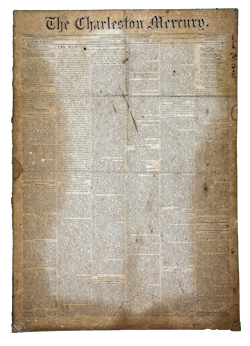
Brigadier General M.L. BONHAM, at the head of five hundred troops from South Carolina, arrived here last evening by the Southern train. A large crowd of citizens and an escort of Virginia troops awaited them at the depot. Cheer after cheer greeted the representatives of the gallant Palmetto State. As we looked along their ranks, we were struck with their bold and manly appearance. Every man of them looked a hero; dark and sunburnt from exposure, their fine countenances lighted up with martial ardor, their fine physique, their perfect equipments, all denoted an invincible and heroic race of men. The Virginians cheered South Carolina, and the South Carolinians, in return, heartily cheered for the Old Dominion. Richmond Enquirer.

Army and Navy Resignations.

A perfect stampede from the ranks of the army of the ‘Old Wreck’ is now going on. A large number of officers, citizens of the Border States, who have heretofore thought it their duty to remain in the service of the Government as long as the States to which they owed allegiance remained members of the Union, now that the bloody designs of LINCOLN are fully unmasked, and it is clearly seen that the Border States have determined to withdraw from an already disrupted Government, are throwing up their commissions as United States officers, and tendering their services to their respective States. The following additional resignations appear in our Baltimore exchanges, which came through yesterday.

MAY, who conducted himself in such a gallant manner during the Mexican war, has resigned his commission and retired to private life. He is now a resident of New York.

Col. JOHN H. WINDER resigned his commission in the Army on Saturday last. The Colonel is a son of the late Gen. WM. H. WINDER, of Baltimore, and served with distinction in the Mexican war.

ARMY OFFICERS RESIGNED. Captain Arnold Elzey, 2d Artillery, of Md.; Capt. Henry Heth, 10th infantry, of Va.; First Lieut. John Mullins, 2d dragoons, of Tenn.; Dr. J. M. Harden, Assistant Surgeon, of Miss.; First Lieut. Walter H. Jenifer, 2d cavalry, of Md. have resigned.

Midshipman FISKE is going South, together with others, to join the Southern army.

0 comments

General P. G. T. Beauregard

Harper’s Weekly
General P. G. T. Beauregard, Harper's Weekly, April 27, 1861

Harper’s Weekly
April 27

WE publish herewith a portrait of General Beauregard, the commander of the Confederate forces at Charleston, to whom Major Anderson surrendered on 13th. General P. G. Toutant Beauregard was born on his father’s plantation, near New Orleans. His father was a wealthy and influential Louisiana planter. His mother—born Reggio—was of Italian origin, and descended from the ducal Reggio family of Italy. General Beauregard entered the United States Military Academy at West Point at an early age, where he graduated in 1838, taking the second honors in a class of forty-five graduates, and was appointed a Second Lieutenant in the First regiment of Artillery, which commission he only held for one week ere he was transferred to the Corps of Engineers. He was promoted to a First Lieutenantcy in June, 1839, and in that capacity served with great distinction during the Mexican War. He was twice brevetted “for gallant and meritorious conduct” in the field, the first time as Captain for the battles of Contreras and Churubusco, to date from August 20, 1847, and again as Major for the battle of Chepultepec, to date from the 13th of September of that year: Major Beauregard was wounded in the assault upon the Garita de Beleu in the city of Mexico. On his return home he was presented with an elegant sword. He. was subsequently placed by the Government in charge of the construction of the Mint and Custom house at New Orleans, as well as of the fortifications on and near the mouth of the Mississippi; General B. is about forty-three years of age, in the prime of life and vigorous health, erect as a soldier, well made, and remarkably active.

0 comments

President Lincoln

Harper’s Weekly

Harper’s Weekly
April 27

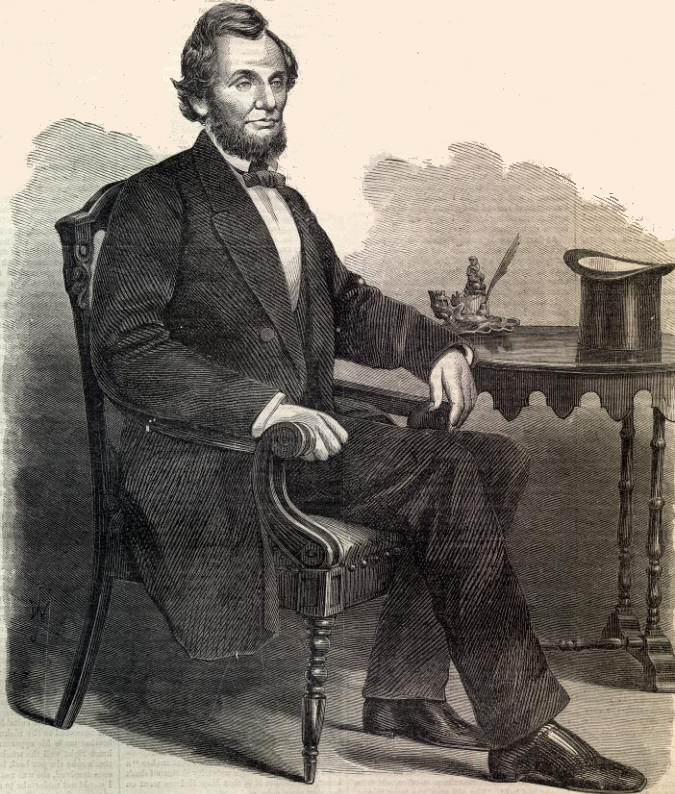
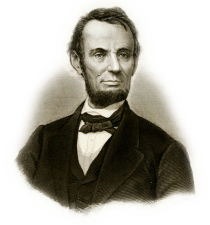
WE publish, herewith, from a photograph just taken expressly for this paper, a PORTRAIT OF THE PRESIDENT. It is the first accurate portrait that has been published of him since he began to grow his beard.

HON. ABRAHAM LINCOLN, of Illinois, was born on the 12th February, 1809, in Hardin County, Kentucky. His family, although much respected, were not blessed with much of this world’s goods, and he was forced to fight his own way through the opening struggles of life’s campaign. In this way be became intimately acquainted with the industrial classes, and they now claim him as One of their number—”The Flatboatman.” It is also reported that he supported himself for a winter by splitting rails for a farmer whence his sobriquet, The Rail-splitter.

Whether he was engaged in rural pursuits, or in piloting down the Mississippi boats laden with produce, he permitted no opportunity to escape for the improvement of his mind. When he had thus, by his own exertions, been admitted to the bar, he settled in the pleasant town of Springfield Illinois; where he has since resided. [continue reading…]

0 comments

“Pres Lincolns two boys were here today to see mine. Juliet was at the Pres.”—Horatio Nelson Taft

Diary of US patent clerk Horatio Nelson Taft.

SATURDAY 27

Another fine day, rather warm. Troops from the North are pouring fast now. There is now here about eighteen thousand men under arms. All the Public Buildings are swarming like Beehives with soldiers, in fact the City is like a great camp, and not half are here yet. Got letter from Frank dated Fort Kearney. Went down to the Ave after dinner, saw two thousand troops pass, who got in today. Pres Lincolns two boys were here today to see mine. Juliet was at the Pres. Got fine Boquet from the garden.


The three diary manuscript volumes, Washington during the Civil War: The Diary of Horatio Nelson Taft, 1861-1865, are available online at The Library of   Congress.

0 comments

“I need a commission of Col or Genl the higher the better”—Samuel Ryan Curtis

The Letters of Samuel Ryan Curtis

Washington Apl 27, 1861

My dear wife

I arrived here with the N York regiment on Wednesday after a steady foot march of a day and a night assisting to haul canon build railroad and chasing the garilla forces that we found in our way.

I have visited all the heads of departments and reported everything. I have no news from our Governor1 but I have told the different officers Iowa is no doubt ready with her regiment and anxious to furnish several more.

Genl Scott told me he wished I had a Commission as General of Militia. He could at once give me power to give orders which I cannot do without a Commission in the Militia service. Ask Genl Reid how I can get such an authority to act. A staff appointment will not do. I need a commission of Col or Genl the higher the better and by being ordered by the Govr my status would enable me to receive General orders from the department which the General knows I could develop in detail.

I am very well and very busy. Sadie will write more fully than I can.

You may know where the Governor is and can hurry up such instructions from him with some sort of commission that will enable me to procure arms and munitions for the state.

Troops are now rolling into Washington and the anxious people of this city breathe easier.

I return a letter which Sadie sent to my address and which was forwarded to me at this place after going to Keokuk as one from Sam was.

See that PM2 and tell him you are authorised to receive and open my letters in my absence. We got your letter last night written the day after I left

Sadie is still at the Resides & very well

Affectionately yours
Saml R. Curtis


1. Samuel Jordan Kirkwood, governor of Iowa 1859-1863, 1876-1877. U. S. Senator 1866-1867, 1877-1881, was also Secretary of Interior under President Garfield, 1881-1882. Kirkwood issued a call for Iowa troops April, 1861.

2. Richard McAllister held office until May, 1861.

0 comments

Visiting Barnwell Island, Home of William Henry Trescot—William Howard Russell

My Diary North and South – William Howard Russell

Note: This particular diary entry—a document written in 186—includes terms and topics that may be offensive to many today.   No attempt will be made to censor or edit 19th century material to today’s standards.

April 27th.—Mrs. Trescot, it seems, spent part of her night in attendance on a young gentleman of color, who was introduced into the world in a state of servitude by his poor chattel of a mother. Such kindly acts as these are more common than we may suppose; and it would be unfair to put a strict or unfair construction on the motives of slave owners in paying such attention to their property. Indeed, as Mrs. Trescot says, “When people talk of my having so many slaves, I always tell them it is the slaves who own me. Morning, noon, and night, I’m obliged to look after them, to doctor them, and attend to them in every way.” Property has its duties, you see, madam, as well as its rights.

The planter’s house is quite new, and was built by himself; the principal material being wood, and most of the work being done by his own negroes. Such work as window-sashes and panellings, however, was executed in Charleston. A pretty garden runs at the back, and from the windows there are wide stretches of cotton-fields visible, and glimpses of the river to be seen.

After breakfast our little party repaired to the riverside, and sat under the shade of some noble trees waiting for the boat which was to bear us to the fishing-grounds. The wind blew up stream, running with the tide, and we strained our eyes in vain for the boat. The river is here nearly a mile across,–a noble estuary rather,–with low banks lined with forests, into which the axe has made deep forays and clearings for cotton-fields.

It would have astonished a stray English traveler, if, penetrating the shade, he heard in such an out-of-the-way place familiar names and things spoken of by the three lazy persons who were stretched out– cigar in mouth–on the ant-haunted trunks which lay prostrate by the sea-shore. Mr. Trescot spent some time in London as attache to the United States Legation, was a club man, and had a large circle of acquaintance among the young men about town, of whom he remembered many anecdotes and peculiarities, and little adventures. Since that time he was Under-Secretary of State in Mr. Buchanan’s administration, and went out with Secession. He is the author of a very agreeable book on a dry subject, “The History of American Diplomacy,” which is curious enough as an unconscious exposition of the anti-British jealousies, and even antipathies, which have animated American statesmen since they were created. In fact, [continue reading…]

0 comments

William Henry Trescott

Civil War Day-by-Day

Civil War Portraits—Leaders, Influencers, and the Incidentally Important #009

William Henry Trescot (November 10, 1822 – May 4, 1898) was an American diplomat born in Charleston, South Carolina, on the November 10, 1822. He graduated at College of Charleston in 1840, studied law at Harvard University, and was admitted to the bar in 1843. He was married to Eliza Natalie Cuthbert, whose family had land originally granted by King George II.

From 1852 to 1854 he was secretary of the U.S. legation in London. In June 1860 he was appointed assistant secretary of state, and he was acting secretary of state in June–October, during General Lewis Cass’s absence from Washington, and for a few days in December after Cass’s resignation. His position was important, as the only South Carolinian holding anything like official rank, because of his intimacy with President James Buchanan, and his close relations with the secession leaders in South Carolina.

He opposed the reinforcement of Fort Sumter, used his influence to prevent any attack on the fort by South Carolina before the meeting of the state’s convention called to consider the question of secession, and became the special agent of South Carolina in Washington after his resignation from his position as United States Assistant Secretary of State in December. He returned to Charleston in February 1861; was a member of the state legislature in 1862–1866, and served as colonel on the staff of General Roswell S. Ripley during the Civil War; and later returned to Washington.

Wikipedia

Title: [William Henry Trescott, half-length portrait, standing, facing front, right hand in coat]
Creator(s): Brady, Mathew B., approximately 1823-1896, photographer
Date Created/Published: [ca. 1889]
Medium: 1 photographic print.
Reproduction Number: LC-USZ62-94551 (b&w film copy neg.)
Call Number: LOT 3206 <item> [P&P]
Notes: In album: Delegates to the International American Conference, Washington, D.C., 1889-90, no. 24.

https://www.loc.gov/pictures/item/92514542/

0 comments

Alarm!—”All the soldiery, numbering some thousands, are marching down to Rocketts…”—Rebel War Clerk, John Beauchamp Jones.

Civil War Day-by-Day
A likeness of Jones when he was editor and majority owner of the Daily Madisonian during President John Tyler’s administration.

April 27th.–We have had a terrible alarm. The tocsin was sounded in the public square, and thousands have been running hither and thither to know its meaning. Dispatches have been posted about the city, purporting to have been received by the governor, with the startling information that the U. S. war steamer Pawnee is coming up the James River for the purpose of shelling the city!

All the soldiery, numbering some thousands, are marching down to Rocketts, and forming in line of battle on the heights commanding the approaches. The howitzers are there, frowning defiance; and two long French bronze guns are slowly passing through Main Street in the same direction. One of them has just broken down, and lies abandoned in front of the Post-Office. Even civilians, by hundreds, are hurrying with shot-guns and pistols to the scene of action, and field officers are galloping through the streets. Although much apprehension is apparent on many faces, it is but just to say that the population generally are resolved to make a determined defense. There is no fear of personal danger; it is only the destruction of property that is dreaded. But, in my opinion, the Pawnee is about as likely to attempt the navigation of the River Styx, as to run up this river within shelling distance of the city.

I walked down to the lower bridge, without even taking a pocket-pistol, and saw the troops drawn up in line of battle awaiting the enemy. Toward evening the howitzers engaged in some unprofitable practice, shelling the trees on the opposite side.

It was a false alarm, if not something worse. I fear it is an invention of the enemy to divert us from the generally conceived policy of attacking Washington, and rousing up Maryland in the rear of Lincoln.

Met with, and was introduced to, Gov. Letcher, in the evening, at the Enquirer office. IHe was revising one of his many proclamations; and is now undoubtedly as zealous an advocate of secession as any man. He said he would be ready to fight in three or four days; and that he would soon have arrangements completed to blockade the Potomac by means of formidable batteries.

0 comments

Fort Pickens—Baltimore a blaze—Wigfall is black with rage—Mary Boykin Miller Chesnut.

Civil War Day-by-Day

MONTGOMERY, Ala., April 27, 1861.—Here we are once more. Hon. Robert Barnwell came with us. His benevolent spectacles give him a most Pickwickian expression. We Carolinians revere his goodness above all things. Everywhere, when the car stopped, the people wanted a speech, and we had one stream of fervid oratory. We came along with a man whose wife lived in Washington. He was bringing her to Georgia as the safest place.

The Alabama crowd are not as confident of taking Port Pickens as we were of taking Fort Sumter.

Baltimore is in a blaze. They say Colonel Ben Huger is in command there–son of the “Olmutz” Huger. General Robert E. Lee, son of Light Horse Harry Lee, has been made General-in-Chief of Virginia. With such men to the fore, we have hope. The New York Herald says, “Slavery must be extinguished, if in blood.” It thinks we are shaking in our shoes at their great mass meetings. We are jolly as larks, all the same.

Mr. Chesnut has gone with Wade Hampton¹ to see President Davis about the legion Wade wants to get up. The President came across the aisle to speak to me at church to-day. He was very cordial, and I appreciated the honor.

Wigfall is black with rage at Colonel Anderson’s account of the fall of Sumter. Wigfall did behave magnanimously, but Anderson does not seem to see it in that light. “Catch me risking my life to save him again,” says Wigfall. “He might have been man enough to tell the truth to those New Yorkers, however unpalatable to them a good word for us might have been. We did behave well to him. The only men of his killed, he killed himself, or they killed themselves firing a salute to their old striped rag.” [continue reading…]

0 comments

Addition of Virginia and North Carolina to the Blockade

Life and Public Services of Abraham Lincoln: Sixteenth President of the United States; and Commander-in-chief of the Army and Navy of the United States
April 27, 1861
By the President of the United States,
…
A Proclamation.
Whereas, for the reasons assigned in my Proclamation of the 19th. instant, a blockade of the ports of the States of South Carolina, Georgia, Florida, Alabama, Louisiana, Mississippi and Texas, was ordered to be established:
And whereas, since that date, public property of the United States has been seized, the collection of the revenue obstructed, and duly commissioned officers of the United States while engaged in executing the orders of their superiors have been arrested and held in custody as prisoners or have been impeded in the discharge of their official duties without due legal process, by persons claiming to act under authorities of the States of Virginia and North Carolina, an efficient blockade of the ports of those States will also be established.
In witness whereof, I have hereunto set my hand, and caused the seal of the United States to be affixed.
Done at the City of Washington, this twenty-seventh day of April, in the year of our Lord one thousand eight hundred and sixty one, and of the Independence of the United States the eighty-fifth.
Abraham Lincoln
By the President:
William H. Seward, Secretary of State.
0 comments