MAY 2d. –There are vague rumors of lawless outrages committed on Southern men in Philadelphia and New York; but they are not well authenticated, and I do not believe them. The Yankees are not yet ready for retaliation. They know that game wouldn’t pay. No – they desire time to get their money out of the South; and they would be perfectly willing that trade should go on, even during the war, for they would be the greatest gainers by the information derived from spies and emissaries. I see, too, their papers have extravagant accounts of imprisonments and summary executions here. Not a man has yet been molested. It is true, we have taken Norfolk, without a battle; but the enemy did all the burning and sinking.
American Civil War Chronicles
Capture of Fort Smith
May 2, 2021
Arkansas True Democrat
Little Rock
May 2, 1861
From the Fort Smith Times and Herald, April 21.
Arrival of Volunteers for the Capture of Fort Smith. Midnight Abandonment of the Post by the Federal Troops.
Last night, about 12 o’clock, the steamers “Tahlequah” and “Frederick Notrebe” arrived almost simultaneously at our wharf, having on board, as we subsequently learned, 235 men, composed of the volunteer companies of Little Rock and Pulaski county, in this State; having come for the purpose of reducing, under the State authority, the federal post at this place. The expedition ordered by Governor Rector, who was represented in it by his Adjutant General, Edmund Burgevin, was under the immediate command of Col. Solon Borland, Aid-de-damp of the Governor, and consisted of five companies, three from the city of Little Rock, and two from vicinity. They were all well armed, drilled and uniformed, and consisted of the flower of the chivalry of that portion of the State. Their disappointment upon learning, when they reached the place of disembarkation, that the enemy had ingloriously fled, was not disguised, and was, doubtless, as we can well imagine, deep and sincere. Yes, the bird had flown.
About one hour before the arrival of the little fleet at this port, the brave federal captain, who had so often vaunted here of his ability to cope with ten thousand assailants, suddenly, in the dead hour of the night, quietly and precipitately, gathered up his plunder, consisting of a train of 23 wagons, and about 160 horses and mules, and crossing the Poteau, and succeeded effectually, without having aroused any suspicion of his purpose, here, in placing himself safe beyond the reach of his brave pursuers. The citizens of Fort Smith were no less chagrined than the volunteers, at this unexpected flight. It is thought that the departure took place after the arrival of the expedition at Van Buren, and before its arrival here, news of which arrival at Van Buren, although we learn it was quiet and thought to be unknown, must have been communicated from Van Buren by telegraph.
The buildings of the Fort remain uninjured. About one o’clock, [continue reading…]
Letter from New Orleans.
May 2, 2021
Daily Advocate
Baton Rouge, May 2, 1861
New Orleans, April 28, 1861.
Editor’s Advocate—The military enthusiasm both in the city and country has reached a high pitch. . . The women are firing up and are as enthusiastic as the men. In passing a point in Iberville where ten or fifteen ladies were assembled, one of them stepped forward, presented arms, and gave us two shots from a double barrel gun. The only drawback is that although they can wave handkerchiefs very well they cannot cheer “worth a shuck.”
Going down Canal street this morning we met a column of over five hundred volunteers from the country, who were marching from their camp on Metairie Ridge to the Jackson Railroad Depot. At the head of one of the companies (the Lafourche volunteers) marched a young girl in bloomer costume, and in the gray Louisiana uniform of the company. She was the Vivandiere of the company, and although they were marching in a long swinging trot, she led them on at the same pace. . . .
The whole city is a blaze of excitement; rich and poor, liberal and mean, are vying with each other who can do the most for freedom, from the dollar-archy of the North.
Visitor.
Ladies’ Meeting.
May 2, 2021
Daily Constitutionalist
Augusta, Georgia, May 2, 1861
Masonic Hall was the scene all of yesterday of patriotic industry. Many of the ladies of Augusta were there, busily engaged in making uniforms and other garments for portions of our gallant soldiery thus far on their way to the Northern frontier. Never did our fair and patriotic townswomen appear to greater advantage. Their prompt and cheerful compliance with the call made upon them will cause them to be gratefully remembered, and give our citizens fresh reason to be proud of their wives and daughters.
The ladies will meet again at the same place this morning at nine o’clock, and continue these meetings daily until further notice.
Cadets.
May 2, 2021
Daily Times
Leavenworth, Kansas,
May 2, 1861
The military spirit seems to have taken hold of “Young America.” Yesterday we witnessed the parade of a company of Cadets, composed of the pupils of Mr. McCarty’s school, numbering some fifteen. They have been drilled by Mr. McCarty, and seem to take to military tactics quite naturally. They passed through the different manouvres with remarkable precision, and their Zouave tactics would do credit to a company composed of “older heads.” Success to the Cadets.
Every day makes me feel more secure of making an efficient defense, and in a very few days my defensive preparations will be complete.
May 2, 2021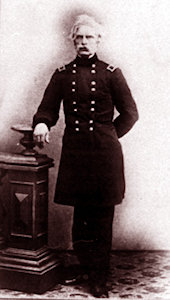
HEADQUARTERS DEPARTMENT OF FLORIDA,
Fort Pickens, May 2, 1861.
Lieut. Col. TOWNSEND. Assistant Adjutant-General:
COLONEL: I have heretofore addressed my official communications to Colonel Keyes, because he, as the agent of the President as well as military secretary of the General-in-Chief, superintended the fitting out of the expedition for the relief of the fort, which expedition was then a secret one. The reasons for secrecy no longer existing, I address my letter, according to regulations, to you. Since my last letter to Colonel Keyes nothing of special interest has occurred. We have been unceasingly employed with my whole force and part of the ship’s in preparing the fort for defense and in unloading the Illinois. Some idea of the condition of the fort for defense may be had when it is considered that every day (one Sunday excepted) since the 17th of April, the day of my arrival, I have had from 1,000 to 1,200 men constantly at work, and of these, 800 have been employed on the work; and although we have achieved quite as much as I expected, we want a fortnight more of work before we shall be fully prepared to resist the numerous batteries and heavy guns that are bearing all around on us. The enemy are equally busy, having large numbers at work on several batteries which are visible to us, and judging by the number of men we see around one or two other places, I think that they have at least two other batteries we cannot see. All the guns excepting those of the forts seem of large caliber, 8 or 10 inch columbiads.
We can see one battery (No. 1) at the navy-yard; one (No. 2) in the rear of Warrington church–a large work, looking like an instruction camp; No. 3, near the barracks–no guns can be seen in it; a little southwest of the fort, and near the old light-house, a battery (No. 4) of four guns, very much concealed; and south of the new light-house another (No. 5) of four guns, plainly to be seen. There is probably one more between this and Fort McRee. These batteries and the forts enfilade and take in reverse every face and curtain of this work but one.
Fort McRee takes in reverse one more important battery, which is [continue reading…]
The extreme anger with which any unfavorable comment is met publicly shows the sensitiveness of the slave-owners.—William Howard Russell
May 2, 2021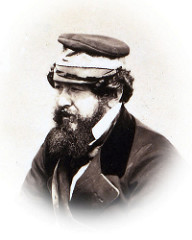
May 2nd.—Breakfasted with Mr. Hodgson, where I met Mr. Locke, Mr. Ward, Mr. Green and Mrs. Hodgson and her sister. There were in attendance some good-looking little negro boys and men dressed in liveries, which smacked of our host’s Orientalism, and they must have heard our discussion, or rather allusion, to the question which would decide whether we thought they are human beings or black two-legged cattle, with some interest, unless indeed the boast of their masters, that slavery elevates the character and civilizes the mind of a negro, is another of the false pretences on which the institution is rested by its advocates. The native African, poor wretch, avoids being carried into slavery totis viribus, and it would argue ill for the effect on his mind of becoming a slave if he prefers a piece of gaudy calico even to his loin-cloth and feather headdress. This question of civilizing the African in slavery is answered in the assertion of the slave-owners themselves, that if the negroes were left to their own devices by emancipation, they would become the worst sort of barbarians—a veritable Quasheedom, the like of which was never thought of by Mr. Thomas Carlyle. I doubt if the aboriginal is not as civilized, in the true sense of the word, as any negro, after three degrees of descent in servitude, whom I have seen on any of the plantations—even though the latter have leather shoes and fustian or cloth raiment, and felt hat, and sings about the Jordan. He is exempted from any bloody raid indeed, but he is liable to be carried from his village and borne from one captivity to another, and his family are exposed to the same exile in America as in Africa. The extreme anger with which any unfavorable comment is met publicly shows the sensitiveness of the slave-owners. Privately, they affect philosophy; and the blue books, and reports of Education Commissions and Mining Committees, furnish them with an inexhaustible source of argument if you once admit that the summum bonum lies in a certain rotundity of person, and a regular supply of coarse food. A long conversation on the old topics—old to me, but of only a few weeks’ birth. People are swimming with the tide. Here are many men who would willingly stand aside if they could, and see the battle between the Yankees, whom they hate, and the Secessionists. But there are no women in this party. Wo betide the Northern Pyrrhus whose head is within reach of a Southern tile and a Southern woman’s arm!
I re-visited some of the big houses afterwards, and found the merchants not cheerful, but fierce and resolute. There is a considerable population of Irish and Germans in Savannah, who to a man are in favor of the Confederacy, and will fight to support it. Indeed, it is expected they will do so, and there is a pressure brought to bear on them by their employers which they cannot well resist. The negroes will be forced into the place the whites hitherto occupied as laborers—only a few useful mechanics will be kept, and the white population will be obliged by a moral force drafting to go to the wars. The kingdom of cotton is most essentially of this world, and it will be fought for vigorously. On the quays of Savannah, and in the warehouses, there is not a man who doubts that he ought to strike his hardest for it, or apprehends failure. And then, what a career is before them! All the world asking for cotton, and England dependent on it. What a change since Whitney first set his cotton gin to work in this state close by us! Georgia, as a vast country only partially reclaimed, yet looks to a magnificent future. In her past history the Florida wars, and the treatment of the unfortunate Cherokee Indians, who were expelled from their lands as late as 1838, show the people who descended from old Oglethorpe’s band were fierce and tyrannical, and apt at aggression, nor will slavery improve them. I do not speak of the cultivated and hospitable citizens of the large towns, but of the bulk of the slaveless whites.
Civil War Day-By-Day
May 2, 2021
May 2, 1861
A Chronological History of the Civil War in America1
- New York 69th Regiment arrived in Washington.
- Colonel Elmer Ellsworth’s Fire Zouaves arrived in Washington.
- Judge Campbell, of Alabama, resigned his seat in the U. S. Supreme Court.
- A Chronological History of the Civil War in America by Richard Swainson Fisher, New York, Johnson and Ward, 1863
It will bankrupt the State
May 1, 2021
New Orleans, May 1, 1861.
J. P. Benjamin:
It will bankrupt the State to keep 6,000 men an indefinite time. To
disband them would be very disastrous. Is it possible for you to intimate how long I should have to keep them before they are mustered into the service of the Confederate States? Answer immediately.
disband them would be very disastrous. Is it possible for you to intimate how long I should have to keep them before they are mustered into the service of the Confederate States? Answer immediately.
Tho. O. Moore.
Transportation of Troops
May 1, 2021
Montgomery, May 1, 1861
Governor I. G. Harris,
Nashville:
All the arrangements have been made for the transportation of the troops to Lynchburg, where they will be armed and equipped and provisioned, of course. Let me know when they will depart. I send by mail bonds to be executed by an assistant quartermaster and assistant commissary for each regiment, leaving you to designate the persons. Their rank and pay will be that of captain. Have the bonds executed according to directions accompanying them and forwarded to me. Would like to know what your Legislature has done.
L. P. Walker.
Burning of the Pioneer Paper Mill.
May 1, 2021
Southern Watchman
[Athens, Ga],
May 1, 1861
The paper mill three and a half miles from this place was totally consumed by fire on Wednesday morning last, together with all the paper and stock on hand. The origin of the fire, we believe, is considered doubtful. It may have been accidental, or it may have been the work of an incendiary. The loss is estimated at $16,000. There was no insurance. We believe it is the intention of the stockholders to rebuild—we hope so, at all events, as it is a great convenience to us to have our paper manufactured at home.
She Wouln’t Go Off.
May 1, 2021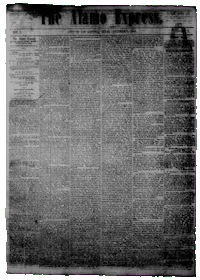
Tri-Weekly Alamo Express
[San Antonio, TX]
May 1, 1861
This morning, Wednesday our city was awakend by the booming of canon, and every one was anxious to know why only seven guns were fired. From a spectator we learn that the eight was intended, but it “flashed in the pan”—wouln’t go off, and after several unsuccessful attempts the gun for Virginia had to be abandoned.
Reward of Merit.
May 1, 2021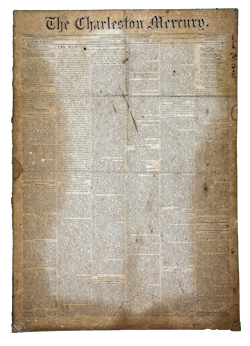
Charleston Mercury
May 1, 1861
The women of Carolina, ever public-spirited and self sacrificing, have always given their approving smiles to the efforts of the brave and true. As a recent instance of this spirit, we have been allowed an opportunity of inspecting a massive gold medal, an offering from the lady friends of the Palmetto Guard, as a remembrance of their long-to-be-remembered 12th and 13th April, 1861.
The medal is of gold, and elegantly wrought. On the obverse, a Palmetto tree in centre, with Rattlesnake in coil, rattles sprung; over the tree the words ‘PALMETTO GUARD,’ and around the border, ‘their mothers, sisters, wives and daughters.’ On reverse, the Stevens’ Battery in the foreground, with State flag—Gun No. 1 just fired—Fort Sumter, with the Federal flag about falling—the fleet in the distance; above is the motto, ‘None but the brave deserve the fair;’ below, ‘April 12th and 13th, 1861.’ A richly engraved border surrounds the whole. This beautiful work of art is from the jewelry store of Messrs. SPENCER & TEAGUE, and the engraving by the now well known engraver.
BORNEMANN.
“The President has not as much Sagacity as I could wish. He is more of a joker than thinker.”
May 1, 2021
Washington May 1, 1861
My dear wife
I am very glad to receive my clothes by S. Rankin Esq who arrived safely last night. I had really become rather shabby in my feelings if not in appearance.
I will now be able to dress up when I go to call on friends. I think you acted very properly in not sending the trunk. There is no doing much with papers these times. When the crisis is over here I will go direct home so I can take up the papers about as I left them. The extra cession of Congress will not last long so it may be I can he at home a considerable portion of the summer. I remain attached to the Seventh New York Regiment of course doing as I please but apparently very populer in the regiment. I shall at the same time attend to our Iowa matters as carefully as possible. James’ papers were sent forward day before yesterday. Papers for John St______us [?] were ordered yesterday. I suppose Howels P.O. papers were sent some days ago but the matters of Bogata is not yet acted on. I will write Howell as to that very soon1
I was very much vexed to find that a man by the name of Taylor of Ohio has been appointed Register at Omaha. I have not yet seen the President but feel like giving him my mind on the subject.
The President has not as much Sagacity as I could wish. He is more of a joker than thinker.
I have just received and read yours of the 25th and Henrys of the 18th You were still ignorant of my way of coming. Since we pressed our way through Maryland a great change seems to be coming over the spirit of their dreams. I hope Maryland will persistently decline the honor of being made the slaughter ground for this eventful struggle. It will be a just tribute to [continue reading…]
Notice to Free Negroes.
May 1, 2021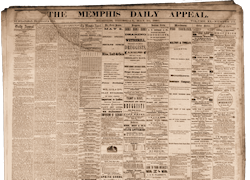
May 1, 1861;
Memphis Daily Appeal
(Tennessee)
Memphis Daily Appeal
(Tennessee)
All Male Free persons of color, resident within the city limits, will report themselves at the office of Wm. B. Greenlaw & Co., within ten days from this date, otherwise they will be summarily dealt with.
Such as may be inclined to partake in the common defense, or discharge any such duties connected therewith as may be assigned to them, will be kindly received and protected.F. Titus, President Committee of Safety.
“There are arms enough for 25,000 men now..,” Rebel War Clerk
May 1, 2021
MAY 1st.—Troops are coming in from all directions, cavalry and infantry; but I learn that none scarcely are accepted by the State. This is great political economy, with a vengeance! How is Gov. Letcher to be ready to fight in a few days? Oh, perhaps he thinks the army will spontaneously spring into existence, march without transportation, and fight without rations or pay! But the Convention has passed an act authorizing the enlistment of a regular army of 12,000 men. If I am not mistaken, Virginia will have to put in the field ten times that number, and the confederacy will have to maintain 500,000 in Virginia, or lose the border States. And if the border States be subjugated, Mr. Seward probably would grant a respite to the rest for a season.
But by the terms of the (Tyler and Stephens) treaty, the Confederate States will reimburse Virginia for all her expenses; and therefore I see no good reason why this State, of all others, being the most exposed, should not muster into service every well-armed company that presents itself. There are arms enough for 25,000 men now, and that number, if it be too late to take Washington, might at all events hold this side of the Potomac, and keep the Yankees off the soil of Virginia.
“The troops keep coming and will continue to come I suppose until we have forty or fifty thousand here.”—Horatio Nelson Taft
May 1, 2021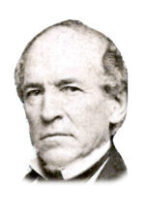
WEDNESDAY, MAY 1, 1861.
A cold windy day with some rain, as unpleasant a “May day” as could well be. Have been in the office all day as usual surrounded by a crowd of soldiers when out of my room. Have a new 2nd Assistant, have today been “breaking him in.” His name is C H Upton of V.A. The 12th NY Regt are now building barracks on Franklin Square near house where they are to be stationed. The troops keep coming and will continue to come I suppose until we have forty or fifty thousand here. There was a mail from the North this morning, the first in 12 days. Did not go from Home after dinner, to bed early.
The three diary manuscript volumes, Washington during the Civil War: The Diary of Horatio Nelson Taft, 1861-1865, are available online at The Library of Congress.
“Long before the Southern Confederacy has a fleet that can cope with the Stars and Stripes my bones will be white in the grave.” Commodore Tatnall
May 1, 2021
May Day.—Not unworthy of the best effort of English fine weather before the change in the calendar robbed the poets of twelve days, but still a little warm for choice. The young American artist Moses, who was to have called our party to meet the officers who were going to Fort Pulaski, for some reason known to himself remained on board the Camilla, and when at last we got down to the river-side I found Commodore Tatnall and Brigadier Lawton in full uniform waiting for me.
The river is about the width of the Thames below Gravesend, very muddy, with a strong current, and rather fetid. That effect might have been produced from the rice-swamps at the other side of it, where the land is quite low, and stretches away as far as the sea in one level green, smooth as a billiard-cloth. The bank at the city side is higher, so that the houses stand on a little eminence over the stream, affording convenient wharfage and slips for merchant vessels.
Of these there were few indeed visible—nearly all had cleared out for fear of the blockade; some coasting vessels were lying idle at the quay side, and in the middle of the stream near a floating dock the Camilla was moored, with her club ensign flying. These are the times for bold ventures, and if Uncle Sam is not very quick with his blockades, there will be plenty of privateers and the like under C. S. A. colors looking out for his fat merchantmen all over the world.
I have been trying to persuade my friends here they will find very few Englishmen willing to take letters of marque and reprisal.
The steamer which was waiting to receive us had the Confederate flag flying, and Commodore Tatnall, pointing to a young officer in a naval uniform, [continue reading…]
State of things in North Carolina
May 1, 2021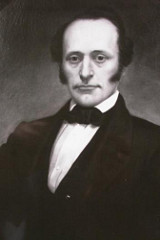
RALEIGH, May 1, 1861.
JEFFERSON DAVIS:
Convention bill passed; also a resolution authorizing me to send troops to Virginia at once without limit. Our mint at Charlotte will coin for the Confederate Government if desired. Ships of war are hovering on our coast near the Cape Fear. Design unknown. I am preparing to manufacture percussion caps. Will succeed. More troops are offering than we can provide for.
JOHN W. ELLIS.
Major Anderson.
May 1, 2021
Charleston Mercury
May 1, 1861
Our readers will bear us testimony that up to this time, whilst others have heaped abuse upon Major ANDERSON for the occupancy of Fort Sumter, and for various other steps he has taken, we have seduously avoided uttering not one word against him, either as an officer or a gentleman. As a military man he had duties to perform. And if blame was to attach for the results, in our opinion, it was not attached to him, but elsewhere. We confess that at times we have thought hard of him as a native Virginian and a Southern man. But we were perfectly aware that there were a class of men at the South, commonly called Federalists, who professed to know no North, and no South, no East and no West; that is, who ignored all rights in the individual States. As an army officer we expected no better from him. A man may be both an officer and a gentleman, without any particular amount of brains, or metaphysical or political science. This we were willing to concede; and we have done so. But we must confess that within the last week we have been thoroughly disgusted with the said Major; and however good an officer he may be, we can perceive very little either of the patriot or the gentleman in his late conduct.
Relieved from Fort Sumter, when utterly untenable, according to his own account, under terms of unparalleled magnanimity, he has acknowledged it by not one word of courteous profession; but, on the contrary, with all the smallness and meanness of a very Yankee, he has only made a boast of his own mighty prowess, whilst accepting the homage of the enemies of his country, in public receptions and dinners in New York, and presentations of five hundred dollar golden boxes. Such is the man we have forborne to press, in sympathy for his position as a soldier, though a Southern man. This is his requital—this is his acknowledgment—this his sense of chivalry. His conduct has cast a slur upon his race and his native State. Egotism has swallowed up his whole heart, and the man we looked to find a soldier, if not a patriot, has proved himself but a vain and selfish mercenary—a hireling of power, and a crafty self-seeker—with God forever upon his lips, and self ever within his heart.
Where South Carolina again meets Major ANDERSON upon the field of battle, she will know how to treat a renegade.
Georgy is excluded from the corps of nurses…
May 1, 2021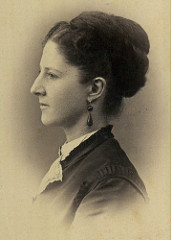
Eliza Woolsey Howland to Abby Howland Woolsey
0 comments
“Tioronda,” Wednesday Evening.
Dear Abby: I was just going to write you a note this p. m. when the Kents came in for a long call and stayed on for an early tea. We sat in the library where the books are now all arranged and the cushion we ordered at Soloman and Hart’s in its place in the bay-window. To be sure there is no carpet down, and we have no tables or chairs, but it already has a very habitable look, and we feel quite at home in presence of our old book-friends. They make a very good show, though there are still a number of empty upper shelves which will fill up by degrees. James Kent had been in town for a couple of days and had a good deal to say about military matters. While Joe was in town I did a good deal of cutting out and have three dozen army pillow-cases and six double-gowns under way. Tomorrow I shall attack the drawers and night-shirts, for which I borrowed a good simple pattern of Mrs. Kent. I smile when I think of the sang-froid with which you and I discussed the cut of drawers and shirts with that pleasant young doctor the other day. I see that Georgy is excluded from the corps of nurses by being under thirty.
The Situation of Affairs
May 1, 2021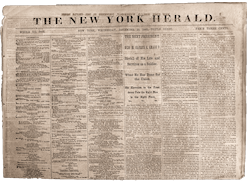
May 1, 1861;
The New York Herald
A crisis is approaching in the military movements progressing at the seat of war. Troops have not been concentrating there for so many days without a definite object, and it is manifest now what the purpose of government is. Baltimore is to be completely filled with troops, and Maryland is to be compelled to act like a State still in the Union. All the information which reached us up to a late hour last night plainly indicated that this is the policy of the government of Washington. Let us state the points of the latest news in brief. The greatest activity prevails in Southern Pennsylvania, seventeen thousand troops being in the field there at the present time. At Camp Scott, York, Pa., there are 6,000 men; at Camp Siffler, near Chambersburg, 2,600; at Camp Curtin, near Harrisburg, 4,000; two regiments from Ohio are quartered near Lancaster, and 1,200 United States regulars at Carlisle. Scattered at different points between Philadelphia, Elkton and Perrysville there are 6,000 more. [continue reading…]
May Day, 1861.
May 1, 2021
Charleston Mercury
May 1, 1861
The annual recurrence of this day, usually devoted to the festivities of those in the early season of life, finds our young men in the tented field and our maidens more thoughtful for the future. The May Pole is not raised, the festoons of flowers, with odors sweet, are not wreathed over the heads of the innocent dancers. As an evidence, however, of the patriotic remembrance of the fair sex, on this May Day, we have to acknowledge the receipt of a superb wreath of flowers of elaborate workmanship, accompanied by this request: ‘Will the Editor of THE MERCURY be kind enough to place this wreath in the hands of the Chairman of the Committee of Citizens who have charge of the Secession Gun, with the request that it be used to crown it on this May Day morning.’
In obedience to this polite request, we shall be pleased to deliver it to the patriotic gentleman of the Committee this morning.
Confederate Loan
May 1, 2021
Warning
The following diary entry contains wording that is offensive to many in the world of today. However, the entry is provided unedited for its historical content and context.
May 1, 1861;
Memphis Daily Appeal
(Tennessee)
The Montgomery papers announce the fact that two negroes there had subscribed liberally to the Confederate loan–$200 each. The Gainesville niggers are not behind. Mr. T. D. Bell’s Henry (Henry says he was raised by Mr. Davenport, of Northumberland County, Va.) and Mr. R. G. McMahon’s “Jim Cotton” have gone into the support of the government, each taking a $50 bond, and paying the money down. They were greeted with hearty cheers by the assembled crowd.
At Warsaw, two negroes, one belonging to Mr. Little and the other to Mr. Gill, gave each $2.50 to the volunteer fund. Mr. Little’s man was “in luck.” Three or four gentlemen standing by were so pleased with his act that they made up for him $10 to take the place of his $2.50.
Our Richmond Correspondence.
May 1, 2021
Charleston Mercury
May 1, 1861
RICHMOND, April 29, 1861.
Of the arrest of General HARNEY, at Harper’s Ferry, on Friday last, you have already been informed by telegram. He reached this city yesterday in charge of a military escort, and was conducted to the Governor, and by him promptly released.
His treatment while here by his Excellency and other high officials, as well as by distinguished members of the Convention and citizens, was all that a distinguished soldier and gallant officer could have expected under the circumstances.
He left in the early train for Washington, D.C., this morning. A Southerner by birth and connection, an officer of distinguished gallantry and large experience, we can hardly entertain a doubt that the commission which he holds, and which he has so much honored, will promptly be laid at LINCOLN’S feet, and his fortunes united with his own South, and he placed in command of one of our crack brigades.
Yesterday I visited the encampments at both the Fair Grounds. The first is occupied by the gallant Palmetto Regiment, commanded by Col. GREGG. A more delightful spot can scarcely be conceived. It commands an extensive view of the upper western part of the city, the river with its bright sheen of waters, dotted here and there by the smoke of some steamer, and the white sails of the shipping plying to and from this city; while thelowlands and rising grounds to the south and southwest present a scene of surpassing beauty.
The Colonel and his staff were seated in the open air, discussing a good breakfast, which they seemed to enjoy very much. I was pleased with their soldierly bearing, no less than by their urbane and gentlemanly deportment. The troops were mustering for sentinel duty; others, not on duty were allowed to attend Divine worship at the various city churches, where, it is needless to say, they were welcomed and conducted to comfortable sittings. Many of them, it is hoped, are soldiers of another ‘King.’
Proceeding to the other encampment, under command of Col. GILLIAM, of the Virginia Military Institute, I found a much larger number of troops. Here are assembled the remaining companies of the 1st Regiment of Virginia Volunteers. The troops from Lynchburg, in one of the companies of which (the Lynchburg Rifle Grays, Capt. LANGHORN, a splendid company, composed of the elite of that city) I met with your former correspondent, ‘Richmond,’ in his fatigue undress, preferring service with those amongst whom he had been reared.
It was pleasant to look upon their cheerful faces even while performing the menial duties incident to camp life.
Reports from the North speak of the rapid concentration of large bodies of troops at such points as may be most accessible to the South, but particularly tending to Washington, where are assembled some 12,000 to 15,000. Governor SPRAGUE, of Rhode Island, is said to have arrived there on Friday last at the head of about 600 troops, while about 500 more from Pennsylvania reached there same day.
Yesterday I met several gentlemen formerly employed in the various departments, all of whom have surrendered office, upon which the support of their families depended, rather than submit to the detestable tyranny of the Black Republicans who infest that city.
They fully confirm the rumors of the reign of terror there, as also the great disaffection of many of those whose surroundings compel them to remain for the present.
Every department connected with the government here is all astir, preparing for the reception of troops. An officer connected with the Ordnance Department said today arrangements would be made for the accommodation of forty thousand troops, should as many be ordered to this point.