The Price of Paper.

Civil War Day-by-Day

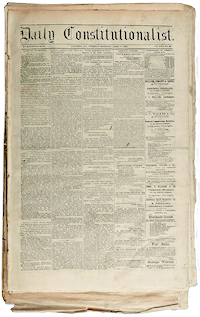
Daily Constitutionalist
Augusta, Georgia,
May 2, 1861

There seems to be some misapprehension with the press generally in the Confederate States in relation to the price of printing paper under the operation of the new tariff. Since the tariff went into effect, paper has advanced about fifteen per cent. This per cent is not only asked on foreign paper, but on that manufactured in South Carolina and Georgia. Now, there has been much talk about building up home industry, etcetera, and so on, but when it is done at our expense, for the benefit of capitalists and manufacturers, we strenuously object to it. We are of opinion that it cannot be shown that the manufacture of paper in the Southern States is conducted at more expense now than it was before the adoption of this tariff. This is the effect of a protective tariff, but somehow the people won’t see it. We agree with the Columbus Corner Stone when it says “we are opposed to building up and fostering anybody’s industry anywhere, because it is always sure to be done at the expense of somebody’s, and indeed everybody’s industry, for the benefit of capital. All that industry wants is to be let alone; and properly directed, it will build itself up anywhere.—Sandersville Georgian.
0 comments

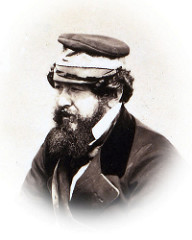
The people are rawer, ruder, bigger—William Howard Russell

My Diary North and South – William Howard Russell

May 4th.—In the morning I took a drive about the city, which is loosely built in detached houses over a very pretty undulating country covered with wood and fruit-trees. Many good houses of dazzling white, with bright green blinds, verandas, and doors, stand in their own grounds or gardens. In the course of the drive I saw two or three signboards and placards announcing that “Smith & Co. advanced money on slaves, and had constant supplies of Virginian negroes on sale or hire.” These establishments were surrounded by high walls enclosing the slave-pens or large rooms, in which the slaves are kept for inspection. The train for Montgomery started at 9 ·45 A.m., but I had no time to stop and visit them.

It is evident we are approaching the Confederate capital, for the candidates for office begin to show, and I detected a printed testimonial in my room in the hotel. The country, from Macon in Georgia to Montgomery in Alabama, offers no features to interest the traveler which are not common to the districts already described. It is, indeed, more undulating, and somewhat more picturesque, or less unattractive, but, on the whole, there is little to recommend it, except the natural fertility of the soil. The people are rawer, ruder, bigger—there is the same amount of tobacco chewing and its consequences—and as much swearing or use of expletives. The men are tall, lean, uncouth, but they are not peasants. There are, so far as I have seen, no rustics, no peasantry in America; men dress after the same type, differing only in finer or coarser material; every man would wear, if he could, a black satin waistcoat and a large diamond pin stuck in the front of his shirt, as he certainly has a watch and a gilt or gold chain of some sort or other. The Irish laborer, or the German husbandman is the nearest approach to our Giles Jolter or the Jacques Bonhomme to be found in the States. The mean white affects the style of the large proprietor of slaves or capital as closely as he can; he reads his papers—and, by the by, they are becoming smaller and more whitey-brown as we proceed—and takes his drink with the same air —takes up as much room, and speaks a good deal in the same fashion.

The people are all hearty Secessionists here—the Bars and Stars are flying at the road-stations and from the pine-tops, and there are lusty cheers for Jeff Davis and the Southern Confederacy. Troops are flocking towards Virginia from the Southern States in reply to the march of Volunteers from Northern States to Washington; but it is felt that the steps taken by the Federal Government to secure Baltimore have obviated any chance of successfully opposing the “Lincolnites” going through that city. There is a [continue reading…]

0 comments

“At the Pat office the RI Regt were paraded and reviewed by Gov Sprague.”—Horatio Nelson Taft

Diary of US patent clerk Horatio Nelson Taft.

SATURDAY, MAY 4, 1861.

Rain all the first part of the day. Soldiers still drilling in the Halls. Our ears are constantly saluted with the word of command and and [sic] the clangor of arms on the marble floors. Went on to the Ave after dinner with wife and Juliet. Soldiers and citizens crowded that prominade about equaly divided in numbers. In the streets Regiments were paraded. We saw 2200 march into the Treasury. At the Pat office the RI Regt were paraded and reviewed by Gov Sprague. On Louisiana Ave another Regt were paraded. Went down to Willards in the evening. Not much of a crowd. Mostly soldiers.


The three diary manuscript volumes, Washington during the Civil War: The Diary of Horatio Nelson Taft, 1861-1865, are available online at The Library of   Congress.

0 comments

Current value of slaves.—Rebel War Clerk.

Civil War Day-by-Day
A likeness of Jones when he was editor and majority owner of the Daily Madisonian during President John Tyler’s administration.

MAY 4th. –Met Win. H. B. Custis, Esq., to-day in the square, and had a long conversation with him. He has made up his mind to sign the ordinance. He thinks secession might have been averted with honor, if our politicians at Washington had not been ambitious to figure as leaders in a new revolution. Custis was always a Democrat, and supported Douglas on the ground that he was the regular nominee. He said his negro property a month before was worth, perhaps, fifty thousand dollars; now his slaves would not bring probably more than five thousand; and that would be the fate of many slaveowners in Virginia.

0 comments

Bluff City Grays.

Civil War Day-by-Day

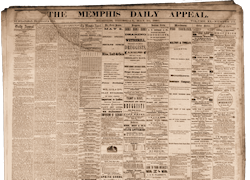
Memphis Daily Appeal
Memphis, Ten
May 4, 1861

This fine company, under command of Captain Edmondson1, depart for Randolph this afternoon. A flag will be presented to them at eleven o’clock this morning, in court square, by Miss E. E. Chidsey. So popular are the Grays that several other flags, we understand, will be presented them in the course of the day.


  1. Jame H (Jimmie) Edmondson— Brother of Belle Edmundson who will later become a Confederate spy and smuggler in the Memphis area. The Grays will become an independent sharpshooter company in 1862.
0 comments

“…those who do not belong here should be so notified.”

War of the Rebellion: from the Official Records of the Union and Confederate Armies and Navies

FORT TAYLOR, FLA., May 4, 1861.

J. P. BALDWIN, Esq., Mayor, Key West City :

MY DEAR SIR: I proposed on yesterday to print an address to the citizens of the United States on Key West. The address was delayed, and I take the opportunity to say to you, in continuation of the conversation had a few days since, that from circumstances brought to my attention direct, and from reliable sources, it is my opinion that there will be a strong effort made to distress the inhabitants of this key. Isolated and shut up by the water of the Gulf, should what I hear prove correct, the distress would be extreme upon the inhabitants of the island. It is in your power to aid in avoiding this contingency, which, whether near or remote, will be terrible when it comes. I have served in Florida during the early wars, and remember the distress of the inhabitants of Saint Augustine, to whom the government had to furnish subsistence. It is probable that such may be the case on the key. The government determining to hold it will be responsible for its loyal citizens; and should the necessities referred to arise, it will be necessary to discriminate, and those who do not belong here should be so notified.

It is also essential that it should be generally known that the functions of the commanding officer on Key West, ex officio, embrace during the present crisis all the military, including citizens desirous to bear arms for the preservation of life and property. It will be necessary for me, in order to combine them with those of the government, that a muster-roll according to the form prescribed should be supplied to these headquarters by any military organization now existing.

I am, sir, very respectfully, your most obedient servant,

WM. H. FRENCH,
Brevet Major, U. S. Army, Commanding.

0 comments

The Hickory Rifles.

Civil War Day-by-Day

Memphis Daily Appeal
Memphis, Ten
May 4, 1861

This noble corps, principally consisting of connections of some of the most respected and influential families in this city and neighborhood, is ordered on active service and leaves us to-night. The members are all hereby summoned by their respected captain, Dr. Martin, to meet at their armory at ten o’clock this morning. The same authority also summons the company to meet at four o’clock in the afternoon, with their baggage, preparatory to marching to their camp. From their armory they will proceed to Dr. Grundy’s church, corner of Main and Beal streets, to receive a flag which will be presented to them by the ladies of Memphis at five o’clock.

0 comments

Civil War Day-By-Day

Civil War Day-by-Day

May 4, 1861

A Chronological History of the Civil War in America1

  • The Governors of Pennsylvania, Ohio, Wisconsin, Michigan, Indiana, etc., met at Cleveland, Ohio, to devise plans for the defense of the Western States.

  1. A Chronological History of the Civil War in America by Richard Swainson Fisher, New York, Johnson and Ward, 1863
0 comments

Mississippi treasury depleted from war expenses.

War of the Rebellion: from the Official Records of the Union and Confederate Armies and Navies
Executive Office,
Jackson, Miss., May 3, 1861.
His Excellency President Jefferson Davis:
Dear Sir: The troops from Mississippi at Pensacola are sending to me for tents, clothing, arms, medicine, &c. I am sending them whatever is in my power to furnish. The expenses of forwarding our troops, arms, ammunition, tents, camp equipage, clothing, &c. , has so depleted our treasury that I am unable to pay the expenses of calling the remaining troops into camp for instruction, which they very much need. Is it proposed by the Confederate Government to refund to the States these advances made by them for the troops sent into service? If so, please have me informed when and how. We have now about eighty companies anxious to get into service and clamoring to be ordered into camp for drill and instruction. The ten cavalry companies provided for in our ordinance were promptly filled, some of them well armed, and drilling daily. They began to despair of being called for, and are asking to be permitted to change their arms for infantry; but I will not trouble you with the detail of these matters. Suffice it to say, all Mississippi is in a fever to get to the field and hail an order to march as the greatest favor you can bestow on them, and if you take the field they could not be restrained.
Governor Winston, of Alabama, wishes a fighting place in the picture. I know him well; he is capable of doing the Confederacy much and valuable service, and many will be trusted with command in this war who are not as faithful, as wise, or as brave as I know him to be. Any aid you may render him in getting a position in the field will be gratefully remembered by me and worthily bestowed on him. I am putting a battery at Vicksburg, but hope to move it several hundred miles up the river before one of the guns is fired at our enemies. I hope you will cause our Confederacy to act like James Fitz-James when beset by Highland foes, “no timid deer, but lion of the hunt aware.”
In hopes of an early additional requisition, I am, very respectfully, your friend,

JOHN J. PETTUS.

0 comments

Provisions for the South

War of the Rebellion: from the Official Records of the Union and Confederate Armies and Navies
May 3, 1861
Hon. L. P. Walker,
Dear Sir: I received to-day from Mr. Tate, the president of the Memphis and Charleston Railroad, the inclosed letter. I am induced to send it to you because of the importance of the matters referred to and the known business character and capacity of the writer. The objects are of great moment, and this must constitute my apology for pressing anything upon your attention at a time when it is so constantly occupied.
I have the honor to be, yours, most respectfully,
ALEX M. CLAYTON.
[Inclosure]
Hon . A. M. Clayton,
Montgomery, Ala.:
Dear Sir: The importance of the questions involved and the interest I know you feel in their success induces me to address you now. I know you are near the President and can get his ear. There are no provisions in the South—not enough for a full supply for sixty days. How are we to get it? The Government at Washington is making important arrangements to take Saint Louis and close the Mississippi effectually against us from Cairo up. This cuts off our last hope for a full supply of provisions and lead. By efficient action now we can save the State of Missouri to the South and keep open an outlet to an abundant supply of provisions. If we don’t aid Missouri, and that quickly, we lose both and place our enemies in a position to concentrate an army in the Northwest unmolested, with plenty to eat and fully equipped to overrun the Mississippi Valley. Governor Jackson is with us. His people are also with us, except at Saint Louis, where they are divided. The first thing we know we will be out of powder, lead, and percussion-caps. They can be had through Cuba alone at this time, and a blockade may be established that will cut off this means of supply. Our Government should act, and act with the most vigorous energy, to effect these objects at once. I am neither a politician nor a warrior. I have too much on my hands to engage actively in either. I can serve my country better in other ways. I hope you will not let our Government lose sight of the vast interests at stake in the Mississippi Valley, and by all means urge the keeping open the navigation of the Mississippi River and the possession of Saint Louis at all hazards.
Your friend,
SAM. TATE.
0 comments

Attention Walker Rifles!

Civil War Day-by-Day

The Ranchero
(Corpus Christi, Texas)
May 3, 1861

In the State Gazette, we notice that the Walker Mounted Rifles, of this city, have been reported and received by the Adjutant General of the State. The company is armed with Mississippi rifles, received from the State during the Cortina raid. The members are all animated with a patriotic zeal which is gratifying to record. This company, by the law under which it was organized, is at all times subject to the orders of the Governor of the State.

0 comments

Emphatic

Civil War Day-by-Day

Daily Times
(Leavenworth, KS)
May 3, 1861

The Kearney companies, on their way to Ft. Leavenworth, passed through Omaha. Rumors having been current at the latter place that Col. Miles, the commanding officer,—being a Southern man by birth—was a secessionist, the “Nebraskian” says there is no foundation for such rumors. That paper reports the following as the substance of remarks made by the Colonel to some citizens of Omaha:

“I don’t desire to take part against the South or the North. In my long service in the army I have achieved too many glories for the whole country, to have them divided and split up now. They don’t belong to the North nor to the South. But they shan’t tear down that Old Flag—I’ll die first. I was born under the Stars and Stripes, and I expect to die under the same old flag, and I DON’T CARE A CONTINENTAL HOW QUICK!”

There is no secession about the gallant Colonel.

0 comments

Rebel War Clerk

Civil War Day-by-Day
A likeness of Jones when he was editor and majority owner of the Daily Madisonian during President John Tyler’s administration.

MAY 3d. –No letters from my wife. Probably she has taken the children to the Eastern Shore. Her farm is there, and she has many friends in the county. On that narrow peninsula it is hardly to be supposed the Yankees will send any troops. With the broad Atlantic on one side and the Chesapeake Bay on the other, it is to be presumed there will be no military demonstration by the inhabitants, for they could neither escape nor receive reinforcements from the mainland. In the war of the first Revolution, and the subsequent one with Great Britain, this peninsula escaped the ravages of the enemy, although the people were as loyal to the government of the United States as any; but the Yankees are more enterprising than the British, and may have an eye to “truck farms” in that fruitful region.

0 comments

Anaconda Plan

War of the Rebellion: from the Official Records of the Union and Confederate Armies and Navies

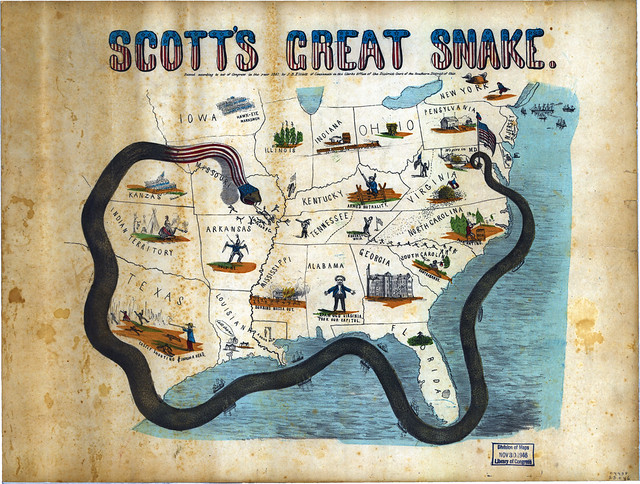
Cartoon map illustrating Gen. Winfield Scott’s plan to crush the Confederacy, economically. It is sometimes called the “Anaconda Plan.”

Headquarters of the Army

Washington, May 3, 1861

Maj. Gen. George B. McClellan,
Commanding Ohio Volunteers, Cincinnati, OH

We rely greatly on the sure operation of a complete blockade1 of the Atlantic and Gulf ports soon to commence. In connection with such blockade we propose a powerful movement down the Mississippi to the ocean, with a cordon of posts at proper points, and the capture of Forts Jackson and Saint Philip; the object being to clear out and keep open this great line of communication in connection with the strict blockade of the sea-board, so as to envelop the insurgent States and bring them to terms with less bloodshed than by any other plan. I suppose there will be needed from twelve to twenty steam gun-boats, and a sufficient number of steam transports (say forty) to carry all the personnel (say 60,000 men) and material of the expedition; most of the gun-boats to be in advance to open the way, and the remainder to follow and protect the rear of the expedition, &c. This army, in which it is not improbable you may be invited to take an important part, should be composed of our best regulars for the advance and of three-years’ volunteers, all well officered, and with four months and a half of instruction in camps prior to (say) November 10. In the progress down the river all the enemy’s batteries on its banks we of course would turn and capture, leaving a sufficient number of posts with complete garrisons to keep the river open behind the expedition. Finally, it will be necessary that New Orleans should be strongly occupied and securely held until the present difficulties are composed.

With great respect, yours, truly
Winfield Scott.


  1. The strategy was nicknamed the Anaconda Plan in the newspapers because it would strangle the Confederacy the way the anaconda snake constricts its victims.
0 comments

Patriotic Liberality.

Civil War Day-by-Day
1860s newsprint

May 3, 1861
Daily Advocate
(Baton Rouge, LA)

Among the numerous instances of patriotic generosity which have been lately displayed by our private citizens, that of Messrs. McHatton, Pike & Co., in giving a full suit of uniform to Capt. Rauhman’s German company, merits especial mention. In various ways the different members of this firm have always generously and nobly responded to solicitations for extending assistance to our suddenly-formed volunteer companies.

0 comments

“But there is so much excitement that it is almost impossible to fix ones mind upon any one subject long at a time.”—Horatio Nelson Taft

Diary of US patent clerk Horatio Nelson Taft.

FRIDAY 3

Rainy day, cold and chilly. In the Pat office the troops have been drilling in all the Halls. The RI Marine Battery, 6 [Janus?] rifled cannon, 150 men, 90 Horses, &c have arrived. They marched through PA Ave to the Prests with their guns and attracted much attention. There is not much doing in the office at present. I have plenty of time to read and write letters. But there is so much excitement that it is almost impossible to fix ones mind upon any one subject long at a time.


The three diary manuscript volumes, Washington during the Civil War: The Diary of Horatio Nelson Taft, 1861-1865, are available online at The Library of   Congress.

0 comments

A Stand of Arms

Civil War Day-by-Day

Daily Times
(Leavenworth, KS)
May 3, 1861

Several correspondents ask us what is a “stand of arms.” It is the equipment of one soldier, and consists of the arms and accoutrements he wears, varying with his branch of the service. Twenty-one thousand stand of arms would equip the same number of troops. The term stand is often confused, and sometimes used as convertible with “stack,” the familiar manner in which muskets are placed, with bayonets interlocked.


Note:  The photo, of course, did not appear with the 1861 news article.

0 comments

Tender of the Services of a Company of Negroes.

Civil War Day-by-Day
1860s newsprint

May 3, 1861
Daily Advocate
(Baton Rouge, LA)

We are informed that Mr. G. C. Hale, of Autauga county, tendered to Gov. Moore of Alabama the services of a company of negroes to assist in driving back the horde of Abolition sycophants who are now talking so flippantly of reducing to a conquered province the Confederate States of the South. He agrees to command them himself and guarantees that they will do effective service.

0 comments

On my way to Montgomery—William Howard Russell

My Diary North and South – William Howard Russell

May 3rd.—I bade good-by to Mr. Green, who with several of his friends came down to see me off, at the terminus or “depót” of the Central Railway, on my way to Montgomery–and looked my last on Savannah, its squares and leafy streets, its churches, and institutes with a feeling of regret that I could not see more of them, and that I was forced to be content with the outer aspect of the public buildings. I had been serenaded and invited out in all directions, asked to visit plantations and big trees, to make excursions to famous or beautiful spots, and specially warned not to leave the State without visiting the mountain district in the northern and western portion; but the march of events called me to Montgomery.

From Savannah to Macon, 191 miles, the road passes through level country only partially cleared. That is, there are patches of forest still intruding on the green fields, where the jagged black teeth of the destroyed trees rise from above the maize and cotton. There were but few negroes visible at work, nor did the land appear rich, but I was told the rail was laid along the most barren part of the country. The Indians had roamed in these woods little more than twenty years ago–now the wooden huts of the planters’ slaves and the larger edifice with its verandah and timber colonnade stood in the place of their wigwam.

Among the passengers to whom I was introduced was the Bishop of Georgia, the Rev. Mr. Elliott, a man of exceeding fine presence, of great stature, and handsome face, with a manner easy and graceful, but we got on the unfortunate subject of slavery, and I rather revolted at hearing a Christian prelate advocating the institution on scriptural grounds.

This affectation of Biblical sanction and ordinance as the basis of slavery was not new to me, though it is not much known at the other side of the Atlantic. I had read in a work on slavery, that it was permitted by both the Scriptures and the Constitution of the United States, and that it must, therefore, be doubly right. A nation that could approve of such interpretations of the Scriptures and at the same time read the “New York Herald,” seemed ripe for destruction as a corporate existence. The malum prohibitum was the only evil its crass senses could detect, and the malum per se was its good, if it only came covered with cotton or gold. The miserable sophists who expose themselves to the contempt of the world by their paltry thesicles on the divine origin and uses of slavery, are infinitely more contemptible than the wretched bigots who published themes long ago on the propriety of burning witches, or on the necessity for the offices of the Inquisition. [continue reading…]

0 comments

Our first trunk of hospital supplies…

Woolsey family letters during the War for the Union
Abby Howland Woolsey to Eliza Woolsey Howland

Friday.

Dear Eliza: We got off our first trunk of Hospital supplies for Colonel Mansfield Davies’ Regiment yesterday and feel today as if we were quite at leisure. You have no idea of the number of last things there were to do, or the different directions we had to go in, to do them. Mr. Davies came in at breakfast yesterday, in his regimentals, quite opportunely, to tell us what to do with the trunk. It went down to his headquarters at 564 Broadway and thence by steamer to Fort Schuyler for the sick soldiers there. Charley and Ned drove out there yesterday afternoon from Astoria to see the drill, and saw the box safely landed within the walls. It was the old black ark which you and G. had in Beyrout, Syria, marked with a capital H, which now answers for Hospital. There were in it as follows–for you may be curious to know:–

42 shirts,
2 drawers,
6 calico gowns,
24 pairs woolen socks, .
24 pairs slippers,
24 pocket handkerchiefs,
18 pillow sacks,
36 pillow-cases,
18 damask napkins,
36 towels,
24 sponges,
4 boxes of lint,
beside old linen, oiled silk, tape, thread, pins, scissors, wax, books (Hedley Vicars and the like), ribbon, cloth, etc., and fifty bandages.

This morning Mother has been putting up a tin box of stores for Mr. Davies – sardines, potted meats, arrow root, chocolate, guava and the like, with a box of cologne, a jar of prunes and a morocco case with knife, fork and spoon, fine steel and double plated, “ just out “ for army use. Lots more. The box, a square cracker box, holds as much in its way as the trunk. I am glad you are in the library at last. You will grow accustomed to it and find it pleasanter even than the dining-room.

0 comments

Civil War Day-By-Day

Civil War Day-by-Day

May 3, 1861

  • General Winfield Scott orders troops to seize Arlington Heights, overlooking Washington D. C.
  • Lincoln calls for volunteers to join the Union Army for a three-year term.

A Chronological History of the Civil War in America1

  • Legislature of Connecticut voted $2,000,000 for public defense.
  • Governor of Virginia called out the militia to defend the State from the Northerners.
  • President of the United States issued a proclamation calling for 42,000 additional three-years’ volunteers, 22,714 additional regulars, and 18,000 additional seamen, to be mustered into the service of the Government.

  1. A Chronological History of the Civil War in America by Richard Swainson Fisher, New York, Johnson and Ward, 1863
0 comments

“I was at Willards tonight when the NY Zuaves Col Ellsworth Regt marched up the “Ave” to the War department…,”—Horatio Nelson Taft

Diary of US patent clerk Horatio Nelson Taft.

THURSDAY 2

Cold today, fire comfortable. M. down to 40. A fine flag was raised on the Pat office today at noon. The RI Regt paraded with Gov Sprague at the head on 7th St. The 7 NY Regt went into camp up 14th St. near Collumbia College. Regiments are now drilling and parading in the streets every day. I was at Willards tonight when the NY Zuaves Col Ellsworth Regt marched up the “Ave” to the War department, eleven hundred strong, and every man with a Sharps Rifle on his shoulder. Signed a petition for Mr Wood of NY to be Comr of public Buildings. Conversed an hour with Prof Heidrick. Went “Maying” with wife & Julia after dinner.


The three diary manuscript volumes, Washington during the Civil War: The Diary of Horatio Nelson Taft, 1861-1865, are available online at The Library of   Congress.

0 comments

Yell county will be all right upon the all important question of secession…

Civil War Day-by-Day

Arkansas True Democrat
Little Rock
May 2, 1861

 For the True Democrat.
Dardanelle, April 19, 1861.

Messrs. Johnson & Yerkes:

I am truly gratified to know, and from the signs of the times I can confidently say, Yell county, is now aroused to a sense of her duty, and will be all right upon the all important question of secession when she has a chance to cast her vote…

This morning we reared a pole, towering 110 feet, and from its lofty summit stretches out our southern flag, the star of Arkansas in the distance, like the swift comet, seeking to form one of those brilliant seven that are shedding light upon the independent pathway of our Confederacy. There were a great many people present from all parts of this (Pope and Perry,) the scene made an impression upon my mind never to be forgotten. As the flag was making its way swiftly aloft, ladies and gentlemen were thronging the side-walks, and amid the roar of the anvils1, (not cannon,) and the enthusiastic tune of Dixey, played by the band of the Showboat, Wave, Col. Lemoyne appeared upon the stand prepared for him, and in his usual manner, when appearing before an audience, seemed to take a survey of the entire crowd, and at the close of Dixey [sic], addressed the ladies, complimenting their sex for the interest they always take in all important matters, illustrated by the effect that music and woman had upon the soldier. He then turned to the men and addressed them as the descendants of the revolutionary patriots, supporters, protectors and guardians of women and children, pictured to them the present state o things, compared it to the revolutionary crisis. . . .


  1. Anvil cannon
0 comments

Communicated.—Talbot All Right!

Civil War Day-by-Day

Daily Constitutionalist
Augusta, Georgia, May 2, 1861

Mr. Editor: Old Talbot [County] is doing her whole duty in this emergency. She has already raised two companies with their full complement of men, and a third is rapidly being formed. Capt. Curley’s company took up the line of march for your city last Friday, which was the most interesting time I have ever witnessed in our town. Mrs. Baxter made a beautiful flag for the company, which was presented to the company with an eloquent speech by Judge Warrell. After which, Rev. Mr. Atkinson made a very touching speech, and presented to the company a  Testament apiece, which were a donation from Mr. Couch. The company was then marched to a splendid table, where they feasted themselves upon the many luxuries which was spread before them… The company is constituted of the very best material, and the flag which has been entrusted to their care will never be disgraced.

J. R. A.

0 comments

Secessionists in Kansas City

Civil War Day-by-Day

Daily Times
Leavenworth, Kansas,
May 2, 1861

A fearful excitement exists in Kansas City—the secessionists sweeping everything before them. The editor of the Free State Republican has been driven out and taken refuge in Wyandotte. He fears his press will be destroyed before he can get it away. Several heavy traders have also been driven out, among them the well known firms of Bruckman & Pulte, Ordway, and others. Threats have been made of an attack upon Wyandotte City.

0 comments