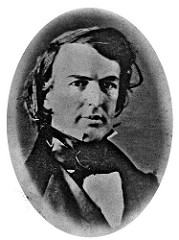
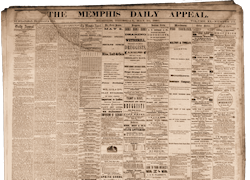
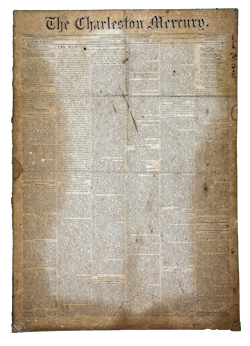
“Went into the East Capitol grounds where the Zuave Regt (Col Ellsworths) was on parade. They are a hard looking set (NY Fire man).”—Horatio Nelson Taft

Diary of US patent clerk Horatio Nelson Taft.

TUESDAY, MAY 7, 1861.

It has been a pleasant fine day and much enjoyed by all after the long cold rain. 4000 soldiers from NJ are here now. Saw them all on parade on the Ave tonight. Went with wife to the Capitol, into both chambers. Had to pass eight sentries. Went into the East Capitol grounds where the Zuave Regt (Col Ellsworths) was on parade. They are a hard looking set (NY Fire man). Called in the evening on Col Allen of Boston at the National. Saw the Col of the NY 5th Regt there and other officers. Got the papers, a map of the City & Georgetown & a [badge?] for myself.


The three diary manuscript volumes, Washington during the Civil War: The Diary of Horatio Nelson Taft, 1861-1865, are available online at The Library of   Congress.

0 comments

Horrible Accident.

Civil War Day-by-Day
1860s newsprint

Daily Advocate
Baton Rouge
May 7, 1861

We learn that Mr. McKelvy, Postmaster at Delhi, met with a serious accident on last Saturday evening, by the explosion of an anvil, with which he was firing salutes1. One of his legs was so shattered as to render amputation necessary. There are some hopes of his recovery.—Herald, Franklin parish.


  1. Anvil firing— is the practice of firing an anvil into the air with gunpowder. Typically, two anvils are used: one as a base (placed upside down), and another one (also known as the “flier”) as the projectile (placed right-side up, atop the base). An alternative method is to place the bottom anvil upright, and fill the hardy hole with black powder. A torus or washer, often made from a playing card, is placed over the hole, with a space for a fuse or powder trail. The top anvil is placed upside down, face to face with the bottom anvil.
0 comments

Rebel War Clerk

Civil War Day-by-Day
A likeness of Jones when he was editor and majority owner of the Daily Madisonian during President John Tyler’s administration.

MAY 7th. –Col. R. E. Lee, lately of the United States army, has been appointed major-general, and commander-in-chief of the army in Virginia. He is the son of “Light Horse Harry” of the Revolution. The North can boast no such historic names as we in its army.

Gov. Wise is sick at home, in Princess Ann County, but has sent me a strong letter to President Davis. I fear the governor will not survive many months.

0 comments

Knights of the Golden Circle.

Civil War Day-by-Day

Memphis Daily Appeal
Tennessee
May 7, 1861

Headquarters, Army of K. G. C.,}
Louisville, Ky., May 1, 1861.}
1. Commandants of K. G. C. castles throughout the various States of the South, excepting Texas, are hereby ordered to forward, without delay, to general headquarters, at Louisville, Ky., complete muster rolls of military companies. If the military organization of a castle is not completed, the commandant will take immediate steps to have it done. Each company, when organized, shall consist of one captain, one first lieutenant, two second
lieutenants, four sergeants, four corporals, two musicians and ninety privates.
2. Castles belonging to the Texas division will report to Gen. Geo. W. Chilton, marshal of di[illegible]on, at Tyler, Smith county, Texas, or to Col. Charles A. Russell, acting adjutant general, at Helena, Karnes county, Texas. The president begs the order to respond fully and promptly to the call of Generals Chilton, Ford, Wilcox and Green, and stand on the defensive
until our national troubles are ended.
3. All general, field and staff officers of the American legion will report immediately by letter or otherwise, to the president at Louisville, Ky.
4. The president begs to state for the information of the order that since the first of February last he has been laboring in Kentucky—principally in the city of Louisville—and has added to the order 1,483 members, 534 of whom have been sent to the army of the Confederate States. Two regiments are now being formed in the State to be held subject to the orders of the Governor. The order has now 17,643 men in the field, and the president has no hesitation in saying that the number can be duplicated if necessity requires.
George Bickley, K. G. C.,
President of American Legion.
0 comments

Street Begging.

Civil War Day-by-Day

Memphis Daily Appeal
Tennessee
May 7, 1861

A system that has long been a curse to northern cities has lately been inaugurated here—we mean the practice of sending little girls out into the streets to beg. As soon as one of these young swindlers—for that is what they are in reality—sees two or three gentlemen conversing together in the streets, she thrusts herself in among them and by pertinacious importunity she interrupts them until she is paid to go away. Rarely, if ever, we have good reason to believe, are these girls—or rather those who compel them to pursue their vicious occupation—really objects of charity. The poor child who is sent out on this soul-destroying business is indeed an object of compassion; but to give her the money she solicits, is to pay those who ill use her to persist in their cruelty. Instead of giving money to these children, the children should be given into custody to the nearest policeman that inquiry may reveal the actual position of those to whom they belong. Yesterday a girl twelve years old, named Mary Anne Moray, was thus placed in custody. It proved that she had a father, who is a shoemaker. Her sister took her from the station house, putting down twenty-five dollars as security for her appearance for examination this morning. In taking the money from her purse she showed not less than fifty to sixty dollars. Do the credulous now see what need there was for the five and ten cent pieces they have kept from the really poor, to give to imposters?

0 comments

Samuel R. Curtis to muster militia in Ioway

The Letters of Samuel Ryan Curtis

War Department
May 7. 1861.

In the absence of regular officers for the purpose the Hon. Col. Samuel R. Curtis of Ioway late of the U.S. Army, is hereby appointed to muster into the Service of the United States the quota of Militia of the State of Ioway called out under the requisition of the President of the U.S.1

He is authorised to take all steps necessary to equip, provisions, and supply these troops till the officers of the several administrative departments can be ordered to relieve him, until which time he will receive, and govern himself, by the instructions these Departments may give.

Simon Cameron
Secy of War


1. The call for 75,000 ninety day troops of the state militia was issued by Lincoln April 15. Iowa’s quota was one regiment. There was a subsequent call for three year troops several weeks later. Three regiments were quickly formed in Iowa to rendenvous at Keokuk May 20.

0 comments

Civil War Day-By-Day

Civil War Day-by-Day

May 7, 1861

A Chronological History of the Civil War in America1

  • Riot at Knoxville, Tenn., on hoisting a Union flag.
  • Governor of Tennessee announced a military league between that State and the Confederate States.

  1. A Chronological History of the Civil War in America by Richard Swainson Fisher, New York, Johnson and Ward, 1863
0 comments

3rd Arkansas State Troops

Miscellaneous document sources

3rd Arkansas State Troops, May 4, 1860, Washington, Arkansas
On the morning of May 4, 1861, a company of Arkansas State Troops known as the Hempstead Rifles prepared to leave for the Civil War. Standing in front of the Jones Hotel in Washington, Arkansas, the men of Company B were given a flag in a presentation ceremony. That afternoon, accompanied by the town’s band, the Rifles marched away, eventually joining Brigadier General Benjamin McCulloch’s Western Army and fighting at Wilson’s Creek on August 10, 1861. Mustered out shortly after the battle, many of the company’s members re-enlisted in other Confederate units.

Tintype by Unknown Photographer

Image Courtesy Wilson’s Creek National Battlefield; WICR 30057

ozarkscivilwar.org/photographs/3rd-arkansas-state-troops/

0 comments

A New Regiment of Massachusetts Volunteers Passing Fanueil Hall on their way to the War

Civil War Day-by-Day

A New Regiment of Massachusetts Volunteers Passing Fanueil Hall on their way to the War
Harper’s Pictorial History of the Civil War by Alfred H. Guernsey and Henry W. Alden; copyrighted 1866 by Harper and Brothers; 1894 by Alfred H. Guernsey and Henry W. Alden; 1894 by McDonnell Bros; pub. The Puritan Press Co.; Chicago, Illinois

0 comments

Landing of Troops at the Wharf of the Naval Academy, Annapolis, Md.

Civil War Day-by-Day

Landing of Troops at the Wharf of the Naval Acadamy, Annapolis, Md.
Frank Leslie’s The Soldier in Our Civil War, Vol. I.; The Stanley Bradley Publishing Company, Incorporated.

0 comments

Interior View of Fort Sumter after the Bombardment

Miscellaneous document sources

Interior View of Fort Sumter after the Bombardment
Frank Leslie’s The Soldier in Our Civil War, Vol. I.; The Stanley Bradley Publishing Company, Incorporated.

0 comments

Troops Drilling in the Grounds on the North Side of the Capitol, Washington, D. C.

Miscellaneous document sources

Troops Drilling in the Grounds on the North Side of the Capitol, Washington, D. C.
(from Frank Leslie’s Illustrated History of the Civil War…, edited by Louis Shepheard Moat, Published by Mrs. Frank Leslie, New York, 1895)

The influx of Northern regiments of troops into Washington during the early days of the war rendered that city every hour in the day a scene of exciting and beautiful military display. The grounds north of the Capitol were used for brilliant dress parades and drills, which attracted throngs of visitors from all parts of the city and surrounding places. The various regiments had their cliques of admiring friends, who deemed the evolutions of their favorites, entirely unapproachable. All the troops however, in their drill and bearing were considered worthy of warm praise, and called forth loud cheers from the spectators.

0 comments

The Funeral Cortege, at Boston, Mass., of the Sixth Massachusetts Soldiers Killed at Baltimore

Miscellaneous document sources

The Funeral Cortege, at Boston, Mass., of the Sixth Massachusetts Soldiers Killed at Baltimore
(from Frank Leslie’s Illustrated History of the Civil War…, edited by Louis Shepheard Moat, Published by Mrs. Frank Leslie, New York, 1895)

“The funeral of the four soldiers of the Sixth Massachusetts Regiment who were killed in Baltimore, April 19th, 1861, while en route to Washington, was held at Boston, May 1st. The bodies were received in the city by a military escort under Governor Andrew and Adjutant General Schouler, accompanied by a large concourse of citizens, and were temporarily deposited in the vaults of King’s Chapel. The names of these first martyrs’ were Luther C. Ladd, Addison O. Whitney, Charles A. Taylor and Sumner H. Needham. The Legislature of Maryland, on March 5th, 1862, appropriated seven thousand dollars, to be dispensed, under the direction of the Governor of Massachusetts, for the relief of the families of those who were killed and injured.”

0 comments

How to Make Ball Cartridges

Civil War Day-by-Day

Charleston Mercury
May 6, 1861

Prepare a stick four inches long, perfectly round, and a little smaller than the ball; cut small slices of paper, an inch and a half long, and wide enough to go one and a half times around the stick; prepare a mucilage of water and gumarabic; roll the paper on the stick one time, then put on the mucilage and press it firmly by rolling it; then trim the stick one-eighth of an inch and put mucilage in the end of the paper; insert the ball and stand it on the point in a cup of flour, or fine dirt or sand, and let it remain until it is dry. This mode is much more convenient and better than the ordinary mode of tying the paper to the ball.

0 comments

“Many of the troops are in an exposed condition and suffering for shelter.”—Horatio Nelson Taft

Diary of US patent clerk Horatio Nelson Taft.

MONDAY 6

Rain again most of the day. Many of the troops are in an exposed condition and suffering for shelter. The NJ troops came in early this morning, over 3000 in the rain and could find no shelter for sometime. Drilling of RI soldiers in the Halls of the Pat office all day. Everything outside looks wet and gloomy. Did not go to the Ave this evening, but got a plate of glass and put in the Aquarium, one was broken. Caught in a shower while after it, to bed early.


The three diary manuscript volumes, Washington during the Civil War: The Diary of Horatio Nelson Taft, 1861-1865, are available online at The Library of   Congress.

0 comments

“Another instance of Southern magnanimity!”—Rebel War Clerk.

Civil War Day-by-Day
A likeness of Jones when he was editor and majority owner of the Daily Madisonian during President John Tyler’s administration.

MAY 6th. –To-day a Yankee was caught in the street questioning some negroes as to which side they would fight on, slavery or freedom. He was merely rebuked and ordered out of the country. Another instance of Southern magnanimity! It will only embolden the insidious enemy.

0 comments

Arkansas Ordinance of Secession

Miscellaneous document sources
AN ORDINANCE
To dissolve the union now existing between the State of Arkansas and the other States united with her under the compact entitled “The constitution of the United States of America.”
AN ORDINANCE To dissolve the union now existing between the State of Arkansas and the other states united with her under the compact entitled "The constitution of the United States of America".Whereas, In addition to the well-founded causes of complaint set forth by this convention, in resolutions adopted on the 11th March, A. D., 1861, against the sectional party now in power at Washington City, headed by Abraham Lincoln, he has, in the face of resolutions passed by this convention pledging the State of Arkansas to resist, to the last extremity, any attempt on the part of such power to coerce any State that had seceded from the old Union, proclaimed to the world that war should be waged against such States until they should be compelled to submit to their rule, and large forces to accomplish this have by this same power been called out, and are now being marshaled to carry out this inhuman design, and to longer submit to such rule, or remain in the old Union of the United States, would be disgraceful and ruinous to the State of Arkansas:
0 comments

Privateering on the Mississippi

War of the Rebellion: from the Official Records of the Union and Confederate Armies and Navies
Floyd, Carroll Parish, La.,
[May –, 1861.]
Dear Sir: The undersigned, who are now raising a company for the purpose of privateering on the Mississippi River, are desirous of the issuance to them of letters of marque and reprisal from our Government for that purpose.
The first name signed hereto would respectfully refer you to the Hon . T. O. Moore, governor of Louisiana, and Hon. Ed. Sparrow, member of the Confederate Congress from this State, and who resides in our parish.
Please let us hear from you at the earliest moment. Respectfully, your, etc.,
E.J. Delany
P.J. Holstein
Hon. L. Pope Walker,
Secretary of War, Confederate States of America.
0 comments

“Fort Pickens is now more than twice as strong as it was three weeks ago.”

War of the Rebellion: from the Official Records of the Union and Confederate Armies and Navies

HEADQUARTERS TROOPS OF
CONFEDERATE STATES,
Near Pensacola., Fla., May 6, 1861.

Hon. L. P. WALKER, Secretary of War, Montgomery:

From the tenor of my orders and instructions there has existed no doubt in my mind that the Department desired me first to secure the defense of my position here, and then the reduction of Fort Pickens, if practicable. No suggestion has been regarded as an order to proceed in any manner contrary to my own conviction, and no step has been taken which my own judgment has not approved; but I have felt it a duty to lay before you the means and sacrifices necessary to accomplish the object.

The change which has been made in my proposed plan of operations is the result of unavoidable delay, by which the enemy has been enabled to frustrate my first intentions. Fort Pickens is now more than twice as strong as it was three weeks ago, and the approaches to it will be made more and more difficult every day. They are now extending their operations on the island of Santa Rosa, and every hour will add seriously to the difficulties to be overcome. The importance of rapid movement on our part is very apparent if we are to proceed to the reduction of Fort Pickens, but it would be very bad policy to move until we are prepared to succeed. My plan for a lodgment on the island is arranged, and will be executed as soon as the means are available. In the present state of that work, with a garrison fully competent for its defense, and a support at all times ready at hand in the fleet, its reduction will cost us many lives, much time and labor, and a very large expenditure of money. Whether the end will justify the means the Department must decide.

My works on this side, both for attack and defense, are nearly completed, and preparations are going on for the island movement, but we are still deficient in many essentials. Five thousand sets of infantry accouterments are necessary for the preservation of our ammunition. It is now carried by the men in their pockets, and one day’s hard service would destroy it all. A supply of musket cartridges is also a first necessity. Having yet had no response to my requisition of last March, I shall send an, officer to Louisiana to see if some can be had at Baton Rouge. The present supply here would last me in an engagement about thirty minutes. Our best defense against the fleet–shells–cannot be used for want of fuses. Not one has yet reached me. These items are not mentioned   by way of complaint, for I know full well the difficulties and embarrassments which surround the Department, but simply to show how utterly impossible it is to check the enemy in his operations.

Night before last we succeeded in placing some serious obstructions in the channel between Forts Pickens and McRee, which will intimidate the fleet and seriously retard any movement to enter the harbor. It might be much more effectually blocked, but at a heavy expense for the necessary vessels. The entrance, however, of steamers would entirely frustrate our movement on the island, if it did not result in a capture of our force.

I am, sir, very respectfully, your obedient servant,

BRAXTON BRAGG,

Brigadier-General, Commanding.

0 comments

Confederate War and Privateering Act

Miscellaneous document sources

AN ACT

Recognizing the existence of War between the United States and the Confederate States; and concerning letters of marque, prizes, and prize goods.

An act recognizing the existence of war between the United States and the Confederate StatesWhereas, the earnest efforts made by this Government to establish friendly relations between the Government of the United States and the Confederate States, and to settle all questions of disagreement between the two Governments upon principles of right, justice, equity and good faith, have proved unavailing by reason of the refusal of the Government of the United States to hold any intercourse with the Commissioners appointed by this Government for the purposes aforesaid, or to listen to any proposals they had to make for the peaceful solution of all causes of difficulty between the two Governments; and whereas the President of the United States of America has issued his proclamation making requisition upon the States of the American Union for seventy-five thousand men for the purpose, as therein indicated, of capturing forts and other strong-holds within the jurisdiction of and belonging to the Confederate States of America, and has detailed naval armaments upon the coasts of the Confederate States of America, and raised, organised and equipped a large military force to execute the purpose aforesaid, and has issued his other proclamation announcing…
0 comments

“I had been much affected at the slave auction held just outside the hotel, on the steps of the public fountain, which I had witnessed on my way to the capitol.”—William Howard Russell

My Diary North and South – William Howard Russell

Note: This particular diary entry–a document written in 1861–includes terms and topics that may be offensive to many today.   No attempt will be made to censor or edit 19th-century material to today’s standards.

May 6th.—I forgot to say that yesterday before dinner I drove out with some gentlemen and the ladies of the family of Mr. George N. Sanders, once United States’ consul at Liverpool, now a doubtful man here, seeking some office from the Government, and accused by a portion of the press of being a Confederate spy—Porcus de grege epicuri—but a learned pig withal, and weatherwise, and mindful of the signs of the times, catching straws and whisking them upwards to detect the currents. Well, in this great moment I am bound to say there was much talk of ice. The North owns the frozen climates; but it was hoped that Great Britain, to whom belongs the North Pole, might force the blockade and send aid.

The environs of Montgomery are agreeable—well-wooded, undulating, villas abounding, public gardens, and a large negro and mulatto suburb. It is not usual, as far as I can judge, to see women riding on horseback in the South, but on the road here we encountered several. After breakfast I walked down with Senator Wigfall to the capitol of Montgomery—one of the true Athenian Yankeeized structures of this novo-classic land, erected on a site worthy of a better fate and edifice. By an open cistern, on our way, I came on a gentleman engaged in disposing of some living ebony carvings to a small circle, who had more curiosity than cash, for they did not at all respond to the energetic appeals of the auctioneer.

The sight was a bad preparation for an introduction to the legislative assembly of a Confederacy which rests on the Institution as the cornerstone of the social and political arch which maintains it. But there they were, the legislators or conspirators, in a large room provided with benches and seats, and listening to such a sermon as a Balfour of Burley might have preached to his Covenanters—resolute and massive heads, and large frames—such men as must have a faith to inspire them. And that is so. Assaulted by reason, by logic, argument, philanthropy, progress directed against his peculiar institutions, the Southerner at last is driven to a fanaticism—a sacred faith which is above all reason or logical attack in the propriety, righteousness, and divinity of slavery.

The chaplain, a venerable old man, loudly invoked curses on the heads of the enemy, and blessings on the arms and councils of the New State. When he was done, Mr. Howell Cobb, a fat, double-chinned, mellow-eyed man, rapped with his hammer on the desk before the chair on which he sat as speaker of the assembly, and the house proceeded to business. I could fancy that, in all but garments, they were like the men who first conceived the great rebellion which led to the independence of this wonderful country—so earnest, so grave, so sober, and so vindictive—at least, so embittered against the power which they consider tyrannical and insulting.

The word “liberty” was used repeatedly in the short time allotted to the public transaction of business and the reading of documents; the Congress was anxious to get to its work, and Mr. Howell Cobb again thumped his desk and announced that the house was going into “secret session,” which intimated that all persons who were not members should leave. I was introduced to what is called the floor of the house, and had a delegate’s chair, and of course I moved away with the others, and with the disappointed ladies and men from the galleries, but one of the members, Mr. Rhett, I believe, said jokingly: “I think you ought retain your seat. If the “Times” will support the South, we’ll accept you as a delegate.” I replied that I was afraid I could not act as a delegate to a Congress of Slave States. And, indeed, I had been much affected at the slave auction held just outside the hotel, on the steps of the public fountain, which I had witnessed on my way to the capitol. The auctioneer, who was an ill-favored, dissipated-looking rascal, had his “article” beside him on, not in, a deal packing-case—a stout young negro badly dressed and ill-shod, who stood with all his goods fastened in a small bundle in his hand, looking out at the small and listless gathering of men, who, whittling and chewing, had moved out from the shady side of the street as they saw the man put up. The chattel character of slavery in the States renders it most repulsive. What a pity the nigger is not polypoid—so that he could be cut up in junks, and each junk should reproduce itself!

A man in a cart, some volunteers in coarse uniforms, a few Irish laborers in a long van, and four or five men in the usual black coat, satin waistcoat, and black hat, constituted the audience, whom the auctioneer addressed volubly: “A prime field hand! Just look at him—good-natered, well-tempered; no marks, nary sign of bad about him! En-i-ne hunthered—only nine hun-ther-ed and fifty dol’rs for ’em! Why, it’s quite rad-aklous! Nine hundred and fifty dol’rs! I can’t raly—That’s good. Thank you, sir. Twenty-five bid—nine hun-therd and seventy-five dol’rs for this most useful hand.” The price rose to one thousand dollars, at which the useful hand was knocked down to one of the black hats near me. The auctioneer and the negro and his buyer all walked off together to settle the transaction, and the crowd moved away.

“That nigger went cheap,” said one of them to a companion, as he walked towards the shade. “Yes, Sirr! Niggers is cheap now—that’s a fact.” I must admit that I felt myself indulging in a sort of reflection whether it would not he nice to own a man as absolutely as one might possess a horse—to hold him subject to my will and pleasure, as if he were a brute beast without the power of kicking or biting—to make him work for me—to hold his fate in my hands: but the thought was for a moment. It was followed by disgust.

I have seen slave markets in the East, where the traditions of the race, the condition of family and social relations divest slavery of the most odious characteristics which pertain to it in the States; but the use of the English tongue in such a transaction, and the idea of its taking place among a civilized Christian people, produced in me a feeling of inexpressible loathing and indignation. Yesterday I was much struck by the intelligence, activity, and desire to please of a good-looking colored waiter, who seemed so light-hearted and light-colored I could not imagine he was a slave. So one of our party, who was an American, asked him: “What are you, boy—a free nigger?” Of course he knew that in Alabama it was most unlikely he could reply in the affirmative. The young man’s smile died away from his lips, a flush of blood embrowned the face for a moment, and he answered in a sad, low tone: “No, sir! I b’long to Massa Jackson,” and left the room at once. As I stood at an upper window of the capitol, and looked on the wide expanse of richly-wooded, well-cultivated land which sweeps round the hill side away to the horizon, I could not help thinking of the misery and cruelty which must have been borne in tilling the land and raising the houses and streets of the dominant race before whom one nationality of colored people has perished within the memory of man. The misery and cruelty of the system are established by the advertisements for runaway negroes, and by the description of the stigmata on their persons—whippings and brandings, scars and cuts—though these, indeed, are less frequent here than in the border States.

On my return, the Hon. W. M. Browne, Assistant Secretary of State, came to visit me—a cadet of an Irish family, who came to America some years ago, and having lost his money in land speculations, turned his pen to good account as a journalist, and gained Mr. Buchanan’s patronage and support as a newspaper editor in Washington. There he became intimate with the Southern gentlemen, with whom he naturally associated in preference to the Northern members; and when they went out, he walked over along with them. He told me the Government had already received numerous—I think he said 400—letters from ship-owners applying for letters of marque and reprisal. Many of these applications were from merchants in Boston, and other maritime cities in the New England States. He further stated that the President was determined to take the whole control of the army, and the appointments to command in all ranks of officers into his own hands.

There is now no possible chance of preserving the peace or of averting the horrors of war from these great and prosperous communities. The Southern people, right or wrong, are bent on independence and on separation, and they will fight to the last for their object.

The press is fanning the flame on both sides: it would be difficult to say whether it or the telegraphs circulate lies most largely; but that as the papers print the telegrams they must have the palm. The Southerners are told there is a reign of terror in New York–that the 7th New York Regiment has been captured by the Baltimore people—that Abe Lincoln is always drunk—that General Lee has seized Arlington heights, and is bombarding Washington. The New York people are regaled with similar stories from the South. The coincidence between the date of the skirmish at Lexington and of the attack on the 6th Massachusetts Regiment at Baltimore is not so remarkable as the fact, that the first man who was killed at the latter place, 86 years ago, was a direct descendant of the first of the colonists who was killed by the royal soldiery. Baltimore may do the same for the South which Lexington did for all the Colonies. Head-shaving, forcible deportations, tarring and feathering are recommended and adopted as specifics to produce conversion from erroneous opinions. The President of the United States has called into service of the Federal Government 42,000 volunteers, and increased the regular army by 22,000 men, and the navy by 18,000 men. If the South secede, they ought certainly to take over with them some Yankee hotel keepers. This ” Exchange” is in a frightful state—nothing but noise, dirt, drinking, wrangling.
0 comments

Civil War Day-By-Day

Civil War Day-by-Day

May 6, 1861

  • Arkansas secedes from the Union
  • Tennessee votes to put the question of secession before the people in a popular referendum.

A Chronological History of the Civil War in America1

  • Virginia admitted as a State of the Confederate States of America.
  • Arkansas State Convention passed an ordinance of secession (69 v. 1).
  • The Confederate States Congress made public the war and privateering act.
  • Legislature of Tennessee passed an ordinance of secession—passed by Senate (20 v. 4) and by House (46 v. 21), which was termed a Declaration of Independence, and ordered it to be voted on by the people.
  • Baltimore city militia disbanded.

  1. A Chronological History of the Civil War in America by Richard Swainson Fisher, New York, Johnson and Ward, 1863
0 comments

Floating Battery Moored near Fort Moultrie

Miscellaneous document sources

The Floating Battery was moored near Fort Moultrie on Sullivan’s Island, as shown in this photo taken the evening before the Confederates opened fire on Sumter.
The Floating Battery was moored near Fort Moultrie on Sullivan’s Island, as shown in this photo taken the evening before the Confederates opened fire on Sumter. (Heritage Image Partnership/Alamy Stock Photo)

HistoryNet

0 comments

The Completed Floating Battery in Charles Harbor 1861

Miscellaneous document sources

Patterned after a model built in France and used during the Crimean War, the Confederates’ Floating Battery was a daunting and, in theory, potentially ruthless vessel
Patterned after a model built in France and used during the Crimean War, the Confederates’ Floating Battery was a daunting and, in theory, potentially ruthless vessel. It even had a compact hospital—complete with operating tables and beds—attached to the rear, which proved an unnecessary “luxury” considering how the contraption was ultimately used.

HistoryNet

0 comments

Floating Battery Construction

Frank Leslie’s Illustrated Newspaper

Construction of the Floating Battery at Charleston
The substantial reliance on slave labor in the construction of the Floating Battery, commented on by Fort Sumter’s Major Robert Anderson, is seen in this Frank Leslie’s Illustrated Newspaper drawing. The group effort at Marsh’s Shipyard proved productive. Construction was completed in a few weeks. (Naval History and Heritage Command)

HistoryNet

0 comments