The Poor of New York in the Crisis

Civil War Day-by-Day

January 23, 1861, The New York Herald

The official reports of the Commissioners of Charities and Correction show that they have now under their charge, 8,777 persons as inmates of the city institutions, an increase of 465 over 1860, and of 850 over 1859 — corresponding periods. Statistics as to the condition of the outdoor poor are still more suggestive. Our reporters have ascertained that the distress among the laboring classes in this city is unprecedented. As many as twenty eight thousand persons, able and willing to work, are now idle. The superintendent of Outdoor Poor has received no less than ten thousand applications for coal during the last two or three weeks. The same official receives daily applications from mechanics who wish to be committed to the Workhouse. Beyond this there is of course an immense amount of suffering which is concealed through false pride and shame. Would it not be well for our republican friends, bank presidents and so on, who voted for Lincoln, to devise some plan for the alleviation of the misery which the political excitement consequent upon his election has caused in the Northern cities? In the South we find the negroes sleek, fat, comfortable and devoted to their masters. In the North the white slaves are walking about the streets with the alternatives of pauperism, starvation or crime. The contrast is not a very pleasant one for us, but it is absurd to deny that such is the state of things.

0 comments

Favorable Signs.

Civil War Day-by-Day

January 23, 1861, The Charleston Mercury

We are very happy, says the Washington Star, to have it in our power to say that the Government here has become satisfied that all danger of hostile collision between its forces and those engaged in the secession movement is rapidly disappearing. The revolutionary authorities of South Carolina have entirely changed their policy, and are now arriving to prevent and avoid the collision in Charleston harbor they were evidently striving to precipitate up to very recently. It is believed that this change of their tactics is the result of the growing desire of the people of South Carolina for a settlement of the difficulties without the permanent destruction of the Union; and that it means that the revolutionary authorities of that State are acting under the advice of leading sympathizers with their cause in other States (such as FITZPATRICK, of Alabama, who has never had any part in the movement; MASON, who represents a border State; DAVIS, who expects to reconstruct the Union; and CLAY, who comes from North Alabama, the lowest toned place in the Cotton States)

0 comments

The True State of Affairs in Virginia.

Civil War Day-by-Day

January 23, 1861, The Charleston Mercury

Our Richmond Correspondence.

RICHMOND, January 19, 1861.

The True State of Affairs in Virginia – What will Save the State for the South – Northern Efforts to Sow Discord in the Old Dominion, etc., etc.

As affairs are fast approaching a crisis, I give you the true state of things in Virginia. Parties are nearly equally divided in this State, the secessionists still being in a small majority; but owing to an imbecile Legislature, not elected with reference to present complications, and consequently misrepresenting our people through ignorance, and the Republicans at Washington and traitors in our midst working upon and holding out deceptive hopes of adjustment to this weak body of Virginia Representatives, sentiment is changing with us, and I apprehend the triumph of the submissionists. The only thing that can save us, and unite the whole South, is the capture of Fort Sumter before the end of this month. This will bring all Virginia to arms, and the Border States will follow her. You have no idea of the efforts of imposture made now on our people. Northern ingenuity is exhausting itself upon this State, knowing it is the citadel of Southern union. South Carolina, by acting at once, can cause a united South. Delay on her part will certainly divide us. Therefore, as much as I deplore bloodshed, I must advise prompt action. The question now is, resistance or submission. Richmond is all right, and will elect secession candidates to the convention. The election takes place on the 4th of February, so no time is to be lost by you.

January

0 comments

Skating in the Central Park

Civil War Day-by-Day

January 23, 1861, The New York Herald

Skating in the Central Park has become an extensive institution. There is hardly a day passes that there are not some fifty thousand people on the ponds there. On Monday fifty five thousand skaters were counted on the ice, and seventeen hundred vehicles drove through the Park. Sixty thousand skaters were there yesterday. During the sleighing period 2,500 sleighs have been there in one day. We have no doubt that if the Central Park were to be cut off tomorrow, there would be almost as great a sensation as the failure of the Croton caused the other day, so essential have its resources become to the people. Parks were usually considered most valuable as places of summer resort, and lungs for a large city in sultry weather; but we have changed all that, for our Park is really more available in winter than in summer. In the latter season it presents but few advantages, but in winter it is a grand poplar gymnasium and curriculum combined.

0 comments

A canker has slowly and surely spread within the last few years.

Civil War Day-by-Day

January 23, 1861, The New York Herald

Eighty five years ago, the population of the United States, numbered little over three millions. According to the recent census, it appears that the States and Territories, in 1860, contained thirty one millions of inhabitants. Our national wealth, at the time of the declaration of the independence from Great Britain of the thirteen colonies, was small. The flag of the country is now carried into every part of the world; our means of inter-State communication have been created at an expense of thousands of millions of dollars; the agricultural, manufacturing, commercial and financial prosperity of the republic, are the wonder and admiration of every quarter of the globe. The energy, enterprise, skill and industry of our citizens, both North and South, have made us the equals in power of Great Britain and France; and, did we but remain true to ourselves, we should continue to be invincible against attack, and self sufficient for all purposes of internal and external progress and aggrandizement. Yet a canker has slowly and surely spread within the last few years, threatening to devour the confederation politically and to destroy it by the most rapid decay known in the history of nations. To whom has our unexampled growth as a people been owing, and who are they whose intrigues and ambition are undermining it? Are the hands that built our political edifice with so much wisdom and sagacity now turned to rend it to pieces, or is the suicidal crisis which convulses it, and which is hurrying it to ruin, attributable to a different class of society?

A careful analysis of the State of the Union must convince every candid mind, that five sixths of those within its limits, who are entitled to the right of suffrage, are in favor of its preservation. Out of the forty eighty hundred thousand voters in the country, probably not over quarter of a million are engaged in the pernicious work of mischief, which threatens us with civil war, bloodshed and the corollary horrors which sectional strife may engender. The vast majority of our citizens are law abiding and peace loving. They view with dismay the approaches of a political hurricane which, if permitted to rage, must shake the fabric of the liberties which their forefathers purchased at such a cost, to its very foundations. They consist of the moneyed, hard working elements, that constitute the worth, intelligence, integrity and patriotism of both the slaveholding and the non-slaveholding States. The planters of the South, including these in cotton growing districts most interested in fostering African slavery; the manufacturers, merchants, financiers, farmers, mechanics and honest [continue reading…]

0 comments

Fort Sumter “… was not taken, and is not held, with any hostile or unfriendly purpose towards your State, but merely as property of the United States.”—Operations in Charleston Harbor

War of the Rebellion: from the Official Records of the Union and Confederate Armies and Navies

WAR DEPARTMENT Washington, January 22, 1861.

Hon. BENJAMIN FITZPATRICK,
Hon. S. R. MALLORY, Hon. JOHN SLIDELL:

GENTLEMEN: The President has received your communication of the 19th instant, with the copy of a correspondence between yourselves and others, “representing States which have already seceded from the United States, or will have done so before 1st of February next,” and Col. Isaac W. Hayne, of South Carolina, in behalf of the government of that State, in relation to Fort Sumter, and you ask the President “to take into consideration the subject of the correspondence.” With this request he has complied, and has directed me to communicate his answer.

In your letter to Colonel Hayne of the 15th instant, you propose to him to defer the delivery of a message from the governor of South Carolina to the President, with which he has been intrusted, for a few days, until the President and Colonel Hayne shall have considered the suggestions which you submit. It is unnecessary to refer specially to these suggestions, because the letter addressed to you by Colonel Hayne, of the 17th instant, presents clear and specific answer to them. In this he says: “I am not clothed with power to make the arrangement you suggest, but provided you can get assurances with which you are entirely satisfied that no re-enforcements will be sent to Fort Sumter in the interval, and that the public peace will not be disturbed by any act of hostility toward South Carolina, I will refer your communication to the authorities of South Carolina, and withholding the communication with which I am at present charged, will await further instructions.”

From the beginning of the present unhappy troubles, the President has endeavored to perform his executive duties in such a manner as   to preserve the peace of the country and prevent bloodshed. This is still his fixed purpose. You, therefore, do him no more than justice in stating that you have assurances (from his public messages, I presume) that, “notwithstanding the circumstances under which Major Anderson left Fort Moultrie and entered Fort Sumter with the forces under his command, it was not taken, and is not held, with any hostile or unfriendly purpose towards your State, but merely as property of the United States, which the President deems it his duty to protect and preserve.” You have correctly stated what the President deems to be his duty. His sole object now is, and has been, to act strictly on the defensive, and to authorize no movement against the people of South Carolina unless clearly justified by a hostile movement on their part. He could not have given a better proof of his desire to prevent the effusion of blood than by forbearing to resort to the use of force under the strong provocation of an attack (happily without a fatal result) on an unarmed vessel bearing the flag of the United States.

I am happy to observe that in your letter to Colonel Hayne you express the opinion that it is “especially due from South Carolina to our States, to say nothing of other slaveholding States, that she should, as far as she can consistently with her honor, avoid initiating hostilities between her and the United States, or any other power.” To initiate such hostilities against Fort Sumter would, beyond question, be an act of war against the United States.

In regard to the preposition of Colonel Hayne, “that no re-enforcements will be sent to Fort Sumter in the interval, and that the public  peace will not be disturbed by any act of hostility towards South Carolina,” it is impossible for me to give you any such assurances. The President has no authority to enter into such an agreement or understanding. As an executive officer he is simply bound to protect the public property go far as this may be practicable, and it would be a manifest violation of his duty to place himself under engagements that he would not perform this duty either for an indefinite a limited period. At the present moment it is not deemed necessary to re-enforce Major Anderson, because he makes no such request, and feels quite secure in his position. Should his safety, however, require re-enforcements, every effort will be made to supply them.

In regard to an assurance from the President “that the public peace will not be disturbed by any act of hostility toward South Carolina,” the answer will readily occur to yourselves. To Congress, and to Congress alone, belongs the power to make war, and it would be an act of usurpation for the Executive to give any assurance that Congress would not exercise this power, however strongly he may be convinced that no such intention exists.

I am glad to be assured from the letter of Colonel Hayne that “Major Anderson and his command do now obtain all necessary supplies, including fresh meat and vegetables, and, I believe, fuel and water, from the city of Charleston, and do now enjoy communication by post and special messenger with the President, and will continue to do so, certainly until the door to negotiation has been closed? I trust that these facilities may still be afforded to Major Anderson. This is as it should be. Major Anderson is not menacing Charleston, and I am convinced that the happiest result which can be attained is that both he and the authorities of South Carolina shall remain on their present amicable footing, neither party being bound by any obligation whatever, except the high Christian and moral duty to keep the peace, and to avoid all causes of mutual irritation.

Very respectfully, your obedient servant,

J. HOLT,

Secretary of War.

0 comments

“If no compromise is made, then nothing but a large force will ensure the Inauguration of Mr Lincoln…”—Horatio Nelson Taft.

Diary of US patent clerk Horatio Nelson Taft.

TUESDAY, JANUARY 22, 1861.

The fact there exists an extensive conspiracy to break up the Government, one of long standing, is growing more apparent every day. The Secession of Virginia and Maryland is a part of the program and the securing of this City accomplishes the desired end. Nothing but concessions on the part of the north will prevent the secession of those States. If no compromise is made, then nothing but a large force will ensure the Inauguration of Mr Lincoln on the 4th March. The next month must settle a great question for this country.


The three diary manuscript volumes, Washington during the Civil War: The Diary of Horatio Nelson Taft, 1861-1865, are available online at The Library of   Congress.

0 comments

A Diary of American Events – January 22, 1861

The Rebellion Record – A Diary of American Events; by Frank Moore

–Sherrard Clemens of Va. made a strong Union speech in the House of Representatives to-day.–(Doc. 24.)

0 comments

Extraordinary Commercial Effects of the Revolution Upon New York.

Civil War Day-by-Day

January 22, 1861, The New York Herald

The political revolution now going forward at the South is resulting in a commercial revolution different in its effects from any that has ever preceded it. By the action of the secession States the usual channels of trade have been choked up in the Southern seaboard, and the result is that the commerce is directed to the city of New York from the interior by the railroads, which are now doing a thriving business.

The harvest never was so abundant, and the prosperity of the country never rose to so high a pitch, during the last year. The demand for its breadstuffs in Europe is unusually great. Money is pouring into New York from abroad. Ten millions of dollars have arrived within a very short time, and capital is daily accumulating here in an unprecedented manner. It cannot long remain inactive when there are products in the interior for sale. Those who want to sell will find purchaser in New York, and trade will become unusually brisk.

Thus, though there may be very little personal communication between the citizens of the seceding States and the North, there will be a flourishing commercial intercourse, and its great centre will be the city of New York. The revolutionary condition of the South is driving the trade to this market, while it is impoverishing the southern ports in the same proportion. From this cause, and from the extraordinary abundance of the crops in the West, and the extraordinary demand for them in England, a great commercial revival is taking place here, and an amount of business will soon be done which will astonish those who imagined that, by their insane proceedings, they were inflicting a deadly blow upon the commerce of New York….

0 comments

Cock Fighting in the City

Civil War Day-by-Day

January 22, 1861, The Charleston Mercury

Yesterday afternoon, the vicinity of Luff, in Harlem lane, presented an animated spectacle. Dozens of carriages were driven up, well dressed gentlemen sprang out and passed into the barroom, where some two or three hundred equally respectable in appearance were collected. Among the party there were several members of the common council, a prominent government official, several Wall street financiers and numbers of well known local politicians. John Morrissey, Dad Cunningham and others of that class made up a small party of the muscular fraternity. Of these, however, there were but few. The reason of this promiscuous gathering was the announcement that a choice lot of New York and Troy fowls were to contend for a purse of $3,000 – Morrissey backing one side, and, it was said, a member of the city government the other.

The tickets of admission to the pit were $3, and though considered a high price every seat was occupied, nearly $900 being received for entrances alone. Morrissey, during some unavoidable delay in preparing the fowls, came into the pit and announced that his lot were affected by sickness and that in consequence $2,600 he had bet outside was withdrawn, but the fight would go on as thirty eight out of the forty two entered were found to be in good condition. Then there was more delay, and why could not be imagined, until Captain Porter, of the Twelfth ward police, came into the pit and announced that there would be no fight that afternoon.

The disappointment of the fancy can better be imagined than described, but nevertheless, no ill feeling was manifested towards the captain, who was said to have simply obeyed orders form the police headquarters. This match has caused more excitement in sporting circles than any other of a similar character which has been made in years past. A sporting man present estimated that the persons at Luffy’s yesterday were interested in the result to the extent of at least $20,000.

The question may be fairly asked; was this match the cause of an adjournment of the board of Aldermen last evening because of the absence of a quorum?

0 comments

Maryland Moving!

Civil War Day-by-Day

January 22, 1861, The Charleston Mercury

Large secession meetings have been held in all the counties of Maryland and the people have taken the Convention question into their own hands. Committees of leading citizens have been appointed to make arrangements for an election to take place throughout the State on the fourth of February, for delegates to a State convention to assemble at Annapolis on the third Monday of February. The obstinacy of the Black Republican Governor HICKS, in refusing to call the Legislature, will, it is said, rather accelerate than retard the secession movement in the State.

0 comments

Federal Troops in Virginia

Civil War Day-by-Day

January 22, 1861, The Charleston Mercury

The Federal Troops, it appears, though not permitted to pass through Virginia, on their way South, are yet suffered to take possession of Virginia herself. If not designed for convenient transit to the South, why are they now sent to Virginia? If the Virginians persuade themselves that these troops are sent to her fortresses, at this juncture, for no purpose under heaven, they are philosophers of a school that recognizes none of the teachings of history. The fortresses of Virginia are manned by the Federal Troops to overawe Virginia; to keep down all patriotic sentiment….

0 comments

Free Transport of Troops and Slaves

Civil War Day-by-Day

January 22, 1861, The Charleston Mercury

Acknowledgement.

We learn that the Northeastern Railroad Company has generously offered to transport, free of charge, the troops which have arrived from Darlington, Marion and Williamsburg. They have also offered to transport negros intended for the service of the State. The following regulations of detail have been adopted:

SUPERINTENDENT’S OFFICE,

NORTHEASTERN RAILROAD COMPANY,

CHARLESTON, January 16, 1861.

The Northeastern Railroad Company have consented to convey to and from Charleston, free of charge, the Darlington Guards, the Marion Volunteers, and the Kingstree Company, subject to the following regulations, which will be strictly observed, on and after this date:

Any member of either the above named companies, or others, conveyed over the road, having a furlough, will be required to pay his full fare, going and returning, under said furlough.

Any member having a discharge from service from the Captain of his Company, and who will show the same at the Railroad Ticket Office, and have it countersigned by the Agent, will be passed over the Road, free of charge.

All negros, intended for the service of the State, with their owner, or one white person to superintend them, will be passed to and from Charleston, free of charge, provided such owner or white person first obtains permission from the Company’s Superintendent, otherwise he will pay the usual fares to the city, which amount will be refunded by this company, upon presentation of the Quarter Master General’s certificate, upon being shown to the CompanyTicket Agent, will secure their return free of charge.

In all cases, where these regulations, are not complied with, the Conductors of the Trains will collect the full fares of the Company.

S. S. SOLOMONS, Eng. and Sup. Northeastern Railroad.

0 comments

The News

Civil War Day-by-Day

January 22, 1861, The New York Herald

The excitement occasioned by the anticipated attack of the Florida troops upon Fort Pickens, at Pensacola, has subsided. It is now stated that Major Chase, the commander of the State forces, has telegraphed to Southern members of congress that he will not attack the fort, or obstruct the passage of vessels going and out of the port, unless the fort opens fire upon him. All that the secessionists desire now is that the status quo shall be observed strictly during the brief interval that the present administration remains in office.

Last evening, in consequence of information received at the Brooklyn Navy Yard of the intention of a mob from New York to make an attack on the North Carolina and the yard, one hundred marines were placed under arms to give them a warm reception should they make the attack. The police force was augmented, and posted where they could act in case of emergency, and the Fifth brigade of militia, under the command of Brigadier General Crooker, assembled at the Henry street armory and the arsenal to support the marines, if necessary. No attack was made, however.

The Post Office at Pensacola was abolished yesterday, the mail service discontinued, and the post masters throughout the country directed by the Post Office Department to send all letters addressed to Pensacola to the Dead Letter Office. This course is a consequence of the interception of the mails by the Florida authorities.

0 comments

“I cannot restrain myself when talking with these fireeaters and Traitors.”—Horatio Nelson Taft.

Diary of US patent clerk Horatio Nelson Taft.

MONDAY 21

Mr Yulee was in my room today and asked me if I thought it best to “coerce” the seceding states. I told him that I thought it best to protect the public property. But says he that is coercion in the opinion of the seceding States. I told him that it mattered little what the opinions of the Pirates and Freebooters were who now controled those states. The danger of a collision was imenent, but it soon passed off. I cannot restrain myself when talking with these fireeaters and Traitors. Weather delightful today, was down at the Hotels, bot a “Times,” read an hour to wife.


The three diary manuscript volumes, Washington during the Civil War: The Diary of Horatio Nelson Taft, 1861-1865, are available online at The Library of   Congress.

0 comments

A Diary of American Events – January 21, 1861

The Rebellion Record – A Diary of American Events; by Frank Moore

–Jefferson Davis, of Mississippi, withdrew from the Senate at Washington to-day. The ordinance of secession having passed the Convention of his State, he felt obliged to obey the summons, and retire from all official connection with the Federal Government.–(Doc. 23.)

At the Brooklyn, N. Y., navy yard, the entire force was put under arms, and held in readiness to act immediately, through some apprehension of an attack by an organized force of persons in sympathy with secession. The guns of the North Carolina were shotted, and a portion of the Brooklyn city military was mustered to cooperate.–Herald, Jan. 22.

–The Georgia State Convention resolved, unanimously:

“As a response to the resolutions of the Legislature of the State of New York, that this Convention highly approves of the energetic and patriotic conduct of the Governor of Georgia in taking possession of Fort Pulaski by the Georgia troops; that this Convention request him to hold possession of said fort until the relations of Georgia with the Federal Government shall be determined, and that a copy of this resolution be transmitted to the Governor of the State of New York.–Times, Jan. 22.

–Wendell Phillips addressed the Twenty-eighth Congregational Society in Boston this afternoon on the “Political Lessons of the Hour.” He declared himself to be a disunion man, and was glad to see South Carolina and other southern slave States had practically initiated a disunion movement. He hoped that all the slave States would leave the Union, and not stand upon the order of their going, but go at once. He denounced the compromise spirit manifested by Mr. Seward and Charles Francis Adams with much severity of language; and there was an occasional stamping of feet and hissing, but no outbreak. Mr. Phillips was escorted home by a few policemen, and a great crowd pushing about him.–Springfield Republican.

–A Union meeting was held to-night at Trenton, N. J., Thomas J. Stryker, Cashier of the Trenton Bank, in the chair.

The Committee on Resolutions reported, deploring the state of the country; recommending, as a means of settling differences, the adoption by the people of the Crittenden resolutions, or some other pacific measure; with such modifications as may be deemed expedient; recommending the Legislature of New Jersey to pass a law to take a vote of the people, yes or no, on the Crittenden resolutions; approving of the course of Virginia in appointing a Commission to go to Washington, and recommending the New Jersey Legislature to do the same.

Speeches were made by Judge Naar, C. W. Jay, and others.

0 comments

Acting Post-master General… for now.—Horatio King

Turning on the Light: A Dispassionate Survey of President Buchanan’s Administration, From 1860 to its Close, by Horatio King

P. O. Dept., Jan’y 21, 1861.

My Dear Sir,–Yours of the 19th inst. is received.

I presume I shall continue to act as P. M. G., as I have been doing since the 1st inst. I do not anticipate that any appointment will be sent to the Senate at least for the present.

I cannot see that there is much if any improvement in the state of things. Yet if the Republicans would only present some reasonable proposition, and vote upon it with anything like unanimity to show that they were willing to do something, it would at once take the wind out of the sails of secession in all the border States, and this would dampen the ardor of the rebels . . . further South.

Very resp’ly and truly yours,

Horatio King.

Nahum Capen, Esq., P. M., Boston, Mass.

0 comments

“You are designated to embark with your company on board the sloop-of-war Brooklyn to re-enforce Fort Pickens…”—Operations in Florida

War of the Rebellion: from the Official Records of the Union and Confederate Armies and Navies

HEADQUARTERS OF THE ARMY,
Washington, January 21, 1861.

Bvt. Col. JUSTIN DIMICK,
Lieut. Col., Second Artillery, Commanding Fort Monroe, Va.:

SIR: The General-in-Chief directs that you embark, after arrangements with the commander of the sloop-of-war Brooklyn, one company of the First Artillery with at least three officers, with arms, a good supply of ammunition, and as much subsistence, not exceeding four months’ supply, as the Brooklyn may be willing to receive. Fill up the company to the maximum standard by transfer. Some spare arms should go with it. Issue, or if there be time purchase and ship, a good supply of desiccated vegetables. Superscribe the inclosed sealed orders with the name of the captain designated by you. They are not to be opened until he is at sea.

I remain, sir, very respectfully, your obedient servant,

L. THOMAS,
Assistant Adjutant-General.

P. S.–Put on board, if possible, six field howitzers with their carriages and equipments and one hundred rounds of ammunition.

L. T.

[Inclosure.]

HEADQUARTERS OF THE ARMY,
Washington, January 21, 1861.

[Capt. ISRAEL VOGDES,].

First Artillery, Fort Monroe, Va. :

SIR: You are designated to embark with your company on board the sloop-of-war Brooklyn to re-enforce Fort Pickens, of which you will become the commander as well as of other forts and barracks which it may be in your power to occupy and defend with the co-operation of any naval commander or commanders at hand, although it is understood that Fort Barrancas and probably Fort McRee are already in the hands of the seceders. It is probable that the Brooklyn may be obliged to land you outside the harbor, but it is hoped not so far from Fort Pickens as to be beyond the protection of its guns if the debarkation should be opposed. Of course, the company will be first landed to cover the supplies which are intended for the fort,. The Brooklyn will touch at Key West. Deliver the accompanying letter to Captain Brannan, and desire him to communicate freely with Major Arnold, who sailed eight days ago from Boston to occupy Fort Jefferson, giving him intelligence of your movement, and the intention to re-enforce both Forts Taylor and Jefferson with a company each, hoping and believing that the latter is in the possession of the major.

The General-in-Chief, by whose direction I write, has every confidence in the zeal and ability of the officers of the First Artillery.

I have the honor to be, sir, your most obedient servant,

L. THOMAS,
Assistant Adjutant-General.

P. S.–You are to understand that you are not to attempt any reoccupation or recapture involving hostile collision, but that you are to confine yourself strictly to the defensive.

L.T.

P. S.–The guns, &c., if it has been found possible to get any on board, are intended for Fort Jefferson.

L. THOMAS.

0 comments

“So many acts of harshness and of incivility have occurred since my removal from Fort Moultrie, which I have not deemed proper to notice or report..,”—Operations in Charleston Harbor

War of the Rebellion: from the Official Records of the Union and Confederate Armies and Navies

In connection with this subject, I deem it not improper respectfully to suggest that his excellency may do an act of humanity and great kindness if he will permit one of the New York steamers to stop with a lighter and take the women and children of this garrison to that city. The confinement within the walls of this work, and the impossibility of my having it in my power to have them furnished with the proper and usual articles of food, will, I fear, soon produce sickness among them.

FORT SUMTER, S.C., January 21, 1861.
(Received A. G. O., January 24.)

Hon. J. HOLT, Secretary of War:

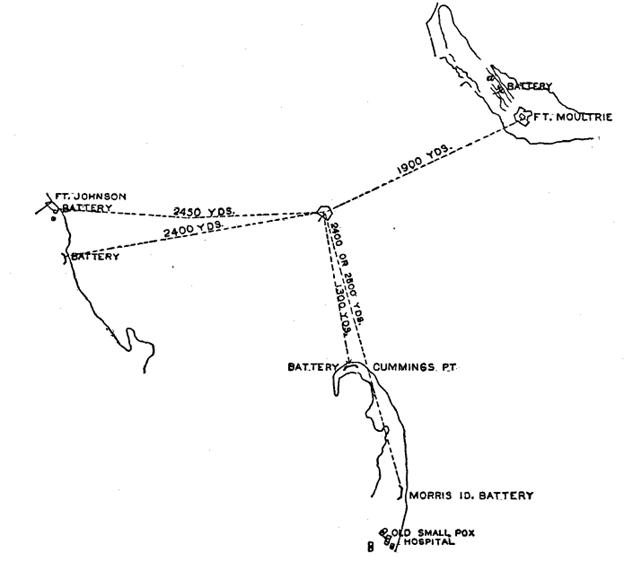
SIR: I have the honor to acknowledge the receipt of your letters, dated the 10th and 19th [16th] instants, and to assure you that I am highly gratified at the unqualified approbation they contain of the course I felt it my duty (under Divine guidance, I trust) to pursue in the unexpectedly perplexing circumstances by which we were surrounded. I shall inclose herewith copies of my correspondence with the officials of this State, and also a copy of the Mercury, which contains an article in reference to supplies for my command. [Mercury article not found.] You will understand at once the reasons for my course, which I hope will meet your approval. So many acts of harshness and of incivility have occurred since my removal from Fort Moultrie, which I have not deemed proper to notice or report, that I cannot accept of any civility which may be considered as a favor or an act of charity. I hope that the Department will approve of my sending (if the governor will permit it) our women and children to New York. They will be in the way here if we should, unfortunately, be engaged in hostilities, and they would embarrass me should I deem it proper to make any sudden move. We are trying daily to strengthen our position. We have now fifty-one guns in position, viz: In barbette, four 42-pounders, three 32-pounders, six 24’s, six 8-inch columbiads, and five 8-inch sea-coast howitzers (24); in casemate, twenty-two 32-pounders and two 42-pounders, (24); and to guard the gateway, which has been nearly closed by a heavy stone wall, three 8-inch sea-coast howitzers; and we are now preparing platforms in the parade for the three 10-inch columbiads, which we are unable to raise to their proper positions. I shall have some of the lower embrasures, in which guns are mounted, closed. This will make our little command more secure. From the perfect isolation of our position here it is impossible for us to ascertain, with any degree of certainty, the character or extent of the preparations which are being made around us. Everything, however, shows that they are exerting all their energies to prevent the entrance of re-enforcements, and to prepare for attacking this work. Saturday night and yesterday (Sunday) they were very actively engaged at work on a battery (commenced Saturday morning) a few hundred yards south of a battery of three guns constructed within the last three weeks in front of Fort Johnson barracks. On Cummings Point, Morris Island, quite an extensive battery or batteries have been constructed within the last week. We think that there may be both mortars and heavy guns at this point. We see them moving heavy timbers, which may be intended for the construction of a bomb-proof. Judging from the great quantity of material which has been landed in that neighborhood, I think it probable that they may have strengthened the battery which fired on the Star of the West. The channel she came in has been closed, pretty effectually I imagine, by four sunken vessels. Sand hills on Morris Island afford such safe positions for batteries that I fear we shall have to waste a great deal of ammunition before we can succeed in dislodging them from its batteries. Several distant shots have been heard from the direction the mouth of Stono Creek. I presume they have closed that by a heavy battery. It is reported that there is a battery guarding the entrance of the Maffitt Channel, and also that there is a battery of heavy guns on Sullivan’s Island (masked from our view by the houses) about three hundred yards to the west of the fort. Fort Moultrie has been   greatly strengthened during the last two weeks. Traverses have been erected along the sea front, and merlons, formed of sand bags and earth, constructed between the guns. These merlons, apparently well built, will afford very good protection for the carriages and men, and defilade the parade and greater portion of the quarters from our direct fire. It seems that they have repaired these carriages, and that all the guns are now in position on the sea front. I am, of course, unable to state with any accuracy the character of the armament of their batteries or the number of men they have under arms; we hear that the garrison on Sullivan’s Island, at Fort Johnson, Castle Pinckney (the parapet of which is strengthened by sand bags), and on Morris Island amount to about two thousand men. In reference to my communications with the Department, you must bear it in mind that that matter is entirely under the control of the governor of this State, who may, whenever he deems fit, entirely prohibit my forwarding any letters, or prevent my sending any messenger, to my Government. I shall, however, as long as I can do so, send daily a brief note to the Department, the reception of which will show that the channel is still open, and the failure will indicate that our communication has been cut off.

Trusting in God that He will be pleased to save us from the horrors of a civil war,

I am, very respectfully, your obedient servant,

ROBERT ANDERSON,

Major, First Artillery, Commanding.


[Inclosure No. 1.]

EXECUTIVE OFFICE, DEPARTMENT OF WAR,
Charleston, January 19, 1861.

Maj. ROBERT ANDERSON:

SIR: I am instructed by his excellency the governor to inform you that he has directed an officer of the State to procure and carry over with your mails each day to Fort Sumter such supplies of fresh meat and vegetables as you may indicate.

I am, sir, respectfully yours,

D. F. JAMISON.

[Inclosure No. 2.]

FORT SUMTER, S.C., January 19, 1861.

Hon. D. F. JAMISON,
Executive Office, Department of War:

SIR: I have the honor to acknowledge the receipt of your communication of this date, stating that you are authorized by his excellency the governor to inform me that he has directed an officer of the State to procure and carry over with my mails each day to Fort Sumter such supplies of fresh meat and vegetables as I may indicate. I confess that I am at a loss to understand the latter part of this message, as I have not represented in any quarter that we were in need of such supplies. As commandant of a military post, I can only have my troops furnished with fresh beef in the manner prescribed by law, and I am compelled, therefore, with due thanks to his excellency, respectfully to decline his offer. If his suggestion is based upon a right, then I must procure the meat as we have been in the habit of doing for years, under an unexpired contract with Mr. McSweeney, a Charleston butcher, who would, I presume, if permitted, deliver the meat, &c., at this fort or at Fort Johnson, at the usual periods for such delivery, four times in ten   days. If the permission is founded on courtesy and civility, I am compelled respectfully to decline accepting it, with a reiteration of my thanks for having made it. In connection with this subject, I deem it not improper respectfully to suggest that his excellency may do an act of humanity and great kindness if he will permit one of the New York steamers to stop with a lighter and take the women and children of this garrison to that city. The confinement within the walls of this work, and the impossibility of my having it in my power to have them furnished with the proper and usual articles of food, will, I fear, soon produce sickness among them. The compliance with this request will confer a favor upon a class of persons to whom similar indulgences are always granted, even during a siege in time of actual war, and will be duly appreciated by me.

I have the honor to be, very respectfully, your obedient servant,

ROBERT ANDERSON,

Major, First Artillery, Commanding Fort Sumter.

P. S.–I hope that the course I have deemed it my duty to take in reference to the supplies will have a tendency to allay an excitement which, judging from the tenor of the paragraphs in to-day’s paper, I fear they are trying to get up in the city.

[Inclosure No. 3.]

HEADQUARTERS QUARTERMASTER’S DEPARTMENT,
Charleston, January 19, 1861.

Major ANDERSON:

DEAR SIR: Inclosed please find copy of letter from Secretary of War. Not waiting your request, I shall send by the mail-boat in the morning two hundred pounds of beef and a lot of vegetables. I requested Lieutenant Talbot to ask you to let me know this evening what supplies you would wish sent daily.

Very respectfully,

L. M. HATCH,

Quartermaster-General, South Carolina Militia.

[Inclosure No. 4.]

HEADQUARTERS QUARTERMASTER’S DEPARTMENT,
Charleston, January 19, 1861.

Colonel HATCH,
Quartermaster-General:

You are ordered to procure and send down with the mails for Fort Sumter to-morrow a sufficient quantity of fresh meat and vegetables to last the garrison of Fort Sumter for forty-eight hours, and inform Major Anderson that you will purchase and take down every day such provisions from the city market as he may indicate.

D. F. JAMISON.

[Inclosure No. 5.]

FORT SUMTER, S. C., January 20, 1861.

Col. L. M. HATCH,
Quartermaster-General:

DEAR SIR: I have the honor to acknowledge the receipt of your note of the 19th instant, and also to state that as no arrangements have been made by me with your government in reference to supplies for this post, I feel compelled to decline the reception of those supplies. I wrote to the honorable Secretary of War yesterday in reference to this matter.

I am, sir, very respectfully, your obedient servant,

R. ANDERSON,

Major, First U.S. Artillery, Commanding.
0 comments

“The temper of the common people is not, however, so easily changed from the high pitch of excitement to which it has been wrought…,”—Operations in Charleston Harbor

War of the Rebellion: from the Official Records of the Union and Confederate Armies and Navies

.

FORT SUMTER, S.C., January 21, 1861.

General Jos. G. TOTTEN,
Chief Engineer U. S. A., Washington, D.C.:

GENERAL: I have the honor to make the following report of the present condition of the batteries around us occupied or being erected by the troops of the State of South Carolina:

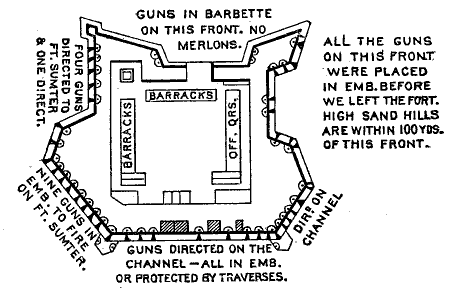
Fort Moultrie.–Until within eight days the work upon this fort, which was executed by several hundred negroes, was confined to the erection of three large traverses on the east half of the sea front, and the enlargement of another that I built upon the same face near the south angle. These traverses were of a size sufficient to contain a temporary bomb-proof shelter, and really served only to screen from our enfilading fire only three guns on the face, and also to cover the south half of the officers’ quarters. The three columbiads at the south angle were not covered. But recently the work of preparation to screen themselves from the fire of Fort Sumter has taken a better turn, and the work done is really important. It consists of high and solid merlons, formed of timber, sand bags, and earth, raised between all the guns that can be brought to bear on this fort, from the west side of their fort, and in placing traverses or merlons so as to screen from enfilading fire all the guns upon the sea front which are arranged to fire upon the channel. The cheeks of the embrasures are of timber, apparently set on end, like palisades, which I think is objectionable; and I also notice that the exterior slope of the merlons is too great to resist the pressure of the earth, and that the sand bags are pressed out in one or two places. These errors are small, however, compared with the great advantage of these merlons, which from their height (about five feet) completely cover the quarters and barracks as high up as the eaves. The following sketch shows pretty nearly the present arrangement of the fronts that I can see:

Fort Moultrie, Charleston Harbor, South Carolina

From Fort Sumter seventeen guns in barbette and eight guns in casemate are now ready to fire on Fort Moultrie–twenty-five guns in all.

Of these, four are 8-inch columbiads, five are 8-inch sea-coast howitzers, eight are 42-pounders, and eight are 32-pounders. I have overhauled and fixed each Carriage so that it works easily, and made maneuvering implements, of which there were none here at first. Besides the above, a 10-inch columbiad, is now being bedded by Lieutenant Snyder as a mortar, to throw shells into Fort Moultrie and upon Sullivan’s Island.

Battery on the upper or east end of the island–Of this nothing definite is known, as it is out of sight, and also, I fear, shielded from our fire by intervening sand hills. Its object is to secure the east point of the island, and also have a fire upon the Maffitt Channel.

Battery on Sullivan’s Island west of Fort Moultrie.–This is situated about 300 yards to the west of the fort, and is built across a cross-street at a. (See sketch.) It is said to contain five guns, but being masked by old buildings and fences in front of it, I cannot tell whether or not it is so. It is intended to fire on Fort Sumter.

Castle Pinckney remains apparently as it was when taken, with the exception of sand bags, which are placed around the parapet apparently for the purpose of protecting the heads of their sharpshooters. It is reported that some of the guns have been taken from the Castle to arm the new earth batteries on Morris Island and other places.

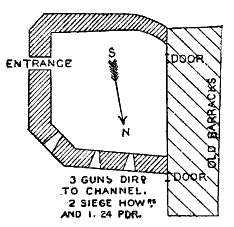
Battery at Fort Johnson.–This is a small earthen battery for three guns in embrasure, intended to fire on the channel. It is situated next to the old barracks, as shown in rough sketch in the margin: I judge of the calibers of the guns by their reports in firing for practice.

imageSecond battery near Fort Johnson.–This is now in the process of construction. It appears to be for mortars, as no embrasures are made. It is of sufficient size for three guns or mortars.

Morris Island Battery.–This is the one that fired on the Star of the West. It is about 2,400 or 2,500 yards from us, and concealed from view by intervening sand hills. It is a gun battery, and did contain two guns at first. Now I am confident that it contains at least four guns. The troops for the service of the batteries are quartered in the buildings constituting the small-pox hospital, over one of which their flag is flying, a red field with white palmetto tree upon it. The flag on Fort Johnson is similar, as is also the one on Castle Pinckney. That on Fort Moultrie is a white field with a green palmetto tree and a red star in the corner.

Battery on Cummings Point.–This is apparently for mortars, and is of sufficient extent to contain six or eight. A large force of negroes has been at work upon it during the last week. A large quantity of timber has been hauled into it, apparently for shell proof shelters as well as platforms; most of the timber was too large for platforms. This battery seems to be for mortars, as no embrasures are yet made. It is within good range of our heavy guns, of which four 8-inch columbiads, three 42-pounders, one 8-inch sea-cost howitzer, and six 24-pounders on the barbette tier bear upon it; besides, two 32-pounders in the lower tier can fire upon it. This will give a powerful fire. Still, they are apparently providing for it. I have no positive knowledge of the proposed armament of this battery, but I have heard twice from persons who would be apt to know that three mortars are already in it. These are probably the two trophy mortars from the arsenal and the 10-inch mortar from Fort Moultrie.

I have heard heavy firing several times, as though for practice, in the direction of the Stono River, and I presume a small battery has been erected there to guard that approach to the city.

Of the garrison of Castle Pinckney I cannot judge very well. Of that for Fort Moultrie and the other batteries on Sullivan’s Island I should judge the number to be about 800. On Morris Island about 500. At Fort Johnson about 100, which will probably be increased with the completion of the second battery to 200.

The temper of the authorities seems to have changed for the better since Mr. Hayne and Mr. Gourdin have been in Washington. The proposition to supply fresh meat and vegetables was made by Governor Pickens on on the 19th, but declined by Major Anderson on the following day. A supply of fresh meat and vegetables that had been sent down yesterday by the South Carolina quartermaster-general was returned. In the letter declining the proffered supply Major Anderson requested Governor Pickens to allow the camp women and children to go to New York in the next steamer, and to allow a lighter to come down to take them and their effects to the steamer as she passes, No answer has yet been received to this request. The temper of the common people is not, however, so easily changed from the high pitch of excitement to which it has been wrought to a suddenly conciliatory course, the reasons for which they do not perceive.

Our hopes for a pacific solution of the present difficulties are very much increased since Lieutenant Talbot’s return.

I have the honor to be, very respectfully, your obedient servant,

J. O. FOSTER,

Captain, Engineers.

image
0 comments

Georgia Secession

New York Times

The New York Times, January 21, 1861

GEORGIA DECLARED OUT OF THE UNION.; PASSAGE OF THE SECESSION ORDINANCE BY THE STATE CONVENTION

MILLEDGEVILLE, Ga., Saturday, Jan. 19.

The State Convention adopted the secession ordinance at 2 o’clock this afternoon, by Yeas, 208; Nays, 89. It is as follows:

An ordinance to dissolve the Union between the State of Georgia and other States united with her under the compact of Government entitled the Constitution of the United States.

We, the people of the State of Georgia, in Convention assembled, do declare and ordain, and it is hereby declared and ordained, that the ordinances adopted by the people of the State of Georgia in Convention in 1788, whereby the Constitution of the United States was assented to, ratified and adopted, and also all acts and parts of acts of the General Assembly ratifying and adopting amendments to the said Constitution, are hereby repealed, rescinded and abrogated.

And we do further declare and ordain that the Union now subsisting between the State of Georgia and other States, under the name of the United States, is hereby dissolved, and that the State of Georgia is in full possession and exercise of all those rights of sovereignty which belong and appertain to a free and independent State.

A motion to postpone the operation of the Ordinance until the 3d of March was lost by about thirty majority.

ALEXANDER H. STEPHENS and HERSCHEL V. JOHNSON are among those who voted against the Ordinance.

A resolution was adopted to continue the present postal and revenue system until it shall be ordered otherwise; also to continue all the civil Federal officers.

The Ordinance of secession was ordered to be engrossed on parchment, and to be signed on Monday at noon.

MILLEDGEVILLE, Saturday, Jan. 19 — 9 P.M.

The Convention has been in secret session nearly all day.

BEN. HILL introduced a substitute for the Secession Ordinance, but it was lost. Subsequently he voted for the Ordinance, declaring as he did so that as Georgia had determined for secession he would share her fate for weal or woe.

Judge LINTON STEPHENS said that while he approved of the Ordinance he saw no reason for its adoption now. He therefore would not vote for or sign it.

Unusual demonstrations of approbation are being made here to-night in honor of the adoption of the Ordinance of Secession, including the firing of cannon, the letting off of sky rockets, the burning of torches, and music and speeches.

0 comments

The Revolution

Civil War Day-by-Day

January 21, 1861, The New York Herald

WASHINGTON, Jan. 20, 1861.

A volunteer company of planters, residing in Prince Georges county, Md. one of the largest and richest slaveholding counties in that State, a few days since tendered their services to Gov. Pickens, agreeing to pay their own expenses, and to contribute one hundred thousand dollars for the purpose of sustaining South Carolina in her position.

The following letter just received in reply to his tender by the officer who made it, shows the condition of the South Carolina army: –

HEADQUARTERS, CHARLESTON, Jan. 17, 1861.

SIR – Yours of the 11th inst. has been received, and I am authorized to express to you our acknowledgements of your courtesy and patriotism. Just now, unfortunately, the South Carolina army, in all its departments, is so full and completely organized that no further aid is wanted. but let me assure you that if war comes and our ranks are decimated, we shall remember your offer, and unhesitatingly apply to you for assistance in the hour of trial. Most truly and respectfully,

PAUL H. HAYNE, Aid de Camp.

0 comments

All Hail to Georgia—The Empire State of the South.

Civil War Day-by-Day

January 21, 1861, The Charleston Mercury

In our telegraphic columns today our readers will find that which will please every Resistance man in the South. The promptitude and decision with which this great State has moved to the rescue and preservation of her imperiled institutions, brings gladness to the heart and joy to the face of every Southron who bears a soul within his ribs. It is the charge of the ‘Tenth Legion’ of victory. The Southern blood is up. The people are rising in their might. They have burst the bonds of parties, and thrown off the colonial vassalage to the North, which fanatics and demagogues have sought to impose upon them. Henceforth the South must and will be free.

In alluding to Georgia, we cannot omit the opportunity of expressing our admiration and pleasure at the effective and lion like course of Senator TOOMBS. The days of TROUP have come again, and again we say, all hail to Georgia, the Empire State of the South!

0 comments

Shipment of Powder and Shell to Charleston

Civil War Day-by-Day

January 21, 1861, The New York Herald

PETERSBURG, Va., Jan. 19, 1861.

One thousand kegs of powder and twenty thousand pounds of shot and shell from the Tredegar Works, Richmond, left this morning, by special train by the Weldon and Wilmington Railroad, destined to Charleston, to the order of Governor Pickens.

0 comments

Are We to have Peace or War?

Civil War Day-by-Day

January 21, 1861, The New York Herald

According to our Washington advices, the war party in the South will not proceed further in their operations until the expiration of Mr. Buchanan’s term of office. This is a sign that the more sensible of the secessionists are getting the upper hand, and that the ardor of the mob is beginning to cool. For the next thirty days, then, we have an armistice and guaranty that the federal property will not be molested. Notwithstanding this action on the part of the authorities of South Carolina, it is still evident that we are on the verge of civil war, the most fearful calamity that can befall a nation. The south is already in arms. In the North Governors of States and militia generals are tendering the services of large bodies of troops for any emergency; the Legislature of this State is asked for an appropriation of half a million dollars, to be expended in munitions of war, and the new Governor of Massachusetts has ordered the militia to be put upon a war footing. People seem to have made up their minds that a collision is inevitable, and the country is rushing into deadly peril without stopping to count the cost. All this is done through the recklessness and stupidity of the politicians. We are, altogether, thirty four millions of people, and we desire, more than anything else, to live together in peace and unity, if the latter is possible, but in peace at all events. There are a few thousands of crazy people in the North and the South who are seeking to pull down the government with the hope that they may profit by the ruin of theirs. But if, at the bidding of this handful of maniacs, the several sections of the country are to take up arms against each other, no one can tell where the thing will stop. Feuds will be engendered and they will rankle in the breasts of our children’s children long after the present generation shall have passed away. We have no right to entail such a heritage upon posterity, nor should we, as sensible men, permit the arbitrament of the sword to be brought into this quarrel. Whatever the final result may be, neither party will gain anything, and the distress, suffering an poverty which intestine    war will create in the meantime should not be risked if they can possibly be avoided. Business men, merchants, master mechanics and others should unite in an appeal to the President elect and his Premier, Mr. Seward, and induce them if possible to counteract the effect of the military spirit which has been displayed both in the North and the south, by the publication of a pacific programme. We do not believe that Abraham Lincoln is anxious to open his administration with a civil war on his hands, and certainly Mr. Seward’s late speech was a pacific one. Let them, then, restrain they over zealous partisans at the North, and all may yet be well.

0 comments