South Carolina to be paid for the troops employed in Charleston Harbor…

News of the Day
A RESOLUTION in regard to military expenditures made by the State of South Carolina.
Resolved by the Congress of the Confederate States of America, That the expenditures made by the State of South Carolina for the pay and maintenance of the troops employed in the defense of Charleston Harbor, under the command of Brigadier-General Beauregard, were intended to be provided for by an act making appropriations for the support of 3,000 men for twelve months, to be called into service at Charleston, S. C., under the third and fourth sections of an act of the Congress to raise provisional forces for the Confederate States of America, and for other purposes; and that the amount of such expenditures be audited by the proper officer of the Treasury Department, and that the amount which shall be found due be paid to the State of South Carolina from the appropriation made by the act aforesaid.
Approved May 10, 1861.
0 comments

Bombardment of Fort Sumter, Charleston Harbor, From Fort Moultrie, 12th & 13th of April, 1861

Miscellaneous document sources

Bombardment of Fort Sumter, Charleston Harbor, From Fort Moultrie, 12th & 13th of April, 1861, Currier & IvesCurrier and Ives 1861

0 comments

“I had not the moral courage to say, ‘I don’t approve of your war and won’t help you, particularly in the murderous part of it.'”–War Diary of a Union Woman in the South

War Diary of a Union Woman in the South

May 10, 1861.—I am tired and ashamed of myself. Last week I attended a meeting of the lint society to hand in the small contribution of linen I had been able to gather. We scraped lint till it was dark. A paper was shown, entitled the “Volunteer’s Friend,” started by the girls of the high school, and I was asked to help the girls with it. I positively declined. To-day I was pressed into service to make red flannel cartridge-bags for ten-inch columbiads. I basted while Mrs. S. sewed, and I felt ashamed to think that I had not the moral courage to say, “I don’t approve of your war and won’t help you, particularly in the murderous part of it.”


Note: To protect Mrs. Miller’s job as a teacher in post-civil war New Orleans, her diary was published anonymously, edited by G. W. Cable, names were changed and initials were generally used instead of full names—and even the initials differed from the real person’s initials. (Read Dora Richards Miller’s biographical sketch.)

0 comments

Civil War Day-By-Day

Civil War Day-by-Day

May 10, 1861

  • Nathaniel Lyons [US] takes control of St. Louis to end rioting, seizing Camp Jackson (Confederate militia) and 1200 1855 Springfield Rifles

A Chronological History of the Civil War in America1

  • The President, by proclamation, declared martial law upon the island of Key West, the Tortugas, and Santa Rosa, Fla.
  • Mob attack upon volunteer Home Guard in St. Louis—seven of the rioters killed.
  • Major-Gen. Robert E. Lee placed in command of the rebel forces in Virginia.
  • Officers in the Union army ordered to take the oath
    of allegiance.

  1. A Chronological History of the Civil War in America by Richard Swainson Fisher, New York, Johnson and Ward, 1863
0 comments

Dahlgren

Frank Leslie’s Illustrated Newspaper

Capt John A. Dahlgren, Inventor of the Dahlgren Gun.Capt John A. Dahlgren, Inventor of the Dahlgren Gun.

Frank Leslie’s Illustrated Newspaper, April 20, 1861

0 comments

Dahlgren

Frank Leslie’s Illustrated Newspaper

The Dahlgren Boat Howitzer Gun.  Designed by Capt Dahlgren and now in General Use in the American Navy.The Dahlgren Boat Howitzer Gun.  Designed by Capt Dahlgren and now in General Use in the American Navy.

Frank Leslie’s Illustrated Newspaper, April 20, 1861

Dahlgren boat howitzers (Wikipedia)

During the Mexican–American War the U.S. found itself lacking in light guns that could be fired from ships’ boats and landed to be used as light artillery in support of landing parties (Ripley 1984, p. 87). Light artillery borrowed from the army proved unsatisfactory. In 1849, then-lieutenant Dahlgren began to design a family of smoothbore muzzle-loading boat howitzers that could be mounted in ships’ launches and cutters as well as being mounted onto field carriages. The first boat howitzers to be designed were a light 12 lb (5.4 kg) “12-pounder”, a heavy 12-pounder (originally designated a “medium”), and a 24 lb (10.9 kg) “24-pounder”. Later a lighter 12-pounder (the “small”) and a rifled 12-pounder heavy howitzer were introduced. All of the boat howitzers were very similar in design, cast in bronze, with a mounting lug or loop on the bottom of the barrel instead of trunnions, and an elevating screw running through the cascabel. Having the single mounting lug expedited moving the howitzer from the launch to field carriage and back. In naval service the boat howitzers had gun crews of 10 in the boat and 11 ashore.

The field carriage was made of wrought iron. No limber was used in naval service, but two ammunition boxes (each containing nine rounds) could be lashed to the axle of the field carriage. Members of the gun crew also carried a single round in an ammunition pouch. The smoothbore boat howitzers fired shell, shrapnel, and canister. The rifled 12-pounder fired shot and shell. Percussion primers were used in naval service, but the howitzers could also use friction primers obtained from the army.

The small and the light 12-pounder boat howitzers were not popular. The heavy 12-pounder howitzers were most popular at their intended jobs, while the 24-pounder boat howitzer were found to serve excellently as primary and secondary armaments on river gunboats and similar small vessels. Some 24-pounder boat howitzers were apparently rifled, but some contemporary accounts confuse rifled 24-pounder boat howitzers and the 20-pounder rifles.

0 comments

City Council.

News of the Day
1860s newsprint

Daily Advocate
Baton Rouge
May 9, 1861

At a meeting of this body, held on Monday, an ordinance preventing slaves being on the streets after nine o’clock, with or without a pass was introduced and adopted. Also one repealing the price of wharfage granted the lessees by the former Board. No slaves but licensed draymen are henceforth to be permitted to hire their own time, and all slave owners are to be prosecuted for allowing their slaves to do so in violation of law.

0 comments

“They says…”—All sorts of vague rumors of insurrection

News of the Day
1860s newsprint

Daily Advocate
Baton Rouge
May 9, 1861

Letter from Grace Hopper.

New Orleans, May 5th, 1861.
Messrs. Editors—To say that New Orleans is one “vast camp” would be to use a stereotype expression that every country editor and city correspondent has flourished through the type. The truth is that everything and everybody is thoroughly pervaded and carried away by the military spirit.
Of course, the men are full of it—bless them, that is one of their redeeming traits, and an all-pervading one. No man, however low-lived and mean he is—how narrowly next to nothing he may whittle down his soul in the pursuit of dollars—how much he may perspire out all the nobler traits of an originally noble heart in the gold sweating business—but what will rally to his country-s defense when her honor is involved. The women are not far behind them. The tramp of their little feet on the stone flags come down with a semi-military vim, and the constant fusilade of their tittle-tattle would, if concentrated in one stream, put to flight a full regiment of Yankees.
These sewing societies, patriotically got up to equip our citizen-soldiery, are a credit to both city and country, but is not their usefulness impaired by one little drawback? Don’t the sex talk a little too much? [continue reading…]
0 comments

U. S. troops were leaving

News of the Day

Arkansas True Democrat
Little Rock
May 9, 1861

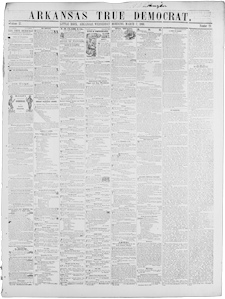
Rev. E. L. Compere, just from North Folk, says it was currently reported there on Tuesday last, that the U. S. troops were leaving Fort Washita; and that they were burning what stores they could not carry with them, and intended to blow up the fortifications. Also, that they intended destroying Forts Arbuckle and Cobb, and then leaving for Fort Leavenworth.—Fort Smith Times, May 3d.

0 comments

Money intended for the several Indian tribes west of Arkansas.

War of the Rebellion: from the Official Records of the Union and Confederate Armies and Navies

A RESOLUTION in reference to money in the hands of the Superintendent of Indian Affairs and Indian agents.

Resolved, That no money or property of any kind whatever, now in the hands of the Superintendent of Indian Affairs or of any Indian agent, being placed there or designed for the Indians on the western frontier of Arkansas, shall be seized, but that the same shall so remain to be applied for and to the use of the several Indian nations faithfully, as was designed when so placed in their hands for disbursement; and the people of the State of Arkansas, here in sovereign convention assembled, do hereby pledge the sovereignty of the State of Arkansas that everything in their power shall be done to compel a faithful application of all money and property now in the hands of persons or agents, designed and intended for the several Indian tribes west of Arkansas.
Adopted in and by the convention May 9, 1861.
DAVID WALKER,
President of the Arkansas State Convention.
Attest.
ELIAS C. BOUDINOT,
Secretary of the Convention.
0 comments

“Soldiers marching, Drums beating and Bugles sounding all the time, and…. the deep booming of a heavy Cannon”—Horatio Nelson Taft

Diary of US patent clerk Horatio Nelson Taft.

THURSDAY 9

Fine day and much enjoyed by everybody. But little seems to be attended to except military matters. Soldiers marching, Drums beating and Bugles sounding all the time, and now and [sic] one hears the deep booming of a heavy Cannon from Fort Washington, or from the Navy Yard or perhaps from some vessel on the River. Saw the 12th NY Regt Parade, then went down to Willards. Saw A B Williams again. Saw Maj Anderson and many other officers. Found Chas & Sallie at the House.


The three diary manuscript volumes, Washington during the Civil War: The Diary of Horatio Nelson Taft, 1861-1865, are available online at The Library of   Congress.

0 comments

New York must pay the penalty of its indifference, and bear the consequences of listening to such counselors.—William Howard Russell

My Diary North and South – William Howard Russell

Note: This particular diary entry—a document written in 1861—includes terms and topics that may be offensive to many today.   No attempt will be made to censor or edit 19th-century material to today’s standards.

May 9th.—My faithful Wigfall was good enough to come in early, in order to show me some comments on my letters in the “New York Times.” It appears the papers are angry because I said that New York was apathetic when I landed, and they try to prove I was wrong by showing there was a “glorious outburst of Union feeling,” after the news of the fall of Sumter. But I now know that the very apathy of which I spoke was felt by the Government of Washington, and was most weakening and embarrassing to them. What would not the value of “the glorious outburst” have been, had it taken place before the Charleston batteries had opened on Sumter—when the Federal flag, for example, was fired on, flying from the “Star of the West” or when Beauregard cut off supplies, or Bragg threatened Pickens, or the first shovel of earth was thrown up in hostile battery? But no! New York was then engaged in discussing State rights, and in reading articles to prove the new Government would be traitors if they endeavored to reinforce the Federal forts, or were perusing leaders in favor of the Southern Government. Haply, they may remember one, not so many weeks old, in which the “New York Herald” compared Jeff Davis and his Cabinet to the “Great Rail Splitter,” and Seward, and Chase, and came to the conclusion that the former “were gentlemen”—(a matter of which it is quite incompetent to judge)—”and would, and ought to succeed.” The glorious outburst of “Union feeling” which threatened to demolish the “Herald” office, has created a most wonderful change in the views of the proprietor, whose diverse-eyed vision is now directed solely to the beauties of the Union, and whose faith is expressed in “a hearty adhesion to the Government of our country.” New York must pay the penalty of its indifference, and bear the consequences of listening to such counselors.

Mr. Deasy, much dilapidated, returned about twelve o’clock from his planter, who was drunk when he went over, and would not let him go to the beaver-dam. To console him, the planter stayed up all night drinking, and waking him up at intervals, that he might refresh him with a glass of whisky. This man was well off, owned land, and a good stock of slaves, but he must have been a “mean white,” who had raised himself in the world. He lived in a three-roomed wooden cabin, and in one of the rooms he kept his wife shut up from the strangers’ gaze. One of his negroes was unwell, and he took Deasy to see him. The result of his examination was, “Nigger! I guess you won’t live more than an hour.” His diagnosis was quite correct. [continue reading…]

0 comments

The Genuine Flag.

News of the Day

Daily Times
Leavenworth, Kansas,
May 8, 1861

In the multitude of banners which float upon the breeze in these patriotic days, there is scarcely one of the correct stripe. The following is the correct style: there are thirteen stripes, seven red and six white, representing the original thirteen States. The field of blue extends to seven of the stripes, and the stars are worked parallel with the stripes.

0 comments

In the press.—Rebel War Clerk.

Civil War Day-by-Day
A likeness of Jones when he was editor and majority owner of the Daily Madisonian during President John Tyler’s administration.

MAY 9th. – The Examiner still fires shot and shell at Gov. Letcher and the dominant majority in the Convention, on account of recent appointments. It is furious over the selection of Mr. Baldwin, recently a leading Union man, for inspector-general; and seems to apprehend bad results from thrusting Union men forward in the coming struggle. The Enquirer is moderate, and kind to Gov. Letcher, whose nomination and subsequent course were so long the theme of bitter denunciation. It is politic. The Whig now goes into the secession movement with all its might. Mr. Mosely has resumed the helm; and he was, I believe, a secessionist many years ago. The Dispatch, not long since neutral and conservative, throws all its powers, with its large circulation, into the cause. So we have perfect unanimity in the press. Per contra, the New York Herald has turned about and leap-frogged over the head of the Tribune into the front ranks of the Republicans. No doubt, when we win the day, the Herald will leap back again.

0 comments

“…last night the news reached us.., (of) a blockade of all Southern ports, beginning at Pensacola.”—Through Some Eventful Years

Through Some Eventful Years by Susan Bradford Eppes
Susa Bradford Eppes

May 9th, 1861.—We hear many rumors and the papers are filled with alarming paragraphs, just enough to keep us “on the anxious bench,” yet not enough to give much real information. We have been hearing hints of a blockade but last night the news reached us that the United States Government established on the 6th of May, a blockade of all Southern ports, beginning at Pensacola. This is bad but the South has so many bays and inlets along her miles and miles of sea-coast that it seems almost impossible to prevent the entrance of vessels that wish to come in. The Southern Confederacy needs everything you can mention in the way of weapons and munitions of war; neither have we manufactories, where these can be made. Nearly every day some new company is organized and the need for arms grows greater all the time. Cousin Bettie Bradford has been at school in New York and now she is in a great hurry to get home before it is too late. Cousin Johnnie has gone on for her but nothing has been heard from them as yet and the family are feeling anxious.


Susan Bradford is 15 years old when this entry was made.

0 comments

“Stoop and totter,” sniggered the steward to No. 110, “and go in.”—Mary Boykin Miller Chesnut.

Civil War Day-by-Day

May 9th.—Virginia Commissioners here. Mr. Staples and Mr. Edmonston came to see me. They say Virginia “has no grievance; she comes out on a point of honor; could she stand by and see her sovereign sister States invaded?”

Sumter Anderson has been offered a Kentucky regiment. Can they raise a regiment in Kentucky against us? In Kentucky, our sister State?

Suddenly General Beauregard and his aide (the last left him of the galaxy who surrounded him in Charleston), John Manning, have gone—Heaven knows where, but out on a war-path certainly. Governor Manning called himself “the last rose of summer left blooming alone” of that fancy staff. A new fight will gather them again.

Ben McCulloch, the Texas Ranger, is here, and Mr. Ward, ¹ my “Gutta Percha” friend’s colleague from Texas. Senator Ward in appearance is the exact opposite of Senator Hemphill. The latter, with the face of an old man, has the hair of a boy of twenty. Mr. Ward is fresh and fair, with blue eyes and a boyish face, but his head is white as snow. Whether he turned it white in a single night or by slower process I do not know, but it is strangely out of keeping with his clear young eye. He is thin, and has a queer stooping figure.

This story he told me of his own experience. On a Western steamer there was a great crowd and no unoccupied berth, or sleeping place of any sort whatsoever in the gentlemen’s cabin—saloon, I think they called it. He had taken a stateroom, 110, but he could not eject the people who had already seized it and were asleep in it. Neither could the Captain. It would have been a case of revolver or “‘leven inch Bowie-knife.”

Near the ladies’ saloon the steward took pity on him. “This man,” said he, “is 110, and I can find no place for him, poor fellow.” There was a peep out of bright eyes: “I say, steward, have you a man 110 years old out there? Let us see him. He must be a natural curiosity.” “We are overcrowded,” was the answer, “and we can’t find a place for him to sleep.” “Poor old soul; bring him in here. We will take care of him.”

“Stoop and totter,” sniggered the steward to No. 110, “and go in.”

” Ah,” said Mr. Ward, “how those houris patted and pitied me and hustled me about and gave me the best berth! I tried not to look; I knew it was wrong, but I looked. I saw them undoing their back hair and was lost in amazement at the collapse when the huge hoop-skirts fell off, unheeded on the cabin floor.”

One beauty who was disporting herself near his curtain suddenly caught his eye. She stooped and gathered up her belongings as she said: “I say, stewardess, your old hundred and ten is a humbug. His eyes are too blue for anything,” and she fled as he shut himself in, nearly frightened to death. I forget how it ended. There was so much laughing at his story I did not hear it all. So much for hoary locks and their reverence-inspiring power!

Russell, the wandering English newspaper correspondent, was telling how very odd some of our plantation habits were. He was staying at the house of an ex-Cabinet Minister, and Madame would stand on the back piazza and send her voice three fields off, calling a servant. Now that is not a Southern peculiarity. Our women are soft, and sweet, low-toned, indolent, graceful, quiescent. I dare say there are bawling, squalling, vulgar people everywhere.


¹ Matthias Ward was a native of Georgia, but had removed to Texas in 1836. He was twice a delegate to National Democratic Conventions, and in 1858 was appointed to fill a vacancy from Texas in the United States Senate, holding that office until 1860.

0 comments

Civil War Day-By-Day

Civil War Day-by-Day

May 9, 1861

A Chronological History of the Civil War in America1

  • C. S. Congress authorized the President to accept all the volunteers that offer.
  • First landing of Union troops by steamers at Baltimore.
  • The “Winans Steam Gun” captured on the Baltimore and Ohio Railroad.
  • A brigade of rebel militia encamped near St. Louis surrendered to the United States forces under Capt. Lyon.

  1. A Chronological History of the Civil War in America by Richard Swainson Fisher, New York, Johnson and Ward, 1863
0 comments

The Floating Battery at Charleston, S.C., Intended to Assist in the Capture of Fort Sumter, with Dr. de Vega’s Hospital Attached.

Frank Leslie’s Illustrated Newspaper

The Floating Battery at Charleston, S.C., Intended to Assist in the Capture of Fort Sumter, with Dr. de Vega's Hospital Attached.
Frank Leslie’s Illustrated Newspaper, March 30, 1862

0 comments

A New Company!—The Leavenworth Vehicles!!

News of the Day

Daily Times
Leavenworth, Kansas,
May 8, 1861

We are gratified to be able to state that a new military organization has been formed in our midst, which promises to eclipse all others in the novelty and elegance of its equipments, and the simplicity and utility of its tactics. It is to be called the “Leavenworth Vehicles,” and will be under the command of Col. Callahan. The original intention was that each member should be provided with a horse and buggy, and the officers with rockaways. But, at the suggestion of Lafayette Mills, Esq., it was decided that the whole company should be equipped with the last-named vehicles, the other mode of conveyance having been rejected as a “one-horse” arrangement. Dr. Morris has submitted a plan by which all the members shall be officers, which proposition has been received with immense favor, and will, it is thought, be unanimously adopted. Another proposition is being considered, to substitute the “coach and four” for the rockaway. Each member must be provided with a feather bed, and a supply of “groceries” for use in case of sickness or excessive fatigue. The design of this company has been submitted to gentlemen of high military reputation, and has met with their full approval and endorsement. We shall be able to give further details in a few days.
P. S.—The Government will undoubtedly furnish the horses, carriages, and commissions to the entire company.
0 comments

The Scalp Hunters.

News of the Day

Navarro Express
Corsicana, Texas
May 8, 1860

The following letter to Wm. A. Lockhart, Esq., explains itself. Those desiring to engage in such an enterprise could not select a more daring leader than Colonel Crawford:
Washington, Texas, May 4, 1861.
Dear Bill: I am raising a company of [illegible] men to go to Montgomery, Ala., to be tendered to the Secretary of War, to operate on the Virginia or Kentucky frontier. The parade uniform of the company will be a buckskin hunting shirt—straight breast—metal buttons, band at the waist, skirt to reach within two inches of the knees, leggins of the same material, to reach to the crotch; coat and leggins to be fringed, and moccasin shoes. The arms are a Colt’s revolver and Colt’s revolving rifle. The rifles can be got in New Orleans as we pass through, also the buckskin for those who cannot find it here. Each man will also be required to pay into the hands of the treasurer of the company $100, to pay the necessary traveling expenses of the company. A company so armed and equipped will be sure to get service, and I am of opinion our expenses will be paid by the Secretary of War, and that we will be mounted by him. The company to rendezvous and leave Hempstead on the 24th inst.
I need scarcely to say that there are few men that I would prefer to have along than yourself. Let me hear from you, and if you find any of the boys of the right sort, that can make the outfit, and will be sure to come up all right, send me their names, but send the names of no doubtful ones. The name of the company is “the Scalp Hunters.”
Yours truly,
Wash. Crawford.
0 comments

Your predictions as to the course of things have indeed been very exactly fulfilled.—Rutherford B. Hayes

Diary and Letters of Rutherford Birchard Hayes
Rutherford B. Hayes (young)

CINCINNATI, May 8, 1861.

DEAR GUY:—I have just received and read your letter of the 27th ult. It does me good to hear from you again. I have thought of you often since these troubles began. Curiously enough, having a bad cold and a slight fever, I dreamed of many things last night. Among others I dreamed of seeing you at the Burnet House; that you wore on your cap some sort of secession emblem and that you were in danger of getting into difficulty with some soldiers who were in the rotunda, and that it was after some effort that I succeeded in getting you rid of them. I should have written you soon even if I had not heard from you.

Your predictions as to the course of things have indeed been very exactly fulfilled. I can recollect distinctly many conversations had twelve, perhaps even fifteen, years ago in which you pointed out the probable result of the agitation of slavery. I have hoped that we could live together notwithstanding slavery, but for some time past the hope has been a faint one. I now have next to no hope of a restoration of the old Union. If you are correct in your view of the facts, there is no hope whatever. In such case, a continued union is not desirable were it possible. I do not differ widely from you as to the possibility of conquering the South, nor as to the expediency of doing it even if it were practicable. If it is the settled and final judgment of any slave State that she cannot live in the Union, I should not think it wise or desirable to retain her by force, even if it could be done.

But am I, therefore, to oppose the war? If it were a war of conquest merely, certainly I should oppose it, and on the grounds you urge. But the war is forced on us. We cannot escape it. [continue reading…]

0 comments

The Hampton Legion

War of the Rebellion: from the Official Records of the Union and Confederate Armies and Navies
Columbia, May 8, 1861.
His Excellency President Davis:
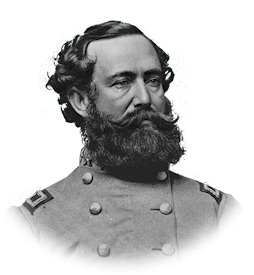
My Dear Sir: I see that you make a call for 3,000 more troops from this State, and I write to say that if you think it desirable I can easily add to the strength of the Legion . In answer to my call , made on the 2d instant, there have already been offers of more than double the number of companies asked for . I can, therefore, easily increase the infantry companies of the Legion, and have a full regiment, if you wish it. My only doubt was as to the infantry, as I knew that 10,000 men were now in camp and 2,000 in Virginia , but the response has been most prompt and gratifying. Of cavalry, more than enough to fill the Legion has offered.
I have not accepted any companies yet, and I propose to inspect all in a few days, selecting the best. I hope thus, in a very short time, to be able to present to Your Excellency a corps of which my State will never be ashamed. I can easily, I think, have several more infantry companies, if you wish them . Any number can be had if they can only feel assured that their steps are to be turned north ward. The terms on which companies enter this service you will see by the inclosed paper.
With my best wishes, I am , very respectfully, your obedient servant,
WADE HAMPTON.
0 comments

Is it Politic?

News of the Day
1860s newsprint

Daily Advocate
Baton Rouge
May 8, 1861

The question has often been propounded in our hearing, is it politic that slaves should be permitted to live around and away from their master’s premises. There are several slaves in our city who not only live in this way, but keep boarding houses, where many transient persons rendezvous. This ought to be stopped. We know not who these strangers may be, or for what they are here. All white men found living in this way should be arrested and undergo a strict investigation, as to who they are, where from, and what they follow for a livelihood. These are not the days to stand idly by, but it behoves our white population to be on the look-out. Our whole Southern country is invested with “wolves in cheeps clothing.” We meet many strange looking faces on our streets every day; we see them stopping at houses kept by slaves and free persons. We do not wish to fasten suspicion on any innocent man, nor to dictate to our efficient city officials, for we know that they are on the alert; but we do wish to arouse our citizens to the necessity and importance of seeing and knowing what their servants are doing. Negroes congregate daily around the numerous small groceries that infest our city, where the seeds of vice, crime and demoralization are dolled out to our colored population, by the glass and the gallon. This all results from the too common habit of allowing slaves to hire their own time. There are severe penalties against it, and they ought to be enforced rigidly, without fear or favor.
0 comments

Letter from Camp Walker.

News of the Day
1860s newsprint

Daily Advocate
Baton Rouge
May 8, 1861

Camp Walker, Metairie Course, May 8, 1861.
Messrs. Editors—Amid all the excitement of military displays here, nothing as yet has eclipsed the review of yesterday. The troops, nearly 3,500 strong, were marched from camp to the oaks, that famed duelling ground. The grounds were filled to overflowing with spectators, a greater portion of whom were ladies. They are everywhere present with pleasant smiles and encouraging words for the young volunteers. I say young, Mr. Editor, for the simple reason that the army here is composed mostly of just such material as left Baton Rouge in the ranks of the Pelicans, all eager and ready for an affray with the minions of the military despot at Washington.
Perhaps an item of a portion of the duties of camp-life will prove interesting to our friends at home. At early dawn we are aroused from our slumbers by the roll of the drum and the shrill notes of the fife. Roll being called, the boys are dismissed to put their tents in order. Breakfast at 6 o’clock. In the meantime, ten men are appointed to serve twenty-four hours in the main guard. The main guard is composed of ten men from each company, whose duty it is to guard camp. A police guard is also appointed who clean up all the dirt and filth about the tents, bring water for the company, wood for the cooks, and, in fact, keep everything in order. During the afternoon we have squad drills; at sundown the companies muster for roll-call and supper; tattoo at 9 o’clock, P. M., when the men retire to their respective tents—fifteen minutes after, three taps of the drum compels every light to be extinguished and the camp is in darkness and quiet. Everything is conducted with regularity and precision. The promptitude and cheerfulness with which every duty is met and discharged by all the members of the company would surprise some of our friends at home. We have everything necessary for our comfort and convenience, and the laughs, jests and songs heard on all sides attest the general satisfaction and good feeling that prevails.
There are some talk of our speedy removal from here to more pleasant quarters a short distance above New Orleans. Be assured that the Pelican Rifles will not return home until they have seen more active duty than mere camp life.
With many kind wishes for friends at home, I remain as ever, respectfully, etc.
W. H. T.
0 comments

In fact, it is most important to complete my Southern tour speedily, as all mail communication will soon be suspended from the South—William Howard Russell

My Diary North and South – William Howard Russell

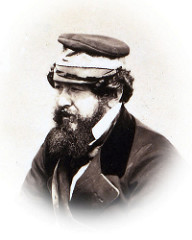
May 8th.—I tried to write, as I have taken my place in the steamer to Mobile to-morrow, and I was obliged to do my best in a room full of people, constantly disturbed by visitors. Early this morning, as usual, my faithful Wigfall comes in and sits by my bedside, and passing his hands through his locks, pours out his ideas with wonderful lucidity and odd affectation of logic all his own. “We are a peculiar people, sir! You don’t understand us, and you can’t understand us, because we are known to you only by Northern writers and Northern papers, who know nothing of us themselves, or misrepresent what they do know. We are an agricultural people; we are a primitive but a civilized people. We have no cities—we don’t want them, have no literature—we don’t need any yet. We have no press—we are glad of it. We do not require a press, because we go out and discuss all public questions from the stump with our people. We have no commercial marine—no navy—we don’t want them. We are better without them. Your ships carry our produce, and you can protect your own vessels. We want no manufactures: we desire no trading, no mechanical or manufacturing classes. As long as we have our rice, our sugar, our tobacco, and our cotton, we can command wealth to purchase all we want from those nations with which we are in amity, and to lay up money besides. But with the Yankees we will never trade—never. Not one pound of cotton shall ever go from the South to their accursed cities; not one ounce of their steel or their manufactures shall ever cross our border.” And so on. What the Senator who is preparing a bill for drafting the people into the army fears is, that the North will begin active operations before the South is ready for resistance. “Give us till November to drill our men, and we shall be irresistible.” He deprecates any offensive movement, and is opposed to an attack on Washington, which many journals here advocate.

Mr. Walker sent me over a letter recommending me to all officers of the Confederate States, and I received an invitation from the President to dine with him to-morrow, which I was much chagrined to be obliged to refuse. In fact, it is most important to complete my Southern tour speedily, as all mail communication will soon be suspended from the South, and the blockade effectually cuts off any communication by sea. Rails torn up, bridges broken, telegraphs down—trains searched—the war is begun. The North is pouring its hosts to the battle, and it has met the pæans of the conquering Charlestonians with a universal yell of indignation and an oath of vengeance.

I expressed a belief in a letter, written a few days after my arrival (March 27th), that the South would never go back into the Union. The North think that they can coerce the South, and I am not prepared to say they are right or wrong; but I am convinced that the South can only be forced back by such a conquest as that which laid Poland prostrate at the feet of Russia. It may be that such a conquest can be made by the North, but success must destroy the Union as it has been constituted in times past. A strong Government must be the logical consequence of victory, and the triumph of the South will be attended by a similar result, for which, indeed, many Southerners are very well disposed. To the people of the Confederate States there would be no terror in such an issue, for it appears to me they are pining for a strong Government exceedingly. The North must accept it, whether they like it or not.

Neither party—if such a term can be applied to the rest of the United States, and to those States which disclaim the authority of the Federal Government—was prepared for the aggressive or resisting power of the other. Already the Confederate States perceive that they cannot carry all before them with a rush, while the North have learnt that they must put forth all their strength to make good a tithe of their lately uttered threats. But the Montgomery Government are anxious to gain time, and to prepare a regular army The North, distracted by apprehensions of vast disturbance in their complicated relations, are clamoring for instant action and speedy consummation. The counsels of moderate men, as they were called, have been utterly overruled.

The whole foundation on which South Carolina rests is cotton and a certain amount of rice; or rather she bases her whole fabric on the necessity which exists in Europe for those products of her soil, believing and asserting, as she does, that England and France cannot and will not do without them. [continue reading…]

0 comments