To the Ladies.

News of the Day

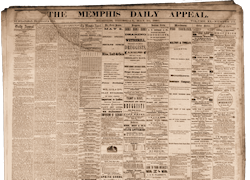
Memphis Daily Appeal
Memphis, Tennessee
May 14, 1861

Headquarters of Prov. Army of Tenn.,}
Memphis, May 12, 1861.}
Major-General Gid. J. Pillow, commanding the Provisional Army of Tennessee, tenders his compliments to the ladies of the city of Memphis engaged in the patriotic duty of providing the gallant sons of Tennessee with necessary clothing for the field, and requests that they cause him to be furnished with information of the number and character of uniforms and other articles of clothing on hand for distribution; and for what different corps they are designed. This information is necessary, to enable the Major-General commanding to understand the extent of preparation by the Quartermaster’s Department, for the brave men who have and are about taking the field to protect the rights, honor and persons of the fair daughters of Tennessee.
By order of Major General Gid. J. Pillow,
Jas. D. Porter, Jr.,
Assistant Adjutant-General.
0 comments

News from the Peninsula

Civil War Day-by-Day

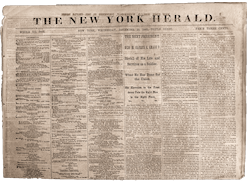
The New York Herald
May 14, 1862,

Our Army Correspondence.

WEST POINT, Va., May 8, 1862.

I have gathered the following details of a most desperate engagement at this point yesterday:-

After the landing of General Franklin’s division, which camped in a large field, surrounded on the south, west and north by a dense wood, and on the east by the York river, the Thirty-second New York, Colonel Matteson, of Newton’s brigade, was ordered to clear the wood of rebels, who had made their presence known to our pickets. The Sixteenth New York were ordered to the same work in other portions of the wood. The Thirty-second proceeded to execute their orders. Entering the wood they came upon a ravine, at the bottom of which they were fired upon by the rebel skirmishers. Up they charged, delivering a falling force upon the enemy’s position. The enemy retired, our troops following until a second ravine appeared in view. In attempting to cross this the rebels from the other side again poured a volley into them with considerable effect, which had not, however, the power to drive our men back, who gallantly pursued the rebels, delivering their fire upon them, or rather upon their position, for they kept themselves concealed by the woods. At a third and last ravine, the rebels had erected breastworks on the opposite side, from which they opened on our men with small arms and grape and canister from mountain howitzers. The Thirty-second charged gallantly up to within a few feet of the work, but were forced to retire on account of the superior force of the enemy. They retired in admirable order. There were only seven companies of the Thirty-second regiment engaged against Alabama, Texas, South Carolina and Tennessee troops. The celebrated Hampton Legion formed a portion of the rebel force.

At two o’clock P.M. our gunboats, three in number, opened fire upon the enemy from their larger guns, the shells taking, to all appearances, effect in the right quarter, for the enemy soon afterwards retired, their battery being silenced on the first shot from the boats. We could trace the enemy’s retreat by the line of smoke in their rear. They were seemingly destroying everything as they retreated. The Sixteenth and Thirty-first regiments New York Volunteers were also engaged in skirmishing with the enemy in the woods. The details of the part these regiments played in the skirmish has not reached me. I learn that the Thirty-second regiment New York Volunteer’s loss will be nearly 100 in killed and wounded. Three officers, – Captain Young, of Company D; Captain Brown, of Company C; and Lieutenant Wallace, of Company G – were killed, and Lieutenant Stone, of Company B, and Lieutenant Twaddle, of Company F, wounded severely. Thirteen privates killed. Lieutenant Wallace was wounded and afterwards bayoneted, and his pockets rifled by Texan soldiers. Our total loss in the different regiments of Newton’s brigade will reach 200 in killed, wounded and missing. The loss of the rebels is known to be heavy, as they were seen from our transport carrying their dead and wounded off in great numbers.

Captain Montgomery, of General Newton’s staff, and Captain Baker, United States dragoons, Franklin’s staff, made a most miraculous escape from the Hampton Legion, into whose picket lines they became entrapped. Captain Montgomery coolly inquired the name of the regiment. Receiving the answer, “The Hampton Legion,” he inquired for General Hampton, and was told that he was a short distance off. He and Captain Baker immediately put spurs to their horses. The rebel pickets fired a volley after them, seven balls entering the body of Captain M.’s horse, killing him instantly. He fell, bruising the rider’s limbs severely. The rebs immediately approached, and commenced rifling the captain’s valuables, he feigning death. The affair was so ludicrous that the captain laughed, which exposed his condition to the pickets. They had carried him some distance, when a battery of our guns opened on them. They immediately dropped their prisoner and ran for their own dear lives. Captain Montgomery arrived safely within our lines after this wonderful and romantic episode.

The conduct of the Texans in this engagement has been dastardly in the extreme. In some cases they took the water from our wounded soldiers’ canteens. The Alabama troops exhibited a feeling of humanity in striking contrast to this. They were seen supplying our wounded with their own canteens filled with water.

The Sixteenth New York, Thirty-first New York and Ninety-fifth Pennsylvania were briskly engaged with the enemy’s skirmishers during the day. Some of the companies of the Sixteenth were at times surrounded by the rebels, and actually had to force their way out. The Thirty-first were in the thickest part of the fray, and bore themselves gallantly. The Ninety-fifth Pennsylvania, Goslin Zouaves, at the first charge of the enemy appeared to recoil for an instant and looked ready to break. This was their first taste of war. But after the first shock they made a magnificent charge with closed lines, which soon put the rebels engaged against them to retreat. They claim that the rebels granted no quarter to our wounded. The Twenty-seventh and Eighteenth New York, though exposed at times to the fire of the rebels, escaped without loss. The New Jersey brigade have gone nearly four miles, but find no force of the rebels. They have picked up many stragglers from the enemy’s ranks. They represent the enemy as fleeing along both the James and York rivers, in two columns. The loss of the enemy in the skirmish is undoubtedly great, though they were in most cases concealed in thick undergrowth, which prevented their discovery by our men until in their presence. The well directed fire of our men, aided by the beautiful gunboat firing must have terribly decimated their numbers. An officer who rode the circuit of the scene of skirmishing yesterday, discovered abundant evidence of the enemy’s heavy loss. The rebels fought with a desperation and valor worthy of a better cause. Though in superior force to our own, they gave away at last before the superior discipline and courage of our troops. Our noble gunboats and their admirably drilled officers and men deserve much of their assistance in causing the rebels to make tracks. At the time the rebels attacked us our force here was quite small. Now we have force sufficient at this point to defend us against any force they can bring against us, which is being added to hourly.

We are waiting anxiously for news of McClellan’s appearance with a force on the James river side, as we hear that he is driving the rebels in that direction. Richmond will be ours before many days elapse. If the reports from Williamsburg which reach us are true, in gaining that and this position, our loss has been small compared with the results accomplished.
0 comments

Temporary Change in the Size of Our Paper.

News of the Day

Memphis Daily Appeal
Memphis, Tennessee
May 14, 1861

We make a slight reduction in the size of the Appeal this morning, owing to the temporary decrease of our advertising patronage. This arrangement, however, will not lessen our usual amount of reading matter in the least–only enabling us to save a considerable waste of paper. It may be proper to remark that, notwithstanding this change, the Appeal is still the largest journal in Tennessee. So soon as business revives, we will of course resume our former size.
0 comments

Thirty women

News of the Day

Charleston Mercury,
May 14, 1861

Thirty women were discovered in Ellsworth’s zouaves after the regiment arrived in Washington. They were sent home. The Zouaves, we fear, are not all of the highest moral character.

0 comments

“The mosquitoes bled me all night. Mosquitoes in the middle of May!” Rebel War Clerk.

Civil War Day-by-Day
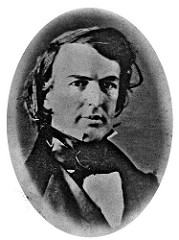
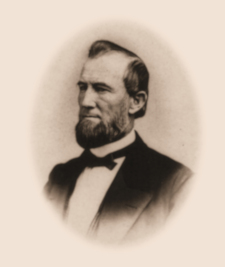
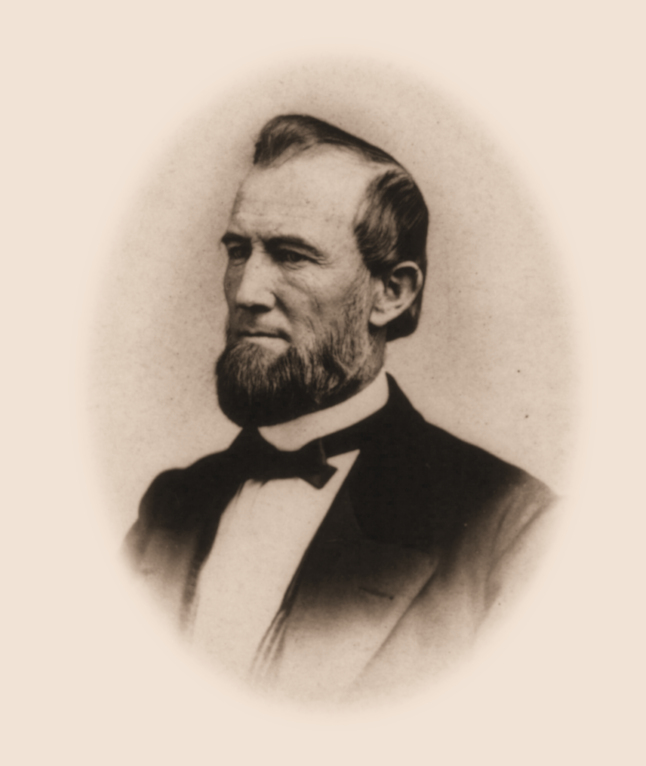
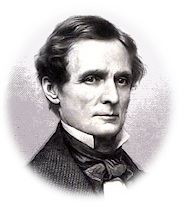
A likeness of Jones when he was editor and majority owner of the Daily Madisonian during President John Tyler’s administration.

MAY 14th. — The weather is very warm. Day before yesterday the wheat was only six or eight inches high. To-day it is two or three feet in height, headed, and almost ripe for the scythe.

At every station [where I can write a little] we see crowds of men, and women, and boys; and during our pauses some of the passengers, often clergymen, and not unfrequently Northern born, address them in soul-stirring strains of patriotic eloquence. If Uncle Abe don’t find subjugation of this country, and of such a people as this, is truly a “big job” on his hands, I am much mistaken.

Passed the Stone Mountain at 11 o’clock A.M. It appears at a distance like a vast artificial formation, resembling the pictures of the pyramids.

Arrived at Montgomery 10 o’clock P.M., and put up at the Montgomery House. The mosquitoes bled me all night. Mosquitoes in the middle of May! And as they never cease to bite till killed by the frost, the pest here is perennial.

0 comments

Writ of habeas corpus at Key West. &c.

War of the Rebellion: from the Official Records of the Union and Confederate Armies and Navies

HEADQUARTERS DEPARTMENT OF FLORIDA, Fort Pickens, May 14, 1861.

Lieut. Col. E. D. TOWNSEND,
Assistant Adjutant-General:

COLONEL: Since my letter of yesterday I have dispatches from Major French, commanding Key West, and among other reports that he has suspended the writ of habeas corpus at Key West. When I was there on my way to this place I left in the hands of Major French a proclamation, to be published when a contingency requiring it should arise. He considers that it has done so. I inclose his letter (A) to me and my answer (B).

The Water Witch, which was dispatched to Havana for sand bags, has returned with some, with which we can finish our defenses.

I was misinformed as to there being 10-inch sea-coast mortars at Tortugas. There are none there or at Key West.

I am, colonel, very respectfully, your obedient servant,

HARVEY BROWN,
Major, Second Artillery, Colonel, Commanding.

[Inclosure A.]

HEADQUARTERS TROOPS AT KEY WEST,
May
8, 1861.

Capt. GEORGE L. HARTSUFF,
Assistant Adjutant-General, Hdqrs. Department Florida:

CAPTAIN: I have the honor to acknowledge the receipt of your communication of the 2d instant this 10 a.m. [continue reading…]

0 comments

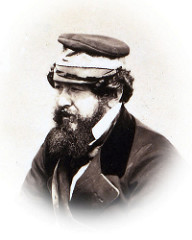
“God knows, when I open my broadside, but that I may be killing my own children.”—William Howard Russell

My Diary North and South – William Howard Russell

May 14th. Down to our yacht, the Diana, which is to be ready this afternoon, and saw her cleared out a little—a broad-beamed, flat-floored schooner, some fifty tons burthen, with a centre-board, badly caulked, and dirty enough—unfamiliar with paint. The skipper was a long-legged, ungainly young fellow, with long hair and an inexpressive face, just relieved by the twinkle of a very “Yankee” eye; but that was all of the hated creature about him, for a more earnest seceder I never heard.

His crew consisted of three rough, mechanical sort of men and a negro cook. Having freighted the vessel with a small stock of stores, a British flag, kindly lent by the acting Consul, Mr. Magee, and a tablecloth to serve as a flag of truce, our party, consisting of the gentlemen previously named, Mr. Ward, and the young artist, weighed from the quay of Mobile at five o’clock in the evening, with the manifest approbation of the small crowd who had assembled to see us off, the rumor having spread through the town that we were bound to see the great fight. The breeze was favorable and steady; at nine o’clock, p.m., the lights of Fort Morgan were on our port beam, and for some time we were expecting to see the flash of a gun, as the skipper confidently declared they would never allow us to pass unchallenged.

The darkness of the night might possibly have favored us, or the sentries were remiss; at all events, we were soon creeping through the “Swash,” which is a narrow channel over the bar, through which our skipper worked us by means of a sounding pole. The air was delightful, and blew directly off the low shore, in a line parallel to which we were moving. When the evening vapors passed away, the stars shone out brilliantly, and though the wind was strong, and sent us at a good eight knots through the water, there was scarcely a ripple on the sea. Our course lay within a quarter of a mile of the shore, which looked like a white ribbon fringed with fire, from the ceaseless play of the phosphorescent surf. Above this belt of sand rose the black, jagged outlines of a pine forest, through which steal immense lagoons and marshy creeks.

Driftwood and trees strew the beach, and from Fort Morgan, for forty miles, to the entrance of Pensacola, not a human habitation disturbs the domain sacred to alligators, serpents, pelicans, and wild-fowl. Some of the lagoons, like the Perdida, swell into inland seas, deep buried in pine woods, and known only to the wild creatures swarming along its brink and in its waters; once, if report says true, frequented, however, by the filibusters and by the pirates of the Spanish Main. [continue reading…]

0 comments

Redirection of appropriations

War of the Rebellion: from the Official Records of the Union and Confederate Armies and Navies

AN ACT to authorize the transfer of appropriations.

The Congress of the Confederate States of America do enact, That
during the recess of Congress the President of the Confederate States may and he is hereby authorized, on the application of the Secretary of the proper Department and not otherwise, to direct, if in his opinion necessary for the public service, that a portion of the moneys appropriated for a particular branch of expenditure in that Department be applied to another branch of expenditure in the same Department; in which case a special account of moneys thus transferred shall be laid before Congress during the first week of the next ensuing session.
SEC. 2. This act shall continue and be of force until the end of the existing war, and no longer.
Approved May 14, 1861.
0 comments

Creole Guards.

News of the Day
1860s newsprint

Daily Advocate
Baton Rouge, Louisiana
May 14, 1861

This excellent company, under command of Capt. Fremaux, Lieuts. Gusman, Lewis and McGimsey, marched through our streets yesterday evening in fine style, with fife and drums and colors flying, on their way to Greenwell Springs, to go into encampment for the purpose of undergoing the strictest military discipline. They will remain at the Springs until their regiment, the Sixth, is organized and ordered to the scene of action. The Creole’s are a fine body of men, numbering about 80. They were dressed in blue flannel trimmed with yellow, presenting quite a fine display.

0 comments

The sale of prizes and the distribution thereof…

War of the Rebellion: from the Official Records of the Union and Confederate Armies and Navies

An act regulating the sale of prizes and the distribution thereof.

The Congress of the Confederate States of America do enact, That
all prizes of vessels and property captured by private armed ships in pursuance of the act passed by Congress recognizing the existence
of war between the United States and the Confederate States; and concerning letters of marque, prizes, and prize goods, which may be condemned in any court of the Confederate States, shall be sold at public auction by the marshal of the district in which the same shall be condemned, within sixty days after the condemnation thereof, sufficient notice of the time and place and condition of sale being first given, on such day or days, on such terms of credit, and in such lots or proportions as may be designated by the owner or owners, or agent of the owner or owners of the privateer which may have captured the same: Provided, That the term of such credit shall not exceed ninety days; and the said marshal is hereby directed to take and receive from the purchaser or purchasers of such prize vessel and property, the money therefor, or his, her, or their [continue reading…]
0 comments

“I am more anxious about Cairo than any other point…,”

War of the Rebellion: from the Official Records of the Union and Confederate Armies and Navies
Headquarters Department of the Ohio,
Cincinnati, May 14, 1861.
Lieut. Col. E. D. Townsend,
Assistant Adjutant-General:
Colonel: Some ten days since I dispatched Lieut. O. M. Poe, Topo graphical Engineers, on a reconnaissance of the southeastern frontier of this State. His trip extended from Portsmouth to Wheeling, whence he returned last night. His opinion is that the frontier in that direction is in no immediate danger; that a small collection of militia on the Kana wha, some twenty miles above its mouth, is the only encampment on that frontier; that the border inhabitants of Eastern Kentucky are eminently loyal, while the Western Virginians from the Kentucky line to Parkersburg are rotten, but loyal above the latter point. It is also his opinion that a display of troops immediately on the frontier, unless with a view of crossing over, would be injudicious at the present moment. These opinions are corroborated by other information in my possession and seem to me sound.
At the present moment I am more anxious about Cairo than any other point, and strongly urge that the heavy guns needed for that point may be forwarded at once. It seems that all the carriages for the heavy guns and most of the guns intended for me have to come from Watervliet and other Eastern arsenals. It is my opinion that at least six heavy guns, say three 8-inch howitzers and three 24-pounders, should be at Cairo in the shortest possible time. I will endeavor to go to Cairo to-day; shall certainly send Captain Benham there immediately on his arrival. I design so covering the batteries as to render them secure against assault, and would again urge the importance of occupying Bird’s Point, on the Missouri side. It will probably be necessary to intrench a small force at Mound City to cover the rear of Cairo. I have been anxiously awaiting Major Bell, of the ordnance, for the last day or two, that he may at once take steps toward the manufacture of infantry accouterments and the preparation of ammunition. Arms will be issued to all the Ohio Volunteers by to-morrow. I deferred it until it could be done with regularity and to afford the opportunity of making some progress in organization and discipline before placing arms in their hands. To revert to Cairo, the presence of some armed steamers there seems to me indispensable and to admit of no delay. Is it not necessary here to provide some limited means of transportation?
I have the honor to be, colonel, very respectfully,y our obedient servant,
GEO. B. McCLELLAN,
Major-General, Commanding Department.
0 comments

Eads’ Plan for Blockading the Mississippi

War of the Rebellion: from the Official Records of the Union and Confederate Armies and Navies

Letter from the Secretary of the Navy to the Secretary of War, transmitting plan of James B. Eads for blockading the commerce of the seceding States on the Mississippi.

Navy Department, May 14, 1861.
Sir: The enclosed communication of Mr. James B. Eads, containing a description of Cairo and submitting a plan for blockading the commerce of the rebelling States on the Mississippi, is respectfully referred to the War Department, to which the subject more properly belongs. Mr. Eads has been informed of the reference.
I have the honor to be, sir, your obedient servant,
Gideon Welles.
Hon. Simon Cameron,
Secretary of War.

[ Enclosure. ]

Washington City, April 29, 1861.
Sir: Herewith I have the honor to submit for your consideration the following proposition and information relative to the feasibility
of effectually blockading the commerce of the rebelling States upon the Mississippi River:
Proposition.—Establish at Cairo, as the base of operations, a strong force, with such batteries on shore and afloat as will effectually control the passage of vessels bound up or down the Mississippi and Ohio rivers.
Description of Cairo.—The city of Cairo has a broad levee front on the Ohio River, raised about fourteen feet above the natural level of the city and extending for a distance of about three miles immediately along the river. On the Mississippi side extends a levee of the same height and about the same length, but removed from the bank of the river from 100 yards to half a mile distant, to be out of danger from the caving in of the bank. From this levee, across from the Ohio River, a levee extends of the same height, by which the town is protected from the backwater, the whole forming a delta. These levees would afford admirable defenses upon which to plant batteries at proper points. The great Central Railroad of Illinois, in addition to the Ohio and Mississippi rivers, would afford means of supplying this point with great rapidity with troops, munitions of war, and provisions, and the place would be capable of accommodating a force on land of 50,000 men, if need be. The levees are perfectly safe, and the drainage system established in connection with the steam pumps of the corporation are amply sufficient to remove all seepage water. The health of the place has been greatly improved by this system of drainage. From the bank on the Ohio side that river can be completely commanded. A large bar of sand lies between the Missouri shore and the levee on the Mississippi side of Cairo and throws the channel along the Missouri shore nearly two miles distant from the town. A floating battery upon the river would be needed to fully command the commerce on the Mississippi River. For the purpose of more readily comprehending the matter, I have drawn from memory a rough sketch , or map, of the place and its surroundings.
Floating batteries.—The Missouri Wrecking Company have one very strong boat, built originally for a snag boat by the United States, and purchased and altered for the purpose of raising steamboats sunk on the Mississippi. It is a twin boat, each hull of which is subdivided into seven water-tight compartments, and shot penetrating three or four of these would not sink her. She is abundantly strong for a complement of 32-pounders, and has four double-flued boilers and two independent engines to drive her. With $ 2,000 or $ 3,000 worth of cotton bales arranged properly upon her she could be made exceedingly effective for offense or defense. The erection of batteries upon the banks of the river by the enemy could be prevented by this means, and steamers could be overhauled or points on the river effectually attacked with her. I know of no boat or vessel on the Mississippi which could possibly resist her. By using the steam pumps with which she is provided she could be kept afloat with twenty 32 pounder shot through her. With her armament on board she would draw about 4 feet. We never find less than 5 feet from Cairo to Memphis. The same company have two other boats, lighter than the above, provided with steam engines, which would be very effective in shoaler water for similar purposes.
The result.—The effect of this blockade would be most disastrous to the South, as it would effectually close the main artery through which flows her food. It would establish a tollgate through which alone her dutiable goods could enter, or through which her products could find their way to market. The only outlets or inlets which would remain to her would be the Tennessee and Cumberland rivers and the railroads from Louisville to Nashville and Chattanooga. The Tennessee and Cumberland rivers are navigable only by very small steamers, except in short seasons of high water. Their mouths can be easily commanded by batteries on the Illinois shore or by floating batteries. The railroad is very vulnerable, as one man could blow up a culvert or bridge and render it useless for the time being. If Kentucky were friendly to the Union, these three inlets could be effectually guarded; if she were unfriendly , their northern termini would be completely at our mercy. Once close them and the great Mississippi, and starvation is inevitable in less than six months.
Very respectfully, your obedient servant,
James B. Eads,
Of St. Louis, Mo.
Hon. Gideon Welles,
Secretary of the Navy.
0 comments

James B. Eads—Renaissance Man and Builder of Ironclads

Civil War Day-by-Day
Civil War Portraits—Leaders, Influencers, and the Incidentally Important #011

Captain James Buchanan Eads (May 23, 1820 – March 8, 1887) was a world-renowned American civil engineer and inventor, holding more than 50 patents.

In 1861, after the outbreak of the American Civil War, Eads was called to Washington at the prompting of his friend, Attorney General Edward Bates, to consult on the defense of the Mississippi River. Soon afterward, he was contracted to construct the City-class ironclads for the United States Navy, and produced seven such ships within five months: St. Louis, Cairo, Carondelet, Cincinnati, Louisville, Mound City, and Pittsburgh. He also converted the river steamer New Era into the ironclad Essex. The river ironclads were a vital element in the highly successful Federal offensive into Tennessee, Kentucky and upper Mississippi (February–June, 1862). Eads corresponded frequently with Navy officers of the Western Flotilla, and used their “combat lessons learned” to improve vessels during post-combat repairs, and incorporate improvements into succeeding generations of gunboats. By the end of the war he would build more than 30 river ironclads.

The last were so hardy that the Navy sent them into service in the Gulf of Mexico, where they supported the successful Federal attack on the Confederate port city of Mobile. All senior officers in the Western Theater, including Grant and Sherman, agreed that Eads and his vessels had been vital to early victory in the West. The first four gunboats were built at the Eads’ Union Marine Works in Carondelet, Missouri. The next three were built under Eads’ contract at the Mound City (Illinois) Marine Railway and Shipyard. Eads’ vessels were the first United States ironclads to enter combat. On January 11, 1862 the Eads-built ironclads St. Louis and Essex fought the Confederate gunboats CSS General Polk, CSS Ivy, and CSS Jackson at Lucas Bend, on the Mississippi River. Subsequently, on February 6, 1862, Eads’ ironclads captured Fort Henry on the Tennessee River. This was over a month before the combat actions of the ironclads CSS Virginia and USS Monitor during the March 8–9, 1862 Battle of Hampton Roads.

During the war, Eads wrote a check to the War Department for $1,000 to help homeless Confederates and Union sympathizers. After the war, he held a fair to raise money for the thousands of homeless refugees in St. Louis.

Read more on Wikipedia

0 comments

Horatio Nelson Taft

Diary of US patent clerk Horatio Nelson Taft.

TUESDAY 14

Warm today. Some of the northern soldiers fainted in the streets. 2nd Connecticut Regt got in today. The 2 Connt Regts are in camp on 7th st at the “Park” about a mile north of the Pat office. Went up after dinner to see the NY 7th Regt camp and Drill or dress parade. There were a great many spectators. Was down at Willards and on the Ave down to Philps Book Store, bought “Philps Washington” (a dollar). Ave full, about two thirds officers & soldiers. Came home 1/2 past 8 o’clock, read the evening papers, have felt quite well and my long walk dose [sic] not tire me.


The three diary manuscript volumes, Washington during the Civil War: The Diary of Horatio Nelson Taft, 1861-1865, are available online at The Library of   Congress.

0 comments

Civil War Day-By-Day

Civil War Day-by-Day

May 14, 1861

A Chronological History of the Civil War in America1

  • A schooner loaded with arms seized at Baltimore; arms seized in other parts of the city. Ross Winans arrested.2
  • St. Louis and Memphis mail contract annulled, and mails stopped.
  • Gun-boat “Quaker City” captured ship “Argo” with $150,000 worth of tobacco.

  1. A Chronological History of the Civil War in America by Richard Swainson Fisher, New York, Johnson and Ward, 1863
  2. His outspoken anti-federal stance as a member of the Maryland House of Delegates, the lower chamber of the General Assembly, (state legislature) led to his temporary arrest on May 14, 1861. At the time of his arrest, Winans was returning on a Baltimore and Ohio Railroad train from an early session of the legislature that was being held in the western Maryland town of Frederic.
0 comments

Confederate Captain William F. McRorie

Civil War Day-by-Day

Civil War Era Photographic Portraiture #002

Half-plate ambrotype of Confederate officer Captain William F. McRorie of Co. A, 4th North Carolina Infantry Regiment, Richmond, Virginia.—C. R. Rees & Co.Half-plate ambrotype of Confederate officer Captain William F. McRorie of Co. A, 4th North Carolina Infantry Regiment, Richmond, Virginia.—C. R. Rees & Co.

Cased images by Rees included in the Liljenquist Family Collection of Civil War Photographs at the Library of Congress show a studio setting identical to this ambrotype.

According to the Gorgas Library at the University of Alabama, “Born to German immigrants in Allentown, Pennsylvania, Rees first established a photographic studio in Richmond, Virginia in 1851. After a brief attempt in the mid-1850s to open a gallery in New York City, Rees and his family returned to the area and established themselves as fixtures in Richmond and nearby Petersburg. After his studio burned in April 1865 along with the rest of Richmond, Rees reopened and continued working in the area until at least 1880.”

Recently sold at auction at Swann Galleries for $13,000 with–A Confederate States America Twenty Dollar bill, with the handwritten number 38392. Circa 1862.

https://www.findagrave.com/memorial/9795989/william-f-mcrorie


0 comments

I did not think you possessed the physical endurance needed for such a post

Woolsey family letters during the War for the Union
Uncle Edward to Joseph Howland.

May 13, 1861.

My dear Joe: My eyes are so weak that I must use your Cousin Emily’s pen to express the surprise caused by the announcement in your letter that your sense of duty had obliged you to accept the adjutancy of a regiment.

Had the question been propounded to me, I should have replied that I did not think you possessed the physical endurance needed for such a post, nor the requisite knowledge of military law and tactics; also that you could be ten times more usefully employed in aiding the cause than by a personal devotion to the duties of an officer of the army. If there had been a deficiency of able men anxious to serve, then the duty might have been imperative to stand forward and offer personal services. There are, however, five men offering to each man required. All this I state, because you wish my candid opinion, though I am fully aware that now, having taken the step under your own sense of duty, it is perhaps well that you had not an opportunity of consulting me previous to your decision.

May God’s presence accompany you; and if during your absence I can be of any use to Eliza let her come to me as freely as to a father.

Your Cousin Emily joins with me in all love and desires to do anything in her power for you or Eliza.

Yours with sincere affection,

E. J. Woolsey.

0 comments

“We attend as usual in our rooms, and do what there is to do, but business is very light this month.”—Horatio Nelson Taft

Diary of US patent clerk Horatio Nelson Taft.

MONDAY, MAY 13, 1861.

Rather hot today. M. 80. RI Regt preparing to leave the Pat off and go into camp near Glenwood Cemetery. Six or eight of the Regts are now in camp. Nothing new now occuring from day to day in the office. We attend as usual in our rooms, and do what there is to do, but business is very light this month. Felt quite ill this morning, ate no breakfast, but am as well as usual tonight. Wife & Julia & Boys were at the Presidents to see a Review of the District Military. All the Regiments have a Dress Parade every evening about 6 o’clock. I saw the 12th tonight on F[ranklin]. Square.


The three diary manuscript volumes, Washington during the Civil War: The Diary of Horatio Nelson Taft, 1861-1865, are available online at The Library of   Congress.

0 comments

It is a righteous war and all the bloodshed will be upon the souls of those who brought it on.

Louise Wigfall Wright — A Southern Girl in ’61

A Northern woman who was a native of Rhode Island, but who had lived all her married life in the South, returned after her widowhood to Providence to be among her people. The following letter was written by her to my mother:

May 13th 1861.

        ” . . . We are always delighted to hear from you—and indeed your letters and Louis’s are the only comfort we have in this Yankee land surrounded by people who have no sympathy with us, and who only open their lips to revile the South and utter blood-thirsty threats. This morning an amiable lady wished she had Jeff Davis in front of a big cannon. This feminine wish was uttered in the cars when L. and F. were going in to Boston. We have now sufficient proof of how much stronger hate is than love of country. Where was the patriotism of Massachusetts when the country was at war with the English in 1812? I lived then at the South, and was ashamed of my countrymen who refused to assist in the war. Massachusetts, which was the leading state of New England, refused to let her militia leave the state and when the U. S. troops were withdrawn, to fight in other places, applied to the Federal Government to know whether the expenses of their own militia, who were summoned to defend their own State, would be reimbursed by the Government. When our capitol at Washington was burned with the President’s House and Treasury buildings, and other public buildings, why did they not go to meet the British? On the contrary, [continue reading…]

0 comments

Traveling to Montgomery—Rebel War Clerk

Civil War Day-by-Day
A likeness of Jones when he was editor and majority owner of the Daily Madisonian during President John Tyler’s administration.

MAY 13th. —We traveled all night, and reached Wilmington, N. C., early in the morning. There I saw a Northern steamer which had been seized in retaliation for some of the seizures of the New Yorkers. And there was a considerable amount of ordnance and shot and shell on the bank of the river. The people everywhere on the road are for irremediable, eternal separation. Never were men more unanimous. And North Carolina has passed the ordinance, I understand, without a dissenting voice. Better still, it is not to be left to a useless vote of the people. The work is finished, and the State is out of the Union without contingency or qualification. I saw one man, though, at Goldsborough, who looked very much like a Yankee, and his enthusiasm seemed more simulated than real; and some of his words were equivocal. His name was Dibble.

To-day I saw rice and cotton growing, the latter only an inch or so high. The pine woods in some places have a desolate appearance; and whole forests are dead. I thought it was caused by the scarifications for turpentine; but was told by an intelligent traveler that the devastation was produced by an insect or worm that cut the inner bark.

The first part of South Carolina we touched was not inviting. Swamps, with cane, and cypress knees, and occasionally a plunging aligator met the vision. Here, I thought the Yankees, if they should carry the war into the far south, would fare worse than Napoleon’s army of invasion in Russia.

But railroads seldom run through the fairest and richest portions of the country. They must take the route where there is the least grading. We soon emerged, however, from the marshy district, and then beheld the vast cotton-fields, now mostly planted in corn. A good idea. And the grain crops look well. The corn, in one day, seems to have grown ten inches.

In the afternoon we were whisked into Georgia, and the face of the country, as well as the color of the soil, reminded me of some parts of France between Dieppe and Rouen. No doubt the grape could be profitably cultivated here. The corn seems to have grown a foot since morning.

0 comments

You will proceed to New York

War of the Rebellion: from the Official Records of the Union and Confederate Armies and Navies
Order of Flag-Officer Bell, U. S. Navy, commanding U. S. naval forces, Mediterranean Sea, to Commander Palmer, U. S. Navy, commanding U. S. S. Iroquois, to proceed without delay to New York.
U. S. Flagship Richmond,
Spezia, May 13, 1861.
Sir: You will get under way as early as possible to-morrow morning and proceed to Leghorn, where I have arranged with the American vice-consul to supply you without delay with coal. As soon after as you are ready in all respects you will proceed to New York, touching on your way either at Gibraltar or Cadiz to replenish your coal. On your way across the Atlantic, if necessary, you can stop either at Madeira or Fayal, according to the route you take, for a further supply. You will exercise your best judgment to make a quick passage, as it is all important that your ship should reach the United States as soon as possible. On your arrival you will report to the Secretary of the Navy and send him a copy of this letter.
Wishing you a safe and quick passage and a happy meeting with your family and friends,
I am very respectfully, yours,
Chas. H. Bell,
Flag-Officer.
P. S.—You will be pleased to write me from Gibraltar or Cadiz , placing your letter in the care of the U. S. consul at Gibraltar, to be handed to me on my arrival at that place.
C. H. B.
Commander J. S. Palmer,
Commanding U. S. S. Iroquois, La Spezia.
0 comments

I am amply strong to hold this fort against any force the enemy can bring against it.

War of the Rebellion: from the Official Records of the Union and Confederate Armies and Navies

HEADQUARTERS DEPARTMENT OF FLORIDA,
Fort Pickens, Pensacola, May 13, 1861.

Lieut. Col. E. D. TOWNSEND, Assistant Adjutant-General:

COLONEL: Since my last nothing of interest has occurred, and no demonstration of any kind been made by the enemy. He continues strengthening his batteries, but I cannot perceive that he has erected any new ones. The Florida and Alabama Railroad has been finished, and he has received some large guns and mortars ; but, so far as I can discover, he is rather making defensive than offensive preparations. My command has been unceasingly employed in unloading ships, storing provisions and stores, and in putting up works for the protection of the men and guns in the fort, and for bombarding the enemy without. The most important would ere this have been finished but for the want of sand bags, which is so important that I had to send an officer to Havana to purchase them or gunny-bags. Major Tower states that he made a requisition for 100,000, and sent it to Washington by Lieutenant Gilman in March, and no notice has yet been taken of it, although two steamers have since then arrived, by one of which (the Philadelphia) they might have been sent.

Having understood that there were three sea-coast 10-inch mortars at Tortugas, I have ordered two of them here. I am also in daily expectation of the schooner Perrin, which sailed from New York about the 17th of April. When she arrives we shall have, it is hoped, every article necessary for offensive operations, of many of the most essential of which we are now sadly deficient.

Great abuse of the flag of truce having in two or three instances occurred, I wrote General Bragg the letter marked A, and sent it by Captain Hartsuff, assistant adjutant-general. In the afternoon of the same day his aid, Captain Wood, accompanied by Captain Stevens, of the Engineers, came to the wharf, where I met them. He brought me a letter from General Bragg, addressed to me commanding Fort Pickens. I told Captain Wood that I was by order of my Government in command of the Department of Florida; as such I had addressed General Bragg, and that I could receive no official communication that did not recognize me as such. He carried back the letter, and I have since heard nothing on the subject. But no objectionable movements have since taken place. On the 7th two steamers appeared off the bar. They were brought to by the Powhatan and Brooklyn, and afterwards permitted by Captain Adams to return to Mobile. I inclose letters B, C, and D on this subject. [continue reading…]

0 comments

Inadequate Resources…

War of the Rebellion: from the Official Records of the Union and Confederate Armies and Navies
May 13, 1861.
Hon. L. P. Walker
Secretary of War of the Confederate States:
Sir: I apprehend, from attention to the subject and inquiry among intelligent merchants, that the resources of the Southern States can not supply the necessities of the Army of the Confederate States with the essential articles of cloth for uniform clothing, blankets, shoes, stockings, and flannel. I respectfully suggest that measures be taken to obtain these articles from Europe. If this suggestion is favorably regarded, I hope that the importation of the enumerated articles may be increased in quantity to meet the wants of the volunteers called into service. The patriotic men who have left their homes for the defense of their country in the present crisis are unaccustomed to exercise sagacity in providing for the future those articles which hitherto have been abundant in the market.
A. C. MYERS,
Acting Quartermaster-General.
0 comments

Agreement between Tennessee and CSA

War of the Rebellion: from the Official Records of the Union and Confederate Armies and Navies
Montgomery, May 13, 1861.
The Congress of the Confederate States of America:
I lay before Congress, for their consideration and action in relation thereto, copies of a convention between the Confederate States and the State of Tennessee, which was concluded and signed by the commissioners of both parties at the city of Nashville on the 7th day of May, A. D. 1861, and of the ratification and confirmation of the same by the General Assembly of the State of Tennessee.
JEFF’N DAVIS.
0 comments

“…making arrangements to get to Pensacola, and Fort Pickens..,”—William Howard Russell

My Diary North and South – William Howard Russell

May 13th.—I was busy making arrangements to get to Pensacola, and Fort Pickens, all day. The land journey was represented as being most tedious and exceedingly comfortless in all respects, through a waste of sand, in which we ran the chance of being smothered or lost. And then I had set my mind on seeing Fort Pickens as well as Pensacola, and it would be difficult, to say the least of it, to get across from an enemy’s camp to the Federal fortress, and then return again. The United States’ squadron blockaded the port of Pensacola, but I thought it likely they would permit me to run in to visit Fort Pickens, and that the Federals would allow me to sail thence across to General Bragg, as they might be assured I would not communicate any information of what I had seen in my character as neutral to any but the journal in Europe, which I represented, and in the interests of which I was bound to see and report all that I could as to the state of both parties. It was, at all events, worth while to make the attempt, and after a long search I heard of a schooner which was ready for the voyage at a reasonable rate, all things considered.

Mr. Forsyth asked if I had any objection to take with me three gentlemen of Mobile, who were anxious to be of the party, as they wanted to see their friends at Pensacola, where it was believed a “fight” was to come off immediately. Since I came South I have seen the daily announcement that “Braxton Bragg is ready,” and his present state of preparation must be beyond all conception. But here was a difficulty. I told Mr. Forsyth that I could not possibly assent to any persons coming with me who were not neutrals, or prepared to adhere to the obligations of neutrals. There was a suggestion that I should say these gentlemen were my friends, but as I had only seen two of them on board the steamer yesterday, I could not accede to that idea. “Then if you are asked if Mr. Ravesies is your friend, you will say he is not.” “Certainly.” “But surely you don’t wish to have Mr. Ravesies hanged?” “No, I do not, and I shall do nothing to cause him to be hanged; but if he meets that fate by his own act, I can’t help it. I will not allow him to accompany me under false pretences.”

At last it was agreed that Mr. Ravesies and his friends Mr. Bartre and Mr. Lynes, being in no way employed by or connected with the Confederate Government, should have a place in the little schooner which we had picked out at the quayside and hired for the occasion, and go on the voyage with the plain understanding that they were to accept all the consequences of being citizens of Mobile.

Mr. Forsyth, Mr. Ravesies, and a couple of gentlemen dined with me in the evening. After dinner, Mr. Forsyth, who, as mayor of the town, is the Executive of the Vigilance Committee, took a copy of Harper’s Illustrated Paper, which is a very poor imitation of the Illustrated London News, and called my attention to the announcement that Mr. Moses, their special artist, was travelling with me in the South, as well as to an engraving, which purported to be by Moses aforesaid. I could only say that I knew nothing of the young designer, except what he told me, and that he led me to believe he was furnishing sketches to the London News. As he was in the hotel, though he did not live with me, I sent for him, and the young gentleman, who was very pale and agitated on being shown the advertisement and sketch, declared that he had renounced all connection with Harper, that he was sketching for the Illustrated London News, and that the advertisement was contrary to fact, and utterly unknown to him; and so he was let go forth, and retired uneasily. After dinner I went to the Bienville Club. “Rule No. 1” is, “No gentleman shall be admitted in a state of intoxication.” The club very social, very small, and very hospitable.

Later paid my respects to Mrs. Forsyth, whom I found anxiously waiting for news of her young son, who had gone off to join the Confederate army. She told me that nearly all the ladies in Mobile are engaged in making cartridges, and in preparing lint or clothing for the army. Not the smallest fear is entertained of the swarming black population.

0 comments