Daily Advocate
Baton Rouge, Louisiana,
May 16, 1861
Daily Advocate
Baton Rouge, Louisiana,
May 16, 1861
Order of the Secretary of the Navy to Commander Rodgers, U. S. Navy, to cooperate with Major-General McClellan, U. S. Army, in the execution of the Eads plan of blockade.
May 16th.—The reveille of the Zouaves, note for note the same as that which, in the Crimea, so often woke up poor fellows who slept the long sleep ere nightfall, roused us this morning early, and then the clang of trumpets and the roll of drums beating French calls summoned the volunteers to early parade. As there was a heavy dew, and many winged things about last night, I turned in to my berth below, where four human beings were supposed to lie in layers, like mummies beneath a pyramid, and there, after contention with cockroaches, sank to rest. No wonder I was rather puzzled to know where I was now; for in addition to the music and the familiar sounds outside, I was somewhat perturbed in my mental calculations by bringing my head sharply in contact with a beam of the deck which had the best of it; but, at last, facts accomplished themselves and got into place, much aided by the appearance of the negro cook with a cup of coffee in his hand, who asked, “Mosieu! Capitaine vant to ax vedder you take some bitter, sar! Lisbon bitter, sar.” I saw the captain on deck busily engaged in the manufacture of a liquid which I was adjured by all the party on deck to take, if I wished to make a Redan or a Malakhoff of my stomach, and accordingly I swallowed a petit verre of a very strong, intensely bitter preparation of brandy and tonic roots, sweetened with sugar, for which Mobile is famous.
The noise of our arrival had gone abroad; haply the report of the good things with which the men of Mobile had laden the craft, for a few officers came aboard even at that early hour, and we asked two who were known to our friends to stay for breakfast. That meal, to which the negro cook applied his whole mind and all the galley, consisted of an ugly-looking but well-flavored fish from the waters outside us, fried ham and onions, biscuit, coffee, iced water and Bordeaux, served with charming simplicity, and no way calculated to move the ire of Horace by a display of Persic apparatus.
A more greasy, oniony meal was never better enjoyed. One of our guests was a jolly Yorkshire farmer-looking man, up to about 16 stone weight, with any hounds, dressed in a tunic of green baize or frieze, with scarlet worsted braid down the front, gold lace on the cuffs and collar, and a felt wide-awake, with a bunch of feathers in it. He wiped the sweat off his brow, and swore that he would never give in, and that the whole of the company of riflemen whom he commanded, if not as heavy, were quite as patriotic. He was evidently a kindly affectionate man, without a trace of malice in his composition, but his sentiments were quite ferocious when he came to speak of the Yankees. He was a large slave-owner, and therefore a man of fortune, and he spoke with all the fervor of a capitalist menaced by a set of Red Republicans.
His companion, who wore a plain blue uniform, spoke sensibly about a matter with which sense has rarely anything to do—namely uniform. Many of the United States volunteers adopt the same grey colors so much in vogue among the Confederates. The officers of both armies wear similar distinguishing marks of rank, and he was quite right in supposing that in night marches, or in serious actions on a large scale, much confusion and loss would be caused by men of the same army firing on each other, or mistaking enemies for friends. [continue reading…]
CINCINNATI, May 16, 1861.
DEAR UNCLE:–I have got your favor of the 14th. . . . You say nothing about my going into the war. I have been fishing for your opinion in several of my late letters. Unless you speak soon, you may be too late.
My new business arrangement and my prospects, bad as times are, are evidently good. Whenever other lawyers have business, I shall easily make all that is needed; but still, as Billy Rogers writes me, “This is a holy war,” and if a fair chance opens, I shall go in; if a fair chance don’t open, I shall, perhaps, take measures to open one. So don’t be taken by surprise if you hear of my soldiering. All the family have been sounded, and there will be no troublesome opposition.
In view of contingencies, I don’t like to leave home to visit you just now. I shall be able to leave money to support the family a year or two, without reckoning on my pay. Events move fast these days.
Since writing the foregoing, Judge [Stanley] Matthews called, and we have agreed to go to Columbus to lay the ropes for a regiment. There are a thousand men here who want us for their officers.
Sincerely,
R. B. HAYES.
S. BIRCHARD.
Memphis Daily Appeal
Memphis, Tennessee
May 16, 1861
The following sketch of life in camp at Randolph is from the correspondence of a member of the Hickory Rifles, in the Christian Advocate: “The first two or three days after we came here were very inclement, rendering it impossible to keep dry or comfortable in marching, or on guard, or even in our tents. They are open at one end; plank or straw are placed upon the ground, to lay our blankets on. Yet only a very few have been on the sick list. Six men are allotted to each tent, and eight to each mess. Every mess has its head man, who, every day at 10 o’clock, draws rations for it, and is supplied with an iron kettle, oven wash pan, tin bucket, wooden bucket and coffee pot. Each member of the mess has his tin plate, cup, spoon and knife and fork. We have our own cooking, washing, etc., to do, which seems quite funny. We are not remarkably skillful in the performance of these domestic duties yet, but we are learning ‘by degrees.'”
Note from Mrs. Professor Smith. My dear Mrs. Howland:
I thank you very much for the beautiful flowers, which are a great delight to us all, and I thank you especially for thinking of our pleasure when your heart must have been so full. I could hardly be reconciled at first to Mr. Howland’s going, but now I am glad that such a man should go. Surely the cause is worthy of the best and noblest, and he will have the same Protector there as at home, and the constant loving prayers of many hearts will be like a shield of defence.
The State Rights Democrat
La Grange, Texas
May 16, 1861
May 16.—To-day I am alone. Mr. _____ has gone to Richmond to the Convention, and so have the Bishop and Dr. S. I have promised to spend my nights with Mrs. J. All is quiet around us. Federal troops quartered in Baltimore. Poor Maryland! The North has its heel upon her, and how it grinds her! I pray that we may have peaceful secession.
May 16, 1861
A Chronological History of the Civil War in America1
MAY 15th. –From my window at the top of the house, I see corn in silk and tassel. Three days ago the corn I saw was not three inches high. And blackberries are in season. Strawberries and peas are gone.
This city is mostly situated in a bottom on the Alabama River.
Being fatigued I did not visit the departments to-day, but employed myself in securing lodgings at a boarding-house. Here I met, the first time, with my friend Dr. W. T. Sawyer, of Hollow Square, Alabama. A skillful surgeon and Christian gentleman, his mission on earth seems to be one of pure beneficence. He had known me before we met, it appears; and I must say he did me many kind offices.
In the afternoon I walked to the capitol, a fine structure with massive columns, on a beautiful elevation, where I delivered several letters to the Virginia delegation in Congress. They were exceedingly kind to me, and proffered their services very freely.
[ Inclosure. ]
From Mother.
May 15, 1861.
My dear Eliza: Thank you and Joe for your letters received this morning. I was hoping to see you here today, and on reading these letters telling of Joe’s sudden departure, and thinking of you as all alone at your house, I at once concluded to go up, Charley and I, by the three o’clock train. I was all packed up to start when your telegram was brought in. I felt relieved to get it, because I was going off in a little uncertainty as to whether we might not possibly pass you on the road, on your way to us. I hope you will come, and Joe too, if he can. He must now I suppose obey orders–a somewhat new position for him! Should the regiment be ordered to Washington, perhaps you might feel like going on there for a while, at least, But remember, my dear child, your home is with us still, for as long as you choose. –Indeed, I think you had better come to us altogether–at any rate we must manage to keep an eye over you, and all of us must look on the bright side and hope for the best. How comforting to fall back at such times to that invisible arm which is ever ready for our support and which, I trust, is leading in all this movement. Charley waits for the letter, and I will only add my tender love to you both. Many thanks to Joe for his letters.
Your loving Mother
WEDNESDAY 15
This has been a fine airy day. The RI Regt is a[l]most gone from the Pat office. Troops are coming into the City every day. It is so common now to see Regts march through the streets that it is hardly known where they come from by the crowd. Went to hear the music at the Prests this evening. The R.I. Band played, quite a crowd there. Lord Lyon quite prominent. 4000 troops were marching on the Ave when we came away. Went into all the Hotels tonight. Not much excitement, but there is “something in the wind.” Genl Butler will be heard from soon.
The three diary manuscript volumes, Washington during the Civil War: The Diary of Horatio Nelson Taft, 1861-1865, are available online at The Library of Congress.
Order of the Secretary of the Navy to Lieutenant Brasher, U. S. Navy, commanding U.S. Brig Bainbridge, to protect California steamers.

In 1861, 27-year-old Georgy Woolsey was among the first women to be accepted for nurse’s training and assigned to duty by Dorothea Dix.
As soon as J. H. was mustered in, G. began to urge that she and E. should go as army nurses. Mother writes: “Georgy is more earnest than ever about being a nurse for the soldiers. I shall never consent to this arrangement unless some of her own family go with her.”
Georgeanna herself writes to Eliza.May 15, 1861.
I supposed you would go to Albany; I am sure I should, and I hope you will take into serious consideration the small plan I suggested to you about being a nurse – at any rate about fitting yourself as far as you can for looking after the sick, if you go, as I suppose you will want to, to Washington in the fall with Joe. I invite you to join me. Mrs. Trotter and I were yesterday examined by the Medical Committee, Drs. Delafield, Wood and Harris, and with ten other women admitted to the course of instruction at the New York Hospital. We are to learn how to make beds for the wounded, cook food properly for the sick, wash and dress wounds, and other things as they come along in the proper care of the wards – fresh air, etc. Not that we have any idea of really going south now, no one will till the fall, and two or three companies of ten each who are fitting themselves at Bellevue Hospital will at any rate go first. Then if there is really a necessity for more nurses we shall send substitutes agreeing to pay their expenses,–unless the opposition in the family has come to an end, in which case, having tested our strength and endurance a little in this training, we shall be very glad to carry out our plan and go. We three might very usefully employ ourselves in Washington if we went no further south, and I shall not be satisfied at all to stay at home while Joe is down there. So, my dear, be keeping the little plan in view in making your arrangements, and don’t say a word to anybody about our being at the Hospital; I don’t want to have to fight my way all through the course, and be badgered by the connection generally, besides giving a strict account of myself at home. We all mean to be very brave about Joe, and I am sure you will be;–it’s a way you have; especially as you and I, and perhaps Mrs. Trotter, will be near him in Washington at one of the hotels or hospitals.
Memphis Daily Appeal
Memphis, Tennessee
May 15, 1861
Two weeks ago service in the negro churches was interdicted. The committee of safety have modified this as follows: Resolved, That the order for the suspension of negro preaching be so modified that when the regular minister of a church, attended by respectable white persons, will agree to hold afternoon services, that the same be allowed.
Dallas Herald
Texas
May 15, 1861
MAY 15, 1861.
Colonel Blenker And Gentlemen Of The First Regiment Of Rifles,—I have the honor to present this stand of colors to your regiment. It is the flag which for three-quarters of a century has been hailed in every quarter of the inhabited globe as the emblem of Constitutional liberty, and the beacon of hope to the oppressed of all nations.
In rushing with generous ardor to the rescue of our flag, you have given to your fellow-citizens a most gratifying proof of the patriotism and the devotion of our German population to the land of their adoption and choice. A large number of you have fled from oppression and tyranny in the Old World, after having in vain shed your blood for the liberties of your country on many a hardfought battle-field in Hungary and Germany.
You have found on these hospitable shores protection, freedom, and loving hearts, and in offering now the sacrifice of your lives on the altar of your adopted country you pay a debt of gratitude for the blessings vouchsafed to you under our liberal institutions.
Our most fervent prayers follow you to the path of duty and honor which you have chosen. May the Almighty, who has thus far showered His choicest blessings upon our cherished Union, protect her brave defenders. May He watch over you in the hour of danger, and may He grant you to return in safety to your homes and firesides after every star in this bright constellation shall have been restored, to abide with its sisters in union and peace to the end of time.
Savannah Republican
Georgia
May 15, 1861
Since we have undertaken the collection of money to supply the troops stationed in and around our city with such necessaries as the army regulations do not provide, no incident connected therewith has created such sincere pleasure as that related in the following note, received yesterday:
May 15.—Busy every moment of time packing up, that our furniture may be safely put away in case of a sudden removal. The parlor furniture has been rolled into the Laboratory, and covered, to keep it from injury; the books are packed up; the pictures put away with care; house linen locked up, and all other things made as secure as possible. We do not hope to remove many things, but to prevent their ruin. We are constantly told that a large army would do great injury if quartered near us; therefore we want to put things out of the reach of the soldiers, for I have no idea that officers would allow them to break locks, or that they would allow our furniture to be interfered with. We have a most unsettled feeling—with carpets up, curtains down, and the rooms without furniture; but a constant excitement, and expectation of we know not what, supplants all other feelings. Nothing but nature is pleasant, and that is so beautiful! The first roses of the season are just appearing, and the peonies are splendid; but the horrors of war, with which we are so seriously threatened, prevent the enjoyment of any thing. I feel so much for the Southerners of Maryland; I am afraid they are doomed to persecution, but it does seem so absurd in Maryland and Kentucky to talk of armed neutrality in the present state of the country! Let States, like individuals, be independent—be something or nothing. I believe that the very best people of both States are with us, but are held back by stern necessity. Oh that they could burst the bonds that bind them, and speak and act like freemen! The Lord reigneth; to Him only can we turn, and humbly pray that He may see fit to say to the troubled waves, “Peace, be still!” We sit at our windows, and see the bosom of our own Potomac covered with the sails of vessels employed by the enemies of our peace. I often wish myself far away, that I, at least, might not see these things. The newspapers are filled with the boastings of the North, and yet I cannot feel alarmed. My woman’s heart does not quail, even though they come, as they so loudly threaten, as an avalanche to overwhelm us. Such is my abiding faith in the justice of our cause, that I have no shadow of doubt of our success.
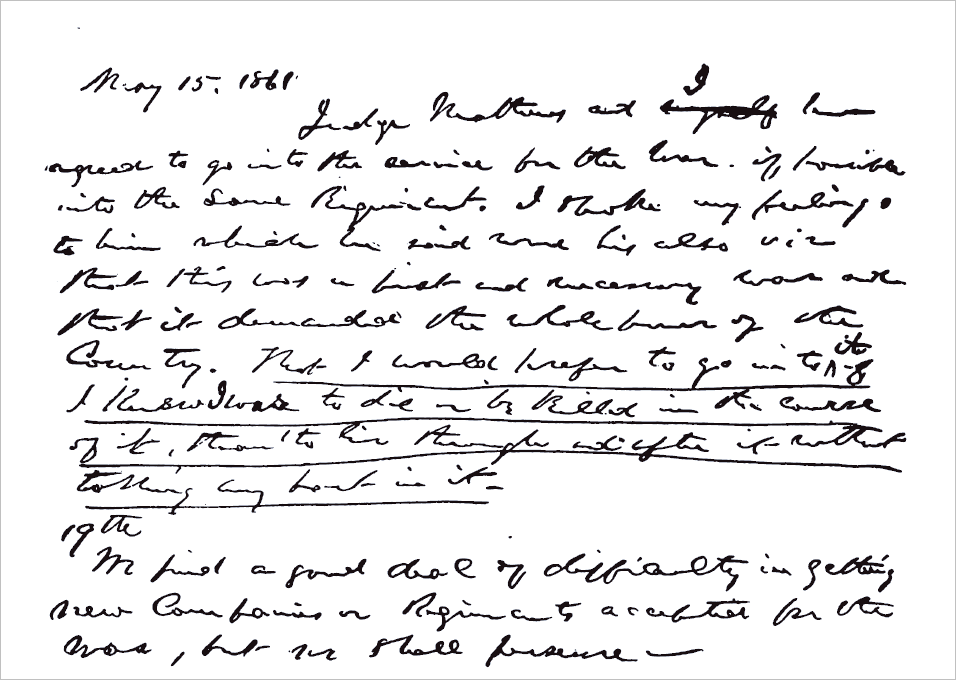
May 15, 1861.–Judge Matthews and I have agreed to go into the service for the war,–if possible into the same regiment. I spoke my feelings to him, which he said were his also, viz., that this was a just and necessary war and that it demanded the whole power of the country; that I would prefer to go into it if I knew I was to die or be killed in the course of it, than to live through and after it without taking any part in it.
May 15, 1861
A Chronological History of the Civil War in America1
Memphis Daily Appeal
Memphis, Tennessee
May 14, 1861