Civil War Day-By-Day

Civil War Day-by-Day

May 20, 1861

  • The state of Kentucky proclaims its neutrality, which will last until September 3 when Confederate forces enter the state.
  • Delegates to the North Carolina Secession Convention passes Ordinance of Secession

A Chronological History of the Civil War in America1

  • North Carolina State Convention met at Raleigh and passed unanimously an ordinance of secession.
  • Seizure of telegraphic dispatches throughout the North. The object was to ascertain who were aiding the rebellion.
  • All mail steamships on the coasts and rivers having any connection with the rebel States stopped.
  • The Governor of Kentucky issued a proclamation declaring the neutrality of the State and forbidding the march of troops from either section across the State.

  1. A Chronological History of the Civil War in America by Richard Swainson Fisher, New York, Johnson and Ward, 1863
0 comments

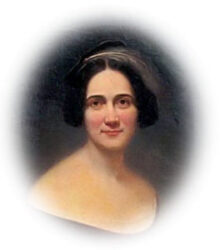
An unexpected reception—Mary Boykin Miller Chesnut.

Civil War Day-by-Day

May 19th.—Mrs. Fitzpatrick says Mr. Davis is too gloomy for her. He says we must prepare for a long war and unmerciful reverses at first, because they are readier for war and so much stronger numerically. Men and money count so in war. “As they do everywhere else,” said I, doubting her accurate account of Mr. Davis’s spoken words, though she tried to give them faithfully. We need patience and persistence. There is enough and to spare of pluck and dash among us, the do-and-dare style.

I drove out with Mrs. Davis. She finds playing Mrs. President of this small confederacy slow work, after leaving friends such as Mrs. Emory and Mrs. Joe Johnston ¹ in Washington. I do not blame her. The wrench has been awful with us all, but we don’t mean to be turned into pillars of salt.

Mr. Mallory came for us to go to Mrs. Toombs’s reception. Mr. Chesnut would not go, and I decided to remain with him. This proved a wise decision. First Mr. Hunter ² came. In college they called him from his initials, R. M. T., ” Run Mad Tom” Hunter. Just now I think he is the sanest, if not the wisest, man in our new-born Confederacy. I remember when I first met him.   He sat next to me at some state dinner in Washington.   Mr. Clay had taken me in to dinner, but seemed quite satisfied that my “other side” should take me off his hands.

Mr. Hunter did not know me, nor I him. I suppose he inquired, or looked at my card, lying on the table, as I looked at his. At any rate, we began a conversation which lasted steadily through the whole thing from soup to dessert. Mr. Hunter, though in evening dress, presented a rather tumbled-up appearance. His waistcoat wanted pulling down, and his hair wanted brushing. He delivered unconsciously that day a lecture on English literature which, if printed, I still think would be a valuable addition to that literature. Since then, I have always looked forward to a talk with the Senator from Virginia with undisguised pleasure. Next came Mr. Miles and Mr. Jameson, of South Carolina. The latter was President of our Secession Convention; also has written a life of Du Guesclin that is not so bad. So my unexpected reception was of the most charming. Judge Frost came a little later. They all remained until the return of the crowd from Mrs. Toombs’s.

These men are not sanguine—I can’t say, without hope, exactly. They are agreed in one thing: it is worth while to try a while, if only to get away from New England. Captain Ingraham was here, too. He is South Carolina to the tips of his fingers; yet he has it dyed in the wool—it is part of his nature—to believe the United States Navy can whip anything in the world. All of these little inconsistencies and contrarieties make the times very exciting. One never knows what tack any one of them will take at the next word.


¹ Mrs. Johnston was Lydia McLane, a daughter of Louis McLane, United States Senator from Delaware from 1827 to 1829, and afterward Minister to England. In 1831 he became Secretary of the Treasury and in 1833 Secretary of State. General Joseph E. Johnston was graduated from West Point in 1829 and had served in the Black Hawk, Seminole, and Mexican Wars. He resigned his commission in the United States Army on April 22,1861.

² Mr. Hunter was a Virginian. He had long served in Congress, was twice speaker of the House, and in 1844 was elected a United States Senator, serving until 1861. He supported slavery and became active in the secession movement. At the Charleston Convention in 1860, he received the next highest vote to Stephen A. Douglas for President.

0 comments

The Movement in Northern Texas

News of the Day

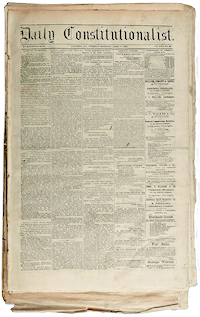
Daily Constitutionalist
Augusta, Georgia
May 19, 1861

The Galveston Civilian, of the 14th instant, says:
We had a telegraphic dispatch yesterday showing that the people of the Northern counties apprehended some difficulty with the United States troops at Fort Washita. Some very exaggerated reports seem to have grown out of the affair in Eastern Texas. The New Orleans Picayune, of Sunday, was informed by passengers by the steamer J. M. Sharp, From Jefferson, Texas, that news reached that place on Tuesday last, by express, in a letter to J. M. & J. C. Murphy, that Montgomery, of Kansas notoriety, at the head of three thousand men, had taken Fort Washita. Messengers had been sent to Marshall and other places for men, money, guns, powder and lead. The same reports had reached Shreveport, La., and volunteers were turning out there to march against the marauders.
The following is, we presume, about all the foundation for these reports: James E. Harrison, Esq., one of the late commissioners to the Indian nation, has returned to Austin, and the State Gazette says: [continue reading…]
0 comments

Horatio Nelson Taft

Diary of US patent clerk Horatio Nelson Taft.

SUNDAY, MAY 19, 1861.

Cool today, fire in Parlor in the morning. Went with Juliet to the camp of the 12th Regt in the morning and heard Rev Mathew Hale Smith (the Chaplin of the Regt) deliver an eloquent discourse to the soldiers. Got to church in time from there and heard Doct Smith, a good many soldiers in the house. Lieut [Millward?] of the 12th called in the evening. He lives in NY, an Englishman by birth. Went down onto the Ave at 6 o’ck and saw the Mich Regt parade. Their Band of Music is very fine. Back before dark, Juliet was with me.


The three diary manuscript volumes, Washington during the Civil War: The Diary of Horatio Nelson Taft, 1861-1865, are available online at The Library of   Congress.

0 comments

Spring Hill—William Howard Russell

My Diary North and South – William Howard Russell

May 19th.—The heat out of doors was so great that I felt little tempted to stir out, but at 2 o’clock Mr. Magee drove me to a pretty place, called Spring Hill, where Mr. Stein, a German merchant of the city, has his country residence. The houses of Mobile merchants are scattered around the rising ground in that vicinity; they look like marble at a distance, but a nearer approach resolves them into painted wood. Stone is almost unknown on all this seaboard region. The worthy German was very hospitable, and I enjoyed a cool walk before dinner under the shade of his grapes, which formed pleasant walks in his garden. The Scuppernung grape, which grew in profusion—a native of North Carolina—has a remarkable appearance. The stalk, which is smooth, and covered with a close grained grey bark, has not the character of a vine, but grows straight and stiff like the branch of a tree, and is crowded with delicious grapes. Cherokee plum and rose trees, and magnificent magnolias, clustered round his house, and beneath their shadow I listened to the worthy German comparing the Fatherland to his adopted country, and now and then letting out the secret love of his heart for the old place. He, like all of the better classes in the South, has the utmost dread of universal suffrage, and would restrict the franchise largely to-morrow if he could.

0 comments

Difficulty—Rutherford B. Hayes

Diary and Letters of Rutherford Birchard Hayes
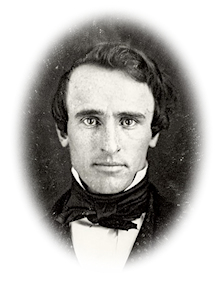
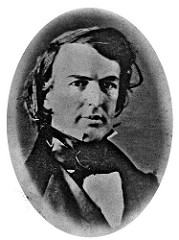
Rutherford B. Hayes (young)

May 19, 1861.—We find a good deal of difficulty in getting new companies or regiments accepted for the war, but we shall persevere.

0 comments

“I often warned Southern gentlemen that this would be the inevitable result.”—James Buchanon.

New York Times

The New York Times
May 19, 1861

Wheatland, May 6, 1861.
To the Editors of the National Intelligencer:
Gentlemen: In the confusion of the times I have not received your tri-weekly numbers 9,157 and 9,158, of April 27 and April 30, I believe. As yours is the only paper of which I preserve a file, I should feel greatly obliged if you would send me these numbers.
Several items in the Intelligencer have awakened my attention to the facility with which military gentlemen relieve themselves from their oaths and change their allegiance. A military oath has ever been held sacred in all ages and in all countries. Besides the solemn sanctions of religion, there is superadded the highest appeal to personal honor. Each military officer swears that he will bear true allegiance to the United States, and serve them honestly and faithfully against all their enemies and oppressors whatsoever. They do not swear to support the Constitution of any State. Educated by the United States, they belong to the Federal Government in a peculiar sense. Whilst I can imagine why an officer might resign rather than shed the blood of citizens of his native State in war, yet it is difficult to excuse or palliate the next step, which is to go over to the enemy and make war upon the time-honored flag of the country.
Maj. Beauregard, when he discharged the first gun against Fort Sumter, lighted a flame which it will require a long time to extinguish. The people of the North at present are enthusiastically unanimous. They never were aroused until that shot was fired. I often warned Southern gentlemen that this would be the inevitable result.
I enjoy good health and as tranquil a spirit as the evils impending over my country will permit.
Your friend, very respectfully,
James Buchanon.
0 comments

Juvenile Beggars

News of the Day

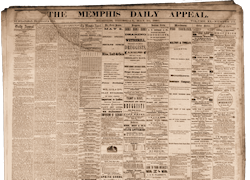
Memphis Daily Appeal
Memphis Tennessee
May 19, 1861

The presence of a number of little girls upon our streets for some time past, who are not only importunate for alms but annoyingly impudent, has been a source of much vexation to numbers of our citizens. We have frequently seen them follow persons for a square at a time, day after day, protesting their poverty and detailing their misfortunes, yet when offered employment in some gentleman’s home, it has been invariably refused, upon some pretext or another. To give in such cases is not charity, however much we may be inclined to relieve want. Rose Conner, one of these juvenile lazaroni, was yesterday before the recorder, and fined five dollars and costs, which was readily settled from a purse well filled with the gleanings of importunate impudence.

0 comments

“I told him (The Secretary of War) my great desire was employment, and facilities to preserve interesting facts for future publication.”—Rebel War Clerk.

Civil War Day-by-Day
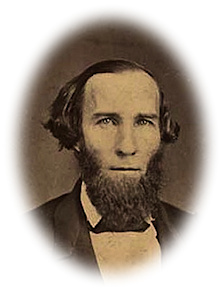
A likeness of Jones when he was editor and majority owner of the Daily Madisonian during President John Tyler’s administration.

MAY 19th. – The Secretary of War sent for me this morning, and said he required more assistance in his correspondence, then increasing daily; but the act of Congress limiting salaries would prevent him from offering me an adequate compensation. He could only name some ten or twelve hundred dollars. I told him my great desire was employment, and facilities to preserve interesting facts for future publication. I was installed at once, with Major Tyler, in the Secretary’s own office. It was my duty to open and read the letters, noting briefly their contents on the back. The Secretary would then indicate in pencil marks the answers to be written, which the major and I prepared. These were signed by the Secretary, copied in another room, and mailed. I was happy in the discharge of these duties, and worked assiduously day and night.

0 comments

Texan Rangers

News of the Day

Memphis Daily Appeal
Memphis Tennessee
May 19, 1861

The advanced corps of the Texan Rangers has arrived at Richmond, Va. The editor of the Dispatch after seeing them says they “are certainly about as dangerous combatants as any the world ever produced. We believe that the far-famed Zouaves, man to man, would be children in their hands. Even if they had no other weapon than the eight-pound bowie-knife, keen as a razor on both sides, and wielded by hands which use it with the most extraordinary strength and dexterity, we should not hazard much in betting on one of these Texan lions against any three of the enemy.”

0 comments

How Arkansas was Carried out of the Union.

News of the Day

The New York Times
May 19, 1861

The Little Rock True Democrat of May 9, relates the manner in which the secession of Arkansas was accomplished. It says:
“The Convention of the people of Arkansas met on Monday morning last, and immediately took the necessary steps to prepare an ordinance of severing the relations existing between the State of Arkansas and the other States united with her, under the compact styled the Constitution of the United States. The ordinance was prepared and reported to the Convention at three o’clock in the afternoon, and was passed immediately, with but one dissenting voice—there being sixty-nine votes in the affirmative, and one in the negative.

We were present at the passage of the ordinance of secession by the Convention, and we never witnessed a more solemn scene. Every member seemed impressed with the importance of the vote he was giving. The hall of the House of Representatives was crowded almost to suffocation. The lobby, the gallery and the floor of the chamber was full, and the vast crowd seemed excited to the very highest pitch. A profound stillness prevailed all the time, as vote after vote was taken and recorded, except occasionally when some well-known Union member would rise and preface his vote with expressions of stirring patriotic Southern sentiments, the crowd would give token of its approbation, but the announcement of the adoption of the ordinance of secession was the signal of one general acclamation that shook the building to its very foundations.”

A weight seemed suddenly to have been lifted off the hearts of all present, and manifestations of the most intense satisfaction prevailed on all sites. The people of Arkansas are united in one great Southern rights party—all past differences and discussions have been buried and forgotten, and they constitute a harmonious band of brothers, pledged to stand by the State, whatever her trials and difficulties may be.

The Convention, we understand, has determined to unite the State with the Confederate States without delay, and have passed a resolution to that effect. The State of Arkansas, with all her resources, both of men and money, stands pledged to the cause of the South, and the fate of the Confederate States will be her fate. Whatever that may be it is accepted by the people of Arkansas, with a firm assurance that the cause she has embarked in is the cause of truth and justice.”

0 comments

Civil War Day-By-Day

Civil War Day-by-Day

May 19, 1861

A Chronological History of the Civil War in America1

  • Rebels at Harper’s Ferry reinforced.

  1. A Chronological History of the Civil War in America by Richard Swainson Fisher, New York, Johnson and Ward, 1863
0 comments

Murder on the Gen. Parkhill

New York Times

This case is of interest because the ship, Gen. Parkhill, after the murder of its Captain and arrest of the sailors, set sail again under a new Captain and was subsequently captured in attempting to run the blockade at Charleston.

LAW REPORTS
__________
United States Circuit Court
Before Judge Nelson.
MURDER ON THE HIGH SEAS.
Samuel Collins, Lewis Featherstone, John Dunlevy and John Kelly, were put on trial charged with murdering Geo. W. Pike, the Captain of the ship Gen. Parkhill. Before commencing the trial, Mr. Smith, the District Attorney entered a nolle prosequi against Kelly, proposing to use him as a witness. One of the crew named Smith was put on the stand and testified that the defendants were sailors on board the ship, which left Liverpool in the morning of Feb 25, 1861; there seemed to have been same difficulty during the day between the Captain and the men, as he as he heard some of the men crying out; in the evening the men were together, and Dunlevy said they were going to stop this work, (by which he understood the Captain’s sulking the men,) and that if they struck him be would strike back, and would serve any one who would not join them in the same way, but witness declined to join them; that after that, about halt-past eight o’clock, the men and the Captain had a fight on deck, and he heard, the Captain cry out, “I am murdered,” and he staggered to the cabin; the mate came up at the noise of the affray, and was stabbed and fell, but refused to go into the cabin, when Dunlevy came up with a handspike and knocked him down, saying that the mate had tried to kill him, and [continue reading…]
0 comments

Three Regiments

News of the Day
Executive Department,
Hartford, Conn., May 18, 1861.
Hon. Simon Cameron,
Secretary of War, Washington :
Dear Sir: Your favor of the 16th instant is at hand, in which you say “one regiment is assigned to your State in addition to the two regiments of three-months militia already called for—three regiments .” You also add :
Let me earnestly recommend to you, therefore, to call for no more than three regiments, of which one only is to serve for three years, or during the war, and if more are already called for, to reduce the number by discharge.
Allow me to say that this communication presents the subject in a different light from that in which I have been acting. The position of matters stands in this manner with me: You first made a call for one regiment for three months. I called that, and, independent of your action, organized two others for three months, and tendered their services to the War Department, which were declined. I then went to Washington and stated my position first to General Scott, as I first saw him, and he said the Department could not use the three-months’ men to advantage, but wanted men for three years. I told him that if he would accept the two regiments already organized, I would organize two more to take their places when their time should expire. He said that under such circumstances or with such assurances the Department would accept them. I called on Your Excellency the next day and merely stated in a very brief manner my business, and I understood Your Excellency to say that you had decided the previous day to meet my wishes in the matter. I did not enter upon any explanation at length, but as your decision must have been based upon the arrangement made with General Scott, I felt that I could not be mistaken in regard to the number of regiments to be raised. I accordingly returned to send forward [continue reading…]
0 comments

On relieving General Harney from his command.

Civil War Day-by-Day

May 18, 1861.—Letter to Colonel F. P. Blair.

Washington, D. C.,
May 18, 1861.
Hon. F. P. Blair
My dear Sir: We have a good deal of anxiety here about St. Louis.
I understand an order has gone from the War Department to you, to be delivered or withheld in your discretion, relieving General Harney from his command. I was not quite satis?ed with the order when It was made, though on the whole I thought it best to make it; but since then I have become more doubtful of its propriety. I do not write now to countermand it, but to say I wis you would withhold it, unless in your judgment the necessity to the contrary is very urgent. There are several reasons for this. We had better have him a friend than an enemy. It will dissatisfy a good many who otherwise would be quiet. More than all, we ?rst relieve him, then restore him, and now if we relieve him again the public will ask, “Why all this vacillation?” Still, if in your judgment it is indispensable, let it be so.
Yours very truly,
A. Lincoln.
0 comments

Horatio Nelson Taft

Diary of US patent clerk Horatio Nelson Taft.

SATURDAY 18

Fine cool day. Very pleasant for the soldiers to drill. “Squads” being seen all over the City marching to and fro under a drill officer. Had letter today from Brother C R. Wrote him in reply after going over to the Genl P.O. Was introduced to Mr Lewis Clephane, the City P.M., by Mr Vansantvoord of the Pat office. Was down to see the Dress Parade of the 12th. From there to “Willards” Hotel and then to Kirkwoods. Saw the officers of the Mich Regt who stop there. Came home about 9 o’clock, bed at 11.


The three diary manuscript volumes, Washington during the Civil War: The Diary of Horatio Nelson Taft, 1861-1865, are available online at The Library of   Congress.

0 comments

New York Regiments under Dix.

News of the Day
First Division, New York Volunteers,
Headquarters, New York, May 18, 1861.
Hon. Simon Cameron,
Secretary of War:
Sir: The Governor of the State of New York has assigned to my division nine regiments, several of which will be in readiness to move as soon as they can be armed, and it is understood that a supply of arms will be received from Spring?eld early next week. The Governor, who is here, informs me that he has received your directions to send nine regiments to Fort Monroe and ?ve to the city of Washington. It is proposed, unless you otherwise direct, that the nine regiments composing my division be sent to Fort Monroe, with the exception of the Eleventh (Firemen Zonaves) now on duty at the capital.
I am, very respectfully, your obedient servant,
JOHN A. DIX,
Major-General.

[Indorsement.]

Respectfully referred to the General-in-Chief.
May 20, 1861.
I do not hesitate to say that in my opinion Major-General Dix would make a most excellent commander of the new military department of which Fort Monroe is to be the headquarters, and at which place his entire division (nine regiments) will soon be assembled.
Respectfuuy submitted to the Secretary of War.
WINFIELD SCOTT.
0 comments

Junaluskee Zouaves.

News of the Day

Semi-weekly Raleigh Register
Raleigh NC
May 18, 1861

We understand that Col. W. H. Thomas, of Jackson County, in this State, has raised a volunteer corps of Cherokee Indians, numbering 200 very efficient men. This “tribe,” consisting of some 1500, are determined not to be mere idle spectators in this war of “Booty and Beauty” which is to be waged against the South. These Indians, it is well known, always fight in their own way. They are most capital riflemen, and not entirely unacquainted with the uses of the “knife.” So we advise the Northern barbarians, with A. Blinkun at their head, to look well to their “scalps” when they hear the war-whoop of the “Cherokees.”

0 comments

“…the charge of dishonesty has failed.”

Civil War Day-by-Day

May 18, 1861.—Letter To Secretary Chase.

Executive Mansion, May 18, 1861.
Hon. Secretary Of The Treasury.
My dear Sir: The suggestions of your note accompanying the commission for Mr. Dennison as naval officer at New York have been considered in the same spirit of kindness in which I know they were offered. They present the very difficulty which has embarrassed me from the first in the case: that Mr. Dennison has not the position in the public eye which would lead to the expectation of his receiving so high an office. I believe I have told you fully what it was, and is, that pressed me to appoint him: the urgent solicitation of an old friend who has served me all my life, and who has never before received or asked anything in return. His ( Mr. Dennison’s) good character was vouched for from the start by many at New York, including Mr. Opdyke.
At length, when I was, as it were, in the very act of appointing him, Mr. ________ made a general charge of dishonesty against him. I pressed him for particulars, and it turned out that Mr. Dennison in his business as a lawyer had got some printing done for his clients, becoming personally responsible for the work, and had not paid for it when dunned. While this, if true, is certainly not to be commended, I believe the like might, in some cases, be proven upon me. They are a class of debts which our clients ought to pay, and when we are personally dunned for them we sometimes hang fire. Besides, Mr. Dennison went far toward a satisfactory explanation of one case; and while Mr. intimated that there were other cases, he did not specify them.
I consider that the charge of dishonesty has failed; and it now seems to me more difficult to change my purpose than if the charge had never been made.
Yours as ever,
A. Lincoln
0 comments

Privateer Phenix

War of the Rebellion: from the Official Records of the Union and Confederate Armies and Navies
Wilmington, Del., May 18, 1861.
Honored Sir: It is with extreme pleasure that I announce the fact
that I have now about ready for sea, the fine steamship Phenix and I solicit a letter of marque, and will you forward the same, if the following description of the ship is satisfactory to you and your cabinet. It is understood by the people here that the ship is for the Spanish Government. Length of ship, 245 feet. Breadth of beam, 34 feet. Depth of hold, 19 feet. Measures 1,643 75/95 tons. She is brig rigged and scroll head, and sets well by the stern. She draws, with her coal (643 tons), provisions, and armament on board, 14 feet 4 inches aft and 11 feet 9 inches forward. She has six A1 rifle cannon, with a superior 32-pound pivot, 276 Burnsides rifles, 320 boarding pikes, 210 cutlasses, 176 boarding knives (Sumners make); also 6 grappling irons which are of the latest improved style, and with an abundant supply of powder and shot. I have had the fortune of obtaining 24 Southern officers and 219 picked men. I shall leave here in about 10 days for Havana; please forward my commission to Apalachicola, Fla., where I will call for it, and if possible will proceed to Montgomery at once if my commission is not ready at Apalachicola. If I find the latter place blockaded, and can not cope with them, you may then expect me at Caillou River, La. You will please inform the Cabinet that I am prepared to whip any one ship of the line. I have drawn the wool over the eyes of the black hearted Republicans; they think I am Union entire. Do not fail to have my letter of marque ready, for I wish to overhaul some of the homeward bound California steamers, for money is required. Any instructions you may give will be carried out to the letter.
I have the honor to be your obedient servant,
Eugene Delany,
Commander Steamship Phenix.
Hon. Jefferson Davis,
Of the Confederate States of America,
Montgomery, Ala.
P.S. I was in Mexico with Beauregard and he knows my courage.
0 comments

“…nowhere is the influence of women greater than in America.”—William Howard Russell

My Diary North and South – William Howard Russell

May 18th.—An exceedingly hot day, which gives bad promise of comfort for the Federal soldiers, who are coming, as the Washington Government asserts, to put down rebellion in these quarters. The mosquitoes are advancing in numbers and force. The day I first came I asked the waiter if they were numerous. “I wish they were a hundred times as many,” said he. On inquiring if he had any possible reason for such an extraordinary aspiration, he said, “because we would get rid of these darned black republicans out of Fort Pickens all the sooner.” The man seemed to infer they would not bite the Confederate soldiers.

I dined at Dr. Nott’s, and met Judge Campbell, who has resigned his high post as one of the Judges of the Supreme Court of the United States, and explained his reasons for doing so in a letter, charging Mr. Seward with treachery, dissimulation, and falsehood. He seemed to me a great casuist rather than a profound lawyer, and to delight in subtle distinctions and technical abstractions; but I had the advantage of hearing from him at great length the whole history of the Dred Scot case, and a recapitulation of the arguments used on both sides, the force of which, in his opinion, was irresistibly in favor of the decision of the Court. Mr. Forsyth, Colonel Hardee, and others were of the company.

To me it was very painful to hear a sweet ringing silvery voice, issuing from a very pretty mouth, “I’m so delighted to hear that the Yankees in Fortress Monroe have got typhus fever. I hope it may kill them all.” This was said by one of the most charming young persons possible, and uttered with unmistakable sincerity, just as if she had said, “I hear all the snakes in Virginia are dying of poison.” I fear the young lady did not think very highly of me for refusing to sympathize with her wishes in that particular form. But all the ladies in Mobile belong to “The Yankee Emancipation Society.” They spend their days sewing cartridges, carding lint, preparing bandages, and I’m not quite sure that they don’t fill shells and fuses as well. Their zeal and energy will go far to sustain the South in the forthcoming struggle, and nowhere is the influence of women greater than in America.

As to Dr. Nott, his studies have induced him to take a purely materialist view of the question of slavery, and, according to him, questions of morals and ethics, pertaining to its consideration, ought to be referred to the cubic capacity of the human cranium—the head that can take the largest charge of snipe shot will eventually dominate in some form or other over the head of inferior capacity. Dr. Nott detests slavery, but he does not see what is to be done with the slaves, and how the four millions of negroes are to be prevented from becoming six, eight, or ten millions, if their growth is stimulated by high prices for Southern produce.

There is a good deal of force in the observation which I have heard more than once down here, that Great Britain could not have emancipated her negroes had they been dwelling within her border, say in Lancashire or Yorkshire. No inconvenience was experienced by the English people per se in consequence of the emancipation, which for the time destroyed industry and shook society to pieces in Jamaica. Whilst the States were colonies, Great Britain viewed the introduction of slaves to such remote dependencies with satisfaction, and when the United States had established their sovereignty they found the institution of slavery established within their own borders, and an important, if not essential, stratum in their social system. The work of emancipation would have then been comparatively easy; it now is a stupendous problem which no human being has offered to solve.

0 comments

Kindling

News of the Day

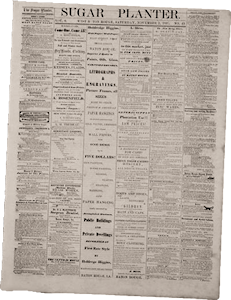
Sugar Planter
West Baton Rouge, Louisiana
May 18, 1861

The closing of trade with North Carolina has deprived New York city of its supply of  kindling wood, the consumption of which is enormous, about a million of dollars having been annually invested in this department of business.

0 comments

U.S. Gun Boat Monticello

Library of Congress
U.S. Gun Boat Monticello, drawing by Alfred R. Waud

The first USS Monticello was a wooden screw-steamer in the Union Navy during the American Civil War. She was named for the home of Thomas Jefferson. She was briefly named Star in May 1861.

Monticello was built at Mystic, Connecticut, in 1859; chartered by the Navy in May 1861; and purchased on 12 September 1861 at New York from H. P. Cromwell & Company, for service in the Atlantic Blockading Squadron, Captain Henry Eagle in command.

Monticello was renamed Star on 3 May 1861, but resumed her original name on 23 May. Seeing immediate action, Monticello relieved USS Baltimore in blockading the James River and preventing communication with the Elizabeth River on 2 May, then relieved USS Quaker City at Cape Henry on the 8th. She engaged the batteries at Sewell’s Point on May 18 and 19, then continued blockade duty… (Read more at Wikipedia)

Image information at Library of Congress:

Title: U.S. Gun Boat Montecello
Creator(s): Waud, Alfred R. (Alfred Rudolph), 1828-1891, artist
Date Created/Published: [between 1860 and 1865]
Medium: 1 drawing on tan paper : pencil ; 8.5 x 13.7 cm. (sheet).
Summary: Broadside view of steamship.
Reproduction Number: LC-DIG-ppmsca-20334 (digital file from original item)
Rights Advisory: No known restrictions on publication.
Call Number: DRWG/US – Waud, no. 972 (AA size) [P&P]
Repository: Library of Congress Prints and Photographs Division Washington, D.C. 20540 USA
Notes:
….Title inscribed below image.
….Formerly Waud no. C-45.
….Gift, J.P. Morgan, 1919 (DLC/PP-1919:R1.2.972)
….Forms part of: Morgan collection of Civil War drawings.

https://www.loc.gov/pictures/item/2004660620/

___________
Mike’s notes:

Note – This image has been digitally adjusted for one or more of the following:
– fade correction,
– color, contrast, and/or saturation enhancement
– selected spot and/or scratch removal
– cropped for composition and/or to accentuate subject

0 comments

Munitions of War Mission

War of the Rebellion: from the Official Records of the Union and Confederate Armies and Navies
Confederate States Of America,
War Department,
Montgomery, May 18, 1861.
Maj. Edward C. Anderson,
Confederate Army, Montgomery, Ala.:
Sir: You are hereby directed to proceed to Europe without delay for the purpose of making purchases of munitions of war and to execute such other instructions as may be intrusted to you by the heads of the Departments of this Government. On your arrival abroad you will at once, if possible, place yourself in communication with Capt. Caleb Huse, who has heretofore been sent abroad on a mission similar to that now intrusted to you. The Bureau of Ordnance will furnish you with copies of the instructions with which Captain Huse is charged, and you will hasten to co-operate with him in making the purchases and shipments therein specified. Should you be unable to communicate with Captain Huse after due inquiry for that purpose, you will proceed yourself to execute all that pertains to the duties with which he was charged. You will report your address to this Department as soon as you arrive abroad and make frequent reports of your proceedings.
Respectfully, your obedient servant,
L. P. WALKER ,
Secretary of War.
0 comments

Breaking In!

News of the Day

Sugar Planter
West Baton Rouge, Louisiana
May 18, 1861

For some days past, a number of the Delta Rifles were encamped in the Courthouse yard, in order to give them a little taste in advance of what they are to get used to. The boys seemed to enjoy the sport hugely; and any one seeing their jolly gay humor and disposition would have imagined it was the richest sort of sport to them. They underwent all the regular duties of camp life, such as drilling, cooking standing guard, etc. They express their thanks to a number of our citizens for kind attention in the way of fresh meats, vegetables, etc. Well, they are all gone now, and joy go with them say we.

0 comments