“Capt. L Vogdes, First Artillery, will embark with his company (A, First Artillery), filled to the maximum by attached men from the other companies of this post, on board the sloop-of-war Brooklyn…,”—Operations in Florida

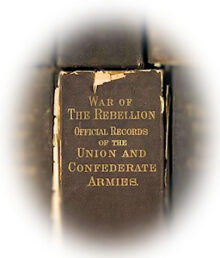
War of the Rebellion: from the Official Records of the Union and Confederate Armies and Navies

HEADQUARTERS FORT MONROE, VA.,
January 25, 1861.

Lieut. Col. L. THOMAS,   Assistant Adjutant-General,

Headquarters of the Army, New York City:

COLONEL: I have the honor to report that in compliance with instructions from the General-in-Chief, Captain Vogdes’ company (A, First Artillery) left this post yesterday between 4 and 5 o’clock p.m. to embark on board the U. S. sloop-of-war Brooklyn. A return of Captain Vogdes’ command is herewith transmitted. I also inclose copies of orders issued by me relative to Captain Vogdes’ movement.

I am, sir, very respectfully, your obedient servant,

J. DIMICK,
Lieut. Col., Second Artillery, and Bvt. Col, Comdg. Post.

[Inclosure]

img7EORDERS NO. 13,

Extract.

HEADQUARTERS FORT MONROE,
January 23, 1861.

In compliance with instructions from the General-in-Chief, Capt. L Vogdes, First Artillery, will embark with his company (A, First Artillery), filled to the maximum by attached men from the other companies of this post, on board the sloop-of-war Brooklyn, as soon as the commanding officer of that ship reports himself in readiness to receive him. The following number of privates will be detailed from the companies at the post, to be attached to Captain Vogdes’ company, viz: From Company C, First Artillery, 5; from Company B, Second Artillery, from Company L, Second Artillery, 6; from Company F, Third Artillery, 6; from Company K, Third Artillery, 5; from Company D, Fourth artillery, 6; from Company L, Fourth Artillery, 6.

**********************************

The assistant commissary will furnish this command with three months’ provisions, it being all that can be transported on the Brooklyn. Fifteen thousand rounds of musket-ball cartridges will be issued. Four mountain howitzers and two 12-pounder field howitzers will be taken, with such a supply of ammunition, not to exceed one hundred rounds for each gun, as can be supplied from this post and arsenal.

Bvt. Second Lieutenant Whittemore, Second Artillery, will proceed with the command.

Sealed orders received from the General-in-Chief have been furnished Captain Vogdes, to be opened when at sea.

By order of Colonel Dimick:

T. J. HAINES, Adjutant.
0 comments

Acknowledgement

Civil War Day-by-Day

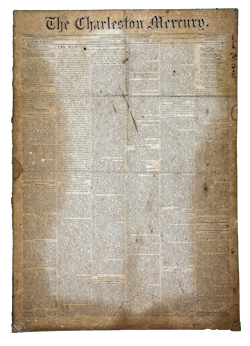
January 25, 1861; The Charleston Mercury

Surgeon General GIBBES respectfully thanks a lady of Charleston for two dozen under shirts, and another lady of Charleston for twenty more. They have been sent as requested. He also acknowledges the patriotic present of bandages and lint for Mollie’s of Talladega, Alabama. He also thanks many ladies of Charleston for continued contributions of bandages and lint.

0 comments

The Pensacola Forts

Civil War Day-by-Day

January 25, 1861; The Charleston Mercury

 (From the Mobile Advertiser.)

Popular interest in warlike movements now centres nearer at home than when Charleston was the only point from which radiated the war excitements of the day. The immense interest of at least three States – Mississippi, Alabama, and Florida – is now becoming alive to the importance of occupying the forts within the borders of the latter commonwealth. We see repeated at Pensacola the manoeuvre of Anderson at Moultrie. There are three forts at Pensacola, a Navy Yard, and a redoubt. Commander Armstrong has abandoned the Navy Yard and Fort Barancus, removing munitions, and spiking guns, and transferring his forces, amounting in the aggregate to between two and three hundred men, from the main land to Santa Rosa Island, has prepared to make good his position within the immensely strong fortifications of Fort Pickens. Whether he has abandoned Fort McCree, also, we are not advised, but we doubt if he has. This fortress is a powerful and castle-like masonry erection, built on a low sand pit of the main land, and appearing to rise out of the water. It is further seaward than Fort Pickens, of which it is the vis a vis across the channel, and a vessel entering must needs run the gauntlet of its guns before approaching the latter, which, however, of itself effectually closes the harbor against the admission of an enemy of even very heavy force.

Fort Pickens is designed to mount no less than two hundred and twelve guns, and under the protection of it immense batteries the ships of an enemy could make good their harbor in the Bay of Pensacola, or if they did not care to run the risk from shore batteries, which could not be in very dangerous range, they could land forces and supplies on the fort to the eastward of Santa Rosa Island, which is some forty miles long, and thus throw in reinforcements and rendezvous even an army at the fort without interruption, unless of a force intrenched on the Island itself, in the rear of the fort – which, however, is almost if not quite as defensible from rear as front. If we are to have war, the seizure of this stronghold is, of course, of the first importance, for unless it is occupied by us, it will secure to the enemy a base of operations along our whole gulf coast, and keep open a road right in the heart of the South, which cannot be obstructed by any fixed fortifications. Once within the gates of the harbor, and an army could be disembarked at any point on the wide bay which it might select. It could run up beyond the Escambia river and land many hours ahead of any opposing force which might be at Pensacola; beside placing a wide river between it and the latter – or even two rivers, the Escambia and Blackwater – by going far enough up. Hence, with a start of at least forty-eight hours, it could march into Interior Alabama. An enemy holding Fort Pickens could rendezvous a naval force there and keep up a blockade of all the ports of the Gulf unless we could meet it on the sea.

0 comments

Keep Back the Cotton

Civil War Day-by-Day

January 25, 1861; The Charleston Mercury

Let the patriots and planters of the South keep back their cotton. In March Europe will need supplies. If our ports are blockaded, Europe will find a way to open them. We can live – our Southern people – for we only send a surplus crop to market. The Cotton States have only need to agree, in confederation, and as an independent power, demand the recognition of Europe. Texas alone, was gladly acknowledged as such, and Great Britain, through her diplomats, tried her best to keep her from entering the United States Confederacy. With all the Cotton States united, we can bind the world to pledges of recognition, and even alliance. We can declare our ports free to the trade of all the world, New England excepted; discriminate between Southern and Northern bottoms; issue letters of marque and reprisal, and play such a game with our blockading gentry as will cure them very soon of their warlike passions. Only be firm, trust no business politicians, and let the COLT’S and the cannon be ready.

0 comments

A Dangerous Experiment

Civil War Day-by-Day

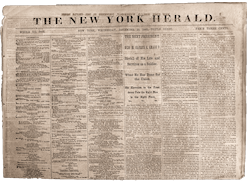
January 25, 1861, The New York Herald

It appears that above Vicksburg, by direction of Gov. Pettus, a battery has been erected, and that every boat hailing from north of Mason and Dixon’s line is compelled to round to and give an account of itself. This, we think, whatever the specific object may be, is a dangerous experiment on the part of the local authorities of the State of Mississippi. The people of the Northwestern States regard the Mississippi river as a free national highway, their natural commercial outlet to the sea. They also have the will and the power to make good their claim against any attempt and any combination to obstruct the free navigation of said river, or, as Mr. Calhoun called it, “inland sea.” Therefore if the authorities of Mississippi do not wish to invite a collision with the eight or ten millions of people of the Northern and Northwestern States who are directly interested in the right of way up and down Father of Waters, these batteries, which would reduce the lower river to the condition of the Dardanelles, will be abandoned. There can be no such a thing as the control of the Mississippi river by a Southern State or a Southern confederacy. It would be as easy to turn back the mighty stream itself as the trade which nature has declared shall float upon its bosom to the sea.

0 comments

The News

Civil War Day-by-Day

January 25, 1861, The New York Herald

Governor Brown, of Georgia, backed by seven hundred State troops, yesterday morning demanded the surrender of the United States Arsenal at Augusta. At noon the demand was complied with. The federal troops saluted their flag and retired. The arsenal, at the time of the surrender, was occupied by a company of United States soldiers, who had, it is reported, been sent to Augusta at the solicitation of the citizens, who desired to protect the property from apprehended attack by a mob.

The Louisiana State convention met on Wednesday, and after organizing, adopted a resolution providing for the appointment of a committee which reported an ordinance of secession yesterday. Entire unanimity prevailed throughout the proceedings. The Legislature of Louisiana has endorsed the action of the Governor with reference to the capture of the fortifications.

Our Washington despatches state that news had reached there that the Legislature of Kentucky had decided against calling a State Convention. This is considered as equivalent to a declaration against secession.

Ex-President Tyler, the Virginia Commissioner appointed to wait upon the President and urge the avoidance of a collision with the secessionists, had an interview with Mr. Buchanan yesterday. It is believed that the only danger of a collision rests with the secessionists themselves. If they remain peaceable there will be no trouble.

Captain Doubleday, writing from Fort Sumter on the 20th inst., denies the report put in circulation by Charleston papers that disaffection exists among the garrison. He represents the troop as in cheerful spirits, and prepared to defend the fort to the last. He also states that mortars have been placed by the South Carolinians on the land nearest the fort, and that two steamers watched the fort all night on the 19th inst.

Just previous to the sailing of the steamship Montgomery for Savannah yesterday afternoon, a posse of the steamboat squad of police went on board for the purpose of examining the freight put on board by Adam’s Express Company. Capt. Berry notified them he was just ready to leave, and to prove the act to them ordered the fasts to be cut (having been previously singled), at the same time starting the engine ahead, when, to avoid a trip to sea, the police hastily scrambled ashore and the steamer shot out into the North river amid the cheers of the crowd assembled on the dock, who gave three cheers for Capt. Berry and three more for Capt. Fletcher.

0 comments

Acknowledgements

Civil War Day-by-Day

January 25, 1861; The Charleston Mercury

The Fairfield Volunteer Company desire, through the MERCURY, to thank ‘Several Ladies of Charleston’ for acceptable presents.

The Palmetto Guard return their thanks to the ladies of Summerville for the bounteous donation of many delicacies.

The thanks of the Union District Volunteers are hereby tendered to Hon. ROBERT BEATTY for his thrice welcome presents of fine hams, &c.

The Cadets stationed at Fort Morris return their sincere thanks to their kind friends who have not forgotten them in their absence. To the lady who sent them the hoods and gloves, they are much indebted, and can assure her that they have done good service in this very inclement weather. The box of sewing materials, lint, bandages, &c. will be of service if the Cadets are allowed the honor of aiding in planting the Palmetto flag on the ramparts of Fort Sumter. They must also gratefully acknowledge the favor of our former Professor, Col. C. C. TEW, which will contribute to lessen the hardships of the campaign. Their friends have been so attentive that they can not enumerate their several acts of kindness, but they must be assured that they were gratefully received.

0 comments

““The Presidents Peace policy is generaly approved of as best for the time being.”—Horatio Nelson Taft.” is locked

Diary of US patent clerk Horatio Nelson Taft.

THURSDAY 24

There was a little snow last night and this morning it rained and the streets were in an awful condition. I did not go to the office until 10 o’clock. No news stirring. Was down at the “National” this evening. It seems to be filling up, as do all the Hotels. People seem less excited than they did, but await the events of the next month with much solicitude, but confidence is in a great measure restored and the Govt is expected to go on as usual. The Presidents Peace policy is generaly approved of as best for the time being.


The three diary manuscript volumes, Washington during the Civil War: The Diary of Horatio Nelson Taft, 1861-1865, are available online at The Library of   Congress.

0 comments

Franking question posed to acting Postmaster General Horatio King.

Turning on the Light: A Dispassionate Survey of President Buchanan’s Administration, From 1860 to its Close, by Horatio King
John Durant Ashmore

Honorable John D. Ashmore, Member of Congress from South Carolina, asks if he has the Right to the Franking Privilege, now that South Carolina has passed an Ordinance of Secession.

Anderson, S. C., Jan. 24, 1861.

My Dear Sir,–I have in my possession some one thousand to twelve hundred volumes of ” public documents,” being my proportion of the same as a member of the thirtysixth Congress. They were forwarded me in mail-sacks and are now lying in my library. Since the date of the ordinance of secession (December 20,1860) of South Carolina I have not used the franking privilege, nor will I attempt to do so without the special permission of the Department To pay the postage on these books, etc., would cost me a large sum, and one I am not prepared to expend. The books are of no use to me, but might be to my constituents, for whom they were intended, if distributed among them. Have I the right to frank and distribute them under existing relations? If so, please inform me. Having said that I have not used the franking privilege since the 20th December, I need hardly add that I shall not do so, even on a “public document,” unless you authorize it.

I am, with great respect,

Truly and sincerely yours,

J. D. Ashmore.

Hon. Horatio King,

Acting Postmaster-General.


(Answered on January 28th.)

0 comments

A Diary of American Events – January 24, 1861

The Rebellion Record – A Diary of American Events; by Frank Moore

–The Charleston Mercury continues the publication of anonymous incendiary appeals, intended to stir up the people to an attack on Fort Sumter. One, headed “Fort Sumter, the Bastion of the Federal Union,” concludes with these words:

“No longer hoping for concessions, let us be ready for war, and when we have driven every foreign soldier from our shores, then let us take our place in the glorious Republic the future promises us. Border southern States will never join us until we have indicated our power to free ourselves–until we have proven that a garrison of seventy men cannot hold the portal of our commerce. The fate of the Southern Confederacy hangs by the ensign halliards of Fort Sumter.”

–The Toronto Leader, the Government paper of Canada, this morning says it is in a position to announce in the most positive terms that it is the intention of the English Government to acknowledge the independence of the Southern Confederacy as soon as it is formed.

–The London Times, in an article on the disunion movement in America, asserts that the United States cannot “for many years be to the world what they have been.”–(Doc. 25.)

–An effort was made by the New York police to seize a quantity of fire-arms which were known to be shipped on board the steamer Montgomery. While the officers were searching on board for the arms, the captain ordered the vessel’s fasts to be cut, and she steamed away from the pier, scarcely giving the policemen time to jump ashore. The five hundred muskets found on board the schooner Caspian were returned to the captain, the authorities being satisfied that the vessel was bound to Carthagena.–Chicago Tribune.

–The United States arsenal at Augusta, Ga., was surrendered to the State authorities, upon the demand of Governor Brown.–Baltimore Sun, Jan. 25.

–The Catawba Indians of South Carolina offered their services to Governor Pickens, and were accepted.–Times, Jan. 25.

0 comments

The Secession of Georgia

War of the Rebellion: from the Official Records of the Union and Confederate Armies and Navies

AUGUSTA ARSENAL, GA., January 24, 1861.

SIR : I have the honor to report that the arsenal was surrendered this morning to the governor of Georgia upon honorable terms, herewith inclosed.

……….I am, sir, very respectfully, your obedient servant,

ARNOLD ELZEY,
Captain, Second Artillery.

Col. S. COOPER, Adjutant-General U. S. Army, Washington, D. C.

(Inolosure.)

AUGUSTA ARSENAL, GA., January 24, 1861.

His excellency the governor of Georgia having demanded the United States Arsenal at Augusta, commanded-by Capt. Arnold Elzey, Second Artillery, U. S. Army, the following terms are agreed upon, to wit:

1st. The flag to be saluted and lowered by the United States troops.

2d. The company to be marched out with military honors and to retain its arms and company property.

3d. The officers and soldiers to occupy quarters until removed beyond the limits of the State, and to have the use of the post transportation to and from the city and in the neighborhood, and the privilege of obtaining supplies from the city.

4th. The public property to be receipted for by the State authorities and accounted for upon adjustment between the State of Georgia and the United States of America.

5th: The troops to have unobstructed passage through and out of the State, by water, to New York, via Savannah.

JOSEPH E. BROWN,
Governor and Commander-in-Chief of the Army of the State of Georgia.
ARNOLD ELZEY,……
Captain, Second Artillery, Commanding Augusta Arsenal.

0 comments

Operations in Charleston Harbor

War of the Rebellion: from the Official Records of the Union and Confederate Armies and Navies

FORT SUMTER S.C., January 24, 1861.

Col. S. COOPER; Adjutant-General:

COLONEL: The storm continued until about daylight this morning. It is still cloudy, but the wind has abated sufficiently to enable our boat to take our mail over to Fort Johnson. I have written to our beef contractor in reference to furnishing us with beef, and also such vegetables as the doctor may deem suitable. The purchase of the latter will, I hope, under existing circumstances, be allowed. A letter has also been written to the agent of the New York line of steamboats about transporting our women and children to New York, where, I hope, the quartermaster will see that they are made comfortable. They will probably leave early next week.

I am, colonel, very respectfully, your obedient servant,

ROBERT ANDERSON,

Major, First Artillery, Commanding.

0 comments

A Six-Gun Battery Upon the Mississippi Firing into a Cincinnati Steamboat

Civil War Day-by-Day

January 24, 1861, The Charleston Mercury

Our Vicksburg Correspondence.

VICKSBURG, Miss., Jan. 14, 1861. Guarding the ‘Father of Waters.’- Suspended Steamboats brought to. – A Six Gun Battery upon the Mississippi Firing into a Cincinnati Steamboat. – The Resistance Feeling in the State, etc., etc.

A despatch was received here on Friday, from Memphis, to the effect that it was expected that General HARNEY, with a body of five hundred Federal troops, would soon come down the Mississippi on the steamboat Silver Wave, to recapture the Louisiana forts and arsenals. Instantly the whole city was astir. It did not take long for our people to determine that no troops should ever pass here on such an errand. A half a dozen twelve pounders were immediately brought out and planted upon the bluff commanding the river. A company of Minute Men, manned the battery, and a rigid watch was kept upon the stream, night and day. Every boat passing downward toward New Orleans was hailed and examined, and most of them took the necessary interruption in good part.

Thus matters wore along until 10 o’clock yesterday morning, when the steamer J. O. Taylor, of Cincinnati, made her appearance, downward bound. As she paid no attention to the hailing, a blank cartridge was fired at her to give her a hint that she must stop. This, too, being disregarded the shotted guns were brought to bear upon her. This had the desired effect. She speedily rounded to, and after submitting to the proper investigation was permitted to pass on. This watch, so necessary at a time like the present when old SCOTT is at his tricks, will be resolutely maintained, and the coercionists, if they mean to subjugate the South, must take some other route than the Mississippi.

Since this State has been out of the Union all party lines have been obliterated, and the people are daily growing more united and determined for resistance. Hundreds of our young men are eager to help to fight the battles of your State if she should need their services.

0 comments

Southern Sympathy

Civil War Day-by-Day

January 24, 1861, The Charleston Mercury

It is indeed a goodly sight to see the spirit with which the people of the South are hastening to offer substantial aid towards the defence of Charleston. Almost daily our columns contain acknowledgments of liberal and unsolicited contributions in money from citizens of our sister States. Not content with this, scores of gallant Southerners, from beyond our borders, are coming into our city to vie with the sons of the Palmetto Republic for the post of peril.

We learn that F. POPHAM, Esq., a member of the last Virginia Legislature, is now doing duty as a private in the ranks of the Carolina Light Infantry.

Yesterday Messrs. J. M. SABLETT and THOMAS ANDERSON, both of Yazoo city, Mississippi, arrived to tender their services to sustain our cause. They report that they left large numbers in their immediate neighborhood who are ready to come the moment they are needed.

0 comments

Mistaken Views of a Southern Confederacy

Civil War Day-by-Day

January 24, 1861, The New York Herald

An opinion prevails among the republicans that in the event of the Southern States seceding and forming a separate confederacy, they would be unable to command influence or credit abroad. This is a mistake. A Southern confederacy would enjoy as much credit as might be required either in London, Paris or New York. The mere fact of its being the only great cotton producing country in the world, and so having the world dependent upon it, would insure this; and however great the repugnance of the English to the institution of slavery, it will be a long time before they leave off wearing shirts, because those useful articles happen to be manufactured from slave grown cotton. In order to enable the confederacy to raise an ample revenue it would be only necessary to impose an export duty of a cent per pound upon the staple product. Cotton consumers would have no alternative but to submit, and there is no doubt they would do so willingly. Moreover, the southern States are possessed of more mineral treasures than may be generally supposed. The mountains of the northern slave States abound in coal and iron more than the British islands ever did; and yet coal and iron made England what she is. Missouri is particularly rich in this respect. So is Georgia. Gold is found in sufficient quantities, here and there over the entire territory, to yield a large profit beyond the expenses of mining, and there are many other natural advantages which might be enumerated as belonging to this section of our country.

There is now gaining strength in Canada, and indeed throughout the whole of British North America, a strong revolutionary feeling in favor of a confederation of all the colonies; and should there really be an irrevocable split in the United States, there will be no slight probability of one or more of these forsaking the protection of England and joining the Northern confederacy. There is no natural boundary between Canada and Maine, and very little difference of opinion.

0 comments

The News

Civil War Day-by-Day

January 24, 1861, The New York Herald

A sentry on Sullivan’s Island, in the harbor of Charleston, fired into a boat from Fort Sumter on Monday night. The boat was manned by three men, and as they neared the beach they were ordered off; but failing to obey, the sentry fired upon them, whereupon they beat a retreat. It was believed that one man was wounded badly. While some persons supposed the men in the boat were deserters, others believed that they were a party bound upon the desperate expedition of spiking the guns of the secession battery.

The muskets seized on board the Savannah steamer Monticello on Tuesday still remain at the arsenal in Seventh avenue, and General superintendent Kennedy says that no claimant appeared yesterday with a view of recovering the same. The United States district Attorney was notified that a large quantity of powder and cartridges were shipped on board the Charleston steamer yesterday, but no steps were taken to prevent the departure of the alleged contraband goods to their destination.

The Second ward police yesterday, by direction of Superintendent Kennedy, seized twenty five cases, containing five hundred muskets, on board the schooner Caspian. These arms were intended for some point at the south, and were seized as contraband merchandise.

0 comments

Extraordinary Increase in Newspaper Circulation

Civil War Day-by-Day

January 24, 1861, The New York Herald

The circulation of the HERALD is now greater than that of all the other New York daily two cent journals put together, and enjoys the largest circulation of any daily paper in the world. Within the past year it has increased over twenty thousand, and the demand is still greater than our present means of supply.

We have received applications from several newspaper agents and others, in New England especially, to publish a tri-weekly edition for the convenience of people in the country, and in small towns and villages. It is urged that the daily paper comes too often, and is too expensive, while our weekly and semi weekly editions do not come often enough to satisfy the popular demand for news. It is therefore suggested from various parts of the New England States that we should issue a paper every second day for country circulation in addition to the daily, weekly and semi-weekly HERALD now published. It appears from the communications we have received that the republican papers cannot get their tri-weeklies to go in New England since the reaction has taken place in the public mind; the people are evidently getting tired of their extreme opinions, and they want a fair, enterprising newspaper, that will give them the intelligence of the day without a nauseating dose of abolition physic accompanying it.

We have taken the matter into consideration, and will publish a tri-weekly HERALD in a short time. Let newspaper agents, then, send on their orders as soon as they can.

0 comments

Civil War Day-by-Day

Civil War Day-by-Day

January 24, 1861

  • Cropped segment from The Staking Out and Flogging of the Girl Patsey - Twelve Years a SlaveLucy, a female slave from Wheeling who fled to Cleveland, Ohio, is returned to her owner. She is the last slave to be returned under the Fugitive Slave Law.

0 comments

Village Life in America

Village Life in America, 1852 – 1872, by Caroline Cowles Richards

January 23. (1856)–This is the third morning that I have come down stairs at exactly twenty minutes to seven. I went to school all day. Mary Paul and Fannie Palmer read “The Snow Bird” to-day. There were some funny things in it. One was : “Why is a lady’s hair like the latest news? Because in the morning we always find it in the papers.” Another was: “One rod makes an acher, as the boy said when the schoolmaster flogged him.”

This is Allie Field’s birthday. He got a pair of slippers from Mary with the soles all on; a pair of mittens from Miss Eliza Chapin, and Miss Rebecca Gorham is going to give him a pair of stockings when she gets them done.

0 comments

“It is my wish, if the weather prove favorable, to ship the families in the Saturday steamer, or the first one after that day.”—Operations in Charleston Harbor

War of the Rebellion: from the Official Records of the Union and Confederate Armies and Navies

FORT SUMTER, S.C., January 23, 1861.
(Received A. G. O., January 27.)

Col. S. COOPER Adjutant-General:

COLONEL: I have the honor to send herewith a copy of the reply of the Hon. D. F. Jamison to my letter to him about supplies for this garrison and the removal of our women and children, and also a copy of my acknowledgment of the Same. I am highly gratified at the courtesy and proper tone of this reply.

The storm which was raging yesterday has continued with unabated severity up to the present moment, and has put a stop to all outdoor work, both with the South Carolinians and ourselves. It is now raining and blowing so heavily and the bay is so rough that I shall not venture to send our boat to Fort Johnson for the mail. Should the storm abate so that I can send our letters off in time for the evening mail I shall send them over. I see by the Coast Survey map that Maffitt’s and the Swash Channel are not the same. I was led into that mistake by an old pilot, who told me that Maffitt’s Channel was formerly called the Swash. I will thank you to be pleased, therefore, to erase the words “Swash or” in my letter to the honorable Secretary of War dated the 21st instant, and also to change the word “enfilade” into “defilade,” where in the same letter I am describing the work which has been recently executed at Fort Moultrie. [Corrections were made in the text.]

I am, colonel, very respectfully, &c.,

ROBERT ANDERSON,

Major, First Artillery, Commanding.

[Inclosure No. 1.]

EXECUTIVE OFFICE, DEPARTMENT OF WAR,
Charleston, January 21, 1861.

Maj. ROBERT ANDERSON:

SIR. In offering to permit you to purchase in this city, through the instrumentality of an officer of the State, such fresh supplies of provisions as you might need, his excellency the governor was influenced solely by considerations of courtesy; and if he had no other motive for refusing to any of your garrison free access to the city to procure such supplies, he would have been moved by prudential reasons for the safety of your people, in preventing a collision between them and our own citizens. As to the manner of procuring your supplies, his excellency is indifferent whether it is done by the officer referred to, or whether your market supplies are delivered to you at Fort Johnson by the butcher whom you say you have before employed. It is only insisted on that the supplies, if sent, shall be carried over in a boat under an officer of the State who takes to Fort Johnson your daily mails. His excellency desires me to say that he willingly accedes to your request as to the women and children in Fort Sumter, and that he will afford every facility in his power to enable you to remove them from the fort at any time and in any manner that will be most agreeable to them.

I am, sir, respectfully, yours,

D. F. JAMISON.

[Inclosure No. 2.]

FORT SUMTER, S. C., January 22, 1861.

Hon. D. F. JAMISON,
Executive Office, Department of War, Charleston:

SIR: I have the honor to acknowledge the receipt of your favor of the 21st instant, and to express my gratification at its tenor. I shall direct my staff officer to write to the contractor in reference to his supplying us with beef, and will communicate with you as soon as the necessary preliminaries are arranged, in order that you may then, if you please, give the requisite instructions for carrying them into effect. Be pleased to express to his excellency the governor my thanks for the kind and prompt manner in which he gave his consent to the proposed transfer of the women and children of this garrison. As there are on Sullivan’s Island the families of two of our non-commissioned officers, with their furniture, &c., and also a quantity of private property (including some musical instruments–not public property) belonging to this command, which the first commander of Fort Moultrie, Colonel De Saussure, sent me word he had collected and placed under lock and key, it will be necessary to permit the two non-commissioned officers to go to the island to assist in moving their families, &c. The lighter, it occurs to me, which will be needed to take the families to the steamer, had better go to the island for the property there before coming for the women and children here. As we are all very desirous of guarding against causing any unnecessary excitement, it will afford me great pleasure to have everything done in the most quiet way possible. I shall, consequently, cheerfully govern myself, as far as possible, by the views and wishes of his excellency in reference to this matter, and will be pleased to hear from you what they are. It is my wish, if the weather prove favorable, to ship the families in the Saturday steamer, or the first one after that day.

I am, very respectfully, your obedient servant,

ROBERT ANDERSON,

Major, First Artillery, Commanding.

0 comments

“I can hardly hope that all will be well six weeks hence.”—Horatio Nelson Taft.

Diary of US patent clerk Horatio Nelson Taft.

WEDNESDAY 23

United States troops are quietly being brought here and are now quartered in different parts of the City. The President is undoubtedly informed of all the movements of the Traitors, and preparations are being made for the reception of any such visitors. The conspiracy has its ramifications through all the departments without a doubt. Men receiving pay from the Govt (as Clerks &c) but ready to turn against it at a moments warning. I can hardly hope that that [sic] all will be well six weeks hence. Heaven grant that it may be. Was at Willards an hour tonight.


The three diary manuscript volumes, Washington during the Civil War: The Diary of Horatio Nelson Taft, 1861-1865, are available online at The Library of   Congress.

0 comments

Improving Fort Jefferson Defenses — Operations in Florida

War of the Rebellion: from the Official Records of the Union and Confederate Armies and Navies

HEADQUARTERS FORT JEFFERSON, TORTUGAS,
January 23, 1861.

SIR: I have the honor to report for the information of the General-in-Chief that I found on my arrival here, notwithstanding the energetic, well-directed, and highly-commendable efforts of Captain Meigs, the Engineer in charge, that Fort Jefferson could not be successfully defended from a judiciously-planned and concerted attack with a formidable force without having each front of the work and each bastion armed with artillery.

By the advice of Captain Meigs I dispatched the steamer Joseph Whitney, with Captain Meigs, Engineers, and Lieutenant Benson, Second Artillery, to Key West, where there is an abundance of guns and munitions, with a letter to Captain Brannan, commanding Fort Taylor, directing him to confer with Captain Meigs, and to send me such guns, &c., as Captain Meigs might deem necessary for the immediate defense of Fort Jefferson, in order that the honor of the Government and the defense of both forts might be maintained.

I am happy to report that Captain Meigs has returned from Key West in the steamer Joseph Whitney with six 8-inch columbiads and four field pieces and an ample supply of ammunition, which, with the two field pieces I brought from Fort Independence, will enable me as soon as they are in position to make a strong defense, most probably to hold this important position–the key of the Gulf–against any force that is likely to be brought against it.

I herewith inclose a copy of Captain Meigs’ report, and I will here   take occasion to express my high sense of the services of Captain Meigs to render this fort defensible.

I am, very respectfully, your most obedient servant,

L. G. ARNOLD,
Brevet Major, U. S. Army, Commanding.

Lieut. Col. L. THOMAS,
Asst. Adj. Gen., U.S. Army, Headquarters Army, New York City.

[Inclosure.]

ENGINEER OFFICE, FORT JEFFERSON,
Harbor of Tortugas, U.S., January 23, 1861.

SIR: I have to report that I returned this morning on board the steamer Joseph Whitney, towing the Horace Beale, loaded with guns and ammunition, which I obtained from Fort Taylor. Lieutenant Benson, in whose charge you had placed the steamer, rendered me valuable assistance in embarking the heavy materials. Captain Maffit, of the U.S. steamer Crusader, to guard against every possible contingency, kindly convoyed us from Key West.

I recommend that one 8-inch columbiad be placed in the first right-curtain casemate on the right and left of bastions A, C, and E; one flanking gun in the casemate next the curtains in each bastion.

The artillerymen will be able to disembark and transport the guns and ammunition, and from the laborers of the Engineer Department all needful manual aid will be afforded. Two mules belonging to the Engineer Department are also at your service, if useful. A casemate gun and sling cart are on board the brigantine. A truck and wheelbarrow are in the Engineers’ park. The guns, I believe, can all be in place by to-night.

The Mohawk, which at my request came here on our arrival at Key West, will, I doubt not, if you desire it, remain here until the guns are in place; after which it would hardly be necessary to detain her, so far as the safety of this work is concerned, if she has other duties of importance to look after. Her presence, however, would, if she is not urgently needed elsewhere, be only a prudent and proper precaution.

I am, very respectfully and truly, your obedient servant,

M. C. MEIGS,
Captain, Engineers, Eng. in charge of Fort Jefferson.

Maj. L. G. ARNOLD,
Commanding Fort Jefferson.

0 comments

Operations in Florida

War of the Rebellion: from the Official Records of the Union and Confederate Armies and Navies

WASHINGTON, D. C., January 23, 1861.

Hon. J. HOLT,   Secretary of War:

SIR: I proceeded to Pensacola, Fla., pursuant to orders received from the General-in-Chief, with dispatches to Commodore Armstrong, U. S. Navy, commanding the navy-yard at that place, and agreeably to your request submit the following statement respectfully to your notice:

On my arrival at Pensacola I, as soon as the light of day would permit, went to the beach (having learned on the cars when about twenty miles from the city that the yard had been surrendered, and that two vessels—the Wyandotte and Supply–of the U. S. Navy, were in the harbor) to make a signal to Captain Berryman, of the Wyandotte, in order to place in his hands the dispatches intended for Commodore Armstrong, the latter being a prisoner of war. I there found no sign of a naval vessel, and leaned that they were distant some seven miles. I then returned to the hotel, and after having arrived on the porch, where I had been only a few minutes, I was arrested by two persons, who said they were authorized by Colonel Chase to arrest me. They carried me to the latter’s house, where I was brought before the colonel, in the presence of some six or eight persons, and requested, or rather demanded, to surrender my dispatches, which I refused to do, as my dispatches were for Commodore Armstrong. Colonel Chase then said he would allow me to deliver them to Commodore Armstrong in the presence of Captain Randolph, then in charge of the navy-yard for the State of Florida. I proceeded to the yard in company with three troopers belonging to the State troops, and saw the commodore, who received my dispatches sealed, and they, still sealed, were demanded from him by Captain Randolph, who opened them and then forwarded them to Colonel Chase. I remained at the yard all of one day, having been placed on parole of honor not to communicate with any officer of the United States Government either at the forts or at the yard, but learned from reports and what I saw that the fort occupied by the United States had been re-enforced by some thirty or more sailors belonging to the navy-yard. The yard had been surrendered, and all the officers, with the marine guard, had been placed on their parole, and the latter had been placed on board of the Supply, to be conveyed to New York. The yard, as also Fort Barrancas, was occupied by State troops, and Fort McRee was to be occupied so soon as troops should arrive.
I left on the 15th instant, and was given by Colonel Chase the following, in order to allow me a safe passage through the country:

HEADQUARTERS PENSACOLA DISTRICT,
January 15, 1861.

Lieut. J. S. Saunders, of the Ordnance, is under parole to me, and is free to go to any part of the country he desires; and this is his safe-conduct for that purpose.

WM. H. CHASE,
Colonel, Commanding Forces of Florida.

I have the honor to remain, respectfully, your obedient servant,

JNO. S. SAUNDERS,
Brevet Second Lieutenant, Ordnance, U. S. Army.

0 comments

“He declares his intention to take possession of the arsenal…,”—The Secession of Georgia

War of the Rebellion: from the Official Records of the Union and Confederate Armies and Navies

HEADQUARTERS AUGUSTA, GA., ARSENAL,
January 23, 1861–1 o’clock p. m.

SIR: I am just officially informed by the governor of Georgia, now in Augusta, supported by a superior military force, that Georgia having resumed exclusive sovereignty over her soil, it has become his duty to require me to withdraw. the troops under my command at the earliest practicable moment from the limits of the State. He declares his intention to take possession of the arsenal, and proposes to receipt for the public property and account for the same on adjustment between the State of Georgia and the United States of America. He further declares that the retention of the troops upon the soil of Georgia after remonstrance is, under the laws of nations, an act of hostility, claiming that the State now is not only at peace but anxious to cultivate the most amicable relations with the United States Government, and that an answer from me to his demand is required at 9 o’clock a. m. to-morrow. An immediate answer to this communication is-respectfully requested.

……..Very respectfully, your obedient servant,

ARNOLD ELZEY, …….
Captain, Second Artillery, Commanding.

Col. S. COOPER, Adjutant-General U. S. Army.

0 comments

The News

Civil War Day-by-Day

January 23, 1861, The New York Herald

All danger of an immediate collision of the federal and State forces at Forts Sumter and Pickens is at an end. It is understood that peace shall be preserved until the 4th of March. Whether the armistice will continue after that date no one can predict.

The House Navy and Army committees are, it is reported, engaged in the preparation of bills placing both arms of the public service on a war footing. The enrollment of volunteers will be recommended, and also the construction of a number of light draft steamers for coast service.

0 comments