JUNE 2d.—My wife had a little gold among her straightened finances; and having occasion to purchase some article of dress, she obtained seven and a half per cent premium. The goods began to go up in price, as paper money fell in value. At Montgomery I bought a pair of fine French boots for $10 in gold—but packed my old ones in the top of my trunk. I was under the necessity, likewise, of buying a linen coat, which cost only $3.50. What will be the price of such commodities a year hence if the blockade continues? It is fearful to contemplate! And yet it ought to be considered. Boarding is rising rapidly, and so are the blood-thirsty insects at the Carleton House.
American Civil War Chronicles
What will prices be in a year if the blockade continues?.—War Department Clerk, John Beauchamp Jones.
June 2, 2021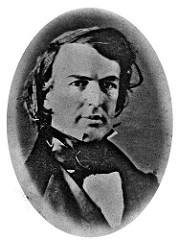
Another Whipping Outrage.
June 2, 2021
Daily Times
Leavenworth, Kansas
June 2, 1861
We learn that a man living some fifteen miles from Butler, in Missouri, was whipped so badly that when the fiends attempted to end their orgies by riding him on a rail he fell off, a corpse. His crime was voting for Lincoln last fall. Every day teams are bringing families out of that State who have been compelled to leave. When will the Government throw the proper protection around its loyal citizens?—Osawatomie Herald.
William Howard Russell’s Diary: Up the Mississippi.—Free negroes and English policy.—Monotony of the river scenery.—Visit to M. Ronan—Slave quarters.—A slave-dance. —Slave-children.—Negro hospital.—General opinion.—Confidence in Jefferson Davis.
June 2, 2021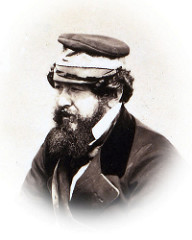
June 2nd. My good friend the Consul was up early to see me off; and we drove together to the steamer J. L. Cotten. The people were going to mass as we passed through the streets; and it was pitiable to see the children dressed out as Zouaves, with tin swords and all sorts of pseudo-military tomfoolery; streets crowded with military companies; bands playing on all sides.
Before we left the door a poor black sailor came up to entreat Mr. Mure’s interference. He had been sent by Mr. Magee, the Consul at Mobile, by land to New Orleans, in the hope that Mr. Mure would be able to procure him a free passage to some British port. He had served in the Royal Navy, and had received a wound in the Russian war. The moment he arrived in New Orleans he had been seized by the police. On his stating that he was a free-born British subject, the authorities ordered him to be taken to Mr. Mure; he could not be allowed to go at liberty on account of his color; the laws of the State forbad such dangerous experiments on the feelings of the slave population; and if the Consul did not provide for him, he would be arrested and kept in prison, if no worse fate befell him. He was suffering from the effect of his wound, and was evidently in ill health. Mr. Mure gave him a letter to the Sailors’ Hospital, and some relief out of his own pocket. The police came as far as the door with him, and remained outside to arrest him if the Consul did not afford him protection and provide for him, so that he should not be seen at large in the streets of the city. The other day a New Orleans privateer captured three northern brigs, on board which were ten free negroes. The captain handed them over to the Recorder, who applied to the Confederate States’ Marshal to take charge of them. The Marshal refused to receive them, whereupon the Recorder, as a magistrate and a good citizen, decided on keeping them in jail, as it would be a bad and dangerous policy to let them loose upon the community.
I cannot help feeling that the position taken by England in reference to the question of her colored subjects is humiliating and degrading. People who live in London may esteem this question a light matter; but it has not only been inconsistent with the national honor; it has so degraded us in the opinion of Americans themselves, that they are encouraged to indulge in an insolent tone and in violent acts towards us, which will some day leave Great Britain no alternative but an appeal to arms. Free colored persons are liable to seizure by the police, and to imprisonment, and may he sold into servitude under certain circumstances.
On arriving at the steamer I found a considerable party of citizens assembled to see off their friends. Governor Roman’s son apologized to me for his inability to accompany me up the river, as he was going to the drill of his company of volunteers. Several other gentlemen were in uniform; and when we had passed the houses of the city, I observed companies and troops of horse exercising on both sides of the banks. On board were Mr. Burnside, a very extensive proprietor, and Mr. Forstall, agent to Messrs. Baring, who claims descent from an Irish family near Rochestown, though he speaks our vernacular with difficulty, and is much more French than British. He is considered one of the ablest financiers and economists in the United States, and is certainly very ingenious, and well crammed with facts and figures.
The aspect of New Orleans from the river is marred by the very poor houses lining the quays on the levee. Wide streets open on long vistas bordered by the most paltry little domiciles; and the great conceptions of those who planned them, notwithstanding the prosperity of the city, have not been realized.
As we were now floating nine feet higher than the level of the streets, we could look down upon a sea of flat roofs and low wooden houses, painted white, pierced by the domes and spires of churches and public buildings. Grass was growing in many of these streets. At the other side of the river there is a smaller city of shingle-roofed houses, with a background of low timber.
The steamer stopped continually at various points along the levee, discharging commissariat stores, parcels, and passengers; and after a time glided up into the open country, which spread beneath us for several miles at each side of the banks, with a continuous background of forest. All this part of the river is called the Coast, and the country adjacent is remarkable for its fertility. The sugar plantations are bounded by lines drawn at right angles to the banks of the river, and extending through the forest. The villas of the proprietors are thickly planted in the midst of the green fields, with the usual porticoes, pillars, verandahs, and green blinds; and in the vicinity of each are rows of whitewashed huts, which are the slave quarters. These fields, level as a billiard-table, are of the brightest green with crops of maize and sugar.
But few persons were visible; not a boat was to be seen; and in the course of sixty-two miles we met only two steamers. No shelving banks, no pebbly shoals, no rocky margins mark the course or diversify the outline of the Mississippi. The dead, uniform line of the levee compresses it at each side, and the turbid waters flow without let in a current of uniform breadth between the monotonous banks. The gables and summit of one house resemble those of another; and but for the enormous scale of river and banks, and the black faces of the few negroes visible, a passenger might think he was on board a Dutch “treckshuyt.” In fact, the Mississippi is a huge trench-like canal draining a continent.
At half-past three P.M. the steamer ran alongside the levee at the right bank, and discharged me at “Cahabanooze,” in the Indian tongue, or ” The ducks’ sleeping place,” together with an English merchant of New Orleans, M. La Ville Beaufevre, son-in-law of Governor Roman, and his wife. The Governor was waiting to receive us in the levee, and led the way through a gate in the paling which separated his ground from the roadside, towards the house, a substantial, square, two-storied mansion, with a verandah all round it, embosomed amid venerable trees, and surrounded by magnolias. By way of explaining the proximity of his house to the river, M. Roman told me that a considerable portion of the garden in front had a short time ago been carried off by the Mississippi; nor is he at all sure the house itself will not share the same fate; I hope sincerely it may not. My quarters were in a detached house, complete in itself, containing four bedrooms, library, and sitting-room, close to the mansion, and surrounded, like it, by fine trees.
After we had sat for some time in the shade of the finest group, M. Roman, or, as he is called, the Governor–once a captain always a captain–asked me whether I would like to visit the slave quarters. I assented, and the Governor led the way to a high paling at the back of the house, inside which the scraping of fiddles was audible. As we passed the back of the mansion some young women flitted past in snow white dresses, crinolines, pink sashes, and gaudily colored handkerchiefs on their heads, who were, the Governor told me, the domestic servants going off to a dance at the sugar-house; he lets his slaves dance every Sunday. The American planters who are not Catholics, although they do not make the slaves work on Sunday except there is something to do, rarely grant them the indulgence of a dance, but a few permit them some hours of relaxation on each Saturday afternoon.
We entered, by a wicket gate, a square enclosure, lined with negro huts, built of wood, something like those which came from Malta to the Crimea in the early part of the campaign. They are not furnished with windows–a wooden slide or grating admits all the air a negro desires. There is a partition dividing the hut into two departments, one of which is used as the sleeping-room, and contains a truckle bedstead and a mattress stuffed with cotton wool, or the hair-like fibres of dried Spanish moss. The wardrobes of the inmates hang from nails or pegs driven into the wall. The other room is furnished with a dresser, on which are arranged a few articles of crockery and kitchen utensils. Sometimes there is a table in addition to the plain wooden chairs, more or less dilapidated, constituting the furniture –a hearth, in connection with a brick chimney outside the cottage, in which, hot as the day may be, some embers are sure to be found burning. The ground round the huts was covered with litter and dust, heaps of old shoes, fragments of clothing and feathers, amidst which pigs and poultry were recreating. Curs of low degree scampered in and out of the shade, or around two huge dogs, chiens de garde, which are let loose at night to guard the precincts; belly deep, in a pool of stagnant water, thirty or forty mules were swinking in the sun and enjoying their day of rest.
The huts of the negroes engaged in the house are separated from those of the slaves devoted to field labor out of doors by a wooden paling. I looked into several of the houses, but somehow or other felt a repugnance, I dare say unjustifiable, to examine the penetralia, although invited–indeed, urged, to do so by the Governor. It was not that I expected to come upon anything dreadful, but I could not divest myself of some regard for the feelings of the poor creatures, slaves though they were, who stood by, shy, curtseying, and silent, as I broke in upon their family circle, felt their beds, and turned over their clothing. What right had I to do so?
Swarms of flies, tin cooking utensils attracting them by remnants of molasses, crockery, broken and old, on the dressers, more or less old clothes on the wall, these varied over and over again, were found in all the huts; not a sign of ornament or decoration was visible; not the most tawdry print, image of Virgin or Saviour; not a prayer-book or printed volume. The slaves are not encouraged, or indeed permitted to read, and some communities of slave-owners punish heavily those attempting to instruct them.
All the slaves seemed respectful to their master; dressed in their best, they curtseyed, and came up to shake hands with him and with me. Among them were some very old men and women, the canker-worms of the estate, who were dozing away into eternity, mindful only of hominy, and pig, and molasses. Two negro fiddlers were working their bows with energy in front of one of the huts, and a crowd of little children were listening to the music, together with a few grown-up persons of color, some of them from the adjoining plantations. The children are generally dressed in a little sack of coarse calico, which answers all reasonable purposes, even if it be not very clean.
It might be an interesting subject of inquiry to the natural philosophers who follow crinology to determine why it is that the hair of the infant negro, or child, up to six or seven years of age, is generally a fine red russet, or even gamboge color, and gradually darkens into dull ebon. These little bodies were mostly large-stomached, well fed, and not less happy than freeborn children, although much more valuable–for if once they get over juvenile dangers, and advance toward nine or ten years of age, they rise in value to £100 or more, even in times when the market is low and money is scarce.
The women were not very well-favored; one yellow girl, with fair hair and light eyes, whose child was quite white, excepted; the men were disguised in such strangely cut clothes, their hats, and shoes, and coats so wonderfully made, that one could not tell what their figures were like. On all faces there was a gravity which must be the index to serene contentment and perfect comfort, for those, who ought to know best, declare they are the happiest race in the world.
It struck me more and more, however, as I examined the expression of the faces of the slaves, that deep dejection is the prevailing, if not universal, characteristic of the race. Here there were abundant evidences that they were well treated; they had good clothing of its kind, food, and a master who wittingly could do them no injustice, as he is, I am sure, incapable of it. Still, they all looked sad, and even the old woman who boasted that she had held her old owner in her arms when he was an infant, did not smile cheerfully, as the nurse at home would have done, at the sight of her ancient charge.
The negroes rear domestic birds of all kinds, and sell eggs and poultry to their masters. The money is spent in purchasing tobacco, molasses, clothes, and flour; whisky, their great delight, they must not have. Some seventy or eighty hands were quartered in this part of the estate.
Before leaving the enclosure I was taken to the hospital, which was in charge of an old negress. The naked rooms contained several flock beds on rough stands, and five patients, three of whom were women. They sat listlessly on the beds, looking out into space; no books to amuse them, no conversation–nothing but their own dull thoughts, if they had any. They were suffering from pneumonia and swellings of the glands of the neck; one man had fever. Their medical attendant visits them regularly, and each plantation has a practitioner, who is engaged by the term for his services. If the growth of sugar-cane, cotton, and corn, be the great end of man’s mission on earth, and if all masters were like Governor Roman, slavery might be defended as a natural and innocuous institution. Sugar and cotton are, assuredly, two great agencies in this latter world. The older one got on well enough without them.
The scraping of the fiddles attracted us to the sugarhouse, where the juice of the cane is expressed, boiled, granulated, and prepared for the refinery, a large brick building, with a factory-looking chimney. In a space of the floor unoccupied by machinery some fifteen women and as many men were assembled, and four couples were dancing a kind of Irish jig to the music of the negro musicians–a double shuffle in a thumping ecstasy, with loose elbows, pendulous paws, angulated knees, heads thrown back, and backs arched inwards – a glazed eye, intense solemnity of mien.
At this time of year there is no work done in the sugarhouse, but when the crushing and boiling are going on the labor is intensely trying, and the hands work in gangs night and day; and, if the heat of the fires be superadded to the temperature in September, it may be conceded that nothing but “involuntary servitude” could go through the toil and suffering required to produce sugar.
In the afternoon the Governor’s son came in from the company which he commands: his men are of the best families in the country–planters and the like. We sauntered about the gardens, diminished, as I have said, by a freak of the river. The French creoles love gardens; the Anglo-Saxons hereabout do not much affect them, and cultivate their crops up to the very doorway.
It was curious to observe so far away from France so many traces of the life of the old seigneur–the early meals, in which supper took the place of dinner– frugal simplicity–and yet a refinement of manner, kindliness and courtesy not to be exceeded.
In the evening several officers of M. Alfred Roman’s company and neighbouring planters dropped in, and we sat out in the twilight, under the trees in the verandah, illuminated by the flashing fireflies, and talking politics. I was struck by the profound silence which reigned all around us, except a low rushing sound, like that made by the wind blowing over cornfields, which came from the mighty river before us. Nothing else was audible but the sound of our own voices and the distant bark of a dog. After the steamer which bore us had passed on, I do not believe a single boat floated up or down the stream, and but one solitary planter, in his gig or buggy, traversed the road, which lay between the garden palings and the bank of the great river.
Our friends were all creoles – that is, natives of Louisiana–of French or Spanish descent. They are kinder and better masters, according to universal repute, than native Americans or Scotch; but the New England Yankee is reputed to be the severest of all slave-owners. All these gentlemen to a man are resolute that England must get their cotton or perish. She will take it, therefore, by force; but as the South is determined never to let a Yankee vessel carry any of its produce, a question has been raised by Monsieur Baroche, who is at present looking around him in New Orleans, which causes some difficulty to the astute and statistical Mr. Forstall. The French economist has calculated that if the Yankee vessels be excluded from the carrying trade, the commercial marine of France and England together will be quite inadequate to carry Southern produce to Europe.
But Southern faith is indomitable. With their faithful negroes to raise their corn, sugar, and cotton, whilst their young men are at the wars; with France and England to pour gold into their lap with which to purchase all they need in the contest, they believe they can beat all the powers of the Northern world in arms. Illimitable fields, tilled by multitudinous negroes, open on their sight, and they behold the empires of Europe, with their manufactures, their industry, and their wealth, prostrate at the base of their throne, crying out, “Cotton! More cotton! That is all we ask!”
Mr. Forstall maintains the South can raise an enormous revenue by a small direct taxation; whilst the North, deprived of Southern resources, will refuse to pay taxes at all, and will accumulate enormous debts, inevitably leading to its financial ruin. He, like every Southern man I have as yet met, expresses unbounded confidence in Mr. Jefferson Davis. I am asked invariably, as the second question from a stranger, “Have you seen our President, sir? don’t you think him a very able man?” This unanimity in the estimate of his character, and universal confidence in the head of the State, will prove of incalculable value in a civil war.
Destruction of the Ship Island Fortification1
June 2, 2021
The New York Times
June 2, 1861
An extra from the office of the Handsboro (Miss.) Democrat of the 22d inst says:
“We have just received information from a number of eye-witnesses, that the unfinished fortification on ship Island has been leveled to the ground, and completely destroyed. The buildings, comprising a large dwelling and various outhouses have been set on fire, the smoke of which can plainly be seen from the beach.”
Ship Island is the property of the United States Government, having been ceded to it by the State of Mississippi to be used for military purposes. It is situated in the Gulf of Mexico, thirty miles north of Chandeiner Islands, ninety-five miles from the North Pass of the mouth to the Mississippi, and seventy-five miles from New-Orleans. The Island is an important strategic point guarding the South Pass to New-Orleans by the Lake Ponchartrain route. Several years ago the Federal Government commenced the erection of a first class fortification on the island, and the work continued at intervals until the secession Government came into power, when the work was abandoned.
The work at the time of suspension had progressed to the raising of a portion of the casemated tier on the exterior faces. The Secessionists, after the Federal force was withdrawn, took possession of the island and the military works thereon, and improved it for defence by means of sand-bag applications, and placed a sufficient garrison therein. There were numerous wooden buildings on the island, used for blacksmith shops, stone cutter’s sheds and workmen’s shanties. In all probability, one of the United States vessels, of the Pensacola fleet, acting under orders from headquarters, proceeded near the island, and with a few shot and shells, have destroyed these buildings.
It will probably be recollected that the guns seized at Pittsburgh, several months ago, were intended for the fortress on Ship Island.
…..
- This snippet from a Southern paper was another war rumor that had apparently little basis in fact.
In January 1861, Mississippi seceded from the Union, becoming the second state of the Confederacy. One of the first acts of war in the state occurred on Ship Island when an armed band of Mississippi militia took possession of the island and the unfinished fort. The militia soon abandoned the island; and it remained deserted until early June 1861, when Confederate troops returned and mounted several cannons. On July 9, the Union Navy’s USS Massachusetts came within range of the Confederate guns. The 20-minute exchange of cannon fire which followed resulted in few injuries and little damage, to either side. That action was the only military engagement in which Ship Island or the fort would be directly involved. During the remainder of the summer of 1861, the Confederate contingent on the island worked with sandbags and timber to strengthen the walls of the unfinished fort. Despite their work, they abandoned the island in mid-September. (Read more at Wikipedia)
The Letters of Samuel Ryan Curtis
June 2, 2021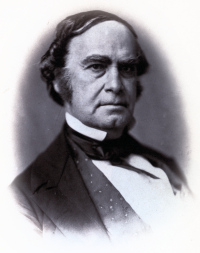
Head Quarters 2nd Regiment Iowa Volunteers
Keokuk, June 2nd 1861
General Order
No. 3.
The roll calls for duty will be as follows :
Revelie at 5 o’clock a.m.
Breakfast at 6’/2 oclock
Surgeons call (For mustering and providing for the sick) at 7 o’clock
Guard Mounting at 8 o’clock.
Dinner at 12 o’clock M.
Evening Parade at 7 o’clock P.M.
Taps (silence and repose throughout the camp) 10 O’c.
Drill–
For convenience of supervision while the companies are in quarters, the Regimental and Company drills will habitually be conducted in the portion of the city limits north of Main street except on Sundays and Saturday afternoons. Company and squad drill to be from 5 ½ o’clock to 6 ½ A.M. and from 8 ½ to 11. A.M. Company drills will again commence at 3 ½ P. M. and be merged into regimental drill at 4 P.M. to be dismissed at the discretion of the Officer Commanding. The Field and Company Officers will personally supervise and direct the drills and all the members of the regiment are expected to dilligently study and practice the profession they have adopted.
The manual of arms will habitually be that of the musket or heavy infantry as shown in the infantry Tactics of May 1st 1861 page 74 to 88. When for change a commander may desire to teach the light infantry or rifle manual he shall give the caution “As Riflemen.”
By order of Saml R Curtis, Co Comdg.
N. P. Chipman Adjutant
Sunday morning mass in camp of 69th N.Y.S.M.
June 1, 2021 Title: Sunday morning mass in camp of 69th N.Y.S.M.
Date Created/Published: [photographed 1 June 1861, printed later]
Medium: 1 photographic print.
Summary: Photograph shows Father Thomas H. Mooney, Chaplain of the 69th Infantry Regiment of the New York State Militia and Irish American soldiers at a Catholic Mass at Fort Cocoran, Arlington Heights, Virginia on June 1, 1861. (Source: The Irish American, June 22, 1861)
Reproduction Number: LC-USZC4-7964 (color film copy transparency) LC-B8184-4132 (b&w film copy neg.)
Rights Advisory: No known restrictions on publication.
Call Number: LOT 4172-C [item] [P&P]
Repository: Library of Congress Prints and Photographs Division Washington, D.C. 20540 USA
…..No. 4132.
…..Civil War Photograph Collection (Library of Congress).
…..Glass copy negative is: LC-B813-3713
Library of Congress permalink
___________
Mike’s notes:
Note – This image has been digitally adjusted for one or more of the following:
– fade correction,
– color, contrast, and/or saturation enhancement
– selected spot and/or scratch removal
– cropped for composition and/or to accentuate subject
The decision of the President was to be final.—John Beauchamp Jones’ Diary
June 1, 2021
JUNE 1st.—In the absence of the Secretary, I arranged the furniture as well as could, and took possession of the five offices I had selected. But no business, of course, could be done before his arrival. Yet an immense mass of business was accumulating—letters by the hundreds were demanding attention.
And I soon found, as the other Secretaries came in, that some dissatisfaction was likely to grow out of the appropriation by the Secretary of War of the best offices. Mr. Toombs said the “war office” might do in any ordinary building; but that the Treasury should appropriately occupy the custom-house, which was fire-proof. For his own department, he said he should be satisfied with a room or two anywhere. But my arrangement was not countermanded by the President, to whom I referred all objectors. His decision was to be final—and he did not decide against it. I had given him excellent quarters; and I knew he was in the habit of having frequent interviews both with the Secretary of War and the Adjutant-General, and this would be inconvenient if they were in different buildings.
“Will the rebels stand up and fight and be crushed, or will they withdraw?”—Horatio Nelson Taft
June 1, 2021
SATURDAY, JUNE 1
Excitement today, fight at Fairfax C.H. this morning, brilliant dash on part of U.S. dragoons. Fighting also below at “Aquia Creek” betwen War Steamers and rebel batteries, firing heard this evening (before dark) over the River. The Artillery practicing, or a fight, every one now on the “qui vive” to hear news from the armies at the different points, Harpers Ferry, Fort Monroe, &c. Will the rebels stand up and fight and be crushed, or will they withdraw? Some think that there will be no general fight. I think there will be more than one, but I do not fear the result. At the “National” after dinner.
The three diary manuscript volumes, Washington during the Civil War: The Diary of Horatio Nelson Taft, 1861-1865, are available online at The Library of Congress.
The Attack upon the Batteries at the Entrance of Acquia Creek, Potomac River, by the United States Vessels ‘Pawnee,’ ‘Yankee,’ ‘Thomas Freeborn,’ ‘Anacosta’ and ‘Resolute, June 1st, 1861
June 1, 2021 (from Frank Leslie’s Illustrated History of the Civil War…, edited by Louis Shepheard Moat, Published by Mrs. Frank Leslie, New York, 1895)
“On May 31st Captain Ward, in command on board of the Thomas Freeborn, and assisted by two more of his gunboats, the Resolute and the Anacosta, began the attack on the Confederate batteries, and after a two hours’ fight, succeeded in silencing the batteries at the landing; but, for wan of long-range ammunition, could not effectually respond to the heavy fire from the heights, and so had to withdraw. The following day, however, with additional aid from the Pawnee and Yankee, the attack was resumed, ant, the batteries were at last silenced and the Confederates compelled to retreat.”
Attack on Aquia Creek Naval Battery
June 1, 2021
Headquarters Department of Fredericksburg,
Fredericksburg, Va., June 1, 1861.
Sir: The enemy attacked the naval battery at Aquia Creek yesterday about 10 a.m. The enemy had three war steamers and some small transports, not containing, however, many troops. They had some long boats or launches; but, so far as observed, made no preparation for landing. The fire on both sides was skillfully directed, and continued up to about 1 p.m., when the steamers hauled off, and, it is supposed, in a partially disabled condition. I took all the available forces, comprising the four companies of infantry and one of cavalry, from this vicinity, and Colonel Bate’s Tennessee (Walker) Legion with me, reaching the Potomac soon after the firing ceased. The conduct of the troops in the batteries—that of Captain Walker, with his 6-pounder rifle-guns, having been brought early into the action—is represented as having been admirable, including the covering and protecting force on the field. I have transferred the Tennessee (Walker) Legion to Brooke’s Station, where I have re-established Camp Jackson. From that point lateral movements may be easily made to cross the coasts, and forward movements to cover the batteries, with great facility.
The ladies are now making tents, cartridges, and belts, and I hope soon to have our forces sheltered and better equipped. I left A quia Creek late last evening, and return there this morning.
Very respectfully, your obedient servant
DANIEL RUGGLES,
Colonel, Provisional Army, Commanding Forces.
Col. R. S. Garnett, Adjutant-General Virginia Forces.
Lieutenant Tompkins, at the Head of B Company. U. S. Dragoons, Charging into the Town of Fairfax Courthouse, in the Face of 1,500 Confederate Troops, June 1st, 1861
June 1, 2021 (from Frank Leslie’s Illustrated History of the Civil War…, edited by Louis Shepheard Moat, Published by Mrs. Frank Leslie,New York, 1895)
“On June 1st, 1861, there was a smart skirmish between B Company, U. S. Dragoons, under Lieutenant Tompkins, and a body of 1,500 Confederates, at Fairfax Courthouse, Va. The Federal cavalry charged into the town,. meeting with a brisk fire from houses on both sides of the street and from all quarters of the town. Lieutenant Tompkins’s horse was shot under him, and falling beneath the animal, he sprained his ankle. After being completely inclosed by the Confederates for a short time Lieutenant Tompkins and his men fought their way out, taking with them seventeen prisoners.”
William Howard Russell’s Diary: Pressure of the blockade.—Money.—Philosophy of abstract rights.—The doctrine of state rights.—Theoretical defect in the constitution.
June 1, 2021
June 1st. The respectable people of the city are menaced with two internal evils in consequence of the, destitution caused by the stoppage of trade with the North and with Europe. The municipal authorities, for want of funds, threaten to close the city schools, and to disband the police; at the same time employers refuse to pay their workmen on the ground of inability. The British Consulate was thronged to-day by Irish, English, and Scotch, entreating to be sent North or to Europe. The stories told by some of these poor fellows were most pitiable, and were vouched for by facts and papers; but Mr. Mure has no funds at his disposal to enable him to comply with their prayers. Nothing remains for them but to enlist. For the third or fourth time I heard cases of British subjects being forcibly carried off to fill the ranks of so-called volunteer companies and regiments. In some instances they have been knocked down, bound, and confined in barracks, till in despair they consented to serve. Those who have friends aware of their condition were relieved by the interference of the Consul; but there are many, no doubt, thus coerced and placed in involuntary servitude without his knowledge. Mr. Mure has acted with energy, judgment, and success on these occasions; but I much wish he could have, from national sources, assisted the many distressed English subjects who thronged his office.
The great commercial community of New Orleans, which now feels the pressure of the blockade, depends on the interference of the European Powers next October. They have, among them men who refuse to pay their debts to Northern houses, but they deny that they intend to repudiate, and promise to pay all who are not black Republicans when the war is over. Repudiation is a word out of favor, as they feel the character of the Southern States and of Mr. Jefferson Davis himself has been much injured in Europe by the breach of honesty and honor of which they have been guilty; but I am assured on all sides that every State will eventually redeem all its obligations. Meantime, money here is fast vanishing. Bills on New York are worth nothing, and bills on England are at 18 per cent, discount from the par value of gold; but the people of this city will endure all this and much more to escape from the hated rule of the Yankees.
Through the present gloom come the rays of a glorious future, which shall see a grand slave confederacy enclosing the Gulf in its arms, and swelling to the shores of the Potomac and Chesapeake, with the entire control of the Mississippi and a monopoly of the great staples on which so much of the manufactures and commerce of England and France depend. They believe themselves, in fact, to be masters of the destiny of the world. Cotton is king–not alone king but czar; and coupled with the gratification and profit to be derived from this mighty agency, they look forward with intense satisfaction to the complete humiliation of their hated enemies in the New England States, to the destruction of their usurious rival New York, and to the impoverishment and ruin of the states which have excited their enmity by personal liberty bills, and have outraged and insulted them by harboring abolitionists and an anti-slavery press.
The abolitionists have said, “We will never rest till every slave is free in the United States.” Men of larger views than those have declared, “They will never rest from agitation until a man may as freely express his opinions, be they what they may, on slavery, or anything else, in the streets of Charleston or of New Orleans as in those of Boston or New York.” “Our rights are guaranteed by the Constitution,” exclaim the South.” “The Constitution,” retorts Wendel Phillips, “is a league with the devil,–a covenant with hell.”
The doctrine of State Rights has been consistently advocated not only by Southern statesmen, but by the great party who have ever maintained there was danger to liberty in the establishment of a strong central Government; but the contending interests and opinions on both sides had hitherto been kept from open collision by artful compromises and by ingenious contrivances, which ceased with the election of Mr. Lincoln.
There was in the very corner-stone of the republican edifice a small fissure, which has been widening as the grand structure increased in height and weight. The early statesmen and authors of the Republic knew of its existence, but left to posterity the duty of dealing with it and guarding against its consequences. Washington himself was perfectly aware of the danger; and he looked forward to a duration of some sixty or seventy years only for the great fabric he contributed to erect. He was satisfied a crisis must come, when the States whom in his farewell address he warned against rivalry and faction would be unable to overcome the animosities excited by different interests, and the passions arising out of adverse institutions; and now that the separation has come, there is not, in the Constitution, or out of it, power to cement the broken fragments together.
It is remarkable that in New Orleans, as in New York, the opinion of the most wealthy and intelligent men in the community, so far as I can judge, regards universal suffrage as organized confiscation, legalized violence and corruption, a mortal disease in the body politic. The other night, as I sat in the club-house, I heard a discussion in reference to the operations of the Thugs in this city, a band of native-born Americans, who at election times were wont deliberately to shoot down Irish and German voters occupying positions as leaders of their mobs. These Thugs were only suppressed by an armed vigilance committee, of which a physician who sat at table was one of the members.
Having made some purchases, and paid all my visits, I returned to prepare for my voyage up the Mississippi and visits to several planters on its banks–my first being to Governor Roman.
Five steamers off Aquia Creek Battery
June 1, 2021
Fredericksburg, Va., June 1, 1861.
Sir: The report has arrived this moment that five of the enemy’s steamers, with two transport ships, one of which is of considerable size, had appeared off Aquia Creek battery, with the evident intention of attacking it. When the train left (11 a.m.), soon after, heavy firing was heard from that point. I am in want of at least one thousand well-disciplined volunteers as soon as it is possible to send them. Twenty thousand musket-rifle caps are absolutely necessary for the use of troops with percussion arms. I go to the battery at once. Communicate with Major Barton, acting assistant adjutant-general, to this office.
DANIEL RUGGLES,
Colonel, Provisional Army.
Col. R. S. Garnett, Adjutant-General.
More Important Arrests
June 1, 2021
The New York Times
June 1, 1861
Baltimore, Thursday, May 30.
Last night four residents of Baltimore County, in the neighborhood of Cockeysville, named Worthington, Matthews, Scott and another whose name is unknown, were arrested by the Federal troops, charged with being in the company that participated with Merriman in his doings, for which he was arrested. They were taken to York, Pennsylvania. They are all influential and respectable citizens.
The Western passenger train on the Baltimore and Ohio Railroad was fired upon about 2 o’clock this morning by the Federal picket-guards about one mile beyond the Relay House. The train was several hours behind time, and it had been rumored that the train was coming with secession troops, hence the guard fired and came near killing some passengers. Several balls passed through the cars.
Vegetables for the Poor.
June 1, 2021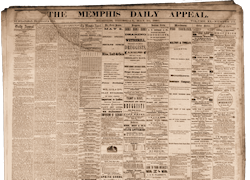
Memphis Daily Appeal
Tennessee
June 1, 1861
Those who attend market with vegetables frequently have some left over, which are spoiled and thrown away before next morning; the city almoner desires us to state that if market people will leave such vegetables at his office, on Second street, east side, four doors north of Madison, he will each day distribute them to the widowed and other poor.
The Cabinet of the Confederate States at Montgomery
June 1, 2021 From Photographs by Whitehurst, of Washington, and Hinton, of Montgomery, Alabama
Attorney General Benjamin, Secretary Mallory, Secretary Memminger, Vice-President Stephens, Secretary Walker, President Davis, Postmaster Reagan, Secretary Toombs.
Harper’s Weekly, June 1, 1861
Important Arrests in Maryland
June 1, 2021
The New York Times
June 1, 1861
Baltimore, Friday, May 31.
Ex-Gov. Pratt was arrested this evening at Annapolis, by order of the Government, and taken to Washington Navy-yard.
It is rumored that Ex-Gov. Lowe has also been arrested.
The Troops that the Traitor Twiggs abandoned—Lieutenant Slemmer and his brother officers—”Southern chivalry” suffered POW U.S. troops to be exposed to starvation
June 1, 2021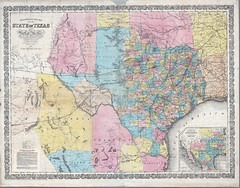
Extract from New York Courier and Enquirer, May 29, 1861.
The remnant of the U. S. troops which the traitor Twiggs abandoned to the tender mercies of the Southern chivalry ”in Texas will arrive here to-day from Havana, and we indulge the hope that somebody will feel it their duty to receive them in a manner worthy of the heroism they have evinced in resisting every conceivable inducement to imitate the conduct of their leader in his treason to the Stars and Stripes. Lieutenant Slemmer arrived at this port on Saturday, and remained until Monday evening; but no more notice was taken of him, his brother officers and soldiers, than if they had done nothing at Pickens to uphold the American flag! If Major Anderson deserved credit and commendation, honors and promotion, for moving his command into Fort Sumter—and no press has lauded that act more than the Courier and Enquirer—then was the conduct of Lieutenant Slemmer in transferring his command to Fort Pickens still more to be commended and still more creditable to the service and the country. Anderson, being ordered to hold and defend a work which he knew was not defensible, disappointed the purposes of the traitor Floyd and occupied a stronger work, where he knew he would be safe. It was a wise and meritorious act, and merited the universal approval which it received. Lieutenant Slemmer was called upon to surrender his command to a force irresistible in numbers, and saw one of the senior officers of the Navy cower before the rebel forces, and, with his brother officers ingloriously pull down the Stars and Stripes and surrender the navy-yard at Pensacola without a blow. He was admonished by his senior and by his example that such also was his duty; but he scouted at yielding, resolved upon resistance, and in defiance of the advice and example of Commodore Armstrong, who should have been driven from the Navy with disgrace, threw himself into Fort Pickens and bid defiance to the rebel force. It was a noble act, and, like Anderson’s at Sumter, worthy of high praise; and even more creditable, because he is a much younger officer than Anderson, was threatened by a much superior force, and was obliged to resist the contaminating influence of the surrender of the navy-yard, its garrison, and all its munitions of war by a senior officer of the navy, without a struggle and with abundant means of defense. By his gallantry he and his handful of brave men saved Fort Pickens to the country, and gave notice that they
were prepared to be starved or to be buried beneath the ruins of the fort, but that never would they surrender it to the rebels or permit their infamous colors to wave over its walls! They redeemed their pledge, have been relieved and came among us on Saturday last. On Monday evening Slemmer and his brother officers left here in pursuit of their families; and although the press announced their arrival, who called to give them a welcome and say Godspeed to the noble young officers and gallant men who had so fearlessly and under such peculiar circumstances sustained the honor of their flag—of our Stars and Stripes— of the banner of the Union, to sustain which a quarter of a million of men are now in arms! [continue reading…]
were prepared to be starved or to be buried beneath the ruins of the fort, but that never would they surrender it to the rebels or permit their infamous colors to wave over its walls! They redeemed their pledge, have been relieved and came among us on Saturday last. On Monday evening Slemmer and his brother officers left here in pursuit of their families; and although the press announced their arrival, who called to give them a welcome and say Godspeed to the noble young officers and gallant men who had so fearlessly and under such peculiar circumstances sustained the honor of their flag—of our Stars and Stripes— of the banner of the Union, to sustain which a quarter of a million of men are now in arms! [continue reading…]
Severe Illness of Senator Douglas
June 1, 2021
The New York Times
June 1, 1861
Chicago, Friday, May 31—9:30 P.M.
Senator Douglas is still gradually sinking. His physicians entertain no hopes of his recovery.
Removal of General Harney.
June 1, 2021
The New York Times
June 1, 1861
St. Louis, Mo., Friday, May 31.
When the McDonald habeas corpus case came up this morning, in the United States District Court, Gen. Harney made the return that Capt. McDonald had been removed to Illinois, and was now in the military command of Gen. McClellan; that he (Harney) had never had the body of the prisoner under his control, consequently he was unable to produce him. Gen. Harney further stated that, by orders from Washington, dated 16th, but only received yesterday, he had been removed from the command of this Department.
It is understood that Gen. Lyon succeeds Gen. Harney.
Extracts from the journal of Commander Semmes, C.S. Navy, commanding C.S.S. Sumter
June 1, 2021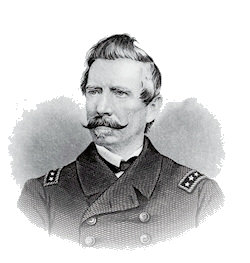
Saturday, June 1, finds us not yet ready for sea. The tanks have all been taken on board and stowed; the gun carriages for the 32’s will be finished on Monday. The circles for the 8 -inch have been laid down and the fighting bolts are ready for placing. On Monday I shall throw the crew on board, and by Thursday next I shall without doubt be ready for sea. In the meantime both the practicable passes are blockaded, the one by the Brooklyn and the other by the Powhatan, but fortune will favor us and we shall run by.
Effects of Rebellion in Portsmouth and Norfolk
June 1, 2021
The New York Times
June 1, 1861
The prostration of business at Portsmouth and Norfolk is most thorough and complete. The Navy-yard, the truck trade, and naval stores, on which the business and almost existence of the two cities is based, have ceased, and were it not for the abundance of vegetables and fish, there would be much suffering among the poor. The truck gardeners are giving away their peas and strawberries to any one who will take the trouble of gathering them. A great many of the immense pea-fields have been plowed in for the purpose of planting corn. The crop of garden truck and strawberries shipped to Baltimore, New-York and Philadelphia last year, during May and June, yielded $400,000, and the yield this year was confidently expected to amount to not less than $600,000.
An interesting offer from Hayti1
June 1, 2021
Haytian Bureau of Emigration,
No. 8 Washington Building, 221 Washington Street,
Boston, June 1, 1861.
Hon. Simon Cameron,
Secretary of War of the United States:
Sir: I notice that since the decision of your Department that “the slaves held by rebels who may seek protection in our camps are to be reported as contraband articles of war” has been published, a great number of negroes have flocked to the fortresses, forts, and war headquarters of our troops now stationed in the rebellion States. Since the number of these contraband articles will soon become too great to be employed in the labors of intrenching, & c ., and must occasion great embarrassment to the troops, I take the liberty of making two suggestions to you, and of offering at the same time to carry them out without expense for my personal services to the Government of the United States:
First. The establishment of a central station, to which all living contraband articles (of a black and colored complexion), who may not be needed by the regiments from whom they seek protection, shall be sent until the war is over, or until the Cabinet may decide what final disposition to make of them.
Second. The shipment of all such said articles to Hayti as by the conduct of their former holders, or the decision of the Cabinet, may be declared free to the Republic of Hayti.
As a citizen of the United States I offer to superintend free of charge such a central station as is here recommended. As the agent of the Government of Hayti I offer to provide every negro whom you may confiscate with a comfortable home and a farm in Hayti.
Respectfully submitted.
JAMES REDPATH.
- In 1860, James Redpath, an American journalist and anti-slavery activist, toured Haiti as a reporter and returned to the United States as the official Haitian lobbyist for diplomatic recognition, which he secured within two years. He simultaneously served as director of Haiti’s campaign to attract free black emigrants from the United States and Canada. His Guide to Hayti (1860) is an anthology of articles by various authors on a wide range of Haitian subjects. Redpath hoped that immigration of skilled blacks to Haiti would elevate conditions there and dispel racial prejudice in the United States. After the Civil War, he abandoned his ideas when he recognized that North American blacks preferred to remain at home. (Read more at Wikipedia)
“For the troops.”—Woolsey family letters, Abby to her sister Eliza.
June 1, 2021
Abby Howland Woolsey to Eliza Woolsey Howland
0 comments
June 1, 1861.
Dear Eliza: We had a funny communication from Theodore Winthrop this morning written at Fortress Monroe, where he is acting as Military Secretary to Major General Butler, in the very middle of the middle of things– “Headquarters Department of Virginia.” He tells about the negroes who are flocking to them, and begs that on the sly we will manage a patriotic job for them–get some sort of kepi, turban or headgear, which shall make them more respectable to look at and more formidable to the enemy. Of course, General Butler is to know nothing of it officially, but since the poor ragged fellows must be clothed they will be glad to have a sort of coarse uniform for them–shirt, trousers and cap–if the ladies will do it privately, and forward to Fortress Monroe.
Last night and night before G. and I each made three havelocks, and Georgy is going to take them down to the Battery Encampment and distribute the six to the six men who fled the hospital. They, at least, must be supplied, as they had had inflamed eyes already from wearing the hot caps. If the Fishkill ladies want work say there is a demand for 3,000 havelocks, 3,000 grey flannel shirts and 3,000 grey or red drawers, and more will be needed. Those are needed today.
Yesterday Charley went about a good deal trying to find a room as a depot for receiving and distributing books and magazines for the troops. He had seen one or two notices on the subject in the papers, but last night’s Post showed us that some gentlemen of the Evangelical Alliance are already in the field.
Regulating the Town
June 1, 2021
The Constitutional
Alexandria, Louisiana
June 1, 1861
Some miscreants, on the night of Friday last, taking advantage of the absence of the patrol, consequent on the great fatigue undergone by all on that day, committed various nocturnal depredations, such as tearing down fences and letting cattle into honest citizens enclosures, carrying away vehicles, up-turning and breaking the same, tearing gates which were locked, from their hinges, breaking sign-boards, &c., &c., and with more diabolical cunning than success, tried to charge these mid-night depredations on the members of the Hope Fire Company. We trust the public is aware that the mission of this gallant company is, protection to all good citizens in their person and property, and that under their future title of the “Alexandria Hope Defencibles,” they will evince their readiness to do so on all occasions.
A man who is supposed to know the parties concerned in “Friday night’s transactions”— but, who refuses to give names until compelled to do so by the proper authorities, exonerates this company from any participation in it.