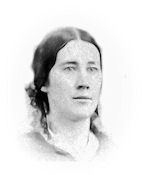
“No particular demonstration has yet taken place on the other side of the River, but there are frequent alarms over there…”—Horatio Nelson Taft

Diary of US patent clerk Horatio Nelson Taft.

TUESDAY 4

Cooler today with some rain. In the office nearly alone all day. The Highland Regt arrived early this morning (2 or 3 o’clock). They march through the Ave playing the “The Campbells are Coming.” They have a fine Band of music. No particular demonstration has yet taken place on the other side of the River, but there are frequent alarms over there and some of the Regts are called out sometimes twice in a night. They all sleep on their Arms. I was at Willards, some 250 Govt cavalry horses were driven by.

______

The three diary manuscript volumes, Washington during the Civil War: The Diary of Horatio Nelson Taft, 1861-1865, are available online at The Library of   Congress.

0 comments

The War Spirit South

News of the Day

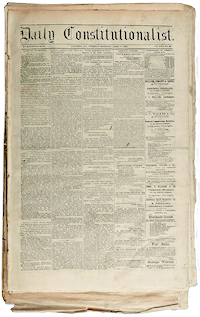
Daily Constitutionalist
Augusta, Georgia
June 4, 1861

A letter from a late Union man of Texas to a New York Journal says:
I have seen it stated in Northern papers that men were forced unwillingly to join the ranks of the Confederate army. I deny it in toto. Let not our Northern invaders flatter themselves that they are about to meet an unwilling foe. They will find men who have grasped the sword and musket in defense of their homes, their firesides, and their property. The spirit of ’76 is abroad throughout the South, and I would proclaim in thunder tones, “Men of the North, you cannot subdue us. You may perhaps exterminate us, but I will guarantee that when the extermination shall be complete there will be but few left to exult in the ruin they have caused.” In the company which I have joined, out of one hundred and four men there are sixty seven Northern born and raised, and nearly the same proportion exists in the other companies. These have all joined voluntarily, and will fight to the death to repel the Northern invader. If time and space permitted I could fill a volume on this subject, but I want the fighting masses of the North to understand that they will have no child’s play. We will contest every inch of ground, and their advance can only be made over our dead bodies and through rivers of our blood.
0 comments

Civil War Day-By-Day

Civil War Day-by-Day

June 4, 1861

  • Delegates to the Second Wheeling Convention are selected.
0 comments

A Few Letters and Speeches of the Late Civil War by DNC Chairman August Belmont

Civil War Day-by-Day

To The Right Hon. Lord DUNFERMLINE,

House of Lords, London.

New York, June 3, 1861

My Dear Lord Dunfermline,–The friendly relations which have existed during several years between us, and which I shall always cherish among the bright recollections of my sojourn at the Hague, induce me to address you this letter, for which I crave your kind and favorable consideration.

The unfortunate position into which a few reckless and selfish politicians, aided by the weakness of our late national administration, have thrown this country, is at this moment directing the serious attention of the British government and people toward us. Knowing your warm and active sympathy, and that of your noble and influential family, for the cause of constitutional liberty, I am sure that you are among those who watch with intense interest the phases of the dark drama which is now enacting on this continent, between the United States, struggling for their national existence, and a rebellious faction, attempting to overthrow our free institutions, in order to plant slavery on the whole American continent.

From the tenor of the English press, and the debates in Parliament, I am inclined to believe that there exists a serious misapprehension in the minds of your government and people in regard to the nature of the Southern rebellion, and the chances of its success.

If you allow me, I will give you my views on the present position of affairs here, in as short a space as the form of a letter, and my desire not to bore you with a lengthy epistle, will permit. I may claim that these views, however erroneous and imperfect they may prove, have at least the merit of fairness and impartiality. My politics have always been opposed to the party now in power, the advent of which has been used by the leaders of the Southern conspiracy as a watchword for an overthrow of our government. I was, and am, opposed to an useless agitation of the slavery question, and any infringement of the Constitutional rights of the South, under a fair and liberal construction, and am equally hostile to the anti-free-trade proclivities of the present administration.

You are doubtless aware that the so-called Republican (anti-slavery) party which is now in power, was first able to claim the position of a national party in 1854, in consequence of the daily increasing aggressions and demands of the pro-slavery oligarchy, which had gained the control of the executive and legislature of the Federal government. The dastardly assault upon Senator Sumner, from Massachusetts, provoked as it undoubtedly was by the violent language of that senator, and the fraud and violence with which the pro-slavery party attempted to force a slavery constitution upon the new State of Kansas, drove hundreds of thousands throughout the North into the ranks of the new party.

In 1856 that party, for the first time, put a candidate for the Presidency in nomination, upon the avowed doctrine of preventing the extension of slavery to our western Territories. Mr. Fremont was then defeated by Mr. Buchanan, who enjoyed the confidence of a very large majority of the conservative and influential portion of the country, and in whose sagacity, experience, and familiarity with public affairs, everybody hoped for a strong government, and for the suppression of the seditious cry of disunion which had been raised by the political leaders of the South ever since the formation of the Republican party.

In these expectations the country was sadly disappointed. Mr. Buchanan threw himself from the very outset into the arms of the very men who are now the rebel leaders of the South. His cabinet, chosen under such influences, sympathized, with one single exception, and was in secret league with the conspirators, giving them during the last four years ample time, means, and influence, in order to prepare their treasonable machinations.

The Secretary of War, convicted since his retirement of actual treason and fraud, had placed all the Federal forts in the South, and an immense quantity of arms, within their reach, so that when the time had come for them to throw down the mask they were enabled to give to their movement an appearance of strength and probability of success, which evidently has deceived public opinion in England.

Upon the first outbreak of secession, and when it was confined to the cotton States, there was also a large party at the North which was in favor of compromise measures, in order to bring the seceding States back to their allegiance. When these failed against the uncompromising attitude of the extremists South and North, they even went so far as to advocate a peaceable separation of the cotton States, convinced that the latter, when once out of the Union, would soon discover how fearfully they had been deceived by their selfish and designing leaders, and that they would be but too glad after a year or so to return into the confederacy.

The attack against Fort Sumter, the treachery of Virginia and North Carolina, and the conduct of Jeff. Davis, have, however, since then, produced a revolution in the public mind of the North, of the strength, intensity, and unanimity of which it would be impossible for me to convey to you even the faintest idea.

The people of the North see now revealed to them, in all their horrid nakedness, the treasonable schemes of the slavery oligarchy, who, while pretending to battle for their threatened Constitutional rights, have dragged the country to this fearful condition, for no other purpose but to insure to themselves the continuance of that power which they have wielded for the last forty years, and to fasten slavery, as a political element, upon this country. The North feels that to admit the right of secession claimed by the revolted States, would be forever to renounce our existence as a nation, and that a peaceful separation of fifteen slave States on one side, and seventeen free States on the other, divided only by an imaginary geographical line, must soon be followed by war and strife, however much treaties and diplomacy might attempt to prevent it. Besides, can it be expected that the powerful North and Northwest, with a hardy and industrious population of twenty-one millions of freemen, would quietly relinquish the mouth of the Mississippi, and all the seaports, from the Chesapeake to the Rio Grande, into the possession of a foreign nation, ruled by unscrupulous and reckless politicians, who, for the sake of their odious domestic institution, and upon the strength of their cotton monopoly, would disregard and violate treaty-stipulations, whenever it would suit their convenience.

With a due appreciation of these considerations, it cannot be doubted that no sacrifice will be too great for the people of the North in support of their government, and the maintenance of the integrity of their country. We are all united, while we know that in Virginia, Tennessee, and Alabama, a very considerable portion of the inhabitants are openly in favor of the Union, and we have good reason to suppose that a very numerous minority in the other cotton States, with the exception, perhaps, of South Carolina, is opposed to secession.

The contest must end in the victory of the government, but I fear that the position of neutrality taken by your government, which raises the rebels to the dignity of belligerents, will give them a moral support only calculated to prolong the war and its horrors.

We had hoped for the active sympathy and support of the British government and people, in our struggle against the spread of the institution of slavery, and against a rebellion, which, by the confession and boast of its leaders, is based upon that institution as its principal element of power.

We could not, of course, expect a direct interference of your government in our intestine quarrel, but we thought that, as they had heretofore done in the case of Greece, Italy, and Spain, the British people would be allowed to follow their noble instincts for freedom and constitutional liberty, and that the anti-slavery cause, which had always been so warmly advocated in England, would now find means, money, and men, in its dark hour of trial, to assist us against the most unjustifiable and criminal rebellion which has ever disgraced the annals of history.

These hopes have been most sadly disappointed by the proclamation of the Queen, declaring strict neutrality between the government of the United States and a portion of its citizens in rebellion against that government. It has, however, in no way lessened the determination of the United North to fight for the restoration of the integrity of their government to the last man. With the preponderance of men and resources which we possess over the South, the final result can only be a question of time; but if the British government desires, as it undoubtedly must, to see the length and horrors of this fratricidal war diminished, its true policy must be to avoid any thing which in the remotest way can give aid and comfort to the seceded States.

Our government has given, by one of the first acts of the new administration, its consent to the first article of the declaration of the Paris Conference on the right of neutrals, abolishing privateers. With its consent, all the maritime powers of the world have now united in declaring privateering piracy, and I hope sincerely that this progress in civilization and humanity will be secured by the acceptance of the consent of my government, notwithstanding that we were somewhat slow in making up our mind.

I trust, also, that the restrictions imposed by the Queen’s proclamation, by which British merchant-vessels are prohibited from carrying arms and munitions of war to either of the belligerents, may be repealed.

The Southern ports being blockaded by our navy, this restriction results of course to the direct advantage of the rebels, and prevents, moreover, your shipowners and manufacturers from realizing a legitimate profit by the manufacturing and carrying of English arms to our ports.

During the Crimean war, notwithstanding the strict neutrality of our government, our merchant-ships and steamers were chartered by the English and French authorities, for the carrying of troops and arms to the Crimea, and large numbers of arms were manufactured here, and sent in American vessels to England.

Our government did not interfere with its ship-owners and manufacturers in the lawful pursuit of their trade, and as the Russian ports were then in the same position as our Southern ports are at present, the neutral course of the United States resulted to the advantage of the allies.

I hope, my dear Lord Dunfermline, that you will excuse this very lengthy epistle, and I trust that your powerful influence will be exerted in favor of the cause of right, justice, and freedom. Your position in the House of Lords, and your intimate relations with Lord John Russell, give a peculiar weight to any steps you may feel induced to take in this important question.

The cordial good feeling of our people for Great Britain, and their deepfelt love and respect for the Queen, will be very much strengthened by an evidence of sympathy on the part of the British nation and government for our cause, which is that of justice and humanity.

If you have sufficient leisure left to let me hear from you, I shall be much gratified, and if I can learn from you that I have not in vain advocated the cause of my country, it will be a source of pride and happiness to me.
0 comments

The Fight at Philippi, Va., June 3d, 1861

Miscellaneous document sources

The Fight at Philippi, Va., June 3d, 1861—The United States Troops under Command of Colonel Dumont, Supported by Colonels Kelley and Lander, and the Confederates under Colonel Porterfield

(from Frank Leslie’s Illustrated History of the Civil War…, edited by Louis Shepheard Moat, Published by Mrs. Frank Leslie, New York, 1895)

“Acting under instructions from Brigadier General Morris, the Federal troops were arranged in two columns, one commanded by Colonel B. F. Kelley and the other by Colonel E. Dumont. It was agreed that Colonel Kelley’s command should proceed along the Beverly Turnpike, above Philippi, with the view of engaging Colonel Porterfield’s rear, by Colonel Dumont’s column would simultaneously open fire from the heights overlooking the village. Colonel Kelley being delayed by a treacherous guide, Colonel Dumont made a dash upon the Confederate pickets, carrying consternation in their ranks and capturing the barricaded bridge across the river. Colonel Kelley then arrived and pursued the fugitives through the streets of Philippi until he was badly wounded.”

0 comments

Engineer Company, 8th New York State Militia, Arlington, Va., June, 1861

Library of Congress

Engineer Company, 8th New York State Militia, Arlington, Va., June, 1861Title: Engineer Company, 8th New York State Militia, Arlington, Va., June, 1861
Date Created/Published: photographed 1861, [printed between 1880 and 1889]
Medium: 1 photographic print on card mount : albumen.
Reproduction Number: LC-DIG-ppmsca-34581 (digital file from original item) LC-B8184-B531 (b&w film copy neg.)
Rights Advisory: No known restrictions on publication.
Call Number: LOT 4190-E, no. 33 [P&P]
Repository: Library of Congress Prints and Photographs Division Washington, D.C. 20540 USA
Notes:
….No. B531.
….Title from item.
….Gift; Col. Godwin Ordway; 1948.

Library of Congress catalog image
___________
Mike’s notes:

Note – This image has been digitally adjusted for one or more of the following:
– fade correction,
– color, contrast, and/or saturation enhancement
– selected spot and/or scratch removal
– cropped for composition and/or to accentuate subject

0 comments

Capture of the “Savannah” by the “U.S.S. Perry”, 1861

Miscellaneous document sources
Capture of the Privateer Savannah by the USS Perry
National Gallery of Art, Washinton, D.C.
Medium: oil on canvas
Dimensions
overall: 59 x 91.2 cm (23 1/4 x 35 7/8 in.)
framed: 69.9 x 101.6 x 7 cm (27 1/2 x 40 x 2 3/4 in.)
Credit Line: Gift of Edgar William and Bernice Chrysler Garbisch
Accession Number: 1967.20.2
Artists/Makers: Fritz Müller (painter) American, 1814 – 1861 or after
Provenance: Recorded as from New York. (David Hollander, New York City), by whom sold in 1960 to Edgar William and Bernice Chrysler Garbisch; gift to NGA, 1967.

___________
Mike’s notes:

Note – This image has been digitally adjusted for one or more of the following:
– fade correction,
– color, contrast, and/or saturation enhancement
– selected spot and/or scratch removal
– cropped for composition and/or to accentuate subject

0 comments

“I think that the rebels are approaching our lines in force.”—Horatio Nelson Taft

Diary of US patent clerk Horatio Nelson Taft.

MONDAY, JUNE 3, 1861.

Hot day. M. 88 — considerable excitement in the City. People seem to feel and think that affairs on the other side of the River as well as at other points are approaching a crisis. Troops are coming in and moveing over the river every day. We can see the tents of the encampments on the other side with the naked eye. Tonight, bright flashing signals were made from there about 10 & 11 o’clock, and answered from the City. I think that the rebels are approaching our lines in force. We did not go to bed till late, watching the lights and listening.

______

The three diary manuscript volumes, Washington during the Civil War: The Diary of Horatio Nelson Taft, 1861-1865, are available online at The Library of   Congress.

0 comments

Journalism in Secessiondom

New York Times
The New York Times
June 3, 1861
The everyday literature of a people is said to be an index to its civilization. “Show me the leading newspapers of a nation,” said Daniel Webster, “and I Will tell you its status, without referring to its history.” Judged by this standard, the civilization of some of the Southern States is certainly peculiar; a strange mixture of grossness and self-sufficiency—vituperative and egotistical to a ridiculous excess. Take the Memphis Avalanche as an example. The Avalanche, a leading paper of Tennessee, thus discourses of the Government at Washington.
“But what contemptible, spavined, broken-winded Rump of a Government is this that undertakes to beard the British Lion. There was a time when it might talk thus—when it had Southern men to fight its battles—but that day is past.”
A curious civilization looks out from every word and line of this short paragraph, and this is in keeping with that evinced by the Press throughout the South. Brave men are generally calm, always courteous in speech and modest in demeanor. It is your coward who is vituperative and egotistical. Brave men never deal in vulgar epithets. It is your coward who scolds, and blusters of his own prowess.
0 comments

Munitions suggestions and request for instructions from the Ordinance Office

War of the Rebellion: from the Official Records of the Union and Confederate Armies and Navies
Ordnance Office,
Washington, June 3, 1861.
Hon. Simon Cameron,
Secretary of War:
Sir: This office not having received any official information as to the entire military force which will be in service, and such information being essential for making its preparations to supply the stores which it is its province to furnish, proposes to assume as a basis an aggregate force of 250,000 men of all arms, cavalry, artillery, and infantry, and to give orders for providing the requisite supplies, and to make its estimates accordingly. Your instructions on this subject, either on the specified basis or such other as you may designate, are requested. In connection with this matter of providing supplies for arms, &c. , I deem it proper to report that I suggested, some five weeks since, when my views on this subject were requested, the propriety of obtaining from abroad from 50, 000 to 100,000 small-arms and eight batteries of rifled cannon, a note of which was taken at the time, but I have not been advised whether any measures have been taken to carry out that suggestion.
Respectfully, &c.,
JAS. W . RIPLEY,
Lieutenant-Colonel of Ordnance.
0 comments

A Prize Capture

War of the Rebellion: from the Official Records of the Union and Confederate Armies and Navies
Abstract of log of U. S. brig Perry, Lieutenant E.G. Parrott, U. S. Navy, commanding.
June 3, 1861.—(Latitude, 32°47′; longitude, 78°52′.) Boarded Bremen bark Copernicus, bound for Baltimore. She certified that she had been boarded by the Minnesota and warned not to enter any port south of the Chesapeake. At 2 saw light-house bearing N.W.by W. At 4 discovered a brig and a schooner; schooner a mile astern of brig. At 4:40 p.m., movements of the schooner being suspicious, gave chase to her. At 5 saw that schooner had a gun. At6:10 schooner hoisted colors and kept them up only for a moment, but we could not make them out. At 7:15 fired a shot ahead of her, but she showed no colors. At 7:50, it being quite dark and the brig out of sight, opened fire on the schooner, which she returned. Several of her shot passed over us. At 8:10 schooner ceased firing and we lost sight of her for a moment. It proved that she had lowered her sails to slow her submission. Wore around and passed near her without firing, asking if she had surrendered. Sent a boat on board of her with Lieutenant J. N. Miller; returned, bringing her captain, several officers, and the captain of the brig Joseph, of Rockland, Me., which brig had been captured by the schooner and was the vessel seen near her. At 12 m. she followed us, under the charge of Master’s Mate Palmer and 6 men. Found the prize to be the privateer Savannah, of Charleston, S. C., Captain T. H. Baker, sailing under a letter of marque, signed by Jefferson Davis. She left Charleston the 2d of June on her first cruise. During the action expended 14 shell and 2 round shot.
0 comments

News from the South

New York Times

The New York Times
June 3, 1861

According to the New Orleans Delta, the State of Louisiana had in the field on the 25th ult., 7,350 men, besides 4,000 in camp, awaiting orders, and 5,000 armed and equipped for home protection.
Col. Van Dorn has by letter informed a committee of the citizens of Corpus Christi, that at an early day he will place troops on the Rio Grande frontier, for its ample protection.
Four steamers passed Vicksburgh on the 23d, with Confederate troops from New-Orleans for Fort Smith, Arkansas, to be commanded by Brig.-Gen. Ben McCulloch.
The convicts in the Virginia Penitentiary are now employed in making gun carriages, wagons, axes, picks, flannel shirts, cloth for uniforms, army shoes, tents, wheelbarrows, and litters for the wounded.
The ladies of Goliad, Texas, have organized a company to practice the use of firearms.
Col. Gaines, of Brazona, offers to be one of twenty to raise $50,000 in land, to be given to the soldiers from that county who may be engaged in any battle for the Confederate States.
It is stated that a vessel (the Eliza Bonsall) has safely arrived at Savannah, from Europe, with rifled cannon.
The Mobile Tribune is informed that an agent of the French Government is now in that city for the purpose of obtaining facts relative to the condition of the South.
The same paper announces the arrival in Montgomery on the 24th of three Peace Commissioners from Maryland.
The Government clerks at Montgomery received orders to prepare to remove to Richmond by Wednesday or Thursday of this week.
0 comments

Extracts from the journal of Commander Semmes, C.S. Navy, commanding C.S.S. Sumter

War of the Rebellion: from the Official Records of the Union and Confederate Armies and Navies
Monday, June 3.—Filled the tanks and received the crew on board. The 32-pounder carriages not yet ready, but promised us for to -morrow.
0 comments

William Howard Russell’s Diary: Ride through the maize-fields.—Sugar plantation; negroes at work.— Use of the lash.—Feeling towards France.—Silence of the country.— Negroes and dogs.

My Diary North and South – William Howard Russell

June 3rd. At five o’clock this morning, having been awakened an hour earlier by a wonderful chorus of riotous mocking-birds, my old negro attendant brought in my bath of Mississippi water, which, Nile like, casts down a strong deposit, and becomes as clear, if not so sweet, after standing. “Le seigneur vous attend;” and already I saw, outside my window, the Governor mounted on a stout cob, and a nice chestnut horse waiting, led by a slave. Early as it was, the sun felt excessively hot, and I envied the Governor his slouched hat as we rode through the fields, crisp with dew. In a few minutes our horses were traversing narrow alleys between the tall fields of maize, which rose far above our heads. This corn, as it is called, is the principal food of the negroes; and every planter lays down a sufficient quantity to afford him, on an average, a supply all the year round. Outside this spread vast fields, hedgeless, wall-less, and unfenced, where the green cane was just learning to wave its long shoots in the wind–a lake of bright green sugar-sprouts, along the margin of which, in the distance, rose an unbroken boundary of forest, two miles in depth, up to the swampy morass, all to be cleared and turned into arable land in process of time. From the river front to this forest, the fields of rich loam, unfathomable, and yielding from one to one and a half hogsheads of sugar per acre under cultivation, extend for a mile and a half in depth. In the midst of this expanse white dots were visible like Sowars seen on the early march, in Indian fields, many a time and oft. Those are the gangs of hands at work–we will see what they are at presently. This little reminiscence of Indian life was further heightened by the negroes who ran beside us to whisk flies from the horses, and to open the gates in the plantation boundary. When the Indian corn is not good, peas are sowed, alternately, between the stalks, and are considered to be of much benefit; and when the cane is bad, corn is sowed with it, for the same object. Before we came up to the gangs we passed a cart on the road containing a large cask, a bucket full of molasses, a pail of hominy, or boiled Indian corn, and a quantity of tin pannikins. The cask contained water for the negroes, and the other vessels held the materials for their breakfast; in addition to which, they generally have each a dried fish. The food was ample, and looked wholesome; such as any laboring man would be well content with. Passing along through maize on one side, and cane at another, we arrived at last at a patch of ground where thirty-six men and women were hoeing.

Three gangs of negroes were at work: one gang of men, with twenty mules and ploughs, was engaged in running through the furrows between the canes, cutting up the weeds and clearing away the grass, which is the enemy of the growing shoot. The mules are of a fine, large, good-tempered kind, and understand their work almost as well as the drivers, who are usually the more intelligent hands on the plantation. The overseer, a sharp-looking creole, on a lanky pony, whip in hand, superintended their labors, and, after a salutation to the Governor, to whom he made some remarks on the condition of the crops, rode off to another part of the farm. With the exception of crying to their mules, the negroes kept silence at their work.

Another gang consisted of forty men, who were hoeing out the grass in Indian corn. The third gang, of thirty-six women, were engaged in hoeing out cane. Their clothing seemed heavy for the climate; their shoes, ponderous and ill-made, had worn away the feet of their thick stockings, which hung in fringes over the upper leathers. Coarse straw hats and bright cotton handkerchiefs protected their heads from the sun. The silence which I have already alluded to, prevailed, among these gangs also–not a sound could be heard but the blows of the hoe on the heavy clods. In the rear of each gang stood a black overseer, with a heavythonged whip over his shoulder. If “Alcíbíade” or “Pompée” were called out, he came with outstretched hand to ask “How do you do,” and then returned to his labor; but the ladies were coy, and scarcely looked up from under their flapping chapeaux de paille at their visitors.

Those who are mothers leave their children in the charge of certain old women, unfit for anything else, and “suckers,” as they are called, are permitted to go home, at appointed periods in the day, to give the infants the breast. The overseers have power to give ten lashes; but heavier punishment ought to be reported to the Governor; however, it is not likely a good overseer would be checked, in any way, by his master. The anxieties attending the cultivation of sugar are great, and so much depends upon the judicious employment of labor, it is scarcely possible to exaggerate the importance of experience in directing it, and of power to insist on its application. When the frost comes, the cane is rendered worthless– one touch destroys the sugar. But if frost is the enemy of the white planter, the sun is scarcely the friend of the black man. The sun condemns him to slavery, because it is the heat which is the barrier to the white man’s labor. The Governor told me that, in August, when the crops are close, thick set, and high, and the vertical sun beats down on the laborers, nothing but a black skin and head covered with wool can enable a man to walk out in the open and live.

We returned to the house in time for breakfast, for which our early cup of coffee and biscuit and the ride had been good preparation. Here was old France again. One might imagine a lord of the seventeenth century in his hall, but for the black faces of the servitors and the strange dishes of tropical origin. There was the old French abundance, the numerous dishes and efflorescence of napkins, and the long-necked bottles of Bordeaux, with a steady current of pleasant small talk I saw some numbers of a paper called La Misachibée, which was the primitive Indian name of the grand river, not improved by the addition of sibilant Anglo-Saxon syllables.

The Americans, not unmindful of the aid to which, at the end of the War of Independence, their efforts were merely auxiliary, delight, even in the North, to exalt France above her ancient rival; but, as if to show the innate dissimilarity of the two races, the French creoles exhibit towards the New Englanders and the North an animosity, mingled with contempt, which argues badly for a future amalgamation or reunion. As the South Carolinians declare, they would rather return to their allegiance under the English monarchy, so the Louisianans, although they have no sentiment in common with the people of republican and imperial France, assert they would far sooner seek a connection with the old country than submit to the yoke of the Yankees.

After breakfast, the Governor drove out by the ever-silent levee for some miles, passing estate after estate, where grove nodded to grove, each alley saw its brother. One could form no idea, from the small limited frontage of these plantations, that the proprietors were men of many thousands a year, because the estates extend on an average for three or four miles back to the forest. The absence of human beings on the road was a feature which impressed one more and more. But for the tall chimneys of the factories and the sugar-houses, one might believe that these villas had been erected by some pleasure-loving people who had all fled from the river banks for fear of pestilence. The gangs of negroes at work were hidden in the deep corn, and their quarters were silent and deserted. We met but one planter, in his gig, until we arrived at the estate of Monsieur Potier, the Governor’s brother-in-law. The proprietor was at home, and received us very kindly, though suffering from the effects of a recent domestic calamity. He is a grave, earnest man, with a face like Jerome Bonaparte, and a most devout Catholic; and any man more unfit to live in any sort of community with New England Puritans one cannot well conceive; for equal intensity of purpose and sincerity of conviction on their part could only lead them to mortal strife. His house was like a French chateau erected under tropical influences, and he led us through a handsome garden laid out with hothouses, conservatories, orange-trees, and date-palms, and ponds full of the magnificent Victoria Regia in flower. We visited his refining factories and mills, but the heat from the boilers, which seemed too much even for the all-but-naked negroes who were at work, did not tempt us to make a very long sojourn inside. The ebony faces and polished black backs of the slaves were streaming with perspiration as they toiled over boilers, vat, and centrifugal driers. The good refiner was not gaining much money at present, for sugar has been rapidly falling in New Orleans, and the 300,000 barrels produced annually in the South will fall short in the yield of profits, which on an average may be taken at £11 a hogshead, without counting the molasses for the planter. With a most perfect faith in States Rights, he seemed to combine either indifference or ignorance in respect to the power and determination of the North to resist secession to the last. All the planters hereabouts have sown an unusual quantity of Indian corn, to have food for the negroes if the war lasts, without any distress from inland or sea blockade. The absurdity of supposing that a blockade can injure them in the way of supply is a favorite theme to descant upon. They may find out, however, that it is no contemptible means of warfare.

At night, there are regular patrols and watchmen, who look after the levee and the negroes. A number of dogs are also loosed, but I am assured that the creatures do not tear the negroes; they are taught “merely” to catch and mumble them, to treat them as a well-broken retriever uses a wounded wild duck.

0 comments

“And troops are beginning to arrive in considerable numbers.”—John Beauchamp Jones’ diary.

Civil War Day-by-Day

JUNE 3d.—The Secretary arrived to-day, sick; and was accompanied by Major Tyler, himself unwell. And troops are beginning to arrive in considerable numbers. The precincts of the city will soon be a series of encampments. The regiments are drilled here, and these mostly forwarded to Manassas, where a battle must soon occur, if the enemy, now in overwhelming numbers, should advance. The Northern papers say the Yankee army will celebrate the 4th of July in Richmond. Nous verrons. But no doubt hostilities have commenced. We have accounts of frightful massacres in Missouri, by German mercenaries. Hampton has been occupied by the enemy, a detachment having been sent from Fortress Monroe for that purpose. They also hold Newport News on the Peninsula. There are rumors of a fight at Philippi. One Col. Potterfield was surprised. If this be so, there is no excuse for him. I think the President will make short work of incompetent commanders. Now a blunder is worse than a crime.

0 comments

Two Missing Dragoons Rescued from Fairfax Courthouse

New York Times

The New York Times
June 3, 1861

Washington, Sunday, June 2.
A gentleman direct from the immediate vicinity of Fairfax Court-house shows that during last night word came into the camp of the Twenty-eighth NewYork Regiment that the two dragoons missing from Company B, which made the sally on Fairfax Courthouse on Saturday morning, were captured by the rebels, and were to be hung this morning. Company B was immediately summoned from their quarters, and mounting, rode up to the Court house, and having by some means ascertained the precise location of their comrades, made a dash through the village, and recovered the two men, whom they brought back in triumph to the camp at daybreak.
Five Confederate prisoners, from the Court-house, have been brought hither; one of them a son of the late Major WASHINGTON, of the Army. He said he did not want to fight against the United States, and made amends by taking the oath of allegiance. The other four refused to subscribe to it, and were detained.
0 comments

As far as possible appointments should be made from the graduates of the Military Academy to military positions.

The Letters of Samuel Ryan Curtis

Head Quarters 2nd Regt. Iowa Volunteers
Keokuk June 3. 1861

Hon S Cameron
Secy of War

Dr Sir

It is needless for me to suggest that as far as possible appointments should be made from the graduates of the Military Academy to military positions. Your recent order to Governors in this respect will do good. The constitution of this State intervenes and requires every officers election. Still in the volunteers the experienced or educated men who are otherwise qualified are generally preferred. I received the unaminous vote of the first 3 year regiment for Colonel. But beyond this I respectfully suggest that appointments to a prospective increase of the army should be made from those who have become enrolled and now show fitness and fidelity worthy of consideration. Such a rule may have exceptions, but it would help secure good material and give encouragement to those in the service.

I find most of those who fail before the people are pressing their claims before the Department and I very much doubt the propriety before appointing such men to a prospective increase of regulars when the chances are you will neither secure better officers nor better men. You have gone so far in the volunteer mode of enrollment, and been so successful, I think the [illegible] way will be to mold the volunteers into regulars & retain such as you need as long as circumstances require.

The difference between a volunteer for 5 years and a regular for 5 years would only be in the mode of appointing officers, and this can be so modified as to secure proper places to all the educated material our schools afford.

Very Respectfully
Yr Obt Servt
Saml R. Curtis

[copy]

0 comments

“Imagine a line of pot-bellied, round-shouldered respectabilities of fifty or thereabouts standing in two rows and trying to dance, and you have a fair idea of this justly celebrated corps.”–Adams Family Letters, Charles Francis Adams, Jr., To His Mother .

Civil War Day-by-Day

Boston, June 3, 1861

The war affords them [of Quincy] some diversion for their thoughts and the clash of arms is heard even among the Quincy exempts, who hail John Captain. I drilled them the other evening and a funnier sight I don’t want to see. Imagine a line of pot-bellied, round-shouldered respectabilities of fifty or thereabouts standing in two rows and trying to dance, and you have a fair idea of this justly celebrated corps. I was infinitely delighted when on glancing down the ranks, as I came the heavy military on them. I saw Mr. Robertson and Captain Crane side by side in the front rank, with Mr. Gill and poor old Flint vainly struggling to cover them in the rear. That was too much and I almost smiled right out loud. The only man I saw who could by any possibility be converted into a soldier was, unfortunately, our worthy pastor, Mr. Wells, who however in case of emergency would probably have other duties to perform. There he was, however, with his musket in his hand and it was so refreshing to see a man who seemed able to bend his back that I asked John to make him a sergeant and I believe he promised that he would. By the way, I really do believe we have drawn quite a prize in Wells. He seems to have pleased every one and you don’t know how strange it seems to have some one here who really takes an interest in and means to manage the Parish. I had a short talk with him the other evening and was much pleased. He evidently understands the people here and is going to make his mark, and I have little doubt that if he lives, you ‘ll find the Parish a very different thing when you come home from what it was when you went away. . . .

0 comments

Civil War Day-By-Day

Civil War Day-by-Day

June 3, 1861

  • Stephen A. Douglas dies from typhoid fever, Chicago, IL
  • Battle of Philippi (also called the Philippi Races):
    • Union forces rout Confederate troops in Barbour County, Virginia, now West Virginia.
    • First land engagement of the Civil War between American and Confederate forces

A Chronological History of the Civil War in America1

  • Battle of Philippi, Va.—rebels routed.

  1. A Chronological History of the Civil War in America by Richard Swainson Fisher, New York, Johnson and Ward, 1863
0 comments

Roach’s Springs, Va. Encampment of the Connecticut Volunteers First Regiment

Library of Congress

Roach's Springs, Va. Encampment of the Connecticut Volunteers First RegimentTitle: Roach’s Springs, Va. Encampment of the Connecticut Volunteers First Regiment
Creator(s): Chapin, John R., 1823-1907, artist
Date Created/Published: [1861 ca. June 2]
Medium: 1 drawing on cream paper : pencil ; 13.7 x 28 cm. (sheet).
Summary: Soldiers relaxing around a tent, with two on picket duty.
Reproduction Number: LC-DIG-ppmsca-20469 (digital file from original item, recto) LC-DIG-ppmsca-20470 (digital file from original item, verso)
Rights Advisory: No known restrictions on publication.
Call Number: DRWG/US – Chapin, no. 4 (A size) [P&P]
Repository: Library of Congress Prints and Photographs Division Washington, D.C. 20540 USA
Notes:
…..Title inscribed below image.
…..Mathematical sum inscribed lower right.
…..The Connecticut regiment began occupying Roach’s Springs on 2 June, 1861.
…..Lean-tos sketched on verso. Inscribed above image: Roach’s Mills Near[?].
…..Published in: Harper’s Weekly, 6 July 1861, p. 423. This is only the left half of the published image.
…..Source unknown.
…..Check: HK: Source possibly Chapin gift 1902.

Library of Congress permalink

___________
Mike’s notes:

Note – This image has been digitally adjusted for one or more of the following:
– fade correction,
– color, contrast, and/or saturation enhancement
– selected spot and/or scratch removal
– cropped for composition and/or to accentuate subject

0 comments

Group of 8th New York State Militia

Library of Congress

Group of 8th New York State Militia in front of tent, Arlington, Virginia, June 1861Title: [Group of 8th New York State Militia in front of tent, Arlington, Virginia, June 1861]
Date Created/Published: [1861 June]
Medium: 1 photographic print.
Reproduction Number: LC-USZ62-48411 (b&w film copy neg.)
Rights Advisory: No known restrictions on publication.
Call Number: LOT 4192 [item] [P&P]
Repository: Library of Congress Prints and Photographs Division Washington, D.C. 20540 USA
Notes:
….Photo from Brady negative.
….This record contains unverified, old data from caption card.
….Civil War Photograph Collection (Library of Congress).

Library of Congress catalog image

___________
Mike’s notes:

Note – This image has been digitally adjusted for one or more of the following:
– fade correction,
– color, contrast, and/or saturation enhancement
– selected spot and/or scratch removal
– cropped for composition and/or to accentuate subject

0 comments

The Star Spangled Banner.

News of the Day

Daily Advocate
Baton Rouge
June 2, 1861

We see very much in Northern prints about the flag of the Union. The speeches of Northern orators are full of allusions to the starry banner, says the Montgomery Advertiser, and the people are appealed to by all the sacred memories which cluster about that banner, to stand by and defend it to the last. Ignorant people are deluded with the idea that the flag is the same as that which floated over the battle fields of the Revolution, and their
remembrance of the many glorious victories achieved under its folds is called upon to arouse their patriotism. This uproar about the sacredness of the flag is all gammon. There is no peculiar interest attaching to the Star Spangled Banner. It is not the flag under which our fathers fought the battles of the Revolution; neither is it the same as the one that floated over the field of battle in the war of 1812. The present flag of the United States was adopted in 1818—less than fifty years ago—from a design by Capt. Samuel C. Reid. There was nothing in its adoption to render it sacred in the eyes of any one, and there has been nothing in its history since to make it so.
This professed devotion to the flag of the Union is pure bunkum.

0 comments

On our side nobody was hurt…

News of the Day
Headquarters Department of Fredericksburg,
Fredericksburg, Va., June 2, 1861.
Sir: I have the honor to state, for the information of the commanding general, that four of the enemy’s armed steamers commenced firing on our batteries at Aquia Creek yesterday morning, at about 9 o’clock, and continued until about 4 p.m. On our side nobody was hurt and no material damage was done to our batteries. The enemy gave no indications of an intention to land, but hauled off to the Maryland shore at the close of the action. This demonstration, thus persevered in, is made, I doubt not, in view of collateral action and movements. I arrived on the field about midday, and returned to this place at night. The batteries were commanded by Captain Lynch and other naval officers. The conduct of my entire force, under the command of Colonel Bate, of the Walker Legion, until my arrival on the field, was admirable throughout the day. The enemy is represented to have thrown five hundred and ninety-seven shots and shells, and our battery, under Captain Lynch, seventy-five.
Very respectfully, your obedient servant,
DANIEL RUGGLES,
Colonel, Provisional Army, Commanding Forces.
Col. R. S. Garnett, Adjutant-General Virginia Forces.
P. S.—The colors were cut away from one of the enemy’s ships by a shot from our battery.
D. RUGGLES,
Colonel, Commanding.
0 comments

The Summer is Going to be a Broken One

Woolsey family letters during the War for the Union
Abbie Howland Woolsey to the Sisters still Abroad.

June, 1861.

We are gradually growing accustomed to things that a few weeks ago would have appalled us, or which we should have received as horrid jokes–such, for instance, as Georgy’s training at the hospital. She comes home fagged-looking but determined to “stick it out.” Did you know, Carry, that Miss Bessie and Miss Mattie Parsons are walking the hospitals in Boston? Some of the ladies there fainted every day for a week, when Dr. Bigelow made them very mad by telling them “they had tried it long enough; they were unfit for it and must go home.” It will not surprise us if by and by Georgy starts for the wars. Nothing astonishes us nowadays; we are blasées in revolutions and topsy-turvyings; or, as Joe elegantly expresses it: “How many exciting things we have had this winter! First, parlor skates, and now, civil war!”

I am reminded to say that the best thing that Theodore Winthrop has ever done, after volunteering for this war, is to write an account of the eventful journey of the Seventh Regiment in “The Atlantic” for June. You will get it in England–Sampson and Low no doubt receive it. It is very bright –just sentimental enough–and has its value given it in the fact that his feelings went along with it in the writing and our feelings go with it in the reading. He describes the fraternization of the New York Seventh with the Massachusetts Eighth, and says they began to think that there was nothing the Eighth couldn’t do. All trades and professions were represented. The man that helped to build the locomotive, you know, stepped out of the ranks to repair it, at Annapolis; others sailed the good ship Constitution; others laid rails; others mended leaky canteens, as tinsmiths; and Theodore says he believes if the order had been given, “poets to the front!” or “sculptors! charge bayonets!” a baker’s dozen would have stepped from each company in answer to the summons.

Don’t let me forget to give you Charley’s message which is to countermand the purchase of his carriage blanket and to beg you to buy his gloves a trifle larger than the size he mentioned, as his hands have spread, as well as his appetite, since he began to drill.

Mr. Dayton, the new French minister, will have arrived in Paris before you leave, and perhaps Mr. Charles Francis Adams may be in London in time for you to see him. I hope Robert will see and consult one or both of them as to the state of things at home and the safety of taking passage in an American steamer. You can do nothing, of course, but take the best advice and then do what seems best to yourselves. The summer is going to be a broken one at any rate. We have given up our rooms in Conway. We cannot leave Eliza entirely alone, as she will be at Fish-kill. Joe has gone “for the war” if he lives and it lasts, and Eliza reverts to our love and protection. The summer will be harassed by skirmishes in Virginia–possibly a great battle may be fought if General Scott thinks we are ready. He is bothered more than anything by the haste of ignorant, injudicious men who think they are great military geniuses, and want to push the matter on. June is a great month for battles in the world’s history– we may add another to the catalogue – but it looks more as if the hard work, especially that in the far South and in the gulf, would be postponed till fall. A rebellion that has been thirty years in maturing isn’t going to be put down in a day.

We went on Sunday night to a grand meeting of the Bible Society where reports were read of the distribution of Testaments and Bibles to the volunteer troops. Twenty-three thousand have been given away, and many interesting anecdotes were told and most stirring addresses made by Professor Hitchcock and Dr. Tyng. They began in a very sober Sunday-night spirit, but before we got through there was the most rampant patriotism – stinging sarcasms about Jeff Davis; kissing of flags which draped the platform; storms of applause, and a great time generally. . . . You would not judge by the streets that we were at war. The shops are thronged by gay women making cheap purchases. Indeed, it seems difficult to pay more than two and sixpence a yard for a new dress– double width at that.

0 comments

Horatio Nelson Taft

Diary of US patent clerk Horatio Nelson Taft.

SUNDAY 2

This has been rather a hot day. M: 84. I did not go out to church, all the rest of the family went. The 12th Regt returned to their quarters on Franklin Square today. We attended their dress parade at 6 o’clock. I went down to Willards afterwards, many officers there of Army and Navy. Among the rest, I saw Comodore Hudson, Genl Mansfield, Genl Stone, Col Butterfield, and Lieutenant Slemmer. Col DeUttasy of the Garabaldi Guard has quarters there and his guard were at the East entrance on duty. Home at 9 o’clk.

______

The three diary manuscript volumes, Washington during the Civil War: The Diary of Horatio Nelson Taft, 1861-1865, are available online at The Library of   Congress.

0 comments