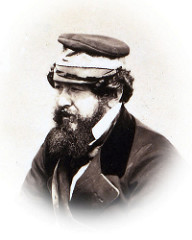
William Howard Russell’s Diary: Leave Houmas.—Donaldsonville.—Description of the City.

My Diary North and South – William Howard Russell

June 10th.–At last venit summa dies et ineluctabile tempus. I had seen as much as might be of the best phase of the great institution–less than I could desire of a most exemplary, kind-hearted, clear-headed, honest man. In the calm of a glorious summer evening we crossed the Father of Waters, waving an adieu to the good friend who stood on the shore, and turning our backs to the home we had left behind us. It was dark when the boat reached Donaldsonville on the opposite “coast.”

I should not be surprised to hear that the founder of. this remarkable city, which once contained the archives of the State, now transferred to Baton Rouge, was a North Briton. There is a simplicity and economy in the plan of the place not unfavorable to that view, but the motives which induced Donaldson to found his Rome on the west of Bayou La Fourche from the Mississippi must be a secret to all time. Much must the worthy Scot have been perplexed by his neighbors, a long-reaching colony of Spanish creoles, who toil not and spin nothing but fishing-nets, and who live better than Solomon, and are probably as well dressed, minus the barbaric pearl and gold of the Hebrew potentate. Take the odd, little, retiring, modest houses which grow in the hollows of Scarborough, add to them the least imposing mansions in the town of Folkstone, cast these broadsown over the surface of the Essex marshes, plant a few trees in front of them, then open a few cafés billard of the camp sort along the main street, and you have done a very good Donaldsonville.

A policeman welcomes us on the landing, and does the honors of the market, which has a beggarly account of empty benches, a Texan bull done into beef, and a coffee-shop. The policeman is a tall, lean, west countryman; his story is simple, and he has it to tell. He was one of Dan Rice’s company–a travelling Astley. He came to Donaldsonville, saw, and was conquered by one of the Spanish beauties, married her, become tavern-keeper, failed, learned French, and is now constable of the parish. There was, however, a weight on his mind. He had studied the matter profoundly, but he was not near the bottom. How did the friends, relatives, and tribe of his wife live? No one could say. They reared chickens, and they caught fish; when there was a pressure on the planters, they turned out to work for 6s. 6d. a-day, but those were rare occasions. The policeman had become quite grey with excogitating the matter, and he had “nary notion how they did it.”

Donaldsonville has done one fine thing. It has furnished two companies of soldiers–all Irishmen–to the wars, and the third is in the course of formation. Not much hedging, ditching, or hard work these times for Paddy! The blacksmith, a huge tower of muscle, claims exemption on the ground that “the divil a bit of him comes from Oireland; he nivir hird af it, barrin’ from the buks he rid,” and is doing his best to remain behind, but popular opinion is against him.

As the steamer could not be up from New Orleans till dawn, it was a relief to saunter through Donaldsonville to see society, which consisted of several gentlemen and various Jews playing games unknown to Hoyle, in oaken bar-rooms flanked by billiard tables. Doctor Cotmann, who had crossed the river to see patients suffering from an attack of euchre, took us round to a little club, where I was introduced to a number of gentlemen, who expressed great pleasure at seeing me, shook hands violently, and walked away; and, finally, melted off into a cloud of mosquitoes by the river bank, into a box prepared for them, which was called a bedroom.

These rooms were built of timber on the stage close by the river. “Why can’t I have one of those rooms?” asked I, pointing to a larger mosquito box. “It is engaged by ladies.” “How do you know?” “Parceque elles ont envoyé leur butin.” It was delicious to meet the French “plunder” for baggage–the old phrase, so nicely rendered–in the mouth of the Mississippi boatman.

Having passed a night of discomfiture with the winged demons of my box, I was aroused by the booming of the steam drum of the boat, dipped my head in water among drowned mosquitoes, and went forth upon the landing. The policeman had just arrived. His eagle eye lighted upon a large flat moored alongside, on the stern of which was inscribed in chalk, “Pork, corn, butter, beef,” &c. Several “spry” citizens were also on the platform. After salutations and compliments, policeman speaks–”When did she come in?” (meaning flat.) First citizen–”In the night, I guess.” Second citizen–”There’s a lot of whisky aboord, too.” Policeman (with pleased surprise)–”Yeu never mean it?” First citizen–”Yes, sir; one hundred and twenty gallons!” Policeman (inspired by patriotism)–”It’s a west-country boat; why don’t the citizens seize it? And whisky rising from 17c. to 35c. a gallon!” Citizens murmur approval, and I feel the whisky part of the cargo is not safe. “Yes, sir,” says citizen three, “they seize all our property at Cairey (Cairo), and I’m making an example of this cargo.”

Further reasons for the seizure were adduced, and it is probable they were as strong as the whisky, which has, no doubt, been drunk long ago on the very purest principles. In course of conversation with the committee of taste which had assembled, it was revealed to me that there was a strict watch kept over those boats which are freighted with whisky forbidden to the slaves, and with principles, when they come from the west country, equally objectionable. “Did you hear, sir, of the chap over at Duncan Kenner’s, as was caught the other day?” “No, sir, what was it?” “Well, sir, he was a man that came here and went over among the niggers at Kenner’s to buy their chickens from them. He was took up, and they found he’d a lot of money about him.” “Well, of course, he had money to buy the chickens.” “Yes, sir, but it looked suspeec-ious. He was a west-country fellow, tew, and he might have been tamperin’ with ’em. Lucky for him he was not taken in the arternoon.” “Why so?” “Because, if the citizens had been drunk, they’d have hung him on the spot.”

The Acadia was now alongside, and in the early morning Donaldsonville receded rapidly into trees and clouds. To bed, and make amends for mosquito visits, and after a long sleep look out again on the scene. It is difficult to believe that we have been going eleven miles an hour against the turbid river, which is of the same appearance as it was below–the same banks, bends, driftwood, and trees. Large timber rafts, navigated by a couple of men, who stood in the shade of a few upright boards, were encountered at long intervals. White egrets and blue herons rose from the marshes. At every landing the whites who came down were in some sort of uniform. There were two blacks placed on board at one of the landings in irons–captured runaways–and very miserable they looked at the thought of being restored to the bosom of the patriarchal family from which they had, no doubt, so prodigally eloped. I fear the fatted calfskin would be applied to their backs.
0 comments

“This policy naturally creates some embarrassment, and may, or may not, work well..,”—Rutherford B. Hayes

Diary and Letters of Rutherford Birchard Hayes

(Private–Don’t show this out of the family.)

CINCINNATI [COLUMBUS], June 10, 1861.

DEAR DOCTOR:–We are not quite certain, but our matters probably stand this way. The governor makes up a regimental staff and assigns to it companies as far removed from it, usually, as possible. We are to be the Twenty-third Regiment and companies will be assigned, usually, from the north. The proposed companies are very fine ones. This policy naturally creates some embarrassment, and may, or may not, work well, but the governor takes the responsibility in a very manly way, and relieves us from all embarrassments. If there is trouble, it will be between the governor and the companies, not involving us in the least. We like our captains, and would get along with them well, if this policy don’t interfere. Nothing can be said about surgeon at present. I suspect it is arranged, but can’t guess how.

I can’t say when I shall come down, but soon, to stay two or three days and fix up; probably about Saturday next. Lucy may gradually get ready my matters; not too many things; there will be time enough.

The camp is at the race-track four miles west. You need not talk much of my probable fix, as changes are possible. Love to all. I will write often.

Sincerely,

R. B. HAYES.

P.S.–Order at Sprague’s a major’s uniform for infantry; they have my measure; see Rhodes; also, a blue flannel blouse, regulation officer’s; pants to be large and very loose about the legs; to be done the last of this week, or as soon as convenient. Blouse and pants first to be done.

DR. JOSEPH T. WEBB.

0 comments

Rebel War Clerk

Civil War Day-by-Day

JUNE 10th. —Yesterday the colonel did not take so many letters to answer; and today he looked about him for other duties more congenial to his nature.

0 comments

The news from Virginia is rather warlike

Journal of Meta Morris Grimball
Meta Morris Grimball

10 [June]

       We got on as usual, the weather is very warm. The war progresses slowly and not always satisfactorily.—Elizabeth had Miss Aiken, the Manigaults to tea, Mrs Vanderhorst & Mrs Wayne.—Mrs V. has given several parties the last very handsome. Miss Adele is the attraction, Mr Arnold the beau, William thinks it promises very fair. A. Vanderhorst has gone to the War, hoping to be made aid to B. Gen. Bee.—There have been sailing parties and Evening parties.—

       The news from Virginia is rather warlike, we are all the time kept anxious about the state of affairs but time seems just to strengthen the cause of the South, and make it more probable that we shall succeed.—

       I had a visit from Mrs Trenholm yesterday evening and found her very pleasant. She spoke kindly about my sons, said they were so well considered in the community and that Arthur was an honest high toned young man. Mr T. said so & he knew for he had business transactions with him. All this was very pleasant to me.—

0 comments

“…the batteries should be rendered as secure as possible…”

War of the Rebellion: from the Official Records of the Union and Confederate Armies and Navies
Headquarters Virginia Forces,
Richmond, Va., June 10, 1861.
General T. H. Holmes, Commanding, &c., Fredericksburg, Va.:
General: It is probable that, realizing the inutility of cannonading the batteries at Aquia Creek with smooth-bore guns, the naval force of the United States will hereafter employ rifled cannon, of large caliber, at long range. It is reported that such means will be employed. It is therefore advisable that the batteries should be rendered as secure as possible by the application of some such means as were so successfully employed at Charleston. Railroad-iron, laid at an angle of about thirty degrees with the horizon, on the exterior slope, the upper ends not projecting above the exterior crest, would probably answer the purpose. If such an arrangement can be made, you are authorized to procure the iron and apply it where in your judgment it may be required.
It is not unlikely that for the attack of these batteries the enemy will provide himself with iron-plated vessels. In this event the shots from the batteries should be so directed as to strike the water short of but near the vessel, so that after the rebound they might strike below any eave which may be presented near the water line at right angles to her sides. The accompanying sketch* expresses the idea herein contained.
Very respectfully, your obedient servant,
R. E. LEE,
General, Commanding.

* not found

0 comments

Charge of Duryee’s Zouaves (Fifth Regiment New York Volunteers) at the Battle of Great Bethel

Harper’s Weekly

Charge of Duryee's Zouaves (Fifth Regiment New York Volunteers) at the Battle of Great Bethel
(Published in Harper’s Weekly, June 29, 1861)

The 5th New York Infantry Regiment, also known as “Duryée’s Zouaves”, was a volunteer infantry regiment of the Union Army, during the American Civil War, led by Colonel Abram Duryée. Modeled, like other Union and Confederate infantry regiments, on the French Zouaves of Crimean War fame, its tactics and uniforms were different from those of the standard infantry.

Even the uniforms of the 5th New York’s were modeled closely on those of French Zouaves: a dark blue Zouave jacket with red trim, a dark blue shirt with red trim, a red Zouave sash with sky blue trim, extremely baggy red pantaloons, a red fez with a yellow tassel, white gaiters and leather jambières (“leggings”).

The regiment was formed on April 12, 1861, by a group of military enthusiasts in Manhattan and deployed from Fort Schuyler at Throgs Neck, New York Harbor. Colonel Abram Duryée was appointed as the commander of the regiment. The majority of the soldiers were educated and above average height. On May 24, the regiment boarded a transport to reach the Virginia Peninsula. Immediately at Fort Monroe, the regiment began making scouting expeditions.

By the end of May, the regiment moved to Baltimore, Maryland, where they built and garrisoned an earthen fort at the summit of Federal Hill. Duryée was promoted to general rank, so Gouverneur Kemble Warren took over command of the regiment. There, the regiment continuously drilled, until General George McClellan ordered the regiment to join the Army of the Potomac in the campaign to capture Richmond, Virginia. McClellan said that, upon seeing the colorful New York regiment, “the Fifth is the best disciplined and soldierly regiment in the Army.”

(Read more about Duryée’s Zouaves at Wikipedia)

0 comments

“We have been at the camp all the afternoon.”—Rutherford B. Hayes

Diary and Letters of Rutherford Birchard Hayes

COLUMBUS, Monday, 10 P. M., June 10, 1861.

DEAREST LU:–I have just sent Judge Matthews to bed in the room over the library, and I thought I’d write a few words to my dear wife before sleeping. We have been at the camp all the afternoon. Our quarters are not yet built; all things are new and disorganized; the location is not nearly so fine as Camp Dennison, but with all these disadvantages, we both came away feeling very happy. We visited our men; they behaved finely; they are ambitious and zealous, and met us in such a good spirit. We really were full of satisfaction with it. We are glad we are away from the crowds of visitors who interfere so with the drills at Camp Dennison.

When we reached town, Judge Matthews learned that Bosley was elected over the Grays; he was more than content with it.

I shall not need things in a hurry; take time, and don’t worry yourself. I shall probably be down the last of the week; I shall only be prevented by the absence of Colonel Rosecrans and Judge Matthews. The colonel has accepted and will be here Wednesday.

There is a good band in camp; several well drilled companies. We shall have four thousand men by Saturday. Ours is the best regiment: two companies from Cleveland, one from Sandusky, one from Bellefontaine and one from Ashtabula, under a son of J.R. Giddings–a pleasant gentleman and a capital company.

But I must stop this. You know how I love you; how I love the family all; but Lucy, I am much happier in this business than I could be fretting away in the old office near the courthouse. It is living. My only regret is that you don’t like our location. We shall probably spend the summer here, or a good part of it, unless we go into Virginia. No more tonight. Much love.

Sincerely,

R.B. HAYES.

MRS. HAYES.

0 comments

“Now if such a regiment is raised, I wish to go in it, and I think I have a right to almost demand your assent to my doing so.”–Adams Family Letters, Charles Francis Adams, Jr., To His Father

Civil War Day-by-Day

Boston, June 10, 1861

I am sorry to see what you say of the possibility of your demanding your passports. Stocks rose in New York on Saturday owing to the reported tenor of your despatches, which must however have been of a tone very different from your letter to me. Still I can’t help thinking that the tenor of the news from this country must create an improvement in England. Now, however, the feeling here is very bitter, and significant intimations fall from some of the leading papers that the July Congress, while it modifies the Morrill tariff so as to assist and help France to the utmost of our power, will indulge in no friendly legislation to England. This is the tone of the Evening Post, a free-trade journal. If England wants to break down the Morrill tariff, her only course is to take the back track and conciliate our good will. . . .

About this war business. A great change has come over my feelings since you left, as I have told you, and I now feel not only a strong inclination to go off, but a conviction that from many points of view I ought to do it. I am twenty-six years old and of course have a right to do as I choose; but I acknowledge, as I have done all along, that great regard is due in this matter to you and your feelings, and now, as heretofore, I shall not go without your consent; but I think you ought to give that consent, if, under certain circumstances, I ask for it. Undoubtedly a further levy will soon be demanded in this war and when it comes there will be an effort made in this state to send forth a model regiment, and already John Palfrey is spoken of as its colonel. I saw Governor Andrew the other evening and he promised me that, in that or any other regiment to be sent from Massachusetts, if I would apply, he would give me a company. Now if such a regiment is raised, I wish to go in it, and I think I have a right to almost demand your assent to my doing so. How does the case stand? I cannot see that in a business point of view I am very necessary to you. Your property and mine would be just as safe and probably better managed in the hands of a man of business, or Sam Frothingham under John’s supervision, than in mine; and of this you must be aware. So how is my presence here necessary to you, which is the only ground on which I think you ought to object? If you say it is, I will give up the idea still, but before saying so I earnestly hope you will consider the matter fairly. You will say there is small glory in a civil war, and this is generally true; but in the civil war in England or in the Revolution here, what should we now think of a man who, in the hour of greatest danger, sat at home reading the papers? For years our family has talked of slavery and of the South, and been most prominent in the contest of words, and now that it has come to blows, does it become us to stand aloof from the conflict? It is not as if I were an only son, though many such have gone; but your family is large and it seems to me almost disgraceful that in after years we should have it to say that of them all not one at this day stood in arms for that government with which our family history is so closely connected. I see all around me going, but I sit in my office and read the papers, for I have nothing else to do. I see great events going on, and a heroic spirit everywhere flashing out, and you ask me for no sufficient cause to stifle my own and, when sitting here at home, I am convinced of my failure as a lawyer, to quietly sink into a real estate agent. I hope you will let me go, for if you should and I return, it will make a man of me; and if I should not return – am I likely to live to a better purpose by going on as I have begun? Perhaps the occasion will not demand it. Perhaps no such regiment will be raised. If it should so happen, however, I earnestly hope for our own credit and that of our name, that you will make no objection to my taking this commission which now I have but to ask for, and going forth to sustain the government and to show that in this matter our family means what it says…

0 comments

Civil War Day-By-Day

Civil War Day-by-Day

June 10, 1861

  • Battle of Big Bethel: Confederate troops under John B. Magruder defeat a much larger Union force led by General Ebenezer W. Pierce in Virginia.

A Chronological History of the Civil War in America1

  • Battle of Big Bethel, Va.—Union force repulsed.
  • Major-Gen. Banks assumed command of the Department of Annapolis.

  1. A Chronological History of the Civil War in America by Richard Swainson Fisher, New York, Johnson and Ward, 1863
0 comments

Camp, Las Moras C.S.A. : near Fort Clark, Texas, March 1861

Library of Congress
Camp, Las Moras C.S.A. : near Fort Clark, Texas, March 1861

Title: Camp, Las Moras C.S.A. : near Fort Clark, Texas, March 1861
Creator(s): Iwonski, Carl G. von, 1830-1922, artist
Date Created/Published: 1861 March.
Medium: 1 drawing on tan paper : pencil and brown ink wash ; 24.8 x 35.2 cm. (sheet).
Summary: Detailed study of Confederate troops and Mexicans opening supply boxes taken from a Union covered wagon, drinking and changing clothes.
Reproduction Number: LC-DIG-ppmsca-22783 (digital file from original item) LC-USZ62-1062 (b&w film copy neg.)
Rights Advisory: No known restrictions on publication.
Call Number: DRWG/US – Iwonski, no. 1 (A size) [P&P]
Repository: Library of Congress Prints and Photographs Division Washington, D.C. 20540 USA
Notes:
…..Signed lower left: C.J. Iwonski fel. 1861.
…..Title inscribed in brown ink above image.
…..Inscribed in pencil upper right: This was the first war sketch recd by Harpers. Inscribed in pencil below title: Following the surrender of Genl. Twiggs.
…..Inscribed on supply boxes: Q[uarter] M[aster] D[epot].
…..Former U.S. Troops enroute to occupy forts as Confederate soldiers, according to Harper’s.
…..Published in: Harper’s Weekly, 15 June 1861, p. 375, as: Bivouac of Confederate Troops on the Las Moras, Texas with Stolen U.S. Wagons, Etc.-Sketched by a Member of the Corps.
…..Source unknown.
…..Reference print available in the Civil War Drawings file F.

Library of Congress permalink

___________
Mike’s notes:

Note – This image has been digitally adjusted for one or more of the following:
– fade correction,
– color, contrast, and/or saturation enhancement
– selected spot and/or scratch removal
– cropped for composition and/or to accentuate subject

0 comments

“A movement seems to be on foot to move troops forward over the River.”—Horatio Nelson Taft

Diary of US patent clerk Horatio Nelson Taft.

SUNDAY, JUNE 9, 1861.

Went down this morning to Franklin Square with my friends from the North to witness the weekly Inspection parade of the 12th Regt. Went from there to church. Doct Smith preached a Funeral Sermon upon Judge Douglass, a very fine effort. Went again in the afternoon with E.P. Introduced him to Doct Smith who is his Father’s friend. In the evening attended the Dress Parade of the 12th, a great concourse of people there. A movement seems to be on foot to move troops forward over the River.

______

The three diary manuscript volumes, Washington during the Civil War: The Diary of Horatio Nelson Taft, 1861-1865, are available online at The Library of   Congress.

0 comments

“…report to the adjutant-general at Columbus, Monday morning.”—Diary of Rutherford B. Hayes

Diary and Letters of Rutherford Birchard Hayes

June 7, 1861, I received a dispatch from Governor Dennison asking me if I would accept the majority in a regiment of which William S. Rosecrans was to be colonel and Judge Matthews lieutenant-colonel. I read it to Lucy, consulted with my old law partner [Ralph P. Buckland], who happened to be visiting Cincinnati, and thereupon replied that I would accept as proposed. Late in the afternoon of the next day I received a dispatch from the governor, addressed to Judge Matthews and myself, directing us to report to the adjutant-general at Columbus, Monday morning. Not being able to find Judge Matthews in the city, on the next day (Sunday, P. M.), I rode out to Judge Matthews’ residence at Glendale, took tea with him and his family and friends (Mrs. Matthews and mother, and Mr. and Mrs. Todd), and rode into the city arriving a few minutes before 9 P. M. I bid good-bye to my family (my mother, mother-in-law, Mrs. Webb, Lucy, and the boys), and at 9:30 P. M. we took the cars by way of Dayton for Columbus.

0 comments

First Federal Prisoner of War.

War of the Rebellion: from the Official Records of the Union and Confederate Armies and Navies
Washington City, June 9, 1861.
The Honorable The General Assembly Of The State Of Maryland:

A tintype button portrait, tentatively identified as Manuel C. Causten, in the uniform of the President’s Mounted Guard. (see Manuel C. Causten, Prisoner of War)

The petition of the undersigned, a citizen of the State of Maryland residing in the city of Washington, respectfully showeth that on Mon day last an armed body of men from Virginia invaded the State of Maryland near Seneca, in Montgomery County, and by force arrested and carried into Virginia Manuel C. Causten ( brother-in-law of your petitioner), who was on a visit to his wife. Said Causten is a private in a volunteer mounted company of this city and was not on any military duty when he was kidnaped and carried out of the State by armed men. Rumor states that he was taken to Manassas Junction and thence to Richmond, but to this date none of his family or friends are aware of what has become of him.

Now your petitioner prays that your honorable body may inquire into the facts relating to this invasion and desecration of the soil of my native State and demand proper reparation from the State of Virginia and the immediate release of said Causten.
And your petitioner will ever pray, & c .,
McCLINTOCK YOUNG.

_________

 Evening Star, June 5, 1861

Private M. C. Caustin, Capt. Owen’s Company, (President’s Mounted Guard), D. C. Volunteers, whose wife lives near Seneca, Maryland, twenty-two miles above Georgetown, went to visit her night before last, and was taken prisoner by secession troops, who crossed from the Virginia shore in a boat. Where he was taken to is unknown, but it is supposed he was carried to Manassas Junction, where the Confederates have a considerable force. His company are in a great rage, and suspect Caustin is a victim to treachery. The Mounted Guard took an active part in the late advance on Virginia and the occupation of Alexandria by the Federal forces [May 24, 1861], having been selected by reason of their familiarity with the different localities on that side of the river, and the Confederates have offered a reward of five hundred dollars for any member thereof taken dead or alive, it is said.  (see Manuel C. Causten, Prisoner of War)

0 comments

Rebel War Clerk

Civil War Day-by-Day

JUNE 9th.—Today the Secretary refused to sign the colonel’s letters, telling him to sign them himself—”by order of the Secretary of War.”

0 comments

Scarcity of Printing Paper.

News of the Day

Daily Advocate
Baton Rouge, Louisiana
June 9, 1861

The great difficulty of obtaining printing paper, and the limited supply we now have on hand, compels us to stop our Daily exchange with a large number of our cotemporaries. The Weekly will, we trust, compensate them for the loss. When our arrangements are perfected for procuring regular supplies of paper, the discontinued Dailies will be renewed.
0 comments

Jennison’s Cavalry.

News of the Day

Daily Times
Leavenworth, Kansas
June 9, 1861

Lawrence Journal
Capt. C. R. Jennison, with a large body of Cavalry, arrived in town on Tuesday. The company numbers one hundred and eight, rank and file, a portion of which were left behind, but will soon join the company here. It is the intention of Capt. J. to get his company accepted, for the service in southern Kansas, where the majority if not all of them have long resided. The men are well versed in guerrilla warfare, having been engaged in the troubles in that section since our organization as a Territory, and if the proper arrangements can be effected, they will prove a valuable auxiliary to government in quelling the rebellious disposition of our evil-disposed neighbors of Missouri, and in keeping the red skins of the Indian Territory quiet. We trust the Captain will prove successful in getting his company into service.
0 comments

Women nurses

War of the Rebellion: from the Official Records of the Union and Confederate Armies and Navies
General Orders
No. 31
War Dept., Adjt. General’s Office

Washington, June 9, 1861.

Women nurses will not reside in the camps nor accompany regiments on a march; but those who apply for service and are highly accredited, having certificates from two physicians and two clergymen of standing, and will forward the same to Miss D. L. Dix, at Washington, will receive a certificate in return accrediting them for service in any military hospital of the United States where such services are required.
By order:
L. THOMAS,
Adjutant-General.
0 comments

William Howard Russell’s Diary: A Southern sporting man.—The creoles.

My Diary North and South – William Howard Russell

June 9th.–A thunder-storm, which lasted all the morning and afternoon till three o’clock. When it cleared I drove, in company with Mr. Burnside and his friends, to dinner with Mr. Duncan Kenner, who lives some ten or twelve miles above Houmas. He is one of the sporting men of the South, well known on the Charleston race-course, and keeps a large stable of racehorses and brood mares, under the management of an Englishman. The jocks were negro lads; and when we arrived, about half a dozen of them were giving the colts a run in the paddock. The calveless legs and hollow thighs of the negro adapts him admirably for the pigskin; and these little fellows sat their horses so well, one might have thought, till the turn in the course displayed their black faces and grinning mouths, he was looking at a set of John Scott’s young gentlemen out training.

The Carolinians are true sportsmen, and in the South the Charleston races create almost as much sensation as our Derby at home. One of the guests at Mr. Kenner’s knew all about the winners of Epsom Oaks, and Ascot, and took delight in showing his knowledge of the “Racing Calendar.”

It is observable, however, that the creoles do not exhibit any great enthusiasm for horse-racing, but that they apply themselves rather to cultivate their plantations and to domestic duties; and it is even remarkable that they do not stand prominently forward in the State Legislature, or aspire to high political influence and position, although their numbers and wealth would fairly entitle them to both. The population of small settlers, scarcely removed from pauperism, along the river banks, is courted by men who obtain larger political influence than the great landowners, as the latter consider it beneath them to have recourse to the arts of the demagogue.

0 comments

Journal of Meta Morris Grimball

Journal of Meta Morris Grimball
Meta Morris Grimball

9th [June]

       Papa went to Somerville to visit Russel Middleton, he returned quite charmed with the place and the good living.—Gov. and Martin dined here last week. Adela is going to have another baby, this will be the 5th it is really terrible.—

       Papa is very naive, he told me he was better here than he had been because of his diet at my table. The Market, is high and I pay nearly $2 each day for dinner, when by ourselves it costs me 50¢.

0 comments

“…there is a nest of traitors that ought to be blown up.”

The Letters of Samuel Ryan Curtis

Keokuk June 9th. 1861

Genl N. Lyon1

Dr Sir

Yours of the 6th is received. AH the Iowa Call 3 regiments each over 1000 strong are here. Two thousand muskets and 40 rounds of cartridges are distributed, I am ready to cooperate therefore although as yet we lack tents haversacks and knapsacks and many other things which we hope soon to receive. But in case of immurgency command me and I will respond promptly.

In the mean time I am keeping myself advised of movements on the Missouri side. The Unionists are greatly in the ascendency in Clark county; but at Aetna in the edge of Clark and Scotland there is a nest of traitors that ought to be blown up. Yesterday they had a Union meeting called there and some 200 unarmed Union men assembled to hear a speech. The traitors to the number of 100 came armed with rifles shot guns &c. guns loaded and prevented the speaking. They have a Company commanded by one Capt Duil and the carry the Secession flag There is also a flag on a high pole in Aetna–red white and red– and a blacksmith manufacturing knives and other weapons. It is a little town of about 200 people. There is also a company of traitors about 40 strong at Edina The Union men want some kind of military or civil authority with [a few] arms to [go and destroy the rascals.–crossed out] put the rascals down LaGrange or Alexandria would be a good point for mustering a force and there are thousands of Union men anxious to be enrolled: but they have no color of Law while the traitors are organizing under the State law.

Something is needed to countervoid that develish Legislative treason, [by charging Iowa with a breach of state soverignty–crossed out]

If you had a little force at Alexander or Legrange it could be easily Augmented from here so as to operate effectually with the Union men and without any fuss on the score of state interference & state pride. [The Union men of Clark could easily raise a considerable force ready to be mustered in if you have authority for so receiving force and they want a hand in wiping out the Squad at Aetna.–crossed out] There is a company of 300 Union men ready for organization in Edina and about 200 in Clark willing to fight and anxious for arms to crush out the rascals. I think a few days would be needed to get the rascals together again at Aetna where they might be surrounded ala Camp Jackson.

I am drilling my regiment very hard, and will soon have it in excellent condition as the material cannot be beat. Come up and review us. You will find a hearty welcome, and it will give encouragement to my efforts in advancing organization discipline and drills. [I expect a class mate of mine A Kean will have command [of] the 3d Regiment so you may soon count on fine backing by pretty well drilled troops from Iowa–crossed out]

Very truly yours
Saml R Curtis
Col 2nd Iowa Vols

[copy]


Nathaniel Lyon, United States Military Academy, 1841, engaged in the Seminole wars, on the coast in California and stationed in Kansas prior to the outbreak of war, was an ardent northern sympathiser. Appointed in charge of the St. Louis Arsenal in February, 1861, he was made a brigadier general in charge of Union forces in St. Louis in May. He was killed in August, 1861, in the bloody battle of Wilson’s Creek.

0 comments

“Some whole companies say that they will not go.”–Army letters of Oliver Willcox Norton.

Civil War Day-by-Day

Camp Wright, Hulton, Penn.,
Sunday, June 9, 1861.

Dear Sister L.:–

I wish you could just step in and see us here, say on a dress parade. We are in just as beautiful a place as I ever saw. The lovely Alleghany rolls along at the foot of the hill, and the little country seats nestled in quiet nooks, the new buildings in camp, the groves and orchards, the lane that leads to the river, and the beautiful mountain rising up on the other side of the river, make a picture I never saw equalled.

I wrote to H. yesterday that we were accepted and were to be mustered in immediately. The Colonel received a telegram last night from the Secretary of War, saying that we would be taken for three years, unless sooner discharged, or we would be sent home. That you see materially alters the case. I don’t know how it will work. Some whole companies say that they will not go. We shall know in a day or two. I hardly know what to do. It seems a long time to live such a life, but if I am needed, I must go. If our company goes as a company, I shall go too. If not, you may look for me home soon.

I just wish I could have seen you last night instead of reading your letter. I thought perhaps you were having a good time about the time I was reading that letter. I sincerely hope the choice you have made is a good one. Give my respects to C and tell him, I think, as matters stand, the sooner he and I become acquainted the better. I would like to have him write to me.

I think from what you write, that vegetation must be more advanced here than there. Potatoes and corn are six inches high, and clover in bloom. I saw strawberries and cherries in market yesterday.

H. B. wrote the other day that his folks had adopted a daughter about fifteen years old, and that L. C. was a secessionist. He had a big fuss with the boys who put up a Union flag near his house, threatened the life of some, sued others, and was bound over himself to appear at court to answer for his rabid conduct.

Well, I must stop. I hope you will not wait so long before writing again. I am so anxious to hear from you often. If there is anything you expected to see, that is omitted, you may hear it in the future. My address is Camp Wright, Pittsburgh.

0 comments

Under orders.—Rutherford B. Hayes

Diary and Letters of Rutherford Birchard Hayes

CINCINNATI, June 10 [9], 1861.

DEAR UNCLE:–I shall go to Columbus in the morning under orders. I do not know what is intended, but by telegraph, Judge Matthews and myself are informed that we are to be in a regiment with Colonel Rosecrans–a West Pointer and intimate friend of Billy Rogers, and a capital officer,–Matthews as lieutenant-colonel and I as major. This is all we know about it. Buckland perhaps told you that I had got a dispatch asking if I would accept, and that I replied accepting the place. We have since been telegraphed that we were under orders accordingly, and must report at Columbus forthwith. This seems certain enough, but as red-tape is in the ascendant, we don’t count positively on anything.

I shall try to visit you before definitely leaving home. Mother will return to Columbus soon. I hope this matter is as it appears. It is precisely what we wish, if we understand it.

Sincerely,

R. B. HAYES.

S. BIRCHARD.

0 comments

Lady Volunteers and Cotton.

News of the Day

Weekly Arkansas State Gazette
Little Rock, Arkansas
June 8, 1861

Everywhere in the Confederate States have the ladies worked unremittingly for the benefit of the volunteer companies organized for the defence of their country against northern aggression.
Flags, stitched and embellished by their fingers, have been presented in great numbers, sand bags and clothing made, lint picked, and money raised by means of fairs and private contribution. New Orleans may well be proud of her noble-hearted daughters, who have done so much for the cause which stirs the souls of her people.
That their labor may be lightened in part, we give the following letter of the veteran Dr. J. C. Nott, of Mobile, which we find in the Register of yesterday:
In my daily rounds I see our ladies wearing out their fingers and eyes in picking lint for our brave soldiers, and while I admire their patriotism and charity, I hope I may be permitted to say, I think they are, for want of information, throwing away much time that might be more usefully spent.
Clean cotton is easily obtained in any quantity, and answers just as well for dressing wounds as the ordinary lint.
The “patent lint” commonly used by surgeons is all, or nearly all, made of cotton. Some of the best European surgeons use the cotton-wool in preference to lint. Everybody uses cotton for a dressing for a burn, the most intense of all inflammations.
To these facts I may add my own ample experiences. I have for years been in the habit of using good sample cotton and lint indiscriminately, in dressing wounds of all kinds, and could never see any difference.
Whenever a gun is fired I shall be in the field and take care to have a good supply of cotton, which is one of the most useful articles a surgeon can have about a hospital for purposes, and one of its most important uses is in padding for splints.
J. C. Nott.
0 comments

First Steamboats Purchased for the Mississippi Gunboat Fleet.

War of the Rebellion: from the Official Records of the Union and Confederate Armies and Navies

Report of Commander Rodgers, U. S. Navy, regarding the purchase of three steamers for naval service.

Cincinnati, June 8, 1861.
Sir: I have, after consultation with General McClellan, and after inspection by Mr. Pook, the naval constructor, bought three steamboats for naval service in these waters.
They were called the A. O. Tyler, the Lexington, and the Conestoga. The name of the first of these I will, with your permission, change to Taylor, a name of better augury than Tyler.
The three are side-wheel, high-pressure boats; their united tonnage amounts to 1,167 tons.
They are all sound; the Lexington is a new boat. The price of these boats was about $ 97,000 to the builders; to the Government it
is $62,000.
All the river boats are so different from war vessels in all their
appliances that considerable alterations are necessary to fit them for use. They needed a good deal of strengthening, and because the crew would be liable to be picked off while passing along the banks of the river in places where no effectual return could be made to the fire of an individual, I decided upon putting bulwarks of oak plank 5 inches thick, which I found by experiment a sufficient guard against small arms.
The boilers and engines can not be defended against cannon shot. We must take our chances.
The necessary changes and additions will cost about $41,000 more, making the price of each of the three boats about $ 34,000, completed.
The principal and longest contract calls for the delivery of these boats by the 27th of June, under a loss of 10 per cent of the whole contract for every day’s delay after that time until delivery.
With such stringent terms I feel assured that the boats will be ready for us by the 27th instant, and I therefore beg that the requisitions which I enclose may receive immediate attention from the proper bureaus.
I am confident that the vessels will be able to render useful service, and I am very anxious to be at my station.
I think it is not desirable to have the crew in town until the vessels are ready for them.
Provisions may more cheaply be bought here than transported from the East. I request permission to buy them here.
I request permission to engage the necessary pilots, engineers, and firemen here.
The management of these engines in the muddy waters of the Mississippi requires a peculiar experience, which it is cheaper to employ than to teach.
I have the honor to be, your obedient servant,
John Rodgers,
Commander, U. S. Navy.
Hon. Gideon Welles,
Secretary of the Navy, Washington, D. C.
0 comments

The Chivalry in War.

News of the Day

Daily Times
Leavenworth, Kansas
June 8, 1861

The Albany Standard scorchingly, though good humoredly,
comments as follows:
“We hope the ‘world’ will make a note of this fact. When a Mississippi soldier is shot down, he should have a bed of rose leaves to die on. He should feed on canvass-back ducks, and have two negroes to carry his musket. When gentlemen go to war they should have gentlemanly treatment throughout. The “Red Glove Battalion,” from the South, we understand grease their boots with oil of lavender, and catch cold if they sleep in a room with a damp tumbler. Their tents are to be filled with French bedsteads, bureaus and looking glasses, while they are only to drill in pleasant weather. They may be very nice troops to look at through a smoked glass, but they are hardly the men to contend with the brawny arms to be found in the New York Fire Brigade. The Mississippi and Louisiana troops are too fine for use. Soldiers who wish to fight under umbrellas and sun-shades won’t do for rough work. They might better be kept at home to adorn picture books.”
0 comments