The Briars, June 12.—We are now in the beautiful Valley of Virginia, having left Chantilly on the 8th. The ride through the Piedmont country was delightful; it looked so peaceful and calm that we almost forgot the din of war we had left behind us. The road through Loudoun and Fauquier was picturesque and beautiful. We passed through the villages of Aldie, Middleburg, and Upperville. At Middleburg we stopped for an hour, and regaled ourselves on strawberries and cream at the house of our excellent brother, the Rev. Mr. K. At Upperville we spent the night. Early next morning we went on through the village of Paris, and then began to ascend the Blue Ridge, wound around on the fine turnpike, paused a moment at the top to “view the landscape o’er,” and then descended into the “Valley.” The wheat, which is almost ready for the reaper, is rich and luxuriant, foreshadowing an abundant commissariat for our army. After driving some miles over the delightful turnpike, we found ourselves at this door, receiving the warm-hearted welcome of the kindest of relatives and the most pleasant of hosts. Our daughters were here before us, all well, and full of questions about “home.” This is all very delightful when we fancy ourselves making a voluntary visit to this family, as in days gone by, to return home when the visit is over, hoping soon to see our friends by our own fireside; but when the reality is before us that we were forced from home, and can only return when it pleases our enemy to open the way for us, or when our men have forced them away at the point of the bayonet, then does our future seem shadowy, doubtful, and dreary, and then we feel that our situation is indeed sorrowful. But these feelings must not be indulged; many are already in our situation, and how many more are there who may have to follow our example! Having no houses to provide for, we must be up and doing for our country; idleness does not become us now—there is too much to be done; we must work on, work ever, and let our country’s weal be our being’s end and aim. [continue reading…]
American Civil War Chronicles
“Her house has been searched, furniture broken, and many depredations committed since she left home; books thrown out of the windows during a rain: nothing escaped their fury.”—Diary of a Southern Refugee.
June 12, 2021
“A fight has occurred at Bethel, and blood—Yankee blood—has flowed pretty freely.”—Diary of Rebel War Clerk John Beauchamp Jones.
June 11, 2021
JUNE 11th.—It is coming in earnest! The supposed thunder, heard down the river yesterday, turns out to have been artillery. A fight has occurred at Bethel, and blood—Yankee blood—has flowed pretty freely. Magruder was assailed by some five thousand Yankees at Bethel, on the Peninsula. His force was about nine hundred; but he was behind intrenchments. We lost but one man killed and five wounded. The enemy’s loss is several hundred. That road to Richmond is a hard one to travel! But I learn there is a panic about Williamsburg. Several young men from that vicinity have shouldered their pens and are applying for clerkships in the departments. But most of the men of proper age in the literary institutions are volunteering in defense of their native land.
“…a rout would be as effective as taking prisoners, by spreading demoralization in their ranks.”
June 11, 2021
Important Movement of Troops.
June 11, 2021
Daily Times
Leavenworth, Kansas
June 11, 1861
organization of a Home Guard, and to furnish them protection, until they are prepared to protect themselves.
consummation most devoutly to be wished.”
We have it in our power to unite that people firmly to us forever.
June 11, 2021
“It rested entirely with the North whether it should be WAR or PEACE.”—Civil War Diary of Susan Bradford Eppes.
June 11, 2021
June 11th, 1861.—Perhaps it would be as well, my dear Diary, to write here a short sketch of the Bradford neighborhood at this time. The war is an established fact and a shadow lies across the hearts of the Southern people. It may be that the North feels it equally with ourselves, but I cannot think so. This is the reason why. We did not want this war. It rested entirely with the North whether it should be WAR or PEACE. We wanted peace but war was forced upon us and now that it has begun we will do our best to win. May The God of Battles help us.
Coming southward from the Georgia line you reach the Bradford neighborhood at Pine Hill Plantation, the home of Dr. Edward Bradford. He has no sons, only daughters, but he has three sons-in-law in the army. The next place is Oaklawn, the home of Captain William H. Lester. The Captain’s head is white, he gained his title in the Indian War but he has three sons and a son-in-law in the army. Then comes Greenwood, where Dr. Holland lives with a house full of daughters. His only son was among the first to volunteer and he also has a son-in-law in the service. Mr. Thomas A. Bradford comes next. Walnut Hill Plantation lost its mistress some years ago and the affairs of the household are administered by four beautiful and capable daughters. There are three sons also and these are in the Confederate army, as well as a son-in-law, who had won the fifth daughter from the old home. Water Oak Plantation is the home of the youngest of the Bradford brothers. He has four sons in the army. [continue reading…]
“Was at the “Drill” of the 12th, thousands of spectators witness their evening dress parade every night.”—Horatio Nelson Taft
June 11, 2021
TUESDAY 11
Another hot day, much as yesterday. E.P. & W[elling]. today have been to Alexandria but the heat prevented them from going back to the entrenchments. There was a Review at the Prests this afternoon of five Regiments. The Scotch Highlanders was one, the 79th. They have a fine Band and make a fine appearance. Was at the “Drill” of the 12th, thousands of spectators witness their evening dress parade every night. Went down with wife & saw the “Highlanders” pass.
______
The three diary manuscript volumes, Washington during the Civil War: The Diary of Horatio Nelson Taft, 1861-1865, are available online at The Library of Congress.
Union soldiers and Zouaves in formation at Franklin Square
June 11, 2021
Title: N.Y. 12
Date Created/Published: 1861 June 11.
Medium: 1 photographic print : salted paper ; 23 x 34 cm.
Summary: Photograph showing Civil War Union soldiers and Zouaves in formation at Franklin Square, Washington, D.C.; small rough buildings, probably barracks, in background.
Reproduction Number: LC-DIG-ppmsca-19886 (digital file from original) LC-USZ662-86346 (b&w film copy neg.)
Rights Advisory: No known restrictions on publication.
Call Number: LOT 12251, p. 103 [P&P]
Repository: Library of Congress Prints and Photographs Division Washington, D.C. 20540 USA
Notes:
…..In album: Benjamin Brown French “Photographs,” p. 103.
…..Title from item.
…..Reference copy in LOT 12251, v. 2.
…..Original in PR 12 LOT 12251.
Library of Congress permalink
___________
Mike’s notes:
Note – This image has been digitally adjusted for one or more of the following:
– fade correction,
– color, contrast, and/or saturation enhancement
– selected spot and/or scratch removal
– cropped for composition and/or to accentuate subject
William Howard Russell’s Diary: Baton Rouge.—Steamer to Natchez.—Southern feeling; faith in Jefferson Davis.—Rise and progress of prosperity for the planters.—Ultimate issue of the war to both North and South.
June 11, 2021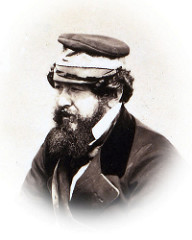
June 11th.–Before noon the steamer hauled alongside a stationary hulk at Baton Rouge, which once “walked the waters” by the aid of machinery, but which was now used as a floating hotel, depot, and storehouse– 315 feet long, and fully thirty feet on the upper deck above the level of the river. The Acadia stopped, and I disembarked. Here were my quarters till the boat for Natchez should arrive. The proprietor of the floating hotel was somewhat excited because one of his servants was away. The man presently came in sight. “Where have you been, you ––?” “Away to buy de newspaper, Massa.” “For who, you ––?” “Me buy ’em for no one, Massa; me sell ‘nm agin, Massa.” “See, now, you ––, if ever you goes aboard them steamers to meddle with newspapers, I’m –– but I’ll kill you, mind that!”
Baton Rouge is the capital of the State of Louisiana, and the State House thereof is a very quaint and very new example of bad taste. The Deaf and Dumb Asylum near it is in a much better style. It was my intention to have visited the State Prison and Penitentiary, but the day was too hot, and the distance too great, and so I dined at the oddest little creole restaurant, with the funniest old hostess, and the strangest company in the world.
On returning to the boat hotel, Mr. Conrad, one of the citizens of the place, and Mr. W. Avery, a judge of the district court, were good enough to call and to invite me to remain some time, but I was obliged to decline. These gentlemen were members of the home guard, and drilled assiduously every evening. Of the 1300 voters at Baton Rouge, more than 750 are already off to the wars, and another company is being formed to follow them. Mr. Conrad has three sons in the field, and another is anxious to follow, and he and his friend, Mr. Avery, are quite ready to die for the disunion. The waiter who served out drinks in the bar wore a uniform, and his musket lay in the corner among the brandy bottles. At night a patriotic meeting of citizen soldiery took place in the bow, with which song and whisky had much to do, so that sleep was difficult.
Precisely at seven o’clock on Wednesday morning the Mary T. came alongside, and soon afterward bore me on to Natchez, through scenery which became wilder and less cultivated as she got upwards. Of the 1500 steamers on the river, not a tithe are now in employment, and the owners of these profitable flotillas are “in a bad way.” It was late at night when the steamer arrived at Natchez, and next morning early I took shelter in another engineless steamer beside the bank of the river at Natchez-under-the-hill, which was thought to be a hotel by its owners.
In the morning I asked for breakfast. “There is nothing for breakfast; go to Curry’s on shore.” Walk up hill to Curry’s–a bar-room occupied by a waiter and flies. “Can I have any breakfast?” “No, sir-ree; it’s over half-an-hour ago.” “Nothing to eat at all?” “No, sir.” “Can I get some anywhere else?” “I guess not.” It had been my belief that a man with money in his pocket could not starve in any country soi-disant civilized. I chewed the cud of fancy faute de mieux, and became the centre of attraction to citizens, from whose conversation I learned that this was “Jeff. Davis’ fast day.” Observed one, “It quite puts me in mind of Sunday; all the stores closed.” Said another, “We’ll soon have Sunday every day, then, for I ‘spect it won’t be worth while for most shops to keep open any longer.” Natchez, a place of much trade and cotton export in the season, is now as dull–let us say, as Harwich without a regatta. But it is ultra-secessionist, nil obstante.
My hunger was assuaged by Mr. Marshall, who drove me to his comfortable mansion through a country like the wooded parts of Sussex, abounding in fine trees, and in the only lawns and park-like fields I have yet seen in America.
After dinner, my host took me out to visit a wealthy planter, who has raised and armed a cavalry corps at his own expense. We were obliged to get out of the carriage at a narrow lane and walk toward the encampment on foot in the dark; a sentry stopped us, and we observed that there was a semblance of military method in the camp. The captain was walking up and down in the verandah of the poor hut, for which he had abandoned his home. A book of tactics – Hardee’s– lay on the table of his little room. Our friend was full of fight, and said he would give all he had in the world to the cause. But the day before, and a party of horse, composed of sixty gentlemen in the district, worth from £20,000 to £50,000 each, had started for the war in Virginia. Everything to be seen or heard testifies to the great zeal and resolution with which the South have entered upon the quarrel. But they hold the power of the United States and the loyalty of the North to the Union at far too cheap a rate.
Next day was passed in a delightful drive through cotton fields, Indian corn, and undulating woodlands, amid which were some charming residences. I crossed the river at Natchez, and saw one fine plantation, in which the corn, however, was by no means so good as the crops I have seen on the coast. The cotton looks well, and some had already burst into flower–bloom, as it is called–which has turned to a flagrant pink, and seems saucily conscious that its boll will play an important part in the world.
The inhabitants of the tracts on the banks of the Mississippi, and on the inland regions hereabout, ought to be, in the natural order of things, a people almost nomadic, living by the chase, and by a sparse agriculture, in the freedom which tempted their ancestors to leave Europe. But the Old World has been working for them. All its trials have been theirs; the fruits of its experience, its labors, its research, its discoveries, are theirs. Steam has enabled them to turn their rivers into highways, to open primeval forests to the light of day and to man. All these, however, would have availed them little had not the demands of manufacture abroad, and the increasing luxury and population of the North and West at home, enabled them to find in these swamps and uplands sources of wealth richer and more certain than all the gold mines of the world.
There must be gnomes to work those mines. Slavery was an institution ready to their hands. In its development there lay every material means for securing the prosperity which Manchester opened to them, and in supplying their own countrymen with sugar. The small, struggling, deeply-mortgaged proprietors of swamp and forest set their negroes to work to raise levees, to cut down trees, to plant and sow. Cotton at ten cents a pound gave a nugget in every boll. Land could be had for a few dollars an acre. Negroes were cheap in proportion. Men who made a few thousand dollars invested them in more negroes, and more land, and borrowed as much again for the same purpose. They waxed fat and rich –there seemed no bounds to their fortune.
But threatening voices came from the North–the echoes of the sentiments of the civilized world repenting of its evil pierced their ears, and they found their feet were of clay, and that they were nodding to their fall in the midst of their power. Ruin inevitable awaited them if they did not shut out these sounds and stop the fatal utterances.
The issue is to them one of life and death. Whoever raises it hereafter, if it be not decided now, must expect to meet the deadly animosity which is now displayed towards the North. The success of the South –if they can succeed–must lead to complications and results in other parts of the world, for which neither they nor Europe are prepared. Of one thing there can be no doubt–a slave state cannot long exist without a slave trade. The poor whites who have won the fight will demand their share of the spoils. The land for tilth is abundant, and all that is wanted to give them fortunes is a supply of slaves. They will have that in spite of their masters, unless a stronger power than the Slave States prevents the accomplishment of their wishes.
The gentleman in whose house I was stopping was not insensible to the dangers of the future, and would, I think, like many others, not at all regret to find himself and property safe in England. His father, the very day of our arrival, had proceeded to Canada with his daughters, but the Confederate authorities are now determined to confiscate all property belonging to persons who endeavor to evade the responsibilities of patriotism. In such matters the pressure of the majority is irresistible, and a sort of mob law supplants any remissness on the part of the authorities. In the South, where the deeds of the land of cypress and myrtle are exaggerated by passion, this power will be exercised very rigorously. The very language of the people is full of the excesses generally accepted as types of Americanism. Turning over a newspaper this morning, I came upon a “card” as it is called, signed by one “Mr. Bonner,” relating to a dispute between himself and an Assistant-Quarter-Master-General, about the carriage of some wood at Mobile, which concludes with the sentence that I transcribe, as an evidence of the style which is tolerated, if not admired, down South:–
“If such a Shylock-hearted, caitiff scoundrel does exist, give me the evidence, and I will drag him before the bar of public opinion, and consign him to an infamy so deep and damnable that the hand of the Resurrection will never reach him.”
No Hoops!
June 11, 2021
Daily Times
Leavenworth, Kansas
June 11, 1861
First summer of the rebellion, Franklin Square, ‘The N.Y. 12th’
June 11, 2021 Title: First summer of the rebellion, Franklin Square, ‘The N.Y. 12th’
Date Created/Published: 1861 June 11.
Medium: 1 photographic print : salted paper ; 24 x 34 cm.
Summary: Photograph showing Civil War Union soldiers and Zouaves in formation at Franklin Square, Washington, D.C.; small rough buildings, probably barracks, in background.
Reproduction Number: LC-DIG-ppmsca-19885 (digital file from original) LC-USZ62-86345 (b&w film copy neg.)
Rights Advisory: No known restrictions on publication.
Call Number: LOT 12251, p. 102 [P&P]
Repository: Library of Congress Prints and Photographs Division Washington, D.C. 20540 USA
Notes:
….In album: Benjamin Brown French “Photographs,” p. 102.
….Title from item.
Library of Congress permalink
___________
Mike’s notes:
Note – This image has been digitally adjusted for one or more of the following:
– fade correction,
– color, contrast, and/or saturation enhancement
– selected spot and/or scratch removal
– cropped for composition and/or to accentuate subject
Arkansas Volunteers.
June 11, 2021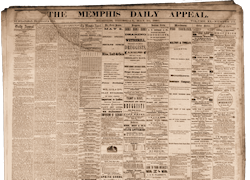
The Memphis Daily Appeal
Memphis, Tennessee
June 11, 1861
Civil War Day-By-Day
June 11, 2021
June 11, 1861
- First session of the Second Wheeling Convention
A Chronological History of the Civil War in America1
- Col. Wallace surprised and routed a rebel force of 800 at Romney, Va.
- A Chronological History of the Civil War in America by Richard Swainson Fisher, New York, Johnson and Ward, 1863
Federal troops driving the rebels from one of their batteries at Great Bethel
June 10, 2021 Title: [Federal troops driving the rebels from one of their batteries at Great Bethel
Creator(s): Waud, Alfred R. (Alfred Rudolph), 1828-1891, artist
Date Created/Published: [1861 June 10]
Medium: 1 drawing on brown paper : pencil, black ink wash, and Chinese white ; 17.1 x 11.7 cm. (sheet)
Reproduction Number: LC-DIG-ppmsca-20190 (digital file from original item, recto) LC-DIG-ppmsca-20191 (digital file from original item, verso) LC-USZC4-5178 (color film copy transparency)
Rights Advisory: No known restrictions on publication.
Call Number: DRWG/US – Waud, no. 824 (AA size) [P&P]
Repository: Library of Congress Prints and Photographs Division Washington, D.C. 20540 USA
Notes:
…..Title inscribed above image.
…..Inscribed on verso: Battle June 10th 1861, Great Bethel, Va.; 5th N.Y., Pierces div.
…..Formerly Waud no. B-59.
…..Gift, J.P. Morgan, 1919 (DLC/PP-1919:R1.2.824)
…..Forms part of: Morgan collection of Civil War drawings.
Library of Congress permalink
___________
Mike’s notes:
Note – This image has been digitally adjusted for one or more of the following:
– fade correction,
– color, contrast, and/or saturation enhancement
– selected spot and/or scratch removal
– cropped for composition and/or to accentuate subject
Big Bethel—Soldiers, caissons, and covered wagons moving through town.
June 10, 2021
Title: Big Bethel
Creator(s): Waud, Alfred R. (Alfred Rudolph), 1828-1891, artist
Date Created/Published: [1861 June 10]
Medium: 1 drawing on tan paper : pencil ; 9.1 x 12.5 cm. (sheet)
Summary: Soldiers, caissons, and covered wagons moving through town.
Reproduction Number: LC-DIG-ppmsca-20192 (digital file from original item) LC-USZC4-5177 (color film copy transparency)
Rights Advisory: No known restrictions on publication.
Call Number: DRWG/US – Waud, no. 825 (AA size) [P&P]
Repository: Library of Congress Prints and Photographs Division Washington, D.C. 20540 USA
Notes:
…..Title inscribed below image.
…..Formerly Waud no. B-60.
…..Gift, J.P. Morgan, 1919 (DLC/PP-1919:R1.2.825)
…..Forms part of: Morgan collection of Civil War drawings.
Library of Congress permalink
___________
Mike’s notes:
Note – This image has been digitally adjusted for one or more of the following:
– fade correction,
– color, contrast, and/or saturation enhancement
– selected spot and/or scratch removal
– cropped for composition and/or to accentuate subject
The Duryea Zouaves Carrying off the Body of Lieu. Greble from the Field of Battle at Great Bethel.
June 10, 2021
The Duryea Zouaves Carrying off the Body of Lieu. Greble from the Field of Battle, Amidst the Fire of the Secession Forces, at Great Bethel. – Sketched by Our Special Artist (Published in Frank Leslie’s Illustrated Newspaper, June 29, 1861.)
The Battle of Big Bethel was one of the earliest land battles of the American Civil War. It took place on the Virginia Peninsula, near Newport News, on June 10, 1861.
The Virginia State government had refused President Abraham Lincoln’s appeal for troops to put down the rebellion of the southern states, and its decision to secede from the Union was ratified by popular vote on May 23, 1861. Confederate Colonel (later Major General) John B. Magruder was sent down the peninsula to deter any advance on the state capital Richmond by Union troops based at the well-defended post of Fort Monroe. This garrison was commanded by Major General Benjamin Butler, a former Massachusetts lawyer and politician, who established a new camp at nearby Hampton and another at Newport News. Magruder had also established two camps, within range of the Union lines, at Big Bethel and Little Bethel, as a lure to draw his opponent into a premature action.
Butler took the bait, when he and an aide, Major Theodore Winthrop, devised a plan for a dawn attack on June 10, 1861, after a night march to drive the Confederates back from their bases. Butler chose not to lead the force in person, for which he was later criticized. The plan proved too complex for his poorly-trained subordinates to carry out, especially at night, and his staff had also omitted to communicate the passwords. They were trying to advance without knowledge of the layout or strength of the Confederate positions, when a friendly fire incident gave away their own. The commander in the field, Massachusetts militia general Ebenezer Peirce, received the most criticism for the failed operation.
The Union forces suffered 76 casualties, with 18 killed, including Major Winthrop and Lieutenant John T. Greble, the first regular army officer killed in the war. The Confederates suffered only 8 casualties, with 1 killed. Although Magruder subsequently withdrew to Yorktown and his defensive line along the Warwick River, he had won a propaganda victory and local Union forces attempted no further significant advance until the Peninsula Campaign of 1862. While small in comparison to many later battles, Big Bethel attracted considerable press coverage and exaggerated importance because of the newness of the war and the general feeling the war would be short.
The engagement was also known as the Battle of Bethel Church or Great Bethel.
Read more at Wikipedia
Will you help us? Can you help us in time?—Western Virginian appeals to Jefferson Davis
June 10, 2021
“We are the Twenty-third Regiment…”—Rutherford B. Hayes
June 10, 2021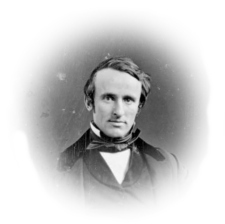
COLUMBUS, June 10, 1861.
DEAR UNCLE:–Matthews and myself are here and find that the governor makes up a list of regimental officers, calls it a regimental organization and assigns to it companies as he pleases, preferring to select officers from one part of the State and men from another. We are the Twenty-third Regiment ¹ and our companies will probably be from the north. The men indicated are said to be a superior body. We have seen the captains and are favorably impressed. Of course this policy is calculated to cause embarrassment, but the governor shoulders the responsibility and we are not involved in any personal unpleasantness. We shall be here probably a week before going down to make our final preparations.
I may not be able to visit Fremont. If not you will see me here.
Sincerely,
R. B. HAYES.
S. BIRCHARD.

_______
¹ The first three-years regiment organized in Ohio
Railroad and Canal Destruction
June 10, 2021
The Battle of Great Bethel
June 10, 2021
The Battle of Great Bethel—Sketched by our Special Artist, who was present throughout the fight. (Published in Harper’s Weekly, June 29, 1861)
Battle Detail
Other Name: Bethel Church, Great Bethel
Campaign: Union Blockade of Chesapeake Bay
Date(s): May-June 1861
Principal Commanders: Brigadier General Ebenezer Pierce [US] Major General John Magruder [CS]
Forces Engaged: 4700 total (US 3500; CS 1200;)
Estimated Casualties: 84 total (US 76; CS 8;)
Description:
This was the first land battle in Virginia. Maj. Gen. Benjamin F. Butler sent converging columns from Hampton and Newport News against advanced Confederate outposts at Little and Big Bethel. Confederates abandoned Little Bethel and fell back to their entrenchments behind Brick Kiln Creek, near Big Bethel Church. The Federals, under immediate command of Brig. Gen. Ebenezer Pierce, pursued, attacked frontally along the road, and were repulsed. Crossing downstream, the 5th New York Zouaves attempted to turn the Confederate left flank, but were repulsed. Unit commander Col. T. Wynthrop was killed. The Union forces were disorganized and retired, returning to Hampton and Newport News. The Confederates suffered 1 killed, 7 wounded.
Results: Confederate Victory
“Some 4000 troops left this morning for Harpers Ferry, as is supposed.”—Horatio Nelson Taft
June 10, 2021
MONDAY 10
This has been one of the hot days. M. 86 in shade. E.P.T. & Welling have gone (or rather have been) to Virginia, but the sun was so hot they did not go far. Some 4000 troops left this morning for Harpers Ferry, as is supposed. The RI Regt went with their fine Battery of rifled Cannon 6:12: pou[n]d[er]s. Hot work is expected. Saml Androus was up today from Alexandria, went back in evening. Was at the Parade of the 12th with Juliet and “Puss” W[oodward]., and then down to “Willards.” Got the NY papers and came home early.
______
The three diary manuscript volumes, Washington during the Civil War: The Diary of Horatio Nelson Taft, 1861-1865, are available online at The Library of Congress.
“Full regiments have been made up…,”—Rutherford B. Hayes
June 10, 2021
COLUMBUS, June 10, 1861.
DEAR FORCE:–I do not dispatch you as to matters here, because it is not certain what will be done, but our present impression is, that we can get no additional companies into our regiment. Full regiments have been made up, and the governor is assigning officers to them, or, rather, he makes up regimental staffs, and assigns companies from a list of accepted companies already in camp. . . . This mode of doing the thing creates some difficulty, and changes are possible, but not probable. I regret this, but we can’t perhaps change it. The governor is doing it in a frank, manly way which relieves us from all embarrassment in the premises.
Sincerely,
R.B. HAYES.
M. F. FORCE, ESQ.
“…the first regiment in Ohio in which the regiment did not elect its own field officers.”—Diary of Rutherford B. Hayes
June 10, 2021
June 10, Monday morning, after a few hours’ rest at the Goodale or Capitol House, we went over to the governor’s office and learned that the governor had made up a regiment composed of companies chiefly from the extreme northern and northeastern part of the East [State], the field officers being all from Cincinnati, to be the Twenty-third Regiment Ohio Volunteer Infantry, for the service of the United States during the war. This regiment was to be organized under General Order No. 15, issued by the adjutant-general of the United States, May 4, 1861, and was the first regiment in Ohio in which the regiment did not elect its own field officers. We feared there would be some difficulty in reconciling the men and officers to officers–strangers–not of their own selection. . . .
Several of these companies had been in camp in Camp Taylor, near Cleveland, together, and wished to remain and act together. All the captains came into the governor’s office, soon after we entered, in a state of some excitement, or at least some feeling, at finding themselves placed under strangers from a distant part of the State. We were introduced to them. Colonel Rosecrans unfortunately was not present, having not yet arrived from some military service at Washington. The governor explained to Matthews and myself that the field officers of the Twenty-third were fixed, that we were the Twenty-third Regiment, and that those captains could go into it or not as they saw fit. A little acquaintance satisfied us that our captains were not disposed to be unreasonable, that their feeling was a natural one under the circumstances, and that all ill feeling would disappear if we showed the disposition and ability to perform our duties. Captain Beatty, however, would not be content. He had been a senator in the Legislature, was fifty-five or sixty years old and not disposed to go under young men.
We took a hack out to Camp Jackson, ¹ four miles west of Columbus on the National Road. Several companies were mustered into service by Captains Simpson and Robinson the same day. Colonel E. A. King, of Dayton, was, under state authority, in command of all the soldiers, some twenty-five hundred in number, not mustered into service. As rapidly as they were mustered in, they passed under Colonel Matthews, as the ranking field officer in United States service. Luckily, Captain Beatty was not ready for the mustering officer and we succeeded in getting Captain Zimmerman’s fine company in his place. Ditto Captain Howard in place of Captain Weller.
_______
¹ Name changed a few days later to Camp Chase.
Colonel Duryea’s Zouave Regiment Ferried over Hampton Creek
June 10, 2021
Colonel Duryea’s Zouave Regiment Ferried over Hampton Creek by the Naval Brigade on the 10th of June (1861), en route to Attack the Secession Forces at Little Bethel, Va.—From a Sketch by our Special Artist Accompanying Gen. Butler’s Command
Frank Leslie’s Illustrated Newspaper, June 22, 1861
Battle of Big Bethel (Bethel Church, Great Bethel )
June 10, 2021