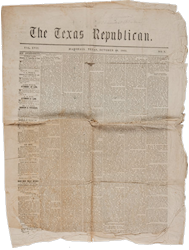
Texas Troops.

News of the Day

Southern Confederacy
Atlanta, Georgia
June 8, 1861

The “Palmer Guards,” company C, Texas Battalion, Captain A. G. Dickerson—80 men—passed through here yesterday morning on their way to Virginia. They are well armed and drilled, and are capable of doing the best of service. Capt. D. was accompanied by his beautiful and accomplished bride, who is the daughter of Ex Congressman Coleman, formerly of
Kentucky, but now President of the Vicksburg & Shreveport Railroad. They were married but a few days since. The patriotic lady says she has enlisted for the war and will share the destinies of her gallant husband, whatever they may be.
The company also had a pet along that attracted no little attention. It was a standard bearer in the person of Madmoeselle Jennette Warde’ from New Orleans—dressed a la bloomer, or soldier fashion, and belted with revolver, Bowie knife, &c. She was sprightly, shared and seemed to enjoy a soldier’s fare.—The beautiful flag which she carried in her hand was much admired.
0 comments

The Naval Brigade

Frank Leslie’s Illustrated Newspaper

The Naval Brigade, Under Command of Lieutenant Crosby, conveying the Federal Troops over Hampton Creek on the Night of 8th of June, Previous to the Battle of Great Bethel. From a Sketch by our Special Artist Accompanying Gen. Butler's Command. (Published in Frank Leslie's Illustrated Newspaper, June 29, 1861.)The Naval Brigade, Under Command of Lieutenant Crosby, conveying the Federal Troops over Hampton Creek on the Night of 8th of June, Previous to the Battle of Great Bethel. From a Sketch by our Special Artist Accompanying Gen. Butler’s Command. (Published in Frank Leslie’s Illustrated Newspaper, June 29, 1861.)

The Battle of Big Bethel was one of the earliest land battles of the American Civil War. It took place on the Virginia Peninsula, near Newport News, on June 10, 1861.

The Virginia State government had refused President Abraham Lincoln’s appeal for troops to put down the rebellion of the southern states, and its decision to secede from the Union was ratified by popular vote on May 23, 1861. Confederate Colonel (later Major General) John B. Magruder was sent down the peninsula to deter any advance on the state capital Richmond by Union troops based at the well-defended post of Fort Monroe. This garrison was commanded by Major General Benjamin Butler, a former Massachusetts lawyer and politician, who established a new camp at nearby Hampton and another at Newport News. Magruder had also established two camps, within range of the Union lines, at Big Bethel and Little Bethel, as a lure to draw his opponent into a premature action.

Butler took the bait, when he and an aide, Major Theodore Winthrop, devised a plan for a dawn attack on June 10, 1861, after a night march to drive the Confederates back from their bases. Butler chose not to lead the force in person, for which he was later criticized. The plan proved too complex for his poorly-trained subordinates to carry out, especially at night, and his staff had also omitted to communicate the passwords. They were trying to advance without knowledge of the layout or strength of the Confederate positions, when a friendly fire incident gave away their own. The commander in the field, Massachusetts militia general Ebenezer Peirce, received the most criticism for the failed operation.

The Union forces suffered 76 casualties, with 18 killed, including Major Winthrop and Lieutenant John T. Greble, the first regular army officer killed in the war. The Confederates suffered only 8 casualties, with 1 killed. Although Magruder subsequently withdrew to Yorktown and his defensive line along the Warwick River, he had won a propaganda victory and local Union forces attempted no further significant advance until the Peninsula Campaign of 1862. While small in comparison to many later battles, Big Bethel attracted considerable press coverage and exaggerated importance because of the newness of the war and the general feeling the war would be short.

The engagement was also known as the Battle of Bethel Church or Great Bethel.

Read more at Wikipedia

0 comments

Departure of the Marshall Guards.

News of the Day

Texas Republican
Marshal Texas
June 8, 1861

R. W. Loughery, Esq.
Dear Sir:—The Marshall Guards, after leaving home reached Swanson’s Landing, where they expected to take a boat the same day for New Orleans. They were disappointed, however, and did not leave there until Thursday morning. The steamers Texas and Fleta, were both above, and the company expected to take passage on the Texas; she did not get down until Wednesday evening, and when she came, she refused to land. She had on board Capt. Clopton’s company, the Star Rifles from Cass, besides considerable freight.
After the Texas left, the Guards, believing that she had other reasons besides that of low water, for refusing to take them, held an indignation meeting, and passed resolutions condemning the boat, and requesting their friends behind to withhold their patronage from her in future. They despatched two messengers that night to New Orleans, with their muster roll, one to go by Vicksburg, the other to go on the Texas. But when they reached Shreveport, they found that it was the intention of the Texas to take them down, and that she would wait their arrival, which she did. The company reached there on Thursday evening on the Fleta. The Guards appointed a committee to wait on the Captain of the Texas, for an explanation, which he gave to their satisfaction—the boat is therefore exonerated from all blame.
Our two Texas companies were received by [continue reading…]
0 comments

Office Politics in the Rebel War Office

Civil War Day-by-Day

JUNE 8th—This morning Col. Bledsoe came in with his letters, some fifty in number, looking haggard and worn. It was, indeed, a vast number. But with one of his humorous smiles, he said they were short. He asked me to look over them, and I found them mainly appropriate responses to the letters marked for answer, and pretty closely in accordance with the Secretary’s dictation. In one or two instances, however, he had been unable to decipher the Secretary’s most difficult chirography—for be had no idea of punctuation. In these instances he had wholly misconcieved the meaning, and the replies were exactly the reverse of what they were intended to be. These he tore up, and wrote others before submitting any to the Secretary.

I had only written some thirty letters; but mine were longer—longer than there was any necessity for. I told the colonel that the Secretary had a partiality for “full” letters, especially when addressing any of his friends; and that Major Tyler, who had returned, and was then sitting with the Secretary, rarely dismissed one from his pen under less than three pages. The colonel smiled, and said when there was nothing further to say, it was economy to say nothing. He then carried his letters into the Secretary’s office, clearing his throat according to custom on passing a door. I trembled for him; for I knew Mr. Walker had an aversion to signing his name to letters of merely two or three lines. He returned again immediately, saying the Secretary was busy. He left the letters, however.

Presently Major Tyler came out of the Secretary’s room with several voluminous letters in his own handwriting, duly signed. The major greeted the colonel most cordially; and in truth his manners of a gentleman are so innate that I believe it would be utterly impossible for him to be clownish or rude in his address, if he were to make a serious effort to be so.

The major soon left us and reentered the Secretary’s office; but returned immediately bearing the colonel’s fifty letters, which he placed before him and then retired. The very first one the colonel’s eye rested upon, brought the color to his face. Every line in it had been effaced, and quite a different answer substituted in pencil marks between the lines! “I wrote that,” said the colonel, “according to his own dictation.” And as every letter carried in its fold the one to which it was a reply, he exhibited the Secretary’s words in pencil marks. The colonel was right. The Secretary had omitted the little word “not”; and hence the colonel had written to the Georgian : “Your company of cavalry is accepted.” The Secretary refused almost uniformly to accept cavalry, and particularly Georgia cavalry. I took blame to myself for not discovering this blunder previously. But the colonel, with his rapid pen, soon wrote another answer. About one-half the letters had to be written over again; and the colonel, smiling, and groaning, and perspiring so extravagantly that he threw off his coat, and occupied himself several hours in preparing the answers in accordance with the Secretary’s corrections. And when they were done, Mr. S. S. Scott, who was to copy them in the letter-book, complimented the colonel on their brevity. In response to this, the colonel said, unfortunately, he wished he, Scott, were the secretary. Scott abused every one who wrote a long letter.

0 comments

William Howard Russell’s Diary: Visit to Mr. M’Call’s plantation.—Irish and Spaniards.—The planter.

My Diary North and South – William Howard Russell

June 8th.–According to promise, the inmates of Mr. Burnside’s house proceeded to pay a visit to-day to the plantation of Mr. M’Call, who lives at the other side of the river some ten or twelve miles away. Still the same noiseless plantations, the same oppressive stillness, broken only by the tolling of the bell which summons the slaves to labor, or marks the brief periods of its respite! Whilst waiting for the ferryboat, we visited Dr. Cotmann, who lives in a snug house near the levee, for, hurried as we were, ‘twould nevertheless have been a gross breach of etiquette to have passed his doors; and I was not sorry for the opportunity of making the acquaintance of a lady so amiable as his wife, and of seeing a face with tender, pensive eyes, serene brow, and lovely contour, such as Guido or Greuse would have immortalized, and which Miss Cotmann, in the seclusion of that little villa on the banks of the Mississippi, scarcely seemed to know, would have made her a beauty in any capital in Europe.

The Doctor is allowed to rave on about his Union propensities and political power, as Mr. Petigru is permitted to indulge in similar vagaries in Charleston, simply because he is supposed to be helpless. There is, however, at the bottom of the Doctor’s opposition to the prevailing political opinion of the neighborhood, a jealousy of acres and slaves, and a sentiment of animosity to the great seigneurs and slave-owners, which actuate him without his being aware of their influence. After a halt of an hour in his house, we crossed in the ferry to Donaldsonville, where, whilst we were waiting for the carriages, we heard a dialogue between some drunken Irishmen and some still more inebriated Spaniards in front of the public-house at hand. The Irishmen were going off to the wars, and were endeavoring in vain to arouse the foreign gentlemen to similar enthusiasm; but, as the latter were resolutely sitting in the gutter, it became necessary to exert eloquence and force to get them on their legs to march to the head-quarters of the Donaldsonville Chasseurs. “For the love of the Virgin and your own sowl’s sake, Fernandey, get up and cum along wid us to fight the Yankees.” “Josey, are you going to let us be murdered by a set of damned Protestins and rascally niggers?” “Gomey, my darling, get up; it’s eleven dollars a month, and food and everything found. The boys will mind the fishing for you, and we’ll come back as rich as Jews.”

What success attended their appeals I cannot tell, for the carriages came round, and, having crossed a great bayou which runs down into an arm of the Mississippi near the sea, we proceeded on our way to Mr. M’Call’s plantation, which we reached just as the sun was sinking into the clouds of another thunderstorm.

The more one sees of a planter’s life the greater is the conviction that its charms come from a particular turn of mind, which is separated by a wide interval from modern ideas in Europe. The planter is a denomadized Arab;–he has fixed himself with horses and slaves in a fertile spot, where he guards his women with Oriental care, exercises patriarchal sway, and is at once fierce, tender, and hospitable. The inner life of his household is exceedingly charming, because one is astonished to find the graces and accomplishments of womanhood displayed in a scene which has a certain sort of savage rudeness about it after all, and where all kinds of incongruous accidents are visible in the service of the table, in the furniture of the house, in its decorations, menials, and surrounding scenery.

It was late in the evening when the party returned to Donaldsonville; and when we arrived at the other side of the bayou there were no carriages, so that we had to walk on foot to the wharf where Mr. Burnside’s boats were supposed to be waiting–the negro ferryman having long since retired to rest. Under any circumstances a march on foot through an unknown track covered with blocks of timber and other impedimenta which represented the road to the ferry, could not be agreeable; but the recent rains had converted the ground into a sea of mud filled with holes, with islands of planks and beams of timber, lighted only by the stars–and then this in dress trousers and light boots!

We plunged, struggled, and splashed till we reached the levee, where boats there were none; and so Mr. Burnside shouted up and down the river, so did Mr. Lee, and so did Mr. Ward and all the others, whilst I sat on a log affecting philosophy and indifference, in spite of tortures from mosquitoes innumerable, and severe bites from insects unknown.

The city and river were buried in darkness; the rush of the stream, which is sixty feet deep near the banks, was all that struck upon the ear in the intervals of the cries, “Boat ahoy!” “Ho! Batelier!” and sundry ejaculations of a less regular and decent form. At length a boat did glide out of the darkness, and the man who rowed it stated he had been waiting all the time up the bayou, till by mere accident he came down to the jetty, having given us up for the night. In about half an hour we were across the river, and had per force another interview with Dr. Cotmann, who regaled us with his best in story and in wine till the carriages were ready, and we drove back to Mr. Burnside’s, only meeting on the way two mounted horsemen with jingling arms, who were, we were told, the night patrol;–of their duties I could, however, obtain no very definite account.

0 comments

Horatio Nelson Taft

Diary of US patent clerk Horatio Nelson Taft.

SATURDAY 8

Left the office today at 12 and went down to the Navy Yard with E P and Capt Welling, saw all the sights there. Went on board the “Freeborn” and saw the effect of the shot &c, she was in four engagements within a week. Capt Ward is evidently a “fighting Cock,” had attended all the “balls” so far. Came home at 3 o’clock. At 5 went to market and while there one of the most tremendous showers occured that I ever witnessed, lasting about an hour.

______

The three diary manuscript volumes, Washington during the Civil War: The Diary of Horatio Nelson Taft, 1861-1865, are available online at The Library of   Congress.

0 comments

War views, Camp life, Army of the Potomac—writing to friends at home

Library of Congress

Boston Light Artillery soldiers in camp at Relay House in Maryland sitting at a long table, writing letters, as one soldier, in the foreground, appears to be sewing.Title: War views. No. 1501, Camp life, Army of the Potomac—writing to friends at home
Creator(s): E. & H.T. Anthony (Firm),
Date Created/Published: New York : Published by E. & H.T. Anthony & Co., American and Foreign Stereoscopic Emporium, 501 Broadway, [photographed June 1861, printed between 1865 and 1869]
Medium: 1 photographic print on stereo card : stereograph ; 2 15/16 x 5 3/4 in.
Summary: Stereograph shows Boston Light Artillery soldiers in camp at Relay House in Maryland sitting at a long table, writing letters, as one soldier, in the foreground, appears to be sewing.
Reproduction Number: LC-DIG-stereo-1s02987 (digital file from original item)
Rights Advisory: No known restrictions on publication.
Call Number: LOT 4169, no. 206 [P&P]
Repository: Library of Congress Prints and Photographs Division Washington, D.C. 20540 USA
Notes:
…..Title from item.
…..No. 1501.
…..Date of photograph, regiment, and location from notations on photograph from the same negative in the custody of American Antiquarian Society.

Library of Congress permalink
___________
Mike’s notes:

Note – This image has been digitally adjusted for one or more of the following:
– fade correction,
– color, contrast, and/or saturation enhancement
– selected spot and/or scratch removal
– cropped for composition and/or to accentuate subject

0 comments

Status of Ordinance Supplies

Diary of Battery A, First Regiment, Rhode Island Light Artillery, by Theodore Reichardt
Ordnance Office,
Washington, June 8, 1861.
Hon . Simon Cameron,
Secretary of War :
Sir: Since the receipt of your letter of the 6th ultimo every attention possible on the part of this office has been given toward obtaining the necessary data for responding to the various questions therein. In ordinary times, and without the confusion as to the condition of ordnance supplies which was occasioned by irregular and, it is believed, unwarranted orders for taking them from the arsenals, it would not have been difficult to have made a prompt answer to your letter. As it was, immediate measures were taken to answer, which involved the necessity of a correspondence with the respective arsenals. Most of them have responded, and a tabular statement is in preparation, exhibiting in a concise form, convenient for easy reference, the facts called for by the first and fifth questions of your letter. There are still some blanks necessarily left in this statement, from the non-receipt of replies from some of the arsenals, which will be filled as fast as they come in, and the complete statement submitted to you. I ought not probably to have delayed an immediate answer to your letter, as far as was possible, but my desire to answer it in full has caused me to do so. I now reply to the second, third, and fourth questions, and will not defer answers to the others longer than is absolutely necessary to enable me to do so. The cost of manufacturing rifle-muskets is $ 13.93 per arm, including appendages, such as screwdrivers, wipers, spring vices, and bullet-molds. The Government has no foundry and purchases its cannon. [continue reading…]
0 comments

There seems to be a war spirit abroad with the young men

Journal of Meta Morris Grimball
Meta Morris Grimball

8th June.

       Lewis not being able to get a commission determined to go to Virginia as a private and Mr Henry Lesegne gave him a letter to Col. George Deas, & I gave him one, too, as he is my Cousin. Martin gave him a letter to Capn Cuthbert, he went off looking rather grave. It is a serious thing to leave home under such circumstances. He had a fine minie rifle got from Elliott, Captain of William’s Company. If any thing happens to the gun it has to be paid for. His pistol a purchase of his own, a blanket, a skin to sleep on which could also answer to keep his knapsack dry. He has joined the Palmeto Guards and hopes to see some service. There seems to be a war spirit abroad with the young men, so many are going to Virginia.—

0 comments

Our present ration is not adapted to the abundance of wholesome and cheap food found in the Mississippi Valley

The Letters of Samuel Ryan Curtis

Head Quarters Iowa troops
Keokuk June 8 1861

Genl L. Thomas
Adt Geni U.S.A.

Dr Sir

Three regiments each over a thousand strong are now assembled here, and earnestly and anxiously awaiting Complete equipment. I command the 2nd (The first for 3 years) and it is already pretty well advanced in company and battalion drill.

By your order No. 15 there is allowed to each regiment one asst quartermaster, one asst. surgeon, and 2 lietuen-ants to a company. The regiments are much larger than those we had in Mexico, and I think we will need the same number of officers we had then, i.e. 2 surgeons, 1 quartermaster 1 Commissary and 3 Lieutenants to each company. The quarter master and Commissary may both be detached from the Lieutenants and so of the adjutant if we have 3 Lieutenants to the company.

I shall write the Comissary department on the subject of varying the ration to suit the varied localities of our army, which if necessary I hope you will favor as our present ration is not adapted to the abundance of wholesome and cheap food found in the Mississippi Valley

Very Respectfully
Your obt Servt
Saml R. Curtis

[copy]

0 comments

“We expect to be ordered to Western Virginia or Harper’s Ferry..,”–Army letters of Oliver Willcox Norton.

Civil War Day-by-Day

Camp Wright, Hulton, Penn.,
Saturday, June 8, 1861.

Dear Sister H.:–

You will see by the date of this that I have left Camp Wilkins and am now at the new camp called Camp Wright. We arrived here to-day. Oh, I tell you we have a splendid place, fifteen miles from Pittsburgh on the south bank of the Alleghany. The barracks of the Erie regiment are sheds seventy-five feet long and twenty feet wide. They stand in a row with an alley ten feet wide between each two. Each shed is divided by a partition running through the middle, making two long rooms ten feet wide. Each company occupies one room in one shed and one in the next shed across the alley.

At the head of the alley are the Captain’s quarters, overlooking his whole company. The railroad runs between the camp and the river and on the other side of the railroad is the parade ground, a beautiful meadow of ninety acres. The barracks are built on a side-hill so that the upper end rests on the ground and the other is some six feet from the ground. The floor descends about seven feet in the seventy-five, making quite a slope. The tables are wide boards hung on hinges to the side of the wall. We are to sleep on the bare floor. We have just the best of spring water and it tastes good after drinking the nasty river water which we had so long in Pittsburgh.


There is a large orchard in camp and a grove of beautiful shade trees. A little brook runs through a shady hollow down on one side, and every one seems delighted at the change from the foul, dirty camp to this beautiful place.

But we are not to stay here long. Colonel McLane received a dispatch from Washington yesterday, saying that we were accepted by the Government, and were to be mustered into the United States service immediately, those who are willing for three years and the others for three months from this time, those who will not enlist for three months to be sent home. I shall not enlist for three years now. I will wait till my three months are up. We are to be uniformed and equipped immediately. We expect to be ordered to Western Virginia or Harper’s Ferry, though, for good reasons, we are not told where we are going.

A large amount of cartridges were sent off from the arsenal Thursday night, and troops are moving south from all directions, showing that something is to be done and that soon, too. Perhaps the war movements will not be so interesting to you, so I will tell you of a visit I paid to a glass factory yesterday. I never was in one before and it was quite a sight to me. A dozen or more great furnaces were filled with boiling glass, and a boy would run up and stick in a long rod, give it a turn and take out a dumpling of the red-hot liquid and hold it over an iron die, when another would cut it off with a pair of shears and bring down a lever on it, pressing it into a mold, and then pull it back and turn out a beautiful salt-cellar or sugar-bowl like yours, or a tumbler, a lamp, a sauce-dish, or whatever the mold happened to be. At another place they were blowing bottles and glass jars, such as they have to hold candy in shop windows. A man takes a hollow rod, runs it in the furnace and brings out a little wad of glass, then blows it a little and it swells out just like a bubble. He then whirls it over his head a few times and blows a little more, rolls it round on an iron plate to make it round, clips it off with a pair of shears, and another man stabs a fork into the bottom of it, and heating it, passes it to another who shapes the neck and mouth. They would make twenty in the time it takes me to tell you how they make one. One of the workmen kindly handed me his pipe and told me to blow a bottle. I did, two or three of them, and blew some glass bubbles, a piece of one of which I send to you. I think you never saw thinner glass, at least I never did.

While I was down to the river yesterday, I saw a curiosity–a tree growing downwards. The roots were in the top of the river bank, and the trunk hung right down and the branches curved upward.

0 comments

Civil War Day-By-Day

Civil War Day-by-Day

June 8, 1861

  • Virginia turns its state militia over to the Confederate States of America
  • By a vote of 108,339 to 47,233, Tennessee decides to secede from the United States

A Chronological History of the Civil War in America1

  • North Carolina State Convention ratified the C. S. Constitution.
  • Gen. Patterson’s advance moved from Chambersburg toward Harper’s Ferry.

  1. A Chronological History of the Civil War in America by Richard Swainson Fisher, New York, Johnson and Ward, 1863
0 comments

A “New” Story

Civil War Day-by-Day

Along with the daily material from the civil war that I am publishing, I am also “collecting” other material, such as magazine stories and articles, from the war years that doesn’t fit well in the daily publication format.  I am publishing literary pieces eparately from the daily blog and linking them under Literary Works, available on the menu bar above.

The newest addition is from the June 1864 Edition of Harper’s New Monthly Magazine:

Why I wrote it — (1864) by Louisa W. Barker, a young woman’s story of growing up in the South, going to school and living in the North when the war began, returning South, marriage, loss of her rebel husband, returning North and struggles of a single mother in a new place.

0 comments

A commission of inquiry and advice in respect to the sanitary interests of the U. S. forces…

War of the Rebellion: from the Official Records of the Union and Confederate Armies and Navies
War Department,
Washington, June 7, 1861.
Mixed Commission,
Medical Bureau:
The Secretary of War has learned with great satisfaction that at the instance and in pursuance of the suggestion of the Medical Bureau, in a communication to this office dated May 22, 1861, H . W . Bellows, Prof. A. D. Bache, LL. D.; Prof. Jeffries Wyman, M. D.; Prof. Wolcott Gibbs, M. D.; W. H. Van Buren, M. D.; Samuel G . Howe, M. D.; R. C. Wood, surgeon, U. S. Army; G. W. Cullum, U. S. Army; Alexander E . Shiras, U. S. Army, have mostly consented, in connection with such others as they may choose to associate with them, to act as a commission of inquiry and advice in respect to the sanitary interests of the U. S. forces and without remuneration from the government. The Secretary has submitted their patriotic proposal to the consideration of the President, who directs the acceptance of the services thus generously offered.
The Commission in connection with a surgeon of the U. S. Army, to be designated by the Secretary, will direct its inquiries to the principles and practices connected with the inspection of recruits and enlisted men, the sanitary condition of the volunteers, to the means of preserving and restoring the health and of securing the general comfort and efficiency of troops, to the proper provision of cooks, nurses, and hospitals, and to other subjects of like nature.
The Commission will frame such rules and regulations in respect of the objects and modes of its inquiry as may seem best adapted to the purpose of its constitution, which, when approved by the Secretary, will be established as general guides of its investigations and action.
A room with necessary conveniences will be provided in the city of Washington for the use of the Commission, and the members will meet when and at such other places as may be convenient to them for consultation and for the determination of such questions as may come properly before the Commission.
In the progress of its inquiries the commission will correspond freely with the Department and with the Medical Bureau, and will communicate to each, from time to time, such observations and results as it may deem expedient and important.
The Commission will exist until the Secretary of War shall otherwise direct, unless sooner dissolved by its own action.
SIMON CAMERON
Secretary of War.
0 comments

More Refugees.

News of the Day

Daily Times
Leavenworth, Kansas,
June 7, 1861

We conversed yesterday with Mr. James Johnson who has been forced to leave Missouri, because he loved his country, and would not forswear his obligations to it. In company with Mr. Henry Lewis and family, he was driven from the State, by a mob of about fifty Secessionists.
The house of Mr. L. was burned to the ground, and all his property “confiscated.” He is now in Coffey County, Kansas, making arrangements to settle there. His little son is at the Planters House. Mr. Johnson has joined the regiment at Camp Lincoln, and wants an opportunity to redress his wrongs, and to fight for the Union.
How long, oh! how long must men be persecuted, in the land of their nativity, for adhering to its glorious old flag? Is it any wonder that soldiers break over the restraints of authority, in their eagerness to resent the insults of a State that permits such outrages?
0 comments

William Harold Russell’s Diary: War-rumors, and military movements.—Governor Manning’s slave plantations.—Fortunes made by slave-labor.—Frogs for the table. —The forest.—Cotton and sugar.—A thunderstorm.

My Diary North and South – William Howard Russell

June 7th.–The Confederate issue of ten millions sterling, in bonds payable in twenty years, is not sufficient to meet the demands of Government; and the four millions of small Treasury notes, without interest, issued by Congress, are being rapidly absorbed. Whilst the Richmond papers demand an immediate movement on Washington, the journals of New York are clamoring for an advance upon Richmond. The planters are called upon to accept the Confederate bonds in payment of the cotton to be contributed by the States.

Extraordinary delusions prevail on both sides. The North believe that battalions of scalping Indian savages are actually stationed at Harper’s Ferry. One of the most important movements has been made by Major-General McClellan, who has marched a force into Western Virginia from Cincinnati, has occupied a portion of the line of the Baltimore and Ohio railway, which was threatened with destruction by the Secessionists; and has already advanced as far as Grafton. Gen. McDowell has been appointed to the command of the Federal forces in Virginia. Every day regiments are pouring down from the North to Washington. General Butler, who is in command at Fortress Monroe, has determined to employ negro fugitives, whom he has called “Contrabands,” in the works about the fort, feeding them, and charging the cost of their keep against the worth of their services; and Mr. Cameron, the Secretary of War, has ordered him to refrain from surrendering such slaves to their masters, whilst he is to permit no interference by his soldiers with the relations of persons held to service under the laws of the States in which they are in.

Mr. Jefferson Davis has arrived at Richmond. At sea the Federal steamers have captured a number of Southern vessels; and some small retaliations have been made by the Confederate privateers. The largest mass of the Confederate troops have assembled at a place called Manassas Junction, on the railway from Western Virginia to Alexandria.

The Northern papers are filled with an account of a battle at Philippi, and a great victory, in which no less than two of their men were wounded and two were reported missing as the whole casualties; but Napoleon scarcely expended so much ink over Austerlitz as is absorbed on this glory in the sensation headings of the New York papers.

After breakfast I accompanied a party of Mr. Burnside’s friends to visit the plantations of Governor Manning, close at hand. One plantation is as like another as two peas. We had the same paths through tasselling corn, high above our heads, or through wastes of rising sugar-cane; but the slave quarters on Governor Manning’s were larger, better built, and more comfortable-looking than any I have seen.

Mr. Bateman, the overseer, a dour strong man, with spectacles on nose, and a quid in his cheek, led us over the ground. As he saw my eye resting on a large knife in a leather case stuck in his belt, he thought it necessary to say, “I keep this to cut my way through the cane brakes about; they are so plaguey thick.”

All the surface water upon the estate is carried into a large open drain, with a reservoir in which the fans of a large wheel, driven by steam-power, are worked so as to throw the water over to a cut below the level of the plantation, which carries it into a bayou connected with the lower Mississippi.

In this drain one of my companions saw a prodigious frog, about the size of a tortoise, on which he pounced with alacrity; and on carrying his prize to land he was much congratulated by his friend. “What on earth will you do with the horrid reptile?” “Do with it! why, eat it to be sure.” And it is actually true, that on our return the monster ‘crapaud’ was handed over to the old cook, and presently appeared on the breakfast-table, looking very like an uncommonly fine spatch-cock, and was partaken of with enthusiasm by all the company.

From the draining-wheel we proceeded to visit the forest, where negroes were engaged in clearing the trees, turning up the soil between the stumps, which marked where the mighty sycamore, live oak, gumtrees, and pines had lately shaded the rich earth. In some places the Indian corn was already waving its head and tassels above the black gnarled roots; in other spots the trees, girdled by the axe, but not yet down, rose up from thick crops of maize; and still deeper in the wood negroes were guiding the ploughs, dragged with pain and difficulty by mules, three abreast, through the tangled roots and rigid earth, which will next year be fit for sowing. There were one hundred and twenty negroes at work; and these, with an adequate number of mules, will clear four hundred and fifty acres of land this year. “But it’s death on niggers and mules,” said Mr. Bateman. “We generally do it with Irish, as well as the hedging and ditching; but we can’t get them now, as they are all off to the wars.”

Although the profits of sugar are large, the cost of erecting the machinery, the consumption of wood in the boiler, and the scientific apparatus demand a far larger capital than is required by the cotton planter, who, when he has got land, may procure negroes on credit, and only requires food and clothing till he can realize the proceeds of their labor, and make a certain fortune. Cotton will keep where sugar spoils. The prices are far more variable in the latter, although it has a protective tariff of 20 per cent.

The whole of the half million of hogsheads of the sugar grown in the South is consumed in the United States, whereas most of the cotton is sent abroad; but in the event of a blockade the South can use its sugar ad nauseam, whilst the cotton is all but useless in consequence of the want of manufacturers in the South.

When I got back, Mr. Burnside was seated in his verandah, gazing with anxiety, but not with apprehension, on the marching columns of black clouds, which were lighted up from time to time by heavy flashes, and shaken by rolls of thunder. Day after day the planters have been looking for rain, tapping glasses, scrutinizing aneroids, consulting negro weather prophets, and now and then their expectations were excited by clouds moving down the river, only to be disappointed by their departure into space, or, worse than all, their favoring more distant plantations with a shower that brought gold to many a coffer. “Did you ever see such luck? Kenner has got it again! That’s the third shower Bringier has had in the last two days.”

But it was now the turn of all our friends to envy us a tremendous thunder-storm, with a heavy, even downfall of rain, which was sucked up by the thirsty earth almost as fast as it fell, and filled the lusty young corn with growing pains, imparting such vigor to the cane that we literally saw it sprouting up, and could mark the increase in height of the stems from hour to hour.

My good host is rather uneasy about his prospects this year, owing to the war; and no wonder. He reckoned on an income of £100,000 for his sugar alone; but if he cannot send it North it is impossible to estimate the diminution of his profits. I fancy, indeed, he more and more regrets that he embarked his capital in these great sugar-swamps, and that he would gladly now invest it at a loss in the old country, of which he is yet a subject; for he has never been naturalized in the United States. Nevertheless, he rejoices in the finest clarets, and in wines of fabulous price, which are tended by an old white-headed negro, who takes as much care of the fluid as if he was accustomed to drink it every day.

0 comments

An appointment by Jeff Davis not recommended by Secretary of War.—John Beauchamp Jones Diary at the Confederate War Office.

Civil War Day-by-Day

JUNE 7th.—We have a Chief of the Bureau of War, a special favorite, it is said, of Mr. Davis. I went into the Secretary’s room (I now occupy one adjoining), and found a portly gentleman in a white vest sitting alone. The Secretary was out, and had not instructed the new officer what to do. He introduced himself to me, and admitted that the Secretary had not assigned him to duty. I saw at a glance how the land lay. It was Col. A. T. Bledsoe, lately of the University of Virginia; and he had been appointed by the President, not upon the recommendation of the Secretary. Here was a muss not larger than a mustard-seed; but it might grow, for I knew well how sensitive was the nature of the Secretary; and he had not been consulted. And so I took it upon myself to be cicerone to the stranger. He was very grateful,—for a long time. Col. B. had graduated at West Point in the same class with the President and Bishop Polk, and subsequently, after following various pursuits, being once, I believe, a preacher, became settled as a teacher of mathematics at the University of Virginia. The colonel stayed near me, aiding in the work of answering letters; but after sitting an hour, and groaning repeatedly when gazing at the mass of papers constantly accumulating before us, he said he believed he would take a number of them to his lodging and answer them there. I saw nothing more of him during the day. And once or twice, when the Secretary came in, he looked around for him, but said nothing. Finally I informed him what I had done; and, without signifying an assent, he merely remarked that there was no room in his office for him.

0 comments

“It is a very commanding position and the “works” well advanced, Ditch & Breastwork.”—Horatio Nelson Taft

Diary of US patent clerk Horatio Nelson Taft.

FRIDAY 7

Offices all closed today in respect to the Memory of Judge Douglas. Took the occasion to visit Alexandria with my son H N Jr, and Mr Vansantvoord. We visited the “Marshall House” first where Col Ellsworth was killed. Got a pass there to go to the Camps of the Mich Regt and the Zuaves on [“Shooters Hill”?] about a mile back of the City. It is a very commanding position and the “works” well advanced, Ditch & Breastwork. Got home about 4 o’clock, found my nephew E.P. and Capt Welling from Lyons. Saml Androus also paid paid [sic] us a visit from the Camp. He returned.

______

The three diary manuscript volumes, Washington during the Civil War: The Diary of Horatio Nelson Taft, 1861-1865, are available online at The Library of   Congress.

0 comments

Officers and non-commissioned officers of Co. A, 8th New York State Militia, Arlington, Va., June, 1861

Library of Congress

Officers and non-commissioned officers of Co. A, 8th New York State Militia, Arlington, Va., June, 1861Title: Officers and non-commissioned officers of Co. A, 8th New York State Militia, Arlington, Va., June, 1861
Date Created/Published: photographed 1861, [printed between 1880 and 1889]
Medium: 1 photographic print on card mount : albumen.
Reproduction Number: LC-DIG-ppmsca-34175 (digital file from original item) LC-B8184-4112 (b&w film copy neg.)
Rights Advisory: No known restrictions on publication.
Call Number: LOT 4187, no. 62 [P&P]
Repository: Library of Congress Prints and Photographs Division Washington, D.C. 20540 USA
Notes:
…..No. 4112.
…..Title from item.
…..Gift; Col. Godwin Ordway; 1948.

Library of Congress permalink
___________
Mike’s notes:

Note – This image has been digitally adjusted for one or more of the following:
– fade correction,
– color, contrast, and/or saturation enhancement
– selected spot and/or scratch removal
– cropped for composition and/or to accentuate subject

0 comments

A Long Journey.

News of the Day

Daily Times
Leavenworth, Kansas,
June 7, 1861

[From the Chicago Tribune.]

M. A. E. Matthews, formerly of Stark co., Ohio, has just accomplished one of the severest journeys ever undertaken in America by one who is not exactly a fugitive slave—having traveled on foot from Houston county, Texas, to Ironton, Mo., sleeping in woods and swamps, traversing prairies and mountain ranges and suffering alternately from the ravages of vigilance committees and vermin.—Mr. Matthews left Texas in the last week of April and reached Ironton on the 24th of the present month [May], whence he was brought, footsore, exhausted and penniless, to Chicago, by the kindness of the railroad officers.
When the news of the bombardment of Sumter reached Houston county, the hostility to persons of Northern birth became so virulent that Mr. Matthews deemed an early departure essential to his personal safety.—When this was followed by the news of President Lincoln’s proclamation, he was required to join the rebel army instanter, or take his chances in what they denominated a court martial. He determined to do neither, and thereupon, with the North star for his beacon, and the night for his leave taking, commenced his long and wearisome march for the free States. What with frequent bewilderment in the woods and more frequent dodging and retreating to escape vigilance committees, Mr. Matthews thinks that he must have traveled fully eight hundred miles before reaching an atmosphere where he could safely say that he was born on this side of Mason & Dixon. At Archadelphia, Ark., he was tried for the offence of traveling northward, and after escaping from the majority of the jury, by means of a tax receipt and a favorable notice in a Texas paper, he was taken in hand by the minority and threatened with hanging in true Arkansas style. He managed to elude them in the night and secrete himself in one of the mountain ranges north of that place. A short time previous to his escape, three persons hunting for cattle in the woods south-west of Archadelphia were hung by a band of regulators, merely because in their terror, they became confused, and were unable to give such an account of themselves as would be satisfactory to their captors. Trackless woods and swamps, deep rivers and heavy rains, continual arrests and persecution, were his portion during the whole of the journey until he reached the Missouri line.
In many parts of Arkansas, Mr. Matthews found Union men, and in some places, (Batesville, for instance,) they were in the majority. These persons lived in perpetual terror, and were longing for nothing so much as the sight of a column of Federal troops to reinstate the supremacy of the laws. The price of corn in that part of Texas where Mr. Matthews lived was between three and four dollars per bushel, and all their supplies came from New Orleans by way of Shreveport. Among the poorer classes there was great suffering for the necessaries of life, and he believes that, in spite of all that is being done to increase the production of grain at the South, the blockade at Cairo will starve out the rebellion.
Is there a reign of terror at the South? Apply to Mr. Matthews for an answer, and read it in his wan features, his swollen feet, his crippled limbs, his dilapidated clothing, and his shattered health.
0 comments

“You may be more interested to know a little about the House of Commons. My diplomatic privilege gives me the entree there, and I have used it twice.”–Adams Family Letters…Charles Francis Adams To His Son .

Civil War Day-by-Day

London, June 7, 1861

For after all that may be said, there is not and cannot be any assimilation of manners and social habits between Americans and English people. All intercourse with the aristocratic class is necessarily but formal. We are invited everywhere, and dine out almost every day, but this brings us no nearer. Everybody is civil, but each one has his interests in England, so that a stranger is but an outsider at best. . . .

You may be more interested to know a little about the House of Commons. My diplomatic privilege gives me the entree there, and I have used it twice. The last time was at the close of the debate on the budget, when it was generally understood that the fate of Mr. Gladstone, if not of the whole Cabinet hung on the decision. More than six hundred members were present, and the array showed great equality on the two sides of the House. I had attended on the Monday before and had made up my mind that if the division should follow, the opposition would prevail by a decided vote. The ministry however had influence enough to command an adjournment, and on Thursday the case stood differently. The attack was neither so vigorous nor so confident, whilst the defence was bolder and more strenuous. The first effective stroke came from Lord John Russell, which I did not get in time to hear. The next was from Mr. Cobden, which was plain, direct and evidently telling on the House. The decisive blow came, however, from Mr. Gladstone, who stood like a bull in the arena surrounded by dogs. He began by tossing the very last one who had attacked him, and he went on with every one in turn, until he had them all sprawling on the ground. He is by all odds the best speaker I have heard, and though I cannot think him a very great man, I must award him the palm as a skilful debater. Lord Palmerston is evidently powerful more from his character, talents and position, than from any oratorical qualities. The ministry triumphed by fifteen majority only.

The characteristic of the House is that it is in essence a real deliberative body, whilst our House has ceased to be one. We speak to the people and not to the audience. Hence we make orations and not speeches. I know not how this can be remedied in America. Some members of Parliament tell me that this is perceptibly growing even here. So it must be, in proportion to the control which the people exercise over their representatives. . . .

0 comments

Army Life of an Illinois Soldier, Charles Wright Wills.

Civil War Day-by-Day
Note: This letter—a document written in 1861—includes terms and topics that may be offensive to many today.   No attempt will be made to censor or edit 19th-century material to today’s standards.

Cairo, June 9, 1861.

I have been over to Bird’s Point this morning for the first time. They have thrown up breastworks and dug a deep ditch outside of them, making a pretty strong camp. We don’t apprehend a shade of a fuss here but the officers are making as much preparation as if a Waterloo No. 2 were coming. I went to old Bird’s house this morning. It is just like the pictures we have seen in Harper’s of southern planters’ homes. A wide, railed porch extends around two sides of the house from the floor of each story. On the lower porch sat Bird and his family talking with a number of officers and their ladies. Looked very pleasant. Back of the house were the quarters filled with 46 of the ugliest, dirtiest niggers I ever saw, dressed in dirty white cotton. Awful nasty! The soldiers at the point have plenty of shade. We have but one tree on our grounds. The boys took a lot of ammunition from Bird the other day, and also another lot from a nest five miles back in Missouri. It was all given back, however, as private property. Our whole brigade of six regiments had a parade yesterday. We are all uniformed now and I think we made a respectable appearance. The general gave us a special notice. Are the Canton boys going or not? Do they drill? We have been sleeping on hay up to this week, but have thrown it away, and now have but the bare boards. The change has been so gradual from featherbed at home to plank here that I can’t think where it troubled me the least. I had a mattress in Peoria, straw in Springfield, and hay here. Our living is now very good. Fresh beef every day, potatoes, rice and beans.

0 comments

Officers of 8th New York State Militia, Arlington, Va., June, 1861

Library of Congress

Officers of 8th New York State Militia, Arlington, Va., June, 1861Title: Officers of 8th New York State Militia, Arlington, Va., June, 1861
Date Created/Published: photographed 1861, [printed between 1880 and 1889]
Medium: 1 photographic print on card mount : albumen.
Reproduction Number: LC-DIG-ppmsca-34171 (digital file from original item) LC-B8184-4104 (b&w film copy neg.)
Rights Advisory: No known restrictions on publication.
Call Number: LOT 4187, no. 58 [P&P]
Repository: Library of Congress Prints and Photographs Division Washington, D.C. 20540 USA
Notes:
…..No. 4104.
…..Title from item.
…..Gift; Col. Godwin Ordway; 1948.

Library of Congress permalink

___________
Mike’s notes:

Note – This image has been digitally adjusted for one or more of the following:
– fade correction,
– color, contrast, and/or saturation enhancement
– selected spot and/or scratch removal
– cropped for composition and/or to accentuate subject

0 comments

William Howard Russell’s Diary: Spirits in the morning.—Breakfast.—More slaves.—Creole planters.

My Diary North and South – William Howard Russell
Note: This particular diary entry–a document written in 1861–includes terms and topics that may be offensive to many today.   No attempt will be made to censor or edit 19th century material to today’s standards.

June 6th.–My chattel Joe, “adscriptus mihi domino,” awoke me to a bath of Mississippi water with huge lumps of ice in it, to which he recommended a mint-julep as an adjunct. It was not here that I was first exposed to an ordeal of mint-julep, for in the early morning a stranger in a Southern planter’s house may expect the offer of a glassful of brandy, sugar, and peppermint beneath an island of ice–an obligatory panacea for all the evils of climate. After it has been disposed of, Pompey may come up again with glass number two: “Massa say fever very bad this morning –much dew.” It is possible that the degenerate Anglo-Saxon stomach has not the fine tone and temper of that of an Hibernian friend of mine, who considered the finest thing to counteract the effects of a little excess was a tumbler of hot whiskey and water the moment the sufferer opened his eyes in the morning. Therefore, the kindly offering may be rejected. But on one occasion before breakfast the negro brought up mint-julep number three, the acceptance of which he enforced by the emphatic declaration, “Massa says, sir, you had better take this, because it’ll be the last he make before breakfast.”

Breakfast is served: there is on the table a profusion of dishes–grilled fowl, prawns, eggs and ham, fish from New Orleans, potted salmon from England, preserved meats from Prance, claret, iced water, coffee and tea, varieties of hominy, mush, and African vegetable preparations. Then come the newspapers, which are perused eagerly with ejaculations, “Do you hear what they are doing now–infernal villains! that Lincoln must be mad!” and the like. At one o-clock, in spite of the sun, I rode out with Mr. Lee, along the road by the Mississippi, to Mr. Burnside’s plantation, called Orange Grove, from a few trees which still remain in front of the overseer’s house. We visited an old negro, called “Boatswain,” who lives with his old wife in a wooden hut close by the margin of the Mississippi. His business is to go to Donaldsonville for letters, or meat, or ice for the house–a tough row for the withered old man. He is an African born, and he just remembers being carried on board ship and taken to some big city before he came upon the plantation.

“Do you remember nothing of the country you came from, Boatswain?” “Yes, sir. Jist remember trees and sweet things my mother gave me, and much hot sand I put my feet in, and big leaves that we play with–all us little children–and plenty to eat, and big birds and shells.” “Would you like to go back, Boatswain?” “What for, sir? no one know old Boatswain there. My old missus Sally inside.” “Are you quite happy, Boatswain?” “I’m getting very old, massa. Massa Burnside very good to Boatswain, but who care for such dam old nigger? Golla Mighty gave me fourteen children, but he took them all away again from Sally and me. No budy care much for dam old nigger like me.”

Further on Mr. Seal salutes us from the verandah of his house, but we are bound for overseer Gibbs, who meets us, mounted, by the roadside–a man grim in beard and eye, and silent withal, with a big whip in his hand and a large knife stuck in his belt. He leads us through a magnificent area of cane and maize, the latter towering far above our heads; but I was most anxious to see the forest primeval which borders the clear land at the back of the estate, and spreads away over alligator-haunted swamps into distant bayous. It was not, however, possible to gratify one’s curiosity very extensively beyond the borders of the cleared land, for rising round the roots of the cypress, swamp pine, and live oak there was a barrier of undergrowth and bush twined round the cane brake which stands some sixteen feet high, so stiff that the united force of man and horse could not make way against the rigid fibres, and indeed, as Mr. Gibbs told us, “When the niggers take to the cane brake they can beat man or dog, and nothing beats them but snakes and starvation.”

He pointed out some sheds around which were broken bottles where the last Irish gang had been working, under one “John Loghlin,” of Donaldsonville, a great contractor, who, he says, made plenty of money out of his countrymen, whose bones are lying up and down the Mississippi. “They due work like fire,” he said. “Loghlin does not give them half the rations we give our negroes, but he can always manage them with whiskey, and when he wants them to do a job he gives them plenty of ‘forty rod’ and they have their fight out–reglar free fight, I can tell you, while it lasts. Next morning they will sign anything and go anywhere with him.”

On the Orange Grove Plantation, although the crops were so fine, the negroes unquestionably seemed less comfortable than those in the quarters of Houmas, separated from them by a mere nominal division. Then, again, there were more children with fair complexions to be seen peeping out of the huts; some of these were attributed to the former overseer, one Johnson by name, but Mr. Gibbs, as if to vindicate his memory, told me confidentially he had paid a large sum of money to the former proprietor of the estate for one of his children, and had carried it away with him when he left. “You could not expect him, you know,” said Gibbs, “to buy them all at the prices that were then going in ’56. All the children on the estate,” added he, “are healthy, and I can show my lot against Seal’s over there, though I hear tell he had a great show of them out to you yesterday.”

The bank of the river below the large plantation was occupied by a set of small Creole planters, whose poor houses were close together, indicating very limited farms, which had been subdivided from time to time, according to the French fashion; so that the owners have at last approached pauperism; but they are tenacious of their rights, and will not yield to the tempting price offered by the large planters. They cling to the soil without enterprise and without care. The Spanish settlers along the river are open to the same reproach, and prefer their own ease to the extension of their race in other lands, or to the aggrandizement of their posterity; and an Epicurean would aver, they were truer philosophers than the restless creatures who wear out their lives in toil and labor to found empires for the future.

It is among these men that, at times, slavery assumes its harshest aspect, and that the negroes are exposed to the severest labor; but it is also true that the slaves have closer relations with the families of their owners, and live in more intimate connection with them than they do under the strict police of the large plantations. These people sometimes get forty bushels of corn to the acre, and a hogshead and a half of sugar. We saw their children going to school, whilst the heads of the houses sat in the verandah smoking, and their mothers were busy with household duties; and the signs of life, the voices of women and children, and the activity visible on the little farms, contrasted not unpleasantly with the desert-like stillness of the larger settlements. Rode back in a thunderstorm.

At dinner in the evening Mr. Burnside entertained a number of planters in the neighborhood – M. Bringier, M. Coulon (French creoles), Mr. Duncan Kenner, a medical gentleman named Cotmann, and others–the last-named gentleman is an Unionist, and does not hesitate to defend his opinions; but he has during a visit to Russia formed high ideas of the necessity and virtues of an absolute and centralized government.

0 comments

August Belmont (DNC Chairman) letter to William Seward

Civil War Day-by-Day

To The Hon. W. H. Seward,

Washington, D. C.

New York, June 6, 1861

My Dear Sir,–In your last kind letter, you requested me to inform you, from time to time, of the phases of public opinion in Europe, as they may come to my knowledge. I shall do so with pleasure, but hope that you will excuse my request if I beg you to consider my communications as strictly confidential.

The letters received by last steamer from England are any thing but satisfactory. The cotton interest seems to have gained so complete an ascendency over every other consideration, that the anti-slavery feeling is entirely pushed into the background.

I fear that the British cabinet is seriously contemplating the recognition of the Southern Confederacy, and what is worse is the almost certainty that France will act in concert with England.

If you will not take it amiss, I will make bold enough to give you, as my candid opinion, that the Morrill tariff has had as much to do with the unfortunate state of feeling in Europe as any other circumstance.

England and France are compelled to keep their army and navy on the most extensive war footing, both mistrusting each other. In order to obtain the enormous sums required for such a state of things, both governments must bring every sacrifice of principle rather than see their commercial and manufacturing interests endangered. Our tariff and our blockade strike a mortal blow to both, and as we cannot, of course, give up the latter, it is certainly worthy the serious consideration of our government and people to see whether sound policy does not dictate the modification of tlje first. Apart from the change of public feeling which a return to free-trade principles would produce in England and France, I think that we absolutely require it in order to increase our revenue, which, under the present system, must continue to be very low. The only interest, in my opinion, for which the plea of protection can be advanced with any degree of justice, is our iron interest, and that can be sufficiently done by a specific duty.

For the rest there ought, in my opinion, to be an average duty of fifteen per cent., and coffee and tea might be taken from the free list.

The government will very soon require a new loan, probably not less than thirty or forty millions, and I confess, candidly, that I do not see any chance for the negotiation of it in Europe, unless the chances of an increased revenue are secured by such a measure.

Before the war can be brought to a satisfactory termination we shall require from fifty to one hundred millions of dollars at least, and I think it will be absolutely necessary to look to the European money market for at least a portion of that amount.

By a reduction of our tariff to fifteen per cent., we take away a very great inducement for France and England to force our blockade and to recognize the South. They evidently expect now, not only to get their supply of cotton, but also to export their produce and manufactures into the Southern ports, to be from there smuggled into the West and North.

With a duty of fifteen per cent., the South cannot defray her expenses of a war, even if the blockade should not exist, and will be obliged to have recourse to an export duty on cotton and tobacco, and nothing will bring out a Union feeling so soon as that, among the influential planting interest.

Excuse the freedom of the expression of my views–they are based upon the best information I can command, abroad and at home, and they are dictated by a sincere devotion to my government.

0 comments