The Secession of Georgia

War of the Rebellion: from the Official Records of the Union and Confederate Armies and Navies

SAVANNAH, GA., January 27, 1861.

I transmit herewith a copy of an order which was handed to me yesterday.

I refused to recognize Colonel Lawton’s authority, or to allow Lieutenant Bassinger to interfere with the barracks or public property. Lieutenant Bassinger, on my refusal to agree to comply with the order which he gave me, called on and obtained assistance from the city police and fastened up my public storeroom. The barracks are now under the charge of the police.

I do not think the State authorities design taking the stores from here at present, or that they will molest me so long as I allow them to keep my storeroom fastened.

Lieutenant Bassinger, an officer of the State, offered to give me any writing I might desire in relation [to] the post and stores, but I refused to take any, or to give him any information. Please inform me if I am to act different from what I have.

……….Very respectfully, your obedient servant,

E. BURT,
Ordnance Sergeant,   U.S. Army.

Col. S. COOPER, Adjutant-General U. S. Army, Washington, D. C.

.

[Inclosure.]

.

SAVANNAH, January 26, 1861.

Lieut. W. S. BASSINGER :

SIR: You will immediately take possession of Oglethorpe Barracks, in this city, in the name of the State of Georgia, and under orders of the commander-in-chief.

The present occupants are not to be disturbed, provided they agree to remain subject to my orders, or to any proper authority of this State.

……….Very respectfully, your obedient servant,

A. R. LAWTON,
Colonel, Commanding.

0 comments

“I have not deemed it advisable to notice in any way the false reports which have originated in Charleston and elsewhere about us.”—Operations in Charleston Harbor

War of the Rebellion: from the Official Records of the Union and Confederate Armies and Navies

FORT SUMTER, S.C., January 27, 1861.
(Received A. G. O. January 30.)

Col. S. COOPER, Adjutant-General:

COLONEL: I have the honor to state, in reply to your letter of the 24th instant, that our letters, &c., are sent by boat, daily, at 12 m., to Fort Johnson in a sealed package, addressed to the postmaster in Charleston, and that the return boat brings our mail in a package bearing the post-office seal. I am satisfied with the existing arrangement. The governor told Lieutenant Talbot, when he saw him on his return from Washington, that I might, if I chose; send up to the city for my mails, but that he thought it would not be judicious for me to do so. I do not apprehend that there would be the slightest danger of any of my men deserting if thus employed, but think they might be insulted or maltreated. The report to which you refer, about the attempt of the men who were sent to the city to attend a murder trial to desert, is absolutely and entirely false. Lieutenant Davis (who refused to take them, though offered arms by several persons and urged to accept them) says that the men conducted themselves with the greatest propriety, and that, although handsomely entertained, they returned perfectly sober. I have not deemed it advisable to notice in any way the false reports which have originated in Charleston and elsewhere about us. I send herewith a slip containing two such reports. Lieutenant Meade states, and I have no doubt with entire truthfulness, that he made no statement whilst absent to any person about my preferences or my opinions, either military or political, and that the inferences given in the article in the Petersburg paper were not deducible from any facts stated by him. The other article, in the Baltimore paper, stating that a boat containing three of my men was fired into from Sullivan’s Island, is also entirely untrue. I cannot see the object to be attained by the circulation of such untruths. The object of one, which has been repeated more than once, that we are getting fresh provisions from the Charleston market, is apparent enough, viz, to show they are treating us courteously.   But even that is not a fact. I send herewith a copy of a letter written to our former beef contractor about furnishing us with meat, &c., to which no reply has yet been received–why, I am unable to ascertain; so that, up to this moment, we have not derived the least advantage from the Charleston markets; and I can confidently say that none of my command desire to receive anything from the city for which we are not to pay. Under the daily expectation of the return of Lieutenant Hall, I have deferred sending in a memorandum of the commissary stores on hand. There are now here 38 barrels pork, 37 barrels flour, 13 barrels hard bread, 2 barrels beans, 1 barrel coffee, ½ barrel sugar, 3 barrels vinegar, 10 pounds candles, 40 pounds soap, and 3/4 barrel salt. You will see from this that for my present command (especially after the departure of our women and children) we shall have an ample supply of pork and bread. It is a pity that my instructions had not been complied with, which would have given us the small stores which are now deficient, and which we shall not object to receiving as soon as the safety of our country will admit of our getting them. Nothing of importance to report. The Columbia is still aground in the Maffitt’s Channel.

I am, colonel, your obedient servant,

ROBERT ANDERSON,

Major, First Artillery, Commanding.

[Inclosure No. 1.]

FORT SUMTER, January 24, 1861.

Mr. DANIEL McSWEENEY:

SIR: I am directed by Major Anderson, commanding this post, to ascertain whether you will furnish such fresh beef and vegetables as may be required here; the beef upon the terms of the contract under which you supplied Fort Moultrie; the vegetables to be purchased by you for us at fair market prices; the whole to be delivered as hitherto, four times in ten days, at some wharf in Charleston, for transportation to Fort Johnson, where it will be received by this garrison. This arrangement, which has been approved by the governor of South Carolina, it is desired shall go into effect immediately, and if you consent to it, you can send 184 pounds of flesh beef at a time, at such hour and wherever Quartermaster-General Hatch (120 Meeting street) may advise you. Of the vegetables you will be further directed. Please acknowledge the receipt of this as soon as possible, in order, if necessary, that other arrangements may be made.

Respectfully, your obedient servant,

T. SEYMOUR,

Captain, U. S. Army.


Copy of extracts from Baltimore Sun and Petersburg Daily Express

[By telegraph for the Baltimore Sun.]

THE LATEST FROM THE SOUTH.

FROM SOUTH CAROLINA–A BOAT FROM FORT SUMTER FIRED AT BY THE SOUTH CAROLINIANS—HON. JEFF. DAVIS SPOKEN OF FOR PRESIDENT OF THE SOUTHERN CONFEDERACY.

CHARLESTON, JANUARY 23.–The battery on the beach at Sullivan’s Island fired into a boat from Fort Sumter on Monday. There were three men in it, who approached the beach with muffled oars. The sentry at the battery hailed them and warned them on. Failing to obey the summons, the sentry fired musketry into the boat, when it turned round and went away. Soon after those at the battery heard a noise like the hauling up of a boat at Fort Sumter. One of the men in the boat is said to have been wounded badly. Their object is supposed have been desertion, but some say it was a desperate effort to run the gauntlet of the sentries and spike the guns of the battery.

[The Daily Express, Petersburg, Va., Tuesday morning, January 22, 1861.]

COMING TO THE POINT–A PRACTICAL MOVEMENT.

THE POSITIONS OF MAJOR ANDERSON.–Lieut. R. K. Meade, of the Engineer Corps, at Fort Sumter, has been in our city, on a visit home, for several day’s past. Several gentlemen with whom he has conversed inform us that he speaks in the highest terms of Major Anderson, not only as a brave and fearless soldier, but as a strong and true Southern man, his position in the present state of affairs, however, rendering it impossible for him to take any other position before the people of the South and of the Union. He does not feel in the slightest complimented by the fanatical cannon firing in his honor at the North, and it is with pain, not fear nor even embarrassment, that he realizes the present attitude of the South towards him. That he loves the South, that he prefers it, every social tie gives ample testimony. He is bound by the holy ties of wedlock to one of the fairest of the fair of Georgia, a daughter of General Clinch. He has four devoted brothers, every one of whom, it is said, is a strong secessionist. Add to this that he is a Southerner by birth, and a descendant of Revolutionary sires, we need hardly more to give us assurance that he not only loves his native south, but will at the proper time, and in an honorable manner, draw the sword in her defense. These are simple references from facts as known. Not a syllable has fallen from the lips of Lieutenant Meade to lead to the remotest deduction that Major Anderson will not perform his whole duty to the Government of the United States. But that he will be hand in hand with the South as soon as he may be, with honor, relieved from his portion, we have little to doubt.

MAJOR ANDERSON.–“A Comrade” writes to the Columbus (Ga.) Enquirer concerning the late removal of Major Anderson to Fort Sumter, and in defense of his action and character. The conclusion is: “Major Anderson is a Southern man–born and raised in the noble old ‘Dark and Bloody Ground.’ He will be found on the side of the South when this government is dismembered, and, when his critical position has been properly understood, his name will be fully exonerated from the grave charges which have been made against it by those who have been deplorably misinformed upon all the points of military honor which have governed this truly gallant and meritorious officer.”
0 comments

“On the morning of the 25th the steamer Columbia, Captain Berry (who was the first to hoist the palmetto flag on board his vessel) in leaving the harbor by the Maffitt Channel, ran on shore”–Operations in Charleston Harbor

War of the Rebellion: from the Official Records of the Union and Confederate Armies and Navies

“Every man…, that is discharged is beset as soon as he reaches town for information, and in some instances they have played upon the credulity of their questioners. In other instances, the information given has been magnified and distorted.”

FORT SUMTER, S. C, January 27, 1861.

General Jos. G. Totten,

GENERAL: I have the honor to report that since the date of my last letter very little has been done by the troops of South Carolina around us, in consequence of the continued storm of rain and wind that has prevailed. The little that has been done comprises the completion of the mortar battery, situated to the southeast of Fort Johnson, on James Island, and the enlargement of the battery on Cummings Point by extending it towards the east. It now occupies the position shown in red in the marginal sketch. [sketch omitted in this report.] The position of the other battery on Morris Island is also shown in red. This is called by the Charlestonians “Fort Morris,” and I will so designate it in future.

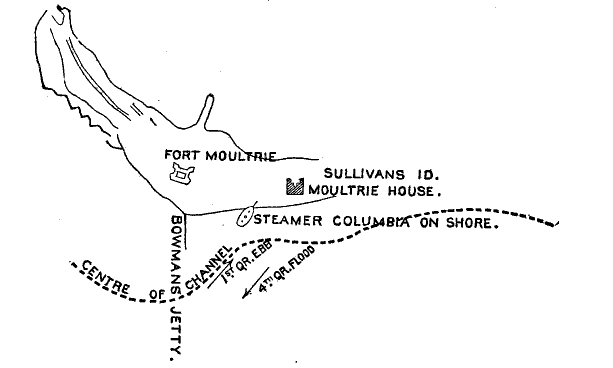
The two or three guard-boats that the authorities have in use are constantly employed in watching the bar, and evidently have signals by which they can communicate intelligence at night as well as in the day. On the morning of the 25th the steamer Columbia, Captain Berry (who was the first to hoist the palmetto flag on board his vessel) in leaving the harbor by the Maffitt Channel, ran on shore between the Moultrie House and Bowman’s Jetty, on Sullivan’s Island. Despite all efforts to get her off at each high tide (and we have had several very high ones since), she still lies in the same position. The probability is that she will go to pieces if it should happen to blow hard from the south or eastward. The cause of this casualty is undoubtedly found in the fact that the taking up of the outer end of Bowman’s Jetty has caused a deposition below it, which has diminished the depth of water, so that a vessel has now to follow a winding course very much like the red [broken] line in the marginal sketch. The difficulty of navigating   the sharp turn opposite where the Columbia now lies is very much increased by the opposite effects of flood and ebb tide, the latter tending to set the vessel on shore.

 Steamer Columbia aground on Sullivan's Island near Fort Mounltrie - map

Going out in the haze of the morning, the Columbia probably failed to observe the turn of tide, and could not turn quickly enough, with full head of steam, to clear the beach. Another of the steamers of the same line came in through the main ship channel last evening, being piloted in by one of the guard-boats.

In Fort Sumter everything goes on quite smoothly. I have done little during the past week, on account of the storm, besides policing, removing materials, and strengthening the filling of the openings for the embrasures of the second tier. One 10-inch columbiad has also been put in position on the parade to throw shells into Fort Moultrie, and surrounded by a strong traverse to avoid all danger from a possible bursting of the piece. Although all of the cement and bricks are used up, and the extreme scarcity of fuel does not permit the burning of shells for lime, I can manage with dry stone to strengthen all parts that require it. I do not propose to discharge my force of forty-three men at present, but to employ them at such work as from time to time becomes necessary. All of them will be of great service in case we have to sustain a cannonade, and the majority of them will also be of material aid in resisting a sudden attack. There is not a particle of truth in the many reports that have crept into the papers about mutinies, &c. The soldiers are in excellent spirits and full of confidence. Those of my men that I have discharged of late have left with great reluctance. In fine, the morale at present is very high.

The trouble that I had with my men soon after the command came over, which resulted in a rapid thinning out of the force, has long since ceased. Every man, however, that is discharged is beset as soon as he reaches town for information, and in some instances they have played upon the credulity of their questioners. In other instances, the information given has been magnified and distorted. And in one case, that of Lieutenant Davis, who went to town on the 19th in charge of four soldiers summoned as witnesses in a murder trial, an effort was made to convince him that his men, having been tampered with, had uttered threats against him, and that he should arm himself before trusting himself to come down with them alone in a boat. Lieutenant Davis declined their proffer of arms. It appears that there was no circumstance to warrant this attempt to place Lieutenant Davis in a false position towards his men, and to give cause for reports prejudicial to the fidelity of the soldiers. The report in the papers that the men attempted to jump out of the window to escape, is utterly without foundation. So, also, is the report that a boat from Fort Sumter, in attempting to reconnoiter the battery on Morris Island, had been fired into by the sentry, and one man wounded. No boat has ever left Fort Sumter for such a purpose, and I question whether it was a boat that the sentry fired at. In fact, it is not safe to credit any reports coming from this region, except such as are favorable to the Government of the United-States. Even the statements that emanated from high authority and were widely circulated, to the effect that this command was supplied with fresh provisions, &c., are not strictly true, for we have not as yet received any.

One lot was sent down on the 20th by the State authorities, which Major Anderson declined to receive. His proposition to get them from the regular contractor, and to pay for them, was accepted; but up to this time (10 a.m. of the 27th) we have not received anything from the contractor in town.

Lieutenant Meade returned on Wednesday, the 23, but on account of the storm was not able to get to the fort before the following day. Both he and Lieutenant Snyder having volunteered for the duty, I have entered them upon the regular roster for guard duty, two of the officers of the command being sick, and one absent. It does not interfere with our regular duties.

I have the honor to be, very respectfully, your obedient servant,

J. G. FOSTER

0 comments

The Secession Flag Flying

Miscellaneous document sources, News of the Day

Fort Moultrie, in Charleston Harbour, South Carolina—The Secession Flag Flying

Description from Fort Moultrie 1809-1930:

The English-born correspondent Thomas Butler Gunn, representing himself as a reporter for the Illustrated London News (although he was also secretly filing stories with the New York Tribune and New York Evening Post), gained admission into occupied Fort Moultrie on January 27, 1861 — unlike his friend and colleague William Waud, who was widely known throughout Charleston as being employed by the anti-secessionist Frank Leslie’s Illustrated Newspaper. Gunn subsequently drew a crude, error-filled sketch of Moultrie’s interior, which he dispatched to London to be featured in the March 2, 1861 edition of the Illustrated London News.

Note: how Gunn’s poor depiction includes a complete misidentification of the fort’s hot-shot furnace in the foreground, as a small building — with soldiers even apparently about to enter into its “door” — while the ramp immediately behind this structure soars up impossibly beyond the level of Moultrie’s Southwest Angle, rather than realistically leveling off at its terreplein.

Source: Original woodcut published at the bottom of Page 194 of the March 2, 1861 issue of the Illustrated London News (Volume 38, Number 1077); a sample is today preserved on Page 216 of Volume 17 of Gunn’s personal diaries, and includes his handwritten annotation “T. B. G. del.” for “Thomas Butler Gunn delineavit” — the Latin expression meaning “drawn by”. Other unannotated copies of this publication are held by libraries such as at Durham University, Emory University, etc., as well as in many private collections.

Image retrieved from:

“The Secession Flag Flying in the Fort Moultrie, South Carolina.” Open Parks Network. Accessed December 26, 2020. openparksnetwork.org/single-item-view/?oid=OPN_NS%3A933DC….

Medium: illustrations (layout features)
Item Location: Fort Sumter NM/Charles Pinckney NHS Curatorial Storage Facility, located at Charles Pinckney National Historic Site
Box: Box 2 of 3 Fosu 19th-c Illustrations Frank Leslie Harpers Weekly London Times, Etc.

Held By Fort Sumter and Fort Moultrie National Historical Park
Identifiers

Permanent Link: purl.clemson.edu/A9154290D7A758A3E653AC8243163835

______________________
Mike’s notes:
Special handed-tinted off-prints were also sold separately from newspapers. Numerous originals held today by public institutions and in private collections.

Note – This image has been digitally adjusted for one or more of the following:
– fade correction,
– color, contrast, and/or saturation enhancement
– selected spot and/or scratch removal
– cropped for composition and/or to accentuate subject

0 comments

The News

Civil War Day-by-Day

January 27, 1861, The New York Herald

The State of Louisiana is now added to the list of seceding States. The ordinance of secession was passed in the State Convention yesterday by a vote of 113 to 17. A deathlike silence prevailed during the calling of the roll, and many members were in tears. When the vote was announced the President of the Convention declared Louisiana a free and sovereign republic. The Convention adopted a resolution guaranteeing the free navigation of the Mississippi river.

The chronological order of the secession movement is as follows:

1. Dec. 20. South Carolina.
2. Jan. 9 Mississippi..
3. Jan. 11 Florida.
4. Jan. 11 Alabama.
5. Jan. 19 Georgia
6. Jan. 26 Louisiana.

The secession junta at Washington, having learned the intention of the government to reinforce the forts on the gulf coast, have telegraphed to Charleston and Pensacola, advising the State authorities to be on the alert. Major Chase, the commander of the Florida forces at Pensacola, has been advised to seize upon Fort Pickens, and as the officer in command of the garrison is represented to be a man of spirit and determination, it is likely that we shall soon have news of a hostile collision between the opposing forces.

The State troops of Louisiana, on the 11th inst., seized upon the United States barracks, situated about two miles below New Orleans, which have been used as a marine hospital for the treatment of sick sailors. At the time of the seizure there were two hundred and sixteen invalids and convalescents in the hospital. The Collector of New Orleans was required to remove the convalescents immediately, and the sick as soon as practicable. The only reason assigned for this discreditable conduct on the part of the State authorities, is, that they wanted the buildings for quarters for their own troops. It is said the federal government has no authority nor means to make provision for the invalids, and they are consequently thrown upon the charity of persosn more merciful than the authorities of Louisiana.

0 comments

The Position of Canada in the Future Northern Confederation

Civil War Day-by-Day

January 27, 1861, The New York Herald

The period has manifestly arrived, for our brethren in the British provinces of North America, and especially in Eastern and Western Canada, to be up and stirring, in view of the contagion of revolution which is rapidly spreading over the continent. The mad efforts of fanatics at the North, and the reactionary movement of extremists at the South, have been crowned with success, and the hard, undeniable fact lies before the world, that the two sections of the country will be compelled, hereafter to work out their respective destinies separately. The constitution which was framed to meet the wants of thirteen sparsely settled colonies, is declared to be insufficient of the requirements of thirty three States, with their prodigious background of uninhabited territory, and the exigencies of national economy and growth are believed to involve the necessity of change. The south looks with eager eyes towards Mexico, Central America, Venezuela and Cuba, out of which, with the fifteen existing slaveholding States, to found an empire that shall extend from the Orinoco to Mason and Dixon’s line, have its capital in New Orleans, and in the midst of which the Gulf of Mexico will form an inland sea. It cannot effect these ends, so long as the Union remains as it is. On the other hand, our Sewards, Sumners and Hales, see in the expanse between the great lakes and the Arctic Ocean, materials out of which nature has called for the establishment of scores of free States, which will spring into being and become prosperous and flourishing, so soon as they are regrafted on the tree to which they belong. Under these circumstances, it is not surprising that a perceptible leaven of agitation is visible in the British territory and it is the duty as well as for the interest of Canada, Nova Scotia and New Brunswick, to take a speedy initiative in the movement of separating themselves from the from the mother country, and constituting themselves a part of the Northern United States. The south which has, heretofore opposed the annexation of free territory will have no object in doing so any longer.

It is in the nature of things that the fever which rages in the veins of the American people, should spread before long across our northern boundary, and lead to results there similar to those that have been witnessed here. Loss of respect for the rights of property would appear to be but a corollary of the movement that convulses our Union. Alabama, Mississippi, Florida, Georgia, Virginia and Louisiana, have emulated the example of South Carolina, and laid hands upon the possessions of the federal government, without a thought that their acts may, at some future period, be reprobated. They have broken the links that bind them to the confederation; seized upon Forts Moultrie, Pinckney, Pulaski, Morgan, [continue reading…]

0 comments

Peaceable Separation Better than Civil War.

Civil War Day-by-Day

January 27, 1861, The New York Herald

The present generation have not experienced the horrors of war upon their own soil, or felt its intolerable burdens, and hence flippant journalists at the North and at the South, and demagogues who desire to fish in troubled waters, can with impunity urge the country to take a leap in the dark over the fearful precipice of civil war – the most horrible, cruel and exhausting of all wars.

Greely formerly belonged to the peace sect, and was as much opposed to fighting as a Quaker. He denounced all sorts of war, even foreign war, and within a few weeks he said it would be contrary to the principles of the Declaration of Independence and the doctrines of human liberty to prevent the peaceable secession of the Southern States. He is now infected with the republican mania for coercion and civil war. At the time of the Mexican war the Tribune denounced the invasion on the part of the United States as a national sin, and endorsed the patriotic wish of Tom Corwin that our army sent to Mexico might be with bloody hands sent to hospitable graves. But, accordingly to Greeley, now, an army sent from the North to butcher our own citizens at the south, because they are not willing tamely to submit to Northern aggression and injustice, would be doing God service; and if they perished they would be enrolled in heaven as noble army of martyrs, in company with John Brown.

If the instigators to war were only successful in their design, they would soon pay the penalty of their wickedness to an impoverished, ruined people awakened to a sense of their folly. The last war with England prostrated the country, exhausted its resources and left it bankrupt. Funds were raised only at heavy ruinous discounts and private individuals were applied to for help in the struggle. Between the disaffection of the New England States and the want of the sinews of war, it was unable to carry on the contest for twelve months longer, and hence the government after three years fighting, was compelled to make peace. If foreign war is so disastrous, what would be the result of a civil war, in which American citizens – those of fifteen sister States on one side, and those of eighteen on the other – divided only by a geographical line, should cut each other’s throats and carry devastation into each other’s territory?

There is only one way which this matter can be settled without a disruption of the Union, and that is by inserting declaratory amendments in the constitution explaining those provisions which have been violated or evaded by the [continue reading…]

0 comments

The Commercial Prospects Before Us

Civil War Day-by-Day

January 27, 1861, The New York Herald

At no period in the commercial history of New York have the prospects of a profitable and flourishing trade in the approaching spring and summer been more bright than at the present time, apart from the obstructions which the political troubles of the day interpose to the fulfillment of the promises which the financial condition of affairs hold out. Specie has been pouring in upon us by millions from Europe and California for some time past, until at the present moment there is probably not less than thirty seven millions in gold and silver deposited in this city, awaiting the settlement of the great political questions of the day to be thrown into active and productive application.

From the crises of the past few years the country has been just relieved, and New York is prepared now to avail herself, as she has ever done, of the rejuvenated prosperity which blesses the land; but, unhappily, the incertitude of public affairs surrounds commerce with embarrassment as with a wall of adamant, arrests progress, and puts checks upon all mercantile transactions; for who will move in an onward direction with a future clouded as our is? Capital finds no outlet, opportunities are lost and resources are thrown away, while the country balances on the verge of chaos. Could the existing political difficulty be settled, the business of this metropolis would experience a revival in the coming spring such as it never knew before.

New York leans upon two sections of the country for its commercial prosperity – the West and the South; and it has so happened in past times that when one section failed her the other held good. In 1857, the financial pressure came principally from the West. The loose system of credit which we had adopted, followed by two years of short crops, bought on the disaster then, and the West became bankrupt; but the Southern trade was good, the cotton crop was abundant, and the south redeemed itself, thus staving off what otherwise must have been inevitable ruin to all the commercial interests of this city.

Now the West is recovering from the blow. The harvest of 1860 were more luxuriant than any which that section of country has ever before known. The granaries are laden with abundance, and but await an outlet for their store to enrich the producers. For the past two or three years the West has been buying comparatively little; hence her wants of all [continue reading…]

0 comments

Semmes Doesn’t Think There will be War.

Miscellaneous document sources

Raphael Semmes[i] to Howell Cobb.

Washington, D. C,  Jan’y 26th, 1861.

My Dear Sir: Permit me to remind you of the conversation we had just before you left Washington. I think States enough have gone out to determine me as to the course I shall pursue. If invited by the Confederacy of the Cotton States I will accept service in its navy and abandon my present position. The chances are that Maryland (my native State) and all the other border slave states will speedily follow you, but whether they do or not I will cast my destiny with yours if you will permit me. I am in some sort claimed as a citizen of Alabama, having resided in that state several years before I was ordered to Washington upon my present duty, and it is probable that my nomination to the new executive for a post in the navy of the new Confederacy will be made by Gov’r Fitzpatrick and other friends from that State. However this may be, may I ask you also to perform this service for me and to inform me promptly of your action and that of the new President in the premises? Messrs. Toombs, Stephens, Fitzpatrick, Clay, Curry, Sydenham, Moore, Stallworth and other good friends to whom I have written or with whom I have conversed freely on the subject will I have no doubt take pleasure in assisting you to accomplish my purpose. As you are a delegate to the convention to form the new Government I may perhaps not inappropriately say a word or two to you on the subject of the organization of your army and navy. The Southern States being planting and agricultural States and but little engaged in commerce and navigation (though doubtless their separation from the North will make them more commercial and navigating than they have hitherto been), they will require but a small naval force for several years to come ; and it strikes me also that it will be bad policy to establish a large army. I would advise therefore that both your navy and army lists be kept within very small compass. I mean the regular forces of each, or such as are to be kept on foot as well in peace as in war. If a war ensue, which I do not anticipate, your regular military establishment can be temporarily increased to meet the emergency by appointments and enlistments to continue during the war and by the commissioning of privateers and other irregular maritime forces to serve during the same period. This will enable you at the end of the war to dismiss, as a matter of course and without complaints, all the personnel of both services excepting only the small army and navy lists before referred to. I have said that I do not think we shall have a war and these are my reasons for the opinion. If the border slave states join you the old confederacy will be split nearly in half, and the idea of coercion would be simply ridiculous; if they do not join you, being retained by compromises that will satisfy them, they will be a barrier and a safeguard to you and will hold the hands of the Vandals who might otherwise be disposed to make war upon you. No slave state could possibly be an ally of the free states in a war upon slave states upon the slave question. Be cool therefore in organizing your military and naval establishments and do not consent to place too great burthens upon the shoulders of the people. It is easier to make armies and navies than to get rid of them when made, and the people will not and ought not to submit to exhorbitant taxation to support large establishments for which they will ordinarily have no use. One word more and I shall have done.

Your naval officers I suppose will be taken from the present navy list of the old government. Preserve their relative rank in their new relations. You know rank is of essence with military and naval men, and the rule I suggest to you is not only just and proper and will work well but it will put an end to all jealousies, rivalries and heartburnings. May I ask the favor of a line in reply?


[i] Lieutenant, 1S37-1855, commander, 1855-1861, United States Navy; commander and rear-admiral, Confederate States Navy, commanding the cruisers Sumter and Alabama.


From Annual Report of the American Historical Association for the Year 1911.

Raphael Semmes (September 27, 1809 – August 30, 1877) was an officer in the Confederate navy during the American Civil War. Until then, he had been a serving officer in the United States Navy from 1826 to 1860. During the American Civil War, Semmes was captain of the cruiser CSS Alabama, the most successful commerce raider in maritime history, taking 65 prizes. Late in the war, he was promoted to rear admiral and also acted briefly as a brigadier general in the Confederate States Army. His appointment or arrangement to act as a temporary brigadier general from April 5 to April 26, 1865, was never submitted to or officially confirmed by the Confederate Senate.

Howell Cobb was an American political figure. A southern Democrat, Cobb was a five-term member of the United States House of Representatives and Speaker of the House from 1849 to 1851. He also served as the 40th Governor of Georgia and as a Secretary of the Treasury under President James Buchanan. Cobb is, however, probably best known as one of the founders of the Confederacy, having served as the President of the Provisional Congress of the Confederate States.

0 comments

Public matters move forward in the same downward direction…

The Letters of Samuel Ryan Curtis

Washington Jany 26. 1861.

My dear wife

We were glad to receive your letter to Sadie last night, and very glad to hear you and Caddie are so well. Some sore throat prevails here. Sadie has been complaining of it for a day or two, but she is about and attended a party with me last night at Mr. Greens, the old friend who lives in a splendid mansion near the Observatory. I had never been there, and we thought we must accept of his kind invitation after so many acts of courtesy received from him during the past 3 years. We were very kindly received and elegantly entertained.

Mr. Tate, his sister in law, and Dr. Tate brother in law are staying there, and I have seen no establishment superior to it in Washington. Mrs. Tate sent her regards to you, saying that she became somewhat acquainted with you two years ago. Henry did not go with us because he and Sadie had by some mistake, made another appointment at Judge Lawrance, where there was also a small and pleasant party. Ned Sturges, who is still with us went and spent the evening at Mr. Cox’ quarters.

The public matters move forward in the same downward direction, but precipitation is not so rapid. Kentucky and other border states are disposed to look before they leap.

I have felt very little concern about the defenses of this city, because I have great confidence in General Scott who ought to provide against any pending danger.

We are supposed to be a deliberative body, and although we ought to assist in carrying out plans, we ought not to have the trouble and embarrassment of details or determination of the question of our own fortification. I say this to explain to you why we in the Congress do not make more fuss about the matter.

The force here is still very insignificant and the Chairman of our Military Committee1 has so intimated to the Secretary of War2 but the Department replies that the President is averse to calling out more force and against the introduction of a bill authorizing him to call out force. The object is to let matters run on, slipshod, till Mr. Lincoln comes in, and then if we are all assassinated Buchanan would say “Shake not thy gory locks at me thou canst not say I did it.” But my hope is that neither Virginia or Maryland will adopt precipitation and without the secession of these States, there is little or no danger of any attack on this city.

Besides such a movement could not be made in this country without more of a note of preparation.

Henry is enjoying himself, and I hope he will stay a week or two before going west.

He has a bed in my room, so that Mrs. Joy will only charge something like day boarding. In this way it will not cost much more that it would in Omaha.

Dear little Caddie, I am very glad you are well and growing larger every day. I hope you will read me a pretty story when I get home. I tell you daughter these little sisters here are not much better than your dollie– Indeed they are not nice enough to make sisters to you and I am not willing to buy them.

You may think Cousin Helin got a very pretty little Cousin and therefore I might get such a one for you; but I tell you there are no more of that sort. Mrs. Morris’ baby has black hair, and I don’t like black headed babies–do you? Besides she won’t sell hers at any price. Don’t you think she is green? I think it cries and bitea her too! Well, if I cannot get a little sister for you, perhaps I can get you a little book or a little pairsol or something else

You tell me something that will please you just as well as a live sister baby.

Ever Affectionately yours
Saml. R. Curtis


1. Benjamin Stanton. representative from Ohio 1851-1858, 1856-1861.

2. Joseph Holt. a Kentucky Democrat. Appointed Commissioner of Patents 1857 to succeed Charles Mason of Keokuk, Iowa, Holt was designated Postmaster General in 1859. A sympathiser of Southern sentiment at this time, he inclined to the Union cause when appointed Secretary of War January 1, 1861, to succeed John B. Floyd, resigned. He actively sought to keep Kentucky in the Union, and later, as Judge Advocate General under Lincoln and Johnson supported the Radicals in Congress. See D. A. B. 9, 181-183.

0 comments

“Business in the Pat office is very dull this winter as might be expected.”—Horatio Nelson Taft.

Diary of US patent clerk Horatio Nelson Taft.

SATURDAY 26

A regular snow storm today, snow four or five inches deep. Nothing important occurs from day today here. But the Govt is posting troops in different parts of the City for its protection. We were just startled by hearing two pistol shots and a cry of Watch Watch on Franklin Square near our house. Did not go down to the “Avenue” this evening on account of the snow. Usualy do go down to the Hotels and get the “Herald” or “Times,” sometimes the “Tribune.” I take the City papers (two). The Balt “Sun,” Home J[ournal]l, N.Y. Lyons paper, Scientific American, &c. I read daily a number of other papers and a good deal in Books, mostly relating to Steam. Business in the Pa[ten]t office is very dull this winter as might be expected.


The three diary manuscript volumes, Washington during the Civil War: The Diary of Horatio Nelson Taft, 1861-1865, are available online at The Library of   Congress.

0 comments

Main Battery at Fort Sumter

Harper’s Weekly

Main Battery at Fort Sumter, Bearing on Fort Moultrie and the Channel.—From a Sketch by an Officer of Major Anderson's Command
Main Battery at Fort Sumter, Bearing on Fort Moultrie and the Channel.—From a Sketch by an Officer of Major Anderson’s Command

Harper’s Weekly, January 26, 1861  (Special handed-tinted off-print)

Special handed-tinted off-prints were often sold separately from newspapers. Numerous originals held today by public institutions and in private collections.

0 comments

Secession ordinance in Louisiana—Dora Richards Miller War Diary

War Diary of a Union Woman in the South

Jan. 26, 1861.–The solemn boom of cannon today announced that the convention have passed the ordinance of secession. We must take a reef in our patriotism and narrow it down to State limits. Mine still sticks out all around the borders of the State. It will be bad if New Orleans should secede from Louisiana and set up for herself. Then indeed I would be “cabined, cribbed, confined.” The faces in the house are jubilant to-day. Why is it so easy for them and not for me to “ring out the old, ring in the new”? I am out of place.


Note: To protect Mrs. Miller’s job as a teacher in post-civil war New Orleans, her diary was published anonymously, edited by G. W. Cable, names were changed and initials were generally used instead of full names—and even the initials differed from the real person’s initials. (Read Dora Richards Miller’s biographical sketch.)

0 comments

A Diary of American Events – January 26, 1861

The Rebellion Record – A Diary of American Events; by Frank Moore

–The Louisiana State Convention passed the ordinance of secession to-day, by a vote of one hundred and thirteen to seventeen. A delay ordinance was proposed yesterday, but was voted down by a large majority. A gold pen was given each member, with which to sign the ordinance of secession.–(Doc. 27.)– Buffalo Courier.

0 comments

Sloop-of-War Brooklyn not headed to Charleston — Confederate Records

War of the Rebellion: from the Official Records of the Union and Confederate Armies and Navies

[JANUARY 26, 1861.] Saturday–8 o’clock a.m.

Hon. JOHN ROBERTSON,

Commissioner from Virginia, Charleston:

President’s reply: “Brooklyn not for South Carolina. On errand of mercy and relief.”

JOHN TYLER.

0 comments

Operations in Florida

War of the Rebellion: from the Official Records of the Union and Confederate Armies and Navies

WAR DEPARTMENT, January 26, 1861.

Lieut. Gen. W. Scott:

DEAR GENERAL: The President is much disturbed by a telegraphic dispatch which announces that the Brooklyn has sailed with two companies instead of one as was ordered. I assured him that the dispatch must be inaccurate, but would be glad to repeat the assurance on your authority.

Sincerely yours,

J. HOLT.

0 comments

Fort Taylor defenses improving.—Operations in Florida.

War of the Rebellion: from the Official Records of the Union and Confederate Armies and Navies

FORT TAYLOR, KEY WEST, FLA.,……….
January 26, 1861.

SIR: I have to report that no demonstration has been made upon this fort to this date. There is no apprehension from the population of Key West, but I have no doubt that a force will soon appear at any moment from the mainland. If my company was filled up to a hundred men, and a sloop of war stationed in this harbor, there would be no danger of any successful attack, or even an attempt at present. The defenses are improving daily.

I am, sir, very respectfully, your obedient servant,

J. M. BRANNAN, ………
Captain, First Artillery, Commanding.

Col. S. COOPER, Adjutant-General U.S. Army, Washington, D. C.

.

P. S.–I have received no communication from the Department in answer to my letter of December 11, 1860.

0 comments

The Homeless Poor of New York

Civil War Day-by-Day

January 26, 1861, The New York Herald

The poor of New York are divided into two great classes – those who have homes, such as they are, and those who when they awake in the morning know not where they will sleep the next night. Of this latter class there are at least a thousand in the city, of whom about one half find shelter every night in the different stations houses throughout the city. This portion is made up of laborers, tradesmen and poor women out of employment, with a small number of unfortunate inebriates who have managed to escape being sent up on the Island as vagrants. In estimating the number of houseless poor in New York at a thousand we are certain we fall very considerably short of the actual count, but then it must be remembered that many of these procure temporary employment and are enabled to provide themselves with a home for at least a week at a time. There are, however, at least a thousand who wander about the city every day, living upon whatever alms they receive, and sleeping in the police stations or cheap lodging houses where they can procure a bed for six pence or a shilling a night, the owners thereof being very little better off than themselves. The number of these homeless and destitute poor, although subject to frequent reductions under the Vagrant act which consigns them to the public institutions, is constantly recruited by the daily accessions made to it by the unemployed who come in from the country, where they have worked upon farms, but where their services are no longer required. We have shown how several of these unfortunate free white citizens are obliged to bind themselves into slavery to the State for certain terms, during which they are obliged to work in return for their food alone! This is the only alternative which is left to save them from starvation, and in some cases that we have seen they are only too willing to accept it. During the present winter there has been a large increase in the class of unfortunates, as shown by the returns of the past four or five days, compared with the average daily returns of the same time last year. From the report of the Superintendent of Police for the quarter ending January 31, 1860, we find that the number of persons accommodated with lodgings in the twenty six station houses of New York was 22, 051. This gives a nightly average of about 240, which is about one half of the number who now find shelter within their walls, although, as will be seen, that shelter is to some instances not of the same [continue reading…]

0 comments

The News

Civil War Day-by-Day

January 26, 1861, The New York Herald

Our Washington correspondent announces that the government has despatched reinforcements to Fort Sumter, in Charleston harbor, and Fort Pickens, at Pensacola, and this report is somewhat confirmed by the departure of the steam sloop-of-war Brooklyn from Norfolk on Thursday, bound South, with sealed orders, having on board two companies of soldiers from Fort Monroe. The preparations of the government have been quietly made and there is reason to believe the expedition will prove successful.

There was a report current in Washington yesterday that the Grand Jury of the district had indicted Mr. Floyd, ex-Secretary of War, for malfeasance in office.

A company of fifty United States troops from Governor Island was landed yesterday on pier No. 1, East river, destined for Washington city.

0 comments

The Brooklyn

Civil War Day-by-Day

January 26, 1861, The Charleston Mercury

The information that the Brooklyn sailed on Thursday evening from Hampton Roads, with troops on board, bound South, reached this city on the same night. It is to be presumed that her destination is Pensacola, although a bright lookout will be kept for her at the entrance of this harbor. The people of South Carolina have so perfectly lost faith in the Government of the United States, that it is preposterous to expect them to remain tranquil so long as Fort Sumter is liable to reinforcements; and consequently the certain knowledge of the intelligence above referred to has renewed to some extent the excitement of a few weeks past.

We surmise, however, that the destination of the Brooklyn is Pensacola, as that place is, from its situation, its harbor, fortifications, and Navy Yard, a position of prime military importance. To send her there, therefore, seems the most natural move of the United States Government, and we may expect to hear of her arrival at that point within the next five or six days. Should she succeed in reinforcing Fort Pickens, Pensacola, the only fortified point within our grasp with a harbor suitable for naval purposes, will be lost to the South, and will be used by the enemy to fit out and shelter its fleets. With these facts, which are as plain as daylight before us, Southern politicians are to be found who have counselled an inaction which can only result in the catastrophe alluded to. So soon as Fort Pickens is reinforced, we presume the surrender of the Navy Yard, under the cover of its guns, will be demanded, and this being refused, it will be reduced to ashes by the shells from the fortifications; thus will be destroyed not only the only Navy Yard on the Gulf, but the only one in the southern Confederacy – which we hope to see formed, but which our reconstruction politicians are by sinister and secret efforts striving to strangle in its birth. Enough already has the South yielded for peace; let us no longer be deceived by its dreams, and let us learn that our only salvation is in looking to ourselves, and in leaving the Federal Union, as we would leave any other foreign Government to take care of itself. We have done with it forever; and let us crush, as we would a viper, any man who would whisper in our ears the word reconstruction.

0 comments

The Southern Revolution—a Southern Confederacy—The Folly of Coercion

Civil War Day-by-Day

January 26, 1861, The New York Herald

The seizure by the local authorities of Georgia of the United States Arsenal at Augusta, with its store of arms, adds but another to the numerous proceedings of a similar character which have placed all the seceded States in the attitude of undeniable revolution against the general government of the Union. At the same time the Conventions, Legislatures and people of said States are steadily and harmoniously progressing to a Southern confederacy. A general Convention of the cotton States will meet at Montgomery, Alabama, on the 4th of February, for the purpose of organizing their general government, and, with some modifications it is understood that they will adopt the federal system embraced in the constitution of the United States. We may thus safely predict, that in advance of the day of Mr. Lincoln’s inauguration, a southern confederacy will be organized, comprehending the States of South Carolina, Georgia, Florida, Alabama, Mississippi, Louisiana and Texas, and, perhaps, several others, all banded together as a unit for Southern independence.

The first difficulty, therefore, that will present itself to President Lincoln, as the officer charged with the execution of the laws of the United States, will be their execution within the limits of the seceded States. To meet the requisitions of the law he must restore to his government the possession of the various forts, arsenals, navy yards, &c. seized and held in the seceded States as State property under the law of revolution. How is this to be done? We are answered that it will be done through enforcement of the laws. Fleets and armies are to be employed, and the seceded States, like rebellious provinces, are to be subjugated by the strong arm of federal power. It is granted that the regular army and navy of the Union will be unequal to this task; but it is supposed by the republican party that, in a call upon the militia the Northern States will furnish any number of troops that may be demanded by the President to assist him in the execution of the laws. Such, fairly stated is the program resolved upon by the incoming administration and the party supporting it.

Let us briefly consider the probable consequences of this policy. Several federal forts at Charleston are occupied by the revolutionists. They must be dispossessed. Accordingly a fleet of armed vessels and transports bearing an army are despatched to Charleston. The forts in question are recovered. But what then? The war has been commenced, in [continue reading…]

0 comments

Civil War Day-by-Day

Civil War Day-by-Day

1861 Mississippi flagJanuary 26, 1861

  • The state of Louisiana secedes from the Union with a vote of 112 to 17 at the Secession Convention.
  • The sovereign state of Mississippi establishes a state flag: It featured a white, five-pointed star on a dark blue canton (commonly called the Bonnie Blue), a field of white with a magnolia tree and a red banner on the fly end.
0 comments

“Kentucky has refused to call a convention as required by the secessionists.”—Horatio Nelson Taft.

Diary of US patent clerk Horatio Nelson Taft.

FRIDAY, JANUARY 25, 1861.

The weather has been moderate today without rain, or sunshine. Political excitement appears to be subsiding in a measure. The conservative feeling in the border States is now relied upon to save the Union, or Civil War. Many prominent men are here now from different sections of the U.S. Kentucky has refused to call a convention as required by the secessionists. It is a good omen for the future. I was down at the “National” and at “Willards” tonight, could learn no news of importance. The condition of the country is still the absorbing topic of conversation.


The three diary manuscript volumes, Washington during the Civil War: The Diary of Horatio Nelson Taft, 1861-1865, are available online at The Library of   Congress.

0 comments

A Diary of American Events – January 25, 1861

The Rebellion Record – A Diary of American Events; by Frank Moore

–A large Union mass meeting was held at Portland, Me., this evening; Chief Justice Shepley presided, and the meeting was addressed by many of the ablest speakers of all parties. Union resolutions were passed.

–A correspondence between Senator Toombs, of Georgia, and Fernando Wood, mayor of New York, relative to the seizure of arms by the police of that city, creates comment and surprise.–(Doc. 26.)

0 comments

Augusta arsenal surrendered—The Secession of Georgia

War of the Rebellion: from the Official Records of the Union and Confederate Armies and Navies

AUGUSTA ARSENAL, GA., January 25, 1861.

SIR : I have the honor to report that this post was surrendered to the authorities of the State of Georgia on a demand made by the governor in person, backed by a very superior force of the military of the State. The company of Second U. S. Artillery stationed here is under orders for New York, and as we are required to evacuate the post as soon as practicable, I would respectfully recommend the immediate discharge of the detachment of Ordnance, and would request that four or six months’ leave of absence be granted to me. It may be well in making the application for leave of absence to say that I have had none for fourteen years, with one exception, which I did avail myself of. Full and complete receipts will be taken for all the public property in my charge.

…………I am, sir, very respectfully, your obedient servant,

JOHN M. GALT,
Military Storekeeper of Ordnance.

Col. H. K. CRAIG, Ordnance Office, Washington, D. C.

0 comments